Posted tagged ‘USA’

Direct aggression by US against Damascus to cause ‘tectonic shift’ in Middle East

October 2, 2016

Direct aggression by US against Damascus to cause ‘tectonic shift’ in Middle East – Moscow

Published time: 1 Oct, 2016 10:22 Edited time: 1 Oct, 2016 18:19

Source: Direct aggression by US against Damascus to cause ‘tectonic shift’ in Middle East – Moscow — RT News


FILE PHOTO Residents in Midan, a Christian district of Aleppo, hit by mortar shelling. © Mikhail Alayeddin
If the US launches a military campaign to oust the Syrian government, it would further fracture the country and have tremendous negative long-term consequence for the entire region, Russian Foreign Ministry spokesperson Maria Zakharova warned.
Read more

Russian Foreign Minister Sergei Lavrov © Mikhail Voskresenskiy

If the US launches a direct aggression against Damascus and the Syrian Army, it would cause a terrible, tectonic shift not only in the country, but in the entire region,” Maria Zakharova said during a talk show, which is to be aired fully later on Saturday and has been cited by RIA.

With no government in Damascus, there will be a power vacuum in Syria, which “so-called moderates, who are, in reality, not moderate at all but just terrorists of all flavors, would fill; and there will be no dealing with them,” the diplomat predicted.

And later it would be aggravated the way it happened in Iraq. We know that [Saddam Hussein’s] Iraqi Army became the basis of the Islamic State. Everything that both the [US-led] coalition and Russia are fighting now stems from it,” Zakharova said.

Russia and the US are accusing each other over the collapse of the ceasefire which was signed last month, but has failed. The US says Moscow did not do enough to win the trust of rebel forces and to prevent the government of Syrian President Bashar Assad from attacking his opponents. Russia says Washington was incapable of separating ‘moderate rebels’ from terrorist groups and keeping them in check for the truce to take hold.

READ MORE: US had never had ‘Plan A’ for Syria, West a root cause of crisis – Syrian UN envoy to RT

With the collapse of the deal, the Syrian government launched an offensive on rebel-held areas of Aleppo, a city divided between the Syrian Army and dozens of armed groups, including Al Qaeda off-shoot Al-Nusra Front.

The US acknowledged that it had not been going after Al-Nusra Front for months because the terrorists intermingled with ‘moderates’ and the civilian population. At the same time, it accused Moscow and Damascus of war crimes, citing civilian deaths caused by the renewed hostilities in Aleppo.

Russia has voiced concern that the US was deliberately shielding Al-Nusra Front from military action by Russia and Syria, hoping that the terrorist group would help oust the Syrian government.

Democrat Congressman: Jews are Like Termites

October 1, 2016

Democrat Congressman: Jews are Like Termites

By Pamela Geller on July 26, 2016

Source: Democrat Congressman: Jews are Like Termites | The Geller Report

The Democrat party — home to Jew-hatred and jihad. Every Jew who associates with these haters are a pox on our people.

And it’s not just this vicious black antisemite. Clinton’s VP pick Tim Kaine is pro-terror, anti-Israel, anti-Jewish. The whole DNC platform is viciously anti-semitic.

As for the term “settler,” I refuse to accept the lexicon of the antisemite. A “settler” is a Jew living in the Jewish homeland.

Congressman: Jewish Settlers Are Like Termites,” By Adam Kredo, WFB, July 25, 2016:
Congressman: Jewish Settlers Are Like Termites
Slams Israeli Government, compares top official to Trump

PHILADELPHIA—A Democratic member of the House Armed Services Committee compared Jewish Israeli settlers to termites on Monday while speaking at an event sponsored by an anti-Israel organization that supports boycotts of the Jewish state.

Rep. Hank Johnson (D., Ga.) launched into a tirade against Israel and its policies toward the Palestinians, comparing Jewish people who live in disputed territories to “termites” that destroy homes. Johnson also compared Israeli Defense Minister Avigdor Lieberman to Republican presidential candidate Donald Trump, a remark that drew vocal agreement from those in the room.

“There has been a steady [stream], almost like termites can get into a residence and eat before you know that you’ve been eaten up and you fall in on yourself, there has been settlement activity that has marched forward with impunity and at an ever increasing rate to the point where it has become alarming,” Johnson said during an event sponsored by the U.S. Campaign to End the Israeli Occupation, an anti-Israel organization that galvanizes supporters of the Boycott, Divestment, and Sanctions movement, or BDS.
“It has come to the point that occupation, with highways that cut through Palestinian land, with walls that go up, with the inability or the restriction, with the illegality of Palestinians being able to travel on those roads and those roads cutting off Palestinian neighborhoods from each other,” Johnson continued. “And then with the building of walls and the building of check points that restrict movement of Palestinians. We’ve gotten to the point where the thought of a Palestinian homeland gets further and further removed from reality.”

Johnson, who in 2010 voiced his fears that Guam would tip over and capsize if too many people resided on the island, said that “Jewish people” routinely steal land and property from Palestinians.

“You see one home after another being appropriated by Jewish people who come in to claim that land just because somebody did not spend the night there,” he said, referring to claims that Israeli settlers plot to seize Palestinian land. ‘“The home their [Palestinian] ancestors lived in for generations becomes an Israeli home and a flag goes up,” he said, adding, “the Palestinians are barred from flying flags in their own neighborhoods.”

Johnson went on to compare Lieberman to Trump as he lashed out against the Israeli government.

“The fact is the Israeli government, which is the most right-wing government ever to exist in the state of Israel in its history, the most right wing government, you got a guy like Trump who is now the minister of defense in Israel calling the shots on defense,” he said, adding that he is not the only member of Congress who holds these views.

James Zogby, a member of the Democratic platform committee and president of the Arab American Institute, informed the crowd that efforts to make the Democratic platform more pro-Palestinian ran up against objections from those who are scared of casino magnate and Republican donor Sheldon Adelson.

“I had no idea the [platform] fight would be over ‘occupation’ and ‘settlements,’” Zogby said, referring to efforts by more mainstream elements of the Democratic Party to ensure the platform language remained staunchly pro-Israel.

“Something happens in this game where they [Democratic Party members] take their policy brain out and put it somewhere and they substitute their politics brain, which they think is a smart brain,” Zogby said, summarizing this thought process as: “We can’t do it because Sheldon Adelson will come out against us.”

“Jesus,” Zogby said, “he’s gonna come out against you no matter what!”

Obama Admin Signed Secret Doc to Lift UN Sanctions on Iran Banks

September 30, 2016

Report: Obama Admin Signed Secret Document to Lift U.N. Sanctions on Iranian Banks

BY:
September 30, 2016 1:23 pm

Source: Obama Admin Signed Secret Doc to Lift UN Sanctions on Iran Banks

The Obama administration signed a secret document to lift United Nations sanctions on two Iranian state banks that were previously blacklisted for their involvement in financing Iran’s ballistic-missile program the same day Tehran released four American prisoners, the Wall Street Journal reported Friday.

Based on the nuclear agreement between Iran and six world powers, the two banks were initially under sanctions until 2023, but the administration agreed to delist the entities on Jan. 17. Senior U.S. officials told the Journal that State Department official Brett McGurk and an Iranian government representative met in Geneva and signed three documents that day.

One document committed the U.S. to dropping criminal charges against 21 Iranian nationals, and Tehran to releasing the Americans imprisoned in Iran.

Another committed the U.S. to immediately transfer $400 million in cash to the Iranian regime and arrange the delivery within weeks of two subsequent cash payments totaling $1.3 billion to settle a decades-old legal dispute over a failed arms deal.

The U.S. agreed in a third document to support the immediate delisting of the two Iranian banks, according to senior U.S. officials. In the hours after the documents were signed at a Swiss hotel, the different elements of the agreement went forward: The Americans were released, Iran took possession of the $400 million in cash, and the U.N. Security Council removed sanctions on Bank Sepah and Bank Sepah International, these officials said.

In February, a documentary by Iranian media outlet Tasnim News Agency, which is affiliated with the Islamic Revolutionary Guard Corps, claimed that Iranian government officials demanded that Bank Sepah  be delisted from U.N. sanctions as part of the deal to release four Americans. Despite previous sanctions on the bank by the Treasury Department, the Obama administration agreed to lift the sanctions under the nuclear deal reached in July 2015.

After the nuclear accord was inked, senior officials said they continued to have dialogue with Iran about the two banks before the three documents were officially signed in January. Tehran argued that Bank Sepah and Bank Sepah International were critical to international trade and their economy, the Journal reported.

Bank Sepah is Iran’s oldest bank and one of its three largest in terms of assets. Bank Sepah International, based in London, was key to financing Iran’s international trade before sanctions were imposed.

The U.S. Treasury was vehemently opposed to the banks back in 2007 for their alleged role in financially backing Iran’s missile program.

At the time, the Treasury said that Bank Sepah and Bank Sepah International had provided financial support to Iranian-state owned companies and organizations developing Iran’s missile program. These included Iran’s Aerospace Industries Organization and the Shahid Hemmat Industries Group.

“Bank Sepah is the financial linchpin of Iran’s missile procurement network and has actively assisted Iran’s pursuit of missiles capable of carrying weapons of mass destruction,” the Treasury said in a January 2007 statement.

Since the nuclear agreement was reached in July 2015, Iran has conducted up to 10 ballistic missile tests. The U.N. has been critical of these launches but has not imposed any new sanctions.

Senior Pentagon officials are upset about the prisoner deal, the Journal noted, despite U.S. officials saying the Obama administration closely vetted all entities and people associated with Bank Sepah before they agreed to the lifting of sanctions.

The dispute in Washington has only deepened in recent weeks, as senior Pentagon officials, including Secretary of Defense Ash Carter, told Congress in a hearing that they weren’t notified by the White House about the cash transfer. The chairman of the Joints Chief of Staff, Marine Gen. Joe Dunford, said at a hearing last week that he found it “troubling” that the U.S. provided Tehran with so much cash, which he argued could be used for “spreading malign influence.”

The Obama administration has repeatedly denied accusations that it sent $1.7 billion to Tehran to secure the release of four American prisoners. Many lawmakers have called the money transfer a ransom payment. A majority of lawmakers supported legislation last week that would legally ban the Obama administration from sending more cash payments to Tehran.

The Washington Free Beacon previously reported on House Majority Leader Kevin McCarthy (R., Calif.) praising the legislation.

While the Obama administration has threatened to veto the bill, McCarthy said the majority of Congress disagrees with the administration’s decision to pay Iran $1.7 billion prior to the release earlier this year of several U.S. hostages.

“The Obama administration paid a cash ransom to Iran for American hostages,” McCarthy told the Free Beacon. “No matter how the Obama administration chooses to redefine this payment, the message to Iran is crystal clear: You will be rewarded for taking hostages—not punished.”

ISIS suspected of gas attack against US, Iraqi troops

September 22, 2016

ISIS suspected of mustard attack against US and Iraqi troops

By Barbara Starr, CNN Pentagon Correspondent

Source: ISIS suspected of gas attack against US, Iraqi troops – CNNPolitics.com


Washington (CNN)ISIS is suspected of firing a shell with mustard agent that landed at the Qayyara air base in Iraq Tuesday where US and Iraqi troops are operating, according to several US officials.

The shell was categorized by officials as either a rocket or artillery shell. After it landed on the base, just south of Mosul, US troops tested it and received an initial reading for a chemical agent they believe is mustard.
No US troops were hurt or have displayed symptoms of exposure to mustard agent.
One official said the agent had “low purity” and was “poorly weaponized.” A second official called it “ineffective.”
A US defense official said troops had gone out to look at the ordnance after it landed. Based on seeing what they thought was a suspect substance, two field tests were conducted.
The first test was positive and the second was negative, the official said. The substance is now being sent to a lab for further examination.

Decontamination precaution

US troops involved in the incident went through decontamination showers as a precaution. No troops have shown any symptoms of exposure, such as skin blistering. CNN has reported on previous instances where ISIS has fired rounds with mustard agents in Iraq and Syria.
“I don’t know of a case like this where it was proximate to US forces like this before,” said one military official, noting that “potentially” the rocket round was “within hundreds of yards” of the US forces and “within the security perimeter” of the base.
The US officials said they “had expected” that ISIS might try use chemical weapons as US and Iraqi forces push towards Mosul in an effort to take the city back from ISIS. Several hundred US troops are using the base as a staging area for supporting Iraqi forces.
All of this has led the Pentagon to assess on a preliminary basis that it was ISIS that fired at the base, since the terror group has been making mustard agent for some time.
In the course of its air campaign against ISIS, US airstrikes have hit several locations the US believes are production sites for mustard agent.

Iran’s Rouhani: Tactical Shift at the UN

September 19, 2016

Iran’s Rouhani: Tactical Shift at the UN

by Majid Rafizadeh September 19, 2016 at 4:00 am

Source: Iran’s Rouhani: Tactical Shift at the UN

  • By criticizing and blaming the U.S. for not honoring the terms, Rouhani plans to exploit President Obama’s weak point, as the negotiating team has been doing all along, by invoking Obama’s fear that Tehran might pull out of the nuclear deal — a move that would highlight the failure of the accord. This tactic will, as usual, successfully pressure the administration to give Tehran even more geopolitical and economic “carrots,” and pursue a policy with Iran of agreeing to even more concessions.
  • Rouhani’s tactical shift is intended to reinforce Iran’s entrenched revolutionary ideal of anti-Americanism, appease Khamenei and the Revolutionary Guards, and ensure his second term presidency.

Iran’s President Hassan Rouhani and Foreign Minister Mohammad Javad Zarif will be attending the 71st session of the UN General Assembly in New York this week.

Based on the latest developments, all signs point to a tactical shift by Rouhani, in which his messages and tone will be quite different this year.

In the previous sessions of the UN General Assembly, Rouhani and his team adopted a diplomatic tone in order to have the UN Security Council lift sanctions against Iran. He praised the success of the nuclear agreement, its contribution to peace and its prevention of more tension and potential conflagration in the region. Iran’s objective was achieved: a few months later, when all four rounds of the Security Council sanctions were removed, billions of dollars and billions of cover-up stories arrived, all cost-free gifts from the U.S.

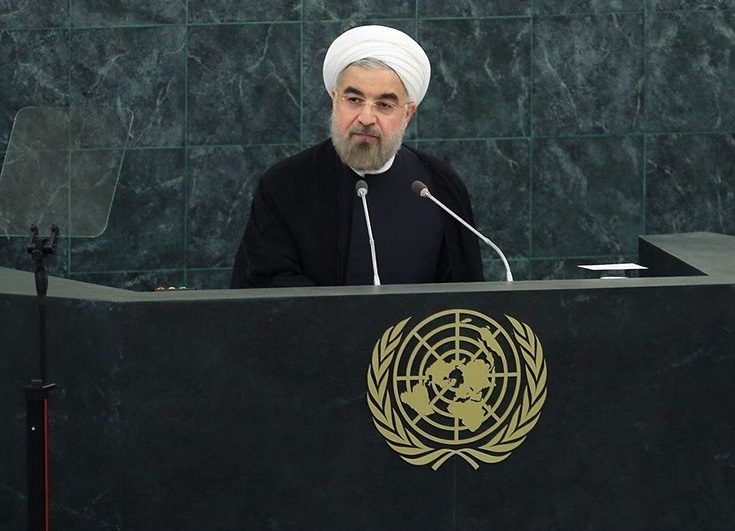
Iranian President Hassan Rouhani speaks at the UN General Assembly, September 26, 2013. (Image source: president.ir)

After achieving these goals for Iran’s ruling politicians, Rouhani’s message this year will switch to blaming the U.S. for all sorts of injurious shortcomings in the nuclear agreement, which Iran, incidentally, still has not signed.

U.S. President Barack Obama’s administration has sent hundreds of billions of dollars to Iran, and has hidden Iran’s supposed non-compliance with the nuclear deal to which it never officially agreed in the first place. The deal, in fact, seems only to have existed in the overheated imaginations of the US and other gullible members of the Joint Comprehensive Plan of Action (JCPOA). Nevertheless, the U.S. has ignored what Iran’s violations could be, and has assisted Tehran in evading any terms of the nuclear agreement it wished.

In addition, now that Iran has seen that the U.S. had lost all political leverage to pressure Tehran through the Security Council sanctions, and that, as critics of the deal had repeatedly and urgently warned, sanctions could not be “snapped back,” partly due to the veto power of Russia and China, Rouhani will be openly delivering the hardline messages of Iran’s Supreme Leader, Ayatollah Ali Khamenei, and the generals of Iran’s Islamic Revolutionary Guard Corps (IRGC), who enjoy power over Iran’s economic and political systems.

Khamenei and the senior cadre of the IRGC draw their legitimacy and power from the revolutionary principle of opposing the U.S., the “Great Satan.”

After the billions of dollars from the nuclear deal were delivered, the regime’s anti-American remarks and behavior only increased. For Rouhani, any expectation of rapprochement with the U.S. must be prevented, and also any domestic political liberalization prevented from occurring.

Reasons for Rouhani’s tactical shift in more publicly adhering to Iran’s revolutionary principle of anti-Americanism also include Iran’s leaders’ awareness that President Obama is tightly and desperately clutching the nuclear agreement until he leaves office: he considers the deal his crowning foreign policy accomplishment and legacy. By criticizing and blaming the U.S. for not honoring the terms, Rouhani plans to exploit President Obama’s weak point, as the negotiating team has been doing all along, by invoking Obama’s fear that Tehran might pull out of the nuclear deal — a move that would highlight the failure of the accord. This tactic will, as usual, successfully pressure the administration to give Tehran even more geopolitical and economic “carrots,” and pursue a policy with Iran of agreeing to even more concessions. Rouhani and Zarif will, as usual, conduct bilateral talks with American diplomats behind the closed doors to make sure they are achieved.

Rouhani’s public shift to Iran’s hard-line political spectrum is also partially pitched to Iran’s upcoming presidential elections. He needs the firm support of the hard-line leaders — fundamentally that of Supreme Leader Khamenei, who enjoys the final say in Iran’s domestic and foreign policy, and that of the IRGC leaders — in order to assure his election to a second term.

By more publicly delivering Khamenei’s message — that the US is not adhering to the terms of the nuclear deal and that it is supposedly the U.S. that has been “breaking oaths and not acting on their commitments and creating obstacles” —
Rouhani is most likely hoping further to endear himself to Khamenei and the IRGC and prove his loyalty.

A recent poll by the Center for International and Security Studies at the University of Maryland revealed that the moderate camp’s popularity has not only decreased, but that Iran’s former president, Mahmoud Ahmadinejad,

“now represents the single largest threat to Rouhani’s re-election, and trails the once-popular incumbent by only eight points. Suddenly, the ex-president [Ahmadinejad] seems once again to be a real political contender.”

Rouhani had also promised the Iranian people that the nuclear deal would improve their economic life. Since the implementation of the nuclear deal, however, the Iranian people have (unsurprisingly) not seen the fruits of the deal and the billions of dollars that the government has received. Rouhani will undoubtedly be trying to distract people’s attention from blaming the Iranian government by pointing to the U.S. as the culprit.

In one of his latest speeches, Khamenei pointed out that the U.S. is attempting to “destroy Iran’s economic relationships with other countries.” He added:

“Was it not supposed to be so that the unjust sanctions would be removed and it would have an effect on people’s lives? After six months, is there any tangible effect on the lives of the people? If not for America violating its oaths, would the administration not be able to do many things during this time? … Of course it has been some years that I have been repeating this about the lack of trust with America, but for some it was hard to accept this reality.”

Another issue on Rouhani’s agenda will be to promote, at the governmental level, business deals and trade, which will further financially benefit the IRGC and Khamenei, not Iran’s private sector.

Rouhani will more likely attempt to justify Iran’s military adventurism in the region by playing the anti-terrorism card, even though Iran is still the leading sponsor of terrorism.

Rouhani’s government will most likely focus on spreading the narrative of Khamenei and the IRGC, that Iran is an indispensable force in fighting the Islamic State and other extremist groups; that regional and global powers need to join Iran in this battle, and that Iran is the victim of terrorism in the region. In addition, Rouhani will presumably attempt to buttress the argument that the international community needs to support the Syrian President Bashar al-Assad in order to defeat terrorism.

Rouhani’s tactical shift is intended to reinforce Iran’s entrenched revolutionary ideal of anti-Americanism, appease Khamenei and the IRGC, and ensure his second term presidency.

Dr. Majid Rafizadeh, political scientists and Harvard University scholar is president of the International American Council on the Middle East. He can be reached at Dr.rafizadeh@post.harvard.edu.

White House: We’re in a ‘Narrative Battle’ With ISIS

September 19, 2016

White House: We’re in a ‘Narrative Battle’ With ISIS

BY:
September 19, 2016 9:11 am

Source: White House: We’re in a ‘Narrative Battle’ With ISIS


White House press secretary Josh Earnest said the U.S. was in a “narrative battle” with the Islamic State terrorist organization during an appearance Monday on CNN’s New Day.

Brought on to discuss the bombings in New York and New Jersey and the possible connections to international terrorism, Earnest cautioned against painting with a “broad brush” regarding terrorism and Islam.

“When it comes to ISIL, we are in a fight, a narrative fight with them, a narrative battle, and what ISIL wants to do is they want to project that they are an organization that is representing Islam in a fight and a war against the West, and a war against the United States,” he said. “That is a bankrupt, false narrative. It’s a mythology, and we have made progress in debunking that mythology.”

After laying out advances made militarily against ISIS, which the Obama administration calls ISIL, Earnest again repeated the U.S. had made progress in “debunking this mythology.”

“We can’t play into this narrative that somehow the United States or the West is fighting against the Muslim religion,” he said. “The fact is there are millions of patriotic Muslims in this country right now that make our country proud. They serve in our armed services. They serve in our law enforcement … These are individuals who make a substantial and positive contribution to our country, and that is an inconvenient fact for the ISIL narrative.”

Earnest used a similar line earlier on MSNBC’s Morning Joe, saying the fight against ISIS was in some ways “just a war of narratives.”

‘Position of strength’: NATO to deploy 4,000-strong ‘deterrent’ near Russia’s borders by May

September 19, 2016

‘Position of strength’: NATO to deploy 4,000-strong ‘deterrent’ near Russia’s borders by May

Published time: 18 Sep, 2016 23:35

Source: ‘Position of strength’: NATO to deploy 4,000-strong ‘deterrent’ near Russia’s borders by May — RT News


NATO is set to deploy a “deterrent” and possible “fighting” force of some 4,000 troops to the Baltic region by next May. The chief of the European Command has called on the alliance to approach Russia from a “position of strength.”

The announcement of the 4,000-strong contingent took place as military leaders from the military bloc gathered in Split, Croatia over the weekend. At the summit, Czech Army Gen. Petr Pavel said four battle groups will be sent to the region at different times in the first half of 2017.

Read more

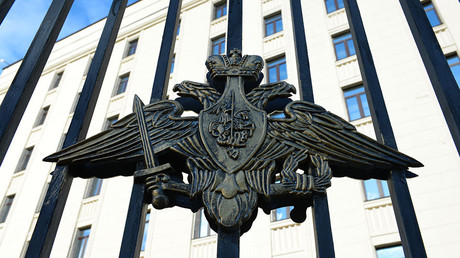
Emblem on the fence of the building of the Russian Defense Ministry on Frunzenskaya Embankment in Moscow. © Natalia Seliverstova

“With these four battle groups, we are not talking about exclusively about a training presence,” he said, according to Wall Street Journal.

“This force is to serve as a deterrent and if necessary as a fighting force. The rules will be different,” Pavel added.

The Croatian General pointed out that the new NATO force in the Baltic is planned to be commanded from the Polish division headquarters with US Army Gen. Curtis Scaparrotti overseeing any deployment of the new NATO force.

US officials told the publication that about 1,000 soldiers, will come from the 2nd Cavalry Regiment based in Vilseck, Germany, and are due to arrive in Poland by April. In addition to US contingent that will be sent to Poland, Germany will send forces to Lithuania. Canada is expected to offer troops to Latvia and the UK will deploy a battle group in Estonia. Norway, Denmark and France as well as other NATO states will be supplementing those forces.

“There are many strands of work,” Gen. Pavel said. “We are trying to come up with the big picture so we are assured the measures we are taking are well-coordinated, mutually supportive and we are not working in different directions.”

The military personnel will be deployed in close proximity to Russia’s northwestern borders in line with the newly-approved multinational task force that was agreed at the NATO summit in Poland in July.

Read more

© Evgeny Biyatov

At the summit in Croatia, the head of NATO operations in Europe tried to unite the alliance’s members to approach Russia from a “position of strength.”

While stressing that opportunities to collaborate with Russia do exist, Scaparrotti noted that “In the view of the allies, I can tell you from this conference that they recognize Russia’s a challenge in many areas.”

Pavel, meanwhile, called for a “pragmatic” but “firm” approach to Russia.

READ MORE: Russia forms brand-new task force to counter NATO buildup in Eastern Europe

Following the Warsaw summit, Russia has proposed that NATO follows a “positive program” for developing relations, aimed at decreasing tensions between Moscow and the US-led military bloc. Relations between Moscow and NATO soured sharply after Russia’s reunion with Crimea and the eruption of the military conflict in Ukraine in 2014.

Moscow considers NATO’s new troop deployment, as well as the increased number of military drills near Russian territory, the creation of anti-ballistic missile sites in Europe and other moves, a threat to Russia’s national security.

Turkey’s Erdogan plans to expand Syrian military op, wants ‘safe zones’

September 19, 2016

Turkey’s Erdogan plans to expand Syrian military op, wants ‘safe zones’

Published time: 19 Sep, 2016 12:22 Edited time: 19 Sep, 2016 12:25

Source: Turkey’s Erdogan plans to expand Syrian military op, wants ‘safe zones’ — RT News

Turkish soldiers on an armoured personnel carrier escort a military convoy on a main road in Karkamis on the Turkish-Syrian border in the southeastern Gaziantep province, Turkey, August 26, 2016. © Umit Bektas / Reuters

Ankara may continue its operation against Islamic State deeper into Syria – to within just 50km of Aleppo, as President Recep Tayyip Erdogan says the Turkish military plans to create a 5,000-sq-km safe zone within the country.

Erdogan says Turkey’s operation in Syria, Euphrates Shield, which started on August 24, has cleared border regions from Islamic State (IS, formerly ISIS/ISIL).

“As part of the Euphrates Shield operation, an area of 900 sq km has been cleared of terror so far. This area is pushing south,” Erdogan said, as cited by Reuters.

However, the Turkish president wants to increase the area of this safe zone, which is also aimed at stopping the advance of Syrian Kurdish forces. “We may extend this area to 5,000 sq km as part of a safe zone,” he added.

President Erdogan also stated that the Turkish military would continue its push further into Syria and its troops would look to capture the IS-held town of Al-Bab, which is some 50km north-east of Aleppo.

“Jarablus and Al-Rai have been cleansed, now we are moving towards Al-Bab… We will go there and stop [IS] from being a threat to us,” he said.

However, Turkey’s plans for a safe zone or a no fly zone have been questioned by its allies, who are unsure how feasible the plan is due to the number of ground troops and planes needed to patrol the area.

Read more

© Str

Turkey’s goal “is likely to require the deployment of thousands of Turkish soldiers in Syria for years and increase risks of a possible military confrontation with the Syrian forces,” Nihat Ali Ozcan, a strategist at the Economic Policy Research Foundation in Ankara, told Bloomberg.

Turkey has been supporting the Free Syrian Army (FSA) on the ground, which is a loose conglomeration of forces opposed to Syrian President Bashar Assad. However, Erdogan says he does not want the US military interfering in Ankara’s affairs and has blamed Washington for increasing tensions with the rebels.

The Turkish president was referring to a small number of US special forces who had entered Al-Rai to help coordinate airstrike against IS. However, the FSA, considered to be American allies, kicked the US military out, calling them “infidels” and “crusaders.”

“If you had rational people making rational policy – perhaps, but here is no evidence of that so far,” Jim Jatras, a former US diplomat, told RT when asked if the reports about Syrian rebels threatening American soldiers could be a turning point in the country’s conflict.

 “The Obama administration’s policy up to this point has been totally confused and contradictory, and now it is just reaching the point of bizarre,” Jatras added.

Russia Accuses US Of Defending ISIS, After Pentagon Admits Coalition Jets Killed 62 Syrian Soldiers

September 18, 2016

Russia Accuses US Of Defending ISIS, After Pentagon Admits Coalition Jets Killed 62 Syrian Soldiers

Source: Russia Accuses US Of Defending ISIS, After Pentagon Admits Coalition Jets Killed 62 Syrian Soldiers | Zero Hedge

Update 4:  The Obama administration officially expressed it’s “regret” for an airstrike that killed Syrian forces with a senior White House official saying “The United States has relayed our regret through the Russian Federation for the unintentional loss of life of Syrian forces.”

Meanwhile, the U.S. UN envoy called Russia’s request for an emergency Security Council meeting a “stunt.”


Russia’s U.N. Ambassador Vitaly Churkin responded by saying that the U.S. airstrike that struck Syrian government troops has put “a very big question mark” over the future of the U.S. and Russian-brokered cease-fire agreement in Syria adding that in his decades as a diplomat he had “never seen such an extraordinary display of American heavy-handedness as we are witnessing today.”

* * *

Update 3: Russia’s foreign ministry says it has “reached the terrifying conclusion” that the US is conniving with the Islamic State. As ABC reports, Russia has called for an emergency session of the United Nations Security Council over a U.S. air raid that it says struck Syrian troops battling the Islamic State group. Spokeswoman Maria Zakharova says Moscow is demanding “full and detailed explanations about whether this was deliberate support of the Islamic State or another mistake.”

Zakharova was quoted by the state news agency Tass as saying that “after today’s attack on the Syrian army, we come to the terrible conclusion that the White House is defending the Islamic State.”

The U.S. military says it halted an air raid against IS in eastern Syria after it was informed by Russia that it might have struck Syrian troops. If confirmed, it would be the first American strike on President Bashar Assad’s forces in the five-year-old conflict. The allegations come as Moscow and Washington are already at loggerheads over a five-day-old Syrian cease-fire, with each accusing the other of failing to fully implement it.

It appears this major diplomatic scandal is only starting to play out.

* * *

Update 2: it appears that Russia is angry, and has called a UN Security Council session, while reporting that Washington never announced any plans to conduct raids in the region in question:

Update: Centcom has issued a statement admitting the killing of over 60 Syrian troops was a mistake.


Earlier:

If the latest news out of Syria are confirmed, one can not only kiss last weekend’s so-called “ceasefire” goodbye, but a full blown war may be about to erupt. The reason: moments ago the Syrian Army General Command reported, and shortly thereafter the Russian military confirmed, that US-coalition forces struck the Syrian airbase at Deir el-Zour, killing at least 62 Syrian army troops, “paving the way” for ISIS militants to advance in the fiercely contested area..

According to Syria’s official SANA news agency, the bombing took place on al-Tharda Mountain in the region of Deir ez-Zor and caused casualties and destruction on the ground.

Sixty-two Syrian soldiers were killed and over 100 injured in the airstrike by the US-led coalition, Russia’s Defense Ministry spokesman, Major-General Igor Konashenkov, confirmed citing information received from the Syrian General Command.

There was no immediate comment from Washington. If confirmed, the attack could be tantamount to an act of war as it would be the first time the coalition has targeted Syrian government forces.  Subsequently, the Pentagon told RT that it is “aware of the reports and checking with Centcom and CJTF (Combined Joint Task Force).”


U.S. Secretary of State John Kerry (R) and Russian Foreign Minister

 Sergei Lavrov walk into their meeting room in Geneva, Switzerland

In a statement Saturday, the Syrian military says the airstrikes caused casualties and damage to equipment, and enabled an IS advance on the hill overlooking the air base. The statement calls it a “serious and blatant attack on Syria and its military” and “firm proof of the U.S. support of Daesh and other terrorist groups.” Daesh is an Arabic acronym for IS.

The Russian Defense Ministry said on Saturday that the aircraft which carried out the bombings had entered Syrian airspace from the territory of Iraq.  Four strikes against Syrian positions was performed by two F-16 jet fighters and two A-10 support aircraft, it added.

“Immediately after the airstrike by coalition planes, Islamic State militants launched their offensive. Fierce fighting with the terrorists is currently underway in the area of the airport where for a long a time humanitarian aid for civilians was parachuted,” Konashenkov said.

“If the airstrike was caused by the wrong coordinates of targets than it’s a direct consequence of the stubborn unwillingness of the American side to coordinate with Russia in its actions against terrorist groups in Syria,” Konashenkov stressed. Alternatively, the Syrians – and Russians – may claim that the US coalition attack meant to cripple Syrian army forces, taking the lethal conflict to an entirely new level, one where Syria and Russia are effectively at war with the US coalition.

Meanwhile, it appears that the Assad regime, which recently also garnered the support of Chinese military forces, is preparing for a full-blown escalation: the Syrian General Command has called the bombing a “serious and blatant aggression” against Syrian forces, and said it was “conclusive evidence” that the US and its allies support IS militants.

* * *

Earlier on Saturday, Russia accused the US of being reluctant to take measures to force rebels under its control to fall in line with the terms of the Syrian ceasefire. As RT reported, numerous Russian appeals to the American side remain unanswered, which “raises doubts over the US’s ability to influence opposition groups under their control and their willingness to further ensure the implementation of the Geneva agreements,” senior Russian General Staff official, Viktor Poznikhir, said. Poznikhir also said that the truce is being used by the militants to regroup, resupply and prepare an offensive against government troops.

Last week, Moscow and Washington agreed to influence the Syrian government and the so-called moderate rebel forces respectively in order to establish a ceasefire in the country “over pizza and vodka.”  We were skeptical, and for good reason: one week later it appears that not only is the ceasefire over but a whole new phase in the war may have broken out.

Russia has repeatedly alleged that the US is failing to keep its part of the bargain. The US, on its part, has blamed Russia for not pressuring Damascus enough to facilitate humanitarian access to Syria.

Both allegations may now be moot if Russia decides to retaliate against members of the US-led coalition, or directly against US forces.


VIDEO: American commandos ‘forced to run away’ from US-backed Syrian jihadis to the cheers of “ALLAH AKBAR”

September 16, 2016

VIDEO: American commandos ‘forced to run away’ from US-backed Syrian jihadis to the cheers of “ALLAH AKBAR”

ByPamela Geller

on September 16, 2016

Source: VIDEO: American commandos ‘forced to run away’ from US-backed Syrian jihadis to the cheers of “ALLAH AKBAR” | Pamela Geller


This must be what Obama means when he says, “leading from behind.”

Look what Obama and Hillary have done to our military. Unrecognizable. This is the poison fruit of their policies which supported and armed  the enemy. What was at first ridiculous and incoherent, is now catastrophic.

Iran is humiliating us at sea, ISIS on land.

Obama continues to be woefully unprepared to face the threat of ISIS and their acolytes: he CREATED the threat by leaving Iraq precipitously and giving an opportunity to this group. Hillary has vowed to follow this failed and reckless strategy.

He has armed the Syrian rebels — many of these arms fell into the hands of ISIS, and the Syrian rebels he armed have the same jihad goal that ISIS does.

“A spokesman for US Central Command said they were aware of the video and looking into the incident. ” Well that instills great confidence ….

“American commandos ‘forced to run away’ from US-backed Syrian rebels,” By Raf Sanchez, Middle East Correspondent, The Telegraph, 16 September 2016:

US commandos are operating in a complex web of alliances and enmities in Syria

Video footage appears to show US commandos fleeing a Syrian town under a barrage of abuse and insults hurled at them by fighters from the American-backed Free Syrian Army (FSA) rebel group.

video appears to be the first evidence of US special forces cooperating with Turkish troops in their battle against Islamic State.The incident illustrates the complex web of alliances and enmities in Syria, where many of America’s allies are fighting each other and some rebel groups that receive US support still harbour strong anti-American sentiments.The footage shows a crowd of rebel fighters in the town of al-Rai near the Turkish border, which was captured from the Islamic State (Isil) by Syrian rebel groups with the backing of Turkey. Turkey, which launched a military incursion into Syria in late August, has been backing the FSA.

The fighters scream anti-American chants as a column of pick-up trucks carrying US commandos drives away from them.

“Christians and Americans have no place among us,” shouts one man in the video. “They want to wage a crusader war to occupy Syria.”

Another man calls out: “They collaborators of America are dogs and pigs. They wage a crusader war against Syria and Islam. ”

The US troops are not wearing traditional uniform but they carry American weapons and are wearing the distinctive round helmets favored by US special forces.

Another video shows the US troops looking nonchalant and waving at the camera even as some of the rebels tell them to leave.