Posted tagged ‘UN Security Council’

U.S. declines to veto U.N. Security Council resolution for Israel to stop Jewish settlement activity

December 23, 2016

U.S. declines to veto U.N. Security Council resolution for Israel to stop Jewish settlement activity, Washington PostCarol Morello, December 23, 2016

The U.N. Security Council on Friday passed a resolution demanding Israel cease Jewish settlement activity on Palestinian territory in a unanimous vote that passed with the United States abstaining rather than using its veto as it has reliably done in the past.

The resolution said settlements are threatening the viability of the two-state solution, and urged Israelis and Palestinians to return to negotiations that lead to two independent nations.

This marked the first time in more than 36 years that the Security Council passed a resolution critical of settlements.

The United States’ abstention Friday reflected mounting frustration in the Obama administration over settlement growth that the United States considers an obstacle to peace.

The resolution came one day after a scheduled vote was postponed when the sponsor, Egypt, withdrew it after the Egyptian president spoke by phone with President-elect Donald Trump. Friday’s resolution was sponsored by New Zealand, Malaysia, Venezuela and Senegal.

Shortly before the vote, several U.S. senators said that if it passed they would introduce legislation to cut off U.S. funding to the United Nations and to any states that voted in favor of it.

US pushes back against Israeli claims of collusion with Palestinians over UN vote

December 23, 2016

US pushes back against Israeli claims of collusion with Palestinians over UN vote, Jerusalem PostMichael Wilner, December 23, 2015

(Please see also, Israel Official: Obama Administration Secretly Worked With Palestinians to Craft ‘Shameful’ UN Resolution. — DM)

ohamawavesUS President Barack Obama speaks at the Righteous Among the Nations Award Ceremony, organised by Yad Vashem, at Israel’s Embassy in Washington January 27, 2016. (photo credit:REUTERS)

WASHINGTON – The White House has not been behind a push for a resolution at the UN Security Council condemning Israel’s settlement enterprise, a senior Obama administration told The Jerusalem Post on Friday, insisting that claims to the contrary are baseless.

Reports that the administration will allow the resolution to pass are “premature,” the official added.

The administration is pushing back against a furious Israeli government that has determined US President Barack Obama intends to abstain from the vote, allowing a resolution harshly critical of its actions to pass. Furthermore, Israeli officials are claiming that Obama orchestrated the effort with their Palestinian counterparts.

“To be clear: from the start, this was an Egyptian resolution,” a senior official told the Post. “The Egyptians authored it, circulated it, and submitted it for a vote on Wednesday evening before asking for a delay and subsequently removing their sponsorship. A group of other Security Council members, not including the United States, is now moving forward the Egyptian text.”

“Contrary to some claims, the administration was not involved in formulating the resolution nor have we promoted it,” the official added. “We have not communicated to any UN Security Council members how the United States would vote if the resolution comes before the UN Security Council.”

After Egypt pulled its resolution last minute— prompted by pressure from both Prime Minister Benjamin Netanyahu and President-elect Donald Trump— New Zealand took up the cause this morning, adopting their published text.

The resolution tracks with longstanding US policy that Israel’s settlement activity in the West Bank is illegal, and damages the peace process.

Once Israel came to the conclusion that Obama was likely to abstain, officials from the government at a “high level” contacted the incoming president’s team to intervene. The Israelis gave the White House warning it would do so, they said.

A senior Israeli official said on Friday that President Obama and Secretary of State John Kerry pushed a “shameful” draft anti-settlement resolution at the UN Security Council.

“The US administration secretly cooked up with the Palestinians an extreme anti-Israeli resolution behind Israel’s back which would be a tailwind for terror and boycotts,” the official said.

The official added that “President Obama could declare his willingness to veto this resolution in an instant but instead is pushing it. This is an abandonment of Israel which breaks decades of US policy of protecting Israel at the UN and undermines the prospects of working with the next administration of advancing peace.”

Israel Official: Obama Administration Secretly Worked With Palestinians to Craft ‘Shameful’ UN Resolution

December 23, 2016

Israel Official: Obama Administration Secretly Worked With Palestinians to Craft ‘Shameful’ UN Resolution, BreitbartAaron Klein, December 23, 2016

obamaohMark Wilson/Getty

TEL AVIV — The Obama administration secretly worked with the Palestinian Authority to craft a “shameful” United Nations resolution behind Israel’s back, an Israeli official told reporters on Friday.

The official told Breitbart Jerusalem by email:

“President Obama and Secretary Kerry are behind this shameful move against Israel at the UN. The US administration secretly cooked up with the Palestinians an extreme anti Israeli resolution behind Israel’s back which would be a tailwind for terror and boycotts and effectively make the Western Wall occupied Palestinian territory. President Obama could declare his willingness to veto this resolution in an instant but instead is pushing it. This is an abandonment of Israel which breaks decades of US policy of protecting Israel at the UN and undermines the prospects of working with the next administration of advancing peace.”

The official sent the same quotes to major news agencies, including Reuters and the Associated Press. He spoke as four UN Security Council members met on Friday to discuss how to advance the anti-Israel resolution despite Egypt’s decision to delay the vote on the draft that it introduced. The draft was originally scheduled for vote yesterday, but was delayed following criticism from Prime Minister Benjamin Netanyahu and President-elect Donald Trump.

After the meeting, diplomats said the UN will move forward with the vote, which is expected to take place Friday at about 3 p.m. Eastern (10 p.m. in Jerusalem).

The text of the resolution repeatedly and wrongly refers to the West Bank and eastern sections of Jerusalem as “Palestinian territory occupied since 1967.”  In actuality, the Palestinians never had a state in either the West Bank or eastern Jerusalem and they are not legally recognized as the undisputed authority in those areas.

Jordan occupied and annexed the West Bank and eastern Jerusalem from 1948 until Israel captured the lands in a defensive war in 1967 after Arab countries used the territories to launch attacks against the Jewish state.  In 1988 Jordan officially renounced its claims to the West Bank and eastern Jerusalem.

The text of the resolution declares that the Israeli settlement enterprise has “no legal validity and constitutes a flagrant violation under international law and a major obstacle to the achievement of the two-state solution and a just, lasting and comprehensive peace.”

It calls for Israel to “immediately and completely cease all settlement activities in the occupied Palestinian territory, including East Jerusalem.”

As the Committee for Accuracy for Middle East Reporting in America (CAMERA) pointed out in an email blast, international law does not make Israeli settlements illegal.

CAMERA notes:

Article 49 of the Fourth Geneva Conventions, which is relied upon by those who claim the settlements are illegal, does not apply in the case of the West Bank. This is because the West Bank was never under self-rule by a nation that was a party to the Convention, and therefore there is no “partial or total occupation of the territory of a High Contracting Party,” as Article 2 of the Convention specifies. Moreover, even if it did apply, by its plain terms, it applies only to forcible transfers and not to voluntary movement. Therefore, it can’t prohibit Jews from choosing to move to areas of great historical and religious significance to them.

If the resolution is brought to a vote in its current form and Obama fails to veto, the resolution would contradict a Bush administration commitment to allowing some existing Jewish settlements to remain under a future Israeli-Palestinian deal.

That U.S. commitment, which the Obama administration has repeatedly violated by condemning settlement activity, was reportedly a key element in Israel’s decision to unilaterally evacuate the Gaza Strip in 2005.

The UN draft resolution text states that “cessation of all Israeli settlement activities is essential for salvaging the two-State solution,” and it “calls for affirmative steps to be taken immediately to reverse the negative trends on the ground that are imperiling the two-State solution.”

In 2004, just prior to the Gaza evacuation, President Bush issued a declarative letter stating that it is unrealistic to expect that Israel will not retain some Jewish settlements in a final-status deal with the Palestinians.

The letter stated:

In light of new realities on the ground, including already existing major Israeli populations centers, it is unrealistic to expect that the outcome of final status negotiations will be a full and complete return to the armistice lines of 1949, and all previous efforts to negotiate a two-state solution have reached the same conclusion. It is realistic to expect that any final status agreement will only be achieved on the basis of mutually agreed changes that reflect these realities.

Elliott Abrams, the Deputy National Security Adviser for Global Democracy Strategy during Bush’s second term, was instrumental in brokering understandings between the U.S. and Israel on settlements. In a June 2009 piece published by the Wall Street Journal, Abrams accused the Obama administration of “abandoning” those U.S.-Israel understandings by taking positions critical of all settlement activity.

Abrams wrote:

There were indeed agreements between Israel and the United States regarding the growth of Israeli settlements on the West Bank … principles that would permit some continuing growth. … They emerged from discussions with American officials and were discussed by Messrs. Sharon and Bush at their Aqaba meeting in June 2003. … The prime minister of Israel relied on them in undertaking a wrenching political reorientation – the dissolution of his government, the removal of every single Israeli citizen, settlement and military position in Gaza, and the removal of four small settlements in the West Bank. … For reasons that remain unclear, the Obama administration has decided to abandon the understandings about settlements reached by the previous administration with the Israeli government. We may be abandoning the deal now, but we cannot rewrite history and make believe it did not exist.

Security Council likely to vote on settlements Friday despite Egyptian reversal

December 23, 2016

Security Council likely to vote on settlements Friday despite Egyptian reversal, Times of Israel, December 23, 2016

A UN Security Council resolution criticizing Israeli settlements will likely go up for a vote Friday despite original sponsor Egypt pulling its support, after four countries agreed to present a draft resolution, diplomats said.

New Zealand, Malaysia, Senegal and Venezuela stepped in after Egypt, under pressure from US President-elect Donald Trump, withdrew the measure.

“Most likely, we will have a vote soon,” French Ambassador Francois Delattre told reporters.

“The key goal that we have here is to preserve and reaffirm the two state-solution,” said Delattre. “The text that we have does not exclusively focus on settlements. It also condemns the violence and terrorism. It also calls to prevent all incitement from the Palestinian side so this is a balanced text.”

Diplomats said the same draft resolution would be submitted to a vote, at the request of the four countries.

The draft resolution demands that “Israel immediately and completely cease all settlement activities in the occupied Palestinian territory, including East Jerusalem.”

It states that Israeli settlements have “no legal validity” and are “dangerously imperiling the viability of the two-state solution” that would see an independent Palestine co-exist alongside Israel.

The four member states had warned earlier that they would push ahead with the resolution if Cairo stood by its decision to delay.

“In the event that Egypt decides that it cannot proceed to call for vote on 23 December or does not provide a response by the deadline, those delegations reserve the right to table the draft … and proceed to put it to vote ASAP,” wrote New Zealand, Venezuela, Malaysia and Senegal in a note they presented to Egyptian officials, according to Reuters.

Egypt had said earlier its president received a call from Trump in which they both agreed to give the incoming US administration a chance to try and resolve the Israeli-Palestinian conflict.

The call came hours after Egypt indefinitely postponed the UN vote on its resolution, following pressure from Israel and Trump, who had called on members to veto it.

A statement from the Egyptian presidency said the two men spoke by phone early Friday and agreed on “the importance of giving a chance for the new American administration to deal in a comprehensive way with the different aspects of the Palestinian issue with the aim of achieving a comprehensive and a final resolution” to the decades-old conflict.

Egypt requested Thursday that its resolution demanding Israel halt settlements be postponed after Jerusalem launched a frantic lobbying effort.

An official in Jerusalem later Thursday accused the Obama administration of attempting a diplomatic “hit” against Prime Minister Benjamin Netanyahu and the settlements by planning to let the resolution pass, and a second Israeli source said the administration, in its final days, was violating a “core commitment” to defend Israel at the UN.

“After becoming aware that the (US administration) would not veto the anti-Israel resolution, Israeli officials reached out to Trump’s transition team to ask for the president-elect’s help to avert the resolution,” an Israeli official told AFP on Friday.

“The [Trump] phone call touched on the draft resolution before the United Nations Security Council on Israeli settlements,” a statement from Sissi’s office said.

Trump, who had campaigned on a promise to recognize Jerusalem as Israel’s capital, bluntly said Washington should use its veto to block the resolution.

“The resolution being considered at the United Nations Security Council regarding Israel should be vetoed,” he said in a statement.

Trump and Sisi discuss Middle East peace

December 23, 2016

Trump and Sisi discuss Middle East peace, Israel National News, Elad Benari, December 23, 2016

trumpandsisiTrump and Sisi meet in New YorkReuters

“The presidents agreed on the importance of affording the new U.S. administration the full chance to deal with all dimensions of the Palestinian case with a view of achieving a full and final settlement,” he added.

Sisi recently praised Trump and said he expected greater engagement in the Middle East from his administration.

******************************

Egyptian President Abdel Fattah al-Sisi on Thursday night spoke with U.S. President-Elect Donald Trump, Sisi’s office said, according to Reuters.

The call came hours after the UN Security Council postponed indefinitely a vote on Egypt’s draft resolution denouncing Israeli “settlements”.

“During the call they discussed regional affairs and developments in the Middle East and in that context the draft resolution in front of the Security Council on Israeli settlement,” said Sisi’s spokesman, Alaa Yousef.

“The presidents agreed on the importance of affording the new U.S. administration the full chance to deal with all dimensions of the Palestinian case with a view of achieving a full and final settlement,” he added.

Thursday’s vote on the UN Security Council resolution was reportedly postponed after Sisi instructed his nation’s delegation to push for a delay in the vote.

Trump had earlier called for the United States to veto the resolution, as it has traditionally done with similar proposals. American officials indicated that the Obama administration was planning to abstain from voting or even to vote yes.

Sisi recently praised Trump and said he expected greater engagement in the Middle East from his administration.

The Egyptian President has also been at the forefront of the effort to resume talks between Israel and the Palestinian Authority, having several months ago urged Israelis and Palestinian Arabs to seize what he said was a “real opportunity” for peace and hailed his own country’s peace deal with Israel.

The comments were welcomed by Prime Minister Binyamin Netanyahu, who stressed that “Israel is ready to participate with Egypt and other Arab states in advancing both the diplomatic process and stability in the region.”

Palestinian Authority (PA) chairman welcomed Sisi’s call as well, saying he welcomed the Egyptian president’s efforts to achieve peace and establish a Palestinian state.

Iran Breaks Nuclear Deal and UN Resolutions

December 15, 2016

Iran Breaks Nuclear Deal and UN Resolutions, Gatestone Institute, Majid Rafizadeh, December 15, 2016

“We will have a new ballistic missile test in the near future that will be a thorn in the eyes of our enemies.” – Iranian President Hassan Rouhani.

The range of existing Iranian ballistic missiles has grown from 500 miles to over 1,250 miles (roughly 2,000 kilometers), which can easily reach Eastern Europe, as well as countries such as Israel.

In addition, Iranian Defense Minister Brig. Gen. Hossein Dehqan said that there would be no limit for the range and amount of missiles that Iran will develop.

The nuclear agreement, known as the Joint Comprehensive Plan of Action Agreement (JCPOA) — effective, as of October 18, 2015, according to the State Department – clearly and distinctly stipulates that Iran should not undertake any ballistic missile activity “until the date eight years after the JCPOA Adoption Day or until the date on which the IAEA submits a report confirming the Broader Conclusion, whichever is earlier.”

Not only is Iran avoiding honoring this stipulation, but also Iran’s ballistic missile operations have significantly ratcheted up. More importantly, there has been no criticism at all from the Obama administration or other involved parties regarding this critical violation.

As cited by Iran’s state-owned Fars News Agency, Brig. Gen. Amir Ali Hajizadeh, Iran’s commander of the Islamic Revolutionary Guards Corps (IRGC) Aerospace Force, said in Tehran on Dec 6, 2016:

“In addition to enhancing the precision-striking power and quality of ballistic missiles, the Iranian authorities and experts have used innovative and shortcut methods to produce inexpensive missiles, and today we are witnessing an increase in production [of ballistic missiles].”

Iran is bragging about it.

1173-2

In addition, Iranian Defense Minister Brig. Gen. Hossein Dehqan said that there would be no limit for the range and amount of missiles that Iran will develop. He boasted:

“90 percent of the country’s defense systems have reached an acceptable standard and enjoy competitive quality compared with the weapons of advanced countries; production of the national individual weapons and efforts to improve the quality and precision-striking power of ballistic missiles are among the defense ministry’s achievements in the defense field.”

Fars News reported on a December 6, 2016 statement from Iran’s Defense Minister:

“His remarks came as the Islamic Revolution Guards Corps (IRGC) fired 2 home-made ‘Qadr H’ ballistic missiles from the Eastern Alborz Mountains at a target in Iran’s Southeastern Makran seashore some 1400km away… The missiles were fired on the sidelines of the main stage of the IRGC drills in Central Iran and various parts of the country.”

One missile, which was launched on March 2016, had a clear message written on it that said in the Hebrew language: “Israel should be wiped off the Earth”. Fars Agency adds:

“Qadr is a 2000km-range, liquid-fuel and ballistic missile which can reach territories as far as Israel… The missile can carry different types of ‘Blast’ and ‘MRV’ [Multiple Reentry Vehicle] payloads to destroy a range of targets. The new version of Qadr H can be launched from mobile platforms or silos in different positions and can escape missile defense shields due to their radar-evading capability.”

Iran has repeatedly test-fired, long-range ballistic missiles and laser-guided surface-to-surface missiles. For example, on March 2016, Iran tested a new ballistic missile, capable of carrying multiple warheads. More recently, Iran fired a test missile with an accuracy within 25 feet, which is characterized as “zero error,” according to Brig. Gen. Ali Abdollahi, the Iranian military’s deputy chief of staff, and Iran’s semi-official Tasnim news agency.

The range of existing Iranian ballistic missiles has grown from 500 miles to over 1,250 miles (roughly 2,000 kilometers), which can easily reach Eastern Europe, as well as countries such as Israel.

According to a previous report obtained by the Associated Press, the launches are “destabilizing and provocative” and the Shahab-3 medium-range ballistic missile and Qiam-1 short-range ballistic missile fired by Iran are “inherently capable of delivering nuclear weapons.”

In addition to violating the nuclear agreement, provoking and threatening other nations, and destabilizing the region, Iran is breaching two UN Security Council Resolutions. Security Council resolution 2231 (section 3 of Annex B) “calls upon Iran not to undertake any activity related to ballistic missiles designed to be capable of delivering nuclear weapons, including launches using such ballistic missile technology.”

The second United Nations Security Council resolution, 1929, states:

“Iran shall not undertake any activity related to ballistic missiles capable of delivering nuclear weapons, including launches using ballistic missile technology, and that States shall take all necessary measures to prevent the transfer of technology or technical assistance to Iran related to such activities.”

Iran has the largest ballistic missile arsenal in the Middle East. It is also the most diversified one. No country, other than Iran, has acquired long-range ballistic missiles before obtaining nuclear weapons. Ballistic missiles can be used for offensive or defensive purposes, but sophisticated missiles are more likely developed as delivery vehicles for nuclear weapons.

These missiles have the capability of carrying multiple nuclear warheads. Iran Tasnim news agency reported:

“Defense Minister Brigadier General Hossein Dehqan praised the country’s military might…saying the Islamic Republic can mass produce ballistic missiles with any range and destructive power… In the missile sphere, Iran has been able to maximize the accuracy of projectiles, as emphasized by Leader of the Islamic Revolution Ayatollah Seyed Ali Khamenei, with reliance on the local forces, Brigadier General Amir Ali Hajizadeh said at an academic ceremony in Tehran on Tuesday.”

Iran is also is increasingly provoking other countries in the region, and has made it clear that the ballistic missiles are aimed at targeting other nations. Brig. Gen. Amir Ali Hajizadeh, said previously to FARS news agency that “Iran has built missiles that can hit targets at 2,000 Km. They are designed to hit Israel at such a distance.” He added that Islamic countries have surrounded Israel and “its [Israel’s] life is short. So it will collapse in any given war — long before a missile is even fired.”

Iran also exports these missiles to its proxies across the region. Tasnim news agency quoted General Hossein Salami as saying:

“Hezbollah has 100,000 missiles that are ready to hit Israel to liberate the occupied Palestinian territories if the Zionist regime repeats its past mistakes… today, the grounds for the annihilation and collapse of the Zionist regime are (present) more than ever.”

In addition, Gen. Salami warned Israeli leaders that if they make the “wrong move,” Israel would come under attack.

It is crucial to point out that both Iran’s so-called “moderates” and hardliners are on the same page when it comes developing ballistic missiles. When his country was unveiling a new missile, Fateh 313, President Hassan Rouhani pointed out that “we will have a new ballistic missile test in the near future that will be a thorn in the eyes of our enemies.”

The Obama administration, the international community, a major global power, or a coalition of nations need robustly to confront these provocations, threats, and violations of the nuclear deal and UN Security Council Resolutions by Iran.

State Dept. warns China not to undermine North Korea sanctions

December 2, 2016

State Dept. warns China not to undermine North Korea sanctions, Washington Examiner, Joel Gehrke, December 1, 2016

chinamissiledefenseChina could use sanctions as bargaining chip over missile defenses. (Rick Bajornas/United Nations via AP)

“Resolution 2321 formulates new measures, showing the resolve of the Security Council, and also points out they must avoid creating adverse consequences for North Korean civilian and humanitarian needs, and are not intended to create negative effects on normal trade,” Chinese Foreign Ministry spokesman Geng Shuang said Thursday, according to Reuters.

***********************

The State Department warned China on Thursday not to undermine a new round of United Nations sanctions against North Korea following Chinese suggestions that the crackdown won’t affect “normal trade” with the dictatorial regime.

State Department spokesman Mark Toner told reporters that China “plays an outside role in terms of the impact of these sanctions; or, rather, the impact they can have implementing these sanctions.”

China allowed a new round of sanctions to pass through the U.N. Security Council this week. But those sanctions were promptly followed by a statement that cast doubt on whether China intends to implement the sanctions in the way that the United States hopes.

“Resolution 2321 formulates new measures, showing the resolve of the Security Council, and also points out they must avoid creating adverse consequences for North Korean civilian and humanitarian needs, and are not intended to create negative effects on normal trade,” Chinese Foreign Ministry spokesman Geng Shuang said Thursday, according to Reuters.

China is a major buyer for North Korea’s coal industry, making their cooperation essential to the success of the sanctions in cutting funding for the regime. “I’m not sure what they mean or what their spokesperson meant by ‘normal trade,'” said Toner, who described the impositions as “targeted really at North Korea’s elite.”

The implementation of the sanctions could give China leverage in other negotiations with the United States, as the two countries are increasingly at odds over how China asserts itself in the Pacific region. “The real reason why China keeps the North Korean state alive economically is because it whenever Pyongyang fires off another test, Washington comes running to Beijing to help it negotiate,” Gordon Chang, author of the 2001 book The Coming Collapse of China, told the BBC.

The Chinese statement about “normal trade” was accompanied by a reiteration of China’s opposition to the U.S. plan to establish a Terminal High-Altitude Area Defense in the region of North Korea, for fear the weapons could be used to thwart Chinese ballistic missiles in the event of a conflict. “China opposes the deployment of the THAAD anti-missile on the peninsula, and urges relevant parties to immediately stop this process,” the Foreign Ministry spokesman said.

New UN Security Council Resolution Strengthens Sanctions Against North Korea

December 1, 2016

New UN Security Council Resolution Strengthens Sanctions Against North Korea, Front Page MagazineJoseph Klein, December 1, 2016

kim

But Iran, freed of sanctions, is likely to be the spoiler.

The United Nations Security Council unanimously adopted Resolution 2321 (2016) on November 30th. It condemns the North Korean (DPRK) regime’s continued pursuit of nuclear weapons and ballistic missiles while its people continue to suffer under inhumane conditions. The resolution strengthens previous UN-imposed sanctions on the DPRK in response to its fifth nuclear test conducted on September 9, 2016.

The prior resolutions have failed to slow, much less eliminate, the DPRK’s nuclear program involving the development and testing of both nuclear device and ballistic missile capabilities. As UN Secretary General Ban Ki-moon pointed out in his remarks to the Security Council following the vote, “The Council first adopted a resolution on the DPRK nuclear issue in 1993. Twenty-three years and six sanctions resolutions later, the challenge persists.”

The new resolution is intended to put more of a financial squeeze on the DPKR regime than ever before by closing loopholes and cutting the DPRK off from sources of hard currency that can be used to fund its nuclear bomb and ballistic missile programs.

Most notably, the new resolution places tighter restrictions on the DPRK’s export of coal. There will now be an absolute cap on how much coal the DPRK can export per year, closing a loophole that had allowed an exemption from any coal export limitations so long as the transactions were determined to be exclusively for “livelihood” purposes. Member states must report all transactions promptly to the 1718 DPRK Sanctions Committee, which is directed to monitor total volumes and notify states when the allowed quantities have been reached and all procurement of coal from the DPRK must end.

The binding export cap will potentially cut the DPRK’s largest export, coal, by approximately $700 million per year from 2015 (more than 60%). Considering the fact that China is the DPRK’s principal purchaser of coal, the new restrictions agreed to by China are significant if fully implemented.

In addition, the new resolution imposes further restrictions on the sale or transfer of copper and other non-ferrous metals. It also places a ban on the supply, sale or transfer from the DPRK of statues, which has proven to be a lucrative source of hard currency needed by the regime. The resolution contains travel bans and assets freezes directed to individuals and entities not previously listed for such punitive actions, who are determined to be involved in the development, production, and financing of the DPRK’s nuclear weapons and ballistic missile programs, as well as the DPRK coal and conventional arms trade. There are more dual-use items, materials, equipment, goods and technology that will be subject to the embargo covering transfers to and from the DPRK.  Strict new sanctions on the DPRK’s illicit transportation activities are imposed.  Inspections of cargo transiting to and from the DPRK by rail, sea, air and road are to be expanded. And the new resolution contains further measures to isolate the DPRK from the global financial system and to prohibit financial support for trade with the DPRK in the form of export credits, guarantees, insurance and the like.

Resolution 2321 emphasizes, for the first time, a human rights dimension beyond the DPKR’s proliferation activities – the need for the DPRK to respect and ensure the inherent dignity of people in its territory. It also warns the DPRK that it is subject to being suspended from its UN rights and privileges.

U.S. Ambassador to the UN Samantha Power, who led the negotiations of the text primarily with her Chinese counterpart, heralded the new resolution. She said it “imposes unprecedented costs on the DPRK regime for defying this Council’s demands.” She admitted, however, that “No resolution in New York will likely, tomorrow, persuade Pyongyang to cease its relentless pursuit of nuclear weapons.” Ambassador Power stressed that for the resolution to have any material impact on the DPRK’s behavior “all Member States of this United Nations must fully implement the sanctions that we have adopted today.” Secretary General Ban Ki-moon, while lauding the new resolution for including “the toughest and most comprehensive sanctions regime ever imposed by the Security Council,” reinforced Ambassador Power’s admonition. He warned that “sanctions are only as effective as their implementation. It is incumbent on all Member States of the United Nations to make every effort to ensure that these sanctions are fully implemented.”

The problem with such an expectation for full implementation by all member states is Iran, which is known to have a tight collaborative relationship with the DPRK to bolster both countries’ nuclear weapons and missile programs. Iran has flouted UN Security Council resolutions in the past aimed at its own nuclear program. And despite the nuclear deal under which Iran is expected to curtail its nuclear program, it is continuing the testing and development of ballistic missiles designed to carry nuclear weapons. When I raised the concern about Iran’s relationship with the DPRK to Ambassador Power after she delivered some brief remarks to the press, she refused to answer my question and walked away. It is not surprising in this case why she ducked my question. The concessions President Obama and Secretary of State John Kerry made in order to reach agreement with Iran on the nuclear deal known as the Joint Comprehensive Plan of Action (JCPOA) have provided a huge loophole for Iran and the DPRK to exploit together.

More specifically, the JCPOA contains a long “Specially Designated Nationals” list of individuals and entities that will no longer be subject to previously instituted nuclear-related sanctions. This delisting includes entities involved in supporting Iran’s ballistic missile program, which Iran is now arguably freer to pursue thanks to other concessions offered by Obama and Kerry.

One of the entities removed from both the UN and U.S. sanctions lists is Bank Sepah, a large Iranian state-owned financial institution. Bank Sepah had been sanctioned by the U.S. Treasury Department back in 2007 for “facilitating Iran’s weapons program” and providing “support and services to designated Iranian proliferation firms.”   The bank had also been listed as an entity “involved in nuclear or ballistic missile activities” in UN Security Council Resolution 1747.

In addition to supporting Iran’s own missile program, Bank Sepah has also been involved, according to the U.S. Treasury Department, in transferring large sums of money from Iran’s Aerospace Industries Organization to a North Korean firm associated with the Korea Mining Development Trading Bureau (KOMID), “a North Korean entity designated for providing Iran with missile technology.”

The DPRK’s Tanchon Commercial Bank, which has been designated by the US and the UN Security Council for sanctions due to its suspected proliferation-related activities, has served as the financial arm for KOMID.  “Since 2005,” according to a statement issued several years ago by the Treasury Department, “Tanchon has maintained an active relationship with various branches of Iran’s Bank Sepah…the U.S. has reason to believe that the Tanchon-Bank Sepah relationship has been used for North Korea-Iran proliferation-related transactions.”

Bank Sepah now is no longer hobbled by sanctions as a result of the JCPOA and a follow-up Security Council resolution endorsing the JCPOA and terminating the previous UN sanctions resolutions against Iran. This means not only more funding for Iran’s missile program, which Iran is continuing to pursue without any consequences. It also means a potential source of hard currency for North Korea’s nuclear program – precisely the opposite of what Ambassador Power said was the intent of the new DPRK Security Council sanctions resolution. And this is only scratching the surface of how the unfreezing of billions of dollars of Iranian assets and removal of sanctions on Iranian entities involved in nuclear-related activities, which have had ties with North Korean entities involved in nuclear-related activities, will help accelerate the nuclear weapons and missile programs of both rogue regimes.

In short, for the Obama administration, “The one hand giveth; the other hand taketh away.” Hopefully, the new Trump administration will do a better job in connecting the dots in the dangerous collaborative relationship between Iran and the DPKR and undo the damage the Iran nuclear deal is likely to do in helping to further that relationship.

Palestinians: The Message Remains No and No

November 16, 2016

Palestinians: The Message Remains No and No

by Khaled Abu Toameh

November 16, 2016 at 5:00 am

Source: Palestinians: The Message Remains No and No

  • The position of the two Palestinian leaders, Arafat and Abbas, is deeply rooted in the Palestinian tradition and culture, in which any compromise with Israel is considered an act of high treason. Abbas knows that concessions on his part would result in being spat upon by his people — or killed.
  • Hence the PA president has in recent years avoided even the pretense of negotiations with Israel, and instead has poured his energies into strong-arming the international community to impose a solution on Israel.
  • The French would do well to abandon their plan for convening an international conference on peace in the Middle East.
  • Declaring a Palestinian state in the Security Council only makes them look as if their actual goal is to destroy Israel — and they know it. They would be fooling no one.
  • Many in Europe, particularly France, seem be aching to do just that — as a “present” to the Organization of Islamic Cooperation to show how submissive they can be; to encourage more “business” with Muslim states, and, they might hope, to deter more terrorist attacks. Actually, if the members of the UN Security Council declare a Palestinian state unilaterally, they are encouraging more terrorist attacks: the terrorists will see that attacks “work” and embark on more of them to help the jihadi takeover of Europe go even faster.

Last week, Palestinian Authority (PA) President Mahmoud Abbas tipped his hand concerning his ultimatum on any revival of the peace process with Israel.

“I’m 81 years old and I’m not going to end my life drooping, making concessions or selling out.”

Thus declared a defiant Abbas at a rally in Ramallah, marking the 12th anniversary of the death of his predecessor, Yasser Arafat.

Abbas in this way relayed to the hundreds of Palestinians who gathered in Ramallah to commemorate Arafat: “I have no intention of going down in history as a leader who compromised with Israel.”

Like Arafat, Abbas would rather die intransigent than achieve a peaceful settlement with Israel.

Yet the position of the two Palestinian leaders is deeply rooted in the Palestinian tradition and culture, in which any concession to or compromise with Israel is considered an act of high treason.

Upon returning to Ramallah in the summer of 2000, after following the botched Camp David summit, Arafat explained his decision to reject the offer made by Israeli Prime Minister Ehud Barak. According to Arafat, Barak wanted the Palestinians to make concessions concerning Jerusalem and its holy sites.

“He who relinquishes one grain of soil of the land of Jerusalem does not belong to our people,” Arafat announced. “We want all of Jerusalem, all of it, all of it. Revolution until victory!”

At Camp David, Arafat and his negotiators demanded full sovereignty over the entire West Bank, Gaza Strip and East Jerusalem, including its holy sites and the Jewish Quarter in the Old City. They also repeated their long-standing demand that the “right of return” for Palestinian refugees be fully implemented, allowing hundreds of thousands of Palestinians to flock into Israel.

Barak, for his part, is said to have offered the Palestinians a state that would be established on 91% of the West Bank, large parts of East Jerusalem and the entire Gaza Strip. What is certain is that Barak wanted the Palestinian leader to make some concessions on the explosive issues of Jerusalem and refugees.

The Camp David summit failed the moment Arafat realized that he was not going to get all of his demands met. Arafat later informed his confidants that he walked out of the summit because he did not want to go down into history as a leader who succumbed to Israeli and American pressure.

Fast-forward 16 years: Abbas stands near Arafat’s grave in Ramallah and spouts similar sentiments. Vowing to continue in Arafat’s path and honor his legacy, Abbas said that these days he was being “inspired” by his predecessor’s “determination” and “resolve.”

Abbas is at least up-front in his intentions. No one, he says unashamedly — not the Israelis nor the Americans nor the Europeans — ought to harbor any illusions. “Peace” with the Palestinians, says Abbas, means Israel fulfilling each and every demand he — and Arafat — has made. “Peace,” in other words, with no Palestinian concessions.

Arafat continues to enjoy massive popularity among Palestinians because he died without “selling out” to Israel. His hero status hinges on his rejectionism at Camp David.

Had Arafat accepted Barak’s offer at that summit, he would have been condemned as a “pawn” in the hands of the Israelis and Americans, a failed leader who betrayed his people.

Abbas’s self-fashioning himself in the guise of Arafat is not new. For many years, he has been following in the footsteps of Arafat and honoring his legacy. Moreover, Abbas is well aware that, like Arafat, he is not authorized by his people to make any concessions to Israel. This is not merely because Abbas is now in his 12th year of a four-year-term in office.

Like his predecessor Yasser Arafat (left), Palestinian Authority President Mahmoud Abbas (right) would rather die intransigent than achieve a peaceful settlement with Israel.

Even if Abbas were a legitimate president, no concessions to Israel would be forthcoming. Arafat was quoted back then as saying that he rejected the Barak offer because he did not want to end up drinking tea with assassinated Egyptian President Anwar Sadat, the first Arab leader to sign a peace agreement with Israel.

Thus, Abbas is in no hurry to return to the negotiating table with Israel. Indeed, for Abbas, there is no negotiation — only demands. He knows that concessions on his part would result in being spat upon by his people — or killed.

Hence the PA president has in recent years avoided even the pretense of negotiations with Israel, and instead has poured his energies into strong-arming the international community to impose a solution on Israel — one that would indeed supply the Palestinians with nearly all their demands.

Abbas and the Palestinian leadership in Ramallah want the international community to hand them what Israel will not give them at the negotiating table. Abbas is hoping to achieve his goal through international conferences on the Middle East, like the one being floated around by France, or through the United Nations and other international agencies and institutions.

In fact, this has been Abbas’s sole strategy in recent years: a diplomatic war in the international arena that is aimed at isolating and delegitimizing Israel, in order to force it to comply with all Palestinian demands.

Of course, this strategy has its risks. Yet, if it fails, Abbas will at least depart the scene without being branded with the scarlet letter of “traitor.” His successor, he hopes, will stand next to his grave and pledge to follow in his footsteps, as he himself has done for Arafat. And this is not an idle hope.

Thanks to decades of indoctrination and anti-Israel rhetoric, for which both Arafat and Abbas are also responsible, Palestinians have been radicalized to the point where it is impossible to identify a single leader who would negotiate in good faith with Israel.

Under the current circumstances, any attempt by the Obama Administration — in its remaining months in power — to support a United Nations vote in favor of a Palestinian state will be seen as a reward to those Palestinians who are opposed to a resumption of peace negotiations with Israel.

Many in Europe, particularly France, seem be aching to do just that — as a “present” to the Organization of Islamic Cooperation (OIC) to show how submissive the French can be; to encourage more “business” with Arab and Muslim states, and, they might hope, to deter more terrorist attacks. Actually, if the members of the UN Security Council declare a Palestinian state unilaterally, they are encouraging more terrorist attacks: the terrorists will see that attacks “work” and embark on more of them to help the jihadi takeover of Europe go even faster.

The Obama Administration (and the next US Administration) need to make it clear to Abbas and the Palestinians that the only way to achieve a state is through direct negotiations with Israel, and not additional UN resolutions.

Similarly, the French would do well to abandon their plan for convening an international conference on peace in the Middle East. They need to understand that Abbas and the Palestinians are hoping to use the conference as an excuse to stay away from the negotiating table with Israel — the only country that could really help the Palestinians achieve a state through direct talks. Declaring a Palestinian state in the Security Council only makes them look as if their actual goal is to destroy Israel by allying “two sides of the Mediterranean” against Israel — and they know it. They would be fooling no one.

The message that needs to be relayed to the Palestinians is that UN resolutions and international conferences will not bring them closer to achieving their aspirations. Another message that needs to be driven home to the Palestinian leadership is that without preparing their people for peace and compromise with Israel, the whole idea of a two-state solution is meaningless.

An entire Palestinian generation has been raised on the poisonous idea that even the consideration of compromise with Israel is traitorous. The next US Administration might do well to consider this unpleasant reality.


Column One: Checkmating Obama

October 27, 2016

Column One: Checkmating Obama, Jerusalem Post, Caroline Glick, October 27, 2016

Obama has waited eight years to exact his revenge on Israel for not supporting his hostile, strategically irrational policies. And he has no interest in letting bygones be bygones.
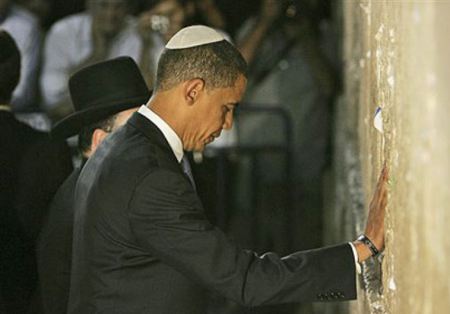
wailingwallobamaObama at the Western Wall. (photo credit:AFP PHOTO)

In one of the immortal lines of Godfather 2, mafia boss Michael Corleone discusses the fate of his brother, who betrayed him, with his enforcer.

“I don’t want anything to happen to him while my mother is alive,” Corleone said.

Message received.

The brother was murdered after their mother’s funeral.

Last week it was reported that the Obama administration has delivered a message to the Palestinian Authority. The administration has warned the PA that the US will veto any anti-Israel resolution brought before the UN Security Council before the US presidential elections on November 8.

Message received.

Open season on Israel at the Security Council will commence November 9. The Palestinians are planning appropriately.

Israel needs to plan, too. Israel’s most urgent diplomatic mission today is to develop and implement a strategy that will outflank President Barack Obama in his final eight weeks in power.

Lobbying the administration is pointless. Obama has waited eight years to exact his revenge on Israel for not supporting his hostile, strategically irrational policies. And he has no interest in letting bygones be bygones.

Before turning to what Israel must do, first we need to understand what Israel can do.

A good place to begin is by considering what just transpired at UNESCO, where twice in a week, UNESCO bodies resolved to erase 3,000 years of Jewish history in Jerusalem and the Temple Mount.

The fight that Israel waged at UNESCO is not the fight it needs to wage at the Security Council. The stakes at the Security Council are far higher.

Like the UN General Assembly, UNESCO’s decisions are non-binding declarations that have no legal or operational significance. As such, there is no reason to expend great resources to fight them. For Israel, the goal of the fight at UNESCO is not to defeat anti-Israel initiatives. That is impossible given the Palestinians’ automatic majority.

The purpose of the fight at UNESCO is to humiliate European governments that side with antisemitic initiatives, and to weaken the congenitally anti-Israel body itself.

The government achieved both of these objectives. Italian Prime Minister Matteo Renzi’s disavowal of his own government’s abstention from the vote on the first resolution – like the similar position taken after the fact by the Mexican government – was a diplomatic victory for Israel.

So too, the fact that UNESCO’s own Secretary-General Irina Bukova felt compelled to disavow her own agency’s actions by rejecting the resolution’s denial of the Jewish people’s ties to Jerusalem was a significant victory for Israel. Her statement was deeply damaging for UNESCO and its reputation.

Finally, the fact that Tanzania and the Philippines voted against the resolution was a testament to Israel’s capacity to convince other governments to abandon their traditional pro-Palestinian voting pattern.

The Palestinians won the vote at UNESCO because they are more powerful diplomatically than Israel. They have an automatic anti-Israel majority. But they weren’t empowered by their victory. To the contrary. They were bloodied by it.

In a sign of their weakening hold on member nations, the Palestinians and Jordanians felt compelled to send a threatening letter to the members of UNESCO’s World Heritage Committee lest they dare to vote against the resolution. Powerful players don’t make threats. They don’t need to.

Israel’s experience at UNESCO teaches us that there are governments that are open to counteroffers. Israel doesn’t need to hide in America’s shadow. It is capable of working on its own to blunt the impact of the Palestinians’ automatic majority. And it will need to use all of its resources to fend off a US-backed assault at the Security Council.

Unlike UNESCO, the Security Council can pass legally binding resolutions. Israel needs to be prepared to bring all of its resources to bear to prevent such a resolution from being adopted against it. Obama’s intention to abandon Israel at the Security Council means that Israel comes to this battle severely hobbled.

But there is one advantage to the US’s betrayal.

Over the years, Israel’s ability to trust the US to veto anti-Israel resolutions at the Security Council was been a mixed blessing. On the one hand, the US has secured Israel from diplomatic assaults. But on the other hand, our ability to trust Washington has made us diplomatically lazy and ineffective.

Safe in Washington’s shadow, we have behaved as through all diplomacy is public diplomacy. That is, we have pretended that statecraft begins and ends with making the moral or strategic case for our side against the other guys.

But public diplomacy is just one diplomatic tool.

The Syrian regime, for instance, has no moral case for securing international support. Bashar Assad didn’t convince Russian President Vladimir Putin to support him by arguing that he is better than alternative regimes. He bought Putin’s support by offering him permanent air and naval bases in Syria.

Then there is Morocco, another weak state with no public diplomacy case to make. Last March, UN Secretary-General Ban Ki-moon outraged Rabat when he acknowledged the plain fact that Western Sahara, which Morocco occupies, is “occupied territory.”

Morocco quickly secured the support of Spain and France and launched an all-out onslaught against Ban. How did Morocco manage?

Morocco’s most powerful diplomatic resource is its control over migration flows from North Africa to Europe. Anytime it wishes, Rabat can open the migratory floodgates just as easily as it can keep them shut. And the French and Spanish know it.

In less than a month, Ban issued repeated abject apologies.

Game. Set. Match. Morocco.

From reports to date, it appears that shortly after the US elections on November 8, the Malaysians or Egyptians will submit a Palestinian-backed resolution that defines Israeli communities in united Jerusalem, Judea and Samaria as illegal. If the resolution is brought to a vote, the US will fail to veto it.

Such a resolution, or a resolution obligating Israel to withdraw to the 1949 armistice lines, would cause Israel grave harm.

So what resources does Israel have to prevent this from happening?

Of course, we have public diplomacy. And that might work with some friendly nations. But it won’t get us over the top. We need to learn from the Syrian and Moroccan examples and consider what we have to offer Security Council members in exchange for their support in scuttling the approaching onslaught against us.

One such resource is the US Congress. Israel’s allies in Congress are sickened by the Obama administration’s devastating Middle East policies. A solid majority of lawmakers can be trusted to support actions that will reinforce Israel’s position.

Israel has other resources as well that we can trade on. We have natural gas. And we have technologies that the governments of the world require to surmount the challenges of the 21 century. There is no reason to give these resources away when we can trade them for diplomatic support.

As for the Palestinians, as the UNESCO vote showed, they are less popular now than at any time in the past 40 years. All they have to offer is threats and antisemitism. Both are powerful weapons.

But they are no longer invincible.

Israel’s goal must be to use our resources at the Security Council in a manner that will make it impossible for Obama to enable an anti-Israel resolution to pass.

A method for achieving this goal has two components. The first component is to convince a friendly country on the Security Council to propose a balanced resolution that would counter the Palestinian-backed Israel-bashing one.

Such a resolution could include four points. First, it could deplore efforts to deny Jewish history in Jerusalem and the Temple Mount.

Second, it can condemn the PA/PLO for their continued unlawful funding of terrorists.

Third, it can urge Israel to restrain settlement construction in areas that in previous negotiations have been identified as likely territory for a future Palestinian state.

Fourth, it can call on Israel and the PA to reinstate negotiations immediately without preconditions.

Israel has friendly ties with a few Security Council members, among them Uruguay and New Zealand. In the final weeks of the Obama era, it is possible that Israel will be able to convince one of them to submit a balanced resolution along these lines.

Obama would be hard-pressed to oppose such a resolution in favor of one that singles Israel out for rebuke.

But that still is insufficient. Obama can make Uruguay and New Zealand a better offer if he wishes.

And so we move to the second aspect of the plan.

If we learn nothing else from the Obama era, we must recognize that the time has come for Israel to stop sufficing with just one Security Council veto. Most states have several. And we need a few more.

Russia today is the best place to start our search for a second veto.

Putin is a dealmaker. As his agreement with Assad showed, he is willing to consider attractive offers. Obviously, Israel won’t offer Russia bases. But we do have other things to offer Putin in exchange for a veto.

For instance, in exchange for a Russian veto at the Security Council, Israel can offer Putin to lobby the US Congress to cancel US sanctions against Russia over Russia’s annexation of Crimea.

Israel has no dog in that fight. And the sanctions are not getting the US anywhere.

Putin might go for the deal for two reasons. First, by stepping into the breach and defending Israel against Obama, he will humiliate Obama.

Second, if Israel succeeds with the Congress, he will reap economic rewards.

For his part, Putin wouldn’t even have to openly side with Israel. All he would have to do is announce that in the interests of regional stability, Russia will not support an unbalanced resolution on Israel and the Palestinians.

If Putin supports a balanced resolution, Obama will be checkmated. His plan to take revenge on Israel for not following him off the strategic cliff will be foiled. Israel will have survived his presidency.

None of this will be easy. And success is far from assured. There are many more ways for Israel to fail than succeed. Our diplomatic weakness remains a millstone around our neck. But as the UNESCO resolutions showed, attacking Israel is no longer cost free. We are not powerless in the grip of circumstances. We have cards to play.

And now is the time to play them for all they are worth.