Posted tagged ‘U.S. military’

Men Like These

June 22, 2017

Men Like These, Bill Whittle Channel via YouTube, June 21, 2017

The short blurb beneath the video summarizes:

A former Special Forces soldier in Mosul runs, unarmed, through an ISIS free-fire zone to rescue an Iraqi child. The video illustrates a story that’s not told often enough, but Scott Ott, Bill Whittle and Stephen Green work to remedy that.

Assad and Putin are testing the US in Syria. Trump is answering.

June 19, 2017

Assad and Putin are testing the US in Syria. Trump is answering., Washington ExaminerTom Rogan, June 19, 2017

(Please see also, Missile strike on ISIS turning Iran into a world power. — DM)

The United States remains the world’s sole superpower. Realistic in our appraisal of national interests and prudent in their pursuit, our adversaries must never doubt our resolve.

****************************

On Sunday, an F-18 fighter jet (almost certainly from the Mediterranean-deployed USS George H.W. Bush carrier strike group), downed a Syrian Air Force Su-22 fighter jet.

It was the right decision for both tactical and strategic reasons.

For a start, the Syrian jet was bombing United States allies (the Kurdish-dominated Syrian Democratic Forces) on the ground. It was warned, but did not retreat.

Yet it’s not just relevant who the Syrians were bombing, it’s also important where they were doing so. Because the Su-22 was striking targets in north-central Syria, proximate to the Islamic State capital, Raqqa, and a town and dam, Taqba.

That locale matters for two reasons.

First, because the Syrian axis (Bashar Assad, Russia, Iran, the Lebanese Hezbollah, and other associated Shiite militias) are determined to displace U.S./allied forces from that area. The Assad axis recognizes that if it secures Taqba, it can push east of the Euphrates river and degrade anti-regime forces operating there with U.S. protection. As I’ve explained, this area of northern Syria is crucial for the future of the Syrian civil war.

Second, had the U.S. allowed axis forces to displace Kurdish forces from the area, the axis would have been able to disrupt the operation to retake Raqqa from the Islamic State. While the axis argue that they support the U.S.-led effort to defeat the Islamic State, the reality is different.

After all, the axis have vested interests in allowing the Islamic State to survive in some form. While the Islamic State is indeed their enemy, its existence allows the axis to pretend that the choice in Syria is between Assad, and the Islamic State and al Qaeda. Russia, especially, uses this narrative to delegitimate and attack more-moderate U.S.-supported Syrian rebel groups. Ever notice that the Russians always claim they are bombing “terrorists” in Syria? The Islamic State gives them that excuse.

Absent the threat of the Islamic State, the axis powers know that the world would view the Syrian regime much more harshly. Absent international jihadist groups in Syria, the regime would no longer be able to claim “we’re the best of a bad bunch.”

Still, there’s a broader issue at stake here.

This latest axis push against U.S. interests is just the tip of the iceberg. As I noted recently, the axis is also threatening a major U.S. base in south-eastern Syria. Collectively, these efforts are designed to test the Trump administration’s commitment to U.S. interests in Syria. Put simply, by escalating their threat against the U.S., and by dangling the prospect of future U.S. casualties, the Assad axis wishes for the Trump administration to back away from its resistance to Assad’s regime. They believe that, as was the case with President Barack Obama’s red lines, the U.S. can ultimately be compelled to yield.

For that reason, the U.S. response on Sunday was the right one.

A two-person U.S. aircrew in an advanced multirole fighter met a Soviet-era aircraft and outmatched it.

The United States remains the world’s sole superpower. Realistic in our appraisal of national interests and prudent in their pursuit, our adversaries must never doubt our resolve.

US drone strikes ‘against spirit of ongoing cooperation,’ Pakistani Army chief says

June 15, 2017

US drone strikes ‘against spirit of ongoing cooperation,’ Pakistani Army chief says, Long War Journal, June 15, 2017

Bajwa insists that all the US needs to do is share intelligence, and the Pakistan military will handle the problem on its own. Yet it is well documented that when the US has given intelligence on groups such as the Haqqani Network, Pakistani officials have passed it along to the terrorists.

Pakistan often views many of these strikes as counterproductive because the US is killing leaders from their pet jihadist groups, such as the Afghan Taliban and the Haqqani Network, the Hafiz Gul Bahadar group, and the Mullah Nazir Group. Pakistani government and military officials have denounced strikes that have killed top leaders from these groups, which are known as “good Taliban” because they don’t actively oppose the Pakistani state. The irony is the good Taliban support the “bad Taliban,” which do fight the Pakistani state.

****************

Pakistan’s Chief of Army Staff General Qamar Javed Bajwa said today that US drone strikes and other unilateral actions “are against spirit of ongoing cooperation” and that any intelligence on terrorist whereabouts should be forwarded to the army for action. Bajwa made the statement despite the fact that Pakistani officials have routinely passed along actionable intelligence to terrorists to help them avoid raids, as well as supposed “counterproductive” drone strikes have historically been effective in killing scores of top tier terrorist leaders.

Bajwa’s view on drone strikes were summarized in an Inter-Services public relations press release that was issued on June 14, just one day after the US killed a Haqqani network leader and two of his deputies in an attack in Pakistan’s northwestern district of Hangu. From the ISPR press release:

COAS [Chief of Army Staff Bajwa] said that unilateral actions like drone strike etc are counterproductive and against spirit of ongoing cooperation and intelligence sharing being diligently undertaken by Pakistan. Pakistan Army is capable of taking effective measure if actionable intelligence is shared. He said that our focus now is to transform our operational achievements in FATA into enduring peace and stability for which early mainstreaming of FATA through reforms is essential and Pakistan Army fully supports all efforts towards that end.

Bajwa’s statement is astounding for many reasons, two of which will be addressed below:

When the US shared “actionable intelligence,” it has been passed along to jihadist leaders

Bajwa insists that all the US needs to do is share intelligence, and the Pakistan military will handle the problem on its own. Yet it is well documented that when the US has given intelligence on groups such as the Haqqani Network, Pakistani officials have passed it along to the terrorists. The Washington Post detailed two such incidents, when, in June 2011, the US passed along information to Pakistani officials on an al Qaeda facility in South Waziristan and a Haqqani Network bomb factory at a girls school in North Waziristan. Unsurprisingly, when Pakistani forces arrived, the two locations were empty.

The US has continued its drone program because the Pakistani military and its intelligence service, the Inter-Service Intelligence Directorate, could not be trusted.

Pakistan’s duplicity when it comes to supporting terrorist organizations in the region is well known. The Afghan Taliban would be a shadow of itself without the support and safe haven provided by the Pakistani government.

“Counterproductive” strikes have killed far more top tier leaders in the Movement of the Taliban in Pakistan than the Pakistani military

US drone strikes in Pakistan have killed more than 120 top tier jihadist leaders and operatives in the 396 recorded strikes in Pakistan since the program began in 2004. The jihadists killed come from a host of groups, including al Qaeda, the Afghan Taliban its subgroup, the Haqqani Network, the Movement of the Taliban in Pakistan, the Islamic Movement of Uzbekistan, Turkistan Islamic Party, Hizb Mujahideen, Lashkar-e-Jhagvi, the Hafiz Gul Bahadar group, and the Mullah Nazir Group (FDD’s Long War Journal maintains a list, here).

Pakistan often views many of these strikes as counterproductive because the US is killing leaders from their pet jihadist groups, such as the Afghan Taliban and the Haqqani Network, the Hafiz Gul Bahadar group, and the Mullah Nazir Group. Pakistani government and military officials have denounced strikes that have killed top leaders from these groups, which are known as “good Taliban” because they don’t actively oppose the Pakistani state. The irony is the good Taliban support the “bad Taliban,” which do fight the Pakistani state.

Oddly enough, Pakistani officials even protest when the US kills members of the Movement of the Taliban in Pakistan, which has killed tens of thousands of Pakistani civilians and soldiers in terrorist attacks and during its decade long insurgency in Pakistan’s northwest. Despite the fact that the Movement of the Taliban in Pakistan is a mortal enemy of the state, the Pakistani military has a paltry record in killing top tier leaders of the group. But US drone strikes have taken out key leaders of the Movement of the Taliban in Pakistan, including:

Hakeemullah Mehsud: Baitullah’s successor
Waliur Rehman Mehsud: Hakeemullah’s deputy and head of the Movement of the Taliban in Pakistan in South Waziristan
Qari Hussain Mehsud: the head of the Movement of the Taliban in Pakistan’s suicide operations and director of suicide camps
Wali Mohammed: the head of the Movement of the Taliban in Pakistan’s suicide operations
Ibn Amin: a Movement of the Taliban in Pakistan military commander in Swat who was also a senior al Qaeda leader

These men were directly responsible for murdering numerous Pakistani civilians and soldiers, and had eluded Pakistani intelligence and military operations for years before they were killed by the US drone program. The killing of these top leaders even led to a schism within the Movement of the Taliban in Pakistan for more than a year before the group could reorganize, with divisions that remain to this day.

Pakistani military and government officials have showed their gratitude by condemning most of these strikes.

However, despite Pakistan’s denouncement of the strikes, there is little the nation can do to halt them, short of deploying its air force and shooting down the US aircraft. In the past, the Pakistani government shut down NATO supply lines into Afghanistan in protest of the US raids. However, the US continued to target and kill top level jihadist leaders in cross-border attacks. The number of US drone strikes have decreased drastically from 117 during the peak year of 2010 to just three in 2016 and four so far this year.

Pakistani objections and international criticism have at times caused the US to halt the strikes, but only for a short period of time. Even though the US hates the optics of unilateral strikes on foreign territory without warning, the US has not reduced the number of strikes in 2016 and 2017 because of fear of retribution from Pakistan or international condemnation. Instead, the reduction can be attributed to several things: the US has shifted some resources and assets to other theaters to target al Qaeda in Somalia and Yemen, as well as the Islamic State in Iraq and Syria; and US intelligence incorrectly assessed al Qaeda’s presence in the region as diminished.

US military warns of Shabaab resurgence, strikes ‘command and logistics node’

June 11, 2017

US military warns of Shabaab resurgence, strikes ‘command and logistics node’, Long War Journal, , June 11, 2017

While announcing an airstrike that targeted a Shabaab “command and logistics node” in southern Somalia, the US military warned of al Qaeda’s resurgence in the country and said it has “taken advantage of safe haven.” The strike is the first announced by the US military since the Trump administration declared that it would expand operations against al Qaeda’s branch in Somalia.

US Africa Command, or AFRICOM, announced that it targeted a “command and logistics node at a camp located approximately 185 miles southwest of Mogadishu in a stronghold for the al-Qaeda-affiliated al-Shabaab organization” in an airstrike. AFRCOM assessed that eight Shabaab operatives were killed.

AFRICOM’s worrying assessment of Shabaab’s revival in Somalia is an admission that efforts by the US, African Union, and Somali government to contain and defeat the group over the past several years have failed. The US Department of Defense admitted as much in late March, when it announced that the Trump administration approved “additional precision fires” to target Shabaab throughout Somalia.

The Pentagon’s desire to actively target Shabaab reflects the growing concern that al Qaeda’s branch in East Africa is gaining strength despite the presence of both African Union and US forces, and it is plotting to attack the West. Shabaab used a sophisticated laptop bomb in an attempt to down a Somali airliner in 2016. This attack was cited by the US government as one of the reasons that electronics have been banned in the cabins of airplanes departing from 10 airports in the Middle East. [See What’s really behind Trump’s laptop ban.]

Today’s strike is part of an overarching effort to “degrade the al-Qaeda affiliate’s ability to recruit, train and plot external terror attacks throughout the region and in America.”

The AFRICOM statement also acknowledged that African Union and Somali forces have suffered significant losses at the hands of Shabaab:

In the last eight months, al-Shabaab has overrun three African Union Mission in Somalia (AMISOM) Forward Operating Bases by amassing large numbers of fighters and attacking in overwhelming numbers. Al-Shabaab has also increased its combat capability by seizing heavy weaponry, armored vehicles, explosives, small arms, ammunition, and other miscellaneous supplies during its operations overrunning Burundian National Defense Forces FOB Leego, Ugandan People’s Defense Force FOB Janaale, and Kenyan Defense Force FOB Ceel Ad.

The terror organization has taken advantage of safe haven. The group has cemented its control [sic] southern and central Somalia, they have used this area to plot and direct terror attacks, steal humanitarian aid, and to shelter other radical terrorists.

Shabaab has successfully overrun Somali and African Union bases in the past and inflicted a large number of casualties on troops based there. In Jan. 2016, Shabaab fighters assaulted a base in Al Ade in the south and killed at least 100 Kenyan soldiers. In June 2015, Shabaab killed an estimated 60 Ethiopian soldiers in the south. That same month, Shabaab fighters killed more than 50 Burundi soldiers in Leego.

Shabaab has been resurgent in Somalia since losing ground to a combined African Union and Somali offensive in 2011. The jihadist group has slowly but methodically retaken several towns and villages that it lost, including the coastal town of Marka.

However, Shabaab’s efforts have not been confined to southern and central Somalia. Late last week, Shabaab fighters overran a base manned by Puntland forces in northern Somalia. Upwards of 60 troops were killed and Shabaab seized a large number of weapons and vehicles as well as a quantity of ammunition.

Today’s strike is the first reported by the US military against Shabaab since the Department of Defense announced that it would expand military operations. AFRICOM released a statement on April 17 to refute press reports that US forces launched airstrikes in southwestern Somalia.

Report: U.S.-Backed Afghan Government Funding Taliban Schools, Hospitals

June 11, 2017

Report: U.S.-Backed Afghan Government Funding Taliban Schools, Hospitals, BreitbartEdwin Mora, June 11, 2017

REUTERS/Mustafa Andaleb

The U.S.-led coalition overthrew the Taliban regime in 2001, soon after invading Afghanistan in response to the 9/11 attacks on the U.S homeland.

Afghanistan has been gripped by a Taliban resurgence since former President Barack Obama declared an end to the U.S. combat mission at the end of 2014.

“The Taliban has grown in confidence three years since Western troops withdrew from the country,” declares the Telegraph.

********************************

The U.S. taxpayer-backed Afghan government is reportedly funding schools and hospitals operated by the Taliban as the terrorist group attempts to establish itself as a legitimate administration in the large swathes of the country under its control.

“They are trying to set up a mini-state – if not the actual state – in Helmand,” Auliya Atrafi, a journalist from the BBC Afghan service who made a film about the deteriorating security conditions there, told the Telegraph.

“In the evening when we sat with the [Taliban] elders and the local leaders, they asked us: ‘Where do you think we will be in 10 years time?’ We knew what they were thinking. They see themselves in ten years time as the government,” added the BBC journalist.

Citing the U.S. forces in Afghanistan, the Special Inspector General for Afghanistan Reconstruction (SIGAR) revealed that jihadists, primarily the Taliban, contest or control 40 percent of Afghanistan.

In particular, the Taliban controls or influences 64 percent (nine of 14 districts) of opium-rich Helmand province, located along the Pakistan border next to Kandahar, the birthplace of the terrorist group.

The Telegraph reports that the Taliban controls at least 80 percent of Helmand province, considered one of the deadliest provinces of the ongoing 16-year-old war for the American-led coalition and their Afghan allies.

Taliban jihadists generate 60 percent of its funding from the illicit opium business in Afghanistan, the world’s top producer of the poppy plant, according to the U.S. military.

The American government has invested more than $117 billion in U.S. taxpayer funds on reconstruction efforts in Afghanistan.

Most of those funds (more than $71 billion) have been devoted to training, housing, equipping, and sustaining the Afghan National Defense and Security Forces (ANDSF) in their fight against the Taliban and other jihadist groups.

Nevertheless, the Telegraph points out, “the Afghan government is funding schools and hospitals run by the Taliban as the militant group seeks to establish itself as a legitimate administration in large swathes of the country, a new film has found.”

“A report by a BBC team granted rare access to the group’s stronghold in Helmand province found the Taliban has been forced to present itself as somewhat modernized since Afghans have grown used to government services and a different way of life after the group was ousted from official power,” it adds.

An estimated 300 U.S. Marines have recently returned to the Taliban-stronghold Helmand.

The U.S.-led coalition overthrew the Taliban regime in 2001, soon after invading Afghanistan in response to the 9/11 attacks on the U.S homeland.

Afghanistan has been gripped by a Taliban resurgence since former President Barack Obama declared an end to the U.S. combat mission at the end of 2014.

“The Taliban has grown in confidence three years since Western troops withdrew from the country,” declares the Telegraph.


How an Iranian general duped US command in Syria

June 10, 2017

How an Iranian general duped US command in Syria, DEBKAfile, June 10, 2017

Our sources cannot confirm for certain what part the Russians played in Iran’s underhand maneuver. Were they in on it, or were they hoodwinked by Soleimani like the Americans? However, the bottom line of this incident is that Syria’s neighbors, Israel and Jordan, face a new and distinctly troublesome downturn in the strategic situation on their borders. The next arena of potential US-Iranian confrontation is building up in Syria’s oil-rich Deir ez-Zor region.

********************************

The Iranian-made Syrian drone downed by US F-15 fighters in southeastern Syria on June 8 was presented by American media as a “pro-regime” drone. It was in fact, as DEBKAfile’s military sources can disclose, an Iranian Revolutionary Guards Shahed-129, which was fired as a part of a complicated ruse to dupe the US commanders while pro-Iranian forces surreptiously moved in on the Syrian-Iraqi border.

The Americans had drawn a line in the Syrian Desert sand 55 km outside the Al-Tanf border crossing embedded in the Syrian-Jordanian-Iraqi border triangle, which is under the control of US, Western and Jordanian special forces, together with a US-trained Syrian rebel group. The Secretary of Defense James Mattis and the US military command in Syria and Iraq were confident that by securing this perimeter, their forces would keep the pro-Iranian advance at bay and the border safe.

When the hostile drone flew past this line, it was shot down. But the Americans were reluctant to let the incident escalate into a major clash, while the Iranians were smarting under the Islamic State attack on Tehran’s national sites. And so they played it down. The next day, therefore, Pentagon spokesman Navy Capt. Jeff Davis reported that “hostilities between the coalition and the pro-regime forces had been avoided thanks to Russian influence. He went on to say: “The calm we see today is largely due to their efforts.”

What brought the Russians onstage?

The sequence of events which unfolded over 48 hours in the Syrian Desert is revealed her by our military sources. The drone was fired as a deliberate provocation to cross the 55-km line enclosing the US-controlled border garrison, on the orders of the Iran’s Gen. Qassem Soleimani. It was intended as a diversion from the real action.

The Russians entered the picture at this stage with an attempt to cool the situation and restore calm. While they were busy assuring the Americans that the Syrian army, Hizballah and its other pro-Iranian allies would refrain from crossing the 55-km line, Qassem moved a large-scale force up to a point just a few hundred meters from the American line.

By Friday, June 9, as Russian de-escalation diplomacy with the Americans wound down, Soleimani’s forces were found to have quietly reached new positions on both sides of the border.

1. He had moved those forces to a point 56km north of Al-Tanf to a rendezvous with pro-Iranian Shiite militias which had come from southern Iraq. That rendezvous breached the Iraqi-Syrian border and attained Iran’s strategic goal of opening up a land bridge between Iraq and Syria.

2. A second pro-Iranian force captured and cut off the roads from northern Syria to the southeastern town of Deir ez-Zor, thereby segregating US and pro-American forces in the north from the American garrison in the south.

Our sources cannot confirm for certain what part the Russians played in Iran’s underhand maneuver. Were they in on it, or were they hoodwinked by Soleimani like the Americans? However, the bottom line of this incident is that Syria’s neighbors, Israel and Jordan, face a new and distinctly troublesome downturn in the strategic situation on their borders. The next arena of potential US-Iranian confrontation is building up in Syria’s oil-rich Deir ez-Zor region.

One missile takes out ISIS command on Golan edge

June 8, 2017

One missile takes out ISIS command on Golan edge, DEBKAfile, June 8, 2017

DEBKAfile’s military sources report concerns in the US military commend lest Iranian general Qassem Soleimani decides to drop a division of Iranian special forces by helicopter, in order to catch the garrison off guard and capture the border crossing.

This concern increased after the Islamic State conducted a surprise bombing-cum-shooting attack on prize Iranian regime targets in Tehran on June 7. The Revolutionary Guards are bent on revenge and looking for an outstanding military success to cover this humiliation.

The US commanders are also under pressure on another score: the Iranians and Syrians have sent secret messages to Moscow complaining bitterly about the US air strike. They both made it clear that they command sufficient air and artillery fire power to overwhelm and wipe the ground with the American force in Syria.  Both Damascus and Tehran appear to be spoiling for a major showdown between their armies, using Hizballah and other Shiite proxies, and the US-led contingent.

***********************

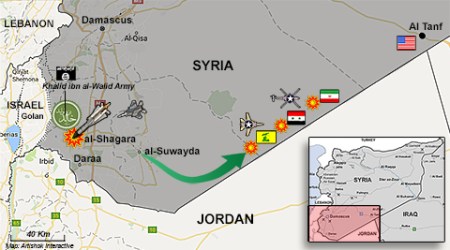
A single mystery missile, which could have been fired from the ground or the air early Wednesday morning, June 7, wiped out the entire top Islamic State command on the Syrian Golan, DEBKAfile’s military and intelligence sources report. All 16 officers of the 2,000-strong Khaled Ibn al Waleed army, the ISIS operations arm on the Syrian Golan, were present in the targeted building in the town of al-Shagara, located in the triangle where the Israeli, Syrian and Jordanian borders meet opposite the Sea of Galilee in northern Israel.

The unidentified missile blew up in the middle of a hall where the top command echelon were gathered to break their daily fast during the month of Ramadan and draw up plans. None of them survived.

Among them were the group’s chief, Gen. Abu Mohammed al-Makdessi; commander of operations, Gen. Abu Udai al-Homsi; and the group’s explosives expert who doubled as its religious leader, Abu Ali Shabat.

They operated under these aliases to conceal their real identities as former high Iraqi army officers who served in the late Saddam Hussein’s armed forces. They were also in senior command positions at the ISIS Syrian command center in Raqqa, when ISIS leader Abu Bakr al-Baghdadi decided to transfer them to the Syrian Golan to spearhead attacks that were planned to take place inside Israel and Jordan.

It took Al-Baghdad just a few hours to replace Magdessi as Khaled Ibn al-Waleed chief with a new man, Mohamed al-Refaei-Abu Hshem al-Askari.

On Tuesday, June 6, the day before the mysterious missile decapitated the Islamic State’s Golan force, US warplanes acted on another front to bomb a convoy of Iranian, Syrian and Hizballah forces that were traveling eastward from the southern town of Derra in the direction of the Al-Tanf border crossing.

Al Tanf, where US and Jordanian special forces units have established a garrison, is located in the triangle where the Syrian, Jordanian and Iraqi borders converge. The US planes destroyed several tanks, troop carriers, artillery pieces and antiaircraft systems, causing also fatalities and injuries, and so halted the convoy’s advance on the strategic crossing.

This was the second US air strike in three weeks on a similar target. The first was on May 18.

DEBKAfile’s military sources report concerns in the US military commend lest Iranian general Qassem Soleimani decides to drop a division of Iranian special forces by helicopter, in order to catch the garrison off guard and capture the border crossing.

This concern increased after the Islamic State conducted a surprise bombing-cum-shooting attack on prize Iranian regime targets in Tehran on June 7. The Revolutionary Guards are bent on revenge and looking for an outstanding military success to cover this humiliation.

The US commanders are also under pressure on another score: the Iranians and Syrians have sent secret messages to Moscow complaining bitterly about the US air strike. They both made it clear that they command sufficient air and artillery fire power to overwhelm and wipe the ground with the American force in Syria.  Both Damascus and Tehran appear to be spoiling for a major showdown between their armies, using Hizballah and other Shiite proxies, and the US-led contingent.

New US base in S. Syria for tussle over control

June 6, 2017

New US base in S. Syria for tussle over control, DEBKAfile, June 6, 2017

The ingathering of major military forces in this part of Syria is ominous: The deployment of a US forward base in the Syrian Desert, and the arrival of the most senior Iranian and Syrian commanders at the head of elite units augur the approach of a major showdown for control of southeastern Syria and its strategic multiple border assets.

***********************

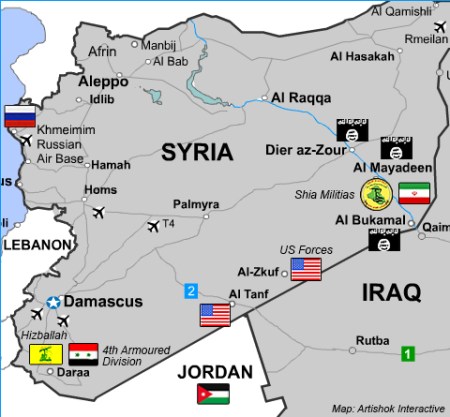
In readiness for a prospective showdown for control of southeast Syria, US Special Forces have set up a forward base at Al-Zukf in the Syrian Desert, DEBKAfile’s military and intelligence sources report. The location is 70km northwest of the Syrian-Iraqi-Jordanian border triangle and the Al Tanf crossing, which is controlled by US, Western allied and Jordanian special forces, together with a US-trained Syrian rebel unit, which calls itself the Revolutionary Commando.

(See the map at the top of this article.)

American sources say the Al Zukf base was set up for two objectives: One is to block the path of the Syrian army-Hizballah armored column, which has been advancing for the past fortnight from Al-Suweida in southeastern Syria toward the Al-Tanf crossing.

The other US objective is to capture the key town of Abu Kamal, a distance of 200km northwest of Al-Tanf, from Islamic State control.

However, the overriding goal of the US advance base is to thwart the Syrian, Hizballah and other pro-Iranian forces from gaining control of 300km of the Syrian-Iraqi border and so being able to open up Tehran’s coveted direct land bridge to the Mediterranean through Iraq.

The US force is not alone in its bid for control of this strategic area. It is getting pretty crowded.

The Syria Army’s 4th armored division rolled this week into the southern Syrian town of Daraa close to the Jordanian border and around 330km west of the new Al-Zukf base. The division moved in with high-grade Russian-made T-90 tanks complete with its high command, headed by Bashar Assad’s younger brother, Gen. Maher al-Assad. The general and staff officers were sighted carrying out inspections of Daraa’s terrain in advance of the resumption of hostilities. Parts of this potential battlefield are no more than 1,000 meters from the Jordanian border.

Our intelligence sources also reported that, this week, further north, al-Qods chief, Gen. Qassem Soleimani, commander of Iran’s Syrian and Iraqi fronts, crossed into Syria from Iraq along with his operations staff. They joined the Palmyra-based command and control of the Syrian force, which is heading out of the town in two columns for two towns – Deir ez-Zor, which is surrounded by Islamic State forces, and Abu Kamal, which is under ISIS control. Elements of Russian elite forces and Hizballah are fighting along with the Syrian troops.

The ingathering of major military forces in this part of Syria is ominous: The deployment of a US forward base in the Syrian Desert, and the arrival of the most senior Iranian and Syrian commanders at the head of elite units augur the approach of a major showdown for control of southeastern Syria and its strategic multiple border assets.

Admitting When You’re Wrong

June 2, 2017

Admitting When You’re Wrong, Investigative Project on Terrorism, Patrick Dunleavy, June 2, 2017

Editor’s note: The IPT has chronicled an attempt by the Council on American-Islamic Relations (CAIR) to smear Senior Fellow Patrick Dunleavy. We’ve noted CAIR’s inability to cite any specific statement Dunleavy has made in his teaching to justify this attack on him. Now, it seems, CAIR’s guilt-by-association play has failed.

Everyone makes mistakes. Not everyone admits it. Plowing headlong into something you know is wrong is a sign of stubbornness. Directing false accusations and innuendos towards an individual is often a sign of vindictiveness.

Nowadays we’ve coined a phrase for it: “Fake News.” Its purpose is to mislead. When directed at an individual its purpose is to slander. If you have ever been the victim of it, I can empathize with you.

Recently, the Council on American-Islamic Relations (CAIR) and another activist organization put out several press releases trying to end my work as a guest instructor for the United States military. I have spoken at the Army’s Counter Terrorism Symposium and the Air Force’s Special Operation School. CAIR called me names, accused me of prejudice and conduct unbecoming of, and detrimental to the goals of the United States military. Its exact words were, “…Mr. Dunleavy does not fit the U.S. military’s standards…”

It demanded that I be removed from any position involving training of U.S. servicemen and women. It followed up the accusations with another press release 45 days later stating that, as a result of their public pressure on the USAF command, the Special Operations School Commandant was ordered to conduct a review of my class. “We welcome this review and hope it results in our military personnel receiving training based on balanced and accurate information, not on personal or political agendas,” said CAIR-Florida Communications Director Wilfredo Ruiz.

If Mr. Ruiz spoke the truth, then he and the entire CAIR organization owe me an apology.

I have been informed that the review of my class material by a group of military officers, which included two commissioned officers who serve as Muslim chaplains in the United States Air Force, is complete. Their findings; Nothing in my course curriculum was found to be denigrating to Islam or Muslims.

I’m not holding my breath waiting for CAIR’s apology.

I realized long ago when I started my career in law enforcement that when you enter public service you have to be ready to take some criticism. I remembered the words of Theodore Roosevelt: “It is not the critic who counts; not the man who points out how the strong man stumbles, or where the doer of deeds could have done them better. The credit belongs to the man who is actually in the arena, whose face is marred by dust and sweat and blood; who strives valiantly; who errs, who comes short again and again, because there is no effort without error and shortcoming.”

Have I made mistakes or errors? Absolutely. But not when it comes to the subject matter I teach about. The Air Force review makes that clear.

I teach a class on Prison Radicalization and Homegrown Terrorism. It is based on my investigative experiences in the criminal justice system as an undercover agent infiltrating organized crime and other criminal enterprises. Part of my career involved working with the both the New York Police Department’s Intelligence Division and the FBI. I don’t teach theory. It is a practicum and it helps military and law enforcement personnel understand how a person can become radicalized.

Training is a necessary component in the war on terrorism. That doesn’t just involve combat tactics but also understanding the enemy – how they operate and draw others to their fight. Islamic radicalization is a very real threat. It operates in society at large and in a particularly vulnerable segment of society, the prison environment.

We call prisons “correctional systems” because we hope in some way to rehabilitate offenders. Jihadists call them training grounds and universities. They have produced terrorists. The most recent examples are Khalid Massood, who killed four people, including a police officer, in London’s Westminster area. Anis Amri killed 12 people in Berlin. Both were former inmates radicalized while incarcerated.

If we ignore the facts or attempt to silence those who speak about the subject, we become like the terrorists, refusing to hear anything that might challenge our own dogma.

Wars are fought in many places other than the battlefield. Wars are also fought in the arena of public opinion.

Honest debate is healthy, slanderous accusations are not.

Maybe CAIR learns a lesson from this episode. But again, I’m not holding my breath.

IPT Senior Fellow Patrick Dunleavy is the former Deputy Inspector General for New York State Department of Corrections and author of The Fertile Soil of Jihad. He currently teaches a class on terrorism for the United States Military Special Operations School.

Massive Kabul truck bomb kills 80, wounds hundreds

May 31, 2017

Massive Kabul truck bomb kills 80, wounds hundreds, BreitbartAFP, May 31, 2017

(How to have a joyous and reflective Ramadan. — DM)

AFP

US troops in Afghanistan number about 8,400 now, and there are another 5,000 from NATO allies. They mainly serve in an advisory capacity — a far cry from the US presence of more than 100,000 six years ago.
************************

Kabul (AFP) – At least 80 people were killed and hundreds wounded Wednesday when a massive truck bomb ripped through Kabul’s diplomatic quarter, bringing carnage to the streets of the Afghan capital and blowing out windows several miles away.

Bodies littered the scene and a huge cloud of smoke rose from the highly-fortified area which houses foreign embassies, after the rush-hour attack tore a massive crater in the ground just days into the Muslim holy fasting month of Ramadan.

No group has so far claimed the powerful blast, which a Western diplomatic source said was caused by 1,500 kilogrammes of explosives packed inside a water tanker.

Rescue workers were digging bodies from the rubble hours after the explosion as anguished residents struggled to get through security cordons to search for missing relatives. Dozens of damaged cars choked the roads as wounded survivors and panicked schoolgirls sought safety.

It was not immediately clear what the target was. But the attack suggests a major security failure and  underscores spiralling insecurity in Afghanistan, where the NATO-backed military, beset by soaring casualties and desertions, is struggling to beat back insurgents.

Over a third of the country is outside government control.

“Unfortunately the toll has reached 80 martyred (killed) and over 300 wounded, including many women and children,” said health ministry spokesman Waheed Majroh, adding the figures would continue to climb as more bodies are pulled from the debris.

President Ashraf Ghani slammed the attack as a “war crime”.

The Taliban — currently in the midst of their annual “spring offensive” — tweeted that they were not involved and “strongly condemn” the blast. The insurgent group rarely claims responsibility for attacks that kill large numbers of civilians.

The Islamic State group has claimed responsibility for several recent bombings in the Afghan capital, including a powerful blast targeting a NATO convoy that killed eight people earlier this month.

The sound of the bomb, which went off near Kabul’s busy Zanbaq Square, reverberated across the Afghan capital, with residents comparing it to an earthquake. Most victims appear to be civilians.

“The vigilance and courage of Afghan security forces prevented the VBIED (vehicle-borne improvised explosive device) from gaining entry to the Green Zone, but the explosion caused civilian casualties,” NATO said in a statement.

– Embassies damaged –

The BBC said its Afghan driver Mohammed Nazir was killed and four of their journalists wounded. Local TV channel Tolo TV also tweeted that a staff member Aziz Navin was killed.

The explosion damaged several embassies in the area, which houses diplomatic and government buildings and is a maze of concrete blast walls, vehicle barriers and armed security guards.

German Foreign Minister Sigmar Gabriel said the “despicable” attack killed an Afghan guard from the German embassy, and added that some employees had been injured, though he did not give further details.

He said the bomb had gone off “in the immediate vicinity” of the German embassy.

France, India, Turkey, Japan, the United Arab Emirates and Bulgaria similarly reported damage to their embassies, including shattered windows, as the blast drew an avalanche of international condemnation.

US ambassador to Afghanistan Hugo Llorens issued a scathing statement condemning the “complete disregard for human life”, saying those behind the attack deserved our “utter scorn”.

Amnesty International said the attack underscores the fact that the conflict in Afghanistan is “dangerously widening in a way that should alarm the international community”.

Germany was forced to postpone a scheduled deportation flight of rejected Afghan asylum-seekers in the wake of the attack. The European nation has drawn criticism for sending back Afghans to an increasingly dangerous country.

Wednesday’s blast was the latest in a string of attacks in Kabul. The province surrounding the capital had the highest number of casualties in the country in the first three months of 2017 due to multiple attacks in the city, with civilians bearing the brunt of the violence.

Pentagon chief Jim Mattis has warned of “another tough year” for both foreign troops and local forces in Afghanistan.

Afghan troops are backed by US and NATO forces, and the Pentagon has reportedly asked the White House to send thousands more soldiers to break the deadlock in the battle against the Taliban.

US troops in Afghanistan number about 8,400 now, and there are another 5,000 from NATO allies. They mainly serve in an advisory capacity — a far cry from the US presence of more than 100,000 six years ago.