Posted tagged ‘U.S. courts’

Federal Court Dismisses Entire Justice Department Mosque Case

September 1, 2017

Federal Court Dismisses Entire Justice Department Mosque Case, PJ Media,  J. Christian Adams, September 1, 2017

(Please see also, Justice Department Forces Christian Pastor to Testify on Islam Views. — DM)

This opinion does raise serious questions, however, about how an abusive and intrusive effort was launched to go after Christian pastors and to ask them to reveal their beliefs about Islam even after a case settled. We’ll be seeking answers.

Next week, Eric Dreiband will have his confirmation hearing to finally fill the vacancy for Assistant Attorney General for Civil Rights. I doubt that abusive and intrusive discovery against Christian pastors about their theological views of Islam is a top agenda item for Mr. Dreiband.

**************************

Yesterday, I reported on an outlandish effort to shake down a Christian pastor about his views on Islam by the Justice Department in an Obama-era holdover case.

Today, a federal court entirely dismissed the Justice Department’s case.

United States District Court Judge Norman Moon ruled that the case was moot because the mosque settled with Culpeper County. The mosque obtained a settlement allowing it to pump and haul sewage from the land.

The United States had sought to keep the case alive, and to conduct wide ranging and intrusive discovery against third parties such as Pastor Steve Harrelson of the Mt. Lebanon Baptist Church.  Harrelson, as discussed in detail in yesterday’s piece, had been served with a Justice Department subpoena compelling him to testify about his views on Islam and to deliver any papers or documents he had about Islam to the government.

The court ruled that because the county had settled with the mosque, the case was done. This means that DOJ won’t be able to probe the Christian pastor for his views on Islam.

Judge Moon wrote:

Taken together, the Government’s additional measures are marginal quibbles that overlook the forest for the trees. They are based on a presumption of bad faith by the County, a presumption supported by little more than bald assertions and which the County has overcome with compelling and unimpeached evidence.

Ouch.

Moon’s ruling means this hunt is now over, as long as the Trump-run Justice Department does not appeal, something it had better not do.  I was all set to appear with Tucker Carlson to discuss this abuse of power, and the particular people at DOJ behind it! Too bad. Judge Moon may have mooted that also.

This opinion does raise serious questions, however, about how an abusive and intrusive effort was launched to go after Christian pastors and to ask them to reveal their beliefs about Islam even after a case settled. We’ll be seeking answers.

Next week, Eric Dreiband will have his confirmation hearing to finally fill the vacancy for Assistant Attorney General for Civil Rights. I doubt that abusive and intrusive discovery against Christian pastors about their theological views of Islam is a top agenda item for Mr. Dreiband.

You can read the full opinion here.

Judge Orders FBI to Release Unredacted Subpoenas From Clinton Investigation

September 1, 2017

Judge Orders FBI to Release Unredacted Subpoenas From Clinton Investigation, Washington Free Beacon, September 1, 2017

Getty Images

A federal judge has ordered the FBI to release new details regarding the subpoenas the bureau issued during the investigation into Hillary Clinton’s private email server.

On Thursday, James Boasberg, a judge for the U.S. District Court for the District of Columbia, ruled in favor of watchdog groups Cause of Action and Judicial Watch, which are suing the government for failing to properly preserve the former secretary of state and failed presidential candidate’s emails.

“The 2016 presidential election may have come and gone, but Plaintiffs Judicial Watch and Cause of Action Institute’s quest for Hillary Clinton’s emails lives on,” Boasberg wrote in the order. “As most readers will remember, Clinton used private email accounts during her tenure as Secretary of State, embroiling the government in myriad Freedom of Information Act suits.”

“In this case, however, Plaintiffs have taken a different tack, alleging a violation of the Federal Records Act,” he wrote. “That is, they claim Defendants State Department and the National Archives and Records Administration failed to maintain records of Clinton’s emails and must now seek the Department of Justice’s Case assistance in their recovery.”

The groups sued the State Department and the National Archives for the unredacted grand jury subpoenas issued in the Clinton email investigation last month.

The existence of the subpoenas was revealed earlier this year, in a redacted declaration filed to the court in secret by E.W. Priestap, the assistant director for the FBI’s counterintelligence division.

Boasberg has now ordered the FBI to reveal the full, unredacted Priestap declaration, which will reveal more information on the government’s efforts to obtain emails stored on Clinton’s BlackBerry email accounts.

Cause of Action Institute president and CEO John J. Vecchione praised the court’s opinion: “The government attempted to end a case with evidence no one could review. This order makes public details submitted by the government about the FBI’s efforts to recover then-Secretary Clinton’s unlawfully removed emails.”

“Americans deserve to know the full scope of that investigation, and we, as Plaintiffs, should have an opportunity to contest the relevance of the government’s facts,” Vecchione said.

Cause of Action and Judicial Watch are still seeking thousands of Clinton’s emails, but the order Thursday is a first step in revealing more information into how the FBI’s case was handled.

The lawsuit led to the discovery of additional classified emails by Clinton that were never disclosed by the State Department, in March.

Washington Free Beacon editor in chief Matthew Continetti filed a declaration in support of the groups’ motion to reveal the unredacted subpoenas because of the “significant public interest” regarding the Clinton email investigation and its implications for national security.

The New Civil War

August 19, 2017

The New Civil War, American ThinkerTom Trinko, August 19, 2017

(Please see also, Anti-Israel Academics Launch Campus Antifa Group for Faculty. — DM)

The first “shots” in our new civil war were fired after Charlottesville when many Democratic leaders claimed that they had the right to use physical force against anyone they didn’t like.

While cowardly leftist leaders are trying to portray themselves as fighting Hitler they are really fighting anyone they don’t agree with. Remember that some Democrats said that Rep. Steve Scalise had it coming since he opposed gun control and that Democrats have been silent when left-wing violence was used to prevent Republicans marching in a parade in Portland.

Facing a continued loss of power because their radical agenda is toxic to most Americans, the Democrat leadership — which includes the MSM — have decided that they have the right to physically attack anyone who stands in their way.

Like their Nazi and Communist forefathers, today’s Democrat leaders are comfortable sending swarms of Brownshirts out to beat into submission anyone who stands between them and power.

Under Obama, Democrats renounced the rule of law by declaring that they could choose to not enforce laws they didn’t like and make up laws that Congress never passed. Now they’re saying that they have the right to attack anyone who dares speak out in disagreement.  Rep. Scalise wasn’t a Nazi or white nationalist, nor were the Republicans in Portland, or the speakers that Democrats forcibly prevented from speaking in Berkeley. Yet the Democratic leadership’s condemnation of all of those events has been muted at best.

While the first American Civil War was fought to protect that particularly Democrat institution slavery, the new civil war Democrat elites are starting to wage is about transferring power from the people to the rich white oligarchs, judges, and government bureaucrats.

As then, Republicans stand for freedom and Democrats stand for slavery.

The Democratic elite has issued a call to war by supporting and endorsing violence against people who don’t agree with them.

The left has gone from endorsing Nazis marching in a neighborhood full of Holocaust survivors to endorsing attacks on Nazis wherever they might appear. We all hate Nazis, but as Americans, Republicans believe in freedom of even odious speech, which is why we’re not tearing down the statues of that mass murderer Lenin that exist in America or the statues of Democrat Robert Byrd, who was a senior official in the KKK.

Republicans have uniformly, including President Trump, condemned Nazis and white nationalists. Yet Democrats are attacking us for not being sufficiently “woke.”

The time for pretending that Democrat leadership is patriotic is over.  It’s time to shout from the rooftops that the Democratic leadership is a fascist cabal intent on overthrowing democracy.

It’s unclear how many of those who voted for Hillary support the clear fascist policies of the Democratic party.  We know that those people tend to be low-information voters who get their “news” from the MSM. Hence, they live in a bubble of lies which make Democrat policies look semi-reasonable.

Even intelligent people fall victim to the Democrat Big Lies. A liberal physicist, for example, was shocked to learn that Osama greenlighted 9/11 because Clinton’s fleeing from Somalia taught Osama that Americans were cowards. He’d never heard that.

Similarly, today many Americans believe that Trump was defending Nazis because the MSM is lying about what he really said.

That’s why we need to be careful and not condemn all Democrats; many of them are honestly unaware of the facts just as the citizens of Nazi Germany didn’t have a clue about how WWII was actually progressing or how the citizens of North Korea thought for decades that though they were starving, they had it better than those poor capitalist South Koreans.

It’s clear that not all of those who voted for Hillary were actually voting for her agenda of taking power from the people and giving it to the elites.

Unlike the average Hillary voter who never heard most of the negative news about her, the Democratic leadership has sinister motives. For decades, they’ve been waging war against America. It started with FDR, a big fan of fascist dictator Mussolini, who began moving this country down the path to socialism with his failed big government policies. Few people remember that those policies didn’t work; it took WWII for the U.S. to recover economically from the Depression.

The next big step was disempowering Americans by giving near absolute power to the unelected Supreme Court. That court overthrew the laws of all 50 states by legalizing abortion for any reason at any time in pregnancy based on a “right to privacy” which is nowhere in the Constitution.

The Supreme Court also created numerous rights for criminals and redefined marriage over the votes of 55,000,000 Americans.

In parallel, the Democrats increased the power of unelected government bureaucrats to the point that they felt empowered to demand that Catholic nuns pay for abortions. To Democrats the 1st Amendment only applies to causes they, the Democrats, support.

Trump’s election was a visceral scream from America saying that we want our power back. That we don’t want to be ruled by pretentious, stupid, elitist fascists like Pelosi and the Clintons, or by RINOs whose first loyalty is to the state, not the people.

The Democratic leadership is now following Mao, who said that political power grows from the barrel of a gun, while Americans are being forced to defend the core American belief that power flows from the people.

Just as the original Democrats repudiated Lincoln for opposing slavery, modern Democratic leaders are repudiating his belief that the government is of the people, for the people, by the people.

The elite bicoastal ruling class is nearly all white and racist to the core, but they use lies about Republicans, spread by the fawning liberal media, to justify violence.

Today Democrats have crossed the Rubicon.  By saying that it’s okay for Antifa to shut down speakers they don’t like and physically assault anyone they don’t happen to agree with Democrats have renounced the rule of law and summoned the whirlwind of civil war.

Why have Democrats once again started a civil war to achieve their ends?

They thought they had everything sewed up. When Hillary won she’d pack the Supreme Court with fascists who believed that they could make up whatever laws they liked. Hillary would, like Obama, ignore the Constitution and further strengthen the administrative state while waging a war against non-Democratic whites and Asians and ensuring that Blacks stayed uneducated so they couldn’t see how Democrats were exploiting them.

But contrary to their expectations, the American people said no. We don’t want to be ruled, we want to be represented — which is why the Republican failure to get rid of ObamaCare is so offensive.

Even with the lying media spreading Democratic talking points 24/7 the majority of Americans want to be free, not enslaved — not told how much soda they can drink or what type of entertainment they can like — Democrats support violent misogynistic rap music while condemning Americans for liking NASCAR. The Democratic message calling on Americans to accept slavery because, according to Democrats, Americans can’t manage their own lives — the same line Democrats used to justify slavery– can’t win elections because American’s aren’t that stupid. As a result, the Democrat leadership has decided that their only way to power is violence.

If they can’t win in the battlefield of ideas, they’ve decided that they need to silence, by the use of force, any voices they don’t like.

The Democrat leaders have turned to the communists they so admire — remember Obama wishing he could rule like the dictator of China does? — and decided that what they can’t win by the ballot they can win with the baseball bat.

Unless we all take a stand now, this spiral of violence initiated by Democrats will lead to a truly horrible future, just as the Democrat’s violent defense of slavery was the cause of the greatest tragedy in American history. If Democrats had voluntarily abandoned slavery, we could have avoided America’s most costly war. Instead we had to fight to end the scourge of slavery.

Contact the Republican leadership and make it clear that instead of condemning Trump for his stand against all violence, they need to attack the Democrat’s support of violence.

There is still time to avoid a massive escalation of violence but if we fail to take a stand against the Democrat’s use of force we will see our streets running with blood.  We know Democrats don’t care about that, because they don’t care about the thousands of Blacks shot in Chicago each year, but we do because we care about all Americans.

Take action and pray that we are not forced to relive the Civil War in order to prevent Democrats from destroying our democracy.

Hawaii judge rules Trump’s travel ban too strict, cannot ban grandparents and other family members

July 14, 2017

Hawaii judge rules Trump’s travel ban too strict, cannot ban grandparents and other family members, Washinton ExaminerJosh Siegel, July 14, 2017

Watson says his ruling is null if the government files an emergency appeal. The government had not issued a response as of publication.

***************************

A federal judge in Hawaii ruled Thursday night that part of the Trump administration’s travel ban is too broad, meaning that it cannot block grandparents and other relatives of people in the U.S. as intended.

The ruling by Hawaii District Court Judge Derrick Watson prevents the government from enforcing two parts of the travel ban.

The federal government cannot use the executive order to “exclude grandparents, grandchildren, brothers-in-law, sisters-in-law, aunts, uncles, nieces, nephews, and cousins of persons in the United States,” Watson wrote.

Watson also ruled that a refugee who has “assurance from a United States refugee resettlement agency” that they will be provided placement services cannot be blocked from travel.

Watson says his ruling is null if the government files an emergency appeal. The government had not issued a response as of publication.

The Supreme Court last month allowed the Trump administration’s ban on foreign nationals from six Muslim-majority countries to go forward in a limited scope. It said the administration could not apply the temporary ban to these travelers if they have a “bona fide relationship with the U.S.”

The Trump administration defined “bona fide relationship” to mean close family members only: parents, spouses, siblings, children, and engaged partners. It would block entry of grandparents, grandchildren, aunts, uncles, nieces, nephews, and cousins from the six countries.

Hawaii had argued this interpretation of “bona fide relationship” was too narrow.

State of Hawaii Files Yet Another Legal Challenge to Trump Travel Ban

July 10, 2017

State of Hawaii Files Yet Another Legal Challenge to Trump Travel Ban, BreitbartMichael Patrick Leahy, July 9, 2017

The Associated Press

Hawaii’s assertion that the Government “intends to continue implementing Executive Order 13780 in a manner that conflicts with the portions of [Judge Watson’s March 29, 2017] preliminary injunction” that were not stayed by the Supreme Court requires Judge Watson to make a significant leap of interpretation, one that, on the face of it, appears to run counter to the specific language the Court used in its June 26 decision.

*****************************

Just hours after the Ninth Circuit Court of Appeals denied its most recent challenge to the Trump travel ban, the state of Hawaii filed yet another motion challenging it in federal court:

In its June 26 decision, the Supreme Court let stand the temporary travel and refugee ban contained in that executive order but added that the ban would not apply to refugees and visa applicants with a “bona fide relationship” to an American resident.

The Trump administration quickly defined “bona fide relationship” as parent, child, sibling, spouse or fiance. The state of Hawaii wants a broader definition that would include grandparents, aunts, uncles, cousins, and possibly more distant relations.

“Late Friday, the Ninth Circuit said no to Hawaii’s request for an emergency appeal of Judge Watson’s denial, saying it lacked jurisdiction to hear the appeal,” as Breitbart News reported on Saturday:

But the liberal judges on the panel could not resist giving Hawaii a road map to get what they want.

The Ninth Circuit ruled that Hawaii should have asked Judge Watson to modify his previous injunction halting the Executive Order on March 15 (partially overturned by the Supreme Court on June 26) instead of asking for him to “clarify” the Supreme Court’s decision.

Later on Friday night, Hawaii Attorney General Doug Chin filed a 31-page motion in Honolulu with U.S. District Judge Derrick Watson that did just that. The former Principal Deputy Solicitor General under President Obama, Neal Kumar Katyal, now a partner at Hogan Lovells in Washington, D.C., is private co-counsel for both plaintiffs–the state of Hawaii and Ismail Eshikh–in the case.

Katyal has extensive experience arguing before the Supreme Court. In November 2015, National Law Journal reported “Neal Katyal’s 26th argument before the U.S. Supreme Court, given in an otherwise routine case Monday, marked a major milestone: He has appeared at the lectern more times than any other male minority lawyer except for Thurgood Marshall.”

“The Government has announced that it is implementing, and that it intends to continue implementing, Executive Order 13780 in a manner that conflicts with the portions of this Court’s preliminary injunction that were not stayed by the Supreme Court’s June 26, 2017 ruling,” the motion stated:

Plaintiffs therefore request that the Court issue an Order enforcing or modifying its preliminary injunction to reflect that:

(1) the injunction bars the Government from implementing the Executive Order against grandparents, grandchildren, brothers-in-law, sisters-in-law, aunts, uncles, nieces, nephews, and cousins of persons in the United States;

(2) the injunction prohibits the Government from applying sections 6(a) and 6(b) to exclude refugees who: (i) have a formal assurance from a resettlement agency within the United States (ii) have a bona fide client relationship with a U.S. legal services organization; or (iii) are in the U.S. Refugee Admissions Program (“USRAP”) through the Iraqi Direct Access Program for “U.S.-affiliated Iraqis,” the Central American Minors Program, or the Lautenberg Program;

(3) the injunction bars defendants from suspending any part of the refugee admission process, including any part of the “Advanced Booking” process, for individuals with a bona fide
relationship with a U.S. person or entity; and

(4) the preliminary injunction prohibits the Government from applying a presumption that an applicant lacks “a bona fide relationship with a person or entity in the United States.”

In its June 26 decision, the Supreme Court ruled that with regards to the temporary 120 ban on refugees, “The Government’s application to stay the injunction with respect to §§6(a) and (b) is accordingly granted in part.”

Section 6(a) may not be enforced against an individual seeking admission as a refugee who can credibly claim a bona fide relationship with a person or entity in the United States.

Nor may §6(b); that is, such a person may not be excluded pursuant to §6(b), even if the 50,000-person cap has been reached or exceeded. As applied to all other individuals, the provisions may take effect.

Just hours after the Ninth Circuit Court of Appeals denied its most recent challenge to the Trump travel ban, the state of Hawaii filed yet another motion challenging it in federal court:

In its June 26 decision, the Supreme Court let stand the temporary travel and refugee ban contained in that executive order but added that the ban would not apply to refugees and visa applicants with a “bona fide relationship” to an American resident.

The Trump administration quickly defined “bona fide relationship” as parent, child, sibling, spouse or fiance. The state of Hawaii wants a broader definition that would include grandparents, aunts, uncles, cousins, and possibly more distant relations.

“Late Friday, the Ninth Circuit said no to Hawaii’s request for an emergency appeal of Judge Watson’s denial, saying it lacked jurisdiction to hear the appeal,” as Breitbart News reported on Saturday:

But the liberal judges on the panel could not resist giving Hawaii a road map to get what they want.

The Ninth Circuit ruled that Hawaii should have asked Judge Watson to modify his previous injunction halting the Executive Order on March 15 (partially overturned by the Supreme Court on June 26) instead of asking for him to “clarify” the Supreme Court’s decision.

Later on Friday night, Hawaii Attorney General Doug Chin filed a 31-page motion in Honolulu with U.S. District Judge Derrick Watson that did just that. The former Principal Deputy Solicitor General under President Obama, Neal Kumar Katyal, now a partner at Hogan Lovells in Washington, D.C., is private co-counsel for both plaintiffs–the state of Hawaii and Ismail Eshikh–in the case.

Katyal has extensive experience arguing before the Supreme Court. In November 2015, National Law Journal reported “Neal Katyal’s 26th argument before the U.S. Supreme Court, given in an otherwise routine case Monday, marked a major milestone: He has appeared at the lectern more times than any other male minority lawyer except for Thurgood Marshall.”

“The Government has announced that it is implementing, and that it intends to continue implementing, Executive Order 13780 in a manner that conflicts with the portions of this Court’s preliminary injunction that were not stayed by the Supreme Court’s June 26, 2017 ruling,” the motion stated:

Plaintiffs therefore request that the Court issue an Order enforcing or modifying its preliminary injunction to reflect that:

(1) the injunction bars the Government from implementing the Executive Order against grandparents, grandchildren, brothers-in-law, sisters-in-law, aunts, uncles, nieces, nephews, and cousins of persons in the United States;

(2) the injunction prohibits the Government from applying sections 6(a) and 6(b) to exclude refugees who: (i) have a formal assurance from a resettlement agency within the United States (ii) have a bona fide client relationship with a U.S. legal services organization; or (iii) are in the U.S. Refugee Admissions Program (“USRAP”) through the Iraqi Direct Access Program for “U.S.-affiliated Iraqis,” the Central American Minors Program, or the Lautenberg Program;

(3) the injunction bars defendants from suspending any part of the refugee admission process, including any part of the “Advanced Booking” process, for individuals with a bona fide
relationship with a U.S. person or entity; and

(4) the preliminary injunction prohibits the Government from applying a presumption that an applicant lacks “a bona fide relationship with a person or entity in the United States.”

In its June 26 decision, the Supreme Court ruled that with regards to the temporary 120 ban on refugees, “The Government’s application to stay the injunction with respect to §§6(a) and (b) is accordingly granted in part.”

Section 6(a) may not be enforced against an individual seeking admission as a refugee who can credibly claim a bona fide relationship with a person or entity in the United States.

Nor may §6(b); that is, such a person may not be excluded pursuant to §6(b), even if the 50,000-person cap has been reached or exceeded. As applied to all other individuals, the provisions may take effect.

Hawaii’s assertion that the Government “intends to continue implementing Executive Order 13780 in a manner that conflicts with the portions of [Judge Watson’s March 29, 2017] preliminary injunction” that were not stayed by the Supreme Court requires Judge Watson to make a significant leap of interpretation, one that, on the face of it, appears to run counter to the specific language the Court used in its June 26 decision.

“The facts of these cases illustrate the sort of relationship that qualifies,” the Supreme Court said of both the temporary travel ban and the temporary refugee ban.

For individuals, a close familial relationship is required. A foreign national who wishes to enter the United States to live with or visit a family member, like Doe’s wife or Dr. Elshikh’s mother-in-law, clearly has such a relationship.

As for entities, the relationship must be formal, documented, and formed in the ordinary course, rather than for the purpose of evading EO–2.

The students from the designated countries who have been admitted to the University of Hawaii have such a relationship with an American entity. So too would a worker who accepted an offer of employment from an American company or a lecturer invited to address an American audience.

Not so someone who enters into a relationship simply to avoid §2(c): For example, a nonprofit group devoted to immigration issues may not contact foreign nationals from the designated countries, add them to client lists, and then secure their entry by claiming injury from their exclusion. (emphasis added)

While Judge Watson expressed considerable personal animosity towards President Trump in his March 15 temporary restraining order and his March 29 preliminary injunction, the state of Hawaii is asking him to interpret the Supreme Court’s June 26 decision in such a way that looks perilously close to largely rejecting it.

Should he rule in favor of the state of Hawaii, and should the Ninth Circuit Court of Appeals uphold that decision upon a likely appeal by the Trump administration, the matter would again go to the Supreme Court for consideration.

Of the 49,803 refugees who have been resettled in the United States during the first nine months and seven days of FY 2017, only three–all from Burma–have been resettled in Hawaii, according to the State Department interactive website.

In FY 2016, the last full year of the Obama administration, not a single refugee was resettled in Hawaii out of the total of 84,995 that were resettled in the entire country.

In the fifteen plus fiscal years since FY 2002, a total of 127 refugees have been resettled in Hawaii.

“The facts of these cases illustrate the sort of relationship that qualifies,” the Supreme Court said of both the temporary travel ban and the temporary refugee ban.

For individuals, a close familial relationship is required. A foreign national who wishes to enter the United States to live with or visit a family member, like Doe’s wife or Dr. Elshikh’s mother-in-law, clearly has such a relationship.

As for entities, the relationship must be formal, documented, and formed in the ordinary course, rather than for the purpose of evading EO–2.

The students from the designated countries who have been admitted to the University of Hawaii have such a relationship with an American entity. So too would a worker who accepted an offer of employment from an American company or a lecturer invited to address an American audience.

Not so someone who enters into a relationship simply to avoid §2(c): For example, a nonprofit group devoted to immigration issues may not contact foreign nationals from the designated countries, add them to client lists, and then secure their entry by claiming injury from their exclusion. (emphasis added)

While Judge Watson expressed considerable personal animosity towards President Trump in his March 15 temporary restraining order and his March 29 preliminary injunction, the state of Hawaii is asking him to interpret the Supreme Court’s June 26 decision in such a way that looks perilously close to largely rejecting it.

Should he rule in favor of the state of Hawaii, and should the Ninth Circuit Court of Appeals uphold that decision upon a likely appeal by the Trump administration, the matter would again go to the Supreme Court for consideration.

Of the 49,803 refugees who have been resettled in the United States during the first nine months and seven days of FY 2017, only three–all from Burma–have been resettled in Hawaii, according to the State Department interactive website.

In FY 2016, the last full year of the Obama administration, not a single refugee was resettled in Hawaii out of the total of 84,995 that were resettled in the entire country.

In the fifteen plus fiscal years since FY 2002, a total of 127 refugees have been resettled in Hawaii.

Judge in Hawaii leaves Trump’s travel ban rules in place

July 7, 2017

Judge in Hawaii leaves Trump’s travel ban rules in place, Washington Times, July 6, 2017

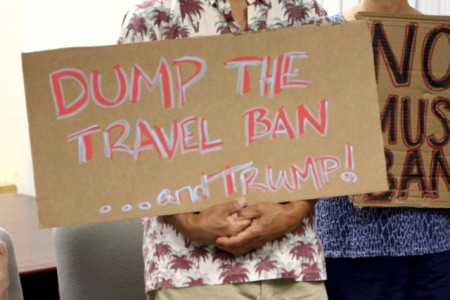
FILE- In this June 30, 2017, file photo, critics of President Donald Trump’s travel ban hold signs during a news conference with Hawaii Attorney General Douglas Chin in Honolulu.

A federal judge delivered President Trump yet another legal victory on his travel ban executive order late Thursday, allowing to remain in effect the White House’s revised rules that cast a fairly narrow screen on who will be admitted as refugees or from six targeted countries.

Judge Derrick K. Watson said the state of Hawaii and other immigrant rights groups challenging Mr. Trump should take their beef up with the Supreme Court since it was the justices’ vague ruling that has led to confusion.

“This court will not upset the Supreme Court’s careful balancing,” Judge Watson wrote.

 In a June 26 ruling, the justices agreed to let much of Mr. Trump’s extreme vetting policy go into effect, canceling an earlier injunction Judge Watson and other federal judges had imposed.

The justices, in a 9-0 ruling, said that for would-be visitors without a connection to the U.S. — either a close relative or a job offer or participation in a school program, for example — Mr. Trump could exclude them. For those with close relationships, however, the justices said the relatives or entities in the U.S. had rights that must be weighed, and for now those rights trump the president’s security concerns.

The Supreme Court has planned full arguments for October.

But the justices didn’t define what a close relationship means, leaving it up to the administration to say, and Mr. Trump’s opponents to then battle over.

Homeland Security said it looked to federal immigration law and previous court rulings and concluded that parents, siblings and spouses were close relationships, but others — including grandparents, cousins, aunts and uncles and even couples engaged to be married — did not qualify.

Hawaii Attorney General Douglas S. Chin had argued that in his state, close family relationships had a much broader meaning that needed to be protected.

Judge Watson said he’d be happy to interpret his own orders, but since the standard in this case was set by the Supreme Court, it’s up to the justices to say what they meant.

Justice Clarence Thomas had predicted a slew of lawsuits would result from the high court’s ruling last month, saying they had left a muddle.

For now, Mr. Trump remains free to restrict entry of many would-be visitors from Iran, Libya, Somalia, Sudan, Syria and Yemen — the majority-Muslim nations that the government, dating back to the Obama administration, has deemed to be threats. His executive order imposes a 90-day pause on those admissions.

Mr. Trump has also called for a 120-day halt to refugee admissions worldwide. The Supreme Court said he could only halt those refugees who, like the visitors from the six targeted countries, don’t have a close relationship with someone in the U.S.

All sides are still trying to hash out what that means, and whether refugees in the pipeline who have been promised resettlement by a nonprofit agency in the U.S. can still come.

For now, Judge Watson’s ruling marks another rare court victory for Mr. Trump after a string of defeats.

His original travel ban policy issued in January was blocked by several courts, including the 9th U.S. Circuit Court of Appeals. He went back to the drawing board and revised his order in March to meet the 9th Circuit’s objections, but that court and the 4th Circuit blocked even the updated order, arguing Mr. Trump broke procedural laws and, in the case of one of the courts, said he showed too much animus toward Muslims to allow his order to stand.

The Supreme Court, though, rejected those reasons, instead looking at the executive order on its face and concluding Mr. Trump did have national security and immigration powers as president that must be respected.

Obama-appointed judges dismiss Supreme Court ruling, continue blocking Trump’s immigration crackdown

June 29, 2017

Obama-appointed judges dismiss Supreme Court ruling, continue blocking Trump’s immigration crackdown, Washington TimesStephen Dinan, June 28, 2017

President Trump met Wednesday with what the White House identified as “immigration crime victims” to urge passage of House legislation. (Associated Press)

President Trump may have won a partial victory at the Supreme Court this week, but other federal judges remain major stumbling blocks to his aggressive immigration plans, with courts from California to Michigan and Atlanta limiting his crackdown on sanctuary cities and stopping him from deporting illegal immigrants he has targeted for removal.

The judges in those deportation cases have rejected Mr. Trump’s argument that he has wide latitude to decide who gets kicked out, without having to worry about district courts second-guessing him on facts of the case.

Instead, the judges said, they get to decide their jurisdiction, and that extends to reviewing Mr. Trump’s immigration policy.

One judge in Michigan ordered the Homeland Security Department to freeze all deportation plans for about 200 Chaldean Christians arrested over the past two months and scheduled to be sent back to Iraq. Nearly every one of them has a criminal record.

A judge in Atlanta ordered the department to reinstate the temporary deportation amnesty — known in governmentspeak as the DACA program — for Jessica Colotl, an illegal immigrant Dreamer whose past made her a target for deportation, officials said.

“The public has an interest in government agencies being required to comply with their own written guidelines instead of engaging in arbitrary decision-making,” said Judge Mark H. Cohen, breaking new ground in establishing legal rights for some illegal immigrants.

On Tuesday, a federal judge in California ordered the Border Patrol to improve its treatment of illegal immigrant children caught sneaking across the border. She said she was troubled by stories from illegal immigrants who said they were kept in dirty rooms without private toilets and sometimes had to wait up to 12 hours for their first meals.

When they were fed, it wasn’t enough, concluded Judge Dolly M. Gee.

Judge Gee ruled that the Border Patrol must provide the children with soap, toothbrushes and toothpaste, and access to showers.

Notably, all four of the judges — including one in San Francisco who blocked part of Mr. Trump’s executive order against sanctuary cities — were appointed to the bench by President Obama.

“Almost all of the judges are acting outside of established law,” said Hans von Spakovsky, a senior legal fellow at The Heritage Foundation who served as a Justice Department lawyer in the Bush administration.

For David Leopold, a former president of the American Immigration Lawyers Association, the judges are heroes upholding the Constitution when the political branches of government won’t.

“You’ve got the Republicans playing ball in the Senate and the House. The only institution that’s putting a check on this guy is the judiciary,” he said.

The Trump administration is fighting all the rulings but has had little luck convincing lower-court judges of Mr. Trump’s powers on immigration.

Mr. Trump, though, has had success at the Supreme Court, which issued a 9-0 decision this week reviving part of his travel ban executive order, which imposes a 90-day pause on some visitors from six majority-Muslim countries and a 120-day halt to all refugee admissions.

Reversing several lower-court rulings — all also issued by judges appointed by Democrats — the Supreme Court said Mr. Trump could stop refugees and visitors when they don’t already have “bona fide” close connections to people or entities in the U.S. For those who do have close connections, however, they have rights that must be respected.

Homeland Security is working out how it will interpret those directives, but analysts are deeply divided on what it means and whether the justices delivered a message to lower courts to back off their criticism of Mr. Trump.

Where lower-court judges pored over Mr. Trump’s campaign statements and perused his Twitter account looking for evidence to use against him, the Supreme Court took the president’s executive order at face value.

“The Supreme Court treated this like a normal case, like a normal executive action. So certainly this has to affect — probably not all judges, but certainly some,” said Ilya Shapiro, editor-in-chief of the Cato Institute’s Supreme Court Review.

He said that could set the stage for a return to the posture of the Obama years, when many of his actions were challenged in court but were greeted with seriousness by the judges who heard the cases — what legal scholars have come to call the “presumption of regularity.”

“I don’t think we’re there yet,” Mr. Shapiro said. “The [president’s] constant tweets — not just about immigration but lots of things — feed the fire of the resistance.”

Mr. von Spakovsky called the Supreme Court ruling “a slap in the face” to the judges who ruled against the broad swath of the president’s immigration plans.

“These judges are clearly hoping these cases don’t get appealed, don’t get to the Supreme Court, because if they do, they’re going to get overturned,” he predicted. “The lesson to them is they need to quit making political decisions based on the fact they don’t like the president and his policy, and start making legal decisions that follow binding precedent.”

Some analysts said the key part of the Supreme Court’s ruling was showing deference to the president’s national security decision-making. The justices said his judgment had to carry weight, particularly when it came to people who don’t have a connection to the U.S. and therefore don’t have constitutional rights to be weighed.

The court will hear broader arguments in the travel ban case in October.

Mr. Leopold said he initially saw the ruling as a loss for immigrant rights advocates, but after rereading it he concluded it’s a major win for his side and a slap at Mr. Trump.

“This is a rebuke,” he said. “They weren’t harsh in their words. It was very professional … But if you read between the lines, they basically say, ‘No, no, we’re not going to defer to you on national security here.’”

He also said the ruling is much more limited in empowering Mr. Trump than it might seem and that few people will be snared by the part of the executive order that the court revived, targeting those without close connections to the U.S.

But on Wednesday evening, the State Department issued a new set of visa guidelines to U.S. embassies on the six affected countries that was much narrower than immigration advocates might have hoped.

Refugee agencies argue that most refugees already in the pipeline have close connections because their names have already been forwarded for placement in the U.S. Immigrant rights advocates said anyone with a job offer, a relative living in the U.S. or who are part of a school program will also be exempted.

Advocacy groups said earlier Wednesday that if they thought the president was being too stingy, they would head back to the courts and likely the same lower-court judges who first ruled against Mr. Trump.

Mr. Leopold said that, far from being chastened, those judges will now feel emboldened by the Supreme Court.

“I think it stiffens the spine because they’re looking at this and they’re basically being upheld on the injunction,” he said. “Those judges have not been overruled.”

DHS Officers Humiliate Judges by Enforcing Immigration Laws, Declares Judge

June 5, 2017

DHS Officers Humiliate Judges by Enforcing Immigration Laws, Declares Judge, BreitbartNeil Munro, June 5, 2017

(Poor baby. Since he is humiliated by doing his job, perhaps he would prefer to be appointed Supreme Rules of the Universe. — DM)

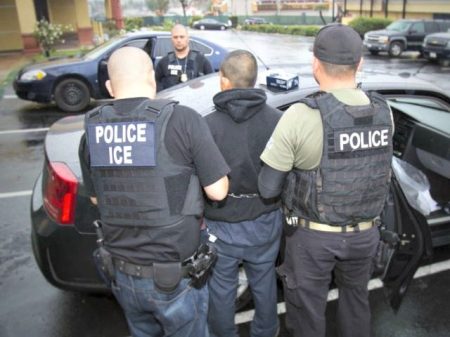
U.S. Immigration and Customs Enforcement

Reinhardt’s intemperate language, said Andrew Arthur, a former immigration judge, suggests that the court’s decisions are political biased. “There is no ‘cold neutrality’ in the Ninth Circuit’s ruling,” Arthur wrote about the court’s preliminary ruling in the Hawaii case. “It is personal, visceral, and vindictive.”

**********************************

Judges are humiliated and dehumanized whenever they must enforce the nation’s immigration laws, according to a senior judge on the far-left Ninth Circuit Court of Appeals.

The judge’s cry of outrage came when he could not block the orderly repatriation of an illegal immigrant who has two drunk driving convictions, plus a U.S. wife and three children.

“We are unable to prevent [Andres] Magana Ortiz’s removal, yet it is contrary to the values of this nation and its legal system,” complained Judge Stephen Reinhardt, who wishes to extend citizens’ rights to illegal foreign migrants. He said:

We are compelled to deny Mr. Magana Ortiz’s request for a stay of removal because we do not have the authority to grant it. We are not, however, compelled to find the government’s action in this case fair or just. …

The government’s decision to remove Magana Ortiz diminishes not only our country but our courts, which are supposedly dedicated to the pursuit of justice. Magana Ortiz and his family are in truth not the only victims. Among the others are judges who, forced to participate in such inhumane acts, suffer a loss of dignity and humanity as well. I concur as a judge, but as a citizen I do not.

The judge, who is married to a former top leader in the ACLU, also lamented the authority of ordinary DHS agents to enforce the law despite protests from well-paid, high-status “civil rights” lawyers:

On January 25, 2017, the President [Donald Trump] signed a series of executive orders dismantling the system of priorities that had previously guided Immigration and Customs Enforcement and Border Patrol in determining whom to deport. The orders also gave far greater authority to individual agents and officers, who are now removing non-citizens simply because they are here illegally, regardless of whether they have committed any offense. In light of the breadth of these orders and the lack of any apparent limit on agents’ discretion, the undocumented must now choose between going to work, school, hospitals, and even court, and the risk of being seized.

In contrast, the new Supreme Court Justice appointed by Trump, Neil Gorsuch, has a more humble vision of his job as a judicial referee, saying in a 2013 award ceremony that:

As my daughters remind me, donning a [judicial] robe doesn’t make me any smarter … It serves as a reminder of what’s expected of us—what [Irish philosopher Edmund] Burke called the “cold neutrality of an impartial judge.” It serves, too, as a reminder of the relatively modest station we’re meant to occupy in a democratic society. In other places, judges wear scarlet and ermine. Here, we’re told to buy our own plain black robes — and I can attest the standard choir outfit at the local uniform supply store is a good deal. Ours is a judiciary of honest black polyester.

The judges on Reinhardt’s Ninth Circuit are expected to release soon a decision blocking Trump’s Executive Orders limiting the entry of people from six terror-prone Muslim countries. The decision is based on a Hawaiian case, in which an Egyptian-born Islamic cleric claimed his constitutional rights were infringed by Trump’s efforts to reduce Islamic jihad in the United States.

The court’s decision may have been delayed by the Islam-inspired bloody attacks in Manchester and London, at least one of which was conducted by the sons of Muslim refugees and migrants from Libya.

Reinhardt’s intemperate language, said Andrew Arthur, a former immigration judge, suggests that the court’s decisions are political biased. “There is no ‘cold neutrality’ in the Ninth Circuit’s ruling,” Arthur wrote about the court’s preliminary ruling in the Hawaii case. “It is personal, visceral, and vindictive.”

Trump quietly slashes number of refugees from Obama’s target despite court order

June 5, 2017

Trump quietly slashes number of refugees from Obama’s target despite court order, Washington TimesStephen Dinan, June 4, 2017

Despite a court order halting most of his extreme vetting policy, President Trump’s administration has quietly been working toward his goal of a drastic cut in the number of refugees the U.S. will accept this fiscal year.

President Obama had set a target of up to 110,000 on his way out the door, but Mr. Trump tried to reset that number to 50,000. If the pace continues, the final tally is likely to be about 60,000 when the fiscal year ends in September — well below the level Mr. Obama wanted to lock in.

Most striking is the drop in the number of refugees from the seven terrorist-connected special interest countries that Mr. Trump singled out for extra scrutiny in his executive orders: Iran, Iraq, Libya, Somalia, Sudan, Syria and Yemen.

Those countries accounted for about half of all refugees admitted over the final months of Mr. Obama’s tenure. But during the past six weeks, they have represented only about a quarter of the refugees — despite a judge’s order instructing Mr. Trump to keep Mr. Obama’s policies in place.

Security analysts cheered the move, saying the new president has already changed the culture from the previous administration.

“Even if ‘extreme vetting’ is on hold, good vetting takes time, and the Trump administration’s plans to follow the law are eliminating the irresponsible rush to judgment that took place under the Obama administration,” said Matthew J. O’Brien, research director at the Federation for American Immigration Reform and a former senior anti-fraud executive at U.S. Citizenship and Immigration Services, one of the agencies that handles refugees.

Across two executive orders — one in January and, after courts blocked it, a revised one in March — Mr. Trump has tried to impose a 90-day halt on all admissions from a half-dozen suspect countries. He has also attempted to enforce a 120-day pause in refugee admissions and a broader halt to any Syrian refugees. He also cut Mr. Obama’s refugee ceiling by more than half, to just 50,000.

The goal, Mr. Trump said, was to give his administration a chance to improve screening procedures so no potential terrorists could slip through.

However a federal judge in Hawaii said Mr. Trump’s entire approach has been tainted by the “animus” he showed Muslims during the presidential campaign and has put all of the key parts on hold.

That means the Trump administration is still admitting refugees from the seven targeted countries of Iran, Iraq, Libya, Somalia, Sudan, Syria and Yemen — but at much lower levels than during Mr. Obama’s tenure.

Syrians made up about 15 percent of all refugees admitted during Mr. Obama’s time this fiscal year. Over the past six weeks, though, they total about 4 percent. The number of Iraqis has dropped from 15 percent under Mr. Obama to about 8 percent of the total in the Trump administration.

Overall, the number of refugees accepted worldwide has dropped from more than 10,000 in October to 2,070 in March, and only slightly more than 3,000 in each of the past two months.

The Justice Department late last week asked the Supreme Court to intervene in the court battle and allow Mr. Trump’s full travel ban and refugee halt to be reinstated — including a full stop to Syrian refugees and reimposing the 50,000 cap for fiscal year 2017.

If they succeed, it would slow refugees even more. The government has admitted more than 46,000 in the first eight months of the fiscal year, so that would leave an average of just 1,000 for each of the final four months — 10 percent the rate Mr. Obama had hoped.

Refugee advocates say thousands of refugees could be stranded without options.

“For people who may have family here who don’t know what the future means for them, that’s just a tragedy. For people who were in the process and now are wondering what’s next for them, and people who are in precarious and tenuous and vulnerable conditions, what does this mean for them? I don’t have an answer for every refugee, but in general it’s not a good situation for refugees,” said Kay Bellor, vice president for programs at the Lutheran Immigration and Refugee Services.

She said American communities have shown “an amazing outpouring of support” for the refugees and that the government needs to match that commitment. Ms. Bellor said a 50,000 cap is well below what the U.S. can — and should — accept.

“Disappointment is kind of not even a strong enough word,” she said. “The U.S. should do more. The problem is great, our resources are great.”

The U.S. looks to the U.N. High Commissioner for Refugees to conduct initial screenings to decide who would be good candidates for resettlement. American officials at U.S. Citizenship and Immigration Services then do their own screening, which includes an interview and the most extensive background check possible, and the State Department makes final approvals.

Refugees are resettled in the U.S. by nonprofit groups such as the Lutheran Immigration and Refugee Services.

Mr. Trump argues that the U.S. needs better refugee screening, and security analysts point to a number of people admitted as refugees who have been charged with terrorist-related offenses over the past decade. Refugee advocates counter that the rate of crime and other dangers from refugees is low.

For now, battles in Congress over budgets and in the courts over the legality of the president’s plans have left the agencies that administer the refugee program struggling.

USCIS began a slowdown in January to conform to Mr. Trump’s 50,000 ceiling. When a judge in Hawaii issued an injunction in March halting the 50,000 number, USCIS had to alter its plans but had already canceled interviews with thousands of potential refugees.

Now, the agency is scrambling to adjust the pace of interviews.

The State Department blamed an uncertain budget situation for the overall slowdown and suggested that activity would pick up after Congress approved funding for fiscal year 2017 in early May.

The department said in a statement that it is acting under the 110,000 ceiling set by Mr. Obama but stressed that is an outer limit, not a target.

“We are not in a position to speculate as to the final number of refugees that will be admitted by the end of this fiscal year,” the department said.

The department declined to answer why the percentage of refugees from special-interest countries has dropped, saying only that “we continue to interview and process refugees of all nationalities.”

Mr. O’Brien said part of the slowdown from special-interest countries could be a result of deteriorating conditions in the Middle East in recent months.

But overall, he said, the numbers are a signal that Mr. Trump is in charge and employees are getting the message.

“Many of the people from the Iraq/Syria region under the Obama administration should never have been admitted to the United States. It appears that the Trump administration is making attempts to engage in serious (as opposed to superficial) vetting efforts and is approving refugee applications only for individuals who appear to be genuine refugees,” Mr. O’Brien said in an email.

He also said he suspects that where the Obama administration treated the refugee cap as a target to be met, the Trump administration sees it as an outer limit.

“Part of Obama’s immigration agenda was to significantly increase the number of both asylees and refugees admitted to the U.S. — presumably because President Obama saw the U.S. as being responsible for the degradation of the security situation in the Middle East. By way of contrast, President Trump has clearly indicated that he sees refugee admissions as a priority national security issue and radical Islam as the source of the problem,” Mr. O’Brien said.

Federal Judges Invite Muslims To Veto Americans’ Elections Over Campaign Statements

May 25, 2017

Federal Judges Invite Muslims To Veto Americans’ Elections Over Campaign Statements, BreitbartNeil Munro, May 25, 2017

(In what fantasy world do the ten judges live? — DM)

Ten progressive judges in Virginia have decided that Muslims can ask judges to change the nation’s national security and immigration policies whenever prior campaign statements in democratic political elections can be described as unfair to Muslims living in America.

“To the extent that our review chills campaign promises to condemn and exclude entire religious groups, we think that a welcome restraint,” boasted the majority opinion, which was approved by 10 judges on the Richmond-based Court of Appeals for the Fourth Circuit, and announced May 25. President Donald Trump’s Executive Order on Islamic migration “speaks with vague words of national security, but in context drips with religious intolerance, animus, and discrimination” from the 2016 election campaign, the judges insisted.

However, a dissent approved by three judges highlighted the political ambitions and risks hiding behind the court’s declaration of support for the Islamic plaintiffs. “The danger of the majority’s new rule is that it will enable any court to justify its decision to strike down any executive action with which it disagrees,” says three three-judge dissent, which concluded:

Unless corrected by the Supreme Court, the majority’s new approach, which is unsupported by any Supreme Court case, will become a sword for plaintiffs to challenge facially neutral government actions, particularly those affecting regions dominated by a single religion. Government officials will avoid speaking about religion, even privately, lest a court discover statements that could be used to ascribe a religious motivation to their future actions. And, in the more immediate future, our courts will be faced with the unworkable task of determining when this President’s supposed religious motive [in the 2016 election] has sufficiently dissipated so as to allow executive action toward these or other majority Muslim countries.

The lawsuit by was brought by Muslim plaintiffs, backed up by a huge array of establishment progressive corporate lawyers, against President Trump’s Executive Order, which merely temporarily blocked or curbed Muslim immigration from six of 50-Muslim-majorityority countries around the world.

The temporary block is intended to help officials institute new safeguards against Islamic-inspired attacks by the growing inflow of Muslim immigrants, refugees, and their future American-born children, into an increasingly diverse and decreasingly unified nation.

The judges’ deference to the Muslim plaintiffs comes after 16 years of deadly, repeated and destructive attacks on Americans motivated by the Islamic religion, starting on 9/11, 2001. Since then, U.S. forces have gone to war in several majority-Muslim countries to curb terrorism, and more than 101 people named after Islam’s primary warrior/prophet have been arrested and convicted by domestic courts for various jihad and terror-related offenses.

That bloody and violent record was important to voters in the 2016 election, where the subsequently elected president, Donald Trump, gained support by promising to reduce immigration of Muslims and to step up vetting of would-be Muslim immigrants.  Trump’s position was bolstered in June 2016 when the son of Muslim immigrants murdered 49 Americans at the Pulse nightclub in Florida.

However, progressive Democrats, establishment Republicans, and business leaders strongly favor a continued inflow of cheap workers, extra consumers and likely future Democratic voters, regardless of the economic and security impact on Americans.

In the dissent authored by Circuit Judge Paul Niemeyer, the three moderate judges scoffed at the 10 judges for ignoring prior Supreme Court guidance. The logic of the 10 judges’ decision, says the dissent, is that any future court:

 need only find one [campaign] statement that contradicts the stated reasons for a subsequent executive action and thereby pronounce that reasons for the executive action are a pretext …

Moreover, the unbounded nature of the majority’s new rule will leave the President and his Administration in a clearly untenable position for future action. It is undeniable that President Trump will need to engage in foreign policy regarding majority-Muslim nations, including those designated by the Order. And yet the majority now suggests that at least some of those future actions might also be subject to the same challenges upheld today. Presumably, the majority does not intend entirely to stop the President from creating policies that address these nations, but it gives the President no guidelines for “cleansing” himself of the “taint” they have purportedly identified…

Finally, the new rule would by itself chill political speech directed at voters seeking to make their election decision. It is hard to imagine a greater or more direct chill on campaign speech than the knowledge that any statement made may be used later to support the inference of some nefarious intent when official actions are inevitably subjected to legal challenges. Indeed, the majority does not even deny that it employs an approach that will limit communication to voters. Instead, it simply opines remarkable that such chilling is “a welcome restraint.”

The Supreme Court surely will shudder at the majority’s adoption of this new rule that has no limits or bounds — one that transforms the [10-judge] majority’s criticisms of a candidate’s various campaign statements into a constitutional violation…

It engages in its own review of the national security justifications supporting the Order and concludes that protecting national security could not be the President’s “primary purpose.” As evidence, the majority points to the President’s level of consultation with national security agencies before issuing the Order; the content of internal Department of Homeland Security reports; the comments of former national security officials made in an amicus brief; and its own assessment of the national security threats described in the Order … The majority’s intense factual inquiry is particularly inappropriate where the government’s secular purpose is related to national security — a subject, as the majority recognizes, on which we owe the executive significant deference…

Unless corrected by the Supreme Court, the majority’s new approach, which is unsupported by any Supreme Court case, will become a sword for plaintiffs to challenge facially neutral government actions, particularly those affecting regions dominated by a single religion. Government officials will avoid speaking about religion, even privately, lest a court discover statements that could be used to ascribe a religious motivation to their future actions. And, in the more immediate future, our courts will be faced with the unworkable task of determining when this President’s supposed religious motive has sufficiently dissipated so as to allow executive action toward these or other majority Muslim countries. The Establishment Clause demands none of these unfortunate and unprecedented results.

Read the court decision here.