FULL MEASURE: May 14, 2017 – Price to Pay via YouTube, May 14, 2017
Why the MB is Still Not Designated as Terrorists in the US, Understanding the Threat, May 14, 2017
(Please see also, MB Backers Hide Terror Support During Capitol Hill Visits. — DM)
It is no oversight the U.S. Muslim Brotherhood is not yet designated a Foreign Terrorist Organization (FTO). In fact, the issue has now been pushed off the table by the Trump administration as the result of a significantly successful information operation perpetrated by the International Muslim Brotherhood continually supported by media outlets.
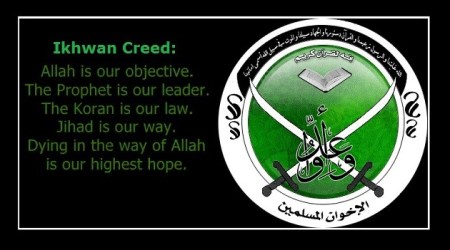
It should be noted that the Senate bill to designate the Muslim Brotherhood a Foreign Terrorist Organization (FTO) provides a significant amount of information revealing this designation is a reasonable and necessary action to protect the citizens of the United States and rid this nation of a cancer that continues to grow daily.
Read the MB Designation Bill HERE.
In the February 23, 2017 edition of the Egypt International (www.almasryalyoum.com), the International Muslim Brotherhood’s Foreign Relations Officer, Mohamed Sudan, revealed the IMB coordinated with a number of nations and entities in a massive information operation (“Propaganda campaign”) to keep the new Trump administration from designating the U.S. MB a terrorist organization.
The article states:
“The international Muslim Brotherhood succeeded in making several contacts with government officials and US Congress to convince them that the Brotherhood is not a terrorist organization and will not get involved in the commission of terrorist acts…”
“People close to former Secretary of State Hillary Clinton helped the group access media companies and contracting, saying that those companies had a role in the completion of communications between the international Muslim Brotherhood and members of Congress, according to the terms of the contract entered into between the parties.”
In the article, the IMB’s Secretary General, Ibrahim Munir, thanked Turkey and Qatar for their assistance in this project. The article went on to say:
“Brotherhood sources confirmed the group contracted with an American advertising company last month to oppose the bill submitted to Congress which aims to classify the MB as a terrorist organization. The sources added the international organization will pay $5 million for corporate propaganda and the publication of articles stating the group rejects terrorist acts to correct its image in the American media.”
Remembering this article was published in Egypt on February 23, 2017 about events that already took place, what was the outcome of this hostile information campaign?
On January 26, 2017, the Wall Street Journal ran a threatening article entitled “Blacklisting the Muslim Brotherhood Carries Risks.” The article made it clear: if the Muslim Brotherhood is designated a terrorist organization, “it could trigger unexpected consequences.” This article was meant to strike fear into the hearts of Islam’s enemies.
On February 22, 2017, the New York Times published an article entitled “I am a Muslim Brother, not a Terrorist,” written by Gehad El-Haddad, the spokesman for the International Muslim Brotherhood who now sits in an Egyptian prison. This was a propaganda piece that supported the idea the Muslim Brotherhood is not a terrorist organization.
It is not unusual for the New York Times to defend enemies of the United States.
This is the same New York Times, by the way, which identified Imam Hesham Shashaa – operating in Germany – as a moderate. Yet, last week Shashaa was arrested by the Germans for supporting ISIS. Weird. Just like when the New York Times called Anwar al Awlaki a moderate, right before the U.S. drone striked him and killed Awlaki for being the Al Qaeda leader in Yemen, among other things.
What is interesting about Gehad El-Haddad is that while he was the spokesman for the International Muslim Brotherhood, he was also the spokesman for Egyptian Presidential candidate Morsi – the Muslim Brotherhood’s candidate.
Oddly enough, while Gehad El-Heddad was the spokesman for the Muslim Brotherhood’s candidate for President of Egypt, he was on the William J. Clinton Foundation where he served from August 2007 to August 2012.
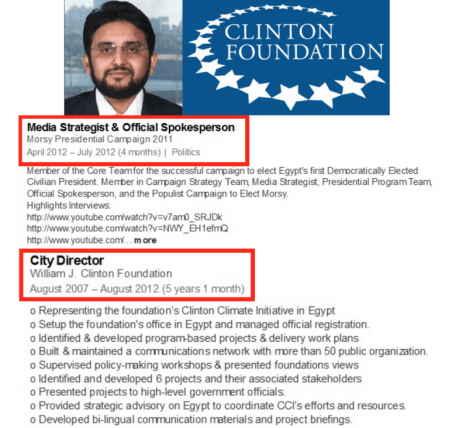
To summarize, the leadership of the International Muslim Brotherhood publicly stated they have an operation underway to influence the U.S. government, the media, and the American public not to designate the Muslim Brotherhood a terrorist organization. The MB reports Hillary Clinton provided support for this operation, and a key node in the operation is the spokesman for the IMB who also spent five (5) years working with the Clinton Foundation.
Treason anyone?
And, at the end of the day, the Trump administration has taken this issue off the table, thereby surrendering to our enemy and giving them a significant victory.
This is why UTT continues to say, this war must and will be won at the local level.
MB Backers Hide Terror Support During Capitol Hill Visits, Investigative Project on Terrorism, John Rossomando, May 15, 2017
 Hani Elkadi outside the Capitol. In November, he called for jihad in Egypt.
When two leaders of a Muslim Brotherhood-linked advocacy group lobbied Congress on May 3, they failed to disclose their open support for the Popular Resistance Movement (PRM) and the Revolutionary Punishment Movement (RPM), terrorist groups that have carried out attacks in Egypt.
Egyptian Americans for Freedom and Justice (EAFJ) President Hani Elkadi and spokesman Mahmoud El Sharkawy asked that aid to Egypt’s military rulers be cut off due to the regime’s human rights record, according to a video of one of the meetings that Elkadi posted on his Facebook page. A staffer for an unidentified member of Congress expressed sympathy with the EAFJ members and told them that his member thought President Trump should not have hosted Egyptian President Abdel Fattah al-Sisi at the White House.
The EAFJ officials’ support for violently overthrowing al-Sisi was never mentioned in the video.
Elkadi, El Sharkawy and other EAFJ members posed for photos outside the offices of Reps. Michael McCaul, R-Texas; Sheila Jackson Lee, D-Texas; Robert Brady, D-Pa.; Bobby Rush, D-Ill.; Brad Sherman, D-Calif.; Marcy Kaptur, D-Ohio; Fred Upton, R-Mich.; Jeff Fortenberry, R-Neb.; Kathleen M. Rice, Bonnie Watson-Coleman, D-N.J.; and the Democratic staff of the House Committee on Foreign Affairs.
Representatives for McCaul, Upton and Fortenberry told the IPT no one from their offices met the EAFJ delegation. The Democratic congressional offices did not respond to multiple requests for comment.

Elkady and El Sharkawy’s support for the Egyptian terrorists is made clear by their social media posts.
In February 2015, they posted PRM’s bloody hand logo with a communiqué from the terrorist group to their respective Facebook pages. The communiqué claimed responsibility for attacks on two police cars, but it did not provide additional details. It included the motto: “God, Martyrs, Revolution” in Arabic. The same bloody hand logo appears on a PRM-linked Facebook page called @Popular.Resistance.EGY that the PRM uses to claim responsibility for its attacks.
The PRM reportedly was founded by three Muslim Brotherhood officials who wanted to react violently to the Brotherhood’s ouster from power by the Egyptian military in 2013. Its first communiqué came on the first anniversary of the military’s deadly assault on Muslim Brotherhood demonstrators in Rabaa Al-Adaweya and Al-Nahda squares.
“We shall pay willingly with our blood until we crush the lackeys of Israel,” the communiqué said. “Retribution for the martyrs is our right, and we shall eventually attain it. So long as people seek their rights, their rights will not be lost. Allah …. Martyrdom ….. Revolution.”
In June 2015, El Sharkawy praised the RPM – a terror group aligned with the PRM –after it killed a man because he helped police round up 40 leaders of pro-Brotherhood protests in Helwan.
“The Revolutionary Punishment Movement executes one of the traitor guides in Helwan!!” El Sharkawy wrote on Facebook.
Muslim Brotherhood spokesmen deny any connection with these terror movements, the Middle East Media Research Institute (MEMRI) notes, but plenty of evidence points to a connection. That includes Brotherhood members issuing statements supporting their attacks.
Among the examples, is former Muslim Brotherhood parliament member Muhammad Sagheer’s 2015 statement: “To the decisive Revolutionary [Punishment] movements: [Coptic businessman Naguib] Sawiris declared that it was he who was financially supporting the Tamarrud movement [which worked to topple the Mursi regime]. I hereby tell you that his property and institutions are a legitimate revolutionary target. Rebellion [Tamarrud] will encounter retribution.”
Abu Emara, a former top Muslim Brotherhood leader, told Egypt’s Al-Bawaba newspaper that the RPM’s fighters belonged to the Brotherhood.
PRM and ISIS each claimed responsibility for an attack against police officers near Cairo on May 7, 2016. The attack was intended to mark 1,000 days since the August 2013 Rabaa massacre, PRM said. This simultaneous claim of responsibility was not an isolated incident, said researcher Patrick Poole, who just returned from Egypt where he interviewed the former head of security for the Sinai.
Poole told the Investigative Project on Terrorism that a similar incident happened in January 2016 after Egypt’s Interior Ministry raided a bomb factory on a farm outside Cairo. Evidence recovered in the raid led police to an apartment in the city of Giza where their suspects blew themselves up killing the officers.
“They were pursuing Muslim Brotherhood people and lo and behold Revolutionary Punishment put out a claim of responsibility on social media, and later so did the Islamic State,” Poole said. “In every one of those cases, whether it’s Popular Resistance, Revolutionary Punishment, both the Interior Ministry and NGO experts like [former Sinai security chief] Khaled Okasha, those groups are all part or were part of Mohamed Kamal’s network.
Kamal was the youngest member of the Muslim Brotherhood’s Guidance Bureau – its top organ – who was killed in a shootout with Egyptian police last October; authorities identified him as the head of the Muslim Brotherhood’s “armed wing.” He established a network of terror cells in Cairo and in Upper Egypt, mostly made up of Muslim Brotherhood youth members, Poole said.
When Kamal died, Muslim Brotherhood spiritual leader Yusuf Qaradawi prayed for him as a martyr. Elkadi, one of the EAFJ officials trying to lobby Congress, shared a post showing that on his Facebook page.
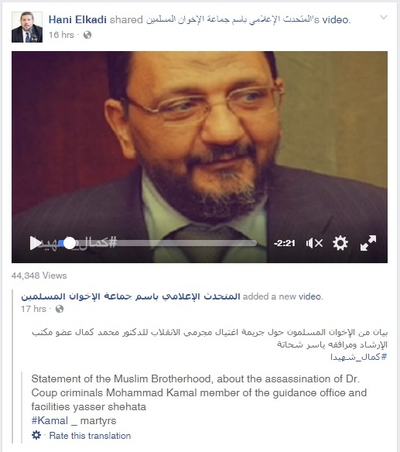
Another post includes an official Muslim Brotherhood communiqué condemning Kamal’s “assassination” by the “coup criminals” with the hashtag #Kamal_martyrs.
Elkadi deleted that, but not before the IPT saved it as a screenshot.
A month later, Elkadi called for jihad.
“A question to all young people against the bloody military coup. If the summons of Jihad calls you to live for Jihad, live for success. Are you ready for the call? … Will we find one who brings his money or half for the expenses of Jihad? Will we see one who leaves everything and lines up in the ranks of the Mujahidin?” Elkadi wrote.
He publicly proclaimed his allegiance to the Muslim Brotherhood in a March 2015 Facebook post.
He attended meetings of the Egyptian Revolutionary Council (ERC) – a group of exiled Morsi-era Muslim Brotherhood politicians – over the May 5 weekend in Istanbul. The website of the banned Freedom and Justice Party (FJP) notes that Elkadi reported on EAFJ’s activities in America including its recent meetings on Capitol Hill.
Al Bawaba identified El Sharkawy as a member of the International Organization of the Muslim Brotherhood in 2015. It also alleged that El Sharkawy was responsible for funding and coordinating operations with Brotherhood members living in Turkey and Qatar.
Other EAFJ member who participated in “Egypt Day at Capitol Hill” publicly endorsed violence or intimidation.
Aber Mostafa, for example, posted the personal information of a pro-Sisi owner of an Egyptian soccer team with the word “Attaaack!” on the same day that Elkadi and El Sharkawy reposted the PRM communiqué.
Ayat Al-Orabi, a member of the Egyptian Revolutionary Council who participated in the lobbying trip, has spouted venom against Egypt’s Christians. In September, she accused Christians of “waging war on Islam,” a leading narrative terrorists use to gain recruits.
“Egypt is Islamic even if occupied by the coup gang and even if assailed by the apostate criminal lackey of the Zionist entity,” Orabi said. “They must realize that the crescent is above the cross, and Islam is above all.”
It’s clear that the EAFJ delegation visited Capitol Hill. It is not known, however, how many offices agreed to meet with them. Given the open support for jihad and terrorist groups by key delegation members, it’s a wonder they got anywhere near the halls of Congress.
The Left’s Mania, Gingrich Productions, Newt Gingrich, May 10, 2017
The Left is getting trapped in its own mania.
Steadfast liberals in the media, academia, and Congress are so pathologically opposed to President Trump and the Republican majority – and so fiercely committed to rejecting the fact that the American people elected both, that they now willfully embrace vulgarity, insults, violence, and hysterical dishonesty.
Late night comedians are so dismayed that they have traded jokes for political assaults and opening monologues for lewd diatribes. Take for example Stephen Colbert’s unhinged rant against President Trump last week. His comments were as obscene as they were offensive, and went well past the line of political satire. Had a TV personality made a similar implication about President Obama or Secretary Clinton, he or she would have been promptly fired and blacklisted from the entertainment industry. Not surprisingly though, Colbert’s network, CBS, took no such action, further proving the media’s growing complicity toward this kind of behavior.
Meanwhile, on college campuses such as Middlebury College and UC-Berkeley, instead of learning to respect those with differing views, liberal students have resorted to violence and threats to silence those with whom they disagree. The academic institutions have largely let it happen – although Middlebury College has said it plans to discipline about half of the more than 70 students who rioted in order to keep Charles Murray, a libertarian social scientist, from speaking March 2, the college has been vague and indecisive about what the ultimate discipline might be. What message does this send to the student body? It implies that if you disagree with someone, it’s okay to shout them down and, if necessary, hurt them.
At UC-Berkeley, administrators have simply given up policing the violent Left. CNN reported that during one protest, “masked agitators” caused $100,000 in damage to the campus. The mere threat of another riot – and the college’s inability or unwillingness to defend against it – kept Ann Coulter from speaking there last month.
Finally, faced with the reality of their dwindling influence, Democrats nationally have turned to fear-mongering and outrageous lies to undermine the efforts of the Republican majority.
Here are a few examples:
From the party of President Franklin Delano Roosevelt’s pledge that “the only thing we have to fear is fear itself,” the Left has descended to the politics of cremation and demagogic fear-mongering.
Let’s be clear: The Left is calling Republicans looking for a better health care plan murderers in order to distract from the complete failure of Obamacare. These extreme liberal over-reactions have even caused the New York Times to pause and fact-check their outlandish claims.
The Left is behaving like it has nothing to lose. The irony is its members’ actions are promoting ideas that are completely opposite to liberalism. Liberals are trapped in a pathology of anger and desperation that is leading them to silence dissenting opinion with vulgarity, threats, and violence; and obstruct real progress by spreading lies and propaganda. I discuss this pathology at length in my new book, Understanding Trump, which will be released June 13.
All Americans who care about maintaining the basic tenets of civil society today must stand up to the Left’s campaign of violence and intimidation.
Congress rejects paying salaries to terrorists, Israel National News, Nitsan Keidar, May 5, 2017
 Capitol Hill, Washington DCThinkstock
The bill also includes a provision that reduces aid to the Palestinian Authority (PA) on a dollar-for-dollar basis for any support the PA, the Palestine Liberation Organization (PLO) and any affiliated organization provides to terrorists or their families.
*********************
The Senate on Thursday passed a $1.1 trillion funding bill which includes a number of provisions to help Israel address security-related challenges.
Senators voted 79-18 in favor of the bill, which will passed the House on Wednesday.
The Omnibus Appropriations bill for Fiscal Year 2017 provides $3.1 billion plus an additional $75 million in overall security assistance to Israel.
The bill also contains $600.7 million for vital joint U.S.-Israel missile defense programs, representing a $113 million increase over FY 2016.
In addition, Congress included $42.5 million for continued U.S.-Israel joint development of technologies to address the complex challenge of locating, mapping and destroying terrorist tunnel networks.
The bill also includes a provision that reduces aid to the Palestinian Authority (PA) on a dollar-for-dollar basis for any support the PA, the Palestine Liberation Organization (PLO) and any affiliated organization provides to terrorists or their families.
The American Israel Public Affairs Committee (AIPAC) welcomed the passage of the bill, saying in a statement it “applauds Congress for including key provisions to help Israel address critical security challenges in the Omnibus Appropriations bill for Fiscal Year 2017.”
The passing of the bill comes a day after the meeting between President Donald Trump and PA chairman Mahmoud Abbas. White House spokesman Sean Spicer told reporters after the meeting that the president had brought up the issue of the PA’s paying salaries to terrorists and their families.
In addition, the lawmakers asked Trump to publicly express support for the Taylor Force Act, a new legislation that would cut U.S. funding to the PA until payments to terrorists cease.
Muslim Brotherhood in Desperate Campaign in US, Clarion Project, Ran Meir, May 4, 2017
 U.S. Capitol building (Photo: JEWEL SAMAD/AFP/Getty Images)
Lectures, discussions and events are being held in prominent American universities, including Harvard and Georgetown, about the “constructive contribution” the Brotherhood has made to Egypt since the Arab Spring began.
****************************
CLICK HERE to Tell Your Members of Congress to Designate the Brotherhood as a Terror Organization
The Muslim Brotherhood in Egypt is mounting a desperate campaign in the U.S. to avoid being designated as a Foreign Terrorist Organization, according to The Seventh Day, one of Egypt’s largest news outlets.
The political winds have changed in Washington and the Brotherhood is running scared. U.S. President Donald Trump has made clear his support of Abdel Fattah el-Sisi, announcing he stands with the Egyptian president in his fight against terror and extremist groups that are threatening one of American’s key allies in the Middle East.
After tens of millions of Egyptians took to the streets to protest the abuse and power grabs of former Egyptian president Mohammed Morsi (a member of the Brotherhood’s political party) in the summer of 2013, El-Sisi and the military took control of Egypt. He was elected president in 2014.
El-Sisi’s recently successful meeting with Trump in Washington set a Brotherhood plan in motion to gain support of members of Congress and academia to block a move to designate the organization as terrorists.
See Clarion Project’s Fact Sheet about the Muslim Brotherhood and its links to terrorism.
Lectures, discussions and events are being held in prominent American universities, including Harvard and Georgetown, about the “constructive contribution” the Brotherhood has made to Egypt since the Arab Spring began.
For example, speaking under the title “The Nobility in Justice,” Mahmoud a-Sharkawi, a Brotherhood official in Washington, lectured about the “positive” role the Brotherhood has played in Egypt since January 25, 2011 (the date marking the beginning of the Arab Spring in Egypt) in a conference at St. John’s University in New York.
The group is also reaching out to members of Congress, trying to re-brand the way it is perceived in Washington after al-Sisi’s successful visit.
Testifying in Congress, Tarek a-Zimer, head of the Building and Development Party, the political party of the Egyptian Brotherhood, urged Americans to change their views about the organization. Other officials of the Brotherhood who attended the hearing used their presence to incite against el-Sisi and the current Egyptian government.
Writing in a blog, A-Zimer asked, “Have the Americans internalized the lesson and fully understood the danger of the current situation to their interests?”
Sources close to the Brotherhood say the purpose of the campaign being waged on American university campuses is to put pressure on Trump in light of the negative opinions about the Brotherhood that are now prevalent in Washington due to the change in administrations.
What they fear most is a decision by the administration to designate the Brotherhood as a terror organization.
Hisham a-Naggar, an Islamic scholar, agreed. He said the purpose of the Brotherhood campaign is to confront the new negative shift in American opinions toward the Brotherhood. These opinions include support for el-Sisi and allying with him against terror – positions that include a crackdown on Brotherhood activities.
Formerly, having the support of the West (and the American president) was the Brotherhood’s “ace in the hole” – the most important card the group could play in its multi-faceted moves to take over Arab countries and their current regimes. Now that support has been taken away, and the group is reeling.
Tarek al-Bashabishi, a former Brotherhhood official who now works against the organization, commented that ever since the Brotherhood lost power in June 2013, it’s been been inciting various Arab countries and international institutions against Egypt to weaken el-Sisi so the Brotherhood can return to power.
Al-Bashabishi added that after Trump was elected, a huge political shift occurred. The U.S. administration is now against the Brotherhood and in support of el-Sisi’s fight against them. Now, he says, the Brotherhood’s only option is to try to bribe Trump’s rivals in Congress so they can be used as mouthpieces for the Brotherhood.
He said the Brotherhood is engaged in a fight for its life, playing all its cards – including using financial support from Turkey and Qatar and the Brotherhood lobby in America – to avoid being designated as a terror organization.
Al-Bashabishi also noted the same phenomenon in the UK, where he said the Brotherhood is trying to bribe members of the House of Commons to support the anti-Egypt opinions of the Brotherhood.
Iran Using U.S. Cash to Fund Unprecedented, Massive Military Buildup, Washington Free Beacon,
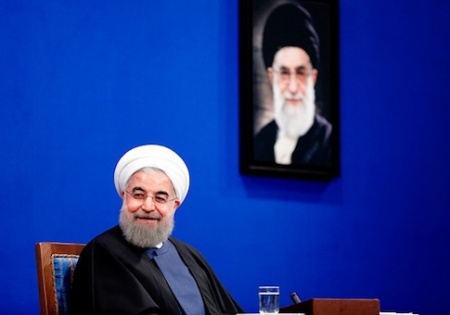
Iranian President Hassan Rouhani gives a press conference in the capital Tehran on April 10, 2017. Photo credit should read ATTA KENARE/AFP/Getty Images)
Iran is using the billions in cash resources provided under the landmark nuclear deal to engage in an unprecedented military buildup meant to transform the Islamic Republic’s fighting force into an “offensive” juggernaut, according to a largely unreported announcement by Iranian military leaders that has sparked concern among U.S. national security insiders and sources on Capitol Hill.
Iranian officials announced late last month that Iran’s defense budget had increased by 145 percent under President Hassan Rouhani and that the military is moving forward with a massive restructuring effort aimed at making it “a forward moving force,” according to regional reports.
Iranian leaders have stated since the Iran deal was enacted that they are using the massive amounts of cash released under the agreement to fund the purchase of new military equipment and other armaments. Iran also has pursued multi-million dollar arms deals with Russia since economic sanctions were nixed as part of the deal.
Leading members of Congress and U.S. officials working on the Iran portfolio suspect that at least a portion of the Obama administration’s $1.7 billion cash payment to Iran has been used to fund and support terrorists in the Middle East.
The latest disclosure about Iran’s military buildup is further fueling concerns that U.S. cash assets returned to the country—which were released with no strings attached by the Obama administration—are helping Iran pursue a more aggressive military stance against U.S. forces in the region.
“President Obama flat-out caved in to Iran when he handed them the disastrous nuclear deal and $1.7 billion in cash payments that could assist Iran’s military,” Rep. Sean Duffy (R., Wis.), an opponent of the nuclear deal, told the Washington Free Beacon. “So it’s no surprise that the world’s lead sponsor of terrorism would feel emboldened to become more aggressive in the region and flex its military muscle.”
Iranian Brigadier General Kiumars Heidari announced the military buildup during Iran’s annual Army Day. While the announcement did not grab many headlines in the Western media, national security insiders have been discussing the announcement for weeks, according to conversations with multiple sources.
Iran’s goal is to turn its army into an “offensive” force, a major shift from its historic role as a support agent for the Iranian Revolutionary Guards Corps, or IRGC, Iran’s extremely well funded primary fighting force.
Iran hopes to revamp its army from top to bottom, including improving logistical capabilities, weaponry, and other armaments.
Mahan Abedin, an Iran analyst writing in Middle East Eye, described the announcement as a major shift in Iranian military policy that would allow the Islamic Republic to intervene in the Persian Gulf region, where the U.S. military has a significant presence.
“This is a major policy announcement with far-reaching consequences for foreign policy and internal defense-related power dynamics,” Abedin wrote. “If implemented properly, Heidari’s proposed modernization policy would not only radically alter Iranian defense doctrine, but just as importantly, it would also reverse the army’s subservient relationship to the Islamic Revolutionary Guard Corps (IRGC).”
Michael Rubin, a former Pentagon adviser and expert on rogue regimes, told the Free Beacon that it should come as no surprise that Iran is diverting the cash it received under the nuclear deal to its military industry.
The disclosure comes as “no surprise to anyone who studied Iran” and should have been anticipated by the Obama administration, which largely sought to downplay the importance of giving Iran billions in cash resources, Rubin said.
“First, there’s history: Between 1998 and 2005, European Union trade with Iran more than doubled and the price of oil quintupled,” Rubin explained. “Iran took that hard currency windfall and invested the bulk of it in its nuclear and missile programs. The person coordinating Iran’s strategy? Hassan Rouhani who was at the time secretary of Iran’s Supreme National Security Council.”
“Obama and Kerry might as well have wired the money directly into the accounts of those seeking to enhance Iran’s military, kill Sunnis, or sponsor terrorism,” Rubin said.
One senior congressional source tracking the matter expressed concern about the safety of U.S. forces in the region, which already are routinely harassed by Iranian military personnel.
“This is certainly grounds for concern,” the source said. “An Iranian military buildup coupled with an offensive posture is a threat to the United States and our allies. This also serves as an important reminder of why the Obama administration’s cash infusion to Iran was so dangerous.”
The cash windfall provided by the United States and European countries is “fungible and hence can be used for everything from sponsoring terror proxies to developing ballistic missiles,” the source warned. “Congress will continue to take action to counter Iranian terrorism and ensure this regime never acquires a nuclear weapon.”
Iran’s military announcement has already sparked a renewed push on Capitol Hill to reimpose economic sanctions on Iran.
“The Iranians know that the party will end this fall, when Congress will pass bipartisan legislation that begins to roll back Iran’s military growth,” one senior congressional adviser working on the sanctions effort told the Free Beacon.
“The Obama administration avoided any serious action for years, and so Iran kept growing its arsenal and using it against our allies, against Syrian civilians, and increasingly against our military,” said the source. “Now they’re rushing to accomplish as much as they can before Congress and the Trump administration get around to reversing Obama’s policies.”
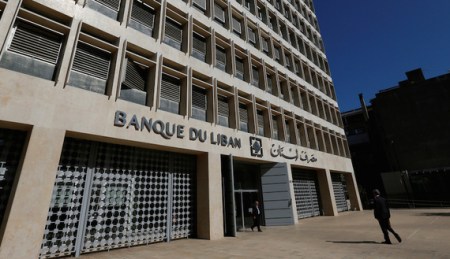
People walk outside Lebanon’s Central Bank in Beirut November 6, 2014. REUTERS/Jamal Saidi/File Photo – RTSEJDF
Congress is blaming the State Department and the US Embassy in Lebanon after draft sanctions legislation was leaked to the Lebanese media, setting off a political and diplomatic firestorm.
House Foreign Affairs Committee Chairman Ed Royce, R-Calif., began devising a new bill targeting Hezbollah last year amid concerns that the Barack Obama administration was slow-walking implementation of a previous effort that was signed into law in December 2015. Royce shared an early draft with State Department experts for their input, sources on and off Capitol Hill told Al-Monitor, but got burned when a media outlet close to Hezbollah got wind of it.
The State Department has not officially acknowledged or denied being involved. Royce declined to comment.
As a result of the leak, numerous newspaper articles in Lebanon over the past month have picked apart — and possibly distorted — an unfinalized draft that only a handful of people in Washington have heard about and fewer still have seen. Even House Foreign Affairs ranking member Eliot Engel, D-N.Y., a natural ally on sanctions legislation, has yet to see the proposed draft, according to a Democratic aide. Sen. Marco Rubio, R-Fla., is working on a similar effort in the Senate.
Lebanese officials say destabilizing sanctions would be ill-advised while tiny Lebanon is struggling to absorb more than a million refugees from Syria.
“We are surprised by all the leaks about new sanctions,” Lebanese member of parliament Yassine Jaber, a former economy minister who met with administration officials during the congressional recess two weeks ago, told Al-Monitor in an email. “We don’t see a need for further legislation, we feel that all these leaks about further legislation to come, only hurts Lebanon, its economy and banking sector, at a moment of very high weakness and vulnerability.”
According to Lebanese media accounts, the 20-page draft bill has also caused a panic in Lebanon because of its potential political impact. While the 2015 bill unnerved a banking sector that is one of the pillars of the country’s economy, the new draft has government leaders fretful that Congress is now coming after them.
The Royce draft, Lebanese President Michel Aoun said last week during a meeting with the Washington-based American Task Force for Lebanon, “would harm Lebanon and its people greatly.” Critics are worried that the draft bill paves the way for sanctioning Lebanese allies and political parties that are close to Hezbollah, including Aoun, the Christian Free Patriotic Movement headed by his son-in-law and Foreign Minister Gebran Bassil, and the Shiite Amal Movement of parliament Speaker Nabih Berri.
In response, the Lebanese government is planning to send a delegation to Washington later this month of government officials, lawmakers and other dignitaries, possibly including Central Bank Governor Riad Salameh. The government hopes to have representatives of the private banking sector tag along to play up any potential threat to the financial sector, a Lebanese source told Al-Monitor, but the main concern appears to be with the bill’s political ramifications.
“This is more about the political groups of the speaker, etc., being nervous rather than the issues of the banks,” the source said. “Politicians — and the government, actually — are trying to get the private banks involved in their effort. I can tell you the private banks do not like that: They do not want to come with politicians here.”
The Association of Banks in Lebanon spent $200,000 in the first three months of this year to discreetly lobby Congress about the bill and other matters, according to lobbying records. The banks would prefer to wait until President Donald Trump fills in top spots at the Treasury Department before organizing their annual visit to Washington, the source said.
Hezbollah claims to get all its funding from Iran. US experts, however, have long suspected that much more comes from Lebanese expatriates, illegal activities and other sources, fueling Congress’ desire to crack down on as many funding streams as possible.
The Lebanese source, who has seen a draft of the bill, said it does not designate Hezbollah’s allies as terror groups. Rather, it would require the Trump administration to publicly report on their financial links to the Shiite militia, including estimates of the net worth of some top Lebanese officials.
“Obviously they don’t want their net worth to be mentioned,” the source said. “I totally see how Nabih Berri could be panicking even if his own party knows how much money he has.”

The first Boeing 737 MAX 9 airplane is pictured during its rollout for media at the Boeing factory in Renton, Washington on March 7, 2017. /Photo credit should read JASON REDMOND/AFP/Getty Images)
Boeing’s efforts to ink multi-billion dollar deals with Iran, the world’s foremost state sponsor of terror, has prompted outrage on Capitol Hill and currently is being reviewed by the Trump administration, which will have the final say on whether Boeing is granted licenses to sell new planes to Iran.
**********************************
Leaders from Boeing reportedly traveled to Tehran recently to meet and sign a deal with a top former Iranian Revolutionary Guards Corps (IRGC) member who threatened to blow up U.S. forces in the Persian Gulf region, raising new questions about the U.S. aerospace company’s continued efforts to ink multi-billion dollar deals with the Iranian regime.
Representatives from Boeing traveled to Iran last month to meet with Hossein Alaei, CEO of Aseman Airlines, which is owned and controlled by the state. Boeing is moving forward with a $3 billion dollar deal to sell new planes to Aseman despite fierce opposition on Capitol Hill and direct evidence Iran has used commercial aircraft to ferry weapons and fighters across the region.
A photograph from the meeting shows a Boeing representative shaking hands with Alaei, who has been identified by Congress as a “prominent and longtime member of Iran’s Islamic Revolutionary Guard Corps,” which is responsible for killing and wounding scores of U.S. troops. The Boeing representative was not named in reports from the Iranian-controlled press or in information provided by U.S. foreign policy insiders.
Alaei, who was a senior figure in the IRGC before being installed as CEO of Aseman Airlines, served as commander of the IRGC Navy until 1990. Alaei oversaw the harassment of U.S. forces in the Persian Gulf and efforts by the IRGC Navy to plant mines in international waters.
Alaei was quoted during this time as threatening to “destroy” U.S. Navy assets in the region.
“We have drawn up plans whereby we will utilize all our military capability to destroy the U.S. fleet and solve the Persian Gulf issue once and forever,” Alaei was quoted as saying in 1987. “The Americans are here to fight us.”
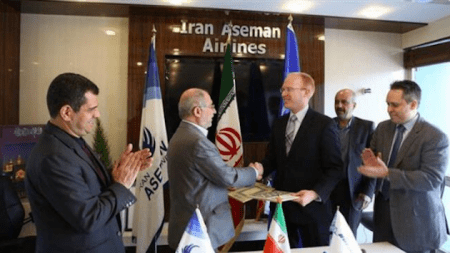 Photo via @mdubowitz Twitter
Boeing’s efforts to ink multi-billion dollar deals with Iran, the world’s foremost state sponsor of terror, has prompted outrage on Capitol Hill and currently is being reviewed by the Trump administration, which will have the final say on whether Boeing is granted licenses to sell new planes to Iran.
Boeing’s deals with Iran are reported to be worth more than $16 billion.
The aerospace company has lobbied Congress aggressively to back the deal and was a key supporter of the Obama administration’s efforts to forge the landmark nuclear deal with Iran, which provided Tehran with billions in economic relief and cash windfalls.
“According to the U.S. Department of Commerce, an aerospace sale of this magnitude creates or sustains approximately 18,000 jobs in the United States,” Boeing said in a statement carried in Iran’s state-controlled media. “Boeing continues to follow the lead of the U.S. government with regards to working with Iran’s airlines, and any and all contracts with Iran’s airlines are contingent upon U.S. government approval.”
Senior sources on Capitol Hill who are working to stop the deal told the Washington Free Beacon that Boeing’s reported meeting with Alaei crosses the line. Representatives of major U.S. corporations should not be posing for pictures with senior IRGC members who have explicitly committed to killing U.S. soldiers, these sources said.
“If Boeing is trying to convince us they are doing their due diligence, they’re not doing a very good job,” said one senior congressional source working on the matter. “These photos of Boeing executives smiling and glad-handing with a prominent member of the Islamic Revolutionary Guard Corps are truly sickening. No self-respecting American should shake Hossein Alaei’s hands. They have American blood on them.”
Sen. Marco Rubio (R., Fla.) and Rep. Peter Roskam (R., Ill.) recently petitioned President Donald Trump to shut down these sales, citing Alaei’s role in the IRGC and Iran’s use of commercial planes to facilitate terrorism.
“Iran, the world’s leading state sponsor of terrorism, has systematically used commercial aircraft for illicit military purposes, including to transport troops, weapons, and cash to rogue regimes and terrorist groups around the world,” the lawmakers wrote. “The possibility that U.S.-manufactured aircraft could be used as tools of terror is absolutely unacceptable and should not be condoned by the U.S. government.”
Does Judge Orrick Think President Obama ‘Fundamentally Transformed’ Executive Orders? PJ Media, Andrew C. McCarthy, April 28, 2017
 Protesters hold up signs outside a courthouse where a federal judge will hear arguments in the first lawsuit challenging President Donald Trump’s executive order to withhold funding from communities that limit cooperation with immigration authorities Friday, April 14, 2017, in San Francisco. U.S. District Court Judge William Orrick has scheduled a hearing on Friday on San Francisco’s request for a court order blocking the Trump administration from cutting off funds to any of the nation’s so-called sanctuary cities. (AP Photo/Haven Daley)
William H. Orrick III is a Democrat campaign bundler and left-wing political activist. He has been known as “Judge Orrick” since 2013, when President Obama managed to get him on the federal bench — with the assistance of Republicans Senators Jeff Flake (Arizona), Lisa Murkowski (Alaska), and Susan Collins (Maine). All other Republicans opposed Orrick’s nomination, except Bob Corker (Tennessee) who failed to vote.
It was as Judge Orrick that the San Francisco-based social justice warrior issued a 49-page decision this week. His decision purported to invalidate President Trump’s executive order (EO) on federal funding for “sanctuary” jurisdictions — cities, counties and other municipal subdivisions that refuse to cooperate in federal immigration-law enforcement.
I say “purported” because Orrick’s screed is a ruling about nothing. The Trump Justice Department had argued that the EO did nothing to alter pre-existing law. Though Orrick tendentiously disputed this construction of the EO, he admitted that his opinion “does nothing more than implement” the Justice Department’s view. He further conceded that his ruling had no effect on the administration’s power to enforce conditions Congress has placed on federal funding (i.e., the very conditions Trump incorporated in the EO by telling his subordinates they could only act “to the extent consistent with law”). Meanwhile, the administration has not endeavored to strip any federal funding from any sanctuary jurisdictions.
So, in effect (or should we say, non-effect?), nothing has happened and nothing has changed. The ruling’s sole achievement is a fleeting star turn for its author. Actually, make that another star turn: In 2015, Judge Orrick thrilled the Democrat-media complex by carrying water for the National Abortion Federation, which wanted an injunction against a whistleblower’s release of videos showing Planned Parenthood officials selling baby parts — oh, sorry, I mean “fetal tissue.”
The ruling is instructive, though, as a measure of how politicized the judiciary has become. Consider the matter of executive orders.
Orrick’s opinion includes the following remarkable passage (at p. 16):
Government counsel explained that the [Executive] Order is an example of the President’s use of the bully pulpit and, even if read narrowly to have no legal effect, serves the purpose of highlighting the President’s focus on immigration enforcement. While the President is entitled to highlight his policy priorities, an Executive Order carries the force of law. Adopting the Government’s proposed reading would transform an Order that purports to create real legal obligations into a mere policy statement[.] [Emphasis added.]
Can it be that, after eight years of Obama’s usurpation of legislative power, judges have forgotten what proper executive orders are?
Contrary to Obama’s practice and Orrick’s apparent belief, executive orders do not carry the force of law — at least not presumptively. They are supposed to be policy statements that give presidential guidance to subordinate executive officials. That is because the president has no unilateral authority to decree law — it is for Congress to write the laws; the executive branch just enforces them.
Now, we have to qualify these principles with caveats like “presumptively” and “unilateral” because there are special situations in which executive orders may have the force of law. These occur when Congress delegates legislative authority to the president — a dubious practice but, alas, a familiar one.
Take, for example, the International Emergency Economic Powers Act. Under the IEEPA (which is codified in sections 1701 et seq. of Title 50, U.S. Code), the president is empowered to declare a national emergency due to a foreign threat to the United States, and to decree regulations and prohibitions on financial transactions pertinent to the threat, particularly transactions between Americans and hostile foreign powers.
But absent congressional authorization, presidents may not make pronouncements that have the force of law. In general, executive orders do not “create real legal obligations.” They can be said to create duties only in the sense that subordinate officials are supposed to obey directives from a superior. But that is a chain-of-command obligation, not a legal duty. Cabinet secretaries get fired if they defy presidential orders; they do not get prosecuted or sued. Legally, such defiance does not trigger a presidential obligation to terminate a subordinate – the president may fire executive branch officials for any reason, or no reason, for they serve at the president’s pleasure. Consequently, the president’s executive orders do not have the “force of law” even with respect to the subordinate government officials the president is legally authorized to direct. As for the rest of us, the president has no authority to impose legal obligations on us; only Congress may do that.
Judge Orrick seemed mystified by the notion that an executive order could be “a mere policy statement,” or a hortatory rendering of a president’s “policy priorities.” When the Justice Department’s lawyers explained — as if explanation were needed — that these were, in fact, the purposes of the EO, Orrick strangely claimed that Justice was reading the EO “narrowly.” (Apparently, “narrowly” is Ninth Circuit-speak for “accurately.”) Orrick then suggested that this “narrow” reading couldn’t possibly be what was intended by the president — i.e., that there was no way the EO could possibly mean what it says. Why? Because if it was just about announcing policy, the judge theorized, there would be no reason to issue an EO. From this asinine premise, Orrick leapt to the conclusion that Trump must instead be up to something sinister: a sweeping withdrawal of federal funding from sanctuary jurisdictions, heedless of any conditions Congress has attached to funding programs.
To the contrary, stating policy preferences and priorities is one of the basic and desirable reasons for issuing executive orders. It is an effective, transparent manner of communicating administration objectives to the executive branch and the public. It is not enough to say that Donald Trump is not the first president to use EOs this way. This is what EOs are for.
How have we gotten to the point where courts presume bad faith from the proper use of executive orders, and simultaneously imply that a normal executive order would have the force of law?
Of course, we are dealing with a “progressive” partisan here, so throw logic out the window. Can there be any doubt that, if Donald Trump were to issue an executive order that actually purported to create legal benefits and duties (like Obama administration directives on immigration did), Judge Orrick would write an equally indignant opinion about how executive orders must not have the force of law?
The irony is that Judge Orrick essentially did what he falsely accused President Trump of doing. Trump did not use his constitutional authority to issue executive orders as a pretext for usurping congressional power; but Orrick did use his constitutional authority to issue judicial opinions as a pretext for usurping executive power.




 anneinpt
 artaxes
 danmillerinpanama
 davidking1530
 Peter Hofman
 Joseph Wouk
 Peter
Peter Louisiana Steve
 WarSclerotic
Recent Comments