Posted tagged ‘U.S. airstrikes’

How US gave Fallujah’s Sunnis into Iranian hands

June 20, 2016

How the US gave Fallujah’s Sunnis into Iranian hands, DEBKAfile, June 20, 2016
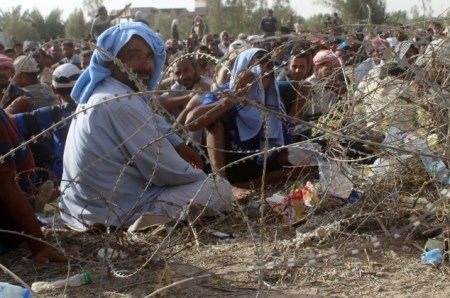
Displaced_Sunni__Iraqis_from_Fallujah_6.16Sunni refugees

In the last few days, the Western press has been full of harrowing reports on the death and destruction wrought by the Islamic State in Fallujah, western Iraq. But no media outlet is covering the still ongoing human disaster in which tens of thousands of the city’s Sunni residents are fleeing for their lives, including many elderly people, women and children. Some are escaping the intense fighting or because their homes were destroyed. But many Sunnis are fleeing in dread of their ‘liberators,” the pro-Iranian Iraqi Shiite militias that captured the eastern and central parts of Fallujah.

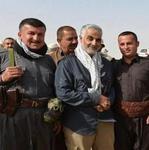
These militias, the Popular Mobilization Forces and the Badar Forces, take their orders from Iranian Gen. Qassem Soleimani, commander of the Al Qods Brigades, and Brig. Gen. Mohammad Pakpour, commander of the Revolutionary Guard Corps ground forces.

There is not much difference between the barbarous acts perpetrated by ISIS and the savagery of Shiite militiamen against the Sunni dwellers of the Iraqi city. In many cases it is even worse. The pro-Iranian fighters are burning down and blowing up houses, murdering and raping women, and executing children and the elderly with bayonets or gunfire.

The Iraqi Special Republican Guard, also called the Golden Division, which participated in the capture of the city center, withdrew from the parts of Fallujah that the pro-Iranian fighters entered. They did so even though Iraqi Prime Minister Haider Al-Abadi had promised the US via Douglas Ollivant, White House aide in charge of Iraq, that the SRG would protect the city’s Sunni population from the Shiite militias. What happened in fact was that the Iraqi soldiers opened the door for the atrocities.

American sources in Washington and Baghdad reported on Monday, June 20, that President Barack Obama and his top aides are furious with Al-Abadi for not keeping his promise. But DEBKAfile’s military and intelligence sources point out that none of this would not have happened were it not for US military involvement in the war on the side of the Iranians.

The pro-Iranian militias were enabled to reach central Fallujah and overwhelm ISIS by the massive bombing raids carried out by US AV-8B Harrier II jets, which flew in from bases in the Persian Gulf, and F/A-18 Hornets from the USS Harry S. Truman aircraft carrier in the eastern Mediterranean.

Even the urgent American calls on Prime Minister Al-Abadi over the last few days to halt the murders and other outrages against the Sunnis population were pointless. Washington knows that he has no authority over the Iranian generals or commanders of the Shiite militias for halting the slaughter.

DEBKAfile’s military and counterterrorism sources point to an especially grave repercussion coming as a direct result of the war crimes allowed to occur in Fallujah. Washington will be hard put to enlist any local Sunni allies for the capture of the two main ISIS strongholds, Mosul in Iraq and Raqqa in Syria.

Some of the American field commanders may believe they can dispense with Sunni support and rely on other local forces, such as the Kurds, to step forward. But they must take into account that many young Sunnis, after witnessing pro-Iranian atrocities in Fallujah may well opt to side with ISIS as the lesser evil.
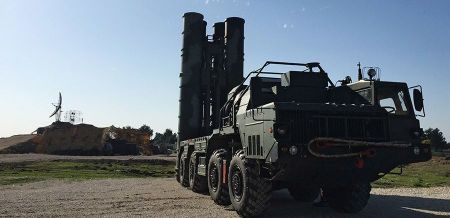
Russian S-400 missiles turn most of Syria into no-fly zone, halt US air strikes

November 28, 2015

Russian S-400 missiles turn most of Syria into no-fly zone, halt US air strikes, DEBKAfile, November 28, 2015

2746772 11/26/2015 An S-400 air defence missile system is deployed for a combat duty at the Hmeymim airbase to provide security of the Russian air group's flights in Syria. Dmitriy Vinogradov/Sputnik

2746772 11/26/2015 An S-400 air defence missile system is deployed for a combat duty at the Hmeymim airbase to provide security of the Russian air group’s flights in Syria. Dmitriy Vinogradov/Sputnik

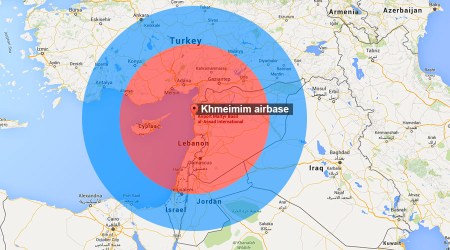
S-400_range_map_25.11.15

The deployment of the highly advanced Russian S-400 anti-air missiles at the Khmeimin base, Russia’s military enclave in Syria near Latakia, combined with Russia electronic jamming and other electronic warfare equipment, has effectively transformed most of Syria into a no-fly zone under Russian control.

Moscow deployed the missiles last Wednesday, Nov. 25, the day after Turkish warplanes downed a Russian Su-24. Since then, the US and Turkey have suspended their air strikes over Syria, including bombardments of Islamic State targets. The attacks on ISIS in Iraq continue without interruption. Turkey is now extra-careful to avoid flights anywhere near the Syrian border.

Both the US and Turkey are obviously wary of risking their planes being shot down by the S-400, so long as Russian-Turkish tensions run high over the Su-24 incident.

Friday, a US-led coalition spokesperson denied that the absence of anti-IS coalition air strikes had anything to do with the S-400 deployment in Syria. He said “The fluctuation or absence of strikes in Syria reflects the ebb and flow of battle.”

However, DEBKAfile’s military sources confirm that neither the US, Turkey or Israel have any real experience in contending with the Russian S-400, which uses multiple missile variants to shoot down stealth aircraft, UAVs, cruise missiles and sub-strategic ballistic missiles. Its operational range for aerodynamic targets is about 250 km and for ballistic targets 60 km. The S-400 can engage up to 36 targets simultaneously.

Thei range covers at least three-quarters of Syrian territory, a huge part of Turkey, all of Lebanon, Cyprus and half of Israel.

Since the downing of their warplane, the Russians have put in place additionally new electronic warfare multifunctional systems both airborne and on the ground to disrupt Turkish flights and forces, Lt. Gen. Evgeny Buzhinksy revealed Friday. Turkey has countered by installing the KORAL electronic jamming system along its southern border with Syria.

An electronic battlefield has spread over northern Syria and southern Turkey, with the Russian and Turks endeavoring to jam each other’s radar and disrupt their missiles. In this, the Russians have the advantage.

With the Americans, Russians and Turks locked in a contest over Syria, and the Israeli Air Force’s freedom of action restricted by objective conditions, some comments made at week’s end by Israeli military and security officials sounded beside the point.

Thursday, Nov. 26, a senior Air Force officer remarked that Israel is being careful to avoid friction with Russia, despite that country’s expanding military presence in Syria. “Russia is now a central player and can’t be ignored. But we each go our own way, according to our own interests,” the officer noted.

“Our policy is not to attack or down any Russian plane. Russia is not our enemy.”

The officer said that Israeli and Russian officers maintain telephone contact. “We don’t notify or ask for anything; we just do our jobs,” he said.

According to DEBKAfile’s military sources, this is not a true picture. Israel does get in touch with the Russians when their planes get too close to Israeli aircraft. There was no need to state that Israeli won’t shoot down Russian planes, as though this was self-evident, because in the current volatile situation, circumstances may change in a trice. Is it in Israel’s interest to fly into air space loaded with electronic warfare waves? But what if Russian warplanes come over the Golan as part of a blitz to destroy Syrian rebels in southern Syria, some of which are backed by Israel?

Russia overrides Middle East cyber waves

October 26, 2015

Russia overrides Middle East cyber waves, DEBKAfile, October 26, 2015

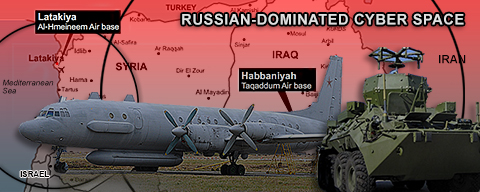
Latakia_Habaniya480

Aloft over Syria, the IL-20 can supply Russian forces and commanders with a complete, detailed picture of the situation on the ground. Its close proximity to Israel, moreover, enables this wonder plane to scoop up a wealth of data from across the border – not just on IDF military movements on the Golan, but also to eavesdrop on electronic activity and conversations in Jerusalem, Military Staff Headquarters in Tel Aviv, Air Force bases in southern Israel and even the nuclear complex in Dimona in the Negev.

******************

The distance as the crow flies between Russia’s Syrian air base Al-Hmeineem near Latakia and its Iraqi host facility at Al Taqaddum Air base is 824 km (445 nautical miles). From the Latakia base to Israel, the distance is just 288 km or 155 nautical miles, a hop and a skip in aerial terms. Syria’s ruler Bashar Assad first let Moscow in with the use of a base where 30 fighter and bombing jets are now parked. Iraqi Prime Minister Haider al-Abadi followed suit Saturday, Oct. 24 by granting the Russian Air force the use of a facility 74 km from Baghdad.

Their presence in the two bases draws a strong arc of Russian aerial control at the heart of Middle East. By boosting its two extremities with state-of-the-art electronic warfare systems, Moscow has imposed a new reality whereby it will soon be almost impossible for any air or ground force, American or Israeli, to go into military action above or inside Syria or Iraq without prior coordination with the Russians.

The bricks of Russian domination are now almost all in place.

In the last week of September, two Ilyushin-20 (IL-20 Coot) super-surveillance planes stole into Syrian airspace, to provide a major upgrade for the Russian air fleet of Sukhoi-30 fighter jets, cargo planes and attack helicopters gathering for combat in Syria.

This was first revealed by DEBKA Weekly’s military and intelligence sources on Oct. 2.

The IL-20s, the Russian Air Force’s top-line intelligence-gathering aircraft, brought over from the Baltic Sea, have exceptional features as an intelligence platform. Their four turboprop engines enable it to stay airborne for over 12 hours, using its thermal and infrared sensors, antennas, still and video cameras, and side-looking airborne (SLAR) radar to collect a wide range of data from long distances, day or night, in almost any kind of weather.

The Coot-20 collates the data gathered and transmits it to intelligence or operational command centers in Moscow or its Latakia air base by powerful jam-resistant communications systems, satellites and other methods.

Aloft over Syria, the IL-20 can supply Russian forces and commanders with a complete, detailed picture of the situation on the ground. Its close proximity to Israel, moreover, enables this wonder plane to scoop up a wealth of data from across the border – not just on IDF military movements on the Golan, but also to eavesdrop on electronic activity and conversations in Jerusalem, Military Staff Headquarters in Tel Aviv, Air Force bases in southern Israel and even the nuclear complex in Dimona in the Negev.

DEBKAfile’s military sources add that an Il-20 Coot has been sighted in the last few days at the Iraqi Al Taqaddum Air base near Baghdad.

Then, on Oct. 4, our sources reveal, another Russian super-weapon was brought to Syria by Russian cargo ships: Nine MT-LB armored personnel carriers fitted with the Borisoglebsk 2 electronic warfare systems, which are among the most sophisticated of their kind in the world.

These APCs were secretly driven aboard tank carriers to Nabi Yunis, which is the highest peak of the Alawite Mountains along the coastal plain of northwest Syria, and stands 1,562 meters (5,125 feet) above sea level. To render the highly complicated Borisoglebsk 2 device system impermeable to attack, our electronic warfare experts describe it as fitted into the interior and walls of the nine APCS, along with receivers that can pick up transmissions on a wide range of frequencies on the electromagnetic spectrum.

From their mountain aerie, its antennas and powerful transmitters are designed to intercept and jam almost any radio signal carried by the electromagnetic waves in military or civilian use.

Russian strategists posted this top-of-the-line system in Syria to enable the Russian air force to operate unhindered in Middle Eastern skies and, just as importantly, to neutralize US-led coalition special forces operating deep within Syrian territory, and block or disrupt the operations of rebel groups and Islamic State forces.

The Borisoglebsk 2 system has only just started rolling off top secret Russian assembly lines. It took five years to plan and manufacture the system, which went into service for the first time at the beginning of this year on the Ukraine battlefield.

From its vantage point in Syria, the Russian electronic warfare system could seriously impair the performance of Israeli intelligence and communication networks arrayed across the Golan and along the northern border in the upper and western Galilee. It could run interference against the IDF’s use of unmanned aerial vehicles (unless they were autonomous), the field operations of Israeli Special Operations forces and air and naval networks, which depend on communications networks in their defense of the country’s northern borders.

After Blasting Israel, State Department Doesn’t Immediately Condemn Afghan Hospital Bombing

October 6, 2015

After Blasting Israel, State Department Doesn’t Immediately Condemn Afghan Hospital Bombing, Washington Free Beacon via You Tube, October 5, 2015


First US-Russian air clash builds up as Moscow orders US planes to exit Syrian air space

September 30, 2015

First US-Russian air clash builds up as Moscow orders US planes to exit Syrian air space, DEBKAfile, September 30, 2015

SU-25-30.9.15Russian warplanes head to Syria

A day after the White House said that “clarity” on Russian intentions in Syria had been achieved at the Obama-Putin summit in New York, the Russian President Vladimir Putin notched up the military tensions around Syria Wednesday, Sept. 30. A senior US official said that Russian diplomats had sent an official demarche ordering US planes to quit Syria, adding that Russian fighter jets were now flying over Syrian territory. US military sources told Fox News that US planes would not comply with the Russian demand. “There is nothing to indicate that we are changing operations over Syria,” a senior defense official said.

Earlier, Putin sought from the Russian upper house, the Federation Council, authorization for the use of military force abroad. He did not specify the country or region, but the only part of the world where Russia is currently building up its ground, air and naval forces outside the country is Syria.

A short time after the request, the Federation Council announced that it had unanimously authorized the use of Russian military force in Syria. The last time Putin sought this authorization was in early 2014 when he decided to annex the Crimean Peninsula from Ukraine. His action now contradicts his assertion to CBS on Sept. 28: “Russia will not participate in any troop operations in the territory of Syria or in any other states. Well, at least we don’t plan on it right now.”

DEBKAfile’s military sources report that Russian preparations for military action in Syria are clearly not limited to that country. They are being run by a joint coordination forward command and war room established a few days ago by Russia, Iran, Iraq and Syria in Baghdad. It is designed as the counterpart of the US Central Command-Forward-Jordan war room established north of Amman for joint US-Saudi-Qatari-Israeli-Jordanian and UAE operations in support of Syrian rebel operations against the Assad regime.

Two rival power war rooms are therefore poised at opposite ends of the Syrian arena – one representing a US-led alliance for operations against Assad, and the other a Russian-led group which is revving up to fight on his behalf.

Conspicuous in the swiftly evolving Syrian situation is the detailed advance planning which went into the Russian military buildup and partnerships, and the slow perception of what was going on, on the part of the United States and Israel.

Tuesday, US Defense Secretary Ashton Carter instructed his staff to establish a communication channel with the Kremlin to ensure the safety of US and Russian military operations and “avoid conflict in the air” between the two militaries. The Russian defense ministry shot back with a provocative stipulation that coordination with the US must go through Baghdad, an attempt to force Washington to accept that the two war rooms would henceforth communicate on equal terms.

Israel’s Defense Minister Moshe Ya’alon denied Tuesday night that Israel was coordinating its operations with the Russian army, stressing that Israel reserves the IDF’s right to freedom of action over Syria and would continue to prevent arms supplies reaching terrorist organizations such as Hizballah.

Meanwhile, six advanced Russian SU-34 strike fighter jets landed at Latakia’s Al-Assad international airport, after flying to their destination through Iraqi airspace.

The Russian military buildup is assuming far greater proportions than either imagined, far outpacing US or Israeli efforts at coordination.

Ridge tells Obama to put his ‘Commander-in-Chief hat on’ to fight Islamic State

July 13, 2015

Ridge tells Obama to put his ‘Commander-in-Chief hat on’ to fight Islamic State, Washington Free Beacon via You Tube, July 13, 2014

(Does Obama even know where or what a “Commander in Chief” hat is? — DM)


Soup Sandwich: Obama and His National Security Team Has no Plan to Combat ISIS

June 9, 2015

Soup Sandwich: Obama and His National Security Team Has no Plan to Combat ISIS, ISIS Study Group, June 9, 2015

(This appeared in an e-mail this morning from Foreign Policy Strategy Report:

Wait, where is everybody? Several hundred U.S. soldiers and Marines at al Asad air base in Iraq are standing by, ready to train some Iraq soldiers. But those Iraqi troops have stopped showing up, leaving the Americans all alone at the sprawling base. FP’s John Hudson, Lara Jakes and Paul McLeary report that across Iraq, there seem to be more U.S. trainers than recruits, with only 2,600 Iraqi soldiers currently receiving training from about 3,000 U.S. military personnel.

While the training has dried up, at the G-7 summit in Germany, President Barack Obama maintained that the United States and its allies must speed up the training of the Iraqi security forces….even, presumably, if they aren’t showing up.

— DM)

President Obama did some talking about the Islamic State (IS) after the G-7. Of note is that he admitted to not having an actual strategy in combatting IS and the threat it poses to the free world. In typical fashion he fails to hold himself accountable for his actions and points the finger at everybody but himself. He’s known about the threat of IS for since 2010 when Baghdadi’s guys initiated the “Breaking the Walls Campaign” in Iraq (which the Long War Journal did a great job of covering btw). This quote from our illustrious President was quite telling:

“I don’t want to put the cart before the horse. We don’t have a strategy yet,”

Obama: No ‘complete strategy’ yet on training Iraqis
http://www.cnn.com/2015/06/08/politics/obama-abadi-iraq-germany-g7/

And here’s President Obama’s press conference after the G-7 (we recommend fast-forwarding to the 18:00 mark to get to the good stuff):


The President comes off as well-versed in “saying the right things” when it comes to things like Greece, healthcare or raising minimum wage. However, he starts stumbling the minute someone asks about IS. At around the 19:00 mark of the aforementioned video he said that we’re making “progress” in pushing IS back, but then goes on to say that as we “secure” an area they move into other areas the Iraq Security Forces/Popular Mobilization Committee (ISF/PMC) left. This is the President’s definition of “winning” the fight against IS. We’re sorry if this offends his supporters (not really), but what’s happening on the ground in Syria, Iraq, Lebanon and Yemen isn’t the US “winning” this fight against IS, Iran or al-Qaida (AQ).

His “solution” to the problem being an acceleration of training up the ISF is smoke and mirrors, really. You can train the ISF up all you want and it won’t make any difference because at its core both the IA and Iraqi Police (IP) have been purged of their most capable commanders and replaced by incompetent officers. The fact that the IA is now 80% Shia further alienates itself from the Sunni Arab and Kurd communities. Even Secretary of Defense Ash Carter stated all the training in the world can’t help the IA due to the cowardice that’s endemic throughout the force. As much as the Iranian regime denied this and pushed back against Carter’s assessment, IRGC-Qods Force commander GEN Suleimani shares many his beliefs in the poor state of the IA – and that’s a big reason why Suleimani has been influencing the establishment of the Iraqi National Guard by working to ensure that the ranks are filled with Shia militia personnel. Oh, and btw, a lot of those “fresh troops” the President was referring to are already being put through the meat grinder in places like Bayji and Ramadi – and the results aren’t pretty.

Iranian Regime, GOI Take Issue With US SECDEF’s Assessment that IA are Cowards
http://isisstudygroup.com/?p=6707

ash-carter-300x169

SECDEF Ash Carter is the only guy in the Obama administration who seems to “get it” – too bad the powers that be forced him to walk back his accurate assessment on the cowardice seen throughout the IA
Source: Wall Street Journal

Again, none of this is surprising to our readers who’ve been with us since the beginning of our site. President Obama had a quasi-strategy of sorts that we covered in last summer’s “Obama’s ISIS Strategy: Failed Before it Started” that was followed up by “Another Reason Obama’s ISIS Strategy Has Already Failed.” To the uninitiated, the Obama strategy called for trainers and the arming of so-called “moderates” in Syria while supporting an Iraqi Army (IA) that has taken on sectarian characteristics. He’s banking on doing the bare minimum to basically run out the clock so that he can say he “didn’t deploy combat troops to Iraq.” In other words, he has a plan alrighHe’s been very untruthful because he’s dramatically increased the US military footprint in Iraq since last summer. Their situation is also much more dangerous now than it ever was during the OIF-era thanks to the restrictive ROE he slapped our brethren with prior to authorizing their deployment. Additionally, his term “no boots on the ground” is misleading because those “advisors/trainers” we’ve deployed are all ground troops – many of which are located in bases currently under siege such as al-Asad Airbase or Habbaniyah. If these aren’t American “combat troops,” then what are they, aid workers? Bystanders? The Obama administration may give the “trainer” label on our guys being deployed to Iraq, but the inconvenient truth of the matter is that they all have either “US ARMY” or “US MARINES” tags on their uniforms.

Obama’s ISIS Strategy: Failed Before it Started
http://isisstudygroup.com/?p=1730

Another Reason Obama’s ISIS Strategy Has Already Failed
http://isisstudygroup.com/?p=1757

US-Backed Syrian Group Disbands – But Were They Ever Truly “Moderate” to Begin With?
http://isisstudygroup.com/?p=5286

It was painful to watch President Obama – the alleged “leader” of the free world – have a hard time answering some pretty easy questions asked about US policy to combat IS. President Obama and his national security team had more than a few years to develop a strategy – but didn’t. Why is that? Its because President Obama doesn’t want his domestic agenda to get sidetracked by things like the foreign-policy arena. He just points the finger at everybody else saying “its their fault” while not formulating any real solution. He’s on his 7th year in office and still blames his predecessor for everything. Coming from military backgrounds ourselves, we were taught that a leader doesn’t make excuses. He makes things happen. A leader doesn’t keep rolling with a plan if it clearly isn’t working. A leader will adjust accordingly and inspire his subordinates to press on. That’s what a leader does. We’re not seeing that from this President. As we’ve stated earlier in this article, he’s just trying to “run out the clock” of his second term so that this will become the “next guy’s problem.” Unfortunately for him, it doesn’t work that way. His inaction and arrogance has directly led to the rise of IS, and his current policies have allowed the terror organization to expand into other locales such as Yemen, Libya, Egypt, Tunisia, Iraq, Afghanistan, Pakistan and the North Caucasus region. History won’t look so kindly on him as the current American media. The public will see this manifest itself in the next administration, when our country gets attacked on our home soil – again. Of course there’s the hope that the American people will finally realize this is what a “hope and change” foreign policy is all about before its too late. But we doubt it.

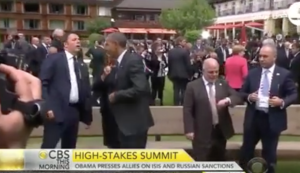
Screen-Shot-2015-06-08-at-2.21.59-PM-300x173

Oh yeah, President Obama knew PM Abadi was next to him and acted as if he wasn’t there – kinda like his approach to foreign policy
Source: CBS News

If you want additional details on the lead up to the rise of IS, then check out the history lesson we put together for President Obama’s counterpart Rand Paul, who is just as naive on foreign policy as he is:

Rand Paul Needs a History Lesson..
http://isisstudygroup.com/?p=6782

Links to Other Related Articles:

Defeating The Islamic State
http://isisstudygroup.com/?p=1708

Egypt Atmospherics
http://isisstudygroup.com/?p=614

Ramadi’s fall opens ISIS road to Baghdad. Jordan warns US air strikes won’t stop the terrorists’ advance

May 18, 2015

Ramadi’s fall opens ISIS road to Baghdad. Jordan warns US air strikes won’t stop the terrorists’ advance, DEBKAfile, May 18, 2015


Jordan’s King Abdullah has warned the Obama administration in an urgent message that US air strikes alone won’t stop the Islamic State’s advances in Iraq and Syria and, what is more, they leave his kingdom next door exposed to the Islamist peril. ISIS would at present have no difficulty in invading southern Jordan, where the army is thin on the ground, and seizing local towns and villages whose inhabitants are already sympathetic to the extremist group. The bulk of the Jordanian army is concentrated in the north on the Syrian border. Even a limited Islamist incursion in the south would also pose a threat to northern Saudi Arabia, the king pointed out.

Abdullah offered the view that the US Delta Special Forces operation in eastern Syria Saturday was designed less to be an effective assault on ISIS’s core strength and more as a pallliative to minimize the Islamist peril facing Saudi Arabia, Jordan and the Gulf emirates.

DEBKAfile’s Washington sources report that US officials refused to heed Abdullah’s warning and tried to play it down, in the same way as Secretary John Kerry tried Monday, May 18, to de-emphasize to the ISIS conquest of Ramadi, the capital of Iraq’s largest province.

At a news conference in Seoul, Kerry dismissed the Islamists’ feat as a “target of opportunity” and expressed confidence that, in the coming days, the loss “can be reversed.”

The Secretary of State’s words were unlikely to scare the Islamists, who had caused more than 500 deaths in the battle for the town and witnessed panicky Iraqi soldiers fleeing Ramadi in Humvees and tanks.

Baghdad, only 110 km southeast of Ramadi, has more reason to be frightened, in the absence of any sizeable Iraqi military strength in the area for standing in the enemy’s path to the capital.

The Baghdad government tried announcing that substantial military reinforcements had been ordered to set out and halt the Islamists’ advance. This was just whistling in the dark. In the last two days, the remnants of the Iraqi army have gone to pieces – just like in the early days of the ISIS offensive, when the troops fled Mosul and Falujah. They are running away from any possible engagement with the Islamist enemy.

The Baghdad-sourced reports that Shiite paramilitaries were preparing to deploy to Iraq’s western province of Anbar after Islamic State militants overran Ramadi were likewise no more than an attempt to boost morale. Sending armed Shiites into the Ramadi area of Anbar would make no sense, because its overwhelmingly Sunni population would line up behind fellow-Sunni Islamist State conquerors rather than help the Shiite militias to fight them.

Iran’s Defense Minister Hossein Dehghan, who arrived precipitately in Baghdad Monday, shortly after Ramadi’s fall, faces this difficulty. Our military sources expect him to focus on a desperate effort to deploy Shiite militias as an obstacle in ISIS’s path to Baghdad, now that the road is clear of defenders all the way from Ramadi.

In Amman, King Abdullah Sunday made a clean sweep of senior security officials, firing the Minister of Interior, the head of internal security (Muhabarat) and a number of high police officers. They were accused officially of using excessive violence to disperse demonstrations in the southern town of Maan.

The real reason for their dismissal, DEBKAfile’s counter-terror sources disclose, is the decline of these officials’ authority in the Maan district,  in the face of the rising influence of extremist groups identified with Al Qaeda and ISIS, in particular.

US continues to insist airstrikes support Iraqi forces, not Shiite militias

March 26, 2015

US continues to insist airstrikes support Iraqi forces, not Shiite militias, Long War Journal, Bill Roggio, March 26, 2015

(Perhaps it’s just Obama’s unrequited love for Iran and his need to get any nuke deal that Iran will give him. — DM)

US government officials and top military commanders are so eager to destroy the Islamic State that they are crawling into bed with the flip side of the jihadist coin: the fanatical Shiite militias backed by Iran that are terrorist organizations and ultimate destabilizers of Iraq in their own right.

*****************

Combined Joint Task Force-Operation Inherent Resolve (CJTF-OIR), the US-led Coalition that is launching airstrikes against the Islamic State in Iraq and Syria, announced that it conducted 17 strikes against Islamic State fighters entrenched in Tikrit. US commanders continue to insist that they are supporting Iraqi security forces, and not the Iranian-backed Shiite militias who make up more than two-thirds of the fighting force in the Tikrit offensive.

The 17 airstrikes targeted “an ISIL [Islamic State] building, two ISIL bridges, three ISIL checkpoints, two ISIL staging areas, two ISIL berms, an ISIL roadblock and an ISIL controlled command and control facility,” according to a press release. The US military continues to refer to Islamic State as ISIL, the outdated acronym for the Islamic State of Iraq and the Levant (Syria).

The airstrikes launched “in support of Iraqi Security Forces in Tikrit commenced last night after a request from the Government of Iraq,” CJTF-OIR stated. The 17 targets hit in the last 24 hours were “approved by the Iraqi Ministry of Defense.”

US military officials have previously said that support for the Tikrit offensive was being withheld because of the massive presence of the Iranian-backed militias and Iranian military units and advisers.

Despite this previous acknowledgment, Lieutenant General James Terry, the commander of CJTF-OIR, skips over the presence of Shiite militias in the Tikrit operation [emphasis mine] in the latest statement.

“The ongoing Iraqi and Coalition air strikes are setting the conditions for offensive action to be conducted by Iraqi forces currently surrounding Tikrit,” said Lt. Gen. James Terry. “Iraqi Security Forcessupported by the Coalition will continue to gain territory from Daesh [a vaguely pejorative Arabic acronym for the Islamic State].” [Emphasis in original — DM]

Pretending that US airpower isn’t supporting the Iranian-backed Shiite militias obviously doesn’t make it so.

US military officials’ denials that they are serving as the air force for Iranian-backed Shiite militias that are responsible for killing hundreds of American soldiers before US forces withdrew from Iraq in December 2011 becomes even more perplexing once you understand that many of the top leaders of these militias have been designated by the US as terrorists. And one of these militias (Hezbollah Brigades) is listed as a Foreign Terrorist Organization. [See LWJ report, US begins airstrikes against Islamic State in Tikrit, supports Shiite militias.]

US government officials and top military commanders are so eager to destroy the Islamic State that they are crawling into bed with the flip side of the jihadist coin: the fanatical Shiite militias backed by Iran that are terrorist organizations and ultimate destabilizers of Iraq in their own right.

Obama’s Iranian-nuclear strategy brings dividend: Rev Guards lead military assault on Tikrit

March 4, 2015

Obama’s Iranian-nuclear strategy brings dividend: Rev Guards lead military assault on Tikrit, DEBKAfile, March 4, 2015

(Please see also The World Bows to Iranian Regional Hegemony and Should We Give Up on the Iraqi Army? — DM)

General_Qassam_Suleimani_IRAQ_1.15Iranian Gen. Qassem Soleimani on Tikrit battlefront

US President Barack Obama’s plans for Iran, which were spectacularly challenged by Binyamin Netanyahu in his Congress speech Tuesday, March 3, were manifested 10,000 kilometers from Washington in the firestorm over Tikrit, the important Sunni town north of Baghdad. There, Iranian-led Iraqi troops are on the offensive against the Islamic State in the biggest ground battle fought in Iraq since the Iraqi army fell apart and scattered last June against the conquering Islamist march through western and central Iraq.

For four reasons, this battle is loaded with ramifications for Obama’s Iran policy and the Islamic Republic’s drive for recognition as the leading Middle East power:

1.   For Tehran it is a high-stake gamble for prestige, Its top military strategist, Al Qods Brigades chief Gen. Qassem Soleimani, was thrown into the Tikrit operation, to become the first high-ranking general Iran has ever placed publicly up front in direct command of a key battle as a guarantee of its success.

2.  However, three days after the offensive was launched on Sunday, March 1, the 25,000 Iranian and Iraqi troops, backed by Iraqi Shiite militias, were still fighting outside its gates, upsetting the high hopes of a swift victory and breakthrough into the city.

Islamist forces slowed their advance by strewing hundreds of mines and roadside bombs on all the roads leading to Tikrit, while teams of suicide bombers jumped out and blew themselves up amidst the invading army – a tactic seen before in the battle for the Syrian Kurdish town of Kobani.
ISIS boasted that one of the suicide bombers was an American citizen whom they dubbed “Abu Dawoud al-Amriki.”

3.  The United States has no military input in the battle – neither US advisers on the ground nor aerial bombardment. On Tuesday, March 3, while Netanyahu was advising Congress in reference to the relative merits of radical Iran and ISIS that “the enemy of your enemy is the enemy,” Gen. Martin Dempsey, Chairman of the US Joint Chiefs of Staff, revealed some of the Obama administration’s thinking on the subject.

He said Iran and its allies (Iraqi Shiite militias) had taken part in the Iraq war ever since 2004. “But the Tikrit campaign signals a new level of involvement,” he said. “This is the most overt conduct of Iranian support in the form of artillery and other things” and “…could turn out to be a positive thing.”

These comments corroborated DEBKAfile’s disclosures on the US-led war on ISIS, which defined America as confining itself to air strikes over Iraq and Syria and assigning the brunt of the ground war to Iran’s Revolutionary Guards forces – a division of labor, which Israeli military chiefs watch with increasing concern as it brings the Iranian peril closer than ever to Israel, DEBKAfile’s military sources report.

The Iraq format is replicated in southern Syria, where the same Gen. Soleimani, joined by a group of fellow Iranian generals, is leading an operation to seize that part of the country from Syrian rebel hands, including the Golan town of Quneitra .

4. The role Obama has assigned Iran in the two embattled Middle East countries bears directly on the scope of his concessions in the bargaining for a comprehensive nuclear deal.