Posted tagged ‘Turkey’

Turkey: “An End to an Era of Oppression”

June 8, 2015

Turkey: “An End to an Era of Oppression,” The Gatestone InstituteBurak Bekdil, June 8, 2015

  • “We, through democratic means, have brought an end to an era of oppression.” — Kemal Kilicdaroglu, leader of the main opposition, Republican People’s Party (CHP).
  • Erdogan is now the lonely sultan in his $615 million, 1150-room presidential palace. For the first time since 2002, the opposition has more seats in the parliament than the AKP.

For the first time since his Islamist party won its first election victory in 2002, Turkish President Recep Tayyip Erdogan was nowhere to be seen on the night of June 7. He did not make a victory speech. He did not, in fact, make any speech.

Not only failing to win the two-thirds majority they desired to change the constitution, the AKP lost its parliamentary majority and the ability to form a single-party government. It won 40.8% of the national vote and 258 seats, 19 short of the simple majority requirement of 276. Erdogan is now the lonely sultan at his $615 million, 1150-room presidential palace. For the first time since 2002, the opposition has more seats in parliament than the AKP: 292 seats to 258.

“The debate over presidency, over dictatorship in Turkey is now over,” said a cheerful Selahattin Demirtas after the preliminary poll results. Demirtas, a Kurdish politician whose Peoples’ Democracy Party [HDP] entered parliament as a party for the first time, apparently with support from secular, leftist and marginal Turks, is the charismatic man who destroyed Erdogan’s dreams of an elected sultanate. Echoing a similar view, the social democrat, Kemal Kilicdaroglu, leader of the main opposition Republican People’s Party [CHP], commented on the early results in plain language: “We, through democratic means, have brought an end to an era of oppression.”

What lies ahead is less clear. Theoretically, the AKP can sign a coalition deal with the third biggest party, the right-wing Nationalist Movement Party [MHP], although during the campaign, MHP leader Devlet Bahceli slammed Erdogan harshly for the embarrassing corruption allegations against the president. At the same time, a CHP-MHP-HDP coalition is unlikely, as it must bring together the otherwise arch-enemies MHP and HDP.

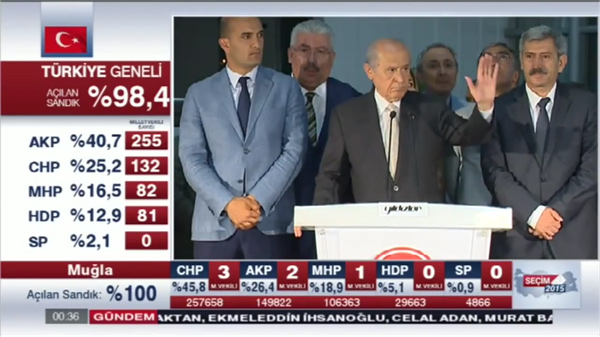
1098Turkey’s Nationalist Movement Party leader Devlet Bahceli addresses supporters after the release of preliminary election results, June 7, 2015. (Image source: MHP video screenshot)

The AKP management may be planning for snap, or early, polls but there are hardly any rational reasons for it except to risk another ballot box defeat. Parliament may try a minority government, supported by one of the parties from outside government benches, but this can only create a temporary government.

Two outcomes, however, look almost certain: 1) The AKP is in an undeniable decline; the voters have forced it into compromise politics rather than permitting it to run a one-man show, with in-house bickering even more likely than peace, and new conservative Muslims challenging the incumbent leadership. 2) Erdogan’s ambitions for a too-powerful, too-authoritarian, Islamist executive presidency, “a la sultan,” will have to go into the political wasteland at least in the years ahead.

The AKP appeared polled in first place on June 7. But that day may mark the beginning of the end for it. How ironic; the AKP came to power with 34.4% of the national vote in 2002, winning 66% of the seats in parliament. Nearly 13 years later, thanks to the undemocratic features of an electoral law it has fiercely defended, it won 40.8% of the vote and only 47% of the seats in parliament, blocking it from even forming a simple majority.

Directive 11: Obama’s Secret Islamist Plan

June 8, 2015

Directive 11: Obama’s Secret Islamist Plan, Front Page Magazine, Daniel Greenfield, June 8, 2015

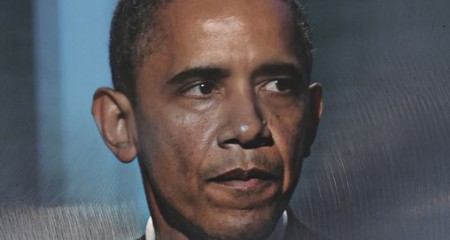
Obama-450x240

What little we know about the resulting classified 18-page report is that it used euphemisms to call for aiding Islamist takeovers in parts of the Middle East. Four countries were targeted. Of those four, we only know for certain that Egypt and Yemen were on the list. But we do know for certain the outcome.

Obama’s insistence that human rights be made a core national security interest paved the way for political and military interventions on behalf of Islamists. Obama had never been interested in human rights; his record of pandering to the world’s worst genocide plotters and perpetrators from Iran to Turkey to Sudan made that clear. When he said “human rights”, Obama really meant “Islamist power.”

********************

Behind the rise of ISIS, the Libyan Civil War, the unrest in Egypt, Yemen and across the region may be a single classified document.

That document is Presidential Study Directive 11.

You can download Presidential Study Directive 10 on “Preventing Mass Atrocities” from the White House website, but as of yet no one has been able to properly pry number 11 out of Obama Inc.

Presidential Study Directive 10, in which Obama asked for non-military options for stopping genocide, proved to be a miserable failure. The Atrocities Prevention Board’s only use was as a fig leaf for a policy that had caused the atrocities. And the cause of those atrocities is buried inside Directive 11.

With Obama’s typical use of technicalities to avoid transparency, Directive 11 was used to guide policy in the Middle East without being officially submitted. It is possible that it will never be submitted. And yet the Directive 11 group was described as “just finishing its work” when the Arab Spring began.

That is certainly one way of looking at it.

Directive 11 brought together activists and operatives at multiple agencies to come up with a “tailored” approach for regime change in each country. The goal was to “manage” the political transitions. It tossed aside American national security interests by insisting that Islamist regimes would be equally committed to fighting terrorism and cooperating with Israel. Its greatest gymnastic feat may have been arguing that the best way to achieve political stability in the region was through regime change.

What little we know about the resulting classified 18-page report is that it used euphemisms to call for aiding Islamist takeovers in parts of the Middle East. Four countries were targeted. Of those four, we only know for certain that Egypt and Yemen were on the list. But we do know for certain the outcome.

Egypt fell to the Muslim Brotherhood, which collaborated with Al Qaeda, Hamas and Iran, before being undone by a counterrevolution. Yemen is currently controlled by Iran’s Houthi terrorists and Al Qaeda.

According to a New York Times story, Obama’s Directive 11 agenda appeared to resemble Che or Castro as he “pressed his advisers to study popular uprisings in Latin America, Eastern Europe and Southeast Asia to determine which ones worked and which did not.”

The story also noted that he “is drawn to Indonesia, where he spent several years as a child, which ousted its longtime leader, Suharto, in 1998.”

The coup against Mubarak with its coordination of liberals, Islamists and the military did strongly resemble what happened in Indonesia. The most ominous similarity may be that the Muslim mobs in Indonesia targeted the Chinese, many of whom are Christians, while the Muslim mobs in Egypt targeted Coptic Christians.

Both were talented groups that were disproportionately successful because they lacked the traditional Islamic hostility to education, integrity and achievement. Islamist demagogues had succeeded in associating them with the regime and promoted attacks on them as part of the anti-regime protests.

Chinese stores were looted and thousands of Chinese women were raped by rampaging Muslims. Just as in Egypt, the protesters and their media allies spread the claim that these atrocities committed by Muslim protesters were the work of the regime’s secret police. That remains the official story today.

Suharto’s fall paved the way for the rise of the Prosperous Justice Party, which was founded a few months after his resignation and has become one of the largest parties in the Indonesian parliament. PJP was set up by the Muslim Brotherhood’s local arm in Indonesia.

His successor, Bacharuddin Jusuf Habibie, was more explicitly Islamist than Suharto and his Association of Muslim Intellectuals (ICMI) conducted a campaign against Christians, Hindus and Buddhists. It helped purge non-Muslims from government while Islamizing the government and Indonesia’s key institutions.

Habibie had been the Chairman of ICMI and ICMI’s Islamists played a key role in moving Suharto out and moving him in. It was obvious why Obama would have considered the Islamization of Indonesia and the purge of Christians under the guise of democratic political change to be a fine example for Egypt.

While we don’t know the full contents of Directive 11 and unless a new administration decides to open the vaults of the old regime, we may never know. But we do know a good deal about the results.

In its own way, PSD-10 tells us something about PSD-11.

Obama’s insistence that human rights be made a core national security interest paved the way for political and military interventions on behalf of Islamists. Obama had never been interested in human rights; his record of pandering to the world’s worst genocide plotters and perpetrators from Iran to Turkey to Sudan made that clear. When he said “human rights”, Obama really meant “Islamist power”.

That was why Obama refused to intervene when the Muslim Brotherhood conducted real genocide in Sudan, but did interfere in Libya on behalf of the Brotherhood using a phony claim of genocide.

Positioning Samantha Power in the Office of Multilateral Affairs and Human Rights at the National Security Council was part of the process that made over the NSC from national security to servicing a progressive wish list of Islamist terrorist groups that were to be transformed into national governments.

Power, along with Gayle Smith and Dennis Ross, led the Directive 11 project.

Secret proceedings were used to spawn regime change infrastructure. Some of these tools had official names, such as “The Office of The Special Coordinator For Middle East Transitions” which currently reports directly to former ambassador Anne Patterson who told Coptic Christians not to protest against Morsi. After being driven out of the country by angry mobs over her support for the Muslim Brotherhood tyranny, she was promoted to Assistant Secretary of State for Near Eastern Affairs.

“The Office” is still focused on “outreach to emergent political, economic and social forces in Egypt, Tunisia, and Libya” even though counterrevolutions have pushed out Islamists in Egypt and Tunisia, while Libya is in the middle of a bloody civil war in which an alliance of the Muslim Brotherhood and Al Qaeda controls the nation’s capital.

But even as Morsi’s abuses of power were driving outraged Egyptians into the streets, Gayle Smith, one of the three leaders of Directive 11, reached out to the “International Union of Muslim Scholars”, a Muslim Brotherhood group that supported terrorism against American soldiers in Iraq and which was now looking for American support for its Islamist terrorist brigades in the Syrian Civil War.

The men and women responsible for Directive 11 were making it clear that they had learned nothing.

Directive 11 ended up giving us the Islamic State through its Arab Spring. PSD-11’s twisted claim that regional stability could only be achieved through Islamist regime change tore apart the region and turned it into a playground for terrorists. ISIS is simply the biggest and toughest of the terror groups that were able to thrive in the environment of violent civil wars created by Obama’s Directive 11.

During the Arab Spring protests, Egyptian Foreign Minister Ahmed Aboul Gheit had told Hillary Clinton that his government could not hand over power to the Muslim Brotherhood. “My daughter gets to go out at night. And, God damn it, I’m not going to turn this country over to people who will turn back the clock on her rights.”

But that was exactly what Hillary Clinton and Obama were after. And they got it. Countless women were raped in Egypt. Beyond Egypt, Hillary and Obama’s policy saw Yazidi women actually sold into slavery.

Directive 11 codified the left’s dirty alliance with the Muslim Brotherhood into our foreign policy. Its support for Islamist takeovers paved the way for riots and civil wars culminating in the violence that birthed ISIS and covered the region in blood.

And it remains secret to this day.

Shoshana Bryen: The Kurds: A Guide for U.S. Policymakers

June 7, 2015

Shoshana Bryen: The Kurds: A Guide for U.S. Policymakerssecurefreedom via You Tube, June 5, 2015

Shoshana Bryen, Senior Director, Jewish Policy Center; Former Senior Director for Security Policy, Jewish Institute for National Security Affairs (JINSA):


Turkey, Our Ally

June 4, 2015

Turkey, Our Ally

June 4, 2015 by Robert Ellis

via Turkey, Our Ally.


On his visit to Turkey in 2009, U.S. President Barack Obama proclaimed that Turkey and the U.S. can build “a model partnership” and in an interview with Time in January 2012, he spoke of “the bonds of trust” he had forged with certain leaders, including Turkey’s Recep Tayyip Erdogan.

Traditional Turkish foreign policy, based on Atatürk’s dictum “peace at home and peace abroad,” has been replaced by a delusion, created by former foreign and now prime minister, Ahmet Davutoglu, that Turkey can restore its former Ottoman magnificence. As Davutoglu proclaimed in Sarajevo in 2009, “Like in the 16th century, when the Ottoman Balkans were rising, we will once again make the Balkans, the Caucasus and the Middle East, together with Turkey, the center of world politics.”

The main thrust of this new policy has been to create a Muslim Brotherhood crescent running from Egypt through Turkey to Syria to rival Iran’s Shia crescent, but this policy has been a dismal failure. Turkish ambassadors have been withdrawn from Syria, Egypt, Israel, Libya and Yemen, and recently from Austria and the Vatican, after their acknowledgement of the Armenian genocide, resulting in what Ibrahim Kalin, Erdogan’s chief adviser, in a tweet two years ago, called “precious loneliness.”

It was the same Kalin who, in a keynote speech at the Istanbul Forum in 2012, rejected the European model of secular politics, democracy and pluralism in favor of what he termed a “value-based” (read: Islamist) foreign policy. However, the AKP government’s attempt to overthrow Syria’s Bashar al-Assad has seriously backfired, but they have still not given up trying to drag the U.S. into the quagmire. Turkey’s proposal for the creation of a safe zone and no-fly zone in Syria has been met with no response, and in return Turkey has denied its NATO ally the use of Incirlik airbase for sorties against Islamic State (ISIL).

Consequently, the Bipartisan Policy Center (BPC) in Washington has in its April report concluded that Turkey is an increasingly undependable ally, and that because of the fundamental strategic disparities between Ankara and Washington, the U.S. should look to other regional players, for example, the KRG (Kurdistan Regional Government), for support.

An overriding factor in the BPC’s conclusions has been the Turkish government’s ideologically driven backing for extremist Sunni groups in Syria, where it has acted as a highway for would-be jihadists, who have been given free rein to travel through, recruit from, equip, operate and recuperate in Turkey.

Furthermore, a report from the U.N.’s Analytical Support and Sanctions Monitoring Team concludes that Turkey has also provided the primary routes for arms smuggled to ISIL and the Al-Nusrah Front, an Al-Qaida affiliate.

In the run-up to the Turkish elections on Sunday, there is a furor about video footage published last Friday by secular daily Cumhuriyet, which shows a shipment of weapons and ammunition disguised as humanitarian aid for Syria on trucks belonging to MIT (Turkey’s National Intelligence Organization), Erdogan’s Praetorian Guard. Reuters has also confirmed how MIT helped deliver arms to parts of Syria under Islamist rebel control during late 2013 and early 2014.

Characteristically, the public prosecutors and gendarmerie officers involved in intercepting the arms shipment have been arrested and charged with attempting to overthrow the Turkish government. A gag order has been imposed on coverage of the scandal and President Erdogan has personally threatened Cumhuriyet’s editor-in-chief with retribution. He has now filed a criminal complaint against the newspaper and its editor, demanding a life sentence.

The Turkish military is also uneasy about the charges brought against the gendarmerie officers involved, as their actions fall under military jurisdiction.

However, there is no reason to believe President Erdogan will give way without a struggle. As the Bipartisan Policy Center notes, losing power would be tantamount to a prison sentence, at best, and is simply not an option.

Egyptian Muslim Brotherhood Videos Call for Violence

June 2, 2015

Egyptian Muslim Brotherhood Videos Call for Violence, The Clarion ProjectRyan Mauro, June 2, 2015

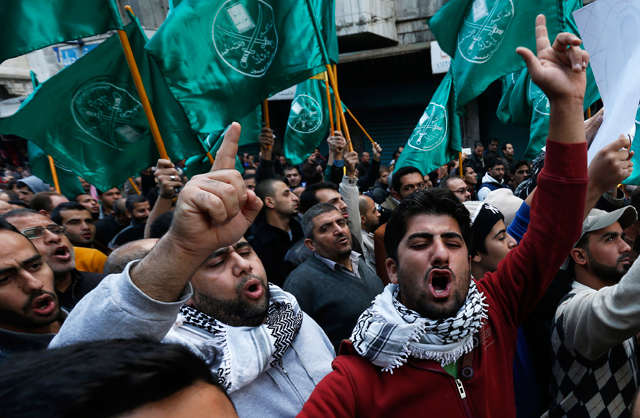
Egypt-Muslim-Brotherhood-Supporters-Flags-IPMuslim Brotherhood supporters in Egypt (Photo: © Reuters)

Egypt has released three videos of Muslim Brotherhood television networks in Turkey advocating violence against the Egyptian police, foreigners, embassies and interests in the region connected to countries that support President El-Sisi.

On Thursday, the Brotherhood’s English-language website announced a decision for revolution “with all its means and mechanisms” against the Egyptian government. The announcement references a declaration signed by 150 Islamic scholars that is less ambiguous in calling for jihad, also published in English.

The first video is from the Muslim Brotherhood’s Rabaa TV network launched in Turkey in 2013. The Egyptian government says the host in the video is a member of the Al-Gama’a Al-Islamiyya terrorist group.

The host is seen reading a statement from the “Revolutionary Youth Coalition;” a group that is almost certainly a Brotherhood front established to give itself plausible deniability while inciting and orchestrating terrorism. The vague terminology is an attempt to give its cause greater legitimacy by appearing more inclusive and broad-based.

The Brotherhood station reads the statement that demands the departure of all foreign Arabs, foreign Africans, embassy personnel, foreign companies and tourists by the end of (last) February. All governments must end their support for the Egyptian government “or else all of their interests in countries of the Middle East will be exposed to severe assaults or will be put in situations that nobody wants.”

The threat warns that henceforth there will be “no concessions or mercy.”

The second video is dated February 24 and is from a satellite network named Misr Alaan that the Egyptian government says was founded by the Brotherhood last year. The Arab press says it was launched from Turkey with Brotherhood sponsorship.  The network’s staff said its purpose is to reach a broader audience than the other Islamist channels in Turkey.

The video comes with an English translation that shows the host of a show explicitly urging the murder of Egyptian police and unspecified revolutionaries to rout the Egyptian soldiers who aid the police in the confrontation. His instructions are clear: “Kill them.”

“I say to the wives of all officers and the sons of all officers: Please be aware, your husbands will be dead. Your children will be orphans,” the host says while adding the sons of police officers may be kidnapped and claiming that the revolutionaries have the home addresses of the police.

The third video, also from Misr Alaan, shows a statement being read by a spokesman calling in from the “Revolutionary Punishment Movement,” continuing the pattern of using new, non-descriptive titles.

The speaker is asked about his group and he only says that it is a youth movement involved in the revolutions since the beginning, referring to the ousting of Egyptian President Mubarak. He condemns the arrests of female members of the group and declares there will be “reciprocal treatment.”

The speaker calls for the kidnapping and killing of Egyptian security personnel by the “lions” of this revolution. He then gives out the names of specific police officers to target without any interruption from the host.

On Thursday, May 28, the Brotherhood’s English-language website carried a statement by spokesperson Mohamed Montaser announcing “a final decision, after consulting its popular base, that the revolutionary option with all its means and mechanisms is its strategic choice from which there will be no retreat.”

The announcement appears to be a response to a reported rift within the Brotherhood between the older and more pragmatic leadership and the more militant youth advocating violence and disruption to society. It reiterates the legitimacy of the Brotherhood leadership and claims that it is inclusive of the youth.

The statement does not explicitly discuss the topic of violence but it certainly does not make the case for non-violence. It gives every reason for an Islamist to believe that violent jihad against the Egyptian government is now permissible.

The intention to inspire violence is detectable in how the Brotherhood references a declaration signed by 150 scholars that declares the Egyptian government to be an “enemy of Allah” waging “war against Islam.” The listed offenses qualify it as a target for violent jihad.

“It is an Islamic duty of the whole Muslim Ummah, rulers and peoples alike, to resist this regime and to seek to break it using all legitimate means in order to safeguard the fundamentals of the Ummah and to maintain the higher objectives of Islam,” it says.

The declaration most clearly instigates violence in points 4 and 6 regarding retribution for acts against the Brotherhood and for forcibly freeing prisoners:

“4. Rulers, judges, officers, soldiers, muftis, media persons, politicians and any other party proven beyond any doubt to be involved in the crimes of violating honor, bloodshed and illegal killing, even if through inciting such acts, are considered, from Islamic perspective, murderers to whom all rulings related to the crime of murder are applicable. They must receive qisas (retribution punishment) within the Islamic Law limits.”

“6. The nation must do its best to free any person, especially women, detained as a result of opposing the coup and demanding respect of the nation’s will and freedom. No effort should be spared to release them using the means approved by Islam.”

The Brotherhood is aware of what it’s calling for. If it didn’t want violent jihad, it would add a disclaimer about the declaration only authorizing non-violence. Instead, there’s only a mention of civil disobedience as a tactic without any kind of rejection of violence in point 13:

“13. We demand all forces opposing the coup and all free people, inside and outside Egypt, to combine efforts in resistance of this criminal regimes and to use all appropriate means such as civil disobedience and any other tool to purge the country of the coup’s tyranny and crimes and to stand up for the martyrs’ cause.”

The declaration is especially significant because brings the Brotherhood a step closer towards officially supporting violence in Egypt; a direction it’s been moving towards in its Arabic content.

In January, the Brotherhood announced a “new phase…where we recall the meanings of jihad and prepare ourselves, our wives, our sons, our daughters, and whoever marched on our path to a long, uncompromising jihad, and during this stage we ask for martyrdom.”

Any doubt as to whether the Brotherhood meant violence is put to rest by what follows:

Imam al-Banna [the founder of the Brotherhood] prepared the jihad brigades that he sent to Palestine to kill the Zionist usurpers and the second [Supreme] Guide Hassan al-Hudaybi reconstructed the ‘secret apparatus’ to bleed the British occupiers.”

The call to violence in Arabic was shortly followed by one in English titled, “Egypt Muslim Brotherhood Reiterates Commitment to Non-Violence.”  The contradiction is reflective of a long-standing patternwhere the Brotherhood speaks more diplomatically in English and more “jihadist” in Arabic. Contrary to assertions that the Brotherhood officially abandoned violence, the group has consistently endorsed and engaged in violent jihad since its supposed “moderation.”

The newly-released videos are just a sample of the proof that the Brotherhood’s “moderate” persona is a contrived mirage.

Turkish Prime Minister: “We will march to liberate Jerusalem”

May 28, 2015

Turkish Prime Minister: “We will march to liberate Jerusalem”

During the inauguration of the 55th airport in Hakkari Province, Turkish Prime Minister Ahmet Davutoglu and Turkish President Recep Tayyip Erdogan called for the re-establishment of the Ottoman Empire.

May 28, 2015, 04:07PM | Rachel Avraham

via Israel News – Turkish Prime Minister: “We will march to liberate Jerusalem” – JerusalemOnline.

Clear ?

Erdogan

Erdogan Photo Credit: Reuters/Channel 2


According to a report published by Palestinian dissident Walid Shoebat, Turkish President Recep Tayyip Erdogan and Turkish Prime Minister Ahmet Davutoglu spoke during the inauguration ceremony of the country’s 55th airport in Hakkari Province.  The airport is named the Selahaddin Eyyubi Airport after Saladin of the Ayyubi dynasty, the Muslim ruler of Kurdish origin that conquered Jerusalem and was a great enemy of the Christian Crusaders especially Richard the Lionheart.  During the ceremony, both Turkish leaders spoke of their desire to conquer Jerusalem and to re-establish the Ottoman Empire.

“By Allah’s will, Jerusalem belongs to the Kurds, the Turks, the Arabs, and to all Muslims,” Davutoglu declared.  “And as our forefathers fought side by side at Gallipoli and just as our forefathers went together to liberate Jerusalem with Saladin, we will march on the same path to liberate Jerusalem.  The Turkish government does not differentiate from East to West.  We intend to put together all of the regions of our nations and we will bring these regions back together.”

Erdogan’s speech was even more grandiose.   He proclaimed himself to be the reincarnation of Saladin, who will kick whom he perceives to be the modern day crusaders out of Jerusalem by uniting the Muslim world behind him by hinting at the re-establishment of the Ottoman Empire: “I am sure that the great commander Saladin is bringing together all of the peoples of the Middle East into the one army that defeated the Crusaders.  Saladin is currently witnessing what we are doing here spiritually.  I was in his spiritual presence and I am addressing him here in Hakkari with the mighty men, be it eastern, brave south-eastern, valiant Anatolian in Old Turkey.”

“Jerusalem is for the Muslims and not for Israel,” Erdogan added.  “Why should we continue to be friends with those that stomped their boots on the Temple Mount?  They insist that we have to be friends?  I say, we will not.”   Erdogan promised to follow in Saladin’s footsteps: “They all promise you O Saladin, if you united the brothers in the Middle East, so will we.  Saladin said ‘Jerusalem is not for the Crusaders.’  Saladin witnessed this.  Allah witnesses this.  One people, one flag, one nation and one state!”

Could Saudi Arabia Need Israel More than Vice Versa?

April 12, 2015

Could Saudi Arabia Need Israel More than Vice Versa? Israel National News, Gedalyah Reback, April 12, 2015

Israel’s status as a regional superpower is unusual for its lacking a reliable set of local allies. Even where security ties with Egypt, Jordan and Saudi Arabia might be strong, the country is forced to keep those ties in the background. Regardless, it exerts a degree of influence just by its own strategic value. While ties are not public, they are also not available for public scrutiny, perhaps enhancing the relationship opportunities with the above mentioned countries as well as other Arab states.

“Rather than a charm offensive,” asserts Robert Kappel of the German Institute of Global and Area Studies, “Israel needs an assertive regional foreign policy” in order to gain more allies.

But is that really true?

“I don’t think that it’s either-or,” says Professor Eytan Gilboa of Bar Ilan University. “I think Israel has a regional policy. We don’t see it but it collaborates with Arab countries and the Persian Gulf, especially on Iran and much more on counter-terrorism. It has a regional policy but it’s undercover.”

Solving the Israeli-Palestinian Conflict is not a Condition for an Alliance

Turning back specifically to Kappel, Gilboa states “I think he means to use it to deal with the Palestinian issue; then comes the Arab Peace Initiative. The assumption is the PA is unable, unable, to reach an agreement with Israel.”

Gilboa sees an Arab desire to expand relations with Israel in spite of the conflict with the Palestinians. Thus, the Arab Peace Initiative might be evidence the Arab countries are eager to reach out with a public offer that would allow them to open the door for Jerusalem without necessarily having to seal a deal on the conflict.

“I reject one claim: that resolution of the Israeli-Palestinian issue is a condition for a regional alliance. The reason for this is simple – all these countries couldn’t care less about the Palestinians. They have an interest in blocking Iran and extremist Islamic organizations. They made all kinds of statements to the contrary but that is not the issue. I don’t think there’s a linkage here.”

Pressing his point, Gilboa says “There’s much less opportunity for regional pressure on the Palestinians than most people think. ‘Collaboration’ is a euphemism for security cooperation on ‘negative interests.’”

Those negative interests are opposition to common regional security challenges like the above mentioned Iran and Islamist terrorist organizations. But to create an alliance, you need much more than common enemies, says Gilboa – you need common interests.

“Turkey ambivalent to ISIS – they share an ideology but still see it as a competitor. Erdogan would like to revive the Ottoman Empire where a non-Arab country leads the Arab world. Where you see this kind of geopolitics, there are a lot of opportunities for collaboration with these countries.”

And actually, “there’s criticism of Israel for not exploiting the situation,” says Gilboa.

New Countries?

When Arutz Sheva asked if Israel’s chances for regional alliances might actually increase if Syria were to collapse into several smaller states or the Iraqi Kurdish Regional Government (KRG) were to become a full-fledged independent state, Gilboa sees the idea as having validity.

“I think this is a valid point. I am only hearing that Israel is collaborating with the Kurds there and you can do a little bit more, but it is a lot more than it used to be. The alliance with Turkey had prohibited close collaboration with the Kurds. But now that the relationship is bad, this condition is nonexistent. I think indeed they could do more.”

Focusing on the much more developed autonomy, infrastructure and ambitions of the Iraqi Kurds than other groups that could emerge in Syria, Gilboa says Kurdistan could definitely become a game-changer in the region’s mixture of waxing and waning alliances. Most significantly, it could be something that does not necessarily replace Arab states as a reliable ally, but actually enhances the chances of a strong alliance between those Arab countries and Israel.

“I also think there is room for a strategic alliance between Israel and pro-US Arab states. Not just potential between Israel and the non-Arab groups, but collaboration with Israel, non-Arab states and those emerging new political entities in the Middle East. It could be done on a bilateral basis first – perhaps between Israel and Kurdistan – or multilateral. Once you gain influence with a group like the Kurds, you could translate that into the other (multilateral) type of alliance.”

Israel and Kurdistan have a long history of both covert and overt relations, especially on security. Kurdistan might then be an example of an emerging country where Israel could carry more influence than the Saudis (assuming Kurdistan is able to gain more autonomy or full sovereignty). Saudi Arabia’s diplomatic and military clout is still behind that of Israel, according to Gilboa.

“Saudi Arabia’s power is limited to its ability to manipulate oil markets, but their strength is precarious as major importers like the United States become self-sufficient in that realm. Even their military strength might turn out to be limited as its operation in Yemen is one of the largest it has ever undertaken. The assumption the Saudis might have strong influence over Pakistan and could persuade Islamabad to sell Riyadh a nuclear bomb to pull ahead of the Iranians has been thrown into doubt by Pakistan’s decision not to join the military operation against the Houthis.”

Ultimately, it might be Israel’s power that the Saudis need more.

Anything but a Saudi win (in Yemen) would not be good for Saudi Arabia,” emphasizes Gilboa. On the other hand, “Israel is much stronger diplomatically, militarily and its society is much more vibrant.”

Book review: The Islamic War

March 16, 2015

The Islamic War: Book review, Dan Miller’s Blog, March 16, 2015

(The views expressed in this article are mine and do not necessarily reflect those of Warsclerotic or its other editors. — DM)

The Islamic War, Martin Archer, 2014

The novel begins with a terror attack on a residential area in Israel, resulting in multiple causalities. It may, or may not, have involved members of the Iranian Revolutionary Guard. Menachem Begin is the Israeli Prime Minister and Ariel Sharon is the Defense Minister. The story begins immediately after the (postponed?) end of the Iran – Iraq war in 1988.

A massive armor, infantry, artillery and air attack on Israeli positions in the Golan follows the terrorist attack. The Israelis are outnumbered and suffer many thousands of casualties.

Israel had anticipated a simultaneous attack via Jordan, so most Israeli tank, infantry and air resources are deployed there, rather than in the Golan, to conceal themselves and await the arrival of Iranian, Iraqi and Syrian forces. They come and are defeated, most killed or fleeing. The Israeli forces then move into Syria and have similar successes there as well.

As the story evolves, it becomes evident that Israel must have known that the Iran – Iraq war had been allowed to fester to permit Iran, Iraq and Syria to develop a well coordinated plan to dispose of Israel, in hopes that a surprise attack could be made as soon as the Iran – Iraq war ended. Other events also suggest that Israel had prior notice:

Nuclear facilities of several hostile nations explode mysteriously.

The Israeli Navy had managed to infiltrate Iranian oil ports — apparently before the attack on the Golan — without being noticed. Then, at a propitious moment near the end of the fighting elsewhere, they destroyed all oil tankers in, entering or leaving port, along with all Iranian oil storage facilities.

The Israel Navy, which had suffered no losses, then moved to Saudi Arabia to protect her oil ports and ships coming to buy her oil and leaving.

As these events unfold, Israel, Egypt, Jordan, Saudi Arabia and Turkey* are negotiating a united front against Iran, Iraq and Syria, much to the displeasure of the U.S. Secretary of State, who wants a cease fire and return to the status quo ante. Fortunately, the U.S. President favors Israel and her coalition and generally ignores his SecState.

I won’t spoil the story by relating what happens at the end, but it’s very good for Israel, Egypt, Jordan, Saudi Arabia, Turkey and the Kurds, and very bad for Iran, Iraq and Syria. The novel is well worth reading, perhaps twice.

_____________

*Historical note: Turkey in 1988 was reasonably secular and also in other ways quite different from now. Egypt under President Al-Sisi is, in some but not all respects, similar to Egypt in 1988 under President Mubarak. Beyond a good relationship with Israel, Al-Sisi is working to modernize and reform Islam by turning it away from the violent jihad which drives both the Islamic State (Sunni) and the Islamic Republic of Iran (Shiite). Egypt remains under fire from the Obama administration due to the “coup” which ousted President Morsi, who had made Egypt essentially an arm of the Muslim Brotherhood. Egypt now helps to protect Israel with her military presence in the Sinai to oppose Hamas and Muslim Brotherhood activities there. Saudi Arabia and Jordan, like most countries in the Middle East, look out for the interests of their rulers first and are quite concerned about both the Islamic State and Iran.

Intelligence: Broken Arrow

March 11, 2015

Intelligence: Broken Arrow

By G. Murphy Donovan

March 11, 2015

via Articles: Intelligence: Broken Arrow.

Policy is a worldview. Intelligence is the real world, a wilderness of untidy facts that may or may not influence policy. When Intelligence fails to provide a true and defensible estimate, a clear picture of threat, policy becomes a rat’s nest of personal and political agendas where asserted conclusions and political correctness become the loudest voices in the room.  The policymaker thinks he knows the answer. The intelligence officer has the much tougher tasks of confirming or changing minds.

American national security analysis has been poisoned by such toxins. An Intelligence report these days might be any estimate that supports the politics of the moment. Truth today is an afterthought at best and an orphan at worst.

Alas, corrupt Intelligence is the midwife of strategic fiasco. Four contemporary failures provide illustrations: revolutionary theocracy, the Islam bomb, imperial Islamism, and the new Cold War.

Back to Theocracy

The Persian revolution of 1979 was arguably the most significant strategic surprise of the last half of the 20th Century. Yes, more significant than the fall of Soviet Communism. (The precipitous fall of the Soviet Bloc, to be sure, was another bellwether event unanticipated by Intelligence analysis.) The successful religious coup in Iran, heretofore an American client regime, now provides a model for all Muslim states where the default setting among tribal autocracies is now theocracy not democracy. In the wake of the Communist collapse, Francis Fukuyama argued that the democratic ideal was triumphant, an end of history as we knew it, the evolutionary consequence of progressive dialects. Fukuyama was wrong, tragically wrong. History is a two-way street that runs forward as well as backwards.

The fall of the Soviet monolith was not the end of anything. It was the beginning of profound regression, an era of religious irredentism. Worrisome as the Cold War was, the relationship with Moscow was fairly well managed. Who can argue today that East Europe or the Muslim world is more stable or peaceful than it was three decades ago?

The Persian revolution of 1979 not only reversed the vector of Muslim politics, but the triumph of Shia imperialism blew new life into the Shia/Sunni sectarian fire, a conflict that had been smoldering for more than a thousand years. The theocratic victory in Tehran also raised the ante for Israel too, now confronted by state sponsored Shia and Sunni antagonists, Hezb’allah, Fatah, and Hamas.

Shia Hezb’allah calls itself the party of God! Those in the Intelligence Community who continue to insist that religion is not part of the mix have yet to explain why God is part of the conversation only on the Islamic side of the equation.

Global Islamic terror is now metastasizing at an alarming rate. More ominous is the ascent of the Shia clergy, apocalyptic ayatollahs, bringing a lowering of the nuclear threshold in the Middle East. Sunni ISIS by comparison is just another tactical terror symptom on the Sunni side — and yet another strategic warning failure too.

Tehran is in the cat bird’s seat, on the cusp of becoming a nuclear superpower. Nuclear Iran changes every strategic dynamic: with Israel, with Arabia, and also with NATO. A Shia bomb is the shortcut to checkmate the more numerous Sunni. Iran will not be “talked out” of the most potent tool in imperial Shia kit — and the related quest for parity with Arabian apostates.

The Islam Bomb

The Islam bomb has been with us for years, in Sunni Pakistan, although you might never know that if you followed the small wars follies in South Asia. The enemy, as represented by American analysis, is atomized, a cast of bit players on the subcontinent. First, America was fighting a proxy war with the Soviets. When the Russians departed, the enemy became the murderous Taliban followed by al Qaeda. Both now make common cause with almost every stripe of mujahedeen today. In the 25 years since the Soviet withdrawal, Afghanistan has been reduced now to a rubble of narco-terror and tribalism. If we can believe bulletins from the Pentagon or the Oval Office, America is headed for the Afghan exit in the next two years — maybe. Throughout, the real threat in South Asia remains unheralded — and unmolested.

Nuclear Pakistan is one car bomb, or one AK-47 clip, away from another Taliban theocracy. This is not the kind of alarm that has been raised by the Intelligence Community. Hindu India probably understands the threat, Shia Persia surely understands the Sunni threat, and just as surely, Israel understands that a Sunni bomb is the raison d’etre for a more proximate Shia bomb. Who would argue that the Sunni Saudis need nuclear “power”? Nonetheless, Riyadh is now in the game too.  The most unstable corner of the globe is now host to a nuclear power pull.

The American national security establishment seems to be clueless on all of this. Indeed, when a unique democracy like Israel tries to illuminate a portion of the nuclear threat before the American Congress, the Israeli prime minister is stiff-armed by the Oval Office. If Washington failed with Pakistan and North Korea, why would anyone, let alone the Israelis, believe that Wendy Sherman is a match for the nuclear pipedreams of apocalyptic Shia priests.

Alas, the motive force behind a Shia bomb is not Israeli capabilities or intentions. Israel is a stable democracy where any territorial ambitions are limited to the traditional Jewish homeland. Israel is no threat to Persia or Arabia.  Pakistan, in contrast, is like much of the Sunni world today, another internecine tribal or sectarian wildfire waiting for a match.

The advent of the Islam bomb in Asia was not just a strategic surprise, but the step-child of strategic apathy. The folly of taking sides with the Sunni has now come home to roost. Iran is about to go for the atomic brass ring too, with the Saudis in trail, and there’s not much that America can/will do except mutter about secret diplomacy and toothless sanctions. Of course, there’s always the option of blaming Jews when appeasement fails.

Imperial Islam

The Ummah problem, the Muslim world, has now replaced the Soviet empire, as Churchill would have put it, as the “riddle wrapped in a mystery inside an enigma.” There are four dimensions to the Islamic conundrum: the Shia/Sunni rift, intramural secular/religious conflicts, kinetic antipathy towards Israel and the West writ large, and the failure of analysis, especially strategic Intelligence, to unwrap the Muslim onion in any useful way. Imperial Islam, dare we say Islamofascism, now threatens secular autocracy and democracy on all points of the compass.

Islam in London

Islamic imperialism is a decentralized global movement. Nonetheless, the various theaters are united by tactics, strategy, ideology, and objectives. The tactics are jihad, small wars, and terror. The strategy is the imposition of Shariah Law. The ideology is the Koran and the Hadith. And the objective is a Shia or Sunni Islamic Caliphate — for infidels, a distinction without difference.

Muslim religious proselytizers and jihad generals in the field make no secret of any of this. The problem isn’t that some Muslims dissent from this agenda, the problem is that the West, especially national security analysts, cannot/will not believe or accept what Islamic imperialists say aloud, about themselves. The enemy is hiding in plain sight, yet the Intelligence Community doesn’t have the integrity or courage to make a clear call.

Noted British criminal psychiatrist Theodore Dalrymple captures the bizarre logic of appeasement:

“Racial, religious and cultural identity are morally important in politics, precisely what so many people would like to deny because it can so easily unleash the vilest political passions. Something that is true, say our people of goodwill to themselves, could have nasty consequences; therefore it is not true.”

Propaganda provides many of the strategic “tells” in any conflict. The Nemstov murder in the shadow of the Kremlin provides an example. The knee-jerk reaction of politicians and pundits in America was to implicate Russian culture, the Kremlin, or Vladimir Putin.

Contrast the Nemstov blame game with any or every recent Islamist atrocity and the nuclear race in the Ummah. With these, the knee-jerk reaction is to defend Islam, more concern for Islamism and the religious equivalence shibboleth than the nuclear threat or Jewish, Christian, and apostate heads that are now literally rolling on a global scale. In a recent US State Department brief, we are told by State Department spokesman Marie Harf that Islamic terrorism might be attributed to “unemployment” (sic).

Cold War Redux

The West can no longer take yes for an answer. The deliberate resuscitation of the Cold War amidst a host of tactical defeats in the Ummah is probably one of the worst foreign policy choices on record.

The old Soviet Union: took down the Berlin Wall, relinquished former satellites, dismantled the Warsaw Pact military alliance, and purged East Europe of nuclear weapons. In response, America and the EU dismantled Yugoslavia, taking the Muslim side we might add, and aggressively expanded NATO up to the traditional Russian border. The “End of (totalitarian) History” as we knew it wasn’t enough. Any vestigial associations with Moscow were relentlessly undermined. The American sponsored coup, orchestrated by Victoria Nuland at the US State Department, with likely help from the CIA, in Ukraine is the best and most recent example.

The “regime change” strategy in Europe has degenerated into some petulant version of nuclear chicken with the Russians. The American embassies in Moscow and Kiev regularly host anti-Putin dissidents in Ukraine and Russia

Regime change folly has lowered the nuclear threshold in South Asia, the Mideast, and now East Europe. Sevastopol and Kiev are side shows. The real target for Brussels and Washington is Moscow — and the Putin regime. The idea that the Kremlin or Russians can be undone or manipulated by: black operations, cyber war, sanctions, propaganda, or provocations is naïve and reckless. Putin is not a Pahlavi, Gadhafi, Assad, or Yanukovych.

Russians were very helpful in ridding Syria of chemical weapons and clearing the Ukraine of nuclear weapons.  Moscow and Putin have the potential also to be very useful against terror, nuclear proliferation, and resolving the Levant lunacy too.

The House minority leader recently lamented losing the “public relations” war with Russia. The American Secretary of State responded that Russian Television (RT) was responsible (sic). The more believable narrative spun by the Kremlin might be closer to the mark. Truth is a powerful ally, especially when it’s coupled with skillful propaganda.

The origin of the new Cold War may have domestic origins. Neither major American political party has a clue as what to do with the metastasizing Muslim problem. Indeed, both sides gag on words like Islam, Muslim, or Mohammed. As 2016 approaches, both parties desperately need to change the subject and find a foreign policy to run on. Regime change in Russia seems to be the consensus choice for American demagogues, Right and Left.

The idea that domestic “politics stops at the border” was always honored more in the breach than anywhere else. The politics of personal destruction is a time honored tradition in America, especially on the Left. That standard has now been folded into the foreign relations bag of tricks. Henry Kissinger claims that “demonization” is not policy. That may be true in any real politic sense, but the Putin bogyman is an ideal straw man for the next American presidential election. Proxy war abroad seems to be the safe sex of domestic politics.

What Now?

The American Intelligence Community is now the largest (17 agencies and uncountable contractors) and most expensive data collection and processing complex in history. Unfortunately, this gold-plated leviathan is undone by inferior analysis, indeed, estimates and reports that are more political than prudent. Withal, existential functions like strategic warning may be in freefall.

The obvious solution would be to take the strategic warning and national estimative functions out from under the IC, and the Executive Branch, and give those tasks to some apolitical body, assuming of course that an impartial forum might be sustained beyond the control of any branch of government. Realistically, it’s hard to believe that any American political party would sponsor an independent and uncontrollable voice of candor or objectivity.

Nonetheless, there are small things that might be done to make a huge difference. During the Cold War, USAF Intelligence ran a service of common concern for the IC called “Soviet Awareness.” The purpose of that program at Bolling AFB was to educate novice intelligence officers and FBI agents about the Soviet threat. The program included Russian history, the rise and spread of Communism, Marxist ideology, and Soviet military capabilities.

Ironically, the inter-agency program that answered the question “why we fight” was discontinued by James Clapper when he became the USAF Assistant Chief of Staff for Intelligence.


Clapper is now the Director of National Intelligence. The Soviet Awareness resources were reallocated to the information processing function. Today there is no awareness program of common concern on Russian, Islamist, or any other threats.

Clapper threw the threat baby out with the Soviet bathwater. Indeed, in most service schools, discussing Islamic ideology or religion is off limits. If any soldier or Intelligence officer were to ask: “Why do we fight?” the answer today would have to be, “Trust me.”

The real tragedy of Intelligence failure today is the burden born by American veterans, servicemen and women: the dead, crippled, and maimed.  “Why we fight?” is a leadership deficit, the forgotten readiness issue. Troops don’t have a clear picture of the enemy or the ideology in play in places like Iraq, Afghanistan, Arabia, the Philippines, and Africa. They will know even less about the rationale for serving in East Europe should another conflict be engineered with Russia.

Indeed, the Pentagon and the Oval Office throw lives at small wars that generals and politicians have no intention of declaring, justifying, or winning — by their own admission.  The Commander-in-Chief says the he seeks outcomes where there are no victors or vanquished. Indeed!

Traditionally, we like to think of collection and associated clandestine operations as the sharp end of the Intelligence spear. In fact, analysis is the cutting edge. Unfortunately, that edge is gone today. You could do worse than think of Intelligence analysis as the Broken Arrow in the national security quiver.

We may not know why we fight today, but there is little mystery anymore about why we fail.

The importance of information is seldom self-evident. Even if significance were obvious, information is still not knowledge. And clearly knowledge is not wisdom. Just as surely, only conscience allows an analyst to know the difference. All key judgments must be accompanied by courage and conviction too; courage to communicate to policy mandarins, or voters, with enough force to prompt action. Repetition is often the midwife of acceptance.

Good data and good analysis might be necessary, but never sufficient. Bridging the gap between analysis and acceptance is often a bridge too far for the timid. The national security continuum is a perilous enterprise. The messenger is always in danger of being shot. Alas, truth is an equal opportunity offender. It doesn’t care who gets hurt.

Nonetheless, changing minds is the object of any good Intelligence. Policy and action is only stimulated by an altered consciousness about the subject at hand. Prudent policy is a function of correct data, honest analysis, moral certainty, and rhetorical skill — written or spoken.

Alas, none of these self-evident, common sense observations, with the possible exception of abundant evidence, play much of a role in American threat analysis these days. A very expensive and growing intelligence Community (IC) is now the weak link in the national security chain. Any speculations about the catastrophic failures of American foreign policy in the past fifty years should begin with the “wilderness of mirrors,” James Angleton’s metaphor for Intelligence praxis.

G. Murphy Donovan was the last Director of Research and Russian (nee Soviet) Studies at USAF Intelligence, the directorate that staffed the associated Soviet Awareness Program.  He served under General James Clapper.
Hero of the Middle East: Abdel Fattah el-Sisi

February 23, 2015

Hero of the Middle East: Abdel Fattah el-Sisi, The Gatestone InstituteBassam Tawil, February 23, 2015

(Please see also Obama kept reform Muslims out of summit on extremism. — DM)

The courageous, historic speech yesterday by the Grand Imam of al-Azhar University, the seat of Sunni Islam, calling for the reform of Islam, was the result of the even more courageous, historic speech delivered a few weeks ago by Egypt’s devoutly Muslim President, Abdel Fattah El-Sisi.

The Muslim Brotherhood, the current American administration’s great friend, is the poison tree whose fruit is the Islamist terrorism embodied by the ISIS, Al-Qaeda, Hamas, Palestinian Islamic Jihad, Al-Nusra Front, Boko Haram and others.

Apparently some of the Sunni Arab States have not yet realized that their own national security, and ability to withstand Iran, depend on how strong Egypt is.

It is possible, in fact, that U.S. policy is to weaken the Sunni world seeking to unite under el-Sisi’s flag of modernity. With European complicity, the U.S. Administration is trying to defraud the Arabs and turn the Israel-Palestine conflict into a center of Middle Eastern chaos, in order to hide the nuclear deal they are concocting with Iran.

The treachery of the U.S. Administration is the reason why Egypt’s faith in the United States, which is supposed to defend the Arabs against a nuclear Iran, has effectively evaporated.

And now the greatest American insanity of all time: America and Turkey are arming and training Islamist terrorist operatives in Turkey, on the ground that they are “moderates” opposed to Bashar Assad’s regime in Syria. They either ignore or are unaware that there is no such thing as a moderate Islamist terrorist. The other name of the “moderates” opposing Assad is ISIS.

The Muslim Brotherhood, in effect, runs Turkey. According to recent rumors, Turkey is also planning to build a nuclear reactor, “for research and peaceful purposes.”

Sheikh Dr. Ahmed al-Tayyeb, the Grand Imam of Cairo’s Al-Azhar University, the seat of Sunni Islam, yesterday delivered a courageous, historic speech in Mecca, Saudi Arabia, urging reform in religious education to curb extremism in Islam. Al-Tayyeb’s address was the result of an even more courageous and historic speech, delivered a few weeks ago by Egypt’s devoutly Muslim President, Abdel Fattah el-Sisi, at Al-Azhar University.

El-Sisi’s monumental statement, truly worthy of a Nobel Prize, is having a seismic result. Al-Sisi directed his remarks, about the ills of Islam to Islamic clerics in Egypt and around the world. It was enormously brave of him. He did not single out radical Islam, but he did call on all Muslims to examine themselves, carry out a religious revolution and renew their faith.

El-Sisi, a man of monumental courage, urged Muslims not to behave according to the ancient, destructive interpretations of the Qur’an and Islam that make the rest of the world hate them, destroy Islam’s reputation and put Muslim immigrants to Western countries in the position of having to fight their hosts. He claimed that it is illogical for over a billion Muslims to aspire to conquer and subdue six billion non-Muslims.

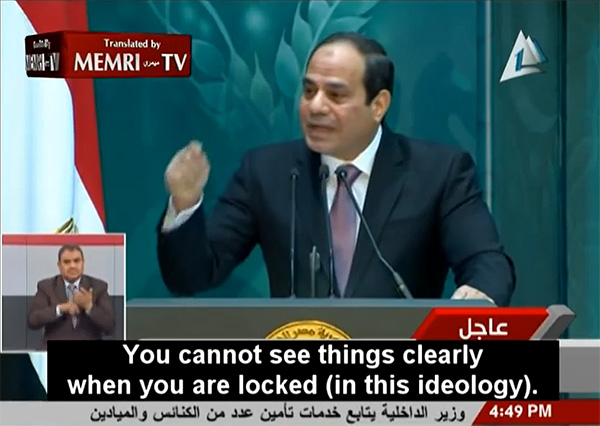
949 (1)Egypt’s President, Abdel Fattah el-Sisi, delivered a historic speech to top Islamic scholars and clergy at Al-Azhar University in Cairo, December 28, 2014. (Image source: MEMRI)

Islam deals in depth with uniting the Muslim nation (umma) and mutual responsibility among Muslims, as though they were one entity. The Prophet Muhammad (S.A.A.W.) said that every drop of Muslim blood is more precious than the entire Kaaba. Thus the liberty ISIS took upon itself to burn alive a Jordanian pilot and 45 Egyptians, to spread terrorism throughout Syria, Iraq and Egypt and to kill other Muslims in various locations around the globe, claiming they were “infidels,” is heresy in and of itself.

The calls for the deaths of “a million shaheeds” and the killing of Jews for the sake of Al-Aqsa mosque in Jerusalem, as was done by Arafat in the past, and is being done now by his heirs in the Palestinian Authority and Hamas, are a crime; they are extremist incitement that is opposed to the forgiving and compromising spirit of Islam. The murder and terrorism carried out by terrorist organizations such as ISIS, Hamas, Palestinian Islamic Jihad [PIJ] and other Islamist organizations against Jews, Christians and other non-Muslims is contrary to the modern Islam needed in the contemporary era.

El-Sisi was correct that the Muslim Brotherhood’s Sunni ideology, which drives most of the extremist Islamist organizations around the world, preaches forced conversion of “infidels” to Islam at any price, or death. Some of the “infidels” are supposed to join Islam of their own accord(targ’ib), out of self-serving interest, and some not of their own accord (tarhib), out of fear and death threats. Such conversions are also contrary to the original Islam, which states that no one is to be forced to convert to Islam and that a calm religious dialogue should be held.

However, a few days after President el-Sisi’s speech, which attempted to unify Muslims and Christian Copts, the Muslim Brotherhood and their affiliated terrorist organizations increased their attacks on Egyptian civilians and security forces throughout Egypt and the Sinai Peninsula, as well as murdering 21 Egyptian Christian Copts in Libya. The Muslim Brotherhood knows that behind the scenes, U.S. President Obama supports the movement, especially the branch in Egypt seeking to overthrow President Sisi. This approval from the U.S. encourages the Muslim Brotherhood to be even more determined to subvert and undermine Egypt’s stability, sabotage its economic rehabilitation and destroy the el-Sisi regime.

In this atmosphere of American support, the Ansar Bayt al-Maqdis terrorist group in the Sinai Peninsula operates under Muslim Brotherhood protection. It recently changed its name to the “Sinai Province” of the Islamic State and swore allegiance to the “Caliph,” Abu Bakr al-Baghdadi. It is currently working hand-in-hand with Hamas in the Gaza Strip to weaken el-Sisi’s Egyptian forces in the Sinai Peninsula.

Other Islamist terrorist organizations also kill Egyptian civilians and security forces with bombs and assault rifles. In the name of the Muslim Brotherhood’s ideology, they indiscriminately attack people on public transport, in airports and in public places, with the intent of retaking control of Egypt.

For this reason, an Egyptian court recently designated Hamas a terrorist organization, along with its military wing, the Izz al-Din al-Qassam Brigades, and outlawed both of them. In response, Qatar, a slippery agent in the service of America but also, treacherously, in the service of Iran, allowed armed Izz al-Din al-Qassam Brigades operatives to be interviewed by its Al-Jazeera TV. The operatives called the Egyptian president a traitor to the Islamic-Arab cause and to those seeking to “liberate Palestine.”

At the same time, Qatar continues to use its Al-Jazeera TV to broadcast hate propaganda targeting the el-Sisi regime, to disseminate videos and to fabricate insulting quotes intended to cause friction between el-Sisi on one side and the leaders of the Arab world and the Gulf States on the other — and to keep them from giving hungry Egyptians economic aid.

As the date for the economic conference in Sharm el-Sheikh (in the Sinai Peninsula) nears, Al-Jazeera’s propaganda machine has moved into ever-higher gear. Apparently, some of the Sunni Arabs states have not yet realized that their own national security and ability to withstand Iran depend on how strong Egypt is.

The U.S. Administration could easily halt the subversion of Egypt, but not only does it turn a blind eye, it suffers from a peculiar form of ignorance that makes it fight ISIS while at the same time supporting the Muslim Brotherhood, the hothouse of most Islamic terrorist organizations, including ISIS. The damage done to Egypt and the cracks in the weak Sunni Muslim ranks in the Middle East will eventually harm American interests and expose the Gulf States to the increasing Iranian threat.

The Muslim Brotherhood, the current American administration’s great friend, is the poison tree whose fruit is the Islamist terrorism embodied by ISIS, Al-Qaeda, Hamas, Palestinian Islamic Jihad, Al-Nusra Front, Boko Haram and others. This linkage has become obvious to all the Arab states, while the U.S. and Europe steadfastly ignore the danger to their own survival, and refuse to outlaw them.

It is possible, in fact, that U.S. policy is to weaken the Sunni world that is seeking to unite under el-Sisi’s flag of modernity. With European complicity, the U.S. Administration is trying to defraud the Arabs and turn the Israeli-Palestinian conflict into a center of Middle Eastern chaos, in order to hide the nuclear deal they are concocting with Iran. That is why the West does not really want to rehabilitate the Palestinian refugees by settling them in the Arab states, and why the West continues to nourish false Palestinian hopes that perpetuate this conflict.

The treachery of the U.S. Administration is the reason why Egyptians’ faith in America, which is supposed to defend the Arabs against a nuclear Iran, has effectively evaporated.

In the meantime, Iran’s Houthi proxies have taken over Yemen, threatening the entire Persian Gulf from the south. The el-Sisi regime is currently in the market for new allies, such as Russian President Vladimir Putin. Putin recently paid a visit to Egypt to examine the possibilities of building a nuclear reactor, sounding the first chord of a regional nuclear arms race.

The problems of the Middle East begin in the United States: that was the claim of participants in the Al-Jazeera TV show, “From Washington.” They described American policy towards Egypt as hesitant, indecisive and undemocratic. They claimed that the U.S. Administration had not yet decided whether or not to support el-Sisi, who heralded change and the willingness to fight radical Islam (a fight America used to participate in) or to remain neutral and waffle, in view of Egypt’s presumed instability. The Americans seem to be putting their all money on the extreme Islamists, who they seem to think will eventually win the bloody conflict currently being waged in Egypt.

The Americans have forgotten that under Mubarak, the regime turned a blind eye to attacks against Israel that were carried out by the Muslim Brotherhood and their carefully fostered agents. Unfortunately, since el-Sisi was elected, Egypt itself has become a victim of radical Islamic terrorism. The U.S. Administration, however, appears clearly to hate el-Sisi, and seems to be doing its utmost to undermine him and see him thrown out.

Under ousted President Mohamed Morsi, Egypt was tolerant and patient toward the U.S. Administration’s best friends, the Muslim Brotherhood, as well as Islamist and Palestinian terrorist organizations such as Hamas, Ansar Bayt al-Maqdis, Al-Qaeda, and Palestinian Islamic Jihad, all of which set up camp in the Sinai Peninsula. These terrorist groups smuggled weapons in from Iran, Sudan, Libya and Lebanon; dug smuggling and attack tunnels; developed missiles and carried out terrorist attacks “only” against Israel, the current U.S. Administration’s other apparent enemy, even though so many American Jews foolishly voted for them.

Now those same Islamist and Palestinian terrorist organizations are striking a mortal blow to the security or Egypt, and killing its civilians and security personnel.

The Muslim Brotherhood, mindful of America’s pro-Islamist policy toward it, is deliberately indulging in a wave of terrorism in Egypt and the Sinai Peninsula. Muslim Brotherhood operatives there are targeting civilians, public transport, airports and natural gas pipelines, all to undermine Egypt’s internal security and bring down el-Sisi’s regime in favor of extremist Islamists and a nuclear-threshold Iran.

In the current international situation, the U.S. Administration has apparently finally cut a deal with Turkey — which will be flimsy and ethereal — that allows Turkey to do the only thing it really cares about: to bring down the regime of Syria’s President, Bashar al-Assad.

The U.S. is also trying to cut a deal with Qatar, which along with Turkey openly supports the Muslim Brotherhood and its terrorist proxies in Egypt, Gaza, Syria and Iraq, who in general work against Western interests.

The ironic result is that Turkey plays host to both NATO and senior Hamas figures, while it deliberately ignores the slaughter by ISIS of Kurds and other ethnic minorities in Iraq and Syria. The Muslim Brotherhood, in effect, actually rules Turkey. Turkey’s President Recep Tayyip Erdogan and his AKP party make it easy for foreign fighters to cross the Turkish border into Syria and join the ranks of ISIS. Meanwhile, the Turkish government wages a diversionary propaganda war against Israel. According to recent rumors, Turkey is also planning to build a nuclear reactor, “for research and peaceful purposes.”

Another surreal result is that Qatar hosts the U.S. military bases, while it finances and encourages terrorist organizations operating against Israel and the Egypt. It also panders to Sheikh Yusuf al-Qaradawi, the spiritual mentor of the Muslim Brotherhood, an Islamist terrorist who issues fatwas permitting the murder of civilians and approves death sentences for apostasy.

And now the greatest American insanity of all time: the U.S. and Turkey are arming and training Islamist terrorist operatives in Turkey, on the grounds that they are “moderates” opposed to Bashar Assad’s regime in Syria. They either ignore or are not aware that there is no such thing as a moderate Islamist terrorist.

The other name of the “moderates” opposing Bashar Assad is ISIS; Iran’s Supreme Leader, Ali Khamenei and Hezbollah’s Hassan Nasrallah are now even saying that the U.S. is arming ISIS.

In the meantime, the Egyptian army continues its struggle against Islamist terrorist targets in the Sinai Peninsula and Libya, unaided, and even undermined, by the U.S.

In view of the U.S. Administration’s collaboration with the Muslim Brotherhood and terrorist organizations in the Gaza Strip, I am persuaded that in the near future it will be possible to find a joint Egyptian-Israeli-Palestinian formula for eradicating the Hamas-PIJ enclave of terrorism, this time by Arabs.

Most ironically of all, in the shadow of American zigzagging, a joint Arab-Israeli front is developing against Sunni and Shi’ite radicalism, and the Palestinians can only profit from it. Thus el-Sisi, who, with towering vision and courage, dares to speak openly about the poison tree of radical Islam and its fruit, when others are afraid, is a truly great Islamic hero.