Posted tagged ‘Turkey’

Report: Iraq sends back Kurdistan-bound coalition planes to Turkey, Kuwait

November 9, 2015

Report: Iraq sends back Kurdistan-bound coalition planes to Turkey, Kuwait

ANKARA

Monday,November 9 2015

Source: Report: Iraq sends back Kurdistan-bound coalition planes to Turkey, Kuwait – MIDEAST

Iraqi Defense Ministry has sent back two aircrafts carrying weapons to Iraq’s Kurdistan region to Turkey and Kuwait after detaining them for a few days, the Doğan News Agency (DHA) reported.

“Upon an order by the Iraqi Armed Forces Command, the two planes which were carrying weapons to Kurdistan have been deported and sent back with their entire cargo to their bases in Kuwait and Turkey after being withheld at Baghdad International Airport for a few days,” DHA quoted a written statement released by the Iraqi Defense Ministry on Nov. 9.

As of Nov. 2, an English-language Iranian news agency, the Fars News Agency (FNA), reported that the Iraqi government seized two planes of the member states of the U.S.-led coalition against the Islamic State of Iraq and the Levant (ISIL) that were carrying weapons to the Kurdistan Region without prior coordination or information-sharing with Baghdad.

“The inspection committee in Baghdad International Airport has found a huge number of rifles equipped with silencers, as well as light and mid-sized weapons,” the agency quoted the head of the Iraqi Parliament’s Security and Defense Commission, Hakem al-Zameli, as saying at the time.

Zameli told the agency that a Swedish and a Canadian airplane were going to fly to the same region but were seized after arms cargo was discovered.

Turkish officials have not yet been available for comment on the news reports.

November/09/2015

Turkey’s Stockholm Syndrome

November 8, 2015

Turkey’s Stockholm Syndrome, The Gatestone InstituteBurak Bekdil, November 8, 2015

(Please see also, Obama’s favorite Muslim dictatorships. — DM)

  • AKP supporters celebrated their victory on November 1 with chants of “Allahu Akbar” [“Allah is the greatest”], an Islamist slogan, indicating that for them the political race in Turkey is in fact a “religious war.”
  • The Turkish “Sultan wannabe” runs an empire of fear. The November 1 vote will only help make him even more despotic.
  • A recent study found that only a quarter of Turks were NOT afraid of Erdogan. According to the research, even some of his own supporters are afraid of him.
  • “The rapidly diminishing choice of media outlets and restrictions on freedom of expression in general impacted the process and remain serious concerns.” — Ignacio Sanchez Amor, Organization for Security and Co-operation in Europe
  • The AKP’s setback in last June’s elections was because some nationalists disapproved of the AKP’s peace process with the Kurdish minority. In July, the government scrapped the peace process and ordered the military relentlessly to bomb the strongholds of militant Kurds in northern Iraq.

Once again, after a brief pause, political Islam has won in Turkey. President Recep Tayyip Erdogan’s Islamist party, the Justice and Development Party (AKP), earned nearly one out of every two votes in the renewed parliamentary elections on November 1. The AKP won more than 4.8 million new votes since the June 7 elections, in which it had lost its parliamentary majority for the first time since it came to power in 2002. The November 1 election gave the AKP a mandate to rule until 2019; by then Turkey’s Islamists will have been in power uninterruptedly for 17 years. There are happy smiles on the faces of half the Turks.

The AKP’s unexpected landslide victory can be explained in numbers. The party won by 9 percentage points more on Nov. 1 than on June 7, just five months before. How did this happen?

  1. The nationalist party, MHP, shares more or less the same voter base with the AKP. Votes often go from one to the other. In the June election, some AKP votes shifted to the MHP, which won 16.3% of the national vote. This was because some nationalists disapproved of the AKP’s peace process with the country’s restive Kurdish minority. After a new spiral of violence started in July, the government scrapped the peace process and ordered the military relentlessly to bomb the strongholds of militant Kurds in northern Iraq. With the AKP boasting its newfound nationalist spirit, the MHP lost 4.1 percentage points on Nov. 1, all of which apparently went to the AKP.
  2. The summer-long violence between the autonomy-seeking Kurdish fighters and the Turkish military, which has killed hundreds, apparently wore down Kurds with more loyalist sentiments to Turkey, and caused a shift of votes at the magnitude of 1.4 percentage points from a pro-Kurdish party to the AKP.
  3. Two splinter Islamist and nationalist parties that won 2% of the vote on June 1 disappeared from the political scene, winning just a combined 0.5% on November 1. From them the AKP earned another 1.5 percentage points.
  4. In the face of President Recep Tayyip Erdogan’s lavish, expensive palace, new private jets, extravagant spending of public funds; his assertive intervention in party politics (he must remain non-partisan, according to the Turkish constitution), and growing allegations of corruption and nepotism, some traditionally AKP voters abstained from voting on June 7. Typically, half of those who abstained in June were AKP voters. Apparently, they returned to the ballot box in November, earning the AKP another good 2 percentage points (the turnout rate was nearly 4 percentage points higher in November than in June).

All of this makes exactly 9 percentage points: the difference between what the Islamists got in June and November. That is worrying for everyone in the civilized (and shrinking) parts of Turkey — and the world. AKP fans celebrated their victory on November 1 with chants of “Allahu Akbar” [“Allah is the greatest”], an Islamist slogan, indicating that for them the political race in Turkey is in fact a “religious war.” The only non-Turkish flags at the celebrations were the Palestinian and Ottoman. It is worrying that the party that won half of the national vote celebrates with religious slogans and Palestinian and Ottoman flags.

True, even if there is not yet credible evidence of vote-rigging, the election campaign was totally unfair to the opposition. Erdogan and the AKP massively used a powerful pro-government media machine, including the state broadcaster and a semi-official news agency.

“While Turkish citizens could choose between genuine and strong political alternatives in this highly polarized election, the rapidly diminishing choice of media outlets and restrictions on freedom of expression in general impacted the process and remain serious concerns,” said Ignacio Sanchez Amor, the special coordinator and leader of the short-term observer mission of the Organization for Security and Co-operation in Europe.

The head of the delegation from the Parliamentary Assembly of the Council of Europe, Andreas Gross, said: “Unfortunately, the campaign for these elections was characterized by unfairness and, to a serious degree, fear.”

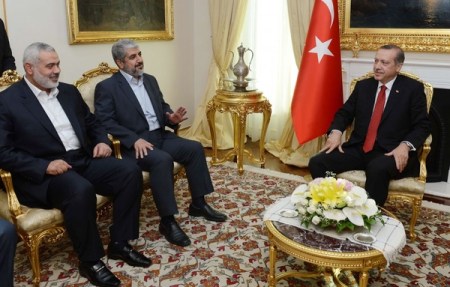
In fact, one could easily understand how democratic and fair the Turkish election campaign was from the words of Khaled Mashaal, head of Hamas’s political bureau. He called both Erdogan and his prime minister, Ahmet Davutoglu, to convey the Palestinian group’s congratulations on Turkey’s “democratic electoral environment.”

826 (1)Turkish President (then Prime Minister) Recep Tayyip Erdogan, right, meeting with Hamas leaders Khaled Mashaal (center) and Ismail Haniyeh on June 18, 2013, in Ankara, Turkey. Mashaal, last week called Erdogan to convey Hamas’s congratulations on Turkey’s “democratic electoral environment.” (Image source: Turkey Prime Minister’s Press Office)

In a way, this is Turkey’s Stockholm Syndrome. A recent study found that only a quarter of Turks were NOT afraid of President Erdogan. As many as 68.5% said they were afraid of the president. It is interesting to note that according to the findings of this research, even some of his own supporters are afraid of him: If Erdogan’s supporters make up 50% of Turkey and those who say they are afraid of him stand at 68.5%, this means a good 18.5% of his own supporters are also afraid of him.

The Turkish “Sultan wannabe” runs an empire of fear. The November 1 vote will only help make him even more despotic.

Obama’s favorite Muslim dictatorships

November 5, 2015

Obama’s favorite Muslim dictatorships, Front Page Magazine, Daniel Greenfield, November 5, 2015

(Please see also, US senior commander says US will not provide arms ‘as of now’ to YPG units. And why isn’t Iran on the list?  — DM)

oy

Obama’s favorite Muslim dictatorships are the opposite of everything that America stands for. They are places where human rights are a myth and terrorism a virtue. They are everything that we should reject. But instead their tyrants and terrorists are the good friends of their man in the White House.

**************************

Michelle Obama is heading to Qatar, a state sponsor of just about every Islamic terrorist group you can name, on a mission of “gender parity” accompanied by late night comedian Conan O’Brien.

That makes sense since the idea of equal rights for women in Qatar is a joke.

Qatar charges rape victims with adultery, has no law against domestic violence and women need permission from their male guardian to get an education, a driver’s license, a job or to leave the country.

Women aren’t equal in Qatar. They’re property.

But Qatar is one of Obama’s favorite Muslim dictatorships. Secretary of State John Kerry recently launched an economic dialogue with Qatar. Qatar got a free pass to smuggle weapons past the NATO blockade of Libya even though the administration knew the weapons were going to terrorists.

While Qatar was buying weapons from Sudan, a country whose leader is wanted for crimes against humanity, to pass along to Islamic terrorists in Syria, the State Department was clearing Qatar to buy American weapons. Qatar was, of course, a Clinton Foundation donor.

The Reagan administration had cracked down on Qatar for illegally getting its hands on Stinger missiles. The first Bush administration had forced Qatar to destroy them. But these days we are the arms dealer for a nasty tyranny that has ties to terrorists. Or as the State Department report politely stated, “U.S officials are aware of the presence of Hamas leaders, Taliban members, and designated Al Qaeda and Islamic State financiers in Qatar.” These nice folks share a country with U.S. Central Command.

Khalid Shaikh Mohammed, the Al Qaeda bigwig who planned 9/11, was tipped off by a member of the Qatari royal family and the former Minister of the Interior which allowed him to escape.

That made it the perfect place to host the “moderate” Taliban for negotiations that went nowhere. It was also where Obama sent the 5 Taliban commanders after their release.

When meeting with the Emir, Obama claimed that “Qatar is a strong partner in our coalition to degrade and ultimately defeat ISIL.” But Qatar has allegedly funded and armed ISIS and other Al Qaeda groups. Islamic State financiers and supporters comfortably move around Qatar flying their ISIS freak flag.

Vice President Biden and Germany’s Development Aid Minister Gerd Mueller were forced to apologize for accusing Qatar of financing terrorists because some truths about our “ally” simply could not be spoken. Meanwhile an Egyptian intelligence document reportedly claimed that Qatar had provided anti-aircraft missiles to ISIS.

But Qatar is only Obama’s second favorite Muslim dictatorship and state sponsor of terror. Topping the list is Turkey, which just underwent another ugly Islamist election defined by accusations of fraud.

Obama had spoken of building a “model partnership” with Turkey between “a predominantly Christian nation and a predominantly Muslim nation”.  The United States, Obama said, is not “a Christian nation or a Jewish nation or a Muslim nation”. He suggested that “modern Turkey was founded with a similar set of principles.” But the Turkish Republic has long since been ground under the wheels of Erdogan’s Islamist Turkey whose model is the Ottoman Empire and whose ruler lives in a billion dollar palace.

A little insight into Erdogan’s view of Islam can be gained from the fact that Turkey’s tyrant was once sent to prison for reciting an Islamic poem with the infamous lines, “The mosques are our barracks, the minarets our bayonets, the domes our helmets and the believers our soldiers.” It’s not surprising that Erdogan’s Turkey supports most of the same Islamic terrorist groups as Qatar including Hamas.

While Turkey still has elections, it is increasingly an Islamist one-party state where the political opposition, journalists, prosecutors and even police can be locked up by the forces of the regime.

And much of that controversy stems from a criminal investigation into arms smuggling to terrorists.

Having helped create the mess in Syria, Turkey has become a waypoint for Syrian Muslims invading Europe. Once shunned by Germany, whose Turkish Muslim settlers are his strongest base of support, the refugee crisis sent Merkel and the Europeans with hat in hand to beg Erdogan to stop the invasion.

But Obama has always been Erdogan’s faithful friend. When the Islamist wanted to build mosques in this part of the world, Communist Cuba turned him down, but he got his $100 million mega mosque in Maryland.  Millions calls Erdogan another Hitler, but Obama calls him “my friend.”

Another friend of Obama is the Sultan of Brunei. Obama called the Sultan, “My good friend” and rolled out a $6 billion green energy financing scheme for Brunei and Indonesia; two Muslim countries that violate human rights like it’s a spectator sport.

While Obama was palling around with the Sultan of Brunei, his “good friend” was bringing back Sharia law complete with stoning gays. The Sultan also banned Christmas and the Chinese New Year while urging “all races” to unite under Islamic law.

African Christian countries that outlawed homosexuality had faced pressure and criticism from the White House, but Obama had no lectures on human rights to offer his good Islamist friend.

Neither did Hillary Clinton whose Clinton Foundation had received millions of dollars from the regime.

But the most explosive allegations about Brunei, like those about Qatar and Turkey, involve Al Qaeda. In one of the more controversial uses of the “super-injunction” in UK law, the ex-wife of the Sultan had filed a gag order against a British businessman involving allegations that the Sultan of Brunei had met with a senior member of Al Qaeda, funded the terror group and even that “the claimant knew or suspected from conversations with her ex–husband that there would be major terrorist attacks on the UK (7/7) and Israel.” There is of course no way to verify the truth of these allegations. But the Islamization of Brunei parallels the goals of groups such as Al Qaeda and ISIS.

Obama has many “good friends” among the tyrants and terrorists of the Muslim world. But one of them is both a tyrant and a terrorist whose illegal regime is heavily subsidized by American taxpayers.

Muslim terrorists in Israel stabbed an 80-year-old woman and a 71-year-old man just this week. They did it because the PLO’s media operation, under President Abbas, told them it was their way to paradise.

Or as Abbas, the dictator whom Obama described as “someone who has consistently renounced violence”, said, “We bless every drop of blood, that has been spilled for Jerusalem…blood spilled for Allah…Every Martyr will reach Paradise.”

The blood includes the blood of elderly women and children, and the blood of families murdered together. Every murder is funded by US foreign aid because every terrorist knows that he can count on a lifetime salary from the PLO. The PLO paid out $144 million to terrorists last year alone.

Some terrorists have even confessed that they tried to kill Israelis to be able to pay off their debts.

Hillary Clinton and the State Department were sued by terror victims for funding terrorism in Israel. But nothing has changed. And when American terror victims won a lawsuit against the PLO in America, Obama’s people stepped in to protect the interests of the PLO against its victims.

The PLO is funded by hundreds of millions in American foreign aid. Over the years, $4.5 billion was spent on promoting “Palestinian democracy”. There is now less democracy than ever because Obama’s PLO pal doesn’t bother with elections. He just takes the money and runs a totalitarian terror state.

Obama’s favorite Muslim dictatorships are the opposite of everything that America stands for. They are places where human rights are a myth and terrorism a virtue. They are everything that we should reject. But instead their tyrants and terrorists are the good friends of their man in the White House.

US senior commander says US will not provide arms ‘as of now’ to YPG units

November 5, 2015

US senior commander says US will not provide arms ‘as of now’ to YPG units, Hurrinet Daily News, November 5, 2015

(Certainly not! The Kurds are the best, if not the only, local forces serious about fighting the Islamic State, et al. Besides, our delightful democratic ally, Turkey — a bastion of human rights and freedom — doesn’t want us to. — DM)

truck with gunAFP photo

“Obviously the Turks have concerns. You know, they’re our partners and allies. We’re going to address those concerns. We’re going to work with them to achieve our common goal, which is to defeat ISIL,” Warren said.

**********************

A senior U.S. commander based in Baghdad, Iraq, for the fight against the Islamic State of Iraq and the Levant (ISIL) said his country, as of now, was not providing arms to the People’s Protection Units (YPG). 

“As of now, we are not providing weapons or ammunition to the YPG. The weapons that we’ve provided thus far, with the ammunition that we’ve provided in our one airdrop executed, was for the Syrian-Arab coalition,” Colonel Steve Warren, a Baghdad-based spokesman for the U.S.-led coalition against ISIL, told reporters via teleconference from Baghdad.

“As of now, future resupplies will also go to Arab-vetted Syrian opposition members,” he added, after a reporter said a senior defense official had recently said the YPG would not be getting any ammunition or weapons. “So, you know, as of now, that’s where our policy stands.”

Turkey regards Syrian Kurdish YPG units in the same category as the outlawed Kurdistan Workers’ Party (PKK), with which the state has been in an armed fight for over 30 years, with a death toll of over 40,000 from both the camps. The state had launched a peace process to solve the Kurdish problem in the country in the early 2010s, which was later halted by the state during the run to Turkey’s general elections on June 7.

Responding a question on whether or not the U.S. would talk to Turkey about the issue, Warren said they were in “very close contact” with Turkey.

“Obviously the Turks have concerns. You know, they’re our partners and allies. We’re going to address those concerns. We’re going to work with them to achieve our common goal, which is to defeat ISIL,” Warren said.

Merkel shifts EU-Turkey stance upon migrant crisis

October 18, 2015

Merkel shifts EU-Turkey stance upon migrant crisis ISTANBUL

Sunday,October 18 2015, Your time is 11:37:21

Source: Merkel shifts EU-Turkey stance upon migrant crisis – DIPLOMACY

Turkish PM Davutoğlu (R) and German Chancellor Merkel (L) hold a joint press meeting in Istanbul on Oct. 18, 2015. Reuters Photo

German Chancellor Angela Merkel has pledged to give support to four Turkish demands on which Ankara has insisted in return for agreeing to a migrant action plan with the European Union.

“There are four elements. Germany is ready to give support on these issues,” Merkel said Oct. 18 during a joint press conference with her Turkish counterpart, Ahmet Davutoğlu.

Merkel made the trip to Turkey amid increasing pressure at home after hundreds of thousands of refugees poured into Germany over the summer.

Davutoğlu said Turkey was ready to work with Germany and the EU on the migration crisis and would take all measures to prevent human trafficking. However, Ankara is focused on four issues, the prime minister said: the opening of negotiation chapters, visa liberalization, the transfer of 3 billion euros from the EU to Turkey for migrant support and the invitation of Turkish leaders to EU summits.

Davutoğlu stressed the “fair share of the burden” on the migration problem and welcomed Merkel’s approach on the issue, while noting that the figures were of secondary importance.

Davutoğlu expressed Turkey’s expectation for the implementation of visa privileges for Turkish nationals by 2016, in return for a readmission agreement which would pave the way for the EU to send migrants back to Turkey.

“In terms of the migration crisis, we seek to contribute a new vision to relations between the EU and Turkey and get out of its frozen situation,” he said.

“We agreed on accelerating the opening of negotiation chapters 17, 23, 24,” he said.

Turkey and Germany will continue cooperation through “working groups” which will convene this week, Davutoğlu said.

Expressing support for the Turkish demands, Merkel especially highlighted that they would work to open Chapter 17, and said they would “discuss” details on Chapters 23 and 24. The German chancellor also reiterated her country’s longstanding hesitations about Turkey’s prospective membership in the union and said, “Turkey’s full membership is an open-ended issue.”

“How can we organize the accession process more dynamically?” Merkel asked.

Working groups will study the “share of burden,” Merkel said, noting that the invitation of Turkish leaders to EU summits would be evaluated by the union.

Ahead of her visit to Turkey, Merkel stated that Turkey’s help was needed to stem the flow of refugees to Europe but that this had not changed her view that Ankara should not become a member of the European Union. “I have always been against EU membership, President [Recep Tayyip] Erdogan knows this, and I still am,” Merkel told a talk show on German public broadcaster ARD on Oct. 7.

Turkey and European Union agreed to a “draft” agreement on migrants last week which will be implemented after Ankara’s political demands are met by Brussels.

The EU has suddenly rediscovered Turkey, Turkish Foreign Minister Feridun Sinirlioğlu told reporters on Oct. 16. The minister identified the draft agreement on migrant action plant as an “ad referendum” which is for further consideration by one having the authority to make a final decision.

Close military cooperation 

The two leaders also discussed Syria, with Turkey informing the German chancellor about violations of Turkish airspace and the change of the power balance in the country, Davutoğlu said, adding that he delivered some intelligence information.

Despite Germany’s withdrawal of Patriot batteries from Turkey, the two countries will step up for closer military cooperation, Merkel said.

Davutoğlu also condemned an attack on the independent candidate for mayor of Cologne, Henriette Reker.

The German and Turkish foreign, defense and economy ministers will also meet in January 2016 in Berlin, Davutoğlu said.

Merkel also met with Erdoğan. Making a joint statement, Erdoğan stated that the two countries recommended an “action plan against terror.”

October/18/2015

Kurds Ask for Peace, Turkey Attacks

October 18, 2015

Kurds Ask for Peace, Turkey Attacks, Gatestone InstituteUzay Bulut, October 18, 2015

  • Just after the bombing attack in Ankara, Turkish authorities said that the Islamic State (ISIS) was responsible. But in response, Turkish jets did not bomb ISIS; they bombed the Kurdish PKK, who are fighting ISIS.
  • Where were the special forces and the police, so quick to shoot Kurds but not protect them? The police delayed medical help, and instead attacked with tear gas the people that were helping the wounded, in an effort to disperse them.
  • “The PKK ceasefire means nothing for us. The operations will continue without a break.” — Senior Turkish security official.
  • “Ankara is the capital of Turkey. If a bird flies here, the state knows about it. … There was a rally of 100,000 people but no security precautions were taken. Look at their own rallies: the security precautions start 10 streets away.” — Selahattin Demirtas, co-chairman of the Kurdish HDP Party.
  • Many massacres have been carried out against the Kurds. None of the perpetrators has ever been punished — in those massacres, the planners were the state authorities themselves.

On October 10, the Kurds in Turkey were exposed to yet another massacre – this time a double suicide bombing in Ankara, the capital of Turkey, in the center of town.

This time, two explosions ripped through a peaceful crowd that had gathered outside the entrance to Ankara’s central railway station to proclaim an end to violence in a “Labor, Peace and Democracy” rally.

Together with the Kurds were officials from the pro-Kurdish Peoples’ Democratic Party (HDP); supporters of left-wing parties, and members of trade unions in Turkey — all calling for peace and democracy.[1]

At least 105 people were killed, according to the Turkish Medical Association, and more than 400 injured.[2]

One victim, Meryem Bulut, was a 70-year-old member of the “Saturday Mothers” group, who have protested about their missing sons and daughters since the 1990s. Her grandchild died last year fighting against ISIS in the Yazidi town of Sinjar, Iraq.

Nine-year old Veysel Atilgan participated in the rally with his father, Ibrahim Atilgan; both were killed in the blasts.

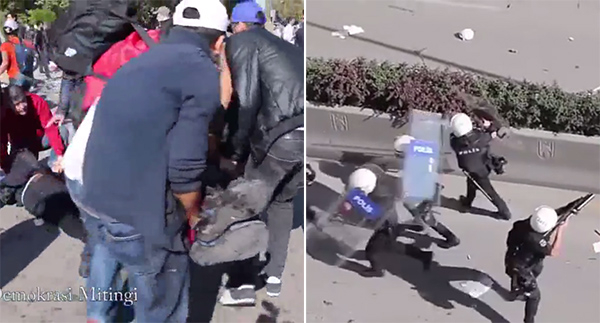
The aftermath of the explosion was almost as horrific. The police delayed medical help, and instead attacked with tear gas and pepper spray the people that were helping the wounded, in an effort to disperse them. The government, after attacking even the wounded, unleashed the military and police apparatus against Kurds who came to mourn their dead.

Orhan Antepli, the legal secretary of the Bursa branch of the Trade Union of Public Employees in Health and Social Services (SES), witnessed the explosion. The police used tear gas against the wounded, he said, and did not allow ambulances to enter the area:

“On the road, for two kilometers, we did not see a single police officer. I was facing where the second explosion took place. After it, there were about 100 pieces of flesh of 1cm each on the coat of the person beside me.”

Antepli said that he ran to help the wounded, but the police did not allow ambulances to enter the area: “While I was treating a wounded man, the police started using tear gas. They blocked the road. Two or three gas bombs were thrown at the people.”
1308At least 105 people were killed and more than 400 wounded in the Oct. 10 Ankara suicide bombings. For a long time after the explosions, neither police nor ambulances came to the scene — victims were left to fend for themselves. When police arrived, they fired tear gas at the wounded and those helping them.

In the meantime, Turkish Prime Minister Ahmet Davutoglu said, incredibly,

“An utterly successful operation against terror was carried out. Similarly, due to our vigorous efforts since 23 July, the most important cadres of ISIS have been arrested or their contacts have been broken. … But when you step out of routine, this has a limit in a democratic state of law. You cannot arrest someone without a reason. There is even a list of people who might engage in suicide bombing in Turkey. You follow them, but when you do something before they carry out that act, you are exposed to another protest.”

So, Turkey keeps a list of potential suicide bombers, while Davutoglu is saying with a straight face that the government — which has attacked and even arrested many journalists simply for doing their job, and even high-school students for tweets critical of the government — should not arrest a potential suicide bomber “without a reason.” The AKP is the last government that should be talking about a “democratic state of law.”

Just after the blasts, some Turkish authorities said that the Islamic State (ISIS) had caused them. Yet in response, Turkish jets did not bomb ISIS; they bombed the Kurdish PKK, who are fighting ISIS. After the government rejected a new ceasefire announced by the PKK on Saturday, the Turkish air force attacked.

The PKK had declared in a written statement that “they reached the decision to stop military action against Turkish state forces as long as there were no attacks.”

The Turkish government, however, seems determined to continue killing Kurds no matter what. “The PKK ceasefire means nothing for us,” one senior Turkish security official told Reuters. “The operations will continue without a break.”

While the Turkish army is bombing the PKK headquarters (again), the Ankara Chief Public Prosecutor’s Office has issued a gag order on the Ankara massacre investigation.

In addition, the state media watchdog, the Turkish Radio and Television Supreme Council (RTUK), imposed a ban on broadcasting images of the bombings. After the temporary ban, Twitter, Facebook, and several other social media sites were also inaccessible throughout Turkey. That is what a repressive state does to keep facts from coming out.

Later, when many people in Ankara, including Kurdish MPs and mayors, took to the streets to protest the massacre, police used water cannons and tear gas against them. Some protesters were wounded and taken to hospital; four were arrested.

Across Turkish Kurdistan, countless protesters were also exposed to police violence. The police in Diyarbakir used real bullets with the tear gas. An ambulance was reportedly prevented from entering the area where Ahmet Taruk, 63, was overcome by the tear gas; he lost his life on the way to the hospital. During a police crackdown in Izmir, 66 people were arrested.

Eventually, the Turkish media reported that both perpetrators of the Ankara suicide bombing attack had indeed been identified as members of ISIS. One of them, Omer Deniz Dundar, had gone to Syria in 2013 and came back to Turkey in 2014. Eight months later, he went back to Syria again. His father said in an interview that he had sought the help of the police many times to bring his son back home, but could do nothing.

The other suspect, Yunus Emre Alagoz, in his latest telephone conversation in May 2015, said, “This is the last time we are speaking.” The call was recorded by the police. They interrogated Alagoz as a “suspect” but then released him.

His brother, Yusuf Alagoz, said that Yunus Emre Alagoz had attended school in Afghanistan in 2009, followed by a religious education at a madrassah [Muslim theological school] in Iran.

Still another brother, Seyh Abdurrahman Alagoz, had carried out the deadly suicide bomb attack in Suruc on July 20, in which 33 people were killed.

But just imagine for a moment that it really was two terrorists who committed the massacre, without the knowledge of the Turkish government, and that the state institutions were completely innocent. Where, then, were the security forces to help people after the blast? Where were the medics to help with the wounded? Where were the ambulances? Where were the special forces and the police, so quick to shoot Kurds but not protect them?

The pro-government media in Turkey has been claiming that the PKK was the perpetrator and that the HDP party should be held responsible. They only criticize the public’s response to the attacks; never the attacks themselves.

In Turkey, at other gatherings, not even a mosquito can fly without the Turkish police interrupting it. Yet for this demonstration, there was no security; no medical personnel, no protection for the demonstrators. After the blasts, people were covering the dead with the banners they brought to the rally. People were trying to resuscitate the wounded and making splints for their broken bones by themselves.

Who knows how many people would have survived had it not been for the tear gas that prevented them from breathing? So severe were the wounds that people could not even leave the area; and police were firing tear gas.

After the massacre, Selahattin Demirtas, the co-chairman of the HDP party, said:

“They are trying to convey the message that ‘we can come and rip you to pieces in the middle of Ankara’. They are on the brink of saying ‘the HDP blew up its own rally.’ The prime minister spoke for half an hour; he spent 20 minutes insulting and threatening us. Did you hear him make a single statement condemning ISIS? No. He is still threatening us. Ankara is the capital of Turkey. If a bird flies here, the state knows about it. This is the city where the intelligence unit is the strongest. There was a rally of 100,000 people but no security precautions were taken. Look at their own rallies: the security precautions start 10 streets away. There were 100 corpses; 500 wounded. But they had also had to deal with the water cannons fired by police. Is that what your justice is?”

During the rule of the AKP government, similar massacres against Kurds in Roboski, Diyarbakir and Suruc have also taken place. Before that, since 1920s, there were many massacres against Kurds. None of the perpetrators has ever been punished: in those massacres, the planners and organizers were state authorities themselves.

On October 10, the Kurds and their friends tried to call for an end to war. The Kurds proclaimed peace and brotherhood — Turkey as usual, responded with murder.

____________________________________

[1] The rally was organized by the Confederation of Progressive Trade Unions of Turkey (DISK), the Union of Chambers of Turkish Engineers and Architects (TMMOB), the Turkish Medical Association (TTB) and the Confederation of Public Workers’ Unions (KESK). The Peoples’ Democratic Party (HDP) was one of the major participants.

[2] The Peoples’ Democratic Party (HDP) said in a written statement that the Ministry of Health does not share the data at hand about the dead and wounded and the chief physicians of hospitals have been given certain instructions not to share the data with the public.

Stability in Syria under Assad ‘a dream’: Turkish FM

October 16, 2015

Stability in Syria under Assad ‘a dream’: Turkish FM

Warning PYD, Ankara says any violation against Turkey will be reciprocated

October 15, 2015

Warning PYD, Ankara says any violation against Turkey will be reciprocated

Emine Kart – ANKARA

Thursday,October 15 2015, Your time is 13:07:07

Source: Warning PYD, Ankara says any violation against Turkey will be reciprocated – DIPLOMACY

AA Photo

AA Photo

In strongly-worded remarks, Turkey’s Foreign Minister Feridun Sinirlioğlu has recommended Syria’s Democratic Union Party (PYD) watch their step, making clear that any move aimed at Turkey would not remain unreciprocated.

“I call on [PYD leader] Salih Muslim to [use] good sense and to pull himself together. It would not be good for him if he doubts Turkey’s will and determination. Turkey has been fighting against terror and nobody should attempt to test its determination in this fight against terror,” Sinirlioğlu said on Oct. 15 in response to reported remarks by Muslim.

Earlier this week, Prime Minister Ahmet Davutoğlu lashed out at both the United States and Russia for supplying weapons and support to the People’s Protection Units (YPG), the military wing of PYD, in its bid to fight extremist jihadists, raising concerns that the arms could be used against Turkey by the outlawed Kurdistan Workers’ Party (PKK), an affiliate of the PYD.

“At the moment, nobody can assure us that these weapons delivered to the PYD will not go to the PKK. If we find out that these weapons are taken into northern Iraq and used there, we will destroy them wherever they are,” Davutoğlu said on Oct. 12.

In remarks reported by Arbil-based BasNews agency on Oct. 14, Muslim said that Syrian Kurds won’t attack Turkey but they will strongly meet any Turkish assaults.

“The message that we have given to the PYD is clear. If they resort to any move directed at Turkey, the required penalty will be given without hesitation,” Sinirlioğlu said a joint press conference with Saudi Arabia’s Al-Jubeir following their meeting.

In Washington, following Davutoğlu’s warning, U.S. State Department Spokesperson John Kirby said the United States will continue its support for groups that are “proving effective against ISIL [the Islamic State of Iraq and the Levant] in Syria.” His remarks on Oct. 14 were delivered in response to a question regarding U.S. aid to the PYD, which underlined a contradiction between statements by State Department Deputy Spokesperson Mark Toner and Muslim on recipients of U.S. ammunition airdrops.

While Toner argued that the ammunition was provided to Syrian Arabs, Muslim told the Turkish press that the PYD and its allies have been receiving U.S. airdrops.

Sinirlioğlu, meanwhile, didn’t touch upon any statements from Washington.

October/15/2015

Turkey warns US, Russia over arms supply to Syrian Kurds

October 14, 2015

Turkey warns US, Russia over arms supply to Syrian Kurds

Serkan Demirtaş – ANKARA

PM Davutoğlu is left apoplectic after the US gives weapons to the Kurdish PYD, an enemy of Ankara, amid additional ire for Moscow

Source: Turkey warns US, Russia over arms supply to Syrian Kurds – DIPLOMACY

In this Tuesday, Oct. 6, 2015, military reinforcements for Iraqi anti-terrorism forces arrive at the Ramadi Stadium after regaining control of the complex and the neighboring al-Bugleeb area. AP Photo

In this Tuesday, Oct. 6, 2015, military reinforcements for Iraqi anti-terrorism forces arrive at the Ramadi Stadium after regaining control of the complex and the neighboring al-Bugleeb area. AP Photo

Turkey’s prime minister has lashed out at both the United States and Russia for supplying weapons and support to the Democratic Union Party (PYD) of Syria in its bid to fight extremist jihadists, raising concerns that the arms could be used against Turkey by the outlawed Kurdistan Workers’ Party (PKK), an affiliate of the PYD.

Turkey summoned the United States’ ambassador to Turkey, John Bass, on Oct. 13 to the Foreign Ministry to convey Ankara’s strong reaction over the airdropping of ammunition to the PYD late Oct. 11. A similar message was scheduled to be conveyed to Russia later on Oct. 13.

“We have expressed this to the U.S. and Russia in the clearest way. This is an issue of national security for us. Everybody perfectly knows how we take action when it’s about our national security, just like we did on the night of July 23, when we attacked the PKK and Daesh,” Prime Minister Ahmet Davutoğlu told Ankara bureau chiefs of newspapers on Oct. 12. Davutoğlu used the Arabic acronym for the Islamic State of Iraq and the Levant (ISIL) as he recalled Turkey’s launch of a comprehensive military operation against ISIL and the PKK.

Davutoğlu’s reaction came as the U.S. Department of Defense confirmed that a U.S. cargo plane airdropped some logistical material to the PYD late Oct. 11 in line with Washington’s plans to reinforce the Syrian Kurds in their fight against ISIL in Syria.

“The aircraft delivery includes small arms ammunition to resupply the local forces” to enable them to continue operations against ISIL, Pentagon spokeswoman Elissa Smith told Anadolu Agency on Oct. 13. Smith said the “successful” airdrop was conducted by a “U.S. Air Force C-17 cargo aircraft flying from the U.S. Central Command area of responsibility” and added that all aircraft exited the drop area safely. Like the U.S., Russia is also in close contact with the PYD, but there are no confirmed reports about arms supplies from Moscow.

“I have instructed the foreign minister on this. Necessary diplomatic initiatives are being taken and our message is that ‘We don’t and never will approve of such a thing,’” he said.

‘These weapons will be destroyed’

Recalling that ISIL was now using the sophisticated weapons Washington had supplied to the Iraqi army a year ago, Davutoğlu indirectly addressed the U.S., saying: “When you provide weapons to a group, you should also be able to foresee whose hands these weapons could go to later. At the moment, nobody can assure us that these weapons delivered to the PYD will not go to the PKK. If we find out that these weapons are taken into the northern Iraq and used there, we will destroy them wherever they are. Nobody should expect understanding on this issue. These weapons will harm our soldiers, police and civilian citizens,” Davutoğlu said.

Turkish prime minister underlined that Turkey will take all necessary measures in the event of any infiltration from Syria into Turkey or the transportation of any ammunition “just like the Turkish army is doing in northern Iraq.” “I want to announce this with clarity.”

PKK, PYD indistinguishable from each other

Recalling that the situation in the region and in Turkey had changed as the PKK resumed its violent acts against the Turkish army, Davutoğlu said: “Five or six months ago when there were no PKK attacks against Turkey, allied countries’ intention to arm the PYD could be seen in a certain frame. It was not right but had a sort of a meaning. The crisis in Syria is a Syrian crisis until an attack targets Turkey. [If] the PYD or the al-Assad regime were to commit an act against Turkey, necessary actions would be taken. We have made clear that we will have no tolerance.”

October/14/2015

Turkey warns US, Russia against backing Kurdish militia in Syria: Officials

October 13, 2015

Turkey warns US, Russia against backing Kurdish militia in Syria: Officials

ANKARA – Reuters

Source: Turkey warns US, Russia against backing Kurdish militia in Syria: Officials – DIPLOMACY

In this Nov. 19, 2014, file photo, fighters from Kurdish popular defense units YPJ (women) and YPG (men) gather during a short break before heading out to fight for new positions in Kobani, Syria. AP Photo

 In this Nov. 19, 2014, file photo, fighters from Kurdish popular defense units YPJ (women) and YPG (men) gather during a short break before heading out to fight for new positions in Kobani, Syria. AP Photo

Turkey has warned the United States and Russia it will not tolerate Kurdish territorial gains by Kurdish militia close to its frontiers in north-western Syria, two senior officials said.

“This is clear cut for us and there is no joking about it,” one official said of the possibility of Syrian Kurdish militia crossing the Euphrates to extend control along Turkish borders  from Iraq’s Kurdistan region toward the Mediterranean coast.

Turkey fears advances by Kurdish People’s Protection Units (YPG) militia, backed by its Democratic Union Party (PYD) political wing, on the Syrian side of its 900-kilometer border will fuel separatist ambitions among Kurds in its own southeastern territories. But Washington has supported YPG fighters as an effective force in combating Islamic State of Iraq and the Levant (ISIL).

“The PYD has been getting closer with both the United States and Russia of late. We view the PYD as a terrorist group and we want all countries to consider the consequences of their cooperation,” one of the Turkish officials said, referring to the PYD, which Turkey links to the outlawed Kurdistan Workers’ Party (PKK).

Turkey suspects Russia, which launched air strikes in Syria two weeks ago, has also been lending support to the PYD and YPG, its armed wing.

“With support from Russia, the PYD is trying to capture land between Jarablus and Azaz, going west of the Euphrates. We will never accept this,” the official said.