Posted tagged ‘Turkey’

Russian-Made T-90 Tank Goes Through Baptism by Fire in Syria

February 7, 2016

Russian-Made T-90 Tank Goes Through Baptism by Fire in Syria

Middle East

17:34 07.02.2016(updated 17:43 07.02.2016)

Source: Russian-Made T-90 Tank Goes Through Baptism by Fire in Syria

For the first time, the Syrian Army used Russian-made T-90A tanks in combat. Their baptism by fire took place near the city of Aleppo.

The T-90A, one of Russia’s most advanced weapons, went through its baptism by fire in service with the Syrian armed forces. Earlier, it was reported by Turkish and Iranian media, and then the Russian Defense Minister confirmed the fact.The Turkish pro-government newspaper Yeni Safak reported, citing a military commander, that over 80 T-72 and T-90 tanks were spotted in combat north of Aleppo. The report also read that Syrian forces backed by Russian jets took control over the towns of Nubul and Zehra, north of Aleppo.

Meanwhile, Syrian T-90s in action near Aleppo were then reported by Iran’s FARS news agency on February 2. According to the agency, T-90 tanks were deployed near the town of Khan Tuman, south of Aleppo, after the Syrian Army regained control over the town in December.

Using the advantages of the T-90 tank, the Syrian Army alongside its allies surrounded the strategic towns of Khan Tuman and Al-Karassi, along the Aleppo-Damascus highway, a military source told FARS News.

However, the first news about delivering T-90 tanks to the mechanized division of the Syrian Army came on November 29, 2015. At the time, Russia neither confirmed nor denied it.On February 5, a source in the Russian Defense Ministry told RNS news agency that in late-2015, a number of T-90 machines were delivered to Syria. According to the source, previously the tanks were in service with the Russian military. Syrian troops practiced at training fields in Russia. According to RNS, the tanks were first used in combat by the Syrian Army near Aleppo. They supported a ground assault by Syrian troops.

The T-90A tank entered service with the Russian Armed Forces in 2004. The T-90A is a modernized version of the T-90 Vladimir tank developed on the basis of the T-72B, in the 1980-1990s. It was named “Vladimir” after its constructor Vladimir Potkin. The T-90A featured a new engine and turret and was equipped with a thermal-vision system. Its engine delivers 1,000 hp at 2,000 rpm. The tanks is equipped with third-generation active armor, capable of withstanding an attack by 120-mm M829A2 and DM43A1 tank rounds, designed for the Abrams M1A1 and Leopard-2 tanks respectively.
The T-90 protective system is capable of protecting the tank from the newest TOW-2A and HOT-2 anti-tank missiles.According to FARS, in four-and-a-half years of the Syrian war various militant groups received over 9,000 US-made TOW anti-tank missile systems and M-79 grenade launchers. They were very successful against the aging T-55 and T-72 tanks of the Syrian Army. Only after the newest T-90 tanks were delivered to Syria the Syrian Army began its advance against militants.

The T-90 was delivered to Syria because the tank is equipped with the Shtora active armor, military analyst Alexei Ramm told Gazeta.Ru. Unlike, for example the T-72B, the T-90 tanks of the Russian Armed Forces were initially equipped with this type of armor. The need for it was dictated by the fact that many Syrian militants are armed with TOW missiles.

A T-90A main battle tank
Host photo agency
A T-90A main battle tank

How does the system works? There are several laser radiation receivers, mounted on the tank, as well as two projectors near the gun. These receivers can detect laser radiation when the tank is being targeted and warns the crew of the threat, Ramm explained. In this situation, the crew can evade the attack. The second option is smoke-screening, and the third option is jamming the enemy target-acquiring system with the projectors.

The T-90A is equipped with a 125-mm smooth-bore gun – the 2A46M-2 – with a barrel length of 51 calibers. Its maximum accuracy range while firing high-explosive anti-tank warheads is 4,000 meters, and while firing fragmentation projectiles – up to 9,600 meters.

According to the analyst, the Syrian Army would actively engage the Russian T-90 tanks in combat. He explained that ground relief allows for using the T-90 near Aleppo, Idlib, Hama and Homs but currently main combat actions are focused on Aleppo and northern Latakia.”The principal task now is to neutralize threats to two western regions – Latakia and Tartus. If Latakia falls it would deal a serious blow to [Syrian President Bashar] Assad’s position and would complicate the Russian aerial operation,” Ramm pointed out.

What is more, now an offensive is also underway against militants in the enclave of Salma. Tanks are not enough in this mountainous area, where ground forces backed by aviation are needed.

“If Salma and Aleppo are liberated Turkey will not be able to deliver supplies to terrorists,” he said.

In December, Syria’s news agency SANA published footage from the battlefield where Russian T-90’s were also spotted.

Between Putin and Obama

February 7, 2016

Between Putin and Obama, Israel Hayom, Boaz Bismuth, February 7, 2016

The tide has turned in Syria: Aleppo, the rebel stronghold, is on the verge of falling to President Bashar Assad’s army. Hezbollah’s Shiite militias, the Iranian army and the massive Russian air strikes have been the difference.

In contrast to the rebels, Assad can count on his partners. On the Syrian dictator’s side, backed by Russia, action is being taken. On the rebel side, backed by the Americans, there has been a lot of talking. This perhaps explains why in January 2017 U.S. President Barack Obama will exit the White House, and Assad will still be in power. We can add this legacy to the American president’s splendid list of achievements.

And we haven’t even mentioned the millions of Syrian refuges, the terrible migrant crisis in Europe (leading to the rise of far-right parties across the continent), and the escalation of hostilities between Shiites and Sunnis. It’s not a short list.

Since last Monday, Aleppo has been under heavy attack from Assad’s forces. The gains on the ground have been considerable. Russia’s intervention has tipped the balance of power. No one can say this was unexpected. Washington, meanwhile, continues to grumble. U.S. Secretary of State John Kerry lambasted Moscow on Friday for the large number of dead Syrian women and children. Moscow isn’t exactly heeding his criticism. Washington still fails to understand that instead of talking, maybe it would be better to take action already. In August of 2013, however, after Assad had attacked his own people with chemical weapons for the 14th time, the Americans did nothing (red lines, remember?). Why should things be any different today?

Washington, you will say, has worked hard to find a diplomatic solution. This is a good time to remind everyone that the peace talks in Vienna have again hit a dead end. The talks aren’t likely to succeed for a number of reasons, namely that the two main players — Saudi Arabia and Iran — have reached a point of open hostilities, thanks to American foreign policy. Instead of cooperating to resolve the Syrian crisis, these two regional powers are closer than ever to a full-fledged military conflict. Riyadh is threatening to send ground forces into Syria to support the rebels. The commander of Iran’s Revolutionary Guard has already vowed that any such intervention would result in immense casualties for the Saudis. This is where things stand.

Over the weekend Turkey’s foreign minister discussed opening his country’s borders to the steady stream of refugees, but the crossings remain as shut as they were in September, 2014, when thousands of Kurds tried to flee the border town of Kobani. The European Union is trying to remind the Turks that they were given $3 billion for the expressed purpose of absorbing these 2 million refugees. But who expects agreements to be kept in today’s Middle East?

Who does have faith in agreements?

The refugee issue is becoming the hot button topic of the Syrian civil war. “The markets solved the economic crisis, the voters will solve the refugee crisis,” a French lawmaker said a few days ago. In the meantime, as Assad solidifies his power the far-right parties in Germany, Sweden, Denmark and Holland, and of course in France, are all growing in strength. It appears that everyone outside the Obama camp is thriving. And here is yet one more legacy to tell the grandchildren about.

Russian hands-off warning to US, Saudis, Turks amid crucial Aleppo battle

February 6, 2016

Russian hands-off warning to US, Saudis, Turks amid crucial Aleppo battle, DEBKAfile, February 6, 2016

S-400_range_map_25.11.15 (1)

The five-year Syrian civil war, faces its most critical moment. Saturday, Feb. 6, a combined force of Syrian army and Hizballah troops and an Iraqi Shiite militia under Iranian officers, were led by Russian air and Spetsnaz (special forces) officers into pressing forward to encircle 35,000 rebels trapped in Aleppo, the country’s largest city. As they tightened the siege, 400,000 Syrian civilians were also trapped and forced to bear heavy Russian air bombardment and savage artillery fire from the ground forces closing in on the city.

Rebel supply routes were cut off Thursday and Friday when Syrian and Hizballah forces captured the Azaz Corridor connecting Aleppo and all of the northern province of Idlib to the Turkish border.

Tens of thousands of refugees fleeing from the beleaguered town are massing at Bab al-Salama, the last Turkish border crossing to be closed against them. This is the largest Syrian refugee exodus since the start of the civil war.

The rebels under siege are painfully short of weaponry for fighting off the massive, combined offensive, DEBKAfile’s military sources report. Their only remaining recourse is to surrender or be ground into submission as the conquering force knocks over their positions and takes over street after street.

Once the combined forces fighting with Bashar Assad’s army take Aleppo and northern Syria, the opposition will have suffered its heaviest defeat since the war began. The rebels groups’ capacity to continue fighting the regime will be gravely diminished.

Their desperate plight – and the fresh surge of Syrian refugees in unmanageable numbers – cut short the conference in Geneva for a settlement of the Syrian conflict, before it got underway – and prompted reactions from sponsors of rebel groups.

In Riyadh, Brig, Gen. Ahmed Asiri, adviser to Saudi Defense Minister Muhammed Bin Salman, announced Friday that Saudi Arabia is ready “to participate in any ground operations that the international coalition launches against ISIS.” This offer was taken as a veiled response to the SOS from the rebel stronghold in Aleppo.

In Washington, State Department circles, in a briefing to US media, said the time had come to establish a no-fly security zone in northern Syria. They said: “Once a zone were established we do not believe Russia would challenge the stronger US and NATO forces, particularly if they were operating mainly from Turkey.”

The next day, Friday, Moscow came back with a sharp response: Russian Deputy Defense Minister Anatoly Antonov said: “Russian air defense systems enable early detection of threats to Russian aircraft flying combat missions over Syria and provide adequate measures to ensure flight safety.”

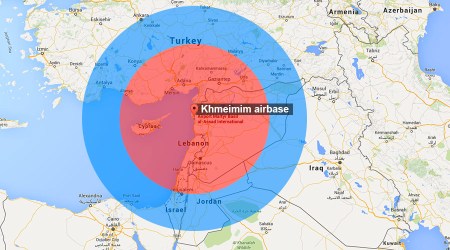
This was a reminder of the sophisticated air defense S-400 and S-300 missile systems Russia installed at its Syrian air base after the Turkish air force downed a Russian warplane in November.

Syrian Foreign Minister Walid al-Moallem put it more crudely: “Any foreign troops entering Syria would return home in wooden coffins.”

He advised armed opposition groups fighting the government offensive in the area to lay down their weapons because, he said, “government advances signal that the five-year-old Syria war is nearing its end.”

Saturday, US Secretary of State John Kerry urged Russia to implement a ceasefire in Syria, saying its bombing campaign was killing women and children in large numbers and “has to stop.” He told reporters on his return from a trip to Europe: “Russia has indicated to me very directly they are prepared to do a ceasefire,” adding “The Iranians confirmed in London just a day and a half ago they will support a ceasefire now.”

DEBKAfile’s military sources have seen no sign of any ceasefire or even a slowdown in the Russian-led Syrian-Iranian Aleppo offensive.

Turkish military launches large air campaign on PKK targets in northern Iraq

February 6, 2016

Turkish military launches large air campaign on PKK targets in northern Iraq Uğur Ergan

– ANKARA

February/06/2016

Source: Turkish military launches large air campaign on PKK targets in northern Iraq – CRIME

The Turkish military has launched a wide-scale air campaign on the outlawed Kurdistan Workers’ Party (PKK) targets in northern Iraq.

The operation which started on Feb. 3 continued on Feb. 4, military sources have told Hürriyet.

Unmanned areal vehicles, fuel feed planes and AWACS surveillance jets accompanied Turkish Air Force F-4E and F-16 jets during strikes on the PKK targets in the neighboring country, the sources said.

Some 40 jets that took of for bases in Diyarbakır, Malatya, Bandırma, Ankara-Akıncı and Merzifon his some 100 targets on the Kandil Mountain, known as ground for the PKK headquarters, on Feb. 3 before they bombed four other points else than Kandil the next day, they said.

Some 50 targets, including a group of PKK members who were in a meeting, were hit on the second day of the operation.

The same sources said PKK targets in Turkey’s Hakkari in the southeast were also hit on Feb. 4.


Turkey trying to conceal illegal military activity on Syrian border

February 4, 2016

Turkey trying to conceal illegal military activity on Syrian border -Russian military

Published time: 4 Feb, 2016 14:02 Edited time: 4 Feb, 2016 17:51

Source: Turkey trying to conceal illegal military activity on Syrian border – Russian military — RT News


© Umit Bektas
Turkey is trying to conceal its illegal military activity on the border with Syria and has canceled an agreed Russian observation flight over its territory because of that, Russia’s Defense Ministry said.

“Such steps carried out by a country, which is a NATO member state, in no way contribute to the strengthening of trust and security in Europe,” Major General Igor Konashenkov, Defense Ministry spokesman, told the journalists at briefing in Moscow.

Konashenkov called the cancelation of the Russian observation flight over Turkish territory “a dangerous precedent and an attempt to conceal illegal military activity near the border with Syria.”

The violation of the Open Skies Treaty by Ankara won’t go without a proper response from Moscow, he said.

Konashenkov also said Russia has boosted all kinds of intelligence and surveillance activities in the Middle East.

“So if someone in Ankara thinks that the cancelation of the flight by the Russian observers will enable hiding something then they’re unprofessional.”

The spokesman reminded that 32 foreign observation flights took place in Russian air space in 2015, in accordance with the treaty, with four of them carried out by Turkish observers.

The earlier agreed observation flight over Turkish territory was canceled on February 3, after Russian experts revealed the route, which would have included airfields and areas near the Turkish-Syrian border.

The spokesman recalled that Moscow had previously provided the international community with irrefutable video evidence of Turkish artillery firing on Syrian populated areas in the north of Latakia Province.

Turkey is also supplying manpower and weaponry to terrorists in the Syrian cities of Idlib and Aleppo, Konashenkov said.

The spokesman showed the media a photo of the Reyhanli checkpoint, saying that “through this very border crossing – mainly at nighttime – the militants, who seized the city of Aleppo and Idlib in northwestern Syria, are being supplied with arms and fighters from the Turkish territory.”

The terrorists in northern Syria are suffering losses and retreating to the Turkish border, the Defense Ministry spokesman said.

According to Konashenkov, terrorist commanders have made major efforts to evacuate injured fighters and regain control of their units.

Turkish airspace violation claims ‘poorly-orchestrated provocation’

Russia still hasn’t received any data from Turkey concerning the alleged incident with the Russian warplane, which Ankara accused of violating its airspace, Konashenkov said.

“Just a few minutes ago, another Turkish official said the data was passed to Moscow… No materials were passed to us by either military or diplomatic channels,” he stressed.

The spokesman said that false statements from the Turkish side “once again confirm that the whole story of the alleged violation of Turkish airspace was made up and is a poorly-orchestrated provocation.”

Turkey claimed that a Russian Su-34 fighter-bomber violated its airspace on January 29, which was immediately denied by Moscow.

Relations between Russia and Turkey have been strained since November 24 last year, when Turkish Air Force downed a Russian Su-24 bomber for allegedly violating its airspace.

The incident, in which one Russian pilot was killed, saw Moscow imposing a set of sanctions on Turkey and boosting the security of its Khmeimim airbase in Syria with S-400 missile systems.

Russian aviation has been carrying out airstrikes against Islamic State (IS, formerly ISIS/ISIL), Al-Nusra Front and other terrorist groups in Syria since September 30 at the request of President Bashar Assad.

The Russian Air Force carried out 237 sorties and hit nearly 900 terrorist targets in Syria on February 1-4, Konashenkov said.

The airstrikes took place on Aleppo, Latakia, Homs, Hama and Deir ez- Zor provinces.

 Russia: Bad Turkey Planning Invasion of Syria, Good Israel Cooperating with Russians

February 4, 2016

Russia: Bad Turkey Planning Invasion of Syria, Good Israel Cooperating with Russians

Source: The Jewish Press » » Russia: Bad Turkey Planning Invasion of Syria, Good Israel Cooperating with Russians

Russian attack planes in Syria

Russian attack planes in Syria
Photo Credit: TASS

The current activity at the Turkish-Syrian border suggest that Turkey prepares to invade Syria, Russian Defense Ministry spokesman Igor Konashenkov said Thursday, according to various reports in Russia’s state-sponsored media. “We have good reasons to believe that Turkey is actively preparing for a military invasion of a sovereign state – the Syrian Arab Republic,” Konashenkov told reporters. “We’re detecting more and more signs of Turkish armed forces being engaged in covert preparations for direct military actions in Syria,”.

Meanwhile, Russia’s Federation Council Speaker Valentina Matviyenko told Israeli media that Russia is content with the level of cooperation with Israel over military operations in Syria.

Last year, during Prime Minister Benjamin Netanyahu’s visit to Moscow, an agreement was reached by the two countries on coordination between Russia’s Aerospace Force and Israel’s Air Force. Matviyenko noted, according to TASS: “We are satisfied how our mechanism has been tailored,” which we only vaguely understood, but assume she meant to say, “We are pleased with the way our agreement has been adjusted.”

As to Turkey, the Russians are not at all pleased with its plan to invade a country they’ve already invaded. As Konashenkov remarked with thick irony, “We’re perplexed by the fact that the usually talkative representatives of the Pentagon, NATO and of the groups allegedly protecting the rights of Syrian people remain silent despite our calls to react to these actions.”

A Thursday afternoon Russian Defense Ministry tweet read: “Russian MoD registers a growing number of signs of hidden preparation of the Turkish Armed Forces for active actions on territory of #SYRIA.”

The Russians are irate because Turkey will not allow a Russian inspection flight over its territory, which they take to prove that Ankara is hiding illegal military activity on the border with Syria.

Elsewhere on the Syrian front, another Russian Defense Ministry spokesman announced Thursday that since the start of February Russian planes have made 237 sorties and attacked almost 900 targets in five Syrian provinces.

Lavrov, Kerry confirm plans to hold meeting on Syria in Munich on February 11

February 4, 2016

Lavrov, Kerry confirm plans to hold meeting on Syria in Munich on February 11 World

February 04, 14:25

Source: TASS: World – Lavrov, Kerry confirm plans to hold meeting on Syria in Munich on February 11

The top diplomats also agreed to take steps to minimize the pause in the intra-Syrian talks
US and Russian Foreign Ministers John Kerry and Sergey Lavrov © Alexandr Sherbak/TASS
MOSCOW, February 4. /TASS/. Russian Foreign Minister Sergey Lavrov and his US counterpart John Kerry in a phone conversation on Thursday confirmed plans to hold a meeting of the International Syria Support Group (ISSG) in Munich on February 11, Russia’s Foreign Ministry has said.
“The agreement was also confirmed on holding another ministerial meeting of the International Syria Support Group in Munich on February 11,” the ministry said. The sides will consider “all the aspects of the Syrian settlement in line with the UN Security Council resolution 2254.” Lavrov and Kerry also agreed to take steps to minimize the pause in the intra-Syrian talks.
The talks in Switzerland’s Geneva were suspended on Wednesday until February 25, UN special envoy for Syria Staffan de Mistura said. “While expressing common regret over the fact that the UN-brokered intra-Syrian dialogue has been temporarily suspended, Lavrov and Kerry agreed to make necessary efforts to ensure that this pause is as short as possible,” the ministry said. Read also Moscow regrets Syria talks paused, but no one expected everything to be smooth — Kremlin Syrian internal opposition says it has legitimate right to take part in talks Russia hopes Syrian Support Group will put no obstacles to intra-Syrian talks — FM Deputy UN envoy: Syria peace talks suspended until 25 February
The Russian side has voiced concerns as some representatives of the Syrian opposition set unacceptable preconditions to establish sustained negotiations with the government of Syria. Moscow also called on the United States and its allies to remain committed to the provisions of the UN Security Council resolution 2254 adopted on December 18 that endorsed a road map for peace process in Syria. Lavrov and Kerry “stated the need for urgent steps both of the Syrian government and the opposition in order to ensure humanitarian access under the UN auspices to the areas of the country blocked both by the government forces and the armed opposition units,” the ministry said.
The Russian and US top diplomats agreed on “possible coordinated actions on delivering humanitarian aid to the certain areas of Syria by air with the use of means of military-transport aviation,” it said.

Turkey’s All-Out War on Kurds and Media

January 28, 2016

Turkey’s All-Out War on Kurds and Media, Gatestone InstituteUzay Bulut, January 28, 2016

(Oh, nonsense. According to UN Secretary General Ban Ki-Moon, the Middle East would be a place of happiness and tranquility if Israel simply ended her occupation of Palestine and committed suicide. Turkey good, Israel bad. Besides, Turkey is a valued member of NATO. /sarc — DM)

♦ On January 20, Turkish police opened fire at a group of civilians who were holding up white flags as they tried to remove the dead and wounded from the street in Cizre, one of the Kurdish towns under Turkish military siege. The Turkish police murdered two people from the group and wounded 12 others.

♦ As the military siege and attacks in Turkey’s Kurdistan intensify with each passing day, the Kurdish media are under a new wave of repression — through arbitrary arrests, psychical violence or blocks on their website content.

♦ “Our only aim today was to share what had happened in Van with the public in a healthy way. Today it was not us, but the people’s right to information that was taken into custody. We will not be silent.” — Reporter Bekir Gunes (from IMC TV), on Twitter. He was taken into custody for trying to report on the murders, but later released.

Since August, Turkey has been bombing and destroying its Kurdistan region in the same pattern: The Turkish government first declares curfews on Kurdish districts; then Turkish armed forces, with heavy weaponry, attack Kurdish neighborhoods and everyone living there. Much of this slaughter is presumably due to the Kurds having gained a large number of seats the latest elections — thereby preventing Turkey’s President Recep Tayyip Erdogan from attaining the super-majority he sought in order to change the Constitution and become “Sultan” for life, to rule as an autocrat. Kurds are also now asking for their right to rule themselves in their native lands, where they have lived for centuries.

Curfews in 19 Kurdish towns (from August 10, 2015 to the present) have penned Kurds in and enabled Turks to murder them more easily. So far, according to the Diyarbakir Branch of the Human Rights Association (IHD), in the past few months, 170 civilian Kurds have been killed. Of these, 29 were children, 39 were women and 102 were men. At least 140 people were wounded; some have lost eyes, legs or arms; others are the victims of brain trauma.

On January 20, Turkish police opened fire at a group of civilians who were holding up white flags as they tried to remove the dead and wounded from the street in Cizre, one of the Kurdish towns under Turkish military siege. The Turkish police murdered two people from the group and wounded 12 others.

1449On Jan. 20, Turkish police in Cizre opened fire at a group of Kurdish civilians who were holding up white flags as they tried to remove the dead and wounded from the street. The Turkish police murdered two people from the group and wounded 12 others.

Refik Tekin, a cameraman of IMC TV and an award-winning journalist, was among the wounded but kept filming the attack even after he was shot. He is now in a hospital.

“The state implements a policy of subjugation on the Kurdish demand for a political status. It has become clear once again that this problem is not about ditches [which some Kurdish youths have dug, over objections by officials, to try to stop the progress of the Turkish troops]. The state attempts to annihilate the Kurdish demand for political status by using the ditches as an excuse,”said Raci Bilici, the head of the Diyarbakir branch of the Human Rights Association.

As the military siege and attacks in Turkey’s Kurdistan intensify with each passing day, the Kurdish media are under a new wave of repression — through arbitrary arrests, psychical violence or blocks on their website content.

On January 1, police used water cannons and tear gas against local people marching from central Diyarbakir to the district of Sur to protest the curfews. Meanwhile, masked Turkish police detained Baran Ok, a cameraman of Kurdsat News Channel. Ferat Mehmetoglu, the local representative of Kurdsat, kept trying to explain to the police that Baran Ok was his cameraman. Disregarding Mehmetoglu’s pleas, the masked police drove off at high speed. At one point, after Mehmetoglu had gotten in front of the police vehicle, he barely avoided being run over when the officers drove off with his cameraman.

Meanwhile, the Dicle News Agency (DIHA) alleged that it obtained a restricted and official document, signed by the local Tank Battalion Command (part of the Turkish armed forces). The document instructs the Turkish armed forces operating in Kurdish towns and offers impunity: “No personnel shall forget not even for a moment that any personnel’s restraint from using arms for fear of prosecution might have very grave consequences, result in martyrs on our side; endanger the survival of the state and nation, [and] help traitors, terrorists and enemies of the state feel more powerful,” it said in part.

A day after DIHA covered this alleged document; its website was blocked for the 28th time by the Turkish Telecommunications Authority (TIB).

On January 5, Peoples’ Democratic Party (HDP) MP Ferhat Encu, in a parliamentary motion, asked Turkish Prime Minister Ahmet Davutoglu about the document. He has not yet received a reply. No Turkish authority has so far either confirmed or denied the existence of such a document.

Kurdish journalists are also exposed to physical violence. On January 5, the special operations police forcibly gathered 37 people from their homes and took them to an indoor sports hall. One of them was Nedim Oruc, a journalist who had extensively covered the military assaults against the Kurdish town Silopi.

At first, no information could be obtained about Oruc who, according to DIHA news agency, had been battered, dragged on the ground and kidnapped by police in an armored vehicle. As a result of the public pressure brought to bear by the Twitter hashtag #NedimOrucNerede Where is Nedim Oruc), Silopi Security Directorate admitted that Oruc was in custody. He is now in Sirnak Prison.

The same day, the police raided a student dormitory and houses in the province of Van. The all-female, pro-Kurdish Jin (Women’s) News Agency reporter and university student Rojda Oguz and many other students were arrested. Rojda is now in Van prison.

“The Turkish public has a right to information from a variety of sources and perspectives, but the government is clearly trying to stifle pro-Kurdish news outlets with these arrests,” said Nina Ognianova, Europe and Central Asia Program Coordinator of Committee to Protect Journalists. “We call on Turkish authorities to release Nedim Oruç and Rojda Oğuz without delay and to stop harassing and obstructing journalists.”

On January 9, the “Women for Peace” group staged a demonstration in Izmir’s Bornova district to protest the recent military siege and attacks against Kurdish districts. Police detained theEvrensel reporter Eda Aktas, along with 12 others, while she was reporting on the protest — on the grounds that the press statement of the protesters violated the article 301 of the penal code, which makes it illegal “to insult Turkey, the Turkish nation, or Turkish government institutions.”

On January 5, in Silopi, three female Kurdish politicians — Sêvê Demir, Pakize Nayir, and Fatma Uyar — were murdered by state forces.

On January 10, in Izmir, when the Kurdish Congress of Free Women (KJA) organized a protest to commemorate the slain politicians, the police attacked the protestors, and detained 35 — including Dilek Aykan, the co-head of the Izmir branch of the Peoples’ Democratic Party (HDP).

The police also prevented Serfiraz Gezgin, a reporter from the Kurdish DIHA agency, and Hatice Erhan, a reporter from the left-wing magazine Kizil Bayrak, from filming the police crackdown. Other journalists just barely stopped police from detaining Gezgin and Erhan.

For months, the Turkish armed forces have been using hospitals and schools as military quarters, threatening, and even murdering medical personnel, and forcing thousands of Kurds to flee their native lands.

The state violence in Turkish Kurdistan escalates daily: On January 10, Turkish soldiers murdered 12 Kurds at close range in the province of Van. The office of the governor of Van announced that 12 PKK members were killed in the province. Photos of the slain Kurds were shared on the social media, apparently by Turkish security forces. A YouTube account called “Special Operations Team,” for instance, published a video entitled “The carcasses of the PKK – Van/Edremit” showing the bodies of slain Kurds, with upbeat music playing in the background.

Reporter Bekir Gunes, and cameraman Mehmet Dursun, working for IMC TV, were trying to follow up on news concerning the murders, but were prevented from doing so by the police. Both were taken into custody and released 11 hours later. “Our only aim today was to share what had happened in Van with the public in a healthy way,” Gunes wrote on his Twitter account. “Today it was not us, but the people’s right to information that was taken into custody. We will not be silent.”[1]

According to the 2015 World Press Freedom Index of Reporters without Borders, Turkey, out of 180 states, ranked 149.[2] “Turkey’s ‘underlying situation’ score,” it wrote, “covering such areas as cyber-censorship, lawsuits, dismissals of critical journalists and gag orders — actually worsened, showing that freedom of information continues to decline.” [3]

Lately, pressures on free speech and free press have been gaining new momentum in Turkey. The latest victim was a Turkish comedian and television host, Beyazit Ozturk (“Beyaz”) known for being apolitical and pro-establishment.

Beyaz found himself in the midst of violent threats after a teacher from Diyarbakir phoned into his popular live chat show and called for an end to violence in the region. She said: “Children are dying here. All of these bomb sounds, bullet sounds… People — especially babies and children — are struggling with a lack of water, with starvation. Please show some sensitivity. See us, hear our voice, extend your hand to us. Please let no more people die. Let no more children die.”

Beyaz thanked the caller, said that he too supported her message of peace and asked the audience to applaud her.

Kanal D [Channel D], the mainstream TV channel broadcasting the show, issued a statement saying they were tricked into allowing the caller on. The television channel’s officials added: “Dogan TV and Kanal D have always been on the side of the state from day one.”

The Turkish ministry of national education started an exhaustive hunt to find the caller. They said that no teacher with that name admitted to having called the show.

The teacher on the phone had not even said who killers were, but for some unfathomable reason, the Turkish nationalists, including state authorities, appear to have taken the remark personally, and interpreted it as an “insult to Turkish security forces” and “terrorist propaganda.”

Beyaz thereupon received a negative reaction from Turkish nationalists, and even death threats on social media. Many Twitter users and pro-government media outlets accused him “of allowing PKK propaganda on his show” and “not showing the required reaction to the caller.”

A popular hashtag said: “Beyaz! Apologize from the Turkish Police!”

A masked individual, allegedly a special operations police officer, posted on YouTube a video entitled, “We will not forget,” threatening Beyaz for allowing a caller from Diyarbakir to say on his show that children are dying.

In the end, Beyaz appeared on Kanal D again, apologizing:

“I am a son of a police officer. Whatever the entire Turkish nation thinks about that place [Turkey’s predominantly Kurdish southeast], I also have the same thoughts. Of course, with all our hearts and souls, we want the terrorist organization to lay down its arms and this issue to be resolved as soon as possible. May Allah make it easy for all of our security forces in the southeast. We are on the side of our state and our nation.”

Finally, the police found the “criminal.” Ayse Celik, the art teacher who phoned in, is now being prosecuted for “making propaganda for the terrorist organization”. Eleven lawyers in the province of Antep who declared their support for the Celik’s message are also being prosecuted for “terrorist propaganda.”

This is the level of political and social pressure that a TV personality — who has had nothing to do with political activism throughout his entire career — is exposed to, in response to the most innocent and humanitarian wishes for peace uttered by a caller on his show. Imagine the enormity of the pressure on Kurds and journalists who try to expose the real crimes Turkey is committing against its Kurdish minority.

_______________________

[1] On January 10, which marks the Working Journalists Day in Turkey, Murat Verim, a Kurdish reporter of Dicle News Agency (DIHA), was detained following a police raid on his home in Mardin’s Dargecit district. On January 12, gendarmerie special operations forces attacked Mursel Coban, a journalist and photographer, as he was reporting on the funeral of the youths murdered in the Sur district of Diyarbakir. Coban said that the police beat him and tried to detain him, while threatening him with “disappearance.”

[2] In 2014, Turkey ranked 154 in the list. “Turkey’s rise in the index must be put in context,” wrote Reporters Without Borders. “It was due above all to the conditional release in 2014 of around 40 imprisoned journalists who nonetheless continue to face prosecution and could be detained again at any time.

[3] In another mass arrest on December 20, 2011, 58 people (many of whom were Kurdish journalists) were taken into custody in a police raid on their offices or houses in 8 provinces.

A new US-Russian-Turkish military buildup over Syria: In unison or at odds?

January 25, 2016

A new US-Russian-Turkish military buildup over Syria: In unison or at odds? DEBKAfile, January 25, 2016

TurkishAirBase480

The US and Russia are in the process of a military buildup in the Kurdish areas of northern Syria. It is ranged along a narrow strip of land 85 km long, stretching from Hassakeh in the east up to the Kurdish town of Qamishli on the Syrian-Turkish border. Facing them from across that border is a parallel buildup of Turkish strength. This highly-charged convergence of three foreign armies athwart a tense borderland is reported here by DEBKAfile’s military sources. It is too soon to determine whether the three armies are operating in sync or at odds, especially in view of the bitter relations between Moscow and Ankara.

US Forces 

American Special Operations troops and Air Force attack helicopters landed first at Remelan airport. They are the first US troops to operate from a ground base in Syria, accommodated in living quarters built for them in advance by a US engineering corps unit. The airport runway has been widened for US warplanes.

American Special Operations troops and Air Force attack helicopters landed first at Remelan airport. They are the first US troops to operate from a ground base in Syria, accommodated in living quarters built for them in advance by a US engineering corps unit. The airport runway has been widened for US warplanes.

Russian Forces

Next came two Russian military missions on Jan. 16.  One group, led by a general and consisting of air force and Special Operations officers, is preparing to take over a small abandoned base in Syrian army-controlled territory just 80 km from the new US facility at Remelan, and adapt it for Russian use.

The other group, which consists of intelligence officers – some from Russia’s FSB federal security service, the FSB – indicates that Moscow has decided it is high time for professionals to protect the classified information moving around the Russian Task Force in Syria and safeguard it from reaching the wrong hands. .

The abandoned base is less than 3.5 km from the Turkish border, and would act as a Russian barrier between US forces in northern Syria and the Turkish border contingents.

Turkish Forces

This Russian deployment set off alarm bells in Ankara, and so the Turkish army responded with the third troop buildup, arraying tanks and mobile artillery on the border across from Qamishli.

Over the weekend, Turkish President Tayyip Erdogan stated, “We have said this from the beginning: we won’t tolerate such formations (in northern Syria) along the area stretching from the Iraqi border up to the Mediterranean.”

At the same time, US Vice President Joe Biden said Saturday, Jan. 23, that  the U.S. and Turkey are prepared for a military solution against ISIS in Syria should the Syrian government and rebel-opposition forces fail to reach a peace agreement during its upcoming meeting in Geneva.

However, Ankara views its war on terror as focused on both Kurdish separatists and ISIS, which is subjecting Turkey to multi-casualty attacks.

DEBKAfile’s military and intelligence sources note that Turkey’s military options are very limited. Its leaders know they dare not put a foot wrong because the Russian force in Syria is just waiting for an opportunity to avenge the downing of a Russian Su-24 warplane by the Turkish air force on November 24.

Another group of actors stirring the pot in northern Syria is the Kurds, particularly the YPG militia, the only fighting force in Syria capable of defeating ISIS, which has been reinforced by the Iraqi autonomous Kurdish region’s Peshmerga, as well as the outlawed Turkish PKK Kurdish organization.

At this stage, it is impossible to determine how this triple buildup will play out tomorrow – how far the US and Russia are in concert, at what point they may decide to vie for footholds in the Kurdish region of northern Syria and how far the Turks are clued into the joint US-Russian strategy for bludgeoning ISIS.

Erdoğan says Turkey will not allow Russia to settle north of Syria

January 22, 2016

Erdoğan says Turkey will not allow Russia to settle north of Syria

Source: Erdoğan says Turkey will not allow Russia to settle north of Syria – Daily Sabah

AA Photo

President Recep Tayyip Erdoğan said on Friday that Turkey will not allow Russia to build a base in northern Syria.

President Erdoğan was asked by reporters after the Friday prayer of what he thinks about claims that Russia will build a base in Northern Syria.

Erdoğan said that Turkey is aware that there are around 100 Russian soldiers deployed in northern Syria.

Erdoğan said that the PYD terror organization, which is known to be supported by Russia, is no different than the Daesh terror organization.

“There is no difference between them. We will also talk with Mr. Biden about this issue in detail tomorrow,” Erdoğan said.

He also emphasized that Qatar, Germany, France and the U.K. were part of the issue.

“We will not allow such a thing in northern Syria,” he said.

Erdoğan also touched upon the PKK’s terror attack on an elementary school which happened on early Friday in Turkey’s southeastern Diyarbakır province.

He said that the terror attack on the school showed the vicious plans of the terror organization.

Erdoğan said that the attack was also a response to the 1,128 academics who signed a petition that described security operations against the PKK in the country’s southeast as a “massacre.”

“They [the academics] say ‘This is who we are. We don’t have a problem with this issue. We are with terror’,” Erdoğan said.

“Our only consolation is that none of our children died during the attack,” he concluded.