Posted tagged ‘Turkey’

Chilling revelations: Diyarbakır, city of the dead and missing (RT EXCLUSIVE)

March 12, 2016

Chilling revelations: Diyarbakır, city of the dead and missing (RT EXCLUSIVE)

Published time: 12 Mar, 2016 09:22

Source: Chilling revelations: Diyarbakır, city of the dead and missing (RT EXCLUSIVE) — RT News

An RT crew has visited Diyarbakır, the unofficial capital of the Turkish Kurds, to throw light on the gruesome consequences of Turkey’s crackdown on the Kurdish population. RT’s William Whiteman talked to the relatives of one of the victims.

RT took an exclusive look into the mass killings of civilians allegedly committed by the Turkish military, filming the mourning of those who lost their loved ones as a result of the ongoing crackdown.

Read more

Buildings, which were damaged during the security operations and clashes between Turkish security forces and Kurdish militants, are seen in the southeastern town of Cizre in Sirnak province, Turkey March 2, 2016. © Sertac Kayar

Friday prayers in Diyarbakir have also become a manifestation of the deep divide between the locals and the Turkish government.

In a further effort to quash Kurdish descent, Turkish authorities now require imams to read government-approved sermons. Thousands of local Kurds are protesting this move by boycotting the city’s main mosque and holding prayers in a nearby park.

The imam speaks in both Kurdish and Turkish, condemning the government’s actions.

RT’s William Whiteman witnessed Turkish military helicopters flying overhead in Diyarbakir, while the explosions and gunfire of the continuing military operation could be heard.

In the city’s Sur district, Turkish security services have continuously waged a military operation against the Kurdistan Workers’ Party (PKK) and its affiliated groups, as part of the ongoing government operation across the region.

Whiteman spoke to the weeping mother of 17-year-old girl Rozerin Cukur. She was killed in a military bombardment of Sur while she was visiting the district with friends in early January. With access to the area now cut off by the fighting, her body has never been recovered. Sadly, she is one of many such cases.

Rozerin’s father, Mustafa, could be found at a nearby memorial for the missing dead.

“We saw the news of her death reported on state TV and the internet. The reports included Rozerin’s ID information, discovered beside her body,” the father told RT.

Through hunger striking, the families here have managed to pressure the government into returning just two of the missing bodies. But the condition they were in was appalling.

“Of the bodies that have been recovered, parts of their flesh and internal organs had been eaten by a stray dog,” Mustafa said. “The bodies were riddled with thousands of bullet holes. It seems that the military continued to shoot them long after they were dead.”

“They were only identifiable through DNA testing,” Mustafa claimed.

RT spoke to the co-presidents of the local Kurdish People’s Democratic Party (HDP) branch about the plight of these families.

“Of the local residents killed in Sur, 14 bodies are yet to be recovered. They have been lying in the open for a long time, first under the siege, and now under the curfew,” Ömer Önen, co-president of HDP office of Diyarbakir, told RT. “Without the bodies, the families have been unable to hold funerals.”

Önen explained that by denying the people in Diyarbakir the right to give their loved ones a traditional Islamic burial, the Turkish government is violating human rights and the sanctity of religious traditions.

Every Saturday in Diyarbakir, the families of people who disappeared during the peak of the Turkish-Kurdish conflict in the 1980s and ‘90s gather to demand information on their missing loved ones. Now they are being joined by the families of new victims, with Rozerin’s parents among them.

Previously RT showed exclusive footage from the city of Cizre, destroyed by Turkish government forces during an anti-Kurdish military operation that ended there only two days ago.

The Turkish government offensive on the mostly Kurdish southeastern regions of the country was launched back in July of 2015 with strict 24-hour curfews imposed on several Kurdish towns.

On Friday RT requested comments on the ongoing anti-Kurdish crackdown in Turkey from aid groups and rights organizations, such as HRW, MSF International, the ICRC, the OHCHR, and Amnesty International. There has been no answer so far.

In the meantime, Turkey has claimed it will continue its operations against Kurdish militia – to ensure peace in the region.

“We will continue our operations to eliminate the PKK. This is necessary to ensure peace in the region,” said Efkan Ala, the Turkish interior minister.

Washington says Ankara has the right to fight terrorists, but only within international law.

“While we have certainly acknowledged Turkey’s right to defend itself against terrorists, and the PKK is a terrorist organization that we have recognized [as such], we have also, and I’ve said it many times from this podium, called on [Turkey] to do so in accordance with the international law and obligations that they [Turkey] have,” US State Department spokesman John Kirby said.

Turkey bombs multiple PKK locations in northern Iraq, 67 militants killed

March 12, 2016

Turkey bombs multiple PKK locations in northern Iraq, 67 militants killed

Published time: 12 Mar, 2016 17:02

Source: Turkey bombs multiple PKK locations in northern Iraq, 67 militants killed — RT News

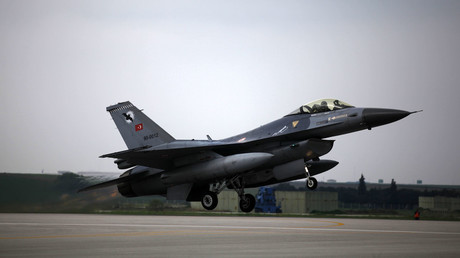
Turkish F-16 fighter jets. © Fatih Saribas / Reuters

The Turkish Air Force has delivered airstrikes in at least five locations on the territory of neighboring Iraq, targeting strongholds of the Kurdish militia, various media reported. The Turkish military claims 67 militants of the Kurdistan Workers’ Party (PKK) have been killed.
Read more

© Umit Bektas

Turkish warplanes have attacked PKK targets in northern Iraq, including the headquarters of the PKK leadership situated right on the Iraq-Iran border in the Qandil Mountains, reportedly hitting the settlements of Avasin, Basyan, Haftanin, Metina and Qandil, Reuters reports, citing the army.

The airstrikes took place on Wednesday, March 9, according to Turkey’s state-run Anadolu Agency. The agency cites an unnamed security source who claimed that 14 F-16 and F-4 fighter jets participated in the assault, bombing PKK camps, arms depots and bunkers.

READ MORE: ‘We are afraid but won’t leave our land’: Syrian Kurds who survived Turkish shelling tell RT

Beginning July 2015, after the two-year truce between Ankara and the Kurds was scrapped, Turkey has been delivering regular airstrikes against Kurdish militia in neighboring Iraq and shelling Kurdish settlements in Syria as well.

The PKK is demanding autonomy for Kurds in Turkey’s south-east, and is listed as terrorist organization #1 by the Turkish government.

READ MORE: ‘Out of question’: Erdogan rules out Turkish troop withdrawal from Iraq

In early December 2015, Turkey deployed about 150 troops and 25 tanks to a base in Iraq’s Nineveh province, without bothering to get permission from Baghdad. Ankara argued that its soldiers were sent to northern Iraq after a threat from Islamic State (IS, formerly ISIS/ISIL) to Turkish military instructors training anti-terrorist forces in the area.

Read more

© Umit Bektas

Turkey’s president Recep Tayyip Erdogan rejected a request from Baghdad to withdraw the troops, claiming that the Turkish military is present in Iraq “as instructors.”

On Friday, Turkish Interior Minister Efkan Ala said that Ankara is preparing another military operation against the Kurdish PPK in the country’s south-east. The minister announced plans to introduce curfews in three districts, saying that eight other districts have been “cleared of terrorists.”

In an interview Friday at the Foreign Ministry in Moscow, Russian Deputy Foreign Minister Gennady Gatilov criticized Turkey for shelling Kurdish positions on Syrian territory, alleging that Ankara is turning a blind eye to arms supplies to terrorists.

Gatilov stressed that such practices must stop in order “to provide a more constructive atmosphere for the intra-Syrian talks and a more durable cease-fire,” Bloomberg reported.

Turkey’s Runaway Anti-Semitism

March 10, 2016

Turkey’s Runaway Anti-Semitism

by Burak Bekdil March 10, 2016 at 4:00 am

Source: Turkey’s Runaway Anti-Semitism

  • When it comes to diplomatic conflict between Turkey and Israel or Turkish anti-Semitism, there is always an unusual optimism in the official language chosen by Israeli officials or Jewish community leaders. Facts on the ground are a little bit different than the rosy picture.
  • If Turkish Jews are “safe and secure” in Turkey, why do they feel compelled to protect their schools and synagogues with heavy security? Why do most synagogues in Istanbul look almost like a U.S. embassy in Baghdad or Islamabad?
  • Anti-Semitism in Turkey reached such intensity that even anti-Semitic Islamists were not immune to anti-Semitic smear campaigns.

The 74th anniversary of an embarrassing tragedy took place in Turkey on February 24, 2016.

The MV Struma was a small iron-hulled ship built in 1867 as a steam-powered schooner, but was later re-engined with an unreliable second-hand diesel engine. In 1941, it was tasked with safely transporting an estimated 781 Jewish refugees from Axis-allied Romania to Britain’s Mandatory Palestine. Between its departure from Constanta on the Black Sea on Dec. 12, 1941 and arrival in Istanbul on Dec. 15, the vessel’s engine failed several times. On Feb. 23, 1942 with her engine still not running but the refugees aboard, Turkish authorities towed the Struma from Istanbul through the Bosporus out to the Black Sea. On the morning of Feb. 24, the Soviet submarine Shch-213 torpedoed the Struma, killing all but one of the refugees and 10 crew aboard.

Until this year Turkey, one of the main culprits, had only once commemorated the victims. This year, official Turkey decided, should be the second time. A wreath and carnations were hurled at the sea in the shadow of the horrible event that took place decades ago.

At the commemoration ceremony at Sarayburnu harbor on the Bosporus were the head of Turkey’s Jewish community, Ishak Ibrahimzadeh, Chief Rabbi Isak Haleva and Istanbul’s governor, Vasip Sahin. In his speech, Sahin said: “We observe that the necessary lessons were not drawn from such tragedies.” He was right, at least from a Turkish point of view.

When it comes to diplomatic conflict between Turkey and Israel or Turkish anti-Semitism, there is always an unusual optimism in the official language chosen by Israeli officials or Jewish community leaders.

For instance, Ibrahimzadeh praised “recent steps by the Turkish state to mend history with the Jewish community.” Echoing the same optimism, chairman Stephen Greenberg and executive vice chairman Malcolm Hoenlein of the Conference of Presidents of Major American Jewish Organizations, assured that Turkey’s small (less than 17,000-strong) Jewish community feels “safe and secure” despite being placed in the middle of a political feud between Turkey and Israel — sparked first in 2009 by then Turkish Prime Minister Recep Tayyip Erdogan’s clash with former Israeli President Shimon Peres at a World Economic Forum meeting in Davos, Switzerland.

Such optimism in official narratives is normal, especially because Ankara and Jerusalem have been privately negotiating a deal to end their hostilities and normalize their diplomatic relations. Non-constructive, let alone explosive, speeches from any state or non-state actor will not help diplomats from either side in their efforts to reconcile. All the same, facts on the ground are a little bit different than the rosy picture.

If Turkish Jews are “safe and secure” in Turkey, why do they feel compelled to protect their schools and synagogues with heavy security? Why do most synagogues in Istanbul look almost like a U.S. embassy in Baghdad or Islamabad?

On Jan. 20, 2016, a Turkish synagogue in an old Jewish neighborhood in Istanbul was vandalized with anti-Semitic graffiti days after holding its first prayer service in 65 years. Vandals painted the external walls of the Istipol Synagogue with the script: “Terrorist Israel, there is Allah.”

“Writing anti-Israel speech on the wall [outside] of a synagogue is an act of anti-Semitism,” said Ivo Molinas, editor-in-chief of Turkish Jewish newspaper, Şalom. “Widespread anti-Semitism in Turkey gets in the way of celebrating the richness of cultural diversity in this country.”

Less than a month after that, a column in the radical Islamist Turkish daily Vahdet claimed that the evolutionary theory of “the Jew” Charles Darwin contradicts Allah’s word in the Koran and that in actual fact, monkeys evolved from perverted Jews whom Allah cursed and punished.

Unsurprisingly, the columnist, Seyfi Sahin, is a staunch supporter of President Erdogan’s Justice and Development Party. Sahin claims to be a physician, and argued that “Jews terrorize the world of science” and, “as a Jew, Darwin concocted his theory of evolution in order to turn Muslims away from their religion.” He further wrote:

“The aim of [Darwin’s] theory is to turn the non-Jews away from their religion, to harm their faith, and to make them suspicious about their religion. Darwin, being a Jew, believed, lived, and was buried according to his religion. His real targets were the Muslims … I believe that the gorillas and chimps living today in the forests of North Africa are cursed Jews. They are perverted humans that have mutated.”

There are no reports of Sahin being investigated or prosecuted under Turkey’s anti-racism laws. Not surprising. No such case has ever been heard of.

More recently, there was the curious case of Yusuf Kaplan, a Turkish Islamist columnist and a darling of Erdogan and his supporters — until he dared to criticize the government’s foreign policy. Kaplan a columnist for Yeni Safak, one of Erdogan’s favorite newspapers and one of his staunchest supporters, argued in a television appearance that the government’s foreign policy was incompatible with regional realities. So what? Not so difficult to guess.

Leading users on social media called for Kaplan’s death and accused him of killing another pro-government journalist, of being a British spy and of “collusion with the Jews.” Many called him a “Jewish stooge.” A Jewish stooge? The man has a remarkable record of making anti-Semitic statements, including his claim that “Jews rule the Western universities and world media and that their paranoia can reach barbaric, cruel and inhuman dimensions.”

Turkish newspaper columnist Seyfi Sahin (left), a staunch supporter of Turkey’s President Erdogan, wrote, “I believe that the gorillas and chimps living today in the forests of North Africa are cursed Jews. They are perverted humans that have mutated.” Yusuf Kaplan (right), another Turkish newspaper columnist, also has a record of making anti-Semitic statements. But when he criticized government policy, he was accused of being a “Jewish stooge.”

On the 74th anniversary of the Struma tragedy, anti-Semitism in Turkey reached such intensity that even anti-Semitic Islamists were not immune to anti-Semitic smear campaigns.

Burak Bekdil, based in Ankara, is a Turkish columnist for the Hürriyet Daily and a Fellow at the Middle East Forum.

Syrian Kurds accuse Turkey of aiding sarin gas delivery to rebels after fresh chemical attacks

March 10, 2016

Syrian Kurds accuse Turkey of aiding sarin gas delivery to rebels after fresh chemical attacks

Published time: 10 Mar, 2016 01:09 Edited time: 10 Mar, 2016 02:18

Source: Syrian Kurds accuse Turkey of aiding sarin gas delivery to rebels after fresh chemical attacks — RT News

In an interview with RT, a spokesman for the Kurdish YPG militia accused Turkey of providing a clear transit route for the chemical weapons that were deployed against them near the city of Aleppo on Tuesday.

READ MORE: ISIS shelled Kurdish-controlled Iraq village with ‘poisonous substances’ – governor

Read more

Aleppo, Syria © Hosam Katan

Syrian anti-government militants “took advantage of the ceasefire” to launch attacks against a Kurdish-controlled area near Aleppo in northern Syria, Redur Xelil told RT. The attackers targeted a civilian district of what was once Syria’s biggest city, and has since become a key battleground. According to Xelil, the shells emitted an “unnatural smell” and “yellow smoke” upon impact, indicating that chemical weapons were involved.

“Our sources inside the rebel groups have confirmed that toxic substances were used. We also have verified information that sarin gas was delivered to them from Turkey. All signs point to the fact that these factions were using banned weapons, but we cannot access the launching area, as it is located on the front between the Turkish and rebel forces,” Xelil told RT by Skype from Rojava in Syria.

Kurdish deputies in the Turkish parliament have previously accused Ankara of supplying Islamic State (IS, formerly ISIS/ISIL) and other jihadist groups inside Syria with chemical weapons, which are used both in their fight against the Syrian government and to pin responsibility for their deployment on the regime of President Bashar Assad.

Tuesday’s attack, which also involved phosphorus, did not result in any severe casualties.

“This attack was a failure, but this doesn’t mean that there won’t be another one. We are convinced the enemy has improvised shells containing phosphorus and sarin gas,” said Xelil.

READ MORE: Who’s behind alleged Aleppo chemical weapons attack?

Last month, the Organization for the Prohibition of Chemical Weapons (OPCW) accused IS of using chemical weapons against Kurdish forces throughout 2015. Reports emerged on Wednesday revealing that the jihadist group had launched a new chemical attack on the Kurdish village of Zaza in northern Iraq, in which more than 40 civilians suffered chemical burns and lung damage.


Our ISIS Problem is also our Saudi Arabia Problem

March 9, 2016

Our ISIS Problem is also our Saudi Arabia Problem, WNDWilliam Murray, March 8, 2016

H/t The Counter Jihad Report

ISIL, or ISIS, now calling itself the Islamic State, is part of a continuing Sunni Muslim problem. Here is some real history to counter current media perceptions paid for by Saudi Arabia and other Gulf states.

Ask the media or any Democratic or Republican senator, and they will tell you that Shiite Muslims (or Shia) are the greatest threat faced by Western civilization today. Besides Sen. John McCain, current presidential candidates Sens. Ted Cruz and Marco Rubio have referred to the Shiite threat in virtually every stump speech, often citing the “Shia Crescent” that runs from Iran through Iraq and Syria and ending in Lebanon. Rubio constantly refers to “our Sunni allies such as Saudi Arabia” and has suggested the creation of a Sunni state in Syria. Apparently, the senator is, as is former Secretary of State Hillary Clinton, unaware that there is already a Sunni state in northern Syria, and it is run by the Islamic State, otherwise known as ISIS or ISIL.

The Sunni Islamic State does have a competitor in Syria, al-Nusra, which is part of al-Qaida and also a Sunni terror organization. The Army of Islam operating in Syria is also a Sunni terror organization supported by Saudi Arabia and Turkey. During battles between al-Nusra and the Islamic State, American-led coalition aircraft have supported Sunni al-Nusra, which is al-Qaida. Which Sunni group to back in the Syrian civil war is always a question for the White House.

In 2015 most of the 17,000 civilians killed in Iraq died at the hands of Sunni terrorists. That is 10 times the number killed in the Sunni terror attack on 9/11. The attacks on the World Trade Center and the Pentagon were conducted by al-Qaida, a Sunni terror organization. The first terror attack on the Trade Center in 1993 was financed by Khalid Sheikh Mohammed, a Sunni cleric also associated with the Sunni terror group al-Qaida.

The 9/11 attack was planned by al-Qaida from Afghanistan, which at the time was controlled by the Taliban, a Sunni Muslim group dedicated to the elimination of Shiites and Christians.

Sunni groups, many funded by interests inside Saudi Arabia and Qatar, declared responsibility for the 2004 Madrid train bombings killing 191 and wounding over 1,800. A Sunni group took responsibility for the 2005 London bus bombings killing 52 and wounding 700. Sunni terror groups were responsible for the massacre of 334 people including 186 children during the 2004 attack on a school in Beslan, Russia, and also the Moscow theater attack in 2002. The various Paris attacks, including the 2015 Charlie Hebdo magazine and Jewish deli attacks over three days and a later attack in November on a theater and restaurants that killed 130, were conducted by the Islamic State, a Sunni Muslim organizations.

The Fort Hood terror attack in 2009 killing 13 plus an unborn child was conducted by Maj. Nidal Hasan, a Sunni Muslim connected to a “vetted” Sunni imam, Anwar al-Awlaki, who was allowed to speak at the Pentagon and Congress. Al-Awlaki and his son, both U.S. citizens, were killed by a drone strike though a death warrant issued by President Obama to shut him up lest he embarrass those at the Pentagon who had “vetted” him. He had been the imam at the Virginia mosque attended by some of the 9/11 hijackers.

There have been numerous “minor” terror attacks against Western targets, such as the 2013 Boston Marathon bombings that killed “only” three and wounded 264. The bombers were brothers from a family of Sunni Muslims who had immigrated legally to the United States from Chechnya, Russia. Other “small” attacks by Sunni Muslims in the United States include the following: A Sunni Muslim convert killed one at a Little Rock military recruiting center in 2009, and four Marines were killed by a Sunni Muslim immigrant in Chattanooga in 2015. Other attacks such as against a 2002 El Al ticket counter at Los Angeles International Airport have been downplayed as only three died.

Most recently in the United States was the 2015 San Bernardino massacre, which was carried out by a Sunni Muslim couple connected to Saudi Sunni extremists and influenced by the Islamic State. A total of 14 were killed and 22 wounded.

In Asia the 2002 Bali bombings that killed 202 mostly Australian tourists was orchestrated Jemaah Islamiyah, a Sunni Muslim organization seeking Shariah law in that nation. Sunni groups have bombed numerous churches in the Philippians, and Thailand suffers almost daily deaths by Sunni Muslim separatist organizations that want a breakaway state under Shariah law. China suffers numerous attacks from Sunni groups every year.

The most noted attack in India by Sunni Muslims from Pakistan was in 2008 when 10 members of Lashkar -e-Taiba, conducted 12 coordinated shooting and bombing attacks over four days, killing 164 people and wounding 308. A landmark hotel, the Taj Mahal Palace, was nearly completely destroyed.

The mass beheadings of 21 Egyptian Christians in Libya that outraged the press in the United States for a few days in 2015 were conducted by a Sunni terror group. All of the slaughter in this Hillary Clinton established “democracy” is being conducted by three Sunni Muslim factions.

Back to the “Shia threat” alluded to by Hillary Clinton, McCain, Cruz and Rubio as well as Secretary of Defense Ash Carter. The last large scale Shia attack against the West was in 1983 against a military target in Lebanon at the U.S. military barracks, killing 299 American and French servicemen.

I have left Israel out of this analysis because it faces a Sunni threat from the south in Gaza and a Shia threat to the north. In line with the theology of the two groups, Sunni-oriented Hamas normally attacks civilian targets while Shia Hezbollah usually attacks military targets.

With this history, why does the Obama administration, like the Bush administration before it, as well as both liberal and conservative members of Congress and virtually all presidential candidates, say the greatest threat is from Shia Muslims?

The simple answer is that Saudi Arabia is Sunni Muslim, and most of the financing for Sunni extremist groups has come from Saudi Arabia, which is “our ally.” The initial funding for the revolt in Syria, which handed us the Islamic State problem, came from Saudi Arabia. Over $2 billion in arms were moved into Syria from Turkey and prepositioned before the initial Sunni uprising that to this day Obama and McCain insist was a secular revolt.

Some contend that only private elements within Saudi Arabia supported ISIS and never the Saudi government. Although Saudi Arabia may not directly support or fund ISIS, Saudi Arabia gives legitimacy to ISIS extremist ideology. Saudi textbooks are used in the ISIS-controlled schools in Syria and Iraq.

If we want to cut off the real head of the snake, the Islamic ideology that threatens the world through al-Qaida and the Islamic State today, we must shut down the educational funding source – and that is Saudi Arabia. Saudi Arabia runs a close second to North Korea on human rights abuses and should be treated to the same sanctions and boycotts. All Saudi-printed literature and all funding of mosques and schools in the United States and Europe should be banned at once.

To stop ISIS, which is actually the second generation of al-Qaida, we must dig out the root which is Saudi Arabia.

Note: The preceding were William J. Murray’s prepared remarks for The Awakening, Orlando, Florida, March 5, 2016.

ISIS shelled Kurdish-controlled Iraq village with ‘poisonous substances’

March 9, 2016

ISIS shelled Kurdish-controlled Iraq village with ‘poisonous substances’ – governor

Published time: 9 Mar, 2016 15:38 Edited time: 9 Mar, 2016 16:25

Source: ISIS shelled Kurdish-controlled Iraq village with ‘poisonous substances’ – governor — RT News

Islamic State (IS, formerly ISIS/ISIL) fighters used “poisonous substances” during the shelling of a village in northern Iraq on Tuesday, a local governor said, according to Reuters.

“There were poisonous substances in these shells. We don’t know what,” Kirkuk province governor Najmuddin Kareem told reporters, referring to a Tuesday attack on the village of Taza.

More than 40 people suffered from partial chocking and skin irritation after mortar shells and Katyusha rockets filled with the “poisonous substances” exploded in the mainly Shia Turkmen village, which is located south of the oil city of Kirkuk, in a region under Kurdish control.

Read more

Aleppo, Syria © Hosam Katan

None of the 40 people died as a result of the attack, though five remain in hospital, health officials told Reuters.

A total of 24 shells and rockets were fired into the village from IS positions in the nearby Bashir area, Kurdish peshmerga forces commander Wasta Rasul said.

It comes just one day after the Kurdish militia group YPG stated that Islamist opposition fighters used yellow phosphorous in a chemical attack on the Sheikh Maqsood neighborhood of Aleppo, Syria, on Tuesday.

Meanwhile, US aircraft have begun targeting IS’ chemical weapons sites near Mosul, Iraq. It comes after an initial round of airstrikes aimed at diminishing the group’s ability to use mustard agent, according to CNN.

It is unclear whether the strikes conducted over the past several days have been successful. The strikes were aided by an IS detainee who provided vital information to the US military, according to the news network.

Last month, a source from the Organization for the Prohibition of Chemical Weapons (OPCW) said that IS militants attacked Kurdish forces with mustard gas in 2015, citing lab tests that came back positive for the substance after Kurdish soldiers fell ill on the battlefield.

It represented the first known instance of chemical weapons use in Iraq since the fall of Saddam Hussein, the source said.

The revelation came just three days after Central Intelligence (CIA) Director John Brennan stated that IS had used chemical weapons on the battlefield, stressing that the militant group may have more in its possession.

In October, the OPCW also concluded that mustard gas was used in neighboring Syria in 2015. Experts believe the mustard gas used in Syria originated from an undeclared chemical stockpile, or that militants have gained the basic knowledge to develop and conduct a crude chemical attack with rockets or mortars.

Turkish Gov’t Bans Int’l Women’s Day March Due to ‘Security’

March 7, 2016

Turkish Gov’t Bans Int’l Women’s Day March Due to ‘Security,’ Clarion Project, Meora Svorsly, March 7, 2016

TUrkey-Womens-Day-Protesters-HPTurkish women defying a ban on marching for International Women’s Day are met by police. (Photo: Video screenshot)

Turkish women, defying a ban issued by Istanbul’s governor prohibiting demonstrations marking International Women’s Day demonstrations, took to the streets en masse to call attention to the challenges faced by women in Turkey.

The demonstrations, three days ahead of the official March 8 commemoration, were met by a brutal police force, which fired rubber bullets into the crowd and shoved and arrested demonstrators.

“We have always said that we would never leave the streets for the March 8 demonstration, and we never will. Neither the police nor the government can stop us,” protester Guris Ozen said, speaking to told Reuters. “You see the power of women. We are here despite every obstacle and we will continue to fight for our cause.”

Women also defied the ban in Ankara, where protestors were similarly manhandled by police officers.

The official reason cited for the demonstration ban was security concerns, but with increasing frequency and brutality, Turkey’s Islamist ruling party – under the direction of President (and former prime minister) Recep Tayyip Erdogan – has cracked down on any and all institutions not in line with his Islamist agenda.

In the past, Erdogan has drawn ire for commenting that Islam defines the role of women as motherhood, adding “You cannot explain this to feminists because they don’t accept the concept of motherhood.” In an earlier comment, he told a delegation of women’s rights activists “I don’t believe in equality between men and women.”

His deputy prime minister, Bulent Arinc, was met with derision after saying that women should refrain from laughing in public because it’s immodest.

The current demonstrations sought to call attention to the dire position of women in Turkey, which was ranked 130 out of 145 states in the 2015 Global Gender Gap Index and last in Europe and Central Asia.

In addition, it has been reported that 40% of women in Turkey suffer from violent abuse from a spouse or family member. The report, compiled by Turkey’s Ministry of Family and Social Policy, had been long suppressed.

Violence against women in Turkey has skyrocketed since Erdogan came to power. According to the Turkish Ministry of Justice, from 2003, when Erdogan took power, until 2010, there was a 1,400 percent increase in the number of murders of women.

In 2014, there were at least 287 cases of women being murdered because they asked for a divorce.

According to the U.N., Turkish women are 10 times more likely to be victims of domestic violence than women in any other European country.

Professor Aysel Çelikel, head of the Support for Contemporary Living Association, or ÇYDD, cited the root cause behind the alarming rise in violence against women saying, “Women’s rights are going backward as much as [Islamist] conservatism is increasing in society.”

The sickening footage of women being abused by plain-clothed and uniformed police (see video below) is an indication of how far Turkish women will need to push back to obtain their rights.

In the words of one protester, “You see the power of women. We are here despite every obstacle and we will continue to fight for our cause.”

Turkish women will need to dig in for a long and hard fight.

Watch women defy the ban on demonstrations in honor of International Women’s Day. Note: The plain clothed men in the video footage are almost entirely police. 

Former UK Ambassador To Syria: US/UK Foreign Policy Is Doomed, Even Corrupt

March 6, 2016

Former UK Ambassador To Syria: US/UK Foreign Policy Is Doomed, Even Corrupt Tyler Durden’s picture

by Tyler Durden on 03/04/2016 22:25 -0500

Source: Former UK Ambassador To Syria: US/UK Foreign Policy Is Doomed, Even Corrupt | Zero Hedge

Authored by Eric Zuesse,

Peter Ford, who was the UK’s Ambassador in Syria during 2003-2006, was asked by the BBC in their “The Big Questions” interview on February 14th, whether the current Syrian President Bashar al-Assad would have to be a part of the solution in that country after the war is over, and Ambassador Ford said:

“I think sadly, but inevitably, he is. Realistically, Assad is not going to be overthrown. This becomes more clear with every day that passes. Western analysts have been indulging in wishful thinking for 5 years; it’s time to get real, we owe it to the Syrian people to be much more realistic and hard headed about this. The West has to stop propping up the so-called ‘moderate opposition’, which is not moderate at all.”

This was quoted by Almasdar News on February 18th, which went on to note that,

“The frustrated interviewer asked Mr. Ford about ‘what we should have done,’ and he responded that ‘we should have backed off, we should have not tried to overthrow the regime.’ Mr. Ford eloquently added that this policy has been ‘like a dog returning to vomit.’”

The video of the interview below showed him making that statement in this context:

The interviewer was clearly anti-Assad, and Ford responded with evident anger by noting (starting at 2:55 on the video) the shocking fact that:

“In Aghanistan, Iraq, Libya, like a dog returning to vomit, we go back to [and the audience already was started to clap here], we never saw a secular Arab regime that we didn’t want to overthrow.”

He was saying there that we support only non-secular regimes, sectarian regimes, in Arabia, this meaning fundamentalist Sunni governments — especially Saudi Arabia, Qatar, Kuwait, UAE, the very same regimes that even the U.S. Secretary of State acknowledged in a 2009 cable that was wikileaked, are the chief regimes that are funding Al Qaeda, ISIS and other jihadist groups. Ford was noting that the United States and UK strive to keep in power those governments, the ones that are led by royal families that supply the bulk of funding for jihadist groups — jihadists who perpetrate terrorism in the United States and Europe. “We never saw a secular  Arab regime that we didn’t want to overthrow”: Ambassdor Ford was so bold as to imply that our governments are supporting, under the table, the very same ruling families that they know to be funding (as that cable only vaguely referred to them) “Sunni terrorist groups worldwide” (which includes in Western countries, too).

The BBC’s interviewer ignored that statement; he wasn’t struck by it, such as to ask: “Why are we supporting the chief funders of Islamic jihad? Why are we overthrowing (or in Syria are trying to overthrow) a secular regime, against which we join foreign jihadist groups in order to overthrow that non-sectarian regime; why are these dogs, as you call the U.S. and UK, returning time and again to that vomit?”

This was a live interview program, and so the BBC censors weren’t able to eliminate Ambassador Ford’s responses from the interview; but, instead, the interviewer did his best to interrupt and to talk over Ford’s shocking — and shockingly truthful — assertions about the government (ours) that supposedly represent our  interests (and not the interests of Western oil companies etc.). Ford will probably not be invited again to be on live television in the West to air his views about Syria.

Ford’s evident anger at what’s going on, and at the media’s resistance to letting the public know about the reality, appeared to reach near to the edge of his blurting out that ulterior motives have to be behind this addiction to “vomit” — but he was a professional diplomat, and so he was able to restrain himself there.

The U.S. Secretary of State who had specifically requested the fundamentalist-Islamic Arab ‘allies’ to stop funding terrorism was Hillary Clinton, the leading candidate now contending for the Democratic Party’s Presidential nomination. Here she was, expressing her current view regarding Syria, in a recent debate against her Democratic Party opponent, Senator Bernie Sanders:

QUESTIONER: In respect to when you take out Syrian President Bashar al-Assad. Right now or do you wait? Do you tackle ISIS first? You have said, Secretary Clinton, that you come to the conclusion that we have to proceed on both fronts at once. We heard from the senator just this week that we must put aside the issue of how quickly we get rid of Assad and come together with countries, including Russia and Iran, to destroy ISIS first. Is he wrong?


CLINTON: I think we’re missing the point here. We are doing both at the same time.


QUESTIONER: But that’s what he’s saying, we should put that aside for now and go after ISIS.


CLINTON: Well, I don’t agree with that.

She’s still (now after five years, and even though she knows  that we’re supporting jihadist-backing Arabic royal families and their Shariah-law regimes) comes back to that “vomit”: that “we never saw a secular Arab regime that we didn’t want to overthrow.” She’s an example of this addiction, to that “vomit.”

She does this even though, in October 2014, the man who had collected the mega-donations to Al Qaeda (all of which had been in cash) had detailed, under oath, in a U.S. court proceeding, that the Saud family were the main people who paid the “salaries” of the 9/11 terrorists. The Saud family are now the chief backers of the overthrow-Assad campaign. Do politicians such as Clinton actually represent the Sauds? It’s not only the Bush family who do.

What’s exhibited here is a double-scandal: first, that a person such as that would even be a Democratic Party candidate for the U.S. Presidency (and Jeb Bush shares Hillary Clinton’s foreign policy prescriptions, though he’s virtually certain not  to win the Republican Presidential nomination); and, second, that the Western press try to avoid, as much as possible, to expose the fact that this is, indeed, “vomit,” and avoid to explain to their audience the very corrupt governmental and news-media system that enables people such as Ms. Clinton to become and remain a leading Presidential candidate in the United States. Clearly, a person like that isn’t qualified to be in government at all; she’s corrupt, or else incredibly stupid. And no one thinks she’s that stupid. But lots of people accuse her of being corrupt.

Turkey keeps shelling Kurds, backing terrorist groups in Syria

March 5, 2016

Turkey keeps shelling Kurds, backing terrorist groups in Syria – Russian MoD

Published time: 5 Mar, 2016 03:51 Edited time: 5 Mar, 2016 04:08

Source: Turkey keeps shelling Kurds, backing terrorist groups in Syria – Russian MoD — RT News

Turkish artillery in a border garrison near the Yanankey settlement targeting Kurdish positions in Syria. / RT

Turkey continues to shell Kurdish forces in Syria, hampering their operations against Al-Nusra terrorists, and at the same time funneling supplies to the militant-controlled areas at the border, Russia’s Defense Ministry reported.

Ankara bears responsibility for the ongoing ceasefire violations in the Syrian provinces of Idlib and Aleppo, the head of the Russian ceasefire monitoring center Lt. Gen. Sergey Kuralenko told journalists at a briefing on March 4.

Militants continue to freely cross the Turkish-Syrian border, Kuralenko noted, presenting the latest reconnaissance video featuring a “large terrorist unit in a forested border area.”

Another video depicted Turkish artillery in a border garrison near the Yanankey settlement targeting Kurdish positions in Syria.

“Artillery shelling of Kurdish militia units, fighting against Nusra Front, continues from the territory of a Turkish border post near Yanankey,” Kuralenko said.

Lt. Gen. also noted that in footage captured by an RT crew who traveled with the Kurdish YPG force in the area, Turkish trucks crossed the Turkish-Syrian border, according to Kuralenko. He said they are carrying supplies and arms exclusively to the territories controlled by Al-Nusra Front and Ahrar ash-Sham terrorist groups.

Read more

Turkish activities in the region are undermining the ceasefire and crippling the efforts aimed at launching the inter-Syrian dialogue and bringing peace to Syria, the defense ministry spokesman reiterated.

The ceasefire regime in Syria is being monitored and promoted via special centers set up in Moscow, Washington, Amman and Latakia and Geneva to collect and review information. The Russian center has registered 27 breaches of the ceasefire regime over the last 24 hours, with most of them – eight breaches – occurring in Aleppo, the Defense Ministry reported on Friday. The province of Idlib has seen a total of 7 violations, Damascus and Homs – 4 in each, Daraa – 3, Latakia – 1.

Besides Damascus, almost 100 various armed groups operating in Syria, alongside different regional and international interested parties, have agreed to take part in ceasefire, according to UN Syria special envoy Staffan de Mistura. The groups that don’t obey the ceasefire, including but not limited to ISIS and Al-Nusra, are considered terrorists.

Five more commanders of so-called Syria’s moderate opposition groups agreed to take part in the ceasefire along with the elders of two settlements in the province of Homs just recently, according to the ministry’s statement. Leaders of four other groups may soon join the agreement.

READ MORE: Syria ceasefire non-binding if threat to Turkey’s security – PM Davutoglu

The nationwide ceasefire was implemented on February, 27 at midnight Damascus time. Outlined by the co-chairs of the ISSG (the International Syrian Support Group) US and Russia, it was supported by the United Nations Security Council and is abiding to all parties involved in the conflict. The exceptions are Islamic State group (IS, formely ISIS/ISIL), Al-Nusra, and “other terrorist organizations” as designated by the UN Security Council.

Turkish police raid Zaman HQs, fire tear gas on readers after gov’t takeover

March 5, 2016

Turkish police raid Zaman HQs, fire tear gas on readers after gov’t takeover

March 04, 2016, Friday/ 15:16:31/ TODAYSZAMAN.COM | ISTANBUL

Source: Turkish police raid Zaman HQs, fire tear gas on readers after gov’t takeover

Turkish police raid Zaman HQs, fire tear gas on readers after gov’t takeover

The entrance of Zaman headquarters. (Photo: Today’s Zaman, Selahattin Sevi)

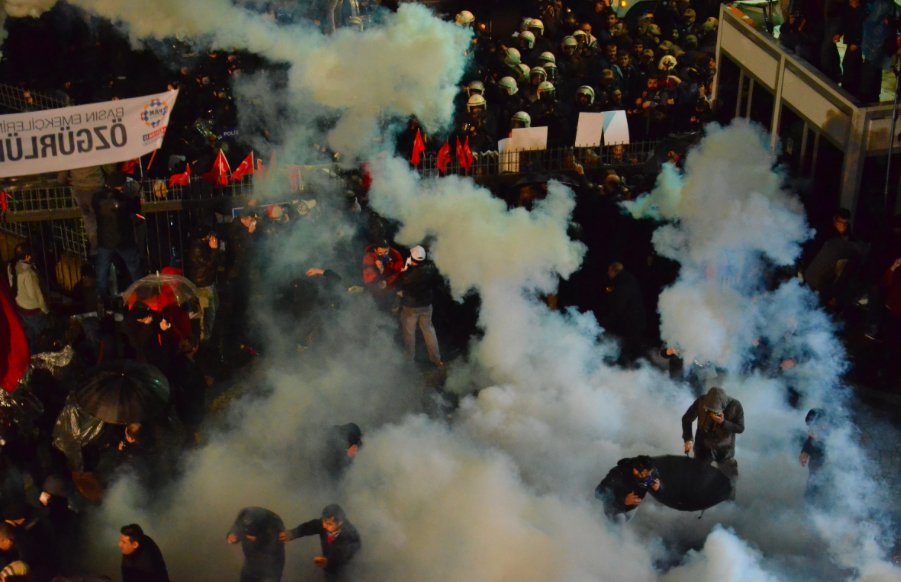
Turkish police fired tear gas and used water cannon on a crowd to forcibly enter the country’s top-selling newspaper on Friday after a court ordered its confiscation. 

An İstanbul court appointed trustees to take over the management of the Feza Media Group, which includes Turkey’s biggest-selling newspaper, the Zaman daily, as well as the Today’s Zaman daily and the Cihan news agency, dealing a fresh blow to the already battered media freedom in Turkey.

Police in riot gear pushed back Zaman supporters who stood in the rain outside its İstanbul office where they waved Turkish flags and carried placards reading “Hands off my newspaper” before they were overcome by clouds of tear gas.

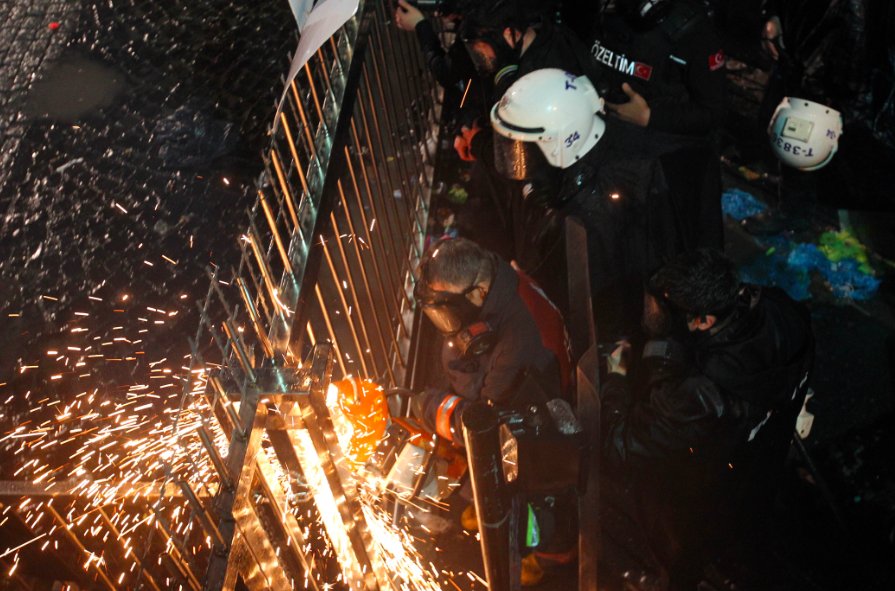
Officers then forcibly broke down a gate and rushed into the building. The footage showed them scuffling with Zaman staff inside the offices.

Zaman employees waiting near the entrance said police immediately tear-gassed hundreds of readers who had gathered outside Zaman newspaper to protest the ruling without even delivering the court decision.

Police use bolt cutter to break the steel gate in front of the Zaman building.

Employees shouted ‘free press cannot be silenced,” as hundreds of police officers entered the building. Zaman daily Editor-in-Chief Abdülhamit Bilici, who had hard time in speaking due to tear gas that covered inside the building, said the scene will be noted in the Turkish history as a black stain.

Police then went to the management floor in the building. Police initially prevented Bilici from entering his office but they later let him in. Bilici was heard saying he does not recognize the court decision.

Live footage also showed Today’s Zaman Editor-in-Chief Sevgi Akarçeşme being pushed by police. She said a police officer held her arm and tried to take her out of the building. “Police did not let us inside our offices in our own newspaper building! This is pure despotism! They physically blocked me, both men&women,” she tweeted.

A group of opposition deputies who were also present at the building to show support for the daily were also affected by pepper gas.

Police then broke cameras in the building to cut live footage from the building, an employee said. “Throw him off the staircase”, one police shouted at 2nd floor as one editor was pushed down from the stairs, another Zaman employee tweeted.

The employees were later asked to leave the building. “We are evacuating the building. This is probably my last message from my office,” Akarçeşme tweeted after midnight.

The decision was issued by the İstanbul 6th Criminal Court of Peace at the request of the İstanbul Chief Public Prosecutor’s Office, which claimed that the media group acted upon orders from what it called the “Fethullahist Terrorist Organization/Parallel State Structure (FETÖ/PDY),” praising the group and helping it achieve its goals in its publications.

The prosecutor also claimed that the alleged terrorist group is cooperating with the Kurdistan Workers’ Party (PKK) terrorist organization to topple the Turkish government and that high-level officials of the two groups have had meetings abroad.

The court decision means that the entire management and the editorial board of Feza Media Group companies will be replaced by the three-member board named by the court.

(Photo: DHA)

A crowd of Zaman and Today’s Zaman journalists, readers and supporters gathered outside Zaman’s headquarters as court-appointed trustees were expected to arrive at any moment.

Zaman Editor-in-Chief Abdülhamit Bilici addressed his colleagues on the grounds of the newspaper, calling the court decision a “black day for democracy” in Turkey as journalists and other newspaper workers held up signs that read: “Don’t touch my newspaper” and chanted “free press cannot be silenced!”

Today, we are experiencing a shameful day for media freedom in Turkey. Our media institutions are being seized,” Today’s Zaman Editor-in-Chief Sevgi Akarçeşme said as she addressed the crowd.

“As of today, the Constitution has been suspended,” she said, referencing to the fact that the Turkish Constitution forbids seizure of printing houses and press equipment.

(Photo: DHA)

Şahin Alpay, a veteran political expert and a columnist for both Zaman and Today’s Zaman, lamented the situation, saying Turkey is having a “dark day” when one of the most prominent media outlets in the country is being confiscated at the order of a political leader.

“It is utterly saddening, particularly for people of my generation, that Turkey is turning into a third-world dictatorship,” Alpay said.

The takeover of Zaman comes as President Recep Tayyip Erdoğan and the government of the Justice and Development Party (AK Party) that he founded intensified pressure on the Turkish media. Zaman, which is affiliated with the Gülen movement, is one of the few opposition media outlets in the country, which is dominated by pro-government television stations and newspapers.

Turkey’ satellite provider Türksat halted the broadcast of the independent İMC TV station last week on terrorism charges. Two newspapers and two television stations owned by Koza İpek Holding were placed under the management of a trustee board on charges of financing terrorism in October 2015. Those media outlets were closed down by the trustee board due to financial losses last week.

“This is not a matter of a fight between the government and the [Gülen] movement. This is a matter of existence for Turkey,” columnist Levent Gültekin said as he joined the crowd outside Zaman in a show of solidarity. “Just a few days ago, they pulled the plug on İMC TV for ‘supporting terrorism,’ which is a massive lie.”

TURKEY-POLITICS/GULEN

An employee of Zaman newspaper holds a chain during a protest at the courtyard of the newspaper in İstanbul, March 4, 2016. (Photo: Reuters)

Erdoğan declared the Gülen movement, inspired by Turkish Islamic scholar Fethullah Gülen, his number one enemy after a corruption investigation in December 2013 that implicated people in his inner circle. He accused alleged sympathizers of the movement within the judiciary and the police of staging a coup against his rule. The corruption charges were dropped after prosecutors of the case were replaced.

According to the court’s decision three trustees were appointed to the Feza Media Group. One of the trustees is Sezai Şengönül, who serves as an editor at a news website. The two others are lawyers are Tahsin Kaplan and Metin İlhan.

İlhan’s social media accounts showed that he is an open supporter of the AK Party and Erdoğan. His personal Twitter account’s background photo shows Erdoğan and Davutoğlu while some of his tweets even included insults at main opposition Republican People’s Party (CHP).