Posted tagged ‘Trump and Russia’

Is a Trump-Putin Detente Dead?

February 21, 2017

Is a Trump-Putin Detente Dead? Rasmussen Reports, Patrick J. Buchanan, February 21, 2017

(Please see also, Highly Classified National Security Information Must Not be Leaked. — DM)

America’s elites still praise FDR for partnering with one of the great mass murderers of human history, Stalin, to defeat Hitler. They still applaud Nixon for going to China to achieve a rapprochement with the greatest mass murderer of the 20th century, Mao Zedong.

Yet Trump is not to be allowed to achieve a partnership with Putin, whose great crime was a bloodless retrieval of a Crimea that had belonged to Russia since the 18th century.

The anti-Putin paranoia here is astonishing.

***************************

Among the reasons Donald Trump is president is that he read the nation and the world better than his rivals.

He saw the surging power of American nationalism at home, and of ethnonationalism in Europe. And he embraced Brexit.

While our bipartisan establishment worships diversity, Trump saw Middle America recoiling from the demographic change brought about by Third World invasions. And he promised to curb them.

While our corporatists burn incense at the shrine of the global economy, Trump went to visit the working-class casualties. And those forgotten Americans in Pennsylvania, Ohio, Michigan and Wisconsin, responded.

And while Bush II and President Obama plunged us into Afghanistan, Iraq, Libya, Yemen, Syria, Trump saw that his countrymen wanted to be rid of the endless wars, and start putting America first.

He offered a new foreign policy. Mitt Romney notwithstanding, said Trump, Putin’s Russia is not “our number one geopolitical foe.”

Moreover, that 67-year-old NATO alliance that commits us to go to war to defend two dozen nations, not one of whom contributes the same share of GDP as do we to national defense, is “obsolete.”

Many of these folks are freeloaders, said Trump. He hopes to work with Russia against our real enemies, al-Qaida and ISIS.

This was the agenda Americans voted for. But what raises doubt about whether Trump can follow through on his commitments is the size and virulence of the anti-Trump forces in this city.

Consider his plan to pursue a rapprochement with Russia such as Ike, JFK at American University, Nixon and Reagan all pursued in a Cold War with a far more menacing Soviet Empire.

America’s elites still praise FDR for partnering with one of the great mass murderers of human history, Stalin, to defeat Hitler. They still applaud Nixon for going to China to achieve a rapprochement with the greatest mass murderer of the 20th century, Mao Zedong.

Yet Trump is not to be allowed to achieve a partnership with Putin, whose great crime was a bloodless retrieval of a Crimea that had belonged to Russia since the 18th century.

The anti-Putin paranoia here is astonishing.

That he is a killer, a KGB thug, a murderer, is part of the daily rant of John McCain. At the Munich Security Conference this last weekend, Sen. Lindsey Graham promised, “2017 is going to be a year of kicking Russia in the ass in Congress.” How’s that for statesmanship.

But how does a president negotiate a modus vivendi with a rival great power when the leaders of his own party are sabotaging him and his efforts?

As for the mainstream media, they appear bent upon the ruin of Trump, and the stick with which they mean to beat him to death is this narrative:

Trump is the Siberian Candidate, the creature of Putin and the Kremlin. His ties to the Russians are old and deep. It was to help Trump that Russia hacked the DNC and the computer of Clinton campaign chief John Podesta, and saw to it WikiLeaks got the emails out to the American people during the campaign. Trump’s people secretly collaborated with Russian agents.

Believing Putin robbed Hillary Clinton of the presidency, Democrats are bent on revenge — on Putin and Trump.

And the epidemic of Russophobia makes it almost impossible to pursue normal relations. Indeed, in reaction to the constant attacks on them as poodles of Putin, the White House seems to be toughening up toward Russia.

Thus we see U.S. troops headed for Poland, Bulgaria, Romania, NATO troops being sent into the Baltic States, and new tough rhetoric from the White House about Russia having to restore Crimea to Ukraine. We read of Russian spy ships off the coast, Russian planes buzzing U.S. warships in the Black Sea, Russians deploying missiles outlawed by the arms control agreement of 1987.

An Ohio-class U.S. sub just test-fired four Trident missiles, which carry thermonuclear warheads, off the Pacific coast.

Any hope of cutting a deal for a truce in east Ukraine, a lifting of sanctions, and bringing Russia back into Europe seems to be fading.

Where Russians saw hope with Trump’s election, they are now apparently yielding to disillusionment and despair.

The question arises: If not toward better relations with Russia, where are we going with this bellicosity?

Russia is not going to give up Crimea. Not only would Putin not do it, the Russian people would abandon him if he did.

What then is the end goal of this bristling Beltway hostility to Putin and Russia, and the U.S.-NATO buildup in the Baltic and Black Sea regions? Is a Cold War II with Russia now an accepted and acceptable reality?

Where are the voices among Trump’s advisers who will tell him to hold firm against the Russophobic tide and work out a deal with the Russian president?

For a second cold war with Russia, its back up against a wall, may not end quite so happily as the first.

Highly Classified National Security Information Must Not be Leaked

February 20, 2017

Highly Classified National Security Information Must Not be Leaked, Dan Miller’s Blog, February 20, 2017

(The views expressed in this article are mine and do not necessarily reflect those of Warsclerotic or its other editors. — DM)

Evidence of political corruption should be.

It has been obvious since the early Republican primaries that most media coverage of a Trump presidency would be adverse and presented out of context. Perhaps a recent editorial at The Week Magazine explains why, albeit inadvertently. Or maybe this cartoon better explains the media view:

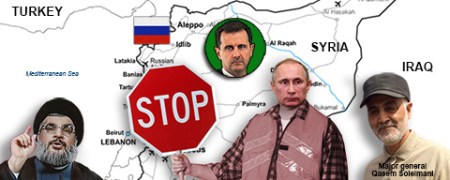
Trump and Putin as seen by the lamebrain media

Trump and Putin as seen by the lamebrain media

According to The Week Magazineall leaks are equal. However, we approve of those which fit our politics and disapprove of those which don’t.

Live by the leak, die by the leak. When WikiLeaks was releasing a steady stream of embarrassing emails hacked from Democratic officials during the presidential campaign, Hillary Clinton and her supporters cried foul, and urged the press not to report their contents. Donald Trump applauded every new revelation, saying the leaks provided voters with important information, and gleefully invited the Russians to find and publish emails she had deleted. “Boy, that WikiLeaks has done a job on her, hasn’t it?” Trump exulted. Now that it’s Trump who is being tortured by leaks, he’s complaining they’re illegal and “un-American.” Democrats, meanwhile, are welcoming the torrent like a rainstorm after a long drought. (See Main Stories.) When it comes to leaks, everyone is a hypocrite. “Good” leaks are ones that damage our opponents. “Bad” leaks are those that hurt Our Side. [Emphasis added.]

But let’s set partisanship aside for a moment. Is it always in the public interest for government officials to leak, and for the media to publish leaked material? Crusading journalist Glenn Greenwald—who angered the Obama administration by publishing Edward Snowden’s trove of stolen NSA documents—argues in TheIntercept.com this week that all leaks exposing “wrong-doing” are good ones, regardless of the leaker’s motives. “Leaks are illegal and hated by those in power (and their followers),” Greenwald says, “precisely because political officials want to be able to lie to the public with impunity and without detection.” The implication of this argument, of course, is that governments, politicians, and organizations should not keep any secrets—that when people in power conceal documents, emails, or information that could embarrass them, they are by definition deceiving the public. Radical transparency certainly sounds noble—but I suspect it’s a standard no public official, or indeed most of us, could survive. It’s so much more convenient to have a double standard: Transparency for thee, but not for me.

I disagree. Leaks of unclassified materials demonstrating corruption of the political process by either party are necessary for an effectively functioning democracy. Leaks of highly classified national security information — particularly in the area of foreign policy — endanger our democracy, are crimes and the perpetrators should be dealt with accordingly. When the media sensationalize leaks of the latter type, they are complicit and must be criticized vigorously.

The press has long served as an objective fail-safe to protect the public from the powers-that-be. That objectivity is now absent and the media’s role in our democratic society is in jeopardy. Rather than self-reflect as to how they got off course, the press have opted to label the man who exposed this derailment as un-American.

What’s un-American is the belief that the press should be unaccountable for its actions. What’s un-American is the belief that any attempt to criticize the press should be viewed as heresy. What’s un-American is the belief that the press is akin to a golden calf that compels Americans, presidents included, to worship the press.

Two very different types of leaks

a. DNC and Podesta e-mails:

The DNC and Podesta e-mails were released as written and posted by DNC officials and Podesta for transmission on unsecured servers easily hacked by modestly competent teenage hackers. I have seen no suggestion that the e-mails were classified. The intelligence community opined that Russian agents had done the hacking, but offered no significant proof beyond that the methods used by the hacker(s) were comparable to those used by Russian hackers in the past.

They found no discrepancies between the original e-mails and those posted by WikiLeaks (which denied that Russia had been the source). The e-mail leaks damaged the Clinton campaign because they portrayed, accurately — and in their own words —  dishonest efforts of high-level DNC and Clinton campaign personnel to skew the Democrat primary process in Ms. Clinton’s favor. They did not involve American foreign policy until Obama — who had previously done nothing of significance to halt Russia’s hacking of highly classified information from our intelligence establishment beyond asking, “pretty please, stop” — decided that Russia must be punished for Hillary’s loss of the general election through sanctions and by the expulsion of thirty-five of its diplomats.

Russian president Vladimir Putin had been expected to respond in kind, with the expulsion of US diplomats from its territory.

However, he later said he would not “stoop” to “irresponsible diplomacy”, but rather attempt to repair relations once Donald Trump takes office.

Mr Trump praised the decision as “very smart.”

b. Flynn telephone conversations:

Neither transcripts nor audio recordings of the Flynn telephone conversations were released. Instead, conclusions of the leakers were released. According to House Intelligence Chair Devin Nunes,

“I think there is a lot of innuendo out there that the intelligence agencies have a problem with Donald Trump. The rank and file people that are out doing jobs across the world — very difficult places — they don’t pay attention to what is going on in Washington,” the California representative told CBS “Face the Nation” host John Dickerson.

“What we have is we do have people in the last administration, people who are burrowed in, perhaps all throughout the government, who clearly are leaking to the press,” Nunes added. “And it is against the law. Major laws have been broken. If you believe the Washington Post story that said there were nine people who said this, these are nine people who broke the law.” [Emphasis added.]

Nunes said the FBI and other intelligence agencies ought to investigate who has leaked information to the press because so few people in the administration knew these secrets, that it would have had to have been someone at the “highest levels of the Obama administration” who is an acting official until Trump replaces him or her.

Did the leaker(s) try to present the conversations honestly, or to damage President Trump’s efforts to deal with Russia in matters of foreign policy where American and Russian interests coincide? To disrupt America’s badly needed “reset” with Russia which seemed likely to succeed under President Trump after Clinton’s and Obama’s efforts had failed?

resetbutton

Remember the Obama – Romney debate when Romney characterized Russia as America’s greatest geopolitical threat and Obama responded that the cold war was over and that “the 1980’s are calling and want their foreign policy back”?

https://www.youtube.com/watch?v=QS2a44F5TgM

The position now asserted by the Democrats and the media seems rather like the position that Obama rejected. If the position(s) of the Democrats and the media are now correct and Russia is again our enemy, might it be due to actions which Obama took or failed to take over the past eight years?

It is unfortunate that there has been a resurgence of Democrat (and some Republican) Russophobia when Russia is reassessing her relationship with Iran and America.

On January 22, 2017, the Russian media outlet Pravda.ru published an analysis on Russia-Iran relations. According to the article’s author, Dmitri Nersesov, Iran is becoming a problem for Russian interests. Nersesov also added that Iran wants Russia to choose between Iran and Washington. “Iran wants Russia to recognize that Teheran holds the key to the regulation of the Syrian crisis. Should Russia decide that the real strategy is built on the cooperation between Moscow and Washington, rather than Moscow and Teheran; the Islamic Republic will be extremely disappointed,” Nersesov wrote. [Emphasis added.]

An American – Russian realignment in areas of mutual concern — which as suggested below had seemed to be progressing well until General Flynn ceased to be involved — would be good, not bad. We have many areas of mutual concern, and Iran is one of them. The war in Syria is another. When were Russians last directed to yell Death to America? Or to refer to America as the “Great Satan?”

c. General Flynn, Russia and Iran

General Flynn had, at President Trump’s request, been dealing with Russia concerning the future roles of Iran, Russia and America in the Syria debacle:

Overlaying US President Donald Trump’s extraordinary, hour-long skirmish with reporters Thursday, Feb. 16, was bitter frustration over the domestic obstacles locking him out from his top security and foreign policy goals. [Emphasis added.]

Even before his inauguration four weeks ago, he had arranged to reach those goals by means of an understanding with President Vladimir Putin for military and intelligence cooperation in Syria, both for the war on the Islamic State and for the removal of Iran and its Lebanese surrogate Hizballah from that country. [Emphasis added.]

But his antagonists, including elements of the US intelligence community, were turning his strategy into a blunderbuss for hitting him on the head, with the help of hostile media.

Thursday, in a highly unconventional meeting with the world media, he tried to hit back, and possibly save his strategy.

That won’t be easy. The exit of National Security Adviser Mike Flynn, the prime mover in the US-Russian détente, sent the Kremlin a negative signal. The Russians began unsheathing their claws when they began to suspect that the US president was being forced back from their understanding. The SSV 175 Viktor Leonov spy ship was ordered to move into position opposite Delaware on the East Coast of America; Su-24 warplanes buzzed the USS Porter destroyer in the Black Sea.

Before these events, Washington and Moscow wre moving briskly towards an understandingdebkafile’s intelligence sources disclose that the Kremlin had sent positive messages to the White House on their joint strategy in Syria, clarifying that Moscow was not locked in on Bashar Assad staying on as president. [Emphasis added.]

They also promised to table at the Geneva conference on Syria taking place later this month a demand for the all “foreign forces” to leave Syria. This would apply first and foremost to the pro-Iranian Iraqi, Pakistani and Afghan militias brought in by Tehran to fight for Assad under the command of Revolutionary Guards officers, as well as Hizballah. [Emphasis added.]

Deeply troubled by this prospect, Tehran sent Iran’s supreme commander in the Middle East, the Al Qods chief Gen. Qassem Soleimani, to Moscow this week to find out what was going on.

Flynn’s departure put the lid on this progress. Then came the damaging leak to the Wall Street Journal, that quoted an “intelligence official” as saying that his agencies hesitated to reveal to the president the “sources and methods” they use to collect information, due to “possible links between Trump associates and Russia.. Those links, he said “could potentially compromise the security of such classified information.”

A first-year student knows that this claim is nonsense, since no agency ever share its sources and methods with any outsider, however high-placed.

What the leak did reveal was that some Washington insiders were determined at all costs to torpedo the evolving understanding between the American and Russian presidents. The first scapegoat was the strategy the two were developing for working together in Syria. [Emphasis added.]

Defending his policy of warming relations with Moscow, Trump protested that “getting along with Russia is not a bad thing.” He even warned there would be a “nuclear holocaust like no other” if relations between the two superpowers were allowed to deteriorate further.

It is too soon to say whether his Russian policy is finally in shreds or can still be repaired. Trump indicated more than once in his press briefing that he would try and get the relations back on track.

Asked how he would react to Russia’s latest provocative moves, he said: “I’m not going to tell you anything about what responses I do. I don’t talk about military responses. I don’t have to tell you what I’m going to do in North Korea,” he stressed.

At all events, his administration seems to be at a crossroads between whether to try and salvage the partnership with Russia for Syria, or treat it as a write-off. If the latter, then Trump must decide whether to send American troops to the war-torn country to achieve his goals, or revert to Barack Obama’s policy of military non-intervention in the conflict. [Emphasis added.]

Substantially more is generally involved in matters of foreign policy than is facially apparent or than government officials should discuss publicly, particularly while negotiations with foreign powers are underway. Leaks by held-over members of the intelligence community did much to reveal the opinions of the leakers but little to reveal what General Flynn had been doing, while upsetting the chances of better American – Russian relations in areas of mutual concern.

Conclusions — The Administrative State

The Federal Government has grown far too big for its britches, giving the unelected “administrative state” substantially more authority, and hence power, than is consistent with a properly functioning democracy. As they have been demonstrating in recent months, holdovers from one administration can succeed, at least partially, in paralyzing a new and democratically elected president. Holdovers with political appointee status can generally be fired. Few others who should be can be.

Getting rid of the obstructionist “civil servants” who have become our masters should rank very high on President Trump’s “to do” list and should be accomplished before it’s too late. The task may be difficult but is not impossible. Perhaps some particularly obnoxious Federal agencies (or departments within those agencies) can be relocated to places less congenial than Washington. Inner City Chicago comes to mind. So do otherwise pleasant cities in California, where housing prices are much higher than in the Washington, D.C. area. How many Federal employees faced with the choice of relocating or resigning would choose the latter option?

There are likely other and probably better ways to get rid of the fatheads. President Trump’s administration should devise them.

The Russian Conspiracy Theory Boils Over

February 17, 2017

The Russian Conspiracy Theory Boils Over, Front Page MagazineMatthew Vadum, February 17, 2017

rty_1

The so-called scandal involving former National Security Advisor Mike Flynn is 9/11, Pearl Harbor, Iran-Contra, Watergate, proof of presidential fascism, a cynical money-making scheme, and a pro-Russian spy thriller all rolled into one, according to the increasingly deranged rants of howling left-wingers and their truth-adverse confederates in the mainstream media.

Despite this relentless barrage of fake news and smears, President Donald Trump pushed back against the orchestrated campaign against him yesterday at what is sure to go down in history as The Best Presidential Press Conference of All Time as he gave the mainstream media the beat-down it deserves. (See transcript.)

“To give you an idea how Trump’s press conference went, afterwards, the press corps demanded a safe space,” Ann Coulter tweeted of the 77-minute long White House event, Trump’s first solo presser as president. “I wish this press conference could go on all day.”

“The public doesn’t believe you people anymore,” a ferocious, animated Trump told the assembled press corps. “Maybe I had something to do with that. I don’t know. But they don’t believe you.”

“This whole Russia scam that you guys” are pushing on people is “so you don’t talk about the real subject which is illegal leaks.”

“The public sees it,” he said. “They see it. They see it’s not fair. You take a look at some of your shows and you see the bias and the hatred. And the public is smart. They understand it.”

“I didn’t do anything for Russia,” he said. “I have done nothing for Russia. Hillary Clinton gave them 20 percent of our uranium. Hillary Clinton did a reset, remember with the stupid plastic button that made us look like a bunch of jerks.”

A mewling Chuck Todd of NBC was offended by the president’s conduct at the press conference and tweeted, “This [is] not a laughing matter. I’m sorry, delegitimizing the press is un-American[.]”

Perhaps he shouldn’t have signed on to the effort to delegitimize President Trump.

Todd, of course, is one the members of the media out to get Trump.

He recently said the invented Flynn-Russia crisis is “arguably the biggest presidential scandal involving a foreign government since Iran-Contra.”

Disgraced former anchorman Dan Rather, the poster child for journalistic malfeasance who humiliated himself a decade ago with his proven lies about George W. Bush’s military service record, couldn’t resist hopping on the bandwagon in order to create the illusion he is relevant.

He gravely pontificated that “Watergate is the biggest political scandal of my lifetime, until maybe now. It was the closest we came to a debilitating Constitutional crisis, until maybe now.”

This manufactured mass hysteria directed against Trump, a democratically elected president, in order to drive him from office continues. It feeds on itself. It infects. It multiplies. It smothers.

This un-American mobocracy threatens to snuff out American democracy itself if not contained.

Calls for President Trump’s impeachment, removal from office by the Senate or by military coup, and assassination are growing on the Left as it comes to grips with the fact that the Chief Executive is deadly serious about protecting America and rolling back President Obama’s poisonous legacy.

No claim or statement is too crazy, lawless, undemocratic, or barbaric for the Left as it desperately tries to keep the borders open to Muslim terrorists, Americans groaning under the chains of Obamacare, businesses buried in red tape, and the welfare state ballooning.

Exhibit “A” from the magical land of fairy dust and unicorns is communist mockumentary director Michael Moore.

In the complete absence of evidence, Moore called Trump a “Russian traitor” and said he should vacate the White House. “We can do this the easy way (you resign), or the hard way (impeachment).” He also called for Trump to be arrested.

Todd, Rather, and Moore are far from alone.

On Fox News Channel, Sean Hannity held up an interview CNN’s Wolf Blitzer did with Rep. Seth Moulton (D-Mass.) as an example of the media’s “abusively biased coverage, this false narrative.”

“If members of the administration are essentially conspiring with Russia either through the campaign earlier or now in the administration itself, I mean, look, Wolf, that’s the definition of treason,” Moulton said. “This is a very, very serious affair.”

From his perch at a glossy, content-free fashion magazine, MSNBC reject Keith Olbermann huffed and puffed. “I call for the immediate indictment of Michael Thomas Flynn on charges of and his immediate arrest on suspicion of violation of the Logan Act,” he said invoking a long-forgotten statute from 1799 under which no one has ever been convicted. Trump should be named as Flynn’s “unindicted co-conspirator,” he added.

Sen. Ed Markey (D-Mass.) conspiracy-theorized that Trump is using the Flynn saga to privatize intelligence-gathering and help his friends on Wall Street make money off it. Trump plans to ask Stephen A. Feinberg, a co-founder of Cerberus Capital Management, to conduct “a broad review of American intelligence agencies,” the New York Times has reported.

“Now what he’s doing is naming another Wall Streeter to go in like a corporate takeover of the intelligence community, clearly with the intent of creating a chilling effect upon these intelligence professionals, who are trying to help America to understand how our security may have been compromised in our relationship with Russia,” Markey said.

Riot-cheerleading Rep. Maxine Waters (D-Calif.), who claims the Reagan administration flooded the nation’s inner cities with crack cocaine, was overjoyed at Flynn’s ouster, describing him as “a liar and someone who cannot be trusted.”

“I’ve always believed that there has been collusion between the Trump outfit here, and Russia and the Kremlin. So I believe this is the tip of the iceberg … the strategy and the plot, to defend Russia and to work with Russia, is part of who Trump and his organization is,” Waters said.

New York Times columnist and hyperbole junkie Thomas Friedman accused Flynn and Trump of participating in some weird, ill-defined international conspiracy. “After the Russians did not respond harshly to the eviction of their spies and diplomats, Trump actually tweeted out some positive encouragement of this. Did the two of them cook this up all along?”

“And it gets … to two other issues,” Friedman continued. “The first is, we have never taken seriously from the very beginning Russia hacked our election. That was a 9/11-scale event. They attacked the core of our very democracy. That was a Pearl Harbor-scale event.”

Radical kook Chauncey DeVega, who calls Trump a “fascist authoritarian,” hyperventilated at Salon that the president is “a traitor to the United States” and so are all who back him.

Trump’s “voters and other supporters who do not denounce him are also traitors, and any Republican officials who continue to back Trump are traitors as well,” he wrote, as visions of sending patriotic Americans to die in forced labor camps danced in his head.

PJMedia’s Michael Walsh calls what’s happening in the country “a rolling coup attempt” and he’s right.

Make no mistake about what’s happening here: this is a rolling coup attempt, organized by elements of the intelligence community, particularly CIA and NSA, abetted by Obama-era holdovers in the understaffed Justice Department (Sally Yates, take a bow) and the lickspittles of the leftist media, all of whom have signed on with the “Resistance” in order to overturn the results of the November election.

This escalating offensive against Trump kicked up a few notches after Flynn, an arch foe of Islamofascism, was forced out of his critically important advisory role Monday night by what is shaping up to be an East German-style Ben Rhodes-centered deep state cabal.

Flynn, a retired lieutenant general in the U.S. Army, fell on his sword reportedly for allegedly making contact with a Russian envoy. The White House claims Flynn resigned after admitting he lied to Vice President Mike Pence about his conversations with the Russian ambassador to the U.S. Sergey Kislyak.

It’s not as if we know what actually happened with Flynn and the Russian or Russians at this point, or if there was any contact at all. News reports don’t quote any on-the-record sources.

And despite the lunatic ravings of NBC, ABC, CBS, CNN, the New York Times, the Washington Post, Bill Kristol, David Frum, Sally Kohn, Joan Walsh, Hollywood celebrities, and many others, there is no credible evidence whatsoever that Trump had anything to do with the hacking of the Hillary Clinton campaign and the Democratic National Committee or that Trump colluded with Russia in whatever may or may not have transpired.

Without proof all of this screaming about Flynn and Trump and their supposedly nefarious connections to Vladimir Putin is just noise.

It could be (and likely is) completely made up.

Fiction is, after all, what Ben Rhodes, now identified as a major player in the plot against the president, specialized in when he worked in the Obama White House. Rhodes bragged to the New York Times about duping Americans by creating a media “echo chamber” to promote the botched, unenforceable nuclear nonproliferation agreement with the Islamic Republic of Iran that will actually end up helping the mad mullahs who want to kill us all get the bomb. Rhodes became a misinformation-manufacturing servant of a hostile power while betraying his fellow Americans to help an Islam-loving president cozy up to the world’s worst state sponsor of terrorism.

But as we keep learning more and more about Rhodes and Obama’s post-presidential sabotage apparatus, there was a small victory for common sense as the FBI announced it sees no reason to do anything about the Flynn case because there’s nothing there.

The FBI is still investigating the Russian saga but won’t pursue charges against Flynn “barring new information that changes what they know,” CNN reported last night. Although Flynn stumbled at times during FBI interviews, investigators believe Flynn was “cooperative and provided truthful answers.”

And that can’t be bad.

Democrats fear Trump’s success with Russia

February 16, 2017

Democrats fear Trump’s success with Russia, American ThinkerE. Jeffrey Ludwig, February 16, 2017

(Please see also, Pro-Kremlin Pravda.ru: ‘ Iran Is Becoming A Major Problem, First And Foremost For Russia’s Interests’. If Russia decides to ally with Trump’s American rather than with Khamenei’s Islamic Republic — the world’s most prolific sponsor of Islamist terrorism — it would be a good thing. — DM)

In one of his latest tweets, President Donald Trump stated, “The real scandal here is that classified information is illegally given out by ‘intelligence’ like candy. Very un-American!”  He is rightly concerned that he is being portrayed as soft on Russia, and even of cooperating with the Russians in their nefarious plots.

Certainly, the characterization of Trump as “soft” on Russia is bewildering when one considers that during the Obama years, an arms agreement was signed between us and Russia; Russia and the U.S. were on the same page regarding the Iran deal; Obama relented on his Syrian red line, so called, by accepting Russian intervention to get Bashar al-Assad to eliminate his chemical weapons (whether or not he did is still the $64,000 question); and Russia was allowed to take Crimea with nary a peep from the USA.  Further, we all recall Obama saying to Russian prime minister Dmitry Medvedev when he thought the microphones were off that he would be able to work more closely with the Russians once he was re-elected.  Thus, it seems to any impartial observer (including Hillary) that the Obama administration was quite open to deals with Russia.

Yet, because of some positive remarks about Vladimir Putin from Trump, the public position taken by the Dems as a whole has been that Trump is soft on Russia.  Because their criticism of Trump contradicts their actions taken over eight years, it seems as if their criticism is more of a political ploy than merely a needed rebuke.  Trump is against the Iran deal and will be no pushover regarding Russian aggression, but there might be common ground between the U.S. and Russia in the fight against ISIS and other maniacal Islamic groups.  This possibility is deeply offensive to the Democrats who insist, against overwhelming evidence, that there is no threat to the U.S. or the West from adherents of Islam.

So, Trump’s positive comments should not be taken as meaning that we are all lovey-dovey with Putin or Russia as it exists today.  Rather, a reorientation of our relationship is needed.  The Democrats are afraid of such a reorientation of U.S. policy with Russia – one that will successfully lead to an abandonment of the Iran deal and the deliverance of a knockout blow to the Islamic maniacs in the Middle East and around the world.  Those successes would prove that the Democrats are weak and silly creatures.  Further, Trump has reintroduced a personal element into the insipid world of diplomacy and has a sense that Putin’s macho man persona matches more with his own than with the Obama effeminacy.


Is This The Coup the Left Wanted?

February 15, 2017

Is This The Coup the Left Wanted?, The Resurgent, February 15, 2017

trumpandflynn

There is no evidence that Donald Trump’s campaign and Russian intelligence cooperated to steal the election from Hillary Clinton. But the New York Times waits for the third paragraph of this sensational story to tell you. First, they want you to know intelligence sources say Trump campaign staffers had multiple, repeated contacts with the Russians.

What we are seeing is an intelligence community trying to sabotage the President of the United States. We should all be concerned even if we have our own concerns about the President and Russia.

It is more and more apparent that, while Mike Flynn misled Vice President Pence and should have been fired, we only know this because members of the intelligence community engaged in an opposition research dump on Flynn with the media. They engaged as a separate and distinct branch of government, and that is a dangerous situation.

The left is cheering on the outcomes, as are some on the right, but they are all ignoring the process. When the intelligence community ceases to serve the Commander-in-Chief and instead tries to sabotage him because they do not like the direction he is taking the country, they are putting their interests ahead of the voters and the electoral process.

The same problem exists with the Ninth Circuit Court of Appeals and its decision on the immigration order. In large part, the court based its decision on Donald Trump’s campaign statements that he wanted a Muslim ban. At first blush, that may seem legit to people but consider Barack Obama and Obamacare.

Chief Justice John Roberts upheld Obamacare’s constitutionality because he said it fell under the taxation powers of the constitution. But Barack Obama had campaigned on Obamacare saying that it was not a tax. Had the Supreme Court used President Obama’s campaign statements against him, they would have thrown out Obamacare.

While one may cheer on the outcome from the Ninth Circuit, they should not cheer the process and flawed legal reasoning.

Both the intelligence and court situation raise troubling issues. By cheering outcomes based on deeply problematic processes, people are rapidly moving towards “ends justify the means” reasoning. That will bring about the very creeping authoritarianism the left fears from Donald Trump.

They cheer this on now because it is working to their advantage as rogue leakers try to undermine a President they do not like. But it will eventually happen to them. By then they will have surrendered any and all moral high ground to cry foul.

The intelligence community serves at the pleasure of the President, not the other way around. The President must be able to depend on the intelligence community’s assessments. Right now, the intelligence community is causing a breakdown in trust with the Trump Administration through leaks designed to undermine his authority.

If a terrorist attack on our soil happens because the President felt he could no longer trust the intelligence community’s assessments, that will be on them. This behavior, in a democratic republic, must be considered unacceptable.

It is possible to be happy Mike Flynn is gone and also be deeply bothered by the means through the intelligence community designed his ouster. People on all sides should be speaking up loudly that the behavior of the intelligence community in damaging leaks is unacceptable.

Finally, we know that Mike Flynn intended to reform the intelligence community and expose side deals made with Iran to secure a diplomatic agreement. President Trump should commit to replacing Mike Flynn with someone as hell-bent on reform and exposure of the Iran deal as Mike Flynn was. The intelligence community cannot be rewarded for bad behavior that undermines the democratic processes of this nation, even if some of us are happy Mike Flynn is gone.

House Conservatives Back Investigation to Get ‘Full Understanding’ of Flynn Call

February 15, 2017

House Conservatives Back Investigation to Get ‘Full Understanding’ of Flynn Call, PJ MediaNicholas Ballasy, February 14, 2017

(Please see also Former Obama Officials, Loyalists Waged Secret Campaign to Oust Flynn. — DM)

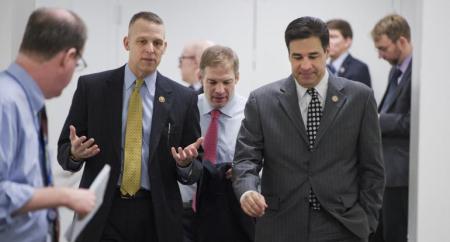
congressonflynnReps. Scott Perry (R-Pa.), left, Jim Jordan (R-Ohio), and Raul Labrador (R-Idaho) leave a meeting of the House Republican Conference in the Capitol on Feb. 24, 2016. (Photo By Tom Williams/CQ Roll Call via AP Images)

WASHINGTON – Members of the House Freedom Caucus signaled today that they would support an investigation of retired Gen. Mike Flynn’s contacts with Russian officials.

Flynn resigned from his position as national security advisor in the Trump administration late Monday.

“We have to be careful because of commenting without the facts, but at the same time I don’t know how you get the facts without doing some investigation, so let me say that. I think there needs to be a full accounting so we understand what happened there,” Rep. Scott Perry (R-Pa.) said on Capitol Hill. “But I would also say from my standpoint that Gen. Flynn’s service both in uniform and out and is beyond reproach and I don’t want to question that. I’m not going to question that at all. I think maybe his actions were premature based on what I’ve heard.”

The White House has acknowledged reports that Flynn and the Russian ambassador had conversations that included discussion of sanctions before Trump took office, and that the Justice Department alerted the White House of the conversations and the potential that Flynn could be blackmailed by the Kremlin. However, Perry said Congress does not know the context of those Flynn conversations.

“I’m concerned that the heat has become hot based on the accusations without any facts to support them, but I think we do need to have a full understanding of what occurred,” he said.

Rep. Justin Amash (R-Mich.) agreed with Perry’s comments.

“I would support an investigation if it’s warranted based on information from the intelligence community, and the first step would be for the intelligence committees to have that understanding with the intelligence community,” Amash said. “The rest of us in Congress wouldn’t have immediate access to the same information, so really it’s incumbent upon the intelligence community and the intelligence committees to work together so we know whether an investigation is warranted.”

Rep. Raul Labrador (R-Idaho) questioned why the U.S. having a “good relationship” with Russia is being portrayed in the media as a “bad thing.”

“We need to be careful what we are saying because we don’t have all the facts, but I do think it’s incumbent upon the intelligence committees to determine what the facts are and see if there has to be further investigation,” he said. “I do find it a little bit fascinating that having a good relationship with Russia all of a sudden is a bad thing when you guys never said a peep about it when the president of the United States said that he would have more flexibility when he won re-election, when Hillary Clinton said she wanted a reset with Russia, when all these different things happened where they were trying to have better relationships with Russia.”

Labrador said the intelligence committees in the House and Senate need to examine the Flynn situation to find out exactly what happened.

“All of a sudden, having a good relationship with Russia apparently is a negative thing. But there’s no question about it in my mind that the intelligence committees need to look first, obviously in confidential meetings and others, but they need to figure out exactly what happened,” he said.

“And I think Gen. Flynn, he offered his resignation, did the right thing because the moment he misled the vice president of the United States, I think he had lost the confidence of the administration whether it was intentional of not, it was a significant enough issue where it should have been a straightforward answer,” he added.

Flynn said in his resignation that he “inadvertently briefed the vice president elect and others with incomplete information regarding my phone calls with the Russian ambassador.”

Rep. Elijah Cummings (D-Md.), ranking member of the House Oversight and Government Reform Committee, said at a press conference today that the obvious question about Flynn’s contact with Russian officials is, “What did the president know and when did he know it?” Cummings called for an “emergency” public hearing with Flynn.

“I know he’s now resigned, but he’s not going to get off that easy. We need some answers to a whole lot of questions, but the obvious questions are what did the president know and when did he know it? Was the president aware of Flynn’s efforts? Did he support them?” he said. “Another question, why did Flynn continue to sit in on the most sensitive classified meetings until just two days ago? Ladies and gentlemen, something is wrong with that picture.”

Cummings also said he wants to see Flynn’s security clearance documents.

“I want to see them. I want to see what he put in those documents to find out if he was honest on those forms, and we need to know how much he got paid to have dinner with Putin – but that is only the beginning,” he said. “The Republicans need to join us. This is not a Democratic issue. This is not a Republican issue. It’s not an independent issue. This is an American issue for the soul of our democracy.”

Pro-Kremlin Pravda.ru: ‘ Iran Is Becoming A Major Problem, First And Foremost For Russia’s Interests’

February 13, 2017

Pro-Kremlin Pravda.ru: ‘ Iran Is Becoming A Major Problem, First And Foremost For Russia’s Interests’, MEMRI

On January 22, 2017, the Russian media outlet Pravda.ru published an analysis on Russia-Iran relations. According to the article’s author, Dmitri Nersesov, Iran is becoming a problem for Russian interests. Nersesov also added that Iran wants Russia to choose between Iran and Washington. “Iran wants Russia to recognize that Teheran holds the key to the regulation of the Syrian crisis. Should Russia decide that the real strategy is built on the cooperation between Moscow and Washington, rather than Moscow and Teheran; the Islamic Republic will be extremely disappointed,” Nersesov wrote.

Below are excerpts from Pravda.ru’s article:[1]

putrou(Source: Islam.ru)

‘Observers Testify That Iranian Internal Propaganda Blames Russia For The Rise Of Iranian Military Losses In Syria’

“After the strange story of the Russian ACF [Air-Cosmos Force – in 2015, the Military Air Force and the Cosmos Defense were united] usage of the Iranian Hamadan military airbase, it became absolutely clear that Tehran cannot be fully trusted.[2] Events of the last several days only strengthen that feeling. Russian-Iranian contradictions appear not only in the vicinity of Syria, but also start influence the Russian-U.S. relations. And that is very serious…

“The point is that Moscow intended the Astana negotiations to become the initial platform for establishing a practical dialogue with the new American administration. That is what the Russian Minister of Foreign Affairs Sergey Lavrov sought to convey at his press-conference. Lavrov said: ‘We consider it right to invite the representatives of the UN and the new U.S. administration to this meeting. We expect that new American administration can accept this invitation and will be represented by its experts of any possible level’… The fact that inviting the Americans was coordinated with Ankara must not be ignored.

“What about Tehran?

“The following was stated there: ‘We did not invite them, we are against their presence’. These words by the Iranian Foreign Minister Javad Zarif are cited by the news agencies. Thus Iran had publicly rejected its allies’ initiative… It seems like that this position of the Iranian leadership does not specifically relate to Syria’s problems. Zarif’s words are a message to Moscow and Washington. We shall try to decipher it.

“The Iranians want Moscow to clearly understand that they intend to control as strictly as possible the implementation of its strategy in Syria, and in the long term– in the Middle East generally. Tehran is able to create problems in fulfilling the combat tasks (by blocking access to the Hamadan airbase), in reaching ceasefire and humanitarian pauses (frequently the pro-Iran Shi’ite units have frustrated these initiatives), and renewing Russia-U.S. contacts on Syria.

“Simultaneously, Tehran’s demarche seemingly forces Moscow to make a choice: between us [Iran], or Ankara define your choice Russians! You can definitely negotiate with the Turks the ceasefire between the Syrian [factions], you can even conduct joint airstrikes against terrorists, but without us, the Iranians, you will not attain any practical goals. Take into account that today Turkey is weak, and it will stay like this indefinitely. And Iran is only getting stronger, as the sanctions against it had been removed, and you will compete with Western corporations for the right to participate in strengthening Iran!

“The Iranians present Moscow with a similar choice regarding the relations with Washington: will Iran or remain Russia’s leading partner in Syria and in the region generally or [will it be] Washington? If Moscow does not fully and decisively acknowledge that the keys to managing the Middle East are in Tehran, and only the intimate team work with Iran makes possible to promote the Russian interests here; if Moscow will ‘suddenly’ decide that the ‘real strategy’ is built not along the Tehran-Moscow axis, but along the Moscow-Washington one – the Islamic Republic will be very disappointed. And will find – definitely find! – the means to punish the ‘arrogant Russians’.

“In this context one should note that during the recent funeral of Hashemi Rafsanjani…was accompanied by the chanting of anti-Russian slogans. Observers testify that Iranian internal propaganda blames Russia precisely for the rise of Iranian military losses in Syria. This should not come as a surprise, because the Russian ACF were kicked out of the Hamadan [military airbase] for ‘ungentlemanly behavior’ and ‘arrogance’. Iran quite willingly believes that any foreigner only thinks about showing them his ‘arrogance’, and they do not forgive this sin. All the more so when it is Russia – the ‘small Satan’ for those who inherited Imam Khomeini’s set of values…

‘It Depends On The U.S. When Iran Will Become A Full-Fledged Nuclear Power’

“Washington? What message did Tehran send to the new president Trump?

“The main thesis is the same: Iran is the leading player in the regional arena, it has the capacity to exert a critical influence on Russia’s position and actions even with regards to Russian-American contacts. In a language resembling Trump’s, it sounds something like this: Tehran is the blocking shareholder in Syria and in the Middle East. Draw your conclusions, Mr. President!

“To talk this way with great powers, Iran must hold strong trump cards. It has them. The main one is the notorious ‘nuclear program’ and the famous deal about it.

“What is the heart of the matter? Ten years of struggle (since Bush-junior) against Iran getting the nuclear missiles brought Iran to the threshold of owning such a weapon. It has the carriers. The warheads which it ostensibly does not have (yet?) can be almost surely made within 15 years, when the limitations imposed as part of the ‘deal’ expire.

“That ‘deal’ was Obama’s favorite baby, his fundamental foreign policy achievement (by his own admission). This achievement means that now it depends on the U.S. when Iran will become a full-fledged nuclear power. For Tehran, just after signing the ‘deal’ (the full text of which no one has seen) had promptly warned everybody: any act which the Iranians will consider to be its violation will mean the abnegation of agreements, and then the Islamic Republic of Iran  will consider itself free to implement its nuclear program.

“Of all the ‘deal’ participants (the U.S., Russia, China, France, Britain, Germany, Iran), only the U.S. is interested and capable of provoking Iran to such a step, for even under Obama, Washington did not lift all the sanctions imposed on Iran. And Trump even claims the intent to renege on Iran’s nuclear program agreement. And if he will really do it, Tehran will have carte blanche to continue the work the result of which may become (with intolerably high probability) the appearance of her nuclear weapon.

“In view of this logic, Iran’s message to Trump is: ‘Mr. President! Upon your first signal, we shall do what your predecessors had steadily led us to! To build our blocking shares into controlling ones we need only a nuclear truncheon. When we get it depends on your decision’.

“Against this background, it is desirable to note a significant detail: several weeks ago, Iran announced the beginning of a program for building a nuclear navy. This means its transformation in the near future into an ocean power capable of ‘force projection’ in the Persian Gulf, in the Indian Ocean, and in the Red and Mediterranean Seas.

“It appears that all this suffices to understand: Iran is becoming a major problem, first and foremost for Russia’s interests. Surely, much can be explained by the upcoming May presidential elections in the Islamic Republic of Iran. Nevertheless, it would be useful to find a way of making Tehran politicians understand that their behavior is becoming too provocative.

“Perhaps the launch of cruise missiles from the Caspian flotilla bears repetition?”

___________________________

[1] Pravda.ru, January 22, 2017.

[2] See MEMRI Special Dispatch No. 6577, Russian Strategic Bombers Deployed To Iran; Russian Senator Says Nuclear Weapons, Heavy Bombers Will Not Be Permanently Deployed In Syria, August 16, 2016.

See MEMRI Special Dispatch No. 6589, Russia This Week – August 22-29, 2016, August 28, 2016.

See MEMRI Special Dispatch No. 6582, Russia This Week – August 15 – 22, 2016, August 21, 2016.

Beautiful Friendship

February 10, 2017

Beautiful Friendship, Front Page MagazineCaroline Glick, February 10, 2017

flags-1

Originally published by the Jerusalem Post

On Sunday, Trump restated his desire to develop ties with Russian President Vladimir Putin. Netanyahu must present Trump with a viable plan to reconstitute US-Russian ties in exchange for Russian abandonment of its alliance with Tehran and its cooperation with Iran and Hezbollah in Syria.

Next week can be the beginning of a new era in Israel’s relations with the US. But to make the most of this unprecedented opportunity, Israel needs to recognize its role as America’s ally. It must take the necessary steps to perform that role, and it must free the administration from the shackles of the PLO while securing its long-term interests in Judea and Samaria unilaterally, and quietly.

********************

Less than a week after he was inaugurated into office, President Donald Trump announced that he had repaired the US’s fractured ties with Israel. “It got repaired as soon as I took the oath of office,” he said.

Not only does Israel now enjoy warm relations with the White House. When Prime Minister Benjamin Netanyahu arrives in the US capital next week, he will be greeted by the most supportive political climate Israel has ever seen in Washington.

It is true that dangers to Israel’s ties with America lurk in the background. The radical Left is taking control of the Democratic Party.

But the forces now hijacking the party on a whole host of issues have yet to transform their hatred of Israel into the position of most Democratic lawmakers in Congress.

Democrats in both houses of Congress joined with their Republican counterparts in condemning UN Security Council Resolution 2334 that criminalized Israel. A significant number of Democratic lawmakers support Trump’s decision to slap new sanctions on Iran.

Similarly, radical Jewish groups have been unsuccessful in rallying the more moderate leftist Jewish leadership to their cause. Case in point is the widespread support Trump’s appointment of David Friedman to serve as his ambassador to Israel is receiving from the community.

Whereas J Street and T’ruah are circulating a petition calling for people to oppose his Senate confirmation, sources close to the issue in Washington say that AIPAC supports it.

Given this political climate, Netanyahu must use his meeting with Trump to develop a working alliance to secure Israel’s long-term strategic interests both on issues of joint concern and on issues that concern Israel alone.

The first issue on the agenda must be Iran.

Since taking office, Trump has signaled that unlike his predecessors, he is willing to lead a campaign against Iran. Trump has placed Iran on notice that its continued aggression will not go unanswered and he has harshly criticized Obama’s nuclear deal with the mullahs.

In the lead-up to his meeting with Trump, Netanyahu has said that he will present the new president with five options for scaling back Tehran’s nuclear program. No time can be wasted in addressing this problem.

Iran continues spinning its advanced centrifuges.

The mullahs are still on schedule to field the means to deploy nuclear warheads at will within a decade. Netanyahu’s task is to work with Trump to significantly set back Iran’s nuclear program as quickly as possible.

Then there is Syria. And Russia.

On Sunday, Trump restated his desire to develop ties with Russian President Vladimir Putin. Netanyahu must present Trump with a viable plan to reconstitute US-Russian ties in exchange for Russian abandonment of its alliance with Tehran and its cooperation with Iran and Hezbollah in Syria.

Here, too, time is of the essence.

According to news reports this week, President Bashar Assad is redeploying his forces to the Syrian border with Israel. Almost since the outset of the war in Syria six years ago, Assad’s forces have been under Iranian and Hezbollah control. If Syrian forces deploy to the border, then Iran and Hezbollah will control the border.

Israel cannot permit such a development. It’s not just that such a deployment greatly expands the risk of war. As long as Russia is acting in strategic alliance with Iran and Hezbollah in Syria, the deployment of Iranian-controlled forces to the border raises the real possibility that Israel will find itself at war with Russia in Syria.

Then there are the Sunnis. For the past six years, Netanyahu successfully withstood Obama’s pressure by developing an informal alliance with Sunni regimes that share its opposition to Iran and to the Muslim Brotherhood.

According to sources aware of the Trump administration’s strategic plans, the administration wishes to integrate Israel more strongly into Washington’s alliance structure with Sunni regimes. Israel, of course, has good reason to support this plan, particularly if it involves extending the US military’s Central Command to include Israel.

There are, however, significant limitations on the potential of Israel’s ties to Sunni regimes. First, there is the fact that all of these regimes are threatened by Islamist forces operating in their territory and on their borders.

As Israel Air Force commander Maj.-Gen. Amir Eshel warned this week, Israel is concerned that in the event any of these regimes is overthrown, the advanced US weapons it fields will fall under the control of Islamist forces.

Then there is the fact that in exchange for taking their relations with Israel out of the proverbial closet, the Arabs will demand that Israel make concessions to the PLO.

This then brings us to the only subject the media is discussing in relation to Netanyahu’s upcoming meeting with Trump: Will Trump push Israel to make concessions to the PLO or won’t he? The short answer is that it doesn’t appear that Trump has the slightest intention of doing so.

Over the past week, the administration has made three statements about the Palestinians.

First, of course, was the White House’s statement about the so-called Israeli settlements that came out last Thursday.

Although nearly all media reports on the statement claimed it aligned Trump with his predecessors in opposition to Israel’s civilian presence in Judea and Samaria, the fact is that the statement was the most supportive statement any US administration has ever made about those communities.

Obama, of course rejected Israel’s right to any civilian presence beyond the 1949 armistice lines, including in Jerusalem. In his final weeks in office, Obama joined the international mob in falsely castigating Israeli communities in these areas as illegal.

George W. Bush for his part, made a distinction between the so-called settlement blocs and the more isolated Israeli villages in Judea and Samaria. He gave grudging and limited support for Israel’s right to respect the property rights of Jews in the former. He rejected Jewish property rights in the latter.

Trump repudiated both of these positions.

In its statement on Thursday, the administration made no distinction between Jewish property rights in any of the areas. Moreover, the statement did not even reject the construction of new Israeli communities.

According to the text of the statement, “the construction of new settlements or the expansion of existing settlements beyond their current borders may not be helpful in achieving” the goal of peace.

But, then again, they may be helpful. And then again, they may have no impact whatsoever on the chance of achieving peace.

Not only did the administration’s statement not reject Israel’s right to build new communities, it rejected completely the position of Trump’s predecessors that Israeli communities are an obstacle to peace.

In the administration’s words, “We don’t believe the existence of settlements is an impediment to peace.”

After renouncing the positions of its predecessors on Israeli communities in Judea and Samaria, the administration then refused to say whether its vision for peace includes a Palestinian state.

In line with the Republican Party’s platform that makes no mention of support for Palestinian statehood, the Trump administration continues to question the rationale for supporting a policy that has failed for the past 95 years.

Finally, the administration said it had no comment on the regulations law this week regarding Jewish construction rights in Judea and Samaria.

All White House spokesman Sean Spicer would say was that it would be discussed in Trump’s meeting with Netanyahu.

This brings us back to that meeting, and how Netanyahu should broach the Palestinian issue.

Both from statements by administration sources since the election and from the administration’s refusal to speak with Palestinian Authority officials since Trump’s electoral victory, Trump and his top advisers have made clear that they see no upside to US support for the PLO.

They do not want to support the PLO and they do not want to be dragged into fruitless discussions between Israel and the PLO. For the past 24 years, US mediation of those discussions has weakened America’s position in the region, has weakened Israel and has empowered the PLO and anti-American forces worldwide.

According to sources with knowledge of the administration’s position, Trump views the Israeli- Palestinian conflict as an internal Israeli issue.

He expects Israel to deal with it and do so in a way that stabilizes the region and keeps the Palestinians out of the headlines, to the extent possible.

In this vein, sources with knowledge of administration considerations claim that last Thursday’s White House statement on Israeli communities in Judea and Samaria was in part the result of exasperation with Israel’s inability to keep quiet on the issue. Had Netanyahu and Defense Minister Avigdor Liberman not announced that they were issuing permits for thousands of building starts in Judea and Samaria, the White House wouldn’t have felt compelled to issue a statement on the matter.

The administration’s desire to disengage from the PLO is well aligned with Israel’s strategic interests. No good has ever come to Israel from US support for the PLO. Moreover, Israel has achieved its greatest strategic successes in relation to determining its borders when it has kept its moves as low key as possible.

For instance, in 1981, when then-prime minister Menachem Begin applied Israeli law to the Golan Heights, he did so with no fanfare. Rather than loudly announcing Israel’s right to sovereignty over the area, Begin insisted that the move was done to satisfy administrative imperatives and that Israel would be willing to consider border corrections in the event that Syria became serious about peace at some later date.

Begin’s example should inform Netanyahu’s preparations for his meeting with Trump.

Unfortunately, Netanyahu does not seem to realize the implications of Trump’s lack of interest in following in his predecessors’ footsteps in relation to the PLO.

Over the past few weeks, Netanyahu has insisted that he wishes to coordinate his positions on the Palestinians with the administration. While he should take any concerns Trump voices to him on the issue into consideration, he should also make clear that the administration’s belief that no good has come to the US from its support for the PLO is well-founded. He should also explain Israel’s need to control Area C in perpetuity, and the problem with maintaining military administration of the area. Finally, he should assure Trump that Israel intends to secure its interests in Judea and Samaria in a way than does not impinge on US priorities.

Next week can be the beginning of a new era in Israel’s relations with the US. But to make the most of this unprecedented opportunity, Israel needs to recognize its role as America’s ally. It must take the necessary steps to perform that role, and it must free the administration from the shackles of the PLO while securing its long-term interests in Judea and Samaria unilaterally, and quietly.

The Trump Way of Winning the War

February 4, 2017

The Trump Way of Winning the War, Real Clear PoliticsCaroline Glick, February 4, 2017

(As to Trump-Putin cooperation against Iran in Syria, please see Trump-Putin safe zones deal ousts Iran from Syria and Russia freezes Syrian, Iranian military movements. — DM)
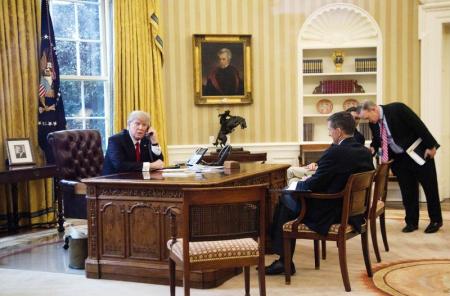
trumpinovaloffice

The PLO is disoriented, panicked and hysterical. Speaking to Newsweek this week, Saeb Erekat, PLO chief Mahmoud Abbas’s chief conduit to Israel and the Americans, complained that since President Donald Trump was sworn into office, no administration official had spoken to them.

“I don’t know any of them [Trump’s advisers]. We have sent them letters, written messages. They don’t even bother to respond to us.”

The Trump administration’s shunning of the PLO is a marked departure from the policies of its predecessor. For former president Barack Obama, together with Iran, the Palestinians were viewed as the key players in the Middle East. Abbas was the first foreign leader Obama called after taking office.

Erekat’s statement reveals something that is generally obscured. Despite its deep support in Europe, the UN and the international Left, without US support, the PLO is irrelevant.

All the achievements the PLO racked up under Obama – topped off with the former president’s facilitation of UN Security Council Resolution 2334 against Israel – are suddenly irrelevant. Their impact dissipated the minute Trump took office.

Israel, in contrast, is more relevant than ever.

While Trump occasionally pays lip service to making peace in the Middle East, his real goal is to win the war against jihadist Islam. And he rightly views Israel as a woefully underutilized strategic ally that shares his goal and is well-placed to help him achieve it.

During the electoral campaign, Trump often spoke derisively of Obama’s nuclear pact with Tehran. And he repeatedly promised to eradicate Islamic State. But when asked to explain what he intended to do on these scores, Trump demurred. You don’t expect me to let the enemy know my plan, do you?

Trump’s critics dismissed his statements as empty talk. But since he came into office, each day signals that he does have a plan and that he is implementing it. The plan coming into focus involves a multidimensional campaign that if successful will both neutralize Iran as a strategic threat and obliterate ISIS.

Regarding Iran specifically, Trump’s moves to date involve operations on three levels. First, there is the rhetorical campaign to distinguish the Trump administration from its successor.

Trump launched the campaign on Twitter on Wednesday writing, “Iran is rapidly taking over more and more of Iraq even after the US has squandered three trillion dollars there.”

Shortly before his post, Iraq’s Prime Minister Haider Abadi appointed Iranian proxy Qasim al Araji to serve as his interior minister.

At a minimum, Trump’s statement signaled an abandonment of Obama’s policy of cooperating with Iranian forces and Iranian-controlled Iraqi forces in the fight against ISIS in Iraq.

At around the same time Trump released his tweet about Iranian control of Iraq, his National Security Adviser Lt.-Gen. (ret.) Michael Flynn took a knife to Obama’s obsequious stand on Iran during a press briefing at the White House.

While Trump’s statement related to Iran’s growing power in Iraq, Flynn’s remarks were directed against its nonconventional threat and its regional aggression. Both were on display earlier this week.

On Sunday, Iran carried out its 12th ballistic missile test since concluding its nuclear deal with Obama, and its first since Trump took office.

On Monday, Iranian-controlled Houthi forces in Yemen attacked a Saudi ship in the Bab al-Mandab choke point connecting the Red Sea to the Indian Ocean.

Flynn condemned both noting that they threatened the US and its allies and destabilized the Middle East. The missile test, he said, violated UN Security Council Resolution 2231 that anchored the nuclear deal.

Flynn then took a step further. He drew a sharp contrast between the Obama administration’s responses to Tehran’s behavior and the Trump administration’s views of Tehran’s provocative actions.

“The Obama administration failed to respond adequately to Tehran’s malign actions – including weapons transfers, support for terrorism, and other violations of international norms,” he noted.

“The Trump administration condemns such actions by Iran that undermine security, prosperity and stability throughout and beyond the Middle East and place American lives at risk.”

Flynn ended his remarks by threatening Iran directly.

“As of today, we are officially putting Iran on notice,” he warned.

While Flynn gave no details of what the US intends to do to Iran if it continues its aggressive behavior, the day before he made his statement, the US opened a major, multilateral, British-led naval exercise in the Persian Gulf. US naval forces in the region have been significantly strengthened since January 20 and rules of engagement for US forces in the Persian Gulf have reportedly been relaxed.

Perhaps the most potent aspect of Trump’s emerging strategy for defeating the forces of jihad is the one that hasn’t been discussed but it was signaled, through a proxy, the day after Trump took office.

On January 21, Prime Minister Benjamin Netanyahu posted a remarkable message to the Iranian people on his Facebook page. Netanyahu drew a sharp distinction between the “warm” Iranian people and the “repressive” regime.

Netanyahu opened his remarks by invoking the new administration.

“I plan to speak soon with President Trump about how to counter the threat of the Iranian regime, which calls for Israel’s destruction,” the prime minister explained.

“But it struck me recently that I’ve spoken a lot about the Iranian regime and not enough about the Iranian people, or for that matter, to the Iranian people. So I hope this message reaches every Iranian.”

Netanyahu paid homage to the Green Revolution of 2009 that was brutally repressed by the regime. In his words, “I’ll never forget the images of proud, young students eager for change gunned down in the streets of Tehran in 2009.”

Netanyahu’s statement was doubtlessly coordinated with the new administration. It signaled that destabilizing with the goal of overthrowing the regime in Tehran is a major component of Trump’s strategy.

By the looks of things in Iran, regime opponents are taking heart from the new tone emanating from Washington. Iranian dissidents have asked for a meeting with Trump’s team. And a week and a half before Trump’s inauguration, regime opponents staged a massive anti-regime protest.

Protesters used the public funeral of former Iranian president Akbar Hashemi Rafsanjani to denounce the regime. In 2009, Rafsanjani sided with many of the Green Movement’s positions. His daughter was a leader of the protests.

Among the estimated 2.5 million people who attended the funeral, scores of thousands interrupted the official eulogies to condemn the regime, condemn the war with Syria and condemn the regime’s Russian allies.

This then brings us to Syria, where the war against ISIS and the campaign against Iran are set to converge. To date, Trump has limited his stated goals in Syria to setting up safe zones inside the country where displaced Syrians can live securely. Saudi Arabia and the Emirates have agreed to cooperate in these efforts.

Trump is now engaged in a talks with the Kremlin both above and below the radar about the possibility of coordinating their operations in Syria to enable safe zones to be established.

It is fairly clear what the US objective here would be. The US wishes to convince Moscow to effectively end its alliance with the Iranian regime. Trump repeatedly stated that the entire spectrum of US-Russian relations is now in play. Talks between the two governments will encompass Ukraine, US economic sanctions on Russia, nuclear weapons, Russian bases in Syria and Russia’s alliance with Iran and its Hezbollah proxies.

Everything is on the table.

Trump understands that Russia is threatened by Sunni jihadists and that Russia views Iran as a counterweight to ISIS and its counterparts in the Caucasus. A deal between the US and Russia could involve a Russian agreement to end its support for Iran and Hezbollah in exchange for US acceptance of Russia’s annexation of Crimea, cancellation of sanctions and perhaps some form of acquiescence to Russia’s military presence in Syria.

Russia and the US could then collaborate with Arab states with Israeli support to defeat ISIS and end the Syrian refugee crisis.

Combined with actions the Trump administration is already taking in the Persian Gulf and Red Sea, and its telegraphed aim of backing a popular Iranian insurrection, Trump’s hypothetical deal with Russia would neutralize Iran as a conventional and nonconventional threat.

This then brings us back to Israel – the first target of Iran’s aggression. If Trump’s strategy is successful, then the PLO will not be Israel’s only foe that is rendered irrelevant.

Earlier this week it was reported that in the two-and-a-half years since the last war with Hamas, the Iranian-backed, Muslim Brotherhood-affiliate terrorist group has rebuilt its forces. Today Hamas fields assets and troops that match the capabilities it fielded during Operation Protective Edge.

Hezbollah, with its effective control over Lebanon, including the Lebanese military, is a strategic threat to Israel.

To date, Israel has demurred from targeting Hezbollah and Hamas missile arsenals, but not because it is incapable of destroying them. Israel’s efforts to avoid conflict with its enemies, even at the price of their rearmament, also haven’t stemmed from fear of European or UN condemnation or even from fear of the so-called “CNN-effect.”

Israel has chosen not to defeat its enemies – not to mention the EU-backed NGOs that whitewash them – because the Americans have supported them.

The Clinton administration barred Israel from taking decisive action against either Hezbollah or the Palestinians.

The Bush administration forced Israel to stand down during the war with Hezbollah in 2006.

The Obama administration effectively sided with Hamas against Israel in 2014.

In other words, across three administrations, the Americans made it impossible for Israel to take decisive military action against its enemies.

Under Obama, the US also derailed every Israeli attempt to curb the power of EU-funded subversive organizations operating from inside of Israel.

Trump’s emerging strategy on Iran and ISIS, together with his refusal to operate in accordance with the standard US playbook on the Palestinians, indicates that the US has abandoned this practice. Under Trump, Israel is free to defeat its enemies. Their most powerful deterrent against Israel – the US – is gone.

Israel has long argued that there is no difference between al-Qaida and Hamas or between ISIS and Hezbollah. It has also argued that Iran threatens not only Israel but the world as a whole. Hoping to co-opt the forces of jihad rather than defeat them, successive US administrations have chosen to deny this obvious truth.

Unlike his predecessors, Trump is serious about winning. To do so, he is even willing to take the radical step of accepting Israel as an ally.

The PLO is right to be hysterical.

Russia freezes Syrian, Iranian military movements

January 31, 2017

Russia freezes Syrian, Iranian military movements, DEBKAfile, January 31, 2017

putinstopsyriaeng480

The ban came from Moscow to prevent military reprisals against the Putin-Trump deal for Syria.

Iran can no longer doubt that the two powers, America and Russia, have ganged up to push the Islamic Republic out of their way. Trepidation in Tehran was articulated on Monday, Jan. 30, at a convention staged in the Iranian capital to celebrate 515 years of Iranian-Russian relations, an anniversary that would not normally be marked by a special event.

****************************

An order to remain stationary was issued Thursday night, Jan. 26, by the Russian Commander in Syria Lt. Gen. Alexander Zhuravlev to the high commands of the Syrian army and of the Iranian and Shiite forces positioned in Aleppo, as well as Hizballah units in all parts of Syria. Gen. Zhuravlev, acting on instructions from Moscow, prohibited any movement by those forces out of their current positions as of noon local time.

DEBKAfile’s military and intelligence sources report that the order banned the opening of new battlefronts anywhere in Syria and the movement of Syrian air force units between bases.

This order has been obeyed to date.

The ban came from Moscow to prevent military reprisals against the Putin-Trump deal for Syria. There was no mention of penalties for disobedience, but the tone was peremptory. The three army commanders did not need reminding that the Russians are capable of using their electronic warfare systems to disrupt unauthorized military movements, jam their communications, and withhold fuel, ammo and spare parts to create havoc in their armies.

lieutenant_general_alexander_zhuravlev_120Russian Lt. Gen. General Alexander Zhuravlev

Moscow has never resorted to extreme action of this kind in previous Russian military interventions in Middle East lands.

The decision was taken shortly after the Kremlin was notified that US President Donald Trump had agreed to join forces with President Vladimir Putin in Syria.

Since then, the Trump administration has kept all dealings with Moscow over Syria under a cloak of secrecy, including the outcome of President Trump’s first phone conversation with his Russian counterpart Vladimir Putin. All other concerned parties, such as Israel, have been left groping in the dark about what happens next.

The Russian standstill order in Syria came shortly before the US presidential decree that barred Iranians from entering the United States (along with the nationals of six other terror-prone Muslim countries)

Iran can no longer doubt that the two powers, America and Russia, have ganged up to push the Islamic Republic out of their way. Trepidation in Tehran was articulated on Monday, Jan. 30, at a convention staged in the Iranian capital to celebrate 515 years of Iranian-Russian relations, an anniversary that would not normally be marked by a special event.

In his opening remarks, Foreign Minster Mohammed Zarif Javad said: that Iran and Russia “need to have far more extensive relations,” and “few countries in the world have relations as deep and historical as Iran and Russia.” This sounded like an appeal to Moscow for protection against the new US president. It most likely fell on deaf ears. Putin is fully engaged in promoting his new relations with Donald Trump.