Posted tagged ‘Trump and North Korea’

Haley: China’s Been a ‘Really Great Friend’ to the U.S. Regarding North Korea

April 24, 2017

Haley: China’s Been a ‘Really Great Friend’ to the U.S. Regarding North Korea, Washington Free Beacon, April 24, 2017

(Please see also, Chinese media: ‘China’s intervention not needed when only N.K.’s nuke facilities are hit’ — DM)


U.S. Ambassador to the United Nations Nikki Haley called China a “great friend” on Monday regarding its efforts to assist the U.S. with pressuring North Korea over its nuclear program.

Haley appeared on “CBS This Morning,” in addition to the other two network morning shows, to discuss rising tensions with North Korea over its nuclear and missile tests, as well as other foreign policy issues facing the Trump administration.

President Trump spoke on the phone Sunday night with Chinese President Xi Jinping, and CBS host Norah O’Donnell asked Haley what more China needs to do to deter the North Koreans from taking more provocative actions. China is North Korea’s most important ally and main trading partner, giving Beijing strong influence over the rogue state.

“I think China is really in good faith doing quite a bit,” Haley said. “They are trying to put pressure on North Korea. What we’ve said is we want you to put more pressure on North Korea, whether that’s with coal, whether that’s with oil, whether that’s with other sanctions … I think China’s been a really great friend of ours, and the way they came together with us to do the statement last week showed that we are united against wanting North Korea to stay away from doing any sort of nuclear threats.”

Haley added that North Korean leader Kim Jong-un is “flailing” and trying to show strength to his people.

“They’re panicking right now,” she said.

Last week, a Chinese spokesman said Beijing was “gravely concerned” about North Korean nuclear activity and praised the U.S. for “constructive” remarks about resolving the issue peacefully.

North Korea has continually made belligerent gestures toward the U.S., displaying a video last week showing the U.S. in flames during a military celebration.

Trump has softened his rhetoric about China, even refusing to call the country a currency manipulator after months of calling it one on the campaign trail, due to its assistance in pressuring North Korea.

“What, am I going to start trade war with China in the middle of him working on a bigger problem with North Korea?” Trump said last week. “I’m dealing with China with great respect. I have great respect for him. We’ll see what he can do.”

Trump has also cited friendly relations with the Chinese president as a reason to not start a trade war with the world’s largest country.

Chinese media: ‘China’s intervention not needed when only N.K.’s nuke facilities are hit’

April 24, 2017

Chinese media: ‘China’s intervention not needed when only N.K.’s nuke facilities are hit’ Dong-a Ilbo, April 24, 2017

A Chinese state-run media outlet said that if North Korea continues nuclear and missile development, China may not provide military support to China even if the U.S. launches preemptive strike on the North. China and North Korea have agreed to provide military assistance if one of them gets under military attack, and hence the latest report is construed as Beijing’s stern warning against Pyongyang.

If the U.S. launches surgical strikes on North Korea’s nuclear facilities, China will seek diplomatic deterrence but military intervention is not needed, China’s state-run Global Times said on Saturday. However, the daily repeated its previous stance that f the U.S. and South Korean militaries cross the 38th parallel to invade the North and seek to topple the North Korean regime, China should immediately start military intervention.”

With the U.S. and China stepping up pressure on North Korea, U.S. President Donald Trump held calls in succession with Japanese Prime Minister Shinzo Abe and Chinese President Xi Jinping Sunday morning, and discussed ways to resolve the North Korean nuclear issue. President Trump reportedly asked the Japanese and Chinese leaders to extend cooperation to manage the situation wherein signs of North Korea’s sixth nuclear test are mounting. Notably, in his call with Chinese President Xi, President Trump reportedly commended Beijing’s recent efforts to deter the North’s nuclear development and called on Beijing to use more specific measures to pressure the North.

In the premiere of “Born in China, a movie jointly produced by the U.S. and China held at the Chinese embassy in Washington on Friday, Chinese Ambassador to the U.S. Cui Tiankai said that President Trump will visit China in the second half of this year. After President Trump and President Xi held summit at Trump’s Mar-a-Lago estate in Florida on April 6 and 7, the two leaders agreed to President Trump’s return visit to China at the earliest date.

CNN: Trump’s North Korea Policy Might Just Be Working

April 19, 2017

CNN: Trump’s North Korea Policy Might Just Be Working, BreitbartJoel B. Pollak, April 19, 2017

AP Photo/Alex Brandon

Former British ambassador to North Korea John Everard writes at CNN.com on Wednesday that President Donald Trump’s assertive strategy towards the rogue nuclear power may have actually worked, despite domestic criticism.

Everard writes:

In my opinion, the most plausible explanation for this is that North Korea blinked. Although it is possible the extensive preparations around its nuclear test site were intended only to wind up the international community, it seems more likely that the North Koreans did indeed plan a nuclear test Saturday but desisted, probably because they assessed the risks of serious retaliation were too great.

The US carrier group it thought was near Korea and China’s threat on April 12 to support UN sanctions, including cutting off North Korea’s oil supply — which would have quickly brought its fragile economy to a halt — probably weighed heavily on Pyongyang as well.

Though domestic critics attacked Trump for stating that the USS Carl Vinson and an “armada” were sailing toward the Korean peninsula, when in fact the ships were far away, Everard says that Trump’s statement was a successful bluff.

The North Korean dictator thought the carrier group really was off the Korean coast, Everard writes. “Very few people outside the US administration knew the carrier group was in fact some 3,500 miles away from the Korean Peninsula.”

He concludes:

Perhaps the North Koreans calculated (rightly, it seems) that either a nuclear test or a test of an intercontinental ballistic missile — a long-range missile of the kind they would need to carry a nuclear warhead to the continental United States — was too dangerous. Instead, launching a medium-range missile would allow them to deny they were buckling under foreign pressure while not triggering a vigorous international reaction. The fact it failed doubtless also softened responses.

If this analysis is right, then the United States has, for now at least, succeeded in its long-term goal of halting the development of North Korea’s nuclear weapons and missiles.

One observer who predicted Trump’s success in the confrontation was Dilbert illustrator and author Scott Adams, who had been stating for weeks that Trump’s unpredictable military moves might scare China into reining in its client state.

CNN is rarely positive in its coverage of the 45th president, making Everard’s article particularly noteworthy.

China’s Korea policy ‘in tatters’ as both North and South defy sanctions

April 17, 2017

China’s Korea policy ‘in tatters’ as both North and South defy sanctions, Washington Post, Simon Denyer, April 17, 2017

(Please see also, President Trump Realigning Geo-Political Alliances, and Few Paying Attention…. — DM)

“Even before the United States upped the tempo, China was in the unusual position of having really very bad relations with both the North and the South — that’s something of an accomplishment,” said Euan Graham, director of the International Security Program at the Lowy Institute in Sydney. “Its peninsula policy was in tatters, and things have only got worse since.”

China is not alone in struggling to construct a successful policy toward North Korea, as the United States can attest. But the failure of its approach has seldom been more starkly outlined, as Pyongyang presses ahead with its nuclear program, the United States sends an aircraft carrier strike group to the region and fears of military conflict mount, analysts say.

“China may marginally increase economic pressure on North Korea by cutting down trade, tourist flows or food aid, but its primary goal is to placate Washington,” said Yanmei Xie, a politics and foreign policy expert at Gavekal Dragonomics. “Beijing has reasons and means to discipline Kim but is more concerned with ensuring the survival of his regime, thus maintaining a buffer against U.S. military presence in the South.”

************************************

More than half a century ago, hundreds of thousands of Chinese troops died in the Korean War, fighting on the side of their Communist allies in the North against the U.S.-backed South. Yet today, China finds itself in the uncomfortable position of falling out with both sides on the Korean Peninsula.

On Monday, South Korea announced that it would press ahead with the “swift deployment” of a U.S. missile defense system, despite vociferous Chinese opposition.

In February, China said it was cutting off coal imports from North Korea in accordance with sanctions imposed by the U.N. Security Council in a bid to persuade the North to abandon its nuclear and missile program. On Sunday, North Korea ignored China’s pleas not to raise regional tensions by conducting another missile test, albeit one that failed.

China has also imposed unofficial and unilateral sanctions against South Korea to persuade it not to deploy the missile defense system, experts say. On Monday, as Vice President Pence warned North Korea not to test U.S. resolve, South Korea’s acting president, Hwang Kyo-ahn, vowed to press ahead with the “swift deployment” of that system, known as Terminal High Altitude Area Defense, or THAAD.

“Even before the United States upped the tempo, China was in the unusual position of having really very bad relations with both the North and the South — that’s something of an accomplishment,” said Euan Graham, director of the International Security Program at the Lowy Institute in Sydney. “Its peninsula policy was in tatters, and things have only got worse since.”

China is not alone in struggling to construct a successful policy toward North Korea, as the United States can attest. But the failure of its approach has seldom been more starkly outlined, as Pyongyang presses ahead with its nuclear program, the United States sends an aircraft carrier strike group to the region and fears of military conflict mount, analysts say.

Both Beijing and Washington share the same goal — a peninsula free of nuclear weapons — but they often appear to be trying to realize those goals in mutually incompatible ways.

Under President Barack Obama, the United States tried to isolate and pressure North Korea economically, an approach that China argues has raised tensions and forced its leader, Kim Jong Un — and his father before him — into a corner.

China had banked on a different approach, believing that building up North Korea’s economy would gradually bring about more moderate politics. That policy, though, has simply given North Korea the resources and the technology to build up its nuclear and missile programs, experts say.

Nor has it brought Beijing the leverage it desires: Kim has never met Chinese President Xi Jinping, and channels of communication between the two governments have never been thinner, experts say.

“China’s hope-based approach has encountered Kim Jong Un’s ‘I’ll have my cake and eat it’ approach,” Graham said. “What’s changed in the political relationship is Kim Jong Un’s total willingness to humiliate China, to slap it in the face, not to give China even the ritual obeisance his father did.”

China believes that the deployment of THAAD, with its sophisticated radar and missile defense capabilities,on its doorstep will allow the United States to spy on it and undermine its national security interests.

It has whipped up nationalist outrage against South Korea over the issue, with the sale of package tours to the country abruptly halted in March and tourist numbers plunging. State-run media have called for boycotts of South Korean businesses and goods, and primary school children have even been encouraged to stage protests. South Korean films were barred from a recent international movie festival in Beijing, and music videos were blocked on streaming services.

Lotte, the South Korean conglomerate that turned over land for THAAD use, has faced huge losses as 87 of its 99 stores in China reportedly have been closed, mostly for ostensibly breaching fire regulations.

But even as Beijing tries to persuade Seoul to cancel the deployment of THAAD, Pyongyang shows utter disregard for China’s interests by launching missile after missile, making the case for the defense system ever stronger.

Now, Beijing has a new headache: brinkmanship not just from Kim but also from President Trump, experts say, with the threat of U.S. military action against North Korea on the table.

There is little doubt this has focused minds in Beijing.

Trump spoke to Xi about North Korea by telephone last week. He later said China is “working with us on the North Korean problem.”

But despite its frustration with Pyongyang, is Beijing really prepared to turn up the heat on its old ally?

There appear to be some within the Communist Party who think it should.

The nationalist Global Times newspaper argued in an editorial on Sunday that China should send a clear message to North Korea: If you conduct a sixth nuclear test, we will cut off the vast majority of your oil imports, through stiffer U.N. sanctions.

Shi Yinhong, a professor of international relations at Renmin University of China, said Beijing is “still hesitant” to take such a radical step, one that would threaten the fuel supplies that keep the North Korean military running.

Indeed, if the United States continues to turn up the heat, with more verbal threats or an even more robust naval presence, China could flip the other way, Shi argues: decide that Washington is the real threat to stability on the peninsula and “shift from suppressing North Korea to opposing the United States.”

Even though coal imports from North Korea appear to have been cut, and Air China canceled some direct flights between Beijing and Pyongyang this week, overall imports and exports between the two countries were up sharply in the first quarter of this year, data released by Chinese customs showed.

In the final analysis, some experts say, the legacy of the Korean War and the survival of the regime China backed at the cost of so much blood remain paramount.

“China may marginally increase economic pressure on North Korea by cutting down trade, tourist flows or food aid, but its primary goal is to placate Washington,” said Yanmei Xie, a politics and foreign policy expert at Gavekal Dragonomics. “Beijing has reasons and means to discipline Kim but is more concerned with ensuring the survival of his regime, thus maintaining a buffer against U.S. military presence in the South.”
Cadence Column: Asia, April 17, 2017

April 17, 2017

Cadence Column: Asia, April 17, 2017,  Pacific Daily Times via China Daily Mail, April 17, 2017

(Excessive optimism? — DM)

Cadence

If the Chinese and Russians wanted to send a message to Washington, they’d send attack vessels like Putin sent late to Syria—at least, he pretended to send a message.

***************************

It’s over. North Korea has been defrocked from among Communist nations. Russia and China aren’t trying to send any kind of message to the US by sending intel-gathering vessels to monitor the Vinson. Spectating usually indicates some kind of support. The “Ruskies” and “Chi-Coms”, as some affectionately call them, kicking back with coke and popcorn in hand isn’t exactly opposition. They are trying to send a message to Communists worldwide, including their own people: Act unruly and you’ll end up like North Korea.

The US can’t do an operation in their back yards without the neighbors keeping a close watch—and Northern Korea is in both Russian and Chinese back yards. If the Chinese and Russians wanted to send a message to Washington, they’d send attack vessels like Putin sent late to Syria—at least, he pretended to send a message.

Countries must appear strong. There is a lot of chest puffing and thumping, even with the soon-to-be-deposed occupation of Northern Korea. The Russians and Chinese will be glad to have the dictator child off of their table of concerns. And, in the process, they want their own people to know whose still boss.

So, it’s over. Soon, we’ll find out just how many Northern Koreans cried for the death of their late “Dear Leader” because they missed him or because they feared what the child dictator would do them if they didn’t. Korea is about to become one country, finally. Kim Jong-Un decided that over the weekend when he threw the temper tantrum that broke every camel’s back in the caravan. Now, the caravan is coming for him.

Dr. Sebastian Gorka: Trump Is Not An Interventionist Commander In Chief

April 16, 2017

Dr. Sebastian Gorka: Trump Is Not An Interventionist Commander In Chief, Fox News via YouTube, April 16, 2017


China’s nuclear get-out clause over defence of North Korea

April 13, 2017

China’s nuclear get-out clause over defence of North Korea, South China Morning PostKristin Huang, April 13, 2017

(Another “hint” from China to North Korea? — DM)

China is not obliged to help defend North Korea from military attack if the reclusive state developed nuclear weapons, according to Chinese diplomatic and military observers.

The assessment comes as senior officials in Washington warn of a strike against the Pyongyang regime.

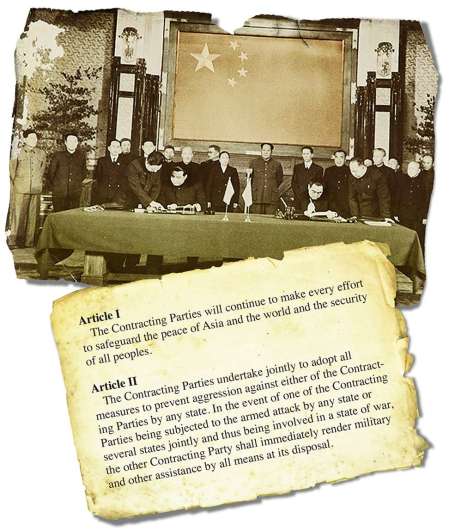
China and North Korea signed a mutual aid and cooperation treaty in 1961 as they sought to mount a united front against Western powers. It specifies that if one of the parties comes under armed attack, the other should render immediate assistance, including military support.

But the treaty also says both nations should safeguard peace and security.

For China, North Korea’s development of nuclear weapons in violation of the United Nations treaty on non-proliferation could amount to a breach of their pact, leaving Beijing with no obligation to lend a hand, observers said.


China could also have a get-out clause if any US military intervention was not deemed an armed attack.

“It’s hard to say how China would assist North Korea militarily in case of war, since North Korea is developing nuclear weapons, an act that might have already breached the treaty between the two nations,” said Li Jie, a retired Chinese naval colonel.

Shanghai-based military analyst Ni Lexiong said China would need to provide military assistance to North Korea if US land forces invaded, but Pyongyang’s violation of the UN non-proliferation treaty was a “strong reason” for Beijing to choose not to help.

Threats of military action against North Korea have grown, with US President Donald Trump saying Washington was prepared to act alone against Pyongyang.

A strike group headed by the aircraft carrier USS Carl Vinson has also been deployed to waters off the Korean peninsula.

Nevertheless, Beijing, North Korea’s economic lifeline, does have some interest in backing up its old ally. China fears the collapse of the regime in Pyongyang could lead to an influx of refugees into China and eliminate the buffer zone keeping US troops from the Chinese border.

But Ni said the possibility of a full-scale war was slim because the US was unlikely to send land forces into North Korea, preferring air strikes or missile launches instead.

“The situation would be much easier for China in this case. China would not have to mobilise its land forces to help North Korea,” he said. “China then only needs to send the North Sea Fleet or military aircraft to step up patrols of the Korean peninsula.”

Zhou Chenming, from the Knowfar Institute for Strategic and Defence Studies think tank, said war over North Korea was unlikely because all the parties involved were looking for ways to defuse tensions.

But if military conflict did erupt, China could help Pyongyang with supplies such as food and weaponry, such as old tanks.

Trump Sends a Message to China Through Syria

April 10, 2017

Trump Sends a Message to China Through Syria, Front Page Magazine, Daniel Greenfield, April 10, 2017

On Thursday evening, President Trump met with China’s President Xi and bombed Syria. The decision came as Trump traveled on Air Force One to meet with Xi at Mar-a-Lago. An hour into their dinner, 59 Tomahawk cruise missiles launched and pounded an airbase in Syria. The message wasn’t just for Assad and Putin. It was for Xi and his North Korean client state. The era of a weak America was over.

Xi had come to America expecting an easy photo op visit. President Trump would urge action on North Korea and Xi would smile coldly and shoot him down. Talk of fairer trade would be similarly dismissed.

And then Xi would go home and laugh that the bold new American leader was another paper tiger.

Except that President Trump had a different plan. Instead of Xi showing how tough he could be, Trump gave him a front row seat to a display of American power. The message was both obvious and subtle.

And President Xi, along with Russia’s Vladimir Putin, North Korea’s Kim Jong-un and Iran’s Supreme Leader Khamenei, aren’t laughing.

The obvious part was as blatant as a 1,000 pound explosive warhead slamming into concrete and steel, and as obvious as upstaging Xi’s efforts to stonewall Trump while warning that North Korea could be next if the Chinese leader continues to be obstinate.

Trump had warned throughout the campaign that he would not be laying his military plans on the table. “You’re telling the enemy everything you want to do!” he had mocked Clinton.

His address to the nation came an hour after the missiles had struck. The element of surprise had held.

And Xi came away with a very different message. The Obama era was over. The new guy was bold, dangerous and unpredictable. Like many of Trump’s American opponents, Xi understood now that the jovial man sitting next to him could and would violate the rules of the game without prior warning.

China would have to be careful. There was a cowboy in the White House again.

And that was the subtle part. Trump does not care very much about Assad. What he truly cares about is American power. Left-wing critics quickly pounced on Trump’s past opposition to strikes on Syria and his criticisms of Obama for not enforcing his own “red line”.

There is no contradiction.

Trump didn’t believe that strikes on Syria were a good idea. But once we had committed to a red line, then we had to follow through if we were going to be taken seriously.

And so Trump enforced Obama’s red line. Not because of Obama or Syria. But because of America.

“When he didn’t cross that line after making the threat, I think that set us back a long ways, not only in Syria, but in many other parts of the world because it was a blank threat,” President Trump said.

President Trump intends to get things done. And he knows it won’t happen with “blank” threats.

Asked about whether the strikes represented a message to Xi and North Korea, Secretary of State Tillerson replied, “It does demonstrate that President Trump is willing to act when governments and actors cross the line and cross the line on violating commitments they have made.”

“President Trump has made that statement to the world tonight,” he added.

The message is more subtle than a 1,000 pound warhead. But not by that much.

President Trump’s move bewildered leftist critics who had to shift from accusing him of having a secret relationship with Russia to accusing him of ruining our relationship with Russia. It also enraged some supporters who maintained a dogmatic non-interventionist position. But Trump doesn’t make decisions based on ideology. He measures policies against real world objectives, not abstract philosophies.

What he has always wanted to do is solve real problems.

The problem he was solving on Thursday wasn’t Assad. President Trump recognizes that Syria is an unsolvable problem and that little good can come of extended engagement with it. There are no good guys in Syria. Only Sunni and Shiite Jihadis and their victims. Syria is and will always be a dead end.

The problem is that Obama thoroughly wrecked American prestige and power over eight years. And that makes it painfully difficult to get anything done when no one in the world will take us seriously.

President Trump sees North Korea’s nuclear weapons as a major threat. But he also sees the crisis as a way to leverage our military might to achieve better trade deals with both partners and rivals. He is not wedded to a globalist or anti-globalist ideology. Instead he sees every problem as an opportunity.

He is not committed to any international coalition, globalist or anti-globalist, except where it temporarily serves American purposes. That is what being a true nationalist actually means.

That is what makes him so unpredictable and so dangerous.

President Trump made a point in Syria. He timed that point for maximum effect. The point isn’t that Assad is a bad man. Though he is. It’s not that he isn’t a Russian puppet, though only the lunatic left could have believed that. The point is that he is determined that America will be taken seriously.

Cruise missile diplomacy isn’t new. Bill Clinton fired over 500 cruise missiles into Iraq. Not to mention Sudan. Bush fired cruise missiles into Somalia. Obama signed off on firing cruise missiles into Yemen and Syria at terrorist targets. The difference is that Trump isn’t just saving face with cruise missile diplomacy.

President Trump’s real objective isn’t the Middle East. It’s Asia. He doesn’t see Russia as our leading geopolitical foe, but China. Syria was the opening shot in a staring contest with the People’s Republic. The moves in this chess game will sometimes be obvious and sometimes subtle. And Trump is usually at his most subtle when he’s being obvious. That’s what his enemies usually miss.

President Trump’s first step in Syria was to reestablish physical and moral authority on the international stage while the President of China had to sit there and watch. He humiliated Democrats and their media operation at the peak of their Russia frenzy. And he sent the message that America is back.

It’s not a bad return on a $60 million investment. We’ve spent much more in the field with less to show for it.

The Obama era in international affairs ended with whimper and a hollow Nobel Peace Prize as a trophy. The Trump era in international affairs began with 59 cruise missiles and a big bang.

Did the Syria strike push China toward action on North Korea?

April 8, 2017

Did the Syria strike push China toward action on North Korea? Hot Air, Jazz Shaw, April 8, 2017

(Kim Jong-un has been deemed “crazy” because he is unpredictable. Trump is far from crazy, but can be unpredictable when he wants to be. China does not know what Trump might do about North Korean nukes and missiles, and that is a good thing. — DM)

So the fireworks in Syria have produced all sorts of interesting results on the international diplomacy front. World leaders in western nations who have seemed at least somewhat skeptical of President Trump (to put it mildly in some cases) were suddenly praising him. The Russians, who Democrats regularly assure us are pulling Trump’s strings, are getting nervous. But perhaps the biggest potential sea change came in an unexpected area. China’s position on North Korea and their diminutive dictator may be shifting quickly. This is probably a result of leaked information about the options Trump is being presented with and considering in terms of the Korean Peninsula. NBC News is reporting that the possible moves include not only assassinating Kim Jong-un, but moving nukes back into South Korea for the first time since the end of the cold war.

The National Security Council has presented President Trump with options to respond to North Korea’s nuclear program — including putting American nukes in South Korea or killing dictator Kim Jong-un, multiple top-ranking intelligence and military officials told NBC News.

Both scenarios are part of an accelerated review of North Korea policy prepared in advance of President Donald Trump’s meeting with Chinese President Xi Jinping this week.

The White House hopes the Chinese will do more to influence Pyongyang through diplomacy and enhanced sanctions. But if that fails, and North Korea continues its development of nuclear weapons, there are other options on the table that would significantly alter U.S. policy.

Excuse me… did you say nukes? And assassinations? That got China’s attention, at least according to the Secretary of State. (Washington Examiner)

Chinese President Xi Jinping has agreed to boost cooperation with the U.S. on trying to persuade North Korea to abandon its pursuit of long-range nuclear weapons, Secretary of State Rex Tillerson said Friday.

In an off-camera briefing with reporters on the second and final day of President Trump’s summit with his Chinese counterpart, Tillerson said the two leaders recognized the imminent threat North Korea poses and agreed to respond accordingly.

Clearly, the Chinese aren’t any more worried about Kim Jong-un today than they were a few weeks ago. The guy is just as crazy as ever and his missile program remains in the same state of clunky, but still worrisome progress that it has been. But the fact that all of this Syria business was rolling out just as Trump was having dinner with Xi Jinping probably has China’s leader more worried about… Trump. After eight years of Obama foreign policy which basically boiled down to speak softly and never even pick up the stick, the rest of the world is now keenly aware that the new administration isn’t all peace, love and unicorns.

In terms of China’s attitude, fold the two stories above together. That leak reported by NBC never should have happened, obviously, but now that it has the Chinese have clearly noticed. The options under discussion, even if they are nothing more than worst case scenarios, are the stuff of nightmares for Xi Jinping. Having the United States move some nukes into South Korea would be far more than a threat to Kim in the North. It would be incredibly provocative towards both China and Russia. Keep in mind that you could basically ride a bicycle from Seoul to the Chinese border in a single day (assuming you could find a road) and Vladivostok isn’t much further up the coast. An attempt to move nukes into the area could actually provoke a showdown similar to the Cuban missile crisis and nobody really wants that.

And assassinating Kim Jong-un? While appealing in a hypothetical sense it would no doubt provoke a response which may well include a very different sort of “nuclear option.” The Chinese have got to be wondering just what sort of tiger they have by the tail in the White House right now. Obama was reliable in terms of not doing anything seriously provocative, but now Xi Jinping has had a chance to see Trump fire off nearly five dozen cruise missiles right while they were bringing out the Crème brûlée in Mar-a-Lago. He’s got to be wondering if Trump isn’t the sort of guy who’s going to wake up in a bad mood one day next week and decide to go punch Kim Jong-un in the face just to see what happens.

So now the Chinese are looking like they’re going to take Kim out behind the woodshed for a chat. Was this part of Trump’s strategy all along or just a happy bit of collateral diplomatic debris? His most ardent supporters can use this as evidence to argue that he’s playing three dimensional chess on the international front after eight years of Obama playing checkers. His detractors will call it dumb luck. Personally, I’m guessing that he was already briefed on and anticipating some benefits from the missile strike in areas which are almost totally unrelated to Syria, but it’s not the sort of thing he wanted to predict publicly because China can be fairly tough to anticipate at times.

North Korea is Crazy

April 6, 2017

North Korea is Crazy, Bill Whittle Channel via YouTube, April 6, 2017