Posted tagged ‘Trump and North Korea’

North Korean Missiles Reaching USA

July 5, 2017

North Korean Missiles Reaching USA, Front Page MagazineMatthew Vadum, July 5, 2017

(Peace talks have failed and the leftist view seems to be “if at first you don’t succeed try the same thing again.” President Trump does not agree and is no longer willing to rely on China. He recently tweeted, “Trade between China and North Korea grew almost 40% in the first quarter. So much for China working with us – but we had to give it a try!” Please see also, Trump Hits China Over Trade Relationship With North Korea. If, as is now apparent, China wants more fruitless negotiations, it’s time to employ our military resources to eliminate North Korea’s nuclear and missile capabilities. An EMP attack could be effective.– DM)

But Americans are finally being disabused of left-wing arms control fantasies, and fortunately, after eight years of dithering and appeasement, we now have a president who actually wants to defend the country from external threats.

And alongside President Trump there are serious adults in the White House and Foggy Bottom willing to respond with an appropriate show of force to the latest provocation from Pyongyang and take other necessary action.

Pentagon spokesman Dana White said “we remain prepared to defend ourselves and our allies and to use the full range of capabilities at our disposal against the growing threat from North Korea.”

*************************************

Less than six months into Donald Trump’s presidency America has awakened to the nightmare of a North Korea armed with intercontinental ballistic missiles that the Trump administration says are capable of reaching Alaska.

U.S., South Korean, and Japanese officials say the North Korean Hwasong-14 ICBM flew approximately 580 miles in 40 minutes and achieved an altitude of 1,500 miles, besting previously reported North Korean test results. North Korea’s successful but unexpected test is a sobering reminder of how urgently the United States needs to ramp up its antiballistic missile program after years of reckless military downsizing by the Obama administration.

The North Korean launch was “the big story we have all been waiting for,” Professor Bruce Bechtol of Angelo State University in Texas told Fox News on Tuesday. “All of the paradigms have changed. It is now time to see what action the USA will take.”

The missile was apparently launched from a mobile launcher, which “nearly destroys our warning time and also means that the North Koreans have a real shot at launching this system at us without us being able to destroy it on the ground.”

North Korea also carried out a successful ballistic missile test on May 14, and the U.S. Missile Defense Agency conducted its first successful interception of an ICBM on May 30. A long-range ground-based interceptor missile launched from Vandenberg Air Force Base in California hit and destroyed the ICBM launched from the U.S. Army’s Reagan Test Site on Kwajalein Atoll in the Marshall Islands.

This idea of missile defense, oft-compared to trying to shoot a bullet with another bullet, grew out of President Reagan’s Strategic Defensive Initiative (SDI), derided by left-wingers at the time and for years after as “Star Wars.” Unsurprisingly, Barack Obama used to scoff at the idea that a missile could take out another missile.

Meanwhile, Monday evening after news of the successful Hwasong-14 ICBM test broke, President Trump took to Twitter.

North Korea has just launched another missile. Does this guy have anything better to do with his life? Hard to believe that South Korea and Japan will put up with this much longer. Perhaps China will put a heavy move on North Korea and end this nonsense once and for all!

Apparently, “this guy” refers to dictator Kim Jong-un. Communist China has been propping up Kim’s dictatorship for years. The Trump administration wants China to push its North Korean ally harder to scrap its nuclear weapons program.

During Independence Day remarks at a picnic for military families on the South Lawn of the White House Trump did not refer to North Korea’s activities but said, “we do have challenges, but we will handle those challenges. Believe me.”

How did we get to this dangerous juncture in world affairs?

Blame the Left. After all, it’s not rocket science.

While left-wingers in Washington were busy reaching out to Islamofascists and projecting American weakness on the international scene over the eight long years of Barack Obama’s presidency, Kim Jong-il and his heir Kim Jong-un were busy transforming their Stalinist hellhole of a country into a nuclear power. They were aided not just by the permissive Obama administration, which did more or less nothing to curb Pyongyang’s nuclear ambitions, but also years earlier by the enabling Clinton administration.

In 1994 Bill Clinton unveiled an agreement between the U.S. and North Korea that he claimed would achieve “an end to the threat of nuclear proliferation on the Korean Peninsula.” Under the deal, North Korea “agreed to freeze its existing nuclear program and to accept international inspection of all existing facilities,” Clinton said at the time. The pact “is good for the United States, good for our allies, and good for the safety of the entire world.”

But Americans are finally being disabused of left-wing arms control fantasies, and fortunately, after eight years of dithering and appeasement, we now have a president who actually wants to defend the country from external threats.

And alongside President Trump there are serious adults in the White House and Foggy Bottom willing to respond with an appropriate show of force to the latest provocation from Pyongyang and take other necessary action.

While American and South Korean forces conducted joint ballistic missile drills following the North’s ICBM test, Secretary of State Rex Tillerson said yesterday that the U.S. government would “never accept a nuclear-armed North Korea.” He urged countries around the world to fully enforce UN sanctions against the rogue nation, saying “global action is required to stop a global threat.”

Pentagon spokesman Dana White said “we remain prepared to defend ourselves and our allies and to use the full range of capabilities at our disposal against the growing threat from North Korea.”

The UN Security Council may convene an emergency meeting as soon as today. On Twitter, U.S. Ambassador to the UN Nikki Haley demonstrated her exasperation at having to devote her Independence Day holiday to emergency consultations by using the hashtag “#ThanksNorthKorea.”

Haley doesn’t have it quite right. If she wants to sarcastically “thank” anybody for the North Korean ICBM test, she should be “thanking” Barack Obama and Bill Clinton, whose suspect policies helped a pariah nation join the nuclear club.

A nuclear trip wire for North Korea

June 29, 2017

A nuclear trip wire for North Korea, Washington TimesDaniel Gallington, June 28, 2017

(Don’t pussyfoot around. — DM)

Illustration on locking down North Korea’s nuclear weapons threat by Linas Garsys/The Washington Times

ANALYSIS/OPINION:

Now that North Korea has a bunch of nukes and is testing ways to deliver them by ballistic missile, we need to address the stark realities of what this new threat really means for us.

And just as important — what it should mean for them.

However, before we begin, it should now be a reality for us that negotiations with fat boy Kim Jong-un’s regime are a total waste of our time, energy and money, just as they were with his stroked-out father’s crew.

Politically, of course, this result was the collective failure of our State Department, the Clinton, Bush and Obama administrations, together with the defective concept of the “Six Party Talks.” The only “accomplishment” was to provide the time and diplomatic cover for the Democratic People’s Republic of Korea’s nuke program, plus give the regime lots of oil and money in the process. In short, the Six Party Talks enabled North Korea’s nuke weapons program. If this sounds familiar, Barack Obama and John Kerry made the same mistakes with Iran.

So, North Korea is now a dangerous nuclear rookie and we must develop — and articulate — policies that reflect, in the words of Defense Secretary James Mattis, the “clear and present danger” they represent.

What should our new policies look like? What should be the “red lines,” and what North Korean behaviors should cause virtually automatic responses from us? As this is a whole new ball game, what should be the thresholds for our responses and what should we be telling the Russians and Chinese about it?

This because nothing we do in response to North Korean aggressive behaviors should come as a surprise to anyone.

It also seems clear we need both short- and longer-term strategies. Along with this approach, we should rule out a number of troublesome scenarios for possible armed conflicts with North Korea — in other words, let’s also define those situations in which we simply will not “play.”

Shorter-term strategies: The short term is, for a number of reasons, the most dangerous. This is because it’s the nuclear muscle-flexing stage for the fat boy and also the period he is most likely to make a mistake or do something dumb. For this same reason, it’s also the period when our responses should be in the virtually “automatic” mode, including pre-emptive strikes.

While there are a number of scenarios that should be addressed, there are a few that deserve special attention. In this category should be a pre-planned nuclear response option for each North Korean action:

• Preparations for a massive artillery attack on Seoul.

• Massing troops at the border.

• Interception of ocean or coastal traffic.

• Interception of aviation.

• Launch of any ballistic missile with an aggressive trajectory.

Longer-term strategies: These should be developed with urgency, but on a different track from the shorter-term ones. In this category should be:

• Discussions with the Japanese for a cooperative nuclear relationship.

• Re-positioning nuclear assets — and nuclear-capable assets — to and around the Korean peninsula.

• Excluding North Korea from any relevant diplomatic discussions; maximizing all types of sanctions — in the U.N. and domestically; terminating any remaining Six Party benefits.

• Working trade embargoes; interceptions of suspicious commerce; very aggressive information operations.

Defining when we won’t “play”: This category is as important as the other two — maybe more so, because it is the essence of deterring the fat boy from doing something stupid. Here are some things we won’t do in context of any conflict or confrontation with the North:

• A land war on the Korean peninsula — been there, done that.

• A build-up of our conventional forces in the region in response to North Korean aggressive behaviors — gradualism does not work.

• Any kind of negotiations with the North — they have given up this option.

Combined, these strategies are intended to have a simple “message” for the North Korean regime: We have defined the limits of your behavior. If you cross the lines, our response will be quick — and pre-emptive if we decide you are about to do something dumb. The response will be nuclear if that is appropriate for the risk you present to us — and in that event, you will cease to exist as a political entity.

Perhaps as important as promulgating these strategies is that they be articulated publicly and fully briefed to our allies and enemies alike.

A useful analogy: During the Cold War, we had a SIOP — a Single Integrated Operational Plan — that included a targeting doctrine (promulgated during the Carter administration) that focused on the top Soviet leadership. My personal experience during the ‘80s was that the leadership-targeting aspect of the SIOP got the attention of the Soviets, along with President Reagan’s Strategic Defense Initiative.

Will the fat boy behave differently if we promulgate the strategies described above? That’s his choice, of course, but if he doesn’t, he should realize that the slightest miscalculation on his part, let alone a dangerous overt act, could cause the end of him and his regime. In short, he has no margin for error — nor do we — and it should surprise no one.

• Daniel Gallington served through 11 rounds of bilateral negotiations in Geneva as a member of the U.S. Delegation to the Nuclear and Space Talks with the former Soviet Union.

Hmm: China’s National Oil Firm Cuts Off North Korea

June 28, 2017

Hmm: China’s National Oil Firm Cuts Off North Korea, Hot Air, Ed Morrissey, June 28, 2017

Beijing had already cut off coal imports from North Korea, depriving Kim of income that could have been used to pay for the fuel. It looks like a squeeze, one that may be picking up in intensity, and one that sends a direct message to North Korea’s military leaders, who will understand only too well what a fuel embargo will do to their readiness posture. It won’t take much more for the situation to reach critical mass on the Korean peninsula.

***********************

Has North Korea run out of credit with China, or has Beijing finally run out of patience with Pyongyang? China’s state-run petroleum operation has cut off fuel sales to rogue nation, Reuters reports, ostensibly due to a lack of payment. However, it’s no secret that the Trump administration has put a lot of pressure on Beijing to get tougher with the Kim regime, and a fuel cutoff will hit Kim Jong-un where he’s most vulnerable:

China National Petroleum Corp has suspended sales of fuel to North Korea over concerns the state-owned oil company won’t get paid, as pressure mounts on Pyongyang to rein in its nuclear and missile programmes, three sources told Reuters.

It’s unclear how long the suspension will last. A prolonged cut would threaten critical supplies of fuel and force North Korea to find alternatives to its main supplier of diesel and gasoline, as scrutiny of China’s close commercial ties with its increasingly isolated neighbour intensifies.

North Korea needs the fuel not just for its farmers and shipping, but also for its military. That presents a particularly difficult problem for Pyongyang’s leaders, who already operate in a crisis-shortage environment. Kim can’t afford to cut back on military supplies, not with all of the saber rattling taking place at the moment, which means he’ll have to starve the rest of the country of fuel resources, which will hamper food production and distribution even further. It will ratchet up internal tension, and it might get worse if military needs can’t be satisfied.

CNPC won’t sell the fuel on credit, Reuters’ Chen Aizhu notes, which means that Pyongyang is having trouble coming up with hard currency. Aizhu’s source says the issue came up over “the last month or two,” and that timing is intriguing. Four months ago, Kim ordered a bizarre assassination of his older brother Kim Jong-nam, using VX nerve agent in the airport of Malaysia’s capital of Kuala Lumpur.  The target and especially the weapon made it clear who ordered the hit, and Malaysia — one of the few nations willing to do business with North Korea — cut off diplomatic and economic ties to Pyongyang, which set off a round of hostage-taking by the Kim regime. Malaysia had been a key partner in avoiding international sanctions and a vital link to hard currency for Pyongyang until the assassination. If North Korea has had trouble paying for diesel and gasoline over the last couple of months, it might signal that Pyongyang has no more options for avoiding sanctions and that its economic back is against the wall, so to speak.

Aizhu’s sources say that this was a “commercial decision,” but nothing’s that simple in China. Beijing had already cut off coal imports from North Korea, depriving Kim of income that could have been used to pay for the fuel. It looks like a squeeze, one that may be picking up in intensity, and one that sends a direct message to North Korea’s military leaders, who will understand only too well what a fuel embargo will do to their readiness posture. It won’t take much more for the situation to reach critical mass on the Korean peninsula.

Hallelujah — North Korea thinks Trump’s nuts

June 24, 2017

Hallelujah — North Korea thinks Trump’s nuts, Washington Times

President Donald Trump speaks during the Congressional Picnic on the South Lawn of the White House, Thursday, June 22, 2017, in Washington. (AP Photo/Alex Brandon)

We want our enemies quaking in their boots, uncertain of how America might react.

*********************************

ANALYSIS/OPINION:

North Korea, via its state-run Communist Party newspaper, put out the message that President Donald Trump’s a “psychopath” who needs to be curbed and controlled.

Hallelujah. North Korea thinks Trump’s a nutcase. It’s just such messaging that’s great for America — that’s great for America’s national security.

This is what the Communist Party newspaper wrote: “South Korea must realize that following psychopath Trump … will only lead to disaster.”

Awesome.

The more U.S. enemies regard U.S. leaders as basket cases, one cross word shy of flying off the handle and starting a worldwide war, the better. In terrorist lingo, that’s called Respect. And with respect, comes hesitation to act impulsively — something we surely want terrorists, murderous nations and despotic dictators to keep in mind as they go about planning their terroristic murderous, despotic aggressions.

We want our enemies quaking in their boots, uncertain of how America might react.

Leftists will wring hands and moan, wailing about the loss of America’s diplomatic prowess on the world stage. But let ‘em moan. America’s allies — our true allies — already know Trump’s not a live wire, poised to push the nuclear button. As for the rest? Fact is, diplomacy’s overrated.

We saw diplomacy under Barack Obama, and it brought us red line upon ISIS-expanding red line, with a little anti-Israel, anti-West Iranian treaty thrown in for good measure. North Korea loved America when Obama was in charge. The regime could shoot off as many test missiles as it liked without having to fear anything more than a strongly worded memo from the Obama administration.

Now, with Trump at the White House helm?

Why, there’s “Mad Dog” Mattis — and who the heck knows what he’s up to? The guy doesn’t even allow the press to travel with him. It’s almost as if — and perish the thought — but it’s almost as if he doesn’t care what the world thinks of him.

It’s almost as if he’s more focused on military matters than poll numbers and overseas’ perceptions.

And now Trump’s been labeled a “psychopath” by the brutal North Korean regime?

Well now, national security for America has indeed taken a turn for the better. We can all sleep safely knowing America’s enemies are having trouble sleeping safely.

Spotlight: China, U.S. reach consensus at high-level security dialogue

June 24, 2017

Spotlight: China, U.S. reach consensus at high-level security dialogue, XinhuaNet, June 24, 2017

(The words sound friendly, but what do we get at what cost? — DM)

Chinese State Councilor Yang Jiechi (1st R) co-chairs a diplomatic and security dialogue with U.S. Secretary of State Rex Tillerson (1st L) and Secretary of Defense James Mattis (2nd L) as Fang Fenghui (2nd R), a member of China’s Central Military Commission (CMC) and chief of the CMC Joint Staff Department, also participates in the dialogue in Washington D.C., the United States, on June 21, 2017. China and the United States began their first diplomatic and security dialogue on Wednesday at the U.S. State Department in Washington D.C. (Xinhua/Yin bogu)

At the dialogue, China the United States agreed to work closely on the Korean Peninsula’s nuclear issue.

Both countries reaffirmed their commitment to achieving the goal of “complete, verifiable and irreversible” denuclearization on the Peninsula.

*********************

WASHINGTON, June 23 (Xinhua) — China and the United States reached an important consensus on the development of bilateral relations and security issues at a high-level dialogue held Wednesday in the U.S. capital of Washington D.C.

The First Round of China-U.S. Diplomatic and Security Dialogue, which was described by both sides as “constructive” and “fruitful,” represents a major step in implementing the consensus reached by Chinese President Xi Jinping and his U.S. counterpart Donald Trump during their meeting in Florida in April.

Looking ahead, the two sides pledged to expand mutually-beneficial cooperation and manage differences on the basis of mutual respect, all in a bid to promote the steady development of China-U.S. relations in the long term.

FREQUENT DIALOGUES

Following Wednesday’s dialogue, U.S. Secretary of State Rex Tillerson said such talks “provide an opportunity to consider how we’re going to engage and how we’re going to live with one another over the next 40 years.

“The action items we have agreed upon today have set a foundation for additional areas of cooperation and we look forward to our next interaction at this level and between our two presidents,” said the top U.S. diplomat.

Emphasizing the importance of high-level exchanges, China and the United States expressed their willingness to achieve a positive outcome for the Hamburg meeting between the two Presidents in July and Trump’s state visit to China later this year.

Meeting with Chinese State Councilor Yang Jiechi at the White House on Thursday, Trump said he looked forward to meeting with Xi in Hamburg and visiting China. He also hoped that these high-level interactions will further promote the development of U.S.-China relations.

PRODUCTIVE MILITARY RELATIONSHIP

Fang Fenghui, a member of China’s Central Military Commission (CMC) and chief of the CMC Joint Staff Department, participated in the dialogue co-chaired by Yang, Tillerson and U.S. Secretary of Defense James Mattis.

At the dialogue, China and the United States recognized that their military-to-military relationship is an important component in the bilateral ties. The two sides agreed that the relationship between the militaries of the two powers should be “constructive, pragmatic, and effective,” according to a statement released Friday.

China and the United States are committed to implementing the annual military exchange program and enhancing high-level engagements, starting with the visits between the two defense ministers and the visit of the Chairman of the U.S. Joint Chiefs of Staff to China as soon as possible.

The two sides also “reaffirm the importance of building mutual understanding, and of reducing the risk of miscalculation between our two militaries,” said the statement.

MAINTAINING COORDINATION ON KOREAN PENINSULAR ISSUE

At the dialogue, China the United States agreed to work closely on the Korean Peninsula’s nuclear issue.

Both countries reaffirmed their commitment to achieving the goal of “complete, verifiable and irreversible” denuclearization on the Peninsula.

“The two sides are ready to continue their efforts to this end, including by fully and strictly implementing relevant United Nations Security Council resolutions, and by promoting relevant dialogue and negotiation,” said the statement.

The two countries also reaffirmed their commitment to maintaining peace and stability on the Peninsula, according to the statement.

John Bolton: Trump ‘in the Right Place’ on North Korea, but State Dept. Continues 25 Years of Failed Policy

June 23, 2017

John Bolton: Trump ‘in the Right Place’ on North Korea, but State Dept. Continues 25 Years of Failed Policy, BreitbartJohn Hayward, June 23, 2017

(Reunification of North and South Korea would be very expensive for South Korea and may not be as appealing to South Korea as it once was. China is very much opposed because it perceives — wrongly in my view — a unified Korea on its border as a threat. How about unification of North Korea and China instead? — DM)

“We’ve tried that for 25 years with respect to the nuclear program. It has had no effect. I don’t think you can change the behavior of the North Korean regime because I don’t think you can change its character,” he said.

“That, to me, is why the only real solution to eliminate the nuclear threat, to stop this treatment of both foreigners and their own citizens, to give the people of North Korea a chance for a decent life, you have to end the regime. My own view is you reunite North and South Korea. The U.S. has to persuade China it’s in their interests to do it. It’s a heavy lift. I acknowledge that. But otherwise, we just keep doing what we’ve done ever since this regime was formed shortly after World War II. It only respects force, and nobody wants to see use of force on the Korean peninsula today, with its potentially tragic consequences,” said Bolton.

“The State Department can keep doing what it’s done unsuccessfully for 25 years. Year 26 is going to be exactly the same. I think we’ve got to try something very, very different. If we don’t, we’re going to get the same result,” he cautioned.

Bolton said he thinks President Trump himself is “in the right place on this.”

********************************

On Friday’s Breitbart News Daily, former U.N. ambassador John Bolton talked about the death of American student Otto Warmbier, recently released from more than a year of captivity in North Korea, most of which he spent in a coma. He also discussed what Warmbier’s death means for America’s North Korea policy moving forward. Bolton then looked at the one-year anniversary of the Brexit vote and U.S. policy toward the Israeli-Palestinian conflict.

“It’s obviously a personal tragedy,” Bolton told SiriusXM host Alex Marlow. “Here’s a perfectly healthy young man, goes to North Korea, and comes back and dies a few days later. Obviously, we are all feeling for his family and his friends.”

“But I think for the United States as a whole, the lesson here is about the character of the North Korean regime: that they’re so barbaric, that even if you take everything they say as true, that Otto Warmbier stole a political poster – you know, that’s what college kids do. Slap him on the wrist, put him in jail for a day, kick him out of the country. That’s what civilized countries do, but not North Korea,” he said.

“Not only did they brutalize him; they lied about it consistently for a year-and-a-half,” he noted. “They’re still holding three other Americans. They have a long history of kidnapping South Korean and Japanese citizens over the past several decades. This is the way they treat foreigners. They run a 25-million-person prison camp in their own country, under just horribly primitive conditions for most citizens. And they’re pursuing deliverable nuclear weapons and appear to be pretty close to achieving that.”

“This is not a regime that you can reason with in the same sense Americans think of that term,” Bolton contended. “They may be rational in terms of the regime in North Korea, but it’s not rational in our terms. That’s why I’m somewhat distressed with the Trump administration reaction, or at least the State Department reaction of saying, ‘Well, we’re just going to apply more pressure on North Korea to get them to change their behavior.’”

“We’ve tried that for 25 years with respect to the nuclear program. It has had no effect. I don’t think you can change the behavior of the North Korean regime because I don’t think you can change its character,” he said.

“That, to me, is why the only real solution to eliminate the nuclear threat, to stop this treatment of both foreigners and their own citizens, to give the people of North Korea a chance for a decent life, you have to end the regime. My own view is you reunite North and South Korea. The U.S. has to persuade China it’s in their interests to do it. It’s a heavy lift. I acknowledge that. But otherwise, we just keep doing what we’ve done ever since this regime was formed shortly after World War II. It only respects force, and nobody wants to see use of force on the Korean peninsula today, with its potentially tragic consequences,” said Bolton.

“The State Department can keep doing what it’s done unsuccessfully for 25 years. Year 26 is going to be exactly the same. I think we’ve got to try something very, very different. If we don’t, we’re going to get the same result,” he cautioned.

Bolton said he thinks President Trump himself is “in the right place on this.”

“I think he, as much as anybody – maybe more than anybody in his administration – understands the danger of North Korea’s nuclear weapons program,” Bolton added. I think he understands and said publicly what a terrible treatment Otto Warmbier received. It should never happen to anybody and shouldn’t happen again.”

“He’s just tweeted a few days ago he doesn’t think China has delivered on the commitments Xi Jinping made when he was here in the United States at the Mar-a-Lago summit. What Trump said then, what he’s implied in the tweet, is that China’s jiving us again – as they have been on North Korea for 25 years, and the United States will have to solve this on its own,” he said.

“The question is whether the bureaucracy responds to the president. At this point, I don’t see it, unfortunately. I don’t rule it out. Obviously, things could be happening that are not public yet. But I think the president’s in one place, and the bureaucracy is in another. The bureaucracy’s in the same place on North Korea it has been for 25 years. It just doesn’t change,” he lamented.

Bolton’s policy recommendations for North Korea included restoring “all of the sanctions previously imposed on North Korea.”

“I would correct the Bush administration’s…one of Condi Rice’s worst mistakes is taking North Korea off our list of state sponsors of terrorism. I would put them right back on that list. They’re not only state sponsors, they are terrorists themselves, given this treatment of Otto Warmbier and many others, American and non-American alike,” he declared.

“I’d put the pressure on, no doubt about it, but I think we’ve got to be realistic: it’s not going to work. It’s not going to change their behavior. They’ll find ways to evade it. Sanctions have been evaded by the North Koreans successfully with the help of China and Russia for decades. We’ve got to have a very straight talk with China about reunification, and if that doesn’t work, then our options are limited and unattractive,” Bolton warned.

Marlow turned to Britain’s exit from the European Union, which reached its one-year anniversary on Friday. He noted that very little progress has been made during the past year.

“It’s disappointing, I must say,” Bolton agreed. “It’s due to several factors. It’s due to the fact that, obviously, David Cameron had to be replaced as prime minister. I think the supporters of leaving the European Union in the Conservative Party hoped to get a champion of the Leave position in as prime minister. That didn’t happen, although Theresa May seemed to be prepared to negotiate for a hard Brexit if necessary. But then she called this snap election, and it seemed like a brilliant move at the time, but it’s resulted in the Conservative Party actually losing seats in the House of Commons, so they’re in disarray.”

“I think it’s going to be hard for Theresa May to survive politically, so you’ve had this turmoil in domestic politics that’s gotten in the way of negotiations,” he said. “I think that those who advocated Leave just need to grit their teeth and continue on because the decision to leave was then, and is today, the right decision for Britain.”

“The elites, the high-minded in Europe and in Britain and in America, all think that they should reverse their decision. That’s not going to happen. People need to get used to that,” he said.

“I think President Trump said some time ago he wanted to step up and establish a bilateral trade relationship between the U.S. and a U.K. no longer in the E.U. I think we should be moving ahead on that,” Bolton advised. “There are certain constraints the Brits face, but we can lay out the big principles so that businesses and financial services institutions on both sides of the Atlantic know what’s coming. I think it’s a win-win for the U.S. and the U.K., and I hope we pay more attention to that.”

“As hard and as unproductive as the past year has been, the fundamental decision remains correct. They just need to fight through it,” he said.

Marlow observed that the hard British left has been working out an alliance with Islamists. “It seems like the encroaching Islamist philosophies of Islamism are becoming much more prevalent and more accepted, and it seems like the priorities of the folks in the Jeremy Corbyn wing of British politics seem to be getting a much more powerful voice than I was anticipating,” he said.

“I must say, within the Labor party in Britain, the only religion that seems to be favored is Islam,” Bolton replied. “Christianity, Judaism are old-fashioned. The levels of anti-Semitism in the Labor party are at historically high levels. I think it has to do with their ideology. I think that this self-segregation, this unwillingness to join the broader U.K. culture, is a huge potential problem.”

“You know, none of the European countries have the concept of the melting pot the way we do in the United States, where people come from all over the world and get into the melting pot and emerge as Americans,” he pointed out. “It’s a huge strength of the United States. It’s why we’ve been a draw for people from all over the world forever. They understand that when they come here, they’re going to do something very different in their lives. They’re going to join a nation that is unique in the world, founded on an idea, and they change.”

“When we’ve seen in recent years people coming to this country who don’t want to get into the melting pot, who don’t want to be Americanized – they don’t even like that word; I think it’s a word we should use more often – it’s a problem for us,” he added.

“The Brits are the closest of the European countries to having that ability, but it’s been failing them for a number of years. It doesn’t work at all on the continent of Europe itself. I think this split within society, this view that some can live under sharia law, everybody else will live under the regular English legal system, is the beginning of the end of the democratic society. I don’t want to be apocalyptic about it, but I think that’s the direction it’s moving in,” Bolton said.

“The Europeans are in the midst of a decision whether they understand it or not, given the hundreds of thousands – indeed, millions – of refugees and migrants that are coming from North Africa and the Middle East,” he contended. “This is a process that’s been in play for a long time. Maybe they don’t care so much about their cultural identity. That’s their choice to make, if they want to lose it. But there are demographic trends at play here that could foreshadow a very different Europe by the end of this century. If they don’t insist on integration into the broader society, then it won’t happen.”

“In the United States, people have come here historically because they want to become Americans. They want to shed some of the baggage of the countries they’re leaving from. To the extent we suffer from that same European problem, we will have the same issues here – maybe a little bit later than the Europeans, but inevitably, we will face the same problems,” he predicted.

“I think it’s emblematic of this unwillingness to deal with this issue that you’re seeing almost daily acts of terrorism across Europe. It hasn’t happened here yet, but we’re beginning to see that pattern, and I think it’s only going to get worse,” said Bolton.

Marlow asked for Bolton’s view of the visit by President Trump’s son-in-law Jared Kushner to the Middle East and the persistent issue of Palestinian payments to the families of suicide bombers, blatantly encouraging violence in a way that makes talk of a “peace process” farcical.

Bolton agreed these payments to the families of terrorists are “a very significant issue.”

“Secretary of State Tillerson testified – I think it’s about two weeks ago now – that the Palestinian Authority said it wasn’t going to make such payments anymore,” he recalled. “The next day, the government of Israel said that’s not true; it’s still going on.”

“You’ve got a fundamentally different perspective on many, many things in that region,” he said. “I think Jared Kushner, I think the president himself, are approaching this in good faith with a good heart. They want to see what they can do. I’ve believed for some time, however, that the two-state solution has run into a dead end. It’s not going to work. It’s not doable. The Palestinian Authority doesn’t have the legitimacy or the capability of making commitments and then carrying them out. I think you’ve got to look at something radically different.”

“I just have to say, as my honest diplomatic and political assessment, repeating the Middle East peace process as we’ve known it this past forty or fifty years, the idea of a two-state solution, isn’t going to go anywhere,” Bolton concluded.

Japan vows ‘specific action’ with US to deter N. Korea

May 29, 2017

Japan vows ‘specific action’ with US to deter N. Korea, The HillKyle Balluck, May 29, 2017

(Please don’t tell us until after it’s done. — DM)

© Getty

Japanese Prime Minister Shinzo Abe is vowing “specific action” with the U.S. to deter North Korea in the wake of Pyongyang’s latest missile test.

“As we agreed at the recent G7, the issue of North Korea is a top priority for the international community,” Abe told reporters on Monday, according to Reuters. “Working with the United States, we will take specific action to deter North Korea.”

The news service added that Japan protested the test.

U.S. Pacific Command said it detected the launch of a short-range ballistic missile from a site near Wonsan Airfield on Sunday. It tracked the missile for approximately six minutes until it landed in the Sea of Japan.

“We are working with our Interagency partners on a more detailed assessment. We continue to monitor North Korea’s actions closely,” U.S. Pacific Command said in a statement, adding that it “stands behind our ironclad commitment to the security of our allies in the Republic of Korea and Japan.”

A National Security Council spokesman said President Trump was briefed on the latest North Korean test.

Pyongyang said last week that it was ready to deploy a new medium-range missile as part of an “answer” to Trump’s policies. The North also fired a missile hours before Trump delivered a major speech in Saudi Arabia earlier this month.

Russia And The North Korean Nukes – An Update

May 17, 2017

Russia And The North Korean Nukes – An Update, MEMRI, May 17, 2017

Official Russia’s position on the recent crisis sparked by the North Korean missile tests and the American warnings to Pyongyang ranged from evenhandedness to an approach condemning American unilateralism and muscle-flexing. Below is a survey of comments on the crisis and on North Korea’s nuclear program:[1]

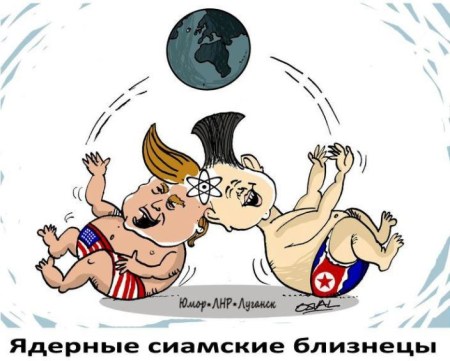
Caption: “Nuclear Siamese twins”

Source: twitter.com/sharzhipero, May 6, 2017; The logo on the bottom emphasizes that the cartoon was drawn in the Lugansk region of Eastern Ukraine that is controlled by pro-Russian separatists)

Russia Detects Launch Of Ballistic Missile From North Korea

On May 13, Russia’s Defense Ministry reported that Russian early warning systems had detected the North Korean missile launch at about 23:30 Moscow time. The Russian Defense Ministry’s statement read: “The missile early warning systems tracked the ballistic target during 23 minutes of its flight until it fell in the central part of the Sea of Japan (about 500 km away from the territory of Russia).” The statement also emphasized that the missile launch “posed no danger” for Russia, and that the Russian missile early warning systems and air defense alert were on routine combat duty.

The Russian news agency Tass reported routinely that North Korea had fired the ballistic missile from the north-west town of Kusong, where much of North Korea’s military industry is based. Tass also carried Japan’s assessment that the missile “flew about 800 km and fell in the sea outside Japan’s exclusive economic zone.”

(Tass.com, May 14, 2017)

Senator Ozerov: Missile Not Directed To Russia, But Russia’s Air-Defense Systems Remain On High Combat Alert

Senator Viktor Ozerov, who heads the Federation Council’s Defense Committee, said that Moscow understands that Russia is not the target of a North Korean attack, but he added: “Nevertheless, in order to keep ourselves safe of possible incidents, our Far Eastern air-defense systems in a high state of combat-readiness.”

(Ria.ru, May 14, 2017)

Putin: The West Should Stop Intimidating North Korea

Answering to media question about North Korea’s missile launch, Russian President Vladimir Putin also said that it was of “no immediate threat” to Russia. However, Putin added that Moscow “categorically opposes any expansion to the club of nuclear powers.” Putin said: “We have made our position clear to our partners, including the North Koreans. We consider this counterproductive, harmful and dangerous.”

On the other hand, Putin mentioned the need to resume dialogue with North Korea, and to “stop intimidating” it. Putin said: “Dialogue with North Korea must be resumed, attempts to intimidate the country must stop and a way to settle these matters peacefully must be found. Is this possible? I believe so, especially considering the positive experience of such dialogue with North Korea. As you may remember, there was a period when North Korea announced the termination of its nuclear program. Regrettably, the negotiating parties failed to muster the patience to translate this intention into reality. I believe we should resume these discussions.

“As for the latest missile launch, the Russian Defense Minister reported to me about it immediately, and the issue was later covered in the media. I have nothing more to say on this. This launch did not present a direct threat to Russia. However, such launches can provoke a conflict, which is not good at all.”

(Kremlin.ru, May 15, 2017)

Yuri Shvytkin, the deputy chair of the State Duma’s Defense Committee, also commented: “Our country is acting in the framework of the international law and… calls on North Korea to refrain from launching various missiles. Having said that, I personally think, that we have to force the U.S. to stop the muscle-flexing games against North Korea…The dispatch of a naval squadron as well as the U.S. president’s rather aggressive comments regarding North Korea, are triggering a defensive reaction… The U.S. should not unilaterally supplant the UN structure.”

(Ria.ru, May 14, 2017)

Russia’s Ambassador to China Andrei Denisov said: “Security in this part of Northeast Asia is complex, as both North Korea’s nuclear-missile program and the military presence of other countries, particularly the U.S., pose a threat to the area. Large-scale military exercises are becoming more and more intimidating, inducing North Korea and other countries to take measures to support their national security.”

(Tass.com, May 11, 2017)

Russian Diplomat: ‘The Reason For Tensions On The Peninsula Lies… Also In The Increased Military Activity Of The United States”

On May 8, at the First Session of the Preparatory Committee of the 2020 Review Conference of the Parties to the Treaty on the Non-Proliferation of Nuclear Weapons (Cluster II. Non-proliferation and IAEA safeguards), Ambassador Mikhail Ulyanov, head of the Russian delegation, said: “Russia rejects the [Democratic People’s Republic of Korea] DPRK’s self-proclaimed nuclear status. We openly declare to Pyongyang our conviction that the policy of nuclear missile capacity building will not contribute to the security of the country. On the contrary, it will have devastating consequences for the DPRK and for the region as a whole. We advocate Pyongyang’s strong commitment to the relevant UNSC decisions, cease of all nuclear and missile tests and return to the NPT regime. It is important though to prevent restrictions from narrowing the window of opportunities for the negotiations, as well as from escalating the humanitarian situation in the DPRK.

“Still we are convinced that the reason of tensions on the peninsula lies not only in Pyongyang’s nuclear and missile programs but also in the increased military activity of the United States and its allies in North-East Asia. It is evident that Pyongyang will not abandon its nuclear weapons as long as it feels that its security is directly threatened. And that is how it interprets regular maneuvers and exercises carried out by U.S.-centered military and political alliances in North-East Asia, alongside the escalation of the U.S. military presence, in particular, deployment of THAAD anti-ballistic missile systems in South Korea.

“The problems of the Korean Peninsula, including the nuclear issue, should be dealt with through an integrated solution to the whole spectrum of issues arising between the parties concerned so as to further create conducive environment for denuclearization. This requires de-escalation of overall military and political tensions, abandonment of further military infrastructure build-up, reduction of the ongoing maneuvers, and establishment of a trust-based climate among the States of the region.”

(Mid.ru, May 8, 2017)

Kremlin-Founded Think Tank’s Director: Russia-U.S. Relations Can Help Ease Asian-Pacific Tensions

Mikhail Fradkov, Director of the Kremlin-founded Russian Institute for Strategic Studies (RISS), said: “the Asian-Pacific direction today is one of the hottest in international relations. Unfortunately, it may appear that the region may literally become hot. What we see here is a snarl of potentially explosive issues, and we all need to join our forces to find peaceful solutions to them using only political means… It is extremely important to activate personal contacts between the Russian and the U.S. presidents during such critical moments in history like this one. Russian-American relations to a great extent identify the general level of security in the whole world.”

(Riss.ru, May 3, 2017)

RISS Analyst Konstantin Kokarev wrote: “The things that are currently happening in northeast Asia directly affect the national security interests of Russia. A targeted concentration of significant military forces of the US in the region and the statements by North Korean leader Kim Jong UN on his readiness for preventive strike with nuclear weapons can result in significant loss of life, permanently and seriously undermine the overall stability, interaction and cooperation in the region. This is a highly undesirable scenario.

“There is only one way out, which to seek solution of the problem exclusively through negotiations and compromise involving all the stakeholders. Russia has consistently advocated the early resumption of six-party talks, peace-building and mutually beneficial cooperation in the region, including in a trilateral format between Russia, the DPRK and the Republic of Korea.”

(Riss.ru, April 28, 2017)

Senator Kosachev: Passing The U.S. Bill On Enforcing N. Korea Sanctions On Foreign Territory Is A ‘Declaration Of War’

Russia has reacted to a bill adopted by the U.S. Congress, tightening sanctions against North Korea. If the law is passed, the U.S. president will have to provide Congress with a complete annual report, covering a period of five years, listing the ports and airports involved in the violation of sanctions against North Korea by any country. In particular, this refers to Vladivostok, Nakhodka and Vanino, as well as ports in China, Iran, Syria and other countries.

Commenting on the bill, head of the Federal Council’s Committee for International Relations, Senator Konstantin Kosachev said: “The realization of this [U.S.] bill includes a proposed force scenario in which the U.S. Navy would conduct compulsory inspections of all ships. Such a scenario is simply unthinkable because it means a declaration of war.” The bill has to be passed by the U.S. Senate and then signed by the U.S. president. Kosachev expressed his hope that Kosachev expressed the hope that the bill won’t pass.

The Deputy Chairman of the State Duma’s Committee for Defense and Security, Frants Klintsevich, also commented: “What immediately draws attention is the list of nations where U.S. congressmen want to have special control over sea ports. These are Russia, China, Iran and Syria. The United States is again trying to expand its jurisdiction all over the globe. It is as if they were telling Russia, China, Iran and Syria that these nations are suspects in crime, which is nonsense, according to international law.”

(Uawire.org, May 5, 2017; .Rt.com, May 5, 2017)

_______________________

[1] See MEMRI Special Dispatch No. 6891, Popular Pro-Kremlin Presenter Says Trump Is More Dangerous Than Kim Jong-Un, April 24, 2017.

Why Only Trump Can Win in North Korea

May 15, 2017

Why Only Trump Can Win in North Korea, Front Page Magazine, Daniel Greenfield, May 15, 2017

(Please see also, Chinese media: ‘China’s intervention not needed when only N.K.’s nuke facilities are hit.’ — DM)

Three options lie before us. We can walk away, withdraw all our forces, limit the potential risk and see what develops. We can destroy North Korea’s nuclear capabilities and as much of the regime infrastructure as we can manage. Or we can continue kicking the can down the road. That is the existing policy and it is the worst of all the three because it exposes us to the most risk with the least upside.

********************************

America is facing the same old bad choices in North Korea.

Either we apply multilateral sanctions hoping that Kim Jong-un, unlike his dad, Saddam Hussein and the Supreme Leader of Iran, will be suitably impressed by having to smuggle his iPhones through three other countries.  Or we build a multilateral coalition to take out its military with minimal civilian casualties and then spend the next decade reconstructing and policing it into a proper member of the United Nations.

Is anyone surprised that after Iraq and Afghanistan, Americans have little appetite for either alternative?

How is it possible that we beat Nazi Germany and Imperial Japan in less time than it’s taking us to figure out that we can’t even trust the clods of dirt in Afghanistan? Let alone reach a peace deal with them.

But WW2 was a war. It may have been the last war in which we leveraged all the firepower at our disposal to smash an enemy. We don’t fight wars anymore. Instead we’re the world’s policeman.

The military and the police have very different functions. The military destroys a threat. The police keep order. What we’ve been trying and failing to do in Afghanistan is keep order. It’s what we want to do in North Korea. Get that obnoxious kid next door to stop testing nukes every time he has a bad day.

The vocabulary is a dead giveaway. When we call a country a “rogue state” instead of an “enemy”, we’re not saying that it’s a deadly threat to us, but that it’s not behaving the way a member of the global community should. But being a “rogue state” is only a crime to globalists. Our problem isn’t that North Korea is failing to abide by the United Nations Convention on the Treatment of Radishes. It’s the nukes.

To solve a problem, you have to clearly define it because your solution will follow your formulation.

To globalists, the problem is an anti-social withdrawal from the global community. The solution is global “shunning” sanctions followed by a return to the loving arms of the global community.

That’s why the Iran nuke deal disaster happened. The diplomats didn’t care a radioactive fig about Iran’s nukes. They were invested in Iran’s membership in the “international community”. And they got what they wanted. They once got North Korea to sign on the dotted line too. And if you stand downwind of the latest test site with a Geiger counter, you know how that worked out.

If we want to win wars, we should stop being the world’s policeman. And defend ourselves instead.

Multilateral sanctions and multilateral coalitions aren’t our only two options. They’re our only two options if we want to spend our time enforcing the will of an imaginary international community.

The international community is a failed illusion. We’ve sacrificed far too many lives and too much money trying to defend our national interests by the rules of a post-national global order. That tragic mismatch dragged us into a disastrous and horrifying series of stalemates and lost wars. These stalemates, like Afghanistan, never end for the same reason that the cops in Chicago can never just declare victory.

Keeping order is an endless job. Policing means accepting the way things are and trying to keep them from getting too far out of hand while hoping that social conditions will somehow improve.

Police officers serve the public. They are expected to die for civilians. That’s exactly what our soldiers have been expected to do in Iraq, Afghanistan and the other societies that we’ve been policing.

If there’s any president who can actually break the cycle and replace policing with war, it’s President Trump. Trump is the first president in a long time to express skepticism about international commitments and the global order. And to propose that we serve our own national interests instead of serving the international community. And that is what needs to happen in North Korea.

Our old reasons for being in Korea expired with the fall of Communism. South Korea just elected a leftist president who likes North Korea better than he likes us. But that sort of thing has been known to happen. Like American leftists, South Korean leftists believe the stalemate with North Korea is our fault.

They have the right to test out that theory.

Our concern with North Korea is not that it might endanger our shipments of Samsung phones, but that its nuclear weapons will endanger us. Any hostile country with nuclear weapons is a potential threat. But North Korea has repeatedly threatened to use its nuclear weapons and has exported its technology to Islamic terror states. Even if we could shrug at the former, we can’t afford to ignore the latter.

Nuclear weapons in the hands of terrorists is the great threat of this century. Imagine the Islamic terror attacks of the last few years if the Jihadists didn’t have to make do with guns, bombs and cars. If we don’t turn off that pipeline in North Korea, Iran and Pakistan, the day will come when we aren’t watching dozens, hundreds or thousands dying on television in the cities of the West, but millions.

Preventing that moment from happening in this century must be our primary strategic objective.

Our post 9/11 engagements drifted from strategic objectives in our national interest that were achievable by military means to international community building projects in which armed force was an obstacle to its diplomatic objectives. That is how Obama’s Afghan surge cost the lives of so many soldiers by tying their hands with rules of engagement that did not allow them to engage the enemy.

President Trump has the opportunity to change all that in North Korea. To win in North Korea, we have to stop thinking in globalist terms. That means discarding talk of “isolating” North Korea. The Norks are already as “isolated” as they’re going to get. Any nation with nuclear weapons and the ability to threaten the United States will always be able to find friends among our enemies.

The trouble with North Korea isn’t that it’s a “Rogue State”. There’s nothing wrong with being a rogue state. We ought to try being one for a change instead of asking the UN for permission to sneeze. The international community is not the problem with North Korea. Nor is international law the solution.

Once we define the problem, we can define the objective. The problem is that North Korea is a dangerous enemy because of its nuclear program. We have two options. Ignore or act.

Plenty of presidents have kicked the nuclear Nork can down the road. Now it’s Trump’s problem.

There will be those around him who will urge him down the same dead end of sanctions, multilateral conferences, condemnations and negotiations. The can will go on rolling down the road. And one fine day, it will go off. Or we can actually end the threat that the North Korean nukes pose to us.

We have grown used to constant military action everywhere around the world. And we have also come to expect that it won’t accomplish anything except to exact an endless cost in money and lives. But those are not wars. They are internationalist police and peacekeeping actions in which we bomb lightly and invade only to rebuild. We are the world’s beat cop with tanks and bombers. It has been a long time since we used the huge warfighting arsenal of our defense industry to actually make war.

Wars don’t have to be long. They do have to be decisive. Their goal isn’t to reunite a lost sheep in the international community, but to destroy the enemy. Since the Cold War ended, we have not truly contemplated a war of destruction. But if we intend to win again, now might be the time to start.

We have spent a great deal of time trying to achieve diplomatic objectives through military means and military objectives through diplomatic means. What we have not done is tackle military objectives through military means. North Korea is not a diplomatic problem, but a military one.

Three options lie before us. We can walk away, withdraw all our forces, limit the potential risk and see what develops. We can destroy North Korea’s nuclear capabilities and as much of the regime infrastructure as we can manage. Or we can continue kicking the can down the road. That is the existing policy and it is the worst of all the three because it exposes us to the most risk with the least upside.

President Trump is the best hope for dropping an existing policy so stupid that only an establishment could cling to it. As an outsider, he is instinctively skeptical of the way things are.

When Alexander the Great was told that to rule he would have to untie a complex knot, he used his sword to cut it apart. The Gordian Knot of our foreign policy looks complicated until you take a sword to it. We can spend the next century trying to make everyone love each other. Or we can fight to win.

North Korea launches new missile. US sabotages

April 29, 2017

North Korea launches new missile. US sabotages, DEBKAFile, April 29, 2017

(???????????????? — DM)

North Korea early Saturday, April 29, launched a medium ballistic missile. It failed, detonating in North air space seconds after launch, just like the first one that was sabotaged by the US on April 16, DEBKAfile reports. US President Donald Trump tweeted as soon as he was informed: “North Korea disrespected the wishes of China & its highly respected President when it launched, though unsuccessfully, a missile today. Bad!”

He was apparently hinting that he would wait for China’s reaction before the US took action.

This missile was also the same as the first, a KN-17, a single-stage, short to medium range, liquid-fueled Scud or No Dong variant. It was test-fired Saturday as a deliberate act of defiance by Kim Jong-un in the face of Trump’s warning Thursday, “There is a chance that we could end up having a major, major conflict” over his expanding nuclear and missile capabilities. Hours earlier, on Friday, American, Chinese and Russian foreign ministers all stood up at the UN Security Council meeting in New York to demand that he give up his nuclear and missile programs.

State Department Secretary Rex Tillerson called for tough new action to punish Pyongyang.

The latest missile launch was not announced by Pyongyang. Nor was it fired from the usual base near the port city of Sinpo, but a site near the capital. US military sources estimated that the KN-17, most likely an upgraded Scud missile adapted for anti-ship warfare, was intended to support Kim’s threat to sink one of the US warships approaching Korean waters with two Japanese destroyers.

One of Tokyo’s major subways systems says it shut down all lines for 10 minutes early Saturday after receiving warning of a North Korean missile launch. Tokyo Metro official Hiroshi Takizawa says the temporary suspension affected 13,000 passengers.