Posted tagged ‘Trump and Iran’

Time to Call Iran’s Revolutionary Guards What They Are: Terrorists

March 10, 2017

Time to Call Iran’s Revolutionary Guards What They Are: Terrorists, American ThinkerReza Shafiee, March 10, 2017

What is missing in all the talks and arguments made in Washington as to what is an effective remedy to counter the mullahs in Iran is the role of Iranian people. Iran is boiling with popular discontent, now. According to Brigadier General Hossein Ashtari, the Iranian regime’s chief of police: “On average 20 to 30 protest gatherings take place around the country by citizens who have lost their life savings to the banks,” These citizens are mainly retired with very limited savings and were scammed out of their lifetime savings by various government-owned financial institutions.  Such protests are but a drop in the ocean when we add the teachers, nurses, factory workers, and an army of college graduates with no prospects of finding decent jobs to the discontent. This amounts to tens of thousands of people, in large numbers of gatherings each year. According to a BBC report, more than 11 million or Iran’s 83 million people are unemployed in the country.

*********************************

Ever since signs emerged that Trump administration is considering a long-overdue classification of Iran’s Islamic Revolutionary Guard Corps (IRGC) as a terrorist organization, the ruling mullahs have gone to work. They put into place a well-known strategy of intimidation and deception aboard, coupled with an absolute iron fist at home. They do this because they know the value of controlling a terrorist organization. The problem is in the harm it means for everyone else.

In the past, the Supreme Leader, Ayatollah Ali Khomeini, would brandish the former by reminding Western governments that if they chose to cross Tehran then they must be prepared to pay dearly. But that was decades ago. One fact is undisputable now: The Iranian regime has long passed its prime revolutionary and glory days when Khomeini rode in on the tides of millions who were sadly unaware of what was to come. In those days, people tasted a short-lived period of high expectations, at the time wildly called “spring of freedom.”

At the same time, hostage-taking by IRGC’s protégés, such as nascent Lebanese Hezbollah, of foreign nationals, preferably Americans, was routine. The ayatollahs were behind it even though it often took place in Lebanon. After each kidnapping, IRGC’s proteges then engaged hostages’ governments in a lengthy and humiliating process of hostage negotiations and sometimes hostage swaps in the 1980s.

Today the IRGC has made it much more convenient to reach the same ends by taking the hostages among dual citizens who take the risk of traveling to Iran. Case in point was hostages released just after Iranian regime struck the nuclear deal with the U.S. and five other world powers. IRGC’s deputy chief, Brigadier General Hossein Nejat, in a speech in Bushehr (south of Iran), said: “The Iranian-American journalist of the Washington Post, Jason Rezaian, who had formed an espionage network was identified and arrested by the IRGC.”

Hossein Nejat stated: “The former Secretary of State, John Kerry with his intelligence forces urged the Iranian Foreign Minister, Mohammad Javad Zarif to release Jason Rezaian. Consequently, the U.S. government in return paid 1 billion and 400 million dollars ransom to Iran for the release of Jason Rezaian.”

Other IRGC officials, on different occasions after the hostages were released, have bragged that the Obama administration released Iranian prisoners in the United States and on top of that paid a hefty sum as ransom money.

In past few weeks, despite attempts by regime officials, such as Zarif, to keep a low profile while anxiously monitoring Donald Trump’s every move, IRGC is actively scheming. It raised the prize on Salman Rushdie’s head, showcased and glorified old terrorists such as Anis-Alnaghash on state-run television and openly threatened the U.S.

CNC News revealed on Feb. 28 that an IRGC strategist, Hassan Abbasi renewed threats that the force has planned to unleash terror cells on U.S. soil. He has elaborated plans to sabotage nuclear plants in the United States among other things. Ironically, at the same time, IRGC has claimed that it is fighting terrorism in neighboring countries.

Javad Zarif has recently said: “the world at large agrees that the IRGC has extended the utmost support for neighboring countries in their fight against terrorism.”

Zarif seemingly refers to IRGC’s destructive and brutal role in Syria and is trying to sell it as constrictive. According to IRGC’s own figures, more than 1,000 members of its rank and file have been killed in cities around the war-torn country.  Many were veteran IRGC officers. The Iranian regime claims that it has only an advisory role in Syria, however it has recruited and dispatched thousands of Afghani and Pakistani nationals to Syrian fronts. Not one has fought ISIS.

On March 2, Brigadier General Ismail Ghaani, who is deputy Quds Force commander, speaking in the northeastern city of Mashhad, told a group from the Fatemiyoun Division, an offshoot of the force fighting in Syria: “Fatemiyoun proved that it is a capable force ready to operate not only in Syria but anywhere else on the planet when Islam requires it.” Fatemiyoun was formed of Afghani recruits, along with its sibling organization Zenabiyoun Division of Pakistanis.

The Iranian regime today makes it no secret that it is heavily involved in Syria and Iraq. It sugarcoats its involvement with the illusion that IRGC and its armed wing, the Quds Force, are fighting ISIS. But it’s not true. After almost six years of involvement in the bloody civil war in Syria, it is out in the open that the regime has no quarrel with ISIS. Former Secretary of State John Kerry said in an interview with Fox News: “Assad facilitated the release of 1,500 prisoners, parallel to 1,000 by Maliki in Iraq, leading to the foundation of ISIS.”  Former U.S. ambassador to Iraq, James Jeffrey, said that Americans knew what Prime Minister Maliki was up to, but chose not to take any action.

It is also a hard fact that Maliki was in every way a puppet of the Iranian regime. He was trained by the IRGC and fought alongside its forces during the 1980-1988 Iran-Iraq war.

What is missing in all the talks and arguments made in Washington as to what is an effective remedy to counter the mullahs in Iran is the role of Iranian people. Iran is boiling with popular discontent, now. According to Brigadier General Hossein Ashtari, the Iranian regime’s chief of police: “On average 20 to 30 protest gatherings take place around the country by citizens who have lost their life savings to the banks,” These citizens are mainly retired with very limited savings and were scammed out of their lifetime savings by various government-owned financial institutions.  Such protests are but a drop in the ocean when we add the teachers, nurses, factory workers, and an army of college graduates with no prospects of finding decent jobs to the discontent. This amounts to tens of thousands of people, in large numbers of gatherings each year. According to a BBC report, more than 11 million or Iran’s 83 million people are unemployed in the country.

When it comes to Iran, the decision-makers in Washington have two options: One is to follow the status quo and tolerate a regime which is the number one state sponsor of terrorism in the world, a stirrer of sectarian violence in the region, and engaged in two wars in Iraq and Syria. It’s a nation that secretly supplies weapons to Yemen’s Houthis which has also cost American servicemen’s lives. If the Trump administration chooses this option, it will make the same mistakes the Obama administration made.

The other, and better, option is to stand with Iranian people and their resistance, to let them shape their own future. All they asked of U.S. in 2009 was for the U.S. to stand with them. At the time, they chanted: “Obama are you with us or with them.” They clearly hoped the U.S. would not placate mullahs with concessions, nor turn a blind eye to regime’s terrorism.

One such good signal in the right direction would be to designate IRGC as a terrorist organization.  In light of all it has done and its growing strength, in designating the IRGC as a terrorist group, we are doing ourselves a favor.

Reza Shafiee is a member of Foreign Affairs Committee of the National Council of Resistance of Iran (NCRI) 

Recruit Russia in the fight against Iran

March 9, 2017

Recruit Russia in the fight against Iran, Israel Hayom, Ariel Bolstein, March 9, 2017

Prime Minister Benjamin Netanyahu’s meeting with Russian President Vladmir Putin in Moscow Thursday takes place at an interesting time.

Russia, which has exhausted its military moves in Syria, is searching for a future strategy that will allow it to integrate into the world of U.S. President Donald Trump. Russia has paid a high price for its confrontation with the West. True, as a result of the United States’ geopolitical retreat under former U.S. President Barack Obama, Russian influence has grown on a few fronts, primarily in the Middle East, but this achievement is not worth much without American recognition of Russia’s new-old status as a world power. The changing of the guard in Washington provided Moscow with a unique opportunity to turn the page on its relationship with the West, but the significance of such a change would also mean concessions on its part.

It seems that Russia may meet Trump halfway on the Iranian issue. Russia did not have much in common with the country of Islamic revolution from the outset, and the collaboration between them stems more from a desire on the part of both countries to challenge the existing world order. Indications of Russia’s openness to the idea of turning its back on Iran have been noted on Russian state television. These channels are full of talk shows that focus on current events, and the variety of voices heard on them is effectively controlled by authorities. In recent weeks, these programs have raised the possibility of placing Iran on the sacrificial altar between Moscow and Washington, and this was received with understanding by a majority of participants. One must remember that Putin and as a result the Russian public are determined to witness Russia’s inclusion in the select club of world powers, but they have no interest in dragging others who also claim the crown along with them, and certainly not Iran.

From Israel’s perspective, Netanyahu is now the only statesman to enjoy the trust of and an unprecedented friendship with both the White House and the Kremlin. Israel has succeeded in preserving its interests in the tempest of upheaval in the Middle East, in large part due to the relationship Netanyahu has forged with Putin. The Russians have been forced to honor Israel’s freedom of action in the region and have come to understand full well Israel’s determination to act whenever Israeli considerations require that it do so.

In the Trump era, Israel’s stock has risen even more in the eyes of the Russians. Moscow could not help but notice the special affinity Trump has shown toward Netanyahu and the feelings of solidarity they share. Israel is clearly not operating within a vacuum — Turkish President Recep Tayyip Erdogan will visit Russia after Netanyahu, and later in the month, Iran’s President Hassan Rouhani will do the same — but those in the Kremlin must understand the differences in influence among these three figures.

The possible resolution in Syria and its de facto division into regions of influence underscores the need to stop the expansion and strengthening of Iran. Russia needs to understand that Hezbollah’s murderousness and lack of humanity is no different from that of the Sunni terrorists it so mercilessly bombed. There should be one law for the Islamic State, Jabhat Fateh al-Sham — formerly Nusra Front — and Hezbollah. If Russia operates according to this principle, its standing and the security of the region will vastly improve.

Iran honestly abiding by nuclear deal or terrified of changing times?

March 7, 2017

Iran honestly abiding by nuclear deal or terrified of changing times? Al Arabiya, Heshmat Alavi, March 7, 2017

(Al Arabiya is “a Saudi-owned pan-Arab[4] television news channel.” — DM)

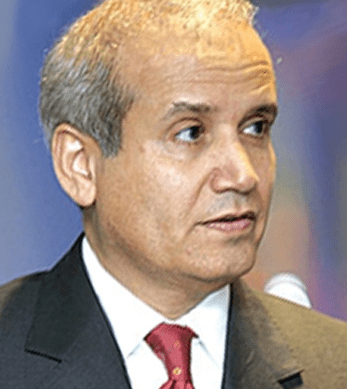
International Atomic Energy Agency (IAEA) Director General Yukiya Amano addresses a news conference after a board of governors meeting at the IAEA headquarters in Vienna, Austria March 6, 2017. REUTERS/Heinz-Peter Bader

During the Obama years Iran understood very well his administration would take no serious actions against their aggressive nature, as seen in the West’s relative silence in the face of more than a dozen missile test launches.

To this end, Iran’s recent compliance by JCPOA articles should only be perceived as a result of its deep fear in the new US administration’s possible policies.

************************************

Yukiya Amano, Director General of the International Atomic Energy Agency, recently issued his latest report to the agency’s Board of Governors. At a first glance the text leaves you thinking Iran is honoring the nuclear deal, known as the Joint Comprehensive Plan of Action, JCPOA.

However, considering the rapid pace of international developments, and US President Donald Trump’s harsh remarks against the nuclear deal, we are seeing Iran going the limits to maintain the JCPOA intact. This is a staunchly different approach from the Obama era.

The latest IAEA report contains very important technical aspects, showing how weak Iran has become. Despite all the threats of abandoning the JCPOA ship altogether, Iran’s recent measures proves it needs the JCPOA more than any other party.

By the statistics

On November 8th, 2016 the IAEA verified Iran’s heavy water reserves reached 130.1 metric tons. Iran also informed the IAEA about sending 11 metric tons of heavy water outside of its borders on November 6th and 19th, also verified by the IAEA.

After this transfer Iran has not dared to exceed the 130 metric ton limit, and on February 14th the IAEA verified Iran’s reserves have decreased to 124.2 metric tons, meaning even 6 metric tons less than the JCPOA specified amount.

During the Obama administration Iran had twice exceeded the 130 metric ton limit, and yet rushed to send the excess amount to Oman prior to Donald Trump taking the helm at the White House.

Natanz

Under the JCPOA Iran is permitted to maintain more than 5,060 IR-1 centrifuges in 30 cascades in the Natanz enrichment site. Again, terrified of the incoming Trump administration, reports indicate Iran has significantly lowered the number of such centrifuges.

Iran is continuing to enrich UF6 uranium at Natanz, yet not daring to enrich any uranium above the 3.67 percent standard set for nuclear fuel production. Iran has also not exceeded the 300-kilogram amount of 3.67 percent uranium 235, equal to 202.8 kilograms of uranium.

By February 18th Iran had stored 101.7 kilograms of 3.67 percent uranium, showing the regime has not only abided, but even halved their stocks. This is another sign of Iran’s concerns of the change in guards in Washington.

Ferdow

The controversial Ferdow uranium enrichment, with a capacity of 3,000 centrifuges, currently has 1,044 IR-1 centrifuges, where 1,042 are placed in six cascades, and two such centrifuges are set aside for research purposes.

During the past three months (especially following the November 8th US elections) Iran has suspended all of Ferdow’s uranium enrichment and R & D activities.

Surveillance

All stocked centrifuges, along with their components, are under constant IAEA surveillance. The IAEA enjoys orderly access to related facilities in Natanz, including daily inspections based on IAEA inspectors’ requests.

Iran continues to allow the IAEA use electronic surveillance devices and online seals on its uranium enrichment facilities to provide continuous monitoring. Iran has also agreed to provide for the presence of a larger number IAEA monitors.

Iran has agreed to abide by the Additional Protocol, once considered a red line for the regime, allowing the IAEA monitor a large number of sites and other facilities affiliated to Iran’s nuclear program.

Iran’s enriched uranium in Oman

Another sign of Iran giving in to major setbacks is the regime’s agreement to stock their enriched uranium in Oman, and seek its sale to foreign buyers from there. This also includes stocks of excessive heavy water. And yet, Iran is also concerned about the fate of its money in Oman banks, as expressed by a number of parliament members.

The irony

In the meantime, one cannot say for certain that the mullahs have actually relented their nuclear weapons drive. It is in the mullahs’ nature to continue their pursuit for terrorism, nuclear weapons and domestic crackdown. These are the Iranian regime’s three main pillars.

It is common knowledge that the mullahs enjoy no social base, and this is seen in remarks made by Ali Akbar Salehi, Iran’s Atomic Energy Agency chief saying in most of his interviews how Tehran intends to relaunch the nuclear program once the JCPOA time limit ends.

Despite all this, the mullahs very well understand the language of force. Iran only succumbed to the nuclear talks once international sanctions began crippling their economy.

During the Obama years Iran understood very well his administration would take no serious actions against their aggressive nature, as seen in the West’s relative silence in the face of more than a dozen missile test launches.

To this end, Iran’s recent compliance by JCPOA articles should only be perceived as a result of its deep fear in the new US administration’s possible policies.

Investments

After Obama left office foreign investment in Iran has also witnessed a nosedive, adding to the mullahs’ growing concerns. Tehran curbed a portion of its nuclear program, yet receiving nothing in return and continuously being described as the main state supporter of terrorism, instability and insecurity.

Iran’s unfrozen money has been transferred to Oman, and yet the government says it cannot release the assets to Tehran. Iran has at least $18 billion blocked in China, with no means to gain access to.

British Petroleum also had double thoughts following Trump’s entrance into the White House. This major international oil company has currently taken a major step back from participating in Iran’s oil projects.

Total in France, seeking to develop the major gas fields south of Iran, has also taken similar measures, suspending its activities until the summer of this year to allow Trump to clarify his JCPOA policy.

Foreign banks and companies

Why are French companies unable to invest in Iran? This country’s largest banks are holding back on any cooperation with Tehran, blocking any major investment by large French companies in this country. In addition to Total, Renault, AirBus and others are unable to invest in Iran without the support of major French banks such as Societe Generale.

These banks, however, are very concerned of unilateral punishing measures by the US against foreign entities investing in Iran. For example, the BNP Paribas was slapped with an $8.9 billion fine by Washington for bypassing US sanctions against Iran.

Airline restrictions

Japan’s Mitsubishi ended its negotiations to sell planes to Iran, citing concerns of the new US administration’s possible future sanctions and policies.

Despite Tehran seeking to expand its airlines and reach abroad following the nuclear deal, New Delhi delivered yet another blow by suspending its flights to Iran.

“Air India Express, the low-cost unit of the South Asian nation’s flag carrier, has put on hold a plan to fly to Tehran amid renewed tensions between the US and Iran after President Donald Trump imposed fresh sanctions on the Persian Gulf country,” according to a Bloomberg report.

Money laundry warnings

The Financial Action Task Force, the international body assigned to fight back against money laundering, issued a stark warning to Tehran to live up to its obligations or else face serious actions.

The FATF recently issued a strong reminder saying “in June 2016, the FATF suspended counter-measures for twelve months in order to monitor Iran’s progress in implementing the Action Plan. If the FATF determines that Iran has not demonstrated sufficient progress in implementing the Action Plan at the end of that period, FATF’s call for counter-measures will be re-imposed.”

Conclusion

More than a year after the JCPOA implementation, and with Washington adopting a completely new mentality and overhauling any pro-appeasement policies vis-à-vis Iran, the mullahs in Tehran have realized the global balance of power has shifted completely against their interests.

To this end, their recent measures to curtail their nuclear stocks should not be considered a coming to mind by Tehran. Not at all. The mullahs understand the language of force, just as President Ronald Reagan came to office in 1981 the fledgling mullahs’ regime rushed to release all American hostages after a 444 ordeal.

Now, Tehran is once again comprehending a significant shift in international politics, and it is taking measures accordingly to limit all possible damages. And rest assured they will jump to the occasion if they sense any weakness or hesitation.

As a result, Iran must be held at the ropes and the next necessary step in this regard is the long overdue designation of its Revolutionary Guards as a foreign terrorist organization. This will begin to limit its ability to wreak havoc across the Middle East and limit its human rights atrocities.

This is in the interest of all nations.
_________________________
Heshmat Alavi is a political and rights activist. His writing focuses on Iran, ranging from human rights violations, social crackdown, the regime’s support for terrorism and meddling in foreign countries, and the controversial nuclear program. He tweets at @HeshmatAlavi & blogs at IranCommentary.

Forging a new approach to Iran

March 6, 2017

Forging a new approach to Iran, Washington Times, Shahram Ahmadi Nasab Emran, March 5, 2017

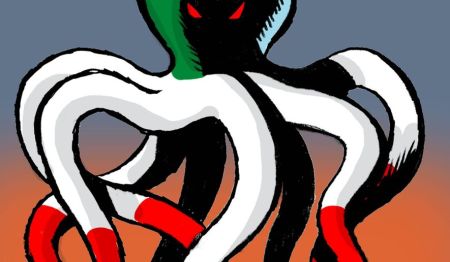
iranianoctopusIllustration on the continuing threat of Iran by Alexander Hunter/The Washington Times

By identifying the gross overreach by the Iranian regime and promising a swift, punitive response, the White House’s stance marked the end of a longstanding American policy of naive appeasement. In so doing, the Trump administration has rightly recognized the true source of instability and existential threat the region faces. Now, instead of issuing broad statements, it must act on a smart strategy for dismantling the key pillars of Iran’s international terror network and stunting the regime’s emboldened overreach.

***********************

Even as the Trump administration seeks to designate the Revolutionary Guard as a Foreign Terrorist Organization, Iran continues its blatant defiance of international norms. Promising “roaring missiles” if threatened, Tehran has test fired several ballistic weapons capable of delivering nuclear material in just the past month. A fundamentally weak regime with dated military capabilities, Iran is attempting to call the United States’ bluff, perhaps to gain leverage in any subsequent re-evaluations of the nuclear deal Tehran struck with the Obama administration. Several blistering statements from the White House backed by a round of sanctions presage the administration’s muscular new approach. But if it hopes to secure the region, it must systematically target the core destabilizing activities of the regime.

In a steady stream of denunciations, the White House pledged tougher U.S. action if the mullahs continue to violate international norms through illicit missile tests, making clear that the Obama era of appeasement is over. “Instead of being thankful to the United States for these agreements, Iran is now feeling emboldened,” an official White House statement read. “We are officially putting Iran on notice.” While many Iranian officials dismissed President Trump’s tough talk on the nuclear deal as empty campaign rhetoric, the president’s appointment of fellow anti-regime hardliner Gen. James Mattis demonstrates his intention to deliver.

Perhaps more importantly, the White House has also challenged the regime’s extended proxy offensives against U.S. allies and friends in the neighborhood. Such actions “underscore what should have been clear to the international community all along about Iran’s destabilizing behavior across the Middle East,” the White House statement continued. Contrary to President Obama’s Middle East policy of abandoning friends and allies and trying to make friends with the adversaries, the Trump administration will fully support its friends. Specifically, this stance challenges Iran’s practice of hiding behind Hezbollah and Houthis militants as it funds and trains them.

Holding a vastly dated arsenal of weapons, Iran is no match for U.S. firepower, leaving only backchannel mercenaries to promote regional dominance. The White House acknowledged this dynamic, specifically characterizing the affront against Saudi forces as being “conducted by Iran-supported Houthi militants.” This link was never recognized by the Obama administration. Such oversight left Iran free to grow and strengthen its hand in these groups, which terrorize the region and undermine our partners. If the Trump administration will craft a strategy for stunting Iran’s proxy network, particularly by cutting funding and armament flows, the region would be far safer and more stable.

Noting Mr. Trump’s concerns about the nuclear deal being “weak and ineffective”, the Trump administration addressed a third key issue in the U.S.-Iranian relationship. Rapidly losing money and influence, the nuclear deal allowed the regime to avoid military confrontation over its development program for which it was grossly unprepared. And despite the intention of weakening the regime and strengthening the Iranian people, rushed U.S. concessions granted the regime an eleventh-hour trickle of lifeblood, both financially and symbolically. By rolling sanctions back, destabilizing behavior was ostensibly met with an influx of funds. As such, the deal signaled that military action against Iran was highly improbable, thus essentially greenlighting the illicit activity that effected warnings and sanctions from the White House over the past month. And despite official remarks by Iranian officials denouncing these statements as naive and weak, the regime would be in dire straits if America turns off the faucet opened by the nuclear deal.

Finally, the administration’s condemnation for Iran’s broader support for terrorism demonstrated clear perspective on the direct threat it poses to international security. In addition to supporting Hezbollah, Iran is currently involved in a life-and-death battle in Syria that includes continuous weapon and militant transfer from Iran to Syria. President Bashar Assad’s downfall in Syria would destroy the linchpin of Iran’s terror apparatus.

Further, any sustainable resolution calls for the withdrawal of all foreign forces from Syria, culling both activity in the country and a pipeline to Hezbollah via the porous borders between Syria and Libya. As Iran finds itself backed into a corner by its regional export of terror, Mr. Trump and his team have many cards to play.

By identifying the gross overreach by the Iranian regime and promising a swift, punitive response, the White House’s stance marked the end of a longstanding American policy of naive appeasement. In so doing, the Trump administration has rightly recognized the true source of instability and existential threat the region faces. Now, instead of issuing broad statements, it must act on a smart strategy for dismantling the key pillars of Iran’s international terror network and stunting the regime’s emboldened overreach.

Iran Prepares Militarily And Politically Vis-à-vis Trump Administration: Strategic Alliance With Russia, Dragging Israel Into War With Hizbullah, Palestinians

March 4, 2017

Iran Prepares Militarily And Politically Vis-à-vis Trump Administration: Strategic Alliance With Russia, Dragging Israel Into War With Hizbullah, Palestinians, MEMRI, March 3, 2017

(The footnote suggests that the article may not reflect the views of the Iranian regime. — DM)

On February 21, 2017, the Iranian reformist news agency Amadnews reported on information from a military source in Iran’s Islamic Revolutionary Guards Corps (IRGC) about preparations being made by the Iranian leadership following President Donald Trump’s threats against Iran.[1] According to this IRGC source, the Iranian leadership had accepted a recommendation to ally strategically with Russia so that Russia would defend Iran in the event of a U.S. military attack on it. In exchange for the Russian defense umbrella, the Iranian officials had recommended to Iranian Supreme Leader Ali Khamenei that Iran grant Russia extensive economic and military privileges, in the form of concessions for the oil fields in southern Iran, as well as access to the Persian Gulf – which would give Russia control of Iran’s ports, and profits that would compensate it for the U.S. sanctions against it. An additional recommendation, which is already being implemented, is reviving the battlefront against Israel by means of Hizbullah in Lebanon and the Palestinian resistance organizations in Gaza and the West Bank, to keep Israel busy fighting and keep the Trump administration focused on Israel, not on Iran.

At the end of the report,  Amadnews underlined the price that Iran would have to pay for the implementation of these recommendations, and noted that they constitute an explicit contradiction of the goals of Iran’s Islamic Revolution and of the legacy of revolution founder Ayatollah Ruhollah Khomeini. Khomeini, it said, had insisted that Iran follow neither the U.S. nor the then-Soviet Union – that is, that it be independent of both of them.

6811aAmadnews.com, February 21, 2017.

The following is the translation of the Amadnews.com article.

“A knowledgeable military source told Amadnews that at secret consultation meetings aimed at deciding on how Iran should confront the threats by the new American president Donald Trump, the decision makers in Iran spoke about serious decisions that contradict [Iran’s] national interests.

“According to this knowledgeable source, many meetings were held, under the title ‘How To Respond To The Threats of The New American President,’ and the conclusions were sent to the Leader [Khamenei]. The decision makers discussed a big question: Is it possible to reopen the U.S. Embassy in Iran? And if the answer is no, how can Iran respond in a way that will reduce the increasing threats by America – threats that can turn into an extensive military confrontation?

“Political, security, and military experts expressed their opinion [at the meetings] and determined that the decision makers in Iran should not deal with reopening the U.S. Embassy in Iran or with normalizing relations with [the U.S.]. Instead, Iran should deepen its strategic ties with Russia, such that in the event of an extensive war, Russia will defend Iran from American threats. According to this report [to Khamenei], there are many ways to deepen Iran-Russia ties: At these meetings, a strategic alliance with Russia was recommended, and three important recommendations were presented to the Leader.

“This team of experts’ first recommendation was to grant Russia a permit for development, concessions, and production in the oil fields and wells of southern Iran. This recommendation will bring Russia annual profits of over $50 billion, at least, which can save it from economic crises stemming from the American sanctions against it because of the Crimea issue.

“The second recommendation is to realize Russia’s decades-old dream of access to free waters. This team proposed giving Russia access to the warm waters of the Persian Gulf, so that if America attacks Iran, Russia will be able to defend Iran against the mighty sea and land strength of America.

“For over a century, Russia has sought access to the ‘warm waters’ of the Persian Gulf, but Iran has refrained from allowing Russia to do this, for fear of Russian infiltration and influence in Iran. If Russia has a Persian Gulf presence, and access to the warm waters of southern Iran, it will take control of southern Iranian ports, and will benefit from increasing economic prosperity despite the severe American sanctions against it.

“The Russians have already been granted the right to use the Noje military base in Hamdan in order to demonstrate [their] military presence in Syria. This right was granted to the Russians by direct order of the Leader [Khamenei] and without the involvement of Iran’s decision-making apparatuses.

“The third recommendation is to involve Israel in a war with Hizbullah, and with the other Palestinian groups, so that it is too busy to discuss [uniting ranks] with other countries worldwide against Iran, and uniting global public opinion against it. A new war between Israel and Hizbullah in Lebanon, as well as with Palestinian groups, will completely divert global public attention from Iran and focus it on Israel. Such a war could become the focal point of the first four-year term of Donald Trump, and prevent an opportunity to fight Iran.

“Yesterday [February 20], Hizbullah secretary-general Sayyed Hassan Nasrallah gave an interview to [Iran’s] official Channel 1 [TV], and the Palestine conference [i.e. the International Conference in Support of the Palestinian Intifada] was held, with the Leader’s attendance. These two things happened because of other recommendations by the team of experts.”

Here, the Amadnews article summarizes the information from the military source, and criticizes the Iranian leadership for deviating from the dictates of Ayatollah Ruhollah Khomeini who had clearly outlined a policy of political independence vis-à-vis the Western bloc, led by the U.S., and the eastern bloc, led by the then-Soviet Union. The article then continues:

“In exchange for giving these rights to Russia, the Russians are supposed to make a military commitment such that if there is a war with any country, Russia will remain Iran’s military ally. But there is a big question: If Iran does not become entangled in a war with any country, how will the Russians give Iran back the rights that they have received? Not least that one of the main slogans of the people of the 1979 Revolution and the toppling of the Shah’s regime was ‘Neither East nor West – [Only] The Islamic Republic.'”[2]

____________________________

[1] Amadnews.com was established by journalists who were arrested or threatened during the 2009 Green Revolution, which maintained that the June 2009 presidential election results had been faked. The journalists said that they were continuing the Green Movement by publishing news transparently and acting to expose corruption in the Iranian regime so as to help the people obtain its rights. Amadnews.com/about-us, accessed February 21, 2017.

[2] Amadnews.com, February 21, 2017.

Tehran’s Trump trepidation

March 2, 2017

Tehran’s Trump trepidation, Israel Hayom, Ruthie Blum, March 2, 2017

It is sufficient for Trump at this point to be perceived as someone capable of bombing Iran on a whim ‎to make the ayatollahs wary. Ironically, it is his enemies at home who have been persuading the ‎powers-that-be in Iran that they have something concrete to worry about. No wonder they have been ‎alternately saber-rattling and toning down their rhetoric, depending on the day and New York Times ‎headline. Indeed, they seem unable to make up their minds which tactic will serve them in safer stead.‎

****************************

Speaking to governors at the White House on Monday, U.S. President Donald Trump announced a ‎sharp increase in the military budget. According to some assessments, the allocation in question could ‎reach wartime levels.‎

If so, rightly so.‎

Americans may not feel it on a day-to-day basis, but their country is the target of global jihadists, some ‎of whom have been committing small-scale killing sprees on U.S. soil, while others are training in the ‎Middle East and honing their skills to execute operations on a grander, more 9/11-type scale.‎

Still, although Trump, like many other leaders and lay people, seems to consider the group Islamic State ‎to be the world’s bogey man, as al-Qaida used to be viewed, the greater danger is posed by the ‎regime in Tehran and its proxies. ‎

For one thing, unlike the Sunni rogues who like to decapitate people on YouTube, Shiite Iran is an ‎actual country with all that this entails, including a place at the proverbial and literal table. What should ‎have been its lowly station in the overall hierarchy of things was lifted to great prominence when the ‎Obama administration and five other governments — those of Britain, France, Russia, China and ‎Germany — groveled before its leaders, begging them to agree to a deal to retard their race to a ‎nuclear weapon.‎

The disastrous end result of this mass genuflection was the acceleration of Iran’s nuclear program ‎through the infusion of billions of dollars into its coffers. Even more unfathomable was what the ‎ultimate agreement — called, oddly, the Joint Comprehensive Plan of Action — included: a clause ‎handing over the responsibility for monitoring activity at Iran’s nuclear facilities to members of its ‎parliament. It would be funny if it weren’t so horrifying. Indeed, the Iranian regime was chuckling, ‎while Israel and others in the West who opposed the JCPOA winced and braced for fallout.‎

When Trump won the U.S. presidential election in November, however, the ayatollahs suddenly ‎stopped laughing. Touted by all Democrats and many Republicans as crazy, unpredictable and a loose ‎cannon, the real estate mogul and reality TV star who took to Twitter and other platforms to bash his ‎detractors made Tehran extremely nervous. The shift from a White House and State Department ‎characterized by appeasement to America’s enemies — refusing even to name them as Islamists — to ‎an administration headed by someone who declared that it would be necessary to perform extreme ‎vetting of Muslims entering the United States could not have been sharper.‎

In the lead-up to and since Trump’s inauguration on January 20, Iranian officialdom has been ‎scrambling to figure out the best strategy for dealing with the new leader of the free world — one ‎about whom many Americans continue to say he cannot be trusted with his finger on the nuclear ‎button, due to his volatility and personal petulance.‎

Iranian Foreign Minister Javad Zarif, for example, was used to belittling then-U.S. Secretary of State ‎John Kerry with utter impunity during nuclear negotiations. Today, he and his fellow honchos have ‎good reason to fear that under Trump and top diplomat Rex Tillerson, such behavior will not fly. What they must now be fretting ‎over is the possibility that it is they who will be kneeling down before an American official and not the ‎other way around.‎

According to the concept of “marit ayin” in Jewish law, certain permissible actions are prohibited ‎when engaging in them might cause observers to mistake them for violations. The same principle — in ‎reverse — is now going on between Tehran and Washington.‎

It is sufficient for Trump at this point to be perceived as someone capable of bombing Iran on a whim ‎to make the ayatollahs wary. Ironically, it is his enemies at home who have been persuading the ‎powers-that-be in Iran that they have something concrete to worry about. No wonder they have been ‎alternately saber-rattling and toning down their rhetoric, depending on the day and New York Times ‎headline. Indeed, they seem unable to make up their minds which tactic will serve them in safer stead.‎

Former Iranian President Mahmoud Ahmadinejad went so far as to pen a letter to Trump on Sunday, ‎urging him to make good on his promise to overhaul America’s “corrupt” political system. In flowery ‎language, Ahmadinejad — who spent his terms in office threatening to wipe Israel off the map and ‎calling the U.S. the “Great Satan” — tried to appeal to Trump on their ostensible shared interests and ‎values. Now there’s a hoot.‎

What both men surely know is that among the countless differences between them, one that stands ‎out is that the previous Iranian puppet manipulated by Supreme Leader Ali Khamenei is a has-been ‎who’s lucky he wasn’t sentenced to death, while Trump is just getting started — by increasing the ‎defense budget.‎

For this alone, his election will have been worth it. ‎

Dr. Jasser participates in a panel discussion about the state of the Middle East & ISIS

February 25, 2017

Dr. Jasser participates in a panel discussion about the state of the Middle East & ISIS, AIFD via YouTube, February 24, 2017

(It’s an about thirty-five minute long video about Middle East related topics, including America’s relations with Russia, Islamist terrorism, Islamist nations, the clash between Judeo-Christian and Islamist cultures and what the Trump administration can and should do. — DM)


‘Abd Al-Rahman Al-Rashed: We Must Form ‘Arab NATO’ To Confront Iran

February 22, 2017

‘Abd Al-Rahman Al-Rashed: We Must Form ‘Arab NATO’ To Confront Iran, MEMRI, February 22, 2017

In February 2017, prominent Saudi journalist ‘Abd Al-Rahman Al-Rashed, the former editor of Al-Sharq Al-Awsat and former director of Alarabiya TV, published two articles calling to take a firm position vis-à-vis Iran and even form an “Arab NATO” to confront the alliance Iran has formed with Iraq and Syria.

The following are excerpts from the articles, as published in English by Al-Sharq Al-Awsat and Alarabiya, respectively:

alrashed‘Abd Al-Rahman Al-Rashed (image: alarabiya.net)

In one article,[1] Al-Rashed criticized the claim that U.S. President Donald Trump’s declarations against the Iran agreement strengthen the radicals there. He argued that Iran’s belligerence since the signing of the agreement proves that openness and flexibility towards it, like the policy pursued by Obama, only encourage it to escalate its aggression. He added that the radical camp in Iran has controlled the country since the Islamic Revolution, while the moderate camp is merely a front used to encourage the West to be lenient with Iran. Hence, policy towards Iran should be firm:

“Nothing happened during three decades to prove that there’s real competition between radicals and moderates inside the [Iranian] ruling command. Major events rather confirmed that the authority was in fact under the control of the radicals, while moderates were just front men. President Hassan Rouhani and his FM Zarif both represented the moderates and they succeeded [in] winning over the administration of former president Barack Obama. They also managed to convince the administration that lifting sanctions and encouraging Iran’s openness were [in] the interest of moderate figures, the region and the whole world.

“Once again, evidence suggested this assumption was wrong. [The] Iranian leadership became more aggressive than ever and for the first time since the establishment of the Islamic Republic, the regime dared to expand its military activity outside its borders. It is currently participating in and funding four wars outside of Iran. All of this was possible due to the nuclear deal that paved the way for better relations, trade and activity and kept silent over Iran’s threats to the region.

“Trump’s extremist rhetoric is a natural outcome of the disappointment [that] prevailed [in] Washington due to Iran’s behavior after signing the deal. Things will keep on getting worse unless a strict international position against Iran’s adventures is taken and unless Iran is forced to end the chaos it is funding in the region and the world.

“Those familiar with the Iranian regime’s [actions] cannot believe the excuses being made by Iran’s allies which stipulate that being lenient with Iran [may cause it to have a] positive [attitude to] the rest of the world. The nature of the regime in Tehran is religious with a revolutionary ideology. It has a political agenda that has not changed much since it attacked the American embassy in Tehran and held diplomats hostage [in 1979]. The same logic leads us to conclude that Iran will dominate [by] using power via its proxies and militias across the region and [by] encouraging and supporting the rebellious behavior of certain local parties in neighboring countries.

“Iran has not changed much since it announced it plans to export revolutions to the world. The only change that happened is that its financial and military situations improved a lot thanks to the nuclear deal it signed with the West.”

In another article,[2] Al-Rashed wrote that Iran has exploited the political vacuum that formed in the region in recent years, as well as the Obama administration’s policy, including the nuclear agreement with it, to expand its influence in Iraq, Syria and Yemen. In light of this, he advised: “Military cooperation, under any umbrella, is a good idea and a necessary step, especially if expanded beyond [military cooperation]. Establishing an alliance to confront Iran is an essential balance to respond to its military alliance that includes Iraq and Syria.

“Iran also cooperates with Russia and the latter has a military base in Iran. The Russians strongly participate in the war in Syria alongside this Iranian alliance. Tehran has strengthened its alliance by bringing armed militias from Pakistan, Iraq, Lebanon and other countries into Syria and they are fighting there under its banner. Iranian forces, in the guise of ‘experts,’ are fighting in Iraq and to some extent manage the conflict there. Therefore, establishing an Arab NATO… remains a natural reaction to Iran’s ‘Warsaw Pact.'”


[1] For the Arabic version of this article see: Al-Sharq Al-Awsat (London), February 12, 2017; for the English version see: english.aawsat.com, February 13, 2017. The English text has been lightly edited for clarity.

[2] For the Arabic version of the article see: -Sharq Al-Awsat (London), February 20, 2017; for the English version see: alarabiya.net, February 21, 2017. The English text has been lightly edited for clarity.

Highly Classified National Security Information Must Not be Leaked

February 20, 2017

Highly Classified National Security Information Must Not be Leaked, Dan Miller’s Blog, February 20, 2017

(The views expressed in this article are mine and do not necessarily reflect those of Warsclerotic or its other editors. — DM)

Evidence of political corruption should be.

It has been obvious since the early Republican primaries that most media coverage of a Trump presidency would be adverse and presented out of context. Perhaps a recent editorial at The Week Magazine explains why, albeit inadvertently. Or maybe this cartoon better explains the media view:

Trump and Putin as seen by the lamebrain media

Trump and Putin as seen by the lamebrain media

According to The Week Magazineall leaks are equal. However, we approve of those which fit our politics and disapprove of those which don’t.

Live by the leak, die by the leak. When WikiLeaks was releasing a steady stream of embarrassing emails hacked from Democratic officials during the presidential campaign, Hillary Clinton and her supporters cried foul, and urged the press not to report their contents. Donald Trump applauded every new revelation, saying the leaks provided voters with important information, and gleefully invited the Russians to find and publish emails she had deleted. “Boy, that WikiLeaks has done a job on her, hasn’t it?” Trump exulted. Now that it’s Trump who is being tortured by leaks, he’s complaining they’re illegal and “un-American.” Democrats, meanwhile, are welcoming the torrent like a rainstorm after a long drought. (See Main Stories.) When it comes to leaks, everyone is a hypocrite. “Good” leaks are ones that damage our opponents. “Bad” leaks are those that hurt Our Side. [Emphasis added.]

But let’s set partisanship aside for a moment. Is it always in the public interest for government officials to leak, and for the media to publish leaked material? Crusading journalist Glenn Greenwald—who angered the Obama administration by publishing Edward Snowden’s trove of stolen NSA documents—argues in TheIntercept.com this week that all leaks exposing “wrong-doing” are good ones, regardless of the leaker’s motives. “Leaks are illegal and hated by those in power (and their followers),” Greenwald says, “precisely because political officials want to be able to lie to the public with impunity and without detection.” The implication of this argument, of course, is that governments, politicians, and organizations should not keep any secrets—that when people in power conceal documents, emails, or information that could embarrass them, they are by definition deceiving the public. Radical transparency certainly sounds noble—but I suspect it’s a standard no public official, or indeed most of us, could survive. It’s so much more convenient to have a double standard: Transparency for thee, but not for me.

I disagree. Leaks of unclassified materials demonstrating corruption of the political process by either party are necessary for an effectively functioning democracy. Leaks of highly classified national security information — particularly in the area of foreign policy — endanger our democracy, are crimes and the perpetrators should be dealt with accordingly. When the media sensationalize leaks of the latter type, they are complicit and must be criticized vigorously.

The press has long served as an objective fail-safe to protect the public from the powers-that-be. That objectivity is now absent and the media’s role in our democratic society is in jeopardy. Rather than self-reflect as to how they got off course, the press have opted to label the man who exposed this derailment as un-American.

What’s un-American is the belief that the press should be unaccountable for its actions. What’s un-American is the belief that any attempt to criticize the press should be viewed as heresy. What’s un-American is the belief that the press is akin to a golden calf that compels Americans, presidents included, to worship the press.

Two very different types of leaks

a. DNC and Podesta e-mails:

The DNC and Podesta e-mails were released as written and posted by DNC officials and Podesta for transmission on unsecured servers easily hacked by modestly competent teenage hackers. I have seen no suggestion that the e-mails were classified. The intelligence community opined that Russian agents had done the hacking, but offered no significant proof beyond that the methods used by the hacker(s) were comparable to those used by Russian hackers in the past.

They found no discrepancies between the original e-mails and those posted by WikiLeaks (which denied that Russia had been the source). The e-mail leaks damaged the Clinton campaign because they portrayed, accurately — and in their own words —  dishonest efforts of high-level DNC and Clinton campaign personnel to skew the Democrat primary process in Ms. Clinton’s favor. They did not involve American foreign policy until Obama — who had previously done nothing of significance to halt Russia’s hacking of highly classified information from our intelligence establishment beyond asking, “pretty please, stop” — decided that Russia must be punished for Hillary’s loss of the general election through sanctions and by the expulsion of thirty-five of its diplomats.

Russian president Vladimir Putin had been expected to respond in kind, with the expulsion of US diplomats from its territory.

However, he later said he would not “stoop” to “irresponsible diplomacy”, but rather attempt to repair relations once Donald Trump takes office.

Mr Trump praised the decision as “very smart.”

b. Flynn telephone conversations:

Neither transcripts nor audio recordings of the Flynn telephone conversations were released. Instead, conclusions of the leakers were released. According to House Intelligence Chair Devin Nunes,

“I think there is a lot of innuendo out there that the intelligence agencies have a problem with Donald Trump. The rank and file people that are out doing jobs across the world — very difficult places — they don’t pay attention to what is going on in Washington,” the California representative told CBS “Face the Nation” host John Dickerson.

“What we have is we do have people in the last administration, people who are burrowed in, perhaps all throughout the government, who clearly are leaking to the press,” Nunes added. “And it is against the law. Major laws have been broken. If you believe the Washington Post story that said there were nine people who said this, these are nine people who broke the law.” [Emphasis added.]

Nunes said the FBI and other intelligence agencies ought to investigate who has leaked information to the press because so few people in the administration knew these secrets, that it would have had to have been someone at the “highest levels of the Obama administration” who is an acting official until Trump replaces him or her.

Did the leaker(s) try to present the conversations honestly, or to damage President Trump’s efforts to deal with Russia in matters of foreign policy where American and Russian interests coincide? To disrupt America’s badly needed “reset” with Russia which seemed likely to succeed under President Trump after Clinton’s and Obama’s efforts had failed?

resetbutton

Remember the Obama – Romney debate when Romney characterized Russia as America’s greatest geopolitical threat and Obama responded that the cold war was over and that “the 1980’s are calling and want their foreign policy back”?

The position now asserted by the Democrats and the media seems rather like the position that Obama rejected. If the position(s) of the Democrats and the media are now correct and Russia is again our enemy, might it be due to actions which Obama took or failed to take over the past eight years?

It is unfortunate that there has been a resurgence of Democrat (and some Republican) Russophobia when Russia is reassessing her relationship with Iran and America.

On January 22, 2017, the Russian media outlet Pravda.ru published an analysis on Russia-Iran relations. According to the article’s author, Dmitri Nersesov, Iran is becoming a problem for Russian interests. Nersesov also added that Iran wants Russia to choose between Iran and Washington. “Iran wants Russia to recognize that Teheran holds the key to the regulation of the Syrian crisis. Should Russia decide that the real strategy is built on the cooperation between Moscow and Washington, rather than Moscow and Teheran; the Islamic Republic will be extremely disappointed,” Nersesov wrote. [Emphasis added.]

An American – Russian realignment in areas of mutual concern — which as suggested below had seemed to be progressing well until General Flynn ceased to be involved — would be good, not bad. We have many areas of mutual concern, and Iran is one of them. The war in Syria is another. When were Russians last directed to yell Death to America? Or to refer to America as the “Great Satan?”

c. General Flynn, Russia and Iran

General Flynn had, at President Trump’s request, been dealing with Russia concerning the future roles of Iran, Russia and America in the Syria debacle:

Overlaying US President Donald Trump’s extraordinary, hour-long skirmish with reporters Thursday, Feb. 16, was bitter frustration over the domestic obstacles locking him out from his top security and foreign policy goals. [Emphasis added.]

Even before his inauguration four weeks ago, he had arranged to reach those goals by means of an understanding with President Vladimir Putin for military and intelligence cooperation in Syria, both for the war on the Islamic State and for the removal of Iran and its Lebanese surrogate Hizballah from that country. [Emphasis added.]

But his antagonists, including elements of the US intelligence community, were turning his strategy into a blunderbuss for hitting him on the head, with the help of hostile media.

Thursday, in a highly unconventional meeting with the world media, he tried to hit back, and possibly save his strategy.

That won’t be easy. The exit of National Security Adviser Mike Flynn, the prime mover in the US-Russian détente, sent the Kremlin a negative signal. The Russians began unsheathing their claws when they began to suspect that the US president was being forced back from their understanding. The SSV 175 Viktor Leonov spy ship was ordered to move into position opposite Delaware on the East Coast of America; Su-24 warplanes buzzed the USS Porter destroyer in the Black Sea.

Before these events, Washington and Moscow wre moving briskly towards an understandingdebkafile’s intelligence sources disclose that the Kremlin had sent positive messages to the White House on their joint strategy in Syria, clarifying that Moscow was not locked in on Bashar Assad staying on as president. [Emphasis added.]

They also promised to table at the Geneva conference on Syria taking place later this month a demand for the all “foreign forces” to leave Syria. This would apply first and foremost to the pro-Iranian Iraqi, Pakistani and Afghan militias brought in by Tehran to fight for Assad under the command of Revolutionary Guards officers, as well as Hizballah. [Emphasis added.]

Deeply troubled by this prospect, Tehran sent Iran’s supreme commander in the Middle East, the Al Qods chief Gen. Qassem Soleimani, to Moscow this week to find out what was going on.

Flynn’s departure put the lid on this progress. Then came the damaging leak to the Wall Street Journal, that quoted an “intelligence official” as saying that his agencies hesitated to reveal to the president the “sources and methods” they use to collect information, due to “possible links between Trump associates and Russia.. Those links, he said “could potentially compromise the security of such classified information.”

A first-year student knows that this claim is nonsense, since no agency ever share its sources and methods with any outsider, however high-placed.

What the leak did reveal was that some Washington insiders were determined at all costs to torpedo the evolving understanding between the American and Russian presidents. The first scapegoat was the strategy the two were developing for working together in Syria. [Emphasis added.]

Defending his policy of warming relations with Moscow, Trump protested that “getting along with Russia is not a bad thing.” He even warned there would be a “nuclear holocaust like no other” if relations between the two superpowers were allowed to deteriorate further.

It is too soon to say whether his Russian policy is finally in shreds or can still be repaired. Trump indicated more than once in his press briefing that he would try and get the relations back on track.

Asked how he would react to Russia’s latest provocative moves, he said: “I’m not going to tell you anything about what responses I do. I don’t talk about military responses. I don’t have to tell you what I’m going to do in North Korea,” he stressed.

At all events, his administration seems to be at a crossroads between whether to try and salvage the partnership with Russia for Syria, or treat it as a write-off. If the latter, then Trump must decide whether to send American troops to the war-torn country to achieve his goals, or revert to Barack Obama’s policy of military non-intervention in the conflict. [Emphasis added.]

Substantially more is generally involved in matters of foreign policy than is facially apparent or than government officials should discuss publicly, particularly while negotiations with foreign powers are underway. Leaks by held-over members of the intelligence community did much to reveal the opinions of the leakers but little to reveal what General Flynn had been doing, while upsetting the chances of better American – Russian relations in areas of mutual concern.

Conclusions — The Administrative State

The Federal Government has grown far too big for its britches, giving the unelected “administrative state” substantially more authority, and hence power, than is consistent with a properly functioning democracy. As they have been demonstrating in recent months, holdovers from one administration can succeed, at least partially, in paralyzing a new and democratically elected president. Holdovers with political appointee status can generally be fired. Few others who should be can be.

Getting rid of the obstructionist “civil servants” who have become our masters should rank very high on President Trump’s “to do” list and should be accomplished before it’s too late. The task may be difficult but is not impossible. Perhaps some particularly obnoxious Federal agencies (or departments within those agencies) can be relocated to places less congenial than Washington. Inner City Chicago comes to mind. So do otherwise pleasant cities in California, where housing prices are much higher than in the Washington, D.C. area. How many Federal employees faced with the choice of relocating or resigning would choose the latter option?

There are likely other and probably better ways to get rid of the fatheads. President Trump’s administration should devise them.

Iranian Dissidents Demand Investigation Into Islamic Regime’s Secret U.S. Lobbying Network

February 20, 2017

Iranian Dissidents Demand Investigation Into Islamic Regime’s Secret U.S. Lobbying Network, Washington Free Beacon, , February 20, 2017

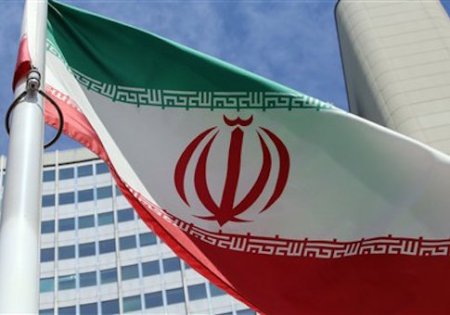
An Iranian flag flies in front of the building where closed-door nuclear talks take place in Vienna, Austria, Wednesday, July 2, 2014. (AP Photo/Ronald Zak)

An Iranian flag flies in front of the building where closed-door nuclear talks take place in Vienna, Austria, Wednesday, July 2, 2014. (AP Photo/Ronald Zak)

A group of nearly 100 prominent Iranian dissidents is demanding that Congress launch investigations into clandestine efforts by the Islamic Republic to influence U.S. policy using a network of lobbyists and propaganda pieces placed in Voice of America’s Persian service, according to a letter sent to leading lawmakers and obtained by the Washington Free Beacon.

The group of dissidents, composed of prominent Iranian voices that oppose the hardline regime in Tehran, says that Congress is not doing enough to expose the Iranian regime’s lobbying efforts in D.C. and propaganda network, which is said to include some at VOA Persia.

Iranian-American groups claiming to represent American interests are said to be carrying water for the Islamic regime inside the White House and on Capitol Hill, according to these dissident voices.

The letter cites VOA’s Persian service as a source of pro-Iran corruption. The Free Beacon has reported multiple times on claims that VOA has been infiltrated by Iran regime loyalists who seek to spin coverage in a favorable way for Tehran. In one instance, an Iranian dissident was barred from appearing on VOA Persia for voicing critical opinions about the regime.

The letter comes at a time when the Trump administration is seeking a tougher approach on Iran for its repeated violations of international accords governing the nuclear deal. The dissidents maintain that U.S. officials have been too soft on the regime and ignored its surreptitious efforts to make American diplomacy more generous to Tehran.

“We write to request a congressional hearing on the efforts of Tehran’s theocratic regime to influence U.S. policy and public diplomacy toward Iran,” the dissidents write to Sen. Bob Corker (R., Tenn.) and Rep. Ed Royce (R., Calif.), the heads of Congress’ foreign affair committees, according to copies of the letter obtained by the Free Beacon.

“We ask that you launch an investigation into any and all lobbying activities of Iranian-American groups, which ostensibly promote the interests of our community but whose real goal is to undermine long-term U.S. national security interests in Iran and its neighborhood,” the dissidents write.

Organizations such as the National Iranian American Council, or NIAC, which played a key role in championing the Iran nuclear agreement and worked closely with the Obama administration, have long operated under a cloud of suspicion. Dissident voices maintain that NIAC in particular serves as a mouthpiece for Iran’s regime in the United States.

The group of dissidents—which includes foreign policy experts, university professors, interfaith leaders, prominent real estate developers, and human rights activists, among others—also requested that Congress shine a light on VOA Persia’s activities.

“We also ask that you launch an inquiry into the Voice of America’s Persian service, whose bloated budget is the largest of all language services under the VOA,” they write.

“There have been numerous instances of editorials by the VOA’s Persian service that have been lenient or favorable to Iran’s clerical despots. We consider this to be totally unacceptable and demoralizing for pro-democracy Iranians who watch these broadcasts.”

Such hearings would compliment past efforts by Congress to investigate corruption at VOA, including what many describe as its pro-Tehran bent.

Peter Kohanloo, a chief architect of the letter and president of the Iranian American Majority, told the Free Beacon that the missive represents an unprecedented effort by Iranian dissidents to expose the Iranian regime’s “influence-peddling agenda.”

“Never before have so many Iranian dissidents of different political persuasions and backgrounds come together to speak with one unified voice,” Kohanloo told the Free Beacon. “This historic letter is a clear and unmistakable message to Tehran that we will no longer tolerate their influence-peddling agenda, which divides our community and demoralizes pro-democracy activists in Iran.”

The group of dissidents informed lawmakers that they are all willing to testify publicly at congressional hearings on both of these matters.