Posted tagged ‘Trump agenda’

Sarsour, Jihad and Terrorism

July 7, 2017

Sarsour, Jihad and Terrorism, The Point (Front Page Magazine), Daniel Greenfield,

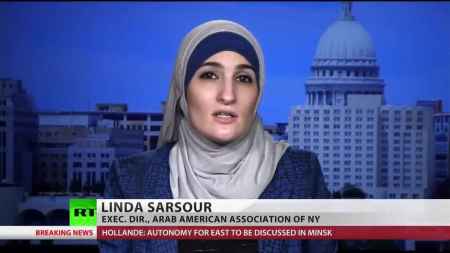
Linda Sarsour, the left’s favorite Muslim organizer, with a history of promoting violence against Jews and ex-Muslims, gave a Jihadist speech at ISNA.

Literally.

“I hope that we when we stand up to those who oppress our communities that Allah accepts from us that as a form of jihad. That we are struggling against tyrants and rulers not only abroad in the Middle East or in the other side of the world, but here in these United States of America where you have fascists and white supremacists and Islamophobes reigning in the White House.”

The very predictable media defense is that Sarsour was speaking of political change, not terrorism. This is the same lie that turned the Arab Spring into a killing field.

Sarsour was speaking in the typical language of the Muslim Brotherhood. Its notion of political change embraces a spectrum that includes both violent and non-violent action. It’s primary allegiance is Islamic Supremacism.

That is the familiar doctrine that Sarsour laid out. Jihad for Allah against the enemies of Islam. The tactics are shaped by the context, but the goal of Jihad never changes.

Trump’s Warsaw Speech Evoked Reagan’s Cold War Rhetoric, Not The Alt-Right’s

July 7, 2017

Trump’s Warsaw Speech Evoked Reagan’s Cold War Rhetoric, Not The Alt-Right’s, The Federalist, July 7, 2017

President Trump gave a stirring defense of western civilization on Thursday morning in Warsaw ahead of the G-20 summit in Germany. In a remarkably candid speech about the threats facing the West, Trump praised Poland for resisting communist and Nazi efforts “to demolish freedom, your faith, your laws, your history, your identity—indeed the very essence of your culture and your humanity.”

Speaking at Krasinski Square in front of the iconic Warsaw Uprising monument marking Poland’s 1944 resistance to Nazi occupation, Trump proclaimed, somewhat dramatically, “Just as Poland could not be broken, I declare today for the world to hear that the West will never, ever be broken. Our values will prevail, our people will thrive, and our civilization will triumph.”

The world hasn’t heard such language from a U.S. president since Ronald Reagan inveighed against the Soviet Union during the Cold War. But apparently it’s racist and fascist these days to talk about resisting tyranny and defending western values—or even to talk about western civilization as such. The Guardian worried about Trump’s use of the word “civilization,” noting that he used it ten times, and claiming the speech “pits western world against barbarians at the gates” and calls for “a clash of civilisations.”

Vox blurted out the headline, “Trump’s speech in Poland sounded like an alt-right manifesto,” calling it “a speech that often resorted to rhetorical conceits typically used by the European and American alt-right. It sounded, at times, not just like the populists of the present but the populists of the past.” The New Republic’s Jeet Heer tweeted that Trump’s speech, “is evidence of how alt right still has a voice in White House” and later posted a commentary saying it “redefined the West in nativist terms.”

Even The Atlantic‘s James Fallows compared Trump’s rhetoric to the Nazi propaganda film, “Triumph of the Will,” saying Trump “represents our country as just another tribe.”

JFK Also Praised Poland’s History and Culture

These reactions belie a worldview that rejects entirely the very idea of “western civilization,” and insists that appeals to Enlightenment principles and cultural cohesion are inherently racist and fascist. And there’s a reason for that. As my colleague David Harsanyi noted, “many of the same people who believe Western values are alt-right dog-whistles want you to adopt a new set of values that have nothing to do with the founding principles and everything to do with their policy preferences.”

But Trump was espousing what used to be considered a fairly standard understanding of western values. “We treasure the rule of law and protect the right to free speech and free expression,” he said. “We empower women as pillars of our society and of our success. We put faith and family, not government and bureaucracy, at the center of our lives… And above all, we value the dignity of every human life, protect the rights of every person and share the hope of every soul to live in freedom.”

Progressives today reject almost all of this—not because Trump is invoking the rhetoric of the alt-right, but because they have moved so far to the left. In fact, far from echoing the blood-and-soil language of the alt-right, Trump’s rhetoric here sounds a lot like the rhetoric deployed in speeches about Poland by Reagan or John F. Kennedy during the Cold War.

Back then, Poland was under communist control, its government a puppet of the Soviet Union and its people prisoners of a tyrannical regime. In a 1960 speech to the Polish-American Congress, then-senator Kennedy recalled his time in Poland in 1939, and Poland’s history fighting the Nazis during World War Two: “After the war, I visited the Polish cemetery in Italy. Some of you who have been there may recall that at the cemetery are written the words, ‘These Polish soldiers for your freedom and theirs have given their bodies to the soil of Italy, their hearts to Poland, and their souls to God.’”

He went on to address the oppression of Poland by the Soviet Union, saying, “we must never… recognize the Soviet domination of eastern Europe as permanent. We must never do it. Poland’s claim to independence and liberty is not based on sentiment or politics. It is rooted in history, and it is to history that we must address ourselves.”

Kennedy called not only for a defensive military buildup so that the Russians would know “that the route of military force can no longer be open to them,” but also for increasing cultural ties to Poland, saying the United States must “strive to restore the traditional identification which Poland has had with the Western European community, which goes back into history. It is tied by culture ties. Poland has always looked to the West, never to the East.” The Polish people, he said, “have not accepted the idea that their culture, their religious heritage, their traditions, can be destroyed by domination by a foreign power.”

Reagan Invoked God, Heritage, and History

Two decades later, Poland was still under communist rule, its government still a puppet of the Soviet Union, but things had begun to change. When Reagan took office in 1981, the Solidarity movement in Poland was building steam. Led by future Polish president Lech Wałęsa and supported by members of the Catholic Church and the anti-Soviet left, Solidarity organized as a free trade union in opposition to communist rule.

By the end of 1981, Poland’s authoritarian government would declare martial law in an effort to crush Solidarity. Reagan gave a speech on December 23 addressing the situation, and praised the Polish people for showing their resistance by placing lit candles in their windows. He said the exiled former Polish ambassador, Romuald Spasowski, had requested that on Christmas Eve a lighted candle burn in the White House window as a “small but certain beacon of our solidarity with the Polish people,” and urged all Americans to do the same that Christmas Eve, invoking God, heritage, and history:

Once, earlier in this century, an evil influence threatened that the lights were going out all over the world. Let the light of millions of candles in American homes give notice that the light of freedom is not going to be extinguished. We are blessed with a freedom and abundance denied to so many. Let those candles remind us that these blessings bring with them a solid obligation, an obligation to the God who guides us, an obligation to the heritage of liberty and dignity handed down to us by our forefathers and an obligation to the children of the world, whose future will be shaped by the way we live our lives today.

Six months later, in his famous Westminster speech to members of the British Parliament, Reagan cast the Soviet Union in the same stark terms that Trump today reserves for ISIS and North Korea. He warned of “totalitarian forces in the world who seek subversion and conflict around the globe to further their barbarous assault on the human spirit. What, then, is our course? Must civilization perish in a hail of fiery atoms? Must freedom wither in a quiet, deadening accommodation with totalitarian evil?”

Reagan’s answer was an emphatic “no.” He again spoke of about Poland’s role in western civilization and its cultural lineage, saying, “Poland is at the center of European civilization. It has contributed mightily to that civilization. It is doing so today by being magnificently unreconciled to oppression.”

He closed that speech with language that would surely scandalize the progressives at Vox and The New Republic, calling the contest against totalitarianism “a crusade for freedom that will engage the faith and fortitude of the next generation. For the sake of peace and justice, let us move toward a world in which all people are at last free to determine their own destiny.”

Europe’s Political Elites Are a Threat to The West

Trump’s Warsaw speech should be understood in this historical context. The president rightly sees the contest between radical Islamic terrorism and the West as a contest between totalitarianism and freedom. He also rightly sees the growing tension between the European Union and the citizenry of European nations as a contest between authoritarian bureaucracy and representative, limited government. His remarks Thursday were aimed at ISIS, but also at a European elite that doesn’t have the inclination or will to defend its borders or cultural heritage.

That’s why Trump said: “The fundamental question of our time is whether the West has the will to survive. Do we have the confidence in our values to defend them at any cost? Do we have enough respect for our citizens to protect our borders? Do we have the desire and the courage to preserve our civilization in the face of those who would subvert and destroy it?”

Trump isn’t just referring to ISIS when he alludes to those who would destroy western civilization. He’s also pointing to European political elites who undermine their own societies by cultural relativism and its resulting slavish and destructive adherence to open borders and mass migration.

Reagan and JFK understood that communism sought ultimately to destroy western civilization and replace it with something else. That’s why they often spoke of civilization and cultural heritage during the Cold War. Trump is saying something similar about the political elites who now rule Europe, and he’s not wrong. That mainstream media outlets like Vox and The Atlantic are scandalized by this is evidence not of Trump’s radicalism, but of their own.

John is a senior correspondent for The Federalist. Follow him on Twitter.

Obama, pre-July 4th, rips Trump-fueled ‘nationalism’

July 3, 2017

Obama, pre-July 4th, rips Trump-fueled ‘nationalism’, Washington TimesCheryl K. Chumley, July 3, 2017

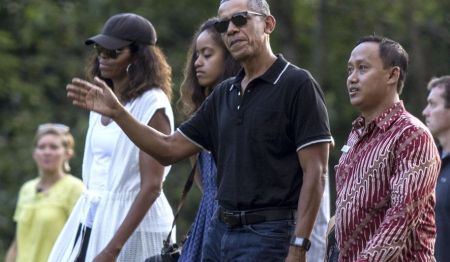
Former U.S. President Barack Obama, center, waves as he walks with his wife Michelle, left, and daughter Malia, rear, upon arrival for a tour at Borobudur Temple in Magelang, Central Java, Indonesia, Wednesday, June 28, 2017. Obama and his family

To Obama, failing to fight climate change is tantamount to racism — not to mention silly sovereign politicking.

Trump’s “Make America Great Again.” Obama’s all about the world view. Trump’s “America First,” and all the other countries, second. Obama? Reverse that. Throw in some hefty taxes and spread the wealth — and then and only then, does America make the list.

************************

Barack Obama, never one to shy from ripping a Republican in the public eye, took occasion from his childhood hometown Jakarta to tear into President Donald Trump for — at root — having too much patriotism.

Call it Fourth of July celebrations, Obama style. America waves Ol’ Glory; Obama beats the global drum.

“The world is at a crossroads,” Obama said, to the Fourth Congress of the Indonesian Diaspora, The Hill reported.

 The overall theme of his message?

Countries ought not pursue sovereign national interests at the risk of the rest of the world. He was speaking largely of the Paris climate accord, and the need for global powers to embrace it.

But he was focused on those who stood opposed to joining it.

Hmm, wonder of whom he spoke? Could it be Trump, who’s flatly refused to jump on the Paris accord train?

To Obama, failing to fight climate change is tantamount to racism — not to mention silly sovereign politicking.

“We start seeing a rise in sectarian politics, we start seeing a rise in an aggressive kind of nationalism, we start seeing both in developed and developing countries an increased resentment about minority groups and the bad treatment of people who don’t look like us or practice the same faith as us,” he said, The Hill reported.

Of course, Obama didn’t use Trump’s name.

But just in case you missed the subtle hint, Obama also noted “the temporary absence of American leadership” on combating climate change.

The change in leadership style, post-Obama, present Trump, couldn’t be more different. Trump’s “Make America Great Again.” Obama’s all about the world view. Trump’s “America First,” and all the other countries, second. Obama? Reverse that. Throw in some hefty taxes and spread the wealth — and then and only then, does America make the list.

Thankfully, it’s Trump who won last November — not the Obama-light candidate of Hillary Clinton. That alone, heading into July Fourth celebrations, is fireworks worthy. Patriotic Americans have at least four years of being considered important, in the eyes of the White House — not just tools to advance a global agenda.

Congressman Warns of Terrorist Attacks If Trump Signs Sanctuary City Bill

June 30, 2017

Congressman Warns of Terrorist Attacks If Trump Signs Sanctuary City Bill, PJ MediaNicholas Ballasy, June 29, 2017

Homeland Security Secretary John Kelly speaks at House Speaker Paul Ryan’s (R-Wis.) weekly news conference in the Capitol on June 29, 2017. (Bill Clark/CQ Roll Call via AP Images)

WASHINGTON – Rep. Adriano Espaillat (D-N.Y.) warned that the sanctuary city bill passed in the House of Representatives could cause a terrorist attack to occur in New York City.

Espaillat joined other members of the Congressional Hispanic Caucus (CHC) to express opposition to the “No Sanctuary for Criminals Act” (H.R. 3003), which would crack down on localities that do not fully cooperate with Immigration and Customs Enforcement (ICE), and “Kate’s Law” (H.R. 3004), which would penalize migrants who attempt to re-enter the U.S. illegally after being deported with up to 20 years in prison. Both bills passed the House today.

According to the White House, H.R. 3003 would “restrict” the “eligibility to receive certain Department of Justice or Department of Homeland Security grants” for cities and states “determined to be in violation of federal law.”

Espaillat predicted that H.R. 3003 would have a “chilling effect” in local communities if it became law.

“People will go into hiding. People will not come forward to report crimes, and if we begin to deny funding to cities across the United States, a city like New York, who experienced 9/11, which has been the safest biggest city in the country since 9/11 because of the federal funding that we got to combat terrorism, providing for training, equipment, overtime pay for law enforcement, we will be allowing terrorists to come in and attack us again,” Espaillat said at a press conference today on Capitol Hill.

“So this is a travesty. This is a lie. We’ve been hijacked and bamboozled by Donald Trump and we should all stand up against this,” he added.

Espaillat described sanctuary cities as places that allow families to stay together regardless of immigration status without “fear” rather than places that harbor illegal immigrants with criminal records.

“It is a safety net for people that are part of our family – they take care of our children, they wash our dishes, they take care of our elderly, they pick our crops,” he said.

Espaillat argued that both bills are an example of the GOP “misguiding” the nation.

“I’m not saying all of his followers are racist, but all of the racists in the country follow him and they have peddled this erroneous vision that immigrants are criminals,” he said. “We all oppose any violent criminals not being arrested. We want them to be arrested and do their time in jail and go back to wherever they came from.”

Rep. Nanette Barragán (D-Calif.) echoed Espaillat’s comments, arguing that H.R. 3003 would put Americans in danger by stripping federal funding from sanctuary cities like Los Angeles.

“You’re talking about taking away funding from cities that rely on these funds to protect our country from terrorism, and you think about incidents like 9/11,” she said.

“These big cities, like mine in Los Angeles, and New York are targets. Imagine taking away their funding because they don’t want to become immigration officers and what that does – that puts us in a lot more harm than what we are looking at,” she added.

Rep. Luis Gutierrez (D-Ill.) argued that “Kate’s Law” would have done “absolutely nothing” to prevent the death of Kate Steinle; the man accused of shooting her, who is still awaiting trial, was living illegally in San Francisco after multiple previous deportations. A few months before the shooting, the San Francisco Police Department had released her suspected killer, Juan Francisco Lopez-Sanchez, despite a request from ICE to keep him in custody for re-entering the country illegally.

Gutierrez said he opposes “Kate’s Law” because it would punish migrants who try to cross the border illegally to reunite with family members.

“Hundreds of thousands of moms and dads have been deported and separated from their American citizen children, and now when they come back to their American citizen children and come back after being deported, guess what this bill does? It says send them to jail for 20 years for trying to come back and raise their children,” he said.

Gutierrez also said he advised an 11-year-old student not to open the front door of his family’s home if an ICE officer knocks.

“Last Monday, I was at Nixon Elementary School. This little boy, a fifth-grader, 11 years old, asked, he said, ‘Congressman, if immigration knocks on my door, do I have to open the door because my Dad doesn’t have papers?’ I told him, ‘no, you don’t have to open up the door unless he has a warrant.’ And then I got into a conversation with 11-year-old fifth-graders about what constitutes a warrant – that’s where we’re at in America,” he said at the Hispanic Caucus press conference.

“And what do they want to do today? They want to make sure that my Chicago police, the L.A. police, every police and every jurisdiction that says we don’t want to be immigration agents and we don’t want to be knocking on those doors of fifth-graders across this country to take away their moms and dads and make them into enforcement agents, and it’s wrong,” he added.

Rep. Joaquin Castro (R-Texas) said both bills are “anti-immigrant” measures. He speculated that Republicans are pushing the legislation through Congress to distract from the healthcare and tax reform debates.

“They’ve failed to do healthcare. They’ve failed to do tax reform,” he said.

Nikki Haley’s Comments on Iran Highlight Russian-Related Complications

June 29, 2017

Nikki Haley’s Comments on Iran Highlight Russian-Related Complications, Iran News Update, Edward Carney, June 29, 2017

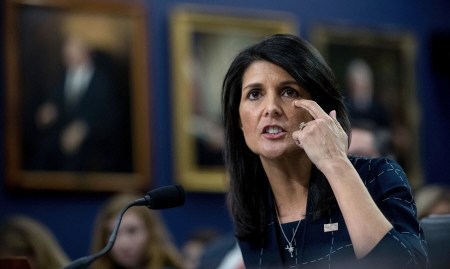
On Tuesday, Nikki Haley, the US ambassador to the United Nations delivered testimony to the House panel on foreign operations, a subcommittee of the Appropriations Committee in the US House of Representatives. In that testimony, Haley addressed multiple issues relating to the Islamic Republic of Iran, thereby reasserting the Trump administration’s assertive policies toward the Iranian regime. By most accounts those policies are still emerging, but they have already come to include purposive outreach to other adversaries of the Islamic Republic and a program of expanded sanctions on matters such as Iran’s ballistic missile program.

However, those efforts to confront and contain the Islamic Republic are arguably complicated by other aspects of the Trump administration’s policy commitments, including a focus on domestic issues and an effort to improve relations between the US and Russia, which boasts close relations with Iran in the areas of trade and military cooperation, especially as it relates to the Syrian Civil War.

While the US supports moderate rebel groups fighting against the dictatorship of Bashar al-Assad, the Iranians and Russians have been credited with turning the war in favor of Assad. Various Shiite militias are currently operating as proxies for Iran in that war, and the Iranian Revolutionary Guard Corps is increasingly playing a direct role in the conflict. Meanwhile, Russia has been providing air support for pro-Assad ground operations since 2015.

Western commentators, including officials in the Trump administration, have variously accused Russia and Iran of ignoring or actively facilitating human rights abuses by the Assad regime, including an April chemical weapons attack that killed at least 80 people in a rebel-controlled civilian area.

As the Associated Press points out, Ambassador Haley’s comments to the House panel came shortly after the White House had issued a warning to Syria regarding alleged preparations for another such chemical attack. The article specified that Pentagon officials had confirmed the intelligence underlying that warning, involving particular movements at the same Syrian air base that had been used as the staging area for the previous chemical attack on Khan Sheikhoun.

White House Press Secretary Sean Spicer said of Assad that “he and his military will pay a heavy price” if they follow through with apparent plans for another “mass murder attack using chemical weapons.” But the AP quoted Haley as saying that the administration’s remarks were not intended only for Assad, but also for Russia and Iran. Both of the Syrian allies joined in denying Assad’s responsibility for the attacks, with some officials insisting that the chemical weapons had originated in a rebel warehouse at the site of a conventional military airstrike.

The dispute over this issue and the subsequent US cruise missile strike on Shayrat air base can be seen as early examples of the escalation between Iranian allies and adversaries which is still going on to this day. In fact, Haley’s effort to fold Russia and Iran into a warning directed more explicitly against Syria is reminiscent of an incident earlier in June wherein a member of Iran’s Revolutionary Guard said that a ballistic missile strike on eastern Syria had been intended largely as a warning to the US and Saudi Arabia.

Those two traditional adversaries of the Islamic Republic have been expanding relations under the Trump administration, sometimes with explicit reference to shared anxieties over expanding Iranian influence and meddling in the broader Middle East. President Trump’s visit to Riyadh in May for an Arab-US summit coincided with the signing of trade agreements that included 110 billion dollars in arms sales to the Arab Kingdom.

But at the same time that the White House is openly siding with Saudi Arabia and its regional allies against the Iranian regime, it does not appear to be giving up on the prospect of improved relations with Russia. In fact, the Western strategy for a political solution to the Syrian Civil War seems to presently involve the expectation that Russia can be encouraged to rein in the Islamic Republic and prevent it from further sabotaging ceasefire agreements.

Recent developments have cast doubt upon the practicality of this strategy however. As the US has taken a more direct role in defending rebel groups, even resorting to the shoot-down of at least two military controlled drones and a Syrian warplane, Russia has responded by threatening to target US aircraft and to halt the use of a hotline intended to prevent mid-air collisions between the multiple powers operating in the skies over Syria.

Haley’s comments on Tuesday were indicative of a roughly matching increase in American criticism of Russia. And this criticism was not limited to the issue of chemical weapons. Haley also explained that Russia’s position on the UN Security Council allowed it to stymie US efforts to sanctions Iran and hold it to account for ongoing misbehavior in matters including the development of the Iranian nuclear program.

“[The Iranians are] going to continue their nuclear capabilities and we just gave them a lot of money to do it with,” Haley said, referring to the 2015 nuclear agreement that President Trump has described as “the worst deal ever negotiated.” She went on to highlight concerns about Iran’s sponsorship of terrorism, suggesting that nuclear weapons could find their way into the hands of terrorist groups at some point in the future, and that Russia would effectively prevent the US and its allies from doing anything to stop this.

“Yes, we would love to sanction Iran; and, yes we will continue to be loud about it; and, yes, Russia will veto it,” Haley said, according to the Washington Examiner.

But this is not to say that the Trump administration has positively brought an end to its strategy of attempting to improve relations with Russia. In fact, various reports suggest that this endeavor is even standing in the way of congressional legislation aimed at increasing national-level sanctions on both Iran and Russia. The Countering Iran’s Destabilizing Activities Act passed the Senate two weeks ago by a margin of 98 to 2, but it was subsequently stalled in the House on procedural grounds, leading Democrats to argue that the House Republican leadership was trying to protect the president’s Russian agenda.

The prospects for resolution appeared to grow dimmer on Tuesday when the Washington Post reported that energy lobbyists were urging lawmakers to reevaluate the bill on the grounds that its restrictions on doing business with Russian companies could have a punishing effect on American firms and foreign firms doing business in the US. These objections could bolster the prospects of the House leadership sending the bill to various committees for review and markup – a process that could delay a final vote by months.

As it concerns Iran, the bill would include sanctions on Iran’s ballistic missile activities and also extend all terrorism-related sanctions to the Revolutionary Guard Corps, for which Trump has urged designation as a foreign terrorist organization. This position has not changed, and it seems that neither has the Trump administration’s hardline approach to Iran policy. Some have suggested that the emerging policy is pointing in the direction of regime change, though this has not become a declared position as yet.

The Washington Examiner pointed out that one member of the House panel on foreign operations, Republican Representative Hal Rogers, had directly raised the prospect of regime change on Tuesday, asking Nikki Haley whether it is an option. The ambassador’s only response was “I don’t know.”

This coming Saturday, the National Council of Resistance of Iran will hold its annual Free Iran rally, which will include explicit calls for regime change driven by a domestic opposition movement within the Islamic Republic. The event is expected to be attended by tens of thousands of Iranian expatriates, plus hundreds of policymakers and experts from the US, Europe, and throughout the world. Notably, these dignitaries will include figures with close ties to the Trump administration, such as John Bolton, who served the second Bush administration in the position now occupied by Haley.

Trump to start implementing travel ban on Thursday

June 28, 2017

Trump to start implementing travel ban on Thursday, Washington ExaminerKelly Cohen, June 28, 2017

The Supreme Court also announced it will hear oral arguments on the case in its October term. (AP Photo/Ted S. Warren, file)

The Department of Homeland of Security will begin partially implementing President Trump’s immigration executive order on Thursday, days after the Supreme Court reversed two lower court rulings that had completely blocked implementation.

DHS spokesman David Lapan told the Washington Examiner implementation will “begin tomorrow and we’ll release additional information then.”

Lapan added that DHS will continue to “work with the Departments of State and Justice on the way forward for implementation of the executive order based on the Supreme Court’s ruling.”

The Supreme Court on Monday lifted most of the lower-court injunctions against Trump’s executive order, which will temporarily ban travel to the United States from six Muslim-majority countries for foreign nationals who lack any “bona fide relationship with any person or entity in the United States.”

The Supreme Court also announced it will hear oral arguments on the case in its October term.

With that decision, the court disregarded lower court rulings that said the order was aimed at excluding people because of their religion, and that the White House didn’t offer enough justification for the order.

Three Supreme Court justices also went further by arguing that the court should have immediately allowed the entire order to take effect.

“I agree with the court that the preliminary injunctions entered in these cases should be stayed, although I would stay them in full,” Justice Clarence Thomas wrote in a dissent that was joined by Justices Samuel Alito and Neil Gorsuch. “The decision whether to stay the injunctions is committed to our discretion … but our discretion must be ‘guided by sound legal principles’.”

Spotlight: China, U.S. reach consensus at high-level security dialogue

June 24, 2017

Spotlight: China, U.S. reach consensus at high-level security dialogue, XinhuaNet, June 24, 2017

(The words sound friendly, but what do we get at what cost? — DM)

Chinese State Councilor Yang Jiechi (1st R) co-chairs a diplomatic and security dialogue with U.S. Secretary of State Rex Tillerson (1st L) and Secretary of Defense James Mattis (2nd L) as Fang Fenghui (2nd R), a member of China’s Central Military Commission (CMC) and chief of the CMC Joint Staff Department, also participates in the dialogue in Washington D.C., the United States, on June 21, 2017. China and the United States began their first diplomatic and security dialogue on Wednesday at the U.S. State Department in Washington D.C. (Xinhua/Yin bogu)

At the dialogue, China the United States agreed to work closely on the Korean Peninsula’s nuclear issue.

Both countries reaffirmed their commitment to achieving the goal of “complete, verifiable and irreversible” denuclearization on the Peninsula.

*********************

WASHINGTON, June 23 (Xinhua) — China and the United States reached an important consensus on the development of bilateral relations and security issues at a high-level dialogue held Wednesday in the U.S. capital of Washington D.C.

The First Round of China-U.S. Diplomatic and Security Dialogue, which was described by both sides as “constructive” and “fruitful,” represents a major step in implementing the consensus reached by Chinese President Xi Jinping and his U.S. counterpart Donald Trump during their meeting in Florida in April.

Looking ahead, the two sides pledged to expand mutually-beneficial cooperation and manage differences on the basis of mutual respect, all in a bid to promote the steady development of China-U.S. relations in the long term.

FREQUENT DIALOGUES

Following Wednesday’s dialogue, U.S. Secretary of State Rex Tillerson said such talks “provide an opportunity to consider how we’re going to engage and how we’re going to live with one another over the next 40 years.

“The action items we have agreed upon today have set a foundation for additional areas of cooperation and we look forward to our next interaction at this level and between our two presidents,” said the top U.S. diplomat.

Emphasizing the importance of high-level exchanges, China and the United States expressed their willingness to achieve a positive outcome for the Hamburg meeting between the two Presidents in July and Trump’s state visit to China later this year.

Meeting with Chinese State Councilor Yang Jiechi at the White House on Thursday, Trump said he looked forward to meeting with Xi in Hamburg and visiting China. He also hoped that these high-level interactions will further promote the development of U.S.-China relations.

PRODUCTIVE MILITARY RELATIONSHIP

Fang Fenghui, a member of China’s Central Military Commission (CMC) and chief of the CMC Joint Staff Department, participated in the dialogue co-chaired by Yang, Tillerson and U.S. Secretary of Defense James Mattis.

At the dialogue, China and the United States recognized that their military-to-military relationship is an important component in the bilateral ties. The two sides agreed that the relationship between the militaries of the two powers should be “constructive, pragmatic, and effective,” according to a statement released Friday.

China and the United States are committed to implementing the annual military exchange program and enhancing high-level engagements, starting with the visits between the two defense ministers and the visit of the Chairman of the U.S. Joint Chiefs of Staff to China as soon as possible.

The two sides also “reaffirm the importance of building mutual understanding, and of reducing the risk of miscalculation between our two militaries,” said the statement.

MAINTAINING COORDINATION ON KOREAN PENINSULAR ISSUE

At the dialogue, China the United States agreed to work closely on the Korean Peninsula’s nuclear issue.

Both countries reaffirmed their commitment to achieving the goal of “complete, verifiable and irreversible” denuclearization on the Peninsula.

“The two sides are ready to continue their efforts to this end, including by fully and strictly implementing relevant United Nations Security Council resolutions, and by promoting relevant dialogue and negotiation,” said the statement.

The two countries also reaffirmed their commitment to maintaining peace and stability on the Peninsula, according to the statement.

Trump signs VA reform bill, following through on campaign promise

June 23, 2017

Trump signs VA reform bill, following through on campaign promise, Fox NewsBarnini Chakraborty, June 23, 2017

President Trump on Friday signed a bill that would protect whistleblowers while making it easier to fire employees at the Department of Veterans Affairs.

The Department of Veterans Affairs Accountability and Whistleblower Protection Act passed by Congress this week streamlines the process to remove, demote, or suspend VA employees for poor performance or misconduct. In addition, it authorizes the VA secretary to recoup any bonuses awarded to employees who have acted improperly.

Under the new law, protections for whistleblowers will be expanded and the VA will be prevented from dismissing an employee who has an open complaint against the department.

The bill helped Trump follow through on a 2016 campaign promise.

The law marks the second time Congress has tried to change the disciplinary process at the VA. In 2014, the Choice Act was passed and tried to cut senior executives’ rights to appeal discipline to the Merit Systems Protection Board. However, a court ruled that it was unconstitutional and violated the Constitution’s appointments clause.

Ahead of the signing, Concerned Veterans for America, a conservative advocacy group, hailed the legislation as a positive step forward in a “new era of accountability, customer focus, and integrity at the department.”

Putin Wins Big

June 23, 2017

Putin Wins Big, Jewish Media Resources, Jonathan Rosenblum, June 23, 2017

(Putin is winning because the national focus is on non-events. Hence, our faith in the electoral system has been damaged and the ability of the Trump administration to focus on the agenda Trump was elected to pursue has been limited. The Congress, rather than focus on legislating, is preoccupied with investigations of non-events. That’s good for America’s enemies and bad for America. President Trump’s successes in focusing on his agenda despite the many distractions speak well of him. — DM)

Smith makes an insightful distinction between “consolations, vicious self-sung lullabies” and “conspiracy theories.” Examples of the former would be: Hillary lost because the Russians hacked the election; our children died because the Jews poisoned the wells.

But such “consolations,” as vicious as they may be, only become full-blown conspiracy theories when weaponized through the mass media for political use. The Protocols of the Elders of Zion would be the classic example of such a conspiracy theory. And, Smith points out, Hillary Clinton’s “deplorables” do not have the platforms “to proliferate weaponized narratives capable of doing real damage to our polity – the elites do.” And those elites — the press, the intelligence community, political parties – have been used to legitimize a conspiracy theory.

James Kirchik, another anti-Trump pundit (as well as a brilliant analyst on many issues) laments the way the “confirmation bias” has resulted in well-meaning, liberal anti-Trump journalists reporting stories that they want to be true and are emotionally true for them – e.g., stories of threatened or actual violence against minorities – but are factually false.

******************************

It is certain that Russia launched a massive hacking campaign to undermine the U.S. electoral process in 2016. That is a major issue that needs to be thoroughly investigated, and steps taken so that it does not recur.

Though the Russian involvement in the 2016 election targeted both presidential candidates at various times, it likely damaged Hillary Clinton’s campaign more. Confirmation in the emails hacked from the Democratic National Committee that the DNC had actively favored Clinton over her chief rival for the Democratic nomination, Senator Bernie Sanders, infuriated Sanders supporters. Conceivably enough of those supporters could have decided not to vote for Clinton based on those emails to have made a difference in the three crucial battleground states – Pennsylvania, Michigan, and Wisconsin.

Thus far, however, the primary focus on the Russian hacking has been with respect to the far-fetched claim that the Russians colluded with the Trump campaign fashion in some fashion The obsessive focus on that issue has turned the hacking into a major victory for Vladimir Putin by introducing an unparalleled degree of rancor and paralysis into the American political system.

James Kirchik writing in the May 3 American Interest (“Who Killed the Liberal World Order”), describes how at last September’s G-20 summit in Hangzhou, China, then President Obama confronted Russian President Vladimir Putin about the Russian hacking of the DNC, and told him to “cut it out” or “face serious consequences.” In October, according to Bloomberg News, the White House used a cyber version of the “red phone” to convey to the Kremlin detailed evidence of Russian hacking of voter data banks in numerous states. On both occasions, Putin, who had long since taken Obama’s measure, did nothing in response.

WHATEVER THE REASON Putin decided to interfere with the 2016 election, it was not because he feared Obama or Obama’s legacy-bearer, former Secretary of State Clinton. Starting with Clinton’s declared “reset” of relations with Russia, shortly after the Obama administration entered office in 2009, until Obama issued his warning at Hangzhou, the United States had repeatedly stood down in every possible confrontation with Russia.

The 2009 reset itself took place in the wake of the assassinations by Russian intelligence agents of Alexander Livinenko in London, where the former Russian intelligence operative he had been granted political asylum, and of Russia’s leading investigative journalist Anna Politkovskaya. Russia was also busy hardening control of areas of Georgia occupied by Russian troops. As part of the reset, the Obama administration abandoned plans to provide Poland and Czechoslovakia with anti-missile defenses.

During the 2012 presidential debates, Obama mocked his Republican opponent Mitt Romney for listing Russia as the United States’ primary international foe. “The 80s called. They want their foreign policy back,” teased Obama. And even prior to the 2012 campaign, Obama told Putin’s sidekick Dmitry Medvedev that he’d be able to be “more flexible” after the campaign, and asked for a little breathing room from Russia.

All Obama’s shows of good will, however, went unreciprocated by Putin. In 2013, Putin granted asylum to Edward Snowden, the former CIA employee who had exposed the U.S. National Security Agency’s surveillance methods. The same year Putin cracked down on foreign-funded NGO’s, and invaded the Ukraine. Obama refused to supply the Ukrainians with defensive weapons, as the United States had committed to do in the Budapest Memorandum, drafted when the former Soviet republics gave up their nuclear stockpiles.

In 2015, Soviet forces entered Syria in force to shore up the Assad regime, fairly daring the United States to challenge them. Previously, Putin had humiliated Obama by offering him a lifeline, when the latter refused to enforce his own redline against Assad’s deployment of chemical weapons.

PUTIN HAD reasons to prefer Trump to Clinton. He harbors a paranoid belief that Hillary orchestrated protests against him in 2011. And, writes Kirchik in the Los Angeles Times, he appreciated that Trump’s ignorant outbursts made “American politics – and by extension America – look like a foolish country.”

Putin may also have thought that Trump’s neo-Jacksonian, quasi-isolationist campaign talk would serve Russia’s interest in carving out a sphere of interest in its near abroad. But, as Kirchik notes in his American Interest piece, Obama’s “interconnected world,” without American power to back it up, had already resulted in a reduction of American influence and allowed Putin free rein in Russia’s near abroad.

The Russians were as shocked as everyone else, however, by Trump’s victory. Their goal was not so much to defeat Clinton, as to render it difficult for her (or Trump) to govern and to thereby “weaken the world’s last superpower,” writes Professor Mark Galeotti of the Institute of International Relations Prague in Tablet. And their means for doing so was to reduce America’s democratic legitimacy by calling the election results into question and reducing the scope for compromise and consensus in the American political system.

Or as veteran Moscow correspondent David Satter argued in the June 12 Wall Street Journal, Putin did not so much support Donald Trump, as he sought American political paralysis. The differences between Trump and Clinton were simply not that significant in his view.

Putin’s method is to sow chaos, to light a hundred brushfires and see which ones turn into full-fledged forest fires. “Putin is not a chess player,” writes Galeotti. “He and his people are improvisers and opportunists. They try to create multiple potential points of leverage, never knowing which will prove useful or not.”

One of those prongs was the so-called “Trump dossier, compiled by former British intelligence official Christopher Steele based on information “sold” to him by Russian intelligence officials. The document bears all the marks of a classic Russian disinformation campaign. “The kind of gossip that fills the Trump Dossier, writes Galeotti, is common currency in Moscow, “even if very little of it has any authority behind it aside from the speaker’s own imagination.”

One thing is almost certain: The Trump campaign did not collude with the Russians. Both Senator Diane Feinstein and Congressman Adam Schiff, the ranking Democrats on the Senate and House intelligence committees investigating Russia’s electoral involvement, respectively, have confirmed that they have seen nothing to implicate Trump or his aides in collusion with Russia.

The absence of collusion is, moreover, logically demonstrable. If there were collusion, the Russians would undoubtedly possess evidence of it. Since coming to office, the Trump administration has taken a much more aggressive anti-Russian stance than Obama ever did – targeting with cruise missiles an airfield and planes of Russian ally Bashir Assad and just this week shooting down a Syrian plane in a dogfight; allowing Montenegro’s entry into the NATO alliance; denying Exxon-Mobil a waiver for energy exploration in Russia; and sharply criticizing Russian support for the Taliban in Afghanistan. If Putin possessed incriminating evidence on Trump, he would have already revealed it in order to destroy President Trump. Elementary, my dear Watson.

DESPITE THE LACK OF ANY PLAUSIBLE EVIDENCE OF COLLUSION, Russian interference in the 2016 election has set in motion a “self-sustaining process,” in Galeotti’s words, in which “America is tearing itself apart with little need for Russian help.”

It is hard to know for sure whether those most actively promoting the Trump-Russian collusion narrative really believe it themselves or just see it as the best way of bringing down the president. About the latter they might be right. Already the anti-Trump forces have succeeded in gaining the appointment of a special prosecutor, and the scope of the special prosecutor’s investigation has expanded to legally flimsy charges of obstruction of justice against Trump. Once a special prosecutor is in the saddle there is no way of knowing where things will go. The longer the investigation continues the greater the chance of a prosecution for something entirely tangential to the original investigation.

Patrick Fitzgerald, for instance, was appointed special prosecutor to investigate the outing of CIA employee Valerie Flame. From the very outset of the investigation, he knew the source of that information; Undersecretary of State Richard Armitage was the one who told it to columnist Robert Novak. Armitage, however, was never prosecuted. But Fitzgerald carried on for years, until he claimed the scalp of Vice-President Richard Cheney’s top aide, Lewis “Scooter” Libby, on perjury charges, over statements given to investigators about which there were conflicting memories.

Putin has succeeded in driving a wedge between President and the intelligence agencies upon which he must rely for crucial decisions. Every week, a new leak emerges from some anonymous intelligence official – leaks which, if true, would subject the leaker to up to ten years in prison. Yet the source of these leaks has received little attention from the FBI or other investigative bodies.

Lee Smith bemoans in Tablet that the president’s very real flaws, which are “plain to every sentient being on the planet,” have been supplanted as a topic of discussion by a “toxic fabulism typical of Third World and Muslim societies.” “A vulgar conspiratorial mind-set [has become] the norm among the country’s educated elite . . . and is being legitimized daily by a truth-telling bureaucrats who make evidence-free and even deliberately false accusations behind a cloak of anonymity.”

Smith makes an insightful distinction between “consolations, vicious self-sung lullabies” and “conspiracy theories.” Examples of the former would be: Hillary lost because the Russians hacked the election; our children died because the Jews poisoned the wells.

But such “consolations,” as vicious as they may be, only become full-blown conspiracy theories when weaponized through the mass media for political use. The Protocols of the Elders of Zion would be the classic example of such a conspiracy theory. And, Smith points out, Hillary Clinton’s “deplorables” do not have the platforms “to proliferate weaponized narratives capable of doing real damage to our polity – the elites do.” And those elites — the press, the intelligence community, political parties – have been used to legitimize a conspiracy theory.

James Kirchik, another anti-Trump pundit (as well as a brilliant analyst on many issues) laments the way the “confirmation bias” has resulted in well-meaning, liberal anti-Trump journalists reporting stories that they want to be true and are emotionally true for them – e.g., stories of threatened or actual violence against minorities – but are factually false.

He points to the non-stop anti-Trump vitriol from the Twitter feed of the New York Times assistant Washington D.C. editor, Jonathan Weissmann – anti-Trump vitriol that matches his own – as an example of the mainstream press having lost any claim to the public’s trust about the news stories it publishes.

In the short-run the beneficiary of the mainstream media’s reporting of baseless stories, such as that the Russians successfully hacked voting machines in key states, is Donald Trump. By refuting the wilder accusations, he can evade the more substantive ones and, at the same time, stoke the anger that brought him to the presidency in the first place.

But in the long-run, the current state of political toxicity, manifested last week in an assassination attempt against GOP congressman, and the loss of credibility of our major media organizations weakens America and its place in the world. And the big winner from that is Vladimir Putin.
On Mueller investigation, Trump should fight fire with fire

June 22, 2017

On Mueller investigation, Trump should fight fire with fire, American ThinkerKarin McQuillan, June 22, 2017

President Trump has the responsibility to re-establish the rule of law in our country, and he will have the enthusiastic backing of his base if he does so.  It is time to end Democrats’ politically motivated abuse of the law.  Stop the Mueller investigation, and go after Obama Inc.’s multiple crimes.

****************************

John Eastman, law professor at Chapman University, writes in American Greatness this week that the powers invested in Special Counsel Mueller to investigate “Russian hacking/collusion/obstruction poses grave dangers to our body politic and our liberty.”  His advice to President Trump: Fight fire with fire.  Turn the law and the courts back on your opponents. Trump is being investigated without any probable cause of a crime.  The Obama administration, in contrast, is a target-rich arena of criminal activity.

It is unconstitutional to issue a search warrant when there has been no crime and there is no probable cause.  But that is exactly what President Trump’s DOJ has inflicted on the president and his team with Mueller’s special investigation.  It was not just cowardice, but folly for the DOJ to buckle to the left-wing media’s hysterical insistence to investigate our president’s alleged collusion with the FSB.  

According to Professor Eastman:

The special counsel will not to track down the details of a crime known to have been committed and determine “who dunnit,” but will scour the personal and business affairs of a select group of people – the President of the United States, members of his family, his business associates, and members of his presidential campaign and transition teams – to see if any crime can be found (or worse, manufactured by luring someone into making a conflicting statement at some point). This is not a proper use of prosecutorial power, but a “witch hunt,” as President Trump himself correctly observed. Or, to put it more in terms of legalese, this special prosecutor has effectively been given a “writ of assistance” and the power to exercise a “general warrant” against this select group of people, including the President of the United States, recently elected by a fairly wide margin of the electoral vote.

That is the very kind of thing our Fourth Amendment was adopted to prevent. Indeed, the issuance of general warrants and writs of assistance is quite arguably the spark that ignited America’s war for independence.

 Professor Eastman suggests fighting fire with fire, prosecution with prosecution.

Unfortunately, the only antidote may be to fight fire with fire. President Trump: Perhaps it is time to make good on that old pledge to appoint a special prosecutor to look into the Clinton “matters” after all. And while you’re add it, add in referrals to the grand jury for the contempt of Congress committed by the IRS’s Lois Lerner and former Attorney General Eric Holder, an FBI investigation of the destruction of government documents and servers in the midst of the IRS scandal, an investigation into alleged perjury committed by IRS Commissioner John Koskinen in testimony about those matters given under oath to Congress, an “obstruction of justice” investigation against former Attorney General Eric Holder and others (and related perjury charges against Assistant Attorney General Thomas Perez) for allegedly ordering that an egregious voter intimidation case against the New Black Panther Party be dropped shortly before a default judgment was about to be entered in the government’s favor, etc., etc., etc.

President Obama and his leftist minions spat on our constitution  and flouted the rule of law for eight long years.  Google “Obama flouts constitution,” or see here and here and here and here and here.  Their abuse of power was ignored by the media and our partisan courts, but it has not been forgotten by conservatives.

President Trump’s voters would like to see equality before the law upheld once again in America.  It is bad for our country that rich and powerful Democrat politicians and bureaucrats harm our national security and ruin other people’s lives, in flagrant violation of the law, and are never held to account for their crimes.

Professor Eastman’s advice to fight fire with fire stops short.  Based on his own analysis, it is unconstitutional to do warrantless searches with no probable cause.  Ending the baseless “Russian collusion” witch hunt is fundamental to upholding our constitution.

Those who counseled President Trump to not prosecute Hillary Clinton said a Clinton investigation would distract the White House from furthering Trump’s positive agenda.  That was a strong argument – then.  But as Professor Eastman points out, it backfired.  Perhaps Trump’s civility was taken as a sign of weakness.  Hillary launched the lie that the Russians made her lose the election.  Democrats instigated this phony Russian collusion investigation of Trump, precisely in an effort to distract the White House and halt the Trump agenda.  The best defense is to return to offense.

President Trump has the responsibility to re-establish the rule of law in our country, and he will have the enthusiastic backing of his base if he does so.  It is time to end Democrats’ politically motivated abuse of the law.  Stop the Mueller investigation, and go after Obama Inc.’s multiple crimes.

H/T: Powerlineblog.com