Posted tagged ‘Trump agenda’

US funding of UN disproportionate

February 2, 2017

US funding of UN disproportionate, Israel Hayom, Clifford D. May, February 2, 2017

This may come as a shock: It’s possible a committee of officials from the Defense, State and Justice departments, as well as the National Security Council, will conduct a review of the disproportionate funding the United States provides to the United Nations and come to the conclusion that American taxpayers should spend less on an organization that is inefficient, corrupt and inimical to American interests.

Nikki Haley, the newly confirmed U.S. ambassador to the U.N., hinted at this radical departure from tradition when she said on Jan. 18 that while she would oppose “slash and burn cuts” to the U.N., she did want to ensure that the U.S. “gets what it pays for.”

One week later, The New York Times reported that it had “obtained” (in other words, someone in the government had leaked) copies of a “draft” executive order (in other words, an unapproved working document) that would “clear the way to drastically reduce the United States’ role in the United Nations and other international organizations.”

A serious question: Is the Times correct to assert that paying less would mean playing a reduced role? The U.S. gets one vote on the Security Council, just as Russia and China do. The U.S. gets one vote in the General Assembly, just as Iran and Venezuela do. How much money it forks over won’t change that.

The Times warned that such cuts “could severely curtail the work of United Nations agencies, which rely on billions of dollars in annual United States contributions for missions that include caring for refugees.”

A second serious question: Are there no other nations that could pick up the slack when it comes to funding efforts to care for refugees? No European nations, no members of the Arab League or the Organization of Islamic Cooperation?

The British Guardian jumped into the controversy, reporting that “U.S. allies have reacted with a mix of alarm and skepticism.” An unnamed “senior European diplomat” said: “It would potentially be brutal.” No one should be so cynical as to think that unnamed senior European diplomats would throw such terms around lightly.

Should the president sign the draft order, funding could be terminated to any international agency that contributes to systematic violations of human rights, is controlled by a state that sponsors terrorism, supports activities that circumvent U.S. sanctions against Iran or North Korea, gives full membership to the Palestinian Authority, or funds abortions.

Third serious question: Based on the results of the last election, why should such organizations and activities continue to be funded by Washington?

The U.N. was founded, in the immediate aftermath of World War II, by statesmen with the best of intentions. Its charter sought to “reaffirm faith in fundamental human rights, in the dignity and worth of the human person, in the equal rights of men and women and of nations large and small.”

A fourth serious question: Can anyone seriously argue that the U.N. is achieving these goals?

Among the recently elected members of the U.N. Human Rights Council are China, Cuba, Qatar, Saudi Arabia and Venezuela. The U.N. has never taken any serious action against genocide, as occurred in Cambodia, Rwanda, the Balkans, Sudan and Syria, nor against states that support terrorism, including Iran. Demonizing and delegitimizing Israel appears to be its main occupation.

Since the 1990s, there have been serious allegations of U.N. peacekeepers sexually abusing women and girls in the Central African Republic, Bosnia, Liberia, Cambodia, and other countries. Studies have identified U.N. peacekeepers as the source of the cholera outbreak that killed more than 8,000 people in Haiti a few years ago.

Reports of mismanagement, corruption and fraud throughout the organization have been numerous. Calls for reform and transparency have been unavailing. Does this really sound like a good investment for ordinary taxpayers?

Which raises a fifth serious question: How much are we paying? According to estimates by Heritage Foundation scholar Brett D. Schaefer, the U.S. shells out “approximately $8 billion a year in mandatory payments and voluntary contributions to the United Nations and its affiliated organizations.” That’s more than is contributed to the U.N. by 183 of the U.N.’s 193 members combined.

There’s also this: Under U.N. rules, the 129 member states that contribute less than 1.3% can pass budgets over the objections of the U.S. and other nations that contribute much more.

Schaefer writes: “This explains why so many member states are blase about increases in the U.N. budget. The financial impact on them is miniscule and undermines incentives for them to fulfill their oversight role.”

It is telling that not one of the articles I’ve read in the major media lamenting the possibility of cuts by the U.S. to the U.N. bothers to mention how much the U.N. spends or how much the U.S. pays.

A piece in the Times does note that the U.S. provides the lion’s share of the funding for U.N. peacekeeping operations, adding: “At least one of these, the operation in southern Lebanon, directly serves Israeli interests by protecting the country’s northern border, though the draft order characterizes the funding cuts as serving Israeli interests.”

A not quite serious question: Has the Times laid off its fact-checkers? It’s no secret that the UNIFIL troops in southern Lebanon have become protectors of Hezbollah, the Iranian-funded terrorist group that rules the area. Following the 2006 war they were given a mission: to ensure that Hezbollah did not re-arm. How did that work out? Under the very noses of those peacekeepers, Hezbollah has installed more than 100,000 missiles in homes, schools, hospitals and mosques, all pointing at Israel.

RIGHT ANGLE: Blame Who’s Responsible

February 2, 2017

RIGHT ANGLE: Blame Who’s Responsible, BillWhittledotcom via YouTube, February 1, 2017


The Trumpocalypse Goes Global

February 2, 2017

The Trumpocalypse Goes Global, Power LineSteven Hayward, February 2, 2017

It isn’t just in the halls of Washington where Trump has everyone in an uproar. In the House of Commons over in Britain, the Corbynite Labour Party had a conniption fit, culminating in this nice exchange between Corbyn and Prime Minister Theresa May, who I must say is reminding me more and more of Margaret Thatcher all the time (about 1:30 long):

There was a similar debate up in Canada this week, too, but much less energetic and colorful, because Canada. (See below.)

Prediction: Trump is going to be a central issue in the upcoming French and German elections. The man’s political brand is going as global as his hotel brand.

What do they debate about in the Canadian parliament? Whether you can say “fart” in debate. Don’t they have a speech and debate clause? (3:38 long.)

Bonus! Nigel Farage gets in on the Trump action in the European Commission:

FAKE NEWS: Iraqi Woman “Killed by Trump” Died Days Before Travel Ban

February 2, 2017

FAKE NEWS: Iraqi Woman “Killed by Trump” Died Days Before Travel Ban, Front Page Magazine (The Point), Daniel Greenfield, February 1, 2017

dan-rather-document-investigation

Don’t worry, Snopes and FactCheck will rate it mostly true. Dan Rather will explain that it’s the idea of the story that matters not the minor question of when the woman actually died. Brian Williams will claim that he personally tried to ferry her out of Iraq on a helicopter.

***********************

How can you tell the media is lying? When its cameras are rolling, its keys are clicking and its presses are printing.

You may have seen this latest horrifying Trumptrocity earlier today when it was being broadcast for all it was worth.

Green-Card Holder Dies a Day After Being Prevented From Returning Home by Trump’s Order, Report Says- TIME

Detroit Son: My Mom Died Waiting In Iraq Because Of Trump – Huffington Post

An Elderly Iraqi Woman Died After Trump’s Travel Ban Barred Her From the U.S.- New York Magazine

Detroit Mother Dies in Iraq After Trump Ban Blocked Her from Returning for Medical Treatment – Democracy Now!

Report: Woman dies day after being kicked off flight due to Trump Ban – MLive.com

Detroit Green Card-Holder Dies After She’s Stopped In Trump Travel Ban – Patch.com

Detroit-area woman dies after being turned away by Trump travel ban – Detroit Metro Times

This Immigrant’s Family Was Destroyed After Donald Trump’s Muslim Ban – Bustle

This is just shocking, horrifying, unbelievable.

A former American serviceman who served in Iraq, where he was born, says his sick mother died a day after being turned away from the U.S. as a result of President Donald Trump’s executive order abruptly banning entry to travelers from seven predominantly Muslim countries.

“I was just shocked. I had to put my mom back on the wheelchair and take her back and call the ambulance and she was very, very upset,” Hager told Fox 2 Detroit, recalling the moment they were pried apart at the terminal. “She knew right there if we send her back to the hospital she’s going to pass away — she’s not going to make it.”

Hager and his family reportedly fled Iraq during the Gulf War. After spending four years in a refugee camp, they were resettled in the U.S., Fox 2 reports. A few years later, he decided to return to his home country as an American serviceman, working with the U.S. Special Forces as an interpreter and adviser.

Did I mention unbelievable?

The leader of a mosque in Dearborn has confirmed to FOX 2 that a man who claimed his mother died in Iraq after being barred from returning to the United States under a ban instituted by President Trump this weekend, lied to FOX 2 about when her death occurred.

Imam Husham Al-Hussainy, leader of the Karbalaa Islamic Educational Center in Dearborn, says Mike Hager’s mom did not pass away this weekend after being barred from traveling to the United States. The Imam confirms that Hager’s mother died before the ban was put in place.

After the story aired on FOX 2 and was posted on FOX2Detroit.com, we received many questions about the validity of Hager’s claims that his mother died waiting to be approved to come home. FOX 2 has confirmed that his mother died five days earlier.

According to Al-Hussainy, Hager’s mother had kidney disease and was receiving treatment in Michigan – where she lived – before traveling to Iraq to visit family. The Imam said she passed away on January 22, 2017, five days before President Trump instituted the travel ban.

Don’t worry, Snopes and FactCheck will rate it mostly true. Dan Rather will explain that it’s the idea of the story that matters not the minor question of when the woman actually died. Brian Williams will claim that he personally tried to ferry her out of Iraq on a helicopter.

But if Facebook really wants to fight fake news, maybe it can start with the media. The media is the main engine of Fake News.

BREAKING: Senate confirms Rex Tillerson as secretary of state

February 1, 2017

BREAKING: Senate confirms Rex Tillerson as secretary of state, Washington TimesGuy Taylor, February 1, 2017

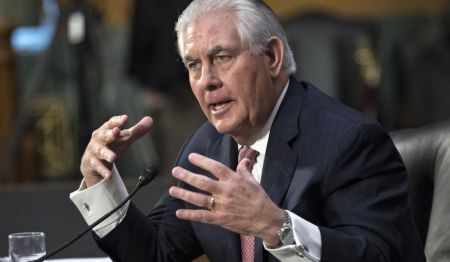
secstatetillersonFILE – In this Jan. 11, 2017, file photo, Secretary of State-nominee Rex Tillerson testifies on Capitol Hill in Washington. Trump’s nomination of Tillerson for secretary of state is headed toward Senate confirmation after several Democrats crossed party lines . . . .

The Senate voted Wednesday afternoon to confirm Rex Tillerson as the nation’s 69th secretary of state, officially making the former ExxonMobil CEO America’s top diplomat and chief foreign policy advisor to President Trump.

In a 56-43 vote, Republicans picked up three Democratic votes to pierce the minority’s hoped-for united front against Mr. Trump’s unconventional nominee: Sens. Joe Manchin III of West Virginia, Heidi Heitkamp of North Dakota and Mark R. Warner of Virginia, all of whom face re-election next year. Democratic-leaning independent Sen. Angus S. King Jr. of Maine also voted to advance Mr. Tillerson’s nomination.

Mr. Tillerson, who had an extended lunch meeting with Mr. Trump Wednesday afternoon, was expected to be sworn in during a private ceremony later in the day. Officials said he is unlikely to appear in person at State Department headquarters in Foggy Bottom before Friday.

Officials said Mr. Tillerson, who had an extended lunch meeting with Mr. Trump Wednesday afternoon, would be sworn in during a private ceremony. He is not expected to appear at State Department headquarters in Foggy Bottom until Thursday or Friday.

Once the swearing in formalities are taken care of, the new secretary of state will be confronted quickly by a slate of delicate issues.

In addition to an already turbulent landscape of foreign policy challenges — from the North Korean nuclear threat to Syria’s civil war, Russian meddling in Ukraine and the international battle against the Islamic State — Mr. Tillerson arrival at Foggy Bottom coincides deep hand-wringing over Mr. Trump’s recent executive order relating to the so-called “extreme vetting” of Muslims trying to enter the U.S.

Recent days brought reports that hundreds of U.S. diplomats and State Department rank and file have signed a scathing dissent memorandum criticizing the order Mr. Trump signed Friday to suspend all refugee access to the U.S. and temporarily halt visas to citizens of seven majority Muslim nations, including Syria, Iran, Iraq, Yemen, Libya, Somalia and Sudan.

“We are better than this,” said the memo, which was submitted as a cable into the State Department’s infamous “dissent channel” and leaked to reporters.

The White House response to those who signed the memo has been confrontational, with administration spokesman Sean Spicer asserting Monday that they “should either get with the program or they can go.”

The new secretary of state will face the immediate and delicate task of trying win back their loyalty and restore morale at the department.

Mr. Tillerson was noncommittal on the visa and refugee issue during his nomination hearing last month. While he voiced apprehension toward Mr. Trump’s campaign trail calls for a ban on “all Muslims” entering the U.S., he also said he might be open to the creation of some kind of registry of Muslims living in the country.

During the hearing, Mr. Tillerson also faced scrutiny over close relationships he built with high-level Russian officials as head of ExxonMobil — he was CEO from 2006 through 2016 — and the extent to which those relationships may influence his view of economic sanctions designed to contain Moscow’s meddling in Ukraine.

Mr. Tillerson was generally elusive on sanctions and Russia. He spoke out against the use of economic penalties as a foreign policy tool. But he also condemned suspected interference by Russia in the U.S. presidential election, and said he believed Moscow’s 2014 annexation of Ukraine’s Crimean Peninsula was illegal and worthy of a muscular response from Washington.

Another issue that drew scrutiny during the hearing was Mr. Tillerson view on climate change and the extent to which he hopes to change or renounce the 2015 global Paris Climate Accord that former Secretary of State John F. Kerry fought for in recent years.

Mr. Tillerson said he believes “the risk of climate change does exist” and “the consequences of it could be serious enough that action should be taken.” While he said the “type of action seems to be where the largest areas of debate exist,” he added that it’s “important to recognize the U.S. had done a pretty good job.”

Spare Us Iran’s Pieties on U.S. Immigration Policy

February 1, 2017

Spare Us Iran’s Pieties on U.S. Immigration Policy, PJ MediaClaudia Rosett, January 31, 2017

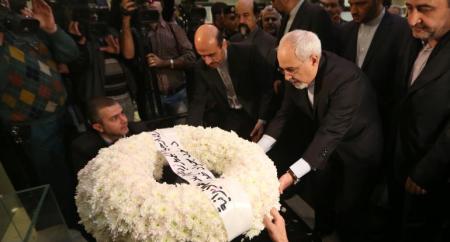
zarifwreathIranian Foreign Minister Mohammad Javad Zarif lays a wreath on the grave of Imad Mughniyeh, a top Hezbollah commander, in the southern suburb of Beirut, Lebanon, Monday, Jan. 13, 2014. (AP Photo/Bilal Hussein)

After eight years of President Obama’s incendiary efforts to couple an expanding American welfare state with a laissez-faire approach to U.S. borders, America is finally launching a real debate over immigration policy. In our democracy, there’s room for everything from the weepy Sen. Chuck Schumer to the defiant President Trump. My hope is that America ends up willing to take as many refugees — and immigrants generally — as possible, subject to genuine regard for American security and preservation of our rambunctious democracy and its Constitution.

What America emphatically does not need, however, is the voice of Tehran’s terror-sponsoring regime insinuating itself anywhere in this immigration debate. Which is exactly what Iran’s foreign minister, Javad Zarif, has been trying to do with his recent comments that Trump’s Jan. 27 executive order on immigration is “a great gift to extremists.” Calling Trump’s order a “Muslim ban” (which it is not), Zarif has accused the Trump administration of intruding into the friendship between the American and Iranian people, and aiding “terrorist recruitment” by “deepening fault lines exploited by extremist demagogues to swell their ranks.”

Zarif’s statements (in which Zarif himself was de facto doing plenty to encourage terrorists and deepen fault lines) were put out on Twitter, replayed via Iran’s Islamic Republic News Agency (IRNA), and amplified by Al Jazeera, under the headline “Zarif: Trump’s Muslim ban ‘great gift to extremists'” — along with Al Jazeera’s report that some 45% of the would-be travelers to America affected by Trump’s order are from Iran, and that “more than a million Iranians live in the United States.”

In case it sounds touching that Zarif should be so concerned about the well-being of America, let’s be clear on what’s really going on here. Zarif, while presenting himself as an enemy of “extremists,” is a prominent official voice of an Iranian regime that has ranked for years as the Middle East’s biggest Old Boys’ Club of “extremism.” The Tehran government Zarif represents is the world’s leading state sponsor of terrorism. He speaks for a regime which since Iran’s 1979 Islamic revolution has as a matter of messianic government policy recruited, trained and funded legions of terrorists — a poisonous influence emanating from the Middle East, a self-declared existential threat to Israel, and home to officially blessed chants of “Death to America.”

According to the State Department’s most recent report on State Sponsors of Terrorism, covering 2015, “Iran continued its terrorist related activity… including support for Hizballah, Palestinian terrorist groups in Gaza, and various groups in Iraq and throughout the Middle East.” State noted that Iran views the terror-sponsoring Assad regime in Syria as “a crucial ally”; that Tehran-backed Shia terrorist groups have “exacerbated sectarian tensions in Iraq and have committed serious human rights abuses”; and that “Iran has also provided weapons, funding and training to Shia militants in Bahrain,” including such gee-gaws as “a bomb-making facility” which, when discovered by the Bahraini government, was housing 1.5 tons of high-grade explosives.

As for Zarif’s charges that the Trump administration is imperiling the friendship between the people of Iran and the people of America, let’s recall that Iran’s Islamic Republic, from the year of its inception right up to the present, has made a practice of seizing and holding Americans as de facto hostages — including the prisoners whose release in Jan. 2016 came coincident with (or, as it now appears, no coincidence?) President Obama’s secret hustling of $1.7 billion in cash to Iran’s terror-sponsoring government. Nor does it help the cause of friendship that Iran — despite its official promise to abjure a nuclear weapons program — continues, as it did just last week, to test ballistic missiles (for which the only realistic use is delivering nuclear weapons).

It is the Tehran regime itself that is the prime cause of misery for people who would like to travel from Iran to America, or vice versa. If Zarif’s real concern is to fight terrorism and encourage the free flow of people between Iran and America, what he really ought to do is resign his post and call for an end to the repressive and terror-sponsoring Tehran government that he himself, under Supreme Leader Ali Khamenei, has for decades so zealously served. That would be the right and decent move; an honest and genuinely useful contribution to world affairs.

Not that Zarif is even remotely likely to do any such thing. But unless he takes the highly improbable course of placing blame where it belongs — on his own government — his indignant opinions about U.S. immigration policy are of less than zero value. They are of a piece with those Iran visas extended to the series of American citizens who took the bait and ended up in Iran’s prisons, held as chits for Tehran’s political extortion rackets. Such are the contributions of Iran’s regime to the cause of international friendships and open exchange of people. Please spare us.

None is too many

February 1, 2017

None is too many, Israel National News, Jack Engelhard, February 1, 2017

(Please see also, The Lessons of Roosevelt’s Failures. — DM)

Sarah doesn’t remember the exact moment when Father and Mother decided it was time to leave as the Gestapo were tightening around Toulouse.

For me, now, I can’t imagine a more horrifying decision. How do you decide that it’s time to leave everything behind and, literally, run for the hills?

You’re leaving your country, your home, everything you know because one particular day you find that life is unbearable and you’ve run out of choices.

You are being hunted.

I can only try to imagine the tears and vexations of my mother when, despite her protests, it was time to go.

Largely through the efforts of the Catholic priest who studied Talmud with my father, and who had contacts with the French Underground, arrangements were made. They packed up. One suitcase. Plus a backpack. The backpack would be used by my father to carry me across the Pyrenees.

I cover much of that in “Escape from Mount Moriah,” a memoir about arriving in Montreal. That’s my story about being a refugee.

So today there are new stories about newer refugees; Trump’s restrictions to modify the influx from certain Muslim lands, and the protests here and abroad to stop Trump. They carry signs saying, “We are all immigrants,” and I say yes, but not all immigrants are alike.

We did not have 57 Jewish countries to save us as there are 57 Muslim countries to save these migrants coming to America.

We had no Israel. We had nothing. We had nobody.

I’m speaking here for ourselves, a family of four, and the millions of other families who were trapped, caught and slaughtered.

Roosevelt had clamped the doors to America except for a quota here and there and it was the same for Canada under Mackenzie King.

Chuck Schumer wasn’t around to weep for us as he weeps for the Muslims and in fact the policy for us was entirely different.

The man who ran the immigration office for Canada spoke for both his country and for America when he flatly declared, “None is too many.”

He was speaking about the few of us – the few Jews that had somehow survived Hitler’s systematic genocide.

I say systematic because there has never been anything like that, when a nation, Germany, takes it into its head to obliterate an entire population.

So there is absolutely no comparing Muslim immigrants to Jewish immigrants – for them it’s civil war, Arab against Arab – and they have choices.

For us it was a methodical and diabolical plan to obliterate us from the face of the earth…in which nearly everybody had a hand, including Islam.

We had no choices.

Today we call it the Holocaust. Back then it had no name. The victims, the prey, the hunted; they only knew it as a world war against them and them alone.

For what reason? What had they done? Had they committed acts of terrorism? There’s nothing like that on record.

Were we coming with books and motives that glorify murder? No, that is not our God. That is their god.

But it is for them and for their god that the world weeps today.

For us the Christian world was silent, in fact complicit, and some Jews living in freedom spoke up, but not nearly enough.

Today they speak up for Muslim immigrants.

These include American and Canadian Jews who had no tears for Jewish immigrants – immigrants who came not seeking a better life.

We were seeking life, period.

So please spare me your broken hearts. The refugees of yesteryear could have used your righteousness.

You are too late and you were nowhere to be found when your true brothers and sisters reached out for your hand but instead found a cold shoulder.

The Lessons of Roosevelt’s Failures

February 1, 2017

The Lessons of Roosevelt’s Failures, Front Page MagazineCaroline Glick, February 1, 2017

djt1

Is US President Donald Trump the new Franklin Delano Roosevelt? Does his immigration policy mimic Roosevelt’s by adopting a callous, bigoted position on would-be asylum seekers from the Muslim world? At a press conference on June 5, 1940, Roosevelt gave an unspeakably cynical justification for his administration’s refusal to permit the desperate Jews of Nazi Germany to enter the US.

In Roosevelt’s words, “Among the refugees [from Germany], there are some spies… And not all of them are voluntary spies – it is rather a horrible story but in some of the other countries that refugees out of Germany have gone to, especially Jewish refugees, they found a number of definitely proven spies.”

The current media and left-wing uproar over the executive order US President Donald Trump signed on Saturday which enacts a temporary ban on entry to the US of nationals from seven Muslim majority countries is extraordinary on many levels. But one that stands out is the fact that opponents of Trump’s move insist that Trump is reenacting the bigoted immigration policies the US maintained throughout the Holocaust.

The first thing that is important to understand about Trump’s order is that it did not come out of nowhere. It is based on the policies of his predecessor Barack Obama. Trump’s move is an attempt to correct the strategic and moral deficiencies of Obama’s policies – deficiencies that empower bigots and fascists while disenfranchising and imperiling their victims.

Trump’s order is based on the 2015 Terrorist Travel Prevention Act. As White House spokesman Sean Spicer noted in an interview with ABC News’ Martha Raddatz Sunday, the seven states targeted by Trump’s temporary ban – Syria, Iraq, Sudan, Iran, Libya, Yemen and Somalia – were not chosen by Trump.

They were identified as uniquely problematic and in need of specific, harsher vetting policies for refugee applications by former US president Barack Obama.

In Iraq, Syria, Libya and Yemen, the recognized governments lack control over large swaths of territory.

As a consequence, they are unable to conclude immigration vetting protocols with the US. As others have noted, unlike these governments, Turkish, Saudi Arabian and Egyptian officials have concluded and implement severe and detailed visa vetting protocols with US immigration officials.

Immigrants from Somalia have carried out terrorist attacks in the US. Clearly there is a problem with vetting procedures in relation to that jihad-plagued failed state.

Finally, the regimes in Sudan and Iran are state sponsors of terrorism. As such, the regimes clearly cannot be trusted to properly report the status of visa applicants.

In other words, the one thing that the seven states have in common is that the US has no official counterpart in any of them as it seeks to vet nationals from those states seeking to enter its territory. So the US must adopt specific, unilateral vetting policies for each of them.

Now that we know the reason the Obama administration concluded that visa applicants from these seven states require specific vetting, we arrive at the question of whether Trump’s order will improve the outcome of that vetting from both a strategic and moral perspective.

The new executive order requires the relevant federal agencies and departments to review the current immigration practices in order to ensure two things.

First, that immigrants from these and other states are not enemies of the US. And second, to ensure that those that do enter the US are people who need protection.

Trump’s order requires the secretary of state and the secretary of homeland security to ensure that the new vetting processes “prioritize refugee claims made by individuals on the basis of religious-based persecution, provided that the religion of the individual is a minority in the individual’s country of nationality.”

Under the Obama administration, the opposite occurred. Christians and Yazidis in Syria for instance, have been targeted specifically for annihilation by Islamic State and related groups. And yet, they have made up a tiny minority of visa recipients. According to Christian News Service, during 2016, the number of refugees from Syria to the US increased by 675%. But among the 13,210 Syrian refugees admitted to the US, only 77, or 0.5% were Christians and only 24, or 0.18%, were Yazidis.

Similar percentages held in previous years.

On the second issue, of blocking potential terrorists from entering the US, Trump’s order calls for measures to be taken to ensure that those who ascribe to creeds that would endanger the lives of US citizens are barred from entering.

Specifically, the order states, “The United States cannot, and should not, admit those who do not support the Constitution, or those who would place violent ideologies over American law. In addition, the United States should not admit those who engage in acts of bigotry or hatred (including ‘honor’ killings, other forms of violence against women, or the persecution of those who practice religions different from their own) or those who would oppress Americans of any race, gender, or sexual orientation.”

Whether or not the Obama administration’s failure to give top priority to Christian and Yazidi refugees being targeted for genocide, enslavement and rape was driven by political considerations, the fact is that the current US refugee system makes it all but impossible for US officials to give priority to vulnerable minorities.

As Nina Shea, director of the Hudson Institute’s Center for Religious Freedom pointed out in an article in National Review in November 2015, the US has relied on the UN High Commissioner on Refugees to vet potential immigrants from these countries. The UNHCR accepts applications for resettlement primarily from people who reside in its refugee camps. Members of the Christian and Yazidi avoid UN camps because UN officials do not protect them.

As Shea noted, human rights groups and media reports have shown that at UN camps, “ISIS, militias and gangs traffic in women and threaten men who refuse to swear allegiance to the caliphate.”

The situation repeats itself in European refugee centers. Shea noted that in Germany, for instance, due to Muslim persecution of non-Muslim refugees at refugee centers, “the German police union recommended separate shelters for Christian and Muslim groups.”

The UNHCR itself has not been an innocent bystander in all of this. To the contrary. It appears that the institution colludes with jihadists to keep persecuted Christians and other minorities out of the UN refugee system, thus dooming them to remain in areas were they are subjected to forms of persecution unseen since the Holocaust.

Questioned by Shea, the UN High Commissioner for Refugees António Guterres said that he opposes the resettlement of persecuted Christians from Syria. Despite the fact that in 2011 Pope Francis acknowledged that Syrian Christians were being targeted for genocide, Guterres told Shea that he doesn’t want Christians to leave Syria, because they are part of the “DNA of the Middle East.” He added that Lebanon’s former president asked him not to resettle the Christians.

Invoking the Holocaust, in recent days US Jews have been among the most outspoken critics of Trump’s executive order. Speaking to Britain’s Independent, for instance, Mark Hetfield, the executive director of HIAS, the Hebrew Immigrant Aid Society, slammed Trump’s executive order as the “lowest point we’ve seen since the 1920s.”

Forward editor Jane Eisner wrote that Trump’s move is immoral and un-American and that all Jewish organizations are morally required to stand up to his “anti-Muslim” policies.

Writing at Vox.com, Dara Lind drew a direct connection between Trump’s executive order and the Roosevelt administration’s refusal to permit the Jews of Europe to flee to the US to escape annihilation in the Holocaust.

This then brings us back to Roosevelt’s immoral policies toward the Jews of Europe and to the question of who has learned the lessons of his bigotry.

The American Jewish uproar at Trump’s actions shows first and foremost the cynicism of the leftist Jewish leadership.

It isn’t simply that left-wing activists like Hetfield and Eisner cynically ignore that Trump’s order is based on Obama’s policies, which they didn’t oppose.

It is that in their expressed concerned for would-be Muslim refugees to the US they refuse to recognize that the plight of Muslims as Muslims in places like Syria and Iraq is not the same as the plight of Christians and Yazidis as Christians and Yazidis in these lands.

The “Jews” in the present circumstances are not the Muslims, who are nowhere targeted for genocide.

The “Jews” in the present circumstances are the Christians and Yazidis and other religious minorities, whom Trump’s impassioned Jewish opponents and Obama’s impassioned Jewish champions fail to defend.

Trump’s executive order is far from perfect. But in making the distinction between the hunters and the hunted and siding with the latter against the former, Trump is showing that he is not a bigot.

Unlike his critics, he has learned the lessons of Roosevelt’s moral failure and is working to ensure that the US acts differently today.

Mexico: Blame Canada

January 31, 2017

Mexico: Blame Canada, Strategy Page, January 31, 2017

(Endemic corruption, cartels, crime, an unpopular president and other bad stuff in Mexico? It must be imperialistic America’s fault. Therefore, remittances should be encouraged and all U.S. border controls eliminated. At least Obama would agree. — DM)

The government announced it would spend $50 million to hire lawyers in the United States to defend Mexican citizens there illegally and faced with deportation. This is all about money and a lot more than $50 million. The Mexican central bank tracks how much money Mexicans abroad send home and in 2016 it was $25 billion, almost all of it from Mexicans in the United States and much of it from Mexicans in the United States illegally. That remittance cash accounts for more foreign exchange than Mexican oil exports. The remittance income is rising. It was nearly $22 billion in 2013 and is expected to rise to $28 billion in 2017, unless the United States enforces its immigration laws like Mexico does. Mexico has for decades tolerated illegal migration to the United States because the corruption and bad government in Mexico did little to provide jobs for the growing number of unemployed Mexicans and created a lot of potentially troublesome young men and women. Tolerating and, for many Mexican politicians, openly supporting the illegal migrants, was a popular policy and the government came to regard it as a right. But it was also about money and the remittances created a huge source of foreign currency flowing back to Mexico.

There’s more to it than money. After years of being accused of permitting the abuse of Central American migrants who enter Mexico the government agreed pay more attention to border security on its own southern border. Many of the illegal migrants from Central American are heading for the United States and that was not seen as a Mexican problem. But criminal gangs increasingly robbed and kidnapped the migrants and the government did very little to stop that. The gangsters often attacked Mexican citizens as well. Mexico has more severe laws against illegal immigration and illegal migrants than the U.S.  It also enforces them more vigorously than does the U. S. By mid-2014 Mexico agreed to undertake Operation Sur which was supposed to curb illegal Central American migrants from entering Mexico. Operation Sur increased surveillance operations along Mexico’s southern border and improved border inspections. The government also tried to improve registration of legal migrants. In addition to the criminals, local police forces in southern Mexico have been accused of extorting money from illegal migrants and police corruption has long been a major problem. Despite Operation Sur, Mexico did little halt illegal migration across its northern border.

All this was noticed in the U.S. and politicians there found themselves under increasing pressure to enforce American migration laws as vigorously as Mexico (and Canada) did. By 2016 that brought to power an American government that seemed serious about applying Mexican practices to illegal migrants and actually did so. That was unpopular in Mexico and will probably lead to unexpected changes inside Mexico. But the practice of blaming your northern neighbor for your problems is losing its punch even in Mexico.

January 28, 2017: Police discovered the decapitated corpses of three policemen from the town of Huimanguillo (Tabasco state). The victims were slain near the border with Veracruz state.

January 27, 2017: In the south (Yucatan state) the government announced the arrest of three men suspected of smuggling drugs for the Sinaloa cartel. One of these, Roberto Najera Gutierrez, was described as a senior cartel leader and one of cartel boss Joaquin Guzman’s top lieutenants. The other two individuals are also Sinaloa cartel operatives. Gutierrez has directed drug trafficking operations from Central American countries and he has been especially active in Chiapas and Yucatan states.

January 24, 2017: The government confirmed the January 19 arrest (in Sinaloa state) of Juan Jose Esparragoza Monzon, the son of a senior member of the Sinaloa cartel. Monzon is suspected of investing cartel funds in real estate in Mexico as well as being involved in violent crimes in Baja California state.

January 23, 2017: Colima state had 607 murders in 2016 versus 189 in 2015. That is a 220 percent increase. A turf war between the Sinaloa and Jalisco New Generation cartels is engulfing the state, with the seaport of Manzanillo the prize. Around 700,000 people live in Colima. The 2016 summary was announced just before state security officials said it believed that that Jalisco New Generation cartel gunmen were responsible for the murders of a dozen people in the state between January 19 and 23. Seven headless corpses were found near Manzanillo on January 21.

January 19, 2017: The government announced that Sinaloa cartel commander Joaquin Guzman had been extradited to the U.S. Media called the unexpectedly rapid extradition a “surprise.” In U.S. federal court in New York Guzman pled not guilty to a 17-count indictment. He faces narcotics trafficking and money laundering charges. He is also accused of ordering murders and kidnappings in the U.S.

January 17, 2017: Oil theft continues to plague the national oil company, Pemex. Attempts to sue U.S. oil companies that sold stolen petroleum products have not been successful. Pemex lost a lawsuit in December 2016 that ultimately involved 23 U.S. companies and several individuals. It was trying to recover money from the sale of stolen products. Cartels sell the stolen oil and (in some cases) refined products to all buyers, including buyers in the U.S. Pemex’s suit failed because the defendants successfully argued they did not know the oil was stolen.

January 16, 2017: Government once again said that foreign companies should not fear investing in Mexico due to fear of violence.

January 14, 2017: A Mexican federal court ordered a drug lord to pay around $1 million in indemnities for the 1985 murders of a Mexican pilot and a U.S. DEA agent. The criminal ordered to pay was identified as Ernesto Fonseca Carrillo, a co-founder of the Guadalajara cartel. The murdered DEA agent was Enrique Camarena and his family will receive around $465,000.

January 11, 2017: The price of tortillas is once again increasing. They have gone up almost 20 percent in the last six months. When the price of corn and other staple goods increase, the government faces instant criticism. For the record, the price of eggs and milk has also spiked. President Enrique Pena’s poll ratings are already miserable. The majority of Mexican citizens believes his government is corrupt. Pena is trying to blame macro-economic and a new administration in the U.S. Fuel prices have increased and the peso has slipped against the dollar.

January 10, 2017: Security official said that police used surveillance photos from a parking lot to identify and then arrest Zia Zafar. Is accused of shooting and wounding U.S. consular official in Guadalajara on January 6. Zafar is a U.S. citizen from California and was extradited to the U.S. on January 9.

January 8, 2016: Protests continue over the rise in gas and diesel prices. Prices have increased 20 percent since January 1 when the government began reducing fuel subsidies. Authorities now estimate 1,500 people have been arrested for looting businesses and attacking gas stations.

January 6, 2017: Police in Ciudad Juarez broke up a gas price increase protest demonstration that tried to block the international bridge to El Paso, Texas. On the evening of January 5 demonstrators occupied customs offices on the international bridge. A government spokesman in Mexico City said that at least four people have died in violence related to gasoline price increase protests.

Los Zetas cartel gunmen ambushed a senior state prosecutor and three police officers in Tamaulipas state. Ricardo Martinez Chavez was the regional director of the Tamaulipas Attorney General’s Office. The attack occurred near the town of Nuevo Laredo.

January 2, 2016: Protests against the increase in fuels prices are spreading throughout the country. The fuel price increase kicked in on January 1 and the violence began on January 2nd. The government is trying to create a competitive energy market. Protestors are using the term “gasolinazo” to describe their gripe. The term translates as “gasoline-punch.” A group of protestors in Mexico City noted that President Enrique Pena promised that prices would drop after competition was introduced. However, in the initial phases of the program, prices are increasing.

December 31, 2016: The government is saying that reports are false that gunmen in the Jalisco New Generation Cartel threatened to burn down gas stations to protest impending price increases. However, for some 24 hours the claim raced around the internet and the Jalisco Attorney Generals Office began an investigation of the allegation.

December 30, 2016: Los Zetas cartel gunmen in Nuevo Laredo kidnapped four Mexican citizens who had just been deported from the U.S. The four men were rescued by Mexican Army soldiers who stormed the house where the victims were being held for ransom.

On Boycotting Radical Islamic Nations

January 31, 2017

On Boycotting Radical Islamic Nations, Gatestone InstitueNonie Darwish, January 31, 2017

The interviewer seemed shocked to hear that I do not have any Arab or Muslim friends who are protesting President Trump’s ban, and that many immigrants of Islamic origin support the ban and are fed up and embarrassed by what jihadists are doing.

The lesson America needs to know is that the West is not doing Muslims a favor by constantly treating them as children who should be shielded from reality. They hungry for the truth: that their educational system and mosque preaching are full of incitement, are abhorrent, hate-filled and the foundation upon which violent jihad is built.

Muslims need to know that the world does indeed have a justifiable and legitimate concern about Islam and actions done in the name of Islam by Muslims.

Muslims need to look at themselves in the mirror and see the world from the point of view of their victims. Instead, the West is sacrificing its culture, values, laws, pride and even self-respect.

It might compassion that leads the West to take in millions of Muslim refugees but it is reckless compassion. Do Westerners question the motivation of Islamic theocracies as to why ultra-rich Arab nations are sending us their refugees but taking in none?

Some “tough love” is urgently needed if Muslims are to be motivated to change and reform.

Early this morning an Arabic radio station in the Middle East called asking my opinion about President Trump’s ban on refugees and citizens of seven Muslim nations. The radio host, who sounded angry over the ban, was a Christian Arab. She was surprised to hear that I supported the ban and think that it should have taken place the day after 9/11.

She then asked me if I knew any Arab American activist who was against the ban because she wanted to interview someone against the ban. She seemed shocked to hear that I do not have any Arab or Muslim friends who are protesting the ban, and that many immigrants of Islamic and Middle East origin support the ban and are fed up and embarrassed by what jihadists are doing.

She said that all she sees on CNN and other channels are riots that portray almost all Americans supporting Muslims and against Trump. I am upset over the success of the leftist propaganda all over the Middle East. It brings back memories of the life of the hate indoctrination and misinformation I lived under for most of my life.

What would Muslim countries do to the West, I asked, if 19 American terrorists flew airplanes into Arab capitals and their government and military headquarters? What did she think Arabs would do if every week or so American terrorists would conduct synchronized killing sprees all over the Muslim world, gunning Muslims down, blowing them up with homemade pressure cookers, ramming into crowds with trucks? There was silence.

She then started calming down and said that of course she is against terrorism, “but”. I asked: “Do you see what jihad did to your Christian community in the Middle East?” She was silent for a minute, then it occurred to me that she might be afraid to continue the conversation because her bosses were probably Muslims.

I was sure she was going to hang up on me, but to my surprise she asked me to please hold. Then she was back, live from the studio, and started interviewing me and asked the same questions on air. I poured my heart out in Arabic to the Arab listeners.

The lesson here is that Arabs are hungry to hear the truth; this Arab station, instead of rejecting these ideas, ended up putting them on air. The lesson America needs to learn is that the West is not doing Muslims (especially the reformists) a favor by constantly treating them as children who should be shielded from reality.

Muslims need to know that the world does indeed have a justifiable and legitimate concern about Islam and actions done in the name of Islam by Muslims. Muslims need to look at themselves in the mirror and see the world from the point of view of their victims. Instead, the West is sacrificing its culture, values, laws, pride and even self-respect. Muslim culture needs a wake-up call telling them that, sooner or later, non-Muslim nations will close their doors to any kind of Muslim immigration if the jihad culture continues. That will also be a strong message to Muslims already in the West who still believe in jihad.

2256President Donald Trump signs an executive order restricting immigration, January 27, 2017. (Image source: Reuters video screenshot)

The Muslim people are hungry for the truth: that their educational system and mosque preaching are full of incitement, abhorrent, hate-filled and the foundation upon which violent jihad is built. The Islamic commandment to do jihad sacrifices Muslim men, women and children to kill and get killed.

As long as the West continues its appeasement of Islamic jihad, Islam will never reform and the West will lose. So far, the West has continued to extend a lifeline to the religion of Islam; a religion for which the number one enemy is the truth, and which struggles to suppress the truth.

It might be compassion that leads the West to take in millions of Muslim refugees, but it is reckless compassion. Why isn’t Saudi Arabia taking refugees temporarily until things settle down in Syria and Iraq? Do Westerners question the motivation of Islamic theocracies, as to why ultra-rich Arab nations are sending us their refugees but taking in none?

Who is really benefiting from the policy of appeasement, the acceptance of Sharia-stricken theocracies and their jihadist, hate-filled education? Some “tough love” is urgently needed if Muslims are to be motivated to change and reform.