Posted tagged ‘Trump agenda’

Promises to Keep

February 13, 2017

Promises to Keep, Front Page MagazineMichael Cutler, February 13, 2017

(“And miles to go before I sleep.” — DM)

cvb_1

During his campaign for the presidency Donald Trump frequently disdainfully scowled when he spoke about how most politicians were “All talk and no action.”

Candidate Trump promised that immigration would be a primary focus of his administration.

President Trump has indeed focused on multiple aspects of the immigration crisis that go well beyond building a wall along the U.S./Mexican border.

His selection of Senator Jeff Sessions to be his Attorney General was the best possible choice for this important position.

Sessions had chaired the Senate Subcommittee on Immigration and the National Interest.

Consider that on February 25, 2016 that subcommittee conducted a hearing on the topic, “The Impact of High-Skilled Immigration on U.S. Workers.”

When the Obama administration conducted meetings for “Stakeholders” on the immigration issue corporate leaders were invited to attend as were immigration lawyers representing illegal aliens and special interest groups that advocate for illegal aliens.

However, no one in attendance represented the “average American.”

Even the union leaders representing the Border Patrol, ICE agents and the adjudications officers were barred from participating in those meetings.

On February 9, 2017 President Trump held a news conference in the Oval Office to conduct a public swearing in ceremony of Attorney General Jeff Sessions.

Immediately after Vice President Pence swore in Jeff Sessions, President Trump signed three executive orders:

Presidential Executive Order on Enforcing Federal Law with Respect to Transnational Criminal Organizations and Preventing International Trafficking

Presidential Executive Order on Preventing Violence Against Federal, State, Tribal, and Local Law Enforcement Officers

Presidential Executive Order on a Task Force on Crime Reduction and Public Safety

President Trump promised to be the “Law and Order” President and he has certainly hit the ground running.

His executive order to prevent violence against law enforcement officers is tangible evidence of his keeping his promise to look out for law enforcement officers.

Let’s next consider how he articulated the purpose for his executive order on enforcing federal laws to attack transnational criminal organizations:

Section 1.  Purpose.  Transnational criminal organizations and subsidiary organizations, including transnational drug cartels, have spread throughout the Nation, threatening the safety of the United States and its citizens.  These organizations derive revenue through widespread illegal conduct, including acts of violence and abuse that exhibit a wanton disregard for human life.  They, for example, have been known to commit brutal murders, rapes, and other barbaric acts.

These groups are drivers of crime, corruption, violence, and misery.  In particular, the trafficking by cartels of controlled substances has triggered a resurgence in deadly drug abuse and a corresponding rise in violent crime related to drugs.  Likewise, the trafficking and smuggling of human beings by transnational criminal groups risks creating a humanitarian crisis.  These crimes, along with many others, are enriching and empowering these organizations to the detriment of the American people.

A comprehensive and decisive approach is required to dismantle these organized crime syndicates and restore safety for the American people.

That statement underscores his understanding of how important immigration law enforcement and border security are to combatting transnational criminals.

What is unfathomable is how many politicians who have to understand this issue have opposed Trump at every opportunity.  Only they can explain their conduct.  However, I have to conclude that those who would oppose President Trump’s efforts to secure our nation’s borders and effectively enforce our immigration laws are siding with the cartels and transnational criminal organizations.

This certainly apply to mayors of “Sanctuary Cities” and governors who want to create “Sanctuary States.”

Sanctuary Cities should be called “Magnet Cities” because they attract criminal aliens including members of transnational gangs, fugitives and international terrorists.

The politicians’ claims that by shielding vulnerable illegal aliens from immigration law enforcement they would be willing to come forward when they fall victim to criminals is a blatant lie that ignores that Sanctuary Cities Endanger – National Security and Public Safety.

Sanctuary policies attract more violent criminals who are likely victimize members of the ethnic immigration communities.  However the false narrative serves to vilify valiant ICE agents who go in harms way every day they report for duty, seeking to protect national security and innocent lives.

Statutorily, U Visas are available for victims of human trafficking and other crimes if they come forward and assist with law enforcement efforts to apprehend the criminals.  Similar visa programs are available for illegal aliens who provide assistance to criminal investigations.

If those duplicitous politicians really wanted to assist illegal alien victims of crimes they would bring them to immigration offices and urge them to cooperate with the investigations of their criminal assailants.

That way everyone would win.

But then the politicians would not get their campaign contributions from the U.S. Chamber of Commerce and a host of special interest groups, and who know who else, who are literally and figuratively making out like bandits by exploiting the immigration system.

In continuing to consider Trump’s executive order on trafficking I call your attention to two of the key elements of this executive order are proverbial “music to my ears.”

(e)  develop strategies, under the guidance of the Secretary of State, the Attorney General, and the Secretary of Homeland Security, to maximize coordination among agencies — such as through the Organized Crime Drug Enforcement Task Forces (OCDETF), Special Operations Division, the OCDETF Fusion Center, and the International Organized Crime Intelligence and Operations Center — to counter the crimes described in subsection (a) of this section, consistent with applicable Federal law; and

(f)  pursue and support additional efforts to prevent the operational success of transnational criminal organizations and subsidiary organizations within and beyond the United States, to include prosecution of ancillary criminal offenses, such as immigration fraud and visa fraud, and the seizure of the implements of such organizations and forfeiture of the proceeds of their criminal activity.

I speak from extensive experience when I say that this task force approach to identifying, investigating and dismantling international drug trafficking organizations is extremely effective.  I spent the final ten years of my career with the INS as a Senior Special Agent assigned to the OCDETF program in New York City.

As for immigration fraud and visa fraud, these two issues are elements of “Extreme vetting” that Trump promised when he campaigned for the presidency.

On May 18, 2004 I testified at a hearing by the House Immigration Subcommittee on the topic of Pushing the Border Out on Alien Smuggling: New Tools and Intelligence Initiatives that addressed the issues of visa fraud and also the strategy of providing visas for illegal alien informants.

On May 20, 1997 I testified before the House Immigration Subcommittee on the topic, Visa Fraud And Immigration Benefits Application Fraud.

That hearing was predicated on two deadly terror attacks carried out in 1993 at the CIA and first World Trade Center Bombing.

In one way or another, all of those involved with those attacks had gamed the visa system and/or the immigration benefits program.

The Clinton administration’s failures to address these vulnerabilities of visa fraud and immigration fraud that enabled these two deadly attacks to be conducted on American soil literally and figuratively, left the door open to the deadly terror attacks of 9/11.

The report, “9/11 and  Terrorist TravelStaff Report of the National Commission on Terrorist Attacks Upon the United States” included this excerpt found on pages 46 and 47:

In addition, Ramzi Yousef, the mastermind of the attack, and Ahmad Ajaj, who was able to direct aspects of the attack despite being in prison for using an altered passport, traveled under aliases using fraudulent documents. The two of them were found to possess five passports as well as numerous documents supporting their aliases: a Saudi passport showing signs of alteration, an Iraqi passport bought from a Pakistani official, a photo-substituted Swedish passport, a photo-substituted British passport, a Jordanian passport, identification cards, bank records, education records, and medical records.6

“Once terrorists had entered the United States, their next challenge was to find a way to remain here. Their primary method was immigration fraud. For example, Yousef and Ajaj concocted bogus political asylum stories when they arrived in the United States. Mahmoud Abouhalima, involved in both the World Trade Center and landmarks plots, received temporary residence under the Seasonal Agricultural Workers (SAW) program, after falsely claiming that he picked beans in Florida.” Mohammed Salameh, who rented the truck used in the bombing, overstayed his tourist visa. He then applied for permanent residency under the agricultural workers program, but was rejected. Eyad Mahmoud Ismail, who drove the van containing the bomb, took English-language classes at Wichita State University in Kansas on a student visa; after he dropped out, he remained in the United States out of status.

In the years since the terror attacks of 9/11 more terror attacks were carried out in the United States while other attacks, for one reason or another, failed.  Most of those attacks involved aliens who committed visa fraud and/or immigration fraud.

Trump’s executive orders address our immigration vulnerabilities and Attorney General Sessions will provide the legal horsepower.

All Americans should be thrilled that this President is keeping his promises.
White House Puts Palestinians, United Nations in Crosshairs

February 13, 2017

White House Puts Palestinians, United Nations in Crosshairs, Washington Free Beacon, February 13, 2017

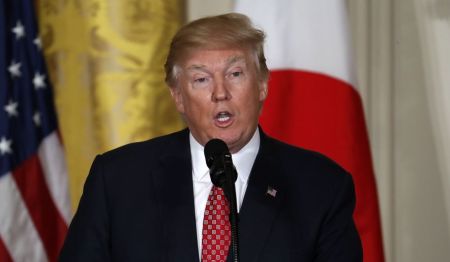
U.S. President Donald Trump holds a joint press conference with Japanese Prime Minister Shinzo Abe following their talks at the White House in Washington on Feb. 10, 2017. (Kyodo) ==Kyodo

U.S. President Donald Trump holds a joint press conference with Japanese Prime Minister Shinzo Abe following their talks at the White House in Washington on Feb. 10, 2017. (Kyodo)

White House officials, as well as senior sources in Congress, told the Free Beacon that the move is part of a larger effort to solidify U.S. support for Israel and counter a range of last-minute moves by the former Obama administration aimed at severing U.S.-Israel ties.

****************************

The White House is sending a strong signal that it will no longer tolerate Palestinian intransigence at the United Nations or the international body’s long record of anti-Israel action, according to White House officials and sources in Congress who told the Washington Free Beacon that the Trump administration will “unabashedly support Israel” in the months and years ahead.

The Trump administration sent shockwaves through the U.N. late last week when it took a stance against the appointment of a senior Palestinian official to serve in a top post overseeing Libya.

Senior officials at Turtle Bay expressed outrage over the Trump administration’s move to block the appointment of former Palestinian Prime Minister Salam Fayyad as a special U.N. representative for Libya. The move was widely supported by U.N. members, and, for a time, the Trump administration.

Sources inside the White House told the Free Beacon that the move was meant to send a signal to the Palestinians that they can no longer manipulate the U.N. system in order to bolster their international clout. This type of action, the sources said, undermines Israel and the ongoing peace process.

White House officials, as well as senior sources in Congress, told the Free Beacon that the move is part of a larger effort to solidify U.S. support for Israel and counter a range of last-minute moves by the former Obama administration aimed at severing U.S.-Israel ties.

The Free Beacon first reported earlier this year that the Trump administration and Congress had already been working on a range of measures meant to boost U.S. support for Israel at the U.N.

“The United States was disappointed to see a letter indicating the intention to appoint the former Palestinian Authority Prime Minister to lead the U.N. Mission in Libya,” Nikki Haley, the U.S. ambassador to the U.N., said in a statement opposing the selection of Fayyad. “For too long the U.N. has been unfairly biased in favor of the Palestinian Authority to the detriment of our allies in Israel.”

“The United States does not currently recognize a Palestinian state or support the signal this appointment would send within the United Nations, however, we encourage the two sides to come together directly on a solution,” Haley said in a vast departure from Obama administration rhetoric. “Going forward the United States will act, not just talk, in support of our allies.”

A senior White House official familiar with the move told the Free Beacon that the Palestinians will no longer get a free pass to push their anti-Israel agenda and win statehood outside the parameters of the peace process.

“It is so refreshing to have an American ambassador to the United Nations who will unabashedly support our ally Israel,” one senior member of the White House’s National Security Council told the Free Beacon. “The appointment of Salam Fayyad as the official U.N. envoy to Libya would be an incremental step towards unilateral recognition of Palestinian statehood by the U.N. absent an agreement with Israel.”

“Ambassador Haley took the only appropriate action and we are looking to supporting her actions any way we can,” the source said.

One senior congressional aide who works on Middle East issues told the Free Beacon that Trump’s approach to the U.N. is centered on backing Israel from any action that could harm its interests.

“The U.N. is not a friend of Israel. After the Obama administration’s eleventh-hour attack on the Jewish state, President Trump is attempting to turn the page,”  the source said. “Our new administration is already pushing back against the U.N.’s rampant bias and reasserting America’s strong support for Israel. This is a good step in the right direction.”

Fayyad, who is widely viewed as a reformer in Palestinian society, appears to have been caught up in a larger battle between the White House and U.N. over the international body’s efforts to delegitimize Israel.

While Fayyad was seen as an acceptable pick for the Libya post, his ties to the Palestinian Authority and its rogue efforts to achieve statehood via the U.N. provoked ire in the White House, sources said.

The White House is determined to keep what it views as the U.N.’s anti-Israel bias in check, particularly after the Obama administration’s last-minute efforts to secure a resolution condemning Israel.

One senior official at a national pro-Israel organization said the Trump administration’s moves would help preserve international agreements barring the Palestinians from seeking statehood outside of the peace process.

“Pro-Palestinian officials at the U.N. thought they had found a clever way to mainstream the Palestinians as legitimate state actors, which is contrary to American policy and violates two decades of signed agreements between the Palestinians and Israel,” said the source, who was not authorized to speak on record. “They figured that the Trump White House would be too worried about optics to take a stand on behalf of our Israeli allies. The White House refused to be intimidated.”

Regional experts tracking the issue think Fayyad could become a lighting rod in a larger matter surrounding U.S. opposition to any U.N. action meant to elevate the Palestinians on the international stage.

Jonathan Schanzer, vice president of research at the Foundation for Defense of Democracies, told the Free Beacon that the controversy surrounding Fayyad actually benefits Palestinian leaders such as Mahmoud Abbas, who fought against Fayyad’s efforts to eradicate corruption.

“The thing people are not asking is why Fayyad was even considering working the Libya file instead of trying to reform the Palestinian Authority at home,” Schanzer said. “The answer is, Fayyad was pushed out by Mahmoud Abbas in 2013. He and Abbas were in an epic battle over corruption and clean governance and reform. Fayyad lost that battle, as Abbas went full dictator.”

The Obama administration is responsible for allowing Fayyad to be pushed out of the Palestinian Authority, Schanzer said.

“The U.S. refused to come to Fayyad’s defense. I lay this at the feet of the Obama administration,” he said. “Fayyad’s reform and clean governance program was gutted, and when Fayyad created an NGO it was raided by Abbas’ forces—and still the Obama admin refused to lift a finger to help him.”

Draft Two – New Immigration Order Could Come This Week – Nigel Farage – Fox & Friends

February 13, 2017

Draft Two – New Immigration Order Could Come This Week – Nigel Farage – Fox & Friends via YouTube, February 12, 2017


Bravo to Ambassador Haley, for Blocking UN Ploy on ‘Palestine’

February 12, 2017

Bravo to Ambassador Haley, for Blocking UN Ploy on ‘Palestine’, PJ Media,  Claudia Rosett, February 11, 2017

(Please see also, US blocks former Palestinian prime minister from senior UN role in Libya ‘out of support for Israel’.  Thought experiment: what would the reactions, noted in the article linked in the preceding sentence, have been if a “right-wing” former Israeli cabinet minister had been named to the post?– DM)

nikkiUnited Nations, New York, USA, 27 January, 2017 – Nikki R. Haley, new United States Permanent Representative to the UN Presents Credentials to Secretary-General Antonio Guterres today at the United Nations Headquarters in New York. (Photo by Luiz Rampelotto/EuropaNewswire) (Sipa via AP Images)

Haley’s statement is important not only for its broad message — that President Trump’s administration will steer by his pledges of support to Israel — but also for calling out Guterres on his not-so-subtle attempt to abet the UN’s long push to confer by increments on the Palestinian Authority a legitimacy it has not earned.

****************************

On Thursday United Nations Secretary-General Antonio Guterres sent the Security Council a letter nominating as the new head of the UN’s mission to Libya a former prime minister of the Palestinian Authority, Salam Fayyad —  who was described in the letter as “Salam Fayyad (Palestine).”

America’s new ambassador, Nikki Haley, said no. Having thus blocked Fayyad’s appointment, Haley then put out a statement explaining why:

For too long the UN has been unfairly biased in favor of the Palestinian Authority to the detriment of our allies in Israel. The United States does not currently recognize a Palestinian state or support the signal this appointment would send within the United Nations, however, we encourage the two sides to come together directly on a solution. Going forward the United States will act, not just talk, in support of our allies.

Haley’s statement is important not only for its broad message — that President Trump’s administration will steer by his pledges of support to Israel — but also for calling out Guterres on his not-so-subtle attempt to abet the UN’s long push to confer by increments on the Palestinian Authority a legitimacy it has not earned.

The UN spokesman’s office responded by Haley’s objection by sending out a statement that:

The proposal for Salam Fayyad to serve as the Secretary-General’s Special Representative in Libya was solely based on Mr. Fayyad’s recognized personal qualities and his competence for that position.

United Nations staff serve strictly in their personal capacity. They do not represent any government or country.

This UN claim is disingenuous in the extreme, as the UN spokesman’s office itself then underscored, in the rest of the same statement quoted just above, by saying:

The Secretary-General reiterates his pledge to recruit qualified individuals, respecting regional diversity, and notes that, among others no Israeli and no Palestinian have served in a post of high responsibility at the United Nations. This is a situation that the Secretary-General feels should be corrected, always based on personal merit and competencies of potential candidates for specific posts.

In other words, Secretary-General Guterres, while disavowing any interest in the origins or potential loyalties of any candidate for a UN post, is simultaneously claiming a special interest in appointing — specifically — Israelis and Palestinians. And — lo and behold — Guterres just happens to have kicked off this erstwhile neutral campaign by nominating to a high-level post not an Israeli, but a Palestinian.

On a related note, to which Haley and her colleagues in the Trump administration might want to pay serious attention, there’s some news broken by Inner-City Press and further reported by veteran UN reporter Benny Avni, writing in the New York Sun (sources that often provide a lot more insight into the UN than you’re likely to find in, say, the New York Times; with further disclosure that the New York Sun has published many of my own articles on the UN). According to both Inner-City Press and the Sun, it appears that an influential voice behind Guterres’s nomination of Fayyad was that of the UN’s undersecretary general for political affairs, Jeffrey Feltman.

Feltman is an American, a former U.S. diplomat, who was appointed to his UN post in mid-2012, during President Obama’s first term in office. The UN fiction, as in the case of Fayyad’s nomination, is that such appointments have nothing to do with where a person comes from. That’s malarkey. Behind the scenes, a U.S. administration has plenty of say in such appointments.

In Feltman’s case, the longer he remains at the UN, the more opportunity he will have to try to inveigle more ground for Obama’s pro-Palestinian/anti-Israel policies, while undermining Trump’s agenda for decent treatment of Israel. According to Inner-City Press, Feltman has plenty of incentive to stay on at the UN “until July 4 so that his UN pension vests.” I have no direct confirmation of this situation, and Inner-City attributes its information to unnamed sources. But at the very least, Haley and her team should be in a position to find out what’s going on with Feltman’s continued presence as the UN’s senior official for political affairs, and do something about it. The UN’s chronic efforts to undermine Israel and confer undeserved legitimacy on the Palestinians are quite bad enough, without being driven by qualifying dates for UN pension packages.

For the U.S. to pressure the UN to replace Feltman immediately would be an excellent move. If Guterres — with his paradoxical prerequisites for UN staff —  still wants to place not only Palestinians but Israelis in high-level UN posts, surely to replace Feltman he could find an Israeli nominee who would be entirely acceptable to the U.S., not least on grounds of his or her personal qualities and competence.

Trump: I’ll do ‘whatever’s necessary’ to fight terrorism; considers modifying order

February 10, 2017

Trump: I’ll do ‘whatever’s necessary’ to fight terrorism; considers modifying order, Washington TimesDave Boyer, February 10, 2017

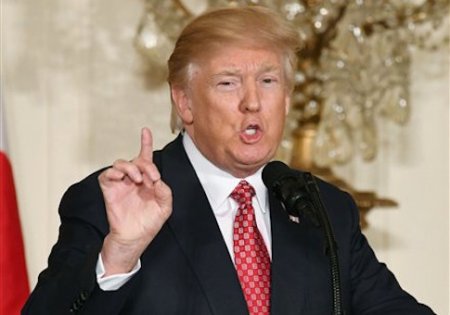
trump_us_japan_57031-jpg-9e9b3_c0-0-2838-1654_s885x516President Donald Trump speaks during a joint news conference with Japanese Prime Minister Shinzo Abe, Friday, Feb. 10, 2017, in the East Room of the White House in Washington. (AP Photo/Pablo Martinez Monsivais)

President Trump said Friday he’ll do “whatever’s necessary” to protect the country from terrorism, including unspecified new executive action next week, in light of a federal appeals court ruling against his “extreme vetting” order.

“We are going to keep our country safe,” Mr. Trump said at a news conference, indicating he would take more actions next week to modify the order or issue another directive.

“We’ll be doing something very rapidly having to do with the additional security for our country,” Mr. Trump said. “You’ll be seeing that sometime next week.”

The president didn’t directly refer to his daily classified intelligence briefings, but his comments suggested that the information he’s received since taking office has made his executive order for migrants from seven terror-prone nations even more urgent to implement.

“While I’ve been president, which is just for a very short period of time, I’ve learned tremendous things that you could only learn, frankly, if you were in a certain position, namely president,” Mr. Trump said. “And there are tremendous threats to our country. We will not allow that to happen, I can tell you that right now.”

He added, “we’ll be going forward and we’ll be doing things to continue to make our country safe. It will happen rapidly and we will not allow people into our country who are looking to do harm to our people.”

But he also said he is confident his administration will win the court case on further appeal.

“It shouldn’t have taken this much time because safety is a primary reason,” Mr. Trump said of the court case. “We’re going to do whatever’s necessary to keep our country safe. One of the reasons I’ms standing here today is the security of our country, the voters felt I would give it the best security.

The 9th Circuit Court of Appeals on Thursday night upheld a temporary restraining order that blocks the president’s extreme vetting plan.

Appeals Court Upholds The Suspension Of Pres Trump’s Temporary Travel Ban – Lou Dobbs – Hannity

February 10, 2017

Appeals Court Upholds The Suspension Of Pres Trump’s Temporary Travel Ban – Lou Dobbs – Hannity, Fox News via YouTube, February 9, 2017

(The video focuses mainly on President Trump’s agenda and slow-walking by the Republican establishment in Congress. — DM)


Uncertain Futures: China, Trump and the Two Koreas

February 10, 2017

Uncertain Futures: China, Trump and the Two Koreas, 38 North, February 9, 2017

(Kim Jong-un may be insane. Or, like his predecessors, he may pretend to be insane to make predictions about his behavior very difficult and often impossible. China’s leaders are not insane, they are merely devious. Dealing with them has been, and will continue to be, very difficult. — DM)

China waving flag on bad day

China waving flag on bad day

At the beginning of the Trump administration, the situation on the Korean peninsula is highly uncertain and potentially volatile. During a late January research trip to Beijing, “uncertainty” and “concerns” were the keywords that best characterized how Chinese scholars and officials are feeling about Trump and the two Koreas. During his presidential campaign, Trump suggested that he would be willing to negotiate with North Korea directly. However, that scenario has become more uncertain in recent months, especially given the hawkish instincts of President Trump and his national security team. Chinese analysts nonetheless expect the US to enlist Beijing’s support on the North Korea issue and are anxiously waiting for Washington to engage so that China can bargain for its preferred outcomes. The prolonged silence from the administration is making Beijing increasingly uncertain and uncomfortable, and complicating its plans to reduce the threat that the United States and its network of alliances in Northeast Asia poses to Chinese security and strategic influence.

Between 2013 and 2016, China tested an alternative alignment strategy on the Korean peninsula. Frustrated with North Korea’s brinkmanship continuously damaging Chinese security interests, President Xi Jinping placed his hope on South Korean President Park Geun-hye to improve China’s strategic position. At the heart of this scheme was an effort to turn South Korea into China’s “pivotal” state in Northeast Asia, thereby undermining the US alliance system in the region and diminishing its threat to China. As a result of Sino-ROK rapprochement, senior-level visits soared, bilateral economic ties strengthened and many South Koreans questioned the utility and future of the US-ROK alliance. In an ideal scenario, China’s new realignment strategy would defeat the US-orchestrated “Northeast Asia NATO” based on America’s alliances with Japan and Korea, and counter the US-Japan alliance with an alignment between China and both Koreas. From the Chinese point of view, this would not only reduce China’s vulnerability vis-à-vis the US, but also lay a firm foundation for Chinese regional predominance.

However, events after the fourth North Korean nuclear test in January 2016 entirely derailed China’s scheme. Overestimating its presumed influence over Seoul, Beijing refused to adequately address South Korea’s legitimate security concerns, which eventually led to Seoul’s decision to deploy the Terminal High Altitude Area Defense (THAAD) system. China sees the THAAD deployment as a threat to strategic stability with the United States and an obstacle to its desired regional blueprint. As such, Chinese policy toward the Korean peninsula has evolved significantly in the last year, reflecting the realization that undermining the US-ROK alliance and turning South Korea into a Chinese strategic asset were both improbable in the near future and raising the prospect that Beijing might not have a choice between the two Koreas after all.

Nonetheless, while China’s ambitious efforts to transform geopolitical alignments on the Korean peninsula did not come to fruition, it still has two other key priorities. First, Beijing has not completely given up its efforts to defeat the THAAD deployment. At a minimum, it hopes that a victory for progressive forces in the upcoming South Korean presidential election, such as the Minjoo Party, could alter Seoul’s deployment plans for the system. While acknowledging that a complete reversal of the deployment decision is unlikely, Beijing hopes that a new South Korean government might delay the initial deployment or reduce the number of deployed units. China sees the propensity of the progressives to engage North Korea, to improve relations with China and to limit the scope of the US-ROK alliance as aligned with its overall strategic agenda. Although China’s ability to sway a South Korean domestic election is limited—for example, by maintaining the implicit sanctions China has imposed on South Korean companies, products and industries for the THAAD deployment—its preference and influence are expected to have an impact.

Second, China hopes to mitigate the impact that any future North Korean intercontinental ballistic missile (ICBM) test might have on its strategic position and influence on the peninsula. The conventional wisdom is that North Korea will not want to conduct the test immediately after Trump’s inauguration, as it will almost certainly block the chance for dialogue with the new US administration and boost the popularity of the conservatives in the South Korean election. However, based on North Korea’s previous pattern of behavior, Chinese experts expect to see provocations in the coming months if Trump chooses to follow Obama’s policy of strategic patience. At the same time, Chinese analysts are inclined to downplay the significance of such an ICBM test, citing the immaturity of North Korea’s long-range missile technology and its likely failure. Still, Beijing will oppose any preemptive strike by the US on the launch site, although it does not fully believe that the US would take such a risky move and jeopardize South Korean security—a fundamental assumption embedded in China’s assessment of the prospects for conflict on the Korean peninsula.

Beijing has always insisted that North Korea’s nuclear development is motivated by Pyongyang’s vulnerability and insecurity, and argued that only the US and North Korea can resolve the stalemate through a peace negotiation. Selfless as it may sound, there is a certain level of hypocrisy in that position. As it has become clear to American officials and experts that strategic patience failed to address the North Korean nuclear threat, there have been more vocal calls to resume US-DPRK dialogue in return for a decision by Pyongyang to suspend its nuclear and missile tests. For China, the danger lies in the unpredictable consequences of such a bilateral negotiation. If the United States and North Korea decide to move ahead with a deal, the improvement of relations between them and the shifting balance of power on the Korean peninsula will diminish what China perceives as its leverage and strategic influence. Therefore, if the Trump administration unilaterally initiates bilateral talks with North Korea, it will be met with suspicion rather than enthusiasm from Beijing.

China’s potential reaction to a North Korean ICBM test all comes down to one question: What does Beijing want? One thing is clear: China wishes to see denuclearization and peace dialogues, but also wants to be an indispensable party in these dialogues to monitor and influence their direction. Beijing believes that the “dual-track” approach (parallel negotiations on denuclearization and a peace treaty) it proposed in 2016 offers the best hopes for achieving its strategic and security goals. Although the Obama administration largely rejected this approach, Beijing sees a new opportunity to try it again with the Trump administration. Trump should understand, however, that China’s position on the Korean peninsula is neither objective nor neutral and that it will view all solutions primarily through the lens of its strategic competition with the United States. As a result, it is important for all the concerned parties to have realistic expectations about a grand bargain with China over North Korea and treat it with extreme caution.

The US-China relationship under Trump is undoubtedly the largest uncertainty in China’s relations with both North and South Korea. If the Trump administration, as appears to be the case, chooses a more confrontational approach towards China, soliciting Beijing’s support and assistance in pressuring North Korea will be exceedingly difficult. A more hawkish stance from the United States will make Beijing instinctively seek more policy leverage, and provocative North Korea behavior that goes unpunished militarily by the United States offers tremendous opportunities for Beijing to be wooed by Americans to rein in Pyongyang. Past experience, including the Cheonan incident, the shelling of Yeonpyeong Island and South Korea’s THAAD deployment, have demonstrated the high level of leniency Beijing will afford Pyongyang when the United States applies greater pressure on China in response to such provocations.

The application of US secondary sanctions on China, which some American officials and experts have discussed, is likely to make China less rather than more cooperative on North Korea. It is unlikely that effective sanctions could be imposed on these entities without poisoning bilateral relations and adversely affecting China’s willingness to cooperate with the US on North Korea. China opposes unilateral sanctions as a general principle, and in particular condemns those that affect Chinese companies or interests. Beijing’s cooperation on the Iran nuclear deal was not incentivized by US sanctions on the Chinese Bank of Kunlun and Zhuhai Zhenrong, but by the opportunities offered for expanding Chinese influence in the Middle East and leveraging its cooperation in overall relations with Washington. In the Chinese view, the North Korea nuclear program, unlike the Iranian case, is much more complicated and sensitive because it directly affects China’s national security, and therefore requires more comprehensive and political solutions.

If the Trump administration’s primary goal is to confront China and thwart Beijing’s regional ambitions, the most effective policy (and the worst nightmare for China) would be a unilateral improvement of relations with North Korea. Whether that is politically possible depends on how far the administration is willing to pursue diplomacy and negotiations to defuse the North Korean threat. On the contrary, pressuring China is unlikely to make it cooperate. Beijing wants a grand bargain over the future of the Korean peninsula conducive to China’s interests. Without a proper endgame to incentivize the Chinese and a policy of dialogue that allows Beijing a key seat at the table, neither pressure nor solicitation will succeed.

Dr. Jasser reacts to a Seattle judge’s ruling regarding the travel ban 02.07.2017

February 9, 2017

Dr. Jasser reacts to a Seattle judge’s ruling regarding the travel ban 02.07.2017, AIFD via YouTube, February 7, 2017

(Please see also, A Maniac is Running Our Foreign Policy! (It’s Not Trump). — DM)


A Maniac is Running Our Foreign Policy! (It’s Not Trump)

February 9, 2017

A Maniac is Running Our Foreign Policy! (It’s Not Trump), Front Page MagazineAnn Coulter, February 9, 2017

(There has been much criticism of President Trump’s rather mild criticism — please see also, A Strange Ruling from a Strange Judge —  of  “so called” Judge Robart. I disagree with the notion that Judges should be immune to criticism regardless of the stupidity demonstrably erroneous natures of their rulings, while other officials nominated by the President and approved by the Senate are fair game. From whence and why did that notion arise? Do judges assume a civil divinity when confirmed? When they don black robes? Had President Trump referred to the Judeo-Christian God as a “so-called God,” I suspect the outrage would have been less vocal and widespread. Perhaps only a similar reference to Allah would have been equally vocal and widespead.– DM)

judge-james-robart

When Arizona merely tried to enforce the federal immigration laws being ignored by the Obama administration, the entire media erupted in rage at this incursion into the majestic power of the president over immigration. They said it was like living in Nazi Germany!

The most reviled section of the act, melodramatically called the “Papers Please” law, was upheld by the Supreme Court. But the other parts, allowing state officials to enforce federal immigration laws, were ruled unconstitutional. A president’s policy choice to ignore immigration laws supersedes a state’s right to enforce them.

The court conceded that hundreds of thousands of illegal aliens were arrested in Arizona each year, that they were responsible for “a disproportionate share of serious crime,” and that illegals constituted nearly 6 percent of Arizona’s population.

But Arizona was powerless to enforce laws on the books — if those laws happened to be about immigration. The president’s authority over immigration is absolute and exclusive, as part of his authority over foreign policy.

**********************

If only we were able to deport citizens, we could use Trump’s new policy of excluding those who are “hostile” toward our country to get rid of Judge James Robart.

Judge Robart’s veto of Trump’s travel ban notwithstanding, there is not the slightest question but that the president, in his sole discretion, can choose to admit or exclude any foreigners he likes, based on “the interests of the United States.”

The Clinton administration used the executive branch’s broad power over immigration to send a 6-year-old boy back to a communist dictatorship. The courts were completely powerless to stop him.

As explained by the federal appellate court that ruled on Elian Gonzalez’s asylum application: “It is the duty of the Congress and of the executive branch to exercise political will,” and “in no context is the executive branch entitled to more deference than in the context of foreign affairs,” which includes immigration.

The court acknowledged that Elian might well be subjected to “re-education,” “communist indoctrination” and “political manipulation.” (Then again, so would enrolling him at Sidwell Friends.) It didn’t matter! Sending little boys back to communist dictatorships was the policy of the Clinton administration.

The Obama administration’s immigration policy was to ensure that millions of poverty-stricken foreigners would come here and help turn our country into a Mexican version of Pakistan.

When Arizona merely tried to enforce the federal immigration laws being ignored by the Obama administration, the entire media erupted in rage at this incursion into the majestic power of the president over immigration. They said it was like living in Nazi Germany!

The most reviled section of the act, melodramatically called the “Papers Please” law, was upheld by the Supreme Court. But the other parts, allowing state officials to enforce federal immigration laws, were ruled unconstitutional. A president’s policy choice to ignore immigration laws supersedes a state’s right to enforce them.

The court conceded that hundreds of thousands of illegal aliens were arrested in Arizona each year, that they were responsible for “a disproportionate share of serious crime,” and that illegals constituted nearly 6 percent of Arizona’s population.

But Arizona was powerless to enforce laws on the books — if those laws happened to be about immigration. The president’s authority over immigration is absolute and exclusive, as part of his authority over foreign policy.

To review:

— When the president’s immigration policy is to promote international communism: The president wins.

— When the president’s immigration policy is to transform America into a different country: The president wins.

— But when the president’s immigration policy is to protect Americans: Some piss-ant judge announces that his authority exceeds that of the president.

This is exactly what I warned you about in Adios, America: The Left’s Plan to Turn Our Country into a Third World HellholeNothing Trump does will be met with such massive resistance as his immigration policies.

The left used to attack America by spying for Stalin, aiding our enemies, murdering cops and blowing up buildings. But, then liberals realized, it’s so much more effective to just do away with America altogether!

Teddy Kennedy gave them their chance with the 1965 immigration act. Since then, we’ve been taking in more than a million immigrants a year, 90 percent from comically primitive cultures. They like the welfare, but have very little interest in adopting the rest of our culture.

In many parts of the country, you’re already not living in America. Just a few more years, and the transformation will be complete. There will be a North American landmass known as “the United States,” but it won’t be our country.

The only thing that stands between America and oblivion is a total immigration moratorium. We are well past the point of quick fixes — as Judge Robart’s delusional ruling proves.

The judiciary, both political parties, the media, Hollywood, corporate America and approximately 1 million lobbying groups are all working frantically to bring the hardest cases to our shores. Left-wing traitors, who used to honeymoon in Cuba and fight with peasant revolutionaries in Peru, toil away, late into the night, to ensure that genocidal Rwandans can move to America and immediately start collecting food stamps, Medicaid and Social Security.

No matter how clearly laws are written, government bureaucrats connive to import people from countries that a majority of Americans would not want to visit, much less become. Federal judges issue lunatic rulings to ensure that there will never be a pause in the transformation of America.

Congress could write laws requiring immigrants to pay taxes, learn English, forgo welfare and have good moral character. It could write laws giving the president authority to exclude aliens in the public interest.

Except it already has. Those laws were swept away by INS officials, federal judges and Democratic administrations — under ferocious pressure from America-hating, left-wing groups.

The country will not be safe until the following outfits are out of business:

The ACLU’s Immigrants’ Rights Project; the National Immigration Forum; the National Immigration Law Center; the National Immigration Project of the National Lawyers Guild; the National Network for Immigrant and Refugee Rights; the Office of Migration and Refugee Services; the American Immigration Law Foundation; the American Immigration Lawyers Association; the Border Information and Outreach Service; Atlas: DIY; the Catholic Legal Immigration Network; the Clearinghouse for Immigrant Education; the Farmworker Justice Fund; Grantmakers Concerned with Immigrants and Refugees; the Immigrant Legal Resource Center; the International Center for Migration, Ethnicity and Citizenship; the Lesbian and Gay Immigration Rights Task Force; the Lutheran Immigration and Refugee Service; the National Association for Bilingual Education; the National Clearinghouse on Agricultural Guest Worker Issues; the National Coalition for Dignity and Amnesty for Undocumented Immigrants; the National Coalition for Haitian Rights; the National Council of La Raza; and the National Farm Worker Ministry.

And that’s only a small fraction of the anti-American immigration groups assiduously dragging the Third World to our shores — while you were busy working.

Look at that list — look at Judge Robart’s ruling! — and ask yourself: Is it possible that anything short of a total immigration moratorium can save this country? Only when there is no immigration to bellyache about will these nuts be forced to think of a new way to destroy America.

Flynn: “If we can’t tackle enemy doctrines that call for our domination or extinction, we aren’t going to destroy their jihadis”

February 9, 2017

Flynn: “If we can’t tackle enemy doctrines that call for our domination or extinction, we aren’t going to destroy their jihadis”, Jihad Watch

“The war against Radical Islamists must begin at home,” he writes. “Muslims want to apply Sharia law by using our own legal system to strengthen what many believe to be a violent religious law that has no place in the United States,” he writes, adding the government must stop implying Islamic and Western civilizations “are morally equivalent.”

**************************

It is so refreshing to see this realism and common sense after eight years of Obama’s denial and willful ignorance.

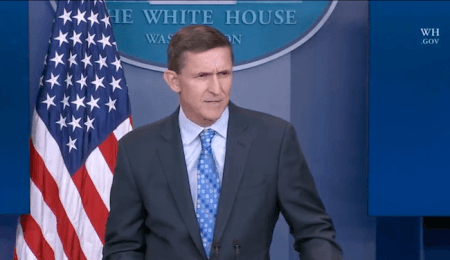
michael-flynn

“Flynn’s plan to beat radical Islam starts with schools and social media,” by Paul Sperry, New York Post, February 4, 2017:

President Trump’s national security adviser wants to fight not just Islamic terrorists but the “radical ideology of Islam,” and he plans to do it from the grass roots up, starting with our children at schools while also using social media.

Dealing with the global Islamist threat on a tactical level through drone strikes and arrests hasn’t worked, retired Lt. Gen. Michael Flynn argues, according to his largely overlooked 2016 book, “The Field of Fight: How We Can Win the Global War Against Radical Islam and Its Allies.” He wants to combat it more broadly, using informational warfare, among other things, on a scale not seen since World War II.

But first, he writes, the government has to overcome the political taboo of tying Islamic violence to the religion of Islam, including its sacred texts, which he says the enemy is using as a manual of warfare….

“If we can’t tackle enemy doctrines that call for our domination or extinction,” Flynn writes, “we aren’t going to destroy their jihadis.”…

“It’s long past time for us to denounce the many evils of Radical Islam,” he writes, while highlighting the many defeats of ISIS and al Qaeda to show potential recruits that “the Almighty has changed sides in the holy war.”Fired by former President Barack Obama from the Defense Intelligence Agency for taking such stands, Flynn vows to reverse the longstanding government practice of whitewashing the violent nature of the enemy’s faith through pleasant platitudes like, “The terrorists are hijacking a religion of peace” and other apologia. He calls such policies “Islamophilia,” and complains they border on appeasement.

“I firmly believe that Radical Islam is a tribal cult, and must be crushed,” he writes.

In his book, Flynn says the Islamist enemy studies our culture “very carefully” and excels at “identifying our weaknesses,” while we, on the other hand, have done very little to exploit weak points in their ideology. We suffer pangs of guilt just “calling them by name and identifying them as fanatical killers acting on behalf of a failed civilization.”

That “failed civilization,” he notes, is Islam, and he says the government must publicly point out its failures, from depressed economies to high illiteracy rates to oppression of women, while supporting “a complete reformation of the Islamic religion” throughout the Muslim world.

He suggests working closely with the president of Egypt, who has called for a renewal of Islam. He also praises reforms pushed by Singapore to convince Muslims that there’s no requirement to follow Sharia in a secular state and that Allah hasn’t blessed jihad against the West. He also cites the half dozen countries that have banned Islamic headscarves around the world.

“We’ve got to get inside the minds of the jihadis” and understand the doctrinal justification for “the cult of killing, the worship of death” and why they, literally, “eagerly drink the blood of their dying enemies,” Flynn writes. What in their scripture brainwashes them into thinking, “We love death more than you love life?” Once that doctrine is exposed, it can be undermined to the point where it loses its potency….

“The war against Radical Islamists must begin at home,” he writes. “Muslims want to apply Sharia law by using our own legal system to strengthen what many believe to be a violent religious law that has no place in the United States,” he writes, adding the government must stop implying Islamic and Western civilizations “are morally equivalent.”“Let us accept what we were founded upon: a Judeo-Christian ideology built on a moral set of rules and laws,” he writes. “Let us not fear, but instead fight those who want to impose Sharia law and their Radical Islamist views.”…

“We can’t win this war by treating Radical Islamic terrorists as a handful of crazies and dealing with them as a policing issue,” he writes. “The political and theological underpinnings of their immoral actions have to be demolished.”