Posted tagged ‘Terrorism’

Turkish ‘Ministry of Religion’ promotes martyrdom to children in colorful comic strips

December 31, 2016

Turkish ‘Ministry of Religion’ promotes martyrdom to children in colorful comic strips

Published time: 3 Apr, 2016 22:32 Edited time: 4 Apr, 2016 10:22

Source: Turkish ‘Ministry of Religion’ promotes martyrdom to children in colorful comic strips — RT News

The latest issue of a children’s magazine published by Diyanet, the Turkish Presidency of Religious Affairs, which is a government agency and the highest national religious body, contains a series of cartoons glorifying Islamic martyrdom.

A colorful cartoon titled “may god bless our martyrs, may their graves be full with holy light” features dialogues between parents and children that promotes an idea of religious martyrdom. In one box of the comics, a father says to his son: “How good it is to be a martyr…” He also adds that martyrdom gives a person an opportunity “to gain the right to go to heaven.”

In another box from the comics, a girl can be seen saying “I wish I could be a martyr.” “If you desire enough, Allah will give you that opportunity,” the mother in the box replies to the girl.

A statement near the last picture reads: “Our prophet says: a martyr feels the pain of dying as much as you feel pain when being pinched.”

Read more

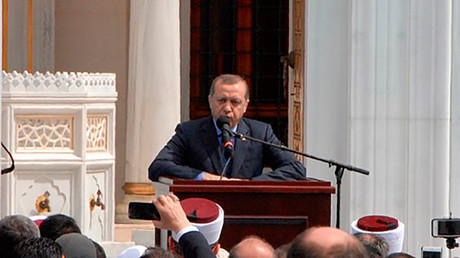
Turkish President Tayyip Erdogan speaks during a dedication ceremony for an Islamic mosque in Lanham, Maryland, April 2, 2016 © Thomas Ramstack

Another statement attributed to Prophet Mohammed says: “A martyr would love to go back to the real world and be martyr 10 times more after the honoring and prestige they receive in the heaven.”

Psychologist and professor Dr. Serdar Degirmencioglu harshly criticized the latest issue of the Diyanet’s “Child Magazine” featuring the controversial comics, but said that introducing children into the ideas of radical Islam has long been part of the Turkish government’s policy.

“They want to use the drawings to transfer the message of martyrdom to children because they think it will be more attractive,” he said in an interview with the Turkish Evrensel newspaper adding that the idea of martyrdom promoted by the government describes it as a “painless death and a promise of heaven.”

“Religiosity has, in recent years, turned into a literal political tool. They do not even hide it. The Ministry of Religion was provided more money than several other ministries combined and continues intensive work for religious children,” he added.

Read more

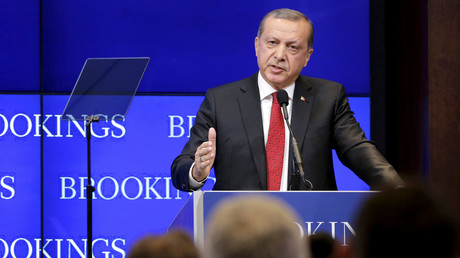
Turkish President Tayyip Erdogan speaks at the Brookings Institute in Washington March 31, 2016. © Joshua Roberts

The professor also equated the mentality promoted by such comics with the mentality of those who committed deadly terrorist attacks in Turkish Ankara and Suruc, as well as Brussels and Paris.

“Turkey is overwhelmed with the pain of these massacres and with those pursuing the mentality of religiosity. All this has led to the death of people. Exactly the same mentality that blinds people to the horrors is what the Presidency of Religious Affairs is trying to spread among the children in Turkey. The children will grow up and they will run toward death when those in power tell them to,” he told Evrensel.

Diyanet follows and promotes the orthodox Sunni Islam tradition not only in Turkey, but also abroad. On Saturday Turkish President Recep Tayyip Erdogan inaugurated a new multimillion Diyanet Center of America, calling it the Turkish-American Center of Culture and Civilization.

A complex, which, according to the Turkish Daily Sabah newspaper, contains “one of the largest Turkish mosques” alongside conference halls, basketball courts, a restaurant, Turkish bath and a cultural research center, was built by funds from Turkish Presidency of Religious Affairs as well as some NGOs.

During the opening ceremony, Erdogan called the complex “a center of civilizations” and said that it would serve both American Muslims and people of other faiths, as well as promote Islam’s message of love and compassion.

UN Approves Funding for First Anti-Israeli ‘Settlement’ Blacklist

December 30, 2016

UN Approves Funding for First Anti-Israeli ‘Settlement’ Blacklist

By Patrick Goodenough | December 27, 2016

Source: UN Approves Funding for First Anti-Israeli ‘Settlement’ Blacklist

(CNSNews.com) – On the same day as the U.N. Security Council passed a controversial resolution condemning Israel, the 193-member U.N. General Assembly on Friday approved a budget that includes $138,700 to fund the compilation of a first-ever U.N. blacklist of private companies doing business in territories disputed between Israel and the Palestinians.

Defined in U.N. documents as a “database,” the blacklist will cover companies of any nationality that do business in Israeli “settlements” located in areas claimed by the Palestinians, including Jerusalem’s Jewish Quarter.

The move, which was mandated by the U.N. Human Rights Council (HRC) last March, is expected to benefit the anti-Israel boycott, divestment and sanctions (BDS) campaign.

The U.S., not a member of the HRC this year, did not have a vote on the matter in March, although the State Department did criticize the decision, with spokesman John Kirby calling it “an unprecedented step” that was “far outside” the scope of the HRC’s authority.

U.S. taxpayers account for 22 percent of the U.N.’s regular operating budget, plus billions of dollars more in voluntary contributions to various parts of the U.N. system each year.

Since Friday’s Security Council resolution – which passed after the Obama administration chose to abstain rather than exercise its veto – several Republican lawmakers have vowed to target U.S. funding for the world body.

The General Assembly approves the budget for the HRC, and was asked this year to green light $26.4 million over and above earlier estimates, to pay for resolutions and decisions taken during the council’s periodic sessions in Geneva.

Included in that request was the sum of $138,700 – $102,400 to pay for the individual tasked to compile the Israeli settlement blacklist over a period of eight months, and $36,300 for “documentation.”

The HRC resolution called for the list to be presented to the council at an upcoming month-long session, which is scheduled to begin in late February next year.

Earlier this month, Palestinian representative Abdullah Abushawesh made clear the BDS goal behind the move.

“We should block the source of financing for settlements on occupied Palestinian territory, in particular by drawing up a list of companies that operate on this territory, whether these companies are Israeli or from other countries,” he told General Assembly member-states considering the budget request.

“As soon as this list is drawn up we encourage all to disseminate it, and to help these transactions with these companies to be stopped,” Abushawesh said through a translator.

“Because I am sure that you would all agree that these settlements are illegitimate,” he added. “As a consequence, any products there are also illegitimate and should not be sold on your markets.”

Hours before the General Assembly adopted the budget resolution without a vote on Friday night, it was approved by the assembly’s “Fifth Committee,” which deals with budgetary affairs.

At that committee session earlier in the day, Israel’s delegation tried to insert an amendment to exclude funding for the blacklist. It was criticized by other delegates for introducing “political elements” – in the words of Slovakia, speaking for the European Union – into what they argued should be a strictly budgetary process.

Israel’s proposal was then put to a vote, and failed dismally, with just six countries (the U.S., Israel, Australia, Canada, Guatemala and Palau) in favor and 151 opposed.

Israel’s delegate afterwards dissociated his country from the specific funding requirement for the blacklist, saying that the funds were being “used to target the State of Israel.”

“It’s time to remove resources for activities that have only one agenda – to politicize the work of the Human Rights Council,” he said.

Last month, the office of the U.N. human rights commissioner Zeid Ra’ad Al Hussein formally invited “all interested persons, entities and organizations” to submit information to enable it to compile the HRC-mandated blacklist.

“The identity of sources of information will be kept confidential,” it said in a notice requesting that concise and pertinent submissions be emailed by November 30.

Ahead of Friday’s budget vote in New York that included funding for the blacklist, Anne Bayefsky, president of the U.N.-focused NGO Human Rights Voices, warned that American companies “are in for a shock.”

“American taxpayers can expect to find themselves funding BDS in the very near future, with American businesses caught in the crosshairs,” Bayefsky wrote.

Plane crash ups Syria-tied Russian deaths to 310

December 26, 2016

Plane crash ups Syria-tied Russian deaths to 310, DEBKAfile, December 26, 2016

tu-154_crash_25-12-16

The Black Sea crash, if an act of terror is proven, will demonstrate that Russia has become a central target for Islamic terrorists, especially ISIS and Al Qaeda’s Syrian arm, the Nusra Front, and is paying a cruel price for its role in the Syrian conflict.

************************

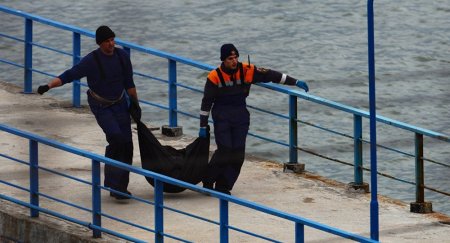
Notwithstanding the extraordinary circumstances surrounding the Russian Tu-154 air crash into the Black Sea minutes after its takeoff for Syria from Sochi early Sunday Dec. 25, the dread announcement that none of the 92 people aboard had survived was not accompanied by an official suggestion of terrorism.

That suggestion began rising to the surface later in the day. Transport Minister Maxim Sokolov reported the finding of 11 bodies in the sea, adding ominously that “fragments of other bodies were also found.” He added: “Of course the entire spectrum and almost any possible causes…are being probed, but it is premature now to speak about this as a terrorist act.”

Maj. Gen. Igor Konashenkov, a military spokesman put in that the pilot was “first-class,” and the 33-year-old Tupelov passenger jet had been serviced recently.

But by then, investigators must have had some idea of what caused the crash just two minutes after takeoff – too suddenly for the pilot to send a distress signal.

Did they find evidence of explosives planted on the plane or, possibly, a sabotaged fuel line or tank, or a passenger carrying a bomb or wearing a bomb vest? A possibly technical fault cannot be ruled out at this stage. However, the unusual Russian response to the disaster indicated that the Kremlin was in a hurry to find answers and that its emergency infrastructure was in high gear to cope with a massive terrorist attack. Deployed to the scene of the crash was an army of 3,000 rescue personnel, including 100 divers, who were rushed in from all parts of Russia, along with 32 ships and submarines and scores of helicopters and drones – all engaged in gathering every scrap of debris and human remains for a complete picture of the disaster.

While world attention remains focused on the wave of terror overtaking Europe, Islamist terrorists including ISIS, are clearly placing Russia firmly in their sights, especially since its intensified military intervention in Syria last September.

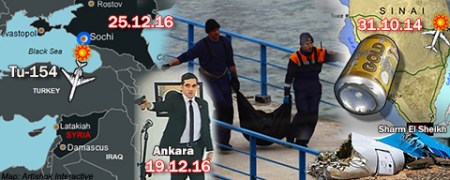
Still registered on the collective Russian consciousness is the tragic downing of the Metrojet Airbus on Oct. 31 2015 over Egyptian Sinai, after taking off from Sharm El-Sheikh, then a favorite Russian tourist resort. None of the 217 passengers and crew survived.

Still ringing in Russian ears is the voice of the Turkish assassin yelling: “Remember Syria! Remember Aleppo!” six days earlier, after he shot Andrew Karlov, 62, the Russian ambassador to Ankara. The video of the crime played out on TV screens across the world.

russainblackseaplane480

So far, President Vladimir Putin has managed to minimize the casualties of Russian military personnel involved in the Syrian war. But the number of fatalities building up from terrorism under the shadow of that war may have just jumped to an ominous level to 310 – not counting soldiers.

The Black Sea crash, if an act of terror is proven, will demonstrate that Russia has become a central target for Islamic terrorists, especially ISIS and Al Qaeda’s Syrian arm, the Nusra Front, and is paying a cruel price for its role in the Syrian conflict.

The doomed Tupolev was carrying more than one popular national symbol: 64 singers of the Red Army Choir, known as the Alexandrov Ensemble, a troupe of dancers, and Yelizaveta Glinka, known popularly as “Doctor Liza,” beloved leader of an organization for aiding victims in Russian combat zones. Nine reporters were also on the plane.  Putin declared Monday a day of national mourning.

They were all flying to the Russian Hmemim airbase in Latakia with a shipment of medicines. A concert for the troops was booked for the New Year.

Terrorists have for years had their eye on the celebrated Black Sea resort of Sochi, venue of international summits and favorite winter getaway location for Russian rulers, including Putin, who maintains a holiday residence there. An assault on Sochi is therefore a poke in the eye for the Russian president and the Russian military and security agencies battling terrorism.

FROM THE RIVER TO THE SEA – A CALL FOR GENOCIDE

December 24, 2016
Published on Oct 15, 2015

By Pierre Rehov. www.middleeaststudio.com

According to most Palestinians, “Israeli Occupation” means Tel Aviv, Ber Sheva and Haifa, and for their leaders, Palestine should be built “From the River to the Sea”. Meaning, should replace Israel, from the Jordan River to the Mediterranean Sea.

In this disturbing film, “From the River to the Sea”, a revised version of “Hostages of Hatred” acclaimed director Pierre Rehov sets out to tell us the real story of those men, women and children, who have been shamefully used as mere pawns for over 50 years, by Arab leaders at first, by Palestinian leaders later on and until this very day but also by the United Nations’ body that was specially created to supposedly take care of them: the United Nations Relief and Works Agency, UNWRA.

Hezbollah using US weaponry in Syria: senior Israeli military officer

December 22, 2016

Hezbollah is using US weaponry in Syria, according to a senior Israeli military officer

Reuters

(By Ori Lewis; editing by Jeffrey Heller)

Source: Hezbollah using US weaponry in Syria: senior Israeli military officer – Business Insider

TEL AVIV (Reuters) – Israel has informed the United States that Lebanese Hezbollah fighters in Syria are using U.S. armored personnel carriers originally supplied to the Lebanese Army, a senior Israeli military officer said on Wednesday.

The U.S. State Department said last month that the American embassy in Beirut was working to investigate images on social media purporting to show Hezbollah, which supports President Bashar al-Assad, displaying U.S. military equipment in Syria.

Those images were widely reported to have been of U.S.-made M113 armored personnel carriers, which the State Department said were extremely common in the region.

In an intelligence briefing to foreign reporters in Tel Aviv, the senior officer showed a photograph of military vehicles, which he said included U.S.-made armored personnel carriers (APCs), along a road.

“These APCs are of the Hezbollah, while fighting in Syria, that they took from the Lebanese armed forces,” he said in English, describing the guerrilla group as dominant in Lebanon.

shia militia M113 APC

An M113 armored personnel carrier in the possession of Iraqi Shia militias.

“We shared this information with other countries, including the U.S. of course, and I can even say that we recognized these specific APCs with some specific parameters that we know … these were given to the Lebanese armed forces. It’s not an assumption,” said the officer, who under the rules of the briefing could not be identified by name, rank or position.

Western diplomatic sources have said the APCs were delivered to the Lebanese Army by the United States as part of a program to equip that force.

The officer made no comment about when the APCs would have been supplied to the Lebanese Army.

The officer said Hezbollah has 8,000 fighters in Syria where more than 1,700 of the group’s combatants have been killed since 2011.

Israel and Hezbollah, which the officer said has 30,000 members, half of them combatants, last fought a war in 2006.


Iran to Trump: Death to America Will Live On

December 5, 2016

Iran to Trump: Death to America Will Live On

by Majid Rafizadeh

December 5, 2016 at 4:00 am

Source: Iran to Trump: Death to America Will Live On

  • Ayatollah Ali Khamenei made it clear that Trump’s presidency causes “no difference” to Iran-US relationships. He called the Americans’ election “a spectacle for exposing their crimes and debacles.”
  • “Thank God, we are prepared to confront any possible incident.” — Iran’s Supreme Leader, Ayatollah Ali Khamenei.
  • From the perspective of Iranian moderates, reformists and hardliners, the US is not a superpower anymore; but a weak actor in the Middle East and on the global stage.
  • Iranian leaders also made it clear that Tehran will continue supporting Hezbollah and other groups that have been designated as terrorist groups by the US Department of State. These groups pursue anti-American and anti-Israeli agendas.

Ideologically speaking, Iran’s hardliners, primarily Supreme Leader Ayatollah Ali Khamenei and senior officials of the Islamic Revolutionary Guard Corps (IRGC) who enjoy the final say in Iran’s domestic and foreign policies, have made it clear that Iran will not change the core pillars of its religious and revolutionary establishment: Anti-Americanism and hatred towards the “Great Satan” and the “Little Satan”, Israel.

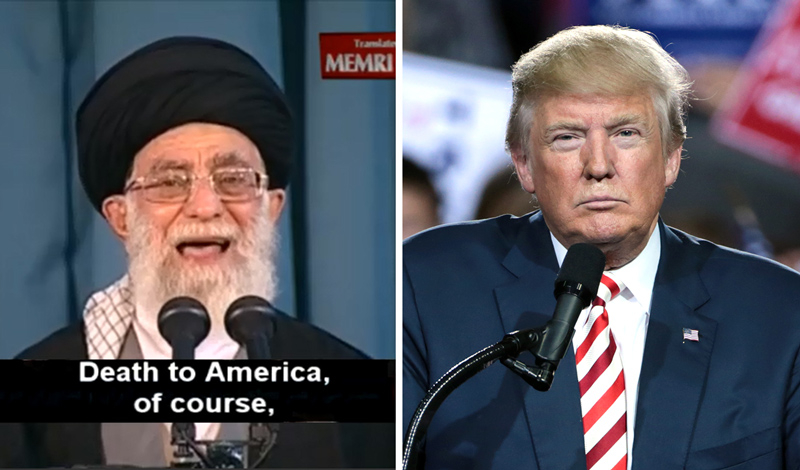
Supporters of Ayatollah Khamenei and the IRGC enthusiastically shouted “Death to America” in response to a recent speech that Khamenei gave, applauding the 1979 hostage-taking and takeover of the US Embassy in Tehran.

Iran’s major state newspapers carried anti-American headlines this week, quoting the Supreme Leader. In his latest public speech to thousands of people, which was televised via Iran’s state TV, Khamenei made it clear that Trump’s presidency will cause “no difference” to Iran-US relationships. Khamenei pointed out that, “We have no judgment on this election because America is the same America”. In his speech, Khamenei attacked President-elect Donald Trump and the American people. The Ayatollah called the US election “a spectacle for exposing their crimes and debacles.”

Other hardliners echoed the same message that there would be no change in Iran’s revolutionary principles and ideals against the US and its allies. The deputy commander of the Revolutionary Guards, Hossein Salami, told Iran’s Fars news agency: “When the Republicans were in power, they threatened us and showed their hostility… and when the Democrats were in power, the policies of the United States were the same.”

Khamenei also remarked that the US will remain the evil, or the “Great Satan,” saying:

“In the past 37 years, neither of the two parties who were in charge did us any good and their evil has always been directed toward us….We neither mourn nor celebrate, because it makes no difference to us… We have no concerns. Thank God, we are prepared to confront any possible incident.”

He added that the remarks made by Donald Trump “over the last few weeks on immoral issues — which are, for the most part, not baseless accusations — are enough to disgrace America.”

Militarily, strategically and geopolitically, Tehran’s core pillars of damaging US national interests, and scuttling US foreign policy objectives will remain intact.

Iran’s semi-official Fars news agency reported that Iran’s armed forces chief of staff, General Mohammad Hossein Bagheri, has heavily criticized Donald Trump for stating that the US will confront Iranian boats in the Gulf if they harass US Navy ships. In the last year, Iran has increasingly harassed and provoked US Navy ships, and detained 11 American sailors.

General Bagheri stated out that, “The person [Trump] who has recently achieved power, has talked off the top of his head! Threatening Iran in the Persian Gulf is just a joke.”

In 2016, the number of incidents of boats from Iran’s navy and Revolutionary Guards provoking and harassing the US Navy ships rose significantly to 31 incidents, highlighting that the IRGC evidently feels sufficiently emboldened to damage US national security publicly and on a regular basis. From the perspective of Iranian moderates, reformists and hardliners, the US is not a superpower anymore; but a weak actor in the Middle East and on the global stage.

In addition, Iran, with underlying anti-American objectives, is aggressively expanding its military presence and naval bases in foreign nations and international waters. Major General Mohammad Hossein Baqheri said, as cited by the Iranian Tasnim news agency, that the expanding presence in international waters and naval bases in foreign countries “could be ten times more efficient than nuclear power.” For the first time, the Iranian Navy’s 44th flotilla, comprised of a Bushehr logistic warship and an Alvand destroyer, has now sailed into the Atlantic Ocean as well.

Tehran is also considering having naval bases on the coasts of Yemen and Syria to support the Assad government and the Houthis. As Iran’s Chief of the General Staff told a gathering of senior naval commanders, “One day, we may need bases on the coasts of Yemen and Syria, and we need the necessary infrastructures for them under international maritime law.”

Iran’s naval commander, Rear Admiral Habibollah Sayyari, also told the gathering of senior naval commanders that boosting military presence in international waters reflects Iran’s power.

According to the Tasnim news agency, Iran’s navy has already deployed 49 flotillas to various maritime zones. Sayyari added that the flotillas showcased Iran’s symbol of power.”

Iranian leaders also made it clear that Tehran will continue supporting Hezbollah and other groups that are designated as terrorist groups by the US Department of State.

These groups pursue anti-American and anti-Israel agendas.

Khamenei and IRGC are sending a strong message that Iran will neither alter its core religious and revolutionary pillar of anti-Americanism, nor change its foreign policy and military objectives of damaging US interests. Iran’s policy towards the “Great Satan” will remain as it has been since the establishment of the Islamic Republic of Iran in 1979.

Dr. Majid Rafizadeh, political scientist and Harvard University scholar is president of the International American Council on the Middle East. He can be reached at Dr.rafizadeh@post.harvard.edu.

The Real Illegal Settlements

December 5, 2016

The Real Illegal Settlements

by Bassam Tawil

December 5, 2016 at 5:00 am

Source: The Real Illegal Settlements

  • While construction in Jewish settlements of the West Bank and neighborhoods of Jerusalem has long been carried out within the frame of the law and in accordance with proper licenses issued by the relevant authorities, the Palestinian construction is illegal in every respect.
  • The Palestinian goal is to create irreversible facts on the ground. The sheer enormity of the project raises the question: Who has been funding these massive cities-within-cities? And why? There is good reason to believe that the PLO and some Arabs and Muslims, and especially the European Union, are behind the Palestinian initiative.
  • The Jewish outpost of Amona, home to 42 families, is currently the subject of fiery controversy both in Israel and in the international arena. Apparently, settlements are only a “major obstacle to peace” when they are constructed by Jews.
  • The EU and some Islamic governments and organizations are paying for the construction of illegal Palestinian settlements, while demanding that Israel halt building new homes for Jewish families in Jerusalem neighborhoods or existing settlements in the West Bank.
  • The hypocrisy and raw malice of the EU and the rest of the international community toward the issue of Israeli settlements is blindingly transparent. Yet we are also witnessing the hypocrisy of many in the Western mainstream media, who see with their own eyes the Palestinian settlements rising on every side of Jerusalem, but choose to report only about Jewish building.

As the international community continues to slam Israel for construction in Jewish settlement communities, Palestinians are quietly engaging in massive construction of entire neighborhoods in many parts of the West Bank and Jerusalem. In addition to overlooking the Palestinian building project, the West has clearly been neglecting a crucial difference between the two efforts: while the construction in the Jewish settlements of the West Bank and neighborhoods of Jerusalem has long been carried out within the frame of the law and in accordance with proper licenses issued by the relevant authorities, the Palestinian construction is illegal in every respect.

In this behind-the-scenes endeavor, which does not meet even the most minimum standards required by engineers, architects and housing planners, the Palestinian goal is to create irreversible facts on the ground.

A quick tour of the areas surrounding Jerusalem from the north, east and south easily exposes the colossal construction that is taking place there. In most cases, these high-rise buildings are slapped together without licenses or any adequate planning or safety concerns.
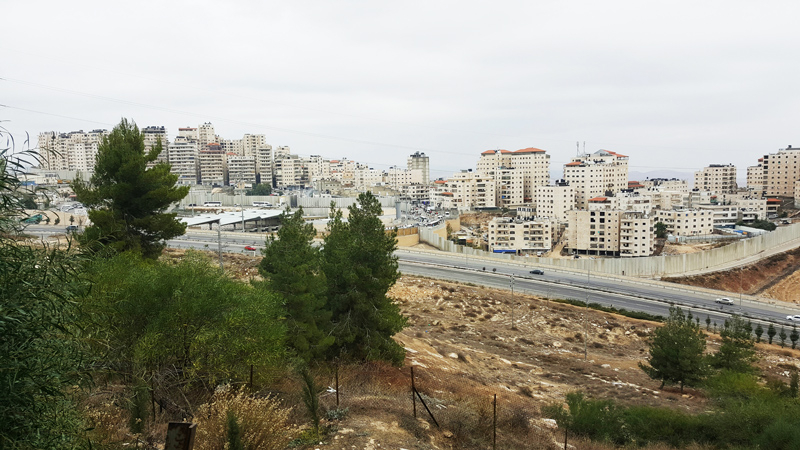
An example of massive illegal Palestinian construction near Shufat and Anata, on the northeastern outskirts of Jerusalem.

The Jewish outpost of Amona in the central West Bank, home to 42 families, is currently the subject of fiery controversy both in Israel and in the international arena. In 2006, the High Court of Israel ruled that the outpost is illegal under Israeli law because it lies on private Palestinian land. In 2014, the High Court ordered the government to evacuate and demolish the entire outpost within two years.

In Israel, as Amona demonstrates, no one is above the law. Israel boasts an independent judiciary system that is second to none.

Yet as the debate in Israel intensifies over the fate of Amona, the Palestinians are making a mockery of laws and building regulations by embarking on massive construction of illegal neighborhoods and buildings. Apparently, settlements are only a “major obstacle to peace” when they are constructed by Jews.

In recent years and continuing to the present, the Palestinians, with the aid of Western donors for whom only Jewish construction is anathema, are working night and day to create irreversible facts in the form of not just single-family houses, but masses of giant high-rise buildings. The sheer enormity of the project raises the question: Who has been funding these massive cities-within-cities? And why? There is good reason to believe that the PLO and some Arabs and Muslims, and especially the European Union are behind the Palestinian initiative.

Ironically, this has been taking place even when it means that the Palestinians have been stealing land from our own people.

The Palestinian building is taking place mostly in what is called Area C of the West Bank, which, under the terms of the Oslo Accords, is supposed to be under exclusive Israeli control. The building has also been mushrooming in many neighborhoods — even in entire villages — surrounding Jerusalem from the north, east and south, leaving the city with only one option: to expand towards the west, thereby building a giant collar of cement effectively to surround and choke off Jerusalem from the Jews.

Recently, entire Arab neighborhoods with crowded high-rises have shot up around Jerusalem. Only a handful of steps separate some of the buildings, and most lack proper sewage systems. Apartment prices range from $25,000 to $50,000 USD. These are ridiculous prices compared with the real costs of apartments in both Arab and Jewish (legal) neighborhoods in Jerusalem. Today, it is almost impossible to purchase a three-room apartment in the city for less than $250,000 USD.

The new neighborhoods are located in Kufr Akab, Samiramis, Kalandya, Beit Hanina, Shufat, Ras Khamis and Anata in the north of Jerusalem.

In the southern and eastern parts of the city, new neighborhoods have emerged with noticeable suddenness in Ras Al-Amoud, A-Tur, Al-Zaim, Jabal Mukaber, Um Tuba and Jabal Mukaber. These areas fall within the municipal boundaries of Jerusalem. However, failing to halt the illegal construction and leaving the city besieged from north, east and south, Jerusalem Municipality officials admit that Israel will have lost the war against illegal Palestinian construction unless immediate action is taken.

Alarmed by the ongoing illegal construction, Jerusalem Mayor Nir Barkat recently took the unprecedented measure of petitioning the High Court to allow the city to demolish 14 illegally built structures in east Jerusalem.

Most importantly, there is no housing crisis for the Arab population; it is not an Arab housing crisis that is prompting this spree of illegal Palestinian construction. Rather, the goal is political: to show the world that Jerusalem is an Arab, and not a Jewish, city. By and large, the apartments remain empty: there is simply no real demand.

Who is behind the unprecedented wave of illegal construction? According to Arab residents of Jerusalem, many of the “contractors” are actually land-thieves and thugs who lay their hands on private Palestinian-owned land or on lands whose owners are living abroad. But they also point out that the EU, the PLO and some Arab and Islamic governments are funding the project.

“They spot an empty plot of land and quickly move in to seize control over it,” said a resident whose land was “confiscated” by the illegal contractors.

“They tell you if you don’t like it, go to court, knowing that by the time the legal procedures are over they would have succeeded in building another tall building and even selling some of the apartments.

“Many Arab land owners feel helpless. They tell us that it is their national duty to build as much as they can on any empty land, otherwise the Jews would be building there.”

Palestinians estimate that in the past few years they have managed to build more than 15,000 illegal housing units in areas surrounding Jerusalem as part of a plan to encircle the city. The construction continues to this moment, unabated. Partial funding comes from the Palestinian Authority (PA) and some Arab and Islamic countries These countries include Qatar, Saudi Arabia, the United Arab Emirates, Kuwait and other oil-rich countries in the Gulf. However, the Palestinians continue to complain that the Arab and Islamic funding is below expectations.

In Area C, a stretch of land accounting for 60% of the West Bank, the European Union, which bitterly condemns construction in Jewish settlements as illegal, openly funds illegal construction carried out by Palestinians. The EU argues that its support for Palestinian construction falls under the category of “humanitarian relief” and is permissible under international law.

The EU’s real goal is to help the Palestinians create these irreversible facts on the ground ahead of any possible future peace deal between the Palestinians and Israel. It is aimed at facilitating the mission of the Palestinians to seize as much land as possible, even if that means funding illegal construction or providing mobile homes to Palestinian communities in this area.

In short, it is the EU and some Arabs and Muslims who are paying for the construction of illegal Palestinian settlements, while demanding that Israel halt building new homes for Jewish families in Jerusalem neighborhoods or existing settlements in the West Bank.

The hypocrisy and raw malice of the EU and the rest of the international community toward the issue of Israeli settlements is blindingly transparent. Yet we are also witnessing the hypocrisy of many in the Western mainstream media — those dozens of correspondents who see with their own eyes the Palestinian settlements rising on every side of Jerusalem, but choose to report only about Jewish building.

Forty-two Jewish families in Amona have the world riveted, but what does the world think about the Palestinian land-grab? It is time to call out this treachery, this illegality and this double-standard, and demand that the Palestinians also cease the construction of illegal settlements, which are designed with one aim in mind: to pre-determine the outcome of any future peace deal.

Bassam Tawil is based in the Middle East.
German Intelligence Officer Arrested Over Suspected Terrorist Attack

November 30, 2016

Report: German Intelligence Officer Arrested Over Suspected Terrorist Attack

BY:

November 29, 2016 4:30 pm

Source: German Intelligence Officer Arrested Over Suspected Terrorist Attack

A German intelligence officer was recently arrested on the suspicion he was plotting to bomb the headquarters of Germany’s domestic spy agency in Cologne.

The 51-year-old, who converted to Islam two years ago, admitted in a “partial confession” that his goal was to “infiltrate” the Office for the Protection of the Constitution, Der Spiegel reported Tuesday.

An official with the intelligence agency said the man attempted to pass on “sensitive information about [the agency], which could lead to a threat to the office.”

The suspect also used online chat rooms in an attempt to recruit radical Islamists to the spy agency to mount attacks against “non-believers.” The man was caught after chatting with an undercover agent from the office, according to Der Spiegel.

Germany is currently under a high-threat terrorist alert following a series of attacks in western Europe this past summer. U.S. Director of National Intelligence James Clapper warned in April that ISIS had terrorist cells in the United Kingdom, Germany, and Italy similar to those operated by the jihadists who carried out attacks in Paris and Brussels.

Declaration Of War? Erdogan Says Turkish Forces Are In Syria To End Assad’s Rule

November 30, 2016

Declaration Of War? Erdogan Says Turkish Forces Are In Syria To End Assad’s Rule

Source: Declaration Of War? Erdogan Says Turkish Forces Are In Syria To End Assad’s Rule | Zero Hedge

Having stated in the past that the only reason Turkish forces are on Syrian soil is to combat Islamic State terrorists, today Turkish president Recep Tayyip Erdogan made a dramatic diplomatic reversal and said that the Turkish Army has entered Syria to end the rule of President Bashar Assad, whom he accused of terrorism and causing the deaths of thousands.

“We entered [Syria] to end the rule of the tyrant al-Assad who terrorizes with state terror. [We didn’t enter] for any other reason,” the Turkish president was quoted by Huyrriyet as saying at the first Inter-Parliamentary Jerusalem Platform Symposium in Istanbul. Erdogan said that Turkey has no territorial claims in Syria, but instead wants to hand over power to the Syrian population, adding that Ankara is seeking to restore “justice.”

“Why did we enter? We do not have an eye on Syrian soil. The issue is to provide lands to their real owners. That is to say we are there for the establishment of justice,” he said, taking a page out of the US playbook, which however in recent weeks has been muted following substantial advances by Syrian and Russian forces which as reported last night, have made material gains in the fight against Syrian rebels in east Aleppo.


Turkish Army tanks driving to the Syrian Turkish border town of Jarabulus

Erdogan went on to say that “in his estimation” almost 1 million people have died in the conflict in Syria, although no monitoring group has provided any similar figures according to RT.

The Turkish moral arbiter of all that is right also said that Turkey could not “endure” the unending killing of civilians and “had to enter Syria together with the Free Syrian Army.

The Turkish leader also accused the UN of inability to influence the situation in Syria and said that the organization is ineffective in its current state. “The world is bigger than five,” he said, referring to the number of permanent members on the UN Security Council, as reported by Hurriyet.

As readers will recall, Turkish troops entered Syria on August 24, launching operation Euphrates Shield. Turkey deployed ground troops and air power to northern parts of its neighboring country, with what then was a stated goal of retaking areas held by Islamic State. However, many observers have said that Ankara aims to suppress Kurdish forces in Syria and prevent them from connecting three de facto autonomous Kurdish areas into one enclave south of the Turkish border.

In October, Turkey’s air forces killed between 160 and 200 fighters of the Kurdish YPG militia group in 26 airstrikes conducted in just one night. The Turkish military campaign in Syria has also led to increasingly strained relations with Assad’s government.

Ankara was forced to halt air support for its ground incursion into Syria on October 22, after Damascus vowed to shoot down Turkish Air Force planes in Syrian skies, accusing Turkey of violating its national sovereignty. Turkey in turn accused the Syrian Army of attacking FSA fighters in the northern Aleppo province.

The announcement is hardly a surprise, coming just one day after what we reported, is set to be Assad’s biggest victory since the start of the Syrian war with the imminent capture of rebel-stronghold Aleppo, and whose eastern part had been some 40% “freed” from militants by Syrian government forces, according to the Russian Defence Ministry.

In light of today’s latest statement, which according to some is tantamount to a declaration of war by Turkey against a sovereign state, it is unclear what the Syrian response will be to the NATO member. It is also unclear how Russia – which is alligned with the Assad regime – will respond in light of recent overtures by both Erdogan and Putin to bring relations between the two nations closer.

Giuliani’s Ties to Iranian Resistance Group MEK Should be Viewed as a Valuable Contribution

November 29, 2016

Giuliani’s Ties to Iranian Resistance Group MEK Should be Viewed as a Valuable Contribution, Iran Focus, November 29, 2016

(The objected-to Politico article was written by Daniel Benjamin, often referred to below but not identified as author of that article. — DM)

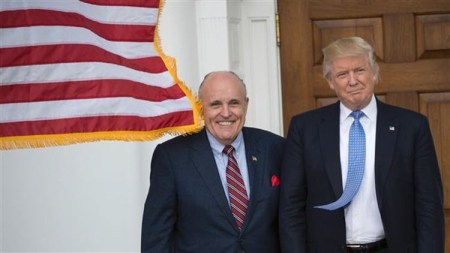
trumpandgu

London, 29 Nov – On November 28, in an article for Politico Magazine, Robert G. Torricelli, former U. S. Senator from New Jersey, and a former member of the U.S. House of Representatives, wrote about the Iranian Resistance Group, Mujahidin e-Khalq (MEK).  His article was written  in response to an article published in Politico last week, criticizing the MEK and the U.S. politicians who support them, particularly former New York Mayor Rudy Giuliani.

Torricelli, a former Democratic member of the Senate Foreign Relations Committee, who is familiar with the MEK and with Giuliani’s work on behalf of the organization says, “I can say unequivocally that Benjamin’s assertions are outrageous—so outrageous that I must respond.” 

A large bipartisan coalition supports the MEK in its campaign for regime change in Iran, including two former chairmen of the joint chiefs, two former CIA directors, a former attorney general and the former chairs of both political parties. People with such varied political ideals, such as Howard Dean and Patrick Kennedy to Newt Gingrich and John Bolton support the MEK. Torricelli says, “From this perspective, the outlier isn’t Rudy Giuliani; it’s Daniel Benjamin.” 

The history of the MEK began when it was part of the coalition opposing the shah of Iran in the late 1970s. The shah’s secret police executed and imprisoned most of their leadership. That vacuum was briefly filled by a Marxist group who were rejected by the incarcerated MEK leaders. Most of the Marxist leaders were killed by the shah or by the mullahs after their ascent to power in 1979. The MEK eventually regained its original leadership, and the MEK became an opposition group to the theocratic regime, and fled into exile in Paris and Iraq.

Torricelli writes, “Throughout this time, the MEK did take part in legitimate political and military action against the Iranian regime, but I have seen no evidence to support the assertion Benjamin makes that it took part in terrorist activities against Iranians or Americans.”

In Iraq in the 1980s, the refugee camps of the MEK were under the protection of the government of Iraq. MEK fighters were aligned with Iraqi Army during Iran/Iraq War. “But Benjamin’s claims that they assisted in Saddam Hussein’s repression of the Kurds have been denied by both MEK and U.S. Army leaders in Iraq. Upon the arrival of U.S. forces in 2003, the MEK willingly handed over its weapons, accepted U.S. protection and actively exposed the Iranian regime and its proxies’ terrorist activities. This included saving American lives by identifying IED locations. This, more than anything, explains the group’s support by former U.S. military personnel, including the former army anti-terror officer and the U.S. military police general assigned to the camp,” writes Torricelli.

The MEK provided invaluable intelligence regarding the Iranian nuclear program that helped counter Tehran’s efforts to develop atomic weapons. Maryam Rajavi, leader of the movement, committed herself publicly to a democratic, non-nuclear, secular Iran at peace with its neighbors with gender equality and a ban on capital punishment. The MEK organized thousands in the Iranian diaspora and built political support in Congress and parliaments across Europe. It is now the most organized and disciplined of the Iranian opposition groups.

“Some current and former State Department employees, including Mr. Benjamin, have a different concept. They remain committed to the idea that the MEK was a terrorist organization—a notion, I believe, which stems from an illusion of American reconciliation with the mullahs. In 1997, a group at State succeeded in convincing President Bill Clinton to place the MEK on the State Department list of terrorist organizations. Some claimed at the time that this decision was mainly intended as a goodwill gesture to Iran. The State Department gave as its reasons the MEK’s long record of violence, but I can tell you that as a member of the Foreign Relation Committee, I reviewed the State Department file on the MEK and found no evidence, no testimony and no reason for the designation except placating Tehran,” Torricelli writes, adding, “Thousands of Iranian-Americans and literally hundreds of members of Congress protested. In 2011, as a private attorney, I led a team of lawyers in a State Department inquiry to resolve the issue. After four hours of testimony, we yielded to the State Department to present their contradictory evidence. They had nothing.”

Without evidence, an order by the U.S. District Court was issued.  The MEK was removed from the State Department list of terrorist organizations by Secretary Hillary Clinton in 2012.

Torricelli continues, “Defeat came hard for the Iran apologists within the department. Mr. Benjamin isn’t the first to argue that the broad coalition of former U.S. intelligence, military, diplomatic and congressional leaders can’t be believed because some accepted speaking fees to attend MEK meetings around the world. The fact that these people faced combat for or dedicated their entire careers to our country, and are among our most respected leaders seems to be of no consequence. It’s an argument that requires no rebuttal except to note that by this standard the views of Thomas Paine, Elie Wiesel and Winston Churchill—all of whom accepted speaking fees from various international organizations—would have been silenced as well.”

Rudy Giuliani was one of the most outspoken supporters. The 3,000 MEK refugees settled along the Iran/Iraq border were under imminent threat in 2012. Iraqi relations with the United States were tense. Torricelli writes,  “Secretary Clinton requested that I assemble a persuasive group of distinguished Americans to travel to Europe and persuade Mrs. Rajavi to relocate the refugees to a former U.S. military base near Baghdad. I appealed to Louis Freeh, Ed Rendell, Michael Mukasey and Rudy Giuliani. Each accepted, canceled commitments, paid his own transportation to Paris and argued persuasively that the MEK assist the United States by relocating.”

Such a broad coalition of diverse Americans has varied perspectives. Torricelli says that, “Some believe that in the political vacuum following an economic or political collapse in Tehran, a determined and well-funded political opposition like the MEK could seize power. Others believe that the MEK might simply be part of a broader coalition, a simple pressure point or just a source of continuing intelligence.” Although rationales for support might differ, this group of Americans is united by the beliefs that the MEK is a genuine democratic force, and that regime change in Tehran is the best option to keep the peace, avoid a nuclear Iran, and benefit American interests.

Going back to Mr. Benjamin’s argument that Rudy Giuliani’s participation in this coalition should disqualify him for consideration as secretary of state, Torricelli has this to say, “Experience and participation in public policy issues was once a condition for high government service. It’s now a complication, because a record of advocacy creates controversy. But the selection of secretary of state needs to be different. Among the most likely crises facing the new president is an escalation in the struggle with the fundamentalist Islamic Republic of Iran. Rudy Giuliani has lived that struggle for a decade. Mr. Benjamin may quarrel with his efforts but it’s important to note that voices in the American foreign policy establishment as diverse as Senator McCain, Secretary Clinton, Deputy Secretary Blinken and John Kerry’s own personal representative on the MEK, Jonathan Weiner disagree. Each has thanked Rudy Giuliani and the other Americans involved in these efforts.”

Whether or not the president-elect chooses Mr. Giuliani as secretary of state, countering Tehran and assisting our country should not be seen as anything other than a valuable contribution to his consideration.