Posted tagged ‘terror tunnels’

Senior Hamas tunnel network defector tried to flee to Israel by sea: sources

April 18, 2016

Senior Hamas tunnel network defector tried to flee to Israel by sea: sources, DEBKAfile, April 18, 2016

Alauwana_Hamas_18.4.16

Western intelligence sources monitoring events in Gaza confirmed Monday that a senior operative from the Hamas tunnel network defected to Israel last week. The sources identified the defector as Sami Atauna, a resident of the Jebalya refugee camp who came to the border fence by himself and surrendered to an IDF patrol. The sources added that the senior operative had also made an unsuccessful attempt to defect to Israel by sea during the past few weeks. It is not clear whether there is any connection between the defection and the discovery of a Hamas tunnel leading into Israel, which was announced by the IDF on Monday.

Report: Hamas taps over 1,000 terror operatives to dig Gaza tunnels

April 8, 2016

Report: Hamas taps over 1,000 terror operatives to dig Gaza tunnels, Jerusalem Post, Staff, April 7, 2016

A Palestinian fighter from the Izz el-Deen al-Qassam Brigades, the armed wing of the Hamas movement, gestures inside an underground tunnel in Gaza August 18, 2014. A rare tour that Hamas granted to a Reuters reporter, photographer and cameraman appeared to be an attempt to dispute Israel's claim that it had demolished all of the Islamist group's border infiltration tunnels in the Gaza war. Picture taken August 18, 2014. REUTERS/Mohammed Salem (GAZA - Tags: POLITICS CONFLICT TPX IMAGES OF THE DAY) - RTR42YJW

A Palestinian fighter from the Izz el-Deen al-Qassam Brigades, the armed wing of the Hamas movement, gestures inside an underground tunnel in Gaza August 18, 2014. A rare tour that Hamas granted to a Reuters reporter, photographer and cameraman appeared to be an attempt to dispute Israel’s claim that it had demolished all of the Islamist group’s border infiltration tunnels in the Gaza war. Picture taken August 18, 2014. REUTERS/Mohammed Salem

Hamas employs more than 1,000 operatives to excavate underground tunnels in the Gaza Strip, Israel Radio reported Thursday.

According to the report, the terrorist organization invests hundreds of thousands of dollars each month in the digging activities, paying each operative engaged in the process some 300 to 400 dollars a month.

Hamas also heavily invests in smuggling building materials, including raw materials and excavation machinery from Egypt and Israel.

To prepare for a possible future incursion with Israel, the Palestinian terrorist organization’s elite ‘Nukhbah’ unit carries out drills practicing different scenarios simulating offenses in the tunnels near the border fence with Israel. Several of the members of the unit have been killed in recent months in tunnel collapses in the coastal Palestinian enclave, according to the Israel Radio report.

The report cited Israeli officials as saying that the funds Hamas uses to invest in rebuilding its network of underground passageways could instead be used to construct full neighborhoods in the Strip.

Earlier this week, Israel temporarily suspended the delivery of cement to Gaza’s private sector after it discovered that Hamas was siphoning the material, which is intended to rebuild destroyed houses.

The Office of the Coordinator of Government Activities in the Territories (COGAT) monitors the flow of cement into Gaza to ensure that Hamas has not used it to construct tunnels to attack Israel.

On Friday, COGAT posted on its Arabic Facebook page that it suspended the transfer of cement to Gaza because some deliveries had been diverted by Imad Elbaz, the deputy director-general for Hamas’s economics office.

The Hamas deputy political bureau chief, Ismail Haniyeh, vowed in February  that his group will never stop digging tunnels and upgrading rockets in preparation for any possible confrontation with Israel.

During the Operation Protective Edge in 2014, the IDF said it had destroyed all the known terror and infiltration tunnels in Hamas’s vast subterranean network .

In March, The Jerusalem Post learned from Palestinian sources that some of the terror operatives digging the tunnels believed Israel was involved in at least some of the various recent tunnel collapses that claimed the lives of several Hamas men.

Official reports from Gaza described the various collapses in recent months as “work accidents” or being caused by flooding from heavy rains; however there are many who believe Israel is responsible.

New Iron Dome version can destroy tunnels

March 11, 2016

New Iron Dome version can destroy tunnels, DEBKAfile, March 11, 2016

Anti_tunnel_missile_NEWIran keeps its ballistic missiles in underground bunkers

Israel has started testing a secret new weapon for defeating the tunnel systems which the Palestinian Hamas and Hizballah are busy digging for surprise attacks against Israel. Western sources reported Friday, March 11, that the new weapon, dubbed the “Underground Iron Dome,” can detect a tunnel, then send in a moving missile to blow it up.

US intelligence sources disclosed only that new weapon is equipped with seismic sensors to detect underground vibrations and map their location before destroying them.

Western experts have been talking for years about a secret Israeli weapon capable of destroying Iran’s Fordo nuclear facility, which is buried deep inside a mountain not far from the Shiite shrine city of Qom. They suggested that this hypothetical weapon could be slipped through the Fordo facility’s vents, thread its way through the underground chambers and take down the illicit enrichment facility.

It was discussed again three years ago, when the Israeli Air Force on Aug. 23 2013 blew up the Popular Palestinian Front-General Command underground facility at Al-Naama on the South Lebanese coast, 15 km south of Beirut.

The PPF-GC leader Ahmed Jibril was then taking his orders from Iran’s Revolutionary Guards Corps.

How this operation turned out was never revealed. But Western military sources saw it as a strong Israeli message to Tehran that its underground nuclear facilities were now vulnerable to attack. The secret JIbril command center was constructed in the 1970s by East German military engineers as one of most heavily fortified military sites in the Middle East.

As for the new weapon, the Pentagon spokesman Christopher Sherwood said that the US had allocated $40 million for completing in 2016 the establishment of “anti-tunnel capabilities to detect, map and neutralize underground tunnels that threaten the US or Israel.”

According to the spokesman, the main part of the development work (on the secret weapon) would be conducted in Israel in 2016. The US would receive prototypes and access to the test sites and hold the rights to any intellectual property.

The Israeli firms working on the anti-tunnel weapon are Elbit Systems and Rafael Advanced Defense Systems, which developed the Iron Dome.

Sherwood denied claims from Israeli defense quarters that the US had earmarked $120 for developing the system, or that another $80 million would be available – half in 2017 and half in 2018.

DEBKAfile’s military sources emphasize that the timeline implicit in those estimates doesn’t necessarily represent the tempo of he Underground Iron Dome’s development.

According to past experience, unfinished Israeli weapons have more than once been rushed to the battlefield to meet an emergency war situation. The Iron Dome is one example. This has the advantage of testing innovative systems in real operational conditions, with the result that improvements and adjustments can be introduced much faster than planned.

Our sources add: Both Palestinian Hamas and the pro-Iranian Hizballah are working overtime on tunnels for sneaking terrorists and commando fighters into Israel to attack IDF posts and civilian locations. During Israel’s last counter-terror operation in the Gaza Strip, Hamas staged a deadly tunnel attack on the Israel side of the border and is planning repeats. Hizballah is training commando units for underground surprise incursions to capture parts of Galilee in northern Israel.

The Israeli government has spent more than $250 million since 2004 on efforts to thwart tunnel construction under the Gaza border.

IDF Chief of Staff Gen. Gadi Eisenkot hinted at these efforts in February. “We are doing a lot, but many of [the things we do] are hidden from the public,” he told a conference at Herzliya’s Interdisciplinary Center. “We have dozens, if not a hundred, engineering vehicles on the Gaza border.”

Egypt’s War on Terrorism Bears Fruit

September 24, 2015

Egypt’s War on Terrorism Bears Fruit, Gatestone InstituteKhaled Abu Toameh, September 23, 2015

  • Egyptian President Sisi’s war against the smuggling tunnels will undoubtedly weaken Hamas and other radical groups in the Gaza Strip. Sisi should be commended, rather than criticized, for his courageous actions against Islamist terrorists, both in the Gaza Strip and in Sinai.
  • Sisi’s actions will benefit not only Egyptians, but also many Palestinians who are opposed to Hamas and radical Islamist groups.
  • When the Egyptians destroy a Hamas tunnel, that is called “war on terrorism.” But when Israel destroys a tunnel, that is condemned as an “act of aggression.” This moral slithering is why it is important for the international community to stand behind Sisi’s relentless war on radical Islam.
  • Without such backing, Islamists will continue to pose a major threat not only to Israel, but to many Arabs and Muslims who oppose Hamas, Islamic State and Islamic Jihad.
  • The environment of the Gaza Strip is the last thing that Hamas cares about. Hamas did not think about damage to the environment or to agricultural fields when it used those fields, as well as populated areas, as launching pads for attacking Israel.

Egypt began this week flooding smuggling tunnels along their border with the Gaza Strip with water from the Mediterranean Sea — a move being condemned by Hamas and other Palestinian factions as a “disturbing nightmare.”

The Egyptian army’s move is another sign of President Abdel Fattah el-Sisi’s determination to destroy the tunnels that were used to smuggle weapons, people and merchandise from Sinai to the Gaza Strip and the other way around.

This act is also a sign of Sisi’s resolve to pursue his military campaign against Islamist terror groups that are waging war against the Egyptian authorities in Sinai. The Egyptians are convinced that Hamas and other Palestinian groups have been providing aid to the terror groups in Sinai.

Since the beginning of the year, dozens of Egyptian soldiers and police officers have been killed in a spate of terror attacks launched by Islamist groups in Sinai.

Earlier this week, Egypt’s Interior Ministry announced that terrorists shot dead an Egyptian general in Sinai. In another similar shooting a few days earlier, a terror group killed General Khaled Kamel Osman.

The decision to pump water into the smuggling tunnels is seen as a severe blow not only to the terror groups in Sinai, but also to Hamas, Islamic Jihad and other Palestinian factions inside the Gaza Strip.
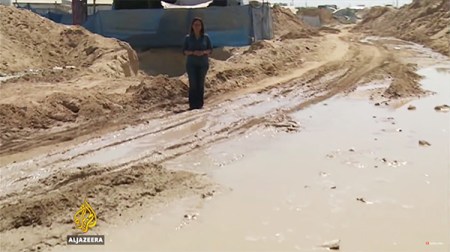
1259Seawater covers parts of the ground where Egypt has been pumping water into smuggling tunnels along the border with Gaza. (Image source: Al Jazeera video screenshot)

Judging from the reaction of the Palestinian groups, it is clear that they are in a state of hysteria as they see their tunnels collapsing one after the other.

In a statement published in the Gaza Strip, Palestinian groups, including Hamas, denounced the flooding of the tunnels as a “disturbing nightmare” for the Palestinians. The factions appealed to the Egyptian authorities to “stop this despicable crime against the Palestinian people and their environment.”

“The Palestinian people are surprised by the Egyptian move, which will tighten the blockade on the Gaza Strip, destroy vast areas of agricultural land and harm those living near the border (with Egypt),” the statement said.

Initially, Hamas leaders did not take the reports about flooding the tunnels seriously. Some Hamas leaders, in fact, first thought that these were rumors designed to scare them and other Palestinian groups in the Gaza Strip.

But when Hamas leaders woke up on September 13 to discover that the Egyptians had begun pumping water into the smuggling tunnels, they could not believe what they were seeing.

Hamas spokesman Sami Abu Zuhri announced that his movement asked the Egyptians to stop flooding the tunnels with seawater. “We hope that the Egyptians will comply with our demand,” Abu Zuhri said. “This measure is completely unacceptable and poses a threat to many families living alongside the border.”

Sources in the Gaza Strip noted this week that the Egyptian move has thus far proven to be effective and successful. They said that since being flooded with water, several tunnels have collapsed.

It is worth noting that despite its outrage, Hamas has stopped short of issuing threats against Egypt in response to the flooding of the tunnels.

Hamas’s response would have been different had it been Israel that was flooding the tunnels with water. But Hamas knows very well that it would not be a good idea to mess with the Egyptian authorities and President Sisi.

During the past two years, the Egyptians have destroyed hundreds of smuggling tunnels along their border with the Gaza Strip. Nevertheless, Hamas did not dare launch one terror attack against Egypt.

Hamas is now pretending that it is concerned about the damage to the environment that is caused by the flooding of the smuggling tunnels. But the truth is that the environment of the Gaza Strip is the last thing that Hamas cares about.

Hamas did not think about damage to the environment or to agricultural fields when its men fired thousands of rockets at Israel in the past few years. In fact, Hamas used these fields, as well as populated areas, as launching pads for attacking Israel.

Hamas is interested only in one thing: preserving its rule in the Gaza Strip. The tunnels that are now being destroyed by the Egyptians were used by Hamas to smuggle all types of weapons into the Gaza Strip. Hamas warlords are also believed to have earned millions of dollars from the smuggling industry during the past few years.

Sisi’s war against the smuggling tunnels will undoubtedly weaken Hamas and other radical groups in the Gaza Strip. The Egyptian president should be commended, rather than criticized, for his courageous actions against Islamist terrorists, both in the Gaza Strip and in Sinai.

Sisi’s actions will benefit not only Egyptians, but also many Palestinians who are opposed to Hamas and radical Islamist groups. Israel also stands to benefit from Sisi’s war against Hamas. The destruction of the tunnels means fewer weapons used by Hamas to attack Israel.

However, Israel still has good reason to be worried about Hamas’s plans and intentions.

While Sisi is busy flooding the tunnels on the border with Egypt, Hamas continues to dig new ones on the border between the Gaza Strip and Israel.

It is no secret that Hamas has also managed to rebuild many of the terror tunnels that were used to infiltrate gunmen into Israel during last year’s military confrontation between the two sides. Hamas is planning to use these tunnels in the future, to dispatch its men to kill as many Israelis as possible.

The Israelis have thus far been monitoring the situation very closely and have refrained from attacking the tunnels. That is because Israel is keen on maintaining the unofficial truce with Hamas that was reached in the aftermath of last year’s war, known as Operation Protective Edge.

There is not much that Israel can do at this stage other than hope that Sisi will continue with his measures to undermine Hamas. Any attempt by Israel to flood a Hamas tunnel will most likely spark an international outcry and bring condemnations from the United Nations. In addition, such a move on the part of Israel is likely to trigger a violent response from Hamas — one that could lead to another war.

When the Egyptians destroy a Hamas tunnel, that is called “war on terrorism.” But when Israel destroys a tunnel, that is condemned as an “act of aggression.” This moral slithering is why it is important for the international community to stand behind Sisi’s relentless war on radical Islam. Without such backing, the Islamists will continue to pose a major threat not only to Israel, but to many Arabs and Muslims who oppose Hamas, Islamic State and Islamic Jihad.

Captured Hamas Operative Details Group’s Terrorist Plans

August 11, 2015

Captured Hamas Operative Details Group’s Terrorist Plans, Investigative Project on Terrorism, August 11, 2015

A Hamas operative provided a treasure trove of intelligence during Israeli interrogation concerning the terrorist group’s rebuilding efforts and future terrorist plans, Israel’s intelligence agency Shin Bet disclosed on Tuesday.

The terrorist, Ibrahim Adal Shahada Sha’ar, 21, described about Hamas’ tunnel reconstruction efforts, planned terrorist attacks against Israel, military strategy, and coordination with Iran, the Jerusalem Post reported.

He admitted working on rebuilding underground tunnels and described how some would be used in future attacks against Israel. Sha’ar disclosed the location of digging sites, tunnel entrances and underground routes, and reportedly said that a road built along the border with Israel is intended partly for terrorist attacks involving vehicles charging into Israeli territory.

He admitted that he stored several 50 kg explosive charges in his home and said that fighters kept explosives and other material in their own homes since Hamas commanders worried that the organization’s weapons depots would be targeted by Israel.

Israeli authorities arrested Sha’ar last month at the Erez Crossing after he attempted to enter Israel for “personal or humanitarian reasons.” Officers were aware of Sha’ar’s terrorist background and immediately detained him.

During last summer’s war between Israel and Hamas, Sha’ar participated in specific battlefield operations, including field logistics, transferring terrorists and weapons, and even admitted to setting up an anti-tank improvised explosion device (IED).

Sha’ar provided details of Iranian-Hamas military cooperation, including how Iran transfers funds and supplies weapons and electronics to the terrorist group. Those supplies include devices intended to jam radio frequencies to bring down Israeli drones deployed over Gaza. Furthermore, Sha’ar described how Iran trained Hamas terrorists to use hang gliders for attacks against Israel – a tactic revealed by previous Israeli interrogations of captured terrorists.

Critics of the recent Iran nuclear agreement argue that newly released funds to the Islamic Republic will bolster their regional hegemonic ambitions and global terrorist activities, including transferring more money and weaponry to its terrorist proxies.

According to Israeli intelligence, the Sha’ar detailed plans using tunnels to conduct cross-border attacks against Israeli targets, akin to Hamas’ attempts during last summer’s war. The Hamas operative confirmed that the terrorist group is diverting civilian reconstruction material for the purposes of rebuilding its terrorist infrastructure and underground tunnel network.

Sha’ar was indicted July 31 in the Beersheba District Court for being a member and engaging in activities with a banned organization, attempted murder, and forbidden military training.

Hizballah copycats Hamas’ terror tunnels for Lebanese-Galilee border. No IDF solutions yet

April 21, 2015

Hizballah copycats Hamas’ terror tunnels for Lebanese-Galilee border. No IDF solutions yet, DEBKAfile, April 20, 2015

Gaza-Terror-Tunnels_4.15A Hamas terror tunnel – a model for Hizballah

Anxiety about the new terror tunnels they sense Hamas is excavating under their feet is no longer confined to Israelis living in proximity to the Gaza Strip, or the soldiers serving there. Israel’s northern borderland dwellers, who can see Hizballah’s yellow flags in from their balconies, have the same concerns. Their reports of mysterious underground explosions are confirmed by thousands of Israeli troops conducting field exercises in the neighborhood. The soldiers attest to heavy earthmoving equipment, explosions, burrowing, and shaking ground on the Lebanese side of the border, giving the area the appearance of a huge subterranean building site.

The Lebanese Shiite Hizballah group, Iran’s Lebanese surrogate, has clearly taken a leaf out of its Palestinian ally, Hamas’ book, for a fully mobilized terror tunnel project against northern Israel. Its manpower, including engineering units, is working under the guidance of Iranian Revolutionary Guards officers to sink a large network of tunnels leading under the border into Galilee. They are working efficiently and at top speed with the aid of modern Western-made earthmoving equipment and foreign professionals paid top dollar to manage the project.

Israel seems to be curiously passive in the face of its enemy’s ambitious enterprise. Only last week, the Defense Ministry’s Political Coordinator Amos Gilad denied any knowledge of terrorist tunnels reaching Israel from Lebanon.

However, Brig. Gen. Moni Katz, commander of the IDF’s Division 91, which is responsible for security of the Galilee region, told a different story: “To me it is obvious that the other side is busy digging tunnels. I don’t need intelligence to tell me this. Intuition is enough. There is no denying that this is what they are up to. Can I say they have completed a tunnel?” The general went on to reply: “I must assume they have. I can’t prove it or say for sure a tunnel has crossed into our territory. But my basic premise is that this is so and it is up to us to make plans to fit this case.”

Putting those plans into practice – which would necessitate destroying the tunnels either before they were built or at their entry-points – faces four major difficulties:

1. Close surveillance and first-class intelligence are required to keep track of hostile tunnel projects starting from the planning stage, the recruitment of manpower, the acquisition of engineering technology and equipment and registering the quantity of earth displaced and removed from the underground burrow.

2.  The digging process, which sound sensors should have no difficulty in detecting, is a relatively short and irregular process which can just as easily be camouflaged by surface activities.

3.  Locating a finished tunnel at the stage when it is still unused and relatively quiet calls for pinning down a number of variables, such as the type of soil, the depth, length, breadth and lining material used in building the tunnel, humidity, weather conditions on the surface as well as its environment, whether urban or rural.

4.  Locating such a tunnel – even when it is already in operational use by an enemy – poses another set of difficulties. In combat conditions, electronic listening devices would be drowned out by the fire and explosions of battle and, in the confusion of war, enemy troops would be hard to intercept as they moved in and out the tunnels.

A glance at the map shows that the danger of tunnel warfare should also be taken into account on Israel’s eastern front – where it would just as hard to detect as in the north and the southwest: The Arab populations inhabiting the West Bank and the Israeli side of the border – only hundreds of meters apart – are similar enough to keep counter-terrorism authorities on a high level of alert for the construction of tunnel links between the two territories.

Perhaps a succession of military chiefs should be held accountable for letting the tunnel terror peril develop to its current proportions. But it must also be said that no silver bullet has so far been invented to counter this primitive vehicle of terror, including the methods tried till now, such as buried microphones, optical fibers sensitive to seismic tremors, deep trenches along the border and an assortment of off-beat inventions.

In the view of our military analysts, any solutions would have to vary from sector to sector, adapted to the military and topographical features in each case and an intelligence assessment of the level of risk involved in counteraction. This effort would have to be directed by an interdepartmental, interagency administration directly answerable to the prime minister or defense minister.

Report: Hamas Using Heavy Machinery to Re-Dig Terror Tunnels

April 15, 2015

Report: Hamas Using Heavy Machinery to Re-Dig Terror Tunnels, Israel National News, Tova Dvorin, April 15, 2015

(From whom are they getting the heavy machinery, how is it being transported and from where to where? — DM)

Less than one year after Operation Protective Edge in Gaza fizzled out, Hamas is already building new terror tunnels under Israel.

But while the evidence that terror activity has resumed has been lingering for months, sources now say that the terror group has taken the digging to the next level.

Hamas has switched from manual slave labor to machinery to dig terror tunnels under Israel, Palestinian Arab sources revealed to Walla! News Wednesday.

The group is using a Bagger 288, a German-produced mining machine known as a bucket-wheel excavator.

A damning letter emerged from Gaza in August 2014 from a Palestinian Arab who was forced to dig terror tunnels after he accepted a cryptic joboffer from Hamas; the group plucked him from his home in a truck and forced him down into a tunnel. At least 160 Palestinian Arab children have also died digging terror tunnels, the same report revealed.

Unlike workers working by hand, however, the Bagger can dig far faster and burrow into smaller spaces, the sources revealed.

In addition, bulldozers can clearly be seen from the Israeli side of the border doing at least part of the digging and cleanup; Hamas is using a mixture of cement (when available) and wooden boards for the construction.

Senior security sources confirmed the report, adding that Hamas’s true aim is to dig the tunnels at high speed and that they are focusing on producing short-range rockets and mortars – which are more difficult for the Iron Dome Missile Defense System to shoot down.

Smuggling between Sinai and Gaza still thriving

August 22, 2014

Smuggling between Sinai and Gaza still thriving

Bedouin guide claims there are 500 tunnels that can shuttle weapons, goods, building materials and people into Strip

By Spencer Ho August 22, 2014, 9:26 am

via Smuggling between Sinai and Gaza still thriving | The Times of Israel.


A Palestinian worker inside a smuggling tunnel, beneath the Egyptian-Gaza border
in the southern Gaza Strip, in February 2013 (photo credit: Abed Rahim Khatib/Flash90)
 

ith Israel’s attention focused on Hamas’s cross-border attack tunnels into Israel, the smuggling of arms and goods from the Sinai Peninsula has continued and gained a boost from the flare-up of hostilities in the Gaza strip, according to Egyptian and Bedouin sources.

“During the Gaza war, business has flourished,” a Bedouin guide, who requested anonymity, told Reuters.

The fighting and humanitarian crisis has increased the demand for weapons and humanitarian supplies that only skilled smugglers can provide. However, while their business is still thriving, it is not what it used to be just two years ago, the report said.

The crackdown on smuggling came amid accusations by Egypt that Hamas had colluded with the Muslim Brotherhood in carrying out “terror attacks” on its territory in the past few years.

In March of this year, Egypt’s military said that it had destroyed 1,370 smuggling tunnels under its border with the Gaza Strip. Coupled with the frequent closure of the Rafah border and Israel’s effective security blockade, the destruction of so many of the tunnels has left the Hamas-run coastal enclave almost completely isolated.

“The situation is much more controlled,” a senior Egyptian official told Reuters, noting that since mid-2012 the army had managed to seriously curtail the smuggling of weapons, fuel, food and drugs. “It’s not 100 percent, but we are trying to reach this percentage.”

For their part, the Bedouin smugglers acknowledge that the Egyptian crackdown has forced them to think smaller. The massive tunnels that used to accommodate cars and trucks have been destroyed, but many of the one- to two-meter-wide corridors have survived. One Bedouin guide told Reuters that smugglers had built up to 200 more such tunnels in the last two years, bringing the total of working tunnels up to 500. Comparatively, before the crackdown, there were some 1,500.

“Each day, about three or four people cross with weapons, and each one carries about six or seven guns,” the guide said, without specifying what type of arms were being transported.

A peek into a derelict house in Egypt where a tunnel opening is located — concealed only by a shower curtain — offers a glimpse into how the system works.

“This tunnel is a partnership between us,” the Egyptian tunnel owner said, referring to his Palestinian counterpart on the Gaza side. “Building it cost us $300,000. He paid half and I paid half. The profit is split between us 50-50.”

On average, the two men net about $200 per day by charging varying rates for different supplies, according to the owner. For instance, a one-square-meter crate of medicine or food would cost $12, while weapons, building supplies, or fuel might cost as much as $150.

When Egypt cracked down on smuggling between its territory and Gaza in 2012, it charged that militant forces were using the tunnels to shuttle weapons and fighters to the groups that were frequently attacking its military forces and causing unrest amongst the population in Sinai. While its campaign may have struck a blow to the enterprise, this tunnel operation proves that the threat still exists.

Much like goods, people can also pass, with the price starting at $50 per person; extra if they are carrying weapons.

“If someone is passing with one or two guns, we charge $60 to $70. But if someone has more weapons, it’s a special operation and might cost as much as $1,000 or $2,000 depending on the type of weapon,” the Egyptian was quoted by Reuters as saying, adding that he has no interest in who they are or their intentions, as long as his Palestinian partner says they are alright.

“As long as they give me $50, I let them through, he said. “I just deliver the weapons and take the money. I’m not concerned with where they’re going.”