Israel coordinates with Russia on Syria as Obama abandons the region | Anne’s Opinions, 24th September 2015
(It seems that events have overtaken some of what I have written below. Nevertheless most of it is still relevant– anneinpt)
Between Shabbat and chagim and more Shabbat and more chagim the world still goes on, and it’s not always happy reading. Before Yom Kippur we learned of the Russian military buildup in Syria:
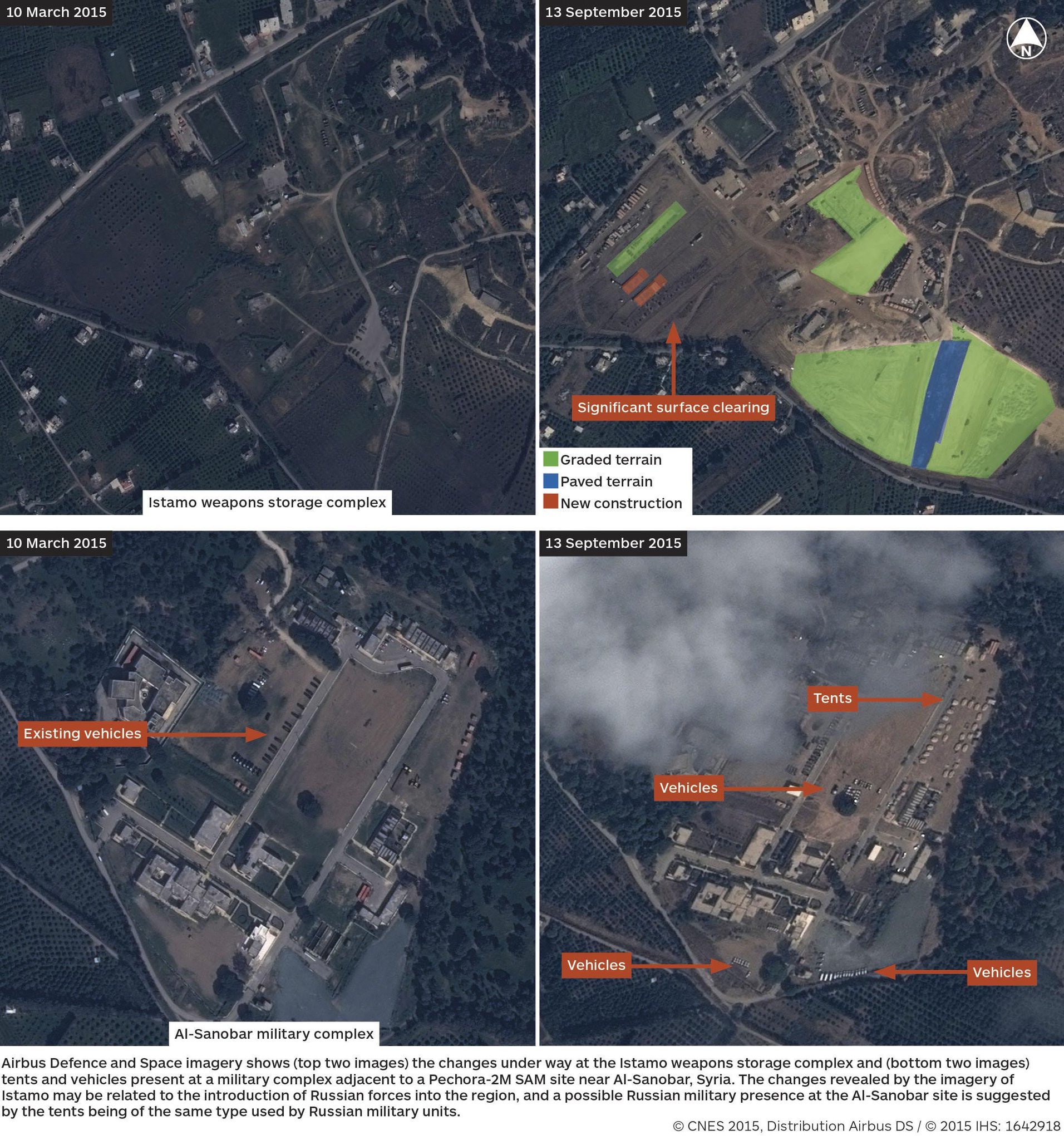
Satellite images showing Russian military installations in Syria
Russia ramped up its military buildup in Syria over the weekend, and there are now a total of 28 combat aircraft plus 16 helicopters on the ground, CBS News national security correspondent David Martin reports.
The Russians masked the transport of the military aircraft by flying them in behind transport aircraft, Martin reports, and the speed of the buildup has surprised the U.S.
If the White House had been paying any attention at all to the goings on in the Middle East instead of abdicating its duty, it would not have been so surprised. But instead of contending with the villains in the Syrian civil war, i.e. Assad, Hezbollah and Iran, the Administration has been arming the rebels – without thought as to who those rebels might be. Harry’s Place describes Obama’s fecklessness on Syria: (emphases added):
The AP reports:
No more than five U.S.-trained Syrian rebels are fighting the Islamic State, astoundingly short of the envisioned 5,000, the top U.S. commander in the Middle East told angry lawmakers on Wednesday. They branded the training program “a total failure.”
After the first 54 fighters were sent in to fight in July, a Syrian affiliate of al-Qaida attacked the group, killing several and taking others hostage while many fled. Asked how many remain, Gen. Lloyd Austin told the Senate Armed Services Committee, “It’s a small number. … We’re talking four or five.”
Congress has approved $500 million to train Syrian fighters, and officials have said fewer than 200 are going through training now. One of the problems has been that many Syrian fighters want training and equipment to fight the government forces of President Bashar Assad, but the U.S. program is limited to rebels who agree to only battle the militants.
Yes, that is a problem. A big one. Especially when it is the Assad regime, even more than the Islamic State, that is responsible for the human catastrophe in Syria that is killing hundreds of thousands and creating millions of refugees, thereby strengthening the extremist rebels.
The American failure of judgement is all the more blatant as the Wall Street Journal reports that Russia and Iran are seen as coordinating on Syria:
Russia and Iran have stepped up coordination inside Syria as they move to safeguard President Bashar al-Assad’s control over his coastal stronghold, according to officials in the U.S. and Middle East, creating a new complication for Washington’s diplomatic goals.
Senior Russian and Iranian diplomats, generals and strategists have held a string of high-level talks in Moscow in recent months to discuss Mr. Assad’s defense and the Kremlin’s military buildup in Syria, according to these officials.
The buildup is continuing: On Monday, U.S. defense officials said Russian surveillance drones have started flying missions over Syria, and Moscow has sent two dozen more fighter jets to Syria.
…
U.S. officials said they haven’t unraveled the full extent of the cooperation or its intention. “We assume [the Russian buildup in Syria is] being coordinated with the Iranians,” said a senior U.S. official, who said the U.S. tracked Gen. Soleimani’s trip to Moscow.
They assume? Don’t they have intelligence? (Both kinds…). As Chess Master Gary Kasparov wittily remarked on Twitter:
The WSJ continues:
The coordinated Iranian and Russian support for Mr. Assad poses a formidable obstacle to the diplomatic aims of the Obama administration, which wants to remove the Syrian dictator from power.
As support from Moscow and Tehran pours into Syria, the U.S. has moderated its demands that Mr. Assad step down before a transition takes place.
Secretary of State John Kerry said last weekend that Mr. Assad may be able to remain as part of a transition to a new government.
A Tweeter summed it up succinctly:
The WSJ mentions Israel’s concerns (more on that further on) and continues with an analysis of possible competing Russian and Iranian intentions in Syria:
Senior U.S. and European officials said that while they suspect there is significant cooperation between Moscow and Tehran, their long-term interests could diverge.
Mr. Putin, they said, appears to be using the Syria conflict to try to increase the Kremlin’s influence in the Middle East and in the international diplomacy focused on finding a post-Assad government.
Tehran, meanwhile, wants to maintain Syria’s coastal region and the areas adjacent to the Lebanese border as the key supply route for arms going into Lebanon and Palestinian militant groups.
The BBC concurs with this analysis and asks What’s at stake for Russia in Syria?
The increased supplies of arms and weapons systems provided by Moscow will make any military operation against Damascus more challenging. Despite the presence of Russian military advisers and other troops, any direct military confrontation between Russia and Western forces in Syria is unlikely though.
…
What’s the endgame for Russia in the wider Middle East?
The confrontation between Russia and the West over Ukraine has contributed to Moscow’s heightened engagement in the Middle East. The Kremlin believes that good relations with states in the region can help Russia avoid international isolation and compensate for the negative effect of US and EU sanctions.
If necessary, the Kremlin can also use its leverage with other states in the region, such as Iran and Egypt, to put additional pressure on Western countries.

PM Binyamin Netanyahu and Russian President Vladimir Putin meet in Moscow to discuss Russia’s role in Syria
As the WSJ above noted, the Russia’s entry into the Middle East poses many problems for Israel. To defuse the situation as much as possible, Binyamin Netanyahu flew to Moscow for a lightning visit, and in an usual step taking 12 officers with him:
DEBKAfile reports that Prime Minister Binyamin Netanyahu will be attended by twelve military officers when he meets President Vladimir Putin at the presidential dacha outside Moscow later Monday. The executive plane is to carry, along with the prime minister, IDF Chief of Staff Lt. Gen. Gady Eisenkot, Military Intelligence Chief Maj. Gen. Hertzi Halevy and another 9 officers, each a specialist in one of the military aspects of the Syrian conflict. It will be a lightening trip. Straight after the meeting with Putin at midday, the prime minister and party are due to fly home.
Following the visit, the PM announced:
The Times of Israel reported: Russia to allow Israeli airstrikes on Syrian arms transfers
“My goal was to prevent misunderstandings between IDF forces and Russian forces. We have established a mechanism to prevent such misunderstandings. This is very important for Israel’s security,” Netanyahu told Israeli reporters during a telephone briefing from the Russian capital.
“Our conversation was dedicated to the complex security situation on the northern border,” the prime minister said. “I explained our policies in different ways to try to thwart the deadly weapons transfers from the Syrian army to Hezbollah — action actually undertaken under the supervision of Iran.”
Netanyahu said that he told Putin in “no uncertain terms” that Israel will not tolerate Tehran’s efforts to arm Israel’s enemies in the region, and that Jerusalem has taken and will continue to take action against any such attempts. “This is our right and also our duty. There were no objections to our rights and to what I said. On the contrary: there was readiness to make sure that whatever Russia’s intentions for Syria, Russia will not be a partner in extreme actions by Iran against us.”
…
The prime minister told his Russian host that Israel’s policy is to prevent these weapons transfers “and to prevent the creation of a terrorist front and attacks on us from the Golan Heights.” Netanyahu came to the Kremlin to “clarify our policies, and to make sure that there is no misunderstanding between our forces,” he said.
Putin for his part appeared to want to reassure Israel about Russia’s intentions:
Putin replied by saying that the Syrian army was too bogged down in its own civil war to deal with fighting against Israel.
“All of Russia’s actions in the region will always be very responsible,” Putin said. “We are aware of the shelling against Israel and we condemn all such shelling. I know that these shellings are carried out by internal elements. In regard to Syria, we know that the Syrian army is in a situation such that it is incapable of opening a new front. Our main goal is to defend the Syrian state. However, I understand your concern.”
He also said he remains mindful that many émigrés from the former Soviet Union live in Israel, which “has a special effect on our bilateral relations.”
Let’s hope this is not a game of Russian roulette for Israel.

IDF Chief of Staff Lt.-Gen. Gadi Eisenkot (left) with Chief of the General Staff of the Russian Army General Valery Vasilevich Gerasimov (photo credit:IDF)
An interesting agreement emerged from the Moscow talks, as the JPost reports: Israel and Russia to coordinate in air, sea and electromagnetic arena:
The IDF and Russian military will set up a joint working group to coordinate their Syria-related activities in the aerial, naval, and electromagnetic arenas, a senior defense source said Monday. The source spoke soon after Prime Minister Binyamin Netanyahu and IDF Chief of Staff Lt.-Gen. Gadi Eisenkot returned from a one-day visit to Moscow, following intensive meetings on Russia’s newly expanded military role in Syria.
According to foreign reports, the Israel Air Force has launched multiple air strikes in recent years to intercept Iranian and Syrian weapons that were on the way to Hezbollah storage facilities in Lebanon.
Israel has shared concerns with Russia that it’s interceptions could be compromised if military coordination is not put into place soon.
In Russia, Eisenkot met with his Russian counterpart, General Valery Vasilevich Gerasimov – the first time chiefs of staff from Russia and Israel held a direct meeting in Moscow. Eisenkot also participated in part of the meeting held between Netanyahu and Russian President Vladimir Putin. Afterward, the two sides agreed to set up a joint working group led by the deputy chiefs of staff from each country. The first meeting will occur in two weeks, and the location will be decided in the coming days.
“It will coordinate air, naval, and the electromagnetic arenas,” the source said. The full composition of the working group has not yet been determined, he added.
“Everything will be raised there. The meetings in Russia were held in a good atmosphere,” the senior source said.
The international diplomatic implications of Netanyahu’s Moscow visit are clear, as Haaretz writes that Netanyahu’s Moscow visit signals end of American era:
The United States was fully informed on the Netanyahu-Putin summit that took place in Moscow on Monday. At least that’s what Benjamin Netanyahu said afterwards. “Our ties with the U.S. are of foremost importance, strong, steadfast and stable. We are entirely coordinated on this matter,” he said. And yet, one of the most significant geopolitical moments in recent years, Israel’s acknowledgement of Russia’s return as a major player in the region, took place without American participation.
…
Not that long ago, it would have been nearly unthinkable that an Israeli prime minister could ask for, and receive, an invitation to an emergency summit with the president of Russia, in much less time than it would take him to obtain a similar invitation to meet the president of the United States. Netanyahu is still the most American of all Israeli leaders, but one thing he shares with Vladimir Putin is the disdain for what they both see as the weakness and prevarication of the current American leadership. It was that perceived weakness which allowed Putin to continually challenge the West over his invasions of Ukraine and it allowed him this month to steal a march on the United States and become the first world power (and second country after Iran) to put its soldiers boots on the ground in Syria. It is that frustration with the hesitancy of America to act in response to Russia which prompted Netanyahu to rush to Moscow and promise Putin that “Israel is neither for, or against Assad.”
Putin and Netanyahu are not alone in this club of leaders who feel that under Barack Obama, the U.S. has left a vacuum in world affairs. Two other prime ministers in Asia whose politics would normally put them in the pro-America camp, India’s Narendra Modi and Japan’s Shinzo Abe, feel the same, and not surprisingly, Netanyahu gets along very well with them. That’s also true of President Abdel-Fattah al-Sissi, the only Arab leader who has no problem saying in an interview that he speaks with Netanyahu on the phone every week.
…
“Obama’s reluctance to use his power around the world hasn’t only weakened America’s position,” says one senior European diplomat. “It has weakened the main European countries as well, because we have been so used to operating together with the U.S. over the last 70 years, we can’t go it alone today.
…
Netanyahu, who is so often and usually justifiably lambasted for his heavy-handed style of diplomacy, can be hardly blamed in this case for his prompt and pragmatic response. In 2012 he bet that Mitt Romney would be elected and was badly mistaken. Three years later, he’s not about to wait around for another U.S. president more to his liking. Putin is the president who has fighter jets and special forces deployed in Syria, while for the first time in eight years, the United States will for the next two months have no aircraft carrier in the Mediterranean or Persian Gulf. Washington still has 10 (soon 11) ocean-going carriers while Russia, despite its efforts, has none; but the test in the Middle East is not having the power, rather being prepared to use it.
There are not many articles in Haaretz with which I agree, but this is one of those rare ones with which I do.
It’s not all plain sailing for Russia by any means though. Could they be getting in too deep? Russia urges action after a shell hits their Damascus embassy:
Russia’s foreign ministry on Monday called for “concrete action” after a shell landed on its embassy compound in the Syrian capital, blaming forces battling Syrian President Bashar al-Assad.
…
“What is needed is not just words but concrete action,” the statement said, adding that “the shelling of the Russian embassy was done from the direction of Jobar, where the anti-government militants are based.”
The militants have “outside sponsors” who are responsible for influencing their actions, the foreign ministry said.
The Russian embassy in Damascus’s Mazraa neighborhood had been hit by shells on prior occasions. In May, one person was killed by mortar rounds that landed nearby. Three were hurt when mortar rounds landed inside the compound in April.
Moreover:
It looks like Russia is going to have its own game of Russian roulette in the region. But who will be the first to go down?






 anneinpt
 artaxes
 danmillerinpanama
 davidking1530
 Peter Hofman
 Joseph Wouk
 Peter
Peter Louisiana Steve
 WarSclerotic
Recent Comments