Posted tagged ‘Syria’

Russian Government Officials Told To Immediately Bring Back Children Studying Abroad | Zero Hedge

October 12, 2016

Russian Government Officials Told To Immediately Bring Back Children Studying Abroad Tyler

by Tyler Durden

Oct 12, 2016 2:42 AM

Source: Russian Government Officials Told To Immediately Bring Back Children Studying Abroad | Zero Hedge

In Europe, when it gets serious, you have to lie… at least if you are an unelected bureaucrat like Jean-Claude Juncker. In Russia, however, when it gets serious, attention immediately turns to the children.

Which is why we read a report in Russian website Znak published Tuesday, according to which Russian state officials and government workers were told to bring back their children studying abroad immediately, even if means cutting their education short and not waiting until the end of the school year, and re-enroll them in Russian schools, with some concern. The article adds that if the parents of these same officials also live abroad “for some reason”, and have not lost their Russian citizenship, should also be returned to the motherland. Znak cited five administration officials as the source of the report.

The “recommendation” applies to all: from the administration staff, to regional administratiors, to lawmakers of all levels. Employees of public corporations are also subject to the ordinance. One of the sources said that anyone who fails to act, will find such non-compliance to be a “complicating factor in the furtherance of their public sector career.” He added that he was aware of several such cases in recent months.

It appears that the underlying reason behind the command is that the Russian government is concerned about the optics of having children of the Russian political elite being educated abroad, while their parents appear on television talking about patriotism and being “surrounded by enemies.”

While we doubt the impacted children will be happy by this development, some of the more patriotic locals, if unimpacted, are delighted. Such as Vitaly Ivanov, a political scientist who believes that the measure to return children of officials from studying abroad, is “long overdue.” According Ivanoc, the education of children of the Russian elite abroad is subject to constant ridicule and derision against the ruling regime. “People note the hypocrisy of having a centralized state and cultivating patriotism and anti-Western sentiment, while children of government workers study abroad. You can not serve two gods, one must choose.”

On the other hand, political analyst Stanislav Belkovsky quoted by Znak, believes that such decisions should be approached with more pragmatism. Such a recommendation is more likely to lead to an outflow of officials from the state, rather than allow the return of the children studying at elite foreign universities. He also warned of attempts to recreate an echo chamber such as that experienced after the failed July coup attempt on Turkey’s President Erdogan.

But what he said next was more disturbing: “On the one hand, this is all part of a package of measures to prepare the elites for some ‘big war’ even if it is rather conditional, on the other hand – this is another blow to the unity of President Putin with his own elite” Belkovsky said. He adds that the Western sanctions launcedh in March 2014, had sought to drive a wedge between Putin and elites. In response, the Kremlin began to act precisely according to the logic of these sanctions. “But while a ban for having assets in the West is one thing, and understanable, when it comes to a ban for offshore health and education services, the blowback will be far greater, as it represents a far more important element of the establishment’s life strategy.”

Ultimately the motivation behind Putin’s decision is unclear: whether it is to show Russia’s high-ranking oligarchs who is boss, to boost a sense of patriotism among the nation by sending a symbolic message that the west is no longer a welcome destination for Russia’s rich kids, or just a preemptive move of repatriating of any individuals affiliated with Russian politics for other unknown reasons; however it underscores the severity of the ongoing diplomatic crisis and just how significant the upcoming isolation between Russia and the West is likely to become in the coming months – unless of course tensions deescalate dramatically in the very near future – resulting in even greater collapse in global commerce and a further slowdown to world economic growth, which may ultimately lead to an armed conflict, whether regional or global, as the only possible outcome.

‘S-300, S-400 air defenses in place’: Russian MoD warns US-led coalition not to strike Syrian army

October 6, 2016

‘S-300, S-400 air defenses in place’: Russian MoD warns US-led coalition not to strike Syrian army

Published time: 6 Oct, 2016 13:22 Edited time: 6 Oct, 2016 14:07

Source: ‘S-300, S-400 air defenses in place’: Russian MoD warns US-led coalition not to strike Syrian army — RT News

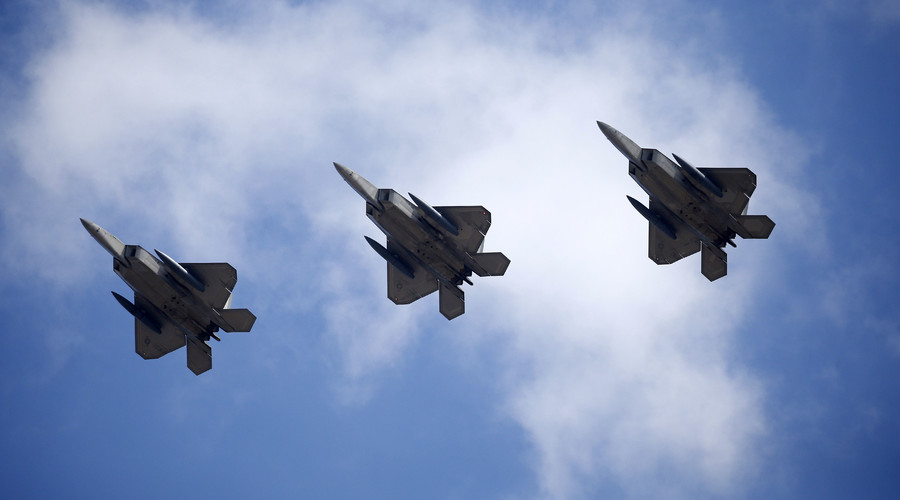
U.S. F-22 stealth fighter jets © Kim Hong-Ji / Reuters

Russia’s Defense Ministry has cautioned the US-led coalition of carrying out airstrikes on Syrian army positions, adding in Syria there are numerous S-300 and S-400 air defense systems up and running.

Russia currently has S-400 and S-300 air-defense systems deployed to protect its troops stationed at the Tartus naval supply base and the Khmeimim airbase. The radius of the weapons reach may be “a surprise” to all unidentified flying objects, Russian Defense Ministry spokesperson General Igor Konashenkov said.

Read more

© Kirill Kallinikov

According to the Russian Defense Ministry, any airstrike or missile hitting targets in territory controlled by the Syrian government would put Russian personnel in danger.

The defense official said that members of the Russian Reconciliation Center in Syria are working “on the ground” delivering aid and communicating with a large number of communities in Syria.

“Therefore, any missile or air strikes on the territory controlled by the Syrian government will create a clear threat to Russian servicemen.”

Russian air defense system crews are unlikely to have time to determine in a ‘straight line’ the exact flight paths of missiles and then who the warheads belong to. And all the illusions of amateurs about the existence of ‘invisible’ jets will face a disappointing reality,”  Konashenkov added.

Read more

© Abdalrhman Ismail

He also noted that Syria itself has S-200 as well as BUK systems, and their technical capabilities have been updated over the past year.

The Russian Defense Ministry’s statement came in response to what it called “leaks” in the Western media alleging that Washington is considering launching airstrikes against Syrian government forces.

“Of particular concern is information that the initiators of such provocations are representatives of the CIA and the Pentagon, who in September reported to the [US] President on the alleged controllability of ‘opposition’ fighters, but today are lobbying for ‘kinetic’ scenarios in Syria,” he said.

He cautioned Washington to conduct a “thorough calculation of the possible consequences of such plans.”

US-led coalition jets bombed positions of the Syrian government forces on September 17, resulting in the deaths of 83 servicemen. Washington said the airstrike was a mistake, however Damascus claimed the incident was a “blatant aggression.”

The relocation of the S-300 system in order to protect Russian ships and the naval base in Syria was confirmed by Russian defense officials on October 4. Konashenkov assured that the S-300 is a “purely defensive system and poses no threat.” Russia also has S-400 missile defense systems at Khmeimim base that were placed there after Turkey downed a Russian SU-24 jet in November of 2015.

U.S. Army Chief Threatens War With Russia

October 5, 2016

U.S. Army Chief Threatens War With Russia “We will beat you harder than you have ever been beaten before”

Paul Joseph Watson – October 5, 2016

Source: U.S. Army Chief Threatens War With Russia » Alex Jones’ Infowars: There’s a war on for your mind!


Army Chief of Staff Gen. Mark Milley warned last night that the United States was ready to “destroy” its enemies in comments that were clearly directed at Russia.

“I want to be clear to those who wish to do us harm….the United States military – despite all of our challenges, despite our [operational] tempo, despite everything we have been doing – we will stop you and we will beat you harder than you have ever been beaten before. Make no mistake about that,” said Milley.

The General went on to warn that Russia and other countries had taken advantage of the U.S. being focused on the war on terror.

“Other countries – Russia, Iran, China, North Korea – went to school on us,” he said, adding, “They studied our doctrine, our tactics, our equipment, our organization, our training, our leadership. And, in turn, they revised their own doctrines, and they are rapidly modernizing their military today to avoid our strengths in hopes of defeating us at some point in the future.”

Milley cautioned that the next major conflict would “be highly lethal, unlike anything our Army has experienced at least since World War II,” and would involve fighting in “highly populated urban areas.”

“Make no mistake about it, we can now and we will … retain the capability to rapidly deploy,” he said, “and we will destroy any enemy anywhere, any time,” he concluded.

Gen. Milley made it clear who he was talking about when he went on to quote a senior Russian official who vowed, “Russia can now fight a conventional war in Europe and win.”

The comments come amidst rising tensions between the two superpowers.

40 million Russians from all sectors of government are currently taking part in a nationwide emergency drill that will wargame “evacuation” procedures during a national crisis.

According to Oleg Manuilov, the director of the Russian Civil Defence Department, the exercise will be a test run of how the population would respond to a “disaster occurrence” under an “emergency” situation.

Last week, Russian officials revealed that huge underground nuclear bunkers had been built to provide shelter for the city’s 12 million population.

A nationwide television station run by the country’s Ministry of Defence also warned citizens last week that nuclear conflict was on the horizon.

“Schizophrenics from America are sharpening nuclear weapons for Moscow,” reported Zvezda.

Obama Warned To Defuse Tensions With Russia, “Unintended Consequences Likely To Be Catastrophic”

October 5, 2016

Obama Warned To Defuse Tensions With Russia, “Unintended Consequences Likely To Be Catastrophic”

Source: Obama Warned To Defuse Tensions With Russia, “Unintended Consequences Likely To Be Catastrophic” | Zero Hedge

A group of ex-U.S. intelligence officials is warning President Obama to defuse growing tensions with Russia over Syria by reining in the demonization of President Putin and asserting White House civilian control over the Pentagon.

ALERT MEMORANDUM FOR: The President


FROM: Veteran Intelligence Professionals for Sanity


SUBJECT: PREVENTING STILL WORSE IN SYRIA


We write to alert you, as we did President George W. Bush, six weeks before the attack on Iraq, that the consequences of limiting your circle of advisers to a small, relatively inexperienced coterie with a dubious record for wisdom can prove disastrous.* Our concern this time regards Syria.


We are hoping that your President’s Daily Brief tomorrow will give appropriate attention to Saturday’s warning by Russia’s Foreign Ministry spokesperson Maria Zakharova: “If the US launches a direct aggression against Damascus and the Syrian Army, it would cause a terrible, tectonic shift not only in the country, but in the entire region.”


Speaking on Russian TV, she warned of those whose “logic is ‘why do we need diplomacy’ … when there is power … and methods of resolving a problem by power. We already know this logic; there is nothing new about it. It usually ends with one thing – full-scale war.”


We are also hoping that this is not the first you have heard of this – no doubt officially approved – statement. If on Sundays you rely on the “mainstream” press, you may well have missed it. In the Washington Post, an abridged report of Zakharova’s remarks (nothing about “full-scale war”) was buried in the last paragraph of an 11-paragraph article titled “Hospital in Aleppo is hit again by bombs.” Sunday’s New York Times totally ignored the Foreign Ministry spokesperson’s statements.


In our view, it would be a huge mistake to allow your national security advisers to follow the example of the Post and Times in minimizing the importance of Zakharova’s remarks.


Events over the past several weeks have led Russian officials to distrust Secretary of State John Kerry. Indeed, Foreign Minister Sergey Lavrov, who parses his words carefully, has publicly expressed that distrust. Some Russian officials suspect that Kerry has been playing a double game; others believe that, however much he may strive for progress through diplomacy, he cannot deliver on his commitments because the Pentagon undercuts him every time. We believe that this lack of trust is a challenge that must be overcome and that, at this point, only you can accomplish this.


It should not be attributed to paranoia on the Russians’ part that they suspect the Sept. 17 U.S. and Australian air attacks on Syrian army troops that killed 62 and wounded 100 was no “mistake,” but rather a deliberate attempt to scuttle the partial cease-fire Kerry and Lavrov had agreed on – with your approval and that of President Putin – that took effect just five days earlier.


In public remarks bordering on the insubordinate, senior Pentagon officials showed unusually open skepticism regarding key aspects of the Kerry-Lavrov deal. We can assume that what Lavrov has told his boss in private is close to his uncharacteristically blunt words on Russian NTV on Sept. 26:


“My good friend John Kerry … is under fierce criticism from the US military machine. Despite the fact that, as always, [they] made assurances that the US Commander in Chief, President Barack Obama, supported him in his contacts with Russia (he confirmed that during his meeting with President Vladimir Putin), apparently the military does not really listen to the Commander in Chief.”


Lavrov’s words are not mere rhetoric. He also criticized JCS Chairman Joseph Dunford for telling Congress that he opposed sharing intelligence with Russia, “after the agreements concluded on direct orders of Russian President Vladimir Putin and US President Barack Obama stipulated that they would share intelligence. … It is difficult to work with such partners. …”


Policy differences between the White House and the Pentagon are rarely as openly expressed as they are now over policy on Syria. We suggest you get hold of a new book to be released this week titled The General vs. the President: MacArthur and Truman at the Brink of Nuclear War by master historian H. W. Brands. It includes testimony, earlier redacted, that sheds light on why President Truman dismissed WWII hero Gen. Douglas MacArthur from command of U.N. forces in Korea in April 1951. One early reviewer notes that “Brands’s narrative makes us wonder about challenges of military versus civilian leadership we still face today.” You may find this new book more relevant at this point in time than the Team of Rivals.


The door to further negotiations remains ajar. In recent days, officials of the Russian foreign and defense ministries, as well as President Putin’s spokesman, have carefully avoided shutting that door, and we find it a good sign that Secretary Kerry has been on the phone with Foreign Minister Lavrov. And the Russians have also emphasized Moscow’s continued willingness to honor previous agreements on Syria.


In the Kremlin’s view, Russia has far more skin in the game than the U.S. does. Thousands of Russian dissident terrorists have found their way to Syria, where they obtain weapons, funding, and practical experience in waging violent insurgency. There is understandable worry on Moscow’s part over the threat they will pose when they come back home. In addition, President Putin can be assumed to be under the same kind of pressure you face from the military to order it to try to clean out the mess in Syria “once and for all,” regardless how dim the prospects for a military solution are for either side in Syria.


We are aware that many in Congress and the “mainstream” media are now calling on you to up the ante and respond – overtly or covertly or both – with more violence in Syria. Shades of the “Washington Playbook,” about which you spoke derisively in interviews with the Atlantic’s Jeffrey Goldberg earlier this year. We take some encouragement in your acknowledgment to Goldberg that the “playbook” can be “a trap that can lead to bad decisions” – not to mention doing “stupid stuff.”


Goldberg wrote that you felt the Pentagon had “jammed” you on the troop surge for Afghanistan seven years ago and that the same thing almost happened three years ago on Syria, before President Putin persuaded Syria to surrender its chemical weapons for destruction. It seems that the kind of approach that worked then should be tried now, as well – particularly if you are starting to feel jammed once again.


Incidentally, it would be helpful toward that end if you had one of your staffers tell the “mainstream” media to tone down it puerile, nasty – and for the most part unjustified and certainly unhelpful – personal vilification of President Putin.


Renewing direct dialogue with President Putin might well offer the best chance to ensure an end, finally, to unwanted “jamming.” We believe John Kerry is correct in emphasizing how frightfully complicated the disarray in Syria is amid the various vying interests and factions. At the same time, he has already done much of the necessary spadework and has found Lavrov for the most part, a helpful partner.


Still, in view of lingering Russian – and not only Russian – skepticism regarding the strength of your support for your secretary of state, we believe that discussions at the highest level would be the best way to prevent hotheads on either side from risking the kind of armed confrontation that nobody should want.


Therefore, we strongly recommend that you invite President Putin to meet with you in a mutually convenient place, in order to try to sort things out and prevent still worse for the people of Syria.


In the wake of the carnage of World War II, Winston Churchill made an observation that is equally applicable to our 21st Century: “To jaw, jaw, jaw, is better than to war, war, war.”

For the Steering Group, Veteran Intelligence Professionals for Sanity

William Binney, former Technical Director, World Geopolitical & Military Analysis, NSA; co-founder, SIGINT Automation Research Center (ret.)

Fred Costello, Former Russian Linguist, USAF

Mike Gravel, former Adjutant, top secret control officer, Communications Intelligence Service; special agent of the Counter Intelligence Corps and former United States Senator

Matthew Hoh, former Capt., USMC, Iraq & Foreign Service Officer, Afghanistan (associate VIPS)

Larry C. Johnson, CIA & State Department (ret.)

John Kiriakou, former CIA counterterrorism officer and former senior investigator, Senate Foreign Relations Committee

Linda Lewis, WMD preparedness policy analyst, USDA (ret.) (associate VIPS)

Edward Loomis, NSA, Cryptologic Computer Scientist (ret.)

Ray McGovern, former US Army infantry/intelligence officer & CIA analyst (ret.)

Elizabeth Murray, Deputy National Intelligence Officer for Middle East, CIA (ret.)

Todd Pierce, MAJ, US Army Judge Advocate (ret.)

Coleen Rowley, Division Counsel & Special Agent, FBI (ret.)

Kirk Wiebe, former Senior Analyst, SIGINT Automation Research Center, NSA, (ret.)

Robert Wing, former Foreign Service Officer

Ann Wright, U.S. Army Reserve Colonel (ret) and former U.S. Diplomat

* In a Memorandum to President Bush criticizing Colin Powell’s address to the UN earlier on February 5, 2003, VIPS ended with these words: “After watching Secretary Powell today, we are convinced that you would be well served if you widened the discussion … beyond the circle of those advisers clearly bent on a war for which we see no compelling reason and from which we believe the unintended consequences are likely to be catastrophic.”
 

Obama Administration Again Deliberates Air Strikes on Assad

October 5, 2016

Obama Administration Again Deliberates Air Strikes on Assad Regime President unlikely to accept military action in Syria

BY:
October 4, 2016 4:46 pm

Source: Obama Administration Again Deliberates Air Strikes on Assad

The Obama administration is again considering air strikes against the regime of Syrian President Bashar al Assad following the failure of a ceasefire deal brokered by the U.S. and Russia.

Top national security officials are meeting with senior administration officials Wednesday to address the ongoing crisis in the rebel-held city of Aleppo. President Obama is expected to reject proposed airstrikes, according to the Washington Post.

Officials from the State Department, CIA, and Joint Chiefs of Staff met last week at the White House to discuss limited military strikes in Syria against the regime to punish Assad for violating the latest ceasefire and continuing to commit war crimes against his people.

Administration officials also hope to pressure Assad into diplomatic talks aimed at ending the country’s civil war, now in its sixth year.

The administration is considering a number of options that include bombing Syrian air force runways, an official participating in the discussions told the Post. The official said the White House would work around its long-standing refusal to strike the Assad regime without a U.N. Security Council resolution by covertly conducting the strikes.

“There’s an increased mood in support of kinetic actions against the regime,” one senior administration official told the Post.

Still, Obama remains unlikely to approve military action against the regime.

The U.S. on Monday suspended bilateral engagement with Russia on negotiating a diplomatic resolution in Syria. Secretary of State John Kerry had worked to restore a week-long ceasefire with Moscow, but talks ultimately fell through given Russia’s continued assault on Aleppo along with Syrian forces.

Moscow delivers S-300 missile system to Syria for defense of Russian naval base

October 4, 2016

Moscow delivers S-300 missile system to Syria for defense of Russian naval base

Published time: 4 Oct, 2016 15:33 Edited time: 4 Oct, 2016 16:02

Source: Moscow delivers S-300 missile system to Syria for defense of Russian naval base — RT News

© Kirill Kallinikov / Sputnik

A battery of Russian S-300 air defense missile launchers has been transported to Syria, Russia’s Defense Ministry said in a statement. Its sole purpose is to defend a Russian naval base and warships, the ministry added.
Read more

The Russian Embassy in Damascus. © Mikhail Alaeddin

The information about the S-300’s deployment was confirmed by ministry spokesman Igor Konashenkov.

“Indeed, the Syrian Arab Republic received an S-300 anti-aircraft missile system. This system is designed to ensure the safety of the naval base in [Syrian city of] Tartus and ships located in the coastal area [in Syria]…” he told the media.

Konashenkov said it is unclear why the deployment of the missile system has created such a fuss in the West.

“The S-300 is a purely defensive system and poses no threat,” he said.

He recalled that before the deployment of S-300, Russia had delivered Fort air defense missile systems to Syria.

The statement comes after a report by Fox news that a Russian S-300 was deployed to Syria. The media cited three US officials who claimed that Moscow “continues to ramp up its military operations in Syria.”

In November 2015, Moscow deployed its newest S-400 air defense missile system to Khmeimim in Syria as part of a security boost following the downing of a Russian jet by Turkey near the border with that country. At the time, Russian President Vladimir Putin said that the S-400 systems are not targeting Russia’s partners, “with whom we fight terrorists in Syria together.”

The S-400 is the most advanced anti-aircraft defense system in Russia.

Russian embassy in Damascus shelled from terrorist-controlled area of Syria

October 4, 2016

Russian embassy in Damascus shelled from terrorist-controlled area of Syria

Published time: 4 Oct, 2016 10:26 Edited time: 4 Oct, 2016 12:33

Source: Russian embassy in Damascus shelled from terrorist-controlled area of Syria — RT News

The Russian embassy in Damascus came under fire on Tuesday from a neighborhood controlled by militant groups, including Al-Nusra Front, the Russian Foreign Ministry reports.
Read more

Al Qaeda-linked Nusra Front fighters © Stringer

One of the mortar shells fired at the embassy complex hit the residential area, while two others landed near the embassy building, the ministry said in a statement. Nobody was injured by the explosions.

“According to reports, the shelling came from the Jobar neighborhood of Damascus, which is under control of the terrorist groups Jabhat Fateh al-Sham and Failak ar-Rahman,” the ministry said.

Jabhat Fateh al-Sham is the new name taken by Al-Nusra Front, the Al-Qaeda offshoot universally considered a terrorist organization. Failak ar-Rahman is a lesser-known Islamist group.

Moscow said the shelling is “result of the actions of those who, like the US and some of its allies, provoke the continued bloodshed in Syria and flirt with militants and extremists of all flavors.”

The ministry said Russia would take “all necessary measures” to return peace and security to Syria.

READ MORE: 30 killed, scores injured in suicide bombing at Kurdish wedding in Syria

The Russian embassy in Damascus has come under militant fire on several occasions. The Syrian capital remains under threat despite the efforts of the army to fend off armed groups.

‘Deal with the devil’: US ‘ready to ally with terror’ to overthrow Assad

October 4, 2016

Deal with the devil’: US ‘ready to ally with terror’ to overthrow Assad – Russia Foreign Ministry

Published time: 3 Oct, 2016 21:37 Edited time: 4 Oct, 2016 00:13

Source: ‘Deal with the devil’: US ‘ready to ally with terror’ to overthrow Assad – Russia Foreign Ministry — RT News

Al Qaeda-linked Nusra Front fighters © Stringer / Reuters

Moscow has accused Washington of sabotaging the Syria ceasefire deal, saying that the US will be responsible for any new terror attacks in Syria, as by taking no action against Al-Nusra terrorists it shows it is ready “to make a deal with the devil.”

READ MORE: US suspends bilateral contact with Russia over Syria

Washington “has never exerted any real pressure on Jabhat Al-Nusra, done nothing for delineation to succeed and taken no action against its militants,” the Russian Foreign Ministry said in a statement Monday, following the US decision to suspend cooperation on Syria.

Besides failing to deliver on its part of the deal, the US were hampering Moscow’s efforts to stop the terrorists, the Russian Foreign Ministry said, calling Washington’s decision a “reflection” of the Obama administration’s inability to meet the key condition for Russia-US cooperation on the Syrian peace process.

Read more

© Ammar Abdullah

The way the situation has been unraveling in Syria in the past few weeks has made Moscow doubt what Washington’s real intentions are, according to the ministry.

“We are becoming more convinced that in a pursuit of a much desired regime change in Damascus, Washington is ready to ‘make a deal with the devil’,” the Foreign Ministry said. For the sake of ousting Syrian President Bashar Assad, the US appears to be ready to “forge an alliance with hardened terrorists, dreaming of turning back the course of history.”

While Jabhat Al-Nusra, a designated terrorist organization, has been known as an Al-Qaeda affiliate for many years, Washington “is not in a hurry to separate US-oriented anti-government forces from it,” Moscow points out. On the contrary, even though Al-Nusra has never been a part of any peace deal, Washington “covers it with the shield of opposition groups which formally confirmed their participation in the cessation of hostilities.”

Meanwhile, Russia’s Permanent Representative to the UN, Vitaly Churkin, who on Monday assumed the post of the President of the UN Security Council, expressed his concerns over the halt in Russia-US cooperation in Syria.

At the same time, he insisted that the current setback in Syria will not lead to another “Cold War” between Moscow and Washington.

“I think you are dramatizing the nature of our disagreements with the US,” Churkin said, replying to a reporter at a press conference, adding that there’s still a chance to revive the cooperation.

“I hope there will not be a new Cold War,” he added.

For now, the main objective in Syria for Russia is to thwart Al-Nusra’s latest offensive in Aleppo, which has seen increasing number of terrorist attacks in the wake of the ceasefire’s collapse.

“In the process of the past few weeks, after the September 9 arrangements were reached, we have seen numerous violations by Nusra and others cooperating with Nusra of the cessation of hostilities regime”, Churkin said, adding that about 1.5 million people are currently stand the risk of being besieged by its militants south of Aleppo.

“We must make sure that Nusra’s influence is not going to continue to spread,” he stressed, describing the situation in Aleppo as “extremely dramatic.”

On a broader scale, Russia’s long-term aim in the region is to “throw the terrorists out” of Iraq and Syria, as it is the only way to secure the lives of civilians, living there in constant danger from extremists.

To mitigate the impact of one of the terrorists’ most powerful weapons, propaganda, Russia has submitted a draft resolution to the UN Security Council designed “to counter terrorist ideology and the ideology of violent extremism,” Churkin said.

Meanwhile, U.S. Assistant Secretary of State for European and Eurasian Affairs Victoria Nuland is set to visit Moscow this week. However, she is expected to discuss solely Ukraine and implementation of the Minsk agreements, according to the State Department’s press release.

40 Million Russians To Take Part In “Nuclear Disaster” Drill, Days After US General Warns Of War With Moscow

October 4, 2016

40 Million Russians To Take Part In “Nuclear Disaster” Drill, Days After US General Warns Of War With Moscow

by Tyler Durden

Oct 4, 2016 3:47 AM

Source: 40 Million Russians To Take Part In “Nuclear Disaster” Drill, Days After US General Warns Of War With Moscow | Zero Hedge


As relations between Russia and the US disintegrate as a result of the escalating proxy war in Syria, which today culminated with Putin halting a Plutonium cleanup effort with the US, shortly before the US State Department announced it would end negotiations with Russia over Syria, tomorrow an unprecedented 40 million Russian citizens, as well as 200,000 specialists from “emergency rescue divisions” and 50,000 units of equipment are set to take part in a four day-long civil defense, emergency evacuation and disaster preparedness drill, the Russian Ministry for Civil Defense reported on its website.

According to the ministry, an all-Russian civil defense drill involving federal and regional executive authorities and local governments dubbed “Organization of civil defense during large natural and man-caused disasters in the Russian Federation” will start tomorrow morning in all constituent territories of Russia and last until October 7. While the ministry does not specify what kind of “man-caused disaster” it envisions, it would have to be a substantial one for 40 million Russians to take part in the emergency preparedness drill. Furthermore, be reading the guidelines of the drill, we can get a rather good idea of just what it is that Russia is “preparing” for.

The website adds that “the main goal of the drill is to practice organization of management during civil defense events and emergency and fire management, to check preparedness of management bodies and forces of civil defense on all levels to respond to natural and man-made disasters and to take civil defense measures.” Oleg Manuilov, director of the Civil Defence Ministry explained that the exercise will be a test of how the population would respond to a “disaster” under an “emergency” situation.

Some further details, on the 3-stage, 4 day drill:

I stage: organization of civil defense actions


The stage is going to practice notification and gathering of senior officials of federal and regional executive authorities, local governments and civil defense forces, deployment of civil defense management system on all levels, readying civil defense communication and notification system. After the National Crisis Management Center have brought the management signals, all management bodies, state authorities, forces and facilities on duty and people will be notified through notification systems available.


II stage: Planning and organization of civil defense actions. Deploying a team of civil defense forces and facilities designed to respond to large disasters and fires.


The stage plans to practice deployment a mobile interagency multi-functional team of civil defense forces and facilities in each federal district in order to carry our rescue and other urgent operations, civil defense actions and to deploy special civil defense units in constituent territories; putting rescue military units, divisions of the federal fire service, rescue units on standby. The stage provides for the team to be reinforced, activation of backup control centers and practicing collecting and exchanging information in the field of civil defense.


III stage: Organization of actions of civil defense management bodies and forces for response to large disasters and fires.


The stage will deal with the use of the civil defense team to respond to large disasters and fires, setting up aerial and mobile control centers, revising of routes for save evacuation of people, organization of vital services; taking off fire and rescue units of the federal fire service to put out fires and conduct rescue operations at potentially dangerous facilities, including closed administrative territorial entities.


The drill will rehearse radiation, chemical and biological protection of the personnel and population during emergencies at crucial and potentially dangerous facilities. Fire safety, civil defense and human protection at social institutions and public buildings are also planned to be checked. Response units will deploy radiation, chemical and biological monitoring centers and sanitation posts at the emergency areas, while laboratory control networks are going to be put on standby.

The fact that among the measures tasked for the civil defense team will be a response to “disasters and fires” as well as the rehearsal of “radiation, chemical and biological protection”, makes it clear that Russia is about to hold its biggest nuclear war drill since perhaps the end of the Cold War.

Why now? Perhaps, in addition to the sharp deterioration in relations between Russia and the west, where tensions are on par with the cold war, another answer may come from the Chairman of the Joint Chiefs of Staff Joseph Dunford, who last week warned Congress that the implementation of a No Fly Zone in Syria as proposed by John Kerry recently, and a centerpiece of Hillary’s foreign policy strategy, would result in World War III.

During testimony before the Senate Committee on Armed Services last week General Joseph Dunford rang the alarm over a policy shift that is gaining more traction within the halls of Washington following the collapse of the ceasefire brokered by the United States and Russia in Syria saying that it could result in a major international war which he was not prepared to advocate on behalf of. Senator Roger Wicker of Mississippi asked about Hillary Clinton’s proposal for a no fly zone in Syria in response to allegations that Russia and Syria have intensified their aerial bombardment of rebel-held East Aleppo since the collapse of the ceasefire.

“What about the option of controlling the airspace so that barrel bombs cannot be dropped? What do you think of that option?” asked Wicker. “Right now, Senator, for us to control all of the airspace in Syria would require us to go to war against Syria and Russia. That is a pretty fundamental decision that certainly I’m not going to make,” said the Chairman of the Joint Chiefs of Staff suggesting the policy was too hawkish even for military leaders.

https://youtu.be/fmE9Jj-rEVs

As a reminder, Hillary Clinton strongly argued in favor of a no fly zone ever since October 2015, just days after Russia began a bombing campaign aimed at maintaining the stability of the Syrian government. “I personally would be advocating now for a no fly zone and humanitarian corridors to try to stop the carnage on the ground and from the air, to try to provide some way to take stock of what’s happening, to try to stem the flow of refugees,” said Clinton in an interview with NBC in October 2015.

Despite the warnings, the former Secretary of State and current presidential candidate, who has a well-known hawkish position towards regime change and matters related to Russia, has continued to advocate this position which has gained traction in recent weeks among top US diplomats.

Clinton is note alone: as the WSJ reported in June, more than 50 US diplomats endorsed a notorious dissent memo, demanding that that the Obama administration employ military options against Assad, such as the implementation of a no fly zone if not a direct attack against the Syrian regime. The argument from the diplomats is that the situation in Syria will continue to devolve without direct action by the US military, an argument of dubious legality if undertaken unilaterally without a UN Security Council resolution but which as Sputnik reports, the US Ambassador to the UN Samantha Power has been laying the groundwork for under the controversial “right to protect” theory of international law arguing that Russia’s opposition to a resolution should be ignored because they are a party to the conflict.

Russia, in turn, has countered that if the Assad regime falls then terrorist groups including ISIS and al-Nusra Front will likely fill the resulting power vacuum descending the country into an even greater harbor for international terrorism. Ultimately, the Syrian conflict is fundamentally about the transport of energy, and whether Russia maintains its dominance over European natural gas imports, or if – with the Syrian regime deposed – a Qatar natural gas pipeline can cross the territory and make its way to Europe.

As for the Russian nuclear war drill, we can only hope that any such rising hints of nuclear warfare remain in the realm of the purely theoretical.

Direct aggression by US against Damascus to cause ‘tectonic shift’ in Middle East

October 2, 2016

Direct aggression by US against Damascus to cause ‘tectonic shift’ in Middle East – Moscow

Published time: 1 Oct, 2016 10:22 Edited time: 1 Oct, 2016 18:19

Source: Direct aggression by US against Damascus to cause ‘tectonic shift’ in Middle East – Moscow — RT News


FILE PHOTO Residents in Midan, a Christian district of Aleppo, hit by mortar shelling. © Mikhail Alayeddin
If the US launches a military campaign to oust the Syrian government, it would further fracture the country and have tremendous negative long-term consequence for the entire region, Russian Foreign Ministry spokesperson Maria Zakharova warned.
Read more

Russian Foreign Minister Sergei Lavrov © Mikhail Voskresenskiy

If the US launches a direct aggression against Damascus and the Syrian Army, it would cause a terrible, tectonic shift not only in the country, but in the entire region,” Maria Zakharova said during a talk show, which is to be aired fully later on Saturday and has been cited by RIA.

With no government in Damascus, there will be a power vacuum in Syria, which “so-called moderates, who are, in reality, not moderate at all but just terrorists of all flavors, would fill; and there will be no dealing with them,” the diplomat predicted.

And later it would be aggravated the way it happened in Iraq. We know that [Saddam Hussein’s] Iraqi Army became the basis of the Islamic State. Everything that both the [US-led] coalition and Russia are fighting now stems from it,” Zakharova said.

Russia and the US are accusing each other over the collapse of the ceasefire which was signed last month, but has failed. The US says Moscow did not do enough to win the trust of rebel forces and to prevent the government of Syrian President Bashar Assad from attacking his opponents. Russia says Washington was incapable of separating ‘moderate rebels’ from terrorist groups and keeping them in check for the truce to take hold.

READ MORE: US had never had ‘Plan A’ for Syria, West a root cause of crisis – Syrian UN envoy to RT

With the collapse of the deal, the Syrian government launched an offensive on rebel-held areas of Aleppo, a city divided between the Syrian Army and dozens of armed groups, including Al Qaeda off-shoot Al-Nusra Front.

The US acknowledged that it had not been going after Al-Nusra Front for months because the terrorists intermingled with ‘moderates’ and the civilian population. At the same time, it accused Moscow and Damascus of war crimes, citing civilian deaths caused by the renewed hostilities in Aleppo.

Russia has voiced concern that the US was deliberately shielding Al-Nusra Front from military action by Russia and Syria, hoping that the terrorist group would help oust the Syrian government.


