Posted tagged ‘Syria war’

Russia vies with Israel over aid for Quneitra

July 19, 2017

Russia vies with Israel over aid for Quneitra, DEBKAfile, July 19, 2017

(Please see also, Operation Good Neighbor: Israel’s part in Syria.– DM)

On their arrival in Quneitra, the Russians found a population that was better fed and cared for than Syrian civilians on any other of the country’s warfronts. They are nonetheless challenging Israel for the locals’ hearts and minds.

******************************

As Russian troops began moving into the Quneitra ceasefire sector opposite Israel’s Golan border on Wednesday, July 19, they found they were in hot competition with Israel over … humanitarian aid for the sector’s rebel-held villages.

Since Israel is adamantly opposed to the Russian presence in the Quneitra demilitarized zone – although it was endorsed by the Trump administration, as DEBKAfile reported exclusively on Tuesday, July 18 – Moscow decided to take it slowly and meanwhile try and win over the Syrian rebel groups whom Israel has succored for years. The Kremlin figured that if these anti-Assad groups could be weaned away from Israel, they might be persuaded to cooperate with the Russian troops in setting up the Quneitra ceasefire zone, and the Russians would not need Israel’s compliance.

On Tuesday, therefore, a Russian military convoy drove into Jabah, a village northeast of Qunetra town and 4km from Israel’s Golan border. Officers described as belonging to the “Russian Defense Ministry’s reconciliation center” alit from the trucks and began handing out food packages to the villagers.

The civilians received necessities and were treated by Russian doctors, a Syrian officer announced. Russian and Syrian officers promised that more humanitarian aid would be delivered to “settlements across the Quneitra province” and Russian doctors would visit all the villages in the ceasefire zone.

Israel, who has been sending aid across these Syrian villages which were cut off by the civil war from basic necessities, has mostly kept its humanitarian program under wraps, except when witnesses reported what they saw to the media. On Wednesday, the IDF officers running the program asked sardonically: “Where were the Russians all these years when Israel alone helped the beleaguered villages across its border?”

After watching the Russian troops hand out packages to the people of Quneitra, the Israeli government and military chiefs decided to challenge the Russian belated propaganda move.

Up until now, Israel has supplied regular humanitarian aid to some 200,000 Syrian villagers living in 80 non-ISIS rebel-controlled villages 15km deep inside the Syrian Golan. Last year alone, Israel sent over half a million liters of heavy fuel, 360 tonnes of foodstuffs, 77 tonnes of clothing and shoes, tens of generators and water system, as well as providing them with medical treatment, including hospital care for sick and injured Syrians and a field hospital on the border.

Wednesday, Israel formalized its assistance program under the title “The Good Neighbor” and disclosed it had been administered since 2016 by a special unit of the Bashan Division which is in charge of the Golan sector.

The IDF released footage of trucks ferrying across the border supplies of medical equipment, medicines, foodstuffs and fuel, as well as pictures documenting IDF medics lifting Injured Syrians off the battlefield for treatment in Israeli hospitals.

According to IDF statistics, at least 3,000 Syrians crossed the border in the past four years for medical treatment. And Israel sent over as needed incubators, respirators and ambulances. In the same period, the IDF conducted 150 assistance operations on Syrian soil.

On their arrival in Quneitra, the Russians found a population that was better fed and cared for than Syrian civilians on any other of the country’s warfronts. They are nonetheless challenging Israel for the locals’ hearts and minds.

To undercut Iran, Russians pressure Assad to cut Syria’s longtime ties to Hezbollah

July 18, 2017

To undercut Iran, Russians pressure Assad to cut Syria’s longtime ties to Hezbollah, Washington Times, Assad Hanna and Jacob Wirtschafter, July 17, 2017

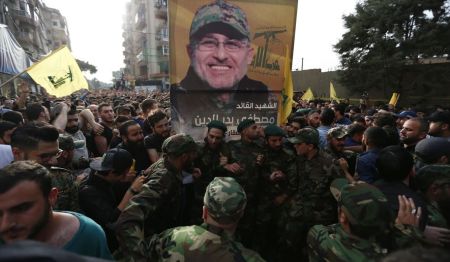
Hezbollah supporters mourned their commander Mustafa Badreddine, who was killed in an explosion last year in Damascus.

ISTANBUL — The Lebanese Shiite militia Hezbollah and the Syrian government have enjoyed a close, fruitful relationship for nearly 40 years. But six years into the Syrian civil war, there are signs that battle fatigue and diverging strategic visions are fraying their alliance.

Syrian President Bashar Assad is coming under increasing pressure from pro-Russian factions in his ruling circle to dump pro-Iranian Hezbollah, as a U.S.-Russia accord to establish a de-escalation zone in southern Syria gets underway this week.

It’s a different kind of proxy war playing out in Syria: Instead of Sunni versus Shiite, or the U.S. versus Russia, it’s Russia versus Iran.

“There is a pro-Moscow faction that wants Syria to be secular and includes officers who trained in Russia,” said Ayman Abdel Nour, publisher of the largest anti-Assad Syrian news portal and leader of the country’s exiled Christian community based in Dubai, United Arab Emirates. “Those who support Iran are people bought by the Iranians or [who] reached their positions of power with Iranian help.”

Incidents of rivalry and strain between Hezbollah forces and Syrian government allies have been increasing since June 2016, when they openly clashed during what was supposed to be a joint operation in the Aleppo countryside.

Hezbollah has balked at implementing Russian-brokered cease-fire agreements, such as one in December in Aleppo, and occasional firefights have broken out between the two forces in the northwestern suburbs of Damascus on the road from the capital to Beirut.

Meanwhile, the Russian Defense Ministry has ordered aerial bombings of Shiite militia positions when Iran-backed forces interfered with plans to evacuate civilians to safe areas.

“The Hezbollah message has been: ‘Don’t think you can make a deal without us. We are on the ground, and we control what’s going on,’” said Ahmad Hardan, a 20-year-old ambulance driver from Aleppo detained by Lebanese Shiite fighters as he and his family fled their home.

“They took all the young men from the cars and drove us to the opposite side of the road. All those who tried to resist were killed,” Mr. Hardan said. “But suddenly there were Russian fighter jets in the sky, the Hezbollah troops started shooting in the air, and then they let the evacuation proceed.”

The situation is new for the two longtime Middle East allies. Hezbollah and the Assad regime have been close since the mid-1980s, when Mr. Assad’s father, Hafez, became a patron of the Lebanese Shiite faction. He allowed Syria to be the transit point for Iranian weapons as Hezbollah armed itself against Israel and its domestic rivals in Lebanon.

The power dynamic reversed as the Syrian civil war turned into a sectarian bloodbath, with many Russian-trained Sunni officers deserting to the rebel side. Mr. Assad turned to Hezbollah for ideologically motivated and battle-tested reinforcements.

‘An Iranian pawn’

But over the years, Hezbollah’s role has been shrinking in Syria’s war, which began in 2011.

Nawar Oliver, an analyst at the Istanbul-based Omran Center for Strategic Studies, said Hezbollah’s estimated 10,000-member force in Syria is just one component that includes a 70,000-strong contingent of local Shiite militias deployed with Iraqi, Afghan and Pakistani fighters.

“The number decreased from an apex of about 15,000 to 20,000 because Hezbollah started recruiting and funding local Shiite militias in order to pull back some of their troops from Syria,” said Mr. Oliver, pointing to more than 1,000 Lebanese battle casualties and a desire to prepare for a likely conflict on the Israel-Lebanon border.

Moscow wants Mr. Assad to change the arrangement with Hezbollah and other Iranian-funded Shiite militias that give Tehran nominal control of the country in exchange for little direct supervision by the regime’s officer corps.

“The Russians have been pressuring the Syrian regime to integrate the militias it created since the inception of the uprising into its armed forces,” said Hilal Khashan, a politics professor at the American University of Beirut.

Command and control functions over Hezbollah fighters are directed by an officer corps drawn from Iran’s Revolutionary Guard Corps.

Hezbollah operates in Syria simply as an Iranian pawn,” Mr. Khashan said. “It uses Hezbollah as part of its scheme to establish a ground corridor from Iran to Lebanon. This is not something that sits well with the Russians, who are keen on limiting Tehran’s preponderance. Russia will not allow Iranian influence in Syria to become similar to Iraq.”

A tentative U.S.-Russia consensus on Syria seems destined to further strain the Hezbollah-Iran-Assad alliance.

Last month, the Hezbollah TV station Al-Manar broadcast footage of what it said was an Iranian drone tailing an American drone over eastern Syria. The announcer’s voice-over included a warning that Hezbollah will strike at U.S. positions inside Syria if America crosses any “red lines.”

“Of course, there are no free lunches in this area,” said Mordechai Kedar, a former Syria desk officer for Israel’s military intelligence agency. “Hezbollah wants to take its share in what seems to be the division of Syria. Three things will be required to get them to leave: Assad’s army will have to regain its power and self-confidence, the Russians have to demand it and the Iranians have to consent.”

For the rebels and other anti-regime figures, it’s crucial that Hezbollah is forced out of Syria.

“Getting Hezbollah and the Iranians out is now our No. 1 priority,” said Mr. Abdul Nour, the anti-Assad news portal editor. “They want to convert all of Syria to Shiism, which is an ideology that [will lead to] them fighting with the majority of Sunnis in the country forever — and we don’t want that.”

The terrorist diaspora: After the fall of the caliphate

July 14, 2017

The terrorist diaspora: After the fall of the caliphate, Long War Journal, July 13, 2017

The cult of martyrdom has grown. A disturbingly large number of people are willing to kill themselves for the Islamic State’s cause. The number of suicide bombings claimed by the so-called caliphate dwarfs all other jihadist groups, including al Qaeda. In 2016, for instance, the Islamic State claimed 1,112 “martyrdom operations” in Iraq and Syria alone. Through the first six months of 2017, the organization claimed another 527 such bombings (nearly three-fourths of them using vehicle-borne improvised explosive devices, or VBIEDs) in those two countries. These figures do not include suicide attacks in other nations where Abu Bakr al Baghdadi’s loyalists are known to operate.

To put the Islamic State’s current “martyrdom operations” in perspective, consider data published by the Washington Post in 2008. According to the Post, there were just 54 suicide attacks in all of 2001, when al Qaeda’s “martyrs” launched the most devastating terrorist airline hijackings in history. The Islamic State currently eclipses that figure every month in Iraq and Syria, averaging 93 suicide bombings per month in 2016 and 88 per month so far in 2017. Many of these operations are carried out by foreign fighters.

[I]t is reasonable to conclude that the number of people willing to die for the sake of the so-called caliphate is disturbingly high – much higher than the number of willing martyrs in 2001 or even much more recently. Even though most of these people have been deployed in war zones, it is possible that more will be used outside of Iraq and Syria if they survive the fight and are able to travel to other countries. The Islamic State has already had some success in instigating would-be recruits to die for its cause in the West after they failed to emigrate to the lands of the caliphate. It is certainly possible that more will be sent into Europe or the U.S. in the future.

***********************************

[Editor’s Note: Below is Thomas Joscelyn’s testimony before the House Homeland Security Committee’s Task Force on Denying Terrorists Entry into the United States. The hearing is titled, “The Terrorist Diaspora: After the Fall of the Caliphate.” A version with footnotes will also be posted.]

Chairman Gallagher, Ranking Member Watson Coleman, and other distinguished Committee Members, thank you for inviting me to testify today concerning foreign fighters and the threat some of them pose to the U.S. and Europe.

The fall of Mosul and the likely fall of Raqqa won’t be the end of the Islamic State. The group has already reverted to its insurgent roots in some of the areas that have been lost. It also still controls some territory. The Islamic State will continue to function as a guerrilla army, despite suffering significant losses. In May, the Office of the Director of National Intelligence (ODNI) assessed that even though it was losing significant ground, the Islamic State “will likely have enough resources and fighters to sustain insurgency operations and plan terrorists [sic] attacks in the region and internationally” going forward. Unfortunately, I think ODNI’s assessment is accurate for a number of reasons, some of which I outline below. I also discuss some hypothetical scenarios, especially with respect to returning foreign fighters or other supporters already living in Europe or the U.S.

Recent history. The Islamic State’s predecessor quickly recovered from its losses during the American-led “surge,” capitalizing on the war in Syria and a politically poisonous environment in Iraq to rebound. Indeed, Abu Bakr al Baghdadi’s organization grew into an international phenomenon by the end of 2014, just three years after the U.S. withdrawal from Iraq was completed. Baghdadi’s men did this while defying al Qaeda’s leaders and competing with rival jihadist groups. This recent history should give us pause any time we hear rhetoric that sounds too optimistic about the end of the Islamic State’s caliphate. The enterprise has had enough resources at its disposal to challenge multiple actors for more than three years. There is no question that the Islamic State’s finances, senior personnel, and other assets have been hit hard. But it is premature to say its losses amount to a deathblow.

Uncertainty regarding size of total membership. While it is no longer at the peak of its power, the Islamic State likely still has thousands of dedicated members. We don’t even really know how many members it has Iraq and Syria, let alone around the globe. Previous U.S. estimates almost certainly undercounted the group’s ranks. In September 2014, at the beginning of the US-led air campaign, the CIA reportedly estimated that the Islamic State could “muster” between 20,000 and 31,500 fighters. This figure was “more than three times the previous estimates,” CNN noted. By December 2016, the U.S. military was estimating that 50,000 Islamic State fighters had been killed. By February 2017, U.S. Special Operations command concluded that more than 60,000 jihadists had perished. Two months later, in April 2017, the Pentagon reportedly estimated that 70,000 Islamic State fighters had been killed.

Taken at face value, these figures (beginning with the September 2014 approximation) would suggest that Abu Bakr al Baghdadi’s enterprise was able to replace its entire force structure more than two times over, while fighting multiple enemies on numerous fronts. This is, of course, highly unlikely. Even with its prolific recruiting campaign, it would be impossible for any cohesive fighting organization, let alone one under the sustained pressure faced by the Islamic State, to train, equip and deploy fighters this quickly. It is far more likely that the U.S. never had a good handle on how many jihadists are in its ranks and the casualty figures are guesstimates. The purpose of citing these figures is not to re-litigate the past, but instead to sound a cautionary alarm regarding the near-future: We likely do not even know how many members the Islamic State has in Iraq and Syria today.

The Islamic State is an international organization. Since November 2014, when Abu Bakr al Baghdadi first announced the establishment of “provinces” around the globe, the Islamic State’s membership grew outside of Iraq and Syria. This further complicates any effort to estimate its overall size. Some of these “provinces” were nothing more than small terror networks, while others evolved into capable insurgency organizations in their own right. The Libyan branch of the caliphate temporarily controlled the city of Sirte. Although the jihadists were ejected from their Mediterranean abode by the end of 2016, they still have some forces inside the country. Similarly, Wilayah Khorasan (or Khorasan province), which represents the “caliphate” in Afghanistan and Pakistan, seized upwards of ten districts in Afghanistan as of early 2016, but has since lost ground. More recently, jihadists in the Philippines seized much of Marawi, hoisting the Islamic State’s black banner over the city. Wilayah Sinai controls at least some turf, and is able launch spectacular attacks on security forces. It was responsible for downing a Russian airliner in October 2015. Other “provinces” exist in East Africa, West Africa, Yemen and elsewhere.

In May, the Office of the Director of National Intelligence (ODNI) reported that the so-called caliphate “is seeking to foster interconnectedness among its global branches and networks, align their efforts to ISIS’s strategy, and withstand counter-ISIS efforts.” Gen. John Nicholson, the commander of U.S. Forces-Afghanistan, has said that Wilayah Khorasan went through an “application process” and the Islamic State mothership provided it with “advice,” “publicity,” and “some financial support.” Although it is impossible to judge the extent of the Islamic State’s cohesion, as much of the data is not available, there is at least some connectivity between the group’s leadership and its “provinces” elsewhere. This is best seen on the media side, as the organization is particularly adept at disseminating messages from around the globe in multiple languages, despite some recent hiccups in this regard.

While their fortunes may rise or fall at any given time, this global network of Islamic State “provinces” will remain a formidable problem for the foreseeable future. Not only are they capable of killing large numbers of people in the countries they operate in, this structure also makes tracking international terrorist travel more difficult. For instance, counterterrorism officials have tied plots in Europe to operatives in Libya. This indicates that some of the Islamic State’s “external plotters,” who are responsible for targeting the West, are not stationed in Iraq and Syria. The U.S.-led air campaign has disrupted the Islamic State’s “external operations” capacity by killing a number of jihadists in this wing of the organization. But others live.

The cult of martyrdom has grown. A disturbingly large number of people are willing to kill themselves for the Islamic State’s cause. The number of suicide bombings claimed by the so-called caliphate dwarfs all other jihadist groups, including al Qaeda. In 2016, for instance, the Islamic State claimed 1,112 “martyrdom operations” in Iraq and Syria alone. Through the first six months of 2017, the organization claimed another 527 such bombings (nearly three-fourths of them using vehicle-borne improvised explosive devices, or VBIEDs) in those two countries. These figures do not include suicide attacks in other nations where Abu Bakr al Baghdadi’s loyalists are known to operate.

To put the Islamic State’s current “martyrdom operations” in perspective, consider data published by the Washington Post in 2008. According to the Post, there were just 54 suicide attacks in all of 2001, when al Qaeda’s “martyrs” launched the most devastating terrorist airline hijackings in history. The Islamic State currently eclipses that figure every month in Iraq and Syria, averaging 93 suicide bombings per month in 2016 and 88 per month so far in 2017. Many of these operations are carried out by foreign fighters.

These suicide bombers have been mainly used to defend Islamic State positions, including the city of Mosul, which was one of the self-declared caliphate’s two capitals. For instance, half of the “martyrdom operations” carried out in Iraq and Syria this year (265 of the 527 claimed) took place in the Nineveh province, which is home to Mosul. The “martyrs” were dispatched with increasing frequency after the campaign to retake the city began in October 2016, with 501 claimed suicide bombings in and around Mosul between then and the end of June 2017.

Some caveats are in order. It is impossible to verify the Islamic State’s figures with any precision. The fog of war makes all reporting spotty and not every suicide bombing attempt is recorded in published accounts. Some of the claimed “martyrdom operations” likely failed to hit their targets, but were counted by the Islamic State as attacks anyway. The U.S.-led coalition and Iraqi forces have routinely taken out VBIEDs before drivers could reach their mark. Not all “martyrs” are truly willing recruits. For instance, the Islamic State’s figures include numerous children who were pressed into service by Baghdadi’s goons.

Still, even taking into account these caveats, it is reasonable to conclude that the number of people willing to die for the sake of the so-called caliphate is disturbingly high – much higher than the number of willing martyrs in 2001 or even much more recently. Even though most of these people have been deployed in war zones, it is possible that more will be used outside of Iraq and Syria if they survive the fight and are able to travel to other countries. The Islamic State has already had some success in instigating would-be recruits to die for its cause in the West after they failed to emigrate to the lands of the caliphate. It is certainly possible that more will be sent into Europe or the U.S. in the future.

Children used in suicide attacks, executions and other operations. The Islamic State has a robust program, named “Cubs of the Caliphate,” for indoctrinating children. It is one of the most disturbing aspects of the organization’s operations. Not only does the Islamic State’s propaganda frequently feature children attending classes, its videos have proudly displayed the jihadists’ use of children as executioners.

Earlier this month, for instance, the group’s Wilayah Jazirah disseminated a video entitled, “They Left Their Beds Empty.” Four children are shown beheading Islamic State captives. The same production is laced with footage of the terrorists responsible for the November 2015 Paris attacks, as well as other plots in Europe. Indeed, the children are made to reenact some of the same execution scenes that the Paris attackers carried out before being deployed. The Islamic State’s message is clear: A new generation of jihadists is being raised to replace those who have fallen, including those who have already struck inside Europe.

The “Cubs of the Caliphate” program is not confined to Iraq and Syria, but also operates in Afghanistan and elsewhere. This means that numerous children who have been indoctrinated in the Islamic State’s ways will pose a disturbing challenge for authorities going forward. As I noted above, some have already been used in “martyrdom operations” in Iraq and Syria. It is possible that others could be used in a similar fashion outside of the group’s battlefields, in Europe or the U.S. One purpose behind making children or adults commit heinous acts is to shock their conscience into thinking there is no way back, that they have crossed a threshold and there is no return. There are no easy answers for how to best deal with this problem.

Diversity of terrorist plots. There are legitimate concerns about the possibility of well-trained fighters leaving Iraq and Syria for the West now that the Islamic State is losing its grip on some of its most important locales. We saw the damage that a team of Islamic State operatives can do in November 2015, when multiple locations in Paris were assaulted. Trained operatives have had a hand in other plots as well. This concern was succinctly expressed by EUROPOL in a recent report. “The number of returnees is expected to rise, if IS [Islamic State], as seems likely, is defeated militarily or collapses. An increasing number of returnees will likely strengthen domestic jihadist movements and consequently magnify the threat they pose to the EU.” While a true military defeat will be elusive, the central point stated here has merit, even though the number of arrests of returnees across Europe has recently declined. According to EUROPOL, “[a]rrests for travelling to conflict zones for terrorist purposes…decreased: from 141 in 2015 to 77 in 2016.” And there was a similar “decrease in numbers of arrests of people returning from the conflict zones in Syria and Iraq: from 41 in 2015 to 22 in 2016.”

However, the overall number of arrests “related to jihadist terrorism” rose from 687 in 2015 to 718 in 2015, meaning that most of these terror-related arrests do not involve returnees.

Still, returnees and the logistical support networks that facilitate travel to Iraq and Syria were prominently represented in court cases tried by EUROPOL member states. “As evidenced in the past couple of years, the majority of the verdicts for jihadist terrorism concerned offences related to the conflict in Syria and Iraq,” EUROPOL reported in its statistical review for 2016. “They involved persons who had prepared to leave for or have returned from the conflict zone, as well as persons who have recruited, indoctrinated, financed or facilitated others to travel to Syria and/or Iraq to join the terrorist groups fighting there.” In addition, “[i]ndividuals and cells preparing attacks in Europe and beyond were also brought before courts.”

These data show that while the threat posed by returnees is real, it is just one part of the overall threat picture. The Islamic State has encouraged supporters in the West to lash out in their home countries instead of traveling abroad, directed plots via “remote-control” guides, and otherwise inspired individuals to act on their own. These tactics often don’t require professional terrorists to be dispatched from abroad. The Islamic State has also lowered the bar for what is considered a successful attack, amplifying concepts first espoused by others, especially al Qaeda. A crude knife or machete attack that kills few people is trumpeted as the work of an Islamic State “soldier” or “fighter.” On Bastille Day in Nice, France last year, an Islamic State supporter killed more than 80 people simply by running them over with a lorry. Other Islamic State supporters have utilized this simple technique, repeatedly advocated by Abu Bakr al Baghdadi’s propagandists, as well.

However, I would urge caution. While the amateurs or individual actors have become more lethal over time, the risk of professionally-trained jihadists carrying out a mass casualty attack remains distinct. On average, the professionals can still do more damage than their amateur counterparts – if they are not stopped beforehand. The threat to aviation demonstrates the point. In October 2015, the Islamic State’s Wilayah Sinai downed a Russian airliner, killing all 224 people on board. Although the jihadists claim to have used a crude improvised explosive device, the plot required that well-placed personnel implant it at an optimal location within the aircraft. U.S. officials are attempting to stop even more sophisticated devices, built by either the Islamic State or al Qaeda, from being placed on board flights bound for Europe or America. Other professionally-planned attacks could involve bombing commuter trains, Mumbai-style sieges, or multi-pronged assaults. Therefore, if the professionals are able to evade security measures, they could easily kill more people than the average amateur.

Counterterrorism services in Europe and the U.S. have stopped a number of professional plots through the years. Some of those foiled in the past year may have been more serious than realized at the time. However, there is a risk that as counterterrorism authorities deal with a large number of individual or amateur plots, the professional terrorists will be able to find another window of opportunity. The various threats posed by the Islamic State have placed great strains on our defenses.

The Islamic State could seek to exploit refugee flows once again. “The influx of refugees and migrants to Europe from existing and new conflict zones is expected to continue,” EUROPOL reported in its review of 2016. The Islamic State “has already exploited the flow of refugees and migrants to send individuals to Europe to commit acts of terrorism, which became evident in the 2015 Paris attacks.” The so-called caliphate and “possibly other jihadist terrorist organizations may continue to do so.” While the overwhelming majority of migrants are seeking to better their lives, some will continue to pose a terrorist threat. European nations are dealing with this, in part, by deploying more “investigators” to “migration hotspots in Greece and soon also to Italy.” These “guest officers” will rotate “at key points on the external borders of the EU to strengthen security checks on the inward flows of migrants, in order to identify suspected terrorists and criminals, establishing a second line of defense.”

This makes it imperative that U.S. authorities share intelligence with their European counterparts and receive information in return to better track potential threats. The U.S. has led efforts to disrupt the Islamic State’s “external attack” arm and probably has the best intelligence available on its activities. But European nations have vital intelligence as well, and only by combining data can officials get a better sense of the overall picture. Recent setbacks with respect to this intelligence sharing, after details of British investigations were leaked in the American press, are troubling. But we can hope that these relationships have been repaired, or will be soon.

It should be noted that would-be jihadists who are already citizens of European countries could have an easier route into the U.S. than migrants fleeing the battlefields. It is much easier for a British citizen to get on a plane headed for the U.S. than for an Islamic State operative posing as a Syrian refugee to enter the U.S. clandestinely through Europe. Given recent events in the UK, and the overall scale of the jihadist threat inside Britain, this makes intelligence sharing on potential terrorists all the more crucial. British officials have said that they are investigating 500 possible plots involving 3,000 people on the “top list” of suspects at any given time. In addition, 20,000 people have been on the counterterrorism radar for one reason or another and are still considered potentially problematic.

Exporting terror know-how. It is possible that more of the Islamic State’s terrorist inventions will be exported from abroad into Europe or the U.S. As the self-declared caliphate sought to defend its lands, it devised all sorts of new means for waging war. It modified drones with small explosives and built its own small arms, rockets, bombs and the like. Al Qaeda first started to publish ideas for backpack bombs and other IEDs in its online manuals. The Islamic State has done this as well, but we shouldn’t be surprised if some of its other inventions migrate out of the war zones. The group could do this by publishing technical details in its propaganda, or in-person, with experienced operatives carrying this knowledge with them.

Russians enter Daraa, Syrians/Hizballah move out

July 12, 2017

Russians enter Daraa, Syrians/Hizballah move out, DEBKAfile, July 12, 2017

Israel has so far objected to any Russian military presence along its borders with Syria, even in the capacity of ceasefire monitors, preferring Americans to police the truce in the Qunetra region. If that proved unfeasible, then Israel would leave the Syrian rebels controlling this area in place.

**********************************

Russian troops stepped into southern Syria for the first time Wednesday, July 13, when they entered the embattled town of Daraa to start enforcing the partial ceasefire agreed by Presidents Donald Trump and Vladimir Putin in Hamburg on July 7.  DEBKAfile’s military sources report this exclusively.

The Russians, including military police and Chechen paratroopers, were sighted getting out of the vehicles of their convoy and taking up positions in the center of Daraa. As they moved into the town, our sources report that tank units of the pro-regime Syrian army’s 5th Armored Division were seen driving out, along with Hizballah.

Their withdrawal cut short the Syrian military’s Operation Big Dawn against the Syrian rebels in Daraa, which breached the ceasefire Monday, July 11 – less then 24 hours after it went into force.

The Russian deployment in a southern Syrian border town Wednesday was the first step in their posting along Syria’s Israeli and Jordanian borders, as agreed between Washington and Moscow. President Trump had assented to this arrangement to bolster the first stage of the Syrian ceasefire going into effect in the de-confliction zone of the southwest.

Jordan also assented, in the interests of de-escalating tensions on its border with Syria.

The Russian troops and Chechens in Russian military police uniforms were armed only with light weapons. On July 5, Putin’s special envoy for Syrian affairs, Alexander Levrentiev, said that the Russian troops deployed in Syrian ceasefire zones would be lightly armed for self-defense. Most would consist of Russian military police. This description was intended to cover the presence of Chechen paratroops, who were seconded to the Russian police force for this mission.

Israel has so far objected to any Russian military presence along its borders with Syria, even in the capacity of ceasefire monitors, preferring Americans to police the truce in the Qunetra region. If that proved unfeasible, then Israel would leave the Syrian rebels controlling this area in place.

But our sources predict that, after the arrival of Russian troops in Daraa to preserve the ceasefire, both Washington and Moscow will lean hard on Jerusalem to accept Russian troops at Quneitra too, that is, opposite the Golan.

New Syrian-Hizballah offensive defies ceasefire

July 10, 2017

New Syrian-Hizballah offensive defies ceasefire, DEBKAfile, July 10, 2017

The Assad regime, for its part, felt free to resume combat because the Trump-Putin ceasefire deal had not set out demarcation lines as dividers between the opposing armies, leaving that task to US and Russian officers on the ground to take up.

**************************************

Less than 24 hours after the US-Russian sponsored ceasefire went into force in southwest Syria, it broke down early Monday, July 10, when large-scale Syrian army and Hizballah forces launched a general offensive on Syrian rebel forces in the Al Suweida province. This region was listed with Quneitra and Daraa as one of three demilitarized locations to be covered by the truce.

DEBKAfile’s military sources report that the Syrian’s army’s 5th Armored Division led the offensive which the Syrian army’s general command designated “Operation Big Dawn,” to mark it as the opening of a new phase in the war in southern Syria.

Our military sources described the attack as focusing on the northern rural areas of Al Suweida province to provide the Syrians and Hizballah with a pretext for claiming they are not part of the town and therefore not part of the ceasefire agreement reached by Presidents Donald Trump and Vladimir Putin in Hamburg last Friday, July 7.

In the early hours of their drive forward, Syrian and Hizballah troops captured 11 villages and small towns, including Tal Asfar and Al-Qasr, which lie 33km from the town of Suweida, 70km from Daraa on the Jordanian border and 78km east of Quneitra and the Israeli Golan border.

They forced the rebels defending them to retreat; most belonging to the Syrian Democratic Forces, who were trained and armed by the US and Jordan.

According to our sources, Damascus decided to terminate another short-lived ceasefire in the six-year Syrian war when the Jordanian army and intelligence took advantage of the pause in fighting to transfer large quantities of weapons and military equipment to allied Syrian rebel forces defending Daraa. Under no illusions about the sustainability of the US-Russian ceasefire deal, Jordan moved fast to bolster its Syrian allies for the next round of fighting.

The Assad regime, for its part, felt free to resume combat because the Trump-Putin ceasefire deal had not set out demarcation lines as dividers between the opposing armies, leaving that task to US and Russian officers on the ground to take up.

Iran is on board new US-Russia truce deal in Syria

July 8, 2017

Iran is on board new US-Russia truce deal in Syria, DEBKAfile, July 8, 2017

The limited deal struck by Trump and Putin provides Israel and Jordan with a partial measure of relief, because Iran will certainly be allowed to complete its military intervention in other parts of Syria in return.

[W]hen the dust settled from the fanfare surrounding it, it began to be realized that the US and Russian presidents had reached very little consent on any issue excepting only the limited Syrian truce.

That too affects only a single limited front on which the US president focused to demonstrate loyalty with US regional allies, Israel and Jordan. But given the ephemeral nature of all former truces agreed between the two powers – and the strategic goals Iran and Hizballah are pressing for in Syria – DEBKAfile’s military sources, expect the fighting in southwestern Syria to flare up pretty soon after the ceasefire goes into effect.


******************************

“The United States, Russia and regional countries reached a ceasefire deal in southwestern Syria,” a US official said on Friday, July 7 after the Presidents Donald Trump and Vladimir Putin ended their hotly-anticipated first encounter in Hamburg. He was referring to Iran and its consent to a ceasefire going into effect Sunday, July 9.

DEBKAfile reports that this was a significant breakthrough in one the most volatile fronts of the six-year Syrian war with direct impact on Israeli and Jordanian security. Our sources reveal that Tehran was persuaded to come on board this limited ceasefire in urgent phone conversations ahead of the summit between Russian Defense Minister Sergey Shoigu and Iran’s National Security Adviser Adm. Shamkhani.

Russia and Iran are the main international backers of Syrian President Bashar Assad while Washington supports some of the rebel groups fighting for his ouster.

Tehran’s consent to giving up the military operations it has been sponsoring along Syria’s borders with Israel and Jordan is no doubt part of a US-Russian tradeoff for Iranian gains on other Syrian fronts which would be of equal or greater value to its interests.

For Iran, the big gain would be its military control of the eastern front along the Syrian-Iraqi border, as the key to opening up its coveted land corridor from Iraq into Syria.

“Still a lot of work to be done,” the US official said

Reporters expected US Secretary of State Rex Tillerson to provide more details of the deal, including how the US and Russia proposed to extend the ceasefire in southwestern Syria to other war fronts.

The limited deal struck by Trump and Putin provides Israel and Jordan with a partial measure of relief, because Iran will certainly be allowed to complete its military intervention in other parts of Syria in return.

US Secretary of State Rex Tillerson, who attended the summit along with Russian Foreign Minister Sergey Lavrov, was upbeat:  “I think this is our first indication of the US and Russia being able to work together in Syria, and as a result of that, we had a very lengthy discussion regarding other areas in Syria that we can continue to work together on to de-escalate the areas and the violence.

Tillerson went on to say: “Once we defeat ISIS, we will work together toward a political process that will secure the future of the Syrian people.” He added: “We see no long-term future for Bashar Assad.”

Tillerson also disclosed that Trump confronted Putin, at the start of their meeting, with the allegations of Russian meddling in the 2016 election. The Russian leader flatly denied the charge. However, Secretary Tillerson said that this confrontation should relieve some of the pressure on the president at home.

Regarding the North Korean missile crisis, Tilleson said shortly that the present situation is “unacceptable” but very few options remain. “We are asking North Korea to come to the table, and still calling upon China to act on North Korea.”

The Putin-Trump encounter scheduled for 30 minutes on the sidelines of the G20 summit ran on to two hours, 16 minutes. But when the dust settled from the fanfare surrounding it, it began to be realized that the US and Russian presidents had reached very little consent on any issue excepting only the limited Syrian truce.

That too affects only a single limited front on which the US president focused to demonstrate loyalty with US regional allies, Israel and Jordan. But given the ephemeral nature of all former truces agreed between the two powers – and the strategic goals Iran and Hizballah are pressing for in Syria – DEBKAfile’s military sources, expect the fighting in southwestern Syria to flare up pretty soon after the ceasefire goes into effect..

Stephen Cohen on Tucker Carlson Praises Trump-Putin Meeting as Most Important Summit since World War II

July 8, 2017

Stephen Cohen on Tucker Carlson Praises Trump-Putin Meeting as Most Important Summit since World War II, American ThinkerPeter Barry Chowka, July 8, 2017

Tucker Carlson: Professor, the first thing you notice is just how much the press is rooting for this meeting between our president and the Russian president to fail. Why would they want it to fail?

Stephen Cohen: It’s a kind of pornography. Just as there is no love in pornography, there is no national interest in this bashing of Trump and Putin. As a historian, let me tell you the headline I would write instead, about what we witnessed today in Hamburg. “Potentially New Historic Detente Anti-Cold War Partnership Begun by Trump and Putin but Meanwhile Attempts to Sabotage It Escalate.”

I think what we saw today was potentially the most fateful meeting between an American and Russian president since the war time [WW II]. The reason is, is that the relationship with Russia is so dangerous and yet we have a president who might have been crippled or cowed by these Russiagate attacks on him, and yet he was not. He was, I think, politically courageous. It went well. They did important things. And this will be astonishing to be said, I know, but I think maybe today we witnessed President Trump emerging as an American statesman. I think it was a very good day for everybody.

***************************

A familiar feature of Tucker Carlson’s nightly prime time Fox News channel program is for Carlson to debate – and usually one-up – a representative of the political left. On occasion, he has welcomed a liberal who seems to agree with or at least to buttress his own conservative position.  One such guest, who has been on the program a number of times in recent months, is Stephen F. Cohen, Ph.D., an American scholar and professor emeritus of Russian studies at Princeton University and New York University. Cohen, 78, is an unabashed liberal. He is a contributing editor to The Nationaccording to Wikipedia “the most widely read weekly journal of liberal/progressive political and cultural news, opinion, and analysis.” Since 1988, Cohen has been married to Katrina vanden Heuvel, the longtime, reliably left-of-center editor of The Nation.

On the occasion of President Trump’s first one-on-one meeting with Russian President Vladimir Putin in Hamburg on July 7, Carlson welcomed Cohen as the second guest on his program the same evening. Cohen is “an actual expert on the subject and a Russian speaker,” Carlson noted in his introduction. In the 4½ minute long segment, the experienced and independent-minded Cohen shredded many of the arguments put forward by the “resist” commentators and academics who were quick to dump on the Trump-Putin meeting as they have similarly jumped on the unproven Russia-Trump-collusion bandwagon since it took off last fall.

The video of the Carlson show segment with Cohen is highly recommended viewing.

https://www.youtube.com/watch?v=5L2F4ocEIZw


Some excerpts:

Tucker Carlson: Professor, the first thing you notice is just how much the press is rooting for this meeting between our president and the Russian president to fail. Why would they want it to fail?

Stephen Cohen: It’s a kind of pornography. Just as there is no love in pornography, there is no national interest in this bashing of Trump and Putin. As a historian, let me tell you the headline I would write instead, about what we witnessed today in Hamburg. “Potentially New Historic Detente Anti-Cold War Partnership Begun by Trump and Putin but Meanwhile Attempts to Sabotage It Escalate.”

You said I was an expert. I actually do have one expertise. I’ve seen a lot of summits, as we call meetings between American and Russian presidents. I was present at some, and even participated in the first George Bush’s summit preparation. When he met with Gorbachev, he invited me to Camp David to debate before his team.

In that context, I think what we saw today was potentially the most fateful meeting between an American and Russian president since the war time [WW II]. The reason is, is that the relationship with Russia is so dangerous and yet we have a president who might have been crippled or cowed by these Russiagate attacks on him, and yet he was not. He was, I think, politically courageous. It went well. They did important things. And this will be astonishing to be said, I know, but I think maybe today we witnessed President Trump emerging as an American statesman. I think it was a very good day for everybody.

In reply to Carlson’s follow-up question, Cohen noted:

You’ve got three major actors being demonized in America: one is of course Putin, second is Trump, but then the leader of Syria, President Assad, is demonized here.

Cohen went on to cite the major achievement of the Trump-Putin summit:

They formed an alliance and that means that we will side for now with Russia with Assad. That will be assailed in Washington because he’s [Assad] loathed in Washington almost as much as Trump and Putin.

Why is Assad so loathed, Carlson asked.

Cohen: When the Syrian civil war began five or six years ago, there were a lot of dirty hands in that mix, including American ones. Everybody was arming somebody. So we have a monstrous war going on there with so many groups being armed by so many different states. The thing about Assad for me has always been – and maybe this is parochial – but he has been the protector of the Jews, of the Christians, and of the non-Jihadist Islamic population in Syria – at a time when the main threat there, the Islamic State, ISIS, chops off the heads of these people. It seems to me that we should stick with Assad until we defeat these people [ISIS].

Cohen wrapped up his interview with these comments:

Focus if you will [on] something that both Trump and Putin said today. They said we are meeting, we have agreed, and we promise positive things to come. In other words, they have formed a political partnership and now it goes forward. But it will be viciously attacked and already is if you look at the press today here.

When I set out to write this article, I didn’t intend to transcribe and quote so much of the Carlson-Cohen interaction. But once I got started, it was hard to know when to stop. Cohen, in my opinion, illustrates his impressive intellect and communications skills by filling the entire time given to him – only about 3½ minutes total when Carlson’s three questions are subtracted – with eminently quotable comments.

LISTEN: Secretary of State Rex Tillerson takes questions in off-camera news briefing

July 7, 2017

LISTEN: Secretary of State Rex Tillerson takes questions in off-camera news briefing, PBS via YouTube, July 7, 2017

According to the blurb beneath the video,

Secretary of State Rex Tillerson spoke and took questions at an off-camera news briefing on Friday after participating in talks with Russia at the G20. Treasury Secretary Steven Mnuchin also spoke briefly before Tillerson.

Tillerson: Trump repeatedly pushed Putin on election meddling

July 7, 2017

Tillerson: Trump repeatedly pushed Putin on election meddling, Washington Examiner,  Sarah Westwood, July 7, 2017

President Trump kicked off his two-hour meeting with Russian President Vladimir Putin by addressing Russia’s election meddling and pressed the issue with him repeatedly, Secretary of State Rex Tillerson told reporters in Hamburg Friday.

Tillerson, who was the only other American official in the room besides Trump, said Putin denied authorizing cyberattacks against Democrats during the presidential race.

The secretary of state confirmed reports that Trump and Putin agreed to a ceasefire with Jordan in southwest Syria.

Syria declares truce before Trump-Putin talks

July 3, 2017

Syria declares truce before Trump-Putin talks, DEBKAfile, July 3, 2017

The picture beginning to unfold is that Washington and Moscow are making an effort to put in place the outline of a plan for deconfliction zones, in time for the first Trump-Putin encounter that is scheduled for later this week on the sidelines of the G20 summit in Hamburg.

However, the two presidents may find pushing hard against them are Iran’s Ayatollah Ali Khamenei, President Assad and Al Qods chief Gen. Qassem Soleimani, commander of Iran’s Syrian and Iraqi fronts. This trio is in full momentum of an offensive to seize this prized, bitterly-contested border region of Syria, and convinced that the tide of this offensive is rolling in their favor.

**********************************

The Syrian army Monday July 3 suddenly declared a ceasefire in the fierce fighting with rebel forces in the southern districts on the Israeli and Jordanian borders.

This was just one of three unexpected events occurring in this embattled part of Syria in the last 24 hours:

1. The ceasefire Damascus said would be in force up until Wednesday, July 6 covers all the active battlefronts in the South: Daraa just 1 km from the Jordanian border: Quneitra – from which Syrian military mortars flew across into the Golan all last week; and Suwaydeh which lies east of Daraa.

Oddly enough, the ceasefire was not announced until Monday afternoon, although it went into effect Sunday midnight without notice.  According to our sources, the Russians most likely had to twist President Bashar Assad’s arm to overcome his refusal to order his army to stop fighting. And then too he would only accept a four-day pause before resuming combat.

2.  The announcement coincided with a meeting of Russian, Turkish and Iranian diplomats in the Kazakh capital of Astana to discuss the carving out of four de-escalation zones in Syria, one of which is southern Syria, where the ceasefire went into force.

3. DEBKAfile’s military and intelligence sources reveal that this step is the first visible sign of an initial understanding reached by American and Russian officers in secret talks Saturday, July 1, in Amman. They discussed the ceasefire in the South for paving the way for establishing a demilitarized zone in eastern Syria.

According to our sources, their understanding covered a 128km strip running from Tabqa in the north up to Karama in the Euphrates River valley. It is not yet clear whether the Syrian army and the pro-Iranian Iraqi and Hizballah forces fighting there will agree to halt their advance on the Syrian-Iraqi border, in compliance with the Russian-US understanding.

The picture beginning to unfold is that Washington and Moscow are making an effort to put in place the outline of a plan for deconfliction zones, in time for the first Trump-Putin encounter that is scheduled for later this week on the sidelines of the G20 summit in Hamburg.

However, the two presidents may find pushing hard against them are Iran’s Ayatollah Ali Khamenei, President Assad and Al Qods chief Gen. Qassem Soleimani, commander of Iran’s Syrian and Iraqi fronts. This trio is in full momentum of an offensive to seize this prized, bitterly-contested border region of Syria, and convinced that the tide of this offensive is rolling in their favor.


