Posted tagged ‘Supreme leader’

[Satire] Iran’s Letter to Obama: Thanks for the Nukes!

November 15, 2014

Iran’s Letter to Obama: Thanks for the Nukes! Israel Today, Noah Beck, November 14, 2014

131015_iran

Dear President Obama,

You’ve been a great friend for the last six years and, to express our appreciation, we’d like to acknowledge some of your many helpful actions:

1) In 2009, our presidential election results were so dubious that millions of brave, pro-democracy protesters risked their lives to demonstrate throughout our country. When our Basij paramilitary force brutalized them, you kept your response irrelevantly mild for the sake of “engaging” us. That surely helped Iranians understand the risks of protesting our “free” election of 2012 (involving our eight handpicked candidates). It was indeed a very orderly rubberstamp.

2) After eight years of Mahmoud Ahmadinejad, we KNEW you’d fall for the smiles of his successor, President Hassan Rouhani! Human rights abuses have actually worsened under his rule and his polished charm only makes him better at duping the world into acquiescing to our nukes, so we LOVE how you’ve overlooked these facts.

3) You’ve been unilaterally weakening the sanctions against us by simply not enforcing them (which reassures us that you’re desperate to avoid any real confrontation).

4) You’ve threatened to thwart any Congressional attempt to limit your nuclear generosity by simply lifting sanctions without Congressional approval. Good stuff!

5) You isolated Israel on the issue of how close we are to a nuclear capability – we love how your estimates are so much laxer than theirs are!

6) The diplomatic snubs and betrayals of Israel by your administration have been EPIC. We couldn’t have asked for more – from your humiliation of Prime Minister Netanyahu in 2010, to Secretary of State John Kerry’s betrayal of Israel during Operation Protective Edge, to calling Netanyahu a “chickenshit” a few weeks ago, without even apologizing later. We found it hilariously ironic that your administration’s accusation of Israeli cowardice was made anonymously! And, FYI, Netanyahu is actually the only leader in the world with the guts to defy us, respond to Syrian border violations, enforce his own declared lines, etc., so we thought that this was particularly priceless.

7) Speaking of enforcing red lines, we LOVE how you backed off yours, after our Syrian buddy, Basher Assad, used chemical weapons on his own people. That was a very helpful signal to everyone that we need not take your threats too seriously (contrary to those scary words you issued in 2012 about how stopping our nukes militarily was still an option, unlike containment, and how you don’t bluff). But we understood back then that you were trying to get re-elected, so we didn’t take it personally.

8) It was adorably naive of you (in 2011) to request so politely that we give back your drone that went down on Iranian soil. In fact, your request was so quaint that we couldn’t resist recently showcasing our knock-off based on that drone.

9) Fortunately, you don’t take our Supreme Leader Khamenei seriously when he tweets out his plan for destroying Israel (why let our true motives get in the way of a fantastic nuclear deal, right)?

10) We LOVE how you obsess over Israel building apartments in Jerusalem because it’s the perfect distraction from our deal.

11) You’ve been pressuring Israel to retreat from more disputed territory, effectively rewarding Palestinians for launching the third missile war against Israel from Gaza in five years last summer and, more recently, the third Intifidah inside Israel in 17 years. You’re almost as awesome as the European appeasers who think Palestinian bellicosity merits statehood!

12) It’s so cute of you to write us these letters asking for help against ISIS and showing us how desperately you want a nuclear deal. All we had to do was hint at an ISIS-for-nukes exchange and you got so excited!

13) You’re smart to go behind everyone’s backs when dealing with us. That’s a bummer that your top aide, Ben Rhodes, was caught saying how a nuclear accord with us is as important to you as “healthcare.” But we’ve got the perfect slogan to sell our deal to Americans: “If you like your nukes, you can keep them.”

14) What’s really awesome about the deal that we’re “negotiating” is that it allows us to continue nuclear enrichment but makes it even harder for Israel to take any military action against our nuclear program. And our agreement will give the press even more ammunition against such an attack. We already know about the world media’s anti-Israel bias – they can’t even get a simple story about vehicular terrorism against Israelis correct. Even we were surprised at how The Guardian writes accurate headlines when Canada suffers an Islamist car attack but not when Israel does). So if you accept our nukes and Israel then attacks them, the media will be even harsher on Israel (even though the world will be silently relieved, if Israeli courage succeeds at neutralizing what scared everyone else).

But we kind of feel sorry for you, because nobody takes you seriously and you’re a lame duck now. Putin is unabashedly conquering neighboring countries while going all Cold War on you with 40 provocative security incidents involving Western nations and Russian flights into the Gulf of Mexico (despite your promise of greater flexibility after your 2012 reelection). The North Koreans are closer than ever to building nuclear missiles. China is dangerously testing disputed borders with India, growing increasingly assertive in the contested Spratly archipelago, and stealing your sensitive defense and corporate data. Oh, and ISIS has grown into a veritable jihadi lovefest thanks to your excellent strategy against them.

Indeed, your foreign policy seems like a massive FAIL, but we’re super ready to help! Your trusted Russian friends have suggested continuing our nuclear talks past the November 24th deadline, and we’re totally down with more enrichment time (that’s another reason we’ve stonewalled the IAEA’s investigations into our nukes), so count us in on this extension like the one from last July (and any future ones). Hey, it’s good for you too: an extension (or agreement) looks so much better than calling out our manipulations and issuing more empty threats to stop us, right?

And after everyone sees the killer deal that you’re giving us, the world’s bad actors will line up to talk to you, with demands of their own that you can try to satisfy in the hope that they’ll stop opposing your national interests so much.

Overall, we appreciate you even more than we did President Carter, because getting nukes is WAY COOLER than holding 52 American diplomats and citizens hostage for 444 days.

With our deepest gratitude,

Your Friends in the Iranian Regime

p.s. We’re glad you didn’t take any personal offense when one of our officials used the N-word to describe you back in 2010. He actually has nothing but respect for you, as do we.

Noah Beck is the author of The Last Israelis, an apocalyptic novel about Iranian nukes and other geopolitical issues in the Middle East.

Obama: OK, I agree to whatever deal YOU want

November 9, 2014

Obama: OK, I agree to whatever deal YOU want, Dan Miller’s Blog, November 9, 2014
No, not with His domestic enemies in the next Congress. He desperately wants a deal, any deal, with Iran.

Obama intends to grant Royal amnesty for millions of illegals currently present in our nation, regardless of the adverse economic and social impacts and Republican warnings. I opined here on what He will likely do and on the unfortunately poor prospects for any Republican efforts to thwart it.

voting

Remember “Leg Tingles?” The tingle has gone, at least temporarily

So much for deal making with the opposition.

However, Obama is anxious to have a deal — any deal — with Iran very soon.

legacy

Although He will not make a deal with His domestic enemies whose voters rejected Him and His policies on November 4th, Obama is apparently so infatuated with His need for a legacy that He continues to push for a nuke deal with Iran. Any deal will do, no matter how disastrous it will be. Obama’s protestations to the contrary are consistent with “if you like your doctor, you can keep your doctor,” “if you like your medical insurance policy you can keep it,” “My administration will be the most transparent in history” and a multitude of others.

A deal with Iran needs to be signed, sealed and delivered well before the next Congress convenes in January. Hence the importance of meeting the November 24th deadline or extending it for the minimum time needed for Iran to demand, and for Him to make, more concessions.

Iran continues to hang tough and Obama continues to seek accommodation from Iran so that He can have a legacy. Obama dispatched a letter to Iran’s Supreme Leader Ayatollah Ali Khamenei last month.

The Wall Street Journal reported Thursday that, according to people briefed on the letter, Obama wrote to Khamenei in the middle of last month and stressed that any cooperation on dealing with the Islamic State, or ISIS, was tied to Iran striking a deal over its nuclear program. The U.S., Iran and other negotiators are facing a Nov. 24 deadline for such a deal. [Emphasis added.]

. . . .

Asked about the reported letter, White House Press Secretary Josh Earnest would not confirm the report.

“I’m not in a position to discuss private correspondence between the president and any world leader,” he said.

However, he said the U.S. policy toward Iran “remains unchanged.”

a1  Obama and Kahameni -building a toaster

In an article at Commentary Magazine titled White House Ignores Khamenei Response to Letters, Michael Rubin wrote that contrary to reports that Khamenei did not respond,

Actually, Khamenei did respond. On the 30th anniversary of the seizure of the U.S. Embassy, he said this, in a mocking tone which is even more apparent in the Persian version of this speech:

The new US President made some beautiful comments. He also repeatedly asked us in writing and orally to turn a new page and help him change the present situation. He asked us to cooperate with him to solve global issues. He went as far as that.

Now, Khamenei continued to say he gave Obama a chance, but Obama didn’t come around. Khamenei then gloated about the strength of the Islamic Republic, a perception which Obama’s groveling tone has bolstered:

I wonder why they do not learn a lesson from what has happened. I do not understand why they are not prepared to get to know our nation. Do they not know that this nation is the one that resisted and brought the two superpowers – that is, the Soviet Union and America – to their knees? When there were two superpowers in the world, they were opposed to one another in almost all areas except in their enmity towards the Islamic Republic. This enmity was the only thing these two superpowers had in common. Why do you not learn your lesson? Today you are not even as powerful as you used to be. The Islamic Republic is several times more powerful today than those days, and yet you are speaking with the same tone? That is arrogance – talking to a nation arrogantly and using threats to get what they want. They threaten us. And our nation says it will resist.

Khamenei then warned the United States not to put its hope in reformers, as Obama seems keen to do:

Just because a handful of naïve or malevolent individuals have confronted the Islamic Republic does not mean that they can roll out the red carpet for Americans in our country. These individuals either had ulterior motives or had naively misunderstood the events without having very bad intentions – I do not want to be judgmental about their malevolence. Americans should know that the nation is resisting firmly.

Despite the very substantial concessions which Obama has already granted, Khamenei’s remarks seem to amount to this: give me whatever else I demand or shove your legacy up your scrawny apostate ass.

It was reported on November 8th that

Ali Akbar Velayati, longtime foreign policy adviser to Khamenei and a former Iranian foreign minister, may join the talks between US Secretary of State John Kerry, Iran’s Foreign Minister Mohammad Javad Zarif and European Union negotiator Catherine Ashton, in a signal that the Supreme Leader may be preparing to sign off on a deal, sources told Al-Monitor on condition of anonymity. [Emphasis added.]

. . . .

The meeting between Kerry, Zarif and Ashton is due to get underway Nov. 9 in Muscat, Oman, which hosted secret US-Iran talks that helped lead to reaching the interim Iran nuclear deal last year. Following the two-day US/Iran/EU trilateral meeting Nov. 9-10, negotiators from the rest of the P5+1 — the five permanent members of the UN Security Council plus Germany — are supposed to join the talks in Oman for a Nov. 11 meeting. Another, possibly final, round of P5+1 Iran talks is due to be held in Vienna from Nov. 18 to 24.

US, Iranian and Russian negotiators say there is still more work to be done, but are expressing increasing, albeit cautious, optimism that a deal is within reach.

The November 24, 2013 P5+1 Interim deal was and remains a scam

In January of this year, I wrote about Obama’s Iran Scam, structured from the beginning in Iran’s favor by legitimizing Iran’s Uranium enrichment and effectively eliminating consideration by the P5+1 negotiators of Iran’s past and continuing efforts to militarize nuclear weapons. The January 16, 2014 White House Summary of the arrangement states,

Iran committed in the Joint Plan of Action to provide increased and unprecedented transparency into its nuclear program, including through more frequent and intrusive inspections as well as expanded provision of information to the IAEA. [Emphasis added.]

Will Iran’s “unprecedented transparency” be similar to that which Obama claimed for His administration? Or the versions of transparency He delivered?

Continuing with the White House Summary,

The Iranian enrichment facilities at Natanz and Fordow will now be subject to daily IAEA inspector access as set out in the Joint Plan of Action (as opposed to every few weeks).  The IAEA and Iran are working to update procedures, which will permit IAEA inspectors to review surveillance information on a daily basis to shorten detection time for any Iranian non-compliance.  In addition, these facilities will continue to be subjected to a variety of other physical inspections, including scheduled and unannounced inspections.

The Arak reactor and associated facilities will be subject to at least monthly IAEA inspections – an increase from the current inspection schedule permitting IAEA access approximately once every three months or longer.

Iran has also agreed to provide for the first time:

  • Long-sought design information on the Arak reactor;
  • Figures to verify that centrifuge production will be dedicated to the replacement of damaged machines; and
  • Information to enable managed access at centrifuge assembly workshops, centrifuge rotor production workshops and storage facilities, and uranium mines and mills.

These enhanced monitoring measures will enable the IAEA to provide monthly updates to the Joint Commission on the status of Iran’s implementation of its commitments and enable the international community to more quickly detect breakout or the diversion of materials to a secret program.

With respect to centrifuges, the U.S. has caved several times on the numbers and types that Iran can have and use and will very likely continue to do so. As of late September,  The U.S.

is considering softening present demands that Iran gut its uranium enrichment program in favor of a new proposal that would allow Tehran to keep nearly half of the project intact while placing other constraints on its possible use as a path to nuclear weapons, diplomats told The Associated Press.

The U.S., which fears Tehran may enrich to weapons-grade level used to arm nuclear warheads, ideally wants no more than 1,500 centrifuges left operating. Iran insists it wants to use the technology only to make reactor fuel and for other peaceful purposes and insists it be allowed to run at least the present 9,400 machines.

The tentative new U.S. offer attempts to meet the Iranians close to half way on numbers, said two diplomats who demanded anonymity because their information is confidential. They said it envisages letting Iran keep up to 4,500 centrifuges but would reduce the stock of uranium gas fed into the machines to the point where it would take more than a year of enrichment to create enough material for a nuclear warhead. [Emphasis added.]

Now, it appears that Iran has sped up Uranium enrichment and may also have violated the interim agreement.

Iran has stepped up efforts to develop a process that could enrich uranium at a much quicker pace, thereby violating the interim nuclear agreement reached with world powers last year, according to the Washington-based Institute for Science and International Security, or ISIS.

“Iran may have violated [the interim deal] by starting to feed [natural uranium gas] into one of its advanced centrifuges, namely the IR-5 centrifuge,” ISIS wrote in an analysis of the confidential IAEA report issued Friday to member states, according to Reuters. “Under the interim deal, this centrifuge should not have been fed with [gas] as reported in this safeguards report.”

. . . .

Iran has also reportedly sped up its low-grade uranium enrichment over the past two months, growing its stockpile by 8% to 8.4 tons.

The issue of advanced enrichment is sensitive because Iran could potentially produce a nuclear weapon if it processes the material further, a main concern for the West.

Perhaps Obama’s willingness to cave is why, as noted above, “the Supreme Leader may be preparing to sign off on a deal.”

Moreover, as I noted here, here and here, the interim agreement and the White House Summary omit any mention of Iran’s military-nuclear sites, such as Parchin, where the IAEA had reason to think that there had been implosion testing in 2011 but was refused access to inspect. They also fail to mention

Development and construction of rocketry capable of delivering nuclear warheads; and

Development and testing of nuclear warheads.

If Iran’s continuing development of militarized nukes is of no consequence, what (besides a legacy for Obama) is the purpose of a deal? Might this happy language in the White House Summary be meaningless?

The Joint Plan of Action marks the first time in nearly a decade that the Islamic Republic of Iran has agreed to specific actions that stop the advance of its nuclear program, roll back key aspects of the program, and include unprecedented access for international inspectors. [Emphasis added.]

The farce continues apace. As the Daily Beast pointed out on November 7th,

Iran continues to refuse to disclose its nuclear activity, and experts do not anticipate the country will become more transparent in the future. That’s the assessment released Friday from the International Atomic Energy Agency. “The agency is not in a position to provide credible assurance about the absence of undeclared nuclear material and activities in Iran, and therefore to conclude that all nuclear material in Iran is in peaceful activities,” said the report, which was also pessimistic about the chance that Iran will be forthright with its nuclear activities in the future. [Emphasis added.]

Scott Johnson at Power Line posted an article on November 7th titled How to understand Obama’s Iran diplomacy. It’s a very good article, so please read the whole thing. He wrote, in the lead paragraph,

I think the easiest way to understand Obama’s diplomacy is this. Assume that Obama believes Iran should have nuclear weapons and would like to facilitate the mullahs’ nuclear weapons program. This assumption is the Occam’s Razor that clarifies what might otherwise be obscure. The assumption may not be correct, but it should prove a handy guide to coming attractions. [Emphasis added.]

Mr. Johnson may well be correct. Or perhaps Obama cares less about whether Iran gets (or keeps) nukes than He cares about securing a legacy. Either way, it’s bad for much of the Middle East and also for the United States.

Iran’s human rights record and support for terrorism

Nor was there any mention in the P5+1 interim deal, or the White House Summary, of Iran’s horrendous and worsening human rights record. According to an article titled Iran Amputating Limbs, Burning Political Opponents,

Iran executed a record-shattering 411 citizens in the first half of 2014 and a total of 852 people in the last 15 months, including at least eight juveniles, according to a new United Nations report that will be introduced to the organization’s General Assembly Tuesday.

In addition to a surge in state-sanctioned killings that a U.N. official referred to as “shocking,” Iran continues to torture imprisoned individuals using techniques such as amputation, electroshock, flogging, and burnings, according to the report, which details human rights in the Islamic Republic.

As noted at the Daily Beast.

While Secretary of State Kerry has referred on occasion to Iran’s human rights record as “abysmal,” the Obama administration has done precious little to pressure Iran on this front. In fact, the rare tough talk of American diplomats has become outpaced by growing references to their blossoming friendship with Iranian regime officials. “It’s reached a level of we know each other well enough to make jokes,” a senior U.S. official recently gushed to reporters. [Emphasis added.]

What do they joke about? Obama? Human rights? Terror? Nukes? Israel?

What does our desperation to get a nuclear deal at all costs say to the modern-day Iranian Solzhenitsyns rotting in Evin prison? Or to the young social-media savvy generation who took to the streets in 2009 after Mahmoud Ahmadinejad’s fraudulent reelection? [Emphasis added.]

Iran hangings by crane

Rayhaneh Jabbari, executed

Rayhaneh Jabbari, executed by Iran

The interim deal as well as the White House Summary also suggest that P5+1 discussions will take no account of Iran’s already massive support for terrorism, for which it will have even more funds as sanctions continue to disappear.

Conclusions

For a major supporter of international terrorism, with a worsening human rights record that makes even that of North Korea seem relatively tame, to have and to be in a position to use nukes will be worse than merely shameful.

What will be Iran’s first nuclear target? Over the weekend the Supreme Leader repeated, for the nth time, his views on Israel:

Supreme Leader Ayatollah Ali Khamenei called for the destruction of Israel over the weekend, stating that the “barbaric” Jewish state “has no cure but to be annihilated.

Will this, transformed from a simulation into reality, be part of Obama’s legacy?

RAMclr-110514-netanyahu-WS-wide.gif.cms_

Who will be next? The Great Satan, perhaps?

Nuke attack hide

A good deal for Iran is also bad for the decreasingly free “free world” for a different reason: since the Obama Nation won’t stand up, effectively, for democracy with freedom — including even the most basic of human rights — who will? Formerly Great Britain?

Continuing and largely successful efforts to sanitize Islam through multicultural political correctness and its necessary ally, repression of what was once free speech, may well mean that no nation will do more than make bland and ineffective shows of standing for even the most basic of human rights.

Iran’s Ideological Camp Fears The Possibility Of A Nuclear Agreement Between Iran And The P5+1, Warns Rohani Government

November 7, 2014

Iran’s Ideological Camp Fears The Possibility Of A Nuclear Agreement Between Iran And The P5+1, Warns Rohani Government, MEMRI, A. Savyon, Y. Mansharof, and E. Kharrazi, November 6, 2014

(What might Obama and Kerry give the “ideologues” to encourage them to board their ship of State, the BHO Titanic? — DM)

Kayhan: “In Negotiations That Could Take Place In 2024, Iran Will Undoubtedly Come To The Negotiating Table With Tens Of Thousands Of Centrifuges That Are More Advanced Than Those It Has Today”; The Nuclear Mushroom Yields Results Once In A Decade

“Under Section 125 of our constitution, international commitments must be approved by the Majlis. But unfortunately, the Majlis members are not being updated at all in the nuclear negotiations issue… Government actions that disregard Majlis opinion will cause future problems, and will cause [the Majlis] to reject agreements that are against the interest of the people – which will have direct repercussions for the negotiating team.”

Democrats in the White House will try to turn their defeat in the elections to their diplomatic advantage. Obama is like a gambler who has lost everything, and he is sending his representatives to the [negotiating] table with empty pockets…

****************

Introduction

Both the U.S. administration and Iran’s pragmatic camp were last week preparing public opinion in their respective countries for the possibility that a nuclear agreement will be reached between Iran and the P5+1 by the November 24, 2014 deadline.[1] According to the emerging contours of the agreement, Tehran will apparently be allowed to operate 4,000 to 6,000 first-generation centrifuges,[2] and in return, in a move that will not require Congressional approval, the U.S. administration will suspend American sanctions.

The pragmatic camp in Iran, headed by Hashemi Rafsanjani and his proxy President Hassan Rohani, is pressuring the White House to reach an agreement with Iran right now, and identifying President Obama as “the weakest American president.”[3] At the same time, this camp’s leaders are laying the groundwork for obtaining Iranian approval for an agreement.

On October 22, 2014, President Rohani emphasized the need for engaging and negotiating with the enemy, framing doing so as the lesson that should be taken from the Shi’ite legend of Karbala – in contrast to the interpretation of these events commonly accepted in Iran.[4] On October 27, the pragmatic camp’s main organ, the Jomhouri-ye Eslami daily, called on the ideological camp not to sabotage the emerging agreement, stressed that the agreement was within the red lines set out by Iranian Supreme Leader Ali Khamenei, and warned the Khamenei camp that it must not cause Iran to miss this golden opportunity.

Furthermore, on November 2, 2014, two days before the nation marked the anniversary of the 1979 seizure of the U.S. Embassy and capture of its staff in Tehran, which this year coincides with Iran’s Ashura rituals, Ali Khorram, senior advisor to Iranian Foreign Minister Javad Zarif, told the reformist pro-Rohani newspaper Shargh that U.S.-Iran relations are now no longer hostile, and are even “friendly.” He claimed there had been a change for the better in U.S. policy, that the two countries need not wait for Judgment Day to trust each other, and that the time had come for them to end the hostility between them. He also said that they had common interests in Iraq and Syria, and that the Americans considered the U.S. Embassy takeover an “old wound.”[5]

In contrast, the ideological camp is alarmed at the prospect of an imminent nuclear deal, voicing its apprehensions that the national interests of the regime would be damaged and that there would be a U.S.-Iran rapprochement. On October 28, 2014, the day after Jomhouri-ye Eslami called on the ideological camp to refrain from sabotaging the agreement, Majlis member Ali Reza Zakani urged the Iranian security apparatuses to intervene, and warned the negotiating team that it would bear responsibility for a “bad agreement” that both crossed the regime’s red lines and failed to completely lift the sanctions.

At the same time, the daily Kayhan, which is close to Khamenei, attacked the emerging agreement from two angles: First, the agreement crosses Khamenei’s red lines and fails to immediately lift all anti-Iran sanctions, and second, following the defeat for U.S. President Barack Obama in the November 4 midterm elections, Iran could, in another decade, according to the newspaper, come to a possible negotiating table as a nuclear power with tens of thousands of advanced-generation centrifuges. It urged the negotiating team not only to not be deterred by White House threats that once the newly elected Republicans take office the sanctions will be increased and thus Iran should sign an agreement now, but also that Iran must give the U.S. an ultimatum. The newspaper also warned of plots and of an organized scheme led by “the men of fitna” past and present – hinting at collaboration among pragmatic camp leaders Rafsanjani and Rohani and Green Movement leaders and former presidential candidates Mir Hossein Mousavi and Mehdi Karroubi, both of whom have been under house arrest for several years for what the regime alleges was their role in the unrest of the 2009 presidential election. He was also hinting at coordination between them and the West, in order to anesthetize the public and Iran’s elites into inaction so that a nuclear agreement could be attained “no matter what the cost.” The paper also warned President Rohani to follow the orders issued by Khamenei on the nuclear negotiations, and even to refrain from talking with the U.S.

The website Afsaran, which is close to security circles, also expressed fears that Iranian negotiating team chief and Foreign Minister Mohammad Javad Zarif – and by allusion his entire camp – is seeking to depose Khamenei by securing a nuclear deal with the U.S.

This paper will review the reaction of Iran’s ideological camp to the possibility of an Iran-P5+1 nuclear agreement:

The Pragmatic Camp: Laying The Groundwork For An Agreement, Urging Ideologues To Accept It

Rohani: From Imam Hussein And The Legend Of Karbala, We Learn We Must Engage And Negotiate

In his October 22, 2014 speech in Zanjan, in northwest Iran, Rohani called on the ideological camp to accept his camp’s policy of engaging the U.S., depicting the legend of Imam Hussein’s martyrdom at Karbala as a paradigm justifying negotiating with the enemy, rather than its customary interpretation of promoting martydom. He said: “The lesson and message of Imam Hussein is brotherhood, unity, forgiveness, [and] accepting the other’s side’s repentance. The lesson of Karbala is one of constructive engagement and negotiation, as part of the logic and the instructions [of the religion or the leader].”[6]

This statement provoked considerable criticism from the ideological camp, especially from Khamenei’s close associate and the editor of Kayhan, Hossein Shariatmadari. Shariatmadari accused Rohani of distorting the Karbala legend, stressing that that the only way to follow its example was to hold fast and to resist the oppressive enemies, even at the price of martyrdom in following God’s path.[7]

Jomhouri-ye Eslami: The Agreement’s Opponents Must Not Make Iran Miss This Chance To Resolve The Nuclear Issue

On October 27, 2014, Jomhouri-ye Eslami wrote: “For over a week, there have been positive reports from both within and without [Iran] about the progress in the Iran-P5+1 nuclear negotiations – within Iran, from statements [by officials from] President Rohani himself to the foreign minister and members of the negotiating team, and outside Iran from senior Russian, Chinese, German, French and American officials. All have emphasized the imminence of a comprehensive nuclear agreement signed by November 25…

“While it is true that there may be some changes in the decision before all members of the P5+1 sign the agreement, it is clear – and this must be noted – that there is practically zero disagreement [among the parties]. Thus, in contrast to what is depicted in the Iranian media, all the parties are more optimistic than ever that the agreement will be signed by November 25. Under the agreement, Iran is satisfied with regard to [what is agreed about] the sanctions, the centrifuges, the [uranium] enrichment, and the nuclear facilities; according to some conservative leaders, the agreement is a victory for Iran…

“Those within [Iran] who oppose the nuclear agreement must be aware of reality – this opportunity to resolve the issue must not be missed. This is because the agreement was drafted within the framework of [Iran’s] national interests and is within the red lines that were set out; also, as senior members of the negotiating team and President Rohani himself have emphasized several times, Iran will not back down one single inch from its [nuclear] right. Additionally, the entire Iranian nation desires to reach an agreement that [both] includes the nation’s right and conclusively resolves the nuclear issue. Therefore, everyone must work for the success of the negotiating team and must refrain from taking measures and from [disseminating] propaganda that will cause problems on this path.[8]

In Ideological Camp, Great Fear Of The Emerging Agreement

Majlis Member Zakani: The Agreement Crosses The Regime’s Red Lines; I Am Asking The Security Apparatuses To Act; The Negotiating Team Will Be Held Responsible

In an October 28, 2014 Majlis speech, Majlis member Ali Reza Zakani warned: “News is coming in that an agreement has been reached between Iran and America. According to this information, red lines set out by the Islamic regime are crossed in it. I hereby warn the foreign minister on the issue of the nuclear boundaries [i.e. red lines]…

“The silence of the country’s diplomatic apparatus in the face of the babbling of the American negotiation representative [Wendy Sherman] – [babbling that] constitutes a reiteration of their exaggerated declarations – is leading to impudence, greed, and nonsensical statements on the part of ‘the Great Satan,’ America.

“I see the campaign promoted by those connected to the nuclear dossier [i.e. Foreign Minister Zarif] that is called ‘any bad agreement is preferable to none at all’ as a humiliation, and I vigorously condemn it. I am asking the security apparatuses to clarify to the Iranian nation what is behind this.

“The news coming in attests that the red lines set out by the Islamic regime have been crossed in the agreement; this will undoubtedly lead to the loss of the Iranian nation’s rights and to the trampling of its nuclear achievements. Accepting the oppressive demands of the American side regarding cutbacks in our [uranium] enrichment, transforming the very essence of parts of our nuclear industry, in return for the lifting of a small part of the sanctions, is unacceptable to the Iranian nation, and will harm the national interests and the interests of the Islamic Revolution.

“Under Section 125 of our constitution, international commitments must be approved by the Majlis. But unfortunately, the Majlis members are not being updated at all in the nuclear negotiations issue… Government actions that disregard Majlis opinion will cause future problems, and will cause [the Majlis] to reject agreements that are against the interest of the people – which will have direct repercussions for the negotiating team.”[9]
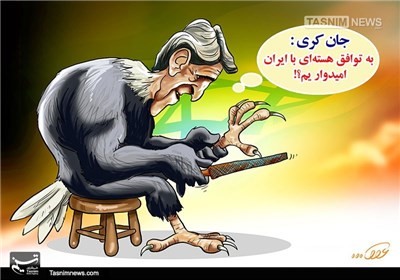
21114November 2, 2014 on Tasnimnews.com, which is close to Iran’s Islamic Revolutionary Guards Corps (IRGC): “Kerry’s Greedy Declarations.” U.S. Secretary of State Kerry the eagle, who is sharpening his talons against the backdrop of an Israeli flag, says: “I am optimistic with regard to the nuclear agreement with Iran.”

Kayhan: “In Negotiations That Could Take Place In 2024, Iran Will Undoubtedly Come To The Negotiating Table With Tens Of Thousands Of Centrifuges That Are More Advanced Than Those It Has Today”; The Nuclear Mushroom Yields Results Once In A Decade

On November 6, 2014, two days after the Republicans swept the U.S. midterm elections, Kayhan wrote: “Obama is now at his lowest point of popularity since he was elected… At the last nuclear negotiating venue [in Oman, at the level of Foreign Minister Zarif, U.S. Secretary of State Kerry, and EU High Representative on Foreign Policy Catherine Ashton, November 9-10, 2014], the Democrats in the White House will try to turn their defeat in the elections to their diplomatic advantage. Obama is like a gambler who has lost everything, and he is sending his representatives to the [negotiating] table with empty pockets… Apparently, the White House emissaries will recommend to the Iranian team to sign the nuclear agreement as soon as possible, since if they do not, Congress will enter the arena with a stick, threats, and sanctions…

“The [negotiating] venue in Oman must be the place where the [Iranian team] gives the Americans a final ultimatum, instead of listening to their boasts… Recently, American negotiating team leader Wendy Sherman quoted former U.S. secretary of state Madeleine Albright as saying that negotiations are ‘like a mushroom that grows best in the dark.’ Soon the result of the[se] negotiations, which have been conducted in the dark for over a year, will become clear.

“The last time that Western [officials] tried to feed Iran this poison mushroom and to force it to submit to the American greed was a decade ago. Undoubtedly, the 2014 mushroom will contain poison that was concocted in 2003. This is because at that point in the negotiations [i.e. in 2003], Iran was operating very few centrifuges, while today it has some 20,000 centrifuges. The Americans need to know that in the most optimal situation [for them], the nuclear mushroom yields results once in a decade… In negotiations that could take place in 2024, Iran will undoubtedly come to the negotiating table with tens of thousands of centrifuges that are more advanced than those it has today.”[10]

Kayhan: Rafsanjani And Rohani Are Bringing Up Various Issues To Distract The Elites From The Upcoming Agreement

On October 28, 2014, Kayhan wrote: “In the Geneva agreements, we put on the table [i.e. we were forced to give up] the product of three years of [uranium] enrichment to 20%, and [agreed to accept] a freeze on activity at the Fordow [enrichment facility] and a halt to the operations to complete the Arak [heavy water] facility, in return for the release of some $7 billion in Iranian funds…

“During the four-month extension [of the Geneva document] we expanded this give-and-take – and now America covets another part of Iran’s assets, saying ‘close Fordow or turn it into a research center; cut back your reserves of enriched [material] to 3.5%, to a quantity that we will tell [you], and remove [it] from Iran; [and] shut down 5,400 of your9,400 operating centrifuges, etc., etc. In return, we will examine your intentions for a period of seven to 20 years, [so that we can ascertain] whether or not we can trust you, or for example, [in return for] our promise not to impose new sanctions.’ This is truly a win-win game and constructive engagement [a jibe at President Rohani].

“The question is, to what point and from what assets does the government intend to pay for this extension of the negotiations and the incremental freeze [on Iran’s nuclear activity]?… When [Iran’s] nuclear technology peaked, Rafsanjani, Rohani, and even [Mir Hossein] Mousavi, and others, saw themselves as major shareholders in this progress. However when the [P5+1] began to impose its impediments, a green light was given for [Iranian] concessions based on a freeze on a small or large part of the [nuclear] program. Rafsanjani even announced his satisfaction with the Geneva negotiations, [saying], ‘Thanks to the negotiations, the taboo [on engagement] with America has been broken.’

“The negotiations apparently had two objectives: The first was to preserve the nuclear program, from the standpoint of [Iran’s right to] enrich [uranium]; the second was to get the sanctions lifted. If some political figures do not attach the requisite importance to the first, they undoubtedly need to explain the second. Therefore, [they must be asked] why not a single sanction was lifted after [Iran] made all these concessions [in the negotiations] – but the sanctions were only made harsher?…

“The acceptance of the West’s demands is the same mistake in judgment that has repeatedly led to an impasse, to the squandering [of Iran’s] strategic assets, [and] to defaming and labelling the critics [of the government] who support [the regime] in an effort to render them passive. The storm surrounding the law to preserve the hijab and modesty, the support for the modesty police, the accusations that the Majlis removed the science minister due to the scholarships scandal[11]… the exploitation of the crime of the acid attacks [against women in Isfahan by claiming that the ideological camp was behind them] – all these are taken from the script and from the organized attempt by the men of fitna and their supporters outside [Iran], with the aim of stirring up marginal scandals within Iran so that [the main issues] are ignored.

“The West sees that Iran’s irreplaceable role has redrawn the map of western Asia and the Middle East, [adding] the qualities of resistance and Islamic awakening in Iraq, Syria, Lebanon, Yemen,l and Bahrain, [and says] ‘Iran must be stopped from playing this role.’

“The men of fitna and the bankrupt extremists… believe that the only way to rebuild their organizations is by dealing with marginal issues and [news-grabbing] explosions that make a huge splash. A group of them… is operating based on a plan given to them, and their media and statesmen are moving ahead in coordination with the Western scheme.

“This hypocritical combination stands out clearly in the government [of Rohani] – revolutionary national enthusiasm [combined with] whispers aimed at trapping critics of the government into dealing with marginal issues to render them passive… to the point where neither the elites nor the people will ask why the negotiations are at an impasse, so that in the atmosphere of passivity and obliviousness it will be possible to reach an agreement, no matter what the cost. [Therefore], by the time the elites and the people wake up and ask what happened, what we gave, and what we got, it will be all over [that is, the deal will be signed]. Most statesmen oppose this harmful approach.

“The government and the president have already learned from the experience acquired in their 14 months in office. They are now at a point of evaluation and course correction. It is always beneficial to prevent damage and dangerous conduct. The leader [Khamenei]… said that the American regime, which stands with Israel, is the exception to Iran’s foreign policy of engagement. The accuracy of his declaration [that we cannot talk to either the U.S. or Israel] was revealed to all over time. Obeying this instruction is the path that will benefit the government and bring it honor. Otherwise, [the Rohani government] will owe a debt to the arrogant ones outside [Iran] and to the seekers of fitna within [Iran], who are skilled in this matter; in this way [i.e. if it talks to the U.S., Iran] will gain  no victory and no prestige…”[12]

Website Affiliated With Ideological Camp: The Pragmatists Are Trying To Remove Khamenei

On October 29, 2014, Afsaran.ir, which is close to Iranian security circles, published an article titled “What Is The Real Objective Of The Line Of Obliviousness [i.e. the pragmatic camp] – Taking The Majlis Or Replacing The Supreme Leader?” The article hinted that Foreign Minister Zarif is party to a Western plot to depose Khamenei, using the pragmatic camp’s strategy for dealing with the Americans, saying that if no agreement is reached, then the ideological stream that opposes rapprochement with the West will seize key political positions in Iran.[13]

The article stated: “Although America’s hostility towards the leader of the revolution [Khamenei] is nothing new, and they have acknowledged this a number of times… the [Americans’] attacks [against Iran] since the New York negotiations… [including] Under Secretary of State Wendy Sherman’s interview on the Voice of America in Persian and [Foreign Minister Javad Zarif’s] entreaties before America’s Council of Foreign Relations have colored it a different hue. Besides the abovementioned incidents, [the Iranian-American academic] Vali Nasr and other American senior officials and influential figures have mentioned Iranian leader Khamenei as the main reason why no agreement has been reached, going so far as to consider replacing him.

“Nasr said: In December 2015, elections will be held in Iran for the Iranian Assembly of Experts, which will appoint Iran’s next leader. He also said: The next [Assembly of Experts] election can change the political direction in Iran.’

“Therefore, it must be asked: Who are the people [in Iran] who directed the policymakers of the enemy [i.e. the U.S.] towards supporting this strategy of deposing the leader Khamenei during direct negotiations with America?

“After consulting with which Iranians does America now consider the nuclear negotiations as an obstacle to its realization of its objectives, and as fertile ground for changing the course of the [Islamic] Revolution [i.e. the regime]?

“In all honesty, is the foreign minister really aiming, in his request to the American Congress to cooperate with the line of obliviousness [i.e. the pragmatic camp], to [obtain American] help so that they [i.e. the pragmatic camp] can win the Majlis elections? Or is he, like Nasr, really referring to a change in the makeup of the Iranian Assembly of Experts [so that it will remove or replace Khamenei]?

“Maybe some within Iran are not yet speaking as frankly as Nasr.”[14]

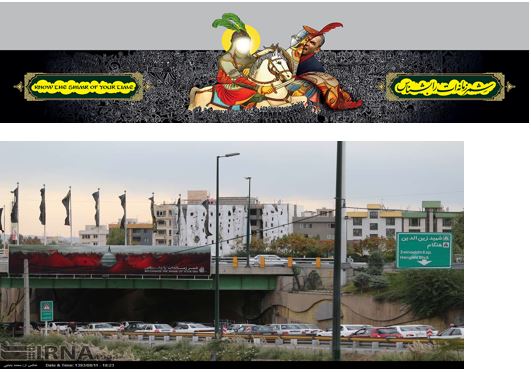
Basij Posts Signs In Iranian Cities Saying ‘Know The Shimr Of Our Time’

Also, the Basij has recently posted signs in Tehran and Shiraz stating, “Know The Shimr [who in Shi’ite legend murdered Imam Hussein] Of Our Time”; the signs clearly depict President Obama and the dome of the U.S. Capitol.[15]
21115

Endnotes:

[1] See October 23, 2014 statement by U.S. Under Secretary for Political Affairs Wendy Sherman, State.gov/p/us/rm/2014/233306.htm.

[2] Most reports refer to 4,000; however, two Iranian sources have referred to at least 6,000. Majlis Nuclear Committee head Ebrahim Karkhanehi reported that P5+1 had agreed to approve the operation of 6,000 to 9,000 centrifuges. Tasnim, Iran, November 2, 2014.

[3] See MEMRI Inquiry & Analysis No. 1127, Iran’s Pragmatic Camp Calls For Exploiting Obama’s Weakness To Attain Comprehensive Nuclear Agreement On Tehran’s Terms, October 26, 2014.

[4]  The Shi’ite legend of Karbala underpins Iranian culture, particularly political culture, in post-Islamic Revolution Iran; it tells of the first Shi’ite martyr, Imam Hussein Ibn Ali, the grandson of the Prophet, at Karbala in 680 CE, after he demanded power and refused to accept the authority of Umayyad caliph Yazid ibn Mu’awiyah.

[5] Shargh (Iran), November 2, 2014. An anonymous party familiar with dealings in the Foreign Ministry told Tabnak in an interview that Khorram is not an advisor to Foreign Minister Zarif, and that his views do not represent the negotiating team or the foreign ministry. Tabnak, Iran, November 4, 2014.

[6] President.ir, October 22, 2014.

[7] Kayhan (Iran), October 23, 2014.

[8] Jomhouri-ye Eslami, (Iran), October 27, 2014.

[9] Tasnim (Iran), October 28, 2014.

[10] Kayhan (Iran), November 6, 2014.

[11] Recently, the ideological camp succeeded in removing Rohani’s science minister for having a record as a reformist.

[12] Kayhan (Iran), October 28, 2014.

[13] See MEMRI Inquiry & Analysis No. 1127, Iran’s Pragmatic Camp Calls For Exploiting Obama’s Weakness To Attain Comprehensive Nuclear Agreement On Tehran’s Terms, October 26, 2014.

[14] Afsaran.ir, October 29, 2014.

[15] IRNA (Iran) November 2, 2014; Tasnim, October 30, 2014.
Is Ahmadinejad making a comeback?

November 7, 2014

Is Ahmadinejad making a comeback? Al-MonitorArash Azizi, November 5, 2014

(Since it now appears that a nuke deal may well be signed by the November 24th deadline — well before the new U.S. Republican Congress takes over in January — what difference does it make now? In any event, with the Supreme Leader in charge regardless of whether Iran’s President is a “moderate” or an “extremist,” what difference does it make, ever? Even a “good” deal can and will be violated with impunity. — DM)

Iran's President Mahmoud Ahmadinejad meets with Iraq's Vice President Khudair al-Khuzaie during his visit in BaghdadMahmoud Ahmadinejad (C) meets with Iraqi Vice President Khudair al-Khuzaie (not seen) during a visit in Baghdad when Ahmadinejad was still president of Iran, July 18, 2013. (photo by REUTERS/Hadi Mizban)

The media activities and meetings of former Iranian President Mahmoud Ahmadinejad signal that he is keeping his name before the public and trying to forge new alliances for his political comeback.

A three-story building in a quiet one-way alley in northern Tehran is the headquarters of an unlikely campaign that opposes both the administration of President Hassan Rouhani and many of the Islamic Republic’s establishment figures.

The Velenjak building is the base of activities for former President Mahmoud Ahmadinejad, who has his offices on its third floor.

Ahmadinejad has been relatively quiet since the ascendance of the moderate Rouhani, but the Iranian Labor News Agency (ILNA) is only one of many outlets that have reported on his desire to make a comeback.

According to Amir Mohebbian, a leading political analyst, Ahmadinejad’s attempt to return to power is obvious as he “quietly awaits favorable conditions and occasionally tests the waters.”

The provincial trips that the former hard-line president makes are one indication.

In addition to making many trips to southern and northern Iran, Ahmadinejad celebrated the end of Ramadan by visiting Taleqan with the family members of four celebrated Iran-Iraq war “martyrs” in a trip that, according to ILNA, was coordinated by the Quds Force, the formidable international arm of Iran’s Islamic Revolutionary Guards Corps.

In April, Ahmadinejad ruled out a return to politics but many of his supporters beg to differ.

They are tirelessly organizing and insist on his return. These are an unlikely bunch. Their young cadre runs many blogs and social media accounts. They draw controversy by their occasionally unconventional mixing of Islamism with an anti-wealthy and anti-establishment discourse, and many have spent time in jail for their activities. Their targets are not only the Reformists but many of the traditional conservatives.

Take Ahmad Shariat, who heads the Internet committee of an Ahmadinejad organization. In his blog, he attacked the policy of backing Syrian President Bashar al-Assad, called for a boycott of the last Majles elections in 2012 (because many Ahmadinejad forces were barred), attacked establishment religious figures such as Ayatollah Mesbah Yazdi and, finally, dared to criticize Supreme Leader Ayatollah Ali Khamenei himself (the latter, in early 2013, led to the closing of Shariat’s blog and his arrest).

These supporters leave no doubt as to their allegiance to the ex-president. One name they go by is “Homa,” a Persian acronym for “Supporters of Mahmoud Ahmadinejad.” An online newspaper with the same name (Homa Daily) opened last week on the occasion of Ahmadinejad’s 58th birthday. (“Square 72” is another outlet, named after Ahmadinejad’s neighborhood in northeastern Tehran).

Abdolreza Davari — who was a vice-president of IRNA, the national news agency for the administration under Ahmadinejad — is a leading organizer of Homa. A controversial figure who was fired from a teaching post for “political activities,” Davari was reported by ILNA as one of the top three media campaigners attempting an Ahmadinejad comeback.

“As an Iranian, I hope for the return of Mr. Ahmadinejad to politics,” Davari told Al-Monitor, before adding that he thinks the ex-president is currently focused on “scientific” activities.

To my question about the regular meetings of Homa in the Velenjak building, Davari says that such meetings are not organized but that “all kinds of people, commentators, students or ordinary people come to meet and talk to Dr. Ahmadinejad.”

Davari also denies that Homa is attempting to organize for next year’s Majles elections. Ahmadinejad’s return to power needs no less than “changes in the current relation of forces,” Davari says, seeming to imply that many of the establishment figures wouldn’t want the ex-president back. Many such figures are especially opposed to Ahmadinejad’s entourage.

Enter Esfandiar Rahim Mashaei, Ahmadinejad’s chief of staff, who was openly rebuked by Khamenei for his maverick mixing of Shiite millennialism, Persian nationalism and leftist language. Despite Khamenei’s personal rejection and the sustained attacks of many who accused Mashaei of leading a “deviationist current,” the ex-president has continued backing his close friend (whose daughter married Ahmadinejad’s eldest son) even after the Guardian Council rejected Mashaei’s candidacy in last year’s presidential elections.

Mashaei’s offices are on the second level of the Velenjak building, and he is known to take part in Homa meetings.

Homa Daily ran Mashaei’s picture in the first page of its first issue, while reprinting his most controversial interview, where he had defended the necessity of “friendship with the Israeli people” — an interview personally criticized and attacked by Khamenei.

Davari says Mashaei doesn’t want to return to politics due to his “cultural and spiritual sentiment.” Taking a note from Mashaei’s book, he says Ahmadinejad’s concept of the Islamic Revolution and his belief in the coming of the hidden Imam is not “meant for a specific geography or religion as the hidden Imam’s global message is aimed at all nations and groups.”

“Freedom-loving and justice-seeking fighters” like Fidel Castro, Che Guevara, Djamila Boupacha, Bobby Sands, Hassan Nasrallah and Hugo Chavez belong to the same global front as Ahmadinejad, Davari insists.

Acolytes of Mashaei seem to have especially targeted Iran’s nuclear negotiations. A group called the “the National Movement for Iran’s Independence” (NAMA, for its Persian acronym) was formed with the declared goal of fighting any compromise with the West. Its unusual name (not mentioning Islam) has the Mashaie imprint.

Mashaei’s presence has always driven away many of Ahmadinejad’s backers. One of them is Mohammadreza Etemadian, a trade adviser to the ex-president. Etemadian told Al-Monitor that he would like to see Ahmadinejad back, but he has always told him to keep Mashaei away since “he is not on good terms with the supreme leader and is a deviant.”

Etemadian is a leading member of the Islamic Coalition Party, the traditional organization of Bazari Islamists and an important part of the establishment. Its leaders seem to detest the populist excesses of Ahmadinejad.

Sensing this, the ever-adventurous Ahmadinejad has been trying to find new allies, even if among the Reformists. He met with Hassan Khomeini, the 40-year-old grandson of the founder of the Islamic Republic, known for his proximity to the Reformists. The ex-president boldly asked Khomeini to lead a group of young clerics to contest the next year’s election of the Assembly of Experts, the body that chooses the supreme leader.

He has also reportedly tried to meet the Reformist ex-President Mohammad Khatami and Ambassador Sadeq Kharazi, an influential diplomat from a key political family.

Meanwhile, it was reported that Gholam-Hossein Elham, the spokesman of Ahmadinejad’s government, has started campaigning for the ex-president and last week met with the governors-generals of the previous government to organize. Elham, however, spoke with the pro-Ahmadinejad “Square 72” website to deny this news.

Unceremoniously bowing out after the disqualification of the candidate he supported in the 2013 presidential elections, Ahmadinejad seems to be busy plotting a comeback.