Posted tagged ‘Soleimani’

Obama Admin’s Iran Point Man Promotes Anti-Israel Conspiracy Theories

October 8, 2015

Obama Admin’s Iran Point Man Promotes Anti-Israel Conspiracy Theories, Washington Free Beacon, October 8, 2015

(Surprising? Nope. — DM)

eyrestate__2_Alan Eyre / Twitter

A State Department official closely involved in the Obama administration’s Iran push has been promoting publications from anti-Semitic conspiracy sites and other radical websites that demonize American Jewish groups and Israel, according to sources and documents obtained by the Washington Free Beacon.

Alan Eyre, the State Department’s Persian-language spokesman and a member of the negotiating delegation that struck a nuclear deal with Iran earlier this year, has in recent months disseminated articles that linked American-Jewish skeptics of the deal to shadowy financial networks, sought to soften the image of Iranian terrorists with American blood on their hands, and linked deal criticism to a vast “neoconservative worldview.”

Eyre described the one article, penned by the anti-Israel conspiracy theorist Stephen Walt, as having an “interesting thesis.”

Insiders who spoke to the Free Beacon about Eyre’s private postings pointed to a pattern of partisanship and called it a sign that key officials at the State Department are biased against the state of Israel. Such criticism has dogged the team Obama since the early days of the administration.

Eyre regularly briefed U.S. officials at the negotiating table and was responsible for proofreading draft texts of the recent Iranian nuclear agreement.

While Eyre has a public Facebook page officially sponsored by the State Department, screenshots taken from his private personal account obtained by the Free Beacon include content that insiders described as concerning.

In one Feb. 13 posting, when Iran talks were at a critical stage, Eyre disseminated a link to an article praising Iranian Quds Force Chief Ghassem Suleimani, who is directly responsible for the deaths of Americans abroad.
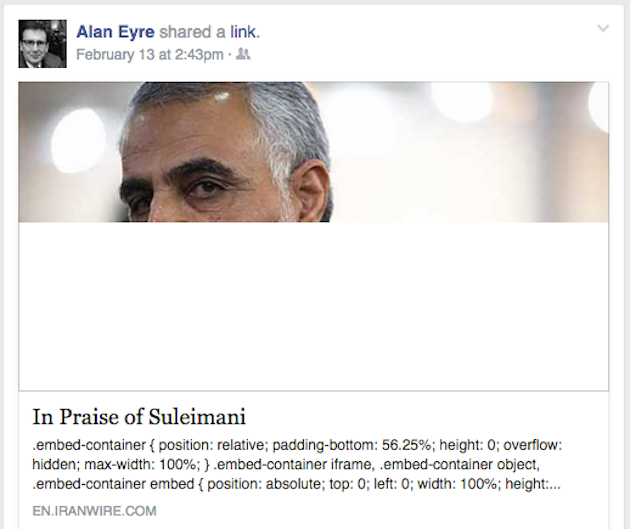
Image-1

Suleimani, who is listed as a terrorist by the U.S. State Department, will have international sanctions against him waived under the parameters of the nuclear accord.

In another posting from Feb. 5, Eyre links to the website LobeBlog, which is viewed by critics as anti-Israel and regularly attacks neoconservative pundits.”

The article Eyre links to, “Who Are the Billionaires Attacking Obama’s Iran Diplomacy,” attacks opponents of the Iranian deal and insinuates that wealthy Jewish donors are behind this push.

The article puts particular emphasis on the Israel Project (TIP), a non-profit advocacy organization run by Josh Block, a longtime Democrat, and claimed that wealthy Jewish individuals were behind a stealth campaign to kill the deal. TIP is portrayed as playing a crucial role in discrediting the deal and convincing lawmakers to take a stance against it.

The article was penned by a former ThinkProgress blogger, Eli Clifton, who was forced out of the Center for American Progress-backed blog following a scandal in which several writers accused Iran deal critics of being “Israel firsters.”

Image-2

In another posting, Eyre links to an article by Stephen Walt, co-author of the book The Israel Lobby, which has been branded by the Anti-Defamation League (ADL) as an “anti-Jewish screed.”

Walt lashes out in the piece at neoconservative critics of the Iran deal, writing that “no one should listen to their advice today.”

Eyre linked to the piece with the comment, “interesting thesis.” He then quoted Walt at length, according to a screenshot:

The real problem is that the neoconservative worldview — one that still informs the thinking of many of the groups and individuals who are most vocal in opposing the Iran deal — is fundamentally flawed. Getting Iraq wrong wasn’t just an unfortunate miscalculation, it happened because their theories of world politics were dubious and their understanding of how the world works was goofy.

Image-3

Eyre also appeared to express disappointment online in March, when Sen. Tom Cotton and 46 other Republican lawmakers penned an open letter to Iran opposing the nuclear talks.

Eyre links to a March 9 Washington Post article by Paul Pillar, an Israel critic who backs boycotts of the Jewish state, titled ‘The misguided, condescending letter from Republican senators to Iran.’ He then opined in the post, “Seriously. Can someone write them a letter telling them that the most fundamental duty of Congress is to pass a budget?”
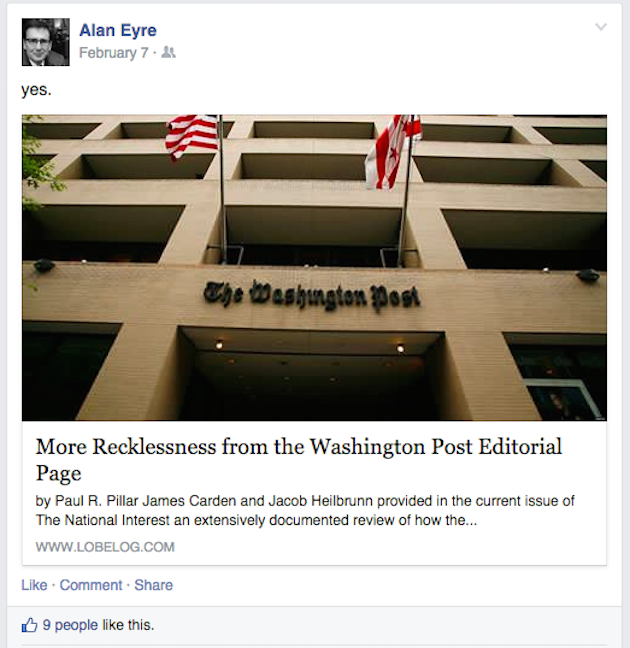
Image-4

At least one of Eyre’s Facebook friends has quibbled with his postings.

When Eyre linked to a Talking Points Memo article claiming that “49 percent of Republicans don’t believe in evolution,” one critic commented: “This post is total crap. Some 300 people were polled, and the polling criteria were, of course, not specified. This outfit has a deserved reputation as a left-leaning, professionally anti-Republican Flak Tank.”

Eyre dismissed that criticism, responding, “If you are going to fact check every incendiary posting I put up, it is going to detract from the sum total of my facebook-derived frivolity.”

In addition to his postings, Eyre has appeared as a keynote speaker at the National Iranian American Council’s Washington, D.C., conference.

The council, which has been accused as serving as a pro-Tehran lobbying shop, has helped the Obama administration disseminate pro-Iran talking points and champion the deal in the public sphere. Its top officials also have insinuatedthat Jewish lawmakers who oppose the deal have more loyalty to Israel than America.

One senior official at a Washington, D.C., pro-Israel organization expressed disappointment but not surprise at Eyre’s posting.

“The easiest way to explain the State Department’s behavior toward the Middle East is to assume that they don’t like the Israelis very much and they have this romantic fascination with Iran,” the source said. “That’s what you’re seeing here.”

“Of course they can’t admit that out loud, because the American people believe exactly the opposite, so they do it through passive-aggressive Facebook posts and occasional slips of the tongue about how moderate and sophisticated the Iranians are,” the source added.

A State Department spokesman declined to comment on Eyre’s personal postings when contacted by the Free Beacon.

“Alan Eyre is the Department’s Persian Language Spokesperson,” the official said. “In that capacity, he maintains his official page on Facebook here,” the spokesman continued, providing a link to the page.

The Facebook page in question, however, is separate from Eyre’s public-facing personal page referenced by the State Department, which said it had no knowledge of the second page.

“We’re not aware of any such content that you refer to posted on that account,” the official said.

The official did not respond to follow-up requests asking for comment from Eyre on the postings.
Iran to arm West Bank Palestinians for new Eastern Front to “efface”Israel

August 18, 2015

Iran to arm West Bank Palestinians for new Eastern Front to “efface”Israel, DEBKAfile, August 17, 2015

Suleimani_Qassem_nameAl Qods chief Gen. Qassem Soleimani

Attesting to the seriousness of Iran’s intent, Jmail Majdalani, PLO executive committee member and personal representative of Mahmoud Abbas, chairman of the Palestinian Authority on the West Bank, has arrived in Tehran. He is there to arrange his boss’s first visit in many years to the Iranian capital.

*********************

Al Qods commander Gen. Qassem Soleimani, acting on the orders of Iran’s supreme leader Ayatollah Ali Khamenei, this week set up a new Iranian command to fight Israel, DEBKAfile reports exclusively from its military and intelligence sources.

It has been dubbed the Eastern Command of the Iranian Revolutionary Guards.The Al Qods Brigades, which are the external terrorist arm of the Guards, are organized according to sectors, with commands for Hizballah, the Palestinians, Syria, Iraq and the Gulf.

Their newest sector is the Eastern Command which, our sources report has been assigned as its first task to start handing out weapons, including missiles, to any Palestinian West Bank group willing to receive them. Tehran’s object is to transform the West Bank into a territory hostile to Israel on the model of southern Lebanon which is ruled by the armed Hizballah and the Gaza Strip under the Hamas and Islamic Jihad terrorists.

In the first week of August, Tehran published a book of 416 pages written by Ali Khamenei entitled “Palestine.” The cover image was labeled “The flagbearer of Jihad to liberate Jerusalem.”

 The volume was released to Western sources, who reported that the most constantly recurring phrases in the text in relation to Israel are “nabudi” – meaning annihilation; imha – meaning disappearing or fading out; and “zaval” meaning effacement.

Khamenei asserts that Israel must be destroyed because it captured Islam’s third most sacred city and is the foremost ally of “Big Satan” – America.

The Iranian leader goes into detail about exactly how Israel should be annihilated – not by “classical wars” or “massacres of the Jews” but by means of a “long period of low-intensity warfare designed to make life impossible for a majority of Israeli Jews.”

When he visited Beirut on Aug. 12, Iran’s Foreign Minister Mohammed Zavad Zarif said it was necessary after the nuclear deal, to “confront the challenges of the region, the most important of which is the Zionist and extremist regime.”

Members of the Obama administration wave away these disclosures of Iranian intent as no more than letting off steam to pacify the hard-line opponents of the nuclear deal – US Secretary of State John Kerry said on July 24: “I also told them that their chants of Death to American and so forth are neither helpful and they’re pretty stupid.”

But in Iran, the supreme leader’s words are treated as decrees demanding obedience. Indeed, at the first conference of the new Eastern Command, Gen. Soleimani read out passages from Khamenei’s book and told the officers that they were under orders to carry those decrees out to the letter.

Attesting to the seriousness of Iran’s intent, Jmail Majdalani, PLO executive committee member and personal representative of Mahmoud Abbas, chairman of the Palestinian Authority on the West Bank, has arrived in Tehran. He is there to arrange his boss’s first visit in many years to the Iranian capital.

The day after the deal

August 9, 2015

The day after the deal, Israel Hayom, Prof. Eyal Zisser, August 9, 2015

(Please see also, Russia and US woo Saudis to help save Assad – albeit putting Israel and Jordan in danger from S. Syria.– DM)

[Soleimani] wanted Russia and Iran to agree on the division of the Middle East in a way that would serve their clients in the region (among them, Assad) and check their joint enemies (the Islamic State). After figuring that out, they probably moved on to the next topic: how to marginalize America in the region. As a means to both ends, Russia will continue to serve as Assad’s protector (despite his many crimes), all the while providing Iran with international backing. But above all it will send arms to Iran, to the Syrian regime, and if needed, to Hezbollah.

***********************

Over the weekend it transpired that Maj. Gen. Ghasem Soleimani, the commander of Iran’s Quds Force, had visited Moscow two weeks ago and met with President Vladimir Putin. The Quds Force, in case you forgot, is in charge of the Iranian Revolutionary Guards’ clandestine operations (including terrorism). The Quds Force is responsible for providing aid to Hezbollah and Hamas as well as to Syrian President Bashar Assad and the Houthi rebels in Yemen. In light of his direct involvement in terrorism, the international community imposed sanctions on Soleimani, including travel restrictions.

Only last week, at a hearing on Capitol Hill, U.S. Secretary of State John Kerry vowed that the U.S. will make sure the sanctions on Soleimani would stay in effect and that the Obama administration would counter Iran’s efforts to destabilize the Middle East. But no one takes Kerry seriously anymore. While Kerry continues to engage Iran’s unimportant Foreign Minister Mohammad Javad Zarif, the real wheeling and dealing is actually in Moscow.

Soleimani did not go to Moscow because he had tickets to the Bolshoi. Rather, he arrived because he wanted to discuss “the day after the nuclear deal” with Putin. Namely, he wanted Russia and Iran to agree on the division of the Middle East in a way that would serve their clients in the region (among them, Assad) and check their joint enemies (the Islamic State). After figuring that out, they probably moved on to the next topic: how to marginalize America in the region. As a means to both ends, Russia will continue to serve as Assad’s protector (despite his many crimes), all the while providing Iran with international backing. But above all it will send arms to Iran, to the Syrian regime, and if needed, to Hezbollah.

The Russians, unlike the Iranians, don’t consider Israel to be an enemy state. But as a famous Russian official once said: “When you chop wood, chips fly.” Israel has become the latest chip — the collateral damage. Soleimani’s visit is just the tip of iceberg. It shed light on the not-so-secret deals that are being negotiated in the wake of the “Vienna nuclear agreement.” Europe, as usual, is focused on profit and its corporate executives are already traveling in droves to Tehran to ink deals. There are also political deals Iran wants to secure, which are as important for Tehran. Their price, however, will be measured in blood rather than in euros or dollars.

No one in the Middle East, it seems, is keen on parsing each and every provision in the nuclear deal. Nor is there an attempt to see whether, in the grand scheme of things, it is will have been a worthwhile endeavor some 10 or 15 years from now, when its key elements expire. In this region, what counts is the way this agreement is perceived here and now — and what really matters to people is the way it is portrayed in the media. Under that criteria, Iran is the victor and America is the vanquished, because it caved to Iran. The deal, according to how the media has portrayed it, is a crushing political blow to Israel and the moderate Arab states, led by Saudi Arabia.

This knockout victory will likely produce a new Iranian-American partnership. At the very least, the two nations will mend fences. This will alienate many of Washington’s clients, who will have to look elsewhere for a more reliable ally. Egypt and the Saudis have already realized this and turned to Russia for aid and arms, figuring it would be more trustworthy than the “staff of this broken reed” (Isaiah 36:6).

Saudi Arabia is reportedly sending feelers to see if there is a deal to be had with Russia and Iran. Under the terms of the proposed deal, Saudi Arabia would withhold aid to the Syrian rebels if Iran ends its rogue presence in the state. Such a deal would secure Assad a victory over the insurgents, or a least ensure his regime survives.

The ongoing developments have caused panic, but not over the rising clout of Iran and Russia. The White House, it seems, is fretting over the possibility that Congress may vote against the Iran deal and further tarnish Obama’s image.

No Trust, No Verification, No Sanctions: Obama’s Humiliating Capitulation to the Mullahs

August 8, 2015

No Trust, No Verification, No Sanctions: Obama’s Humiliating Capitulation to the Mullahs, National Review, Andrew C. McCarthy, August 8, 2015

(I have been beating this drum for quite a while. So have others. The Obama administration’s position still makes no sense whatever, unless unfortunate motives are attributed to the Commander in Chief. — DM)

The sanctions regime President Obama and Secretary of State Kerry vowed to step up has already collapsed. The mullahs are already scooping up billions in unfrozen assets and new commerce, and they haven’t even gotten the big payday yet. Obama’s promises of “anytime, anywhere” inspections have melted away as Tehran denies access and the president accepts their comical offer to provide their own nuclear-site samples for examination. Senator John Barasso (R., Wyo.), a medical doctor, drew the apt analogy: It’s like letting a suspect NFL player what he says is his own urine sample and then pronouncing him PED-free.#

And now even the Potemkin verification system has become an embarrassing sham, with Iran first refusing to allow physical investigations, then declining perusal of documentation describing past nuclear work, and now rejecting interviews of relevant witnesses.

Recall that administration officials indignantly assured skeptics that there would be no agreement in the absence of Iran’s Iran’s coming clean on the “past military dimensions” of its nuclear work. As Kerry put it, “They have to do it. It will be done. If there’s going to be a deal; it will be done.”

The reason it had to be done is obvious. According to Obama, his Iran deal is built on verification, not trust — at least when the president is not trusting Ayatollah Khamenei’s phantom anti-nuke fatwa. Plainly, it would be impossible to verify whether Iran was advancing toward the weaponization of nuclear energy — whether it had shortened the “breakout time” the elongation of which, Obama claims, is the principal objective of his deal — unless one knew how far the mullahs had advanced in the first place

But now, in open mockery of an American president they know is so desperate to close this deal he will never call their bluff, the mullahs have told the International Atomic Energy Agency to pound sand — although not sand in Iran, where the IAEA is not permitted to snoop around. Tehran is steadfastly refusing to open its books, and the IAEA sheepishly admits that it cannot answer basic questions about Iran’s programs and progress.

So what does Team Obama do? Do they, as they promised, walk away from an unverifiable and thus utterly indefensible deal that lends aid and comfort to our enemies? Of course not. Now they’re out there telling Americans, “We don’t need this IAEA program to discover whether or not Iran was pursuing a nuclear weapon — they were,” as Senator Chris Murphy, a Connecticut Obamabot, told the Wall Street Journal.

Well good for you, Sherlock; Obama, Kerry, and Hillary Clinton may still be hanging on that fatwa, but you hit the bull’s-eye.

Here’s the thing, though, Senator Murphy: Yes, all of us know the Iranians, as you cheerily put it, “were” pursuing a nuclear weapon — especially all of us who oppose Obama’s Iran deal and who recognize that the jihadist regime has waged war against us since 1979, killing thousands of Americans. But you “let’s make a deal” guys told us your objective was to uncover how far along they “were” and to roll back their progress. (Actually, you used to tell us your objective was to prevent them from getting nuclear weapons, period — as in “if you like your health-care plan, you can keep your health-care plan, period.”)

If you don’t have a baseline from which to begin verification, you can’t verify the time of day, much less the progress of nuclear research, development, procurement, and experimentation. Iran is saying we don’t get the baseline without which the Obama administration guaranteed there would be no agreement.

So in the grand deal our president describes as subjecting the mullahs to historically rigorous inspection, disclosure, and verification requirements, there is no inspection, no disclosure, and no verification.

And did I mention no sanctions?

On July 29, Kerry assured lawmakers that Iranian Quds Force commander “Qassem Soleimani will never be relieved of any sanctions.” Soleimani orchestrates the regime’s terrorist operations and, according to the Pentagon, is responsible for killing at least 500 American soldiers in Iraq.

Yet, only five days before Kerry gave that testimony, Soleimani traveled to Russia for meetings with Putin’s government — notwithstanding the vaunted sanctions that, Kerry would have us believe, confine him to Iran.

Russia, of course, is a member of the U.N. Security Council, from which Obama sought and obtained endorsement of his Iran deal before seeking congressional review. Not only has Russia rendered the current sanctions a joke; it has made Obama’s implausible promise of future “snapback” sanctions against Iran even more laughable. Russia, by the way, has also agreed to build yet another nuclear reactor for the mullahs in Busheir — which Obama’s deal obligates the United States to protect against sabotage. And Putin has also just agreed to supply the terrorist regime in Tehran with $800 million worth of S-300 anti-aircraft missiles that can be used against the U.S. Air Force and have enough range to strike planes in northern Israel.

What a deal, Mr. President!

Actually, we really don’t know quite what a deal it is because key provisions remain secret. After its bold verification promises, the Obama administration was too embarrassed to reveal exactly how pathetic the agreement’s inspections provisions are. So, as I outlined in a recent column, Obama and Kerry tucked them into a secret side deal between Iran and the IAEA. It then twaddled that the details — i.e., the heart of the deal from the American perspective — are, conveniently, between Iran and the IAEA. None of our business, you see.

This message was reiterated on Capitol Hill this week by the IAEA. Understand: The IAEA could not function (to the limited extend it does function) without the United States Congress’s underwriting of 25 percent of its budget — the American taxpayer contribution dwarfs that of every other country, including Iran’s, which is tiny. Yet, the IAEA chief told lawmakers that he could not reveal the agreement between his agency and Tehran because that is “confidential” information, disclosure of which would compromise the IAEA’s “independence.” The only things the IAEA would confirm are that (a) there are verification provisions and (b) Iran is not cooperating with them.

Feel better?

Well, to further improve your mood, let’s talk the Corker bill. Remember, that’s the legislation by which the GOP-controlled Congress reversed the constitutional presumption against international agreements and virtually assured that Obama’s Iran deal — no matter how appalling it may be, no matter how much aid and comfort if provides to the enemy — will become law.

Why on earth would Beltway Republicans agree to anything so catastrophic for the national security that the Constitution’s Treaty Clause is designed to protect? Because, they proclaimed, by making this devil’s bargain, they would ensure that Congress and the American people got full disclosure of the Iran deal that Obama would otherwise shroud in secrecy.

But as I asked at the time, what possessed them to think Obama would not shroud the agreement in secrecy just because there would now be a law forbidding that?

Supporters are telling themselves that the Corker bill’s benefits [include that] the president will have to produce the agreement. . . . But this is a mirage. . . . The president is notoriously lawless, and thus Republicans can have no confidence that the agreement he produces to Congress will, in fact, be the final deal he signs off on with Iran and, significantly, submits to the U.N. Security Council for an endorsing resolution.

And so it has come to pass: Republicans forfeited their constitutional power for an unenforceable promise of transparency from an infamously duplicitous backroom dealer. Now they have no power and no idea what they’ve enabled.

The president had it backwards Wednesday when, in his repulsively demagogic speech on the Iran deal, he said that Republicans are aligned with the Iranian chanting ‘Death to America.’” It is Obama who is aiding and abetting the hardliners. Republicans have merely aided and abetted Obama.

Iran confirms trip by Quds Force Commander to Moscow to discuss arms shipments

August 8, 2015

Iran confirms trip by Quds Force Commander to Moscow to discuss arms shipments, Fox News, , August 8, 2015

Iranian officials confirmed Friday that General Qassem Soleimani, the heavily sanctioned Revolutionary Guard Quds Force commander, traveled to Russia last month and was conducting weapons deals, including discussion of the S-300 missile system, according to Reuters.

The U.S. ambassador to the United Nations, Samantha Power, said Friday the U.S. is very concerned about the development.

“Qassem Soleimani is subject to a UN travel ban and this travel ban requires all states to prohibit Qassem Soleimani from traveling to their nation and the only exception to that is if the Iran sanctions committee grants an exemption,” she said at UN headquarters in New York.

The White House did not specifically blame the Russians for hosting the Iranian general.

“I can’t confirm these specific reports but it is an indication of our ongoing concerns with Iran and their behavior,” White House press secretary Josh Earnest told reporters Friday at the daily press briefing.

Mike Rogers, former chairman of the United States House Permanent Select Committee on Intelligence, weighed in late Friday afternoon.

 “We should not underestimate what this means to our national security,” he said. “A leading general in Iran just told the world that the United States of America is irrelevant and Russia welcomed him with open arms. Not only do Russia and Iran not fear us, they do not respect us. And that, is dangerous.”

According to two separate Western intelligence sources, Soleimani arrived in Moscow on Iran Air flight 5130 from Tehran on July 24, ten days after the nuclear agreement between Iran and six world powers was announced that included a provision to lift the arms embargo on Iran.

Five days later, Secretary of State John Kerry testified about the Iran nuclear deal before the Senate Armed Services Committee, assuring Congress pressure would remain on Iran’s shadowy general.

“Under the United States’ initiative, Qassem Soleimani will never be relieved of any sanctions,” Kerry told the Senate Armed Services Committee.

In Moscow, Soleimani met with President Vladimir Putin and Russia’s defense minister.

In June, Russia announced it would send S-300 anti-aircraft missiles to Iran by next year, according to a top Kremlin official.

Soleimani was photographed in Iraq recently on the front lines with Iranian-backed Shia militias battling ISIS, also in defiance of the travel ban.

Soleimani is blamed for the deaths of 500 Americans in Iraq. He also is suspected of orchestrating the failed assassination attempt on the Saudi Arabian ambassador to the United States at a popular Georgetown restaurant in Washington.

Soleimani’s Moscow visit elicited a reference during the Republican debate Thursday night.

“He’s directly responsible for the murder of over 500 American servicemen in Iraq and part of this Iranian deal was lifting international sanctions on Gen. Soleimani — the day Gen. Soleimani flew back from Moscow to Iran was the day we believe Russia used cyber warfare against the joint chiefs,” said Sen. Ted Cruz, R-Texas.

Iran’s acknowledgement of Soleimani’s visit to Moscow indicates a possible split in Iran’s leadership: those loyal to the military are unconcerned about blazingly defying sanctions even before the nuclear deal is sealed.

Iran Will Walk

June 5, 2015

Iran Will Walk, The Gatestone InstituteLawrence A. Franklin, June 5, 2015

(What if the article is otherwise correct but Obama agrees to a “deal” anyway? — DM)

  • The Islamic Revolutionary Guard Corps (IRGC), the Praetorian Guard of Iran’s regime, controls most of the economy, as well as the black-market, alternative economy. The IRGC therefore actually benefits from sanctions; it is private firms, such as those involved in international commerce, that suffer. Why would IRGC operatives want to see the playing field made more level by private investment, transparency and a competitive economy?
  • Sanctions never hurt the regime’s ruling class; lifting them only helped the regime solidify its power over its people.
  • The objective of these two demands [an immediate lifting of all sanctions and no, or severely limited, inspections] is either to have them accepted, or to render it untenable for the Obama administration to offer Congress any deal that could be accepted – thereby shifting blame for the collapse of the talks to the U.S.
  • The U.S should also be on guard against the mullahs’ belief that the Obama administration is weak both politically and its aversion to using force. The mullahs might find great pleasure in humiliating Obama, as they did President Jimmy Carter, by dragging out hostage crisis negotiations by running out the clock until his term was over. They clearly believe that the Obama administration, simply to say it got “a deal,” is ready to sign anything.

From Washington to Riyadh, not to mention Jerusalem, statesmen are gritting their teeth at the possibility of a U.S.-Iran nuclear deal that seems overly generous to the theocratic-terror state of the Islamic Republic.

1008Representatives of the P5+1 countries pose with Iranian Foreign Minister Javad Zarif after nuclear negotiations in Lausanne, Switzerland on April 2, 2015. (Image source: U.S. State Department)

Most intelligence analysts and journalists assume that because Iran’s leadership endorsed the negotiations and has been the beneficiary of several key concessions by the P5+1 (the five permanent members of the UN Security Council, plus Germany), that an agreement is imminent. Forecasters have been predicting what the likely consequences of such a deal would be: negative.

But what if the Iranians walk?

Sanctions never hurt the regime’s ruling class; lifting them only helped the regime to solidify its power over its people.

A nuclear deal combined with an improvement in the commercial and business relations with the West would be inimical to IRGC interests.

The Islamic Revolutionary Guard Corps (IRGC), the Praetorian Guard of the regime, controls most of the economy as well as the black-market, alternative economy. IRGC-controlled conglomerates operate outside the law and reap huge profits through their control of the black market. The IRGC therefore actually benefits by sanctions; it is the private firms, such as those involved in international commerce, that suffer.

Furthermore, IRCG naval vessels, and private ships under their control, have been engaging in sanctions-breaking deliveries of imports across Persian Gulf waters to Dubai. The IRGC then sells the products at a profit by filtering them through the many foundations they control in Iran.

The most recent example of IRGC’s skirting of sanctions involved the illegal acquisition of aircraft through front-organizations with offices in both Europe and the Arabian Peninsula. Mahan Air, an IRGC front, was able to purchase 15 used commercial aircraft for $300 million. Another front, al-Naser Air, was about to purchase two more aircraft, this time from a U.S. owner. Israeli intelligence, however, passed details of the planned sale to the U.S. government, and on May 21, the deal was scuttled by the Office of Export Enforcement of the Department of Commerce.

Why would IRGC operatives want to see the playing field made more level by private investment, transparency and a competitive economy?

Moreover, if a nuclear deal indicated improved relations with the United States, Iranian hardliners, whether clerical revolutionaries or intelligence operatives, might fear seeing their ideological legitimacy erode. The Iranian regime’s only remaining fig leaf of legitimacy is its anti-American animus, with its accompanying pledge to “protect” Iran’s interests against the U.S.-Israel-Sunni “alliance.”

Improved relations with Washington might raise false hopes among Iran’s citizens that the regime may ultimately improve its woeful record on human rights. There remains only a thin patina of clerical control over Iranian society; if the hoped-for social and political reforms were not implemented, the result could produce a destabilizing political environment, harmful to the interests of the regime.

Another fallacy embraced by many “inside-the-beltway” analysts is that, as the Supreme Leader Ayatollah Khamenei endorsed the negotiations, a legitimate deal is now probable.

The once all-powerful Office of the Supreme Leader no longer calls all the shots. The current Iranian regime resembles a military junta or a security state as much as a theocracy. While the reach of Ayatollah Khamenei, through his network of representatives, still penetrates all dimensions of Iranian society, he does not have the final decision on key security matters. The regime’s strategic assets, for instance, such as its ballistic missile programs, are firmly under the control of the IRGC. Decisions related to Iran’s expansionist presence in the region are made by IRGC Quds Force Commander Qasem Soleimani. The role of Khamenei’s representative to the IRGC resembles more that of a handler than of an action officer.

The principal task for the regime is to find a way to back out of the negotiations while avoiding the blame. Iran’s efforts at disengagement may already have been underway for the past few weeks; the pace of decoupling from the talks seems to be accelerating. Iran has been increasing its demands apparently in the hope that they will either be accepted, or else rejected like the “poison pills” they are — such as inspectors no longer being allowed on its military sites.[1]

Another way to make the talks no longer palatable for the Obama administration was to create a hostile incident with the United States in the Persian Gulf, as it has tried to do by aggressively tailing American warships. Iranian ships affiliated with the IRGC Navy also seized a commercial ship, the Maersk Tigris, in the Strait of Hormuz, and temporarily detained both vessel and crew. Then, on May 14, IRGC boats fired several shots across the bow of a Singapore flagged vessel, but it escaped unharmed.

By this type of reckless comportment, the IRGC Navy appears intent on producing a clash with American naval vessels in the Gulf waters. Western negotiators have only to recall the presidency of Mohammad Khatami, when the IRGC and Iran’s Ministry of Intelligence and Security operated independently after they felt that the reformers had gone too far, thus threatening hard-liner control of the regime. The IRGC may have decided that Rouhani along with his American-educated Foreign Minister Zarif have reached a similar tipping point. This independent IRGC initiative is being executed even though a deal would release Iranian monetary assets that would in turn boost the sagging economy.[2]

Iran’s combative posture in Gulf waters against international shipping is also a direct challenge to international maritime law, which guarantees freedom of navigation through the world’s shipping lanes such as the Strait of Hormuz. A key principle of U.S. foreign policy is to enforce this freedom of navigation, if it is challenged by any foreign power, as one also hopes the U.S. will do in the South China Sea.

Iranian military and political spokesmen have also raised the temperature of their anti-American and anti-Israeli rhetoric of late. Leading members of the regime, including its Supreme Leader, Ali Khamenei, keep repeating, “Death to America” as well as its theological “obligation” to destroy Israel. While the Obama administration has alleged that these threats are just for “internal consumption,” an old Persian saying goes: “They spit in his eye and he calls it rain.”

Mojtaba Zolnour, Ayatollah Khamenei’s Deputy Representative to the IRGC, stated that the Islamic Republic of Iran, “has the divine permission to destroy Israel.” This media assault on Israel was designed to widen the divergence between the Obama administration and the Israeli government regarding the efficacy of the framework of a nuclear agreement negotiated so far.

Additionally, various Iranian principals have drawn “lines in the sand” designed to cause the Americans to disengage from the talks, such as the assertion that Iran will never accept inspection of its declared military sites. Another is Tehran’s repeated statement that it will not accept a gradual lifting of sanctions. Iranian leaders have insisted on immediate and irreversible lifting of all sanctions immediately after a nuclear deal is signed. The objective of these two demands is either to have them accepted, or to render it untenable for the Obama administration to offer Congress any deal that could be accepted — thereby shifting the blame for the collapse of the talks to the U.S.

Regime hard-line representatives to the majlis [Iranian Parliament] have already been mobilizing members to denounce the talks as detrimental to Iran’s national sovereignty. Eighty majlismembers signed a petition on May 12, calling upon the regime to suspend the nuclear talks until Washington halts its rhetorical threats against Iran. Hardliners in the majlis and elsewhere within the regime’s bureaucracy will likely continue to lobby against any deal.

Western analysts should be looking for the Iranian regime’s hard-line media outlets to increase domestic commentary condemning alleged U.S. deception in the negotiations as a reason to abandon the talks.

The death knell for the nuclear negotiations could come from newspapers such as Kayhan, a pro-regime newspaper run by Hossein Shariatmadari, and often characterized as a Khamenei mouthpiece.

The regime’s Friday-prayer Imams in key Iranian cities might also start opposing the talks. The themes of their noonday khutbahs [sermons] are likely to appeal to Iranian people’s patriotism, and suggest that it is more important for Iran to endure continued sanctions rather than submit to intrusive monitoring that offends Iran’s sovereignty.

Finally, hardliners who oppose any possibility of Iran’s improved relations with the U.S. may launch personal attacks on Iran’s negotiators to the nuclear talks, and, in an effort to discredit them, challenge their loyalty to the Iranian revolution. Their point of attack on Foreign Minister Mohammad Javad Zarif’s loyalty might be his alleged obsequious behavior to Secretary of State John Kerry. Zarif, on account of his many years of residency and education in the United States, can be depicted as an Americanized Iranian.

The United States should also be on guard against the mullahs’ belief that the Obama administration is weak — both politically and in its reluctance to use force. The mullahs might find great pleasure in humiliating Obama as they did President Jimmy Carter, when they dragged out hostage crisis negotiations by running out the clock until his term was over. They clearly believe that the Obama administration, simply to say it got “a deal,” is ready to sign anything.


[1]Iran’s powerful Guard rejects inspection of military sites” by Ali Akhbar Dareini, Associated Press, 19 April 2015. Deputy Chief of the IRGC General Hossein Salami is quoted and several more statements by IRGC officials since have repeated the same prohibitive statements regarding Iran’s military sites.

[2]U.S. to Award Iran $11.9 Billion Through End of Nuke Talks,” Washington Free Beacon, 21 January 2015. In the first of many subsequent denunciations, Senator Mark Clark of Illinois attacked the Obama administration’s plan to free Iran’s frozen assets if nuclear deal is reached.

Iranian Rev Guards ready to intervene in Syria to save Assad. Soleimani: Expect major events in Syria

June 3, 2015

Iranian Rev Guards ready to intervene in Syria to save Assad. Soleimani: Expect major events in Syria, DEBKAfile, June 3, 2015

elite_forces_Revolutionary_GuardIranian Revolutionary Guards elite forces

Tehran is believed to be preparing to dispatch a substantial Revolutionary Guards (IRGC) special operations unit to Syria to tackle the separate rebel and ISIS advances closing in on the Assad regime, Western and Arab intelligence sources report. They say the Syrian army is already setting aside an area in northern Syria for the Iranian troops to take up position.

If this happens, DEBKAfile’s military sources note that it would be the Revolutionary Guards first direct intervention in the nearly five-year Syrian war. Up until now, Tehran has carefully avoided putting Iranian boots on the ground in both Syria and Iraq. The only place where Iranian forces are directly engaged in battle is at Iraq’s main refinery town of Baiji, where small infantry and artillery units have been trying – without success thus far – to dislodge ISIS forces from the refinery complex.

In the other Syrian and Iraqi war arenas – and elsewhere – Tehran follows the practice of using local Shiite militias as surrogates to fight its wars, providing them with training and arms. The Guards have also brought Shiite militias over from Pakistan and Afghanistan.

That Tehran is about to change course to save Bashar Assad was indicated in a surprise statement Tuesday, June 2 by Gen. Qassem Soleimani, supreme commander of Iranian forces fighting outside the country. After urgent consultations in Damascus with President Assad and his military chiefs, the Iranian general said enigmatically that “major developments” are to be expected in Syria “in the next few days.” Another source quotes him more fully as saying: “In the next few days, the world will be pleasantly surprised [by the arrangements] we [the IRGC] working with Syrian military commanders are currently preparing.”

DEBKAfile, which Sunday, May 31, exclusively disclosed Soleimani’s post-haste arrival in Damascus, now reports from its military sources that Hizballah military chiefs were summoned to Damascus to attend those consultations. On his way to the Syrian capital, those sources also reveal that the Iranian general stopped over at the Anbar warfront in western Iraq near the Syrian border.

The IRGC expeditionary force, according to Gulf sources, will have to initial objectives to recover Jisr al-Shughour in northwestern Syria and Palmyra. The first has been taken over by Syrian rebels of the Army of Conquest, a band of Sunni militias sponsored by the United States, Saudi Arabia, Turkey and Qatar; the second was captured by the Islamic State last month.

The recovery of the two cities and their return to Syrian government control would deflect the immediate threats posed by opposition and Islamist forces to the highways from Homs to Damascus and the Mediterranean port of Latakia. This, in turn, would relieve the Assad regime of much of the military pressure threatening its survival.