Posted tagged ‘Sisi’

Why hasn’t Sisi visited Washington yet?

October 9, 2015

Why hasn’t Sisi visited Washington yet? Al-MonitorMohamed Saied, October 8, 2014

(Obama thinks highly of the Islamist Muslim Brotherhood and rejects President Sisi because he supported the Egyptian masses who sought the overthrow of an increasingly dictatorial President Morsi. Obama’s rejection of Sisi’s Egypt pushed it into an alliance with Russia. Now Obama, et al, claim that alliance as a basis for the continuing hostility toward Sisi. Perhaps it is. Obama, et al, have also complained about Egyptian human rights violations in repressing the Muslim Brotherhood; few similar complaints have been made about far greater Saudi and Iranian human rights violations. Sisi is the only president of a Muslim nation who seeks to promote a more secular and hence moderate Islam, to which the Muslim Brotherhood is hostile. Please see also, Egypt’s secular culture minister ruffles Salafi feathers. — DM)

One of the most important issues that may hinder the return of US-Egyptian relations to their previous state is the strong relationship between Cairo and Moscow; Sisi has met his Russian counterpart Vladimir Putin four times so far, and Egypt is currently considered the most important ally of Moscow in the Middle East.

**********************

CAIRO — Ever since Egyptian President Abdel Fattah al-Sisi took office on June 8, 2014, US-Egyptian relations have been deteriorating. This has been further confirmed by the fact that Sisi has not visited Washington yet despite the shuttle visits he has made abroad.

Differences and conflicts plagued the US-Egyptian relationship during the era of President Gamal Abdel Nasser. These conflicts culminated in the 1967 Six-Day War, when diplomatic relations between the two countries were severed because of the economic and military support by the United States to Israel.

However, these relations started to take a positive turn based on the strengthening of the strategic interests shared between the two countries in the wake of the signing of the Camp David Accords with Israel — the US’ permanent ally — on Sept. 17, 1978, between Egyptian President Anwar Sadat and Israeli Prime Minister Menachem Begin, as per the State Information Service affiliated with the Presidency of the Republic.

Only one meeting was held between Presidents Sisi and Barack Obama on the sidelines of the 69th Session of the UN General Assembly in September 2014 in New York, but other than this the two presidents have been settling for phone calls to discuss the latest developments in the region.

According to The Washington Times, Obama refused to meet with Sisi on the sidelines of the 70th session of the UN General Assembly. Egyptian Foreign Minister Sameh Shoukry attributed this in a press statement on Sept. 24 to the mismatching agendas and schedules of the two presidents, which prevented them from holding individual talks.

According to the US Embassy in Egypt’s reports on the situation in the country following the revolution of June 30, 2013, Washington started a “comprehensive review” of its relations with Egypt on the background of the ouster of former Egyptian President Mohammed Morsi.

On Aug. 15, 2013, following the killing of hundreds of Muslim Brotherhood demonstrators in Al-Nahda Square and Rabia al-Adawiya Square, Obama announced the cancellation of the Bright Star maneuvers, which were launched in 1980 following the signing of the peace treaty between Egypt and Israel and consisted of a joint military exercise between the two countries.

By October 2013, the review of relations put a halt to the deal consisting of delivering arms to Egypt. Also in October 2013, the US administration suspended $260 million that was going to be directly transferred to the Egyptian government along with another $300 million in US loan guarantees.

However, in a telephone call on March 13, Obama told Sisi that the military aid amounting to $1.3 billion would continue.

Meanwhile, Dina Badawi, spokeswoman for the US State Department for the Middle East, expressed concerns in a live interview on the ONtv channel April 2 over the state of rights and freedoms in Egypt, and pointed out that aid is aimed at continuing the democratic track and the political reforms in the country.

Abdel Moneim Said, director of the Regional Centre for Strategic Studies, and Shai Feldman, the Judith and Sidney Swartz director at the Crown Center for Middle East Studies, said in a research paper titled “Resetting US-Egyptian relations,” which was published in March 2014 on the center’s website, that at the root of the downturn in the US-Egyptian relations is the huge gap between the two sides’ narratives regarding the events of June 30, 2013.

One of the most important issues that may hinder the return of US-Egyptian relations to their previous state is the strong relationship between Cairo and Moscow; Sisi has met his Russian counterpart Vladimir Putin four times so far, and Egypt is currently considered the most important ally of Moscow in the Middle East.

The dispute between Russia and the United States is in regard to several issues. Chief among these is the Syrian issue; Moscow launched airstrikes on Sept. 30, sparking criticism on the part of Obama during a press conference Oct. 2. Obama said that Moscow is acting “not out of strength, but out of weakness” in support of the losing party. The president was referring to Syrian President Bashar al-Assad, and he pointed out that Russia should help in reaching a political settlement.

Meanwhile, the Egyptian Foreign Ministry did not issue any statements condemning or supporting such strikes.

In January, spokeswoman for the US State Department Jennifer Psaki said during the daily press brief that a meeting she described as “routine” was held with a delegation of members of the former Egyptian parliament from the dissolved Muslim Brotherhood-affiliated Freedom and Justice Party, on the sidelines of their visit to Washington, which was organized and financed by Georgetown University in Washington.

This meeting raised the ire of the Egyptian political leadership, as well-informed sources told Reuters in June that the Egyptian government summoned the US ambassador in Cairo to express displeasure over visits to Washington by figures of the Muslim Brotherhood, which is banned in Egypt.

Concerning the fact that Egypt did not extend an official invitation to Obama to meet with Sisi, or vice versa, Atef el-Ghomri, former director of the office of the Egyptian Al-Ahram newspaper in Washington and a member of the Egyptian Council for Foreign Affairs, said, “There is an ongoing split within the US decision-making circles over the revolution of June 30, 2013, and the toppling of former President Mohammed Morsi, who belongs to the Muslim Brotherhood.”

Ghomri told Al-Monitor that over the past years, Egypt’s relations have been confined to its foreign relations with Washington as it only took into account its regional and international interests. This deprived Egypt of any international initiatives or insights about various issues. Also, Egypt had to give up its pivotal role in the Middle East as far as the African and Arab countries are concerned. This negatively affected Egypt over time.

“The Egyptian leadership is trying to diversify its foreign relations. It resorted to the Eastern bloc led by Russia, as well as East Asia represented by China and Singapore.” Ghomri added.

Washington is concerned about several files managed by the Egyptian leadership, mainly the human rights and political reforms issues. The United States has been expressing those concerns since the June 30 Revolution, when the Muslim Brotherhood was toppled and replaced by a military president.

Under such circumstances, Cairo had to resort to other countries, while the US-Egyptian relations are expected to witness further tension, especially with the differences in views concerning several international issues, namely Syria, Iran and Libya.

 

Egypt’s secular culture minister ruffles Salafi feathers

October 7, 2015

Egypt’s secular culture minister ruffles Salafi feathers, Al-MonitorRami Galal, October 6, 2015

(Building a secular Muslim state in a region dominated by Islamists is difficult and takes time, as Egypt and Al-Sisi are learning. — DM)

helmiEgypt’s newly appointed Culture Minister Hilmi al-Namnam appears on the Egyptian talk show 25/30, Nov. 11, 2014. (photo by youtube.com/ONtv)

CAIRO — On Sept. 19, a new Egyptian Cabinet, headed by Prime Minister Sherif Ismail, was sworn in before President Abdel Fattah al-Sisi. Among the new ministers is the journalist Hilmi al-Namnam, who holds the culture portfolio. The appointment of Namnam, a secularist, has sparked controversy among Egyptian Salafis and aroused opposition in Saudi Arabia. Such Saudi writers and intellectuals as Jamal Khashoggi, editor-in-chief of Al-Arab News Channel, object to Namnam’s appointment because he opposes Wahhabi Salafism, the religiopoliticial movement that originated in the Nejd region of the Saudi kingdom.

Muhammad ibn Abd al-Wahhab founded what became the Wahhabi movement in the 18th century. In 1744, Wahhab allied with Muhammad ibn Saud, emir of the Nejd and founder of the first Saudi state, to increase followers of the Quran, Sunnism and the words and actions of the Salaf, the first three generations of Muslims. In doing so, they sought to purify Islam of misguided practices negatively affecting the Islamic essence of unity and various forms of heresy.

Immediately after Namnam assumed the culture portfolio, a video of him from July 2013 went viral. In it, Namnam stated, “The political Islam current must leave the political game completely, especially the Salafist Nour Party, which is more dangerous than the Muslim Brotherhood.” He compared the Nour Party to a “whore who extorts her husband if he doesn’t fulfill her demands by escorting someone else.” Namnam also said, “We lie when we say Egypt is a naturally religious country. It is high time we said Egypt is a naturally secular state.”

The Nour Party came in second in the 2012 parliamentary elections. Among its positions at the time were prohibitions on electing women and Copts, saluting the flag and singing the national anthem. The party altered these platforms, however, after lending its stamp of approval in 2013 to the June 30 revolution, although most of its leading figures waivered over what course to take.

On Sept. 19, Shaaban Abdel Aleem, a member of the Nour Party’s board, requested information on the selection criteria used for appointing the new ministers. On the same day, Khashoggi, who is close to Saudi decision-makers, commented on Namnam’s appointment via Twitter. “For whoever is planning mutual cultural exchanges with our brothers in Egypt, the following piece of information could be useful: Namnam is not only a critic of Wahhabism, but abhors it and blames it for all his country’s catastrophes,” Khashoggi tweeted. In a separate tweet, he wrote, “Honestly, for the sake of relations between Saudi Arabia and Egypt, and due to the nature of the regime there, Egypt should not appoint a minister like Namnam, who has taken it too far in offending the kingdom.”

Namnam responded that evening in a phone call to “Al-Ashera Masaa,” a show on Dream TV, saying, “I did not say Wahhabism was the mother of vices. These are not my words, but I am against terrorist groups in general.” He added that he had criticized “attempts to export Wahhabism to Egypt,” but that he “respects the kingdom’s choices, just as the kingdom’s writers should respect Egypt and Egyptians’ choices.”

Khashoggi immediately replied, again on Twitter, writing, “Egypt’s minister of culture claims he respects Wahhabism, but admits that he is against exporting it to Egypt. I would like to tell him that Wahhabism cannot be exported. It is a pillar of the Egyptian revolution and is represented by emblematic figures like the followers of Sheikh Muhammad Abduh.” The Islamic jurist Abduh, an Egyptian, is a founder of Islamic modernism. He spearheaded the movement at the end of the 19th century, beginning of the 20th century to counter intellectual and cultural stagnation and revive the Islamic nation in line with the times.

Khashoggi argued, “Salafism preceded the Muslim Brotherhood in Egypt, as there was the Ansar al-Sunna al-Muhammadiyah group, which remains the oldest reformist Islamic organization in Egypt and the world.” Ansar al-Sunna al-Muhammadiyah seeks absolute unity and the rejection of superstitions and cults. It began in Cairo’s Hadara Mosque in 1926. Many Al-Azhar scholars and Salafist preachers were welcoming of it.

On Oct. 2, tensions escalated when Namnam said during an interview on the Sada al-Balad channel that he was ready to be “martyred to spare Egypt from turning into a caliphate state.” He added that secularism is not the adversary of Islam, as some claim. “Every moderate Muslim is necessarily secular. But, not every secularist is a Muslim,” he said.

The following day, Yasser Borhami, deputy leader of the Salafist Call, implored Sisi to intervene and forbid Namnam from making such statements, which he said contradict the constitution given that Sharia is the primary source of legislation.

Nour Party leader Younes Makhyoun entered the fray Oct. 3, asserting that Namnam should remain impartial or be dismissed. “The person [Sisi] who appointed this minister must oblige him to respect the constitution,” he stated.

Sayyed Mustafa, deputy chair of the Nour Party, told Al-Monitor, “The party did not look into Namnam’s old opinions, because they stem from personal freedom. Each person has the right to believe whatever they wish. But he must realize that he is the minister of culture for 90 million Egyptians. The Ministry of Culture should represent all currents, not just one, be it secular or nonsecular.” He added, “As a minister handling a political portfolio, Namnam must take into consideration Egypt’s foreign relations in general and brotherly relations in particular, like those it shares with Saudi Arabia.”

Zubeida Atta, former dean of Helwan University’s faculty of arts and a member of the Supreme Council of Culture, has a different perspective on the issue. “The concept of secularism that Namnam called for is not a heretical one. It relies on the use of education and its application in countries to improve them and ensure their civil aspects, instead of mixing religion with political life. The latter [mixing of the two] would send Egypt down a sectarian abyss that would threaten its existence,” she told Al-Monitor. “The Nour Party demanded clarifying the selection criteria of ministers. I demand clarifying the criteria that allow such a religious party to participate in political life and in parliamentary elections.”

As for the rumblings from the Gulf, Atta asserted, “Egypt does not dare suggest a Saudi Arabian minister for a certain ministry in the kingdom or criticize a current minister in the Saudi Arabian regime, because this is an internal Saudi Arabian matter. Why is Khashoggi, among others, allowing himself to interfere in the appointment of a minister in the Egyptian Cabinet?”


The Holocaust Museum defends Muslim Brotherhood Nazis

September 25, 2015

The Holocaust Museum defends Muslim Brotherhood Nazis, Front Page Magazine, Daniel Greenfield, September 25, 2015

united-states-holocaust

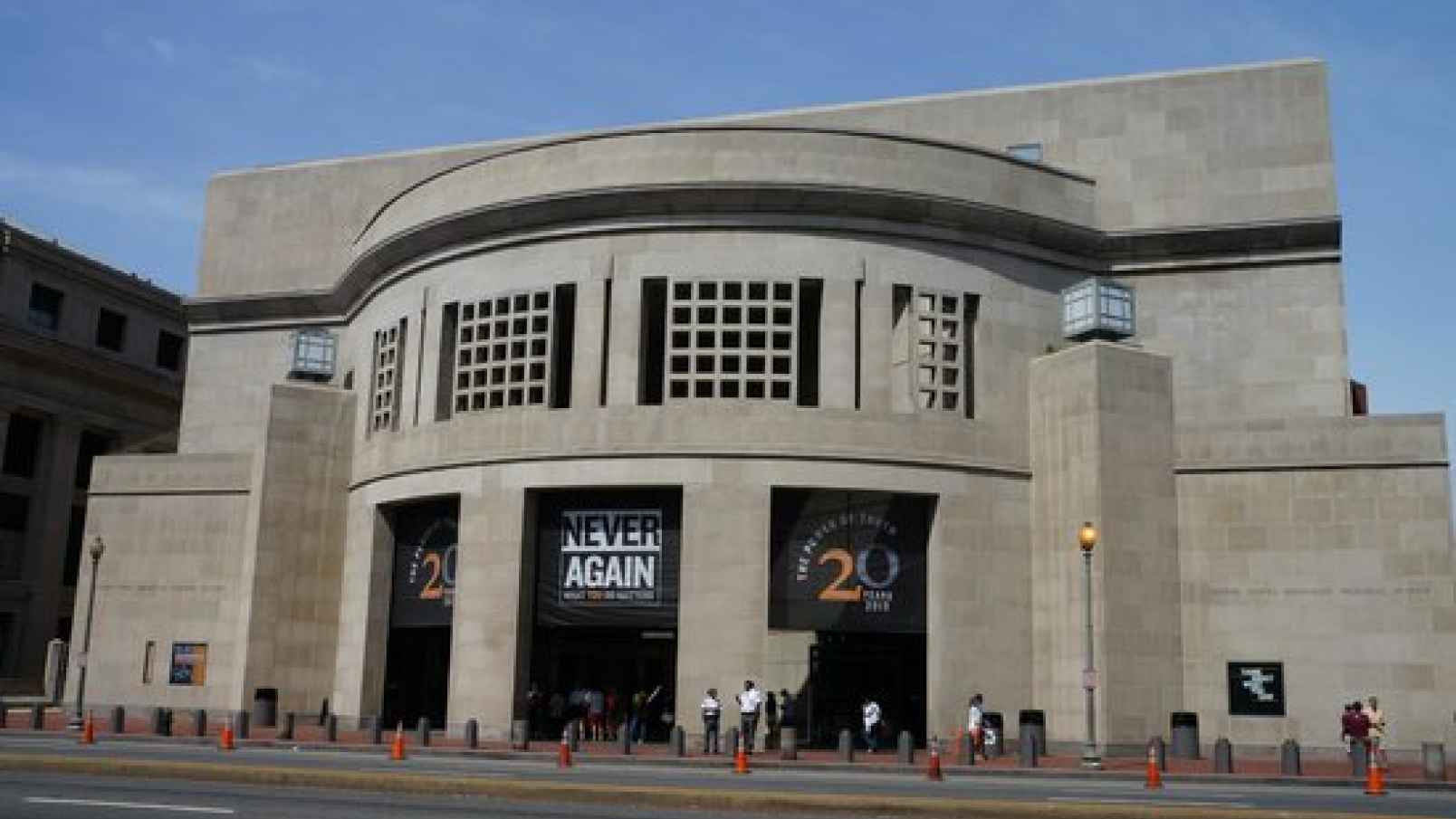
Despite the constant threats to destroy the Jewish State, Iran is also rated at low risk. Instead the Holocaust Museum claims that the real threat of genocide is in Egypt which is “experiencing a mass killing episode perpetrated by the current regime against the Muslim Brotherhood and oppositionists.”

***************************

The United States Holocaust Memorial Museum was tainted from the start.

Carter created the President’s Commission on the Holocaust to pander to the Jews after endorsing a PLO state. Then Carter complained that there were too many Jews on the Commission. One of the Jews he was complaining about was a Presbyterian with a German last name, but he was too bigoted to care.

The Museum hit a new low when the Clinton administration pressured its chairman to invite Arafat, a protégé of Hitler’s Mufti who had been trained to kill Jews by a former Nazi officer. It hit an even lower low when it brought in John K. Roth who had compared Israel to the Nazis.

Now the Holocaust Memorial Museum has rolled out an “Early Warning Project” to warn of the risk of mass killings and genocide.

According to the “Project,” Israel is not at risk of genocide. Its risk assessment is lower than the UK or Panama. If another Holocaust happens, it’s more likely to take place in London or Brazil. (But the EWP also claims that America and New Zealand are at a higher risk of mass killings than Cuba even though the Castro regime, unlike New Zealand Prime Minister John Key, actually engaged in mass killings.)

Despite the constant threats to destroy the Jewish State, Iran is also rated at low risk. Instead the Holocaust Museum claims that the real threat of genocide is in Egypt which is “experiencing a mass killing episode perpetrated by the current regime against the Muslim Brotherhood and oppositionists.”

Jews don’t face genocide in the Middle East. The Nazi-influenced Muslim Brotherhood does. Muslim Nazis are the real victims of a new Holocaust.

The Muslim Brotherhood was allied with Hitler. It distributed Arabic translations of Mein Kampf. Hitler’s Mufti, Haj Amin al-Husseini, who headed the Muslim Brotherhood’s affiliate in Israel, had personally met with Hitler, encouraged the extermination of the Jews and visited the gas chambers at Auschwitz.

The Mufti had preached genocide, encouraging Muslims to “get rid of this dirty race… Kill the Jews, burn their property, destroy their stores” making him one of the earlier promoters of BDS.

Five years after the Holocaust, Sayyid Qutb, the Muslim Brotherhood’s leading thinker, wrote a pamphlet titled, “Our Struggle with the Jews”.  Qutb’s Muslim Brotherhood had been heavily influenced by Nazi Germany and the title and theme were deliberate echoes of Hitler’s Mein Kampf.

Qutb claimed that the Jews were the source of all evil. Like Hitler, he insisted that there was a struggle for world domination, except instead of a struggle between Aryans and Jews, it was a struggle between Muslims and Jews. He echoed Hitler’s claims that the Jews had invented sex and materialism and blamed them for everything from the Sunni-Shiite split to the fall of the Ottoman Empire.

The intellectual leader of the Muslim Brotherhood even insisted that Hitler had been an instrument of Allah to punish the Jews. The claim was recently repeated by Sheikh Qaradawi, the Brotherhood’s current Qutb, who said, “Throughout history, Allah has imposed upon the [Jews] people who would punish them for their corruption. The last punishment was carried out by Hitler. By means of all the things he did to them – even though they exaggerated this issue – he managed to put them in their place. This was divine punishment for them. Allah willing, the next time will be at the hands of the believers.”

The “believers” are the Muslims. As opposed to the unbelievers who are everyone else. The Muslim Brotherhood likes what Hitler did to the Jews, but it wants to carry out the next Holocaust on its own.

Or as Qaradawi put it, “count their numbers and kill them down to the very last one.”

If the Holocaust Memorial Museum’s Early Warning Project were really concerned about “genocide” in Egypt, it might have noted the Muslim Brotherhood attacks on Christians and churches.

It might have spoken up when video emerged of the Muslim Brotherhood’s former Egyptian president, Mohammed Morsi, urging his followers “to nurse our children and our grandchildren on hatred for them: for Zionists, for Jews.”

Egyptian children, “must feed on hatred; hatred must continue,” he said. “The hatred must go on for Allah and as a form of worshiping him.”

The Early Warning Project might have noted that the charter of the Muslim Brotherhood affiliate in Gaza, the terrorist group Hamas, states, “The Day of Judgment will not come about until Muslims fight the Jews”.  And Hamas is doing its best to advance that date.

But instead the front page of the Holocaust Museum focuses on Syrian refugees. The piece on the Muslim migrants invading Hungary begins with the statement that, “In the 1930s, the world watched as Nazi Germany forced its beleaguered Jewish population to leave their homes.”

The piece is written by a Syrian who served as the Holocaust Museum’s Director of Special Events.

The Holocaust Museum has spent a good deal of time on Syria. It even hosts a paper describing the Muslim Brotherhood’s Sheik Moaz al-Khatib as “a well-respected, moderate Sunni cleric”. It leaves out his statement that Saddam Hussein’s positive legacy was “terrifying the Jews”.

The Museum obsesses over false Muslim claims that they are being persecuted by Buddhists in Burma and Hindus in India. It takes the time to visit Syria, but not Sderot. It puts up photos of Syrians, but not Jewish families murdered by members of genocidal Islamofascist terrorist organizations.

Despite all the propaganda, the Muslim Rohingya illegal aliens in Burma are not being exterminated. Muslim terror against Jews in Israel however is part of an ongoing campaign of genocide.

Hassan al-Banna, the founder of the Muslim Brotherhood, warned, “If the Jewish state becomes a fact, and this is realized by the Arab peoples, they will drive the Jews who live in their midst into the sea.”

“Kill the Jews wherever you find them,” the Mufti of Jerusalem had proclaimed. “Allah is with you.” Hamas declares that, “Killing Jews is worship that draws us close to Allah”.

There was a reason why Adolf Eichmann, the architect of the Holocaust, turned for sympathy to the Muslim world. “You 360 million Mohammedans to whom I have had a strong inner connection since the days of my association with your Grand Mufti of Jerusalem. You, who have a greater truth in the surahs of your Koran. I call upon you to pass judgment on me.”

The Holocaust Museum’s Early Warning Project is ignoring Muslim genocide aimed at Jews while promoting the bizarre myth that the Muslim Brotherhood is at risk of genocide. It couldn’t be any stranger if the Holocaust Museum had begun insisting that Neo-Nazis face genocide in Germany.

“Either this place will be a sanctuary, or it will be an abomination,” Elie Wiesel had said of the museum.

It did not take long for the United States Holocaust Memorial Museum to become an abomination. From its early days, a museum dedicated to teaching about the evil of the Final Solution instead became a platform for promoting the newest attempt to solve the “Jewish problem” with the Two-State Solution.

Now it approaches the final phase of the left’s Post-Holocaust Anti-Semitism where Muslims are transformed into Jews so that Jews may be transformed into Nazis to justify another Holocaust.

After all this time, the Holocaust Museum has decided that the Nazis were the real victims.

Egypt’s War on Terrorism Bears Fruit

September 24, 2015

Egypt’s War on Terrorism Bears Fruit, Gatestone InstituteKhaled Abu Toameh, September 23, 2015

  • Egyptian President Sisi’s war against the smuggling tunnels will undoubtedly weaken Hamas and other radical groups in the Gaza Strip. Sisi should be commended, rather than criticized, for his courageous actions against Islamist terrorists, both in the Gaza Strip and in Sinai.
  • Sisi’s actions will benefit not only Egyptians, but also many Palestinians who are opposed to Hamas and radical Islamist groups.
  • When the Egyptians destroy a Hamas tunnel, that is called “war on terrorism.” But when Israel destroys a tunnel, that is condemned as an “act of aggression.” This moral slithering is why it is important for the international community to stand behind Sisi’s relentless war on radical Islam.
  • Without such backing, Islamists will continue to pose a major threat not only to Israel, but to many Arabs and Muslims who oppose Hamas, Islamic State and Islamic Jihad.
  • The environment of the Gaza Strip is the last thing that Hamas cares about. Hamas did not think about damage to the environment or to agricultural fields when it used those fields, as well as populated areas, as launching pads for attacking Israel.

Egypt began this week flooding smuggling tunnels along their border with the Gaza Strip with water from the Mediterranean Sea — a move being condemned by Hamas and other Palestinian factions as a “disturbing nightmare.”

The Egyptian army’s move is another sign of President Abdel Fattah el-Sisi’s determination to destroy the tunnels that were used to smuggle weapons, people and merchandise from Sinai to the Gaza Strip and the other way around.

This act is also a sign of Sisi’s resolve to pursue his military campaign against Islamist terror groups that are waging war against the Egyptian authorities in Sinai. The Egyptians are convinced that Hamas and other Palestinian groups have been providing aid to the terror groups in Sinai.

Since the beginning of the year, dozens of Egyptian soldiers and police officers have been killed in a spate of terror attacks launched by Islamist groups in Sinai.

Earlier this week, Egypt’s Interior Ministry announced that terrorists shot dead an Egyptian general in Sinai. In another similar shooting a few days earlier, a terror group killed General Khaled Kamel Osman.

The decision to pump water into the smuggling tunnels is seen as a severe blow not only to the terror groups in Sinai, but also to Hamas, Islamic Jihad and other Palestinian factions inside the Gaza Strip.

1259Seawater covers parts of the ground where Egypt has been pumping water into smuggling tunnels along the border with Gaza. (Image source: Al Jazeera video screenshot)

Judging from the reaction of the Palestinian groups, it is clear that they are in a state of hysteria as they see their tunnels collapsing one after the other.

In a statement published in the Gaza Strip, Palestinian groups, including Hamas, denounced the flooding of the tunnels as a “disturbing nightmare” for the Palestinians. The factions appealed to the Egyptian authorities to “stop this despicable crime against the Palestinian people and their environment.”

“The Palestinian people are surprised by the Egyptian move, which will tighten the blockade on the Gaza Strip, destroy vast areas of agricultural land and harm those living near the border (with Egypt),” the statement said.

Initially, Hamas leaders did not take the reports about flooding the tunnels seriously. Some Hamas leaders, in fact, first thought that these were rumors designed to scare them and other Palestinian groups in the Gaza Strip.

But when Hamas leaders woke up on September 13 to discover that the Egyptians had begun pumping water into the smuggling tunnels, they could not believe what they were seeing.

Hamas spokesman Sami Abu Zuhri announced that his movement asked the Egyptians to stop flooding the tunnels with seawater. “We hope that the Egyptians will comply with our demand,” Abu Zuhri said. “This measure is completely unacceptable and poses a threat to many families living alongside the border.”

Sources in the Gaza Strip noted this week that the Egyptian move has thus far proven to be effective and successful. They said that since being flooded with water, several tunnels have collapsed.

It is worth noting that despite its outrage, Hamas has stopped short of issuing threats against Egypt in response to the flooding of the tunnels.

Hamas’s response would have been different had it been Israel that was flooding the tunnels with water. But Hamas knows very well that it would not be a good idea to mess with the Egyptian authorities and President Sisi.

During the past two years, the Egyptians have destroyed hundreds of smuggling tunnels along their border with the Gaza Strip. Nevertheless, Hamas did not dare launch one terror attack against Egypt.

Hamas is now pretending that it is concerned about the damage to the environment that is caused by the flooding of the smuggling tunnels. But the truth is that the environment of the Gaza Strip is the last thing that Hamas cares about.

Hamas did not think about damage to the environment or to agricultural fields when its men fired thousands of rockets at Israel in the past few years. In fact, Hamas used these fields, as well as populated areas, as launching pads for attacking Israel.

Hamas is interested only in one thing: preserving its rule in the Gaza Strip. The tunnels that are now being destroyed by the Egyptians were used by Hamas to smuggle all types of weapons into the Gaza Strip. Hamas warlords are also believed to have earned millions of dollars from the smuggling industry during the past few years.

Sisi’s war against the smuggling tunnels will undoubtedly weaken Hamas and other radical groups in the Gaza Strip. The Egyptian president should be commended, rather than criticized, for his courageous actions against Islamist terrorists, both in the Gaza Strip and in Sinai.

Sisi’s actions will benefit not only Egyptians, but also many Palestinians who are opposed to Hamas and radical Islamist groups. Israel also stands to benefit from Sisi’s war against Hamas. The destruction of the tunnels means fewer weapons used by Hamas to attack Israel.

However, Israel still has good reason to be worried about Hamas’s plans and intentions.

While Sisi is busy flooding the tunnels on the border with Egypt, Hamas continues to dig new ones on the border between the Gaza Strip and Israel.

It is no secret that Hamas has also managed to rebuild many of the terror tunnels that were used to infiltrate gunmen into Israel during last year’s military confrontation between the two sides. Hamas is planning to use these tunnels in the future, to dispatch its men to kill as many Israelis as possible.

The Israelis have thus far been monitoring the situation very closely and have refrained from attacking the tunnels. That is because Israel is keen on maintaining the unofficial truce with Hamas that was reached in the aftermath of last year’s war, known as Operation Protective Edge.

There is not much that Israel can do at this stage other than hope that Sisi will continue with his measures to undermine Hamas. Any attempt by Israel to flood a Hamas tunnel will most likely spark an international outcry and bring condemnations from the United Nations. In addition, such a move on the part of Israel is likely to trigger a violent response from Hamas — one that could lead to another war.

When the Egyptians destroy a Hamas tunnel, that is called “war on terrorism.” But when Israel destroys a tunnel, that is condemned as an “act of aggression.” This moral slithering is why it is important for the international community to stand behind Sisi’s relentless war on radical Islam. Without such backing, the Islamists will continue to pose a major threat not only to Israel, but to many Arabs and Muslims who oppose Hamas, Islamic State and Islamic Jihad.

The Fiction of Political Islam

September 2, 2015

The Fiction of Political Islam, The Gatestone InstituteBassam Tawil, September 2, 2015

  • To this day, the Obama administration mourns the fall of Egypt’s Islamist President Morsi, and turns a cold shoulder to forward-looking President el-Sisi, who is (sometimes) trying to take Egypt into the 21st century and extricate Egypt from its economic and societal crisis.
  • Muslim Brotherhood terrorism against the Egyptian regime is a perfect example of how this “political movement” is in reality a terrorist movement whose objective is the violent overthrow of Egypt’s government. The White House, fully aware of the facts, continues hosting senior Muslim Brotherhood officials and shows them respect during consultations about the American Islamic community and U.S. policy in the Middle East.
  • Events in Sinai prove there is no such thing as “political Islam.” There is a radical Islamist leadership that represents itself to the gullible West as “moderate,” preaches violence from mosques, cloaks itself in ideological-religious tradition, and employs Islamist terrorists to attack civilians and Egyptian government targets.
  • It is hard not to conclude, looking at President Obama’s record (ignoring protesters of 2009 in Iran; “I’ve got a pen, and I’ve got a phone”; the dictatorial way the Iran deal is bypassing the democratic process) that in his heart-of-hearts, he is far more committed to supporting extremist Islamist regimes — whether the mullahs of Iran or the Muslim Brotherhood — than to supporting democracy, individual freedoms or human rights.
  • The Europeans are more aware of the situation but woke up too late. As hundreds of thousands of migrants from Muslim lands continue to pour over Europe’s open borders, there is little doubt that radical Islam is poised to take over the West. Islamic communities and terrorist cells continue to mushroom throughout the cities of Europe.
  • The world is beginning to understand that the catastrophes of the Middle East have nothing to do with the resolution of the Palestinian issue but are caused by the innate homicidal tendencies of the Arab rulers and the regional Islamist terrorist organizations.

Hamas is in trouble. Its relations with Egypt are going from bad to worse, and the influx of money, primarily from Qatar, Saudi Arabia and the mosques in the Western world — where charity (zakat) was collected to finance anti-Israel terrorism — has dwindled to almost nothing. So has the flow of arms and explosives from Iran, Libya, Sudan and Lebanon. The resulted is the weakening of Hamas rule in the Gaza Strip, making it ever more difficult for Hamas to continue its ongoing subversion of the Palestinian Authority (PA) in the West Bank and its non-stop attempts to overthrow President Mahmoud Abbas to take over the West Bank and establish there the sort of Islamic emirate it established in the Gaza Strip.

Hamas’s military buildup was halted when the President Mohamed Morsi’s radical Muslim Brotherhood regime in Egypt was toppled and General Abdel Fattah el-Sisi was elected President. Morsi, it will be recalled, strangely received support from President Obama until he was ousted. The Obama administration supported him despite Morsi enabling for the flow of money and arms to Hamas in Gaza to continue unhampered through the tunnels in the Sinai Peninsula. The weapons were used not only to attack Israel, but also to sabotage peace talks between Israel and the Palestinians and, indirectly, to attack the Palestinian Authority.

The Islamist terrorism festivities ended when President el-Sisi clamped down on the Islamists in Egypt, destroyed the tunnels and sealed Egypt’s border with Gaza. Since el-Sisi has been president of Egypt, Muslim Brotherhood rule has ended and the tunnels have been destroyed. It is hard to fathom why, to this day, the Obama administration mourns the fall of the Islamist Morsi administration and turns a cold shoulder to forward-looking el-Sisi, who is (sometimes) trying to take Egypt into the 21st century and extricate Egypt from its economic and societal crisis.

Since el-Sisi has been in power, money and arms no longer flow through the tunnels into the Gaza Strip; instead they began to flow in the opposite direction, from the Gaza Strip into Egypt’s Sinai Peninsula. Since the Muslim Brotherhood and its affiliated terrorist organizations, Hamas among them, have not accepted defeat, there has been an increase in terrorist attacks targeting the Egyptian regime both inside the country proper and in the Sinai Peninsula. The terrorist campaign receives ongoing support from the Izz al-Din al-Qassam Brigades, Hamas’ military-terrorist wing, and the ISIS-affiliated Ansar Bayt al-Maqdis. Both continuously attack the Egyptian police and army in the Sinai Peninsula, murder Egyptian officials and target Egyptian institutions.

The endless terrorist campaign in Egypt has proven yet again that the claim of a political Islam, separate from the terrorist organizations, is simply a lie. Muslim Brotherhood terrorism against the Egyptian regime is a perfect example of how the “political movement” tries to represent itself as dealing only with the da’wah [proselytizing], while in reality it is a terrorist movement whose objective is the violent overthrow of el-Sisi’s administration. The White House, fully aware of the facts, continues hosting senior Muslim Brotherhood officials and shows them respect during consultations about the American Islamic community and U.S. policy in the Middle East.

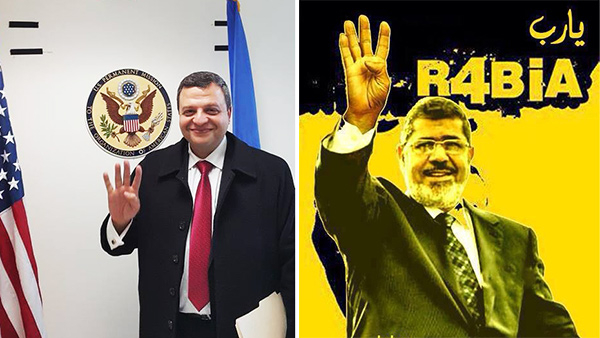
919 (1)While being hosted by the State Department on a visit to Washington in January 2015, Muslim Brotherhood judge Waleed Sharaby (left) flashed the organization’s four-finger “Rabia” sign. At right, ousted Egyptian President Mohamed Morsi (from the Muslim Brotherhood) displays the Rabia sign.

The events in the Sinai Peninsula prove there is no such thing as “political Islam.” There is a radical Islamist leadership that represents itself to the gullible West as “moderate,” preaches violence from the mosques, cloaks itself in ideological-religious tradition, and employs a hard core of Islamist terrorists to carry out attacks on civilians and Egyptian administration targets.

In the meantime, the real victims are the Egyptians. The Muslim Brotherhood’s terrorism has paralyzed Egypt’s tourist industry, as foreigners fear to visit Egypt’s antiquities. And now there are terrorist threats to the New Suez Canal, a project initiated and carried out under the leadership of General Sisi to turn both banks of the two canals into an international logistics, commercial and industrial area.

The Islamists’ plans are clear. First, they want to leverage violence, murder and countless Egyptian army casualties into establishing an autonomous terrorist enclave in the Sinai Peninsula. Then they will try to overthrow the Egyptian government and reinstate an Islamist Muslim Brotherhood regime headed by Morsi. That is exactly what their offshoot, Hamas, did in the Gaza Strip when it liquidated Palestinian Authority officials and established an Islamic emirate. The writing on the wall is still illegible as far as the U.S. government is concerned. Or else the Obama administration is still in the thrall of extremist Islam and its Muslim Brotherhood leaders. The two main ones are Turkey’s Recep Tayyip Erdogan, who has just called new elections so that he can try again to acquire enough seats in parliament to amend Turkey’s constitution to award himself a one-man Sultanate, an absolute dictatorship-for-life to go along with his new palace. The other is Mohamed Morsi, whom Obama apparently is still backing.

It is hard not to conclude, looking at the U.S. president’s record (ignoring the protesters of 2009 in Iran; “I’ve got a pen, and I’ve got a phone” and the dictatorial way the Iran deal has been short-circuited to bypass the democratic process) that in his heart-of-hearts, he is far more committed to supporting extremist Islamist regimes — whether the mullahs of Iran or the Muslim Brotherhood — than to supporting democracy, individual freedoms or human rights.

The Europeans are more aware of the situation but unfortunately woke up too late. As hundreds of thousands of migrants from Muslim lands continue to pour over Europe’s open borders, there is little doubt that radical Islam is poised to take over the West. Islamic communities and terrorist cells continue to mushroom and gather strength throughout the cities of Europe.

From the beginning of the wave of attacks in Egypt, senior Egyptian security officials threatened Hamas. Egypt warned Hamas to stop training, arming and sending its terrorists to collaborate with ISIS operatives in attacks against the Egyptian army. Hamas steadfastly denies any involvement, even as it continues collaborating with ISIS against Egypt.

As far as Hamas is concerned, destroying the Egyptian army is essential, because its continued actions along the Rafah border and in Sheikh Zuweid in the northern Sinai Peninsula prevent Hamas from acquiring money and stockpiling weapons to fight Israel, which weakens its subversion against Mahmoud Abbas and its plans to take over the West Bank.

Despite profuse denials, at the end of August 2015, four operatives from Hamas’s military-terrorist wing, the Izz al-Din al-Qassam Brigades, were taken off a bus by armed Egyptians on the way from Rafah through the Sinai Peninsula to Cairo. Hamas immediately accused Israeli intelligence of responsibility and warned the Egyptian authorities that “the abduction of its operatives will not go unpunished.”

In response, Dina Ramez, a co-host on Egypt’s official TV station, called Hamas out on its lies and denials of its terrorist activities in the Sinai Peninsula against the Egyptian regime. She asked Hamas, “If you are not involved in terrorism, what were your senior Izz al-Din al-Qassam Brigades operatives doing in Sinai?” and called them “cockroaches.”

Sources in Hamas called her a “whore,” and called Egypt a loser country defeated by Israel, using a peace treaty to sell Palestine to the enemy. Was that really the way to thank Egypt for everything it has done for the Palestinians, sacrificing its army and soldiers for us? It is a sad situation for the Palestinians and for our leadership.

What have we Palestinians gained from Hamas’s military actions against Egypt? What have we gained from our solidarity with Islamist organizations fighting against Assad in Syria, or joining organizations such as the “Palestinian Liberation Army” fighting for Assad? Why are we killing each other in the Ain al-Hilweh refugee camp? Why do we refuse everything the Israelis offer us?

Anyone who remembers history remembers the ungrateful path trodden by the Palestinians against the Kingdom of Jordan, when our leaders, headed by Arafat, tried in 1970 to overthrow King Hussein, despite the refuge Jordan offered us during the catastrophes of the Nakba in 1948 and the Naksa in 1967. Then we did the same thing in Lebanon, to where we fled from Jordan. The PLO relocated its headquarters to Beirut, and went on to turn Lebanon into a terrorist country and the lives of the Lebanese into a nightmare. If the Israelis had not invaded Lebanon in 1982, and forced the PLO to relocate to Tunisia (where its behavior was also criminal), the Palestinians definitely would have destroyed Lebanon.

The Middle East is in chaos, and Palestinian factionalism and ingratitude continue to inflame the dissolution of the Arab states and the internal Palestinian division between Hamas in Gaza and the Palestinian Authority in the West Bank.

The world is beginning to understand that the catastrophes of the Middle East have nothing to do with the resolution of the Palestinian issue, but are caused by the innate homicidal tendencies of the Arab rulers and the regional Islamist terrorist organizations.

The only person left who believes the Israeli-Palestinian nonsense is President Barack Obama, even though he is witness to the murders, rapes, beheadings and the millions of refugees, next to which the Palestinian issue is an old, irrelevant and very tired joke.

Iran Deal: A Potential Kiss Of Death For Liberalism In The Middle East’

August 28, 2015

Iran Deal: A Potential Kiss Of Death For Liberalism In The Middle East’, MEMRI, August 27, 2015

In a July 19, 2015 article on Al-Ahram’s English-language website titled “Iran Deal: A Potential Kiss of Death for Liberalism in the Middle East,”[1]Egyptian blogger and political commentator Nervana Mahmoud criticized the claim made, inter alia, by U.S. President Barack Obama and others in his administration, that the nuclear deal with Iran will strengthen moderate elements in that country.[2] Rather than promote liberals, she writes, the deal will only vindicate Iran’s current theocratic leadership by ending Iran’s isolation. It will also, she stresses, send a message to other authoritarian regimes in the region that the U.S. is likely to overlook their crackdown on dissidents, while encouraging Islamist movements to emulate Iran by embracing extremism.

Ms. Mahmoud goes on to accuse the Obama administration of promoting “illiberalism” by defining as moderate “any group, entity, or state willing to show pragmatism and cooperation with the United States, regardless of that state’s intolerant actions on the ground.”

24629Nervana Mahmoud (Image: Nervana1.org)

“For The Iranian Mullahs, The Nuclear Deal Is An Indirect Acknowledgment From The West That Their Anti-Modernity Model Is Viable And Successful”

“After 12 years of diplomatic proposals and 20 months of tough negotiations, theocratic Iran and world powers have reached a nuclear deal that, regardless of its potential advantages, is undoubtedly a victory for smart illiberalism and a potential kiss of death for the prospect of liberal, pluralistic democracies in the Middle East.

“Both illiberal Shi’a and Sunni Islamists and illiberal non-Islamist autocrats could receive an enormous boost from the deal.

“A few years ago, against all advice, I visited the Islamic Republic of Iran. To my surprise, I found a vibrant nation, with many liberal youth yearning for freedom and democracy. Those youth may now celebrate the lifting of sanctions and the end of isolation, but it is doubtful the nuclear deal will bridge the deep divide between them and their theocratic rulers.

“For the Iranian Mullahs, the nuclear deal is an indirect acknowledgment from the West that their anti-modernity model is viable and successful. U.S. President Barack Obama may be genuine in his hopes that Iran will abandon its ‘path of violence and rigid ideology’ following this ‘historic agreement,’ but his hopes may turn out to be no more than wishful thinking.

“The regime – now less isolated–has less incentive to couple its agreed abandonment of its nuclear program with an abandonment of what it sees as successful ideology than ever before.”Many commentators have pointed out that the deal could not have come at a worse time for the Arab world. With open sectarian tension in many Arab countries, a strong Islamic Iran will only inspire other political Islamic groups to try to match up to the Mullahs.

“Iran’s regional influence in Lebanon, Iraq, Syria, and Yemen will only prompt a counter-movement by forces that share an underlying belief in Islamism, but differ in its sectarian interpretation. Since 1979, Sunni Islamism has learned one important lesson from Iran: ‘Yes, we can’ -– a slogan the Islamists touted quietly, long before Obama uttered those words in 2008.

“Arab Islamists saw theocratic Iran as a perfect model for fulfilling their dream of ruling Muslim societies. The new nuclear deal will add two more lessons, and liberal democracy is not one of them– defiance and lobbying in Washington…

“Last Saturday, Ahrar Al-Sham, an Islamist Sunni insurgent group fighting in Syria, published an article in the Washington Post claiming to believe in ‘a moderate future for Syria.’ Charles Lister, a visiting fellow at Brookings, scrutinized their claim: ‘Ahrar Al-Sham has been one of the most consistent military allies of Al-Qaeda affiliate Jabhat Al-Nusra.’ The publication of the article in itself indicates how some people in the corridors of power in Washington are willing to buy Ahrar’s narrative.

“The implication for Syria could not be more serious. Syria will continue to be torn between two mutually exclusive Sunni versus Shi’a forces; many of them are radical, ruthless, and undemocratic. Somehow, the Obama administration seems to see no problem in embracing both…’However, tacitly embracing radical Shi’a militias’ fight against radical Sunni groups such as the Islamic State (ISIS), while pretending that other radicals such as Ahrar Al-Sham are moderate, does not seem to be a sound strategy.”

“It Is Dangerous For The U.S. To Empower Illiberalism In A Region That Suffers Mainly As A Consequence Of Its Illiberal Players”

“In Egypt, neither the removal of Hosni Mubarak nor the ousting of Muhammad Mursi has produced a liberal democracy. Moreover, a significant section of the Muslim Brotherhood, despite its antipathy to Shia Islamism, has started to view the Iranian model as the way forward to regain power.

“They wrongly attribute their failure to run the country during Morsi’s tenure to what they describe as their ‘reluctance to embrace revolutionary politics.’ The Mullahs’ violent ejection of their opponents in 1979 is seen as ‘a model.’ In addition, the Muslim Brotherhood and its supporters will continue to lobby in Washington, hoping that its projection of an Iranian–style defiance will convince the Obama Administration to exert pressure on the leadership in Cairo to change its posture toward the group.

“On the other hand, many among President Abdel Fattah El-Sisi’s supporters will use Iran as a pretext to justify more crackdown on opponents, and argue that world powers, which are willing to lift sanctions against the Iranian regime, despite 36 years of ruthless rule, have no moral ground on which to judge Egypt.

“In his speech in Cairo in 2009, President Obama advocated tolerance, respect for minorities, and religious freedom. He also said elections alone do not constitute a true democracy.

“Now, as Hisham Melhem, Bureau Chief of the Al Arabiya News Channel in Washington, has pointed out, ‘after almost six and a half years of trying to shape events in the Middle East, President Obama has very little to show for it except the nuclear deal with Iran.’ More alarmingly, the American president seems to have lowered the bar, and is now willing to accept a softer definition of moderation to include any group, entity, or state willing to show pragmatism and cooperation with the United States, regardless of that state’s intolerant actions on the ground.’

“There are intrinsic reasons behind the metastasizing sectarian and ethnic conflicts that followed the failed Arab awakening. It is unreasonable to expect the United States to ‘fix’ the region; however, it is dangerous for the U.S. to empower illiberalism in a region that suffers mainly as a consequence of its illiberal players. It would be a pity if President Obama went down in the history books as the man who fumbled with the West’s anti-illiberalism alarm button, and embraced the enemies of liberalism in the Middle East.”

_____________________

Endnotes:

[1] English.ahram.org.eg, July 19, 2015.

[2] See for example Obama’s interviews in Al-Sharq Al-Awsat (Aawsat.net, ,May13, 2015) and with National Public Radio (Npr.org, April 7, 2015).

Egypt and the Hamas “Cockroaches”

August 26, 2015

Egypt and the Hamas “Cockroaches,” The Gatestone InstituteKhaled Abu Toameh, August 26, 2015

  • “What were your four [Hamas] men doing in Sinai? Haven’t you denied in the past the presence of any Hamas men in Sinai? So where did these men pop up from?” — Dina Ramez, Egyptian journalist.
  • The incident also proves that Hamas does not hesitate to take advantage of Cairo’s humanitarian gestures to smuggle its men out of the Gaza Strip. Obviously, the four Hamas men were not on their way to receive medical treatment. That they are members of Hamas’s armed wing, Ezaddin al-Qassam, speaks for itself.
  • The Egyptians are particularly fed up with reports about Hamas’s increased involvement in their internal affairs and links to terror groups in Sinai.
  • This practice by Hamas is something that the Egyptian authorities have come to understand, which is why they are refusing to reopen the Rafah border crossing between Gaza and Egypt. The question now is whether the international community will understand Hamas’s true intentions and plans — namely to prepare for another war against Israel.

Egypt’s President Abdel Fatah Sisi has once again proven that he and his country will not tolerate any threats from Hamas or other Palestinians.

The crisis that erupted between Sisi’s regime and Hamas after the removal from power of Muslim Brotherhood President Mohamed Morsi two years ago, reached it peak in the past few days with the kidnapping of four Hamas operatives in Sinai.

The four men were snatched from a bus shortly after crossing from the Gaza Strip into Egyptian territory on August 19. Reports said that unidentified gunmen stopped the bus and kidnapped the four Hamas men, who are wanted by Egypt for their involvement in terrorism.

1222A bus carrying Palestinians drives through the Rafah crossing, from the Gaza Strip to Egyptian Sinai, on August 23, 2015. (Image source: Aqsatv video screenshot)

Although initial reports suggested that the kidnappers belonged to a salafi-jihadi group based in Sinai, some Hamas officials have accused Egyptian security forces of being behind the abduction. The Hamas officials even issued veiled threats against Sisi and the Egyptian authorities, and said that they held them fully responsible for the safety of the Hamas men.

A statement issued by Hamas warned the Egyptian authorities against harming the four men. “These men were the victims of deception and their only fault is that they are from the Gaza Strip,” the statement said. “This incident shows that the criminals are not afraid to target our people.”

Hamas leader Musa Abu Marzouk said that his movement holds the Egyptian authorities fully responsible for any harm caused to the abductees. He said that the kidnapping raises many questions and its circumstances remain unclear.

Hamas claims that salafi-jihadi groups in Sinai have informed its representatives that they did not kidnap the four men. According to Hamas officials, the abduction took place near the border with the Gaza Strip — an area where the Egyptian army maintains a large presence.

Sources in the Gaza Strip, however, have confirmed that the four men belong to Hamas’s armed wing, Ezaddin al-Qassam. The sources said that the men were apparently on their way to Iran for military training. The sources pointed out that the four had received permission from the Egyptian authorities to leave the Gaza Strip through the Rafah border crossing. The visas, however, are supposedly for civilians, not for Hamas operatives.

Hamas’s threats against Egypt have, meanwhile, enraged the Egyptian authorities as well as some top journalists in Cairo.

Egyptian authorities responded by refusing to give permission to Hamas leader Ismail Haniyeh and some leaders of his movement to travel to Qatar and Lebanon through the Rafah border crossing. The Hamas leaders were hoping to hold talks with some of their colleagues in those two countries about the possibility of reaching a long-term truce with Israel.

The Egyptians’ refusal to allow the Hamas leaders to leave the Gaza Strip has further strained relations between the two sides. Hamas representatives in the Gaza Strip were quoted as accusing the Egyptian authorities of “conspiring” against the movement and all Palestinians.

In Cairo, Egyptian security officials denied any link to the kidnapping of the four Hamas men. However, the denials have fallen on deaf ears and no one in Hamas seems to believe the Egyptian authorities. Even worse, Hamas representatives continued over the past few days to issue warnings and threats against Egypt.

As in the past, each time tensions rise between Hamas and Egypt, the Egyptians unleash some of their senior journalists against the Islamist movement. Since President Morsi’s removal from power, the Egyptians have displayed zero tolerance when it comes to Hamas. They are particularly fed up with reports about Hamas’s increased involvement in their internal affairs and links to terror groups in Sinai.

During the last war between Israel and Hamas, several Egyptian journalists and public figures openly expressed hope that the Israelis would destroy the movement for once and for all. Other journalists in Cairo, who are openly affiliated with the Sisi regime, have even urged their government to launch attacks against Hamas bases in the Gaza Strip.

This week, and in wake of the renewed tensions between Hamas and Egypt, Egyptian journalists resumed their rhetorical attacks against the movement. The question that most of these journalists asked was: What are Hamas members doing on Egyptian soil in the first place? The journalists accused Hamas of exploiting Egypt’s humanitarian gestures to smuggle its men out of the Gaza Strip.

One of these journalists, Dina Ramez, who is known as a staunch supporter of President Sisi, launched a scathing attack on Hamas, calling its members and leaders “cockroaches.”

Referring to the Hamas threats against Egypt, Ramez said: “Has anyone ever heard of cockroaches or ants that could threaten lions? These cockroaches belong to Hamas, which is threatening Egypt following the abduction of four of its men. I want to ask the Hamas cockroaches a simple question: What were your four men doing in Sinai? Haven’t you denied in the past the presence of any Hamas men in Sinai? So where did these men pop up from? I dare you to approach the border with Egypt. We have confidence in our army and our response will be painful. It will be a strong and deterring response against any cockroach that dares to come close to our border or threaten Egypt.”

Regardless of the identity of the kidnappers, the incident shows that Sisi and the Egyptian authorities continue to view Hamas as a threat to Egypt’s national security. The incident also proves that Hamas does not hesitate to take advantage of Cairo’s humanitarian gestures to smuggle its men out of the Gaza Strip. Obviously, the four Hamas men were not on their way to receive medical treatment or pursue their studies in Egypt or any other country.

That they are members of Ezaddin al-Qassam speaks for itself. Instead of dispatching its fighters to Iran and Turkey, Hamas should have allowed medical patients and university students to leave the Gaza Strip. But Hamas does not care about the well-being of the Palestinians in the Gaza Strip. Rather, it cares about sending its men to Iran and Turkey to receive military and security training.

This practice by Hamas is something that the Egyptian authorities have come to understand, which is why they are refusing to reopen the Rafah border crossing between Gaza and Egypt. The question now is whether the international community will understand Hamas’s true intentions and plans — namely to prepare for another war against Israel.

Egypt’s Christians in the Shadow of the Muslim Brotherhood

August 11, 2015

Egypt’s Christians in the Shadow of the Muslim Brotherhood, Washington Free Beacon, August 11, 2015

(Please see also, WFB’s Bill Gertz discusses story on Obama support for Muslim Brotherhood on Steve Malzberg Show. — DM)

Copts view the Obama administration cynically. Egyptians now whisper that the American president who pleased Arab liberals with his speech “A New Beginning” at al-Azhar in 2009 is secretly funding the Muslim Brotherhood and purposefully neglecting the Islamic State. A group of Copts protested outside of the White House in February 2015, demanding more aggressive action against IS following the beheading of the 21 Copts.

Al-Ahram, the largest newspaper in Egypt, published reports in 2013 that the United States diplomatic mission in Egypt, led by Ambassador Anne Patterson, was discouraging Coptic Christians from participating in protests against Morsi. Even though Patterson adamantly denied the accusations, the report sowed more distrust among Copts.

Tensions between the Coptic community and the administration worsened when, in the same year, an Obama Homeland Security adviser named Mohamed Elibiary suggested Copts raising awareness of their persecution were promoting “Islamophobic” bigotry.

**************************

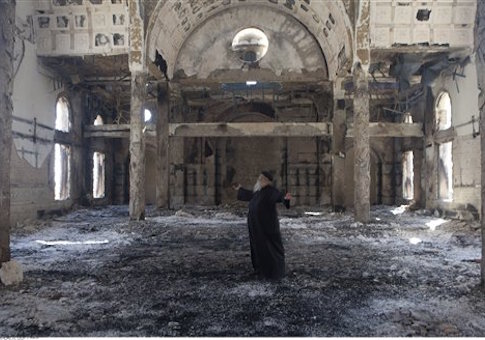
Christian Coptic Priest Father Samuel reacts as he stands inside the burned and heavily damaged St. Mousa church in Minya, Egypt / AP

In the nearly five years of turmoil that have followed the resignation of President Hosni Mubarak in 2011, no group in Egypt has suffered more than the 15 million Coptic Christians. Both a religious and ethnic minority, the Copts are descended from the native population of Egypt who lived and ruled there from the time of the pharaohs until the Roman conquest in 31 B.C. They are the largest Christian community in the Middle East today.

Copts have long been the target of discrimination and persecution in the majority-Arab nation. But this ancient people faced a terrifying new prospect in 2012: Muslim Brotherhood rule.

After Mubarak was ousted, the violence began almost immediately. Churches and schools were burned; peaceful protestors were massacred. When parliamentary elections were held nine months later, they were swept by the Muslim Brotherhood and other Islamist parties. When Mohamed Morsi won the presidential election in May 2012, the party’s victory looked complete. The same year, Morsi gave himself unlimited powers and the party drafted a new constitution inspired by Sharia law.

Morsi benefitted from the organizational advantage of the Muslim Brotherhood. Backed by imams preaching the benefits of religious rule, the previously banned political party was able to defeat the fractured coalitions of the pro-West, liberal, and secular candidates.

“They used thugs to carry out political intimidation against Christians,” a former member of Egyptian Parliament told the Washington Free Beacon. Chants celebrating the Brotherhood victory echoed through the streets of Cairo. “Morsi won! Copts out!”

Ousted president Mohamed Morsi / AP

During Morsi’s rule, Christians were murdered and tortured by the hundreds. Attacks and abductions of Christian children spiked significantly. “Most Americans do not know how vicious and bloody the Muslim Brotherhood is,” Ahmed, a 24-year old secular Muslim, said. “They really can’t understand.”

Pope Tawadros II, Egypt’s Coptic Christian leader, criticized Morsi for negligence after six Christians were killed when police and armed civilians besieged Egypt’s largest cathedral. “We want actions, not words,” the Pope said.

Public accusations of blasphemy also became ubiquitous. A Facebook post interpreted as undermining Islam could bring a mob of fundamentalists with rocks and Molotov cocktails to the homes of Christians, surrounding them with families trapped inside. Sham trials with no legal representation would follow. Anti-Christian terrorism was not punished, but the wrong words often landed Copts in prison, forcing the church to make public apologies and families to leave their towns and villages.

Lydia, an activist who provides relief supplies to torn Christian communities in Upper Egypt, and who requested that only her first name be used to preserve her safety and that of her colleagues, witnessed the Muslim Brotherhood offer the very poorest Egyptians social services that bought their allegiance. “When you have no food or money, you will listen to anyone who gives you the resources your family desperately needs,” Lydia said. “They brainwash the illiterate with extremism so they hurt Christians.”

Still, Morsi’s authoritarian rule—rewriting the constitution, disbanding the Egyptian parliament, tossing potentially obstructive judges into jail—was not long lived. Barely a year after he assumed office, a reported 35 million citizens took to the streets to protest his rule, leading the Egyptian military, under Gen. Abdel Fattah al-Sisi, to remove him from power in July 2013.

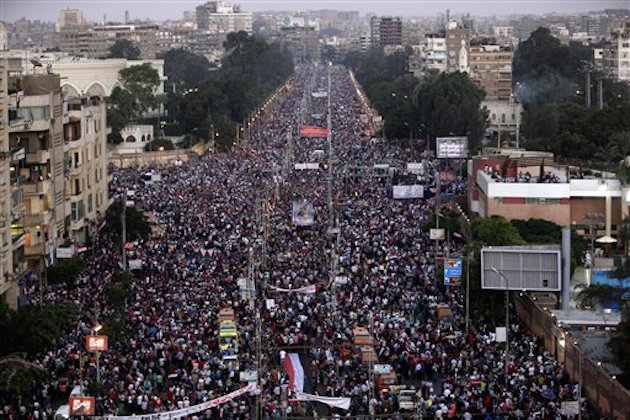
Egypt’s ousted President Mohammed Morsi protest at the presidential palace in Cairo, Egypt, Friday, July 26, 2013 / AP

Sen. James Lankford (R., Okla.) told the Free Beacon that had al-Sisi not responded, the promise of Egyptian Democracy would have died. “What it seemed the Egyptian people wanted was more opportunity to be able have some sort of functioning democracy, elections, input into their own government,” Lankford said. “It was the immediate understanding as soon as the Muslim Brotherhood was elected, that was the last election Egypt would have.”

In 2014, al-Sisi was elected Egypt’s new president. He won a solid electoral victory, giving him control of the Egyptian government with the responsibilities of forming a new constitution, a new parliament, and a new judicial system. The Coptic Church fervently supported al-Sisi’s candidacy because the new president promised Copts equality in citizenship, security in their communities, and the ability to build places of worship.

The new Egyptian president challenged the leaders of the Islamic world to push a more moderate message. In December 2014, hundreds of Christian and Muslim theologians gathered at al-Azhar, Egypt’s leading mosque and religious university, participated in a conference to fight “jihad” and promote inclusion. Al-Sisi ambitiously called for a “religious revolution” in January 2015, saying that clerics bear responsibility for the growing extremism in the Middle East.

As president, al-Sisi took many symbolic steps to integrate the Coptic community with the majority Sunni population. In a surprise to most Egyptians, al-Sisi attended a mass at Saint Mark Orthodox Cathedral in Cairo on Christmas Eve, a first for any Egyptian president. Al-Sisi regularly invites Pope Tawadros II to appear beside him when he announces major policy rollouts or requests public dialogue from senior advisers.

Al-Sisi also appointed two Copts as members of his cabinet. Under the constitution, the president of Egypt has the power to select 10 members of parliament. Political observers believe he will select Copts to fill a majority of those appointed seats to offer a more representative parliament.

“Our lives haven’t changed much but one positive result of the revolution is the Egyptian people have politically woken up,” said Hala, a Mubarak-era government official who also wished to be identified by her first name only because she fears political retribution. “We no longer accept what we are told. Egyptians are at least aware of the government’s actions and they are more aware of the troubles Copts face.”

But while al-Sisi’s administration provides a welcome change of tone toward the Coptic community, the day-to-day lives of Copts remain little changed from the Mubarak days.

Coptic Solidarity is a five-year-old public charity organization and advocacy group devoted to advancing equality for Copts in Egypt. Their efforts have helped raise awareness about the persecution Christians face in the Middle East. Alex Shalaby, an Egyptian businessman currently residing in the United States and Coptic Solidarity’s new president, believes Egypt under al-Sisi has continued many of the same practices as previous presidents Sadat, Mubarak, and Morsi.

“Discrimination is rampant, especially in Upper Egypt. We still see reconciliation tactics pressuring the closing of Christian churches and there are still very few Coptic government appointees, he explained. “Coptic Solidarity monitors all developments within Egypt and we are not able to say much has been accomplished in terms of real change to improve Coptic lives in the last 12 months.”

Human rights groups have been critical of al-Sisi’s record. Amnesty International’s Hassiba Hadj Sahraoui accused the president of “employing the same methods of torture and other ill-treatment used during the darkest hours of the Mubarak era.” The Egyptian government received heavy criticism after a court sentenced hundreds of Muslim Brotherhood members to death, intensifying its crackdown on Islamists.

Despite assurances from al-Sisi, sectarian violence still regularly occurs in the rural villages of Upper Egypt where the government has less control.

In Nasreya, Islamists responded to a video of five Christian students making fun of the Islamic State terrorist groups by demanding the students be turned over to the authorities for insulting the religion of Islam. Villagers hurled rocks at Copts and vandalized their property. No arrests were reported for the attacks but the teacher and students were imprisoned for days.

On March 26, 2015, in El Galaa another horde gathered to protest the building of a new church that served 1,400 Christians, also attacking Christian homes in a similar manner. The local government forced the new church to have no outer symbol of Christianity. In Mayana and Abu Qurqas villages, police raided churches, confiscated items from the altar, and shut down reconstruction work.

Lydia, the activist based in Upper Egypt, has witnessed firsthand the damage from these attacks. “I had to console a girl, nine years old, crying because she was afraid her parents were going to be kicked out of their own home,” she said.
“They are poor, illiterate, and now their home is burned and their own community has banned them. All because they are Christians,” she continued.

“The police don’t bother to protect Christians. They do the exact opposite in Upper Egypt,” Lydia said. “The local governments have been loaded with Islamists for years.”

But violence is not exclusive to the country’s outskirts. On June 30, 2015, the two-year anniversary of the popular uprising against Morsi, Islamists detonated bombs by the homes of well-known Christians. Additionally, The Fathers Church in Alexandria was firebombed on July 22, 2015. This summer’s assassination of Egypt’s Attorney General Hesham Barakat in a car bombing, reportedly carried out by a wing of the Muslim Brotherhood, served as an ugly reminder that Egypt’s violence has not passed.

An Egyptian policeman stands guard at the site of a car bombing that killed n Egyptian policeman stands guard at the site of a car bombing that killed Hesham Barakat / AP

Despite these problems, al-Sisi still enjoys support among prominent Copts. Amir Ramzy is a prominent Coptic judge and public figure in Egypt’s legal system, and a loyal defender of al-Sisi’s administration.

“We cannot remove prejudice overnight,” Ramzy said. “We must focus on changing the attitude of the people on the ground first.”

The judge pointed to the dire state al-Sisi found the country in when he took office as reason for slow progress.

“Egypt is fighting Islamists inside and outside our borders. Egypt is fighting a horrid economy with massive unemployment. Al-Sisi is taking on large projects to change these conditions,” Ramzy said. “It is difficult to control chaos and promote social change at the same time.”

The judge referred to the decades it took the United States to implement civil rights reforms. He asked for reasonable expectations out of Egypt’s new president and insists under al-Sisi the country is heading in the right direction. “Just one year after his election, Egypt has new roads, a new canal, new investments, and a new hope for the poor.”

Despite not being content with the pace of progress, Shalaby said al-Sisi is an improvement over his predecessor. As a retired executive, he said he understood national security and economic development should be the president’s priority. “Al-Sisi must do what is best for Egypt first. What is best for Egypt is what is best for Copts. What is good for Copts is good for Egypt.”

Abdel-Fattah al-Sisi / AP

Copts view the Obama administration cynically. Egyptians now whisper that the American president who pleased Arab liberals with his speech “A New Beginning” at al-Azhar in 2009 is secretly funding the Muslim Brotherhood and purposefully neglecting the Islamic State. A group of Copts protested outside of the White House in February 2015, demanding more aggressive action against IS following the beheading of the 21 Copts.

Al-Ahram, the largest newspaper in Egypt, published reports in 2013 that the United States diplomatic mission in Egypt, led by Ambassador Anne Patterson, was discouraging Coptic Christians from participating in protests against Morsi. Even though Patterson adamantly denied the accusations, the report sowed more distrust among Copts.

Egyptians publicly celebrated when Patterson left the country.

Tensions between the Coptic community and the administration worsened when, in the same year, an Obama Homeland Security adviser named Mohamed Elibiary suggested Copts raising awareness of their persecution were promoting “Islamophobic” bigotry. Elibiary, who generated controversy due to views perceived by some to be friendly to the Muslim Brotherhood, released a series of tweets with the R4BIA salute, perceived to be a symbol of hate by many in Egypt.

Elbiary later deleted his tweets and removed the symbol. Bishop Angaelos, Pope Tawadros II’s personal representative called the incident “disturbing.” Elbiary left the Obama administration under pressure from critics in 2014.

Following the ouster of Morsi, the United States canceled weapons deliveries to Egypt and halted all military aid. As the White House took its time to build a relationship with al-Sisi, Russian President Vladimir Putin visited the country and signed a nuclear agreement.

The White House announced in the spring of 2015 that weapons deliveries to Egypt would ultimately be resumed.

Despite the uneasiness in the country, Christians believe they will one day be equal citizens in their homeland. Such progress may be slow and painful, but amidst anxiety there is hope in Egypt.

Much of this hope is derived from the perception of al-Sisi’s decent treatment of the Copts. Ramzy, the judge, told theFree Beacon, “al-Sisi may not be perfect, but he is Copts’ best chance to promote ourselves from second class citizens. He should receive America’s support.”

ISIS infiltrates Egyptian special forces, joins with Hamas to occupy N. Sinai, liquidate Sisi

July 23, 2015

ISIS infiltrates Egyptian special forces, joins with Hamas to occupy N. Sinai, liquidate Sisi, DEBKAfile, July 23, 2015

islamic-State-Corvette-AttackThe ISIS Kornet missile attack on Egyptian Navy vessel

Islamic State affiliates in Sinai and Libya have banded together with the Palestinian Hamas rulers of the Gaza Strip for the shared goals of capturing northern Sinai from the Egyptian army and staging an assassination coup against President Abdel-Fatteh El-Sisi, DEBKAfile’s exclusive military and intelligence sources report.

They are in the throes of four steps for promoting their objectives:

1.  Monday, June 29, a rogue group of Egyptian Special Forces accessed the heavily-guarded upscale Cairo district of Heliopolis to plant a bomb car, which they remotely detonated as the convoy of their target, Egypt’s general prosecutor Hisham Barakat, went by. He was killed on the spot. The assassins were members of the Egyptian elite force which had defected to the Islamic State of Iraq and the Levant.

Three weeks later, on July 16, notwithstanding reinforced security in Heliopolis, ISIS killers reached inside the neighborhood once again and planted a roadside bomb. It was detonated as an Interior Ministry special forces security patrol moved past.

Because of the tight official blackout on the event, there are no reliable accounts on casualties. The authorities in Cairo reported that one Egyptian soldier was injured, but this is no doubt only part of the picture.

The following day, July 17, a violent clash erupted In the Talibiya neighborhood of Giza near the pyramids between Egyptian Special Forces and Muslim Brotherhood’s underground cells. Five MB adherents were reported killed, but again no word on military losses.

2. On July 1, ISIS forces launched their most ambitious offensive to date against Egyptian military and police facilities in northern Sinai. Still ongoing three weeks later, the losses the Egyptian military have sustained to date are estimated at 120 dead and hundreds injured. Though fighting fiercely, Egyptian troops have not been able to repel the continuous Islamist assault or contain its advance through the northeastern section of the peninsula.

Tuesday, July 21, Hamas terrorists arrived at ISIS positions in northern Sinai for a joint assault on the base of the Multinational Observer Force at El Gorah, not far from the embattled town of Sheik Zuwaid. It was the first major attack on the US-led force that was installed in Sinai to monitor the 1979 Egyptian-Israeli peace accord – and is still going on..

Here, too, the MFO command and Cairo have combined to impose a blackout on the situation in the camp and the extent of casualties..

3. On July 17, the Islamic state of Sinai sank an Egyptian coast guard vessel with a sophisticated guided Kornet anti-tank missile. The ship was patrolling the Mediterranean shore of Rafah to prevent the smuggling of arms and fighters from Egypt proper and Libya into northern Sinai. This was a landmark incident in that it was the first time ISIS is known to have sunk an adversary’s vessel at sea.

Cairo reported at first that a fire broke out on the ship and there were no casualties.

4.  On July 22, an audio message began making the rounds in Cairo and other Egyptian cities claiming to be the voice of Hisham al-Ashmawy, an Egyptian Special Forces officer who defected to ISIS. He said the country had been “overpowered by the new pharaoh” and called on all Egyptians “to come together to confront the enemy.” The message concluded with the words: “Do not fear them, but fear Allah if you are true believers.”

Western and Middle East counter-terror experts have concluded that it was Hisham al-Ashmawy who orchestrated the assassination of the general prosecutor last month. They tag him as the leader of the group of Egyptian officers and men who defected to ISIS. Egypt’s elite military units would appear therefore to be heavily penetrated by the Islamic State.

For Egyptian rulers this is a recurring menace. Thirty-years ago in October 1981, President Anwar Sadat was assassinated by a senior Egyptian intelligence officer who had secretly joined the radical Egyptian Islamic Jihad, one of Al Qaeda’s two parent groups, and went AWOL a short time earlier.

US-Israeli-Egyptian mobile sensor-fence projects to block further ISIS Mid East expansion

July 10, 2015

US-Israeli-Egyptian mobile sensor-fence projects to block further ISIS Mid East expansion, DEBKAfile, July 10, 2015

mobile_surveillance_sensor_towers7.15A US mobile surveillance sensor tower

US counter-terror experts are overseeing a lightning operation for setting up mobile sensor towers and electronic fences in Tunisia, Egypt, Jordan and Israel in a desperate bid to seal their borders off against the fast-moving impetus of the Islamic State of Iraq and the Levant – ISIS, or at least slow it down. This reign of terror is spreading out from Iraq and Syria and creeping into southern Jordan, the Israeli Negev, and Egyptian Sinai, then on to Libya and over to Tunisia and Algeria, covering a distance of 4,000 km.

When President Abdel-Fatteh El-Sisi saw his army had not repelled the ISIS Sinai affiliate’s offensive in North Sinai as it went into its second week – controlling only the main highway from El Arish to Cairo via Bardawil Lake – he turned to Washington with an urgent request to ship over mobile surveillance sensor towers and American crews to operate them. His plan is to string them across the Sinai Peninsula and along Egypt’s borders with Libya and Sudan in a last-chance bid to block the constant influx of reinforcements and weapons to ISIS fighters reaching Sinai from Libya, through the Egyptian borde,r and from Iraq, through southern Jordan and the Israeli Negev.

The State Department acceded to the Egyptian request and has submitted the application worth $100 million for congressional approval.

The application states: “This procurement is intended for Egyptian Border Guard Forces, which currently lack any remote detection capability along unpatrolled areas of Egypt’s borders.” Libya, Sudan and Sinai are specified. The application goes on to explain: “The system would provide an early warning capability to allow for faster response times to mitigate threats to the border guards and the civilian population.”

DEBKAfile’s counter-terror and intelligence sources disclose that Egypt already has one set of American mobile sensor towers. They were installed on the 193 km long banks of the Suez Canal more than a year ago and have kept ISIS terrorists from reaching those banks and firing missiles at passing ships to block the waterway, like the RPG attack of Sept. 5, 2013.

The sensor towers have proved effective so long as the various terrorist groups, such as ISIS, were deterred from directly attacking American facilities by tactical considerations of their own, such as a preference for those systems rather than a large-scale army forces to police the Suez zone, which would physically impede the convoys carrying men and arms from Libya into Egypt.

The drivers of these convoys stop over at Suez and Port Suez to rest up before carrying on with the long drive to their destinations in Sinai. Scattering the mobile sensor towers in areas unpatrolled by Egyptian troops would expose the American operators to ISIS attacks and abductions. So while solving one problem, they may well generate another. In any case they won’t make the ISIS threat go away.

Whereas Egypt asked for mobile sensors, Tunisia is to have a new, permanent fence with electronic warning stations along its route. Our counter-terror experts point out that, however effective this system is, it can’t promise Tunisia hermetic protection against terrorist encroachment.

ISIS has at least two ways of getting around the fence barrier:

1. Landing by sea. The gunman who massacred 39 tourists on the Soussa beach on June 26 landed from the Mediterranean by speedboat.

2. Circumventing the fence through the meeting point of the Tunisian-Libyan-Algerian borders. That point will not be enclosed. Tunisia may be reached through western Algeria where the border is wide open.

The second electronic fence the United States is providing will run down 30 km of the border between Israel and Jordan from Timna to Eilat. It is a joint project, which has become necessary to curb ISIS movements from southern Jordan through the Israeli Negev and onto Egyptian Sinai and the Gaza Strip.