Posted tagged ‘Siani’

Egypt’s War on Terror

October 20, 2015

Egypt’s War on Terror, Israel DefenseDr. Shaul Shay, October 20, 2015

AP_568967571149An Egyptian armored vehicle patrols on the Egyptian side of the border, Thursday, July 2, 2015 (Photo: AP)

The Egyptian army has launched operation “Martyr’s Right” – the largest and most comprehensive operation aimed at rooting out and killing militants in North Sinai. The operation is just one campaign of many launched by the government in response to the wave of terrorist attacks.

The Second Field Army units, the Commandos and anti-terrorism units with the support of air force attacked the terrorist hotbeds in North Sinai. The Egyptian Navy participates in the operation to tighten the grip on the terrorists and prevent them from escaping via sea as well as to cut the supplies provided to the terrorists.

North Sinai, which borders Israel and the Palestinian Gaza Strip, is a stronghold of Islamist militant group Ansar Beit Al-Maqdis, (known today as Wilayat Sinai) which pledged its allegiance to ISIS in 2014.

The Egyptian army has been battling a decade-long militant insurgency in North Sinai, which has spiked in the last two years following the ouster of Islamist president Mohamed Morsi in July 2013.

Ansar Beit Al-Maqdis has claimed responsibility for some of the deadliest attacks in Egypt. In October 2014, Ansar Beit Al-Maqdis claimed responsibility for an attack that killed as many as 30 soldiers and in July 2015 the group mounted its largest attack on Egypt’s security forces in North Sinai.

Days before operation “Martyr’s Right”, Ansar Beit Al-Maqdis released a video showing attacks it had carried out on military forces.

Operation “Martyr’s Right” – Phase 1

The operation against Islamist militants, was launched on September 8, 2015, at dawn, in the towns of Rafah, Arish, and Sheikh Zuweid in the northern part of Sinai peninsula.

The operation included the following steps:

The army said it has beefed up security around major government institutions and private buildings in the region as well as roads.

Army troops along with anti-terror police units attacked hideouts of Islamist militants, killing many terrorists and destroying vehicles and equipment used by the terrorists.

The military has stopped and arrested many of the North Sinai-based militant leaders and organizers of terrorist operations.

The Air force launched massive air strikes to repel the militants, killing tens of insurgents.

The security forces exercised the utmost care to save lives, public and private property in Sinai.

The army hailed efforts exerted by the citizens in Sinai in the anti-terror fight, saying, health, social and daily life services are guaranteed. The statement lauded unprecedented harmony of the military forces, police and the residents of Sinai to restore stability and security in the peninsula.

The border with Gaza strip – a tunnel was destroyed under a house in Rafah. Military costumes, telescopes, advanced guns, ammunition, a bipod for a sniper rifle and satellite communication devices were found inside the tunnel. The Egyptian authorities have also begun flooding its buffer zone along borders with Gaza to destroy remaining tunnels and prevent future digging.

The Egyptian army announced the end of the first stage of the operation on September 22, 2015, after the “achievement of its primary objectives,” which reportedly included the killing of over 500 militants and destroying various “terrorist” hideouts and artillery storage facilities in North Sinai.

The operation also extended to the Bahariya Oasis in western Egypt, where the army killed 10 militants who were planning to execute terrorist and criminal acts against vital targets and foreign interests during the Eid vacation, scheduled to take place from 23 to 27 September 2015.

Operation “Martyr’s Right” – Phase 2

The Egyptian armed forces announced on October 8, 2015, the commencement of the second phase of operation “Martyr’s Right” in North Sinai in the cities of Sheikh Zuweid, Rafah, and Arish. Phase two of the operation, according to a statement released by the army after the conclusion of the first phase, will “pave the road for creating suitable conditions to start development projects in Sinai.”

The second phase includes:

The commencement of numerous development projects and planned execution of reconstructions in North Sinai in the cities of Sheikh Zuweid, Arish, and Rafah.

The armed forces announced the dispatch of a convoy loaded with medical supplies and construction materials, as well as food for the people of North Sinai.

The armed forces are preparing for the construction of the new town of Rafah, which will include 1200 housing units as well as a hospital and schools.

The second stage of “Martyr’s Right” includes plans to build 27 water desalination plants as well as water tanks and new roads.

Summary

Egypt’s army latest campaign in North Sinai, operation “Martyr’s Right” is the largest and most comprehensive operation aimed at rooting out and killing terrorists.

During the first phase of the operation  according to the Egyptian military spokesman (stated on its official Facebook page) the military was able to combat and seize weapons and ammunition storage places and take over main roads in the area in addition to destroying large numbers of vehicles including 4WD, motor bikes and communication devices.

In ten different statements issued daily during the operation, the military alleged that the forces were able to kill 535 terrorists and 578 others were arrested. In an official statement by the military it alleged that it took precautions to take care of civilians and protect them.

President Abdel Fattah El-Sisi has greeted the armed forces over the advent of Eid Al-Adha. In a statement by the Presidency, Sisi said “this Eid provides a sublime value of sacrifice that all of us should cherish while serving our nation to realize security and stability for a better future for our kids.”

He lauded the efforts exerted by army and police personnel to eradicate terror in Sinai. He said they sacrifice their souls to defend their nation and confront terrorism and extremism.

He hailed the achievements realized during the first stage of the operation “Martyr’s Right” in Sinai that have largely contributed to curbing terror in Egypt. President El-Sisi underlined the importance of proceeding with the second phase with the same resolve and determination of the first stage.

The operation was billed to the Egyptian public as the decisive battle in the state’s ongoing campaign to tackle the country’s terrorist group.  In the press, the operation has been declared a sweeping success, and commentators have predicted that domestic terrorism will be “completely eradicated” by the 6 October, to coincide with the anniversary of what is perceived to be Egypt’s great 1973 military triumph against Israel.

In spite of the optimistic reports in the Egyptian media the war against the Islamic terror in Sinai is not over yet and Egypt will have to deal with Islamic insurgency for long time.

Egypt’s War on Terrorism Bears Fruit

September 24, 2015

Egypt’s War on Terrorism Bears Fruit, Gatestone InstituteKhaled Abu Toameh, September 23, 2015

  • Egyptian President Sisi’s war against the smuggling tunnels will undoubtedly weaken Hamas and other radical groups in the Gaza Strip. Sisi should be commended, rather than criticized, for his courageous actions against Islamist terrorists, both in the Gaza Strip and in Sinai.
  • Sisi’s actions will benefit not only Egyptians, but also many Palestinians who are opposed to Hamas and radical Islamist groups.
  • When the Egyptians destroy a Hamas tunnel, that is called “war on terrorism.” But when Israel destroys a tunnel, that is condemned as an “act of aggression.” This moral slithering is why it is important for the international community to stand behind Sisi’s relentless war on radical Islam.
  • Without such backing, Islamists will continue to pose a major threat not only to Israel, but to many Arabs and Muslims who oppose Hamas, Islamic State and Islamic Jihad.
  • The environment of the Gaza Strip is the last thing that Hamas cares about. Hamas did not think about damage to the environment or to agricultural fields when it used those fields, as well as populated areas, as launching pads for attacking Israel.

Egypt began this week flooding smuggling tunnels along their border with the Gaza Strip with water from the Mediterranean Sea — a move being condemned by Hamas and other Palestinian factions as a “disturbing nightmare.”

The Egyptian army’s move is another sign of President Abdel Fattah el-Sisi’s determination to destroy the tunnels that were used to smuggle weapons, people and merchandise from Sinai to the Gaza Strip and the other way around.

This act is also a sign of Sisi’s resolve to pursue his military campaign against Islamist terror groups that are waging war against the Egyptian authorities in Sinai. The Egyptians are convinced that Hamas and other Palestinian groups have been providing aid to the terror groups in Sinai.

Since the beginning of the year, dozens of Egyptian soldiers and police officers have been killed in a spate of terror attacks launched by Islamist groups in Sinai.

Earlier this week, Egypt’s Interior Ministry announced that terrorists shot dead an Egyptian general in Sinai. In another similar shooting a few days earlier, a terror group killed General Khaled Kamel Osman.

The decision to pump water into the smuggling tunnels is seen as a severe blow not only to the terror groups in Sinai, but also to Hamas, Islamic Jihad and other Palestinian factions inside the Gaza Strip.

1259Seawater covers parts of the ground where Egypt has been pumping water into smuggling tunnels along the border with Gaza. (Image source: Al Jazeera video screenshot)

Judging from the reaction of the Palestinian groups, it is clear that they are in a state of hysteria as they see their tunnels collapsing one after the other.

In a statement published in the Gaza Strip, Palestinian groups, including Hamas, denounced the flooding of the tunnels as a “disturbing nightmare” for the Palestinians. The factions appealed to the Egyptian authorities to “stop this despicable crime against the Palestinian people and their environment.”

“The Palestinian people are surprised by the Egyptian move, which will tighten the blockade on the Gaza Strip, destroy vast areas of agricultural land and harm those living near the border (with Egypt),” the statement said.

Initially, Hamas leaders did not take the reports about flooding the tunnels seriously. Some Hamas leaders, in fact, first thought that these were rumors designed to scare them and other Palestinian groups in the Gaza Strip.

But when Hamas leaders woke up on September 13 to discover that the Egyptians had begun pumping water into the smuggling tunnels, they could not believe what they were seeing.

Hamas spokesman Sami Abu Zuhri announced that his movement asked the Egyptians to stop flooding the tunnels with seawater. “We hope that the Egyptians will comply with our demand,” Abu Zuhri said. “This measure is completely unacceptable and poses a threat to many families living alongside the border.”

Sources in the Gaza Strip noted this week that the Egyptian move has thus far proven to be effective and successful. They said that since being flooded with water, several tunnels have collapsed.

It is worth noting that despite its outrage, Hamas has stopped short of issuing threats against Egypt in response to the flooding of the tunnels.

Hamas’s response would have been different had it been Israel that was flooding the tunnels with water. But Hamas knows very well that it would not be a good idea to mess with the Egyptian authorities and President Sisi.

During the past two years, the Egyptians have destroyed hundreds of smuggling tunnels along their border with the Gaza Strip. Nevertheless, Hamas did not dare launch one terror attack against Egypt.

Hamas is now pretending that it is concerned about the damage to the environment that is caused by the flooding of the smuggling tunnels. But the truth is that the environment of the Gaza Strip is the last thing that Hamas cares about.

Hamas did not think about damage to the environment or to agricultural fields when its men fired thousands of rockets at Israel in the past few years. In fact, Hamas used these fields, as well as populated areas, as launching pads for attacking Israel.

Hamas is interested only in one thing: preserving its rule in the Gaza Strip. The tunnels that are now being destroyed by the Egyptians were used by Hamas to smuggle all types of weapons into the Gaza Strip. Hamas warlords are also believed to have earned millions of dollars from the smuggling industry during the past few years.

Sisi’s war against the smuggling tunnels will undoubtedly weaken Hamas and other radical groups in the Gaza Strip. The Egyptian president should be commended, rather than criticized, for his courageous actions against Islamist terrorists, both in the Gaza Strip and in Sinai.

Sisi’s actions will benefit not only Egyptians, but also many Palestinians who are opposed to Hamas and radical Islamist groups. Israel also stands to benefit from Sisi’s war against Hamas. The destruction of the tunnels means fewer weapons used by Hamas to attack Israel.

However, Israel still has good reason to be worried about Hamas’s plans and intentions.

While Sisi is busy flooding the tunnels on the border with Egypt, Hamas continues to dig new ones on the border between the Gaza Strip and Israel.

It is no secret that Hamas has also managed to rebuild many of the terror tunnels that were used to infiltrate gunmen into Israel during last year’s military confrontation between the two sides. Hamas is planning to use these tunnels in the future, to dispatch its men to kill as many Israelis as possible.

The Israelis have thus far been monitoring the situation very closely and have refrained from attacking the tunnels. That is because Israel is keen on maintaining the unofficial truce with Hamas that was reached in the aftermath of last year’s war, known as Operation Protective Edge.

There is not much that Israel can do at this stage other than hope that Sisi will continue with his measures to undermine Hamas. Any attempt by Israel to flood a Hamas tunnel will most likely spark an international outcry and bring condemnations from the United Nations. In addition, such a move on the part of Israel is likely to trigger a violent response from Hamas — one that could lead to another war.

When the Egyptians destroy a Hamas tunnel, that is called “war on terrorism.” But when Israel destroys a tunnel, that is condemned as an “act of aggression.” This moral slithering is why it is important for the international community to stand behind Sisi’s relentless war on radical Islam. Without such backing, the Islamists will continue to pose a major threat not only to Israel, but to many Arabs and Muslims who oppose Hamas, Islamic State and Islamic Jihad.

The Fiction of Political Islam

September 2, 2015

The Fiction of Political Islam, The Gatestone InstituteBassam Tawil, September 2, 2015

  • To this day, the Obama administration mourns the fall of Egypt’s Islamist President Morsi, and turns a cold shoulder to forward-looking President el-Sisi, who is (sometimes) trying to take Egypt into the 21st century and extricate Egypt from its economic and societal crisis.
  • Muslim Brotherhood terrorism against the Egyptian regime is a perfect example of how this “political movement” is in reality a terrorist movement whose objective is the violent overthrow of Egypt’s government. The White House, fully aware of the facts, continues hosting senior Muslim Brotherhood officials and shows them respect during consultations about the American Islamic community and U.S. policy in the Middle East.
  • Events in Sinai prove there is no such thing as “political Islam.” There is a radical Islamist leadership that represents itself to the gullible West as “moderate,” preaches violence from mosques, cloaks itself in ideological-religious tradition, and employs Islamist terrorists to attack civilians and Egyptian government targets.
  • It is hard not to conclude, looking at President Obama’s record (ignoring protesters of 2009 in Iran; “I’ve got a pen, and I’ve got a phone”; the dictatorial way the Iran deal is bypassing the democratic process) that in his heart-of-hearts, he is far more committed to supporting extremist Islamist regimes — whether the mullahs of Iran or the Muslim Brotherhood — than to supporting democracy, individual freedoms or human rights.
  • The Europeans are more aware of the situation but woke up too late. As hundreds of thousands of migrants from Muslim lands continue to pour over Europe’s open borders, there is little doubt that radical Islam is poised to take over the West. Islamic communities and terrorist cells continue to mushroom throughout the cities of Europe.
  • The world is beginning to understand that the catastrophes of the Middle East have nothing to do with the resolution of the Palestinian issue but are caused by the innate homicidal tendencies of the Arab rulers and the regional Islamist terrorist organizations.

Hamas is in trouble. Its relations with Egypt are going from bad to worse, and the influx of money, primarily from Qatar, Saudi Arabia and the mosques in the Western world — where charity (zakat) was collected to finance anti-Israel terrorism — has dwindled to almost nothing. So has the flow of arms and explosives from Iran, Libya, Sudan and Lebanon. The resulted is the weakening of Hamas rule in the Gaza Strip, making it ever more difficult for Hamas to continue its ongoing subversion of the Palestinian Authority (PA) in the West Bank and its non-stop attempts to overthrow President Mahmoud Abbas to take over the West Bank and establish there the sort of Islamic emirate it established in the Gaza Strip.

Hamas’s military buildup was halted when the President Mohamed Morsi’s radical Muslim Brotherhood regime in Egypt was toppled and General Abdel Fattah el-Sisi was elected President. Morsi, it will be recalled, strangely received support from President Obama until he was ousted. The Obama administration supported him despite Morsi enabling for the flow of money and arms to Hamas in Gaza to continue unhampered through the tunnels in the Sinai Peninsula. The weapons were used not only to attack Israel, but also to sabotage peace talks between Israel and the Palestinians and, indirectly, to attack the Palestinian Authority.

The Islamist terrorism festivities ended when President el-Sisi clamped down on the Islamists in Egypt, destroyed the tunnels and sealed Egypt’s border with Gaza. Since el-Sisi has been president of Egypt, Muslim Brotherhood rule has ended and the tunnels have been destroyed. It is hard to fathom why, to this day, the Obama administration mourns the fall of the Islamist Morsi administration and turns a cold shoulder to forward-looking el-Sisi, who is (sometimes) trying to take Egypt into the 21st century and extricate Egypt from its economic and societal crisis.

Since el-Sisi has been in power, money and arms no longer flow through the tunnels into the Gaza Strip; instead they began to flow in the opposite direction, from the Gaza Strip into Egypt’s Sinai Peninsula. Since the Muslim Brotherhood and its affiliated terrorist organizations, Hamas among them, have not accepted defeat, there has been an increase in terrorist attacks targeting the Egyptian regime both inside the country proper and in the Sinai Peninsula. The terrorist campaign receives ongoing support from the Izz al-Din al-Qassam Brigades, Hamas’ military-terrorist wing, and the ISIS-affiliated Ansar Bayt al-Maqdis. Both continuously attack the Egyptian police and army in the Sinai Peninsula, murder Egyptian officials and target Egyptian institutions.

The endless terrorist campaign in Egypt has proven yet again that the claim of a political Islam, separate from the terrorist organizations, is simply a lie. Muslim Brotherhood terrorism against the Egyptian regime is a perfect example of how the “political movement” tries to represent itself as dealing only with the da’wah [proselytizing], while in reality it is a terrorist movement whose objective is the violent overthrow of el-Sisi’s administration. The White House, fully aware of the facts, continues hosting senior Muslim Brotherhood officials and shows them respect during consultations about the American Islamic community and U.S. policy in the Middle East.

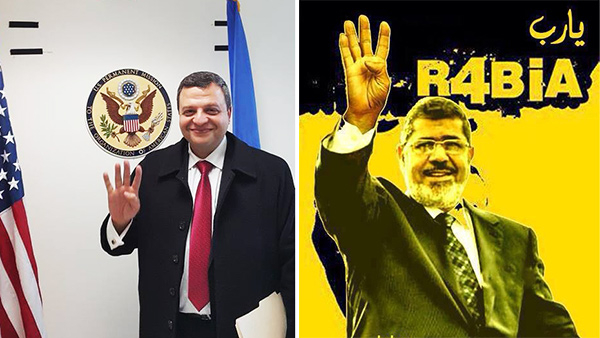
919 (1)While being hosted by the State Department on a visit to Washington in January 2015, Muslim Brotherhood judge Waleed Sharaby (left) flashed the organization’s four-finger “Rabia” sign. At right, ousted Egyptian President Mohamed Morsi (from the Muslim Brotherhood) displays the Rabia sign.

The events in the Sinai Peninsula prove there is no such thing as “political Islam.” There is a radical Islamist leadership that represents itself to the gullible West as “moderate,” preaches violence from the mosques, cloaks itself in ideological-religious tradition, and employs a hard core of Islamist terrorists to carry out attacks on civilians and Egyptian administration targets.

In the meantime, the real victims are the Egyptians. The Muslim Brotherhood’s terrorism has paralyzed Egypt’s tourist industry, as foreigners fear to visit Egypt’s antiquities. And now there are terrorist threats to the New Suez Canal, a project initiated and carried out under the leadership of General Sisi to turn both banks of the two canals into an international logistics, commercial and industrial area.

The Islamists’ plans are clear. First, they want to leverage violence, murder and countless Egyptian army casualties into establishing an autonomous terrorist enclave in the Sinai Peninsula. Then they will try to overthrow the Egyptian government and reinstate an Islamist Muslim Brotherhood regime headed by Morsi. That is exactly what their offshoot, Hamas, did in the Gaza Strip when it liquidated Palestinian Authority officials and established an Islamic emirate. The writing on the wall is still illegible as far as the U.S. government is concerned. Or else the Obama administration is still in the thrall of extremist Islam and its Muslim Brotherhood leaders. The two main ones are Turkey’s Recep Tayyip Erdogan, who has just called new elections so that he can try again to acquire enough seats in parliament to amend Turkey’s constitution to award himself a one-man Sultanate, an absolute dictatorship-for-life to go along with his new palace. The other is Mohamed Morsi, whom Obama apparently is still backing.

It is hard not to conclude, looking at the U.S. president’s record (ignoring the protesters of 2009 in Iran; “I’ve got a pen, and I’ve got a phone” and the dictatorial way the Iran deal has been short-circuited to bypass the democratic process) that in his heart-of-hearts, he is far more committed to supporting extremist Islamist regimes — whether the mullahs of Iran or the Muslim Brotherhood — than to supporting democracy, individual freedoms or human rights.

The Europeans are more aware of the situation but unfortunately woke up too late. As hundreds of thousands of migrants from Muslim lands continue to pour over Europe’s open borders, there is little doubt that radical Islam is poised to take over the West. Islamic communities and terrorist cells continue to mushroom and gather strength throughout the cities of Europe.

From the beginning of the wave of attacks in Egypt, senior Egyptian security officials threatened Hamas. Egypt warned Hamas to stop training, arming and sending its terrorists to collaborate with ISIS operatives in attacks against the Egyptian army. Hamas steadfastly denies any involvement, even as it continues collaborating with ISIS against Egypt.

As far as Hamas is concerned, destroying the Egyptian army is essential, because its continued actions along the Rafah border and in Sheikh Zuweid in the northern Sinai Peninsula prevent Hamas from acquiring money and stockpiling weapons to fight Israel, which weakens its subversion against Mahmoud Abbas and its plans to take over the West Bank.

Despite profuse denials, at the end of August 2015, four operatives from Hamas’s military-terrorist wing, the Izz al-Din al-Qassam Brigades, were taken off a bus by armed Egyptians on the way from Rafah through the Sinai Peninsula to Cairo. Hamas immediately accused Israeli intelligence of responsibility and warned the Egyptian authorities that “the abduction of its operatives will not go unpunished.”

In response, Dina Ramez, a co-host on Egypt’s official TV station, called Hamas out on its lies and denials of its terrorist activities in the Sinai Peninsula against the Egyptian regime. She asked Hamas, “If you are not involved in terrorism, what were your senior Izz al-Din al-Qassam Brigades operatives doing in Sinai?” and called them “cockroaches.”

Sources in Hamas called her a “whore,” and called Egypt a loser country defeated by Israel, using a peace treaty to sell Palestine to the enemy. Was that really the way to thank Egypt for everything it has done for the Palestinians, sacrificing its army and soldiers for us? It is a sad situation for the Palestinians and for our leadership.

What have we Palestinians gained from Hamas’s military actions against Egypt? What have we gained from our solidarity with Islamist organizations fighting against Assad in Syria, or joining organizations such as the “Palestinian Liberation Army” fighting for Assad? Why are we killing each other in the Ain al-Hilweh refugee camp? Why do we refuse everything the Israelis offer us?

Anyone who remembers history remembers the ungrateful path trodden by the Palestinians against the Kingdom of Jordan, when our leaders, headed by Arafat, tried in 1970 to overthrow King Hussein, despite the refuge Jordan offered us during the catastrophes of the Nakba in 1948 and the Naksa in 1967. Then we did the same thing in Lebanon, to where we fled from Jordan. The PLO relocated its headquarters to Beirut, and went on to turn Lebanon into a terrorist country and the lives of the Lebanese into a nightmare. If the Israelis had not invaded Lebanon in 1982, and forced the PLO to relocate to Tunisia (where its behavior was also criminal), the Palestinians definitely would have destroyed Lebanon.

The Middle East is in chaos, and Palestinian factionalism and ingratitude continue to inflame the dissolution of the Arab states and the internal Palestinian division between Hamas in Gaza and the Palestinian Authority in the West Bank.

The world is beginning to understand that the catastrophes of the Middle East have nothing to do with the resolution of the Palestinian issue, but are caused by the innate homicidal tendencies of the Arab rulers and the regional Islamist terrorist organizations.

The only person left who believes the Israeli-Palestinian nonsense is President Barack Obama, even though he is witness to the murders, rapes, beheadings and the millions of refugees, next to which the Palestinian issue is an old, irrelevant and very tired joke.

Resolving the Syrian war is not the silver bullet for stopping ISIS

August 29, 2015

Resolving the Syrian war is not the silver bullet for stopping ISIS, DEBKAfile, August 29, 2015

(Please see also, Pentagon Not Targeting Islamic State Training Camps. — DM)

jISIS_mobile_defense_of_SVBIED_8.15ISIS “mobile defense SVBIED” in action in Iraq

President Obama may likewise offer King Salman all sorts of assistance for standing up to ISIS, but he will find no buyers in Riyadh for his failed policy of reliance on Saudi Arabia’s rival, Iran, for liquidating the Islamist threat looming against the oil kingdom from neighboring Iraq.  Neither is US aid much use for stemming the tide of pro-ISIS radicalism spreading among young Saudi men.

As matters stand today, therefore, the Islamic State faces no tangible threat – even if Iran does go ahead and achieve a nuclear bomb.

**************************

The war to stop the Islamic State in Iraq and the Levant (ISIS) has entered a dark tunnel. And with it the bottomless conflicts in Syria, Yemen, Libya and Iraq. The search for a ray of light moves next week from Moscow to Washington, when Saudi King Salman Bin Abdulaziz makes his first visit as monarch for talks with President Barack Obama.

The three worried Arab rulers received in the Kremlin Tuesday, Aug. 25, by President Vladimir Putin could only talk in circles: Egyptian President Abdel-Fatteh El-Sisi,is  embattled on three fronts, Sinai, his border with Libya and Cairo; Jordan’s King Abdullah II – is wedged between two wars; and UAE Crown Prince Sheikh Mohamed bin Zayed Al Nahyan, has sent his army to fight the Yemen insurgency alongside Saudi Arabia.

For them, resolving the Syrian conflict looked like the silver bullet, the key to ending all their troubles. But whichever Russian or Iranian plans and ideas they considered for a way forward, they were all forced to come back to the same impasse. Even Putin and Obama can’t get around or ignore two solid facts:

1. In the year since the US built an international coalition for fighting ISIS, the brutal Islamists have not been cut down; they have instead been empowered to seize more turf outside their Iraqi and Syrian conquests, such big oil fields in Libya, an ascending threat to Egypt and big plans for Lebanon.

2. A major letdown has followed on the high hopes reposed in Iran. The nuclear deal negotiated with the six world powers – and the elevated regional status conferred on Iran – hinged closely on US expectations that Tehran would put up effective military resources for tackling ISIS.

But the Revolutionary Guards, the popular Syrian and Iraqi forces the Guards established,and  the Afghan and Pakistani Shiite militias they imported – none have proved a match for ISIS and jihadi tactics.

In Syria, ISIS stands fast, unthreatened in the terrain, towns and oil fields they have captured, in the past year – excepting only on fringe fronts, where they have been forced back by local Kurdish rebel fighters.

Hizballah is a big part of the disappointment. It was supposed to serve as a bulwark against ISIS invading eastern Lebanon from Syria. Instead, these Lebanese Shiite fighters, allies of Assad’s army, are bogged down in a bitter battle for the strategic Syrian town of Zabadani, after failing to breach Syrian rebel defenses in forays from the south, the north or the center.

The door is therefore open for the Islamist State to march into Hizballah’s strongholds in the Lebanese Beqaa valley and head north to the port of Tripoli for a foothold on the Mediterranean.

Whether Bashar Assad stays or goes, which might have made a difference at an early stage of the Syrian insurgency, is irrelevant now that his army and allied forces are in dire straits.

In Iraq, the forces fighting ISIS are equally stumped. The jihadis are in control of a deadly string of  strategic towns, Ramadi, Faluja, the refinery city of Baiji, Mosul, and most of the western province of Anbar, including Haditha which commands a key stretch of the Euphrates River.

Here, too, the Islamist terrorist army’s lines remain intact, unbroken either by the undercover Jordanian Special Forces campaign 200 km inside Anbar, albeit backed by US and Israeli military and intelligence assistance; by the “popular mobilization committees” set up by the Iranian general Abu Mahdi al-Muhandis, deputy of the Al Qods chief Qassem Soleimani, or less still by US-trained Iraqi army units.

This week, the impasse spurred two combatants into chilling escalations:

— Iran began shipping its solid propellant missile, Zelzal-3B (meaning “earthquake”), across the border into Iraq, in the hope that this powerful projectile, with a range of 250km , would give the Revolutionary Guards their doomsday weapon for tipping the scales against ISIS.

— The Islamists, for their part, embraced a new tactic, known in the west as “SVBIED mobile defense.” Scores of armed vehicles are packed tight with hundreds of tons of explosives and loosed against military convoys on the move and static enemy positions and bases.

This tactic quickly proved itself by killing the 10th Iraqi Division’s chief, deputy and its command staff, as well as the deputy chief of Iraqi forces in Anbar.

In Moscow last week, Putin offered his three Middle East guests Russian nuclear reactors, arms, joint pacts for fighting terror and assorted ideas for the future of Bashar Assad. But he too had no practical proposals for bringing the Islamic State down.

President Obama may likewise offer King Salman all sorts of assistance for standing up to ISIS, but he will find no buyers in Riyadh for his failed policy of reliance on Saudi Arabia’s rival, Iran, for liquidating the Islamist threat looming against the oil kingdom from neighboring Iraq.  Neither is US aid much use for stemming the tide of pro-ISIS radicalism spreading among young Saudi men.

As matters stand today, therefore, the Islamic State faces no tangible threat – even if Iran does go ahead and achieve a nuclear bomb.

Egypt and the Hamas “Cockroaches”

August 26, 2015

Egypt and the Hamas “Cockroaches,” The Gatestone InstituteKhaled Abu Toameh, August 26, 2015

  • “What were your four [Hamas] men doing in Sinai? Haven’t you denied in the past the presence of any Hamas men in Sinai? So where did these men pop up from?” — Dina Ramez, Egyptian journalist.
  • The incident also proves that Hamas does not hesitate to take advantage of Cairo’s humanitarian gestures to smuggle its men out of the Gaza Strip. Obviously, the four Hamas men were not on their way to receive medical treatment. That they are members of Hamas’s armed wing, Ezaddin al-Qassam, speaks for itself.
  • The Egyptians are particularly fed up with reports about Hamas’s increased involvement in their internal affairs and links to terror groups in Sinai.
  • This practice by Hamas is something that the Egyptian authorities have come to understand, which is why they are refusing to reopen the Rafah border crossing between Gaza and Egypt. The question now is whether the international community will understand Hamas’s true intentions and plans — namely to prepare for another war against Israel.

Egypt’s President Abdel Fatah Sisi has once again proven that he and his country will not tolerate any threats from Hamas or other Palestinians.

The crisis that erupted between Sisi’s regime and Hamas after the removal from power of Muslim Brotherhood President Mohamed Morsi two years ago, reached it peak in the past few days with the kidnapping of four Hamas operatives in Sinai.

The four men were snatched from a bus shortly after crossing from the Gaza Strip into Egyptian territory on August 19. Reports said that unidentified gunmen stopped the bus and kidnapped the four Hamas men, who are wanted by Egypt for their involvement in terrorism.

1222A bus carrying Palestinians drives through the Rafah crossing, from the Gaza Strip to Egyptian Sinai, on August 23, 2015. (Image source: Aqsatv video screenshot)

Although initial reports suggested that the kidnappers belonged to a salafi-jihadi group based in Sinai, some Hamas officials have accused Egyptian security forces of being behind the abduction. The Hamas officials even issued veiled threats against Sisi and the Egyptian authorities, and said that they held them fully responsible for the safety of the Hamas men.

A statement issued by Hamas warned the Egyptian authorities against harming the four men. “These men were the victims of deception and their only fault is that they are from the Gaza Strip,” the statement said. “This incident shows that the criminals are not afraid to target our people.”

Hamas leader Musa Abu Marzouk said that his movement holds the Egyptian authorities fully responsible for any harm caused to the abductees. He said that the kidnapping raises many questions and its circumstances remain unclear.

Hamas claims that salafi-jihadi groups in Sinai have informed its representatives that they did not kidnap the four men. According to Hamas officials, the abduction took place near the border with the Gaza Strip — an area where the Egyptian army maintains a large presence.

Sources in the Gaza Strip, however, have confirmed that the four men belong to Hamas’s armed wing, Ezaddin al-Qassam. The sources said that the men were apparently on their way to Iran for military training. The sources pointed out that the four had received permission from the Egyptian authorities to leave the Gaza Strip through the Rafah border crossing. The visas, however, are supposedly for civilians, not for Hamas operatives.

Hamas’s threats against Egypt have, meanwhile, enraged the Egyptian authorities as well as some top journalists in Cairo.

Egyptian authorities responded by refusing to give permission to Hamas leader Ismail Haniyeh and some leaders of his movement to travel to Qatar and Lebanon through the Rafah border crossing. The Hamas leaders were hoping to hold talks with some of their colleagues in those two countries about the possibility of reaching a long-term truce with Israel.

The Egyptians’ refusal to allow the Hamas leaders to leave the Gaza Strip has further strained relations between the two sides. Hamas representatives in the Gaza Strip were quoted as accusing the Egyptian authorities of “conspiring” against the movement and all Palestinians.

In Cairo, Egyptian security officials denied any link to the kidnapping of the four Hamas men. However, the denials have fallen on deaf ears and no one in Hamas seems to believe the Egyptian authorities. Even worse, Hamas representatives continued over the past few days to issue warnings and threats against Egypt.

As in the past, each time tensions rise between Hamas and Egypt, the Egyptians unleash some of their senior journalists against the Islamist movement. Since President Morsi’s removal from power, the Egyptians have displayed zero tolerance when it comes to Hamas. They are particularly fed up with reports about Hamas’s increased involvement in their internal affairs and links to terror groups in Sinai.

During the last war between Israel and Hamas, several Egyptian journalists and public figures openly expressed hope that the Israelis would destroy the movement for once and for all. Other journalists in Cairo, who are openly affiliated with the Sisi regime, have even urged their government to launch attacks against Hamas bases in the Gaza Strip.

This week, and in wake of the renewed tensions between Hamas and Egypt, Egyptian journalists resumed their rhetorical attacks against the movement. The question that most of these journalists asked was: What are Hamas members doing on Egyptian soil in the first place? The journalists accused Hamas of exploiting Egypt’s humanitarian gestures to smuggle its men out of the Gaza Strip.

One of these journalists, Dina Ramez, who is known as a staunch supporter of President Sisi, launched a scathing attack on Hamas, calling its members and leaders “cockroaches.”

Referring to the Hamas threats against Egypt, Ramez said: “Has anyone ever heard of cockroaches or ants that could threaten lions? These cockroaches belong to Hamas, which is threatening Egypt following the abduction of four of its men. I want to ask the Hamas cockroaches a simple question: What were your four men doing in Sinai? Haven’t you denied in the past the presence of any Hamas men in Sinai? So where did these men pop up from? I dare you to approach the border with Egypt. We have confidence in our army and our response will be painful. It will be a strong and deterring response against any cockroach that dares to come close to our border or threaten Egypt.”

Regardless of the identity of the kidnappers, the incident shows that Sisi and the Egyptian authorities continue to view Hamas as a threat to Egypt’s national security. The incident also proves that Hamas does not hesitate to take advantage of Cairo’s humanitarian gestures to smuggle its men out of the Gaza Strip. Obviously, the four Hamas men were not on their way to receive medical treatment or pursue their studies in Egypt or any other country.

That they are members of Ezaddin al-Qassam speaks for itself. Instead of dispatching its fighters to Iran and Turkey, Hamas should have allowed medical patients and university students to leave the Gaza Strip. But Hamas does not care about the well-being of the Palestinians in the Gaza Strip. Rather, it cares about sending its men to Iran and Turkey to receive military and security training.

This practice by Hamas is something that the Egyptian authorities have come to understand, which is why they are refusing to reopen the Rafah border crossing between Gaza and Egypt. The question now is whether the international community will understand Hamas’s true intentions and plans — namely to prepare for another war against Israel.

US-Israeli-Egyptian mobile sensor-fence projects to block further ISIS Mid East expansion

July 10, 2015

US-Israeli-Egyptian mobile sensor-fence projects to block further ISIS Mid East expansion, DEBKAfile, July 10, 2015

mobile_surveillance_sensor_towers7.15A US mobile surveillance sensor tower

US counter-terror experts are overseeing a lightning operation for setting up mobile sensor towers and electronic fences in Tunisia, Egypt, Jordan and Israel in a desperate bid to seal their borders off against the fast-moving impetus of the Islamic State of Iraq and the Levant – ISIS, or at least slow it down. This reign of terror is spreading out from Iraq and Syria and creeping into southern Jordan, the Israeli Negev, and Egyptian Sinai, then on to Libya and over to Tunisia and Algeria, covering a distance of 4,000 km.

When President Abdel-Fatteh El-Sisi saw his army had not repelled the ISIS Sinai affiliate’s offensive in North Sinai as it went into its second week – controlling only the main highway from El Arish to Cairo via Bardawil Lake – he turned to Washington with an urgent request to ship over mobile surveillance sensor towers and American crews to operate them. His plan is to string them across the Sinai Peninsula and along Egypt’s borders with Libya and Sudan in a last-chance bid to block the constant influx of reinforcements and weapons to ISIS fighters reaching Sinai from Libya, through the Egyptian borde,r and from Iraq, through southern Jordan and the Israeli Negev.

The State Department acceded to the Egyptian request and has submitted the application worth $100 million for congressional approval.

The application states: “This procurement is intended for Egyptian Border Guard Forces, which currently lack any remote detection capability along unpatrolled areas of Egypt’s borders.” Libya, Sudan and Sinai are specified. The application goes on to explain: “The system would provide an early warning capability to allow for faster response times to mitigate threats to the border guards and the civilian population.”

DEBKAfile’s counter-terror and intelligence sources disclose that Egypt already has one set of American mobile sensor towers. They were installed on the 193 km long banks of the Suez Canal more than a year ago and have kept ISIS terrorists from reaching those banks and firing missiles at passing ships to block the waterway, like the RPG attack of Sept. 5, 2013.

The sensor towers have proved effective so long as the various terrorist groups, such as ISIS, were deterred from directly attacking American facilities by tactical considerations of their own, such as a preference for those systems rather than a large-scale army forces to police the Suez zone, which would physically impede the convoys carrying men and arms from Libya into Egypt.

The drivers of these convoys stop over at Suez and Port Suez to rest up before carrying on with the long drive to their destinations in Sinai. Scattering the mobile sensor towers in areas unpatrolled by Egyptian troops would expose the American operators to ISIS attacks and abductions. So while solving one problem, they may well generate another. In any case they won’t make the ISIS threat go away.

Whereas Egypt asked for mobile sensors, Tunisia is to have a new, permanent fence with electronic warning stations along its route. Our counter-terror experts point out that, however effective this system is, it can’t promise Tunisia hermetic protection against terrorist encroachment.

ISIS has at least two ways of getting around the fence barrier:

1. Landing by sea. The gunman who massacred 39 tourists on the Soussa beach on June 26 landed from the Mediterranean by speedboat.

2. Circumventing the fence through the meeting point of the Tunisian-Libyan-Algerian borders. That point will not be enclosed. Tunisia may be reached through western Algeria where the border is wide open.

The second electronic fence the United States is providing will run down 30 km of the border between Israel and Jordan from Timna to Eilat. It is a joint project, which has become necessary to curb ISIS movements from southern Jordan through the Israeli Negev and onto Egyptian Sinai and the Gaza Strip.

Egyptian army backed by Apaches kills 63 Islamists in broad area between Sheikh Zuwaid and Rafah

July 6, 2015

Egyptian army backed by Apaches kills 63 Islamists in broad area between Sheikh Zuwaid and Rafah, DEBKAfile, July 6, 2015

(Please see also, The U.S. Must Help Egyptian President Sisi. — DM)

SinaiEgyptENG

An immense stretch of Sinai desert populated by half a million people is under siege, as the Egyptian army fights off a major offensive by the Islamic State’s Egyptian affiliate, the Sinai Province, against its positions in northern Sinai. The battle, which Monday, July 6, went into its sixth day, is being fought in an area bounded by the northern town of Sheikh Zuwaid, Rafah on the Gaza border, and up to Kerem Shalom and Nitzana on the Israeli border to the south. DEBKAfile’s military sources report a news blackout on the ongoing warfare except for Egyptian army handouts.

Egyptian security sources reported Monday that the latest round of helicopter strikes and ground operations had killed 63 Islamists in villages between Sheikh Zuwaid and Rafah, where four of their hideouts had been located. Our sources add that these air strikes are directed against civilian dwellings, especially in farming districts, where ISIS fighters are suspected of hiding out. No figures have been released by Cairo on civilian or Egyptian army casualties.

DEBKAfile describes the contest as an asymmetrical one between an army that depends heavily on aerial operations and ISIS terrorists, who have resorted mainly to guerilla warfare. By night, they flit swiftly on foot between the dunes to strike Egyptian army positions. By day, their foot soldiers trap Egyptian soldiers by setting up ambushes around those positions and on the roads of Sinai to keep Egyptian troops pinned down. Terrorist operations are a constant on their agenda.

The Egyptians respond with blanket air strikes which swoop on any moving object in the embattled area – whether by car or on foot

The hide-and-seek tactics employed by ISIS are sustainable in the long term, especially when the Islamists can rely on a constant influx of reinforcements, weapons and ordnance, the sources of which DEBKAfile disclosed in an exclusive report Sunday, July 5.

The Islamic State is rushing reinforcements to Egypt from Libya and Iraq for its battle with Egyptian forces in northern Sinai, which went into its fifth day Sunday, July 5, and other offensives, DEBKAfile’s intelligence and counter-terror sources report. After sustaining hundreds of casualties, both sides claim to have won the upper hand but the tenacious struggle is not over.

An Islamist manpower pool is provided by Egyptian extremists who crossed into Libya in the past and settled in bases around Benghazi.  Last week, ISIS summoned them to take up positions in Cairo and the Suez Canal and wait for orders to go into action. They crossed back with the help of smugglers. Those rings, dominated by the Muslim Brotherhood underground, with branches controlled by Hamas and Hizballah, bring illicit weapons and ammunition supplies to Sinai from Libya via Egypt.

President Abdel Fatteh El-Sisi is therefore obliged to earmark substantial military and intelligence resources for defending the Suez Canal and Cairo – more even than the Sinai front.

The other source of jihadi reinforcements is Iraq, They use another branch of the smuggling network which carries them through southern Jordan to the Gulf of Aqaba where they are picked up by smugglers’ boats and ferried across to the eastern coast of the Sinai Peninsula.

The IDF had more than one reason for its decision last Wednesday to close to traffic Rte 12, Israel’s main southern highway, which runs parallel to the Egyptian border up to Eilat: It was a necessary precaution lest ISIS turned its terrorists and guns against Israel from next-door northern Sinai. The other reason was to deter the Islamists coming from Iraq from trying to transit Israel and reach Sinai with the help of Bedouin smugglers operating on both sides of the Israeli-Egyptian border.

Our military sources estimate that some 1,000 jihadists are directly engaged in the North Sinai battle with the Egyptian army, but add that they could quickly recruit supplementary fighting manpower from Bedouin tribes near the warfront who already play ball with the terrorists.

Egyptian tacticians have strictly limited the army action on this front to air and helicopter strikes and local ground and armored forces. They are focusing on defending three Sinai enclaves, the northern district around Sheikh Zuweid, El Arish port and Rafah, and Sharm el-Sheikh in the south, to pin ISIS forces down in those places and prevent them from fanning out into areas controlled by the big Bedouin tribes.

When President El-Sisi visited the troops in northern Sinai Saturday, July 5, he disclosed that only one percent of the Egyptian army of 300,000 men was assigned to Sinai. He indicated that his army was perfectly capable of wiping out the Sinai terrorist threat in no time if all its might were to be thrown into the fray.

This strategy leaves ISIS with free rein in central Sinai. However, El-Sisis, like his predecessor Hosni Mubarak, is not prepared to go all out against ISIS in its “dens” any time in the near future, because he needs all his military resources and assets he can muster to defend the capital Cairo and the Suez Canal.
Neither the Islamic Army nor the Muslim Brotherhood or any other radical Islamists make any secrets of their next plans. ISIS has announced that it is setting its sights on Egypt’s pyramids, the Sphinx of Giza, and the country’s unique historic monuments in general, after its savage vandalism and looting of other precious world heritage sites.

In a new message released Friday, July 3, a number of radical Islamist leaders, including the ISIS “caliph” Abu Bakr al-Baghdadi, told their followers that the destruction of Egypt’s national monuments, such as the pyramids and the sphinx, was a “religious duty” that must be carried out by those who worship Islam, as “idolatry is strictly banned in the religion.”

This message has sharply ratcheted up the jihadist element of ISIS military confrontation with Egypt to a higher, more inflammatory level.

Israeli policymakers’ alarming over-reliance on Egypt to grapple with Hamas and ISIS

July 3, 2015

Israeli policymakers’ alarming over-reliance on Egypt to grapple with Hamas and ISIS, DEBKAfile, July 3, 2015

Sinai_fight_1.7.15Egyptian troops battle ISIS in Sinai

The statements coming from different Israeli spokesmen this week were not just at dangerous variance with the actual events but with one another, when it came to Egypt’s massive confrontation this week with ISIS close to Israel’s border, a fresh round of Palestinian West Bank anti-Israel terror and the ambivalent role played by Hamas extremists in all these events.

Coordinator of Government Activities in the Territories, Maj. Gen. Yoav Mordechai said in an Al Jazeera interview Thursday, July 2, that Israel had “clear evidence” of Hamas aiding the offensive the Islamic State’s Sinai affiliate launched against Egyptian positions in northern Sinai Wednesday.

The Israeli commander accused Hamas of giving “weapons and logistical support to the ISIS affiliate.”  He added “we have examples of Hamas commanders who actively participated in this assistance,” and named “Wael Faraj, a brigade commander of the military wing of Hamas…who smuggled wounded [ISIS fighters] from Sinai into Gaza,” and “Abdullah Kitshi …who trained operatives belonging to Wilayat Sinai.”

Asked about Israeli-Egyptian cooperation, Mordechai commented: “Egypt is a strong and independent country.”

The Defense Ministry’s strategic adviser Amos Gilead was more specific: He said Egypt was “a strong country of 90 million people with an army of half a million.” Gilead was sure that the Egyptians would do everything necessary for a determined war on ISIS.

Thursday, July 2, the day after the ISIS raid, the Egyptian military said it had killed 123 Islamic State gunmen in two days, 100 of which were killed on Wednesday. Egyptian bombers were then described as wiping out ISIS concentrations around the northern Sinai town of Sheikh Zuwaid. “The situation in northern Sinai is now under complete control,” said the Egyptian spokesman

All three officials were doing their best to put a good face on the Egyptian army’s reverses in its largest battle yet with ISIS, say DEBKAfile’s military sources. No one was ready to admit that the Islamic State’s Sinai branch had won this confrontation on points.

For two years, the Egyptian army has only chipped away at the edges of the threatening Islamist presence growing larger in the Sinai Peninsula, even through Israel suspended the restrictions of the 1979 peace accord and allowed Egypt to bring large military forces, tanks, artillery and helicopters into Sinai for a major campaign to expunge that presence. This has not happened although both the Egyptians and the IDF know the exact whereabouts of the Islamist terrorists’ bases.

Even while playing down the unwelcome outcome of the Wednesday battle, the IDF took the precaution of closing to traffic the main Israeli highway running parallel to the Egyptian border from Nitzana to the southern port of Eilat. The army in the south was also placed on high alert in case ISIS raiders crossed the border from Egyptian Sinai.

Then, on Friday afternoon, parts of southern Israel heard a red alert for rockets which the IDF estimated had come from Sinai, i.e. ISIS, rather than the Gaza Strip.

Israeli officials are at their most mixed up when they discuss Hamas – even after crediting that extremist Palestinian group with conducting a fresh surge of terrorist attacks on the West Bank and Jerusalem. In the past week, they murdered three Israelis – David Capra, Danny Gonen and Malachi Moshe Rosenfeld.

Yet, according to the mantra the IDF has taught accredited military correspondents, all Hamas wants is a long-term ceasefire so as to live in peace. They also trot out the official claims that the deadly attacks were the work of “lone wolves,” just as the persistent trickle of rocket fire from the Gaza Strip comes from “rogue” elements.

Israeli officials appear to have lost their way amid vain attempts to let Hamas off the terrorist hook.

Hamas’ own willingness to jump into bed with Egypt, Hizballah, Iran and ISIS – all at once – undoubtedly creates a confused picture about its shifting motives. However, Israeli policymakers must beware of falling into the dangerous trap of ambivalence and loss of focus.

President El-Sisi must realize by now that his army has missed the boat for a resounding one-strike victory against ISIS, because that enemy is no longer alone. Its association with Hamas is further bolstered by a secret pact with the Egyptian Muslim Brotherhood, the deadly foe of the El-Sisi administration.

Hamas, as the Brotherhood’s ideological offspring, in fact hosted Mahmud Izzat Ibrahim, head of the Brotherhood;s clandestine operational networks, which run from Libya through to Sinai.

This tripartite ISIS-Muslim Brotherhood-Hamas axis is currently in full momentum. Egypt is therefore in for a drawn-out bloody war.

Israeli policymakers would be foolish to depend on Cairo pull this red-hot iron out of the terrorist fire any time soon. They must find ways – the sooner the better – to grapple with the reality of a rampant Islamic State next door. ISIS is already in the process of overrunning the Gaza Strip; it is on the way to seizing expanding sections of the Sinai Peninsula. That territory will serve as a convenient base for Islamist raids against Israel.

If ISIS leaps further to hijack the coastal areas of Sinai, it may be necessary to fight a major war to preserve  the freedom of navigation in the Suez Canal and Israel’s southern exit through the Gulf of Aqaba.

After terrorists claim 13 lives in Sinai, El-Sisi reshuffles top army, navy, intelligence and Suez Canal chiefs

April 13, 2015

After terrorists claim 13 lives in Sinai, El-Sisi reshuffles top army, navy, intelligence and Suez Canal chiefs, DEBKAfile, April 13,2015

police_station_in_the_city_of_al-Arish12.4.15Devastated Egyptian police station in El Arish

DEBKAfile’s military sources report that northern Sinai, due to the increasing frequency and scale of terrorist attacks, is beginning to resemble Baghdad, which on that same Sunday was struck by four ISIS car bombs and other devices, which killed at least 12 people and injured dozens.

*********************

President Abdel-Fatteh El-Sisi was spurred Sunday, April 12, to make a clean sweep of his top military intelligence, navy and Second Field Army command (responsible for Sinai and the Suez Canal) by another two deadly attacks in northern Sinai by Ansar Bayt al-Maqdis, the lslamic State’s local branch. They claimed 13 deaths, seven of them Egyptian troops, including two officers, and injured more than 50.

The Sinai terrorists have played havoc with Sinai security since pledging loyalty to and gained support from the Islamic State of Iraq and the Levant. The Egyptian military, even after being substantially reinforced and imposing a state of emergency, has been unable to stem the deadly spiral and paid for it with a heavy toll of casualties.

In the first attack Sunday, six soldiers, including two officers, were killed when a roadside bomb struck their armored vehicle traveling south of el-Arish, the capital of North Sinai. Twelve hours later, a suicide car bomber detonated his vehicle at the entrance of a large police station in el-Arish, killing seven people, including five policemen, and injuring at least 40, many of them civilians.

In a third smaller attack, militants clashed with soldiers at a mobile checkpoint in Rafah, south of el-Arish, wounding one police officer and two soldiers.

Saturday, April 11, Ansar Bayt al-Maqdas, using the methods of its new parent, released a video clip depicting an Egyptian soldier being shot dead and the decapitation of an Egyptian civilian. Both victims were snatched during an attack on April 2, which left 15 soldiers dead, on an Egyptian army position in the El Arish vicinity.

DEBKAfile’s military sources report that northern Sinai, due to the increasing frequency and scale of terrorist attacks, is beginning to resemble Baghdad, which on that same Sunday was struck by four ISIS car bombs and other devices, which killed at least 12 people and injured dozens.

Before the thunder of the blasts died down in Sinai, the Egyptian president announced a major reshuffle of his military, security and intelligence ranks.

The most senior officer to be sacked was military intelligence chief, Maj. Gen. Salah El-Badry. He was replaced by Gen. Mohamed al-Shahat, a former commander of the Second Field Army, which is the current backbone of the army force fighting the Islamists terrorists in northern Sinai.

Gen. Nasser al-Assi is the new commander of the Second Army. Our military sources report that al-Assi spent some months in northern Sinai on a personal assignment on behalf of the president and returned to Cairo with new recommendations for combating the terrorists.

In another key change, Rear Admiral Osama El-Gendy was replaced as commander of the Egyptian Navy by Rear Admiral Osama Mounir.

The navy’s role is increasingly prominent since Egyptian warships were deployed in the last two weeks off the coast of Yemen to secure the strategically vital Bab el-Mandab Strait — the gateway to the Suez Canal – against Iranian-backed Houthi rebel control. Their guns have been trained on the Yemeni port of Aden in a running barrage to prevent the rebels and their allies, the mutinous Yemeni army’s  212nd Brigade, from overrunning the town.

The Navy’s role in the Yemen war makes a change of commanders in mid-combat highly unusual. However, it had become just as urgent at this stage to shift Rear Adm El-Gendy from the Navy to the top post in the Suez Canal Authority, to take charge of one of the most important seaways in the world, which had became a highway from the rampant smuggling of the arms and fighters nourishing ISIS terrorist outposts in Sinai.

DEBKAfile reports that ships from Libya and Jordan carry the contraband by sea and unload it at secret dropping-off points on the Sinai Peninsula’s western Mediterranean and the eastern Gulf of Aqaba coasts. Some of the goods are conveyed from Libya via the Suez Canal via the towns of Suez, Ismailia and Port Said, whence smuggling rings based on the banks of the waterway collect them by boat.

Tunnels between the Gaza Strip and Sinai are also an important smuggling route for supplying terrorist groups. The Egyptian military reshuffle was accompanied by an amendment to the penal code by presidential decree which raised the penalty for building or using cross-border tunnels to life in jail. The penalty also applies to people with knowledge of tunnels who fail to report them to the authorities. The Egyptian government was authorized to seize buildings at the top of tunnels and equipment for digging them.

Report: Israeli Jet Struck Weapons Depots in Libya

April 4, 2015

Report: Israeli Jet Struck Weapons Depots in Libya, Israel National News, Gil Ronen, April 4, 2015

img373532IAF F-16 IAF Website

Al Watan added that Egypt allowed the Israeli jet to pass through its airspace en route to southern Libya.

********************

Arab news sources reported at week’s end that an unidentified jet believed to be Israeli destroyed warehouses in southern Libya that held weapons bought by Iran for Hamas.

According to the reports in Al Watan and other news outlets, the warehouses were completely destroyed. The weapons that were inside them had allegedly been purchased by Iran, by means of weapons dealers in Sudan and Chad, and were supposed to be smuggled to Hamas through Egypt, by means of the smuggling tunnels between Sinai ands Gaza.

The destruction of the weapons stores in southern Libya was carried out in coordination with the Egyptian security and intelligence apparatuses, the reports claimed.

Al Watan added that Egypt allowed the Israeli jet to pass through its airspace en route to southern Libya.