Posted tagged ‘Shiite’

Shia Militia Leader Explodes Over Possibility of U.S. Support for Kurdish Forces

April 30, 2015

Shia Militia Leader Explodes Over Possibility of U.S. Support for Kurdish Forces, Center for Security PolicyKyle Shideler, April 30, 2015

In the United States, the Obama Administration finds itself on the same side of the argument as Moqtada Al-Sadr, opposing the bill to permit arms for Kurdish forces.

******************

Shia leader Moqtada Al-Sadr, head of the Jaish al-Mahdi (JAM), issued a stark denunciation of the U.S. Defense Bill currently in front of the U.S. House of Representatives this week, threatening to fight U.S. interests both in Iraq and overseas, in the event that the bill passed.

Al Sadr opposes the bill, because it would authorize the direct transfer of military aid to Kurdish Peshmerga and Sunni tribal forces in order to fight the Islamic State, outside of the direct control of the central government in Baghdad.

“The U.S. House of Representatives intends to pass a draft law on Iraq making each sect independent from the other, and this will be the beginning of Iraq’s division,” Sadr said in a statement. If the U.S. passes such law, “then we will be obliged to lift the freeze on the military wing which is tasked with (fighting) the American side, to start hit the U.S. interests in Iraq and even abroad possibly,” Sadr warned.

Al Sadr’s JAM was one of the primary Shia militia forces used by Iran during Operation Iraqi Freedom, and responsible the deaths of numerous American fighting men and women. Iraq has primarily leaned on the use of Shia militias, operating under the rubric of the Popular Moblization Forces, but many of the 30,000+ militia fighters operate under direct command and control from the Iranian Islamic Revolutionary Guards Corps.

The Baghdad government, which is heavily supported by Iran, has also vocally opposedthe measure:

We will reject the arming of the Peshmerga directly by the US,” Iraq’s Defense Minister Khalid Al-Obeidi, told Rudaw on Thursday.

Kurdish forces have repeatedly complained that aid designated for use by their forces has repeatedly been redirected by the Baghdad government to Shia militias, some of whom are responsible for sectarian war crimes. Kurdish forces have also expressed concern over the entry of Shia forces into areas viewed by the Kurds as traditionally Kurdish, such as Kirkuk.

Supporters of the Peshmerga took to twitter to complain about the double standard:
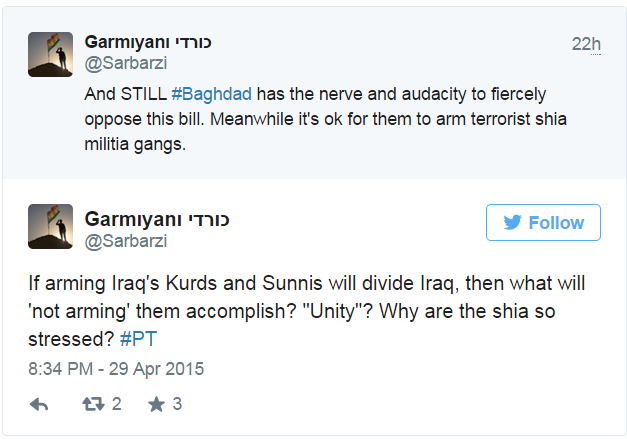
garmiyani-tweet

In the United States, the Obama Administration finds itself on the same side of the argument as Moqtada Al-Sadr, opposing the bill to permit arms for Kurdish forces. As State Department Spokeswoman Marie Harf confirmed yesterday:

QUESTION: Yes. Do you have any comment about this draft resolution at the Armed Services Committee that calls for the recognition of the Sunni fighters and the Kurdish Peshmerga forces as a country, and so they can be – directly receive aid and weapons from the U.S., not through the central government?

MS HARF: I saw that. I saw that. And to be very clear: The policy of this Administration is clear and consistent in support of a unified Iraq, and that we’ve always said a unified Iraq is stronger, and it’s important to the stability of the region as well. Our military assistance and equipment deliveries, our policy remains the same there as well, that all arms transfers must be coordinated via the sovereign central government of Iraq. We believe this policy is the most effective way to support the coalition’s efforts.

So we look forward to working with congress on language that we could support on this important issue, but the draft bill, as you noted, in the House – this is very early in the process here for the NDAA – as currently written on this issue, of course, does not reflect Administration policy.

By opposing the direct arming of Sunni and Kurdish forces (and the Kurdish forces in particular), the administration is continuing a policy arc in the region that continues to serve the interests of the Iranians because it creates a dynamic where the only viable players are either Sunni jihadists (whether Islamic State, or in the case of Syria, Al Qaeda-linked groups such as Jabhat al-Nusra), or Iranian-backed forces, such as Assad and the Shia militias operating in Iraq, who are no less committed enemies of the United States.  Bringing supplies directly to Kurdish forces will give the United States a third option to positively affect the outcome of events in Iraq without requiring the modus vivendi with the Iranians.
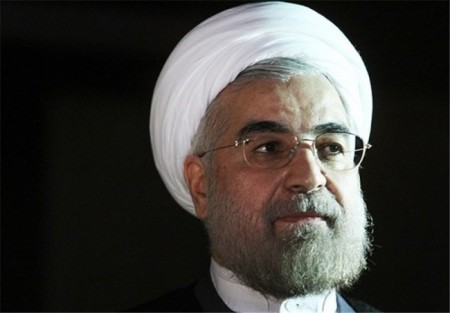
How Iran Saved Obama’s “Blame America” Foreign Policy

April 29, 2015

How Iran Saved Obama’s “Blame America” Foreign Policy, Front Page Magazine, April 28, 2015

rouh-450x313

Obama’s public rejection of every ally, from Israel to Egypt to Saudi Arabia, has finally created the Post-American Middle East that his “Blame America” doctrine sought. The Post-American Middle East is a hive of terrorist groups and a region of nuclear arms races where murderous despots with vast armies dream of resurrecting the Ottoman Empire, the Persian Empire and the Abbasid Caliphate.

*********************

Obama’s Middle East policy was doomed to fail because it was based on the myth that everything wrong with the region was America’s fault.

Senator Obama had argued that Iraq would fix itself once we pulled out. Without America, the Iraqis would create a “political solution”. Instead the Shiites used the withdrawal to take over the government and Al Qaeda rebounded to dominate the Sunnis. After years of denying what was going on, he was forced back into Iraq after genocide and beheadings filled every television screen.

From the White House, he deployed the “Iraq Solution” across the Middle East by withdrawing support from American allies and backing terrorist groups like the Muslim Brotherhood. The chaos tore apart the region and turned over entire cities and countries to terrorists.

Egypt went through multiple coups. Street violence in Tunisia wrecked the country and supplied thousands of fighters to ISIS. His regime change war in Libya led to terrorist takeovers of its capital. Al Qaeda nearly took over Mali. Houthi Jihadists backed by Iran took over Yemen’s capital. The Saudis are bombing Yemen. The Egyptians are bombing Libya. The French are still fighting in Mali.

Iran and Al Qaeda have divided up Iraq, Syria and Yemen between themselves.

Withdrawing American power and influence didn’t work because we were never the problem. American soldiers weren’t causing the Sunnis and Shiites to fight each other. They were the only thing preventing it. American power and influence across the Middle East wasn’t holding back freedom and human rights, it was the only thing keeping a modicum of freedom alive in places like Egypt and Tunisia that quickly fell to Islamist rule in the Arab Spring, resulting in street violence, torture, terrorism and military coups.

The left had been fundamentally wrong about the cause of the problems in the Middle East. Obama trashed the region by following its wrongheaded doctrines.

Once the “Blame America” foreign policy has been implemented and the region went to hell, he had no idea what to do next. Intervening in Libya made sense according to the “Blame America” doctrine because Gaddafi had recently cut a deal with the United States and was obstructing the Jihadists who were implementing the local version of the Arab Spring in coordination with the Muslim Brotherhood.

But intervening in Syria didn’t. Assad wasn’t an American ally. Therefore the “Blame America” doctrine said that he should be left alone. But he was obstructing the Arab Spring. Overthrowing him would let the Muslim Brotherhood claim another country, but would alienate Iran and spoil any reconciliation.

Unable to make a final decision, Obama veered back and forth between Iran and the Muslim Brotherhood. Some days he seemed on the verge of bombing Syria and other days he was against even providing the promised weapons to the Sunni rebels. Even his supporters accused him of having no plan.

Syria’s real red line was the one that it had drawn through his foreign policy. Instead of making the Middle East better, his withdrawals had made it worse. And the beneficiaries of his foreign policy, especially the Muslim Brotherhood, were clamoring for more American military intervention.

Even Iraq’s Shiite government, backed by Iran, wanted American intervention.

Obama’s foreign policy had created a new set of untrustworthy client states which had to be kept alive by American intervention. The great joke of his foreign policy was that his new terrorist states acted just like the old dictators they were supposed to replace. They wanted American weapons and soldiers. Their own people hated them and hated America by extension. The climax of the Arab Spring came with crowds in Tahrir Square denouncing Obama and the Muslim Brotherhood for acting as his client state.

The “Blame America” foreign policy had led to even more blame of America. The new “democratic” Islamist governments that he helped bring to power to appease the Arab Street and atone for the sins of supporting the old secular-ish dictators backfired by making the Arab Street hate us more than ever.

Iran saved Obama’s foreign policy. Just as he was stumbling around Syria and weeping at being stuck back in Iraq, the agents of the Iran Lobby suggested that the whole mess could be put back together again. Iran and the US would fight on the same side against ISIS in Syria and Iraq. And this cooperation could be used to hammer out a nuclear accord that would retroactively justify Obama’s Nobel Prize.

The only problem was that everyone else in the region was completely against the idea.

The Iran Lobby threw Obama’s failed foreign policy a lifeline and he grabbed it. The bombing of Syria was off. Assad turned over some WMDs, but went on using others. The US began acting as the air force for Iran’s Shiite militias in Iraq while the Kurds and the Sunni Sheikhs of the Awakening were shut out.

When the Houthis took over Yemen, Obama shrugged. When the Saudis began bombing Yemen, they didn’t tell him because they were afraid the news would leak to Iran. And the administration covertly began pressuring them to stop, confirming that it now took its marching orders from Tehran, not Riyadh.

Obama ignored the vocal opposition, particularly from Israel’s Netanyahu, because the Iran deal was the only thing holding his foreign policy together. It made it seem as if he knew what he was doing. Take away the Iran deal and there was no longer a strategy, just a series of incoherent panicked responses.

That is why he continues to cling to the Iran deal. Without it, the Emperor’s foreign policy is naked.

The Iran deal salvaged the “Blame America” foreign policy by reorienting it away from the Muslim Brotherhood to deal with our great enemy in the region. By acceding to Iran’s nuclear program, Obama could finally fix everything by atoning for America’s biggest foreign policy sin in the region.

Despite his Muslim family background, Obama never understood the Middle East. Instead he looked at the region through a left-wing lens and saw only America’s crimes.

The Sunnis and Shiites, the Arabs, Kurds, Persians and Turkmen, weren’t fighting because of America. They were fighting over differences in religion, ethnicity and clan. The left has always thought that the way to fix the Middle East was to withdraw American influence. Instead doing that destabilized the region and created a power vacuum that Russia and Iran have been more than happy to fill.

Obama’s final foreign policy act was to fall directly into Iran and Al Qaeda’s trap.

Iran and the various Al Qaeda groups had effectively split parts of the region among themselves. By embracing Iran, Obama alienated the Sunni Middle East and shoved entire populations into Al Qaeda’s waiting embrace. He completed the polarizing process that he began with the Arab Spring by selling out the moderates to the extremists and waiting for everyone in the region to love America again.

But the Muslim Brotherhood lost out to its edgier Al Qaeda children. Egypt and the Saudis are scrambling to hold together some sort of Sunni center without the United States and against its wishes. Obama’s alignment with Iran, his rejection of Egypt’s new government and his failure to back the Saudis in Yemen has sent the message that the only legitimate alternative to Al Qaeda is Iran.

That’s not an alternative that most Sunnis can accept. Many would rather stand with Al Qaeda than Iran.

Obama’s public rejection of every ally, from Israel to Egypt to Saudi Arabia, has finally created the Post-American Middle East that his “Blame America” doctrine sought. The Post-American Middle East is a hive of terrorist groups and a region of nuclear arms races where murderous despots with vast armies dream of resurrecting the Ottoman Empire, the Persian Empire and the Abbasid Caliphate.

While genocide goes on, sex slaves are raped under the rule of a Caliph and black flags are unfurled and nuclear weapons are developed to fulfill apocalyptic Islamic prophecies, Obama smiles for the camera and waits for his second Nobel Prize.

It had been America’s fault all along. Now that Iran and Al Qaeda are in charge, everything will be okay.

Arab world: Egypt’s dangerous stalemate

April 17, 2015

Arab world: Egypt’s dangerous stalemate, Jerusalem Post, Zvi Mazel, April 17, 2015

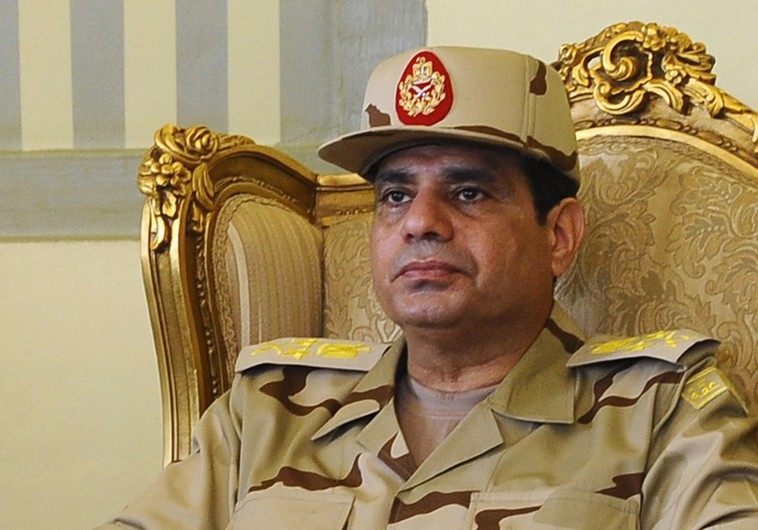
Egypt's Defense Minister Abdel Fattah al-Sisi is seen during a news conference in Cairo on the release of seven members of the Egyptian security forces kidnapped by Islamist militants in SinaiAbdul Fattah Sisi. (photo credit:REUTERS)

Vainly did the Egyptian president try to convince the US-led coalition against Islamic State to extend its activities to the whole Middle East. But US President Barack Obama is unwilling to acknowledge that there is a regional and international dimension to the movement.

*****************

Egyptian President Abdel Fattah al-Sisi is fighting for his country’s survival – and his own.

Islamic terrorism is not abating, hampering vital efforts to bring a better life to the people through a revitalized economy and political stability. Sisi knows he has to show results soon to prevent Egypt from slipping back into anarchy and chaos.

Despite the army’s all-out effort to defeat Islamist insurgency in Sinai, there is no end in sight. F-16 fighter planes and Apache helicopters have joined the campaign, security forces have killed or wounded hundreds of terrorists, destroying their haunts and their training groups – but more keep coming.

Ansar Bayt al-Maqdis gunmen, who have pledged allegiance to Islamic State, continue making daring raids against police stations and other security targets, leading to loss of life and heavy damage.

In one instance on April 14, the commander of the central police station of El-Arish was wounded in a raid; the assailants were able to escape.

For all intents and purposes the situation has reached a stalemate, though the army has managed to contain the terrorists in the northern part of the Sinai Peninsula, preventing them from extending their activities to the south and to the Suez Canal – where they could have inflicted untold damage to economic and security infrastructure, and severely undermined public morale.

However, there are still sporadic terrorist attacks in Cairo and other parts of the country.

Bombs explode, killing and maiming; power lines are blasted. A number of terrorist groups are involved, from Ansar Bayt al-Maqdis and the so-called Soldiers of Egypt to the ever-present Muslim Brotherhood; many of their members have been arrested, their leaders sentenced to death – though no one has been executed yet – but they keep on demonstrating against the regime (though in diminishing numbers).

In Yemen, Iranian-backed Houthi tribes are poised to take over the strategic Red Sea straits, threatening free passage to the Suez Canal – a reminder, if one was needed, of the fact that Islamic terrorism knows no border.

Vainly did the Egyptian president try to convince the US-led coalition against Islamic State to extend its activities to the whole Middle East. But US President Barack Obama is unwilling to acknowledge that there is a regional and international dimension to the movement.

The fact remains that Islamic State dispatches terrorists and weapons to Ansar Bayt al-Maqdis in the Sinai Peninsula from Libya, where there is an unlimited supply of both. No matter how many guerrillas are intercepted or killed by the Egyptian army, more are coming through the vast mountainous and desert region, along the 1,200-km border between the two countries.

Then there is Gaza, where terrorists can find refuge, regroup and train, and where new weapons can be tested.

Cairo is desperately trying to cut off the peninsula from the Strip. The Rafah crossing is closed most of the time, and when it opens it is under the strict supervision of Egyptian authorities. More than 2,000 contraband tunnels have been destroyed and a 1-km.-deep sanitized zone has been installed; thousands of families have been uprooted.

They have been compensated but resentment is high, and the move has prompted widespread condemnation by human rights associations.

Against this backdrop, the regime is weighing extending the zone to 5 km. and making the digging of contraband tunnels punishable by life imprisonment. A court in Cairo has forbidden Hamas activities in Egypt, and another has declared Hamas a terrorist organization; however, the central government is appealing that decision for the sake of its ongoing dialogue with Gaza’s leaders on the Palestinian issue.

The Iranian-Houthi threat has led Sisi to call for the creation of a rapid-response Arab unit, as Saudi Arabia has rallied neighboring states to form a coalition against the rebels in Yemen – who are threatening its border in the south, and were about to take control of the strategic port of Aden.

Though the creation of a united Arab unit was decided at a summit in Sharm e-Sheikh last month, implementation will not be easy. A number of states such as Lebanon and Iraq have warned they would not allow any infringement to their sovereignty; some Gulf states and Jordan have been more forthcoming, and meetings between army commanders are scheduled.

The problem is that these countries are not keen to risk their troops in a ground operation in neighboring states. Armies are the traditional bulwark of Arab regimes; a failed intervention outside their borders could cause their downfall. Nevertheless, since the West is largely indifferent to what is happening, Sisi and his Gulf allies have no choice but to unite against the common threat of Islamic terrorism, be it Sunni or Shi’ite.

On the home front, Sisi has launched a series of impressive projects – a new canal parallel to the old one to enable simultaneous crossing in both directions, thereby doubling receipts; an industrial, commercial and tourist zone between the two canals; 3,000 km of modern roads. Perhaps his most ambitious project is the creation of a new administrative capital city east of Cairo, at an estimated cost of $45 billion. Arab states have rallied to his side, pledging billions of dollars at a special economic summit last month; international groups have indicated their interest in some of the projects – a significant victory for the embattled president.

But Egypt’s endemic problems – population explosion, illiteracy leading to widespread unemployment and enduring poverty, as well as corruption on an epic scale – are not making Sisi’s task easier.

He is also calling to reform Islam by purging it of its extremist discourse, and has already instructed the Education Ministry to eliminate extremist content such as the call to jihad and attacks on other religions.

Meanwhile, the political situation is still unclear and elections are repeatedly postponed, allegedly because of ambiguities in the election law.

The fact is that the president has not been able to secure a large enough block to ensure his electoral victory, while the Muslim Brotherhood – though banned – and other Islamic parties can still muster a sizable vote.

Can Sisi win all his battles? How long will the Egyptian people wait for some much-needed economic results? Egypt is going it alone, still waiting for the West to understand that Cairo remains its best ally against the rising tide of terrorism now lapping at its shores.

Dr Andrew Bostom on Lisa Benson show 12.5.2015

April 13, 2015

Dr Andrew Bostom on Lisa Benson show 12.5.2015, You Tube, April 13, 2015

(Dr. Bostom relates Islamic doctrine to Iran’s negotiating tactics. Please see also, Lt. Col Ralph Peters: “The Iranians Negotiate, We BEG!” — DM)

Take Them At Their Word: Iran Might Destroy Us | Bill Whittle

April 9, 2015

Take Them At Their Word: Iran Might Destroy Us | Bill Whittle via You Tube, April 9, 2015


The Shadow of Munich Haunts the Iran Negotiations

April 2, 2015

The Shadow of Munich Haunts the Iran Negotiations, National Review Online, Victor Davis Hanson, April 2, 2015

(Hitler did tell the truth occasionally, in Mein Kampf for example. It was generally ignored until too late. “Death to America and Israel” are spouted by the Iranian Supreme Leader at every opportunity. Obama, et al, ignore it. Will Israel be Obama’s Czechoslovakia? And then what?– DM)

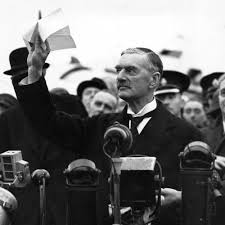
Neville Chamberlain

Our dishonor in Lausanne, as with Munich, may avoid a confrontation in the present, but our shame will guarantee a war in the near future.

*********************

Once again our leaders are needlessly appeasing a hostile state that shows them nothing but contempt.

The Western capitulation to Adolf Hitler in the 1938 Munich Agreement is cited as classic appeasement that destroyed Czechoslovakia, backfired on France and Britain, and led to World War II. All of that is true.

But there was much more that caused the Munich debacle than simple Western naiveté. The full tragedy of that ill-fated agreement should warn us on the eve of the Obama’s administration’s gullible agreement with Iran on nuclear proliferation. Fable one is the idea that most people saw right through the Munich folly. True, Europeans knew that Hitler had never once told the truth and was already murdering German citizens who were Jews, Communists, or homosexuals. But Europeans did not care all that much.

Instead, the Western world was ecstatic over the agreement. After the carnage of World War I, Europeans would do anything to avoid even a small confrontation — even if such appeasement all but ensured a far greater bloodbath than the one that began in 1914.

Another myth was that Hitler’s Wehrmacht was strong and the democracies were weak. In fact, the combined French and British militaries were far larger than Hitler’s. French Char tanks and British Spitfire fighters were as good as, or superior to, their German counterparts.

Czechoslovakia had formidable defenses and an impressive arms industry. Poland and perhaps even the Soviet Union were ready to join a coalition to stop Hitler from dissolving the Czech state.

It is also untrue that the Third Reich was united. Many of Hitler’s top generals did not want war. Yet each time Hitler successfully called the Allies’ bluff — in the Rhineland or with the annexation of Austria — the credibility of his doubters sank while his own reckless risk-taking became even more popular.

Munich was hardly a compassionate agreement. In callous fashion it immediately doomed millions of Czechs and put Poland on the target list of the Third Reich.

Munich was directly tied to the vanity of Neville Chamberlain. In the first few weeks after Munich, Chamberlain basked in adulation, posing as the humane savior of Western civilization. In contrast, loud skeptic Winston Churchill was dismissed by the media and public as an old warmonger.

Hitler failed to appreciate the magnanimity and concessions of the French and British. He later called his Munich diplomatic partners “worms.” Hitler said of the obsequious Chamberlain, “I’ll kick him downstairs and jump on his stomach in front of the photographers.”

The current negotiations with the Iranians in Lausanne, Switzerland, have all the hallmarks of the Munich negotiations.

Most Westerners accept that the Iranian government funds terrorist groups such as Hezbollah and Hamas. It has all but taken over Iraq, Lebanon, Syria, and Yemen. Yet the idea of stronger sanctions, blockades, or even force to stop Iranian efforts to get a bomb are considered scarier than Iran getting a bomb that it just possibly might not threaten to use.

The U.S. and its NATO partners are far stronger than Iran in every imaginable measure of military and economic strength. The Iranian economy is struggling, its government is corrupt, and its conventional military is obsolete. Iran’s only chance of gaining strength is to show both its own population and the world at large that stronger Western powers backed down in fear of its threats and recklessness.

Iran is not united. It is a mishmash nation in which over a third of the population is not Persian. Millions of protestors hit the streets in 2009. An Iranian journalist covering the talks defected in Switzerland — and said that U.S. officials at the talks are there mainly to speak on behalf of Iran.

By reaching an agreement with Iran, John Kerry and Barack Obama hope to salvage some sort of legacy — in the vain fashion of Chamberlain — out of a heretofore failed foreign policy.

There are more Munich parallels. The Iranian agreement will force rich Sunni nations to get their own bombs to ensure a nuclear Middle East standoff. A deal with Iran shows callous disagreed for our close ally Israel, which is serially threatened by Iran’s mullahs. The United States is distant from Iran. But our allies in the Middle East and Europe are within its missile range.

Supporters of the Obama administration deride skeptics such as Democratic senator Robert Menendez and Israeli prime minister Benjamin Netanyahu as if they were doubting old Churchills.

Finally, the Iranians, like Hitler, have only contempt for the administration that has treated them so fawningly. During the negotiations in Switzerland, the Iranians blew up a mock U.S. aircraft carrier. Their supreme leader, Ayatollah Khamenei, did his usual “death to America” shtick before adoring crowds. Our dishonor in Lausanne, as with Munich, may avoid a confrontation in the present, but our shame will guarantee a war in the near future.

Victory Against ISIS in Tikrit Will Embolden Iran

April 2, 2015

Victory Against ISIS in Tikrit Will Embolden Iran, Front Page Magazine, April 2, 2015

370x270xtikrit-450x328.png.pagespeed.ic.9xBCkeIFLH

The downside to playing on the same team as the Iranian regime, even in just this one military campaign against ISIS, is that we are helping to enable a far more dangerous power than ISIS to extend its hegemonic dominance throughout the entire region.

****************

Iraq’s defense minister Khalid al-Obeidi is claiming victory over ISIS forces in the city of Tikrit, which ISIS had captured last summer as its forces advanced across large swaths of territory in northern and western Iraq. “We have the pleasure, with all our pride, to announce the good news of a magnificent victory,” Obeidi said. The Pentagon and a spokesman for the U.S.-led coalition were a bit more cautious, noting some residual ISIS resistance. However, they too reported that significant progress had been made in wresting control of Saddam Hussein’s birthplace from ISIS’s grip.

The next strategic military objective in pushing ISIS back from the territories it controls in Iraq is to re-take Iraq’s second largest city, Mosul.

Iran supplied significant military support to the Shiite militia forces, who were a major part of the Iraqi counter-offensive on the ground. At the same time, U.S. air strikes seemed to have helped in supporting the Iraqi ground forces’ advance into Tikrit. The precise extent of any behind-the-scenes direct or indirect coordination between the U.S. and Iran is unknown at the present time. However, according to DebkaFile {March 26, 2015), “In the last two weeks of the Tikrit operation, liaison between the US and Iranian military in Iraq was routed through the office of the Iraqi Prime Minister in Baghdad.”

There is little question that without the Iranian-backed Shiite militia and substantial military support on the ground from Iran, ISIS would most likely still be in control of Tikrit today. U.S. airstrikes may have been necessary to soften ISIS’s resistance, but only ground troops with Iran’s support could dislodge them.

The downside to playing on the same team as the Iranian regime, even in just this one military campaign against ISIS, is that we are helping to enable a far more dangerous power than ISIS to extend its hegemonic dominance throughout the entire region.

As General David Petraeus, who certainly knows something about Iraq, told the Washington Post recently:

In fact, I would argue that the foremost threat to Iraq’s long-term stability and the broader regional equilibrium is not the Islamic State; rather, it is Shiite militias, many backed by — and some guided by — Iran… Longer term, Iranian-backed Shia militia could emerge as the preeminent power in the country, one that is outside the control of the government and instead answerable to Tehran.

Without downplaying ISIS’s horrific acts, its rapid-fire successes in Syria and Iraq (even with the setback in Tikrit), and its growing allegiances in Libya, Nigeria and areas further away from its home base including Afghanistan, the fact is that ISIS’s ambitions far exceed its current means for achieving them.  ISIS is proficient in using social media for recruitment, propaganda and intimidation purposes, but that can only take ISIS so far.

Iran, by contrast, has built up its military capabilities to the point that it can back up its aggressive threats in the region. And that’s even without the nuclear arms capability that President Obama seems to be willing to risk allowing Iran to achieve in order to secure his legacy with a deal.

As a result, America’s traditional Sunni allies in the region such as Saudi Arabia and other Persian Gulf states are doubting whether they can continue to count on the United States for support. And they are taking matters into their own hands, including a decision to form a multinational Arab military force to respond to Iranian aggression and other perceived threats.

As explained by Gamal Abdel Gawad Soltan, a political scientist at the American University in Cairo and quoted by the New York Times: “The U.S. is much less trusted as an ally, as an insurance policy towards the security threats facing the governments in the region, and so those governments decide to act on their own.”

These governments know their neighborhood well and see Iran as a much graver threat to regional peace and security than ISIS. Iran’s military and financial support of the Shiite Houthi rebels in taking control of major parts of Yemen was the last straw. Saudi Arabia on its own initiative decided to launch an air campaign against Houthi positions in Yemen and has not ruled out a ground attack along with the military forces of other Arab countries.

In response to the air and sea blockade of Yemen that Saudi Arabia is imposing on Yemen, Iran’s supreme leader Ayatollah Ali Khamenei decided to dispatch “two naval task forces to sail to the Red Sea,” according to DebkaFile (March 31, 2015). “The naval task forces are being sent to draw a sea shield around the Houthi forces to defend them against Saudi-Egyptian assaults. This maneuver was orchestrated by the Al Qods Brigades chief Gen. Qassem Soleimani,” DebkaFile reported.

Soleimani certainly gets around. Earlier this month he popped up in Iraq to lead the Shiite militias in their fight against ISIS. Now the man who fought on the same side as us against ISIS in Iraq is apparently coordinating Iran’s fight to hold onto the Houthis’ gains in Yemen where they forced the American and Saudi Arabian-backed president to flee.

Soleimani is “the puppet master controlling numerous Iranian surrogates in various countries,” said Jim Phillips, Middle East analyst for the Heritage Foundation. “His organization is drenched in American blood,” Phillips added. “It’s infused with an anti-American philosophy and a cooperation with him or his followers would not be on a sustainable basis. The U.S. would regret it.”

The Obama administration is now scrambling to catch up with Iran’s multi-pronged offensives, some of which are under Soleimani’s coordination. Thus, President Obama decided to support the Sunni Gulf coalition and Egypt against Iranian-backed action by the Shiite Houthi rebels to take control of Yemen.

However, the Obama administration’s reactive tactics in dealing with the crisis in Yemen are too little too late. Saudi Arabia is reportedly looking to Pakistan for help in acquiring its own nuclear arms to counter the Saudis’ well-founded suspicions that any deal negotiated by the Obama administration with Iran will not prevent Iran from becoming a nuclear armed power. And while Obama finally lifted the arms freeze he imposed against Egypt two years ago, clearing the way for the delivery of F-16 aircraft, Harpoon missiles and tanks, he also decided to end Egypt’s ability to finance purchases of American arms by drawing credits in advance based on future aid Egypt expects to receive starting in the 2018 fiscal year. Obama also wants to reduce Egypt’s flexibility in what it can purchase with the future military aid. Thus, the Egyptian government can be expected to continue on its course to find other sources for military aid and weapons including Russia, because of doubts that the U.S. will remain a reliable supplier.

The Obama administration has been willing to sacrifice the confidence of its Arab allies, not to mention the United States’ historically close alliance with Israel, in a vain effort to lure the Iranian regime into acting as a responsible party in the Middle East that can help stabilize this volatile region. Instead, Obama should listen to the expert on Iraq, General Petraeus, whose surge victory Obama undermined completely with his precipitous withdrawal of all U.S. troops from Iraq in 2011:

The current Iranian regime is not our ally in the Middle East. It is ultimately part of the problem, not the solution. The more the Iranians are seen to be dominating the region, the more it is going to inflame Sunni radicalism and fuel the rise of groups like the Islamic State…Iranian power in the Middle East is thus a double problem. It is foremost problematic because it is deeply hostile to us and our friends. But it is also dangerous because, the more it is felt, the more it sets off reactions that are also harmful to our interests — Sunni radicalism and, if we aren’t careful, the prospect of nuclear proliferation as well.

We can rejoice in the pushback of ISIS out of Tikrit. Perhaps it is a sign of more victories over ISIS to come. However, we should not delude ourselves into thinking that we have more in common with the Iranian regime in combatting ISIS in Iraq or Syria than the Iranian regime ultimately has in common with ISIS. They may be bitter enemies in the struggle over which set of fanatical jihadists should get to rule the global Islamic ummah or caliphate they both fantasize about. However, both fervently believe in the fundamental ideological goal of universal Islamic supremacy. And both are willing to sacrifice the lives of millions of people to reach that goal, no matter how long it takes them. The difference is that a nuclear-armed Iran would be much more capable of carrying out its jihadists’ apocalyptic vision than ISIS and in a much shorter period of time.

Why Allying With Iran Helps ISIS

March 31, 2015

Why Allying With Iran Helps ISIS, Front Page Magazine, Daniel Greenfield, March 31, 2015

287x203xIslamic_State_IS_insurgents_Anbar_Province_Iraq1.jpg.pagespeed.ic.-peTL_37oH

The Jihad is a machine for generating atrocities.

A new horror is deployed. Then it becomes routine. The horror of one decade, such as suicide bombing, has to be made dirtier and uglier by using women and children, by targeting houses of worship and families, and then finally superseded by the horror of another decade, mass beheadings.

Terrorism is a shock tactic. It only works if you’re horrified by it. If you get bored of ISIS beheading its victims, it will bring out child beheaders. It will set men on fire. Then it will have children set men on fire.

Like an acrobat juggling at a telethon, it’s always looking for ways to top its last trick.

In a crowded market, each Jihadist group has to be ambitious about its atrocities. No matter what horrifying thing an Islamic group did last year or last decade, another group will find a way to top it.

The old group will become the lesser evil. The new group will become the greater evil.

“If Hitler invaded Hell,” Churchill said of the Nazi invasion of the USSR, “I would at least make a favourable reference to the Devil in the House of Commons.”

There are a lot of favorable references to the Jihadist devil in Foggy Bottom where the terrible terror groups of yesteryear turn out to be misunderstood moderates who can help us fight this year’s devil. Obama’s Countering Violent Extremism program is tweeting Al Qaeda criticisms of ISIS. Iran and its Hezbollah terrorists no longer show up on the list of terror threats. Instead they’re our new allies.

When Western governments embrace the “lesser evil” doctrine, they ally with terrorists who are not fundamentally any different than the terrorists they are fighting. When ISIS broke through into the media, multiple stories emphasized that it was more extreme than Al Qaeda (despite having once identified as Al Qaeda.) But is a terrorist group that flies planes full of civilians into buildings full of civilians more moderate than a sister group that chops off heads on television? Is ISIS’s sex slavery more extreme than Iran’s practice of raping girls sentenced to death so that they don’t die as virgins?

The distinction between one evil and another is insignificant compared to their overall evil. The search for the lesser evil is really a search for ways to exonerate evil.

The Jihad creates endless greater evils. Today’s greater evil is tomorrow’s lesser evil. If another Jihadist group rises out of Syria that commits worse atrocities than ISIS, will we start thinking of the Islamic State’s rapists and headchoppers as moderates? The behavior of our diplomats suggests that we will.

Experts used the rise of ISIS to urge us to build ties with everyone from Hamas to Hezbollah to the Taliban to head off ISIS in their territories. The new president of Afghanistan is proposing apologies to the Taliban while defining ISIS as beyond the pale. Obama has chosen to turn over Iraq and Syria to Iran and its terrorist groups to fight ISIS.

If the process continues, then the United States will end up allying with terrorist groups to fight ISIS. And all this will accomplish is to make ISIS stronger while morally corrupting and discrediting our own fight against Islamic terrorism.

And if ISIS loses, there will always be a Super-ISIS that will be even worse.

We had few options in WW2, but ISIS is not the Wermacht. We don’t need to frantically scramble to ally with anyone against it; especially when the distinctions between it and our newfound allies are vague.

The Syrian opposition, that we armed and almost fought a war for, consists of Jihadists, many of them allied with Al Qaeda. But the Syrian government which we are now allied with, turned the Iraq War into a nightmare by funneling the suicide bombers across the border that ISIS used to kill American soldiers.

ISIS may be officially at war with the Syrian government, but it’s also selling oil to it, and there have been accusations that there is a secret understanding between Assad and ISIS.

How unlikely is that? Almost as unlikely as a Hitler-Stalin pact.

The Communists and the Nazis were tactically intertwined, despite their official ideological enmities, because they shared many of the same enemies (moderate governments, the rest of Europe) and many of the same goals (seizing territory, radicalizing populations, shattering the European order).

Iran and Sunni terrorist groups, including Al Qaeda, cooperate based on similar premises. That was why Al Qaeda could pick up terror tips from Iranian terror groups to prep for September 11. Both Sunni and Shiite Islamic revolutionaries want to topple governments, conquer territory and radicalize populations. Despite their mutual enmity, they share bigger enemies, like America, and bigger goals, destroying the current map of the Middle East and remaking it along completely different lines.

The collapse of the Iraqi military that led to ISIS marching on Baghdad was caused by its Shiite officer corps inserted into place by a sectarian Shiite government. That government was not interested in maintaining the American fantasy of a multicultural democratic Iraq. It wanted to crush the Sunnis and Kurds through a partnership with Iran. The collapse of the Iraqi military endangered its survival, but fulfilled its overall goal of driving recruitment to Shiite militias in Iraq trained and commanded by Iran.

Obama’s avoidance of Iraqi entanglements and panic at the ISIS juggernaut led him to a deal with Iran. The deal effectively gives control of Iraq to its Shiite proxies. The sheiks of the Sunni Awakening were ignored when they came to Washington. The Kurds have trouble getting weapons. Instead they’re going to the Shiite militias. By using ISIS to create a crisis, Iraq’s Shiite leaders forced a US deal with Iran.

ISIS has killed a lot of Shiites, but for Iran taking over Iraq is a small price to pay for losing the pesky ‘not really Shiite’ Alawites of Syria. And it hasn’t actually lost them yet.

Iran’s ideal situation would be an ISIS Caliphate spread across parts of Syria and Iraq that would destabilize the Sunni sphere. Like the Hitler-Stalin pact, such an arrangement could end with the ISIS Hitler stabbing the Iranian Stalin in the back, but ISIS does not actually need to defeat Assad. It is not a nationalist group and doesn’t believe in nations. Its focus is on ruling Sunni territories.

Sunni nations have far more to worry about from ISIS than Iran does. Its advance challenges the bonds that hold their nations together. Its goal is the destruction of the Sunni countries and kingdoms.

That is also Iran’s goal.

Both the USSR and Nazi Germany described Poland as an illegitimate child of Versailles. Iran and the Sunni Islamists likewise view the countries of the Middle East as illegitimate children of Sykes-Picot with Israel standing in for Poland as the infuriating “foreign-created” entity ruled by a “subject” people.

ISIS and Iran want to tear down those old borders and replace them with different allegiances. The USSR and the Nazis elevated ideology and race over the nation state. Iran and ISIS elevate the Islamic religion over the nation state. It’s an appeal that can destroy the Sunni nations that block Iran’s path to power.

The trouble with the “lesser evil” doctrine is that the lesser evil is often allied with the greater evil. Hitler used Stalin to cut off any hope of support for Eastern Europe. Stalin then used Hitler to conquer Eastern Europe. While huge numbers of Russians died, Stalin got what he wanted. And that’s all he cared about.

Shiites are dying, but Iran is getting what it wants from ISIS.

Before we start saying favorable things about the devil, we might want to think about the hell we’re getting into.

Analysis: Iranian Reactions to Operation Decisive Storm

March 31, 2015

Analysis: Iranian Reactions to Operation Decisive Storm, Long War Journal, March 30, 2015

(As P5+1 rolls along, Iranian Middle East hegemony expands. — DM)

A win for the coalition conducting Operation Decisive Storm would at most mean that Iran’s ability to co-opt local forces in the Arabian Peninsula has been challenged. But given Iran’s clear linkage of the crisis in Yemen to other theaters of conflict in the Middle East, it and its allies will retain incentives for responding asymmetrically and elsewhere, and that is something in which the Islamic Republic excels.

******************

Yemen’s Houthi rebels, who for roughly six-months have been ascendant and on the offensive, were met with airstrikes from a coalition of 10 countries on Wednesday evening. Designed to “defend and support the legitimate government of Yemen,” the airstrikes prominently feature Gulf Cooperation Council (GCC)planes, with 100 of them reportedly from the Royal Saudi Air Force (RSAF).

Despite being a local force indigenous to Yemen and of the Fiver-Zaydi branch of Shiite Islam (Iran is of the Twelver variety), the Houthis have reaped significant dividends from their new and evolving relationship with the Islamic Republic of Iran. In fact, a December 2014Reuters report confirmed “Iranian military and financial support to the Houthis before and after their takeover of Sanaa on Sept. 21” based on divergent sourcing. It is exactly this kind of involvement that Operation Decisive Storm aims to break.

In September 2014, Iran’s Armed Forces Chief of Staff, Major General Seyyed Hassan Firoozabadi, describedIran’s relationship with Ansar-Allah, the Arabic name for the Houthi movement, as follows: “we only pray for them.” This stance was later amended by Ali-Akbar Velayati, a former Foreign Minister of Iran and currently an International Affairs Advisor to Supreme Leader Ayatollah Seyyed Ali Khamenei. In an October 2014 statement, Velayati touted: “We are hopeful that Ansar-Allah has the same role in Yemen as Hezbollah has in eradicating the terrorists in Lebanon.”

A recent (March 20th) arms-shipment of roughly 185 tons “of weapons and military equipment” at the al-Saleef port in Yemen by Iran may be one way of transforming Ansar-Allah into a new Hezbollah. Additionally, as has been well-documented, Iran doesmore than “only pray” for Hezbollah. That may best explain why Hezbollah, long recognized as an Iranian proxy in Lebanon, has come out so strongly against Operation Decisive Storm. In their reported statement, Hezbollah called the operation a “Saudi-American attack on the people and army of Yemen and the infrastructure of this country.”

That then brings us to Iranian responses to Operation Decisive Storm. Firstly, before addressing the position of Iran’s political and military elite, an assessment of the operation in Iranian media outlets by journalists and analysts is in order. This allows readers to diagnose the level of A) narrative vs. fact-reporting which is present and B) how much the operation is seen through the prism of the Saudi-Iran rivalry. In that regard, as would have been expected, Fars News Agency has taken the lead, promoting a regime-centric narrative castigating the Saudis. On March 26th, Fars ran a primer with links to varying elements of the war. The piece ran the following as part of a title: “The Cries of Thousands of Yemenis in Sana’a: Yemen will be the Graveyard of Saudi Agents.” Another title in Fars, this time on March 27th, paraphrased the journalist Ali-Reza Karimi, proclaiming: “Yemen, a Bite Too Big to Swallow for the Decrepit Kings of Saudi.”

Close-behind however, was Iran’s Khabar-Online, which is allegedly close to Ali Larijani, the current conservative Speaker of Iran’s Parliament [Majlis]. An article penned by a writer named Mohammed-Reza Noroozipour on March 26th, elucidated a broad retaliatory strategy for the Houthi’s. It noted that: “The Houthi’s have currently obtained the necessary excuse for engaging in any military or retaliatory operation whether it be deep in the land of Saudi Arabia, or be it in Bab al-Mandeb, the Red Sea, or even the Strait of Hormuz.” It further noted, and perhaps eerily recommended, that “The first and most valuable target for them will be the oil-wells, oil-tankers, and mother industries.”

Elsewhere, Fars ran a piece quoting a member of the Yemeni Scholars Organizing Committee, Sheikh Ali-Khaled al-Shammari, who touted: “The Yemeni Scholars Organizing Committee invited the people of this country to carry arms and [engage in] jihad after the invasion of the Saudi regime to Yemen and the targeting of innocent Yemeni citizens.” In another piece, Hassan Zaid, the Secretary-General of the al-Haq Party, reportedly“affiliated with the Houthis,” was quoted describing the operation as having taken “place with the decision of Benyamin Netanyahu, the Prime Minister of Israel.”

Members of Iran’s analytical community, such as Sa’ad-Allah Zaraei, an Iranian Middle East Analyst, drew attention to the lack of legal cover the operation was believed to have. Zaraei stated that: “The action[s] of Saudi Arabia against the people of Yemen is an atrocious action and lacks any legal basis.” He then assessed Saudi intentions as follows: “By militarily attacking Sana’a and Sa’ada via air, the Saudis seek to suspend the tide of progress of the revolutionaries and Ansar-Allah until they can create special security conditions in Yemen based on the perspectives of [Saudi] Arabia and America.”

Zaraei further proclaimed that “pouring bullets on the heads of the Yemeni people will not have any interest for the people of [Saudi] Arabia.” Zarei additionally stressed a solution where Saudi Arabia would disengage from the conflict and allow the continuation of the political process in Yemen.

Yadollah Javani, another political analyst who focused more on Saudi Arabia, proclaimed: “This regime has fallen for the tricks of America and the Zionists, since with this action, they desire to make-up for their consecutive defeats in these years, but they will face [yet] another defeat.” Javani’s linkage of U.S. allies making up for any/all perceived shortcomings by the U.S. in the region is instructive. It further highlights long-held beliefs about regime-centric analysis in Iran – namely the inability to ascribe agency to local actors regardless of their political orientation. Javani continued to display this trend of over-linkage: “The military attack of [Saudi] Arabia against Yemen is related to the issues of West Asia, including the issue of Syria, the occupied territories, and Iraq.” Lastly, Javani linked Yemen’s resistance against a foreign aggressor to Iranian historical experiences.

Formally, the Islamic Republic’s Deputy Foreign Minister for Arab and African Affairs, Hossein Amir-Abdollahian, has discussed the issue of Yemen during his recent trip to the Russian Federation. But commentary by Abdollahian does not book-end the perspectives of Iran’s political elite on the current crisis. Mohammad-Javad Zarif, Iran’s Foreign Minister recently proclaimed that “The events in Yemen are a bitter event taking place in the region today.” Zarif called for an immediate end to the conflict, in addition to reminding the international community that Iran would spare no effort to “inhibit the crisis in Yemen.”

Members of the hawkish National Security and Foreign Policy Committee of Iran’s Parliament also weighed in on the crisis, often analyzing the conflict through the broader prism of the Saudi-Iranian Cold-War. The Committee’s Chairman, Ala al-Din Boroujerdi, hoped for a swift political resolution to Yemen’s crisis, but did not fall short of blaming Saudi Arabia: “[Saudi] Arabia’s igniting the flames of a new conflict in the region is an indicator of its inattentiveness and irresponsibility to the problems of the Islamic nation [Ummah], and the smoke of this fire will go into the very eyes of [Saudi] Arabia since war is never limited to one area,” he said. Picking up on the “smoke” analogy was Mohammad-Saleh Jokar, another member of the same Parliamentary Committee. He echoed that “the smoke of this operation will go into the eyes of the Saudis and invaders and it will create chaos in the region.”

Another member of the Parliamentary Committee, Esmaeil Kowsari, chose to broaden his criticism to the United Nations, noting “it is better if this organization is rounded-up and disbanded,” since, according to his perception, “This organization has allowed [Saudi] Arabia, with America’s guiding to attack the nation of Yemen, which has a domestic issue and within its country has developed a revolution.” Kowsari additionally re-iterated the line that the attack was not in the interests of the Saudi people, and they should “protest in relation to this issue.”

Iran’s former nominee to the United Nations (now an aide to President Hassan Rouhani) Hamid Aboutalebi, also joined the fray, attempting to refocus attention on Riyadh by pointing out seeming hypocrisy by the Kingdom: “Can [Saudi] Arabia logically explain its contradictory actions in supporting the developments in Egypt after Morsi from one side, and supporting the President of Yemen from the other?”

Thus far, in addition to Iran’s Foreign Ministry censuring the operation, Iranian Foreign Minister Mohammad-Javad Zarif has pushed back against foreign leaders like President Erdogan of Turkey, who accused Iran earlier of seeking regional supremacy. Should Iran continue to support the Houthis, even as they appear outgunned, that may translate into the loss of states like Turkey as a pseudo-ally of Iran, which is already opposed to Iran in Syria (over President Bashar al-Asad) and has formerly engaged in a sanctions-busting scheme benefiting Iran. But beyond that, despite the media-spin by Persian sources, should those partaking in Operation Decisive Storm successfully push-back the Houthis, it should not be taken as a clear loss for Iran. Indeed, while the Islamic Republic has armed and backed the Houthis, its focus remains clearly on the Levant given its steep investments in that region spanning over decades. And with nuclear negotiations reaching an apex, Iran will be inclined to pay most attention (at present) to the theaters where members of its Islamic Revolutionary Guard Corps Qods-Force (IRGC-QF) are dying.

A win for the coalition conducting Operation Decisive Storm would at most mean that Iran’s ability to co-opt local forces in the Arabian Peninsula has been challenged. But given Iran’s clear linkage of the crisis in Yemen to other theaters of conflict in the Middle East, it and its allies will retain incentives for responding asymmetrically and elsewhere, and that is something in which the Islamic Republic excels.

Why ‘Operation: Decisive Storm’ is Iran’s worst nightmare

March 29, 2015

Why ‘Operation: Decisive Storm’ is Iran’s worst nightmare, Al ArabiyaMajid Rafizadeh, March 28, 2015

(Al Arabiya is Saudi owned. — DM)

[B]y the U.S. being so concentrated on a nuclear deal and President Obama being so focused on leaving behind a historic legacy regarding a nuclear deal with Iran, the unintended consequences of such an inefficient foreign policy are being ignored and overshadowed. Although the U.S. has military bases in the region, it has evidently chosen to ignore Iran’s military expansion.

********************

Often, scholars and politicians have made the argument that regional powers in the Middle East are opposed to a nuclear deal between Iran and the six world powers due to the nuclear technicalities of the deal or restoring relationships between Tehran and the U.S. Nevertheless, this premise fails to shed light on the underlying concerns, nuances and intricacies of such a nuclear deal as well as Iran’s multi-front role in the region.

The underlying regional concerns are not primarily linked to the potential reaching of a final nuclear deal with the Islamic Republic or easing of ties between the West and Tehran. At the end of the day, regional powers would welcome and be satisfied with a nuclear deal that can ratchet down regional tension, eliminate the possibility of the Islamic Republic to become a nuclear state, and prevent a nuclear arms race.

But what is most worrying is the expanding empire of the Islamic Republic across the Arab world from Beirut to Baghdad, and from Sanaa to Damascus, as the nuclear talks reach the final stages and as no political will exists among the world powers to cease Iran’s military expansion.

Establishing another proxy in Yemen

Iran’s Quds forces have long being linked to the Houthis. The Islamic Republic continues to fund and provide military support to the Houthis (by smuggling weapons such as AK-47s, surface-to-air missiles as well as rocket-propelled grenades) in order to establish another proxy in the Arab world.

Iran’s long-term strategic and geopolitical objectives in Yemen are clear. The Islamic Republic’s attempt to have a robust foothold near the border of Saudi Arabia, as well as in the Gulf Peninsula, will tip the balance of power in favor of Tehran.

By empowering the Houthis, Tehran would ensure that Saudi Arabia is experiencing grave national security concerns, the possibility of conflict spill-over, and internal instability. In addition, by influencing Yemeni politics through the Houthis, Iranian leaders can pressure Saudi Arabia to accept Iran’s political, strategic and economic dominance in Iraq, Syria, and Lebanon as well.

The latest advancement of the Houthis supported the interests of the Islamic Republic until recently. There was a need for robust action against Iran’s hegemonic ambitions. Nevertheless, the West was resistant to act.

From geopolitical, strategic and humanitarian perspective, the robust military action, Operation Decisive Storm, is a calculated and intelligent move to send a strong signal to the Islamic Republic that its interference in another Arab state will not be overlooked. In other words, Arab states do not have to wait for the West to act against Iran’s covert activities and support for Shiite loyalist-militias in the region.

The tightening grip over another Arab capital

As the nuclear talks between Britain, China, France, Russia and the United States – the five permanent members of the Security Council – plus Germany (P5+1) and the Islamic Republic appear to show progress towards a final agreement to curb Iran’s nuclear ambitions, the world powers (specifically the United States) have chosen to turn a blind eye on Iran’s military expansion in the Arab states, and particularly in Yemen.

Iran’s long term strategic and geopolitical agenda should not be overlooked. Iranian leaders’ hegemonic ambition is to consolidate and strengthen its grip on the Arab states, and to have control over Arab capitals from Beirut to Baghdad and from Sanaa to Damascus.

The Islamic Republic’s ambitions to expand its empire during the nuclear talks and regional insecurities are carried out through several platforms. Central figures, such as Quds Force commander General Qassem Soleimani, hardliners such as Ali Reza Zakani, Tehran’s representative in the Iranian parliament and a close figure to the Iranian supreme Leader Ayatollah Ali Khamenei, and the Supreme Leader himself, play a crucial role in fulfilling Iran’s regional hegemonic ambitions.

Iranian leaders are not even concerned about repercussions from boasting about their grip over Arab capitals. Zakani recently bragged about having control over Arab capitals, “Three Arab capitals have today ended up in the hands of Iran and belong to the Islamic Iranian revolution”. He added that Sanaa will soon be under the grip on the Islamic Republic as well. According to him, most of Yemen’s territories will soon be under the power of the Shiite group, the Houthis, supported by the Islamic Republic.

The second platform that the Islamic Republic utilizes is sponsoring, financing, equipping, training and advising loyalist and heterodox Shiite groups across the region. The number of these militia groups is on the rise and they operate as a pawn to serve the geopolitical, strategic, economic, ideological and national interests of the ruling clerics.

America’s lack of political willingness to act

As the Islamic Republic creates such Shiite groups across the region to “protect” Arab capitals, Tehran centralizes its power across the region. In addition, after the creation of new Shiite groups, the elimination of these proxies will not be a simple task, for they will be ingrained in the socio-political and socio-economic fabric of the society.

In addition, these loyalist militia groups are game changers in the region, tipping the balance of power further in favor of the Islamic Republic and its regional hegemonic ambitions.

The expansion of Iran’s military and loyalist-militia groups in the region transcends Tehran’s political ambitions. The ideological tenet of this expansion and of Tehran’s overall growing regional empire (under the banner of Popular Mobilization Forces: an umbrella institution of Shiite armed groups) are crucial facets to analyze.

More fundamentally, as the final nuclear deal approaches, and as Tehran witnesses the weakness of Washington and other powers when deciding to overlook Iran’s militaristic and imperialistic activities in the region, Tehran has become more emboldened and vocal when it comes to its military expansion.

Iranian leaders boast about their role in Arab states projecting Tehran as a savior for the Arab world. As Zakani stated, according to Iran’s Rasa new agency “had Hajj Qassem Soleimani not intervened in Iraq, Baghdad would have fallen, and the same applies to Syria; without the will of Iran, Syria would have fallen”.

Nevertheless, by the U.S. being so concentrated on a nuclear deal and President Obama being so focused on leaving behind a historic legacy regarding a nuclear deal with Iran, the unintended consequences of such an inefficient foreign policy are being ignored and overshadowed. Although the U.S. has military bases in the region, it has evidently chosen to ignore Iran’s military expansion.

The concerns of regional countries about the nuclear deal is not solely linked to the nuclear technicalities of the deal or Iran-West rapprochement, but are primarily related to Iran’s growing empire as well as the consequences of such a nuclear deal leading Tehran to apply more assertive and expansionist foreign policy in the region.

Regional robust actions such as Operation Decisive Storm are sometimes required in order to set limits to Iran’s hegemonic, imperialistic objectives, and interference in other Arab states’ affairs, as well as in order to prevent the destabilizing effects emanating from the growing militia rebels sponsored by the Islamic Republic.