Posted tagged ‘Shiite vs Sunni’

Iran and the Houthis of Yemen

November 29, 2016

Iran and the Houthis of Yemen, Front Page MagazineJoseph Puder, November 29, 2016

shia

Lt. Gen. Sir Graeme Lamb, former head of U.K. Special Forces, wrote in The Telegraph (September 2, 2016), “Iran’s involvement in Yemen must be seen in the broader context of its strategy of challenging the existing Middle East order by generating unrest, which then allows it to maneuver an advantage through the resulting uncertainty.  Iranian military forces and their proxies predominate in Iraq and Syria, while other proxies have a long history of involvement in Lebanon and Gaza.  Nor are these forces likely to leave the region when the immediate threats such as ISIL (Islamic State in Iraq and the Levant) are pushed underground or displaced, as we, the West, will.” 

*******************

Arab News has reported on November 23, 2016 that Yemen’s Houthi rebels and supporters of the former Yemeni President Ali Abdullah Saleh are responsible for the killing of 9,646 civilians.  8,146 of them men, 597 women, and 903 children, from January 1, 2015 to September 30, 2016 in 16 Yemeni provinces.  According to Shami Al-Daheri, a military analyst and strategic expert, the Houthis are being led by Iran and follow Tehran’s orders.  “They are moving in Yemen, Iraq, and Syria following Tehran’s orders.  If the country sees there is pressure on its supporters in Iraq, it issues orders to the Houthis in Yemen to carry out more criminal acts in order to divert attention and ease pressure on its proxies in these countries.”

The brutality of the Iran led campaign in Syria, and U.S. voices calling for some form of intervention, might have prompted Tehran to give the Houthis a green light to attack American naval ships. The Houthis fired three missiles at the U.S. Navy ship USS Mason last month, in all probability following Tehran’s orders. In retaliation, U.S. Navy destroyer USS Nitze launched Tomahawk cruise missiles, destroying three coastal radar sites in areas of Yemen controlled by the Houthis.  These radar installations were active during previous attacks, and attempted attacks on ships navigating the Red Sea. The USS Mason did not sustain any damage.  U.S. Army Gen. Joseph Votel, the top American commander in the Middle East, said that he suspected Iran’s Shiite Islamic Republic to be behind the twice launched missiles by the Houthi rebels against U.S. ships in the Red Sea.

Al-Arabiya TV (August 16, 2016) claimed that Iran’s Islamic Republic News Agency (IRNA) said that missiles made in Tehran were also recently used in Yemen by Houthi militias in cross border attacks against Saudi Arabia.  The Saudis it seems, were able to intercept the Iranian manufactured Zelzal-3 rockets, also delivered to Hezbollah in Lebanon, and Assad regime forces in Syria.  The rockets were fired into the Saudi border city of Najran, according to the official Saudi Press Agency.  The Saudi-led coalition has been targeting the Houthis in an effort to restore the internationally-recognized Yemeni president, Abd Rabbuh Mansour Hadi.

The conflict in Yemen has its recent roots in the failure of the political transition that was supposed to bring a measure of stability to Yemen following an uprising in November, 2011 (The Year of the Arab Spring) that forced its longtime authoritarian president, Ali Abdullah Saleh, to hand over power to his deputy, Abd Rabbuh Mansour Hadi.  President Hadi had to deal with a variety of problems, including attacks by al-Qaeda, a separatist movement in the South, the loyalty of many of the army officers to the former President Saleh, as well as, unemployment, corruption, and food insecurity.

The Zaidi-Shiite Houthi minority captured Yemen’s capital Sanaa on September 21, 2014. They were helped by the Islamic Republic of Iran, who have provided the rebel Houthis with arms, training, and money.  As fellow Shiite-Muslims, the Houthis became another Iranian proxy harnessed to destabilize the Sunni-led Arab Gulf states, and Saudi Arabia.  Since 2004, the Houthis have fought the central government of Yemen from their stronghold of Saadah in northern Yemen.  The Houthis are named after Hussein Badreddin al-Houthi, who headed the insurgency in 2004 and was subsequently killed by Yemeni army forces.  The Houthis, who are allied with Ali Abdullah Saleh, against Abd Rabbuh Mansour Hadi, the legitimate President of Yemen, have the support of many army units and control most of the north, including the capital, Sanaa.

The Houthis launched a series of military rebellions against Ali Abdullah Saleh in the previous decade. Recently, sensing the new president’s (Hadi) weakness, they took control of their Northern heartland of Saadah province and neighboring areas.  Disillusioned by the transition of power and Hadi’s weakness, many Yemenis, including Sunnis, supported the Houthi onslaught.  In January, 2015, the Houthis surrounded the Presidential palace in Sanaa, placing President Hadi and his cabinet under virtual house arrest. The following month, President Hadi managed to escape to the Southern port city of Aden.

Yemen is another flashpoint in the conflict between Shiite-Muslim Iran and Sunni-Muslim Saudi Arabia, over regional power and influence.  Sanaa, along with Baghdad, Damascus, and Beirut are Arab capitals now forming the so called Shiite “arc of influence.”   In Baghdad, the site of the Abbasid Sunni Caliphate, the Shiites dominate the government of Haider al-Abadi.  In Damascus, the capital of the Umayyad Sunni Caliphate, Bashar Assad, an Alawi (offshoot of Shiite Islam) dictator, is ruling over a Sunni majority in a state of civil war.  Iran, its Revolutionary Guards, Iraqi Shiite militias, and the Lebanese Shiite proxy Hezbollah, are fighting Sunni Islamists, and genuine Syrian Sunnis, who are frustrated with being ruled by a minority dictator.  Beirut is dominated by Hezbollah, the only group allowed to carry arms, whose power exceeds that of the Lebanese army, and whose masters in Tehran set its priorities.

Lt. Gen. Sir Graeme Lamb, former head of U.K. Special Forces, wrote in The Telegraph (September 2, 2016), “Iran’s involvement in Yemen must be seen in the broader context of its strategy of challenging the existing Middle East order by generating unrest, which then allows it to maneuver an advantage through the resulting uncertainty.  Iranian military forces and their proxies predominate in Iraq and Syria, while other proxies have a long history of involvement in Lebanon and Gaza.  Nor are these forces likely to leave the region when the immediate threats such as ISIL (Islamic State in Iraq and the Levant) are pushed underground or displaced, as we, the West, will.”

Gen. Lamb asserted that “the tragedy of Yemen is that it has become, over the decades, a sphere of contested influence between the grand masters of Empire and superpowers: East against West, Communism versus Capitalism.  Today, it is Iranian backed Shiite revivalism against Sunni status quo, an emerging order versus an existing order.”  According to Gen. Lamb, Tehran has dissuaded the Houthis from accepting a U.N. peace plan in favor of creating its own “supreme political council” to challenge the legitimate Yemeni government of Abdrabbuh Mansour Hadi.

It is tempting for Tehran to enter the exposed underbelly of Saudi Arabia though the Houthis control of Northern Yemen, bordering Saudi Arabia. It is however, too expensive a proposition for the Islamic Republic to have to fund another proxy – a failing state like Yemen.  While Hezbollah requires millions of dollars in support, Yemen would require billions.  Iran is spending a great deal in support of the Assad regime in Syria, Hamas in Gaza, and loyalist Iraqi Shiite militias.  Iran would nevertheless like to control the sea lanes into the Red Sea and have access to the Bab Al Mandeb strait, which connects the Red Sea to the Gulf of Aden.  This would provide it with a strategic vantage point in threatening the U.S. and the West.

Iran’s meddling in Yemen is another example of its Shiite revivalism, and its challenge of the existing Middle East order, regardless of the cost in human lives that its proxies (Houthis, Hezbollah, Hamas, and Iraqi Shiite militias) are inflicting.

Together With Its Allies, The Syrian Regime Is Forcing Demographic Change In Areas Of The Country – For Self-Protection And Self-Preservation

November 15, 2016

Together With Its Allies, The Syrian Regime Is Forcing Demographic Change In Areas Of The Country – For Self-Protection And Self-Preservation, MEMRI, E. B. Picali* November 15, 2016

Introduction

Throughout the five and a half years of the war in Syria, and along with military action against the rebels, the regime of Syrian President Bashar Al-Assad, together with Iran, Hizbullah, and the pro-Assad militias, have implemented various measures to change the demographics of regions populated primarily by pro-rebel Sunnis, replacing them with pro-regime groups, primarily Alawites and Shi’ites.

These moves appear to be aimed at creating a homogenously pro-regime area with a Shi’ite and Alawite majority in a geographic region many refer to by the post-World War I term La Syrie Utile (“Useful Syria”). This is aimed at helping ensure the survival of the Syrian regime and of its strategic depth with Hizbullah in Lebanon and with Iran, in the event that Syria ends up being divided in any way as a solution to the crisis.

President Assad outlined this policy in a July 26, 2015 speech, saying: “The homeland does not belong to those who live there, nor to those who hold a passport or are citizens. The homeland belongs to those who protect and guard it.” Assad explained that circumstances on the ground require the Syrian army to withdraw from various areas “so that it can protect other, more important regions” and that the regime army “cannot fight on all fronts out of fear of losing control in certain areas, [and therefore] we relinquish [certain] regions in favor of important areas under our control.” These statements have been interpreted by Syrian opposition elements as proof that such a La Syrie Utile project is indeed underway.[1]

The Assad regime seems to be using a number of methods to carry out this project, including expelling its non-Shi’ite population that is not loyal to Assad and replacing it with an Assad-loyalist Shi’ite or Alawite population; agreements regarding the removal and replacement of local residents; killing and intimidating residents; demolishing homes and burning farmland; besieging towns and starving residents; offering besieged residents food if they sell their land to the regime; burning down land registration offices to destroy records; the buying up of land and homes by Iranian agents. In addition to these methods are the continued Shi’ization of the area, which has been underway for some time.[2]

Some of these measures, particularly the agreements for the removal and replacement of local residents, have been carried out under the auspices of the UN. Both the regime and the UN have been harshly criticized for them, by elements in the Syrian opposition as well as by anti-Syrian regime elements in Lebanon.

This report will review the purpose of this removal of local populations from areas of Syria, the means used to do so, and criticism of it and of the UN. The main sources cited in this report are anti-Syrian regime, anti-Iran, and anti-Hizbullah.

Creating A Homogenously Pro-Regime Geographic Region Stretching From Western Syria To Lebanon – To Ensure The Survival Of The Regime And Of Its Strategic Depth With Hizbullah And Iran

As stated, the army of the Syrian regime, along with Iran, Hizbullah, and the pro-regime militias, have been working to change the demographics of regions of Syria, using various means to remove their mostly Sunni pro-rebel residents, who include Palestinians, and replacing them with a pro-regime population. These measures are being carried out primarily in Damascus and its surroundings, in the west of the country along Lebanon’s northern and central Beqaa Valley, and along the Damascus-Beirut highway, with the aim of creating a contiguous region from Tartus to Latakia on the Mediterranean coast eastward to Homs and southward to Damascus – and perhaps even farther south to Quneitra – that will ultimately be populated solely by pro-Assad Shi’ites, Alawites, and others. Many refer to this region as La Syrie Utile, because it  will serve the Syrian regime and Iran if Syria ends up divided as part of a solution to the crisis.
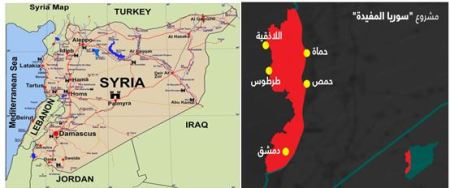
30686La Syrie Utile region (Alkhaleejonline.net, Istanbul-city-guide.com/map/Latakia-map)

Originally, the term La Syrie Utile, coined following World War I by the French Mandate for Syria and the Lebanon, referred to the borders of Greater Syria minus Jordan and Palestine. It defined the area of the Levant that at that time was considered economically and demographically more important and more central than other areas. The area the term refers to today covers nearly all of Syria’s most important economic, administrative, and demographic areas. Many Syrian oppositionists saw proof that the Assad regime had a plan to make this region demographically homogenous and pro-regime in Assad’s July 26, 2016 speech to union officials at the presidential palace in Damascus. In it, Assad explained that circumstances on the ground require the Syrian army to withdraw from various areas “so that it can protect other, more important regions” and that the regime army “cannot fight on all fronts out of fear of losing control in certain areas, [and therefore] we relinquish [certain] regions in favor of important areas under our control.”[3]

Today’s La Syrie Utile region borders on the regime’s strategic depth in Lebanon, that is, the areas controlled by Hizbullah and its allies. These include the northern Beqaa Valley, which has a decisive Shi’ite majority; parts of the central Beqaa Valley, whose border with Syria is controlled by the Popular Front for the Liberation of Palestine – General Command (PFLP-GC); and the Damascus-Beirut highway. Following extensive removal of the original residents by various means, the Syrian regime and its allies now control a large swath of Syria’s western regions and parts of eastern Lebanon in which the population is loyal to tem, rendering actual international borders nearly meaningless.

Syria’s creation of pro-regime demographic homogeneity within this region serves Iranian plans to control Syria and Lebanon, and serves the Iran-Hizbullah relationship. In January 2016, the anti-Iran Lebanese lawyer Nabil Al-Halabi, who heads the Lebanese Institute for Democracy and Human Rights (LIFE), told the Syrian oppositionist website Orient News: “Iran’s agenda in Syria is aimed at creating a large expanse… that will incorporate the entire [Syrian] border into Lebanon’s northern and eastern Beqaa and will connect them to the Baalbek-Hermel area [that is, Lebanon’s northern Beqaa], so as to transform it into an Iranian statelet subordinate to [Iran’s] Rule of the Jurisprudent.”[4] Similar statements were made by ‘Abdelilah Fahd, of the National Coalition for Syrian Revolutionary and Opposition Forces.[5]

In this context it should be mentioned that as early as three years ago, Lebanese newspapers that are known to support Hizbullah, Syria, and the resistance axis published articles about the importance of this geographic region in Syria and the need to connect it to the Lebanese depth so as to create a single area that will ensure the survival of the Syrian regime, Hizbullah’s strategic depth in Syria, and the geographic connection between them.[6]

Syrian oppositionists and anti-Assad Lebanese have warned about this plan. In August 2016, Syrian oppositionist Ahmad Abazid told the London-based Saudi daily Al-Sharq Al-Awsat: “The implementation of the plan [to bring about] a demographic shift in Syria began in the last quarter of 2012, with the regime using Shi’ite militias to change the composition of the population around Damascus and near the Lebanese border.”[7] Earlier, in February 2016, Lebanese Druze leader Walid Jumblatt, who was aware of the ramifications of this move for Lebanon, warned: “Lebanon could become a new province of La Syrie Utile, which the Syria-Iran axis is attempting to establish from Daraa to Tartus to Latakia.”[8]

Methods And Means Used By Regime And Its Allies To Create Pro-Regime Homogeneity In La Syrie Utile Region

For the past few years, Arab media, and particularly Syrian and Lebanese media hostile to the resistance axis, have been reporting on what is happening to the mostly Sunni anti-regime population in Damascus and its environs; in Homs, on the Damascus-Tartus road; in the towns of Al-Qusayr and Baniyas, between Homs and the northern Lebanese Beqaa Valley; in Al-Zabadani, north of the Damascus-Beirut highway; and recently also in the town of Madaya (on the Damascus-Beirut highway) and in Darayya (south of Damascus). The latter two locales have been in the news because of the regime’s systematic starvation and expulsion of their residents.[9] These reports reveal a wide range of violent methods used by the Syrian regime, Iran, and Hizbullah to shift the mostly Sunni population that they do not want there, including besieging towns and starving their residents;[10] transferring residents as part of ceasefire agreements; demolishing homes and burning farmland; setting up roadblocks to monitor and intimidate the population; forcing residents to sell their property; burning land registration offices in order to destroy records; and killing residents and intimidating the survivors. In addition to these methods are Shi’ization (on which see below) and, following the removal of Sunni and anti-regime residents, settling Shi’ite, ‘Alawite, and other pro-regime families in these areas.
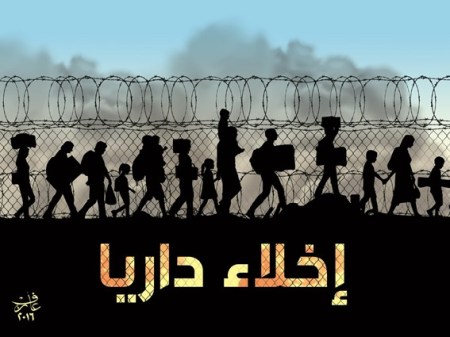
30687“The evacuation of Darayya” ( Al-Arab, Qatar, August 28, 2016)

 Following are examples of these methods, which Syrian regime opponents claim constitute “sectarian cleansing”:

Expelling Non-Shi’ite Residents From La Syrie Utile Region

One violent method used by the regime and its allies to create demographic homogeneity has been expelling non-Shi’ite anti-Assad residents and making it impossible for them to return. Sometimes this is done by intimidating residents and threatening them with death so that they will leave of their own accord.

Thus, for example, in August 2015, the Lebanese daily Al-Mustaqbal, which is known to oppose Hizbullah and the Syrian regime, cited General Authority of the Syrian Revolution (GASR) spokesman Ahmad Al-Qusayr as saying that since it occupied the town of Al-Qusayr in June 2013, Hizbullah has expelled most non-Shi’ite residents of the surrounding villages and is preventing them from returning to their homes.[11]

A November 2015 report in another Lebanese daily, Al-Safir, which supports the resistance axis, provided proof for the claim that Hizbullah and the Syrian regime are preventing residents of Al-Qusayr from returning to their homes. Reporting from the town, Al-Safir reporter Ali Duraij said that only former residents whose names are on a Syrian Army list may enter. The daily also quoted a Syrian soldier as saying that pro-rebel residents would only be returning to the town “over the soldiers’ dead bodies.”[12]

In March 2015, the Egyptian news portal Masr Al-Arabia quoted a young man residing in the old city of Damascus as saying that Shi’ite militias are threatening local young Sunnis with forced labor in order to drive them out of the city, and that as a result many families have abandoned their homes. It also reported that Damascenes are saying that Hizbullah is preventing families who have left from returning to their homes in neighborhoods that Hizbullah has taken over and made into strongholds.[13]

In January 2015, the Syrian oppositionist website Orient News reported that when Hizbullah and other Shi’ite militias occupied the town of Sayyidah Zaynab and others surrounding it, south of Damascus, they executed residents and left their bodies lying in the street to terrorize others and spur them to leave on their own. The remaining residents were forcefully expelled, and the area was transformed into a center for Shi’ite militiamen and their families. Abu Nasser Al-Shami, an opposition activist in southern Damascus, said that the expelled residents had repeatedly tried to return to their homes but that the Shi’ite militias had prevented them from doing so.[14]

The regime has also razed entire neighborhoods in Damascus and Homs as part of new infrastructure plans. Alsouria.net cited Syrian legal expert ‘Abd Al-‘Aziz as stating, in August 2015, that Assad’s Presidential Decree No. 66, of 2012, ordering  the demolition of thousands of homes and other buildings in the neighborhoods of Al-Mezzeh, Kafr Soussa, and others in southern Damascus, and the construction of new homes in their place, was aimed at expelling their original residents, since Al-Mezzeh and Kafr Sousa are strategic strongholds housing important security facilities of the Syrian regime.[15] Two months previously, in June 2015, the London-based Qatari daily Al-Quds Al-Arabi had cited an Al-Mezzeh resident as saying that the regime had ordered hundreds of families living east of the neighborhood and near the Iranian Embassy to leave their homes because they were going to be demolished to make way for “Iranian towers.”[16]

Following the regime’s approval of two new plans for infrastructure for Homs’ Baba Amr neighborhood,  local residents claimed that the plans as they were approved by the city council are aimed at expelling them from their homes as retribution for their support for the rebels.[17]

On March 20, 2016, Al-Quds Al-Arabi reported, citing Syrian activists and eyewitnesses, on the construction of a nonconventional military facility and on the excavation of tunnels, with help from Iranian experts, on the Syria-Lebanon border and near the Damascus-Beirut highway, and that local residents were being expelled, their homes were being razed, and trees were being uprooted.[18] The following day, the daily again reported that it was feared that the facilities were for the storage of chemical or other nonconventional weapons.[19]

On June 11, 2016, Al-Quds Al-Arabi correspondent ‘Omar Muhammad in the town of Madaya reported that Hizbullah fighters who control the southern approach to the town had forced 16 local families to immediately evacuate their homes. According to Muhammad, the fighters then looted the buildings, torched them, and took over the land, as part of the plan to change the demographics of the Damascus environs.[20]  

Pro-Rebel Residents Out, Shi’ite And Alawite Families In

Another method being used by the regime and its allies to change the demographics of the region is to settle Shi’ite and ‘Alawite families in areas from which non-Shi’ite residents have been removed. In many cases, ownership of the properties is transferred to the new residents without the original owners’ knowledge, and land registration offices have been burned down in order to remove all evidence of original ownership. Fields have also been burned, and homes razed.

In August 2015, the Lebanese daily Al-Mustaqbal reported that privately owned farmland surrounding the town of Al-Qusayr that belonged to Syrians who had been forced to leave their homes was being sold at attractive prices and on installment plans to “a specific sector” (likely pro-Hizbullah) of Lebanese citizens. Additionally, according to the report, Hizbullah had demolished the homes of residents “one after another.”[21] Previously, the newspaper reported that Hizbullah was settling its own fighters and their families in homes abandoned by the locals.[22]

Further evidence that Shi’ites were being moved into Al-Qusayr appeared in an August 2015 article discussing the population transfer methods being used by the regime and its allies, that was posted on the Syrian oppositionist website Alsouria.net. The article cited Samer Al-Homsi, a Syrian oppositionist in Homs, as stating that Hizbullah was settling the families of its fighters in Al-Qusayr.[23] Al-Homsi added that the Homs provincial council, which he said supported the regime, had posted notices on the doors of shops in the city’s old marketplace warning that if they did not open for business the property would be expropriated and turned over to new owners – while the regime was preventing the shop owners from returning to the city. He said that the regime is transfering these properties to newly arrived Alawite and Shi’ite families with security clearance.

The article also stated that the Syrian regime and Hizbullah had burned down the land registration office and other buildings in the city where real estate records were stored, so as to eliminate evidence of the ownership of thousands of properties.[24] The anti-Hizbullah Shi’ite-Lebanese website Janoubia.com also cited a source that said that the regime had transferred these properties to Iraqi and Lebanese Shi’ites, as well as to Alawites.[25]

The same thing happened in the old city of Damascus. A Masr Al-Arabia report quoted a young resident who said that homes abandoned by their original residents now house Lebanese, Iraqi, and Afghan militiamen whose families recently received Syrian citizenship, as well as displaced non-Sunni Syrians – all in accordance with a regime order giving itself the right to rent out these homes and to hold the rent received in escrow for the owners.[26] The report also quoted residents as saying that the regime had decreed that homes in Damascus may only be rented to people approved by the security authorities – and that only Iraqi, Iranian, Afghan, and Lebanese fighters are approved.[27]

The Syrian oppositionist website All4syria.info reported that in the town of Sayyidah Zaynab in the Rif Dimashq Governorate, Shi’ite militias were settling Shi’ite refugees from Basra, Iraq in homes whose owners had been removed. The report also quoted young resident Abu Radwan Al-Shami as saying said that a militia member had taken over his family home  and refused to leave despite his demands that he do so. Upon appealing to the police, Al-Shami was told that these militiamen are “guests who must be welcomed, and who cannot be removed.” The policemen cited Assad’s speech about  the land belonging to those who fight and defend it.[28]

An Al-Zabadani city councilmember told the London-based Al-Arabi Al-Jadid daily that the regime had demolished some 95% of the homes and commercial areas in the city, set fire to much of the farmland south and southwest of the city, near Madaya, and capped irrigation wells used by the farmers, all in an effort to force residents to leave. Media personality Faris Al-Arabi attested to the torching of orchards and buildings in these areas. According to Al-Zabadani residents, the town’s commerce and agriculturehad provided a livelihood for thousands, and the city is no longer worth living in because its economy and infrastructure have been completely destroyed.[29]

Hizbullah and the Syrian military have used the tactic of burning farmlands in the Madaya region as well, as reported on September 11,  2016  by the Syrian oppositionist website Enabbaladi.net.[30]

On September 6, 2016, Al-Sharq Al-Awsat cited a source close to the Iraqi militias in Syria as stating that the Iran-backed Al-Nujaba militia had begun settling some 300 Shi’ite families from southern Iraq in the towns of Darayya and Muadamiyat Al-Sham, southwest of Damascus. According to the report, the towns’ original residents had left as part of population transfer agreements (see following section).[31]

Siege, Starvation, And UN-Sponsored Population Transfer

The Syrian regime, along with Hizbullah and its other allies, are also besieging areas and starving the residents,[32] with the aim of wearing down the local population, causing it to turn against the rebels, and leveraging it to push rebel forces into signing local ceasefire agreements. The Assad regime calls these ceasefire agreements “national reconciliations” or “local reconciliations,” spinning them as a rebel surrender – while in actuality they involve the uprooting of pro-rebel residents and their transfer outside the La Syrie Utile region. This has been implemented in many places, particularly in Homs, the Al-Yarmouk refugee camp, Al-Zabadani, and Madaya and Darayya.

Some of the siege-lifting agreements have been sponsored by UN representatives, even though they were achieved by harsh sieges and by starving local residents, and involved removing residents from their homes and  the departure of the rebels and their families under population transfer agreements. From 2014 to 2016, the regime and the rebels arrived at a number of agreements under which the regime lifted the siege, stopped bombardment, and allowed humanitarian aid into the area, in return for the rebels’ and their families’ departure. Such UN-sponsored agreements have been signed for Homs’ old city[33] and parts of its Al-Waer neighborhood.[34] They were also signed for the majority-Turkmen towns of Kezhal and Umm Al-Qasab in western Rif Homs; rebel families from these towns were transferred to the northern Rif Homs.[35]
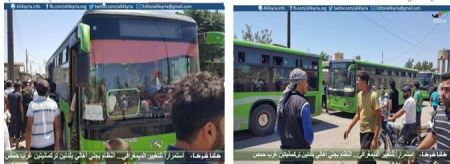
30688Residents of Turkmen towns west of Homs exiled north of Homs (All4syria.info, July 17, 2016)

Nabil Al-Halabi, the Lebanese lawyer and LIFE director, said that in Homs’ old city the regime had offered food to besieged residents who wanted to leave the city but only on the condition that they sold the regime their land and property.[36] On January 13, 2016, Al-Mustaqbal reported that Hizbullah fighters in Bloudan had threatened residents of the besieged Al-Zabadani and Madayya nearby who had managed to escape that they would be forced back into Madayya unless they sold their land and houses to them for pennies on the dollar. According to the daily, some of these residents agreed to this extortion in return for food or a handful of coins, while others were brought back into Madayya.[37] It was around this time that the ongoing siege on Madayya – which violated a previous agreement between the regime and rebels in the city – made headlines, after residents and rebels raised an outcry because the residents were reduced to eating weeds, eggshells, and cats, with some dying of starvation, and medical supplies had run out.[38] Earlier in January, Orient News quoted Madayya activists as saying that Hizbullah was allowing residents to leave if they sold them their homes, land, and property.[39]

In September 2015, Iranian representatives, with UN sponsorship and assistance, arrived at a ceasefire with the rebel group Ahrar Al-Sham, which controlled Al-Zabadani. The agreement covered the city and several surrounding towns, among them Madayya, besieged by Assad and Hizbullah, and the Shi’ite towns of Al-Fua and Kefraya in northern Syria, besieged by the rebels, and included a population transfer agreement. Under the latter, armed rebels and interested residents from Al-Zabadani would be transferred to the northern city of Idlib, which is under rebel control and outside of La Syrie Utile, while 10,000 women, children, and over-50 men from Al-Fua and Kefraya would be transferred to Al-Zabadani – thus effecting a demographic shift.[40]

One of the most prominent examples of the regime’s removal of anti-regime residents following extended siege, starvation, and bombardment occurred recently as part of a rebel-regime agreement in Darayya, south of Damascus. After four years of siege, Darayya has become a symbol of this regime policy. In November 2012, the Syrian army and its allies besieged Darayya, and only allowed in humanitarian aid three and half years later, in early 2016. Almost four years of siege, starvation, and carpet bombing of the city, and, according to the rebels, regime threats to burn down the city with all its residents, brought the rebels to surrender. On August 25, 2016, the sides reached an agreement under which the armed rebels and residents would leave the city and hand over their medium and heavy weapons to the regime army as it entered.[41] Thus, on August 27, 1,650 rebel fighters and anti-regime residents abandoned Darayya for the rebel-controlled Idlib in northern Syria.[42] The Assad regime said that Darayya had been rendered uninhabitable, and promised that after it was rebuilt, its residents would be allowed to return.[43] However, on August 27, 2016, the Kurdish website Ara News reported that mere hours after the expulsion of its residents, dozens of Iraqi families had already moved in.[44]

According to the opposition, in Darayya the regime had escalated its attempts to subdue the rebels and the residents, threatening to exterminate the population. Syrian oppositionist Bassma Kodmani, a member of the Syrian opposition’s High Negotiations Committee (HNC), said that regime forces changed tactics after failing to starve the residents in the besieged areas, and that “the threats of ‘surrender or starve’ that we have heard for four years have now become ‘surrender or we will destroy you.'”[45]

The UN was criticized for its role in the Darayya agreement. UN Special Envoy for Syria Staffan de Mistura denied that he had had any connection to it, and said he had not even known about it,[46] but city councilman Fahdi Muhammad said, “The council updates de Mistura on events and developments in the city immediately after they happen, and his denial is nothing but an attempt to shirk his responsibility to protect the residents who were expelled by the Assad regime.” He added: “UN officials and a Red Cross delegation knew about the negotiations, and even oversaw the expulsion operation.”[47]

Among the opponents of the Darayya agreement were Arab League secretary-general Ahmed Abu Al-Gheit, who in a statement called it “a worrisome development that could pave the way for similar arrangements that bring about demographic changes in Syrian cities, especially since they are with UN sponsorship.” He added: “Expelling residents under duress is a violation of international law.”[48]

Reports in recent months indicate that there will be a repeat of this ceasefire-agreement scenario in the town of Muadamiyat Al-Sham, also southwest of Damascus. On September 1, 2016, the Syrian daily Al-Watan, which is close to the Assad regime, reported that an agreement is set to be signed between the regime and representatives of the town residents, under which all rebels  and anti-regime residents will leave the town in order to “settle their status vis-a-vis the regime.”[49] The previous day, on August 31, Orient News had reported that the regime is aiming for an agreement like Darayya’s in Muadamiyat Al-Sham, and that in talks between the sides, the regime had warned the townspeople that it would burn the whole town along with its residents if the rebels did not hand over their medium and heavy weapons and depart with the anti-regime residents.[50]

Apparently, the Russians, in addition to the UN, are also involved in these so-called “reconciliation agreements” under which population transfers are conducted following siege and starvation. Thus, for example, Russian officials praised the Darayya agreement. On September 1, 2016, Russian Foreign Ministry spokeswoman Maria Zakharova, said that “the successful experience” of removing the rebels from Darayya “will help reduce the level of violence.” She assessed that further agreements were forthcoming, stating that the regime had “reached an agreement similar to” the Darayya agreement in Muadamiyat Al-Sham, and called for the international community to support these agreements and for the signing of similar ones on all Syrian battlefronts.[51] Orient News reported that Russian officers had participated in the talks between Muadamiyat Al-Sham representatives and the regime.[52]

In this context, it should be mentioned that the regime and its allies have also taken measures to get rid of Palestinians residing in Palestinian refugee camps who have expressed support for the rebels. Ayman Abu Hisham, director of the general Palestinian refugee authority in the temporary Syrian government of the National Coalition of Syrian Revolutionary and Opposition Forces, said that the regime is assassinating or expelling Palestinians who do not support it, without distinguishing opponents from neutral parties. He accused it of starving residents of the Al-Yarmouk refugee camp in southern Damascus, and of completely destroying other camps, such as Jaramana on the Damascus airport road and Handarat in northeastern Aleppo, to keep the residents, who had fled, from returning.[53]

On November 8, 2016, the website of the National Coalition of Syrian Revolutionary and Opposition Forces reported that the regime had bombarded Khan Al-Sheikh, a Palestinian refugee camp in the western Ghouta, in order to drive out its residents, after they did not heed the regime’s demand to evacuate the camp.[54]

Shi’ization And Iran’s Takeover Of Property In And Around Damascus

There have also been many reports on significant Iranian activity in Damascus and its environs,including direct and indirect purchase of land and homes, as well as extensive Shi’ite religious outreach and proselytizing, aimed particularly at young people, and the establishment of Shi’ite religious, cultural, and educational centers.
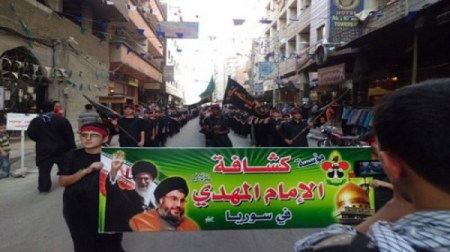
30693A march of the Al-Imam Al-Mahdi scouts movement in Syria (orientnews.net, January 19, 2015)

The Lebanese daily Al-Mustaqbal cited knowledgeable sources as stating that the Syrian regime was transferring ownership of state buildings and land in Damascus to Iran, as part of a repayment of regime debts.[55] Some three months previously, the Lebanese daily Al-Akhbar, which supports Hizbullah and the resistance axis, had reported that the Syrian regime had mortgaged state real estate to Iran in exchange for Iranian military and economic aid.[56]

A Damascus engineer identified as Suheil told Alsouria.net that he had sold his home to a Gulf businessman who later turned out to be an agent for Iranian firms, and that many other Syrians had done likewise. The website also reported that the number of Shi’ite residents in many Damascus neighborhoods was on the rise.[57]

The London daily Al-Sharq Al-Awsat also reported, citing numerous Syrian sources, that Iranian merchants and brokers had purchased property and land in various cities, with Iranian encouragement and support and with the cooperation of the Syrian regime. The daily quoted a report by the Electronic Group of the Syrian Rebellion as stating that Iran had established a network of real estate brokers and speculators for purchasing homes, hotels, and land from Syrian citizens who wish to leave Syria. According to the report, Iran had fraudulently transferred to itself ownership of various assets.[58]

Orient News reported that the Supreme Syrian-Iranian Council, headed by the Syrian Samer Al-As’ad, a representative of Iranian businessman and former IRGC general Rostam Qasemi, had appointed agents on the council’s behalf to pressure Damascus residents to sell their assets as part of an Iranian plan to create a demographically homogenous area stretching “from Darayya to the new building of the Iranian embassy in Damascus.”[59]

On June 22, 2015, Al-Quds Al-Arabi cited a resident of the Al-Mezzeh quarter in Damascus who said that Iranian Shi’ites fighting in Syria had been pressuring anti-regime owners of homes and land to sell them their assets by various means, including public humiliation, beatings, and even murder. According to the resident, the Kafr Soussa neighborhood is seeing much of this activity as well.[60]

On April 11, 2016, the Iranian news agency Fars reported that Iranian Majlis member Amir Khojasteh had presented a report to the Majlis after visiting Lebanon and Syria with a Majlis delegation. According to this report, Assad had agreed to grant residency visas to the 10,000 Iranian citizens already living in Syria, at no cost.[61]

In recent years, there has been increased Shi’ite and Iranian religious activity in both Damascus and in the town of Sayyidah Zaynab, south of Damascus. Sayyidah Zaynab is the site of the tomb of Zaynab, a descendent of the Prophet Muhammad, and it attracts many thousands of Shi’ite pilgrims annually. Entire areas of Damascus and other cities have turned Shi’ite, after families of foreign Shi’ite fighters immigrated to Syria and occupied homes abandoned because of the war. Further evidence of the rise of Shi’a in Syria was the unprecedented scale of the 2014 ‘Ashura ceremonies in Damascus, which were held even in areas of the capital that were not recognized as Shi’ite.[62]
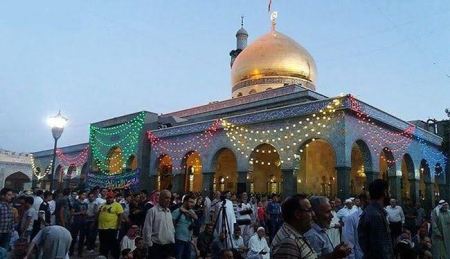
30690The tomb of Sayyidah Zaynab south of Damascus (All4syria.info, January 29, 2016)

Orient News reported that days after the residents of Darayya left it, as part of the agreement with the Assad regime, Shi’ite militiamen entered it to pray and conduct Shi’ite ceremonies at a tomb that has in recent years become a Shi’ite pilgrimage site. It is claimed to be the burial site of Sayyidah Sakinah, the daughter of Hussein and granddaughter of the Prophet Muhammad.[63]
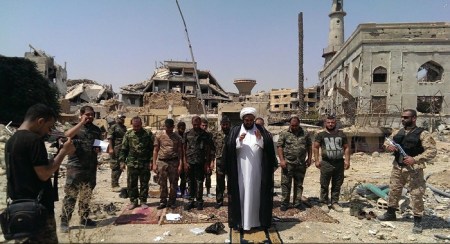
30692Amjad Al-Bahadli, leader of the Iraqi Al-Imam Al-Hussein Brigade militia praying at the ruins of the tomb of Sayyidah Sakinah in Darayya (Facebook.com/500674723445460, August 31, 2016)

The Syrian oppositionist website Enabbaladi.net reported that the Iraqi Abu Al-Fadl Al-Abbas militia has launched an advertising campaign, aimed at Iraqi Shi’ites, for an eight-day trip to the Shi’ite holy sites in Syria at a cost of $400 per person. The trip includes the tomb of Sayyidah Sakinah.[64]

Opponents Of Syrian Regime: These Forced Demographic Changes Are War Crimes, Carried Out With UN Complicity – That Serve Iran

The Syrian opposition and its supporters in Lebanon have been extremely critical of the La Syrie Utile project and the measures undertaken, by the regime and by its allies, to implement it.[65] Some said that the regime’s methods were worse than Israeli actions against the Palestinians, while others compared them to the Nazi racial policy that eventually become the Final Solution.

The head of the interim government of the National Coalition of Syrian Revolutionary and Opposition Forces, Ahmad Tu’mah, said that the regime was changing the demographics in Homs Governorate by forcing Sunnis out and bringing in Iranians to replace them.[66] George Sabra, head of the Syrian National Council and a member of the National Coalition, claimed that the La Syrie Utile project was aimed at dividing the country into sectarian statelets that served Iran; he added that the Syrian regime no longer cares about the Syrian homeland or people, but only about self-protection and self-preservation.[67]

HNC member Muhammad ‘Aloush called the removal of residents of Darayya and Muadamiyat Al-Sham “a war crime carried out by the Syrian regime, and forced expulsion.”[68] Orient News wrote about the siege and starvation of Madaya that Hizbullah and its secretary-general Hassan Nasrallah were using methods “that even Israel does not use.”[69]

Syrian opposition officials also harshly criticized the UN, saying that it was participating in these arrangements that are changing the country’s demographics. On August 29, 2016, HNC general coordinator Riyad Hijab sent a letter to the UN secretary-general warning the UN not to sponsor measures by the regime and its allies aimed at shifting demographics. Hijab argued that Aleppo, Homs, Rif Dimashq, and other areas are subject to such forced demographic changes, and that the Assad regime and its allies are carrying out these changes with UN sponsorship in the guise of local ceasefires. He asked rhetorically: “Do you believe that this will eliminate terrorism? Will it eliminate extremism? Will it end the spilling of Syrian blood and the killing of women and children? Will it make the world a safer place? Will it preserve the unity and territorial integrity of Syrian soil?” He added that since the start of the political process vis-à-vis Syria, “the regime, Iran, and the militias [supporting them] have killed over half a million Syrians and expelled millions,” and that therefore this political process is “backing the regime and its allies in implementing this demographic change.”[70]

In an article in the Kuwaiti daily Al-Qabas, National Coalition member Abdelilah Fahd alleged: “Officials in UN offices in Damascus have pressured the residents [of the Al-Waer neighborhood in Homs] in an attempt to reach a ceasefire that leads to a surrender [of the rebels]. The [UN] office in Damascus held talks with local residents to persuade them to accept a false ceasefire, which indicates it is a party to the expulsion plan… and that it has failed miserably to defend citizens according to international law.” Fahd also stated that the regime is implementing a policy of expulsion, killing, and destruction “in order to preserve the regime at all costs, in the belief that additional crimes will help it eliminate the rebelling Syrian people’s desire for freedom.” He called the methods being used by the regime “a scarlet letter in the history of the UN and international law.”[71]

The Lebanese daily Al-Mustaqbal  has published articles criticizing the demographic policies of the Syrian regime and its allies. In his July 7, 2015 column, ‘Ali Rabah wrote: “Hizbullah is attempting to change Syria’s demographics by expelling original residents to settle others in their place… This is the modus operandi of Hizbullah – which has for decades warned about a Zionist plan to divide the region – in an attempt to cancel the Sykes-Picot Accords.”[72] In another column, published August 12, 2015, Rabah wondered how Hizbullah leader Nasrallah could warn Shi’ites in Bahrain about demographic change that the Bahraini regime might implement against them while he was doing the same thing to Sunnis in Syria – and using the methods that Israel used against the Palestinians in 1948. He wrote: “The [Syrian] villages that Hizbullah wants to empty of their local residents could total a larger area than all of Palestine, or at least larger than all the [Israel-]occupied lands from 1948. Many haven’t noticed that the number of Syrian refugees in camps in Turkey and Jordan alone is three times greater than the number of Palestinians expelled by Israel.” Rabah added that Hizbullah was occupying Syria and establishing settlements and camps there.[73]

Lebanese poet and literary critic Paul Shaoul, who writes for Al-Mustaqbal, compared Hizbullah to Dracula, saying that it is sucking the blood of Syrians, and added that its policy in Syria was racist and sectarian and aimed at changing Syria’s demographics by eliminating Sunnis and expelling them from the country.[74] Mustafa ‘Aloush, a member of the Al-Mustaqbal faction’s Political Bureau and a columnist for the Al-Mustaqbal daily, compared the plan of Syria, Hizbullah, and Iran to the Nazi racial theory that developed into the Final Solution: “Their despair over the [failure of the] plan for the Rule of the Jurisprudent to control all Syria as its backyard has made the followers [of the Rule of the Jurisprudent] settle for the so-called La Syrie Utile. Today, it appears that Hizbullah’s entry into Syria is part of a ‘Final Solution’ supported by an Iranian fatwa aimed at ethnically cleansing areas bordering the central and northern Beqaa Valley [in Lebanon], possibly in preparation for the next stage, which will bring extensive changes to the political and demographic maps.”[75]

* E.B. Picali is a research fellow at MEMRI


Endnotes:


[1] Al-Watan (Syria), July 26, 2015.

[2] See MEMRI Inquiry & Analysis No. 1131, Shi’ization Of Syria: In Damascus, Unprecedentedly Extensive Observance Of The ‘Ashura, November 13, 2014.

[3] Al-Watan (Syria), July 26, 2016.

[4] Orient-news.net, January 6, 2016.

[5] Etilaf.org, September 21, 2016.

[6] Al-Akhbar (Lebanon), May 27-29, 2013. See MEMRI Inquiry & Analysis Series Report No. 980, Lebanon Openly Enters Fighting In Syria, June 13, 2013.

[7] Al-Sharq Al-Awsat (London), August 28, 2016.

[8] Al-Mustaqbal (Lebanon), February 4, 2016.

[9] See MEMRI Inquiry & Analysis Series Report No. 1226, Hizbullah Faces Criticism In Lebanon For Besieging Madaya: Its Starvation Of Syrians Recalls Past Crimes Of Mass Extermination In History, February 9, 2016.

[10] See MEMRI Inquiry & Analysis Series Report No. 1221, Local Ceasefire Agreements In Syria: Capitulation To Regime’s Siege-And-Starvation Strategy Under UN Sponsorship, January 26, 2016.

[11] Al-Mustaqbal (Lebanon), August 12, 2015.

[12] Al-Safir (Lebanon), November 4, 2015.

[13] Masralarabia.com, March 15, 2015.

[14] Orient-news.net, January 19, 2015.

[15] Alsouria.net, August 21, 2015.

[16] Al-Quds Al-Arabi (London), June 22, 2015.

[17] Alarabiya.net, August 27, 2015.

[18] Al-Quds Al-Arabi (London), March 20, 2016.

[19] Al-Quds Al-Arabi (London), March 21, 2016.

[20] Al-Quds Al-Arabi (London) June 11, 2016.

[21] Al-Mustaqbal (Lebanon), August 12, 2015.

[22] Al-Mustaqbal (Lebanon), July 30, 2015. Yasser Haidar, a member of the coordinating body in Al-Qusayr, told the Saudi daily ‘Okaz that he and other residents were expelled from the town, and that under the auspices of Hizbullah, it has become a center for bandits and gangs of smugglers and kidnappers. ‘Okaz (Saudi Arabia), February 7, 2015. According to the Lebanese daily Al-Mustaqbal, Hizbullah sent Shi’ite Lebanese criminals wanted in Lebanon to Syria, and particularly to the Al-Qusayr and Al-Qalamoun areas, chief among them the Shi’ite Lebanese fugitive Noah Zaiter, who posted images on his Facebook page of himself along with Hizbullah officers fighting in those areas in Syria. Al-Mustaqbal (Lebanon), September 15, 2015.

[23] Alsouria.net, August 21, 2015.

[24] Alsouria.net, August 21, 2015.

[25] Janoubia.com, December 11, 2015.

[26] Al-Ba’th (Syria), May 21, 2014.

[27] Masralarabia.com, March 15, 2015.

[28] All4syria.info, January 29, 2016.

[29] Al-Arabi Al-Jadid (London), October 20, 2015.

[30] Enabbaladi.net, September 11, 2016.

[31] Al-Sharq Al-Awsat (London), September 6, 2016.

[32] See MEMRI Inquiry & Analysis Series Report No. 1221, Local Ceasefire Agreements In Syria: Capitulation To Regime’s Siege-And-Starvation Strategy Under UN Sponsorship, January 26, 2016; and Inquiry & Analysis Series Report No. 1069, Syria Regime’s Tactic Against Opponents: ‘Surrender Or Starve’, February 13, 2014.

[33] Al-Quds Al-Arabi (London), May 3, 2015.

[34] Alarabiya.net, December 5, 2015.

[35] All4syria.info, July 17, 2016.

[36] Orient-news.net, January 6, 2016.

[37] Al-Mustaqbal (Lebanon), January 13, 2016.

[38] See MEMRI Inquiry & Analysis Series Report No. 1221, Local Ceasefire Agreements In Syria: Capitulation To Regime’s Siege-And-Starvation Strategy Under UN Sponsorship, January 26, 2016.

[39] Orient-news.net, January 6, 2016.

[40] Orient-news.net, September 19, 2015.

[41] Sana.sy, August 25, 2016.

[42] Al-Quds Al-Arabi (London), August 27, 2016; Sana.sy, August 27, 2016.

[43] Dp-news.com, August 29, 2016.

[44] Aranews.net, August 27, 2016.

[45] Aksalser.com, September 1, 2016.

[46] Orient-news.net, August 27, 2016.

[47] Etilaf.org, August 27, 2016.

[48] Alarabiya.net, August 28, 2016.

[49] Al-Watan (Syria), September 1, 2016.

[50] Orient-News.net, August 31, 2016.

[51] Aksalser.com, September 1, 2016.

[52] Orient-news.net, August 31, 2016.

[53] Al-Quds Al-Arabi (London), May 2, 2014.

[54] Etilaf.org, November 8, 2016.

[55] Al-Mustaqbal (Lebanon), August 12, 2015.

[56] Al-Akhbar (Lebanon), April 29, 2015.

[57] Alsouria.net, August 21, 2015.

[58] Al-Sharq Al-Awsat (London), March 26, 2016.

[59] Orient-news.net, November 6, 2016.

[60] Al-Quds Al-Arabi (London), June 22, 2015.

[61] Fars (Iran), April 11, 2016.

[62] See MEMRI Inquiry & Analysis No. 1131, Shi’ization Of Syria: In Damascus, Unprecedentedly Extensive Observance Of The ‘Ashura, November 13, 2014.

[63] Orient-news.net, September 1, 2016.

[64] Enabbaladi.net, September 17, 2016.

[65] See MEMRI Inquiry & Analysis Series Report No. 1226, Hizbullah Faces Criticism In Lebanon For Besieging Madaya: Its Starvation Of Syrians Recalls Past Crimes Of Mass Extermination In History, February 9, 2016.

[66] Dp-news.com, January 23, 2016.

[67] Aljazeera.net, September 29, 2015.

[68] Alarabiya.net, September 1, 2016.

[69] Orient-news.net, January 6, 2016.

[70] Aksalser.com, August 29, 2016.

[71] Al-Qabas (Kuwait), August 31, 2016.

[72] Al-Mustaqbal (Lebanon), July 7, 2015.

[73] Al-Mustaqbal (Lebanon), August 12, 2015.

[74] Al-Mustaqbal (Lebanon), August 12, 2016.

[75] Al-Mustaqbal (Lebanon), January 13, 2016.
Al-Hariri’s Choice Of Hizbullah Ally Aoun For Lebanese Presidency Is Another March 14 Forces Concession To Pro-Iran Axis

October 28, 2016

Al-Hariri’s Choice Of Hizbullah Ally Aoun For Lebanese Presidency Is Another March 14 Forces Concession To Pro-Iran Axis, MEMRI, E.B. Picali and Y. Yehoshua, October 28, 2016

Introduction

On October 31, 2016, the Lebanese parliament will convene and is expected to vote in Free Patriotic Movement leader and Hizbullah ally Michel Aoun as president of Lebanon; he is Hizbullah’s sole candidate. The move follows a deal struck between Aoun and former Lebanese prime minister Sa’d Al-Hariri, leader of the Sunni Al-Mustaqbal stream, under which Aoun, if elected, will assign Al-Hariri the task of forming the next government.

This move by Al-Hariri has significant implications for the intra-Lebanese political arena and for the regional power balance. Therefore it has encountered criticism both within and outside Lebanon. This move represents a surrender by the March 14 Forces, headed by Al-Mustaqbal, to Hizbullah’s will, and reinforces the position of Hizbullah’s patron Iran at the expense of Saudi Arabia.

The following report reviews Al-Hariri’s decision, the reactions it has encountered, and what it means for Lebanon and the region.

Hizbullah Ally Aoun Expected To Be Chosen President

On October 31, 2016, the Lebanese parliament will hold its 46th presidential selection session since Michel Suleiman’s term ended two-and-a-half years ago.  That session is expected to choose Free Patriotic Movement leader Michel Aoun, who is an ally of Hizbullah, as president. Aoun’s selection will end a two-and-a-half-year presidential vacuum that resulted from disagreement over Suleiman’s successor from among the country’s opposing streams – primarily Al-Mustaqbal, led by Sa’d Al-Hariri, and Hizbullah, which together with Aoun stymied the formation of the quorum that is necessary to elect a president. The breakthrough in the talks over the selection of a president came when Al-Hariri and Aoun reached an agreement under which Al-Hariri would support Aoun’s presidential candidacy and in return Aoun would task Al-Hariri with forming the new government, which would be a national unity government as stipulated in the agreement.[1] This constitutes an Al-Hariri surrender to Hizbullah, which sought an Aoun presidency. It should be mentioned that Al-Hariri’s support for an overt Hizbullah ally is not unprecedented; a year ago, Al-Hariri announced his support for another ally of Hizbullah, and of Syrian president Bashar Al-Assad, Suleiman Frangieh, for the post of Lebanese president.[2]

Al-Hariri announced his support for Aoun in an October 20, 2016 speech, saying that by supporting him he was aiming to save Lebanon from dangerous leadership and economic crises which could, in turn, lead to a new civil war.[3]

Two days later, on October 22, Hizbullah secretary-general Hassan Nasrallah announced that his party’s MPs, who had been boycotting presidential selection sessions, as had MPs from other parties including Aoun’s own Change and Reform bloc, would be attending the October 31 session and would be choosing Aoun.  Nasrallah added that Hizbullah had no objections to Al-Hariri’s serving as prime minister in the new government.

These statements by Al-Hariri and Nasrallah pave Aoun’s path to the presidential palace, even though obstacles and uncertainty remain, both in Lebanon and in the region, in this matter.

Various Lebanese Elements Oppose Aoun’s Appointment As President

The opposition to Aoun’s appointment comes mainly from Lebanese parliamentary speaker Nabih Berri, and from Suleiman Frangieh, who is running against Aoun in the presidential race. Both Berri and Frangieh are March 8 Forces members and open Hizbullah allies. Berri even announced that he would not be part of the government that would be established under the Al-Hariri-Aoun deal, and questioned the deal’s future, saying that it had been arrived at by two sides only, without taking into account the country’s main political elements, himself among them. Druze leader and centrist bloc member Walid Jumblatt, who is another major Lebanese political figure, has not yet expressed a position on this matter, but it is thought that he will back Aoun.

On the other side as well, some in Al-Hariri’s Al-Mustaqbal party and in the March 14 Forces in general   oppose this deal. Immediately after Al-Hariri’s October 20 announcement of support for Aoun, another former prime minister, Fouad Al-Siniora, the head of the Al-Mustaqbal party, (a component of Al-Hariri’s broader Al-Mustaqbal stream) announced that he would not join Al-Hariri in backing Aoun for president. Al-Siniora was joined by other party members, including parliamentary vice president Farid Makari, MPs Ahmad Fatfat and Ammar Houri, Telecommunications Minister Boutros Harb of the March 14 Forces, and March 14 Forces secretary-general Fares Souaid.

Along with the opposition to an Aoun presidency within the Al-Mustaqbal party, other Sunni public figures also objected to the deal, among them Justice Minister Ashraf Rifi, former director-general of the Lebanese Internal Security Forces and a former Al-Hariri supporter. Last year, Rifi harshly attacked Al-Hariri for his support for Hizbullah and Syrian regime ally Suleiman Frangieh. On October 22, 2016, two days after Al-Hariri’s announcement of his support for Aoun as president, Rifi organized an anti-Aoun protest in Tripoli called “Proud Tripoli Rejects the Candidate of Iranian Patronage.” The next day, October 23, a convoy of vehicles from Akkar in the north of the country made its way to Rifi’s home in Tripoli bearing posters of him and expressing support for his position on this matter. It should be mentioned that in the past year, Rifi has gradually chipped away at overall Lebanese Sunni support for Al-Hariri, as evidenced by his party’s landslide victory over Al-Hariri’s party in the mayoral elections in Tripoli, the city with the largest Sunni concentration in the country.

Many in the Al-Mustaqbal party, the March 14 Forces, and the Sunni public who oppose the Al-Hariri-Aoun deal see Al-Hariri’s support for Aoun as yet another concession to Hizbullah and the pro-Iran axis that backs it, and to Hizbullah as an armed state within a state.[4] They accuse Al-Hariri, inter alia, of seeking to become prime minister by selling out Sunni interests and the political legacy of his father Rafiq Al-Hariri, whose 2005 assassination, when Syria was the real power in Lebanon, is thought to have been carried out by five senior Hizbullah officials.

Addressing critics of his deal, Al-Hariri explained his support for Aoun as well as his previous support for Frangieh: “I am willing to take the risks a thousand times over, just as I am willing to risk myself, my people, and my political future, to defend Lebanon and its people.”[5]

Al-Hariri’s Choice Of Aoun Is A Political Victory For Hizbullah

Al-Hariri’s move to support the Hizbullah candidate and ally Aoun has major implication for the internal Lebanese political arena. It constitutes another successful attempt by Hizbullah to impose its wishes there and a further weakening of the country’s main Sunni force, the Al-Mustaqbal party. This triumph for Hizbullah comes at a time when it is mostly preoccupied outside of Lebanon’s borders, primarily with fighting alongside the Assad regime in Syria, as well as elsewhere in the Arab world as a proxy of Iran. The organization has fortified its position within Lebanon by virtue of its network of political alliances in the country, as well as by virtue of the quantity of weapons in its possession.

Ibrahim Al-Amin, head of the board of directors of the Lebanese daily Al-Akhbar and a known Hizbullah supporter, argued that the March 14 Forces, including the Al-Mustaqbal stream, show “the symptoms of card-game addicts,” who delude themselves that they can win and are “unwilling to give up” even when it is clear that it is Hizbullah who is actually directing events on the ground.[6]

At the same time, Hizbullah’s success in pushing its own candidate through is also a result of the political weakness of its rivals, particularly the Hariri-led Al-Mustaqbal stream, who wants the premiership at nearly any cost in order to strengthen his own political status in the country and perhaps his economic status as well.

An Aoun presidency does not mean that the issues contributing to the vast schism between the sides in Lebanon will be resolved, among them the disarming of Hizbullah as demanded by the March 14 Forces – Aoun opposes the organization’s disarmament.[7] As president, Hizbullah ally Aoun would be in charge of a number of security and military portfolios, aggravating the tension between the sides and jeopardizing the army’s independence .

Additionally, the Al-Hariri-Aoun deal does not guarantee that Al-Hariri will actually succeed in forming a government, because of the opposition he faces both inside and outside Lebanon. The deal with Aoun could also harm Al-Hariri’s status among his traditional Sunni support base, thus weakening him in the upcoming spring 2017 parliamentary elections.

An Aoun Presidency: Ramifications For The Regional Power Balance – Down With Saudi Arabia, Up With Iran

Since Lebanon’s future depends on the regional political balance, with Iran, Syria, and Saudi Arabia the patrons of various local Lebanese political players, Al-Hariri’s move has regional ramifications. His surrender to Hizbullah’s wishes reflects the strengthening of Iran, which has exploited the Syrian civil war to deepen its penetration of the region and of Lebanon in particular. Electing the Hizbullah presidential candidate Aoun will definitely serve future pro-Iran interests in Lebanon at the expense of Sunni interests in Lebanon, and also at the expense of Saudi Arabia, which views itself as the protector of these interests.

Saudi Arabia has previously backed Al-Hariri’s past substantial political moves even if these moves haven’t always served Saudi political interests in Lebanon or elsewhere. It is still unclear whether his deal with Aoun has Saudi support, and the Lebanese press has published conflicting reports on the matter. As yet, there has been no official Saudi comment on this, but recent articles in the Saudi press indicate a lack of support for Al-Hariri’s deal with Aoun. However, following a lengthy Saudi silence, Saudi Gulf Affairs Minister Thamer Sabhan, who visited Beirut on October 27 said that his country would not intervene in the selection of Lebanon’s president and would support the president chosen by the Lebanese.[8]

There were also reports in the Lebanese press noting that Al-Hariri’s political status in Lebanon is declining, and that the Saudis no longer consider him the sole representative of the Sunnis in Lebanon, but only one such representative.

It should be noted that in previous years, Saudi Arabia, as the leader of the Sunni world, played a key role in the selection of Lebanese presidents, as did Syria, which together with Hizbullah’s patron Iran represented the resistance axis. Al-Hariri’s choosing Aoun for president without full Saudi backing reflects a decline in Saudi influence in Lebanon, and in Saudi Arabia’s regional status in general. In this context, a report in the Lebanese daily Al-Safir, a known supporter of the resistance axis, claims that Egypt was involved in promoting Aoun’s prospects for the presidency.[9] A possible inference from this report is that Egypt is attempting to step into Saudi Arabia’s shoes in Lebanon in an attempt to restore its status in the Arab world, and particularly in the Sunni world.

Articles in the daily Al-Akhbar, known for its pro-Hizbullah line, addressed the regional implications of Al-Hariri’s gambit and gloated that the move reflected Saudi Arabian weakness. Al-Akhbar columnist Ghassan Saoud wrote that an Aoun presidency would be a manifestation of “Hizbullah’s ability to break the international will, and the Saudi will.”[10]

However, Ibrahim Al-Amin wrote in an Al-Akbar editorial that wars in the Arab region created a reality that was forcing the March 14 Forces to see the choice of Lebanese president differently, and that they needed to realize that the Saudis can no longer help them. As he usually does, he concluded his piece with implied threats, stating: “Anyone who does not want anarchy in Lebanon has no alternative but to choose Aoun for president.”[11]


*E. B. Picali is a research fellow at MEMRI; Y. Yehoshua is Vice President for Research And Director of MEMRI Israel


Endntoes:

[1] One of the main political players pushing for an Aoun presidency is Samir Geagea, chairman of the Lebanese Forces. In January 2016, after a long period of talks, Geagea and Aoun, formerly bitter Christian political rivals, agreed that Geagea would support Aoun’s presidential bid. One of the main reasons behind Geagea’s decision to do so was Al-Hariri’s previous support for the presidential candidacy of Suleiman Frangieh – a fierce rival of Geagea who had been accused of killing several members of the Frangieh family during the country’s civil war.

[2] Similarly, in 2008, during another presidential interregnum, the March 14 Forces and Al-Hariri were forced to make concessions to Hizbullah, which was included in the newly formed Fouad Siniora government; this took place at the Doha conference. The most important concession won by the Hizbullah-led March 8 Forces, as stipulated in the government guidelines, was the legitimation of the Resistance (which allowed Hizbullah to operate as an independent armed force within Lebanon). Hizbullah also received enough cabinet seats to veto any government decision, and Hizbullah subsequently used this veto power against Al-Hariri’s government in 2011. Hizbullah obtained these concessions following the leadership vacuum, the lengthy Hizbullah siege on central Beirut, and the violent events of May 7, 2008.

[3] Al-Mustaqbal (Lebanon), October 21, 2016.

[4] See MEMRI Inquiry & Analysis Series Report No. 1092, Al-Mustaqbal Losing Ground As Representative Of Lebanese Sunnis, May 19, 2014.

[5] Al-Mustaqbal (Lebanon), October 21, 2016.

[6] Al-Akhbar (Lebanon), October 24, 2016.

[7] In an interview with Al-Akhbar, Lebanese Foreign Minister Gebran Bassil, who is Aoun’s son-in-law and heads the Change and Reform bloc founded by Aoun, said that Free Patriotic Movement, to which the Change and Reform bloc belongs, supports Hizbullah’s retention of its weapons. Al-Akhbar(Lebanon), October 22, 2016.

[8] Al-Watan (Saudi Arabia), October 28, 2016.

[9] Al-Safir (Lebanon), October 25, 2016.

[10] Al-Akhbar (Lebanon), October 27, 2016.

[11] Al-Akhbar (Lebanon), October 24, 2016.

Pro-Iranian Shiites ready to lead Mosul operation

October 28, 2016

Pro-Iranian Shiites ready to lead Mosul operation, DEBKAfile, October 28, 2016

1-5

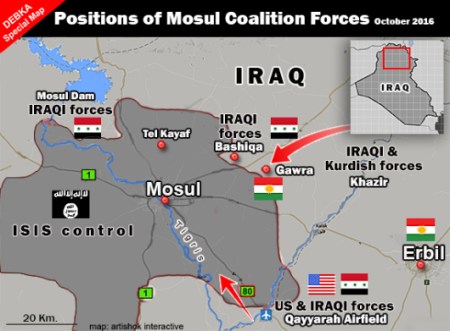
The US-led coalition offensive for liberating Mosul from ISIS suffered two ominous downturns on its 10th day

Friday, Oct. 28, DEBKAfile’s military sources report. One: Pro-Iranian Iraqi Shiites stand ready to assume a lead role, sparking the threat of sectarian violence in the mainly Sunni city; and, two, the Islamic State is poised to launch surface missiles with a range of 500km against Baghdad, as well as Jordan and Israel.

Friday, a spokesman for the Iraqi Shiite paramilitary groups the Bader Brigades and the Population Mobilization Force announced that their advance toward the Islamic State-held town of Tal Afar, about 55 km west of Mosul, was imminent.

These militias are fighting under the command of the Iranian Al Qods chief, Gen. Qasem Soleimani, who takes his orders from Tehran.

The capture of Tal Afar – a mix of Sunni and Shiite ethnic Turkmen until the Islamic State’s takeover two years ago – would cut off ISIS-held Mosul from Syria.

Turkey, Iraq’s northern neighbor, and the Kurds are seriously alarmed by the Shiite groups’ initiative.

The Shiites, who are not part of the main coalition fighting body preparing to storm Mosul, are about to strike ISIS from the north.

DEBKAfile’s military sources note that coalition commanders erred by not taking Tal Afar in the early stage of the Mosul offensive and so blocking ISIS supply lines.

The offensive was hobbled two days day earlier by the Kurdish decision to withdraw Peshmerga fighters from the operation to retake Mosul. President Masoud Barzani of the autonomous Kurdish Regional Government stated Wednesday, Oct. 26, that his army had ended its role in the warfare, after cleansing dozens of mostly uninhabited villages on the road to Mosul, and did not intend to enter the city at this time.

This decision by the KRG in Irbil was not published.

Since the Kurds and the Shiite militias are out of it, who is left to finish the job and go into Mosul?

The mission which started out as a grand coalition enterprise has been left now to US forces and the Iraqi army.

However, Iraq’s elite 9th Golden Division and its federal anti-terror police unit have not made much headway in their advance against ISIS forces east of Mosul. Their commanders now warn the government in Baghdad that they can’t go any further without reinforcements.

But there are no Iraqi military reserves to draw on, without stripping any more main Iraqi towns of their defenses and laying them open to Islamists assaults, like those ISIS staged successfully last week on the oil city of Kirkuk, the Kurdish town of Sinjar and Rutba near the Jordanian border.

The long and short of it is that the Mosul offensive has virtually ground to a halt.

ISIS meanwhile is compounding its atrocities and gearing up for escalation.

1. The UN Human Rights agency reported Friday that, since the Mosul offensive began on Oct. 17, Islamic State forces in Iraq have abducted tens of thousands of men, women and children from areas around Mosul and are using them as “human shields” in the city as Iraqi government troops advance.

They shot dead at least 232 people on Wednesday, including 190 former Iraqi troops and 42 civilians when they refused to obey their orders.

2.  ISIS has plans to use chemical weapons against the coalition forces advancing any further towards Mosul.

3.  Following their raids on key Iraqi cities, the Islamist State is preparing to launch surface missiles against Baghdad.

4. ISIS may not confine its missile attacks to targets in Iraq. Our military sources report that the jihadists have laid hands on Syrian and Iraqi ground-to-ground missiles with a range of 500km and are holding them ready for attacks on Iraq’s neighbors, which could be Jordan. Israel too is in their sights.

MOSUL: Iraqi Military Displays Shi’ite Flags In Advance on Sunni Region

October 24, 2016

MOSUL: Iraqi Military Displays Shi’ite Flags In Advance on Sunni Region, Counter Jihad, October 24, 2016

huss

Shi’a flags above Iraq’s army as it proceeds into Mosul means that no peace is possible regardless of the outcome of the fight against the Islamic State (ISIS).  This is the endorsement of a sectarian war by the official arm of the Baghdad government.  Even if ISIS loses, the Sunnis will have to fight on in order to avoid being subjugated by a central government that has become their actual enemy.

***********************

Here are CounterJihad we have been warning for some time about the growing influence of Shi’a militias within Iraq, as they proclaim that their first loyalty is to Iran and its clerical leadership.  The power that these sectarian militas are exercising within Iraq makes it difficult to believe that the government in Baghdad will be able to remain independent from Iran, as the militias are a dagger pressed at Baghdad’s throat.

This story is worse than that.  This story is about the flying of sectarian flags by Baghdad’s own official state military.

Iraqi soldiers fighting to retake the largely Sunni city of Mosul from Islamic State are mounting Shiite flags on their vehicles and raising them atop buildings, stoking the sectarian divisions that Iraq’s government has vowed to repair….  Flying on tanks or over government checkpoints and homes in recently reclaimed Sunni villages, they often dwarf Iraqi flags next to them.

The flags are rankling Sunnis as well as Kurdish Peshmerga fighters taking part in the assault. Sunnis said the display undermines the message of national unity against Islamic State and reinforces their long-held impression that they don’t belong in Iraq’s state and security structure.

Further testing the alliance, Iraqi Shiite militias said Friday they were set to join the battle to dislodge Islamic State from Mosul.

This development underlines just how we got to a caliphate in western Iraq to begin with.  The Sunni forces fighting against the Baghdad government were brought to the peace table out of an outrage with al Qaeda in Iraq’s brutality against them.  They agreed to support the Baghdad government in return for fair treatment, instead of being suppressed as an ethnic minority.

The US military, which in those days had multiple divisions within Iraq, conducted patient negotiation with militants formerly aligned with al Qaeda in Iraq.  The agreements the US military negotiated for the Sunnis were designed to effect a reconciliation between the government and the tribes.  Agreements included promises of jobs, assistance for communities recovering from the war, and many other things that the government agreed to provide in return for the support of these former enemies.  The United States helped to negotiate all these agreements, and promised to see that they would be kept faithfully.

Instead, our Secretary of State — one Hillary Clinton — failed to produce either a new Status of Forces agreement that would permit US troops to remain in Iraq, or an agreement that would allow State Department personnel to move about the country safely to observe whether agreements were being kept.  In the wake of the precipitous withdrawal of US forces, Prime Minister Maliki moved to arrest Sunni leaders in government, and broke all his promises to the tribes.

The result was that the western part of Iraq once again became fertile ground for an Islamist insurgency.

The Baghdad government is responsible for the actions that undermined Sunni faith in the system it represented.  It compounded the problem by allowing these Iranian-backed Shi’a militias to conduct punitive war crimes against Sunni villages that had supported Saddam’s regime.  At least the militias were plausibly acting on their own, however, rather than as agents of the state.

Shi’a flags above Iraq’s army as it proceeds into Mosul means that no peace is possible regardless of the outcome of the fight against the Islamic State (ISIS).  This is the endorsement of a sectarian war by the official arm of the Baghdad government.  Even if ISIS loses, the Sunnis will have to fight on in order to avoid being subjugated by a central government that has become their actual enemy.

Turkey’s Dangerous Moves in Iraq

October 11, 2016

Turkey’s Dangerous Moves in Iraq, Gatestone Institute, Burak Bekdil, October 11, 2016

Turkey’s primary concern is not to drive ISIS out of Mosul but to make it a “Sunni-controlled city” after ISIS has been pushed out. And this ambition jeopardizes the planned assault on ISIS.

Turkey’s pretext is that its troops are in Iraq to “fight ISIS.” That does not convince anyone.

In a span of five years Turkey has had serious political and military tensions with several countries in its vicinity: Israel, Syria, Russia, Jordan, Egypt, Cyprus and Greece. Most recently, Iraq has also joined the club of hostilities surrounding Turkey.

Despite the Iraqi government’s vehement requests that Turkey withdraw its troops in Iraq, Ankara shrugs it off and says it will maintain its military presence in the neighboring country for “Iraq’s stability.” What a nice neighborly gesture! Behind the Turkish indifference lies sectarian concerns and ambitions.

On October 1, Turkey’s parliament extended the mandate of Turkish troops deployed in Iraqi territory by one more year. The troops are stationed near Bashiqa in northern Iraq — as unwanted guests. That sparked a row with Baghdad and may further complicate the cold sectarian war between the Sunnis in the region, supported by Turkey, Saudi Arabia and Qatar, and their Shiite enemies, supported by Iran and the Shiite-controlled government in Baghdad.

1937(Image source: TRTWorld video screenshot)

Iraqi Prime Minister Haider al-Abadi renewed the call for the withdrawal of Turkish soldiers from his country and warned that Turkey’s military adventurism could trigger another war in the Middle East. He said: “We do not want to enter into a military confrontation with Turkey … The Turkish insistence on [its] presence inside Iraqi territories has no justification.”

The Iraqi parliament said in a statement: “The Iraqi government must consider Turkish troops as hostile occupying forces.”

Baghdad has also requested an emergency meeting of the United Nations Security Council (UNSC) to discuss the issue. The UNSC should “shoulder its responsibility and adopt a resolution to end to the Turkish troops’ violation of Iraq’s sovereignty,” said Ahmad Jamal, spokesman for the Iraqi Foreign Ministry.

The Turkish move does not annoy only Iraq, but also its Western allies. Col. John Dorrian, the spokesman for the US-led coalition of 65 countries that fight the Islamic State (ISIS), said that Turkish troops in Iraq are not acting as part of the alliance. Dorrian said that Turkey is operating “on its own” in Iraq. He added that the coalition position is that every unit “should be here with the coordination or and with the permission of the government of Iraq.”

By October 9, things started to get more annoying. Iraq’s Ambassador to Turkey, Hisham Alawi,said:

“If we do not reach some result, the Iraqi government will be forced to consider other options, and by doing so, Iraq would be practicing its right to defend its sovereignty and Iraq’s interests.”

Ankara remains defiant. Prime Minister Binali Yildirim said that Turkish troops would remain in Iraq. Turkey’s pretext is that its troops are in Iraq to “fight ISIS.” That does not convince anyone. Turkey’s intention is largely sectarian (read: pro-Sunni) and Yildirim admitted that in a not-so-subtle way when he said that the Turkish troops were in Iraq also “to make sure that no change to the region’s ‘demographic structure’ is imposed by force.”

Turkey fears that the aftermath of a planned assault on Mosul, Iraq’s second largest city and ISIS’s Iraqi stronghold, could see a heavy Shiite and Kurdish dominance in the Mosul area. Turkish Foreign Minister Mevlut Cavusoglu said: “Involving Shiite militias in the operation [against IS] will not bring peace to Mosul. On the contrary, it will increase problems.” Unsurprisingly Turkey’s pro-Sunni Islamists want Sunni dominance in a foreign country. This is not the first time they passionately do so.

The problem is that Turkey’s sectarian ambitions come at a time when the coalition is preparing a heavy offensive on ISIS-controlled Mosul. Turkey’s primary concern is not to drive ISIS out of Mosul but to make it a “Sunni-controlled city” after ISIS has been pushed out. And this ambition jeopardizes the planned assault on ISIS.

Iraqis think that the offensive to retake Mosul from ISIS is unlikely to begin as long as Turkish troops remain in Iraq. “I think that as long as these Turkish troops remain around Mosul, the operation to control the city will not start, or there must be a new agreement for the Turkish force not to take part in the offensive,” said Iraqi lawmaker Abdelaziz Hasan, also a member of the defense and security committee at the Iraqi parliament.

Turkey’s sectarian ambitions in neighboring Syria have ended up in total failure and bloodshed. Now Ankara wants to try another sectarian adventure in another neighboring and near-failed state, under the pretext of “bringing stability.” Yildirim said that Turkey “bears responsibility for stability in Iraq.” That is simply funny. You cannot bring stability to a country that looks more like a battleground of multiple religious wars than a country with just a few hundred troops.

Israeli-Saudi Ties Warming; Hizballah and Iran Livid

August 8, 2016

Israeli-Saudi Ties Warming; Hizballah and Iran Livid, PJ MediaP. David Hornik, August 7, 2016

netImage Courtesy of Shutterstock

As Khamenei tweeted on Monday: “Revelation of Saudi government’s relations with Zionist regime was stab in the back of Islamic Ummah.”

************************

The Israeli society that I encountered embraces a culture of peace, has accomplishments it wants to (protect), wants coexistence, and wants peace.

Those words weren’t spoken by an enthused congressman after a trip to Israel. They were spoken to BBC Arabic by Abd al-Mujid al-Hakim, director of the Middle East Center for Strategic and Legal Policy in Jedda, Saudi Arabia, and a member of a Saudi delegation that recently visited Israel.

The delegation, which included academics and businessmen, was led by Dr. Anwar Eshki, a retired Saudi general and former top adviser to the Saudi government. About a year earlier Eshki had shaken hands and shared a stage in Washington with Israeli Foreign Ministry director-general Dore Gold—seen as a major breakthrough at the time. But a public visit to Israel of this kind, which could only have been carried out with the approval of the highest level of the Saudi government, is a historical first and still has a taste of the surreal to it.

During the visit Eshki met again with Gold; with Maj.-Gen. Yoav Mordechai, responsible for Israeli administration of the territories; with Palestinian officials in Ramallah; and with opposition Members of Knesset.

One of those opposition MKs, Issawi Frej of the far-left, mostly Jewish Meretz Party, said:

The Saudis want to open up to Israel. It’s a strategic move for them. They want to continue what former Egyptian president Anwar Sadat started (with the 1979 Israeli-Egyptian peace treaty). They want to get closer with Israel, and we could feel it clearly.

What’s going on?

Israeli commentator Yossi Melman, while noting that the visit marks a new plateau in the increasingly overt Israeli-Saudi ties, points out:

[O]n a covert level, according to foreign reports, the ties being cultivated are even more fascinating. Intelligence Online reported that Israel is selling intelligence equipment, as well as control and command centers, to the Saudi security forces. Previously, it had been reported in the foreign media that the heads of the Mossad, the organization responsible for Israel’s covert ties, met with their Saudi counterparts. Media outlets affiliated with Hezbollah even reported that officers from the two countries’ armies had met.

What’s going on, in other words, is that Israel and Saudi Arabia have common enemies in the region, and with American power withdrawing, Israel’s power constantly growing, ISIS threatening, and the Obama administration having paved a path to nuclear weapons for Iran, the Saudis—like Egypt, Jordan, and other Sunni states—are casting their troubled gaze toward Jerusalem.

Or as Melman puts it:

Israel and the Saudis share a fear for Iran’s nuclear program and Tehran’s efforts to increase its influence in the region. They also both have an interest in weakening the standing of Hezbollah, “the forward headquarters” of Iran on Lebanon’s Mediterranean coast. Prime Minister Benjamin Netanyahu speaks often of Israel’s ties with the “Sunni Bloc,” and hints that the Saudis are included in this group.

It appears that he need hint no more.

Last week’s Saudi visit to Jerusalem—a dramatic, even stunning confirmation of Israel’s cooperation with that bloc—did not go unnoticed, of course, by the rival Shiite bloc. And they’re not happy about it.

Hizballah chief Hassan Nasrallah accused the Saudis of “normalizing for free, without receiving anything in return…. It seems the future of Palestine and the fate of its children have become a trivial matter for some Arab states recently.”

The Saudi visit, he said, “couldn’t have taken place without the agreement of the Saudi government. We know how things work there. In Saudi Arabia a person will be lashed for so much as tweeting.”

But if Nasrallah is not pleased with this development, his boss—Iranian supreme leader Ayatollah Khamenei—is even less thrilled.

As Khamenei tweeted on Monday: “Revelation of Saudi government’s relations with Zionist regime was stab in the back of Islamic Ummah.”

None of this means that the Sunni Arab part of the Ummah is ready to warmly embrace Israel. While in Israel last week, Dr. Eshki—like Egyptian and Jordanian officials before him—said that real “normalization” would have to await a resolution of the Palestinian issue. It’s code for: “We’re not really ready to accept a Jewish state in our midst.”

Still, considering that Israel and Sunni Arab states used to fight wars every few years, a reality of nonbelligerency and pragmatic ties is a major improvement for Israel. Whoever is the next U.S. president might want to cooperate with the Israeli-Sunni alliance against Iran instead of giving the mullahs a “sunset clause” leading to nuclear night.

GCC leaders reject Obama’s Middle East policy

April 23, 2016

GCC leaders reject Obama’s Middle East policy, DEBKAfile, April 23, 2016

Big Bomber


DEBKAfile’s intelligence sources and its sources in the Gulf report exclusively that US President Barack Obama failed to convince the leaders of the six Gulf Cooperation Council member states, during their April 22 summit in Riyadh, to support his Middle East policy and cooperate with Washington.

Our sources also report that Saudi Arabia, with Turkey’s help, and the US carried out separate military operations several hours before the start of the summit that showed the extent of their differences.

The US on Thursday started to use its giant B-52 bombers against ISIS in an attempt to show Gulf leaders that it is determined to quash the terrorist organization’s threat to Gulf states. The bombers deployed at Qatar’s Al Udeid airbase attacked targets around Mosul in northern Iraq, but the targets were not identified.

Meanwhile, Saudi Arabia and Turkey, which recently established a bloc along with Egypt and Jordan to oppose Obama’s Middle East policy, started to infiltrate a force of 3,500 rebels back into Syria.

The force has been trained and financed by the Saudis at special camps in Turkey and Jordan. Members of the force are now fighting alongside other rebels north of Aleppo, but they are being bombed heavily by the Russian and Syrian air forces.

Riyadh sent the rebels into Syria to demonstrate to Obama that the Saudi royal family opposes the policy of diplomatic and military cooperation between the US and Russia regarding Syria that enables President Bashar Assad to remain in power in Damascus.

Since the war in Syria began in 2011, Obama has promised countless times that Washington would train and arm Syrian rebel forces outside the country, and then deploy them in Syria in order to strengthen rebel forces.

However, it has not done so except for one instance in 2015. The US infiltrated a small force consisting of no more than several dozen fighters, but it was destroyed by the Nusra Front, an affiliate of Al Qaeda, shortly after it crossed the border. The terrorist group had apparently been tipped off about the arrival of the pro-American force.

All of Washington’s efforts to recruit and train Syrian fighters, which have cost close to $1 billion, have failed.

DEBKAfile’s sources report exclusively that the leaders of the six GCC member states put their previous differences aside and presented Obama with four requests aimed at building a new joint policy regarding the region. According to our sources, these requests were:

1. Action by Washington to strengthen the Sunni majority in Iraq and facilitate representation of the Sunnis in the central government in Baghdad. The Gulf rulers told Obama that his policy of trying to win the support of Iraqi Prime MinisterHaider al-Abadi is mistaken.

They also pointed out reports by their intelligence services that al-Abadi is likely to be deposed and be replaced by a pro-Iranian prIme minister in the near future.

Obama rejected the request and said he refuses to change his Iraq policy.

2. Imposition of new US sanctions on Iran over its continuing ballistic missile tests.

On April 19, several hours before Obama’s departure for Riyadh, Iran carried out its latest act of defiance by attempting to launch a satellite into orbit using one of its “Simorgh” intercontinental ballistic missiles. The missile failed to leave the Earth’s atmosphere, fell to earth and crashed along with the satellite.

Obama turned down the Gulf leaders on new sanctions as well.

3. Provision of US-made F-35 fighter-bombers to Saudi Arabia and the UAE so they can take action against the Iranian missile threat. The US president declined the request.

4. Abandonment of Washington’s cooperation with Russia and the UN for political solution in Syria, and instead cooperate with Gulf states and Turkey to end the war and depose President Bashar Assad. Obama refused.

In other words, the summit in Riyadh, Obama’s final meeting with GCC leaders before he leaves the White House next January, ended without a single agreement.

Op-Ed: Obama’s public face – a political theater of distraction and deception

March 20, 2016

Op-Ed: Obama’s public face – a political theater of distraction and deception, Israel National News, Jeffrey Ludwig, March 20, 2016

In his article “Iran’s Diplomacy for Dummies,” Jonathan Tobin, a totally reasonable individual, again misses the perfidy of Obama’s policies, towards Iran.  We brought to the UN our concerns about Iran testing ballistic missiles being a violation of the Iran deal.  Russia stated flatly that they “would not permit sanctions to be [re-] imposed because Iran’s actions did not violate UN Security Council resolutions.”  Samantha Powers expressed frustration and dismay at the Russian reaction to our concerns.

However, Amb. Powers’ comments against the Russians in the UN were nothing more than a charade. Her comments were a pretense of being offended by Russia.  The Obama administration was just playing politics with the issue, and using Samantha as the actress to give voice to our “concern” in this one-act political theater. We pretend to be standing up for real-time enforcement of the Iran deal, and then blame the Russians when enforcement is prevented. Whereas the truth is there was no real expectation or desire for enforcement by Obama and his lady advisors from day one of the negotiations or our sign-off.  Powers and Obama are merely trying to appear earnest in their implementation of the treaty (which they falsely called an agreement).

The charade (i.e., playacting) can be seen at work over a variety of political scenarios.  These bits of play acting are the modus operandi of the Obama administration.  They seek to reverse the idea found in Shakespeare’s drama “Hamlet.”  There we find the line, “The play’s the thing. Wherein [to] catch the conscience of the king.”   For the Obama inner clique, the principle is “the play’s the thing” to deflect our understanding of the king’s dereliction of duty for God and country.

We see this playacting during a recent interview.  During the course of the interview, Obama tried to appear measured and sincere in his thinking.  For example, he says to the interviewer, “Real power means you can get what you want without having to exert violence.”  He presented himself as a wise Solon who prefers negotiation to force. Here he may not be completely duplicitous but simply be in denial.

Many so-called peaceniks on the left fail to see the cowardly and traitorous underpinnings (motives) of their pseudo-pacifism. Thus, seen in a more honest light, we need to understand that preference for negotiation over force is, in reality, a preference for capitulation and a policy of fear. Capitulation is then interpreted as being wise and detached, whereas it is actually a flight from reality and the unpleasant experiences that accompany any of life’s confrontations.

He also pretended to be detached in the Shiite-Sunni conflict. According to Obama, the two sides “need to find an effective way to share the neighborhood.”  Bret Stephens of the Wall Street Journal tags this remark as sounding more “like Mr. Rogers.” However, this writer finds it to be more duplicitous and sinister than Mr. Stephens thinks.   In reality Obama has taken the side of the Shiites and of the Muslim Brotherhood wing of the Sunnis.  He has decided to reject Sunni leadership that is not rooted in Muslim Brotherhood ideology — in Libya (overthrew Qaddafi), Egypt (overthrew Hosni Mubarak and is not working cooperatively with General Abdel el-Sisi, but did send F-16s to el-Sisi’s predecessor Muslim Brotherhood President Mohamed Morsi), and Yemen (allowed a pro-Iranian Shiite faction to overthrow the pro-Saudi government).

Further, the U.S. has not lifted a finger to prevent Iranian-backed Hezbollah from taking over Lebanon.

Lastly, and most important from a Jewish perspective, he has justified U.S. funding of Hamas via their alliance with the PLO in 2014.   And we know that Hamas is a Shiite (Iranian-backed) organization with Muslim Brotherhood backing as well. Thus by saying to Goldberg that Shiites and Sunnis will just have to learn to get along, Obama was feigning a neutrality that in practice he totally rejects.  His remarks are pure political theater, totally divorced from the policies and practices of his administration.

Although Bret Stephens characterizes Obama’s thinking as shallow, it seems to this writer that Obama’s playacting is not rooted in shallowness, but simply in his being wrong. His underlying principles are ultimately harmful.  He is identified with left-wing pseudo pacifism (“pseudo” because violence is justified, but only for leftist ideals), a Marxist-derived anti-American bias that would portray the U.S. as an exploitative society, a bitter anti-Israel bias derived from his Muslim roots, and a false universalism (“false” because it is not God-centered).

His playacting is thus an attempt to distract from his deep ideological commitments. In Hamlet, the play was intended to reveal the hidden murderous action of the King of Denmark.  With the present U.S. executive branch, the intent of the playacting is to hide the murderous intent.

Executed Saudi Shiite Cleric al-Nimr Backed Terror Attacks on America

January 3, 2016

Executed Saudi Shiite Cleric al-Nimr Backed Terror Attacks on America, Front Page Magazine, Daniel Greenfield, January 3, 2016

nimr-al-nimr5

The Saudi justice system is cruel and barbaric. But occasionally they get one right.

The media is scuttling to turn Sheikh Nimr al-Nimr, a Shiite leader so great they named him twice, into a martyr after the Saudis put him down on terror charges. But Nimr al-Nimr was a terror leader. There are no shortage of quotes from him endorsing terrorism, backing Iran and calling for Iranian intervention in Saudi Arabia.

And yes, he hated America too.

 Sheikh al-Nimr also made various anti-American references, claiming that America “wants to humiliate the world.”  In the case of America striking Iran, al-Nimr stated that “Iran has the right to close the Straits of Hormuz, to destroy the Zionist enemy, and to strike at American bases and American interests anywhere.”

Nimr was an agent of Iran. We, these days, have no ability to execute traitors. The Saudis do.

Saudi Arabia is full of Sunnis who say most of the same thing. Nimr got it because he was a Shiite and backed Iran. We don’t actually have a dog in this fight, but we can say good riddance to another enemy. The media has tried to turn Nimr and his relative Ali Mohammed al-Nimr into martyrs. But let’s remember how their Iranian bosses treated protesters during the Green Revolution.

The Nimrs at least weren’t raped beforehand. That’s more than those murdered by their Shiite terror regime in Iran can say.

Taraneh Mussavi may or may not be that green-clad girl who was arrested at a demonstration near the Ghaba Mosque on June 27. The girl who was raped, suffered from a torn uterus and a torn anus, landed at a Karaj hospital, and was finally found dead in an unknown cemetery in northern Iran. Regardless, her name is the secret name for all the women who have been raped in prisons since the 1979 Revolution. What I want to say is that Taraneh Mussavi is not just one individual.

Mehdi Karroubi writes: “Some individuals have raped detained girls with such force as to cause tears and injuries to their sexual organs.” His claim may be entirely false, but that does not make any difference. The following are not exceptions: When Azar Al Kanaan (Nina Aghdam) speaks in front of the camera about how she was raped at Sanandaj prison. When Roya Toloui speaks of how she was raped by her interrogator. When Monireh Baradaran writes in her book Simple Truth, about Tahereh, a woman remembered by most prisoners from the 1980s, a beautiful woman who lost her sanity after being raped by a Pasdar [“Revolutionary Guard”]. When [Canadian Iranian Journalist] Zahra Kazemi’s dead body is covered with cement and her attorney, Shirin Ebadi asks the court, “Why the victim’s clothing was torn and bloodied in a particular location.” When the report from the coroner’s office states that Zahra Bani Yaghub was raped in the Basij headquarters’ detention center in Hamadan.

Published reports are available about these types of torture committed against women political prisoners after the 1979 Revolution. The most systematic type of reported rape has been the rape of virgin girls who were sentenced to death by execution because of political reasons. They were raped on the night before execution. These reports have been substantiated by frequent statements from the relatives of women political prisoners. On the day after the execution, authorities returned their daughter’s dead body to them along with a sum considered to be the alimony. Reports state that in order to lose their virginity, girls were forced to enter into a temporary marriage with men who were in charge of their prison. Otherwise it was feared that the executed prisoner would go to heaven because she was a virgin!

This was the sort of thing that the Nimrs and other Iranian agents want to spread. No one will weep for either the House of Saud or the Shiite Islamic Revolution or ISIS when they are gone.