Posted tagged ‘Settlements’

New Palestinian Poll Shows Hardline Views, But Some Pragmatism Too

June 26, 2014

New Palestinian Poll Shows Hardline Views, But Some Pragmatism TooDavid PollockJune 25, 2014

via New Palestinian Poll Shows Hardline Views, But Some Pragmatism Too – The Washington Institute for Near East Policy.


New survey results show that violence is not a popular option among Palestinians and that Hamas is not benefiting from the current troubles, giving U.S. policymakers some breathing room to concentrate on more urgent crises in Iraq and Syria while backing practical steps to cool tensions.

A reliable new West Bank/Gaza public opinion survey conducted on June 15-17 — the only such poll since the current kidnapping crisis began — shows that Palestinian popular attitudes have hardened considerably on long-term issues of peace with Israel. Commissioned by The Washington Institute and conducted by a leading Palestinian pollster, the poll comprised face-to-face interviews with a standard random geographic probability sample of 1,200 adult Palestinians, yielding results with a 3% statistical margin of error. The responses indicate that fewer than 30% of Palestinians now support a “two-state solution”: a West Bank/Gaza Palestinian state in lasting peace with Israel. At the same time, some surprising signs of short-term pragmatism emerged — especially, and even more surprisingly, in Gaza.

Download a slideshow of poll data (PDF)

https://farm3.staticflickr.com/2924/14503134701_9184a57080_z.jpg


TWO-STATE SOLUTION SUDDENLY A MINORITY POSITION

Regarding the longer-term, fundamental issue of a two-state solution, Palestinian public opinion has clearly taken a maximalist turn. Other recent polls, even after the collapse of the latest peace talks, showed a majority or plurality still favoring the goal of an independent Palestinian state in the West Bank and Gaza, alongside Israel (though the numbers were gradually declining). But now, a clear majority (60% overall, including 55% in the West Bank and 68% in Gaza) say that the five-year goal “should be to work toward reclaiming all of historic Palestine, from the river to the sea.”

On this key question, just 31% of West Bankers and 22% of Gazans would opt instead “to end the occupation of the West Bank and Gaza to achieve a two-state solution.” And even fewer, contrary to other recent findings, pick a “one-state solution,” in which “Arabs and Jews will have equal rights in one country, from the river to the sea.” That is the preferred option of a mere 11% in the West Bank and 8% in Gaza.

This pattern is confirmed by other questions in the survey. For example, just one-third said that a two-state solution “should be the end of the conflict.” Nearly two-thirds said “resistance should continue until all of historic Palestine is liberated.” And only a third said that “it might be necessary to give up some of our claims so that our people and our children can have a better life.

Similarly, only a third said that a two-state solution would be their leadership’s final goal. Instead, almost two-thirds said it would be “part of a ‘program of stages,’ to liberate all of historic Palestine later.” This remarkable finding helps explain how a plurality or more of Palestinians can support President Mahmoud Abbas and reject a two-state solution at the same time.

BUT THE PUBLIC WANTS “POPULAR RESISTANCE,” NOT VIOLENCE

Despite continuing tensions over the June 12 kidnapping of three Israeli teenagers in the West Bank and Israel’s resulting intensive searches and arrests, the Palestinian public is not turning toward large-scale violence. Rather, on tactical questions of relations with Israel, respondents broadly supported a nonviolent approach. The survey did not ask specifically about the latest kidnapping, which does appear fairly popular among Palestinians judging from traditional and social media content and anecdotal evidence.

In this survey, when asked whether Hamas “should maintain a ceasefire with Israel in both Gaza and the West Bank,” a majority (56%) of West Bank respondents and a remarkable 70% of Gazans said yes. Similarly, asked if Hamas should accept Abbas’s position that the new unity government renounce violence against Israel, West Bankers were evenly divided, but a majority (57%) of Gazans answered in the affirmative.

Nevertheless, “popular resistance against the occupation” — such as demonstrations, strikes, marches, mass refusals to cooperate with Israel, and the like — was seen as having a positive impact by most respondents in both territories: 62% in the West Bank and 73% in Gaza. And in the week since the survey was completed, Israel’s shooting of several Palestinians and arrest of hundreds more in the course of searching for the kidnap victims may be turning the Palestinian public in a more actively hostile direction.

Both the kidnapping and a Palestinian hunger strike in Israeli jails have also maintained public attention on the prisoner issue. Asked what Israel could do “to convince Palestinians that it really wants peace,” a large plurality picked “release more Palestinian prisoners.” That option far outranked the others, each in the 15-20% range: “share Jerusalem as a joint capital,” “stop building in settlements beyond the security barrier,” or “grant Palestinians greater freedom of movement and crack down on settler attacks.”

HAMAS IS NOT GAINING POLITICAL GROUND FROM THE CRISIS

Most striking, and contrary to common misperception, Hamas is not gaining politically from the kidnapping. Asked who should be the president of Palestine in the next two years, a solid plurality in both the West Bank and Gaza named Abbas (30%) or other Fatah-affiliated leaders: Marwan Barghouti (12%), Muhammad Dahlan (10%), Rami Hamdallah (6%), Mustafa Barghouti (4%), Salam Fayyad (2%), or Mahmoud al-Aloul (1%). These findings strongly suggest that the Palestinian public as a whole has little or no desire to carry out any threats to “dissolve” the Palestinian Authority.

In stark contrast, Hamas leaders Ismail Haniyeh and Khaled Mashal rated a combined total of just 9% support in the West Bank and 15% in Gaza. Another intriguing finding is that Dahlan has significant popular support among Gazans, at 20%. Also notable is that not one of the other old-guard Fatah figures, such as Abu Ala, Nabil Shaath, or Jibril Rajoub, attracted even 1% support in either the West Bank or Gaza.

MAJORITY WANT ISRAEL TO OFFER JOB OPPORTUNITIES

Some additional and unexpected signs of short-term pragmatism showed up concerning bread-and-butter issues. Over 80% said they would “definitely” or “probably” want Israel to allow more Palestinians to work there. Around half said they would personally take “a good, high-paying job” inside Israel.

Moreover, despite narrow majority support for boycotting Israel, a larger majority said they would also like Israeli firms to offer more jobs inside the West Bank and Gaza. Nearly half said they would take such a position if available. This kind of pragmatism was particularly pronounced among the younger generation of adult Palestinians, those in the 18-to-35-year-old cohort. In a similar vein, among West Bankers in that group, more than three-quarters said they would like a new north-south highway bypassing Israeli checkpoints around Jerusalem. Among older West Bankers, that figure was somewhat lower, at around two-thirds.

DECRYING ISRAELI PRESSURE, BUT ALSO LOCAL CRIME AND CORRUPTION

As Israel continues its search for the kidnap victims, Palestinian respondents voiced widespread concern about Israeli behavior in the territories — but also about unrelated Palestinian behavior. In the West Bank, three-quarters see a “significant problem” with “threats and intimidation from Israeli soldiers and border guards,” and with “delays and restrictions at checkpoints.” Somewhat fewer West Bankers, but still a majority (63%), see “threats and intimidation from Jewish settlers” as a significant problem. These figures were all a bit lower in Gaza, where Israel’s presence on the ground is much less intrusive.

Yet putting those numbers in perspective is the widespread negative perception of some Palestinian behavior. Among West Bankers, 72% view “corruption by Palestinian government officials” as a major problem; among Gazans, the proportion is 66%. Similarly, 77% of West Bankers and 71% of Gazans see local crime as a significant problem.

POLICY IMPLICATIONS

These counterintuitive findings — demonstrating that violence is not a popular option among Palestinians, and that Hamas is not benefiting from current troubles — should give U.S. policymakers some needed breathing space to let the dust settle in this arena while concentrating on more urgent crises in Iraq and Syria. Indeed, the unexpected combination of short-term Palestinian popular pragmatism and long-term maximalism revealed by this survey suggests that U.S. policy should seriously consider abandoning all hope of a near-term, permanent Israeli-Palestinian peace deal. In its place, Washington should focus on immediate steps to lower tensions, improve practical conditions, and perhaps set the stage for more moderate attitudes and more fruitful diplomatic discussions at some later date.

David Pollock is the Kaufman Fellow at The Washington Institute and director of Fikra Forum.


France warns citizens over doing business in settlements

June 25, 2014

France warns citizens over doing business in settlementsForeign ministry declares economic activity in the territories a ‘legal risk’;
Israel: Warning indicates ‘deep confusion’

By Aron Dónzis and Raphael Ahren June 25, 2014, 4:23 pm

via France warns citizens over doing business in settlements | The Times of Israel.


A view of the settlement of Kiryat Arba, in the southern West Bank, adjoining the city of Hebron. (photo credit: Michal Fattal/Flash90)
 

The French government released a public message to its citizens Tuesday warning against conducting business or investing in Israeli settlements in the West Bank, East Jerusalem and Golan Heights.

The French Foreign Ministry wrote in the statement that under international law the settlements are illegal, and therefore doing business with them is taking a legal risk, according to a report in Haaretz.

A French diplomat noted to the daily that the announcement is part of a coordinated effort by the European Union’s five largest countries — Germany, Britain, France, Italy and Spain — to curb economic cooperation with Israeli settlements.

Britain and Germany issued similar warnings several months ago.

Italy and Spain are expected to publish similar messages in the coming days, in the wake of failed Israeli-Palestinians negotiations and new settlement construction tenders.

Israeli Foreign Ministry spokesman Yigal Palmor told The Times of Israel that the warning was nothing new.

“This is a well known EU position on this particular issue. Here we can see again the deep confusion of the EU policy on this as they appear to be warning their citizens of legal consequences without hinting at the slightest relevant legal reference,” he said.

The warning was posted on the website of the French Foreign Ministry as part of broader recommendations for those traveling to Israel. “Due to the fact that the settlements are illegal under international law, conducting economic activity in the settlements, such as financial transfers, investments, acquisition of assets, provision of supplies or performing other economic activities by which the settlements benefit is taking a legal risk,” the warning read in French.

The statement further said that the settlements are built on occupied territory and that the international community does not recognize them as part of Israel.

“This will likely lead to land disputes or to disagreements over water, minerals or other natural resources,” the statement said. “and this risks the reputation of those carrying out economic activity… We call on citizens and business people considering engaging in economic activity in the settlements to seek out legal advice before making a decision.”

The French notification and the coordination between the EU’s five biggest members comes against the backdrop of discussions that have taken place in various EU institutions over the last few weeks in Brussels regarding a general warning from the European Commission to all EU businesses that carry out economic activities in the settlements.

In anticipation of the move, Israel’s Foreign Ministry instructed Israeli embassies across the EU last week to contact the local foreign ministries and request they not publish the warnings, according to Haaretz.

An Israeli diplomat told the paper that the ambassadors were instructed to say that at present, especially in light of the abduction of the three teens from Gush Etzion, publishing such a warning could further increase tensions between Israel and Europe and cause real damage to the relationship. The French did not respond to this request.

With the French publication, Jerusalem fears a landslide of similar warnings from other EU countries could ensue.

Palestinian terrorist government – good. Israeli housing – bad

June 6, 2014

Palestinian terrorist government – good. Israeli housing – bad, Anne’s Opinions, June 6, 2014

[W]ho came in galloping like a knight on a white horse to save the day for Israel? Our new best friend, Australia, who (along with Canada, our other very staunch friend) has recently been stepping up to the plate to defend Israel in international forums.

Arab and JewOffensive Jewish housing (a golden oldie that’s as relevant as ever)

In response to the formation of the Fatah-Hamas unity government, Israel announced yesterday the approval for building 1,500 (possibly up to 3,000) housing units in Judea, Samaria and Jerusalem:

The Ministry of Housing and Construction has announced it will approve the construction of 1500-3000 new housing units in Jerusalem’s Ramat Shlomo and Givat Ze’ev neighborhoods, as well as the town’s of Efrat, Beitar Ilit, Adam and other settlements.

These are all in areas “over the Green Line” – in other words areas which are considered by the nations of the world as“verboten” for Jews to build there. After all, Heaven forfend that a Jew should be allowed to build a home in his own homeland.

Well, judging from the outraged squawks emanating from the four corners of the world, one would have thought that… well… that Israel maybe brought a terrorist organization into its government.

The US – never backwards in coming forwards (as we saw with their over-eager rush to recognize the new terrorist Palestinian government) – were the first to condemn Israel’s housing plans:

“We oppose settlement construction in the West Bank as well as announcements regarding such construction,” Dan Shapiro told Army Radio. “We would do so with or without this disputed case of a new Palestinian transitional government.”

This is true, but that makes the American position only worse. They cannot find it in themselves to condemn a Palestinian government comprising a proscribed terrorist group, but Jewish housing on disputed territory deserves an immediate condemnation. This is not even a double standard. It is a stand-alone hypocrisy of the highest order.

A similar harsh condemnation was issued by the French and the EU, followed closely by – who else? – the UN.

The Palestinians, playing the part of the robbed Cossack, threatened an unprecedented response to Israel’s housing plans – as if creating a terrorist governing body isn’t bad enough, although, as Dan Miller points out:

The “unprecedented” Palestinian response is also unspecified. However, complaining to the U.S. and/or the U.N. would hardly be “unprecedented.” Nor, for that matter, would increased terrorist activity be “unprecedented.” What “unprecedented response” do they have in mind?

So far so unexpected.

But then, who came in galloping like a knight on a white horse to save the day for Israel? Our new best friend, Australia, who (along with Canada, our other very staunch friend) has recently been stepping up to the plate to defend Israel in international forums.

George_BrandisAustralian Attorney-General George Brandis

Australia’s Attorney-General George Brandis boldly stated that Australia will not be using the term “occupied territory” any more in regards to Israeli-held “East” Jerusalem:

In a dramatic change of policy, the Australian government on Wednesday declared that it does not consider East Jerusalem to be occupied territory.

The statement was made by Attorney-General George Brandeis during a Senate hearing after Greens Senator Lee Rhiannon referred to East Jerusalem as occupied territory several times. Brandeis reportedly dismissed the use of the term “occupied” and said that labeling it as such would predetermine an issue that is subject of negotiations between Israelis and Palestinians.

“The tendentious description that Senator Rhiannon is using is not the descriptor that the government uses,” he said. ”I don’t profess view on this matter. I’m merely correcting the use of a term.”

Brandeis initially refused to answer when several senators demanded that he specify what the government’s opinion on East Jerusalem is, but several hours later read a written statement that said the government does not define East Jerusalem as occupied.

The statement said that ”The description of East Jerusalem as ‘Occupied East Jerusalem’ is a term freighted with pejorative implications, which is neither appropriate nor useful.”

The statement went on to say that Australia supports a peaceful solution to the “dispute” between Israel and the Palestinian people, which “recognizes the right of Israel to exist peacefully within secure borders and also recognizes the aspiration to statehood of the Palestinian people.”

”The description of areas which are subject to negotiations in the course of the peace process by reference to historical events is unhelpful,” the statement read.

I feel like standing up and applauding, although we have reached a  sad state of affairs if such a statement of plain truth by the Australians is considered so controversial and so courageous in today’s extreme politically-correct climate.

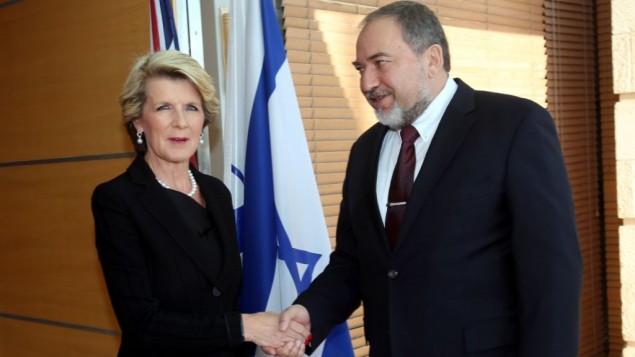
croppedjulie-bishop-and-lieberman-13.1.14-635x357Australian and Israeli Foreign Ministers Julie Bishop and Avigdor Liberman

This is not the first time that Australia has come to Israel’s defence regarding the settlements. In January, Foreign Minister Julie Bishop pointedly asked which precise law the settlements were violating.

Sadly, Australia’s stance runs counter to what some in Israel’s own Knesset declare!

Backing up Australia’s (and Israel’s) reasoned opinion that the “disputed territories” and East Jerusalem are not occupied, here is Eli E. Herz at Myths and Facts:

The term “occupied territory,” which appears in the Fourth Geneva Convention, originated as a result of the Nazi occupation of Europe. Though it has become common parlance to describe the West Bank and Gaza as “occupied territories,” there is no legal basis for using this term in connection to the Arab-Israeli conflict.

Professor Julius Stone, a leading authority on the Law of Nations, categorically rejected the use of the term “occupied territory” to describe the territories controlled by Israel on the following counts:

(1) Article 49 relates to the invasion of sovereign states and is inapplicable because the West Bank did not and does not belong to any other state.

(2) The drafting history of Article 49 [Protection of Civilian Persons in Time of War] – that is, preventing “genocidal objectives” must be taken into account. Those conditions do not exist in Israel’s case.

(3) Settlement of Jews in the West Bank is voluntary and does not displace local inhabitants. Moreover, Stone asserted: that “no serious dilution (much less extinction) of native populations” [exists]; rather “a dramatic improvement in the economic situation of the [local Palestinian] inhabitants since 1967 [has occurred].”

Be that as it may, given the hostile climate towards Israel in international forums, we must applaud Australia’s brave and principled stance, and pray that more nations join her in defending Israel’s basic and inalienable rights to settle its own land. We should also not be afraid to condemn and criticise those, like the US and EU, who condemn and criticise us for no wrong-doing while giving a free pass to terrorists.