Posted tagged ‘Saudi Arabia’

Saudi Arabia Funding Extremist Islamist Groups in Germany?

December 21, 2016

Saudi Arabia Funding Extremist Islamist Groups in Germany? Clarion Project, Codi Robertson, December 21, 2016

(Here is a recent video about Salafist indoctrination of children in Germany.

https://www.youtube.com/watch?v=M3X29ybZdiI

— DM)

A newly-leaked German intelligence report says Saudi Arabia, among several other countries, is funding extremist Islamic groups in Germany.

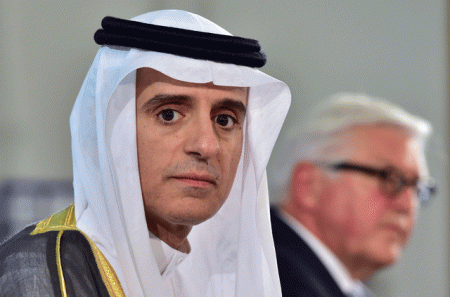
saudi-arabia-germany-foreign-ministers-john-macdougall-afp-getty-640German Foreign Minister Frank-Walter Steinmeier (R) and his Saudi counterpart Adel al-Jubeir give a joint press conferenceat the Foreign Ministry in Berlin. (Photo: © JOHN MACDOUGALL/AFP/Getty Images)

A newly-leaked German intelligence report states Saudi Arabia, Kuwait and Qatar are funding extremist Islamic groups in Germany.

The German newspaper Süddeutsche Zeitung and Northern German public radio broadcaster Norddeutscher Rundfunk saw the brief and raised concern regarding a reported increase in Salafism, an ultra-conservative movement within Sunni Islam, within Germany.

The report, compiled by German domestic intelligence agency Bft and Federal Intelligence Agency (BND) allegedly accuses Saudi Arabia and the two Gulf nations of funding various Islamic institutions including mosques and religious schools, as well as individual strict preachers and conversion, or “dawah” groups.

The three countries supported missionary groups as a “long-running strategy to exert influence,” according to the report.  More specifically, the report called out  the Saudi Muslim World League, Sheikh Eid Bin Mohammad al-Thani Charitable Association and the Kuwaiti Revival of Islamic Heritage Society (which is banned in both the U.S. and Russia for allegedly supporting al-Qaeda).

The report found that these organizations have strong ties to the governments of their home countries.

Neither of the German intelligence agencies have confirmed the accuracy of the leaked report.  There are some who say that say the leak was made intentionally so that Germany would cease controversial arm sales to Saudi Arabia.

While Germans await official word from the intelligence agencies, Saudi Arabia’s German ambassador, Awwas Alawwad, completely rejected the report, stating that his country has “no connection with German Salafism.”

Weeks before the leak, German authorities  banned the Islamic missionary group Germany Die Wahre Religion (DWR), or “The True Religion,” after officials found was “bringing jihadi Islamists together across the country under the pretext of preaching Islam.”

Germany, of course, is not new to the threat of Islamic terrorism.  An attack Monday on a Christmas market in Berlin left 12 dead and close to 50 injured. Two two attacks carried out by Islamic State supporters this past July.

Also, suspicion that Saudi Arabia is funding terrorist organizations is not new.  Especially since the recent disclosures by the Saudis that they had, in fact, funded extremism in the past.

If it is discovered that the Saudis are still funding extremist Islamic groups, it could prove devastating for the West, as Saudi Arabia has been considered one of the few Middle Eastern countries that the West can call an ally.


‘If Russia & Saudi Arabia lead, rest will follow’: Saudi energy minister on historic oil deal

December 11, 2016

‘If Russia & Saudi Arabia lead, rest will follow’: Saudi energy minister on historic oil deal

Published time: 11 Dec, 2016 03:01

Source: ‘If Russia & Saudi Arabia lead, rest will follow’: Saudi energy minister on historic oil deal — RT News

The deal between OPEC members and oil exporting countries from outside the group could bring more stability to the oil market for the common benefit, Saudi energy minister, Khalid Al-Falih, told RT, praising the role of Russia in the agreement.

The Saturday meeting of the members of the Organization of Petroleum Exporting Countries (OPEC) with 12 oil exporting countries outside the group “is significant because [it] has brought so many countries together for the first time,” Al-Falih said.

Read more

© Stringer

Al-Falih stressed that the total volume of oil produced by the countries that attended the meeting is close to 53 million barrels per day out of a total of roughly 90, so their share in the world’s oil production approaches 60 percent. He went on to say that the share of the countries that took part in the negotiations in Vienna on Saturday is even greater in the total volume of oil that is traded because “oil produced by the countries that were not represented at today’s meeting is mostly consumed within the countries that produce it.”

The minister welcomed the agreement on the oil production reduction and hailed Russia’s commitment to the deal.

“This meeting gave us understanding that we are all in the same boat, we all benefit [from being] together while [our attempts] to take advantage of each other” eventually hurt the market, he said, adding that this agreement showed that the OPEC and non-OPEC countries “were able to build trust.”

He then stressed that the parties to the agreement have to reinforce this mutual trust by ensuring the maximum compliance with the agreement and expressed his hope that Russia will take one of the leading roles in this process.

Al-Falih particularly said that he trusts the word of the Russian Economy Minister Aleksandr Novak and expressed confidence that Russia will comply with the terms of the deal.

“If Russia and Saudi Arabia lead, the rest will follow,” he stressed.

He then said that he “does not expect the US government to react to this in any way” to the Saturday deal as it has “not reacted in the past and let the market respond.”

Read more

© Nick Oxford

At the same time, Al-Falih expects oil producers in the US to “respond to the higher prices and more stability” which will result in “healthy” development. Saudi Arabia welcomes the development of the oil industry in the US, as it “has been a center of innovation” and provided “new cost-efficient technologies”, so the Saudis want it to be “competitive and healthy.”

On Saturday, twelve non-OPEC countries, including Azerbaijan, Oman, Mexico, Sudan, South Sudan, Bahrain, Malaysia, Equatorial Guinea, Bolivia, Kazakhstan and Russia, agreed to cut oil production by 558,000 barrels per day (b/d) under the deal with the OPEC members.

OPEC members also confirmed their commitment to the plan to reduce the oil supply by 1.2 million b/d. This, together with the commitments made by non-OPEC states, would lead to the total reduction of oil production by about 1.7-1.8 million b/d, Russian Energy Minister Aleksandr Novak said at the press conference.

The commitments taken by both OPEC and non-OPEC countries put an end to the ’pump-at-will’ policy the group has conducted since 2014, which sent oil prices down from $100 to less than $50 a barrel. Now, both OPEC and non-OPEC oil exporters are trying to push prices up.

Shari’a Law Meets the Internet

December 8, 2016

Shari’a Law Meets the Internet, Gatestone InstituteDenis MacEoin, December 8, 2016

Shari’a councils should not have the right effectively to deny women rights they hold as British citizens under British law.

In the end, the biggest problem is that there is no system of external regulation for the councils. There is no legal requirement for them to keep full records of the cases they adjudicate on, no requirement to report to a civil authority with the right to prevent abuses, and not even a requirement for any council to register with a government agency.

The Muslim Brotherhood in the US itself listed the Fiqh Council of North America (FCNA) as one of several organizations who shared their goals, including the destruction of Western civilization and the conversion of the US into a Muslim nation.

The “minorities” jurisprudents generally favour a non-violent approach to the encounter of Islam and the West, while retaining a critical stance towards the latter and a conviction that Islam must, in the end, replace it. But on occasion, as in the Middle East, violence is sanctioned.


The UK has for several years faced problems with its growing number of shari’a councils (often misleadingly called courts). These councils operate outside British law, yet frequently give rulings on matters such as divorce, child custody, inheritance and more, which are based on Islamic law and in contradiction of the rights of individuals (usually women) under UK legislation. Many Muslim communities in cities such as Bradford, Birmingham, Luton, or boroughs such as Tower Hamlets in London are both sizeable and close-knit; individuals in them are made to live lives in accordance with Pakistani, Bangladeshi and Islamic traditional norms. This means that contact with British life at large is often restricted, with a lack of assimilation that traps many women and girls into lives very close to the lives of their sisters in Muslim countries.

Much of the concern about the “courts” has been expressed by Baroness Caroline Cox, whose bill to limit their impact on Muslim women has passed more than once through the House of Lords and, recently, into the House of Commons. Her personal determination and clear-sightedness have meant that the matter has remained for several years a focus for debate in politics and the media. Her arguments have received widespread support from women’s rights organizations, especially several concerned with the rights of Muslim women.

This year, in addition, two important academic studies of the issue have appeared. First was Machteld Zee’s “Choosing Sharia?: Multiculturalism, Islamic Fundamentalism & Sharia Councils,” which appeared in January. Zee is a Dutch political and legal scholar who carried out research in the UK, where she was given limited access to two shari’a councils, one in Birmingham and one in London. Her book devotes much time to the problems of what she calls “Essentialist Multiculturalism,” specifically the way multiculturalist theorists condemn individuals to be treated according to the culture and religion to which they belong, rather than as people who may wish to reject one or both of these.

An equally pertinent and academically sound treatise appeared in May: Elham Manea’s “Women and Shari’a Law: The Impact of Legal Pluralism in the UK.” Manea is of Yemeni origin; an Associate Professor in the Political Science Institute at the University of Zurich, a Fulbright Scholar, and a consultant for Swiss government agencies and international human rights organizations. Her book also focuses on the way in which multiculturalism undermines individual rights, especially in a chapter entitled, “A Critical Review of the Essentialist Paradigm.”

“Essentialists” demand that individuals conform to the cultural and legal norms of whatever community they are born into, and apparently prefer a multiculturalist vision of competing cultures and faith groups that maintain social distinctions. rather than mixed but well-integrated societies. The result is that restrictions are placed on the freedom of individuals to take their own path in life. In the instance of close-knit Muslim communities, the heaviest impact is on women. This involves forced and early marriage, first-cousin marriage, restriction of education for girls, rejection of appeals for divorce, denial of a woman’s right to child custody, and enforcement of the rule that women are only entitled to much lower inheritance payments than their brothers. It also means that women are limited in their freedom to work. In fundamentalist communities, their loss of that freedom means that they are forced to stay in the home to cook and look after children. This loss of freedom effectively destroys their opportunity to work (or be educated) alongside men. Women are often forbidden to adopt Western clothing norms even while living in open, Western societies. Shari’a “courts” have a deeply regressive influence on matters such as these.

Baroness Cox does not call for the abolition of the shari’a councils, given that Muslims have a right to turn to their own advisors for advice. But shari’a councils should not have the right effectively to deny women rights they hold as British citizens under British law. Many Muslim women are married purely under Islamic law and their marriages are not registered by civil registrars: this means that they can be denied their right to ask for a divorce or child custody from British courts. In the end, the biggest problem is that there is no system of external regulation for the councils. There is no legal requirement for them to keep full records of the cases they adjudicate on, no requirement to report to a civil authority with the right to prevent abuses, and not even a requirement for any council to register with a government agency — leading to the problem of how many councils exist in the country.

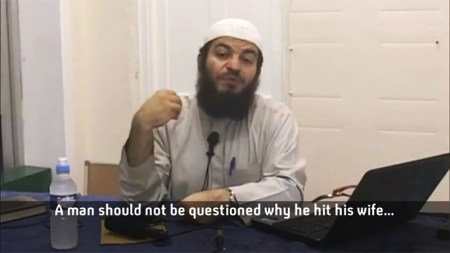
1013Haitham al-Haddad is a British shari’a council judge, and sits on the board of advisors for the Islamic Sharia Council. Regarding the handling of domestic violence cases, he stated in an interview, “A man should not be questioned why he hit his wife, because this is something between them. Leave them alone. They can sort their matters among themselves.” (Image source: Channel 4 News video screenshot)

If political reluctance to upset Muslims is not allowed to prevent Caroline Cox’s bill from becoming law, then there is hope that proper regulation will succeed the present chaos and irregularity that surround the councils as they are now operated. But even this may not be enough. Because of this absence of proper supervision, shari’a rulings impact British Muslims from three directions: through the shari’a councils, from the larger bodies to the informal “courts” that are reputed to operate from small terraced houses in Bradford, Birmingham and elsewhere; through the many online fatwa “banks” (websites) to which individuals refer themselves; and through the fatwas issued by the European Council for Fatwa and Research, based in Dublin.

These last two sources of shari’a rulings are usually ignored in studies of Islamic law in Britain, but they do, in fact, account for an undetermined number of responses to questions from individual Muslims in this country, and more formal diktats seen as binding across Europe, including the UK.

What I term “fatwa banks” are websites run either by individual muftis[1] or larger collective sites on an international scale. The sites I used in “Sharia Law or One Law for All” were Sunnipath, Ask Imam (answers from South Africa, but accessed through the Jamia Madina Mosque in Hyde), Madrasa In’aamiyyah, Darul Iftaa Leicester[2], IslamOnline.net[3], Ask the Scholar, Ask an Alim, Leicester, and the Islamic Shariah Council (Leyton in London).

Others operate out of other countries and in different languages, but can be accessed from the UK without difficulty. The most popular is IslamQ&A, which provides rulings in English and fifteen other languages. It is run from Saudi Arabia by the Salafi mufti Shaykh Muhammad Saalih al-Munajjid, and is not only one of the most popular Salafi websites, but also, according to Alexa.com, the world’s most popular website on the topic of Islam generally. The impact of its fatwas worldwide cannot be exaggerated. It includes some rulings on jihad.[4] There is no space here to reproduce these in full, but here are a few in brief that show the extent to which shari’a rulings diverge from British laws and values.

  1. Waging jihad against Americans (and other enemies of Islam) is to be encouraged.
  2. Shari’a law takes priority over secular law.
  3. A husband may prohibit his wife from leaving the house.
  4. Shari’a law can override British courts.
  5. A Muslim lawyer should not always act in accordance with UK law where it contradicts shari’a.
  6. Polygamy is acceptable even if against the law.
  7. A man may divorce his wife but keep that a secret from her.
  8. Execution or severe beating for homosexuals is correct.
  9. A wife has no property rights in case of divorce.
  10. There is no requirement to register a marriage according to the law of the country one lives in.
  11. A Muslim woman may not marry a non-Muslim man.
  12. Insurance is forbidden even if required by law.
  13. Child marriage is justified.
  14. A husband is not obliged to support a childless wife.
  15. A husband has conjugal rights over his wife. “Both partners have the right to have their physical demands met.” The only difference is that the husband may demand this, while the wife cannot.
  16. Divorce does not require a witness.
  17. Taking out insurance is forbidden.
  18. Medical insurance schemes are forbidden.
  19. If being a police officer in West contradicts shari’a, it is forbidden.
  20. Beating one’s wife is permissible (unless it harshly done).
  21. The mere intention to divorce is sufficient to make it valid, regardless of what is said.

Many of the above rulings are shocking, and by no means all websites or British shari’a councils will endorse many of them. But there they are, freely available to Muslims everywhere. If a believer tends towards strict interpretations of the sacred texts or the laws, he or she may well gravitate to fatwa banks such as these, and may well act on their basis rather than on the judgements of the nearest shari’a council. After all, what real authority do the muftis on the councils have beyond that of the other, online muftis? Shaykh Yusuf al-Qaradawi, for example, outranks pretty well all other contemporary Muslim authorities, with his TV show “Shari’a and Life” reaching an estimated 60 million viewers, and his learned essays promoting his personal views within the overall context of the Muslim Brotherhood, one of the most fundamentalist of today’s Islamic organizations.

Let us leave the British councils for a moment. There is another external source of fatwas. In many Muslim states, shari’a laws may be, and often are, imposed, often to the extent of punishing crimes from theft to murder. This means that matters that would not be crimes in Western states, such as adultery, blasphemy, or apostasy receive corporal punishments or the death penalty.

Knowing that there is no freedom in the West to criminalize these latter faults or to apply shari’a punishments for them, it became essential to come up with fatwas that would give authoritative guidance to Muslims in Western countries on how to conduct themselves in the “Land of War” (“Dar al Harb”, the opposite of the “Land of Islam”) while remaining shari’a-observant. The overall aim is to bring shari’a into Western societies by the back door. Even if Western governments like that of the UK were to find ways to register and control shari’a courts, or even abolish them, religious authorities could subvert this by presenting fatwas that would recommend certain behaviours for individuals and small communities.

The deliberations of the jurisprudents resulted in the need to adapt shari’a rulings to the situation of large-scale Muslim communities living outside enforceable Islamic jurisdictions. This endeavour has been termed Fiqh al-‘Aqalliyyat (“Jurisprudence of the minorities“). The purpose of this system — in which the classical system of Muslims ruling non-Muslims has been reversed — is to find a way to use shari’a without incurring the wrath of the indigenous legal system in secular parliamentary democracies. This has some resemblance to Muslim efforts during the colonial era to use shari’a in personal affairs in British and French colonies such as India or Algeria.

In its current form, the jurisprudence of the minorities dates back to the 1990s. It was developed by two individuals, the formerly mentioned Shaykh Yusuf al-Qaradawi and the late Shaykh Dr. Taha Jabir al-Alwani of Virginia. Al-Qaradawi is, among other things, president of the International Union of Muslim Scholars, a body founded in 2004 with its headquarters in the vastly wealthy Wahhabi state of Qatar. Its close ties to the Muslim Brotherhood have led to its designation by the United Arab Emirates as a terrorist organization. It boasts a membership of at least 90,000 Islamically-qualified scholars from around the world, representing several different sectarian positions.

Al-Alwani (d. 2016) was the founder and former chairman of the Fiqh Council of North America(FCNA), whose 18 members issue religious rulings, resolve disputes, and answer questions relating to Islamic practice. Their declared purpose:

“To consider, from a Shari’ah perspective, and offer advice on specific undertakings, transactions, contracts, projects, or proposals, guaranteeing thereby that the dealings of North American Muslims fall within the parameters of what is permitted by the Shari’ah.”

The FCNA too has close ties to the Muslim Brotherhood, which may, under a bill launched by Senator Ted Cruz, soon be designated by the US as a terrorist organization in its own right. The Muslim Brotherhood in the US itself listed the FCNA as one of several organizations who shared their goals, including the destruction of Western civilization and the conversion of the US into a Muslim nation.

The “minorities” jurisprudents generally favour a non-violent approach to the encounter of Islam and the West, while retaining a critical stance towards the latter and a conviction that Islam must, in the end, replace it. But on occasion, as in the Middle East, violence is sanctioned. When asked in an interview about Palestinian suicide bombings, al-Alwani responded, “We think that the Palestinian people have the right to defend themselves in the way they view as suitable and we will back it and support it.”[5]

That view was, until recently, shared by al-Qaradawi, who has supported terrorism, including suicide bombings.

Dr. Denis MacEoin is the author of Sharia Law or One Law for All as well as many academic books, reports, and hundreds of academic and popular articles about Islam in many dimensions. He is a Distinguished Senior Fellow at the Gatestone Institute.


[1] A mufti (a religious scholar who issues fatwas) is a learned man specializing in Islamic law; he issues judgements on cases, determining what is compliant with his law school, but the sentencing is carried out by a judge (a qadi). Sometimes, the same person performs both functions.

[2] The Darul Iftaa in Leicester was founded and run by Mufti Muhammad ibn Adam al-Kawthari, a graduate of the Deobandi Darul Uloom in Bury.

[3] This important site features a “Live Fatwa” session, where answers are given by Muhammad al-Mukhtar al-Shinqiti, director of the Islamic Center of South Plains in Lubbock, Texas. Al-Shinqiti is a prominent figure in Fiqh al-‘Aqalliyyat.

[4] Examples of fatwas from the above sites (apart from Islam Q&A, which I did not consult at that time) may be found in “Sharia Law or One Law for All,” pages 74 to 127. Unwittingly, they provide insights into the topics to which British Muslims who speak English have access: not just the archives of fatwas that they maintain, but in order to ask questions themselves on matters from oral sex to male doctors seeing female patients.

[5] Cited Fishman p. 11 from the London Arabic newspaper, Al-Sharq al-Awsat.

BREAKING: McCain and Graham Seek to Gut 9/11 Bill to Immunize Foreign Governments Funding Terrorists

December 1, 2016

BREAKING: McCain and Graham Seek to Gut 9/11 Bill to Immunize Foreign Governments Funding Terrorists, PJ MediaPatrick Poole, November 30, 2016

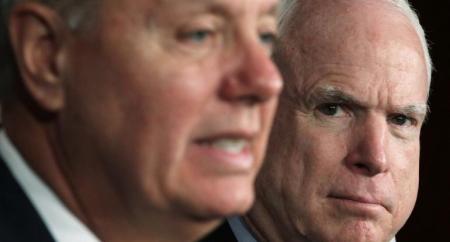
john-mccain-lindsey-graham-saudi-terror-sized-770x415xcU.S. Sen. Lindsey Graham (R-SC) (L) speaks as Sen. John McCain (R-AZ) (R)

In a Senate floor speech today, Senators John McCain and Lindsey Graham announced that they are offering an amendment to strip a key element of the recently passed Justice Against Sponsors of Terror Act (JASTA) that clarifies U.S. law for civil claims against foreign governments for funding terrorism.

JASTA was passed in the Senate in May with no objections, and passed the House of Representatives unanimously in September. President Obama promptly vetoed the bill. The Senate and House successfully voted to override the veto and the bill became law.

McCain and Graham specifically said they want to strip the “discretionary state function” provision from JASTA that creates liability for foreign governments funding terrorist groups.

According to Hill sources familiar with the McCain/Graham amendment, their intention is to immunize countries like Saudi Arabia and Qatar that have funded Sunni terrorist groups in Syria — the Syrian “rebel” effort that both McCain and Graham have publicly supported since 2011.

The McCain/Graham amendment was slammed by 9/11 family groups that fought for JASTA.

The 9/11 Families and Survivors United for Justice Against Terrorism put out the following press release this afternoon:

In a speech on the Senate floor this afternoon Senator Graham pitched this new language as a simple “caveat” but in reality he is proposing to amend JASTA to add a specific jurisdictional defense Saudi Arabia has been relying on for the last 13 years to avoid having to face the 9/11 families’ evidence on the merits.Moreover, Senator Graham and Senator McCain mischaracterized JASTA in several material respects during their speeches today. For example, Senator Graham argued that JASTA is deficient because it does not require that a foreign state have “knowingly” supported terrorism in order for liability to attach, but in fact JASTA’s liability provision expressly requires that the foreign state have “knowingly provided substantial assistance” to a designated terrorist organization in order for liability to arise. Senator Graham also suggested that adding a discretionary function provision to JASTA would protect the US from claims for drone strikes in Pakistan, which is simply incorrect given that Pakistan has made clear its view that domestic and international law prohibit those strikes.

Notably, Graham’s and McCain’s efforts come in the wake of a massive lobbying campaign by the Kingdom of Saudi Arabia which is now employing roughly a dozen Washington lobbying firms at a cost of more than $1.3 million per month.

“In April of this year, Senator Graham met with 9/11 family members from the September 11 Advocates Group and told them that he supported our cause 100%,” said Terry Strada, National Chair for the 9/11 Families and Survivors United for Justice Against Terrorism.

“Senator Graham is now stabbing the 9/11 families in the back. He and Senator McCain are seeking to torpedo JASTA by imposing changes demanded by Saudi Arabia’s lobbyists. We have reviewed the language, and it is an absolute betrayal.”

“The 9/11 Families are fortunate to have Senators John Cornyn and Chuck Schumer to block this action in the Senate, and we take comfort that President-elect Donald Trump strongly supports our cause. The President-elect has made his support for JASTA crystal-clear, and there is zero risk that he will support this kind of backroom backstabbing of the 9/11 families,” Strada concluded.

In their statements today, Senator Graham said with respect to their intentions:

We’re trying to work with Senator Schumer and Senator Cornyn, who deserve a lot of credit for trying to help the 9/11 families. Here’s what we’re asking. We’re asking that we put a caveat to the law we just passed saying that you can bring a lawsuit, but if you’re suing based on a discretionary function of a government to form an alliance with somebody or to make a military decision or a political decision, the only time that government is liable is if they knowingly engage with a terrorist organization directly or indirectly, including financing. I am okay with that because our country is not going to fall in league with terrorists and finance them to hurt other people. If we don’t make this change, here’s what I fear: That other countries will pass laws like this, and they will say that the United States is liable for engaging in drone attacks or other activity in the war on terror and haul us into court as a nation and haul the people that we give the responsibility to defend the nation into foreign courts.

McCain added:

The changes that Senator Graham and I are proposing, I think, are modest. And I think that logically, that you should not pursue or prosecute a government that did not knowingly — the word isn’t abetted or orchestrated, but knowingly — knowingly stand by and assist a terrorist group that they shouldn’t be dragged into our courts. If we don’t fix it, our ability to defend ourselves would be undermined. And I just want to emphasize one more point that the senator from South Carolina made. We have had drone strikes in many places in the world, in many countries in the world. Pakistan is another example. And all of us have supported the efforts, and many of them successful, in destroying those leaders who were responsible for the deaths of American servicemen and women. And it is a weapon in the war against terror. But sometimes, as in war, mistakes are made and innocent civilians were killed along with those terrorists. Does that mean that the United States of America, the government, is now liable? I’m afraid that some in the tort profession would view this as an opening to bring suits against the United States of America.

It appears their intention is to pass the amendments to JASTA during the lame-duck session before they lose key allies, such as Senator Kelly Ayotte, who lost her reelection bid in New Hampshire.

Iran and the Houthis of Yemen

November 29, 2016

Iran and the Houthis of Yemen, Front Page MagazineJoseph Puder, November 29, 2016

shia

Lt. Gen. Sir Graeme Lamb, former head of U.K. Special Forces, wrote in The Telegraph (September 2, 2016), “Iran’s involvement in Yemen must be seen in the broader context of its strategy of challenging the existing Middle East order by generating unrest, which then allows it to maneuver an advantage through the resulting uncertainty.  Iranian military forces and their proxies predominate in Iraq and Syria, while other proxies have a long history of involvement in Lebanon and Gaza.  Nor are these forces likely to leave the region when the immediate threats such as ISIL (Islamic State in Iraq and the Levant) are pushed underground or displaced, as we, the West, will.” 

*******************

Arab News has reported on November 23, 2016 that Yemen’s Houthi rebels and supporters of the former Yemeni President Ali Abdullah Saleh are responsible for the killing of 9,646 civilians.  8,146 of them men, 597 women, and 903 children, from January 1, 2015 to September 30, 2016 in 16 Yemeni provinces.  According to Shami Al-Daheri, a military analyst and strategic expert, the Houthis are being led by Iran and follow Tehran’s orders.  “They are moving in Yemen, Iraq, and Syria following Tehran’s orders.  If the country sees there is pressure on its supporters in Iraq, it issues orders to the Houthis in Yemen to carry out more criminal acts in order to divert attention and ease pressure on its proxies in these countries.”

The brutality of the Iran led campaign in Syria, and U.S. voices calling for some form of intervention, might have prompted Tehran to give the Houthis a green light to attack American naval ships. The Houthis fired three missiles at the U.S. Navy ship USS Mason last month, in all probability following Tehran’s orders. In retaliation, U.S. Navy destroyer USS Nitze launched Tomahawk cruise missiles, destroying three coastal radar sites in areas of Yemen controlled by the Houthis.  These radar installations were active during previous attacks, and attempted attacks on ships navigating the Red Sea. The USS Mason did not sustain any damage.  U.S. Army Gen. Joseph Votel, the top American commander in the Middle East, said that he suspected Iran’s Shiite Islamic Republic to be behind the twice launched missiles by the Houthi rebels against U.S. ships in the Red Sea.

Al-Arabiya TV (August 16, 2016) claimed that Iran’s Islamic Republic News Agency (IRNA) said that missiles made in Tehran were also recently used in Yemen by Houthi militias in cross border attacks against Saudi Arabia.  The Saudis it seems, were able to intercept the Iranian manufactured Zelzal-3 rockets, also delivered to Hezbollah in Lebanon, and Assad regime forces in Syria.  The rockets were fired into the Saudi border city of Najran, according to the official Saudi Press Agency.  The Saudi-led coalition has been targeting the Houthis in an effort to restore the internationally-recognized Yemeni president, Abd Rabbuh Mansour Hadi.

The conflict in Yemen has its recent roots in the failure of the political transition that was supposed to bring a measure of stability to Yemen following an uprising in November, 2011 (The Year of the Arab Spring) that forced its longtime authoritarian president, Ali Abdullah Saleh, to hand over power to his deputy, Abd Rabbuh Mansour Hadi.  President Hadi had to deal with a variety of problems, including attacks by al-Qaeda, a separatist movement in the South, the loyalty of many of the army officers to the former President Saleh, as well as, unemployment, corruption, and food insecurity.

The Zaidi-Shiite Houthi minority captured Yemen’s capital Sanaa on September 21, 2014. They were helped by the Islamic Republic of Iran, who have provided the rebel Houthis with arms, training, and money.  As fellow Shiite-Muslims, the Houthis became another Iranian proxy harnessed to destabilize the Sunni-led Arab Gulf states, and Saudi Arabia.  Since 2004, the Houthis have fought the central government of Yemen from their stronghold of Saadah in northern Yemen.  The Houthis are named after Hussein Badreddin al-Houthi, who headed the insurgency in 2004 and was subsequently killed by Yemeni army forces.  The Houthis, who are allied with Ali Abdullah Saleh, against Abd Rabbuh Mansour Hadi, the legitimate President of Yemen, have the support of many army units and control most of the north, including the capital, Sanaa.

The Houthis launched a series of military rebellions against Ali Abdullah Saleh in the previous decade. Recently, sensing the new president’s (Hadi) weakness, they took control of their Northern heartland of Saadah province and neighboring areas.  Disillusioned by the transition of power and Hadi’s weakness, many Yemenis, including Sunnis, supported the Houthi onslaught.  In January, 2015, the Houthis surrounded the Presidential palace in Sanaa, placing President Hadi and his cabinet under virtual house arrest. The following month, President Hadi managed to escape to the Southern port city of Aden.

Yemen is another flashpoint in the conflict between Shiite-Muslim Iran and Sunni-Muslim Saudi Arabia, over regional power and influence.  Sanaa, along with Baghdad, Damascus, and Beirut are Arab capitals now forming the so called Shiite “arc of influence.”   In Baghdad, the site of the Abbasid Sunni Caliphate, the Shiites dominate the government of Haider al-Abadi.  In Damascus, the capital of the Umayyad Sunni Caliphate, Bashar Assad, an Alawi (offshoot of Shiite Islam) dictator, is ruling over a Sunni majority in a state of civil war.  Iran, its Revolutionary Guards, Iraqi Shiite militias, and the Lebanese Shiite proxy Hezbollah, are fighting Sunni Islamists, and genuine Syrian Sunnis, who are frustrated with being ruled by a minority dictator.  Beirut is dominated by Hezbollah, the only group allowed to carry arms, whose power exceeds that of the Lebanese army, and whose masters in Tehran set its priorities.

Lt. Gen. Sir Graeme Lamb, former head of U.K. Special Forces, wrote in The Telegraph (September 2, 2016), “Iran’s involvement in Yemen must be seen in the broader context of its strategy of challenging the existing Middle East order by generating unrest, which then allows it to maneuver an advantage through the resulting uncertainty.  Iranian military forces and their proxies predominate in Iraq and Syria, while other proxies have a long history of involvement in Lebanon and Gaza.  Nor are these forces likely to leave the region when the immediate threats such as ISIL (Islamic State in Iraq and the Levant) are pushed underground or displaced, as we, the West, will.”

Gen. Lamb asserted that “the tragedy of Yemen is that it has become, over the decades, a sphere of contested influence between the grand masters of Empire and superpowers: East against West, Communism versus Capitalism.  Today, it is Iranian backed Shiite revivalism against Sunni status quo, an emerging order versus an existing order.”  According to Gen. Lamb, Tehran has dissuaded the Houthis from accepting a U.N. peace plan in favor of creating its own “supreme political council” to challenge the legitimate Yemeni government of Abdrabbuh Mansour Hadi.

It is tempting for Tehran to enter the exposed underbelly of Saudi Arabia though the Houthis control of Northern Yemen, bordering Saudi Arabia. It is however, too expensive a proposition for the Islamic Republic to have to fund another proxy – a failing state like Yemen.  While Hezbollah requires millions of dollars in support, Yemen would require billions.  Iran is spending a great deal in support of the Assad regime in Syria, Hamas in Gaza, and loyalist Iraqi Shiite militias.  Iran would nevertheless like to control the sea lanes into the Red Sea and have access to the Bab Al Mandeb strait, which connects the Red Sea to the Gulf of Aden.  This would provide it with a strategic vantage point in threatening the U.S. and the West.

Iran’s meddling in Yemen is another example of its Shiite revivalism, and its challenge of the existing Middle East order, regardless of the cost in human lives that its proxies (Houthis, Hezbollah, Hamas, and Iraqi Shiite militias) are inflicting.

Saudi Jihadi Rehab Actually Encourages Jihad

November 29, 2016

Saudi Jihadi Rehab Actually Encourages Jihad, Front Page Magazine (The Point, Daniel Greenfield, November 28, 2016

four_lions_menus_3_2

You wouldn’t let Guinness or Budweiser run AA. Having the Saudis run a Jihadi rehab program is just as much of a joke. And yet our leaders went along with the joke by pretending that the Saudis were helping transform bad misunderstanders of Islam into good Muslims through Koran lessons and some R&R. The notion that Islam is best fought with Islam came to characterize CVE.

And it’s a bad joke.

Counterterrorism experts have long suspected Saudi Arabia’s “rehabilitation” center for terrorists does a poor job of de-radicalizing jihadists. But a Saudi detainee at Guantanamo Bay now reveals it’s actually a recruiting and training factory for jihad.

According to recently declassified documents, senior al Qaeda operative Ghassan Abdullah al-Sharbi told a Gitmo parole board that the Saudi government has been encouraging previously released prisoners to rejoin the jihad at its terrorist reform school, officially known as the Prince Mohammed bin Naif Counseling and Care Center.

The Obama administration has praised the effectiveness of the Saudi rehab program — which uses “art therapy,” swimming, ping-pong, PlayStation and soccer to de-radicalize terrorists — and conditioned the release of dozens of Gitmo prisoners, including former Osama bin Laden bodyguards, on their entry in the controversial program.

Al-Sharbi dropped a bombshell on the Gitmo parole board at his hearing earlier this year, when he informed members that the Saudi kingdom was playing them for suckers. “You guys want to send me back to Saudi Arabia because you believe there is a de-radicalization program on the surface.

True. You are 100% right, there is a strong — externally, a strong — de-radicalization program,” al-Sharbi testified. “But make no mistake, underneath there is a hidden radicalization program,” he added. “There is a very hidden strong — way stronger in magnitude — broader in financing, in all that.”

Al-Sharbi is one of the longest serving, and most unrepentant, prisoners at Gitmo. A Saudi national with an electrical engineering degree from King Fahd University, he attended a US flight school associated with two of the 9/11 hijackers. He traveled to Afghanistan in the summer of 2001 and trained at an al Qaeda camp, building IEDs to use against allied forces.

Al-Sharbi was captured March 28, 2002, at an al Qaeda safehouse in Faisalabad, Pakistan, with senior al Qaeda leader Abu Zubaydah. According to his US intel dossier, he told interrogators that “the US got what it deserved from the terrorist attacks on 9/11.”

Given a chance at parole after 14 years, however, Al-Sharbi was surprisingly frank with the board.

He explained that Riyadh is actively recruiting and training fighters to battle Iranian elements in neighboring Yemen and Syria. Saudi views Shiite-controlled Iran as a regional threat to its security.

“They’re launching more wars and the [United] States is backing off from the region,” he said. “They’re poking their nose here and here and there and they’re recruiting more jihadists, and they’ll tell you, ‘Okay, go fight in Yemen. Go fight in Syria.’ ”

Al-Sharbi said the Saudis also are “encouraging” former detainees “to fight their jihad in the States.”

This isn’t a mystery to anyone. We simply insist on pretending that the Saudis aren’t involved in terror.

Saudi Arabia is already here, in Toronto

November 25, 2016

Saudi Arabia is already here, in Toronto, CIJ NewsDiane Weber Bederman, November 24, 2016

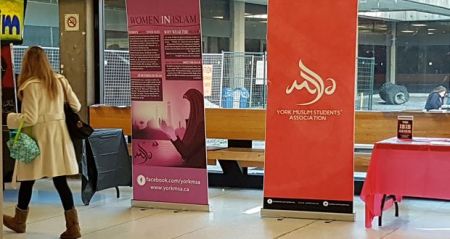
islam-awareness-week-at-york-u-4-photo-cijnewsIslam Awareness Week at York U. Photo: CIJnews

Well, Mr. Prime Minister, you don’t have to move Saudi Arabia to live in that culture, because under your government, these intolerant, abhorrent teachings are here in Canada, at universities and in our bookstores and shared in public places like Dundas Square in downtown Toronto. They are teachings that Muslims are trying to have accepted here in Canada.

***********************

Dear Prime Minister, Justin Trudeau,

If you were to take your family, your wife and children and move to Saudi Arabia, as an immigrant, not an expat, how long do you think it would take you to embrace the culture of your adopted country?

How long would it take before you preached the need for women to wear a Burka when leaving home, and that they must be accompanied by a male relative at all times?

Or how long before your beautiful, independent wife Sophie Grégoire Trudeau (she has kept her maiden name and said in Havana that women “can no longer be ignored”), would accept that she cannot drive, can no longer be independent of you, that her husband has not only the right but the responsibility to punish his wife for not performing her wifely duties, and that it is appropriate to beat your wife to bring her into line? Would Mme Grégoire Trudeau accept a lashing in the street from the religious police for any perceived infraction of the laws regarding modesty?

How long would it take the two of you, Sir, to teach your sons that women are inferior to men and your daughter that she has few civil rights, and that Muslims are superior to all others? And how would you explain to your children, Xavier James , Ella-Grace Margaret , and Hadrien the sight of men hanging from cranes in the middle of the square-guilty of being gay?

And what would you say to your children as you walked along the streets and saw people without hands or feet-amputated in the name of Islamic justice? And how would you explain to your children that it is appropriate to refer to Jews as pigs and descendants of apes? That is acceptable to call for “Death to the West” and “Death to Israel”?

Well, Mr. Prime Minister, you don’t have to move Saudi Arabia to live in that culture, because under your government, these intolerant, abhorrent teachings are here in Canada, at universities and in our bookstores and shared in public places like Dundas Square in downtown Toronto. They are teachings that Muslims are trying to have accepted here in Canada. They are using the false claim of freedom of religion when in fact this has nothing to do with religion and everything, Sir, to do with trying to bring Sharia Law, the ethic that underpins the ideology of Islam and undermines western freedom into law in Canada.

I am going to go out on a limb here and suggest that you would never embrace those teachings-that ideology. That you and your wife would enver accept the teachings in “Women in Islam & Refutation of some Common Misconceptions,” authored by the Saudi scholar Dr. Abdul-Rahman al-Sheha and printed by the Saudi Dawah organization Muslim World League (رابطة العالم الاسلامي) Or teachings being promulgated in Canada in the book “The Quran” (Saheeh International) shared now at York University during Islam Awareness Week.

The following are excerpts from the book that include Quranic verses followed by a modern interpretation:

Surah (chapter) Al-Baqarah

Verse 79

So woe 32 to those who write the “scripture” with their own hands, then say, “This is from Allah,” in order to exchange it for a small price. Woe to them for what their hands have written and woe to them for what they earn.

Footnote 32

i.e., death and destruction.

Verse 131

When his Lord said to him, “Submit,” he said, “I have submitted [in Islam] 45 to the Lord of the worlds.”

Footnote 45

The meaning of the word “Islam” is “submission to the will of Allah.” This is the way of life ordained by Allah and taught by all of the prophets from Adam to Muhammad (PBUH). A Muslim is one who submits himself to Allah.

Verse 191

And kill them wherever you overtake them and expel them from wherever they have expelled you, and fitnah 69 is worse than killing. And do not fight them at al-Masjid al-Haram until they fight you there. But if they fight you, then kill them. Such is the recompense of the disbelievers.

Footnote 69

Among the meanings of fitnah are disbelief and its imposition on others, discord, dissension, civil strife, persecution, oppression, injustice, seduction, trial and torment.

Or Surah (chapter) Al-Maidah

Verse 33

Indeed, the penalty 262 for those who wage war 263 against Allah and His Messenger and strive upon earth [to cause] corruption is none but that they be killed or crucified or that their hands and feet be cut off from opposite sides or that they be exiled from the land. That is for them a disgrace in this world; and for them in the Hereafter is a great punishment,

Footnote 262

Legal retribution.

Footnote 263

i.e., commit acts of violence and terrorism against individuals or treason and aggression against the Islamic state.

Or this:

Verse 75

And among the People of the Scripture is he who, if you entrust him with a great amount [of wealth], he will return it to you. And among them is he who, if you entrust him with a [single] silver coin, he will not return it to you unless you are constantly standing over him [demanding it]. That is because they say, “There is no blame upon us concerning the unlearned.” And they speak untruth about Allah while they know [it].

Footnote 133

The Jews do not consider it a sin to cheat or lie to a gentile or a pagan.

Verse 112

They have been put under humiliation [by Allah] wherever they are overtaken, except for a rope [i.e., covenant] from Allah and a rope [i.e., treaty] from the people [i.e., the Muslims]. 144 And they have drawn upon themselves anger from Allah and have been put under destitution. That is because they disbelieved in [i.e., rejected] the verses of Allah and killed the prophets without right. That is because they disobeyed and [habitually] transgressed.

Footnote 144

Once they have surrendered, the People of the Scripture retain their rights and honor (in spite of their refusal of Islam) through payment of the jizyah tax in place of zakah and military service due from Muslims. They are then under the protection of the Islamic state.

Just take a walk with your family along Dundas Square or stroll through York University. You can talk to people who share these beliefs openly and proudly and are expending great energy in proselytizing them. So, Sir, as a proud feminist and supporter of LGBTQ2 rights, a man who cherishes diversity, accommodation, inclusion, and tolerance, how do you defend these teachings in our cities and universities, let alone to your wife and children? And will these ideals be taught during Muslim Heritage Month?

As always, Sir, I look forward to your comments. I am ever hopeful that one day you will take the time to respond to my concerns, Sir, for I have no doubt that there are millions of Canadians who would like to hear the answers to these questions. And, Sir, we have that right and you, Sir, have the obligation to respond.

Islamic literature in Toronto deals with wife beating, stoning, crucifixion, amputation

Muslim Dawah (outreach, “call to Islam”) activists at Toronto’s Dundas Square distributed during recent years a variety of Islamic literature (click HERE)

The following are the highlights of some of the Islamic books/booklets which were obtained by CIJnews:

  • Homosexuality is a major sin

  • Liberated’ Western women… are trapped in a form of slavery
  • Polygamy is permitted in certain conditions

  • Wife must obey the “commands” of her husband

  • Wife beating is permissible in certain conditions (“Submissive or subdued women… may even enjoy being beaten”)

  • Muslims have a duty to spread the message of Islam in society

  • Prayers to Allah to give Muslims victory over the disbelievers
  • Non-Muslims of an Islamic State have to pay the jizya (poll-tax) tax
  • Punishment of flogging for public intoxication and traffickers

  • Punishment of stoning to death for married adulterers

  • Punishments of amputation (hand and leg), crucifixion and execution in serious crimes
  • Punishment of cutting off the hand for the thief

  • Punishment of execution for apostates
  • Possession of slaves is permissible in certain conditions.

ICNA Canada’s online syllabus: women are inferior to men, Western civilization “enemy” (clickHERE)

ICNA Canada’s online syllabus: Songs, music, jesters, buffoons are “satanic work” (click HERE)

ICNA Canada’s online syllabus: Muslim wife must obey her husband when he calls her to bed(click HERE)

ICNA Canada’s online syllabus: “majority of the dwellers of Hell are women” (click HERE)

ICNA Canada’s online syllabus: pregnant adulteress to be stoned after giving birth (click HERE)

ICNA Canada’s online syllabus on wife beating (click HERE)

ICNA Canada’s online syllabus on stoning adulterers, chopping off thieves’ hands (click HERE)

ICNA Canada’s online syllabus on wearing hijab and honour killing in Islam (click HERE)

ICNA Canada’s online syllabus legalizes “slave-girls” (click HERE)

ICNA Canada online syllabus: “Muslims will dominate the Jews”, kill them (click HERE)

ICNA Canada syllabus: “give us victory over the disbelieving people” (click HERE)

ICNA Canada’s syllabus explains ruling on ‘sex slaves’ in Islam (click HERE)

ICNA Canada free book: “Every human being is born as a Muslim” (click HERE)

ICNA – Canada’s senior official appears to blame gays for Ontario “lurid” sex education (clickHERE)

Trudeau: We strive to show that “Islam is not incompatible” with Western values (click HERE)

Germany bans Muslim org used as front to recruit jihadists

November 15, 2016

Germany bans Muslim org used as front to recruit jihadists, Creeping Sharia, November 15, 2016

salafistSalafist preacher Ibrahim Abou-Nagie was known for his campaign to distribute Korans to every household in Germany, Switzerland and Austria

Sounds like CAIR. Unfortunately for Germans, their leaders have not banned Muslim immigration – the carriers of the ideology.

Source: Germany bans Islamist organization after raids – CNN.com

German authorities have banned an Islamist organization that they say is responsible for inspiring 140 youths to join the Syria conflict.

Germany Interior minister Thomas de Maiziere announced the ban on Tuesday after police carried out dawn raids on around 200 targets connected to The True Religion, a Salafist organization, across 10 states.

“As a federal minister, I today banned the organization called The True Religion,” de Maiziere told reporters, adding that the ban addressed “the misuse of religion and extremist religions.”

“We do not accept and won’t tolerate” the acts of this network, de Maiziere said, adding that it glorified death and terror.

Salafism is an ultrafundmentalist branch of Islam that is particularly prevalent in Saudi Arabia. It is intolerant of what its adherents consider “deviant” or mainstream Sunni Islam, including Islamic sects, such as Shia Islam, as well as other world religions.

The True Religion is led by prominent Salafist preacher Ibrahim Abou-Nagie, who was born in a refugee camp in Gaza and moved to Germany when he was 18. He later became a German national.

The raids targeted mosques, apartments, offices and storage halls. The main focuses of the raids were in the states of North Rhine-Westphalia, Hesse and Hamburg, de Maiziere said.

In Berlin 200 officers took part in raids on 20 sites, Berlin police told CNN.

Abou-Nagie triggered national debate in Germany in 2011 when he spearheaded a drive to give a copy of the Koran to every German, Swiss and Austrian household.
Federal Police in September said 800 German nationals had traveled to Syria to join the conflict.

Al-Hariri’s Choice Of Hizbullah Ally Aoun For Lebanese Presidency Is Another March 14 Forces Concession To Pro-Iran Axis

October 28, 2016

Al-Hariri’s Choice Of Hizbullah Ally Aoun For Lebanese Presidency Is Another March 14 Forces Concession To Pro-Iran Axis, MEMRI, E.B. Picali and Y. Yehoshua, October 28, 2016

Introduction

On October 31, 2016, the Lebanese parliament will convene and is expected to vote in Free Patriotic Movement leader and Hizbullah ally Michel Aoun as president of Lebanon; he is Hizbullah’s sole candidate. The move follows a deal struck between Aoun and former Lebanese prime minister Sa’d Al-Hariri, leader of the Sunni Al-Mustaqbal stream, under which Aoun, if elected, will assign Al-Hariri the task of forming the next government.

This move by Al-Hariri has significant implications for the intra-Lebanese political arena and for the regional power balance. Therefore it has encountered criticism both within and outside Lebanon. This move represents a surrender by the March 14 Forces, headed by Al-Mustaqbal, to Hizbullah’s will, and reinforces the position of Hizbullah’s patron Iran at the expense of Saudi Arabia.

The following report reviews Al-Hariri’s decision, the reactions it has encountered, and what it means for Lebanon and the region.

Hizbullah Ally Aoun Expected To Be Chosen President

On October 31, 2016, the Lebanese parliament will hold its 46th presidential selection session since Michel Suleiman’s term ended two-and-a-half years ago.  That session is expected to choose Free Patriotic Movement leader Michel Aoun, who is an ally of Hizbullah, as president. Aoun’s selection will end a two-and-a-half-year presidential vacuum that resulted from disagreement over Suleiman’s successor from among the country’s opposing streams – primarily Al-Mustaqbal, led by Sa’d Al-Hariri, and Hizbullah, which together with Aoun stymied the formation of the quorum that is necessary to elect a president. The breakthrough in the talks over the selection of a president came when Al-Hariri and Aoun reached an agreement under which Al-Hariri would support Aoun’s presidential candidacy and in return Aoun would task Al-Hariri with forming the new government, which would be a national unity government as stipulated in the agreement.[1] This constitutes an Al-Hariri surrender to Hizbullah, which sought an Aoun presidency. It should be mentioned that Al-Hariri’s support for an overt Hizbullah ally is not unprecedented; a year ago, Al-Hariri announced his support for another ally of Hizbullah, and of Syrian president Bashar Al-Assad, Suleiman Frangieh, for the post of Lebanese president.[2]

Al-Hariri announced his support for Aoun in an October 20, 2016 speech, saying that by supporting him he was aiming to save Lebanon from dangerous leadership and economic crises which could, in turn, lead to a new civil war.[3]

Two days later, on October 22, Hizbullah secretary-general Hassan Nasrallah announced that his party’s MPs, who had been boycotting presidential selection sessions, as had MPs from other parties including Aoun’s own Change and Reform bloc, would be attending the October 31 session and would be choosing Aoun.  Nasrallah added that Hizbullah had no objections to Al-Hariri’s serving as prime minister in the new government.

These statements by Al-Hariri and Nasrallah pave Aoun’s path to the presidential palace, even though obstacles and uncertainty remain, both in Lebanon and in the region, in this matter.

Various Lebanese Elements Oppose Aoun’s Appointment As President

The opposition to Aoun’s appointment comes mainly from Lebanese parliamentary speaker Nabih Berri, and from Suleiman Frangieh, who is running against Aoun in the presidential race. Both Berri and Frangieh are March 8 Forces members and open Hizbullah allies. Berri even announced that he would not be part of the government that would be established under the Al-Hariri-Aoun deal, and questioned the deal’s future, saying that it had been arrived at by two sides only, without taking into account the country’s main political elements, himself among them. Druze leader and centrist bloc member Walid Jumblatt, who is another major Lebanese political figure, has not yet expressed a position on this matter, but it is thought that he will back Aoun.

On the other side as well, some in Al-Hariri’s Al-Mustaqbal party and in the March 14 Forces in general   oppose this deal. Immediately after Al-Hariri’s October 20 announcement of support for Aoun, another former prime minister, Fouad Al-Siniora, the head of the Al-Mustaqbal party, (a component of Al-Hariri’s broader Al-Mustaqbal stream) announced that he would not join Al-Hariri in backing Aoun for president. Al-Siniora was joined by other party members, including parliamentary vice president Farid Makari, MPs Ahmad Fatfat and Ammar Houri, Telecommunications Minister Boutros Harb of the March 14 Forces, and March 14 Forces secretary-general Fares Souaid.

Along with the opposition to an Aoun presidency within the Al-Mustaqbal party, other Sunni public figures also objected to the deal, among them Justice Minister Ashraf Rifi, former director-general of the Lebanese Internal Security Forces and a former Al-Hariri supporter. Last year, Rifi harshly attacked Al-Hariri for his support for Hizbullah and Syrian regime ally Suleiman Frangieh. On October 22, 2016, two days after Al-Hariri’s announcement of his support for Aoun as president, Rifi organized an anti-Aoun protest in Tripoli called “Proud Tripoli Rejects the Candidate of Iranian Patronage.” The next day, October 23, a convoy of vehicles from Akkar in the north of the country made its way to Rifi’s home in Tripoli bearing posters of him and expressing support for his position on this matter. It should be mentioned that in the past year, Rifi has gradually chipped away at overall Lebanese Sunni support for Al-Hariri, as evidenced by his party’s landslide victory over Al-Hariri’s party in the mayoral elections in Tripoli, the city with the largest Sunni concentration in the country.

Many in the Al-Mustaqbal party, the March 14 Forces, and the Sunni public who oppose the Al-Hariri-Aoun deal see Al-Hariri’s support for Aoun as yet another concession to Hizbullah and the pro-Iran axis that backs it, and to Hizbullah as an armed state within a state.[4] They accuse Al-Hariri, inter alia, of seeking to become prime minister by selling out Sunni interests and the political legacy of his father Rafiq Al-Hariri, whose 2005 assassination, when Syria was the real power in Lebanon, is thought to have been carried out by five senior Hizbullah officials.

Addressing critics of his deal, Al-Hariri explained his support for Aoun as well as his previous support for Frangieh: “I am willing to take the risks a thousand times over, just as I am willing to risk myself, my people, and my political future, to defend Lebanon and its people.”[5]

Al-Hariri’s Choice Of Aoun Is A Political Victory For Hizbullah

Al-Hariri’s move to support the Hizbullah candidate and ally Aoun has major implication for the internal Lebanese political arena. It constitutes another successful attempt by Hizbullah to impose its wishes there and a further weakening of the country’s main Sunni force, the Al-Mustaqbal party. This triumph for Hizbullah comes at a time when it is mostly preoccupied outside of Lebanon’s borders, primarily with fighting alongside the Assad regime in Syria, as well as elsewhere in the Arab world as a proxy of Iran. The organization has fortified its position within Lebanon by virtue of its network of political alliances in the country, as well as by virtue of the quantity of weapons in its possession.

Ibrahim Al-Amin, head of the board of directors of the Lebanese daily Al-Akhbar and a known Hizbullah supporter, argued that the March 14 Forces, including the Al-Mustaqbal stream, show “the symptoms of card-game addicts,” who delude themselves that they can win and are “unwilling to give up” even when it is clear that it is Hizbullah who is actually directing events on the ground.[6]

At the same time, Hizbullah’s success in pushing its own candidate through is also a result of the political weakness of its rivals, particularly the Hariri-led Al-Mustaqbal stream, who wants the premiership at nearly any cost in order to strengthen his own political status in the country and perhaps his economic status as well.

An Aoun presidency does not mean that the issues contributing to the vast schism between the sides in Lebanon will be resolved, among them the disarming of Hizbullah as demanded by the March 14 Forces – Aoun opposes the organization’s disarmament.[7] As president, Hizbullah ally Aoun would be in charge of a number of security and military portfolios, aggravating the tension between the sides and jeopardizing the army’s independence .

Additionally, the Al-Hariri-Aoun deal does not guarantee that Al-Hariri will actually succeed in forming a government, because of the opposition he faces both inside and outside Lebanon. The deal with Aoun could also harm Al-Hariri’s status among his traditional Sunni support base, thus weakening him in the upcoming spring 2017 parliamentary elections.

An Aoun Presidency: Ramifications For The Regional Power Balance – Down With Saudi Arabia, Up With Iran

Since Lebanon’s future depends on the regional political balance, with Iran, Syria, and Saudi Arabia the patrons of various local Lebanese political players, Al-Hariri’s move has regional ramifications. His surrender to Hizbullah’s wishes reflects the strengthening of Iran, which has exploited the Syrian civil war to deepen its penetration of the region and of Lebanon in particular. Electing the Hizbullah presidential candidate Aoun will definitely serve future pro-Iran interests in Lebanon at the expense of Sunni interests in Lebanon, and also at the expense of Saudi Arabia, which views itself as the protector of these interests.

Saudi Arabia has previously backed Al-Hariri’s past substantial political moves even if these moves haven’t always served Saudi political interests in Lebanon or elsewhere. It is still unclear whether his deal with Aoun has Saudi support, and the Lebanese press has published conflicting reports on the matter. As yet, there has been no official Saudi comment on this, but recent articles in the Saudi press indicate a lack of support for Al-Hariri’s deal with Aoun. However, following a lengthy Saudi silence, Saudi Gulf Affairs Minister Thamer Sabhan, who visited Beirut on October 27 said that his country would not intervene in the selection of Lebanon’s president and would support the president chosen by the Lebanese.[8]

There were also reports in the Lebanese press noting that Al-Hariri’s political status in Lebanon is declining, and that the Saudis no longer consider him the sole representative of the Sunnis in Lebanon, but only one such representative.

It should be noted that in previous years, Saudi Arabia, as the leader of the Sunni world, played a key role in the selection of Lebanese presidents, as did Syria, which together with Hizbullah’s patron Iran represented the resistance axis. Al-Hariri’s choosing Aoun for president without full Saudi backing reflects a decline in Saudi influence in Lebanon, and in Saudi Arabia’s regional status in general. In this context, a report in the Lebanese daily Al-Safir, a known supporter of the resistance axis, claims that Egypt was involved in promoting Aoun’s prospects for the presidency.[9] A possible inference from this report is that Egypt is attempting to step into Saudi Arabia’s shoes in Lebanon in an attempt to restore its status in the Arab world, and particularly in the Sunni world.

Articles in the daily Al-Akhbar, known for its pro-Hizbullah line, addressed the regional implications of Al-Hariri’s gambit and gloated that the move reflected Saudi Arabian weakness. Al-Akhbar columnist Ghassan Saoud wrote that an Aoun presidency would be a manifestation of “Hizbullah’s ability to break the international will, and the Saudi will.”[10]

However, Ibrahim Al-Amin wrote in an Al-Akbar editorial that wars in the Arab region created a reality that was forcing the March 14 Forces to see the choice of Lebanese president differently, and that they needed to realize that the Saudis can no longer help them. As he usually does, he concluded his piece with implied threats, stating: “Anyone who does not want anarchy in Lebanon has no alternative but to choose Aoun for president.”[11]


*E. B. Picali is a research fellow at MEMRI; Y. Yehoshua is Vice President for Research And Director of MEMRI Israel


Endntoes:

[1] One of the main political players pushing for an Aoun presidency is Samir Geagea, chairman of the Lebanese Forces. In January 2016, after a long period of talks, Geagea and Aoun, formerly bitter Christian political rivals, agreed that Geagea would support Aoun’s presidential bid. One of the main reasons behind Geagea’s decision to do so was Al-Hariri’s previous support for the presidential candidacy of Suleiman Frangieh – a fierce rival of Geagea who had been accused of killing several members of the Frangieh family during the country’s civil war.

[2] Similarly, in 2008, during another presidential interregnum, the March 14 Forces and Al-Hariri were forced to make concessions to Hizbullah, which was included in the newly formed Fouad Siniora government; this took place at the Doha conference. The most important concession won by the Hizbullah-led March 8 Forces, as stipulated in the government guidelines, was the legitimation of the Resistance (which allowed Hizbullah to operate as an independent armed force within Lebanon). Hizbullah also received enough cabinet seats to veto any government decision, and Hizbullah subsequently used this veto power against Al-Hariri’s government in 2011. Hizbullah obtained these concessions following the leadership vacuum, the lengthy Hizbullah siege on central Beirut, and the violent events of May 7, 2008.

[3] Al-Mustaqbal (Lebanon), October 21, 2016.

[4] See MEMRI Inquiry & Analysis Series Report No. 1092, Al-Mustaqbal Losing Ground As Representative Of Lebanese Sunnis, May 19, 2014.

[5] Al-Mustaqbal (Lebanon), October 21, 2016.

[6] Al-Akhbar (Lebanon), October 24, 2016.

[7] In an interview with Al-Akhbar, Lebanese Foreign Minister Gebran Bassil, who is Aoun’s son-in-law and heads the Change and Reform bloc founded by Aoun, said that Free Patriotic Movement, to which the Change and Reform bloc belongs, supports Hizbullah’s retention of its weapons. Al-Akhbar(Lebanon), October 22, 2016.

[8] Al-Watan (Saudi Arabia), October 28, 2016.

[9] Al-Safir (Lebanon), October 25, 2016.

[10] Al-Akhbar (Lebanon), October 27, 2016.

[11] Al-Akhbar (Lebanon), October 24, 2016.
The Story Changes: The Pentagon Is No Longer Sure Yemen Fired Missiles At A US Ship

October 21, 2016

The Story Changes: The Pentagon Is No Longer Sure Yemen Fired Missiles At A US Ship

Source: The Story Changes: The Pentagon Is No Longer Sure Yemen Fired Missiles At A US Ship | Zero Hedge

Last Thursday, after two consecutive missile attacks on the US Navy ship USS Mason, which allegedly were launched by Houthi rebel forces in Yemen, the US entered its latest military engagement in the middle east, when the USS Nitze launched several Tomahawk cruise missiles aimed at radar installations located by the Bab el-Mandab straight, and which enabled the launch of at least three missiles against the U.S. ship.


The USS Mason (DDG 87), a guided missile destroyer

As Pentagon spokesman Peter Cook said, “these limited self-defense strikes were conducted to protect our personnel, our ships and our freedom of navigation,” adding that “these radars were active during previous attacks and attempted attacks on ships in the Red Sea,” including the USS Mason, one of the officials said, adding the targeted radar sites were in remote areas where the risk of civilian casualties was low. That said, as we highlighted, the U.S. said while there growing indications, there was no official proof that Houthi fighters, or forces aligned with them, were responsible for the attempted strikes which targeted US ships. Still, the lack of concrete proof did not bother the US which, cavalier as usual, unleashed the missile assault on Yemeni territory, breaching the country’s sovereignty and potentially killing an unknown number of people.

However, today – four days after the US “counterattack” – the story changes. According to Reuters earlier today the Pentagon declined to say whether the USS Mason destroyer was targeted by multiple inbound missiles fired from Yemen on Saturday, as initially thought, saying a review was underway to determine what happened.

We are still assessing the situation. There are still some aspects to this that we are trying to clarify for ourselves given the threat — the potential threat — to our people,” Pentagon spokesman Peter Cook told a news briefing.”So this is still a situation that we’re assessing closely.”

And yet, the US had no problem with “clarifying” the source of the threat on Thursday when it fired American cruise missiles at Yemeni targets.

At this point we refer readers to what we said on Thursday, when we once again put on the cynical hat, and voiced what those who have not been brainwashed by US media thought, to wit:

In retrospect one now wonders if the “cruise missiles” that fell close to the US ships were merely the latest false flag providing the US cover to launch another foreign intervention.To be sure, the Houthis, who are battling the internationally-recognized government of Yemen President Abd Rabbu Mansour al-Hadi, denied any involvement in Sunday’s attempt to strike the USS Mason.

A few days later, we have the closest thing possible to a confirmation that, even as the Pentagon itself admits, the “open and closed” case that Yemeni rebel fighters would, for some unknown reason, provoke the US and fire unperforming cruise missiles at a US ship, has just been significantly weakened. Of course, it if it wasn’t Yemen rebels, the only logical alternative is the adversary of Yemen’s rebels: Saudi Arabia. Although with the Saudis in the press so much as of late, almost exclusively in a negative light, we doubt that the Pentagon’s “assessment” would ever get to the point where it would admit that America’s Saudi allies launched missiles at US ships in a false flag attempt to get the US involved in the Yemen conflict by attacking the Saudi opponents and in the process aiding and abetting the Saudi execution of even more “war crimes.”