Posted tagged ‘Saudi Arabia’

‘We will participate’: Saudi military admits US coalition mulling ground invasion in Syria

March 1, 2016

‘We will participate’: Saudi military admits US coalition mulling ground invasion in Syria

Published time: 1 Mar, 2016 03:23

Source: ‘We will participate’: Saudi military admits US coalition mulling ground invasion in Syria — RT News

© Faisal Al Nasser
Saudi Arabia has acknowledged that the US-led anti-ISIS coalition has held a “political” discussion about a potential ground troop deployment in Syria. Riyadh’s statements have been criticized by Damascus as destructive and a threat to regional security.

In an interview with Reuters, an aide to Saudi Arabia’s defense minister, Brigadier General Ahmed Asseri, confirmed that defense ministers from the anti-Islamic State (IS, formerly ISIS/ISIL) coalition debated placing ground troops on the ground in Syria during a ministerial meeting in Brussels last month.

“It was discussed two weeks ago in Brussels,” Asseri said, clarifying that the discussions took place on the “political” level only without going into details of a potential “military mission.”

Read more

© Bulent Kilic

The general stressed that if the decision is made, Saudis would be more than willing to contribute troops – a move that Syria strongly warned against on a number of occasions. Asseri also acknowledged that Riyadh has been working on the military implementation of a possible Syria invasion.

“Once this is organized, and decided how many troops and how they will go and where they will go, we will participate in that,” he said.

“We need to discuss at the military level very extensively with the military experts to make sure that we have a plan.”

The Saudi general stressed that for the time being, the Kingdom’s air force is ready to strike Islamic State targets from Turkey’s Incirlik air base, where four Saudi fighter jets were deployed last month.

Washington also confirmed Saudi Arabia’s’ willingness to strike targets in Syria, with State Department spokesman John Kirby saying that the US would welcome the Kingdom’s participation.

“But there’s a lot that needs to be discussed in terms of what they would do, what their makeup would be, how they would need to be supported by the coalition going forward. So there’s a lot of homework that needs to be done,” Kirby said.

Read more

© Ammar Abdullah

Saudi Arabia’s push for ground incursion into Syria comes at a time when Moscow warned that Turkey is strengthening its military positions on the border with Syria at a time when US and Russia are doing their best to cement a fragile ceasefire in the country.

On Monday, an official source at the Syrian Foreign and Expatriates Ministry told Syria’s official SANA news agency that Saudi Arabia is playing a “destructive role” in the peace process while “threatening security and stability” of the world.

The statement came in reply to Saudi Foreign Minister Adel Al-Jubeir comments that he made on Sunday, accusing Syrian troops of violating the ceasefire brokered by Russia and the US, and reiterating the Kingdom’s position that Bashar Assad has no place in the future of Syria.

The Syrian official stressed that Al-Jubeir’s statements violate UN Security Council resolution 2268 that endorses the ceasefire. The resolution specifically demands that all parties to the agreement use their influence to ensure that parties to the Syrian conflict fulfill their commitments and create the conditions for a durable ceasefire.

In this regards, the source told SANA that Damascus requests that the UN Secretary-General form a committee to examine the possibility of “crimes that were committed and are still being committed by the Saudi regime and in the Arab world.”

Meanwhile, a US defense official told Reuters that Washington will continue to support forces on the ground in Syria that fight against Islamic State terrorists.

“We will continue to provide equipment packages to vetted leaders and their units so that over time they can make a concerted push into territory still controlled,” the official said. “As a matter of policy, we won’t comment or speculate on potential future operations.”

From Hitler to Erdogan: Liberal Passivity in the Face of Another Rising Fascist Empire

February 19, 2016

From Hitler to Erdogan: Liberal Passivity in the Face of Another Rising Fascist Empire

By Saladdin Ahmed

Thu, 18 Feb 2016, 01:07 PM

Source: From Hitler to Erdogan: Liberal Passivity in the Face of Another Rising Fascist Empire — The Jerusalem Post

Had Hitler been confronted in Spain, the world could have been spared World War II, saving many millions of lives both in Germany and elsewhere. Instead, international passivity in the face of Hitler’s aggressions in Spain from 1936 to 1938 emboldened him to invade the rest of Europe and launch his genocidal campaigns. Today, 80 years on, Erdogan is building a similar fascist front, and the revolution in North and West Kurdistan stands alone in its uncompromising opposition to that Neo-Ottoman project.

 In 1936, the fate of the anarcho-communist revolution against fascists and nationalists led by Franco was met with similar indifference on the part of foreign governments. The struggling republic, which was born after the fall of the monarchy only five years prior, had the sympathy of liberal governments in the West (with the exception of some Catholic and conservative fractions that sympathized with the nationalists), but it was a cowardly sympathy completely lacking in action.

 Progressive intellectuals around the world recognized that the Spanish Civil War would be a turning point in history, that it was the last hope to stop fascism from spreading to all of Europe. Yet, in spite of the tens of thousands of volunteers who joined the International Brigades, not a single Western government came to the aid of the poorly-armed revolutionaries. This continued even as Hitler and Mussolini ordered warplanes to bombard Barcelona and Madrid on daily bases and openly shipped weaponry and troops to bolster Franco’s forces. As the Munich Agreement proved, as late as October 1938, France and Britain were still trying to avoid any confrontation with Hitler, preferring to submit to his bullying politics.

 Today’s Middle East and North Africa share striking parallels with late 1930s Europe. It is a region teeming with fascism, albeit of an Islamist persuasion, and at the very heart there is again a powerful populist leader with a deadly vision for the world. 

 Notwithstanding the influence of Saudi Arabia and Qatar, Erdogan is for Sunni Islamism what Hitler was for fascism. Turkey under Erdogan has been the single most powerful ally of Sunni Islamists from the Muslim Brotherhood and Hamas to Al-Nusra and the Islamic State. Moreover, Erdogan’s popularity among Sunni Islamists of all backgrounds exceeds that of any other populist leader, and, to make things worse, his agenda has gone largely unnoticed, especially amidst the chaos in Iraq and Syria.

 While Kurds and their allied progressive forces struggle to stop this rise of Islamism, the West has done little more than yield to Erdogan’s bullying politics with bad faith, hoping that he would one day stop supporting the Islamic State and other Islamist forces. Passive solidarity or sympathy alone will not enable Kurds and allied forces to stop Islamists in Syria. This is particularly the case given that Turkey, with the silent approval of NATO, continues to use all its power to destroy Kurds in both Turkey and Syria, just as Nazi Germany was directly involved in suppressing the ant-fascist revolution in Spain.  

 If the world remains reluctant to stop Erdogan, the impending disaster will indeed be comparable to World War II. While his two-faced politics with the liberal West – again resembling those of Hitler from 1936 to 1938 – continue for the time being, Erdogan’s imperialist Caliphate is already taking shape. At the same time, his politics of blackmailing the European Union with the refugee crisis and the United States with the prospect of (largely unmaterialized) support in the war on the Islamic State have proven extremely effective.

 Erdogan intends to establish an Islamist empire by 2023, and if the popular support he enjoys at present is any indication, the coming empire will have the backing of the vast majority of Sunni Islamists. Turkey’s genocidal campaign against Kurds is therefore just the beginning. With time, the world will no doubt realize that Erdogan is a fatal threat to international peace; unfortunately, however, it will likely be too late. Just as world leaders were too late in putting a stop to Hitler in 1939, just as they failed to support Catalonian, Basque, and Spanish progressives, not to mention Jews, the world today stands idly by as the revolutionaries in Kurdistan confront NATO’s second largest army.

saladdinahmed.com

Expelliarmus! Saudi Police to learn anti-magic tactics

February 18, 2016

Expelliarmus! Saudi Police to learn anti-magic tactics, Jerusalem Post, Zack Pyzer, February 18, 2016

MagicHaifa Magic for Peace event, June 1, 2015 . (photo credit:TZVI ROGER, CITY OF HAIFA)

Saudi Arabia’s new police recruits are now being trained in more than enforcing modesty standards. According to various reports across Arab media, cadets are taking a five-day course in combating wizards, witches and as-of-yet unconfirmed plague of leprechauns blighting the Kingdom.

Saudi media reported that 30 members of the religious police, formally named the Committee for the Promotion of Virtue and the Prevention of Vice (CPV), completed the course in February. Classes educated the officers in how to identify and safely apprehend the dangerous suspects who may be travailing the Arabian desert, such as Sharia-desecrating elves.

This is by no means the first time Saudi Arabia has attempted to get to grips with the occult, with the “anti-witchcraft unit”  formed back in May 2009 for this very purpose.

The Kingdom takes witchcraft so seriously that it has banned theHarry Potter series by British writer J.K. Rowling, rife with tales of sorcery and magic. In 2011, Abdullah Jaber, a political cartoonist at the Saudi daily Al-Jazirah, told The Media Line “In accordance with our Islamic tradition we believe that magic really exists. The fact that an official body, subordinate to the Saudi Ministry of Interior, has a unit to combat sorcery proves that the government recognizes this, like Muslims worldwide.”

There is no shortage of anecdotal evidence to say that the Saudis are right in their convictions. In 2011, the anti-witchcraft unit cracked the case of the cursed wolf’s head wrapped in lingerie, with officers able to break a spell allegedly keeping a family trapped in the cursed head’s power. It was not confirmed whether the officers themselves needed to use magic in breaking the curse, or just regular detective work.

Unfortunately, sorcery is no laughing matter for those accused of the crime, with Saudi Arabia carrying out the death penalty for those convicted. Amina bint Abdul Halim bin Salem Nasser was executed in 2011, having been convicted on charges of “sorcery and witchcraft.”

Special Israeli emissary to Moscow over Russian Syria air strikes near border

February 17, 2016

Special Israeli emissary to Moscow over Russian Syria air strikes near border, DEBKAfile, February 17, 2016

Israel_near_border_16.2.16

In view of the crisis building up on the southern Syrian-Israeli border, Prime Minister Binyamin Netanyahu decided immediately on his return home from Berlin early Wednesday, Feb. 17, to send a special  emissary to Moscow to ask for clarifications. Tuesday, Intensified Russian air strikes came to within 6 km of the Israeli border, sparking a growing exodus of Syrian refugees heading towards the Qoneitra border crossing to Israel.

DEBKAfile’s sources reveal that the envoy is Dr. Dore Gold, director-general of the Foreign Ministry and one of the prime minister’s few trusted confidantes.

It was still not clear whom Gold will meet in the Russian capital, but it is assumed that it will be one of Moscow’s senior decision-makers in the loop on its military operation in Syria.

The fact that Netanyahu decided to dispatch a top diplomat rather than a senior military or intelligence officer is a sign that the prime minister is not of one mind with the IDF’s intelligence assessments of the situation on the ground.

Netanyahu’s concerns grew after after the Russian air force on Tuesday widened its massive bombing of southern Syria from the city of Daraa to the Golan town of Quneitra, in order to help the Syria army’s 7th armored division push the rebels east, so they will not attempt to cross the border and seek shelter in Israel.

DEBKAfile’s military sources report that that 12 of the 15 targets bombed by the Russian air force across from the Israeli border were new rebel positions that had not been attacked before, even by the Syrian army. Military sources monitoring the war said Tuesday night that there is no doubt that the Russians are in the process of wiping out the rebel positions along the Israeli border by means of an offensive comparable to their operations in the northern Aleppo sector.

Our sources report that Israel’s concerns grew when, as the Russians bombing raids neared the Israeli border, Syrian officials threatened Jordan with serious consequences if Amman gave the Saudi air force a base for attacking eastern or southern Syria.

The threats began Tuesday, after Jordanian forces took over the Syrian-Jordanian border crossings formerly held by Syrian rebels, as a measure to stem the volume of Syrian refugees in search of sanctuary in the Hashemite Kingdom. But this step was interpreted by the Syrians and their Russian ally as clearing the way for Saudi intervention in the Syrian conflict using Jordan as a jumping-off base.

Meanwhile, Western military sources reported a sub substantial presence Tuesday of both Russian and Israeli warplanes in the skies over and around southern Syria.

Saudi Arabia, Yemen and the Politicized UN

February 16, 2016

Saudi Arabia, Yemen and the Politicized UN, Gatestone InstituteRichard Kemp and Jasper Reid, February 16, 2016

♦ The UN’s assertion that the Saudi-led coalition has committed war crimes in Yemen is unlikely to be true. UN experts have not been to Yemen, depending instead on hearsay evidence and analysis of photographs.

♦ The UN has a pattern of unsubstantiated allegations of war crimes against the armed forces of sovereign states. Without any military expertise, and never having visited Gaza, a UN commission convicted the Israel Defense Force of deliberately targeting Palestinian civilians in the 2014 conflict. It was an assessment roundly rejected by America’s most senior military officer, General Martin Dempsey, and an independent commission.

♦ The Houthis have learned many lessons from Hamas and Islamic Jihad in Gaza, groups also supported by Iran. Those lessons include the falsification of civilian casualty figures and their causes. The UN swallowed the fake Gaza figures hook, line and sinker, and are now making the same error in Yemen.

♦ The Houthis exploit gullible or compliant reporters and human rights groups to facilitate their propaganda, including false testimony and fabrication of imagery.

♦ Forensic analysis shows that rather than deliberately targeting civilians, the Saudis and their allies have taken remarkable steps to minimize civilian casualties.

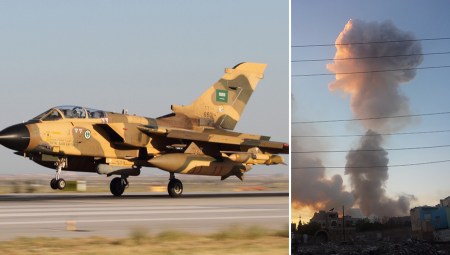
The United Nations, Amnesty International and other groups have accused the Saudi-led coalition of war crimes in Yemen. A leaked UN report claims the bombing campaign against Iranian-supported Houthi insurgents seeking violently to topple the legitimate government of Yemen has conducted deliberate, widespread and systematic attacks on civilian targets.

If the UN’s assertion is true, and the coalition is deliberately and disproportionately killing thousands of innocent civilians, it is a war crime. But it is unlikely to be true. The UN has produced no actual evidence of war crimes. None of their allegations is based on investigation on the ground. Their experts have not been to Yemen, depending instead on hearsay evidence and analysis of photographs.

The UN has a pattern of unsubstantiated allegations of war crimes against the armed forces of sovereign states. Only last year, without any military expertise, and never having visited Gaza, a UN commission convicted the Israel Defense Force of deliberately targeting innocent Palestinian civilians in the 2014 conflict. It was an assessment roundly rejected by America’s most senior military officer, General Martin Dempsey, the Chairman of the Joint Chiefs of Staff.

Dempsey’s own findings were confirmed by an independent commission of experienced senior military officers and officials from nine countries. The High Level Military Group found that Israel had not committed war crimes, but had in fact set a bar for avoiding civilian casualties so high that other armed forces would struggle to reach it.

Moreover, last September the UN said that a US airstrike against a hospital in Kunduz, Afghanistan, was “inexcusable” and “possibly a war crime.” Few military forces in the world take greater precautions to prevent civilian casualties on the battlefield than the US. Anyone who has actually experienced combat knows that while such incidents are tragic, when carried out by Western forces, they are far more likely to be the result of human error or the chaos of battle than deliberate war crimes.

There is every reason to believe that the UN is again crying wolf. There is no doubt that thousands are dying in Yemen in horrific circumstances. But we cannot just accept the UN’s figures and its attribution of the proportion of deaths being inflicted by the Saudi coalition. Most of the data comes from the Houthi insurgents, either directly or via non-governmental organizations (NGOs), and is simply accepted as fact. The Houthis have learned many lessons from Hamas and Palestinian Islamic Jihad in Gaza, groups also supported by Iran. Those lessons include the falsification and distortion of civilian casualty figures and their causes. The UN swallowed the fake Gaza figures hook, line and sinker, and are now making the same error in Yemen.

As with Israel’s defensive campaign in Gaza in 2014, and the continued U.S. military support to the Afghan regime, the Saudis’ war to defend the government of Yemen and curb Iranian aggression in the region is lawful and legitimate. Therefore, the illegality of civilian deaths must be assessed according to the laws of armed conflict, in particular whether adequate precautions were taken to avoid them, whether they were proportionate to the military objectives and whether they were necessary to achieve legitimate military goals. The UN cannot possibly make such judgements without a more far-reaching and thorough investigation, and especially not on the basis of information provided by Saudi Arabia’s enemies and by interpreting photographs.

Most of us do not like the way that the Saudi regime runs their country according to the strict application of Islamic Sharia law, and we abhor their record on human rights. But the Saudi military ethos is well known and understood by Western military leaders, including from the U.S. and UK, who have worked closely with them for many years. The reality is, as our officers currently serving alongside them will attest, that the Saudis and their allies are not deliberately trying to kill innocent civilians. Indeed, they are doing their best to minimize civilian casualties. The question is whether their best is good enough.

Saudi Arabia and its coalition allies have the most sophisticated Western combat equipment, including planes, attack helicopters, drones and precision-guided munitions. But they lack battle experience. The exception to this is the Emirati forces within the coalition. They have had many years of combat experience alongside Western militaries, including in Somalia, Kosovo, Libya and Afghanistan. Because of that, they have acquitted themselves in Yemen with great professionalism and effectiveness at sea, on the ground and in the air.

But the lack of experience of the other coalition members puts them many years behind our own forces in wielding the highly complex 21st century capabilities of intelligence, surveillance, reconnaissance, communication and targeting.

Yet the coalition faces the same tough challenges that we face on battlefields everywhere. Their Houthi adversaries fight according to the well-developed doctrine of their backers, the Iranian Quds Force. Like Hizballah, Hamas, the Taliban, Al Qaeda and the Islamic State, their techniques include deliberately killing civilians, fighting from within the population and forcing innocents to become human shields.
1474

Completely ignoring the laws of war, they exploit their enemies’ adherence to them. They lure their opponents to attack and kill civilians. They exploit gullible or compliant reporters, international organizations and human rights groups to facilitate their propaganda, including false testimony and systematic fabrication of imagery. The aim is to instigate international condemnation in order to constrain their militarily superior enemies.

We have seen credible forensic analysis of strikes in Yemen that directly contradict the findings of the UN. Forensic analysis shows that rather than deliberately targeting civilians, the Saudis and their allies have taken remarkable steps to minimize civilian deaths. Of note, they have learned much from Israel’s conduct of operations in Gaza. This has included the use of guided munitions to conduct precision attacks against insurgents while seeking to reduce collateral damage.

Why would coalition forces spend vast amounts of money in a cripplingly expensive conflict firing precision strike munitions, and put their valuable pilots at risk, if they wanted to massacre civilians? Why not use much cheaper unguided munitions or Assad’s indiscriminate barrel-bombs?

The overwhelming majority of civilian deaths caused by the Saudi-led coalition have been due not to deliberate targeting, but to inexperienced pilots and unsophisticated intelligence and targeting capabilities in the face of an enemy that fights from within the civilian population. And to that the friction, confusion, stress and fog of war that leads even the most sophisticated, experienced and restrained military forces, such as American, British and Israeli, to sometimes kill civilians unintentionally. Contrary to the UN’s claim, this is unlikely to amount to war crimes.

Like every conflict in the Middle East, the war in Yemen is almost intractable, takes a heavy toll on innocent civilians, and is unlikely to end in anything approaching a perfect solution. But Saudi Arabia and its allies are making considerable efforts to restore stability to the country and its legitimate government.

Instability in Yemen undermines Western interests, including oil supplies. Instability also allows Al Qaeda and the Islamic State — proven and lethal threats to the US and the West — to flourish there.

By confronting the Houthis in Yemen, Saudi Arabia is also confronting Iran, which represents an even greater threat to the region and to the world. Emboldened by U.S. President Barack Obama’s nuclear deal, enriched by the release of billions of dollars of previously frozen funds, encouraged by the imminent boost in oil revenues, Iranian imperial aggression is today rampant in Iraq, Syria, Lebanon and Yemen.

However unpalatable to many, Saudi Arabia is and will remain a vital ally of the West. We must continue to support them in the fight in Yemen. We must not allow the false, ill-informed and increasingly shrill condemnations by the UN, human rights groups and the media to undermine Saudi’s fighting effectiveness as they have sought to do against other legitimate government forces fighting lawless insurgents in so many other places.

Assad ‘will be removed by force’ if peace talks fail, Saudi Foreign Minister claims

February 16, 2016

Assad ‘will be removed by force’ if peace talks fail, Saudi Foreign Minister claims ‘Bashar al-Assad will leave – have no doubt about it’

Samuel Osborne

Sunday 14 February 2016 12:30 BST

Source: Assad ‘will be removed by force’ if peace talks fail, Saudi Foreign Minister claims | Middle East | News | The Independent

Syrian President Bashar al-Assad will be removed by force if the peace process fails, Saudi Arabia’s Foreign Minister has said.

“Bashar al-Assad will leave – have no doubt about it,” Saudi Arabia’s Foreign Minister Adel al-Jubeir told CNN. “He will either leave by a political process or he will be removed by force.”

Saudi Arabia has sent troops and fighter jets to a Turkish military base ahead of a possible ground invasion of Syria.

Mr Jubeir said Saudi Arabia is prepared to contribute ground troops to the fight in Syria, but only as part of a US-led coalition.

Saudi-F15-fighter-jets.jpg
There were reports of Royal Saudi Air Force F-15 jets arriving at Incirlik Air Base in Turkey on Saturday morning

He added: “We will push as much as we can to ensure that the political process works. But if that doesn’t work, it will be because of the obstinance of the Syrian regime and that of its allies.

“And should that prove to be the case, then it becomes clear that there is no option to remove Bashar al-Assad except by force.”

putin-assad.jpg
Bashar al-Assad and Vladimir Putin

On Sunday, he told a press conference in Riyadh that previous efforts to prop up Assad by Iran had failed.

“Now, [President Assad] has sought the help of Russia, which will fail to save him,” he added.

The Foreign Minister’s comments come as Syrian government forces, backed by Russian air strikes, have taken rebel ground near Aleppo and are poised to advance on the Isis stronghold of Raqqa province.

The move could be aimed at pre-empting any Saudi plans to send ground forces to fight Isis in Syria.

Although world powers agreed to a temporary “cessation of hostilities” within a week, there is little hope for a long-term peace as President Assad vowed to regain control of the entire country by force, which he said would “take a long time and will incur a heavy price”

Saudi Arabia confirms sent aircraft to Turkey to fight against ISIL

February 14, 2016

Saudi Arabia confirms sent aircraft to Turkey to fight against ISIL

February 14, 2016, Sunday/ 10:38:20/ REUTERS WITH TODAY’S ZAMAN

Source: Saudi Arabia confirms sent aircraft to Turkey to fight against ISIL

 Saudi Arabia confirms sent aircraft to Turkey to fight against ISIL

Royal Saudi Air Force jets fly in formation in Riyadh. (File photo: Reuters)

Saudi Arabia confirmed late on Saturday it sent aircraft to NATO-member Turkey’s İncirlik air base for the fight against Islamic State in Iraq and the Levant (ISIL) militants, although Turkish sources reportedly denied arrival of any Saudi aircraft.

Brig. Gen. Ahmed al-Assiri, adviser in the office of Saudi Arabia’s minister of defense, told pan-Arab Al Arabiya television that the kingdom was committed to stepping up the fighting against ISIL and that the move was part of those efforts.

He also said that the current presence in the air base was limited to aircraft and no ground troops had been sent.

“What is present now is aircraft that are part of the Saudi Arabian forces,” Assiri said in response to a question on whether ground troops were included.

Turkey’s Hürriyet daily, however, quoted Turkish military sources as denying the arrival of Saudi jets at the İncirlik air base. According to the military sources, Saudi jets had not arrived at İncirlik yet and their arrival would take two to three weeks, Hürriyet reported.

Saudi Arabia has resumed its participation in air strikes against ISIL in recent weeks and US Defense Secretary Ash Carter on Thursday welcomed its commitment to expand its role.

Turkish Foreign Minister Mevlüt Çavuşoğlu told the Yeni Şafak newspaper on Saturday that Saudi Arabia had carried out inspections at the air base in preparation for sending aircraft.

Saudi jets to fly missions in Syria from Turkish base

February 13, 2016

Saudi jets to fly missions in Syria from Turkish base

Published time: 13 Feb, 2016 10:27 Edited time: 13 Feb, 2016 15:44

Source: Saudi jets to fly missions in Syria from Turkish base — RT News


Saudi Arabia is to deploy military jets and personnel to Turkey’s Incirlik Air Base in the south of the country, Ankara said. The base is already used by the US Air Force for their sorties in Syria.

The deployment is part of the US-led effort to defeat the Islamic State terrorist group, Turkish Foreign Minister Mevlut Cavusoglu said.

“At every coalition meeting, we have always emphasized the need for an extensive result-oriented strategy in the fight against the Daesh terrorist group,” he said, referring to IS by an Arabic-language abbreviation.

Cavusoglu spoke to the Yeni Şafak newspaper after addressing a security conference in Munich, Germany, where the Syrian crisis was one of the top issues on the agenda.

“If we have such a strategy, then Turkey and Saudi Arabia may launch a ground operation,” he added, fueling concerns that a foreign troop invasion may soon further complicate the already turbulent situation in the war-torn country.

Read more

Russian Prime Minister Dmitry Medvedev © Ekaterina Shtukina

Earlier, Saudi Arabia, Bahrain and the UAE voiced their readiness to contribute troops for a ground operation in Syria on the condition that the US would lead the intervention. Damascus and its key regional ally, Iran, warned that such a foreign force would face strong resistance.

The US, Turkey and Saudi Arabia have shared goals in Syria, as all three want the government of Syrian President Bashar Assad to be toppled by rebel forces. On other issues they differ. For example, the US supports Kurdish forces in Syria who scored significant military victories against IS, but Turkey considers them terrorists and is targeting them with airstrikes.

Russia, which supports the government of Bashar Assad, seeing it as the only regional force capable of defeating IS on the ground, has warned against a ground intervention, which, Moscow believes, would only serve to prolong the war in Syria.

Speaking at the Munich Security Conference, Russian PM Dmitry Medvedev called on his Western counterparts “not to threaten a ground operation” in Syria, stressing that Moscow is doing its utmost to pave the way for a lasting peace in the war-torn country.

Russia and other leading world powers have brought Damascus and a number of rebel groups to negotiations and leveraged them into agreeing to a ceasefire. The agreement, however, remains shaky, as neither side trusts the other, and the unity of the rebel delegation remains questionable. The terrorist groups IS and Al Nusra Front are not part of the talks.

Between Putin and Obama

February 7, 2016

Between Putin and Obama, Israel Hayom, Boaz Bismuth, February 7, 2016

The tide has turned in Syria: Aleppo, the rebel stronghold, is on the verge of falling to President Bashar Assad’s army. Hezbollah’s Shiite militias, the Iranian army and the massive Russian air strikes have been the difference.

In contrast to the rebels, Assad can count on his partners. On the Syrian dictator’s side, backed by Russia, action is being taken. On the rebel side, backed by the Americans, there has been a lot of talking. This perhaps explains why in January 2017 U.S. President Barack Obama will exit the White House, and Assad will still be in power. We can add this legacy to the American president’s splendid list of achievements.

And we haven’t even mentioned the millions of Syrian refuges, the terrible migrant crisis in Europe (leading to the rise of far-right parties across the continent), and the escalation of hostilities between Shiites and Sunnis. It’s not a short list.

Since last Monday, Aleppo has been under heavy attack from Assad’s forces. The gains on the ground have been considerable. Russia’s intervention has tipped the balance of power. No one can say this was unexpected. Washington, meanwhile, continues to grumble. U.S. Secretary of State John Kerry lambasted Moscow on Friday for the large number of dead Syrian women and children. Moscow isn’t exactly heeding his criticism. Washington still fails to understand that instead of talking, maybe it would be better to take action already. In August of 2013, however, after Assad had attacked his own people with chemical weapons for the 14th time, the Americans did nothing (red lines, remember?). Why should things be any different today?

Washington, you will say, has worked hard to find a diplomatic solution. This is a good time to remind everyone that the peace talks in Vienna have again hit a dead end. The talks aren’t likely to succeed for a number of reasons, namely that the two main players — Saudi Arabia and Iran — have reached a point of open hostilities, thanks to American foreign policy. Instead of cooperating to resolve the Syrian crisis, these two regional powers are closer than ever to a full-fledged military conflict. Riyadh is threatening to send ground forces into Syria to support the rebels. The commander of Iran’s Revolutionary Guard has already vowed that any such intervention would result in immense casualties for the Saudis. This is where things stand.

Over the weekend Turkey’s foreign minister discussed opening his country’s borders to the steady stream of refugees, but the crossings remain as shut as they were in September, 2014, when thousands of Kurds tried to flee the border town of Kobani. The European Union is trying to remind the Turks that they were given $3 billion for the expressed purpose of absorbing these 2 million refugees. But who expects agreements to be kept in today’s Middle East?

Who does have faith in agreements?

The refugee issue is becoming the hot button topic of the Syrian civil war. “The markets solved the economic crisis, the voters will solve the refugee crisis,” a French lawmaker said a few days ago. In the meantime, as Assad solidifies his power the far-right parties in Germany, Sweden, Denmark and Holland, and of course in France, are all growing in strength. It appears that everyone outside the Obama camp is thriving. And here is yet one more legacy to tell the grandchildren about.

Russian hands-off warning to US, Saudis, Turks amid crucial Aleppo battle

February 6, 2016

Russian hands-off warning to US, Saudis, Turks amid crucial Aleppo battle, DEBKAfile, February 6, 2016

S-400_range_map_25.11.15 (1)

The five-year Syrian civil war, faces its most critical moment. Saturday, Feb. 6, a combined force of Syrian army and Hizballah troops and an Iraqi Shiite militia under Iranian officers, were led by Russian air and Spetsnaz (special forces) officers into pressing forward to encircle 35,000 rebels trapped in Aleppo, the country’s largest city. As they tightened the siege, 400,000 Syrian civilians were also trapped and forced to bear heavy Russian air bombardment and savage artillery fire from the ground forces closing in on the city.

Rebel supply routes were cut off Thursday and Friday when Syrian and Hizballah forces captured the Azaz Corridor connecting Aleppo and all of the northern province of Idlib to the Turkish border.

Tens of thousands of refugees fleeing from the beleaguered town are massing at Bab al-Salama, the last Turkish border crossing to be closed against them. This is the largest Syrian refugee exodus since the start of the civil war.

The rebels under siege are painfully short of weaponry for fighting off the massive, combined offensive, DEBKAfile’s military sources report. Their only remaining recourse is to surrender or be ground into submission as the conquering force knocks over their positions and takes over street after street.

Once the combined forces fighting with Bashar Assad’s army take Aleppo and northern Syria, the opposition will have suffered its heaviest defeat since the war began. The rebels groups’ capacity to continue fighting the regime will be gravely diminished.

Their desperate plight – and the fresh surge of Syrian refugees in unmanageable numbers – cut short the conference in Geneva for a settlement of the Syrian conflict, before it got underway – and prompted reactions from sponsors of rebel groups.

In Riyadh, Brig, Gen. Ahmed Asiri, adviser to Saudi Defense Minister Muhammed Bin Salman, announced Friday that Saudi Arabia is ready “to participate in any ground operations that the international coalition launches against ISIS.” This offer was taken as a veiled response to the SOS from the rebel stronghold in Aleppo.

In Washington, State Department circles, in a briefing to US media, said the time had come to establish a no-fly security zone in northern Syria. They said: “Once a zone were established we do not believe Russia would challenge the stronger US and NATO forces, particularly if they were operating mainly from Turkey.”

The next day, Friday, Moscow came back with a sharp response: Russian Deputy Defense Minister Anatoly Antonov said: “Russian air defense systems enable early detection of threats to Russian aircraft flying combat missions over Syria and provide adequate measures to ensure flight safety.”

This was a reminder of the sophisticated air defense S-400 and S-300 missile systems Russia installed at its Syrian air base after the Turkish air force downed a Russian warplane in November.

Syrian Foreign Minister Walid al-Moallem put it more crudely: “Any foreign troops entering Syria would return home in wooden coffins.”

He advised armed opposition groups fighting the government offensive in the area to lay down their weapons because, he said, “government advances signal that the five-year-old Syria war is nearing its end.”

Saturday, US Secretary of State John Kerry urged Russia to implement a ceasefire in Syria, saying its bombing campaign was killing women and children in large numbers and “has to stop.” He told reporters on his return from a trip to Europe: “Russia has indicated to me very directly they are prepared to do a ceasefire,” adding “The Iranians confirmed in London just a day and a half ago they will support a ceasefire now.”

DEBKAfile’s military sources have seen no sign of any ceasefire or even a slowdown in the Russian-led Syrian-Iranian Aleppo offensive.