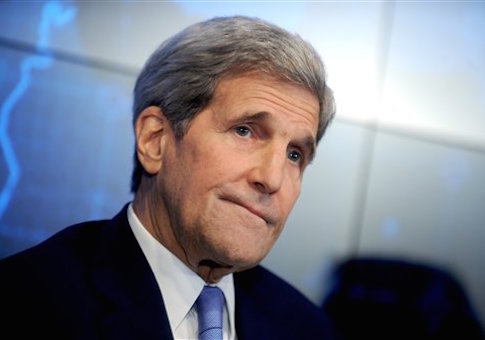
Photo by: Dennis Van Tine/STAR MAX/IPx 8/11/15 John Kerry participates at a discussion on Iran.(NYC)
Two leading U.S. senators are calling on the Obama administration to release secret letters to foreign governments assuring them that they will not be legally penalized for doing business with the Iranian government, according to a copy of a letter sent Wednesday to the State Department and obtained by the Washington Free Beacon.
Sens. Mark Kirk (R., Ill.) and Marco Rubio (R., Fla.) disclosed in the letter to the State Department that U.S. lawmakers have been shown copies of several letters sent by the Obama administration to the Chinese, German, French, and British governments assuring them that companies doing business with Iran will not come under penalty.
The Obama administration is purportedly promising the foreign governments that if Iran violates the parameters of a recently inked nuclear accord, European companies will not be penalized, according to the secret letters.
Congress became aware of these promises during closed-door briefings with the Obama administration and through documents filed by the administration under a law requiring full disclosure of all information pertaining to the accord.
The issue of sanctions on Iran has become a major issue on Capitol Hill in the weeks since the Obama administration agreed to a deal that permits Iran to enter the international community in exchange for temporarily constraining its nuclear program.
Iran will receive more than $150 billion in sanctions relief as part of the deal and many of its military branches will be removed from international sanctions designations.
“The documents submitted by the Administration to Congress include non-public letters that you sent to the French, British, German, and Chinese governments on the consequences of sanctions snap-back,” Kirk and Rubio wrote to Secretary of State John Kerry.
“These letters appear to reassure these foreign governments that their companies may not be impacted if sanctions are re-imposed in response to Iranian violations of the agreement,” they claim. “While Administration officials have claimed that this is not the case, we think it is important for the American public to be able to read your assurances to foreign governments for themselves as their elected representatives review this deal in the coming weeks.”
Kirk and Rubio are demanding that the Obama administration release these letters to the public so that the full nature of the White House’s backroom dealings are made known.
“We therefore request the Administration to publicly release these letters, which are not classified, so that the full extent of the Administration’s non-public assurances to European and Chinese governments can be discussed openly by Congress and analyzed by impartial outside experts,” they write.
“Given the conflicting interpretations hinted at by the deal’s various stakeholders, it would also ease congressional review of the deal if you were to receive assurances from the other members of the P5+1 about the guidance they will provide to companies about the inherent risks of investing in Iran due to Iran’s ongoing support for terrorism and use of its financial system for illicit activities and the potential for sanctions to snap back if Iran violates the nuclear agreement,” the letter states.
As Iranian companies and government entities are removed from sanctions lists, they will be permitted to do business on the open market. A number of governments, including the Russia and Italy, have already expressed interest in partnering with Iran.
U.S. lawmakers remain concerned that if Iran violates the nuclear accord, sanctions will not be reimposed in a meaningful way.
“The conditions under which foreign investment in Iran would proceed under the nuclear agreement remain unclear,” Kirk and Rubio wrote. “On July 23, 2015, Secretary of the Treasury Jack Lew told the Senate Foreign Relations Committee that companies that have invested in Iran would ‘not be able to continue doing things that are in violation of the sanctions’ if sanctions snap back.”
“Foreign investment in Iran will involve long-term contracts in many cases, however, and some interpretations of the Iran agreement indicate these contracts might be protected from the snap-back of sanctions by a so-called ‘grandfather clause,’” they write.
Under the terms of the agreement, sanctions on Iran’s Revolutionary Guard Corps (IRGC), a paramilitary force known to commit acts of terrorism across the globe, will be lifted.
A multi-billion dollars financial empire belonging to Iranian Supreme Leader Ali Khamenei also will be removed from sanctions lists, according to the parameters of the deal.
Iran is refusing to commit to a written nuclear deal ahead of the March 31 deadline that American officials had touted for a general framework to be signed, the New York Times reports.
The Obama administration and Congress have clashed over bills to impose new sanctions on Iran or to require Senate ratification of any nuclear deal. However, the Iranians appear to have treated the March 31 date as merely an opportunity to drag talks out further–this time, until a deadline of July 1.
When the extension of talks was announced last year–the third new deadline in a process that was supposed to last no more than six months when first announced in late 2013–there were two deadlines reported. One was March 1, 2015, the deadline for a “political framework agreement.” The other was July 1, for “final agreement including annexes,” according to a CNN report at the time. However, the political framework agreement was always vaguely defined, and later extended.
The West has attempted to negotiate with Iran for years. Iran’s refusal to obey international norms and treaties to which it had already committed led to six UN Security Council resolutions banning all nuclear enrichment activity.
When he came to office, President Barack Obama treated prior negotiations as if they had never happened, and sought new talks with the regime. Israeli officials warned that Iran would simply use new talks to buy more time to develop its nuclear capabilities.
And thus it proved to be. Under the present negotiations–which Israeli Prime Minister Benjamin Netanyahu called a “historic mistake,” and the French government once called a “sucker’s deal”–Iran has bought time again and again.
The Obama administration played up the March deadline as if it would produce a written agreement, perhaps to buy time as Congress began questioning the emerging details of the likely deal.
Iran, however, has played Obama, once again, for a fool.
A bad nuke deal with Iran seems likely to be approved by the P5+1 negotiators under Obama’s guidance. It will be disastrous. However, if it is signed and Obama tries to implement it, there will be little if anything the Congress can do about it, even if it wants to, until January of 2017 — which will likely be too late. Even if it is not too late in 2017 it may or may not happen, depending on who is our President and who controls Congress.
I have written extensively about the Iran Scam and Obama’s untruths and obfuscations concerning it. I did so most recently in a semi-satirical article titled To get a nuke deal with Iran Obama and the Islamist world demonize Israel. Please read at least the Iran Scam article; to repeat here the points made there would make this post far too long.
Sen. Lindsey Graham (R-S.C.) took to the Senate floor on Thursday to ask for unanimous consent to schedule a vote on a bill that would give Congress final approval over any deal, or else reinstate tough sanctions on Iran.
Democratic Sen. Chris Murphy (Conn.) quickly rejected the request, arguing that scheduling a vote on the deal would be “premature at this point.” He said it would “send a fairly chilling message” that U.S. officials at the table with Iran did not have full authority to negotiate an agreement.
But when Republicans take control of the Senate, they could move to pass that bill, or push legislation from Senate Foreign Relations Chairman Bob Menendez (D-N.J.) and Sen. Mark Kirk (R-Ill.) which would reinstate sanctions if Iran violates any deal.
Their bill also pledges military support for Israel if it decides to strike Iran’s nuclear facilities, which it has threatened to do.
. . . .
The president has already threatened to veto the legislation, but doing so would be politically risky. The bill already enjoys the support of 60 senators, including 16 Democrats, and there is sweeping support for a similar bill in the House.
A deal that’s not supported by Congress or seen as weak could also hurt the 2016 Democratic presidential nominee, especially if it fails to prevent Iran from obtaining nuclear weapons capabilities.
Obama has displayed utter disdain for the Congress and constitutional processes. He will most likely continue to do so, in spades, when the new Republican dominated Congress is seated in January. The perceptions of the author of the linked article are excessively optimistic, as suggested below.
As a lame duck President, Obama has little if anything to lose. Any impact on the 2016 elections of a bad nuke deal with Iran may well not be of substantial importance to Obama and, to the extent that it is, He will probably use His ample opportunities to “Gruber” – to obfuscate and lie effectively — about the facts and their consequences substantially to diminish any adverse impact of His actions on those elections.
There’s more here about Obama, Gruber and Grubering, which Obama continues to do with at least modest success.
As the Obama administration did from the beginning and continues to do with the ObamaCare debacle, it will “Gruber” the facts and consequences of a nuke deal in presenting it to the Congress and the public. Should the next Congress nevertheless pass a bill which He does not like, He will veto it as He has promised to do. To override a veto requires the affirmative vote of two thirds of both houses under Article 1, Section 7, of the Constitution. Even in the unlikely event that an Obama veto is overridden, there is no reason to assume that He will apply the new law as Congress intends.
Congressional attempts to defund administration efforts to implement an agreement with Iran seem unlikely to work: multiple other governmental functions, facially unconnected with the matter, would still have to be funded. The parameters of their funding would have to be extraordinarily tight to avoid fund shifting. Even then, the Obama administration has shown itself to be extraordinarily adept at fund shifting regardless of congressional intent as reflected in seemingly clear statutory language.
Even were U.S. Sanctions – the only sanctions on which the Congress has any significant impact – to be reinstated, their enforcement would be up to the Obama administration, not the Congress. The administration would likely refuse to enforce them, as it has multiple times with other Federal laws of which Obama does not approve. Were the Congress or other interested parties to succeed in getting judicial review, the process would be long and the results uncertain until the Supreme Court granted and exercised review. That process could easily take years. In addition, it remains questionable whether the Congress, its representatives or anyone else would even have standing to initiate judicial action.
In any event Germany, Iran’s most substantial commercial partner and others who now deal with Iran, as well as Iran itself, have enjoyed substantial sanctions relief for long enough that the process is broken to the point that U.S. efforts to revive useful sanctions would likely be ineffective. According to an article at FARS News Agency, an Iranian source, posted on November 16th,
Chairman of the Iranian parliament’s National Security and Foreign Policy Commission Alaeddin Boroujerdi said imposing sanctions against Tehran is an already failed policy.
“The sanctions imposed on Iran are a failed policy; the sanctions tool has never been able to make the Iranian nation withdraw from its righteous positions,” Boroujerdi said in a meeting with new Italian Ambassador to Tehran Mauro Conciatori on Sunday. [Emphasis added.]
“Sanctions have only resulted in ample financial loss for the European industrial and trade companies,” he added. [Emphasis added.]
The article claiming that a Republican controlled Congress can dash Obama’s hopes for a nuke deal with Iran also suggests that it can pledge “military support for Israel if it decides to strike Iran’s nuclear facilities.” It can certainly do that. However, just as the Obama administration has refused to enforce or simply ignored aspects of other legislation, it can refuse to enforce or simply ignore that pledge as well.
With the exception of a possible — but far from certain — prompt and effective Israeli military attack on Iran’s nuke facilities, the mess has gone too far for effective action. Israel, which rarely brags about what she can or intends to do, has quite properly been rather coy about the resources she can use against Iran. So have possible allies in the Middle East concerning such help as they may be willing and able to provide. However, Israel probably has substantial electromagnetic pulse (EMP) capabilities which could be used to damage Iran’s command and control facilities substantially.
The attack could be carried out using a nuclear warhead detonated after launch by one of Israel’s Jericho III missiles at high-altitude over north central Iran.
EMP affects computers and other electronics and would disrupt critical infrastructure that relies on electronics and electricity, such as communications, transportation, and other networks.
The burst would create “no blast or radiation effects on the ground,” the article stated.
“Coupled with cyber-attacks, Iranians would not know it happened except for a massive shutdown of the electric power grid, oil refineries, and a transportation gridlock,” the article said.
“Food supply would be exhausted and communication would be largely impossible, leading to economic collapse. Similarly, the uranium enrichment centrifuges in Fordo, Natanz, and widely scattered elsewhere, would freeze for decades.”
Iran more than likely also has substantial EMP capabilities, so unless Israel uses her own first, and sooner than Iran anticipates, it will be too late.
Summary and Conclusions
Sanctions may well have prompted Iran to agree to discuss a nuke deal with P5+1. However, the negotiations have done little beyond diminishing those sanctions to the point of ineffectiveness, while giving Iran ample time, incentive and opportunity to continue research on, and implementation of, its nuke plans. If preventing Iran from continuing its development of nukes had been the objective, or even a substantial objective, Iran’s military facilities and advances on nuke development would have been central to any “interim agreement.” Far from being central, they were not even peripheral.
From the beginning, as contended here, here, here and elsewhere, the “Grubered” interim agreement and White House Summary of it have given Iran every possible advantage and shielded its military facilities from effective scrutiny.
Some elections have consequences. Obama’s 2012 election had very unfortunate consequences. However, the 2014 elections will probably have few if any beneficial consequences with respect to the Iran Scam and come January 2017 it will probably be too late should effective action then be attempted.
If, as seems likely, a nuke deal with Iran, good for Iran and bad for the most of the rest of world is signed, it now appears that the only possible effective solution with a decent chance of success will be prompt military action by Israel, in conjunction with her temporary and therefore uncertain allies in the Middle East which are opposed to Iranian nukes.
I am well aware of the possible adverse consequences of such a strike, including extreme actions that Russia and her allies might take in response. However, the possibility of mutually assured destruction worked in the past and should work again. Russia, et al, unlike Iran, are not compelled by a barbaric religion to bring to the world Armageddon and the arrival of the Twelfth Imam. They want power, not death. If they and their enemies are obliterated, their current power and hopes of increasing it would be destroyed along with them.





 anneinpt
 artaxes
 danmillerinpanama
 davidking1530
 Peter Hofman
 Joseph Wouk
 Peter
Peter Louisiana Steve
 WarSclerotic
Recent Comments