Posted tagged ‘Russia’

Report: France May Send Force to Fight ISIS on the Ground

November 15, 2015

A global intelligence service says that sending an expeditionary force is one of France’s options to try to defeat ISIS.

By: JNi.Media Published:

November 15th, 2015

Source: The Jewish Press » » Report: France May Send Force to Fight ISIS on the Ground

The picture shows the kepi blanc. the French Foreign Legion

French army soldiers soon may find themselves fighting ISIS terrorists.

French army soldiers soon may find themselves fighting ISIS terrorists.
Photo Credit: Archangel12 / https://www.flickr.com/photos/archangel12/

Stratfor, a global intelligence analysis service, issued a report Saturday contending France may send its “expeditionary force” to Syria to retaliate against ISIS.

The report, titled “After Paris, France Contemplates a Reckoning,” suggests the French response to the Paris attacks is markedly different from that of the Spanish Government following the March 2004 Madrid train bombings. Instead of pulling back from the global coalition working against radical Islamists, “it appears that the French will renew and perhaps expand their efforts to pursue revenge for the most recent assault.”

According to Stratfor, “France has numerous options for retaliation at its disposal.”

First, France has to establish that the attackers were, in fact, members of ISIS. Then:

France will likely ramp up its Syrian air operations. The skies over Syria, however, are already congested with coalition and Russian aircraft. With this in mind, the French may choose to retaliate by focusing instead on the Islamic State in Iraq, or perhaps even other Islamic State provinces in places such as Libya.

Another option would be to increase French programs to train and support anti-Islamic State forces in Iraq and Syria, or even to conduct commando strikes against key leadership nodes.

Finally, says the report, “France also has the option of deploying an expeditionary force like it did in the Sahel, although that would probably require outside airlift capacity from NATO allies, especially the United States.”

One area that is already undergoing a radical change is passage through Europe’s borders, which this weekend are being sealed by many EU members. Bavarian Prime Minister Horst Seehofer said the Paris attack showed border controls are more necessary than ever.

Seehofer, who is critical of the German government’s handling of the refugee crisis, demands permanent border controls and swift repatriation of asylum seekers. It doesn’t appear that Chancellor Angela Merkel will find many allies supporting her soft, pro-refugee stance in light of the Paris bombings.

The anti-Schengen camp, seeking to revoke the agreement making it possible for virtually every European citizen to go anywhere in Europe unheeded, received yet another vindication last week, according to Stratfor, when a Montenegro citizen was arrested on his way to Paris with a stack of weapons.

It isn’t clear whether he was on his way to joining the Friday attacks in Paris, but it’s possible—and frightening. And so the Paris attacks will raise the clout of anti-immigration parties across Europe, chipping away at the Schengen agreement. As of this weekend, France, Germany, Sweden, Slovenia and Hungary have already re-established strict border controls. It is expected that the remaining EU governments will follow suit this week.

Iran Threatens to Walk Away from Nuke Deal

November 13, 2015

Iran Threatens to Walk Away from Nuke Deal Rouhani: Any new sanctions are a deal breaker

BY:
November 12, 2015 3:05 pm

Source: Iran Threatens to Walk Away from Nuke Deal – Washington Free Beacon

Iran has threatened to walk away from the recently inked nuclear deal and stop rolling back its nuclear enrichment program, according to recent comments by Hassan Rouhani, the Islamic Republic’s president.

Rouhani, in comments on Thursday, threatened to break the deal if the United States imposes any new sanctions on Iran, even ones concerning the country’s human rights abuses and its ballistic missile program.

The comments are a direct response to promises by the Obama administration to continue pursuing economic sanctions targeted at Iran’s terrorist proxies and efforts to foment unrest across the globe.

The warning from the Iranian president was delivered amid bipartisan calls in Congress to increase pressure on Iran in response to its recent arrest of two Americans, one a dual citizen and one a D.C.-based permanent resident.

Iran “will not fulfill agreements” aimed at curbing its nuclear program if any new sanctions are considered, Rouhani said, according to reports carried by the country’s state-controlled media.

“The obligations are the following: the group of six [global powers] will not impose new sanctions, and we should fulfill the agreements,” Rouhani said. “In case the Unites States or other countries fail to comply with their obligations, we will be forced to do the same.”

Rouhani’s made these comments just days after reports emerged indicating that Iran has stopped dismantling its nuclear centrifuges, a key requirement of the agreement.

Major differences between the United States and Iran have arisen on the issue of sanctions. While Iran maintains that all U.S. sanctions must be terminated, the Obama administration says it is only required to suspend nuclear-related sanctions.

This leaves open the possibility that the United States could reintroduce sanctions if Iran violates the deal and could level new sanctions unrelated to the country’s nuclear program.

Rouhani acknowledged that this has caused tension between the two nations, stating in his remarks, “a U.S. decision to withdraw only nuclear-related sanctions on Tehran but keeping other restrictions in place has led to continuous disagreement between Iran and the United States.”

The Iranian president also demanded in his remarks that the United States “apologize” for its past actions against Iran.

“If they [the U.S.] modify their policies, correct errors committed in these 37 years and apologize to the Iranian people, the situation will change and good things can happen,” Rouhani said.

Sen. Ted Cruz (R., Texas), a vocal opponent of the nuclear deal, told the Washington Free Beacon that the administration is intentionally ignoring Iran’s bad behavior in order to preserve the accord.

“The Obama administration may insist that the nuclear deal is somehow isolated from other bad behavior on the part of the Islamic Republic, but the fact is that this is all part of the same ugly pattern,” Cruz said. “Tehran understands perfectly well that the terrorist activities of the Revolutionary Guard, including the detention last month of American citizen Siamek Namazi and American resident Nizar Zakka, are part of the same anti-American hostility that also fuels their nuclear program.”

“Trying to separate out their activities is a fool’s errand,” Cruz said. “There can be no good-faith deal with a regime that is the world’s leading state sponsor of terrorism and that has been targeting America and our allies for 36 years.”

The Obama administration has reserved the right to pursue new sanctions.

The State Department explained to the Free Beacon earlier this week that it will not remove sanctions relating to certain elements of Iran’s Revolutionary Guard Corps, an organization responsible for waging terror attacks. Other sanctions aimed at curbing Iranian human rights abuses also remain in place.

However, the State Department has declined to go further with its sanctions against the corps, telling the Free Beacon that it is not considering designating the military group as a foreign terrorist organization, which could severely restrict its activities.

“We believe the sanctions we have in place remain the most appropriate and effective tools for targeting the IRGC, and we are making full use of such authorities with respect to the IRGC,” a State Department official told the Free Beacon this week. “In addition to Iran’s designation as a State Sponsor of Terrorism, we have a substantial set of sanctions already in place against the IRGC.”

Questions still remain about whether the United States will respond to the recent arrests of two American citizens in Iran. While members of Congress have called for sanctions as a result of the arrests, the administration has balked.

Sen. Mark Kirk (R., Ill.), among other lawmakers, has demanded that the Obama administration work with lawmakers to strengthen sanctions.

“Iran’s threatening behavior will worsen if the administration does not work with Congress to enact stronger measures to push back, including renewal of the expiring Iran Sanctions Act of 1996 and targeted sanctions against Iran’s Revolutionary Guard and against any Iranian official found to have participated in the unjust detainment of American citizens,” Kirk said in a statement.

“It should come as no surprise that Iranian leaders are trying to blackmail the administration into ignoring Iran’s terrorism, human rights abuses, tests of missiles that can strike Israel, and detention of American citizens,” Kirk told the Free Beacon. While Congress has red lines that Iran passed long ago, the question is whether the administration has any red lines.”

Iran is pursuing a policy aimed a tying the White House’s hands, analysts said.

“Under the deal Iran always has a gun to America’s head,” said Omri Ceren, managing director for press at The Israel Project, a D.C.-based organization that has been critical of the final terms of the deal. “Any time the Iranians don’t like anything the U.S. is doing, they can blackmail Washington by threatening to walk away from the deal. “

“This time they’re telling Congress that lawmakers are prohibited from responding to the arrest of American citizens,” Ceren said. “Who knows what they’ll ban the U.S. from doing next time?”

Other analysts agreed.

Michael Rubin, a former Pentagon adviser and expert on rogue regimes, said that these types of threats by Iran are a hallmark of the hardline administration.

“It’s the traditional Tehran two-step: One step forward and two back,” Rubin said.

Iran is comfortable issuing threats because it has already begun to receive sanctions relief granted under the nuclear accord. Tehran also has leverage over the Obama administration because of the way the deal is structured, according to Rubin.

“Kerry’s team played into Iran’s hands by front-loading Iran’s rewards and removing any incentive for Tehran to adhere to commitments,” Rubin said. “Who besides Obama and Kerry would give a rogue regime and the world’s largest state sponsor of terrorism a free pass against consequence for any of their actions?”

“Kerry essentially handed Iran a get out of jail free card, and the Iranian leadership will respond by seeing how far they can push,” Rubin explained. “Obama stays quiet on the arrest of reporters or businessman? Well, why not execute one or two and see what happens then? Obama ignores Iranian shipment of missiles to Hezbollah? Why not launch a few?”

Report: Turkish weapons found in ISIS stronghold within Iraq

November 12, 2015

Report: Turkish weapons found in ISIS stronghold within Iraq The Iranian media reported that in a raid on an ISIS stronghold in Iraq, Iraq found explosive materials, ammunition, and arms that were manufactured in Turkey. If the report is proven to be true, Ankara will find themselves in a difficult position due to the fact that the Turkish government vehemently denies that they are assisting the murderous terror organization.

Nov 12, 2015, 01:14PM | Rachel Avraham

Source: Report: Turkish weapons found in ISIS stronghold within Iraq – JerusalemOnline

Did Turkey provide ISIS with weapons?

Did Turkey provide ISIS with weapons? Photo Credit: Reuters/Channel 2

The Fars Iranian News Agency reported this morning that Iraqi forces found explosive materials, ammunition and arms that were manufactured in Turkey within an ISIS stronghold in the Anbar Province within the country.   According to the report, the explosive materials had a “made in Turkey” sign on it alongside the weapons and the missiles.

The findings of the report puts into doubt Turkey’s policy.  Turkey claims that they are against ISIS and have joined the Western coalition against the murderous terror organization.   According to the Turkish government, they support Al Qaeda’s branch in Syria known as the Al Nusra Front but not ISIS, whom they view to be an enemy.

Despite the repeated denials from the Turkish government that they aren’t supporting ISIS, the Western and Iranian media indicate that there are a number of discoveries which prove that Turkey is helping the murderous terror organization.    According to one of the reports, Erdogan’s daughter opened up a field hospital along the Turkish-Syrian border, where members of various terror groups that were injured in the struggle against Assad receive medical treatment.

Since the beginning of the Syrian Civil War, Turkey has supported toppling Assad’s regime and has supported groups that are opposed to Assad.   However, they have refrained from supporting liberal Kurdish opposition groups due to the fear that helping them would complicate Turkey’s own issues with their Kurdish population, preferring to provide backing to Sunni Islamist groups.  Iranians who support Assad’s regime reported that the weapons Turkey provided to ISIS were given to the brutal terror organization within Syria and from there was transferred to Iraq.

According to a senior level member of a Shia militia in Iraq, the weapons were found in the murderous terror organizations’ stronghold in Tikrit within the Anbar Province, which is located within Western Iraq and extends along the border with Syria.

‘Hezbollah weapons warehouses were the target of Wednesday’s Israeli airstrikes in Syria’

November 12, 2015

Hezbollah weapons warehouses were the target of Wednesday’s Israeli airstrikes in Syria’

Source: ‘Hezbollah weapons warehouses were the target of Wednesday’s Israeli airstrikes in Syria’ – Arab-Israeli Conflict – Jerusalem Post

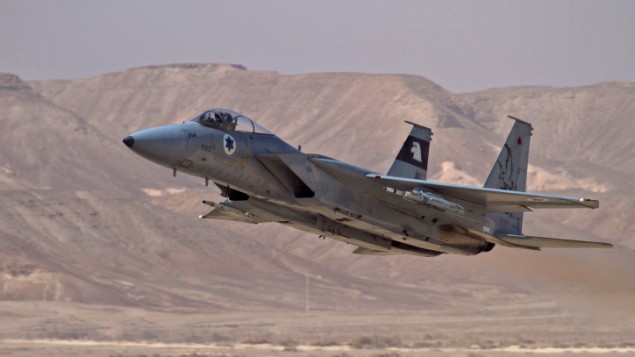
Israeli jet fighter

The target of Israel’s alleged airstrikes in Syria on Wednesday evening were Hezbollah weapons warehouses, Arab media affiliated with the opposition to Syrian Preisdent Basher Assad reported Thursday.

Pro-Assad operatives on Facebook said that the strikes, adjacent to Damascus airport, struck “military outposts near the airport, and there is a high probability that it was IDF warplanes that struck.”

New portal ‘Damascus Alan,’ which is affiliated with the Assad regime, reported that heavy damage was caused to army outposts around the airport, all of which went up in flames. The site did not specify what damage was caused to the outposts, but they said that nobody was hurt.

Syrian opposition activist Ahmed Yabrudi said: “Israeli warplanes entered from south Lebanon, arrived at Qalamoun and flew above the international airport in Damascus where they struck nearby military outposts.”

He added that “the Israeli planes remained in Syria’s skies for a half hour, and there is no information about the outposts that were hit – except that they belonged to Hezbollah.”

Official Syrian media failed to report on the air strikes attributed to Israel.

Israeli defense officials also declined to comment on the foreign media reports.

However, Israel did previously announce a strict-policy of intolerance towards threats to the state, such as weapons transfers to Hezbollah in Lebanon.

The last reported Israeli strike in Syria, on October 31, targeted numerous Hezbollah targets in Syria’s south.

In the October alleged attack, Syrian media reported that up to a dozen Israeli war planes conducted the mission close to the Lebanon-Syria border in the Qalamoun Mountains region. Estimated targets included a weapons convoy destined for Hezbollah fighters traveling through Syria.

The alleged attack on Wednesday night would be the second attributed to Israel since Russia began operating in the area.

Israel has reportedly struck Hezbollah in Syria several times over the past year.

Jpost.com staff and Noam Amir contributed to this report.

Battle to break ISIS siege of Kweires airbase caught on camera (GRAPHIC VIDEO)

November 12, 2015

Battle to break ISIS siege of Kweires airbase caught on camera (GRAPHIC VIDEO)

Published time: 12 Nov, 2015 01:34

Source: Battle to break ISIS siege of Kweires airbase caught on camera (GRAPHIC VIDEO) — RT News

Intense battles raged in and around the Kweires airbase near Aleppo between government forces and Islamist militants, as the Syrian Army supported by the Russian Air Force managed to partially lift a blockade following a two-year Islamic State siege.

Gun battles as well as shelling can be seen in the incredible footage of the advance made by government forces. The dead bodies of Islamist terrorists are also visible across the battlefield.

As a result of the push by Syrian government troops, with the help of Russian airstrikes and local irregular forces, more than 900 militants were killed near the village of Telmam in Aleppo province. Intelligence regarding the locations of the terrorists’ positions around the base was partially provided by the Syrian opposition, the Russian Defense Ministry announced on Wednesday.

READ MORE: Syrian opposition provided intel to target terrorists around besieged key airbase – Russia

A spokesman for the Syrian Army and Armed Forces added that new progress in the war against Islamist militants was being made in the Latakia and Aleppo provinces. The Syrian Air Force carried out 75 sorties that destroyed 150 targets across the country.

In Aleppo province where the combat footage was filmed, the spokesman said that army units, aside from establishing control over Kweires airbase after “heavy fighting,” are now also in control of more than 250 square kilometers of the surrounding area.

According to the spokesman, the Syrian Air Force targeted three Islamic State (IS, formerly ISIS/ISIL) sites in the Aleppo countryside in addition to “fortified sites” belonging to Al-Nusra Front.

The government forces have made rapid advances against jihadist groups over the past six weeks following the start of Moscow’s air campaign. Russia has carried out over 1,600 sorties since establishing an airbase in northern Syria in September at the personal request of Syrian president Bashar Assad, who has been battling the Islamic jihadists since 2011.

Anti-ISIL coalition preparing broad air operation:

November 12, 2015

Anti-ISIL coalition preparing broad air operation:

Report ISTANBUL

Source: Anti-ISIL coalition preparing broad air operation: Report – MIDEAST

And so it begins .

AA photo

Coalition forces fighting against the Islamic State of Iraq and the Levant (ISIL) jihadist group are preparing for a wide-scale aerial operation in Syria, private broadcaster CNN Türk has reported.

A number of Turkish and American fighter jets in southern Adana’s İncirlik Air Base were preparing for a “wide-scale operation” by next month, with a “boots on the ground” option set aside by the security sources in Ankara.

The coalition’s air operation could be an intensive one which lasts for days, the report added.

The aim of the operation was also to cleanse the Jarabulus, Azaz and Mare lines in northern Syria.

The U.S. Air Force’s F-15 jets, which arrived in İncirlik on Nov. 6, meanwhile would not secure Turkish airspace as previously reported, with an objective instead of securing coalition jets from possible attacks coming from Syria and Russia.

In addition, the opposition Turkmens and Arab forces in Syria will continue to work on the ground while Turkish troops will stand by on the border. Moreover, the option of a Turkish operation would only be discussed if Democratic Union Party (PYD) forces in northern Syria pass to the western banks of the Euphrates, the report said.

Jets in İncirlik:

– 6 F-15C fighter jets

– 12 KC-135 tanker aircrafts

– 11 MQ-1 predators

– 12 A-10 bomber aircrafts

– 14 Turkish F-16 fighter jets

November/12/2015

Turkey: Syria land operation possible but not alone

November 11, 2015

Turkey: Syria land operation possible but not alone

Uğur Ergan – ANKARA

Source: Turkey: Syria land operation possible but not alone – MIDEAST

Turkish Prime Minister Ahmet Davutoğlu (R) sitting across CNN International's Christiane Amanpour (L) in an interview on Nov. 9, 2015. AA Photo

Turkish Prime Minister Ahmet Davutoğlu (R) sitting across CNN International’s Christiane Amanpour (L) in an interview on Nov. 9, 2015. AA Photo

Turkish Prime Minister Ahmet Davutoğlu said a ground forces operation in Syria could be possible but Turkey would not conduct such an operation alone, speaking in an interview with CNN International’s Christiane Amanpour on Nov. 9.

“[A] ground forces [campaign] is something which we have to talk [about] together and share. As I told you in our last interview, there’s a need of an integrated strategy, including an air campaign and ground troops,” Davutoğlu told Amanpour on Nov. 9.

“But Turkey alone cannot take on this burden. If there’s a coalition and a very well designed integrated strategy, Turkey is ready to take part in all senses,” he added.

Davutoğlu confirmed once again that he was talking about a possible ground forces operation after Amanpour asked if the strategy also included “the ground.”

“Yes, of course,” Davutoğlu answered.

He said that without an integrated strategy for Syria, which was needed, another terrorist group could emerge apart from the Islamic State of Iraq and the Levant (ISIL).

“We have to solve the Syrian crisis in a comprehensive manner,” Davutoğlu said.

According to Turkish security sources who spoke to daily Hürriyet on condition of anonymity, it was not considered a warm option for the Turkish Armed Forces to enter Syrian territory for a land operation against ISIL without a decision taken in the international arena, either with the United Nations Security Council (UNSC) or the NATO Council. The inclusion of coalition forces in these international decisions is also being sought for Turkey to take part in a ground forces campaign, the sources said.

Since civil war erupted in Syria, sources said, Turkey has been making plans on various scenarios, which included launching a land operation, and were making the necessary changes to them according to new developments. The sources said it was “normal” for Turkey to conduct such plans.

If an attack is launched directly towards Turkey from the Syrian side, then Turkey would respond to this attack without seeking a decision from the UNSC or NATO, according to the sources.

Turkey could launch a special forces unit operation into the area in Syria where a attack on Turkey was launched from, but this would be a limited campaign and it could not be regarded as an extensive operation, the security sources said.

Sources added Turkey would be more involved in airstrikes under a coalition led by the U.S.

Turkish Foreign Minister Feridun Sinirlioğlu’s words last week in Iraq’s Arbil on the possibility of Turkey having “plans to militarily take action against ISIL” could be regarded in this perception, the sources said.

Turkey also needed to take into consideration Russia when making plans on a ground operation in Syria, they said.

November/11/2015

Russian weapons chief: S-300 deal with Iran has been signed

November 9, 2015

Russian weapons chief: S-300 deal with Iran has been signed Final contract would allow Moscow to begin delivery of advanced surface-to-air missile system to Tehran

By Raoul Wootliff

November 9, 2015, 12:32 pm

Source: Russian weapons chief: S-300 deal with Iran has been signed | The Times of Israel

Undated photo of a Russian S-300 anti-aircraft missile system on display in an undisclosed location in Russia (photo credit: AP, File)

Undated photo of a Russian S-300 anti-aircraft missile system on display in an undisclosed location in Russia (photo credit: AP, File)

Russia and Iran have signed a contract on Moscow’s delivery of the advanced S-300 missile defense system to the Islamic Republic, Sergei Chemezov, chief executive of Russian state-owned defense conglomerate Rostec, said Monday.

“The contract on delivery of S-300 to Iran has not only been signed by the sides but has already entered into force,” Chemezov said at the Dubai Airshow-2015, according to Russian media.

One of the most sophisticated anti-aircraft weapons in the world, the S-300 is capable of tracking multiple planes at once, and some versions have an interception range of up to 200 kilometers.

Israel has long sought to block the sale to Iran of the S-300 system, which analysts say could impede a potential Israeli strike on Tehran’s nuclear facilities. Other officials have expressed concern that the systems could reach Syria and Hezbollah, diluting Israel’s regional air supremacy.

The agreement would allow the delivery of five systems to Iran following a nine-year delay in the $800 million deal. Russia initially agreed to sell the system to Iran in 2007 but then balked, saying at the time it was complying with a United Nations arms embargo on the Islamic Republic.

In April, shortly after the announcement of the Lausanne outline for the nuclear deal between world powers and Iran, Russia announced it was lifting the ban on selling the advanced missile defense system to Iran, over American and Israeli objections.

In August, Iran and Russia announced that the system would be delivered by the end of the year, with Russian Deputy Foreign Minister Mikhail Bogdanov saying at the time that “just technical details” remained to be agreed upon.

Monday’s statements suggesting the final deal has been signed came as Prime Minister Benjamin Netanyahu was set to meet with US President Barack Obama in Washington to discuss US military assistance to Israel for the coming decade. Some of the weapons said to be under discussion reflect the prominence of Iran in US and Israeli military thinking.

Prime Minister Benjamin Netanyahu prepares to board a plane headed to the US, November 8, 2015 (PMO)

The two leaders are expected to discuss commitments that could see Israel get more than the 33 high-tech F-35 jets already ordered, along with precision munitions and a chance to buy V-22 Ospreys and other weapons systems designed to ensure a qualitative Israeli military edge.

The F-35 is the only aircraft able to counter the S-300 surface-to-air missile system. Officials said Israel may also seek to ensure that other US allies in the region do not get the F-35.

The White House has so far rebuffed Arab Gulf states’ requests to buy the planes.

Leading American Scholar John Mearsheimer: The West Blew It Big Time

November 7, 2015

Leading American Scholar John Mearsheimer: The West Blew It Big Time and Irreversibly Endangered European Security

Damir Marinovich

Wed, Mar 18, 2015

Source: Leading American Scholar John Mearsheimer: The West Blew It Big Time and Irreversibly Endangered European Security

  • Round Table on “Defining a new security architecture for Europe that brings Russia in from the cold” was held in Brussels on March 2.
  • The organizer of the event was the American committee for East West Accord.
  • Three key presenters were American scholars Professor John Mearsheimer and Professor Steve Cohen, and publisher-editor of The Nation, Katrina Vanden Heuvel.
  • Q&A session was conducted by VIP guest panel which included five Members of the European Parliament from Left, Center and Right party groupings, two ambassadors and other senior diplomats from several missions, a senior member of the EU External Action Service, and Professor Richard Sakwa, author of the recently published Frontline Ukraine.
  • For more exclusive videos, please visit and subscribe to Russia Insider You Tube Channel

Professor John J. Mearsheimer is an American senior professor of political science at the University of Chicago. He is a leading international relations theorist. We owe a special thanks to Gilbert Doctorow, our invaluable RI contributor and moderator of this round table, for providing us with the video material.

The key points of Mearsheimer’s speech:

  • The best we can hope for is to return to the Status quo ante – the situation that existed in Europe before 2008. However it will be extremely difficulty to achieve this.
  • 1990-2008 was a golden period for Europe with no serious possibility of conflict between Russia ad the West.
  • This is because NATO remained intact and Americans served as a pacifier, ultimate arbiter, higher authority and NATO did not threaten Russia.
  • 2008 was a fateful year – NATO announced that both Georgia and Ukraine would become NATO member states. This was categorically unacceptable for Russians.
  • Furthermore, in May 2008, the EU announced its Eastern Partnership, thus, the EU too will be expanding to the east.
  • Not surprisingly in August 2008 there was a war between Georgia and Russia with Georgians hoping for NATO support that didn’t come.
  • Obama failed to reset the relationship with Russia because the West lead by the US continues to try to make Ukraine part of the West.
  • Democracy promotion, run by the US, actually means toppling leaders who are seen as anti-American and putting in their place leaders who are pro-American.
  • Major crises emerged with the toppling of Yanukovich and the rise of the pro-American regime.
  • The solution is to return to the situation that existed before 2008.
  • Ukraine needs to be turned into a neutral, buffer state.
  • EUis basically telling the West it has two choices: back off or we will use every means available to ensure Ukraine never joins the West.
  • NATO and EU expansion as well as “democracy promotion” must be explicitly taken off the table for Ukraine. However, it’s unlikely this will happen.
  • Western leaders are heavily invested in these post-2008 policies, and now Russia doesn’t trust the West anymore and NATO itself is in trouble since US focus moved from Europe to Asia.
  • Fundamental transformation if China continues to rise: Asia is the most important area of the world for US, Persian Gulf second and Europe only a distant third place.
  • Europe had excellent security before 2008, and we (the West) blew it big time.

US boosts security at Mideast airports, Russia suspends Egypt air travel

November 7, 2015

US boosts security at Mideast airports, Russia suspends Egypt air travel White House: New measures are ‘prudent response,’ as intelligence points to bomb in Saturday’s Sinai plane crash; 50,000 Russian tourists in Egypt

By Times of Israel staff and AFP

November 7, 2015, 1:24 am

Source: US boosts security at Mideast airports, Russia suspends Egypt air travel | The Times of Israel

Tourists queue at the airport in Egypt's Red Sea resort of Sharm El-Sheikh on November 6, 2015. (AFP/ MOHAMED EL-SHAHED)

Tourists queue at the airport in Egypt’s Red Sea resort of Sharm El-Sheikh on November 6, 2015. (AFP/ MOHAMED EL-SHAHED)

The US Department of Homeland Security announced new security measures on Friday at some foreign airports for flights into the US, and Russia suspended all air travel to Egypt, amid mounting intelligence that a bomb brought down the Russian passenger plane that crashed last Saturday in the Sinai, killing all 224 people aboard.

A day earlier, the United Kingdom suspended all flights over the restive Sinai Peninsula, following French carrier Air France and Germany’s Lufthansa, both of which banned flights to the area last week.

The Islamic State terror group in Egypt, also known as Wilayat Sinai, has claimed responsibility for bringing down the plane, claiming that it was an act of retribution for Russian air strikes against the group in Syria.

The White House said the US would ask for increased security for less than 10 airports, all in the Middle East, according to a Reuters report.

White House spokesman, Josh Earnest, said the new measures were a “prudent response” to the incident.

An investigation into the crash has been ongoing, with Egypt and Russia initially dismissing the Islamic State’s claims of responsibility. But US and UK officials, including President Barack Obama and Prime Minister David Cameron have said that there were strong indications an explosive device brought down the aircraft.

Sources close to the probe said Friday that an analysis of black boxes from the plane which took off from Sharm el-Sheik en route to St.Peteresburg pointed to a “violent end” in the form of bomb attack.

The flight data and voice recorders showed “everything was normal” until both failed at 24 minutes after takeoff, pointing to “a very sudden explosive decompression,” one source said.

The data “strongly favors” the theory a bomb on board had brought down the plane, he added.

Another source said the plane had gone down suddenly and violently.

The Times newspaper reported Friday that electronic communications intercepted by British and US intelligence suggested a bomb may have been carried onto the plane.

Satellites uncovered chatter between militants in Egypt’s Sinai Peninsula and Syria, it said.

“The tone and content of the messages convinced analysts that a bomb had been carried on board by a passenger or a member of the airport ground staff,” the newspaper reported, without giving a source.

Meanwhile, British airlines were scrambling to evacuate passengers in Sharm el-Sheikh after cancelling flights to the Red Sea resort from which the doomed Airbus had taken off Saturday.

One of the black boxes recovered from the crash site showed that the plane suffered “a violent, sudden” end, a source close to the case in Paris told AFP.

The flight data recorder showed that “everything was normal during the flight, absolutely normal, and suddenly there was nothing.”

Russian President Vladimir Putin ordered flights halted on the recommendation of his security chief, the Kremlin said, although Moscow had previously downplayed reports that a bomb caused the crash.

At an emergency meeting, the head of Russia’s FSB security service, Alexander Bortnikov, said it would be prudent to halt flights for now.

“Until we have determined the true reasons for what happened, I consider it expedient to stop flights by Russian aviation to Egypt,” he said.

According to Reuters, which cites the Russian Travel Industry Union, there are an estimated 50,000 Russian tourists currently in Egypt.

Debris of the A321 Russian airliner a day after the plane crashed in Wadi al-Zolomat, a mountainous area in Egypt's Sinai Peninsula, on November 1, 2015. (AFP/Khaled Desouki)

With international concerns mounting, European airlines prepared to bring home thousands of tourists from the Red Sea resort, which has been a jewel in Egypt’s tourism crown.

A first flight landed at London’s Gatwick airport Friday afternoon, after a lengthy delay to its departure. Another plane was also headed for Britain.

There were angry scenes at the airport as thousands of anxious Britons, who had also hoped to fly home, were sent back to their hotels after Egypt blocked several other repatriation flights.

British Ambassador John Casson was heckled as he announced the news.

Egyptian Aviation Minister Hossam Kamal said only eight of 29 flights would take off because the airport could not cope with all the luggage left behind.

In a sign of mounting fears about the security of baggage handling in Egypt, Dutch carrier KLM announced that it had banned check-in luggage on an early flight from Cairo, mirroring moves taken by several European airlines.