Posted tagged ‘Russia’

Erdoğan says Turkey will not allow Russia to settle north of Syria

January 22, 2016

Erdoğan says Turkey will not allow Russia to settle north of Syria

Source: Erdoğan says Turkey will not allow Russia to settle north of Syria – Daily Sabah

AA Photo

President Recep Tayyip Erdoğan said on Friday that Turkey will not allow Russia to build a base in northern Syria.

President Erdoğan was asked by reporters after the Friday prayer of what he thinks about claims that Russia will build a base in Northern Syria.

Erdoğan said that Turkey is aware that there are around 100 Russian soldiers deployed in northern Syria.

Erdoğan said that the PYD terror organization, which is known to be supported by Russia, is no different than the Daesh terror organization.

“There is no difference between them. We will also talk with Mr. Biden about this issue in detail tomorrow,” Erdoğan said.

He also emphasized that Qatar, Germany, France and the U.K. were part of the issue.

“We will not allow such a thing in northern Syria,” he said.

Erdoğan also touched upon the PKK’s terror attack on an elementary school which happened on early Friday in Turkey’s southeastern Diyarbakır province.

He said that the terror attack on the school showed the vicious plans of the terror organization.

Erdoğan said that the attack was also a response to the 1,128 academics who signed a petition that described security operations against the PKK in the country’s southeast as a “massacre.”

“They [the academics] say ‘This is who we are. We don’t have a problem with this issue. We are with terror’,” Erdoğan said.

“Our only consolation is that none of our children died during the attack,” he concluded.

Islamist militants in Aleppo, Syria, got reinforcements from Turkey

January 21, 2016

Islamist militants in Aleppo, Syria, got reinforcements from Turkey – Russian Foreign Ministry

Published time: 21 Jan, 2016 12:25 Edited time: 21 Jan, 2016 13:14

Source: Islamist militants in Aleppo, Syria, got reinforcements from Turkey – Russian Foreign Ministry — RT News

© Hosam Katan


Terrorists have increased their activities ahead of the next week’s inter-Syrian talks, with insurgents in the Syrian province of Aleppo receiving reinforcements from Turkey, Russia’s Foreign Ministry said.

The much-anticipated talks between the Syrian government and different opposition groups are scheduled to take place in the Swiss city of Geneva on January 25.

“Unfortunately, in recent days, it’s especially noticeable that ahead of the planned start of the inter-Syrian negotiations in Geneva the activities of terrorist groups have intensified. Obviously, they’re trying to turn the tide in their favor on the battlefield,” Foreign Ministry spokeswoman Maria Zakharova said during a briefing in Moscow.

Read more

Al-Qadam district south of Damascus © RT Arabic

According to Zakharova, Attempts to launch counter-attacks against the government forces were performed by Al-Nusra Front and Ahrar ash-Sham groups, which “got serious reinforcements from Turkey.”

The increased activity of the terrorists was witnessed in several suburbs of Damascus, Homs and Idlib provinces of Syria, she added.

Russia will continue providing humanitarian assistance to the civilian population in Syria, Zakharova stressed.

She reiterated that Russia’s Emergencies Ministry has performed 30 flights “not only to Syria, but also to Lebanon and Jordan” in January, delivering 600 tons of food and essentials for those affected by the conflict.

Besides humanitarian assistance, “Russia has also been involved in evacuation of citizens who want to leave dangerous areas,” she added.

Zakharova said that Moscow was “surprised” by recent comments from Washington, in which “representatives of the US State Department said that they don’t see Russia’s efforts in regard to providing humanitarian aid to Syria.”

“This is very strange, especially since the State Department allegedly sees everything, including Russian tanks that are being flown in or crawling into the territory of other states, but there’s no humanitarian aid in sight,” she said.

Read more

U.S. Secretary of State John Kerry shakes hands with Russian Foreign Minister Sergey Lavrov before their meeting on Syria, in Zurich, Switzerland, January 20, 2016. © Jacquelyn Martin

Zakharova said that Russia is concerned over Ankara’s increased military incursions into Syria, adding that “it cannot be ruled out that… fortifications [built by Turkey] along the Syrian-Turkish border may be used by militant groups as strongholds.

“While all parties involved pin their hopes on the start of a meaningful and… inclusive dialogue between the Syrian government and the opposition, external forces continue to help militants in Syria, including terrorist groups, providing them with arms and ammunition,” she stressed.

According to the spokeswoman, the Syrian government has sent an official appeal to UN secretary-general and chairman of the UN Security Council over “repeated incursions of Turkish troops into Syrian border areas.”

Since March 2011, Syria has been engulfed in a bloody civil war, in which over 250,000 lives were lost, according to UN estimates.

During those years, the Syrian government of President Bashar Assad battled various opposition and terror groups, including Islamic State (IS, formerly ISIS) and Al-Nusra Front.

Why Russia Has Every Right to Be Alarmed by NATO’s Buildup in the Baltics

January 18, 2016

Why Russia Has Every Right to Be Alarmed by NATO’s Buildup in the Baltics

17:16 18.01.2016(updated 17:43

Source: Why Russia Has Every Right to Be Alarmed by NATO’s Buildup in the Baltics

As the North Atlantic Alliance continues to expand its presence in the Baltic countries, Russian experts warn that the US-led alliance is attempting to turn the region into a staging area from which a possible invasion of Russia might take place.

In his swansong State of the Union address before Congress, President Barack Obama indicated that the US would “make sure [that] other countries pull their own weight” in helping Washington contain its geopolitical opponents.Commenting on the president’s remarks, journalist Vasily Vankov suggested that for their part, “Washington’s Baltic satellites can only welcome a situation in which they will be used as a stick with whose help the Americans can have a smack at the Russian bear.”

In his analysis for independent Russian newspaper Svobodnaya Pressa, Vankov recalled that, “impatient ahead of the ‘shift change’ set to take place in the White House, Baltic politicians have raised another tantrum, using the old tune about the ‘Russian threat’. Latvian politician and economist Uldis Osis recently suggested that if Republican frontrunner Donald Trump wins the election, Washington will ‘give away’ the Baltics, Syria and Ukraine to Russia.”

“Apparently,” Vankov writes, “this absurd scenario is taken seriously among the political establishment in the Baltics. At the very least, its officials are doing everything possible to transform the once peaceful, almost pastoral region into a citadel bristling with American bayonets along a potential new eastern front.”

“The militarization of the Baltic states is taking place at an accelerated pace,” the journalist notes, citing the arrival of more and more US heavy equipment, large-scale NATO drills, parades 300 meters from the Russian border, and the creation of new army and air force bases stretching across the region.

​”In response to just indignation on the part of the Russian Foreign Ministry [over the creation of one such base in Lithuania], Lithuanian Defense Minister Juozas Olekas characteristically replied that his country’s moves were ‘forced measures’ taken in connection with Russia’s ‘takeover of Ukrainian territory’ and its ‘aggressive onslaught’ in Syria.”

“And it seems,” Vankov warns, “that the Pentagon has no plans to stop there. Officials have confirmed plans to build warehouses for the forward deployment of military equipment in the Baltic countries, despite the fact that such a move would violate a key provision of the 1997 NATO-Russia Founding Act. Furthermore, this summer’s NATO summit in Warsaw will discuss the placement of increased NATO forces in the region on a permanent (!) basis.”

Commenting on the developments, Ivan Konovalov, the director of the Center for the Study of Strategic Trends, a Moscow-based military think tank, told Svobodnaya Pressa that NATO’s moves to turn the Baltics into a potential staging area for an invasion of Russia is undoubtedly viewed as a threat in Moscow.”I would like to begin by drawing attention to the fact that Moscow has adequately assessed the situation,” Konovalov noted. “A few days ago, the Defense Ministry announced the formation of three new divisions in the western direction. Before the Ukrainian crisis, the area was almost entirely undefended.”

For their part, the analyst suggested, the Baltic countries’ political elites “are using the worsening confrontation between the West and Russia for their own purposes. To begin with, the presence of US and NATO troops on their territory benefits them economically.”

“The military lobby in the Baltic countries has achieved what they were after – the allocation of budgetary funds for armies which could previously be categorized only as ‘dwarf’ in scale. At the same time, the presence of foreign troops will more than reimburse any financial losses. One can only imagine how much the Americans will lay out for the new air bases, of which there are now three in the Baltics. The cost of a full-fledged base, when accounting for aircraft and the ground components, can run upwards of a billion dollars a year.”

“For this reason,” Konovalov explained, “our restless Baltic neighbors are trying to gain permanent bases on their territory – we are talking about big money, which will come in handy for the budgets of countries whose economies have shriveled as a result of the economic crisis and the sanctions war with Russia.”

Commenting on NATO officials’ recent “categorical denial” that NATO’s military buildup poses any threat to Moscow, Konovalov bluntly retorted that “surely you must agree that it is difficult to see how Abrams tanks and artillery can be considered equipment with a purely defensive purpose? Russia was forced to respond because it reminded it of the situation in 1941, when the Germans moved large formations up to our borders, while simultaneously talking about their defensive nature.”As for the current bases’ rotational nature, the analyst noted that it makes little difference. “Yes, NATO is increasing its presence near Russia’s northwest borders on a rotating basis, but by and large, this doesn’t change much. Obviously, they do not want to completely throw out the NATO-Russia Founding Act, because that would untie Moscow’s hands. However, without any fanfare, 300 pieces of NATO heavy equipment have appeared on Russia’s borders. It may not seem like much, but this is already a division-sized force. And to think – only a couple of years ago, Estonia had only one old T-55 tank, which it borrowed from neighboring Latvia to hold military exercises.”

Ultimately, Konovalov warns, “given the pace of the military buildup, it’s not hard to imagine how many pieces of equipment the Baltics might accumulate — say a year from now.”

As for the Russian response to the buildup, the expert notes that Russia “is changing its plans for defense – including the transfer of forces to the western direction. And this is absolutely justified. It is well known that in [Russian] military history, the enemy has most commonly attacked from the west. The main obstacle for invasion has always been the Belarusian marshland. Therefore, they usually bypass the marshes via the northwest and the southwest.”

“By and large, the most convenient bridgehead for an attack on Russia by conventional forces has been via the southern direction. The Germans broke through to Stalingrad via Ukraine. And in the north, they could not pass, stopping at Leningrad…Incidentally, the Wehrmacht’s northern breakthrough failed not least because the Baltic states at the time were part of the Soviet Union. Here, the Germans were forced to break the first line of defense. The defense of Liepaja, Latvia, for example, lasted for almost a week.”As for the worrying prospect of the US deploying tactical nuclear weapons in the Baltics, Konovalov explained that this too is now more likely, given that the latest modification of the B-61 variable yield nuclear bomb can be placed on any airborne platform, and is not limited to strategic bombers.

“The same NATO planes which are now permanently patrolling Baltic airspace, flying near our borders, could be loaded up [with such weapons]. Europe now has 200 such bombs. Accordingly, the 16 aircraft at the bases at Zokniai, Lithuania or Amari, Estonia, can carry them onboard. And the pilots of these countries have been trained on how to use such weapons.”

Speaking to Svobodnaya Pressa, veteran defense commentator Viktor Litovkin agreed with his counterpart that ultimately, “the rotational character of the existing bases, in fact, is of little importance. [All it means is that] one group leaves, and another comes to take their place.”

As to whether the buildup in the Baltics and elsewhere in Eastern Europe violates the spirit of the NATO-Russia Founding Act, Litovkin suggested that in his view, “it obviously does…The Pentagon uses uncertain wording, which forbids the placing of ‘significant numbers of troops’ [in the region]. What precisely is considered ‘significant’? A company-sized force? A battalion? A regiment? A brigade? It is unclear. Moreover, Washington does not want to negotiate with Moscow on the concretization of this fuzzy definition.”

Ultimately, the analyst notes, “NATO will not risk an invasion of Russia. But the deployment of military bases in the Baltics is akin to a situation where you get a stone caught in your shoe. If you cannot shake it out, it will be a constant irritant, and may eventually make it painful to walk.””This NATO ‘stone in our shoe’ will force Moscow to react. And the US is actively trying to provoke another arms race in order to weaken our country economically. The Baltic states’ leaders also benefit – receiving rent for the bases, and taxes for local budgets. Therefore, I would say that the anti-Russian hysteria among the Baltic countries’ political elites have a multi-valued character.”

Emphasizing that Russia full realizes the risks created by NATO’s provocations, Litovkin concludes that in any case, “the three new divisions, referred to by Defense Minister Sergei Shoigu, are only one small part of the measures Russia will take to ensure the security of its western borders.”


Putin bypasses Israel, sets up joint war room for S. Syria with Jordan

January 14, 2016

Putin bypasses Israel, sets up joint war room for S. Syria with Jordan, DEBKAfile, January 14, 2016

Jordan_specail_forces

By teaming up with Jordan for a joint war room to cover operations in southern Syria, Putin has gone around Netanyahu’s back and acquired a helper for evicting Syrian rebels from southern Syria.

***************************

In a pivotal step reflecting the changeability of military and political deals in Israel’s neighborhood, Jordan has almost overnight agreed to establish a shared war room with Russia for the concerted conduct of their operations in Syria. This represents an extreme reversal of Amman’s policy. Until now, Jordan fought against Russia’s protégée Bashar Assad from a joint war room north of Amman called the US Central Command Forward-Jordan, as part of a lineup with the US, Saudi Arabia and Israel.

But this week Jordan shifted onto a new plane.

DEBKAfile’s military and intelligence sources say Jordanian King Abdullah’s decision to team up with Moscow starts a whole new ball game rolling on policy-making and intelligence-sharing. He doesn’t plan to shut down his shared command center with the US and Israel, but the center of gravity of Jordan’s military and intelligence efforts will be redirected to the new center with Russia, representing a major earthquake in those areas.

Amman is working hard to downplay the new partnership, presenting it as designed to foster better coordination between the American and Russian military efforts in Syria and the war on the Islamic State.

That picture is misleading.

With all due respect to the Jordanian monarch, his military and his intelligence services, they are not exactly qualified for the role of coordinator between the two world powers. The US and Russian presidents handle this in person. And in fact, the new Russian-Jordanian war room did come up, according to our Washington and Moscow sources, in the latest telephone conversation between the two presidents on Jan. 13.

Obama then held a quick meeting with King Abdullah at Andrews Air Force Base in Maryland and asked for an explanation.

For the various rebel militias holding out in large parts of southern Syria, including the Israeli border regions, the new Jordanian-Russian war room is bad news. Hitherto, Jordan provided the rebels with their main pipeline for fighters, weapons and funds from the US, Saudi Arabia and the UAE. The US even ran training camps in Jordan for Syrian rebel fighters.

This pipeline is now likely to be shut down or reduced to a minimum.

The Jordanians gloss over their shift, claiming it is designed to force the Syrian rebels of the South to accept a ceasefire and join peace talks with the US and Russia on Syria’s future. That is no more than diplomatic-speak for the real purpose, which is to compel them to give up the fight against Assad, and make way for Moscow to achieve its key objective, which is to restore the Assad regime’s control over the South.

Ever since his major intervention in Syria, Putin has tried to persuade Prime Minister Binyamin Netanyahu to pull the rug from under the Israeli-backed rebels in the South. They are deemed as a necessary buffer for securing Israel’s northern border and blocking the reimposition of Assad’s authority there.

The content of the exchanges between Putin and Netanyahu has only been shared with tight circles of confidants in Jerusalem and the Kremlin, so little is reliably known about their areas of agreement and dispute.

There is no doubt that the prime minister spoke firmly about Israel’s abiding concern that, once Assad regained control of the South, he would open the door up to the Israeli border and let in his allies and Israel’s arch enemies, Hizballah and the mostly-Iraqi Shiite militias fighting under the command of officers from Iran’s Revolutionary Guard Corps.

By teaming up with Jordan for a joint war room to cover operations in southern Syria, Putin has gone around Netanyahu’s back and acquired a helper for evicting Syrian rebels from southern Syria.

A Strategy to Defeat Islamic Theo-fascism

January 7, 2016

A Strategy to Defeat Islamic Theo-fascism, American ThinkerG. Murphy Donovan, January 7, 2016

Surely, whatever passed for American foreign or military policy in the past three decades is not working. Just as clearly, in case anyone keeps score these days, the dark side of Islam is ascendant at home and abroad. What follows here is a catalogue of policy initiatives that might halt the spread of Islamic fascism and encourage religious reform in the Ummah.

Some observers believe that the Muslim problem is a matter of life and death. Be assured that the need for Islamic reform is much more important than either. The choices for Islam are the same as they are for Palestine Arabs; behave or be humbled. Europe may still have a Quisling North and a Vichy South; but Russia, China, and even America, at heart, are still grounded by national survival instincts – and Samuel Colt.

Call a spade a spade

The threat is Islam, both kinetic and passive aggressive factions. If “moderate” Islam is real, then that community needs to step up and assume responsibility for barbaric terror lunatics and immigrants/refugees alike. Neither America nor Europe has solutions to the Islamic dystopia; civic incompetence, strategic illiteracy, migrants, poverty, religious schisms, or galloping irredentism. The UN and NATO have no remedies either. Islamism is an Ummah, Arab League, OIC problem to solve. Absent moral or civic conscience, unreformed Islam deserves no better consideration than any other criminal cult.

Western Intelligence agencies must stop cooking the books too. The West is at war and the enemy is clearly the adherents of a pernicious ideology. A global war against imperial Islam might be declared, just as angry Islam has declared war on civilization.  A modus vivendi might be negotiated only after the Ummah erects a universal barrier between church and state globally. Islam, as we know it, is incompatible with democracy, civility, peace, stability, and adult beverages.

Oxymoronic “Islamic” states need to be relegated to the dustbin of history. If the Muslim world cannot or will not mend itself, Islamism, like the secular fascism of the 20th Century, must be defeated, humbled in detail. Sooner is better.

Answer the Ayatollahs

Recent allied concessions to Tehran may prove to be a bridge too far. If the Persian priests do not abide by their nuclear commitments, two red lines might be drawn around Israel. Firstly, the ayatollahs should be put on notice, publicly, that any attack against Israel would be considered an attack against America — and met with massive Yankee retaliation. Secondly, any future cooperation with NATO or America should be predicated on an immediate cessation of clerical hate speech and so-called fatwas, those arbitrary death sentences.

Clerical threats to “wipe Israel off the face of the earth” and “death to America” injunctions are designed to stimulate jihad and terror globally. The only difference between a Shia ayatollah and a Sunni imam in this regard these days seems to be the torque in their head threads.

Ostracize the Puppeteers

Strategic peril does not emanate from Sunni tacticians like Osama bin Laden, Mullah Omar, or Abu Bakr al-Baghadadi. Nor does the real threat begin with or end with al Qaeda, the Taliban, Hezb’allah, Hamas, or the Islamic State. Lethal threat comes, instead, on four winds: toxic culture, religious politics, fanatic fighters, and furtive finance, all of which originate with Muslim state sponsors. The most prominent of these are Saudi Arabia, the Emirates, Turkey, Iran, and Pakistan.

Put aside for a moment the Saudi team that brought down the Twin Towers in New York. Consider instead, the House of Saud as the most egregious exporter of Salifism (aka Wahabbism) doctrine, clerics, imams, and mosques from which ultra-irredentist ideologies are spread. The Saudis are at once the custodians of Islam’s sacredshrines and at the same time the world’s most decadent, corrupt, and duplicitous hypocrites. Imam Baghdadi is correct about two things: the venality of elites in Washington and Riyadh. The House of Saud, an absolutist tribal monarchy, does not have the moral standing to administer “holy” sites of any description — Mecca, Medina, or Disneyland.

The cozy relationship between Europe, the European Union, and Arabia can be summarized with a few words; oil, money, arms sales, and base rights. This near-sighted blend of Mideast obscenities has reached its sell-by date. The “white man’s burden” should have expired when Edward Said vacated New York for paradise.

Jettison Turkey and Pakistan

What Saudi Arabia is to toxic ideology in North Africa, Turkey and Pakistan are to perfidy in the Levant and South Asia. Turkey and Pakistan are Islam’s most obvious and persistent grifters. Turkey supports the Islamic State and other Sunni terror groups with a black market oil racket. Pakistan supports the Taliban, al Qaeda, and ISIS with sanctuary and tolerance of the world’s largest opium garden. Oil and drug monies from Arabia, Turkey, and South Asia are financing the global jihad. Turkey also facilitates the migration of Muslims west to Europe while sending Islamist fighters and weapons south to Syria and Iraq.

With the advent of Erdogan and his Islamist AKP, Turkey has morphed into NATO’s Achilles Heel, potentially a fatal flaw.  Turkey needs to be drummed out of NATO until secular comity returns to Ankara. Pakistan needs to be restrained, too, with sanctions until it ceases to provide refuge for terrorists. Pakistani troops harassing India could be more prudently redeployed to exterminate jihadists.

Sanctions against Russia and Israel are a study in moral and political fatuity whilst Arabs and Muslims are appeased midst a cultural sewer of geo-political crime and human rights abuses. If NATO’s eastern flank needs to be anchored in trust and dependability, Russia, Kurdistan, or both, would make better allies than Turkey. Ignoring Turkish perfidy to protect ephemeral base rights confuses tactical necessity with strategic sufficiency.

Recognize Kurdistan

Aside from Israel, Kurdistan might be the most enlightened culture in the Mideast. The Kurds are also the largest ethnic group in the world not recognized as a state. While largely Muslim, the Kurds, unlike most of the Ummah, appreciate the virtues of religious diversity and women’s rights. Indeed, Kurdish women fight alongside their men against Turkish chauvinism and Sunni misogyny with equal aplomb. For too long, the Kurds have been patronized by Brussels and Washington.

While Kurdish fighters engage ISIS and attempt to control the Turkish oil black market, Ankara uses American manufactured NATO F-16s to bomb Kurds in Turkey and Syria. Turkish ground forces now occupy parts of Iraq too. In eastern Turkey, Ergdogan’s NATO legions use ISIS as an excuse for bookend genocide, a cleansing of Kurds that might rival the Armenian Christian genocide (1915-1917).

195876_5_Kurdish angel of death

All the while, American strategic amateurs argue for a “no-fly” zone in contested areas south of Turkey. Creating a no-fly zone is the kind of operational vacuity we have come to expect from American politicians and generals. Such a stratagem would foil Kurdish efforts to flank ISIS and allow the Erdogan jihad, arms, and oil rackets to flourish. A no-fly zone is a dangerous ploy designed to provoke Russia, not protect Muslim “moderates.”

Putin, Lavrov, and the Russians have it right this time; Turkish and Erdogan family subterfuges are lethal liabilities, not assets.

Washington and European allies have been redrawing the map in Eastern Europe, North Africa, South Asia, and the Mideast since the end of WWII. The time has come to put Kurdistan on the map too. Kurdistan is a unique and exemplary case of reformed or enlightened Islam; indeed, a nation that could serve as a model for the Muslim world.  If base rights are a consideration, Kurdistan would be an infinitely more dependable ally than Turkey or any corrupt tribal autocracy in Arabia. America has a little in common with desert dictators — and fewer genuine friends there either. Indeed, at the moment America is allied with the worst of Islam.

Create New Alliances

NATO, like the European Union, has become a parody of itself. Absent a threat like the Soviet Union or the Warsaw Pact, Brussels has taken to justifying itself by meddling in East Europe and resuscitating a Cold War with the Kremlin. Indeed, having divided Yugoslavia, NATO now expands to the new Russian border with reckless abandon; in fact, fanning anti-Russian flames now with neo-Nazi cohorts in former Yugoslavia, Georgia, and Ukraine.

NATO support for the Muslims of one-time Yugoslavia is of a piece with support for Islamic troublemakers in Chechnya and China too. Throughout, we are led to believe that jihad Uighurs and caliphate Chechens are freedom fighters. Beslan, Boston, Paris, and now San Bernardino put the lie to any notion that Islamists are “victims” (or heroes). Indeed, the Boston Marathon bombing might have been prevented had Washington a better relationship with Moscow.

Truth is, America has more in common with Russia and China these days than we do with any number of traditional European Quislings. Indeed, it seems that Europe and America can’t take yes for an answer.

The Cold War ideological or philosophical argument has been won. Moscow and Beijing have succumbed to market capitalism. Islamism, in stark contrast, is now a menace to Russian, Chinese, and American secular polities alike. The logic of a cooperative or unified approach to a common enemy seems self-evident. America, China, and Russia, at least on issues like toxic Islam, is a match made in Mecca.

The late great contest with Marxist Russia and China was indeed a revolution without guns. Now the parties to that epic Cold War struggle may have to join forces to suppress a theo-fascist movement that, like its Nazi predecessor, will not be defeated without guns. The West is at war again, albeit in slow motion. Withal, questions of war are not rhetorical. Saying that you are not at war does not make it so. Once declared, by one party or the other, the only relevant question about war is who wins and who loses. Losers do not make the future.

If America and Europe were as committed to Judeo/Christian secular values as Islamists are committed to a sick religious culture, then the war against pernicious Islam would have been won decades ago. Or as Jack Kennedy once put it: “Domestic policy can only defeat us; foreign policy can kill us.

Trump Footnote

Donald Trump made several policy suggestions on the Islamism issue, one on immigration, the other on Mideast oil. On the former, he suggests a hiatus on Muslim immigration until America develops a plan or reliable programs to vet migrants. On Arab oil, he suggests, given the lives and treasure spent liberating Kuwait and Iraqi oil fields, America should have held those resources in trust and use oil revenues to finance the war against jihad, however long that takes. The problem with both Trump ideas is that they come perilously close to common sense, an American instinct in short supply these days.


Assad again controls Damascus thanks to Russian air strikes and intelligence

December 26, 2015

Assad again controls Damascus thanks to Russian air strikes and intelligence, DEBKAfile, December 26, 2015

Allous_Killed_25.12.15

Less noticed, was the UN plan to remove at the same time several thousands ISIS fighters from the Syrian capital and transport them to their Syrian headquarters. The latter project has not been trumpeted for good reason: It implies UN recognition of ISIS as a party in the Syria war.

***************************

The Russian air strike that Friday, Dec. 25, killed Zahran Aloush, founder of the most powerful Syrian rebel group Jaysh al-Islam and his deputy, gave President Bashar Assad a big break in the Syrian war, thanks to his powerful backer, Vladimir Putin.

This grave loss will accelerate the breakup of Syrian rebel strongholds in and around Damascus. It will also hasten the evacuation under a UN-sponsored ceasefire of at least 2,000 rebels from the Damascus region. Less noticed, was the UN plan to remove at the same time several thousands ISIS fighters from the Syrian capital and transport them to their Syrian headquarters. The latter project has not been trumpeted for good reason: It implies UN recognition of ISIS as a party in the Syria war.

For nearly five years, the war seesawed back and forth, with neither the Syrian army nor the insurgents gaining the upper hand for long, even after Tehran threw its Lebanese proxy, Hizballah,  into the fray to bolster Assad’s army.

Interventions by the US, Saudi Arabia, Qatar, the UAE, Jordan and Israel were too trifling and hesitant to tilt the balance in favor of the anti-Assad insurgent militias. Weapons supplies were inferior and tardy and kept the rebels heavily outgunned by the Syrian army’s tanks, helicopters and fighter jets, and helpless against the Iranian-made barrel bombs dropped by the Syrian air force.

The Obama administration was the architect of this uneven support strategy, going so far as to constrain the rebels’ other foreign backers against giving them the resources for carrying the day, aside from local victories.

This strategy had the effect of prolonging the vicious conflict – until it was cut short by two events:

1. In the summer of 2014, the Islamic State of Iraq and the Levant arrived in full force to capture the northern Iraqi city of Mosul, scattering seven Iraqi armed divisions to the four winds, and grabbing  their sophisticated American weapons, along with their arsenals, that were crammed with good American tanks, armored personnel carriers, and an assortment of surface, antitank and antiair missiles.

Part of this booty was diverted to ISIS Syrian headquarters in Raqqa.

2.  A year later, in late September 2015, President Vladimir Putin embarked on a massive buildup of Russian military strength in Syria – notably, his air and missile forces – for direct intervention in the war.

In contrast to President Barack Obama, who sought to keep his hand on the conflict by a complicated system of dribbling arms to select Syrian rebel groups, Putin went all out with massive military and strategic backing to assure the Syrian ruler and his Iranian ally of victory.

The Russian strategy is now becoming evident:  It is to drive the rebels out of the areas they have captured around the main cities of Latakia, Aleppo, Idlib, Homs, Hama and the capital, Damascus, giving them two options: join the opposition front around the table for negotiating an end to the war, or total eradication – even though Moscow and Washington have yet to agree which of the rebel militias belong around that table.

According to Moscow’s scale of priorities, the fight against the Islamic State must wait its turn until after Bashar Assad’s authority as president is fully restored and his country returns to his army’s control.

But on the way to this objective, Putin has run up against a major impediment: the failure of Iranian, Shiite militia, Hizballah and Syrian army ground forces keep up with his pace. The plan was for Russian air strikes and missiles to clear rebels out of one area after another and for pro-Assad ground troops to storm in and take over.

But these troops are proving too slow to press the advantage given them by the Russians.

Last week, the Russians decided to use their intelligence assets to speed things up. They borrowed an Israeli counter-terror tactic to start targeting key rebel chiefs for liquidation.

The death of the Jaysh al-Islamc commander as the result of a Russian airborne rocket strike on Friday was an intelligence feat rather than a military one. Just as Israel last Sunday used its clandestine assets in Damascus to precisely target the Hizballah-Iranian arch terrorist Samir Quntar at his home in the Jaramana district, so the Russians directed their agents on the ground to mark the secret meeting of Jaysh al-Islam commanders at Marj al-Sultan at the precise moment for taking them down.

This blow to the rebel movement, plus the mass-evacuation of its fighters from the Syrian capital, are major steps towards bringing the Syrian capital back under the control of the Syrian dictator.

Turkey and Israel: A Rickety Handshake

December 23, 2015

Turkey and Israel: A Rickety Handshake, Gatestone InstituteBurak Bekdil, December 23, 2015

(What benefit beyond oil sales to Turkey — a minor one that Turkey could extinguish at its pleasure — would Israel receive? — DM)

♦ It would be truly embarrassing if a Turkey-Israel normalization results in new arms shipments into Gaza and rockets over Israeli skies — with the only achievement being a temporary peace with Turkey’s Islamists, who never hide their ideological kinship with Hamas.

♦ The future Turkish and Israeli ambassadors would always have to keep their bags packed, ready to return to their own capitals at the first dispute – which could be caused by Israeli retaliation against Arab terrorism or anything that may make Erdogan roar in front of cameras.

♦ How do you shake hands with a man whom you know ideologically hates you and wishes to mess up things at his earliest convenience?

None of this happened half a century ago; the timeline here covers only a span of a year and a half: A Turkish-Kurdish pop star wrote on her Twitter account, “May God bless Hitler. He did far less [than he should have done to Jews].” The mayor of Ankara replied: “I applaud you!” Hundreds of angry Turks, hurling rocks, tried to break into the Israeli diplomatic missions in Ankara and Istanbul. The mayor of Ankara said: “We will conquer the consulate of the despicable murderers.” He blamed the Charlie Hebdo massacre in Paris on Israel’s Mossad. Islamist columnists close to the government suggested imposing a “wealth tax” on Turkish Jews (who are full citizens). A governor threatened to suspend restoration work at a synagogue. And a credible research group at the Kadir Has University in Istanbul found in a poll that Turks view Israel as the top threat to Turkey.

Against such a background, Turkish and Israeli diplomats are negotiating a historical deal that will, in theory, end Turkey’s hostility toward the Jewish state and normalize diplomatic ties between Ankara and Jerusalem.

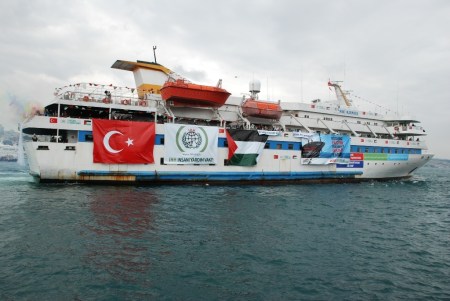
In 2010, a Turkish flotilla, led by the Mavi Marmara with hundreds of jihadists and anti-Israeli “intellectuals” aboard, sailed toward the coast of Gaza, aiming to break Israel’s naval blockade of the Hamas-run strip. Israel’s naval blockade aims to prevent weapons such as rockets being smuggled into Gaza. To stop the flotilla, naval commandos of the Israel Defense Forces boarded the vessel and, during clashes, killed nine aboard.

1080The Turkish-owned ship Mavi Marmara, which took part in the 2010 “Gaza flotilla” that attempted to break Israel’s naval blockade of Gaza. (Image source: “Free Gaza movement”/Flickr)

Since the incident, Turkey’s Islamist leaders have pledged to isolate Israel internationally and have downgraded diplomatic ties with Jerusalem. They have put forward three conditions before any normalization could take place: an Israeli apology, compensation for the families of the victims and the removal of the naval blockade on Gaza.

After President Barack Obama’s intervention, Israeli Prime Minister Benjamin Netanyahu in 2013 apologized for “any error that may have led to the loss of life.” Turkey’s two other conditions remain unfulfilled. But diplomatic teams from Ankara and Jerusalem are apparently working on a deal. There are good reasons why an accord may or may not be possible.

Since the nearest Turkish election is four years from now, neither Turkish President Recep Tayyip Erdogan nor his prime minister, Ahmet Davutoglu, has any reason to cultivate further anti-Semitism at election rallies in order harvest votes from conservative masses who are deeply hostile to Israel and Jews. These are days when Turkey’s leaders need not practice their usual anti-Israeli rhetoric.

There is another reason related to “timing” that makes a deal attainable. After pledging to isolate Israel, Turkey has become the most isolated country in the region, especially after the recent crisis with Russia that emerged after two Turkish F-16 fighters shot down a Russian SU-24 aircraft along Turkey’s Syrian border on Nov. 24.

In its region, Turkey does not have diplomatic relations with Cyprus and Armenia. It has downgraded diplomatic relations with Israel and Egypt. It is confronted by Shiite and Shiite-dominated regimes in Iran and Iraq, respectively. On top of all that, an angry Vladimir Putin, Russia’s president, curses and threatens every day to punish Turkey. Turkey buys over half of its natural gas and 10% of its oil from Russia.

Therefore, a third incentive could be a mutually beneficial future deal for Turkey to buy natural gas from Israel. If the two countries build an underwater pipeline, Turkey can compensate for the potential loss of Russian gas supplies, starting in 2019. For Israel, a pipeline to Turkey would be the most commercially feasible route to export its gas to Turkey and other potential buyers beyond.

A Turkish-Israeli handshake would also be music to ears in Washington. Deep hostility and occasional tensions between its two allies in the Middle East have always been unnerving for the U.S. administration.

The road ahead has its problems. Turkey’s second condition for normalization, compensation, is not too difficult to overcome. But the third condition, that Israel should remove the naval blockade of Gaza — and risk weapons being smuggled into the hands of Hamas (or other terrorist groups) — could be an unsafe move for Israel.

It would be truly embarrassing if a Turkey-Israel normalization results in new arms shipments into Gaza and rockets over Israeli skies — with the only achievement being a temporary peace with Turkey’s Islamists, who never hide their ideological kinship with Hamas.

If Netanyahu decides to take risks and go for a deal, he must make sure that however the naval blockade of Gaza would be eased, it does not expose Israel to the risk of new acts of terror.

Another risk is the potential psychological domino effect any deal could cause. It is certain that Turkish Islamists will portray any deal as a success story — that they were able to “bring Israel to its knees.” This message, relayed through a systematic propaganda machine, could set a dangerous precedent and potentially encourage Arab Islamists to consider more assertive policies toward Israel in the future.

The future Turkish and Israeli ambassadors would always have to keep their bags packed, ready to return to their own capitals at the first dispute – which could be caused by Israeli retaliation against Arab terrorism or anything that may make Erdogan roar in front of cameras, “Our Palestinian brothers … Those murderer Jews again … Go back to your pre-1967 borders or you’ll suffer the consequences!”

Netanyahu’s problem is that he does not trust Erdogan in the least. He is right not to trust Erdogan. But then how do you shake hands with a man whom you know ideologically hates you and wishes to mess up things at his earliest convenience?

Media: Saudi Arabia, UAE, Qatar and Jordan may send 90,000 military to fight IS

December 10, 2015

Media: Saudi Arabia, UAE, Qatar and Jordan may send 90,000 military to fight IS

World December 10, 11:16 UTC+3

Source: TASS: World – Media: Saudi Arabia, UAE, Qatar and Jordan may send 90,000 military to fight IS

Iraq Press Agency quoted politician Hanan Al Faltawi as saying she received that information from reliable sources after talks between US Senator John McCain and Iraqi Prime Minister Haider al-Abadi

© EPA/ALI HASSAN

BEIRUT, December 10. /TASS/. Around 100,000 foreign military, including 90,000 from Arab countries, may be deployed to Iraq to fight against the Islamic State (IS) terrorist organization, Iraq Press Agency quoted politician Hanan Al Faltawi as saying.

Al Fatlawi said that she received this information from reliable sources after talks between US Senator John McCain and Iraqi Prime Minister Haider al-Abadi. The meeting took place on November 27 in the joint American-Iraqi operational headquarters in Baghdad that coordinates military actions against IS, she added.

Foreign forces of 100,000 – 90,000 from Saudi Arabia, the United Arab Emirates, Qatar and Jordan and 10,000 from the United States – will be stationed in Iraq’s western parts,” Al Fatlawi noted. The politician added that “the Iraqi prime minister openly expressed bewilderment over McCain’s statement but was told that everything had already been decided.”

Islamic State extremist organization

The Islamic State is an extremist organization banned in Russia. In 2013-2014, it called itself the Islamic State of Iraq and the Levant (ISIL). In June 2014, IS announce the establishment of the “Islamic caliphate” on the territories seized in Iraq and Syria. According to US’ Central Intelligence Agency, the extremist group includes around 30,000 people, while Iraqi authorities claim there are around 200,000 in IS. Among members of the group are citizens of 80 countries, including France, Great Britain, Germany, Morocco, Saudi Arabia, US, Canada, as well as Russia and other CIS countries. According to reports, militants now control around 40% of the Iraqi territory and 50% of the Syrian territory.

Turkish jets strike Kurdish positions in Iraq amid rising tension between Ankara & Baghdad

December 10, 2015

Turkish jets strike Kurdish positions in Iraq amid rising tension between Ankara & Baghdad

Published time: 9 Dec, 2015 18:35 Edited time: 9 Dec, 2015 20:04

Source: Turkish jets strike Kurdish positions in Iraq amid rising tension between Ankara & Baghdad — RT News

© Umit Bektas
Ankara carried out airstrikes targeting Kurdistan Workers’ Party (PKK) forces in northern Iraq, the Turkish army said on Wednesday. The action comes in the wake of rising tensions between Ankara and Baghdad over the deployment of Turkish troops in Iraq.

Ten F-16 fighter jets launched an attack between 10pm and 10:50pm on Tuesday, targeting PKK positions in the Kandil, Hakurk, Zap and Avasin-Baysan regions in northern Iraq, the Turkish General Staff said in a statement. It added that the targets were “destroyed in an aerial campaign.”

Tensions have been rising between Ankara and Baghdad after Turkey deployed hundreds of troops equipped with tanks and artillery to Iraq’s northern Nineveh Governorate last Thursday, saying they will train forces battling Islamic State (IS, formerly ISIS/ISIL).

Baghdad said it had not asked for the help of Turkish forces, and demanded their withdrawal after it said Turkey had “illegally” sent the troops into Iraq. Describing the move as violation of sovereignty, the Iraqi government also asked NATO to intervene.

Read more

© Cem Ozdel

Meanwhile, Shiite paramilitary groups have threatened to use force against Turkey unless it pulls its forces out of Iraq. Likening the Turkish incursion to the occupation of Iraq by IS militants, Badr Brigade spokesman Karim al-Nuri said “all options” were available.

We have the right to respond and we do not exclude any type of response until the Turks have learned their lesson,” Nuri said on Wednesday. “Do they have a dream of restoring Ottoman greatness? This is a great delusion and they will pay dearly because of Turkish arrogance.”

Also on Wednesday, the Iraqi parliament unanimously approved a motion condemning the Turkish intervention, supporting the government in taking whatever measures it viewed as appropriate.

Russia raised the issue at a meeting of the UN Security Council on Tuesday, expressing hope that Ankara will avoid escalating the situation in the region with any further reckless actions. Following the meeting, Russia’s UN envoy Vitaly Churkin said that Moscow expects Ankara to “settle the situation in Iraq in a way that would satisfy the Iraqi government.”

“Now the situation is within the focus of the attention of the Security Council, so we hope it will help resolve [it] to the satisfaction of the Iraqi government, whose sovereignty, territorial integrity and independence will be respected,” he said.

Russian Foreign Minister Sergey Lavrov slammed Ankara’s actions while speaking to Italian media on Wednesday.

Lavrov proposed a thorough examination of how Turkey performs goals set by the coalition in Syria. “We need to examine how a member of the US-led coalition – the Republic of Turkey – performs goals set by the coalition,” the minister said. “Why is it not bombing terrorists as such, but the Kurds instead?”

READ MORE:West’s reaction to Turkish invasion – an exercise in hypocrisy

On Wednesday, Ankara argued that Turkish soldiers were sent to northern Iraq after a threat from IS to Turkish military trainers in the area. Prime Minister Ahmet Davutoglu said that the deployment was an act of solidarity, not aggression.

The [military] trainers in the Bashiqa camp were threatened by Daesh (Islamic State) because it is 15-20 kilometers from Mosul and they have only light arms,” he told media in Istanbul. “So when these threats increased… we sent some troops to protect the camp, not as an act of aggression but as an act of solidarity.

‘Hopefully, no nukes will be needed’ against ISIS

December 9, 2015

‘Hopefully, no nukes will be needed’ against ISIS – Putin

Published time: 9 Dec, 2015 07:01 Edited time: 9 Dec, 2015 11:13

Source: ‘Hopefully, no nukes will be needed’ against ISIS – Putin — RT News

© Aleksey Nikolskyi
Vladimir Putin has praised the Russian cruise missiles fired against terrorists in Syria from the sea. He expressed hope that these weapons would not have to be armed with nuclear warheads.

Meeting in the Kremlin with Defense Minister Sergey Shoigu, who reported the latest results of the anti-Islamic State (IS, formerly ISIS/ISIL) ops in Syria, the Russian president made a notable remark.

We must analyze everything happening on the battlefield, how the weapons operate. The Kalibrs (sea based cruise missiles) and KH-101 (airborne cruise missile) have proved to be modern and highly effective, and now we know it for sure – precision weapons that can be equipped with both conventional and special warheads, which are nuclear,” Putin said.

“Naturally, this is not necessary when fighting terrorists and, I hope, will never be needed,” the president added.

On Tuesday, a Russian Kilo-class submarine, the Rostov-on-Don, fired Kalibr-PL cruise missiles against an IS installation near the terrorists’ stronghold in Raqqa. Water-to-surface cruise missiles were launched from a submerged sub in the Mediterranean Sea, according to the Russian defense minister.

“We’ve been registering the missiles launches, flights and, of course, their hitting the targets,” Shoigu said. “We warned our Israeli and American colleagues about these launches.”

Kalibr and KH-101 cruise missiles have been deployed for the first time this year in Russia’s counter-terrorist operation in Syria.