Posted tagged ‘Russia – Syrian war’

Turkish army like Iraqis stalled by ISIS pushback

December 28, 2016

Turkish army like Iraqis stalled by ISIS pushback, DEBKAfile, December 28, 2016
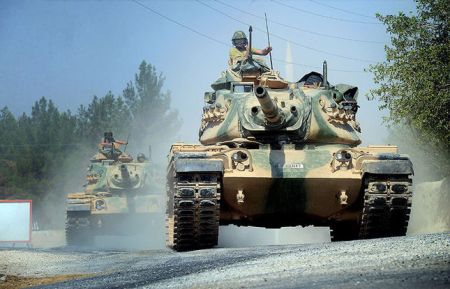
turkeytrot

Wednesday, Dec. 28, hours before US Secretary of State John Kerry was due to deliver a major speech on his vision for the Middle East, Turkey and Russia announced a ceasefire plan going into effect the same night for the whole of Syria, and in all regions, where fighting between pro-government forces and opposition groups were taking place – excepting for terrorist organizations.

Moscow and Ankara assumed the role of guarantors of the process. This accord will be brought for approval before the Syrian peace conference to be convened in the Kazakhstan capital, Astana, this week, attended by Russia, Turkey, Iran, the Syrian government and Syrian opposition groups. The US and Europe were not invited.

Not content with kicking Washington out of any role in resolving the Syrian crisis, the Turkish president Tayyip Erdogan accused the US, leader of the Western war on the Islamic State, of supporting “terrorist groups.”

He claimed Tuesday to have evidence of the US “giving support to terrorist groups including Daesh, YPG, PYD,” adding, ” We have…  pictures, photos and videos.”

While Erdogan is scoring in the diplomatic arena, he faces nothing but frustration militarily over the failure of the large, professional Turkish army to gain ground in the battle for Al Bab in northern Syria. This is Turkey’s first face-to-face with the Islamic State in its  four-month old Euphrates Shield operation in northern Syria – and it is not gong well. The fighting is deadly with no end in sight.

This may partly account for Erdogan’s oddly inconsistent behavior.

Tuesday, Dec. 26, he quietly asked the Obama administration to step up its air support for the Turkish campaign to capture Al Bab, 55 km north of Aleppo and the only major town in ISIS hands in northern Syria. He accused the US of not doing enough.

It was doubly odd in that Turkey has a large air force of its own, and if that force was not enough to support the campaign against ISIS, Erdogan’s obvious address for assistance would be his ally in the Syrian arena, Russian President Vladimir Putin. After all, Ankara, Moscow and Tehran are in the middle of a shared effort to set the rules of the game in Syria, which has pointedly excluded the US under the Obama administration.

As to the state of the fighting, on Dec. 21, Erdogan claimed: “Right now, Al-Bab is completely besieged by the Free Syrian Army and our soldiers.” In fact, this siege has been in place for weeks and, worse still, the casualties are mounting.

Wednesday, Dec. 28, the Turkish military said  it had “neutralised” 44 Islamic State fighters in Al Bab and wounded 117 in Al Bab,  while 154 Islamic State targets had been struck by artillery and other weaponry.

No casualty figures have been released for the Turkish army fighting for Al Baba. They are conservatively estimated at 90 dead and hundreds injured. The losses of Free Syrian Army (FSA), the local rebel force fighting alongside the Turkish army, are undoubtedly heavier still.

Our military and counterterrorism experts explain how the Islamic State’s beleaguered fighters are not just holding out in Al Bab against a superior army, but running circles around it.

The jihadists took the precaution of clearing back passages from Al Bab to their headquarters in Raqqa, 140km to the southeast, and Palmyra, 330km away.

This heritage town, which the Russians took from ISIS several months ago, was recaptured by the jihadists earlier this month, when Russian forces were fully engaged with capturing Aleppo. The US air force has in the last few days redoubled its strikes on Palmyra – both to cut off the flow of reinforcements and supplies to the besieged ISIS fighters in Al Bab and to clear the way for Russian forces to recover the lost town.

This US-Russian cooperative effort is at odds with the Obama administration’s presentation of Washington’s prickly relations with Moscow.

Notwithstanding the forces ranged against it, ISIS has so far managed to repel almost every Turkish bid to break into Al Bab – thanks to the new tactics it has introduced to the battles for Syrian Al Bab and Iraqi Mosul, which mark a turning point in the war on Islamist terror in those countries.

Those tactics hinge heavily on maximizing enemy casualties in order to knock the opposing army off the battlefield.

This is achieved by a deadly mix of guerilla and terrorist methods, and includes car bombs, bomb belt-clad suicides, improvised explosive devices (IED), sniper squads, gliders carrying explosives with small parachutes, as well as the increasing use of anti-air missiles and poison chemicals.

Tuesday, Iraqi Prime Minister Haydar Al-Abadi estimated that the Iraqi army needed another three months to beat ISIS in Mosul. He was trying to buck up the Iraqi people by concealing the true situation.
The fact is that the Iraqi military offensive against ISIS in its Mosul stronghold has ground to a halt – and no wonder, when some units have suffered a 50 percent manpower loss.

Gen. Stephen Townsend, commander of American troops in Syria and Iraq, was of the opinion last week that at least two years of fighting were needed to drive ISIS out of its two capitals, Mosul and Raqqa. He did not spell this out, but his meaning was clear: to achieve this objective, a far larger army was needed than the military manpower available at present.
How Iran actually lost in Aleppo

December 26, 2016

How Iran actually lost in Aleppo, American ThinkerHeshmat Alavi, December 26, 2016

For 16 years America has failed to adopt a correct policy in the Middle East despite having huge opportunities to make significant changes. The 2003 war literally gift-wrapped Iraq to Iran, parallel to the highly flawed mentality of preferring Shiite fundamentalism to Sunni fundamentalism. This allowed Iran take full advantage of such failures and resulting voids.

Aleppo will be a short-lived success story for Iran. The tides are changing across the globe and Iran will no longer enjoy opportunities from West rapprochement. Understanding this very well, this is exactly why Tehran has resorted to such atrocities and sought to massacre all in Aleppo.

In contrast to how the U.S. handed Iraq in  a silver plate to Iran, Russia never entered the Syria mayhem to hand it over to Iran. The roots of Aleppo remain in the hearts of all Syrians. As world powers, especially the U.S. and Russia review their future objectives, Iran will be the first and ultimate party to suffer.

***********************************

Following a historic period of perseverance, Syrian rebels and their families were forced to evacuate eastern Aleppo after its liberation back in 2012. An unjust, intense war was launched upon Aleppo by Iran’s Revolutionary Guards (IRGC) and its proxy forces on the ground: Russia with its indiscriminate air strikes, and a lame-duck Syrian army of less than 20,000 deployable forces.

After more than 15 months continuous air raids and a long-lasting inhumane siege, Syrian rebels and civilians sealed an international agreement to depart Syria’s once economic and cultural hub.

In the past few weeks widespread bombing campaigns continued relentlessly on civilian areas. No Aleppo hospital was spared. The IRGC and its foot-soldiers, numbering at the tens of thousands, spearheaded the military of Syrian dictator Bashar Assad in horrific mass executions of innocent people. The United Nations reported 82 individuals, including women and children, were murdered on the spot in the streets and in their homes. God knows how many more incidents have gone unreported.

The amazing perseverance shown by Aleppo locals for years now in the face of atrocious airstrikes and artillery shelling is unprecedented to say the least. Amidst all this, the silence and inaction seen from the West, especially the United States, will remain forever a source of shame.

Conflict of Interests

In the pro-Assad camp there are three decision-makers. First Russia, second Iran, and third the Syrian regime. The role played by Assad and his military in such scenes is next to nothing.

The West and Turkey became frantic for a ceasefire in Aleppo in the early days of the war due to the negative public opinion resulting from shocking crimes. They sought to have the rebels and remaining civilians transferred to other Syrian opposition controlled areas.

On December 13th, Washington and Moscow reached what can be described a ceasefire agreement. Intense negotiations between Turkey and Russia were started afterwards, resulting in an agreement between the Syrian opposition with Russia and Turkey to evacuate Aleppo. Practically, the parties involved in the talks were Aleppo representatives and Russia, hosted by Turkey. All necessary preparations were made to begin evacuating the city from the morning of Wednesday, December 14th.

However, Iran disrupted this agreement and the IRGC hindered the evacuation process. It was crystal clear Russia and Iran were pursuing different objectives and sets of interests. Iran sought not to have Aleppo evacuated but to exterminate all Syrian rebels and civilians.

Twenty-four hours later, pressure from the international community forced the implementation of the Russia-Syrian rebel agreement on December 15th. On the morning of that day the first convoy carrying the wounded exited Aleppo, only to face roadblocks imposed by Iran-backed forces and the Assad military.

Iran raised certain conditions for the evacuation. Russia later threatened to airstrike any party hindering the evacuation, an obvious warning to Iran. Tehran was forced to wind back under Moscow pressure.

As a result, the last phase of this war and the method chosen to evacuate Aleppo was a defeat for Iran and a victory for the Syrian opposition. Especially since the conflict of interest between Iran/Assad and Russia became crystal clear. Politically speaking, Iran has become a secondary party in Syria.

“For Putin, a political settlement now makes sense. Staying involved in an ongoing insurgency does not. But for that, he needs the opposition — which is fractured — to accept a political outcome, and there is little prospect of that so long as Assad remains in power,” as explained by Dennis Ross, who served as the Director of Policy Planning in the State Department under President George H. W. Bush, the special Middle East coordinator under President Bill Clinton, and was a special adviser for the Persian Gulf and Southwest Asia (which includes Iran) to the former Secretary of State Hillary Clinton.

Is this the end?

The turn of events does not spell the end of the Syrian opposition. The opposition controls large swathes of Syria, with areas over ten times larger than Aleppo and millions of residents. Idlib Province has at a three million strong population; the western coast of the Euphrates in the Turkish border, recently liberated by the Free Syrian Army from Daesh (ISIS/ISIL); large portions of Deraa Province neighboring Jordan; a strategically important section in the north in Latakia Province on the Turkish border; large portions of areas in the Damascus vicinity and large portions in the Aleppo vicinity.

In contrast to Western mainstream media reporting, the Syrian opposition enjoys the capability to rise once again.

Despite all its differences, a comparison made to the Iran-Iraq War may help. In 1986, Iran made significant advances taking control over the Faw peninsula in southern Iraq. Western media and think-tanks all forecasted further advances by Iran and a defeat for Iraq. In 1988 Iran was forced into a U.N.-brokered ceasefire agreement.

Deep divisions between the Syrian nation and the Assad regime have reached the point of no return. Nearly 500,000 have been killed and more than half of the Syrian population displaced. The Syrian nation will never accept the continuation of this regime. Despite sporadic military advances, Assad has no place in Syria’s future.

Where Iran stands in Syria

Iran will not be the final victor in Syria.

First — For Iran, it is vital to maintain Assad in power. His fall will mark the end of Iran’s crusades in Syria. Even if the Syrian opposition becomes weaker, the overall crisis will continue while Assad remains in power. Assad is no longer acceptable in the international stage with an international consensus over his resort to war crimes and crimes against humanity.

Second — While Iran is financing and providing the ground forces, in this war, it no longer enjoys the first and final word. Russia calls the shots now with stark differences in interest, as seen in Aleppo.

Trump’s America

U.S. President Barack Obama’s weak foreign policy, especially the failed engagement with Iran, prolonged the Syrian crisis, allowed Tehran to take advantage, Russia to take the helm and America be sidelined.

Where will developments lead with Donald Trump in the White House? What will be the new U.S. foreign policy vis-à-vis Syria, Iran and the Middle East? How can we define Washington’s relationship with Moscow, and what practical measures will Trump take against Daesh (ISIS/ISIL)? Time will tell.

Good relations between the U.S. and Russia will at least not have a negative impact on the region, and this is good news for the Syrian opposition. Russia has weighable interests in Syria. However, what will Trump do with Iran? Considering Trump’s harsh tone on Iran to this day, far more positive outcomes can be forecasted for the Syrian opposition.

Second, Trump and secretary of state nominee Rex Tillerson have the potential of eventually convincing Russia to provide concessions. This is not in Iran’s interests, as Tehran remembers Russia ditching Libyan the dictator Muammar Qaddafi.

Lesson learned in Syria

For 16 years America has failed to adopt a correct policy in the Middle East despite having huge opportunities to make significant changes. The 2003 war literally gift-wrapped Iraq to Iran, parallel to the highly flawed mentality of preferring Shiite fundamentalism to Sunni fundamentalism. This allowed Iran take full advantage of such failures and resulting voids.

Aleppo will be a short-lived success story for Iran. The tides are changing across the globe and Iran will no longer enjoy opportunities from West rapprochement. Understanding this very well, this is exactly why Tehran has resorted to such atrocities and sought to massacre all in Aleppo.

In contrast to how the U.S. handed Iraq in a silver plate to Iran, Russia never entered the Syria mayhem to hand it over to Iran. The roots of Aleppo remain in the hearts of all Syrians. As world powers, especially the U.S. and Russia review their future objectives, Iran will be the first and ultimate party to suffer.


Plane crash ups Syria-tied Russian deaths to 310

December 26, 2016

Plane crash ups Syria-tied Russian deaths to 310, DEBKAfile, December 26, 2016

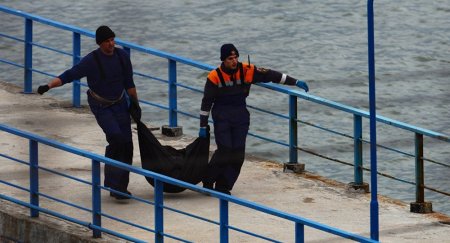
tu-154_crash_25-12-16

The Black Sea crash, if an act of terror is proven, will demonstrate that Russia has become a central target for Islamic terrorists, especially ISIS and Al Qaeda’s Syrian arm, the Nusra Front, and is paying a cruel price for its role in the Syrian conflict.

************************

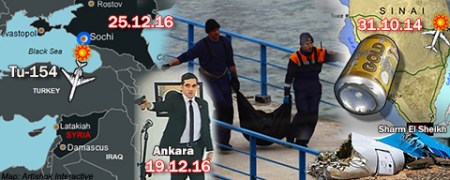
Notwithstanding the extraordinary circumstances surrounding the Russian Tu-154 air crash into the Black Sea minutes after its takeoff for Syria from Sochi early Sunday Dec. 25, the dread announcement that none of the 92 people aboard had survived was not accompanied by an official suggestion of terrorism.

That suggestion began rising to the surface later in the day. Transport Minister Maxim Sokolov reported the finding of 11 bodies in the sea, adding ominously that “fragments of other bodies were also found.” He added: “Of course the entire spectrum and almost any possible causes…are being probed, but it is premature now to speak about this as a terrorist act.”

Maj. Gen. Igor Konashenkov, a military spokesman put in that the pilot was “first-class,” and the 33-year-old Tupelov passenger jet had been serviced recently.

But by then, investigators must have had some idea of what caused the crash just two minutes after takeoff – too suddenly for the pilot to send a distress signal.

Did they find evidence of explosives planted on the plane or, possibly, a sabotaged fuel line or tank, or a passenger carrying a bomb or wearing a bomb vest? A possibly technical fault cannot be ruled out at this stage. However, the unusual Russian response to the disaster indicated that the Kremlin was in a hurry to find answers and that its emergency infrastructure was in high gear to cope with a massive terrorist attack. Deployed to the scene of the crash was an army of 3,000 rescue personnel, including 100 divers, who were rushed in from all parts of Russia, along with 32 ships and submarines and scores of helicopters and drones – all engaged in gathering every scrap of debris and human remains for a complete picture of the disaster.

While world attention remains focused on the wave of terror overtaking Europe, Islamist terrorists including ISIS, are clearly placing Russia firmly in their sights, especially since its intensified military intervention in Syria last September.

Still registered on the collective Russian consciousness is the tragic downing of the Metrojet Airbus on Oct. 31 2015 over Egyptian Sinai, after taking off from Sharm El-Sheikh, then a favorite Russian tourist resort. None of the 217 passengers and crew survived.

Still ringing in Russian ears is the voice of the Turkish assassin yelling: “Remember Syria! Remember Aleppo!” six days earlier, after he shot Andrew Karlov, 62, the Russian ambassador to Ankara. The video of the crime played out on TV screens across the world.

russainblackseaplane480

So far, President Vladimir Putin has managed to minimize the casualties of Russian military personnel involved in the Syrian war. But the number of fatalities building up from terrorism under the shadow of that war may have just jumped to an ominous level to 310 – not counting soldiers.

The Black Sea crash, if an act of terror is proven, will demonstrate that Russia has become a central target for Islamic terrorists, especially ISIS and Al Qaeda’s Syrian arm, the Nusra Front, and is paying a cruel price for its role in the Syrian conflict.

The doomed Tupolev was carrying more than one popular national symbol: 64 singers of the Red Army Choir, known as the Alexandrov Ensemble, a troupe of dancers, and Yelizaveta Glinka, known popularly as “Doctor Liza,” beloved leader of an organization for aiding victims in Russian combat zones. Nine reporters were also on the plane.  Putin declared Monday a day of national mourning.

They were all flying to the Russian Hmemim airbase in Latakia with a shipment of medicines. A concert for the troops was booked for the New Year.

Terrorists have for years had their eye on the celebrated Black Sea resort of Sochi, venue of international summits and favorite winter getaway location for Russian rulers, including Putin, who maintains a holiday residence there. An assault on Sochi is therefore a poke in the eye for the Russian president and the Russian military and security agencies battling terrorism.

The sorrow and the pity in Syria

December 21, 2016

The sorrow and the pity in Syria, Washington Times

(Please see also, Lies and Hypocrisy over Aleppo. — DM)

iraninsyriaIllustration on Iran’s future role in Syria by Linas Garsys/The Washington Times

ANALYSIS/OPINION:

Over the last five years, Syria has been descending into a hell on Earth. Over the last four months, the lowest depths of the inferno have been on display in Aleppo, an ancient city, once among the most diverse and dynamic in the Middle East. On Friday, in the final press conference of his presidency, Barack Obama addressed this still-unfolding humanitarian and strategic catastrophe.

“So with respect to Syria,” he said, “what I have consistently done is taken the best course that I can to try to end the civil war while having also to take into account the long-term national security interests of the United States.”

An estimated 500,000 dead, 11 million displaced, millions more living in fear, sorrow and pitiful poverty, Iranian forces backed by Russian forces occupying the heart of the Arab world — yet no-drama Mr. Obama remains so casual, so confident that the decisions he’s made were “the best” and, what’s more, that he made them “consistently.” Is refusing to change one’s mind as conditions worsen and policies fail really a virtue?

To bolster his case, the president emphasized that he has spent lots of time — “if you tallied it up, days and weeks” — attending meetings on Syria. “We went through every option in painful detail with maps,” he said, “and we had our military and we had our aid agencies and we had our diplomatic teams, and sometimes, we’d bring in outsiders who were critics of ours.” Imagine that: painful detail, maps, aid agencies, even critical outsiders.

Count me among those not convinced. In 2011, during that hopeful moment known as the Arab Spring, peaceful protesters took to the streets of Damascus. The dynastic dictator Bashar Assad responded brutally. Before long, a civil war was ignited.

Mr. Obama’s top advisers recommended assisting non-Islamist and nationalist rebels — not with the proverbial boots on the proverbial ground but with secure communications devices, money, weapons and training. Mr. Obama rejected that advice. He had done the math: Mr. Assad, a member of the Alawite minority, hadn’t enough loyal troops to prevail against Syria’s insurgent Sunni majority. So the fall of the Assad regime had to be both inevitable and imminent.

What that failed to take into account: Iran’s theocrats would send in foreign Shia fighters, including those of Hezbollah, their Lebanese proxy, all under the leadership of their Islamic Revolutionary Guard Corps. Vladimir Putin also would deploy forces in support of the Assad regime. We can surmise his reasons: to have a Mediterranean port for his navy; to re-establish Russia’s influence in the Middle East; to show the world that, unlike Mr. Obama, he does not abandon his friends; to diminish American credibility and prestige.

Mr. Obama’s response was, as it so often is, mainly rhetorical. He warned Mr. Putin that he was stepping into a quagmire. He proclaimed, as so he often does, that there can be “no military solution.”

The Russian president, a product of the KGB rather than the faculty lounge, knew that was nonsense. In the Middle East, the law of the jungle trumps international law every time.

Having accused President George W. Bush of overreach, Mr. Obama adopted a policy that might be called underreach. He decided not to enforce the “red line” he had declared against Mr. Assad’s use of chemical weapons. He decided not to eliminate Mr. Assad’s air power, which would have ended the barrel-bombing of civilians. He wasn’t even willing to help establish “safe zones” where innocent Syrians might stand a chance to defend themselves.

I know: Mr. Obama saw his mission as ending wars and certainly not risking additional American entanglements. And he is among those who believe that the projection of American power generally does more harm than good.

Not mutually exclusive is the theory that he had a specific goal in mind: to bring Iran’s rulers into a strategic partnership with the United States. To achieve that, he had to demonstrate that he respected what he has called their “equities” in Syria. Were he to take action against Mr. Assad, the Islamic republic’s envoys might walk away from the table where they were negotiating the nuclear weapons deal Mr. Obama envisioned as his great foreign policy legacy.

The president has been nothing if not “consistent” in his pursuit of detente with Iran’s Islamic revolutionaries. In all likelihood, that is what explains his decision, just after taking office, to turn a blind eye to the clerical regime’s ruthless repression of the Green Movement that took to the streets of Iranian cities following a rigged presidential election in 2009.

History will record that these efforts failed. Nixon went to China. Mr. Obama will not be going to Iran — or to Syria, which Iran intends to incorporate into its version of a caliphate (which Shia call an “imamate”).

Aleppo,” U.S. Ambassador Samantha Power said last week at the U.N., “will join the ranks of those events in world history that define modern evil, that stain our conscience decades later. Halabja, Rwanda, Srebrenica, and, now, Aleppo. To the Assad regime, Russia, and Iran, your forces and proxies are carrying out these crimes.”

She went on to ask: “Are you truly incapable of shame? Is there literally nothing that can shame you? Is there no act of barbarism against civilians, no execution of a child that gets under your skin?”

Would it be unfair to suggest that the answers to these questions should have been apparent to her and the president years ago? Had that been the case, perhaps they would have formulated different policies and implemented a different course of action. Or perhaps not.

Russian role in Aleppo’s fall impacts US politics

December 16, 2016

Russian role in Aleppo’s fall impacts US politics, DEBKAfile, December 16, 2016

aleppo-damage_9-15

The Putin factor comes in handy for the latest tactic in a series pursued since the November 8 election, for delegitimizing Trump’s victory and negating his fitness to reach the White House.

This campaign may resonate strongly on America’s future policy and position as a world power, because it is designed to block Trump’s path to a deal with Putin for resolving the Syrian conflict. The Obama administration has no wish to see the new president succeed where it failed for nearly six years.

********************************

Aleppo’s fall to the Assad regime with the surrender Thursday, Dec. 15, of the Syrian rebel forces locked in a corner of the eastern districts was the most disastrous military and strategic setback to befall the Obama administration for two years. It started evolving in September 2015, when Russia stepped up its military intervention in the Syria war and rescued Bashar Assad.

When Aleppo succumbed to the Russian-backed government army and its allies, Iran, Hizballah and fellow Shite militias, it did not fall alone.  It brought down the entire architecture of US-backed positions in northern Syria. The US had invested in and trained local groups, such as the Syrian Kurdish militia and the rebel Free Syrian Army, as the bedrock for its policy and interests in the conflict. Those groups have melted away.

The acknowledged overlords of northern Syria today are Russian President Vladimir Putin and Turkish President Recep Tayyip Erdogan, who can claim the Aleppo victory. Bashar Assad and Iran are reduced to playing second fiddle. But whereas the Al Qods chief Iranian general Qassem Soleimani commands pro-Iranian forces in the region, America has been divested of all its military assets and has no real say in the next chapter of the horrific war.

Hence US Secretary of State John Kerry’s despairing appeal Thursday in a press briefing to bring the bloodshed and suffering to an end: “We can’t have another Srebrenica” – a reference to the Serbian slaughter of 8,000 Bosnian Serbs in 1985 – he said.

Kerry has toiled tirelessly for a diplomatic solution to the dreadful Syrian war, but his appeal falls on senses hardened by the many Srebrenicas perpetrated in more than five years of conflict. Hundreds of thousands of civilians and soldiers have been slaughtered – according to an unofficial estimate up to a million – and many subjected to chemical warfare. The secretary can’t count on the Kremlin to relent and so, even after the last Syrian rebels and their families are out of Aleppo, the killing will go on.

In Washington, 10,000 kilometers away, the Aleppo calamity is being dished up as a political tool. The claim was heard Thursday that the “same Vladimir Putin” who sponsored the atrocities in Aleppo, also interfered in the US presidential election by sending hackers to influence the results in favor of Donald Trump. The claim is touted by Obama administration spokesmen and the Democratic Party, whose candidate Hillary Clinton lost the election. It appears to be fodder for a Democratic party drive building up for the president-elect’s impeachment even before he is sworn in as president on Jan. 20.

The Putin factor comes in handy for the latest tactic in a series pursued since the November 8 election, for delegitimizing Trump’s victory and negating his fitness to reach the White House.

This campaign may resonate strongly on America’s future policy and position as a world power, because it is designed to block Trump’s path to a deal with Putin for resolving the Syrian conflict. The Obama administration has no wish to see the new president succeed where it failed for nearly six years.

Putin will have no qualms about capitalizing on Washington’s preoccupation with its internal power struggle and will build up as many gains in Syria as he can before Donald Trump takes over. Obama’s threat Friday, Dec. 12, to retaliate for Russia’s efforts to influence the presidential election will just provoke the Russian president to move faster and more determinedly in his grab for more assets in Syria.

ISIS seizes big Russian-Syrian T-4 air base

December 12, 2016

ISIS seizes big Russian-Syrian T-4 air base, DEBKAfile, December 12, 2016

cairo_terror480

Islamic State forces pushed their assault forward to retake the central Syrian town of Palmyra Monday, Dec. 12. By evening, they had entered the big Russian-Syrian T-4 air base outside the town, carrying off substantial quantities of Russian armaments. Reporting this, DEBKAfile’s military sources add that the booty they snatched included different types of ground-to-ground missiles as well as anti-tank and anti-air rockets.

Russian forces manning the base were hurriedly evacuated from Palmyra and the T-4 base, after the worst defeat Russian armed forces had ever experienced at ISIS hands in Syria. Military circles in Moscow commented grimly that the Russian army had suffered “a major disgrace” in Palmyra.

According to our sources, long convoys of ISIS fighters backed by tanks taken booty from the Syrian army, first forced the Syrian 11th Tank Division to abandon the strategic Jhar Crossroad. After that, the way was clear for the jihadis’ column to reach the T-4 base.

DEBKAfile reported on the ISIS terrorists’ fresh momentum Sunday.

Judging from the rash of reports claiming US-Iraqi military progress in the Mosul offensive against ISIS and the extra American special operations forces personnel posted to Syria for an impending US-Kurdish operation to capture the ISIS Syrian stronghold of Raqqa, the Islamic State ought to be cowering under siege, finally defeated – or at least on the run.

But the facts tell another story. ISIS is on the offensive – so far in the Middle East. Over the weekend, Islamist terrorists accounted for dozens of deaths and injured hundreds more.

Sunday, Dec. 11, at least 25 people worshipping at the Coptic St. Peter’s and St. Paul’s church adjacent to St, Mark’s cathedral in Cairo were killed and scores injured. The Coptic pope often leads the prayers there. DEBKAfile’s counterterrorism sources reveal that the attack was carried out by Islamist terrorists from Raqqa who bided their time until they struck in the Egyptian capital. Saturday, six Egyptian troops were killed by another Islamist bomb near the Giza pyramids.

On the same day, ISIS fighters pushed back into the ancient Syrian town of Palmyra, nine months after their expulsion.

The Raqqa terrorist stronghold is clearly alive and kicking on more than one front. A number of contributing factors enable the Islamic State to unleash a fresh spate of terror.

1. The US-Iraqi-Kurdish drive has stalled without driving ISIS out of Mosul or choking off the terrorist fighters’ freedom to move between Mosul and Raqqa, their Syrian bastion.

US Defense Secretary Ashton Carter, who arrived in Baghdad Sunday, Dec. 11, was assigned by the Obama administration to make a last effort to reactivate the Mosul campaign. His chances of success are slim. The military coalition which launched the campaign two months ago has lost a vital component, the Kurdish Peshmerga, which backed out three weeks ago. The Iraqi military units which captured some of the city’s outskirts stopped short when they reached the strongest defense lines set up by the Islamic State and have been unable to break through, even with US air support.

The pro-Iranian Iraqi Shiite front which undertook to seize Tal Afar in order to sever the ISIS connecting link between Iraq and Syria are parked outside, having been warned by Turkey not to set foot in the town.

Added to these setbacks, the US CENTCOM which is running the aerial war in Iraq is at loggerheads with the Iraqi Air Force command and has practically grounded all Iraqi warplanes.

Even if Carter can wave a magic wand and resolve all these issues, the momentum and high hopes that actuated the Mosul campaign when it started have been lost and can hardly be recovered before Barack Obama leaves the White House.

At least two of the incoming president Donald Trump’s designated security advisers – Defense Secretary Gen, James Mattis and National security Adviser Gen. Michael Flynn – have criticized the operation in is current form.

2. What is happening in Raqqa doesn’t fit the designation of an offensive. At most, small Kurdish and Syrian rebel groups are mounting sporadic raids against ISIS fighters on the town’s outskirts, with the support of the Obama administration. Our military experts say that Raqqa can’t be captured from the Islamist terrorists by conventional means – mainly because it is spread over a large area of mostly empty desert. ISIS has taken advantage of this terrain to distribute knots of defenders across a vast area ranging hundreds of kilometers from northern to eastern Syria up to the winding, heavily overgrown banks of the Euphrates River.

So when Ash Carter announced Saturday that he would be sending another 200 Special Operations Forces into Syria to join the battle for Raqqa, he had no idea that he, the Russians and the Syrians were about to be caught off guard by a fresh ISIS initiative to reoccupy Palmyra, the ancient Syrian two from which they are thrown out in March.

This was a poke in the eye for Russian President Vladimir Putin who proclaimed Palmyra’s capture from ISIS as a signal coup for the Russian army in its war on Islamist terror.

3.  He might well commiserate with Egyptian President Abdel-Fatteh El-Sisi. For two years, the Egyptian armed forces have been fighting an uphill battle to crush the ISIS groups infesting the Sinai Peninsula. The jihadists constantly elude punishment with the help of supportive Bedouin tribes.

Every few months, they pose a real threat to the stability of the El-Sisi regime by striking inside Cairo, the capital, with some terrorist atrocity, for which they are aided by the Muslim Brotherhood underground and Palestinian Hamas extremists in the Gaza Strip.

The bombing of the Coptic church Saturday was unusually the work of jihadists deployed from Raqqa, Syria.  Egypt has reacted by placing extra guards at Christian sites and declaring three days of national morning for the disastrous bombing attack on Egypt’s largest minority.

The new Islamist drive is looking ominously like the onset of the Christmas-New Year holiday terror onslaught the Islamic State has threatened to unleash in the Middle East and beyond. US and European security services have been placed on high alert in the belief that returning jihadis are programmed to strike at home.

Israel jets mark go-it-alone policy on Syria

November 30, 2016

Israel jets mark go-it-alone policy on Syria, DEBKAfile, November 30, 2016

raidfire480Arab media show damage caused by air strikes to Syrian army compound in Damascus

Although Erdogan is notorious for his wildly unpredictable decision-making, it is more than likely that before going public on his radical change of heart on Assad, he was in touch with the new national security team taking shape in Washington. If that was the case, then Donald Trump was using Erdogan to notify Putin that the entire architecture of their understandings on Syria was now at risk.

If the Arab media reporting on Israeli air attacks on Syrian military and Hizballah targets in Damascus from Lebanese air space are confirmed, Jerusalem will be shown to have followed Ankara in backing away from those short-lived, understandings, opting instead for an independent policy in its own security interests with regard to Syria.

*****************************

Arab media carried conflicting reports wich described Israeli warplanes striking in and around Damascus overnight Tuesday, Nov. 29, with “four long-range Popeye” missiles fired from Lebanese air space on the government-held town of Al-Saboorah, a western suburb of Damascus, near the highway to Beirut.

A Lebanese newspaper reported that a Syrian army ammunition depot was destroyed in one of the raids, while other strikes hit and damaged a Hizballah arms convoy bound for Lebanon on the Damascus-Beirut Highway. There was also speculation, later denied, that one of the air strikes aimed at assassinating a senior Hizballah figure.

None of these reports were confirmed by Israel or any other official source.

Even so, Israel’s reported military action against enemy targets in Syria is bound to have repercussions in the next 24 hours, since, whatever took place, broke out of the secret overarching understandings on Syria reached provisionally this month between US President elect Donald Trump, Russian President Vladimir Putin and Turkey’s Recep Tayyip Erdogan.

Those understandings hinged strongly on joint US-Russian cooperation in the war on the Islamic State in Syria, supported by the coalition fighting for the Assad regime, namely, the Syrian army and its allies, the Lebanese Hizballah and foreign Shiite militias under the command of the Iranian Revolutionary Guards.

As the sub-text of the “big power” understandings, an outline was drafted between the next US administration, Moscow, Jerusalem, Amman and the UAE on arrangements for stabilizing Syria’s southern borders with Israel and Jordan.

Talks on these arrangements were first disclosed in an exclusive DEBKAfile report on Nov. 21, after they had already produced the unheralded return of the UN observers to the Golan demilitarized zone outside Quneitra.

But then, Sunday, Nov. 27, Russian warplanes staged a sudden series of airstrikes against Syrian rebel concentrations in the very region under discussion, southern Syria. After a three-month pause in these attacks, Moscow appeared to have waited for major Syrian government progress in Aleppo, to go against those understandings and send Russian jets into action over Jasim and Daraa in order to wipe out the rebel forces holding out in the South. Heavy casualties were sustained by those forces.

The Russian action was seen by the incoming Trump administration and Jerusalem as presaging the next danger-fraught step: To round out the raids, the Syrian army would come flooding into the South, along with Hizballah and other Shiite militias fighting under Iranian Revolutionary Guards command.

Tuesday saw two further ruptures in the trilateral understandings on Syria.

Assad announced he was gearing up for a decisive victory in Aleppo, notwithstanding a request from Trump’s advisers to Putin to hold back from the final step and refrain from retaking every last eastern district from rebel hands..

This was followed by an unforeseen statement by Erdogan: “The Turkish military launched its operations in Syria to end the rule of President Bashar al-Assad.”

This sentiment pivoted sharply away from the secret Trump-Putin understandings endorsed by the Turkish leader that was contingent on Assad remaining in power.

Although Erdogan is notorious for his wildly unpredictable decision-making, it is more than likely that before going public on his radical change of heart on Assad, he was in touch with the new national security team taking shape in Washington. If that was the case, then Donald Trump was using Erdogan to notify Putin that the entire architecture of their understandings on Syria was now at risk.

If the Arab media reporting on Israeli air attacks on Syrian military and Hizballah targets in Damascus from Lebanese air space are confirmed, Jerusalem will be shown to have followed Ankara in backing away from those short-lived, understandings, opting instead for an independent policy in its own security interests with regard to Syria.

Egyptian pilots flying Russian choppers in Syria

November 26, 2016

Egyptian pilots flying Russian choppers in Syria, DEBKAfile, November 26, 2016

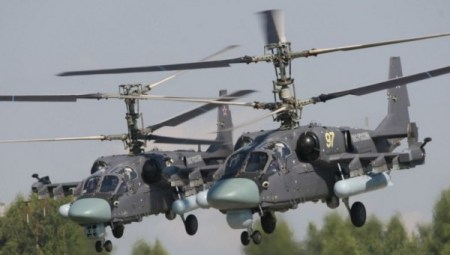
attack_ka-52_alligators

Egyptian President Abdel-Fatteh El-Sisi’s secret decision to intervene militarily in the Syrian war on the side of the Syrian President Bashar Assad is revealed here by DEBKAfile’s military and intelligence sources. The precise details of that intervention vary from source to source.

1. According to one version, a group of Egyptian helicopter pilots – 18, according to one estimate – landed secretly a few days ago at the Syrian Air Force base in Hama and were pressed at once into service for strikes against Syrian rebel forces.

Some sources describe the Egyptian flight crews as taking over the cockpits of Russian attack/reconnaissance Kamov Ka-52 helicopters, with which they were familiar, having trained on them since the end of 2015.

2. Others say that the Egyptian airmen flew those helicopters from Egypt to Syria over the eastern Mediterranean.

3. There is also a claim that their arrival was preceded by a preliminary inspection of the Syrian front lines by two major generals from the Egyptian general staff operations division, who later submitted their recommendations to the Egyptian president. It is not clear if they met the Russian commanders in Syria during that trip.

4. Others say the Egyptian generals headed a military delegation, which has set up a permanent mission in Damascus.

But every one of those sources agrees that, one way or another, Egypt has secretly entered the Syrian war in support of the Bashar regime – a development which has raised a firestorm in Arab capitals.

Saudi Arabia is particularly incensed over El-Sisi’s move. For years, Riyadh granted Cairo billions of dollars in aid, hoping this was an investment for procuring the Egyptian army as the stalwart protector of the kingdom and the Gulf emirates against Iran.

But towards the end of last year, Riyadh was affronted when the Egyptian ruler turned down an appeal for ground troops to support the Yemen campaign against Iranian-backed Houthi rebels. An eye-opener came when Egypt showed sympathy for Assad’s fight against extremist Islamist groups in the rebel movement, especially those associated with the Muslim Brotherhood, which El-Sisi has outlawed in Egypt as the sworn foe of his regime. Then, when Cairo supported Russian pro-Assad diplomacy at the United Nations, Saudi Arabia abruptly cut off financial assistance to Egypt and discontinued its oil shipments.

Donald Trump’s election this month as the next US president has already become the catalyst of a major reshuffling of Middle East alliances and stakes.

Some of its rulers, including El-Sisi, see the landscape changing and may be gambling on Trump reaching a deal with Russian President Vladimir Putin for joint military operations in Syria against the Islamic State and other Islamic terror groups, including the Al-Qaeda affiliate, the Nusra Front. The new bandwagon about to roll appears to favor Bashar Assad and his army.

The US president elect’s take on the Syrian ruler is expected to be markedly different to that of outgoing President Barack Obama, who castigated Assad, but held back from fighting him on the battlefield.

DEBKAfile reported exclusively on Nov. 21 that clandestine talks between Jerusalem, Amman and Damascus were afoot for the restoration of the demilitarized zone on the Golan and steps to stabilize their common borders in southern Syria.

Those talks are taking place with the knowledge of the Trump transition team and the Kremlin. They have already produced results in the return of UNDOF observers to their former posts on the Syrian Golan.

There are grounds to speculate now that the deployment of Egyptian aviators to Syria may be one more product of the secret inter-power diplomacy swirling in recent weeks over Syria’s bloody and intractable five-year war.

Two Hizballah brigades deployed to Aleppo

November 20, 2016

Two Hizballah brigades deployed to Aleppo, DEBKAfile, November 20, 2016

hezbollaonparade

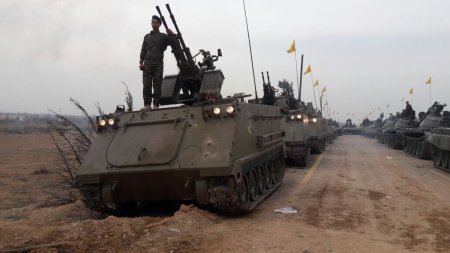
The two Hizballah brigades carry both American and Russian weaponry. DEBKAfile’s military sources report: The motorized rifle brigade is armed with American armored personnel carriers and tanks, whereas the Light Brigade carries Russian arms. Some of the units use both American and Russian hardware, like the Russian ZPU-2 anti tank guns which are mounted on US M113 APCs.

****************************

Hizballah this week transferred two brigades of some 5,000 fighters to the Aleppo front to bolster the Assad regime’s concentrated push to finally rout the rebels who have been holding out year after year in the eastern half of the ravaged city. Indiscriminate Syrian air strikes continue.

The new spearhead is made up of Hizballah’s heavy motorized rifle brigade of tanks and heavy weapons and its light commando brigade, which is trained to operate behind enemy lines. Their arrival brings the total number of Hizballah fighters in Syria to 15,000.

Russian military sources say that, after Aleppo is won for Bashar Assad, the two Lebanese Shiite brigades will turn to Idlib province in the north, to tackle the largest concentration in the country of Al Qaeda’s Syrian arm, the Nusra Front.

The two Hizballah brigades carry both American and Russian weaponry. DEBKAfile’s military sources report: The motorized rifle brigade is armed with American armored personnel carriers and tanks, whereas the Light Brigade carries Russian arms. Some of the units use both American and Russian hardware, like the Russian ZPU-2 anti tank guns which are mounted on US M113 APCs.

Sunday, Nov. 14, on the day that Hizballah started moving the two brigades to the Aleppo front, its propaganda machine released to the Arab media images of a military parade in Qusayr, in the Qalamoun mountain range of western Syria, showing Hizballah troops marching with American hardware. The parade, according to our sources, was faked, the point being to show the world that the Iranian proxy was amply supplied with American equipment.

Assad rewarded Hizballah for capturing Qusayr three years ago by allowing the Iranian proxy to turn the ghost town into a military center. Several workshops for recycling captured weapons for reuse in battle were set up there. (In the same way, the IDF recycled the masses of Russian weapons taken booty from Arab armies in the 60s and 70s.)

Another project was the creation and arming of the Light Brigade modeled on the Iranian Revolutionary Guards special operations units. They are equipped with highly adaptable “jihad-mobiles” which are designed to move in all-terrain and all-weather conditions to take the enemy by surprise from the rear. The the battle of Aleppo sees their first operation in the Syrian war.

Like Syrian special forces units, the Hizballah Light Brigade drives Russian UAZ Patriot-SUV pickup trucks on which are mounted Kord heavy machine guns and AGS-17 grenade launchers. These vehicles are equipped with automatic filters adapted for combat in arid desert conditions to overcome difficulties in vision and breathing.

Putin’s low-key Syrian operation – a call to Trump

November 16, 2016

Putin’s low-key Syrian operation – a call to Trump, DEBKAfile, November 16, 2016

The Russian air force and navy launched a “large-scale” operation against “terrorists” in the Syrian provinces of Idlim and Homs Tuesday, Nov. 15. Bombers took off from the Hmeymim air base and the Admiral Kuznetsov aircraft carrier whle cruise missiles were fired from the Admiral Grigorovich frigate. According to Russian Defense Minister Sergey Shoigu, who addressed a meeting of Russian generals with President Vladimir Putin, the targets were positions of the Islamic State and Al Nusra.

He did not say how long the operation would go on.

DEBKAfile’s military and intelligence sources say that the proportions of the Russian operation as seen from the ground better fit the description of low key than “large scale.”

No more than 2 Sukhoi Su-33 fighters lifted off the carrier’s decks and only a few Kaliber cruise missiles were fired from the frigate. They were not aimed at Islamist terrorist positions, but at arms factories and ammunition stores. Towards evening, a third Russian air strike hit a target in the hills overlooking the coastal province of Latakia.

The timing of the Russian operation was significant. It came five days after President Barack Obama finally ordered the Pentagon to seek out and target Nusra Front leaders, after long holding out against Moscow’s demand in this regard, and 12 hours after US president elect Donald Trump and Putin held their first telephone conversation after the election.

Since the attack was too limited to change the military situation on the Syrian war’s front lines, what was its purpose? And why was its launch given world-wide exposure accompanied by a photo-op of the Russian president meeting his generals for heightened drama?

It appears that Putin sought by this maneuver to convey the impression that Trump had agreed to the operation during their initial conversation on Monday. It is far more likely, however, that the Russian leader presented the offensive to Trump in general terms and did not hear an explicit negative response. He therefore decided to go ahead with the attack, marking out Islamist terrorists – which the president elect had declared in his campaign as America’s enemy – on the assumption that he would not disagree with a Russian strike against a consensual target. By this maneuver, Putin hoped to draw the next US president into backing Russia’s strategy in the Syrian war.
It is hard to believe that Donald Trump will be so easily drawn.