Posted tagged ‘Rogue nations’

Terror will not be defeated with reports

June 22, 2015

Terror will not be defeated with reports, Israel Hayom, Dr. Gabi Avital, June 22, 2015

(Please see also, US: Iran’s Support for Terror Undiminished. — DM)

Iran is led by rational and calculated religious clerics, whose goals are openly declared and well-defined. The rationality one should expect to find in the State Department has dissipated in a haze of illusions, which are exacting a heavy toll. Meanwhile, only the Islamic State stands to outflank Iran, and that is only under the assumption that these two terrorist entities are on completely divergent paths. To be sure, that is quite the baseless assumption.

Yet those who with one hand sound the alarm over an increase in terror, while with the other help the perpetrators of said terror rule the roost by giving it nuclear weapons, must provide convincing explanations. The United States, with its utter foreign policy failures — from Iraq to Yemen to Syria to Egypt and Iran — is not forthcoming with such explanations.

Where is Michael Moore when you need him? The State Department can see what is happening, but Kerry is on his way to a nuclear deal with the world’s leading sponsor of terrorism. Not much could be worse.

********************

Understanding history is a tricky proposition. Its lessons are sometimes hidden to us for long periods; often only subsequent generations can achieve the proper historical perspective, after a series of fateful events has unfolded. Even so, within less than 40 years we have witnessed global events that many political scientists correctly predicted.

The time is the late 1970s. All signs point to an oncoming revolution in Iran. However, U.S. President Jimmy Carter (whom some call the worst president ever), is instead consumed with the wording for a peace deal that undermines pre-existing agreements and international accords. Egypt wins the entire pot in a peace deal with Israel. Iran rises in prominence; the Soviet Union bolsters its standing across the globe, until the arrival of Ronald Reagan, who in an effort to defeat the Soviet Union in the ongoing Cold War, announces his Star Wars program.

We know the ending. Almost every single international relations expert points to that declaration as the beginning of the fall of the Soviet Union. In 1989, Reagan concludes two terms in office, and the Soviet Union falls apart.

Terrorism spreads across the globe. The leading sponsors are Saudi Arabia, Syria and Iran. An extensive report, examining the dangers of mass terrorist attacks on U.S. soil, is being compiled. The conservative-democratic pendulum in the U.S. swings toward the Democratic candidate, Bill Clinton. The egregious disregard of the report, now collecting dust, brings terrorism to its horrific pinnacle on Sept. 11, 2001. All fingerprints lead back to Saudi Arabia. Everything had already been laid out in the dust-covered Pentagon report. What the democratic Pentagon and State Department cooked up, the Republican George W. Bush was forced to eat.

The State Department has now published its annual report on terrorism. The seeds of this report were planted in the Carter era, when peace at all costs was championed without any understanding of the world in general and the Middle East in particular. Iran is led by rational and calculated religious clerics, whose goals are openly declared and well-defined. The rationality one should expect to find in the State Department has dissipated in a haze of illusions, which are exacting a heavy toll. Meanwhile, only the Islamic State stands to outflank Iran, and that is only under the assumption that these two terrorist entities are on completely divergent paths. To be sure, that is quite the baseless assumption.

So what does the report say? There will be a dramatic 35% rise in global terrorist acts. Iran supports terrorist organizations all over the world and in the Middle East especially; it backs the Shiite fighters in Iraq, Hezbollah in Lebanon and in Syria, with arms, training, money and intelligence. And we haven’t even mentioned Syria yet, or Hamas and Islamic Jihad.

Yet those who with one hand sound the alarm over an increase in terror, while with the other help the perpetrators of said terror rule the roost by giving it nuclear weapons, must provide convincing explanations. The United States, with its utter foreign policy failures — from Iraq to Yemen to Syria to Egypt and Iran — is not forthcoming with such explanations. Russia is back on the Cold War track; the Islamic State group is emboldened by the conduct of the U.S. president and his team at the State Department; Iran is envisioning a nuclear bomb in its arsenal; and Saudi Arabia is looking on nervously as the carpet of reciprocity is being pulled out from under it and its oil fields.

Only a week before Secretary of State John Kerry, one of the pillars of this dangerous U.S. foreign policy, takes off to pursue the deal with Iran, Tina Kaidanow, the State Department’s coordinator for counterterrorism, tells us: “We continue to be very, very concerned about [the Islamic Revolutionary Guard Corps] activity as well as proxies that act on behalf of Iran.”

What then, is Kerry really unaware of the findings in the 388-page report? And does he not understand that the deal with Iran, the seeds for which were planted in the Carter era and now being cultivated by Obama, is terrorism itself, and that there is no need for any report to merely sit and collect dust again in the State Department cellar?

Where is Michael Moore when you need him? The State Department can see what is happening, but Kerry is on his way to a nuclear deal with the world’s leading sponsor of terrorism. Not much could be worse.

The Iran scam worsens — Part II, North Korea – China connection

June 17, 2015

The Iran scam worsens — Part II, North Korea – China connection, Dan Miller’s Blog, June 17, 2015

(The views expressed in this article are mine and do not necessarily reflect those of Warsclerotic or its other editors. — DM)

It is likely that the P5+1 nuke “deal” with Iran will be approved soon. Military and other nuke sites which Iran has not “disclosed” will not be inspected. Nor will Iran’s nuke ties with North Korea — which P5+1 member China seems to be helping, Iran’s massive support for terrorism and abysmal human rights record be considered because they are also deemed unnecessary for “deal” approval. Sanctions against Iran are moribund and will not be revived regardless of whether there is a “deal.” However, a bronze bust of Obama may soon be displayed prominently in Supreme Leader Khamenei’s office and one of Khamenei may soon be displayed proudly in Dear Leader Obama’s office.

Iran fenced in

Part II — The North Korea – China connection

The North – Korea connection is a “natural,” and its basis should be obvious: Iran has been receiving funds through sanctions relief and will get substantially more when the P5+1 “deal” is made. North Korea needs money, not to help its starving and depressed masses, but to keep the Kim regime in power and for its favorites to continue their opulent lifestyles.

As I have written here, here and elsewhere, North Korea has been making substantial progress on nuclear weapons and means to deliver them, which it shares with Iran. Now, China appears to be intimately involved in their transfers of nuclear and missile technology as well as equipment.

As noted in an April 15, 2015 article titled Obama Hid North Korea Rocket Component Transfer to Iran,

US intelligence officials revealed that during the ongoing Iran nuclear negotiations, North Korea has provided several shipments of advanced missile components to the Islamic regime in violation of UN sanctions – and the US hid the violations from the UN. [Emphasis added.]

The officials, who spoke to the Washington Free Beacon on Wednesday on condition of anonymity, said more than two shipments of missile parts since last September have been monitored by the US going from North Korea to Iran.[Emphasis added.]

One official detailed that the components included large diameter engines, which could be used to build a long-range missile system, potentially capable of bearing a nuclear warhead. [Emphasis added.]

The information is particularly damaging given that Admiral Bill Gortney, Commander of North American Aerospace Defense Command (NORAD) and US Northern Command (USNORTHCOM), admitted this month that the Pentagon fears that North Korea and possibly Iran can target the US with a nuclear EMP strike.

Critics have pointed out that the nuclear framework deal reached with Iran earlier this month completely avoids this question of Iran’s intercontinental ballistic missile (ICBM) program, which would allow it to conduct nuclear strikes. [Emphasis added.]

US President Barack Obama was given details of the shipments in his daily intelligence briefings, but the officials say the information was hidden from the UN by the White House so that it would not take action on the sanctions violations. [Emphasis added.]

On June 17th, Secretary Kerry stated, just before leaving to participate in P5+1 negotiations, that the

“US and its negotiating partners are not fixated on the issue of so-called possible military dimensions [of the Iranian nuclear program] because they already have a complete picture of Iran’s past activities.”

This comment was a compendium of contradictions and untruths.

Sure, John. A June 17th article at Power Line on the same subject is titled Kerry’s absolute idiocy.

Here are the highlights from a March 29, 2015 article at The Daily Beast titled Does Iran Have Secret Nukes in North Korea?

As can be seen from the North Korean base housing Tehran’s weapons specialists, Iran is only one part of a nuclear weapons effort spanning the Asian continent. North Korea, now the world’s proliferation superstar, is a participant. China, once the mastermind, may still be a co-conspirator. Inspections inside the borders of Iran, therefore, will not give the international community the assurance it needs. [Emphasis added.]

Inspections? We don’t need and won’t get no stinkin inspections since His Omniscience Kerry knows everything and is not troubled by it.

The cross-border nuclear trade is substantial enough to be called a “program.” Larry Niksch of the Center for Strategic and International Studies in Washington, D.C., estimates that the North’s proceeds from this trade with Iran are “between $1.5 billion and $2.0 billion annually.” A portion of this amount is related to missiles and miscellaneous items, the rest derived from building Tehran’s nuclear capabilities.

Iran has bought a lot with its money. Mohsen Fakhrizadeh, thought to be Tehran’s chief nuclear scientist, was almost certainly in North Korea at Punggye-ri in February 2013 to witness Pyongyang’s third atomic test. Reports put Iranian technicians on hand at the site for the first two detonations as well.

. . . .

The North Koreans have also sold Iran material for bomb cores, perhaps even weapons-grade uranium. The Telegraph reported that in 2002 a barrel of North Korean uranium cracked open and contaminated the tarmac of the new Tehran airport.

The relationship between the two regimes has been long-lasting. Hundreds of North Koreans have worked at about 10 nuclear and missile facilities in Iran. There were so many nuclear and missile scientists, specialists, and technicians that they took over their own coastal resort there, according to Henry Sokolski,  the proliferation maven, writing in 2003.

As noted in a January 31, 2014 Daily Beast article titled Iran and North Korea: The Nuclear ‘Axis of Resistance,’

Last September, at the same time Iran was secretly meeting with U.S. officials to set up the current nuclear talks, North Korea leaders visited Tehran and signed a science and technology agreement that is widely seen as a public sign the two countries are ramping up their nuclear cooperation.

“Iran declared Sept. 1, 2012 North Korea was part of their ‘Axis of Resistance,’ which only includes Iran, Syria, and Hezbollah. They’ve announced to the world they are essentially allies with North Korea,” said David Asher, the State Department’s coordinator for North Korea from 2001 to 2005. [Emphasis added.]

On February 13, 2013, DEBKAfile reported that North Korea —  Iran nuclear connection is substantial.

There is full awareness in Washington and Jerusalem that the North Korean nuclear test conducted Tuesday, Feb. 12, brings Iran that much closer to conducting a test of its own. A completed bomb or warhead are not necessary for an underground nuclear test; a device which an aircraft or missile can carry is enough. [Emphasis added.]

Mahmoud Ahmadinejad’s boast this week that Iran will soon place a satellite in orbit at an altitude of 36,000 kilometers – and Tehran’s claim on Feb. 4 to have sent a monkey into space – highlight Iran’s role in the division of labor Pyongyang and Tehran have achieved in years of collaboration: the former focusing on a nuclear armament and the latter on long-range missile technology to deliver it. [Emphasis added.]

Their advances are pooled. Pyongyang maintains a permanent mission of nuclear and missile scientists in Tehran, whereas Iranian experts are in regular attendance at North Korea’s nuclear and missile tests.[Emphasis added.]

Since the detonation of the “miniature atomic bomb” reported by Pyongyang Tuesday – which US President Barack Obama called “a threat to US National security”- Iran must be presumed to have acquired the same “miniature atomic bomb” capabilities – or even assisted in the detonation. [Emphasis added.]

On the same day, an article at Fox News observed,

In an exclusive interview with Fox News, Ambassador Thomas Graham, Jr, who has advised five U.S. presidents as a world renowned authority on arms control and nuclear non-proliferation, noted “If the assessments are correct as to his (Fakhrizadeh’s) role in the Iranian nuclear program, if China knowingly permitted him transfer from Iran across China to witness the North Korea test … then it would appear that China or at least some element in China are cooperating with nuclear programs in North Korea and Iran.” [Emphasis added.]

The Feb. 11 test has been described by experts as a miniaturized atomic bomb test of a relatively small yield of 6-7 kilotons, mounted on a Nodong missile.

. . . .

Ambassador Graham added: “The objective of this test has said to be the development of a compact highly explosive nuclear warhead mated with a North Korean missile. Iranian missiles were developed from North Korean prototypes. It could appear that North Korea is building nuclear weapons for transfer to Iran.” [Emphasis added.]

A June 11, 2015 Gatestone Institute article titled North Korea’s Serious New Nuclear Missile Threat, noted that North Korea already has upwards of twenty nukes and that

if North Korea’s technical advances are substantive, its missiles, armed with small nuclear weapons, might soon be able to reach the continental United States — not just Hawaii and Alaska. Further, if such missile threats were to come from submarines near the U.S., North Korea would be able to launch a surprise nuclear-armed missile attack on an American city. In this view, time is not on the side of the U.S. Submarine-launched missiles come without a “return address” to indicate what country or terrorist organization fired the missile.

The implications for American security do not stop there. As North Korea is Iran’s primary missile-development partner, whatever North Korea can do with its missiles and nuclear warheads, Iran will presumably be able to do as well. One can assume the arrangement is reciprocal.

Although attempts have been made to debunk recent photoshopped images of North Korea firing of a missile from a submerged platform, the immediately linked Gatestone article offers substantial reasons to think that it was indeed fired and that it is troubling.

The linked Gatestone article continues, despite hopes that China may force or talk North Korea into halting its missile development program and sharing with Iran, such hopes are

painfully at odds with China’s established and documented track record in supporting and carrying out nuclear proliferation with such collapsed or rogue states as Iran, Syria, Pakistan, North Korea and Libya, as detailed by the 2009 book The Nuclear Express, by Tom C. Reed (former Secretary of the Air Force under President Gerald Ford and Special Assistant to the President of National Security Affairs during the Ronald Reagan administration) and Daniel Stillman (former Director of the Lawrence Livermore National Laboratory).(Emphasis added.]

Far from being a potential partner in seeking a non-nuclear Korean peninsula, China, say the authors, has been and is actually actively pushing the spread of nuclear weapons to rogue states, as a means of asserting Chinese hegemony, complicating American security policy and undermining American influence. [Emphasis added.]

The problem is not that China has little influence with North Korea, as China’s leadership repeatedly claims. The problem is that China has no interest in pushing North Korea away from its nuclear weapons path because the North Korean nuclear program serves China’s geostrategic purposes. [Emphasis added.]

As Reed and Stillman write, “China has been using North Korea as the re-transfer point for the sale of nuclear and missile technology to Iran, Syria, Pakistan, Libya and Yemen”. They explain, “Chinese and North Korean military officers were in close communication prior to North Korea’s missile tests of 1998 and 2006.″ [Emphasis added.]

Thus, if China takes action to curtail North Korea’s nuclear program, China will likely be under pressure from the United States and its allies to take similar action against Iran and vice versa. China, however, seems to want to curry favor with Iran because of its vast oil and gas supplies, as well as to use North Korea to sell and transfer nuclear technology to both North Korea and Iran, as well as other states such as Pakistan. As Reed again explains, “China has catered to the nuclear ambitions of the Iranian ayatollahs in a blatant attempt to secure an ongoing supply of oil.” [Emphasis added.]

What about Russia which, like China, is a P5+1 member? Russia announced in late May of this year that it would build an Iranian nuclear reactor for “peaceful” generation of electricity. It announced in April that it would provide accurate, long range S-300 missiles to Iran.

Iranian news sources are reporting that negotiations with Russia to buy the S-300 surface-to-air missile systems were “successful.”

Western officials say delivery of the system would essentially eliminate the military option to stop Iran from obtaining nuclear weapons.

During a press conference Monday, Iran’s Deputy Foreign Minister for Arab and African Affairs Hossein Amir-Abdollahian said that the missiles will be delivered as soon as possible.

On September 23, 2014, the Iranian FARS News Agency announced that Iran was completing its own version of the S-330 missile.

Last month, senior Iranian military officials announced that their home-grown version of the Russian S-300 missile defense system, called Bavar (Belief)-373, has already been put into test-run operation and has once shot at a target successfully.

Commander of Khatam ol-Anbia Air Defense Base Brigadier General Farzad Esmayeeli told the Iranian state-run TV that “Bavar-373 has fired a first successful shot”.

Might Russia have given Iran the plans needed to build its own version of the Russian missile? Why not?

Conclusions

We have to guess far more than we actually know about the North Korea – China – Iran nuclear connection. That is unfortunate. It is absurd that the P5+1 joint plan of action and the White House summary focus on Iran’s uranium enrichment to the exclusion of its militarization of nukes. Since nuke militarization, among other substantial matters, is deemed irrelevant to whether there is a “deal,” so is the connection with North Korea, China and possibly Russia.

Obama wants a “deal” with Iran, regardless of what it may say or — more importantly — what it may not say.

NK and Iran

General Michael Flynn and Ambassador Robert Joseph on Iran’s Missile Program and a Nuclear Deal

June 11, 2015

General Michael Flynn and Ambassador Robert Joseph on Iran’s Missile Program and a Nuclear Deal, Secure Freedom.Org. via You Tube, June 11, 2015

Former DIA Director Lt. General Michael Flynn and Ambassador Robert Joseph discuss their concerns about the exclusion of Iran’s ballistic missile program from the nuclear agreement currently being negotiated with Tehran and their belief that this deal will not stop or slow Iran’s pursuit of nuclear weapons.


N. Korea Submarine Missile Allows Covert Nuclear Strike on US

May 5, 2015

N. Korea Submarine Missile Allows Covert Nuclear Strike on US, Israel National News, Ari Yashar, May 5, 2015

(Perhaps North Korea and Iran can make a deal — North Korea gets sanctions-relief money and Iran gets missile equipment and nukes for its submarines. Or maybe Iran could just pay North Korea to attack the U.S. mainland.– DM)

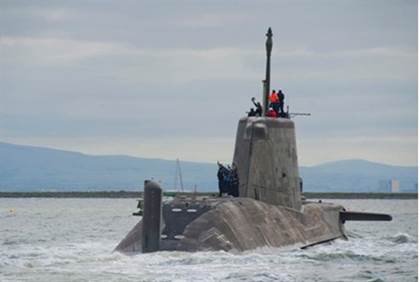
img369953Military submarine (illustration) Reuters

[I]t was reported last month that US President Barack Obama hid intel from the UN about North Korea transferring rocket components needed to create a nuclear missile to Iran even during the nuclear talks, to try and prevent the UN from acting on the information with increased sanctions.

[O]nce the KN-11 and mobile KN-08 “systems go operational, it potentially gives North Korea a dual threat for attacking the United States with nuclear or chemical weapons – a threat generated from difficult to detect mobile platforms on both land and sea.”

***********************

In a worrying step showing North Korea’s rapidly expanding nuclear strike capabilities, the Communist regime recently held a test of a new submarine-launched ballistic missile (SLBM), the first time it has launched a missile capable of carrying a nuclear warhead from underwater.

According to US defense officials cited by the Washington Free Beacon on Tuesday, the test took place on April 22 from an underwater test platform near the coastal city of Sinpo in the southeast of the country, and tested what the US is calling a KN-11 missile.

The test appears to have been successful, and is the third KN-11 test showing the high-priority of the nuclear missile program for North Korea. Previous tests in January and last October were from a sea-based platform not underwater and a land-based platform.

The KN-11 joins the KN-08 mobile intercontinental ballistic missile (ICBM) as being part of a varied North Korean missile arsenal on platforms that would be hard for the US to detect, and consequently allow a strike that would be difficult to shoot down.

Admiral Bill Gortney, Commander of North American Aerospace Defense Command (NORAD) and US Northern Command, admitted last month that North Korea could hit the continental US with a nuclear strike. That admission accompanied the announcement that NORAD is reopening its nuclear-EMP-proof Cheyenne Mountain bunker, apparently amid renewed concerns of an EMP attack by which a nuclear weapon would be detonated over the US, knocking out all of its electronic devices, and thereby rendering it defenseless to secondary nuclear strikes.

The latest launch test also comes after Chinese experts warned the US last month that American estimates are wrong and North Korea actually has 20 nuclear weapons, with that arsenal to double next year thanks to the regime’s higher than anticipated advanced enrichment capabilities.

Nuclear strikes the US won’t see coming

Admiral Cecil D. Haney, commander of the Strategic Command, confirmed the SLBM launch test in comments to the Senate on March 19, reports the Washington Free Beacon. The program is in violation of UN Security Council resolutions.

Regarding the UN, it was reported last month that US President Barack Obama hid intel from the UN about North Korea transferring rocket components needed to create a nuclear missile to Iran even during the nuclear talks, to try and prevent the UN from acting on the information with increased sanctions.

Former US Defense Intelligence Agency official Bruce Bechtol, Jr. told the paper that North Korea’s SLBM program is meant to give it the ability to strike the US, and to not have the strike be detected in advance.

“With an SLBM they get both,” said Bechtol. “The submarine can get the platform to launch the missile within range of the continental United States, Alaska, or Hawaii. Thus, once operational, this immediately brings key nodes in the United States within range of what would likely be a nuclear armed missile.”

He noted that once the KN-11 and mobile KN-08 “systems go operational, it potentially gives North Korea a dual threat for attacking the United States with nuclear or chemical weapons – a threat generated from difficult to detect mobile platforms on both land and sea.”

Obama is bringing the US to “tragedy”

A number of American officials responded sharply to the KN-11 test, placing the blame squarely on Obama’s shoulders.

“This missile, along with the KN-08, happened on Obama’s watch and nothing has been done,” one US intelligence official told the Washington Free Beacon.

Former US Ambassador to the UN John Bolton added his criticism, saying, “by utterly ignoring North Korea’s growing missile threats, Obama has allowed the threat of rogue state proliferators to fall out of the center of the national political debate.”

“This is a potential tragedy for the country,” Bolton warned.

Air Force Lt. Gen. (ret.) Thomas McInerney said that the KN-08 and KN-11 programs constitute “threats to the continental United States and have been developed under the Obama administration’s leadership.”

“Leading from behind is a failed strategy as evidenced by this very dangerous strategic threat to the continental United States of nuclear attack by a very unstable North Korean government,” said McInerney.

The general also spoke about Obama’s admission that the nuclear deal being formed with Iran will allow it to obtain a nuclear weapon in under 15 years if it doesn’t breach conditions and obtain it sooner, noting that the deal “puts the United States in the most dangerous threat of nuclear attack since the height of the Cold War but from multiple threats – North Korea, China, Russia, and Iran.”

Opponents of the nuclear deal being formulated with Iran ahead of a June 30 deadline have warned it follows in the footsteps of the failed deal sealed by then-President Bill Clinton with North Korea in 1994.

Despite the deal, North Korea tested its first nuclear weapon in 2006, just over ten years after the agreement.

Raid on Iran

April 28, 2015

Raid on Iran, Jerusalem PostHarry Moskoff, April 28, 2015

The only question now is:  when could an attack on Iran be carried out? At this point, Israel can’t afford NOT to make a strike, as the policy of the current nuclear negotiations with Iran has changed from prevention, to containment.  Indeed, all have come to agree that if the military option isn’t utilized by either the US or Israel, a nuclear Iran is simply a fait accompli.

If a preventative strike on Iran’s nuclear facilities is going to happen, it must be both before the P5+1 negotiating deadline of June 30th, and before the Russian S-300 anti-aircraft missiles are delivered and setup on Iranian soil. Indeed, if and when that eventuality comes into play, Israel may be forced to destroy that weapons convoy on route to Iran. I’m pretty sure this threat has already been issued.

**********************

As a rule, I don’t usually get involved in war scenarios, but after seeing the Israeli Air Force (IAF) jets put on their brilliant display this week for Israel Independence Day, I was inspired.  I was thinking: what if they just continued flying southwest? There’s an important point that I want to make here.

Sooner rather than later, Israel will be forced to make that raid. You know the one. It’s the BIG one. It will make the 1981 precision strike on Iraqi’s Osirak reactor, otherwise known as Operation Raid on the Sun, look like a walk in the park. Back then (just like now), when some argued that the attack would alienate both the United States and Europe, Ariel Sharon allegedly quipped “If I have a choice of being popular and dead or unpopular and alive, I choose being alive and unpopular.” Prime Minister Begin ultimately agreed and the rest of the cabinet fell in behind him. The only question now is:  when could an attack on Iran be carried out? At this point, Israel can’t afford NOT to make a strike, as the policy of the current nuclear negotiations with Iran has changed from prevention, to containment.  Indeed, all have come to agree that if the military option isn’t utilized by either the US or Israel, a nuclear Iran is simply a fait accompli.

If a preventative strike on Iran’s nuclear facilities is going to happen, it must be both before the P5+1 negotiating deadline of June 30th, and before the Russian S-300 anti-aircraft missiles are delivered and setup on Iranian soil. Indeed, if and when that eventuality comes into play, Israel may be forced to destroy that weapons convoy on route to Iran. I’m pretty sure this threat has already been issued. Effectively, we’re looking at a window of opportunity of a little over 2 months to initiate an attack that could take many hours, if not days to carry out, with hundreds or even thousands of missile strikes per day.  Simply put, if there is no attack now, Israel must prepare for the day after – a new, grim reality in the Middle East.

However, here’s an interesting point. If the arms shipment isn’t destroyed, there may be another answer to the S-300. Israel’s Defense Ministry sent a Letter of Request to Congress in 2003 asking for authorization to purchase “up to” 75 brand new, top of the line jet fighters that have significant new counter-missile capabilities. In 2010, it signed a deal with the US-based Lockheed-Martin aeronautical company for 19 F-35As, with the first few aircraft set to arrive in late 2016. The total cost of that deal was $2.75 billion, a spokesman for Lockheed-Martin said, out of which $475 million was for non-recurrent costs for the incorporation of upgraded Israeli technology. It’s interesting to note that the approximate cost of the aircrafts was (a staggering) $120 million. Each! These are stealth fighters with highly advanced radar, which will see its targets before it is seen.  Armed with the intelligence of where the surface to air missile systems are located, the IAF will then take the necessary measures to first avoid the S-300 systems, then destroy them.  What other choice is there – finding the Ark of the Covenant and using that, as in biblical times? True, the planes are insanely expensive, but obviously quite necessary!

On April 15 at Yad Vashem, and echoing his recent, now-famous address to Congress, PM Netanyahu said: “Even if we are forced to stand alone against Iran, we will not fear…”  Well folks, I dare say that we have reached that point.  Everyone knows by now that where the negotiations are concerned, the US no longer considers use of force in the cards, and quite the contrary, President Obama has indicated that even sanctions have become negotiable. People here in Israel feel that the State Dept. may even act AGAINST Israel if it unilaterally attempts a pre-emptive attack.  Besides the obvious existential threat to Israel, one of the other problems is that Iran seeks to “dominate the region” (Netanyahu’s words), and impose a Khomeini-style revolution in the Middle East.  We now see clearly that they are doing just that in places like Yemen, Syria, Lebanon, and even here in Gaza. Whether Israel sees a right-wing government emerge in the coming weeks, or even a broad-based coalition with the Left, all agree at the end of the day that it’s just a matter of time before Iran breaches their side of an already bad deal, and action will need to be taken, whether backed by the US or not.

What most Israeli’s don’t realize is that once a breach in the agreement is discovered (publicly), there is simply no way the US will neutralize Iranian capabilities with a military strike.  Obama won’t do it, and the reason why he won’t do it is because he is not prepared to cast and label Iran as an Enemy of the State. To him, those days are over and it doesn’t lie in synch with his doctrine. In fact, the US President apparently vetoed a potential Israeli attack on Iran’s nuclear facilities back in 2012. Is it so hard to see why? Back door negotiations were going on even then between the US and Iran, as Hillary Clinton recently admitted herself.  It is crystal clear that the White House CAN forcibly bring the Iranian nuclear program to a halt, it simply chooses not to do so. Will this change after, let’s say – an Iranian nuclear test?  Perhaps, but unlikely.

As such, practically speaking, can Israel attack Iran with any real success? Is it worth it? The following are some salient points to consider.

We know that Saudi Arabia has already given tacit permission for Israel to use its airspace to reach the Iranian military targets because as a Sunni Muslim state, they are considered as ‘infidels’ to Iran, who are Shiite Muslims. In fact, they have more to worry about than Israel does, and as a result of the framework agreement that was signed in Vienna, they are demanding the same rights to nuclear capabilities that Iran is apparently going to get. Credible sources state that Pakistan is now prepared to ship a nuclear package to the Saudis. As for Iran, it already has the ballistic missile capability that could hit Saudi Arabia with a warhead at the push of a button. And they know it. So does Jordan.

The truth is that Israel has sufficient nuclear and conventional power to destroy the Islamic Republic in one day in the event of any war. In this case though, we’re talking about a surprise attack (more or less). As mentioned above, Israel is believed to have a fully prepared plan to launch a strike, which by necessity, would likely involve some 80 planes, and perhaps up to several hundred aircraft according to some military experts. In reality, this has been in the planning for over 10 years. Israel possesses the advanced midair refueling capabilities required for carrying out sorties over multiple Iranian targets situated between 1,500 and 2,000 km away from home. Possible targets could include uranium-enrichment sites at Natanz and Qom, the uranium-conversion plant at Isfahan, and a heavy water reactor in Arak suspected of being used to pursue a plutonium-based nuclear arms program, as well as additional facilities. The mission would require the use of powerful, penetrating warheads, otherwise known as bunker-buster bombs, as well as possible repeated strikes to ensure success. According to a Newsweek article from September of last year, the US Congress signed and transferred 55 such bombs to Israel. Further, the attack would likely be coordinated with the assistance of Israeli intelligence satellites that could provide real time detailed images from the battle arena, as well as Airborne Warning and Control (AWAC) aircraft. It could also involve the use of a fleet of giant Heron 2 drones, which are the size of 737 commercial airliners. The UAVs form the first line of defense against an expected Iranian counterstrike, involving the launch of long-range Shihab 3 missiles, or worse.   These drones can reportedly reach Iran and hover over missile launch sites. Israel’s Arrow missile defense shield would undoubtedly also come into play to intercept missiles heading into Israeli airspace.

In terms of other forms of weaponeering capabilities, Israel maintains (at least) two elite special forces units dedicated to assisting with air strikes, one dedicated to laser target designation (Sayeret Shaldag/Unit 5101) and one to real time bomb damage assessment (Unit 5707).  These units are extremely well-trained and could potentially be infiltrated to the target zone prior to attack.  While it would be both difficult and risky to deploy these units inside Iran, they would be very useful in aiding the strike package, particularly in bad weather.

Obviously, such a strike would touch off conflict with Iran’s proxy in southern Lebanon, Hezbollah, which is armed with thousands of rockets, as well as Hamas in Gaza, and possibly with Syria. The resulting chain of events could easily lead to a major regional war and long-term instability, so much so that some senior Israeli defense figures have reportedly been rejecting the idea of attacking Iran for years.  Assuming that a military strike is issued in the near future, Israel cannot hope to destroy Iran’s entire nuclear infrastructure, as facilities are distributed across the country and there are simply too many sites to plan to attack them all.  To have a reasonable chance of success, both in the mission and in the ultimate goal of rendering Iran’s nuclear program impotent, the target set must be narrowed to concentrate on the critical nodes in Iran’s nuclear infrastructure, which seems to be growing by the day!

The main focus of an imminent strike must be to target the Natanz facility first.  Natanz is by far both the most difficult and most important target to destroy.  The main enrichment facility apparently has two large (25,000-32,000 m2) halls located 8 to 23m underground and protected by multiple layers of concrete.  The combination of large size and target hardening mean that only a very robust strike could hope to destroy or at least render unusable the centrifuges within.  In order to ensure penetration of a target with these high levels of hardening, one technique is to use the bunker busters targeted on the same aimpoint but separated slightly in release time to ‘burrow’ into the target. What happens essentially, is that one bomb hits the crater made by the previous weapon, a technique contemplated by the U.S. Air Force in the first Gulf War.  This takes advantage of the extremely high accuracy of bombs in combination with a penetrating warhead.  The IAF appears to have purchased these with this technique in mind. In fact, Gen. Eitan Ben-Eliyahu, former commander of the IAF (and a participant in the Osirak strike), commented on this method of attacking hardened facilities in Jane’s Defense Weekly: “Even if one bomb would not suffice to penetrate, we could guide other bombs directly to the hole created by the previous ones and eventually destroy any target.”

Has the point been made yet? This is just the tip of the proverbial iceberg on Israel’s military capability, and there is no doubt that the IAF can pull off an attack and get the job done. And let’s not forget about our Dolphins (nuclear subs) in the Gulf.  The factor that complicates matters so much is that, unlike in 1981 where the mission was so secret that the pilots themselves only learned of their target the day before, the US government must be notified before an attack of this magnitude.

On that note, the Obama administration has been exerting great pressure in the back halls for some time now in order to convince (even by means of veiled threats to withhold their veto power in the UN), their Israeli counterparts to refrain from issuing an attack order on Iran.  The only problem is that if Israel chooses again to wait it out and not attack, the world is bound to lie in dread of a new, powerful Iranian nuclear regime – to shake under their threat, similar to the way the world was just 70 years ago regarding the appeasement of Germany. Saudi Arabia will then look to the US for advice, and to provide an umbrella defense mechanism. Needless to say, a third world war might just emerge (heaven forbid).  This scenario is actually already depicted in the Zohar, the Midrash and other traditional Jewish texts in reference to the future world war of ‘Gog and Magog.’  Let’s pray it doesn’t come to that! In our lifetimes, or our offspring.

What bothers me the most right now though, is that even as the West is negotiating with a fanatical, expansionist Islamic regime in those posh Viennese boardrooms, the people on Tehran’s streets are chanting: “Death to the US; death to Israel” (in that order). The recent military parade echoed the same rhetoric.  HELLO…… isn’t someone paying attention over there? This is the reason why Israel shouldn’t just flex its military muscles for display to the Mullahs. It must attack. And it must attack now. This is precisely what the IDF was created for! Ben Gurion knew it. Menachem Begin knew it, and now Netanyahu knows it too. At this juncture in time, Iran cannot be trusted, and we know this to be an undeniable and unfortunately, well proven fact. Especially since, as of last week, the world discovered that Iran’s intent to destroy Israel is “non-negotiable.”  I believe that the citizens living in Israel (like myself) should, and will, accept the inevitable consequences that come with protecting our beautiful country.

A raid on Iran? My point here is:  The best defense is a good offense.

An EMP attack on America seems likely

April 19, 2015

An EMP attack on America seems likely, Dan Miller’s Blog, April 19, 2015

(The views expressed in this article are mine and do not necessarily reflect those of Warsclerotic or any of its other editors. — DM)

Some consider North Korea to be the rogue nation most likely to use an electromagnetic pulse (EMP) to attack America; Iran is also seen as quite likely to do it. It matters little which succeeds.

Here is a lengthy 2013 video about an EMP attack, what would happen and why:

The possibilities and consequences of an EMP attack on America are too horrific to contemplate; the “legitimate news media” generally ignore them. We therefore tend to relegate them to the realm of remote “tin foil hat conspiracy theories” and to focus instead on more congenial stuff — the latest sex scandal, Hillary Clinton’s campaign van parking in a disabled-only space and other matters unlikely to impact America to an extent even approaching that of an EMP attack. Meanwhile, most of “our” Congress Critters, who should know better, focus on opinion polls, filling their campaign coffers and getting richer personally while neglecting our atrophying missile defense systems and other potential means of avoiding or recovering from an EMP attack.

Here is a 2013 video about the likelihood of an Iranian EMP attack on America that would paralyze the country for a very long time.

North Korea and the Islamic Republic of Iran have long cooperated in the development of nukes and means to deliver them. I wrote about their cooperation here, herehere and elsewhere. It now appears that Iran intends to use them for an EMP attack on America.

The issue of a nuclear EMP attack was raised in the final hours of this week’s elections in Israel when U.S. authority Peter Vincent Pry penned a column for Arutz Sheva warning of Iran’s threat to free nations.

“Iranian military documents describe such a scenario — including a recently translated Iranian military textbook that endorses nuclear EMP attack against the United States,” he wrote. [Emphasis added.]

Here is a March 7, 2015 video about the impact of the P5+1 “negotiations” on Iran getting (or keeping) nukes and the likelihood of an Iranian EMP attack on America:

In April of this year, John Bolton had this to say about the Iran – North Korea connection, how much we don’t know and the ongoing P5+1 “negotiations.”

Perhaps Israel can take out Iran’s nuke capabilities.

Here is a February 2015 video about what’s (not) being done to harden our domestic power grid:

As of February of this year, Govtrack US opined that the chances of passage of the SHIELD act were zero percent. Be that as it may, simply hardening the power grid would not solve communications or transport problems — most modern communications devices, as well as vehicles built after 1987, depend on computer chips and, when the chips are fried, will not function. Even if food and water could be processed, getting them to consumers in sufficient quantities to keep them alive would be an enormous if not impossible task.

Problems of a human nature would also arise and remaining alive would be difficult. If one’s family were about to starve, how many would try to steal food and water from those who still have even enough for a few days? How many roving gangs of armed criminals, quite willing to kill, would do the same? The police would likely have no communications ability and might well be otherwise occupied, tending to their own families. Military forces not confined to base would likely have the same problems and be doing the same.

That suggests another problem in restoring infrastructure seriously damaged or destroyed by the EMP attack. It would not only require the availability of transport, communications and undamaged equipment. It would also require the availability of personnel, not otherwise occupied in scrounging for food, water, medical supplies and other resources to care for their own families, while protecting them from those lacking such resources, as well as from armed gangs.

Now, the U.S. military is taking steps to protect itself by reopening a cold war bunker at Cheyenne Mountain, abandoned in 2006.

Cheyene Mt. Complex

Cheyene Mt. Complex

The Pentagon last week [early April 2015] announced a $700 million contract with Raytheon Corporation to oversee the work for North American Aerospace Command (NORAD) and US Northern Command.

Admiral William Gortney, head of NORAD and Northern Command, said that ‘because of the very nature of the way that Cheyenne Mountain’s built, it’s EMP-hardened.’

. . . .

‘And so, there’s a lot of movement to put capability into Cheyenne Mountain and to be able to communicate in there,’ Gortney told reporters.

‘My primary concern was… are we going to have the space inside the mountain for everybody who wants to move in there, and I’m not at liberty to discuss who’s moving in there,‘ he said.  [Emphasis added.]

The Cheyenne mountain bunker is a half-acre cavern carved into a mountain in the 1960s that was designed to withstand a Soviet nuclear attack. From inside the massive complex, airmen were poised to send warnings that could trigger the launch of nuclear missiles.

But in 2006, officials decided to move the headquarters of NORAD and US Northern Command from Cheyenne to Petersen Air Force base in Colorado Springs. The Cheyenne bunker was designated as an alternative command center if needed.

Now the Pentagon is looking at shifting communications gear to the Cheyenne bunker, officials said.

‘A lot of the back office communications is being moved there,’ said one defense official.

Officials said the military’s dependence on computer networks and digital communications makes it much more vulnerable to an electromagnetic pulse, which can occur naturally or result from a high-altitude nuclear explosion.

Under the 10-year contract, Raytheon is supposed to deliver ‘sustainment’ services to help the military perform ‘accurate, timely and unambiguous warning and attack assessment of air, missile and space threats’ at the Cheyenne and Petersen bases.

Raytheon’s contract also involves unspecified work at Vandenberg Air Force Base in California and Offutt Air Force Base in Nebraska.

When will the site be fully operational, for what and who will be allowed to go there?

Some other military bases are probably being hardened, at least to an extent that might (or might not) preserve their electrical grids. If it works, they may serve as refugee centers for adjacent civilian populations. However, the military installations would likely run out of food and potable water before very long and, with food and water processing centers no longer operational, there would be substantial difficulties in getting — as well as transporting — large quantities of food and water. Were the processing centers to become operational, transportaion difficulties would remain. Communications between the military installations and the outside world? Likely zilch, at least initially, because radios, telephones and other modern communications devices (as most now are) depend on computer chips and would be fried by an EMP attack. Some might eventually be restored at some military bases, but that is not likely to be the case with those not on those bases.

Conclusions

What would you do in the event of an EMP attack? In a major metropolitan area, you would probably be SOL very quickly. In a small town? Marginally but not much better off. An isolated small farm, close to a mountain spring and adequately stocked with food, medical supplies, firearms and ammunition, could provide reason to hope that you might eventually be able to grow or slaughter sufficient food and have access to enough potable water to survive; at least until roving armed gangs arrive and overpower you.

This video is about a massive world-wide pandemic. In the event of a pandemic, electricity, automobiles and communications would still function, at least for a while. Following an EMP attack, the consequences would likely be substantially worse and last far longer.

Here is a link to a novel about one family in a small city and its efforts to survive an EMP attack on America. It does a reasonable job of summarizing the potential consequences.

PART II: Michael Rubin on Obama: ‘He is Constructing an Imaginary Iran’

April 17, 2015

PART II: Michael Rubin on Obama: ‘He is Constructing an Imaginary Iran’ Breitbart, Adelle Nazarian, April 17, 2015

Rubin

Obama doesn’t understand that the Middle East isn’t a neighborhood to organize. He doesn’t understand that he’s the leader of the free world and not a zoning commissioner. In effect, the bad guys are running all over him. And the problem is, he’s too naive or too arrogant to care.

****************************

Breitbart’s Adelle Nazarian had the opportunity to speak with renowned Middle East expert and resident scholar at the American Enterprise Institute (AEI) Dr. Michael Rubin recently. Dr. Rubin provided his analysis on U.S.-Iran relations under the Obama Administration and provided a look into the future through the periscope of the past.

This is Part II of a two-part series. For the first installment, click here.

BREITBART: Why didn’t the Obama administration look back at Khomeini’s letter from 1988 calling for nuclear weapons and compare it to Khamenei’s supposed nuclear fatwa today when approaching the nuclear talks?

RUBIN: You’ve got a situation where the Obama Administration is cherry picking dishonestly. And frankly, if Obama acted this way as a university professor, he would be dismissed. He is constructing an imaginary Iran. Take the case of the fatwa.

Does the fatwa actually exist? According to open source center there was something delivered in 2014 that purports to  be the text of the fatwa to the United Nations. But in that text — according to the open source center of the United States — it doesn’t use the word “never.”

Here’s another problem. It’s Diplomacy 101 to know that you don’t rely on anything that’s not written down. Even with North Korea, we got the North Koreans and the Americans to agree on a piece of paper.

I’m not sure John Kerry is even competent to negotiate with a 5-year-old over chocolate or vanilla ice cream. I mean how could you not get something in writing? It’s the same thing with Obama and the fatwa. Get it in writing. How come Obama can’t put this up on the White House website? He puts up everything else.

BREITBART: Is it true that a fatwa, either verbalized or written, can be changed at any time?

RUBIN: Yes. It can. And Obama is operating in a vacuum.

It’s like Groundhog Day. In 2003, Mohammaed Javad Zarif negotiated with the Americans with regard to non-interference in Iraq. According to the Iranian press, the Iranians proceeded to break that agreement and inserted 2,000 Revolutionary Guardsmen into Iraq.

Now the question is, did Zarif lie? Or was he sincere but he didn’t have the power to ensure that all aspects of the Iranian government would abide by the agreement? And why is it that, 12 years later, we’re having the same discussion about the same man? Either Zarif is a liar, in which case we never should have sat down with him again. Or he’s powerless and a conman, in which case we should have never sat down with him again.

There is a major misconception under the current administration– with Obama and Kerry– that it was due to a lack of diplomacy under the Bush Administration that the number of centrifuges skyrocketed in Iran.

#1: Between 2000-2005, the European Union almost tripled its trade with Iran and sat down with them regularly. That directly corresponds to the rapid increase in Iranian centrifuges. It was because of diplomacy, not because of coercion.

#2. During that same period, the price of oil almost quintupled and the bulk of hard-currency windfall went into Iran’s nuclear and ballistic missile programs. That was under the so-called “reformists,” and this is why the so-called reformists like to claim that they are responsible for the success of the nuclear program. But this raises questions about why Obama would again repeat the same issue.

The Iranian economy, according to Iran’s Central Bank, had declined 5.4% in the year before we sat down to negotiate the joint plan of action. Now, Iran’s economy is in the black because we’ve given them an infusion of cash. But if we hadn’t given them that infusion of cash in conjunction with the halving of the price of oil, then we could literally force Iran to drink from the chalice of poison.

Those were the words that Khomeini said when he ended the Iran-Iraq War after swearing he would never do it until Jerusalem was liberated.

Giving someone $12 billion is not forcing them to drink from a chalice of poison. What Obama did was the equivalent to giving a five-year-old dessert first and then asking him to eat his spinach.

BREITBART: What has to be done strategically to stop Iran from expansion?

RUBIN: It’s the same thing with Putin and any other expansionist dictators. The more you appease, the more you show that your red lines are drawn in pink crayon and the more they are going to test you. What we forget is when Iran tested the U.S. under Reagan, Reagan responded with Operation Praying Mantis. He sank the Iranian Navy which gave way to a joke from that time. “Why does the Iranian Navy have glass bottomed-boats? So they can see their air force as well.”

Operation Praying Mantis was the largest surface naval engagement since WWII and it taught the Iranians that you don’t mess with the United States. Obama doesn’t understand that the Middle East isn’t a neighborhood to organize. He doesn’t understand that he’s the leader of the free world and not a zoning commissioner. In effect, the bad guys are running all over him. And the problem is, he’s too naive or too arrogant to care.

BREITBART: Should the next President of the United States of America be an expert on Iranian issues?

RUBIN: What you need in a presidential candidate is not someone that knows the Iran issue inside and out. What you need is someone that is true to their values, can provide moral leadership, is not afraid of moral clarity and understands the following:

#1. The importance of individual liberty, because individual liberty is a character which no dictatorship can withstand. You need someone who isn’t afraid of understanding that we should not live in a morally and culturally equivalent world.

#2. The United States is not the equal to countries like Iran or Russia. We are their moral superiors and as such it is important that we win and our adversaries lose. It’s important that freedom and liberty triumph.

You don’t need to be an expert in Iran to understand that. But you need to be someone who is not going to calibrate their foreign policy to the latest poll. Principles have to trump polls and I think that’s where Bush and Clinton are going to be disasters.

Obama Hid North Korea Rocket Component Transfer to Iran

April 15, 2015

Obama Hid North Korea Rocket Component Transfer to Iran, Israel National News, Ari Yashar, April 15, 2015

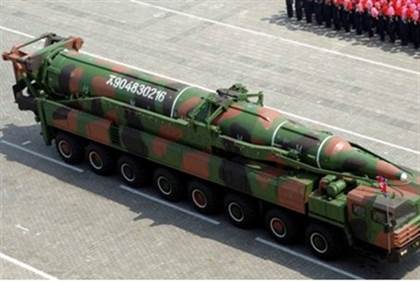
NK missileA North Korean rocket in a military parade (file)Reuters

The information is particularly damaging given that Admiral Bill Gortney, Commander of North American Aerospace Defense Command (NORAD) and US Northern Command (USNORTHCOM), admitted this month that the Pentagon fears that North Korea and possibly Iran can target the US with a nuclear EMP strike.

********************

US intelligence officials revealed that during the ongoing Iran nuclear negotiations, North Korea has provided several shipments of advanced missile components to the Islamic regime in violation of UN sanctions – and the US hid the violations from the UN.

The officials, who spoke to the Washington Free Beacon on Wednesday on condition of anonymity, said more than two shipments of missile parts since last September have been monitored by the US going from North Korea to Iran.

One official detailed that the components included large diameter engines, which could be used to build a long-range missile system, potentially capable of bearing a nuclear warhead.

The information is particularly damaging given that Admiral Bill Gortney, Commander of North American Aerospace Defense Command (NORAD) and US Northern Command (USNORTHCOM), admitted this month that the Pentagon fears that North Korea and possibly Iran can target the US with a nuclear EMP strike.

Critics have pointed out that the nuclear framework deal reached with Iran earlier this month completely avoids this question of Iran’s intercontinental ballistic missile (ICBM) program, which would allow it to conduct nuclear strikes.

US President Barack Obama was given details of the shipments in his daily intelligence briefings, but the officials say the information was hiddenfrom the UN by the White House so that it would not take action on the sanctions violations.

Back in 2010, the UN Security Council put sanctions on Iran’s illegal uranium enrichment program. Those sanctions prohibit Iran from buying ballistic missile parts, and any “technology related to ballistic missiles capable of delivering nuclear weapons.”

The US officials said the recent transfers fall within the scope of the sanctions.

In confirmation, a spokesperson for Spain’s mission to the UN, now in charge of the UN’s sanctions committee, said the committee has not been told about the incidents by the US since Spain took over in January.

White House and State Department spokespersons contacted by the paper refused to comment on the report.

Hiding transfers from the UN – “typical” Obama

A wave of experts came out with criticism against Obama’s administration for hiding the missile part transfer from the UN.

Former UN Ambassador John Bolton said the shipments violate UN sanctions on Iran, as well as those imposed on North Korea back in 2009.

“If the violation was suppressed within the U.S. government, it would be only too typical of decades of practice,” Bolton said. “Sadly, it would also foreshadow how hard it would be to get honest reports made public once Iran starts violating any deal.”

Former CIA analyst Fred Fleitz shared his assessment, saying “while it may seem outrageous that the Obama administration would look the other way on missile shipments from North Korea to Iran during the Iran nuclear talks, it doesn’t surprise me at all.”

“Iran’s ballistic missile program has been deliberately left out of the talks even though these missiles are being developed as nuclear weapon delivery systems,” noted Fleitz. “Since the administration has overlooked this long list of belligerent and illegal Iranian behavior during the Iran talks, it’s no surprise it ignored missile shipments to Iran from North Korea.”

The mounting criticism was added to by Thomas Moore, a former Senate Foreign Relations Committee arms control specialist, who told Washington Free Beacon that the transfer “certainly points out the glaring omission present in the Iran deal: the total lack of anything on its missile threat.”

“If true, allowing proliferation with no response other than to lead from behind or reward it, let alone bury information about it, is to defeat the object and purpose of the global nonproliferation regime – the only regime Obama may end up changing in favor of those in Tehran, Havana and Pyongyang,” Moore said.

And Henry Sokolski, head of the Nonproliferation Policy Education Center, said the missile transfer “more than suggests why the administration had to back away from securing any ballistic missile limits in its negotiations” with Iran.

Exposing the Iran-North Korea missile partnership

The Washington Free Beacon went into detail about the relationship between North Korea and Iran in building the latter’s advanced missile program, which is poised to construct ICBMs capable of delivering a strike with a nuclear warhead at astounding distances.

A classified State Department cable from October 2009 that was exposed by Wikileaks details that Iran is the leading missile customer of North Korean.

It stated how since the 1980s North Korea has been handing Scud missiles and technology for developing Nodong missiles with a 620-mile range to Iran.

“Pyongyang’s assistance to Iran’s [space launch vehicle] program suggests that North Korea and Iran may also be cooperating on the development of long-range ballistic missiles,” read the cable.

Another cable from September 2009 posited that the steering engines in Iran’s Safir rocket likely come from North Korea, and are based on Soviet-era SS-N-6 submarine launched ballistic missiles.

Importantly, that transfer of technology let Iran develop a self-igniting missile propellant that “could significantly enhance Tehran’s ability to develop a new generation of more-advanced ballistic missiles.”

“All of these technologies, demonstrated in the Safir [space launch vehicle] are critical to the development of long-range ballistic missiles and highlight the possibility of Iran using the Safir as a platform to further its ballistic missile development,” read the cable.

The assessments of the classified cables were confirmed by Joseph DeTrani, former director of the US intelligence agency National Counterproliferation Center, who said North Korea has kept “close and long term” relations with Iran in transferring missiles and related technology.

“U.N. Security Council resolutions prohibit this type of activity, and continued missile-related transfers from North Korea to Iran would be in violation of these Security Council resolutions,” added DeTrani, a former CIA officer and special envoy to North Korea nuclear talks.

The Danger of Negotiating with Iran

March 9, 2015

The Danger of Negotiating with Iran, Washington Free Beacon, March 9, 2015

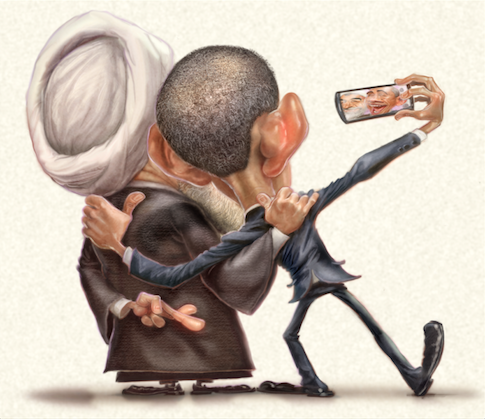
Obama-Rouhani-Selfie

Incentivizing defiance also undercuts diplomacy. In the year before Obama blessed talks with Iran, the Iranian economy had shrunk 5.4 percent. After talks, its economy grows. In order to bring Iran to the table, Obama has released more than $11 billion to Iran. To put that in perspective, that is equivalent to the last two years’ budget of the IRGC, a group responsible for the deaths of hundreds of Americans. What Obama has done is the equivalent of giving a toddler dessert first, and then asking him to come back to eat his broccoli.

How can these past successes be replicated? Sunset clauses, multinational contracts, and sanctions relief won’t do it. Only one thing will: Forcing the regime to choose between its nuclear ambitions and its survival.

*********************

As a candidate for president, Barack Obama made diplomacy with rogue regimes a signature issue. “The notion that somehow not talking to countries is punishment to them…is ridiculous,” he declared in 2007. In both his inaugural addressand his first television interview as president, he reached out to the Islamic Republic of Iran. “If countries like Iran are willing to unclench their fist, they will find an extended hand from us,” he told Al-Arabiya. In the six years since, whether firebrand Mahmoud Ahmadinejad or reformer-by-comparison Hassan Rouhani held the Iranian presidency, Obama has been so committed to a deal on Iran’s illicit nuclear program that he hasn’t let anything stand in his way—Congress, allies, or evenfacts.

Unfortunately, when it comes to the history of high-profile diplomacy with rogue regimes, Obama’s behavior is more the rule than the exception. If every senator looks in a mirror and sees a future president, then every president looks in a mirror and sees a brilliant statesman, a man who will be Nixon in China or Reagan in Reykjavik. In reality, what most should see is a reflection of Frank B. Kellogg, Aristide Briand, or Neville Chamberlain. With very little understanding of history, Obama, alas, sees only himself.

Albert Einstein is often credited (wrongly) with the adage that insanity is doing the same thing repeatedly while expecting different results. By that definition, Foggy Bottom is Bedlam. The U.S. military, in contrast, constantly forces soldiers to confront their mistakes—that is, after all, why sergeants-major chew out soldiers. Soldiers spend more time in the classroom dissecting exercises than they do in the field. Even when deployed, they never neglect after-action reports to determine what they might have done better.

In the last half century, however, the State Department has never conducted a “lessons learned” exercise to identify what went wrong with high stakes diplomacy. Nor does the State Department have any clear metrics to measure success and failure. State Department spokesmen often make declarations of progress that declassified records of talks—with Iran, North Korea, the Palestinians, Saddam Hussein’s Iraq, Muammar Gaddafi’s Libya, Pakistan or, increasingly, Turkey and Russia—belie.

Too many American diplomats dismiss the need to consider mistakes. Instead, many are committed to the belief that talking is a cost-free, risk-free strategy. Testifying before the Senate in support of Obama’s outreach to Iran, Nicholas Burns, the second undersecretary of state for foreign affairs under George W. Bush, promised, “We will be no worse off if we try diplomacy and fail.” Richard Armitage, another veterans of Bush’s State Department, has promoted a similar argument: “We ought to have enough confidence in our ability as diplomats to go eye to eye with people—even though we disagree in the strongest possible way—and come away without losing anything.”

But Armitage was wrong to project American values onto others. Americans may not see willingness to talk as weakness, but other cultures do. On the same day in 2008 that William J. Burns, Bush’s third undersecretary of state for foreign affairs, met an Iranian delegation in Geneva—the first public high-level meeting between American and Iranian diplomats in decades—Mohammad-JafarAssadi, the ground force commander of the Islamic Revolutionary Guard Corps (IRGC) declared that, “America has no other choice but to leave the Middle East region beaten and humiliated.”

But Armitage was wrong to project American values onto others. Americans may not see willingness to talk as weakness, but other cultures do. On the same day in 2008 that William J. Burns, Bush’s third undersecretary of state for foreign affairs, met an Iranian delegation in Geneva—the first public high-level meeting between American and Iranian diplomats in decades—Mohammad-JafarAssadi, the ground force commander of the Islamic Revolutionary Guard Corps (IRGC) declared that, “America has no other choice but to leave the Middle East region beaten and humiliated.”

American diplomats genuinely want peace, but cultural equivalence can kill. So too can ignorance of an adversary’s true goals. This is why Obama’s headlong rush into a deal with Iran will be disastrous.

Obama has had no shortage of cheerleaders. Secretary of State Hillary Clinton endorsed his embrace of diplomacy with rogue regimes.  “You don’t make peace with your friends,” she said, adding, “You have to be willing to engage with your enemies.” That may be true, but how you engage with rogues is important. And this is where Obama—and so many would-be statesmen before him—have gone wrong.

It is possible both to take diplomacy seriously and to remember that rogue regimes are a particular problem. There is, of course, no standard definition of “rogue,” but there is no universal definition of “terrorism” either. That doesn’t mean it doesn’t exist. In effect, rogueness is the diplomatic equivalent of pornography; attempting to define it calls to mind Justice Potter Stewart’s quip about pornography: “I can’t define it, but I know it when I see it.”

For the purposes of American policy, it wasn’t the “neocons” of the Bush administration who coined the concept, but rather the progressives within the Clinton administration. In 1993, Les Aspin, then the secretary of defense, warned that “the new nuclear danger we face is perhaps a handful of nuclear devices in the hands of rogue states or even terrorist groups.” The following year, Bill Clinton himself described Iran and Libya as “rogue states” in a speech before European officials. Secretary of State Warren Christopher, hardly a hawk, repeatedly referred to Iran as a rogue regime, and, in 1997, Madeleine Albright argued that “dealing with the rogue states is one of the great challenges of our time…because they are there with the sole purpose of destroying the system.”

Indeed, Iran checks every box for a rogue regime: It has sacked embassies at home and blown them up abroad. When, between 2000 and 2005, the European Union more than doubled its trade with Iran in the name of supporting “Dialogue of Civilizations,” Mohammad Khatami’s reformist administration poured the bulk of its hard currency windfall into nuclear and ballistic missile programs, constructing, for example, the undeclared and covert enrichment facility at Natanz.  Iranian leaders have also been unapologetic about ratcheting up terrorism and support for insurgencies in proportion to their sense of the West’s diplomatic desperation. In their wildest dreams, the Iranians never imagined seeing Western acquiescence to their domination not only of Syria and Lebanon, but also of Iraq, Yemen, and perhaps the Gaza Strip. The Iranians have only grown more truculent under Obama, sending naval warships through the Suez Canaland undertaking their first naval deployment to the Pacific Ocean since the 10th century.

Of course, the Iranian people themselves bear the brunt of the Islamic regime’s tyranny. Every time Iranian leaders speak of reform to the Western audience, public executions and crackdowns on religious minorities increase: Iranians understand the message: talk of reform is for external consumption only.

That hasn’t stopped every U.S. administration from seeking to bring Iran in from the cold. Obama may have reached his hand out to Iran, but he wasn’t the first: both Bushes, Clinton, Reagan, and Jimmy Carter each tried something similar. Revolutionary leaders only had American hostages to seize because Carter was determined to keep hopes for rapprochement alive, and to keep the embassy in Tehran open whatever the risks—Khomeini’s rhetoric notwithstanding. Then, as now, the president had the media in his corner. The day before Khomeini’s revolutionary thugs seized the U.S. embassy, Steven Erlanger, the New York Times’ future chief diplomatic correspondent, published an analysis arguing that “the religious phase [of Iran’s Revolution] is drawing to a close even as it is becoming formalized.” In other words, Carter was right. The naysayers who listened to what the Iranian leaders actually promised were not sophisticated enough to understand the nuanced position of the new regime.

But Carter did not stand alone in his hope of restoring the partnership between Tehran and Washington, nor are Democrats the only party who have expected dialogue to reform rogues. The Reagan-era “Arms for Hostages” scheme began as an effort to engage Iran and cultivate a new generation who might succeed Khomeini. And it was George H.W. Bush, not Obama, who used his inauguration topromise the Iranian leadership that, “Goodwill begets goodwill. Good faith can be a spiral that endlessly moves on.” President Ali Akbar Hashemi Rafsanjani publicly suggested that he was willing to play ball, and Bush was hooked. Only when Bush had the secretary general of the United Nations send an intermediary to Tehran did he learn that Rafsanjani’s interest in peace was a ruse. Rafsanjani, whom aides to Carter, Reagan, and George H.W. Bush all called a pragmatist at various times, subsequently suggested that Iran could annihilate Israel with a single nuclear bomb while Iran’s size would enable it to withstand any retaliation.

Bill Clinton turned the other cheek to Iran’s culpability in the 1996 Khobar Towers attack in order to give diplomacy a chance. After Khatami’s term ended, his own advisors began to brag about how they had played the United States. On June 14, 2008, Abdollah Ramezanzadeh, Khatami’s press secretary, hinted about the real motivation behind Iran’s reformist rhetoric. “We should prove to the entire world that we want power plants for electricity,” he said. “Afterwards, we can proceed with other activities.” Ramezanzadeh had this to say about the purpose of dialogue: “We had an overt policy, which was one of negotiation and confidence building, and a covert policy, which was continuation of the activities.”

When Obama declared on April 5, 2009, that “All countries can access peaceful nuclear energy,” the hardline daily Resalat responded with a front-page headline, “The United States capitulates to the nuclear goals of Iran.”

If Obama were serious about ending Iran’s nuclear threat, he would consider the lessons from past diplomacy with Iran. First, taking force off the table undercuts rather than eases diplomacy. Consider the hostage crisis. According to interviews with veterans of Carter’s Iran crisis team, Gary Sick, the 39th president’s point man on Iran, leaked word that the White House had agreed to table any military response. Hostage takers have since acknowledged that, once they learned that they could expect no military consequences, they transformed their 48-hour embassy sit-in into a 444-day crisis.

Desperation for a deal also backfires. After Iran seized the hostages, Secretary of State Cyrus Vance sought to talk to any Iranian who would listen. He sought a meeting with his Iranian counterpart, Abulhassan Bani Sadr. Bani Sadr made demands, but lost his post just two and a half weeks after the meeting was held. So Vance then sought to work with Bani Sadr’s successor, Sadegh Ghotbzadeh, a former trainer for Palestinian terrorists, who proved his revolutionary credentials by augmenting earlier demands. Steering into the Iranian political maelstrom has never worked.

Western diplomats, like community organizers, pride themselves on sensitivity. Multiculturalism is their religion and moral equivalence is their mantra. They seldom understand how adversaries feign grievance to put Americans on the defensive. Take, for example, Ambassador Thomas Pickering, a vocal proponent of engagement with Iran, who warned that Iranians “bristle at the use of the phrase ‘carrots and sticks,’” because it both depicted them as donkeys and implied noncompliance would lead to a beating. What Pickering and crew never realized, however, is that Iranians often use the phrase “carrots and sticks” themselves.

Likewise, Iranians often demand apologies for grievances real and imagined. When Albright apologized for the American role in the 1953 coup against Iranian Prime Minister Mohammad Mosaddeq, Tehran demanded compensation. Alas, Albright was apologizing to America’s co-conspirators: Due to right-wing Iranian fears of communism during the Cold War, the clergy had sided with the United States and the Shah over the left-leaning populist.

Incentivizing defiance also undercuts diplomacy. In the year before Obama blessed talks with Iran, the Iranian economy had shrunk 5.4 percent. After talks, its economy grows. In order to bring Iran to the table, Obama has released more than $11 billion to Iran. To put that in perspective, that is equivalent to the last two years’ budget of the IRGC, a group responsible for the deaths of hundreds of Americans. What Obama has done is the equivalent of giving a toddler dessert first, and then asking him to come back to eat his broccoli.

Obama recently dismissed a speech by Prime Minister Benjamin Netanyahu of Israel for being devoid of any “viable alternatives.” But Netanyahu was right: leverage matters. Reagan talked to the Soviet Union, but only after a massive military build-up that allowed him to negotiate from a position of strength. He never abandoned moral clarity. Only twice in history has the Islamic Republic reversed course after swearing to a course of no compromises. The first time was about what it would take to release the American hostages, and the second about what it would take to end the Iran-Iraq War. After the hostages were released on the first day of the Reagan presidency, Carter’s associates credited the persistence of diplomacy. This is nonsense: As Peter Rodman has pointed out, Iraq’s invasion of Iran had rendered Tehran’s isolation untenable. Khomeini needed to release the hostages or his country would have crumbled. Likewise, Khomeini considered ending the Iran-Iraq War in 1982, but the IRGC pushed him to continue it until “the liberation of Jerusalem.” After six years of stalemate and another half million deaths, Khomeini reconsidered. In his radio address, he likened accepting the ceasefire to drinking from a chalice of poison, but suggested that he had no choice if Iran was to survive.

How can these past successes be replicated? Sunset clauses, multinational contracts, and sanctions relief won’t do it. Only one thing will: Forcing the regime to choose between its nuclear ambitions and its survival.