Posted tagged ‘Qatar’

Will Trump make a peace breakthrough in 2018?

June 15, 2017

Will Trump make a peace breakthrough in 2018? DEBKAfile, June 15, 2017

(Lots of speculation about future events, but an interesting piece nevertheless. — DM)

US President Donald Trump’s goal of generating a rapid improvement of Israel’s ties with the Arab world, including the Palestinians in 2018, is not just up to Prime Minister Binyamin Netanyahu and Palestinian Authority Chairman Mahmoud Abbas, but depends largely on how the Trump administration handles the continuing conflict between Qatar and its powerful Arab opponents, Egypt, Saudi Arabia and the UAE.

Up until the end of this week, Trump had turned down the efforts of Secretary of State Rex Tillerson and Secretary of Defense James Mattis to resolve the Gulf conflict by diplomacy. Instead of heeding them, the president took the advice of the Saudi defense minister, Prince Mohammed bin Salman, and Saudi Foreign Minister Adel Al-Jubeir, who visited Washington this week. Tillerson and Mattis tried to arrange a conference between Saudi Arabia and Qatar so as to gradually ease the tensions, but Trump torpedoed the initiative by adopting Riyadh’s tough line.

A complex situation has arisen in the last few days regarding the US diplomacy for bringing Israel and the Palestinians aboard a peace process. The signs of movement on this score fluctuate between crises and some progress:

1. The Gaza electricity row falls under the first heading. Some circles contend that the crisis is artificial, since the Palestinian enclave is receiving as much power now as before. What is different is the new, intensified pressure by Egypt on the one hand and the Palestinian Authority on the other in the hope of toppling Hamas rule in the Gaza Strip or squeezing its leaders into toeing their lines. Neither Egyptian President Abel Fatteh El-Sisi nor the Palestinian Authority chairman has made headway. Hamas stubbornly refuses Cairo’s demand to sever ties with Qatar, while launching a counteroffensive to draw Israel into the dispute by making an empty threat of an “explosion.”

Israel responded with a counter-threat on Thursday, June 15: a proposal to transfer one hour’s worth of power from West Bank Palestinian towns to boost the supply to Gaza.

This maneuver kept the entire electricity issue in the court from it was tossed, Ramallah.

2. A shower of Israeli concessions is landing on the Palestinians judging by almost daily reports. Some are true and others false. But in sum, they are designed to impress President Trump with the Netanyahu government’s good will towards his peace initiative and readiness to take steps in its support. In fact, the prime minister is preparing the ground for the forthcoming arrival of Jason Greenblatt, Trump’s envoy on the Israel-Palestinian issue.

3. US Secretary of State Tillerson this week informed the Senate that the Palestinian Authority had agreed to  halt its payments to the families of Palestinian terrorists who were killed while carrying out attacks against Israelis. Palestinian officials no doubt let this be understood to demonstrate their willingness to go along with Trump’s peace initiative, without, however, have any real intention of following through.

4. Media reports and the findings of Arab research institutes add up to the following predictions on the fate of the negotiations generated by the Trump administration between Israel and the Arab world:

A. Some time during 2018, a showcase summit will be staged for Trump, Netanyahu and leading Arab rulers like Saudi King Salman, Egyptian President El-Sisi and the UAE’s Crown Prince Mohammed bin Zayed al-Nahyan.

They will publish a joint declaration signaling the phased normalization of relations with Israel by such preliminary steps as the exchange of economic and business delegations, the opening of trade offices and of Arab skies to Israeli commecial flights. None of these researchers is clear about the Palestinian role in this event.

B. Meanwhile, Israel will make concessions towards improving the lives of ordinary Palestinians, such as removing checkpoints, issuing building permits for Palestinian towns and more jobs in Israel.

C. Israel and the Palestinian Authority will expand their security cooperation. The Palestinians will be persuaded to cease their incitement against the Jewish State and stop payouts to the families of convicted Palestinian terrorists and other security offenders.

D. Direct Israeli-Palestinian negotiations will ensue, without preconditions on either side, and expand. with Arab governments sitting in.

E. At the end of a period of some years, this process will mature into a discussion of the core issues of the dispute, Palestinian statehood, future borders, settlements, Jerusalem and refugees.

In other words, the year 2018 will see the building of normal relations between Israel and Arab countries to be followed at a later date by the Israeli-Palestinian peace process. President Trump has clearly seized on relations with Riyadh, Cairo and Abu Dhabi as a lever for pushing Israel and the Palestinians into peace talks.

The idea is simple. Israel’s improved ties with the Arab world will resonate positively on Israeli-Palestinian relations. That appears to be Trump’s formula for peace. But there is a catch. It depends heavily on the US President maintaining good relations with the Arab world in the long term.

Qatar’s Comeuppance

June 15, 2017

Qatar’s Comeuppance, Gatestone InstituteRuthie Blum, June 15, 2017

Ironically, pressure from this new anti-Iran Muslim bloc in the Middle East has done more to call the world’s attention to Qatar’s key role in the spread of Islamist terrorism than years of cajoling on the part of previous administrations in Washington to get Doha to live up to its signed commitments.

***********************************

Putting Doha on the Well-Deserved Defensive

Qatar’s extensive ties to terrorism and abetting of financiers to bolster it are well-documented.

Saudi Arabia, the UAE, Egypt and Bahrain issued a statement designating 59 individuals and 12 organizations as having terror ties to Qatar. According to the statement, Doha “announces fighting terrorism on one hand and finances and supports and hosts different terrorist organizations on the other hand,” and harbors “terrorist and sectarian groups that aim to destabilize the region, including the Muslim Brotherhood, Daesh [ISIS] and Al Qaeda.”

Ironically, pressure from this new anti-Iran Muslim bloc in the Middle East has done more to call the world’s attention to Qatar’s key role in the spread of Islamist terrorism than years of cajoling on the part of previous administrations in Washington to get Doha to live up to its signed commitments.

A mere two weeks after U.S. President Donald Trump delivered his first major foreign policy speech in Riyadh to delegates from dozens Muslim/Arab countries, Bahrain announced on June 5 that it was halting all flights to Qatar for being a sponsor of radical Islamist terrorists. Immediately, Saudi Arabia joined the boycott, as did the United Arab Emirates (UAE), Egypt and Yemen, all of which also shut off access to Al Jazeera, the anti-American, anti-Semitic Qatari television network established in 1996 and operating since then to foment unrest across the Middle East and bolster the terrorist organization the Muslim Brotherhood and its offshoot, Hamas.

The emir of Qatar, Sheikh Tamim bin Hamad Al Thani, and other officials in Doha fiercely denied the charge that their government has been backing terrorism, blaming a “fake news” report on the website of the state-controlled Qatar News Agency for the eruption of the Gulf crisis.

The report, which the FBI and other U.S. security agencies believe was the result of a Russian hacking attack, quoted Al Thani calling Iran an “Islamic power,” referring to Hamas as “the legitimate representative of the Palestinian people” and saying Qatar’s relations with Israel were “good.”

Although the report did turn out to be a hoax, Qatar’s extensive ties to terrorism and abetting of financiers to bolster it are well-documented. A Foundation for Defense of Democracies (FDD) study, titled “Qatar and Terror Finance: Private Funders of al-Qaeda in Syria,” shows that while Doha has pretended for more than a decade to be partnering with the United States to defeat Al Qaeda, the monarchy, in fact, has taken no action whatsoever against the Qatari financiers of the terrorist organization’s Syrian branch, the Nusra Front, which continues to plot attacks against the West. One of the reasons that this group eluded U.S. strikes operating in Syria was that it, like America, has been fighting ISIS. Another was that it changed its name to Jabhat Fateh al-Sham (JFS or the Front for the Conquest of Syria), in an effort to distance itself from Al Qaeda. This effort was led by Qatar.

According to the FDD study, the second of a three-part document written by David Andrew Weinberg:

“…[I]ntelligence officials from Qatar and other Gulf states met several times with Nusra’s leader [in 2015] to suggest that his group could receive money, arms, and supplies after stepping away from al-Qaeda.”

While the first part of the study, released in 2014, revealed “Doha’s dismal record” during the reign of Emir Hamad Al Thani (the current monarch’s father), this one

“evaluates the publicly available evidence on Qatar’s record since then, focusing primarily on individuals sanctioned by the U.S. Treasury Department in 2014 and 2015. All of these sanctions were imposed after Qatar agreed in September 2014, as part of a U.S.-led initiative called the Jeddah Communiqué, to bring terror financiers to justice.”

Weinberg concluded that Qatar has done little or nothing to comply. On the contrary, he wrote, “The funders of certain terrorist groups still enjoy legal impunity there. Nusra/JFS appears to be foremost among them.”

It is just as unlikely that a single news item was responsible for the banding together of several Arab states to impose a blockade on Qatar as it is implausible that these states, particularly Saudi Arabia — which itself has backed and spread radical Islamist ideology — are holding Qatar accountable for its ties to global jihad. Equally simplistic is the view, expressed by Trump on Twitter, that the embargo indicated the seriousness with which the above states took his call to “drive out the terrorists and extremists” from their midst.

“During my recent trip to the Middle East I stated that there can no longer be funding of Radical Ideology. Leaders pointed to Qatar — look!” Trump tweeted on June 7.

“So good to see the Saudi Arabia visit with the King and 50 countries already paying off. They said they would take a hard line on funding extremism, and all reference was pointing to Qatar. Perhaps this will be the beginning of the end to the horror of terrorism!”

This prompted pundits on both sides of the political spectrum to question whether Trump was simply being reckless in his response, or actually announcing a shift in decades of U.S. policy regarding Qatar, home of the Al Udeid Air Base southwest of Doha. Al Udeid is not only America’s largest military base in the Middle East — with some 10,000 troops, but since 2003, it has served as forward headquarters for CENTCOM (the U.S. Central Command), and has been crucial in America’s operations in Afghanistan, Iraq and Syria.

The following day, Trump was accused of backtracking, when he phoned Al Thani and offered to “help the parties resolve their differences, including through a meeting at the White House if necessary.”

Jerusalem Post columnist Caroline Glick pointed out that this was not a case of Trump reversing his position, but rather of proposing the most reasonable course of action available:

“With the Pentagon dependent on the Qatari base, and with no clear path for unseating the emir through war or coup without risking a much larger and more dangerous conflict, the only clear option is a negotiated resolution.

“Under the circumstances, the best option for the US to openly work towards is to diminish Qatar’s regional profile and financial support for Iran and its terrorist allies and proxies.”

Nevertheless, mixed messages appeared to be emerging from the Trump administration. On June 9, Secretary of State Rex Tillerson said that the blockade was hindering U.S. operations against ISIS. On the same day, Pentagon spokesman Navy Capt. Jeff Davis asserted that the isolation of Qatar so far has had no negative impact on U.S. operations in and out of Al Udeid. “All of our supplies are getting in just fine,” he told reporters. “The Defense Logistics Agency is certainly always looking at contingency plans if they’re needed, but for right now they’re OK.”

On the day that these conflicting claims began to circulate, Saudi Arabia, the UAE, Egypt and Bahrain issued a statement designating 59 individuals and 12 organizations as having terror ties to Qatar. According to the statement, Doha “announces fighting terrorism on one hand and finances and supports and hosts different terrorist organizations on the other hand,” and harbors “terrorist and sectarian groups that aim to destabilize the region, including the Muslim Brotherhood, Daesh [ISIS] and Al Qaeda.”

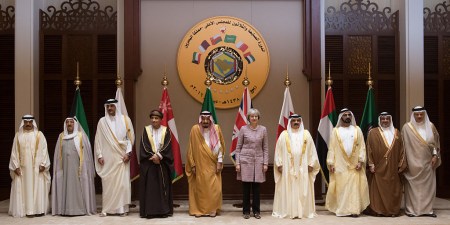
Bygone days of unity. The leaders of the Gulf states pose with British PM Theresa May at the Gulf Cooperation Council summit, on December 7, 2016 in Manama, Bahrain. (Photo by Carl Court/Getty Images)

On June 7 — the day of Trump’s phone call and two days before the release of the Saudi statement — Qatar hired of the law firm of John Ashcroft, former attorney general under President George W. Bush, to help counter terror accusations. This clearly was a calculated move, as Ashcroft had been instrumental in pushing through the post-9/11 “Uniting and Strengthening America by Providing Appropriate Tools Required to Intercept and Obstruct Terrorism Act of 2001,” more commonly known as the Patriot Act.

According to the “Scope of Engagement” of the Ashcroft retainer, its “broad purpose,” for a “flat fee” of $250,000, is to:

“provid[e] the Client with comprehensive strategic advice, legal counsel, support, and representation related to confirming, educating, assessing and reporting the Client’s efforts to combat global terrorism and its support of and compliance with international financial regulations, including compliance with United States Treasury rules and regulations.

“The firm understands the urgency of this matter and need to communicate accurate information to both a broad constituency and certain domestic agencies and leaders…will advance, advocate, represent, and protect the Client’s interests as necessary, including but not limited to the development of comprehensive legal and government affairs strategy, coordination as necessary and in the interest of the Client, assessment of the pending news and certain nations’ claims that adversely impact the Client’s reputation and pose serious risk and consequences.”

Hiring Ashcroft is not the only indication that Qatar is running scared. Another is its leaders’ simultaneous attempt to assuage fears among its populace – reported to have begun “panic-shopping” at supermarkets — and threaten fellow Gulf Cooperation Council countries that they will suffer severe financial consequences as a result of their boycott.

“If we’re going to lose a dollar, they will lose a dollar also,” warned Qatari Finance minister Ali Shareef Al Emadi. Emadi added, “Our reserves and investment funds are more than 250 percent of gross domestic product, so I don’t think there is any reason that people need to be concerned about what’s happening or any speculation on the Qatari riyal.”

In spite of Emadi’s posturing and Doha’s assertion that it is not in cahoots with Iran, Tehran announced that it has begun sending hundreds of tons of food products to Qatar. Oman, too, is transferring goods to Doha. Turkey went a step further, authorizing the dispatch of 3,000-5,000 troops to its military base in Qatar, to assist Al Thani’s regime, should it be jeopardized by the Saudi-led initiative and internal power struggles.

This unfolding of events is creating what Middle East expert Jonathan Speyer called a “clear drawing” of the “lines of confrontation between the two central power blocs in the region…”

As Speyer wrote on June 10:

“The shunting aside of little Qatar… is ultimately only a detail in the larger picture. What is more significant is the re-emergence of an overt alliance of Sunni Arab states under US leadership, following the development of military capabilities in relevant areas, and with the stated intention of challenging the Iranian regional advance and Sunni political Islam.”

Ironically, pressure from this new anti-Iran Muslim bloc in the Middle East has done more to call the world’s attention to Qatar’s key role in the spread of Islamist terrorism than years of cajoling on the part of previous administrations in Washington to get Doha to live up to its signed commitments.

Ruthie Blum is a journalist and author of “To Hell in a Handbasket: Carter, Obama and the ‘Arab Spring.'”

White House: Middle East Crisis Sparked By Trump’s Demand to End Support for Extremists Groups

June 13, 2017

White House: Middle East Crisis Sparked By Trump’s Demand to End Support for Extremists Groups, Washington Free Beacon, , June 13, 2017

(Please see also, Military crisis in Qatar may spark Gaza outbreak — DM)

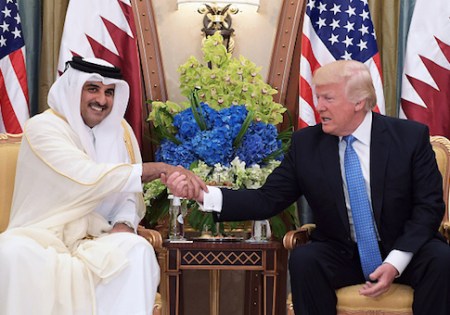
US President Donald Trump (R) and Qatar’s Emir Sheikh Tamim Bin Hamad Al-Thani take part in a bilateral meeting at a hotel in Riyadh on May 21, 2017. / AFP PHOTO / MANDEL NGAN (Photo credit should read MANDEL NGAN/AFP/Getty Images)

A percolating crisis in the Middle East over a top U.S. military ally’s support for extremist terror groups was ignited by President Donald Trump’s demand that U.S. allies in the Arab world end their support for Islamic extremism, according to senior U.S. officials familiar with the situation.

Trump is seeking a more active role in mediating a growing dispute between leading Arab nations and Qatar, a U.S. counterterrorism ally that has long provided financial support to the very terror groups it has vowed to fight.

Trump’s recent trip to the Middle East—where he publicly and privately urged top Arab allies such as Saudi Arabia to crackdown on Islamic extremism—is said to have sparked a regional dispute with Qatar, thrusting the country’s issues with terrorism financing into the spotlight, sources told the Washington Free Beacon.

U.S. officials, both inside and outside the White House, have long avoided the thorny issue of Qatar’s support for terrorism in an effort to preserve military relations with the country, which hosts a major U.S. air base that is a central front in the war against terror.

Trump’s focus on Qatar is said to be part of a larger regional strategy that focuses on strangling financial support for terror organizations that long benefited from Arab governments turning a blind eye to the issue.

Trump’s push to crackdown on this type of behavior—not just in Qatar—is said to have fueled the diplomatic break with Qatar earlier this month, which saw several leading Arab nations led by Saudi Arabia ceasing all diplomatic ties with the energy-rich nation.

U.S. officials and administration insiders who spoke with the Free Beacon about the situation said that Trump is seeking to play an active role in helping to mediate the crisis and shutdown Qatar’s financing of terror groups such as al Qaeda and ISIS.

“Look, last month President Trump visited Riyadh and gave a historic speech challenging America’s Arab friends and partners to do more to combat the violent radicalization that is growing within Islam,” one senior administration official told the Free Beacon.

“And the fact of the matter is that even though Qatar has been an important partner in some areas, they’ve also been a significant source of terrorist financing,” said the official, who would only speak on background when discussing the sensitive diplomatic issue. “What you’re seeing now is a regional response to the president’s challenge, and Qatar is going to have to respond as well.”

Trump’s stance against Islamic extremism and willingness to call out state backers of the movement has forced U.S. officials, particularly those in the Department of Defense, to address an issue that has been downplayed in pursuit of preserving diplomatic relations with Qatar and other Arab nations, sources said.

The hope is this will result in concrete change, which has been elusive in recent years as nations such as Qatar play both sides of the terror issue.

“American policy in the Gulf has been a bipartisan failure for over a decade. For different reasons, both parties found reasons to ignore terror financing coming out of the Gulf,” said one veteran foreign policy official who has been briefed by White House officials on Trump’s Gulf region strategy.

“Even when Obama officials did talk about terror financing, they used it as an excuse to pressure the Saudis and others to cut off legitimate anti-Assad forces,” the source said. “President Trump has been clear to our allies and adversaries that the incoherence has to end. He called on the Arab world to clean house, and what you’re seeing is the beginning of that.”

Trump discussed the issue in Monday remarks at a White House cabinet meeting, where he emphasized that terror-financing issues have became a central focus for the United States.

“One of the big things we did, and your seeing it now with Qatar and all of the things that are actually going on in a very positive fashion, we are stopping the funding of terrorism,” Trump said. “They’re going to stop the funding of terrorism. And it’s not an easy fight, but it’s a fight we’re going to win. You have to starve the beast, and we’re going to starve the beast.”

Secretary of State Rex Tillerson has walked a more diplomatic line of the issue, in a move sources characterized as a “good-cop-bad-cop” ploy.

State Department officials would not comment on Trump’s latest remarks about Qatar, referring a reporter to Tillerson’s public remarks last week.

“Qatar has a history of supporting groups that have spanned the spectrum of political expression, from activism to violence,” Tillerson said. “The emir of Qatar has made progress in halting financial support and expelling terrorist elements from his country, but he must do more and he must do it more quickly.”

Military crisis in Qatar may spark Gaza outbreak

June 13, 2017

Military crisis in Qatar may spark Gaza outbreak, DEBKAfile, June 13, 2017

A military crisis centering on Qatar would be a catalyst for an outbreak of violence from the Gaza Strip. And indeed, after the failed Sanwar mission to Cairo and the reduction of electric power to the Gaza Strip, Hamas spokesmen warned that an “explosion” was imminent.

*********************

The electricity cutback in the Gaza Strip, engineered by Palestinian leader Mahmoud Abbas to flex muscle against Hamas rule, was just one piece on the checkerboard created by the crackdown Egypt, Saudi Arabia Bahrain and the United Arab Emirates have imposed on Qatar for supporting terrorist groups like the Palestinian extremist Hamas. Therefore, Hamas leader Yahya Sanwar had little to expect from his mission to Cairo last weekend to persuade the El-Sisi government to ease its restrictions on the Gaza Strip.

He arrived at the head of a large mission, in which the group’s military arm, Ezz e-Din El-Qassam was heavily represented. Their appeals to Maj.-Gen Khaled Fawzy, director of Egyptian General Intelligence, met with a list of tough conditions. When the Palestinian delegation balked, Cairo acted to tighten its blockade on the Palestinian enclave.

The Hamas rulers of the Gaza Strip found themselves in the same boat as their old friend, Qatar, in the week that their internal rival, Mahmoud Abba, docked payment for the electricity Israeli supplies the Gaza Strip. The power supply was cut by 40 percent.

From 2015, the emir of Qatar remained the only Arab ruler backing the Palestinian extremist Hamas with occasional cash donations to Gaza City and permission for its top officials to set up shop in Doha.

This flow of aid was abruptly cut off by the land, sea and air blockade Saudi Arabia, the UAE, Bahrain and Egypt clamped down on Qatar last week over its support for terrorist groups and ties with Tehran. Sheikh Tamim bin-Hamad Al-Khalifa defied the ultimatum they presented him, and so Qatar’s banks and international assets have been losing dollars, its currency has plummeted and there is no money to spare for the Gaza Strip.

Qatar and Hamas are being pushed into the same corner.

The small Gulf island, which is the world’s largest supplier of natural gas, was been told by the four leading Arab governments to expel Muslim Brotherhood and Hamas officials from its soil, after years of providing them with hospitality plus pensions generous enough for them to live a life of ease and plenty, while also running their terrorist networks across the region and beyond.

Qatar was also told to discontinue its propaganda campaigns against Egypt, Saudi Arabia and the UAE, and shut down its main platform, the Al Jazeera TV channel; and hundreds of Egyptian and Saudi dissidents granted political asylum deported forthwith.

With nowhere else to go, these dissidents could potentially head for sanctuary in the Gaza Strip, making it a “little Qatar,” which is why Cairo further tightened the Palestinian enclave’s isolation by blocking all routes of access.

The Hamas delegation was likewise confronted in Cairo with tough demands by the Egyptian intelligence chief:

1. To turn in the Muslim Brotherhood fugitives they were sheltering in the Gaza Strip.

2.  Not just to sever cooperation between the Hamas military arm and the Islamic State networks in the Sinai Peninsula, but to surrender to Egypt all the intelligence they possessed about the jihadists and their activities.

3.  To discontinue weapons smuggling operations through Sinai.

After balking at the Egyptian demands, Yahya Sanwar was forced to leave Cairo empty-handed with regard to eased restrictions and humanitarian aid – only to find on his return home that the Egyptians had raised their biggest gun against the Gaza Strip: They had cut off power.

A humanitarian catastrophe now hangs over the two million inhabitants of the tiny Mediterranean enclave. Hospitals are cutting back operations, refrigerators are switched off, clean water supplies are dwindling because desalination plants are without power, raw sewage is dumped into the sea and sanitary conditions deteriorating.

Cairo asked the Palestinian Authority in Ramallah and the Israeli government not to relent, but to keep the pressure on the Hamas regime high. Ramallah must continue to hold back payment to cover Israel’s electricity bills, which suits Mahmoud Abbas’ campaign for bringing Hamas to heel.

But for Israel, there is a dilemma. Nonetheless, the Netanyahu government is extremely wary of breaking away from the anti-terror line taken by Arab governments, because this could put paid to the delicate ties established with them – especially in the military domain – through long and laborious effort.

In Jerusalem, it is therefore ardently hoped that the Qatar crisis is quickly resolved and Hamas and Cairo can reach terms exponentially for easing the humanitarian crisis in the Gaza Strip.

For the time being, there is no sign of this happening. On the contrary, there are indications of the crisis moving onto a military plane. Sources in the Middle East are not ruling out possible military action by Saudi Arabia, Egypt and the UAE against Qatar.

Read more about this looming potential in the coming DEBKA Weekly issue (for subscribers) out next Friday, June 16. 

A military crisis centering on Qatar would be a catalyst for an outbreak of violence from the Gaza Strip. And indeed, after the failed Sanwar mission to Cairo and the reduction of electric power to the Gaza Strip, Hamas spokesmen warned that an “explosion” was imminent.

Report: The Top Muslim Scholar Calls for Death of Christians

June 12, 2017

Report: The Top Muslim Scholar Calls for Death of Christians, Clarion ProjectElliot Friedland, June 12, 2017

Sheikh Yusuf al-Qaradawi, one of the leading theologians of the Muslim world, who is considered the spiritual guide of the Muslim Brotherhood, has called for the murder of Christians. He was recently blacklisted as a terrorist by Saudi Arabia, the United Arab Emirates, Bahrain and Egypt. Qaradawi, 90, was included in a list totaling 59 names of individuals and 12 entities listed as terrorists connected to Qatar.

Ahmed Adnan, a Saudi journalist, writer and political advisor based in Lebanon made the claim Qaradawi supports killing Christians in an interview with Al-Ahram al-Arabi.

“A call of Yusuf al-Qaradawi was intercepted in which he gave a fatwa to blow up churches and kill Christians,” he said in the interview. “This information is not from me but from a special source. This fatwa inspired training sessions in Libyan Islamist militia camps. These training sessions resulting in terror attacks that blew up churches and the incident of al-Minya.”

On May 26, masked gunmen opened fire on a convoy of Copts in Minya governate, killing 28.

Adnan also claimed in the interview that Qatar was indirectly connected to the Manchester terrorist attack through its support of militias in Libya.

The Ministry of Education in Saudi Arabia published an announcement saying Minister of Education Ahmed Ibn Muhammed al-Issa ordered there should be no book, articles, pamphlets or anything else written by al-Qaradawi in the libraries of the universities, colleges, school and departments of education.

Following Qaradawi’s listing as a terrorist, the Saudi-backed Muslim World League expelled Qaradawi.

Qatar, Trump and Double Games

June 9, 2017

Qatar, Trump and Double Games, Front Page MagazineCaroline Glick, June 9, 2017

Originally published by the Jerusalem Post

Ahead of the 2016 US elections, WikiLeaks published documents which disclosed that the emir of Qatar presented Bill Clinton with a $1 million check for the Clinton Foundation as a gift for his 65th birthday. During Hillary Clinton’s tenure as secretary of state, Qatar reportedly contributed some $6m. to the Clinton Foundation.

Clinton, for her part, was deeply supportive of the regime and of Al Jazeera. For instance, in testimony before the Senate Foreign Relations Committee in 2011, Clinton praised Al Jazeera for its leading role in fomenting and expanding the protests in Egypt that brought down Mubarak.

Clinton wasn’t the only one that Qatar singled out for generosity. Since the 1990s, Qatar has invested hundreds of millions of dollars in US universities. Six major US universities have campuses in Doha.

Then there is the Brookings Institution. The premier US think tank had a revolving door relationship with the Obama and Clinton administrations.

**********************************

US President Donald Trump has been attacked by his ubiquitous critics for his apparent about-face on the crisis surrounding Qatar.

In a Twitter post on Tuesday, Trump sided firmly with Saudi Arabia, Egypt, the United Arab Emirates and the other Sunni states that cut diplomatic ties with Qatar and instituted an air and land blockade of the sheikhdom on Monday.

On Wednesday, Trump said that he hopes to mediate the dispute, more or less parroting the lines adopted by the State Department and the Pentagon which his Twitter posts disputed the day before.

To understand the apparent turnaround and why it is both understandable and probably not an about-face, it is important to understand the forces at play and the stakes involved in the Sunni Arab world’s showdown with Doha.

Arguably, Qatar’s role in undermining the stability of the Islamic world has been second only to Iran’s.

Beginning in the 1995, after the Pars gas field was discovered and quickly rendered Qatar the wealthiest state in the world, the Qatari regime set about undermining the Sunni regimes of the Arab world by among other things, waging a propaganda war against them and against their US ally and by massively funding terrorism.

The Qatari regime established Al Jazeera in 1996.

Despite its frequent denials, the regime has kept tight control on Al Jazeera’s messaging. That messaging has been unchanging since the network’s founding. The pan-Arab satellite station which reaches hundreds of millions of households in the region and worldwide, opposes the US’s allies in the Sunni Arab world. It supports the Muslim Brotherhood and every terrorist group spawned by it. It supports Iran and Hezbollah.

Al Jazeera is viciously anti-Israel and anti-Jewish.

It serves as a propaganda arm not only of al-Qaida and Hezbollah but of Hamas, Islamic Jihad and any other group that attacks the US, Israel, Europe and other Western targets.

Al Jazeera’s reporters have accompanied Hamas and Taliban forces in their wars against Israel and the US. After Israel released Hezbollah arch-terrorist Samir Kuntar from prison in exchange for the bodies of two IDF reservists, Al Jazeera’s Beirut bureau hosted an on-air party in his honor.

Al Jazeera was at the forefront of the propaganda campaign inciting against then-Egyptian president Hosni Mubarak in 2011 and against Libyan leader Muammar Gaddafi in 2012. Its operations were widely credited with inciting their overthrow and installing in their places regimes controlled by the Muslim Brotherhood and other jihadist groups.

As for the regime itself, it has massively financed jihadist groups for more than 20 years. Qatar is a major bankroller not only of al-Qaida and Hamas but of militias associated with ISIS in Iraq and Syria. In a State Department cable from 2009 published by WikiLeaks, US diplomats referred to Qatar as the largest funder of terrorism in the world.

According to the Financial Times, the straw that broke the camel’s back for the Saudis and their allies was their discovery that in April, Qatar paid Iran, its Iraqi militias and al-Qaida forces in Syria up to a billion dollars to free members of the royal family held captive in southern Iraq and 50 terrorists held captive in Syria.

Given Qatar’s destabilizing and pernicious role in the region and worldwide in everything related to terrorism funding and incitement, Trump’s statement on Tuesday in support of the Sunnis against Qatar was entirely reasonable. What can the US do other than stand by its allies as they seek to coerce Qatar to end its destabilizing and dangerous practices? The case for supporting the Saudis, Egyptians, the UAE and the others against Qatar becomes all the more overwhelming given their demands.

The Sunnis are demanding that Qatar ditch its strategic alliance with Iran. They demand that Qatar end its financial support for terrorist groups and they demand that Qatar expel terrorists from its territory.

If Qatar is forced to abide by these demands, its abandonment of Iran in particular will constitute the single largest blow the regime in Tehran has absorbed in recent memory. Among other things, Qatar serves as Iran’s banker and diplomatic proxy.

If the story began and ended here, then Trump’s anti-Qatari stance would have been the obvious and only move. Beyond being the right thing to do, if Qatar’s regime is overthrown or emasculated, the development would mark the most significant achievement to date against the Iranian axis of jihad.

Unfortunately, the situation is not at all simple.

First there is the problem of Doha’s relations with key Americans and American institutions.

Ahead of the 2016 US elections, WikiLeaks published documents which disclosed that the emir of Qatar presented Bill Clinton with a $1 million check for the Clinton Foundation as a gift for his 65th birthday. During Hillary Clinton’s tenure as secretary of state, Qatar reportedly contributed some $6m. to the Clinton Foundation.

Clinton, for her part, was deeply supportive of the regime and of Al Jazeera. For instance, in testimony before the Senate Foreign Relations Committee in 2011, Clinton praised Al Jazeera for its leading role in fomenting and expanding the protests in Egypt that brought down Mubarak.

Clinton wasn’t the only one that Qatar singled out for generosity. Since the 1990s, Qatar has invested hundreds of millions of dollars in US universities. Six major US universities have campuses in Doha.

Then there is the Brookings Institution. The premier US think tank had a revolving door relationship with the Obama and Clinton administrations.

In 2014, The New York Times reported that Brookings, which opened a branch in Doha in 2002, had received millions of dollars in contributions from Qatar. In 2013 alone, the Qatari regime contributed $14.8 million to Brookings.

Not surprisingly, Brookings’ scholars supported the overthrow of Mubarak, and supported the Muslim Brotherhood regime during its year in power. Brookings scholars urged the Obama administration to cut off military assistance to Egypt after the military overthrew the Muslim Brotherhood in 2013.

Brookings scholars have similarly written sympathetically of Qatar and its ally Turkey. As the Investigative Project on Terrorism revealed in a four-part series on Brookings’ relations with Qatar in 2014, Brookings’ scholars ignored human rights abuses by Qatar and praised Turkey’s Erdogan regime as behaving like the US in enabling religion to have a role in public life.

It is likely that given then-president Barack Obama’s strategic goal of reorienting US Middle East policy away from its traditional Sunni allies and Israel toward Iran and its allies in Qatar and Turkey, that Brookings, Clinton and other beneficiaries of Qatar’s generosity were simply knocking on an open door. Indeed, in 2014, during Operation Protective Edge, the Obama administration’s alliance with Qatar, Turkey and Iran against Sunnis and Israel came out of the shadows.

During the Hamas war with Israel, Obama sought to dislodge Egypt from its traditional role as mediator between Israel and Hamas and replace it with Qatar and Turkey. For their part, both regimes, which fund and support Hamas, accepted all of Hamas’s cease-fire demands against Israel and Egypt. As their partner, the Obama administration also supported Hamas’s demands.

Had Egypt and Israel bowed to those demands, Hamas would have achieved a strategic victory in its war against Israel and Egypt. To avoid buckling to US pressure, Egypt built a coalition with the same states that are now leading the charge against Qatar – Saudi Arabia and the UAE – and openly supported Israel.

In the end, the standoff between the two sides caused the war to end in a draw. Hamas was not dismantled, but it failed to secure Israeli or Egyptian acceptance of any of its demands for open borders and access to the international banking system.

Given that Trump is not aligned with Brookings, the Clinton Foundation or US academia, it could be argued that he is not beholden to Qatari money in any way.

But unfortunately, they are not the only beneficiaries of Qatari largesse.

There is also the Pentagon.

In the 1990s, Qatar spent more than $1b. constructing the Al Udeid Air Base outside of Doha.

It is the most sophisticated air force base in the region. In 2003, the base replaced Saudi Arabia’s Prince Sultan Air Base as headquarters for the US military’s Central Command. Since 2003, all US operations in Iraq, Afghanistan and Syria are controlled from the base.

Following Trump’s Twitter postings, the Pentagon was quick to say that operations at Al Udeid base had not been influenced by the crisis between Qatar and its neighbors. The Pentagon spokesman refused to say whether or not Qatar sponsors terrorism.

Instead, Capt. Chris Davis stated, “I consider them a host to our very important base at Al Udeid.” He commended Qatar for hosting US forces and for its “enduring commitment to regional security.”

Also on Tuesday, according to the Egyptian media, Iran deployed Revolutionary Guard Corps forces to Doha to protect the emir and his palace.

On Wednesday, Turkey’s parliament voted to empower Erdogan to deploy forces to Qatar to protect the regime.

The moves by Qatar’s allies Iran and Turkey significantly raise the stakes in the contest of wills now at play between Qatar and its Sunni neighbors and adversaries.

With Iranian forces guarding the palace and the emir, the possibility of a bloodless coup inside the Al Thani family has been significantly diminished.

Any move against the emir will raise the prospect of an open war with Iran.

So, too, if Egypt and Saudi Arabia invade or otherwise attack Qatar, with or without US support, the US risks seeing its Arab allies at war with its NATO ally Turkey.

Under the circumstances, Trump’s refusal to endorse Article 5 of the NATO treaty during his speech in Brussels appears wise and well-considered.

Article 5 states that an attack against one NATO ally represents an attack against all NATO allies.

With the Pentagon dependent on the Qatari base, and with no clear path for unseating the emir through war or coup without risking a much larger and more dangerous conflict, the only clear option is a negotiated resolution.

Under the circumstances, the best the US can probably work toward openly is a diminishment of Qatar’s regional profile and financial support for Iran and its terrorist allies and proxies. Hence, Trump’s announcement on Wednesday that he will mediate the conflict.

However, in the medium and long term, Trump’s statement on Twitter made clear his ultimate goal.
Sweden: A Qatari Protectorate

May 17, 2017

Sweden: A Qatari Protectorate, Gatestone InstituteJudith Bergman, May 17, 2017

In the former democracy of Sweden, politicians are no longer answerable to the citizens, and can apparently cover up whatever topics they choose, no matter how detrimental to the people who elected them. The mainstream media willingly collude with the authorities by uniformly ignoring the issue.

**********************************

At the opening of the mega-mosque, Malmö City Councilor Frida Trollmyr gave a speech in which she continued to use the term “cultural center”, never using the word “mosque”, as if — Soviet-style — the use of certain words could alter reality.

The mega-mosque was never supposed to be a mosque, according to the Wakf’s own application for building permits, but merely a “cultural center” (the application talks about “an activity center for youth and families in Malmö with a focus on Rosengård”).

When the journalist asked Khaled Assi whether his organization was in fact building a mosque, he told her that “there already is a mosque in Malmö” and that the “cultural center” would just contain a “small prayer room”.

On April 28, the Ministry of Awqaf and Islamic Affairs of the State of Qatar opened the Umm Al-Mu’minin Khadijah Mosque in Malmö, Sweden. Qatar — the epicenter of Muslim Brotherhood and the base of its proselytizing megaphone, Al Jazeera — paid more than 3 million euros to build the mosque, which is almost 2,000 square meters and accommodates up to 2,000 people, making it the largest mosque in Scandinavia.

One astonishing fact about this new mega-mosque is that, according to Swedish mainstream media, the opening never happened. Not a single Swedish news outlet mentioned the opening. Swedish authorities were also completely silent on the topic. On her Facebook and Twitter accounts, Malmö’s Mayor, Katrin Stjernfeldt Jammeh, wrote about the opening of a new office for army recruits in Malmö and the Swedish coast guard moving its activities to Malmö harbor, but failed to mention the opening of the largest mosque in Scandinavia. The website of Malmö municipality was also silent on the topic.

For information on what goes on in Sweden, therefore, one has to turn to Qatar News Agency, which reported:

“Director of the Islamic Affairs Department at the Ministry of Awqaf and Islamic Affairs Khalid Shaheen Al Ghanim said that the mosque was built and furnished by the State of Qatar at a cost of over 3 million euros, under the supervision of the Ministry of Awqaf and in collaboration with the Wakf of Scandinavia in Malmo, Sweden

“He added that the Umm Al-Mu’minin Khadijah Mosque is the largest mosque in Scandinavia and is located on the first and second floors of the four-story building of the Wakf of Scandinavia in Sweden. The mosque is equipped with facilities for people with special needs to perform prayers and others for children and women.

“The opening ceremony was attended by representatives of Swedish local authorities, representatives of Islamic institutions in Sweden and Denmark, as well as a number of businessmen.”

The organization in Sweden behind the mega-mosque is the Swedish Wakf, better known as the Islamic Community of Malmö. In its statutes, the Swedish Wakf describes itself as a “religious and cultural community, registered as an ideal institution”, and “politically independent”.

The neighbors of the mega-mosque, which was never supposed to be a mosque, according to the Wakf’s own application for building permits, but merely a “cultural center” (the application talks about “an activity center for youth and families in Malmö with a focus on Rosengård”), protested when they learned of the plans in 2010. The Malmö municipality brushed them off. “It is like any congregational activity, and I find it hard to see that there should be anything to worry about”, said Dick Johansson, representing Malmö municipality, at the time.

As it turns out, there is a great deal to worry about.

Several of the Swedish Wakf’s members come from the Swedish Islamic Cultural Association, whose spokesman and front figure, Ammar Daoud, was described by Swedish newspaper Sydsvenskan in an article from 2006, as the “apprentice” of the Danish imam Abu Laban. Laban, who died in 2007, was known for his jihadist connections and for instigating riots in the Muslim world against Denmark after the 2005 publication of the Mohammed cartoons in Denmark’s Jyllands-Posten. He led his own Danish Wakf — Danish Islamic community — in Copenhagen.

Laban declared Sayid Qutb, the Muslim Brotherhood’s chief ideologue, to be his role model, and was a frequent guest preacher at one of the basement mosques of the Swedish Cultural Association in Rosengård (a crime-ridden, infamous no-go zone in Malmö).

Already in 2006, Abu Laban told the daily Sydsvenskan that he wanted to “help” his Swedish Muslim friends establish a new mosque. Abu Laban and Ammar Daoud were unhappy with the existing mosque in Malmö, Islamic Center Mosque, which Abu Laban derisively labelled “Islam-light”.

In 2010, Khaled Assi, head of the Swedish Wakf (a position he still holds today), told a Swedish journalist that he was “inspired” by Abu Laban and his Wakf in Denmark. When the journalist asked Khaled Assi whether his organization was in fact building a mosque, he told her that “there already is a mosque in Malmö” and that the “cultural center” would just contain a “small prayer room”. Asked about the financing of the project, Assi said that the Wakf was “unassociated with any organization” and that all financial contributors were “individuals from Malmö and Skåne”, although they would also approach “individuals” abroad.

At the opening of the mega-mosque of the Wakf on April 28, Malmö City Councilor Frida Trollmyr gave a speech in which she continued to use the term “cultural center”, never using the word “mosque”, as if — Soviet style — the use of certain words could alter reality:

“In many ways, this cultural center is unique but at the same time it is one of many meeting places that has contributed to the diversity that has made Malmö into the city it is today. We Malmöites know what this diversity entails and all its strength — it is that which has made Malmö into the city it is today.”

Trollmyr’s speech will go down in history as the moment Malmö municipality finally submitted completely to Islam.

When the Swedish independent news site, Samtiden, tried to reach Trollmyr for comment on how the new gender-separated mosque corresponds to Swedish values about gender equality, about Trollmyr’s views on the financing of mega-mosques by foreign dictatorships, and what this entails for Malmö with regards to radicalization, Trollmyr’s secretary informed Samtiden that the politician did not have time to answer the questions.

In the former democracy of Sweden, politicians are no longer answerable to the citizens, and can apparently cover up whatever topics they choose, no matter how detrimental to the people who elected them. The mainstream media willingly collude with the authorities by uniformly ignoring the issue.

One would have thought, however, that at least one mainstream Swedish journalist would be interested in uncovering the cover-up of the Swedish authorities. Here are some of the many unanswered questions:

How did a project that the Malmö municipality approved as a “cultural center” end up as the largest mosque in Scandinavia?

How did an organization, the Swedish Wakf, which is supposed to be “politically independent”, and which said it was collecting its financing from local Muslims, end up having its mosque bought and paid for by Qatar, the primary exporter — along with Saudi Arabia — of Wahhabism in the world?

When did Sweden become a province of the dictatorship of Qatar, where the presence of Qatari government officials at the opening of a Qatari-funded mosque in a major Swedish city does not elicit the slightest media attention, let alone criticism, as if this kind of occurrence were the most routine order of the day? Instead, the only Swedish reaction is an embarrassingly sycophantic speech by a representative of the Malmö municipality.

In short, when did the Swedish population vote to become a Qatari protectorate?

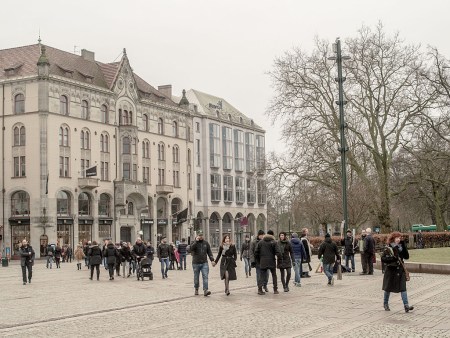
Malmö, Sweden. (Image source: David Ramos/Getty Images)

Middle East: A Shift from Revolution to Evolution

April 8, 2017

Middle East: A Shift from Revolution to Evolution, Gatestone InstituteNajat AlSaied, April 8, 2017

The lesson the Trump administration might learn from the disastrous mistakes of its predecessor is that the main sources of terrorism in the region are political Islam and all its related religious groups. All these radical groups, including ISIS, Al-Qaeda, Jabhat Al-Nusra and Hamas have been spawned by a political Islam driven by the ideology of the Muslim Brotherhood.

The fight, therefore, should not be against Islam, but against political Islam. Islam needs to be practiced the way other religions are, as a private personal faith that should be kept separate from public life and politics, and whose expression should be confined to worship only.

Mosques, whether in the Arab and Muslim world or in the West, should be places of worship only and must not transformed to centers for polarizing society or for recruitment by political religious groups.

After each Islamist terrorist attack in the West, the public is divided into two camps: one angry and one indifferent. The problem with defeating Islamist terrorism seems to be that either it is attacked by conservatives who call Islam an evil cult or it is forgiven entirely by liberal apologists. What, then, is the answer?

One of the main failures in Western analyses of the origins of terrorism in the Middle East and North Africa is that the West attributes them to a lack of democracy and a lack of respect for human rights. This is, indeed, part of the cause, but the root of the problem is a lack of development and modernity. U.S. President Donald Trump did not exaggerate when he said that the Obama administration’s foreign policy was disastrous. It was catastrophic mainly for two reasons. One was the knee-jerk support for the “Arab Spring” and for extremist Islamic political groups such as the Muslim Brotherhood. The second was the alliances the Obama administration built with unreliable countries such as Qatar, which supports radical political groups such as the Muslim Brotherhood. In addition, Obama made the mistake of continuing to try to appease Iran’s theocratic regime.

The Arab Spring’s uncalculated, hasty attempt to establish so-called democracy only generated more turmoil and chaos in the region. Certain radical political groups simply exploited the elections to serve their own political and sectarian agendas; that swoop for power only resulted in more authoritarian and dictatorial regimes, as have played out, for instance, in Egypt, where we have witnessed the murder of civilians and police officers by the Muslim Brotherhood. In other countries, the situation is even worse; attempts to install democracy have totally destroyed the state and facilitated the spread of terrorist militias, as in Libya.

It is ironic that Western countries and their advocates stress the need to apply democratic practices in Arab countries, but evidently do not recall that development and secularism preceded democracy in Western Europe. The United Kingdom, which has the oldest democratic system, did not become fully democratic until 1930. France became fully democratic only in 1945, 150 years after the French Revolution.

The Emir of Qatar, Sheikh Tamim bin Hamad Al-Thani, at the Arab Summit in Jordan on March 28, 2017 delivered a speech in which he indicated his continuous support for the Muslim Brotherhood:

“If we are serious about focusing our efforts on armed terrorist organizations, is it fair to consider any political party we disagree with as terrorist? Is our goal to increase the number of terrorists?”

Many Arab leaders were infuriated by his speech; at the forefront was President Abdel Fattah el-Sisi of Egypt, who left the Arab Summit Hall during the speech to meet King Salman of Saudi Arabia.

Most Arab leaders and analysts, in fact, are enraged by Qatar’s continuous support for Islamist political groups such as the Muslim Brotherhood, because these groups are a threat to their national security.

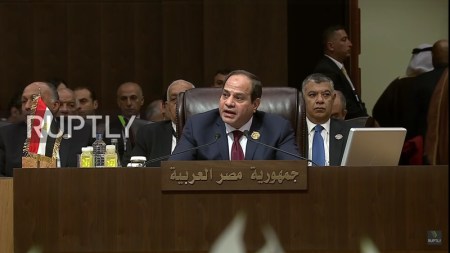
President Abdel Fattah el-Sisi of Egypt speaks at the Arab Summit, on March 29. The previous day, Sisi walked out of a speech by the Emir of Qatar, Sheikh Tamim bin Hamad Al-Thani. Sisi was infuriated by Al-Thani’s declaration of support for the Muslim Brotherhood. (Image source: Ruptly video screenshot)

Another consequence of Obama’s foreign policy — in particular attempts to get close to Iran’s hostile regime — has been a fraying of relationships with old Arab allies of the United States. Some of Obama’s advisors thought that replacing Saudi Arabia with Iran was somehow “better” for the United States, if Iran “is beginning to evolve into a very civilized and historically important country” — an analysis that can be described as completely short-sighted.

The Saudi regime, with all its flaws, is a monarchy run by princes; the Iranian regime is a theocracy run by clerics. The Saudi regime is not a theocratic regime but a hybrid structure, which is neither wholly secular nor wholly religious. As such, the religious class functions under the authority of the ruling class. Princes are driven by self-interest; clerics are driven by ideology. In terms of extremism, the Iranian regime is pushing for hegemony, whilst Saudi Arabia has been taking only a defensive, rather than an expansionist, position.

The motivation of Saudi Arabia in exporting mosques world-wide and installing radical Saudi imams is defensive, not expansionist as in Iran. Saudi Arabia’s impetus is to confront Iran’s hegemony and the spread of its hostile ideology. It is this strategy, which Saudi Arabia has practiced since 1979 to balance Iran’s power and to combat its rebellious ideology, that must change.

That Iran’s Khomeini regime sought to embarrass Saudi Arabia — a country that is home to Islam’s two holiest mosques, in Mecca and Medina — by portraying it as not sufficiently Islamic, meant that the foundational Islamic Wahhabism of the Saudi Kingdom was aggressively reinforced. This emphasis resulted in even more constraints being put in place in Iran: especially on entertainment. Since the Khomeini revolution in 1979, all plays, fashion shows, international events, and cinemas have been banned. As for women, the Commission for the Promotion of Virtue and Prevention of Vice has increasingly harassed them. As for minorities, especially Shia challenging the Iranian Shia regime and its support for Shia militias — particularly the dominant Revolutionary Guards — books were published attacking the Shia:

More books appeared, attacking the Shias and especially Khomeini’s views. These books – like the arguments of Khomeini’s followers – rejected modern thinking as an “intellectual invasion.” Saudi Arabia, considered the guardian of Sunni Islam, spent billions of dollars on challenging the Khomeini-backed Shiites.

This religious one-upmanship — a competition over which body can be the “most religious” — must stop. Saudi Arabia would do well to understand that in order to confront the hegemony of the Iranian theocratic regime, the answer is not to radicalize Saudi society but to return to the way it was before 1979.

The best way to defeat the rebel hostile regime in Iran might be through creating an inclusive and tolerant society in Saudi Arabia. Saudi Arabia needs to change its approach towards Iran because the current strategy has not worked. The current strategy has done nothing except to strengthen the Iranian regime’s dominance; distort, globally, the image of Saudi Arabia and accelerate terrorism.

The lesson the Trump administration might learn from the disastrous mistakes of its predecessor is that the main source of terrorism in the region are political Islam and all its related religious groups. All these radical groups including ISIS, Al-Qaeda, Jabhat Al-Nusra and Hamas have been spawned by a political Islam driven by the ideology of the Muslim Brotherhood. Extremist jihadists such as Osama bin Laden, Abdullah Azzam and Ayman al-Zawahiri were all taught by the Muslim Brotherhood.

Political Islam practiced by the Iranian theocratic regime has been comfortably generating Shia radical militias, including the terrorist group, Hezbollah. The fight, therefore, should not be against Islam, but against political Islam. Islam needs to be practiced the way other religions are, as a private personal faith that should be kept separate from public life and politics, and whose expression should be confined to worship only. Mosques, whether in the Arab and Muslim world or in the West, should be places of worship only and must not transformed to centers for polarizing society or for recruitment by political religious groups. Unfortunately, Western countries have turned a blind eye to the political activities inside these mosques.

The danger of these religious political groups is that they do not believe in democracy or human rights; they just use elections to grasp power in order to impose a system of “Islamic Caliphate” as their only form of government. Most of these groups use religion as an ideology to oppose governments other than their own, and when they are criticized or attacked, they play the role of the oppressed.

The Trump administration needs to take advantage of the fact that the majority of people in the Middle East and North Africa have lost faith in religious political groups, especially since the failure of the Muslim Brotherhood in Egypt and Tunisia.

Before the Arab Spring, support for these groups was huge; now it stands at less than 10% of the population. This study was conducted in the Arab world, not including Turkey. The Muslims who support Turkish President Recep Tayyip Erdogan are the Muslim Brotherhood.

Most recent polls indicate that the majority of people in Arab and Muslim countries prefer religion to be kept separate from politics.

The country that is working the most systematically to fight these religious political groups in the region is the United Arab Emirates (UAE). There are several institutes and think tanks researching how to combat these groups. Dr. Jamal Sanad Al-Suwaidi, Director General of the Emirates Center for Strategic Studies and Research (ECSSR), has given a robust analysis of these groups and how to combat them in his book, The Mirage. In it, he cites a study on public opinion on political religious groups: A survey of the UAE population, on how these groups are able to influence the public by taking advantage of certain flaws in the system: 53.9% because of corruption; 47.9% because of poverty and 29.1% because of an absence of civil society groups that confront these opportunists.

The Middle East-North Africa region will undoubtedly have to go through several stages before it can successfully establish democracy. An evolutionary developmental approach will definitely be better than the failed revolutionary democratic one pursued by the Obama administration.

Secularization is also crucial in the fight against terrorism. Trying to build a democracy before going through the stages of secularism and political reformation — which includes rectifying existing flaws, such as corruption; modernization which means the liberation of the region from extremist totalitarian religious dogma and all other forms of backwardness in order to kick-start a renaissance; and scientific development — will not only be inadequate but will actually generate more terrorism by helping radicals to keep gaining power. It would be like a farmer who wants to plant roses in arid desert soil full of thorns.

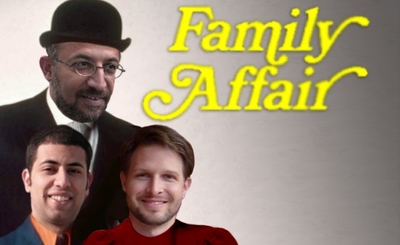
Georgetown University and Radical Islamists: It’s a Family Affair

March 28, 2017

Georgetown University and Radical Islamists: It’s a Family Affair, Investigative Project on Terrorism, March 28, 2017

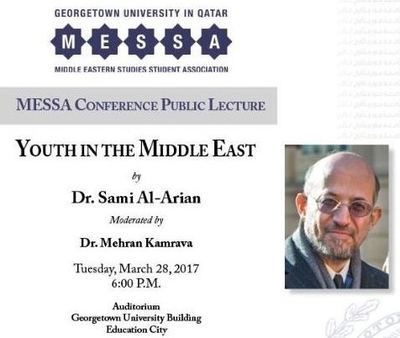
Georgetown University’s Qatar campus is set to host Sami Al-Arian for a lecture tonight in Doha. According to a news release from the school’s Middle Eastern Studies Student Association, Al-Arian is a “civil rights activist” who hopes to challenge students to “make it a better, and more equitable and peaceful world.”

Those are charitable descriptions for Al-Arian, a documented member of the Palestinian Islamic Jihad’s Majlis Shura, or board of directors. According to the Islamic Jihad’s bylaws, which law enforcement agents found during searches of Al-Arian’s home and offices, there can be “No Peace without Islam.” The group’s objective is to create “a state of terror, instability and panic in the souls of Zionists and especially the groups of settlers, and force them to leave their houses.”

It’s an agenda Al-Arian took to heart. Following a double suicide bombing in 1995 that killed 19 Israelis, Al-Arian solicited money from a Kuwaiti legislator. “The latest operation, carried out by the two mujahideen who were martyred for the sake of God, is the best guide and witness to what they believing few can do in the face of Arab and Islamic collapse at the heels of the Zionist enemy…” he wrote.

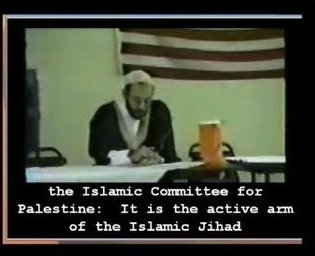
“I call upon you to try to extend true support of the jihad effort in Palestine so that operations such as these can continue, so that the people do not lose faith in Islam and its representatives…” he wrote. Four years earlier, he spoke at a fundraiser in Cleveland, introduced as the head of the “active arm of the Islamic Jihad Movement in Palestine.”

Why, then, is a Jesuit university, albeit at a campus in Qatar, hosting a leader of a designated terrorist group’s “active arm”?

There’s a family bond between Georgetown University and the Al-Arians. Son Abdullah is an assistant professor at Georgetown’s Qatar campus, teaching history in its School of Foreign Service. He earned his Ph.D. at Georgetown, writing his dissertation about the Egyptian Muslim Brotherhood during the 1970s, a time his father acknowledges being part of the global Islamist movement.

Jonathan Brown, Al-Arian’s son-in-law, also works at Georgetown, as the [Saudi] Prince Alwaleed Bin Talal Chair of Islamic Civilization. Brown recently drew criticism for a lecture in which he argued that slavery isn’t inherently “morally evil” if the slave is treated well. He also minimized sexual consent as a recent social more, arguing no one is really free enough to grant consent anyway.

Property records show Brown and his wife Laila Al-Arian bought a modest house just outside Tampa in 2015. Brown also owns a $1.1 million house in Mclean, Va.

Brown’s boss, Georgetown University Professor John Esposito, has been a staunch Al-Arian defender. Al-Arian is “an extraordinarily bright, articulate scholar and intellectual-activist, a man of conscience with a strong commitment to peace and social justice,” Esposito wrote in a letter to a federal judge.

Brown’s slavery and sexual consent lecture was hosted by the International Institute of Islamic Thought (IIIT) in Herndon, Va. The IIIT was a prime financial supporter of a think tank Al-Arian founded in Tampa called the World and Islam Studies Enterprise (WISE). It provided cover for at least three other members of the Palestinian Islamic Jihad’s Shura Council, including his brother-in-law Mazen Al-Najjar, an academic named Basheer Nafi and Ramadan Abdullah Shallah – the Islamic Jihad’s secretary general since late 1995.

Federal prosecutors wanted Al-Arian to tell a grand jury what he knew about the IIIT’s financial support for terrorists. He refused. Al-Arian was charged with criminal contempt after maintaining that stance even after a judge granted him immunity for his truthful testimony.

The case never went to trial. Al-Arian was deported to Turkey in 2015, pursuant to terms in his 2006 guilty plea connected to his Palestinian Islamic Jihad support. He now works as “director of the Center for Regional Politics at Istanbul Sabahattin Zaim University,” the Georgetown Middle East students group’s news release said.

Al-Arian is a computer scientist.

Sabahattin Zaim opened in 2010 and claims to have about 1,100 undergraduate students.

While the Georgetown University program is organized by a student group, promotional material lists Mehran Kamrava as moderator. Kamrava directs the Georgetown School of Foreign Service’s Center for International and Regional Studies.

His presence adds the university’s imprimatur to the Al-Arian event. In addition, the School of Foreign Service posted the news release promoting Al-Arian’s lecture.

Qatar has supported Hamas, the Islamic Jihad’s rival Palestinian terrorist group, providing money and refuge for Hamas leaders. In that light, Al-Arian’s invitation doesn’t seem out of place. But it is still an event hosted by a Georgetown University campus, moderated by one of its prominent faculty.

While Al-Arian has tried to deny his Islamic Jihad activities, or at least minimize them, his work to advance the group’s bloody ambitions is undeniable. He self-identified as the Shura Council’s secretary. In his plea agreement, he admits lying about Shallah’s prominent role in the Islamic Jihad.

During his 1991 remarks in Cleveland after his “active arm” introduction, Al-Arian urged donations for jihad. “Your brothers in Palestine are struggling with their beings,” he said, “so let us struggle here with our money.”

“This is the way of giving,” he said earlier. “This is the way of struggle. This is the way of battle. This is the way of jihad. This is the way of martyrdom. Thus is the way of blood, because this is the path to heaven.”

The student association’s news release failed to mention this background as a convicted felon, describing the former University of South Florida professor as a “civil rights advocate.” It fails to mention Al-Arian’s guilty plea, and whitewashes his resulting deportation to Turkey by saying “Al-Arian relocated.”

The federal judge who saw all the evidence against Al-Arian, who watched him lie about his true identity and violent ambitions, called him a “master manipulator.” Old habits die hard, apparently. The question in this case is whether Georgetown and its student groups are being duped or are witting accomplices in whitewashing a terrorist into a “human rights advocate.”

Are Saudi Arabia, Qatar and Kuwait Funding German Salafism?

December 21, 2016

Are Saudi Arabia Qatar and Kuwait Funding German Salafism? Gatestone InstituteGeorge Igler, December 21, 2016

(Please see also, Saudi Arabia Funding Extremist Islamist Groups in Germany? — DM)

The Sheikh Eid Bin Mohammad al-Thani Charitable Association and the Saudi Muslim World League are coordinating a “long-running strategy to exert influence” by Gulf States in Germany, according to a report authored by Germany’s security agencies.

“This is about war, about children being indoctrinated, they are only in primary school and already fantasize about how when they grow up, they want to join the jihad, kill infidels.” — Wolfgang Trusheim, Frankfurt State Security office.

“For quite some time we’ve had indications and evidence that German Salafists are getting assistance, which is approved by the governments of Saudi Arabia, Qatar and Kuwait, in the form of money, the sending of imams and the building of Koran schools and mosques.” — Rolf Mützenich, German MP and Middle East expert.

Declining to assimilate in the West continues with the apparent, religiously mandated, preference to have the host countries become Islamic.

Salafism — from salaf, “ancestors” or “predecessors” in Arabic — urges the emulation of the first three generations of the Islamic prophet Mohammad’s companions, and Mohammad himself. It is often deemed the most fundamentalist interpretation of Islam.

Security agencies in Germany claim that 9,200 such Islamic extremists currently call the country home. Another intelligence briefing cited by Süddeutsche Zeitung, warns that “the ideology already has 10,000 followers” and growing, in the country.

“Almost all of the German nationals who have travelled to Syria to fight for Islamic State became radicalized by Salafis, who target low-income Muslim youths in German cities,” wrote the Los Angeles Times, adding that it is proving increasingly challenging for German intelligence officials, “to differentiate between those who identify intellectually with Salafism and those who espouse using violence to realize a radical version of Islam.”

1360-2

Both Germany’s Federal Office for the Protection of the Constitution (BfV) and Federal Intelligence Agency (BND) “have accused Saudi Arabia and Kuwait of funding religious groups and conversion groups, as well as financing the building of mosques and backing hardline imams,” according to the Daily Express.

Following raids of their offices throughout Germany the activist group Die Wahre Religion (“The True Religion”) has already been banned in the country.

According to the German interior minister, Thomas de Mazière, “translations of the Quran are being distributed along with messages of hatred and unconstitutional ideologies … Teenagers are being radicalised with conspiracy theories.”

A radicalized 12-year old Muslim boy was recently arrested in the country; he was accused of planting bombs aimed at targeting shoppers in Germany’s famous Christmas markets.

Police raided 190 locations nationwide, affiliated with Die Wahre Religion; authorities described the group as a “collecting pool” for jihadists, which had already sent at least 140 fighters to foreign battlefields.

850 people are thought to have journeyed, “from Germany to Syria and Iraq to join extremist groups like the Islamic State as fighters,” according to the Associated Press.

In a warehouse near the western city of Cologne, authorities seized about 21,000 German-language copies of the Quran. The ban came a week after security authorities arrested five men who allegedly aided the Islamic State group in Germany by recruiting members and providing financial and logistical help.

The German interior minister stressed that the ban does not restrict the freedom of religion in Germany or the peaceful practice of Islam in any way. However, he said the group had glorified terrorism and the fight against the German constitution in videos and meetings.

Terrorism is naturally an abiding concern in Germany, yet recent comments by Wolfgang Trusheim, of Frankfurt’s State Security office, point to where much of the Salafist influence is being focused, namely, the minds of the young:

This is about war, about children being indoctrinated, they are only in primary school and already fantasize about how when they grow up, they want to join the jihad, kill infidels. They refuse to play football with infidels, they say: “I’m not allowed to play football with you, but when I’m grown up, I will kill you, because you are an infidel.”

As cited by a recent TV report by Hessischer Rundfunk:

There were instances of radical Salafist parents, who are willing to teach their children the hatred of believers of a different creed by any means. A father who puts his children in front of the TV, they are forced to watch the most cruel decapitation videos, and will be questioned, and just as they have learned, they reply that the human who has just been burnt alive or decapitated, deserves it because he is an infidel.

Salafists, according to the New York Times, “are known for aggressive proselytizing and their sympathies for the Islamic State.” Much of the recent crackdown by German government agencies is aimed at preventing such extremists from targeting the country’s swelling “refugee” population.

Germany is already experience a boom in births as a product of its “unmanageable” population influx.

“Something must be done immediately. We cannot wait any longer,” says Michael Kiefer, an Islamic Studies specialist at the government-sponsored Institute for Islamic Theology at the University of Osnabrück, about the growth of Salafism in Germany.

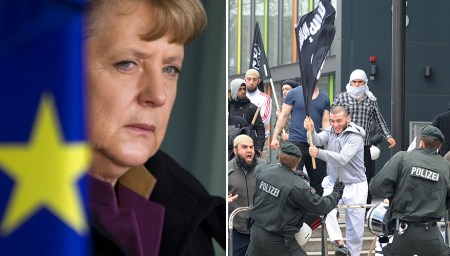
Such warnings, quoted in an analysis by Gatestone Institute as far back as 2014, evidently fell on deaf ears. The following year, Germany’s Chancellor, Angela Merkel, permitted over 1.5 million Muslim migrants to swell her nation’s Islamic population still further.

According to Dr. Bernd Baumann, a representative of the populist Alternative for Germany party (AfD) from Hamburg, with Germany representing less than 1% of the world’s population, in the year 2016, the European nation had accepted more “refugee” applications than the rest of the world combined:

Public Islamist recruitment drives, however, are becoming an increasingly common sight on German streets, as Die Zeit reported on November 28.

The Daily Express reported on December 15, 2016:

“The Kuwaiti Revival of Islamic Heritage Society (RIHS), a non-governmental organization (NGO) banned by the U.S. and Russia for alleged links to terrorist group Al-Qaeda, has also been blamed for the rising support for fundamentalist Salafi groups in Germany.”

Missionary groups from the Gulf States, including the Saudi Muslim World League, and Qatar’s Sheikh Eid Bin Mohammad al-Thani Charitable Association, are allegedly involved in a “long-running strategy to exert influence” on Muslims in Germany.

RIHS and the Sheikh Eid Bin Mohammad al-Thani Charitable Association have denied the allegations. The Saudi ambassador to Germany, Awwas Alawwad, also rejected the intelligence claims, saying his country has “no connection with German Salafism.”

Despite such denials, Chancellor Angela Merkel, “has confirmed plans rapidly to expand the scope and size of Germany’s intelligence services including its domestic spy agency.”

As the German MP and Middle East expert, Rolf Mützenich, has said, “The danger is real and should not be underestimated.” He added:

“For quite some time, we have had indications and evidence that German Salafists are getting assistance, which is approved by the governments of Saudi Arabia, Qatar and Kuwait, in the form of money, the sending of imams and the building of Koran schools and mosques.

“The best way of preventing refugees from being radicalised is speedy and successful integration. To achieve that, we need professional prevention and de-radicalisation programs. That means more money and resources for specialists in schools, government administration, police, youth welfare organisations, prisons and reform schools.”

Critics might argue that that there is enormous pressure in Muslims not to assimilate. The injunction begins with the Koran:

O you who have believed, do not take the Jews and the Christians as allies. They are [in fact] allies of one another. And whoever is an ally to them among you – then indeed, he is [one] of them. Indeed, Allah guides not the wrongdoing people. (Q5:51, Sahih International translation)

And:

Let not the believers take the unbelievers for friends rather than believers; and whoever does this, he shall have nothing of (the guardianship of) Allah, but you should guard yourselves against them, guarding carefully; and Allah makes you cautious of (retribution from) Himself; and to Allah is the eventual coming. (Q3:28, Shakir translation)

Declining to assimilate in the West continues with the apparent, religiously mandated, preference to have the host countries become Islamic.

With Islamist double-agents working for German intelligence services now being arrested in the country, Germany’s security challenges clearly go far deeper.