Posted tagged ‘Putin’

Acting on secret Obama-Putin Syria deal, Moscow’s air strikes focus first on rebels, next on ISIS

November 18, 2015

Acting on secret Obama-Putin Syria deal, Moscow’s air strikes focus first on rebels, next on ISIS, DEBKAfile, November 18, 2015

Putin50

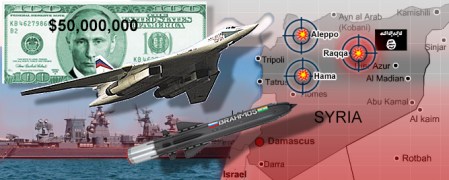
As a result of the deal between the two presidents, 75 percent of Russian attacks in Syria Tuesday were aimed against various rebel groups (around Hama and Aleppo), and only 25 percent against ISIS (at its Raqqa headquarters) and Al-Nusra Front targets.

************************

The secret deal for a political solution for the Syria conflict reached by Presidents Barack Obama and Vladimir Putin on the sidelines of the G20 summit in Antalya over the weekend has radically changed and intensified Russia’s air strike tactics in the last 24 hours.

For the first time since the intensified Russian military intervention in the Syrian civil war in the last week of September, Russian air force planes took off Tuesday, Nov. 17 for attacks on Syrian rebel and ISIS targets, from a home base, the Morozovsk airbase in the southern Rostov district. Until now, the Russian bombers had taken off from Hmeymim airbase near Latakia.

Also for the first time, they lofted Tupolev Tu-160 and Tupolev Tu-95 bombers. The Tupolev Tu-160 Blackjack is a long-range strategic bomber and the biggest combat aircraft in the world, while the Tu-95 Bear is a huge strategic bomber with four turboprop-powered engines that is also used to launch missiles.

DEBKAfile’s military sources note that that the entry of these heavy bombers marks an increase in the frequency of the attacks and in the firepower used by Russia against the rebels and ISIS. Together with the firing of advanced Russian Kalibr cruise missiles at targets in Syria – also for the first time on Tuesday – these changes substantially escalate the Russian military effort in Syria.

Western sources take these changes to mean that Putin is driving hell-bent to settle accounts with the Islamic State after the downing of the Russian plane over Sinai on Oct. 31, and that he will coordinate this effort with French President Francois Hollande, who is due in Moscow in the coming days.

However, DEBKAfile reports that the new, stepped up Russian aerial offensive is fact bringing forward certain – not necessarily jihadist – Syrian rebel groups as Moscow’s priority targets, with ISIS only in second place.

In their 30-minute conversation on Sunday, Nov. 15, our sources reveal, Obama secretly accepted most points of Putin’s plan for a political resolution of the Syrian conflict (first revealed by DEBKA Weekly earlier this month), with the exception of the point relating to Bashar Assad’s future.

The White House and the Kremlin consequently announced a joint decision on a cease-fire in Syria to be followed by UN-mediated negotiations between the rebels and the Assad regime.

The first point of the Russian blueprint called for intensified air strikes by the US and Russia against rebel groups refusing to enter into these negotiations in order to force them to toe the line.

As a result of the deal between the two presidents, 75 percent of Russian attacks in Syria Tuesday were aimed against various rebel groups (around Hama and Aleppo), and only 25 percent against ISIS (at its Raqqa headquarters) and Al-Nusra Front targets.

Obama agreed to Russian expanding its air campaign to this end for at least three weeks. It was also decided that Russia would beef it up with another 25 heavy bombers and addition warplanes.

Meanwhile, also on Tuesday, Russia released the findings of its investigation into the downing of a Russian airliner on October 31 in the Sinai Peninsula that caused the deaths of all 224 passengers and crew.

Putin and the heads of the Russian intelligence community have concluded that the destruction of Metrojet Flight 9268 soon after takeoff from Sharm El Sheikh was the result of a bomb planted on board by terrorists. Egypt quickly rejected the conclusion, claiming there was no proof of it whatsoever. But the conclusion led Putin to offer an unprecedented $50 million reward for information leading to the capture of those who planted the bomb.

According to our counterterrorism sources, Russian intelligence chiefs are convinced that certain top Egyptian military and security service officers know exactly who was responsible. The enormous reward was offered to draw them out and tempt them to break ranks with Egyptian President Abdel-Fatteh El-Sisi’s dogged resistance to the charges of a terrorist hand at work behind the Russian air disaster. After all, 50 million dollars must be hard to resist.

That Other Side of Russia’s Syria Campaign…

November 15, 2015

That Other Side of Russia’s Syria Campaign…, Independent Strategy and Intelligence Group, November 14, 2015

(Obama’s America isn’t “winning the war” against the (non-Islamic) Islamic State. If Putin’s Russia isn’t either, who will — France? — DM)

True to form, Vlad is increasing operations and the size of his military’s footprint in Syria while lowering the bar of what constitutes “success.” In a recent piece (“Russian-Backed Offensive in Syria Begins to Stall-What Now?”) we discussed how out of all the fronts in the multi-pronged offensive the pro-regime forces are engaged in, only Aleppo has seen any gains – although those gains have been mixed. The SAA and IRGC had to divert resources from the Hama and Idlib fronts just to sustain the Aleppo offensive and achieve the gains that they did – all while sustaining heavy casualties in the process. The diverting of personnel and resources grounded the remaining forces in Hama and Idlib to halt. In some cases they’ve actually lost ground in the two fronts. The only thing that has kept them from driven out of those areas completely is the fact that al-Nusra sent a lot of their fighters to Aleppo, meaning the opposition factions don’t have the manpower to seize the initiative. And so they wait.

Russian-Backed Offensive in Syria Begins to Stall-What Now?
http://isisstudygroup.com/?p=9219

Has Assad’s New Offensive Changed Syria’s Front Lines?
http://www.syriadeeply.org/articles/2015/11/8733/assads-offensive-changed-syrias-front-lines/

puppet-master-248x300The Puppet Master Source: Derek Bacon (Getty Images)

As of this writing the Russian military has 18 artillery pieces and 9 combat helicopters deployed west of Tadmur with a Spetsnaz unit also operating in the area. Initially these forces were focused on supporting the Assad regime’s multi-pronged offensive in the Northwest due to the major threat the opposition forces posed. Since mid to late-OCT Vlad has conducted airstrikes in Halab Province as part of the effort to disrupt the Islamic State’s (IS) push on the Aleppo supply line. Airstrikes have also been conducted on Raqqa City, Dayr az-Zawr and areas just outside of Damascus. That said, the Russian military is struggling to satisfy the fire support requests of pro-regime forces. The Russian military has 32 combat aircraft, 16 combat helicopters (with more than half in Tadmur) and a Brigade-sized element of artillery.

We’re not surprised that Vlad’s IO guys are trumpeting the recapture of a couple villages and a derelict airbase (Kweires) in Aleppo Province – especially since opposition forces operating in the Ghab Valley were blocking regime advances just a few days ago. Then there’s Jaysh al-Fatah seizing control of several villages in Hama Province. They’ve been poised to push deeper into the areas Northwest of Hama City as of 10 NOV. Regarding Kweires, the recapturing of the base has more symbolic than tactical value. Vlad is hoping the symbolic victory will galvanize the SAA (we’re not holding our breath).

Syrian Regime, Allies Boast of Breaking Aleppo Air Base Siege
http://www.wsj.com/articles/syrian-government-forces-allies-boast-of-breaking-aleppo-air-base-siege-1447265552

Vlad’s increased sense of urgency is understandable considering the current state of the SAA, not to mention the mounting losses of the Iranian military force in-country. Since OCT the IRGC has lost four senior officer to include their most senior official – BG Hossein Hamedani (Reference “Pro-Assad Forces Experience Setbacks Despite Russian Military Intervention”). Even Hezbollah has lost several senior commanders, such as Hassan al-Haj. GEN Suleimani deployed an additional 2,000 IRGC-Qods Force operators to Syria this past summer in response to combat losses. Our sources have informed us that even Ayatollah Khameini has been getting worried about the increase in casualties from the ongoing offensive, which was the driving force behind his decision to deploy additional conventional IRGC personnel (armor, artillery etc). Thing is Khameini is busy trying to keep the Iranian public from learning that things aren’t going as well as advertised. Vlad is already prepping his own domestic audience for a prolonged Russian mission in Syria.

Pro-Assad Forces Experience Setbacks Despite Russian Military Intervention
http://isisstudygroup.com/?p=8778

The Main Intelligence Directorate (GRU) is central to Vlad’s efforts to shape domestic and international opinion of the Syrian campaign – especially against the US. A great deal of the IO portion of this campaign involves messaging that highlights Russia’s humanitarian work (of course leaving out the part about indiscriminately targeting civilians) blames the US and its allies for the Syrian regional war and the rise of IS – even to the extent of claiming that Team Baghdadi is really an “American puppet” (FYI that messaging would work if the Obama administration wasn’t grossly incompetent). There’s actually been some inconsistencies with their messaging, because on one hand they’ll claim the US is “orchestrating” IS’ activities while running a parallel series of messaging highlighting American failures to combat the terror group – they may want to tighten up their shot group in that regards. Our in-country sources report the use of UAVs to distribute leaflets warning opposition fighters of their impending “annihilation” if they don’t flee the area. Another area GRU has been busy is employing the services of independent bloggers, sympathetic website admins and pro-Vlad organizations to distribute messaging. They’ve also been creating fake personas to convey IO themes and present counter-arguments to anything critical of Russia’s intervention, the Assad regime and Vlad himself. We’ve encountered a few of these personas on our Facebook and Twitter feed – they’re not hard to identify since they tried to bait us into divulging the identities of our sources (which isn’t going to happen).

In order to fully understand what’s going on, one must first understand Vlad himself. Our favorite KGB officer has gone his whole life trying to avoid the appearance of “weakness.” Also, his perception since the invasion of Crimea of being labeled a “pariah” by the West likely compels him to be aggressive on the international stage – especially when it comes to projecting power in the Middle East. His KGB service continues to drive his worldview. An example of this is time as a KGB officer in Dresden left a particular mark on his psyche as it was during the last days of the Soviet Union – which he refers to as “the most traumatic experience of his life.” So it should come as no surprise that he views himself as Russia’s lone “champion” that can stand up to defend against America. As such, he views Syria as an opportunity to replace US influence and more importantly, as a test of his reputation and Russia’s international prestige.

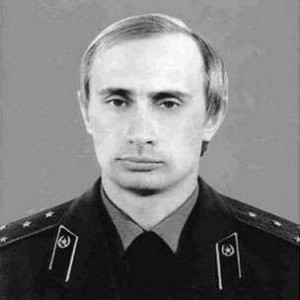
putin_Young-300x300A younger Vlad Source: PBS

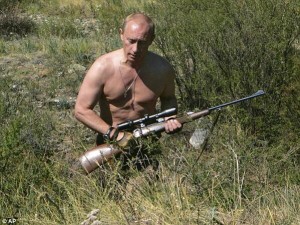
He has a constant need for recognition and validation, which is why popularity polls are so important to him and why his cult of personality was crafted. Ever wondered why he’s always posing in photos lifting weights, doing the topless horse-riding thing or shooting things? That’s why. Interestingly enough, Vlad was his parents’ only surviving child, and was considered small, weak and sickly. Before that, his parents went through a great deal of hardships during the Siege of Leningrad during WWII. In other words, nothing came easy for him – which we respect. Still, he grew up being regarded as “special” – which resulted in the special snowflake growing up thinking that he was “superior” to everybody else (this is the one thing he has in common with President Obama). As for Vlad’s childhood, he grew up in a rat-infested one-room apartment. It certainly wasn’t the privileged childhood of traveling to exotic locales that his American counterpart got to enjoy. Since he was small, fights occurred regularly – which led to his current interest in martial arts. As for his signature unemotional facial expressions, those are a product of a well-cultivated effort to project strength and guard against unwelcome emotional responses, such as sadness or fear. Acts that he views are intended to undermine or humiliate him will result in his escalating a situation in response. He will only “back off” on his own terms – such as feeling a negative response might come from the public, for instance. For instance, his response to the 2011-2012 Moscow protests is a reflection of his sensitivity to internal dissent. His actions since that time – increased public outreach and propaganda efforts – are geared towards reinforcing the narrative he made of himself as being “indispensable.” The current fight against IS (and the West) is a big part of that plan.

putin_gun-300x225He sure doesn’t seem to like wearing shirts, now does he? Source: Associated Press

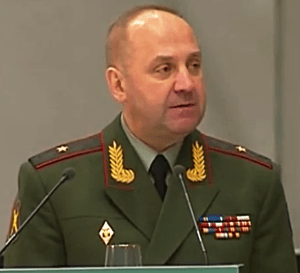
The architect of Vlad’s Middle East strategy is GRU Chief Igor Sergun, who was added to the EU’s sanctions list last year in response to his involvement of Russia’s Ukraine campaign. Specifically, he’s a member of Vlad’s “circle of trust” who holds the distinction of being one of the few people involved in the decision-making process leading up to the Crimea invasion receiving the “green light.” More recently, Sergun became a major advocate for Russia to increase its presence in the Middle East. He was the point-man involved in the negotiations that led to the establishment of the joint-intelligence coordination centers in Iraq and Syria (Check out “Russia Providing Lethal Aid to Syria, Iran and Establishment of Intel Centers in Iraq” and “Russia Poised to Increase Military Presence in Middle East in Response to Islamic State’s Strength” for additional info). Of note is that Sergun sees bilateral ties as a means of learning about Western intentions and countering them. The US is just “gaga” over this guy’s smile, but the turn is that he’s the leading figure behind the current IO campaign against the US. This guy has a plethora of experience, having joined the GRU in 1984. From 1989-1992 he served undercover under the guise of being a “military attache” in Stockholm and Tirana in 1997. As a side note, we hear that Sergun loves gardening to unwind and has a nice little dacha near Moscow (we’re working to obtain pics).

Russia’s Military Chief and deputy PM added to EU’s sanctions list
http://www.ft.com/intl/cms/s/0/4a3ff1cc-cf71-11e3-bec6-00144feabdc0.html#axzz3rZBrt6dm

Ukrainian Rebel Commander Identified As Russian GRU Military Intelligence Colonel

Ukrainian Rebel Commander Identified As Russian GRU Military Intelligence Colonel

Russia Providing Lethal Aid to Syria, Iran and Establishment of Intel Centers in Iraq
http://isisstudygroup.com/?p=8532

Russia Poised to Increase Military Presence in Middle East in Response to Islamic State’s Strength
http://isisstudygroup.com/?p=8416

igor-sergun-300x273Igor Sergun: Likes to channel his “Inner-Martha Stewart” for relaxation. Source: The ISIS Study Group

The guy Sergun hand-picked to oversee intel and IO operations in Syria is COL Pavel Vladimirovich Petrunin. His duties involve the coordinating of intel-sharing with the SAA, IRGC and other pro-regime elements, such as Hezbollah. One of the things he’s been heavily involved with is overseeing the creation of IO messaging that emphasizes Russian/Syrian “successes” no matter how minor. According to our sources, he’s also been engaged in stream-lining offensive cyber-warfare operations with the Syrian Electronic Army in the targeting of opposition social media accounts and web sites – even targeting American and allied computer systems. One of the more interesting things we’ve learned is that he was the one who recommended spinning fratricide/civilian collateral damage incidents (which are a common occurrence on the Syrian front) as “IS attacks” as a means of masking SAA ineptitude. Just as important is the direct intel support that his subordinates provide to the Spetsnaz operators conducting CT-operations in the country against opposition leadership.

Apparent Russian raids kill 11 in Syria’s Idlib: monitor
http://news.yahoo.com/10-dead-syria-regime-raids-held-town-monitor-143407847.html

This fight isn’t going to end anytime soon and because of that, the GRU’s IO campaign is going to increase in importance. Keep in mind that Vlad feels that he’s “Russia” itself, and therefore views his failure as “Russia’s failure.” As we’ve stated previously, Vlad is now at the point where he has to escalate the Russian military mission in Syria so as to continue to project that image of “strength.” This becomes even more important after the Sinai Plane Bombing and Paris attacks. That said, the current situation on the ground in Syria and Vlad’s sensitivities to internal dissent presents several exploitable opportunities for the US to launch an IO campaign of its own – whether they’ll have the testicular fortitude to actually do it is another thing altogether…

Other Related Articles:

Russia Supports New Syrian Offensive and Begins Prepping For Russian Ground OPs
http://isisstudygroup.com/?p=8669

Amplifying Details on the Sinai Plane Bombing and the Egypt-Libya Nexus
http://isisstudygroup.com/?p=9230

Sinai Plane Crash Update
http://isisstudygroup.com/?p=9184

Islamic State Claims to Have Shot-Down Russian Plane in Sinai – But Did They?
http://isisstudygroup.com/?p=9157

US to cut 40,000 troops despite Russian and Chinese Belligerence and Rapidly Expanding Islamic State
http://isisstudygroup.com/?p=7563

Amplifying Details on the Sinai Plane Bombing and the Egypt-Libya Nexus

November 7, 2015

Amplifying Details on the Sinai Plane Bombing and the Egypt-Libya Nexus, Independent Strategy and Intelligence Study Group, November 7, 2015

The last few days have been filled with a flurry of information regarding the downing of Flight 7K9268. Within the last 18 hrs we’ve received amplifying information from our sources in the country. Our sources within the Egyptian Directorate of Military Intelligence (DMI) confirmed that Russian investigators found the remnants of the explosive device we were talking about in our 03 NOV “Sinai Plane Crash Update.” Furthermore, the running theory of those investigators is that depressurization caused by an internal explosion tore off the tail section, causing the plane to flip over and send it to the ground. When we asked one of our sources if 500 grams of C4 could cause that, he answered back that it wouldn’t take much to bring a plane down, especially if the device was placed near the fuel line – which is what DMI assesses to be the case. Another source working with Russia’s Health Ministry Center for Forensic Medical Expertise confirmed that parts of an explosive device was uncovered.

sinai-crash-300x168Source: Associated Free Press/Getty Images (Maxim Grigoryev)

As for the operative who emplaced the device on the plane, we’ve confirmed that the individual did not receive any assistance from a member of the security forces – because he’s a member of the security forces himself. The individual in question used his position to circumvent the 8 explosive detection systems and security checkpoints located at the airport in order to get to his target. DMI knew how this went down fairly quickly, although our sources couldn’t answer how this fell through the cracks, although they did imply that the security forces are plagued with serious internal issues due to the rising insider threat. However, Sharm al-Sheik Airport Chief Abdel-Wahab Ali was removed from his position due to these major security lapses. The fact that the British government aired these very same concerns LAST YEAR made the decision to remove him much easier.

The Latest: Sharm El-Sheikh Airport Chief Has Been Replaced
http://www.nytimes.com/aponline/2015/11/04/world/middleeast/ap-egypt-russian-plane-crash-the-latest.html?_r=0

UK had concerns about Sharm el-Sheikh airport security almost a year ago
http://www.theguardian.com/politics/2015/nov/05/uk-had-concerns-sharm-el-sheikh-airport-security-year-ago-egyptian-beach-resort

Sinai Plane Crash Update
http://isisstudygroup.com/?p=9184

IS-Sinai-300x135Islamic State-Sinai (IS-Sinai) aka “Wilayat Sinai (WS)”: Just entered the next stage of Operations. Source: The ISIS Study Group

Adding further weight to what we’ve been saying is that the Black Box reveals that the crash was not an accident. More importantly, the media (and some Western governments) are saying what we first mentioned in our “Sinai Plane Crash Update.” Excerpt:

European investigators who analyzed the two flight recorders from the Metrojet plane that went down last weekend in Egypt are categorically saying the crash is not an accident, CNN affiliate France 2 reported Friday.

The investigators said the cockpit voice recorder of Metrojet Flight 9268 shows an explosion and the flight data recorder confirms the explosion is not accidental — there is no sign of mechanical malfunction during the initial part of the flight, France 2 reported.

Everything is fine during the first 24 minutes, then in a fraction of a second there is a blackout and no more cockpit conversation, convincing investigators there was a bomb on board, according to France 2.

CNN Aviation Analyst Richard Quest said there would have been different data on the black boxes if there was a catastrophic failure than if there was an explosion. The key is what happened just before the data suddenly stops, he said.

“It’s this split second, and it’s a millisecond, where you hear an explosion of some description,” he said. “And you see all the parameters (on the recorders) go haywire before the power is completely lost. If this report is accurate, (investigators) have now analyzed that … heard it and they can identify it.”

If the plane had broken apart due to structural failure, there would have been more noise — and for a longer time, he said.

France’s air accident investigation agency, the BEA, told CNN that Egyptian officials will make an announcement about the crash investigation within the next 24 hours.

Report: Black boxes show bomb brought down Russian jet
http://www.cnn.com/2015/11/06/middleeast/russian-plane-crash-egypt-sinai/

Screen-Shot-2015-11-06-at-6.50.48-PM-300x167

Media now talking about the bomb being placed in the cargo hold among the luggage near the fuel line
Source: CNN

This wasn’t the first time WS gained access to an Egyptian airport either. Last year they recruited an employee at Cairo International Airport who provided Team Baghdadi with schematics of the facility, locations of guard postings and security procedures. Fortunately, DMI found out and arrested him before the attack plan was set into motion – which was the same plan carried out in Sharm al-Sheik. This was one of a long list of incidents – many of which were never reported by the country’s media outlets – that led to GEN Sisi authorizing the DMI to lead the crackdown on the insider threat within the security forces. From MAY 15 – JUL 15 several junior and mid-level officers within the Army were detained for either being sympathizers or full-fledged members of WS. There’s also been an increase in military personnel refusing to carry out missions against WS – not because they’re “scared” – because they “didn’t want to kill their Muslim Brothers” (which is a red flag since most Muslims would never consider IS as their “Muslim Brothers”). For the most part the military has been the main advocate for moderate Islam and secularism. Unfortunately, that all changed when the Muslim Brotherhood’s Muhammad Morsi rose to power, where he quickly began to sack “problematic” (read-those of moderate Islam or secular leanings) officers. Then he began to fill the ranks with those he reflected his values – in other words, guys with extremist views. The result was a new breed of officers in the junior and mid-level ranks who were very sympathetic to the ideologies of al-Qaida (of which the MB is closely-aligned) and IS. WS’ increase in capability is a good indicator of the success they’ve had in recruiting personnel with formal military experience (Check out “ISIS-Sinai Beheads Croatian Hostage – Just the Beginning” for additional info).

ISIS-Sinai Beheads Croatian Hostage – Just the Beginning
http://isisstudygroup.com/?p=8195

mohamed-morsi-300x225Egypt’s insider threat: Morsi’s legacy. Source: Sharif Abdel Minoem (Associated Press)

The bombing of that Russian airliner is the beginning of WS and IS’ Libya affiliate entering into a new phase of Team Baghdadi’s overall global campaign of conducting high-profile attacks outside of Syria and Iraq. WS followed up the plane bombing with another attack targeting an officer’s club that killed three policemen. But that’s just the start – WS fully intends to expand their operations to targeting Russians and Western tourists to both cripple Egypt’s tourism industry (which would result in significant economic damage) and retaliating for Russia’s Syria intervention. The indicators were all there with the sharp increase in the frequency and scale of attacks carried out by WS in Sinai throughout the year and this past summer in particular (Reference – “Sinai Under Siege Rising capabilities of Wilayat Sinai”). That said, the first real indicators of WS’ increased capabilities was seen as early as JAN 14 when they shot down an Egyptian military helicopter in the Sinai with a MANPAD that was traced back to one of the Qaddafi regime weapons depots that was raided by so-called “moderates” during the early days of the “Arab Spring.” In AUG 15 another attempt was made by WS to bring down an aircraft – this time a Thomson Airways airliner – as it was heading to Sharm al-Sheik Airport. Fortunately the pilot was able to perform evasive maneuvers and avoid being brought down (See the Guardian’s article titled, “Sharm el-Sheikh flight from Stansted dodged missile in August” and our initial piece on the Sinai crash, “Islamic State Claims to Have Shot-Down Russian Plane in Sinai – But Did They?”).

Egypt: 3 police officers killed in North Sinai bombing
http://www.cnn.com/2015/11/04/africa/egypt-north-sinai-bombing/

Militants Down Egyptian Helicopter, Killing 5 Soldiers

Sharm el-Sheikh flight from Stansted dodged missile in August
http://www.theguardian.com/uk-news/2015/nov/06/missed-by-a-1000-feet-how-british-holidaymakers-came-close-to-being-hit-by-a-missile-in-august?CMP=twt_gu

Sinai Under Siege Rising capabilities of Wilayat Sinai (WS)
http://isisstudygroup.com/?p=7587

Islamic State Claims to Have Shot-Down Russian Plane in Sinai – But Did They?
http://isisstudygroup.com/?p=9157

WS-July-2015-attack-Sinai-300x169

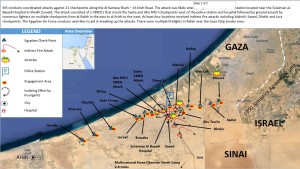
This is just a quick snapshot of attacks that occurred in JUL 15
Source: The ISIS Study Group

WS also wanted to show Baghdadi that they’re an effective force capable of achieving the objectives of his external operations campaign, but also to justify that their request for additional funding. This was also a bid for obtaining heavier weaponry from IS’ Libya affiliate, who sends weapons and supplies to Syria – some of which goes through Sinai (Check out “The Strategic Importance of Egypt to ISIS,” “2015: The Year of ISIS Expansion From Gaza to North Africa” and “The ISIS Expansion Into North Africa” for more details). We don’t think Libyan IS Emir Abu Nail will satisfy that request until after he seizes Darnah – which IS was driven out of back in JUN 15. As of this writing, IS-Libya has been busy consolidating its forces in the al-Fatayeh-area located Southeast of the city. That area is the likely staging-area from which the offensive to retake the town will be launched. The Libyan affiliate is facing a tough fight as they’re forced to take on several other opposition groups of varying jihadist flavors as well as the forces of the Egypt-back Libyan GEN Khalifa Haftar.

For the third time, Haftar’s forces fail to control Derna
https://www.middleeastmonitor.com/news/africa/20744-for-the-third-time-haftars-forces-fail-to-control-derna

Isis in Libya: Islamic State driven out of Derna stronghold by al-Qaeda-linked militia
http://www.ibtimes.co.uk/isis-libya-islamic-state-driven-out-derna-stronghold-by-al-qaeda-linked-militia-1506241

ISIS responsible for most Libya killings: ICC prosecutor
https://www.dailystar.com.lb/News/Middle-East/2015/Nov-06/321833-isis-responsible-for-most-libya-killings-icc-prosecutor.ashx

ISIS In Libya? Gadhafi Sirte Residence Searched By Islamic State For Hidden Money: Report
http://www.ibtimes.com/isis-libya-gadhafi-sirte-residence-searched-islamic-state-hidden-money-report-2139456

Warplanes bomb Libya’s Sirte, target Islamic State: witness
http://www.reuters.com/article/2015/10/29/us-libya-security-idUSKCN0SN2JM20151029

The Strategic Importance of Egypt to ISIS
http://isisstudygroup.com/?p=1392

2015: The Year of ISIS Expansion From Gaza to North Africa
http://isisstudygroup.com/?p=5248

The ISIS Expansion Into North Africa…
http://isisstudygroup.com/?p=3257

IS’ Libya affiliate is the terror organization’s most-developed branch and has become a critical part of Baghdadi’s vision of being able to project power outside of Syria/Iraq. Its worth noting that the Libya affiliate has been tasked with providing material support to other affiliates in North Africa in addition to WS and the main effort in Syria. WS actually receives a great deal of their financial support from the Libya affiliate. In fact so much influence has been placed on bolstering the Libya affiliate that some foreign fighters have actually been diverted there. Our sources report the presence of fighters from France, Germany, Egypt, Algeria, Sudan, Saudi Arabia, Canada and one unconfirmed report of Americans serving among the ranks. Recent reporting also suggests that a group of Indonesian jihadists are projected to be entering the country for this same purpose – other sources imply that they may have already arrived. Not only is Libya an alternative for foreign fighters who aspire to wage jihad but can’t make the trip to Syria, its a training ground for select personnel who get sent back to their countries of origin to establish their own attack networks and conduct the cell-based external operations that the IS leadership has been transitioning to over the last few months (For more info on this transition to cell-based external OPs, check out “Neil Prakash and Friends – an Update” and “Nail in the Coffin: ISIS’ Anwar al-Awlaqi BN Sends Fighters to Europe”). Think of it as IS’ way of “diversifying their terror portfolio” for their goal of launching such attacks in the West.

Neil Prakash and Friends – an Update
http://isisstudygroup.com/?p=8862

The Loss of Key ISIS External OPs Figures and the Anwar al-Awlaqi Battalion
http://isisstudygroup.com/?p=8467

Nail in the Coffin: ISIS’ Anwar al-Awlaqi BN Sends Fighters to Europe
http://isisstudygroup.com/?p=8562

With all this happening, what’s next for Vlad? Make no mistake, he’s going to respond – and when he does, people are either going to die or “disappear.” The big mistake the IS mothership in Syria and the Sinai affiliate made is thinking that Vlad is as soft and flaccid as President Obama. They’re going to find out real quick just how big of a mistake they made once he expands his intervention in Syria (although there will be challenges-more on that in another article) followed by enhanced collaboration with the Sisi regime – which has been steadily moving away from America and getting closer to Russia for well over a year (Check out “Egypt Atmospherics” for more details). On the flip side we assess that IS’ Caucasus affiliate (made up mostly of remnants of Imarat Kavkaz or “IK”) are going to become very active in launching attacks inside Russia itself. Although the media seized on the fact that Syria is one of Vlad’s client states, what didn’t get any real coverage are the 2,500-3,000 Russian nationals currently fighting under the IS banner in Syria – many of which are of Chechen/Dagestani/Tajik ethnicity (Reference the following for additional info – “Russia Poised to Increase Military Presence in Middle East in Response to Islamic State’s Strength,” “Islamic State’s Expansion into the Caucasus Region,” “Gulmurod Khalimov Update – His Militant Views May Not Be a Recent Development” and “Introducing Tajik Special Police COL Gulmurod Khalimov: Islamic State Defector”). At some point those foreign fighters are going to return to Mother Russia. A few already have. So if you thought this high-profile attack was an “isolated incident” that only affects Egypt, you thought wrong.

Egypt Atmospherics…
http://isisstudygroup.com/?p=614

Russia Poised to Increase Military Presence in Middle East in Response to Islamic State’s Strength
http://isisstudygroup.com/?p=8416

Islamic State’s Expansion into the Caucasus Region
http://isisstudygroup.com/?p=6880

Gulmurod Khalimov Update – His Militant Views May Not Be a Recent Development
http://isisstudygroup.com/?p=7760

Introducing Tajik Special Police COL Gulmurod Khalimov: Islamic State Defector
http://isisstudygroup.com/?p=7027

vlad2-300x219

Egyptian locals are increasingly “Pro-Vlad” – but aren’t big fans of President Obama
Source: The ISIS Study Group

Other Related Articles:

Haftar-Sisi Alliance: The Roadblock to ISIS Bridge Into the Maghreb
http://isisstudygroup.com/?p=5033

Egypt Strikes ISIS Positions in Libya: Moderate Muslims Rise Up Against Terror
http://isisstudygroup.com/?p=4889

Egypt and UAE Launch Airstrikes in Libya – US Kept in the Dark
http://isisstudygroup.com/?p=1302

Is Egypt Planning Military Intervention in Libya?
http://isisstudygroup.com/?p=584

Jordan Steps Up Airstrikes Against ISIS, Egypt Launches New Sinai Offensive
http://isisstudygroup.com/?p=4669

Egyptian Army and IDF Take On ISIS Supporters in Sinai
http://isisstudygroup.com/?p=1500

Egyptian Army Hits Back At ISIS In Sinai
http://isisstudygroup.com/?p=2410

ISIS Plots to Bring the “Flames of War” to US, UK and Australia
http://isisstudygroup.com/?p=6431&

Putin halts flights to Egypt until “true causes” known for Metrojet crash

November 6, 2015

Putin halts flights to Egypt until “true causes” known for Metrojet crash, DEBKAfile, November 6, 2015

(Please see also, Russia to suspend flights to Egypt until causes of Sinai crash are clear. — DM)

Bomb_evidence_B_5.11.15

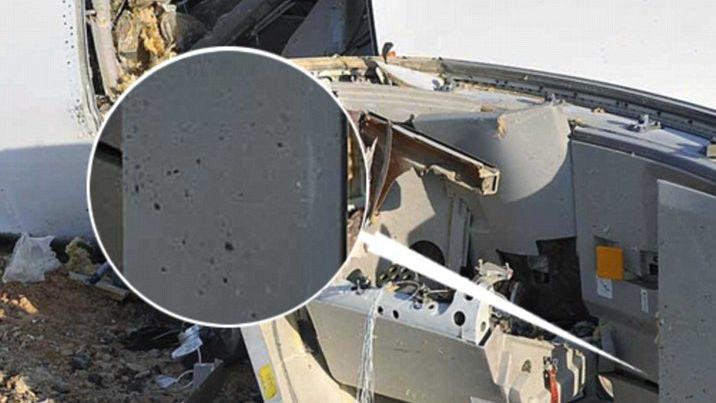
They discovered holes made by iron balls planted inside a bomb and scattered through all parts of the plane (see attached photos), as well as large tears in the outer walls that were caused by a powerful explosion.

****************************

President Vladi­mir Putin halted all Russian flights to Egypt Friday, Nov. 6, “until we know the true causes of the incident” .i.e. the cause of the Russian Metrojet flight crash over Sinai Saturday which killed all 224 people aboard. Several European and Gulf Arab governments suspended flights to Sharm el-Sheikh, but Russia was the first to halt all outbound flights to Egypt. Kremlin spokesman Dmitry Peskov said that Putin acted on the recommendation of the Russian security service chief Alexander Bortnikov.

The language of the statement – “true causes of the incident” – indicates that the Russians have lost patience with President Abdel-Fatteh El-Sisi and don’t trust the Egyptian investigation into the causes of the disaster. For most of the week, the Russians played along with Egypt’s obstinate resistance to any suggestion of terrorism and insisted on waiting for the official investigations before making any determinations. Thursday, Moscow sharply criticized British prime minister for presuming on the strength of intelligence that the plane was most likely downed by a bomb.

Putin abruptly changed course Friday following four developments:

1. Russian investigators collecting samples at the crash scene in Sinai found residue and other evidence of an explosion emanating from inside the plane or externally from a missile. They discovered holes made by iron balls planted inside a bomb and scattered through all parts of the plane (see attached photos), as well as large tears in the outer walls that were caused by a powerful explosion. Samples from the airplane’s wreckage were collected and presented to a meeting of the National Anti-Terrorist Committee Thursday.

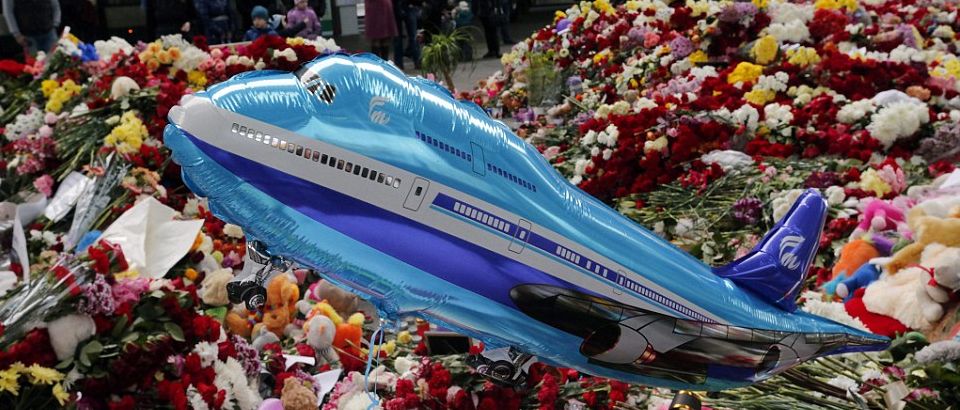
Mourners_memory_5.11.15

2.  Forensic examination of victims’ remains left no doubt that they died as a result of an explosive blast.

These findings spread like wildfire in Moscow and in St. Petersburg among the grieving families. The Russian leader saw he could no longer afford to line up with Cairo’s playdown of the terrorist factor.

3. Moscow received intelligence that the Islamic State plans to follow up on its first “success” with further terrorist attacks on Russian and European passenger jets.

By downing the Russian airliner over Sinai, the Islamist terror group delivered a huge blow to Egypt’s tourism industry. Russia tops Egypt’s tourist market. Last year, 3.1 million Russians visited Egypt, yielding $2.5bn out of the total national tourism income of $7.3bn in 2014.

Sharm el-Sheikh was the scene of havoc Friday, as Russian and British tourists mobbed the airport in an attempt to fly home after the Egyptian authorities limited the number of outbound flights.

The Regional Storm Hits Israel

November 5, 2015

The Regional Storm Hits Israel, Israel DefenseAmir Rapaport, November 5, 2015

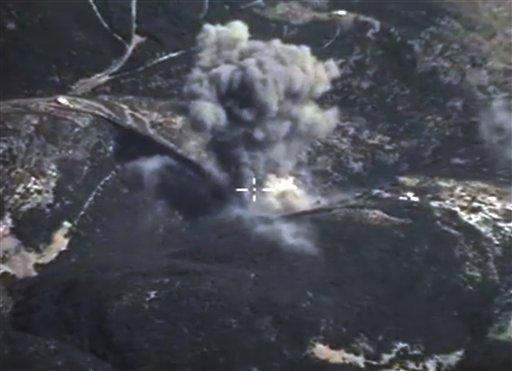
bomb in SyriaAn aerial view of a bomb explosion in Syria (Photo: AP/Russian Defense Ministry Press Service)

1. High Tide/Low Tide. When the “Second Intifada” broke out in October 2000, IDF used to refer to the riots and terrorist attacks in the Judea and Samaria area, as well is inside the territory of the State of Israel as “High Tide/Low Tide”, as each wave of riots was followed by a period of relative quiet, and then a new trigger emerged, leading to a wave of renewed violence, and so on.

Eventually, the “High Tide/Low Tide” incidents assumed a pattern of a murderous terrorist offensive, which took the lives of more than a thousand Israelis through suicide attacks, until the Intifada finally subsided in 2004.

The wave of riots and terrorist attacks that erupted about 15 years later, in the fall of 2015, appears to be connected, in some way or another, to the state of instability that characterizes many areas throughout the Middle East. For the last few years, the lion’s share of the fighting takes place in Syria, where hundreds of thousands of people were killed and millions more became refugees.

The major question that arose within the Israeli defense establishment in the fall of 2015 was whether this latest wave of terrorist attacks marks the outset of a “Third Intifada”. Although outwardly the Israeli interest is to announce “This is not a new Intifada,” in effect, there is talk about a “new situation” and no one knows how it will evolve.

Analyses performed within the defense establishment point to a number of reasons that suggest that this is a significant wave of terrorism which could turn out to be prolonged, as well as to reasons that justify the claim “This is not a new Intifada”.

One of the reasons that this wave of attacks is serious and could be prolonged is the religious motive: the Israeli media does not speak about it too often, but the Arab world is raging around rumors or reports that Israel actually intends to change the status quo on Temple Mount.

Even when one attempts to fish only “comfortable” data out of the statistics of the latest terrorist attacks, it is impossible to ignore the increase, by tens of percent, in the number of violent incidents throughout the Judea and Samaria area as well as within the “Green Line” during the last few weeks.

On the other hand, one significant difference between October 2015 and “Black October” (following the outbreak of the Second Intifada 15 years ago), is that the Israeli security forces are currently operating freely throughout the Judea and Samaria area. Consequently, entering the hospital in Nablus did not call for tactical support by tanks and aircraft. During the Second Intifada, on the other hand, it took the IDF and ISA quite a long time before they succeeded in regaining control over the centers of the Palestinian cities, pursuant to Operation Defensive Shield, and even then, the control achieved was only partial.

The recent events erupted despite the fact that IDF and ISA operate continuously against terrorist detachments. In each of the last few years, 2,000-3,000 Palestinian inhabitants were arrested. 80% of them were sentenced by the courts to prison terms of several months minimum.

It is still difficult to predict how the events will evolve over the next few months, but in any case, it seems that we have “a new security situation” on our hands.

2. Vladimir Putin. Many people regard the regional instability as the direct result of the American strategy of minimizing US involvement in the region, due to separatism processes and shifting the focus of world attention to Eastern Asia and the Pacific region (among other things, owing to the reduced dependence on Arab oil).

The party that stepped very effectively into the vacuum left by the USA was Russian President Vladimir Putin, who currently positions himself as the regional “Sheriff”.

No one can overestimate the importance of the moves made by Russian President Vladimir Putin, who deployed military forces to Syria this fall and continues to position himself as the strong man of the Middle East who never abandons his allies, while the USA has “transmitted” that her allies cannot rely on US support (as the USA had abandoned Egyptian President Hosni Mubarak in 2011).

This fall, the Russians deployed to Syria fighter aircraft that attack targets of the rebels opposing the military of President Bashar al-Assad. These moves were carefully coordinated with Iran, which, for her part, deployed hundreds of troopers (who are currently helping Hezbollah withdraw some of its forces back to Lebanon).

The Russian-Iranian move may have been intended to exert pressure on Saudi Arabia that supports the rebels, as well as to raise the price of oil, which is important to the economies of both countries.

Complicated? Even if there is no connection between the moves in Syria and the energy market, there is a definite connection between the fighting in Syria and the war raging in the southern part of the Arabian Peninsula. A solution in Syria may project on the war over there, as in both regions Iran and Saudi Arabia support opposing sides, with the conflict between the Shi’ite and Sunni factions of Islam as the backdrop.

Behind the scenes of the latest developments in Syria there has always been a Russian plan to bring about the end of the civil war in Syria by dividing it into areas of influence, with about 30% of the territory, in the Tartus and Lattakia area, remaining under control of the Alawite community of the current President, Bashar al-Assad.

Russia is interested in the sea ports in this area, and much less in maintaining Assad in control over a part of the disintegrated country. The Russians will not yield to the American demand to remove Assad from power until they have guaranteed their important interests. The party expected to pay the price is Israel, which may find itself, within a few months, facing a de-facto Iranian and Hezbollah domination on the other side of the border with Syria on the Golan Heights.

This situation could evolve despite the fact that Israel and Russia coordinate some of their respective moves, as indicated by the trip made by Prime Minister Netanyahu’s to Moscow last September, accompanied by the IDF Chief of Staff, Lt. Gen. Gadi Eizenkot, and Head of the IDF Intelligence Directorate, Maj. Gen. Hertzi Halevi, during which they met with “Sheriff” Putin.

3. Meanwhile, in the South. The good news come from the south, where Egypt under Abdel Fattah el-Sisi is determined to defeat the forces of al-Qaeda and the Islamic State that operate throughout the Sinai Peninsula. Egypt, Israel and the USA cooperate closely in the context of this effort, owing to their shared interests.

El-Sisi regards Hamas in the Gaza Strip as an enemy, owing to the cooperation between Hamas and the Egyptian Muslim Brotherhood movement, which is engaged in an on-going conflict with his regime.

Hamas itself is under tremendous pressure from different directions: from Egypt, which cuts off the underground tunnels connecting the Gaza Strip with the Egyptian territory, as well as from al-Qaeda and elements identifying with the Islamic State, who urge the leaders of Hamas to renew the fighting against Israel and occasionally even launch a rocket into Israeli territory in order to motivate Israel (which regards Hamas as the party responsible for such launches) to attack Hamas.

The reality that emerged in the Gaza Strip is yet another example of the complexity in our region. Iran, encouraged by the signing of the nuclear agreement with the superpowers, has renewed its support for Hamas, both financially and militarily (despite the fact that Hamas identifies with the rebels fighting against Bashar al-Assad in Syria and in Iran itself).

The positive bottom line is that Hamas, owing to its own considerations, does its best to maintain the ceasefire agreement reached with Israel following Operation Protective Edge in the summer of 2014. That state of affairs remained in effect until the fall of 2015 but reality, as everyone knows only too well, is highly dynamic.

4. A Small Military. One of the most significant moves expected within IDF in November is the endorsement of the long-term plan for the coming five-year period, and the conversion thereof into an effective order for execution.

“Gideon” is the name of the new multi-year plan led by IDF Chief of Staff, Lt. Gen. Gadi Eizenkot. The plan is intended to rely on the long-term budget allocated to the IDF according to the recommendations of the Locker Committee, and will come into effect in 2016, after five years during which IDF have operated without a long-term plan, as the previous plan had ended as far back as during the tenure of Lt. Gen. Gabi Ashkenazi as Chief of Staff. The Gideon plan is intended to convert the IDF into a technological, cyber-based military organization, possessing fast maneuvering elements equipped with accurate, lethal weapons and enhanced sea and air branches. Above everything else, the most substantial investment will be made in intelligence.

The greatest concern among quite a few elements within the defense establishment pertains to the size of the military, as the new plan calls for the demobilization of quite a few units. One of the principles of Israel’s national security concept since the days of David Ben-Gurion is the need to maintain a strong, substantial military force, based on hundreds of thousands of reservists. The principle is still valid, but in effect, the emphasis is placed on intelligence, air power and commando operations. The substantial ground army, along with its massive tank OrBat, is reduced dramatically – which is inconsistent with the aforesaid principle.

5. Defense Exports. Nearing the end of 2015, the Israel Ministry of Defense and the Israeli defense industries embarked upon a massive sales effort. Between October and December, they will take part in not less than five major defense exhibitions in the USA, South Korea, Japan, Colombia and Thailand.

Even if that effort proves successful, the statistics for 2015 will indicate that Israeli defense exports still follow the downward trend that began in 2014. At best, the defense exports for 2015 will amount to US$ 5 billion, as opposed to US$ 7 billion in 2013.

The main reason for this decrease is the end of the global campaigns in Iraq and Afghanistan. Several major deals that are still on the agenda, mainly in India, can still change the picture before the end of 2015 and lead to a positive trend in terms of the scope of exports. In any case, the contribution made by the defense exports, which amounts to billions of dollars, to the Israeli economy and to the Israeli security resilience is immense. The massive proceeds enable the Israeli defense industries to continue to invest funds in research in order to develop products at the cutting edge of technology.

Russia warns that Syria war could become a ‘proxy war’

November 1, 2015

Russia warns that Syria war could become a ‘proxy war’ BreitbartJohn J. Xenakis, November 1, 2015

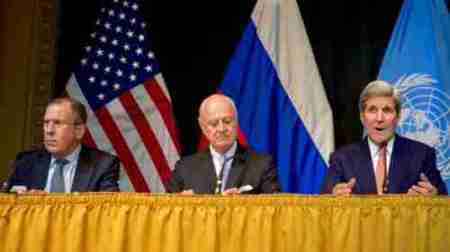
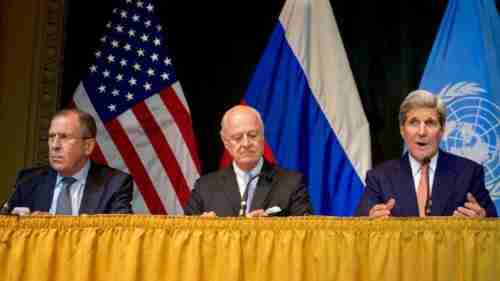
g151031bL-R: Sergei Lavrov, United Nations Special Envoy for Syria Staffan de Mistura, and John Kerry in Vienna on Friday (state.gov)

Russia has poured millions of dollars of heavy weapons into Syria, and is now sending in Russian troops to establish bases there. Recently, Russia launched 27 cruise missiles from the Caspian Sea to targets in Syria. Iran is pouring new troops into Syria. Iran has also given Lebanon’s Hezbollah terrorist group a great deal of money, and Hezbollah has sent thousands of troops into Syria to support Syria’s president Bashar al-Assad.

Al-Assad’s genocidal attacks on innocent Syrian Sunnis, killing hundreds of thousands and forcing millions from their homes, has caused Sunni jihadists from all of the world to fight against al-Assad, Russia, Hezbollah, and Iran in Syria. Along the way, these jihadists formed the so-called Islamic State (IS or ISIS or ISIL or Daesh).

And now, on Friday, Russia’s Foreign Minister Sergei Lavrov made a pronouncement that Barack Obama was going to trigger a “proxy war” in Syria by sending in 50 special operations forces, as we reported yesterday.

You can’t make this stuff up.

Thanks to Iran, Russia, al-Assad and Hezbollah, there are now tens of thousands of foreign troops fighting each other in Syria, with al-Assad in particular supported by massive amounts of foreign weapons.

But somehow, those tens of thousands of foreign fighters don’t make it a “proxy war,” but America’s 50 special forces troops do.

You can’t trust any garbage that comes out of Lavrov’s mouth, or out of al-Assad’s mouth, or out of Vladimir Putin’s mouth, but I listen to BBC, al-Jazeera, FOX, CNN, and other media sources all the time, and I see these news anchors report this crap with a straight face all the time. I don’t know whether it is more sickening to watch those fatuous news anchors, or to watch the fawning Secretary of State John Kerry suck up to Lavrov and Putin, which has happened in issues involving Ukraine, Iran’s nuclear development, and Syria.

All this verbiage is coming out of a meeting in Vienna whose purpose is to find a “political solution” to the Syria problem. With hundreds of thousands of Syrian migrants pouring into Europe, and with hundreds of ISIS militants returning to Russia to fight Putin, there is a lot of pressure to find a “political solution.” But this week’s announcement that Iran will fully enter the war in Syria on the side of the Syrian regime makes any “political solution” farther away than ever. On the contrary, Saudi Arabia and other Gulf countries will never agree to anything like the emerging situation. Actions by Russia and Iran, intervening militarily in Syria, is an emerging disaster, likely triggering a sectarian Sunni versus Shia war throughout the region. BBC and International Business Times and Reuters

Syria’s civil war and Generational Dynamics

In the 12 years that I’ve been doing this, I’ve posted about 4,000 articles with hundreds of Generational Dynamics predictions.

In 2011, when the Syrian civil war began, I said that the war should fizzle within a year or two. Of all the hundreds of Generational Dynamics predictions, this is the one where I’ve clearly been (depending on how you look at it) either wrong or poorly described.

Syria’s last generational crisis war was civil war that climaxed in 1982 with the massacre at Hama. There was a massive uprising of the 400,000 mostly Sunni citizens of Hama against Syria’s president Hafez Assad, the current president’s father. In February, 1982, Assad turned the town to rubble, 40,000 deaths and 100,000 expelled. Hama stands as a defining moment in the Middle East. It is regarded as perhaps the single deadliest act by any Arab government against its own people in the modern Middle East, a shadow that haunts the Assad regime to this day.

(As a related matter, the civil war in Lebanon also climaxed that year, with the bloody massacre at Sabra and Shatila occurring in September 1982. And it occurred as the Iran/Iraq war was ongoing, three years after Iran’s bloody Great Islamic Revolution in 1979. At that time, much of the Mideast was re-fighting World War I and the collapse of the Ottoman Empire, 60 years earlier.)

So, in 2011, I said that the civil war in Syria would fizzle, and could not turn into a crisis civil war. And that’s both wrong and true. There are too many survivors who remember the 1982 slaughter, and do not want to see it repeated. And so there’s been no massive anti-government uprising, as there was in 1982, and Bashar al-Assad’s Shia/Alawite troops have been fighting half-heartedly, with many soldiers defecting or deserting.

But the war did not fizzle.

It should have fizzled in 2011 or 2012, but Hezbollah and Iran starting pouring troops in to support al-Assad. And foreign fighters from around the world arrived to fight al-Assad and to form ISIS. That’s not something that Generational Dynamics could have predicted.

Earlier this year, it looked like al-Assad’s army was near collapse. In July, a desperate al-Assad gave a national speech in which he admitted he was losing. The war should have fizzled this year. But now, Russia and Iran are pouring tens of thousands more troops into Iran to bolster al-Assad. And that also is not something that Generational Dynamics could have predicted.

So the problem for me is: How should I have characterized the situation in 2011? The prediction that it wouldn’t turn into a crisis civil war was correct, but the war did not fizzle, because it turned into a proxy war.

Well, I don’t think there’ll be a next time, but if there is, I’ll try to characterize the situation differently, without simply using the word “fizzle.” NPR (1-Feb-2012)

Generational Dynamics and crisis civil wars

I write about a number of civil wars going on in the world today, so this is a good time to discuss civil wars from the point of view of Generational Dynamics.

Among generational crisis wars, an external war is fundamentally different than a civil war between two ethnic groups. If two ethnic groups have lived together in peace for decades, have intermarried and worked together, and then there is a civil war where one of these ethnic groups tortures, massacres and slaughters their next-door neighbors in the other ethnic group, then the outcome will be fundamentally different than if the same torture and slaughter is rendered by an external group. In either case, the country will spend the Recovery Era setting up rules and institutions designed to prevent any such war from occurring again. But in one case, the country will enter the Awakening era unified, except for generational political differences, and in the other case, the country will be increasingly torn along the same ethnic fault line.

The period following the climax of a crisis war is called the “Recovery Era.” One path that the Recovery Era can take is that the leader of one ethnic group decides that the only way to prevent a new civil war is for him to stay in power, and to respond to peaceful anti-government demonstrations by conducting massive bloody genocide, torture and slaughter of the other ethnic group, in order to maintain the peace. (Dear Reader, I assume you’ve grasped the irony of the last sentence.)

For example, in a July article about Burundi, I described how Burundi’s Hutu president Pierre Nkurunziza was using such violence to quell Tutsi protests, supposedly to avoid a repeat of the 1994 Rwandi-Burundi genocidal war between Hutus and Tutsis.

As another example, in a June article about Zimbabwe, I described how Zimbabwe’s president Robert Mugabe was even worse. His 1984 pacification campaign was known as “Operation Gukurahundi” (The rain that washes away the chaff before the spring rain). During that campaign, accomplished with the help of Mugabe’s 5th Brigade, trained by North Korea, tens of thousands of people, mostly from the Ndebele tribe, were tortured and slaughtered. Later, Mugabe single-handedly destroyed the country’s economy by driving all the white farmers off the farms, resulting in one of the biggest hyperinflation episodes in world history.

That is what Bashar al-Assad is doing in Syria. Fearing a Sunni uprising, like the one in 1982, al-Assad is conducting a massive “peace campaign” by slaughtering and displacing millions of innocent Sunnis. As I wrote above, this should have fizzled in 2011 or 2012, but it’s turned into a proxy war, and it’s a disaster for the Mideast and the world.

But none of the above three examples is a crisis civil war. A crisis war has to come from the people, not from the politicians. So, for example, there’s a massive crisis civil war going on today in Central African Republic (CAR), between the Muslim ex-Seleka militias fighting Christian anti-Balaka militias.

Unlike the previous examples, CAR is in a generational Crisis era. CAR’s last generational crisis war was the 1928-1931 Kongo-Wara Rebellion (“War of the Hoe Handle”), which was a very long time ago, putting CAR today deep into a generational Crisis era, where a new crisis war is increasingly likely. That’s why the CAR is a genuine crisis civil war, and won’t fizzle out. In fact, it won’t end until it has reached some kind of explosive conclusion — of the kind we described in Hama or Sabra and Shatila. ( “2-Oct-15 World View — Violence resurges in Central African Republic crisis war”)

Generational Dynamics and war between Palestinians and Israelis

I’ll discuss one more example — not a civil war, but very similar to a civil war, with the same kinds of issues.

In the last few years, there have been three non-crisis wars between Israelis and Palestinians in Gaza. In each case, the Israelis destroyed Hamas’s infrastructure, ending the war. The war began again each time when Hamas’s infrastructure was rebuilt.

But the point I want to make is that these three non-crisis wars were all directed by politicians. Palestinians attacked when the leadership told them to, and stopped attacking when the leadership told them to stop.

What I have been describing in numerous articles recently is that there is emerging a major, fundamental, historic change.

In the emerging situation, young people today are no longer willing to listen to these leaders. According to the CIA World Fact Book, 20% of Gaza’s population are in the 15-24 age range, and so are 21% of the West Bank — about 200,000 males in each territory, or 400,000 young males total.

On the Israeli side, there are over 600,000 young males in the same age range. There have been unconfirmed reports of young Israelis also disgusted with the leadership. It is possible that, like the young Palestinians, they are willing to take matters into their own hands.

So in this environment, what could happen next? The last three Gaza wars were non-crisis wars, but the next one could be a crisis war between Israelis and Palestinians.

How can a crisis war begin? How about if those 200,000 young male Gazans blow holes in the walls, pour across into Israel and start killing Israeli citizens en masse in their homes and villages? And how about if they are joined by those 200,000 young male Palestinians on the West Bank, who start with the Jewish settlers and continue with the Jews in Jerusalem. And how about if the young Israeli males strike back and start killing Palestinians in their homes and villages?

Israel’s tanks and bombers would not be of much use. You can’t bomb Jerusalem, and you can’t bomb Israeli villages and settlements to kill Palestinians.

That is the difference. That is what a generational crisis war is like. It is not two tanks shooting at each other. It is hand to hand combat in homes, neighborhoods and streets by people armed with sticks and knives. It is what happened in Central African Republic last year, it is what happened in Rwanda in 1994, in Bosnia in 1994, and in Palestine in 1947.

And by the way, that assumes that the bloody mess stays confined to Israel and the Palestinian territories. The Palestinians are likely to be joined by tens or hundreds of thousands from Jordan, Lebanon and Egypt.

The recent widely reported changes in the attitudes and behaviors of young Palestinians is a sign that this kind generational crisis war is coming.
The New Cold War: The Russia-Shia Alliance VS the Islamic State

November 1, 2015

The New Cold War: The Russia-Shia Alliance VS the Islamic State, Counter Jihad Report, Brian Fairchild, October 31, 2015

(An excellent summary and analysis of the consequences of the Obama Middle East vacuum. — DM)

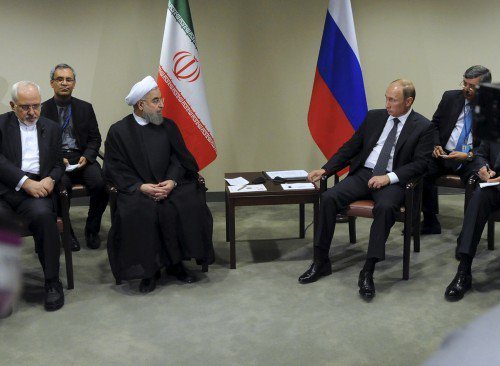
rtx1sy30_iran_russia_un_092015-e1443810243164Russia’s President Vladimir Putin (2nd R) meets with Iran’s President Hassan Rouhani (2nd L) on the sidelines of the United Nations General Assembly in New York, September 28, 2015. REUTERS/Mikhail Klimentyev.

Just one month ago, the US was the only major military player in the Middle East, but that has all changed.  Russia’s aggressive and well-planned military campaign in Syria has tilted the balance of power in the region away from the US and toward Russia and its new Shia-dominated quadrilateral alliance.  As a result, the US plan to effect regime change in Syria is now impossible, but more importantly, US influence in Iraq is steadily diminishing, and thus, the number of options available to American military commanders to degrade the Islamic State are also diminishing.

***********************

The New Cold War:

In late-September 2015 Russia and Iran launched a clandestine strategic military campaign to support Syria’s Bashar al-Assad.  Russia’s bold move took the West by surprise and changed the balance of power in the Middle East in Russia’s favor.  It will go down in history as the milestone depicting Russia’s first aggressive military action outside of its own sphere of influence since the fall of the Soviet Union, and, when viewed from a global strategic perspective, will be remembered as the first clear sign that a New Cold War had erupted between the US and Russia.

Russia’s Middle Eastern campaign is formed around the new “quadrilateral alliance”, which has divided the region into two sectarian blocs:  the Russian-led Shia Muslim alliance, which forms a powerful “Shia Crescent” stretching from Iraq, through Iran and Syria, to Lebanon, and the Sunni Arab bloc led by Saudi Arabia with minimal backing by the United States.

Thus far, Russia’s campaign has been executed seamlessly. Upon entering Syria clandestinely, Russian forces immediately deployed sophisticated surface to air missile defense batteries as well as top-of the-line jet fighters to protect Russian and Syrian forces from the US coalition.  Once air defenses were in place, Moscow began a barrage of airstrikes targeting anti-Assad rebels in order to re-establish and consolidate Assad’s power.  The airstrikes were subsequently integrated with ground operations carried-out by Syrian military units, Iranian Quds forces, Shia militia from Syria and Iraq, and Hezbollah fighters.  There are also credible news reports that Cuban Special Forces have joined the fray for the first time since Cuba’s proxy wars in Angola and central Africa in the 1970’s on behalf of the Soviet Union.

The Russia-Shia Alliance and its Effect on Iraq, Jordan, and the Kurds:

Iraq:

In tandem with its military campaign, Russia launched a diplomatic campaign that has been just as effective.  Iraq is the geographical base for US coalition operations against the Islamic State in Iraq and Syria, but American influence in Iraq has steadily diminished over the past year.

In early October 2015, Iraq secretly established a new Russia-Iran-Syria-Iraq intelligence center in the middle of Baghdad that surprised and angered American military commanders.  Worse, after Russia’s increasingly effective Syrian air campaign, Iraqi Prime Minister Haider al-Abadi called for Russia to begin unilateral airstrikes against the Islamic State in Iraq.  The Pentagon became so alarmed by the possibility that Russia might get a strategic foothold in Iraq that on October 21, 2015, it dispatched Chairman of the Joint Chiefs of Staff General Joseph Dunford to Baghdad to deliver an ultimatum to the Iraqi leadership.  Dunford told the Iraqi Prime Minister and Defense Minister that Iraq had to choose between cooperating with Russia or the US.  Upon his departure from Baghdad, General Dunford told the media that he received assurances that Iraq would not seek Russian assistance, but just three days later, Iraq officially authorized Russian airstrikes in-country.

Jordan:

On that same day, another of America’s most dependable allies, the Kingdom of Jordan, announced its agreement to create a new Russian-Jordanian military coordination center to target the Islamic State and that this center would go well beyond just a formal information exchange.  According to Jordan’s Ambassador to Russia:

  • “This time, we are talking about a specific form of cooperation — a center for military coordination between two countries. Now we will cooperate on a higher level. It will not be just in a format of information exchange: we see a necessity ‘to be on the ground’ as Jordan has a border with Syria”

The Kurds:

Moscow is attempting to undermine US relations with the Kurds.  Since the rise of the Islamic State, the US has sought to provide anti-Islamic State military support to the Kurdish Regional Government (KRG) in northern Iraq via the Iraqi central government, but the Iraqi government has no desire to see the KRG gain additional power in the north so this mission has been largely ineffective.  The US has had a measure of success providing limited support to the Kurdish People’s Protection Units (YPG), but has balked at providing full support because any support whatsoever angers Turkey due to contacts between the YPG and the Kurdish Worker’s Party (PKK), a separatist organization, that seeks to overthrow the Turkish government.  On October 29, 2015, Turkish president Erdogan demonstrated this anger when he vehemently criticized US support for the YPG and stated that Turkey would attack the YPG on the Iraqi side of the border if it attempts to create a separatist Kurdish administrative zone.  Because Turkey is a NATO ally, Turkish threats cause the US significant political and diplomatic problems, but they will not deter Putin from moving to organize and utilize Kurdish forces in pursuit of his goals; in early October, he went out of his way to show disdain for Turkey and NATO by allowing his Syrian-based jets to illegally invade Turkish airspace.

No Kurdish group is happy with the current situation of getting limited support from the United States to fight the Islamic State, but all of them have expressed interest in cooperating with Russia.  Significantly, Sergey Ivanov, the head of the Kremlin administration, specifically urged cooperation between the Syrian Kurdish militia and the US-backed YPG.

The Russia-Shia Alliance and the Islamic State:

The Shia composition of the quadrilateral alliance is extremely significant because it plays directly into the Islamic State narrative.  The Islamic State and the majority of the world’s Muslims are Sunni, but in the heart of the Middle East, the Shia governments of Iran, Iraq, Syria, and Lebanon, with Russian support, dominate, and these countries surround the Islamic State’s new “caliphate” on three sides.  Understanding this strategic disadvantage, the Islamic State knows that it must muster as much international Sunni support as possible to survive, so it carries-out a relentless policy to polarize the international Sunni population against the Shia.

The chance to remove Bashar al-Assad, who represents the Shia Alawite sect, was the primary reason the Islamic State moved to Syria from Iraq, and removing al-Assad from power served as its initial rallying cry to the global Sunni community.  It was this rallying cry that created the dangerous “foreign fighter” phenomenon that subsequently brought more than 30,000 radical Sunni Muslims from around the world to the new caliphate.

The Islamic State repeatedly emphasizes in its official publications and statements its contention that Shia Muslims are not true Muslims and must be eradicated, and, in these communications, it refers to Shia Muslims as “Rafidah” (rejecters).  But of all the Shias in the world, the Islamic State has a particular hatred for the Shia Iranians, who are Persian rather than Arab, and who ruled Islam during the ancient Safavid (Persian) empire, which the Islamic State regards as religiously illegitimate.  It therefore refers to Iranians as the “Safavid Rafidah”.

Moreover, the Islamic State accuses the US and Russia of being modern day “crusaders” who have joined forces with the Iranians to destroy Sunni Islam, a contention made clear on March 12, 2015, when its spokesman Abu Mohamed al-Adnani stated:

  • The Safavid Rāfidah (Shia Iranians) today have entered a new stage in their war against the Sunnis. They have begun to believe that it is within their power to take areas of the Sunnis and control them completely. They no longer want a single Muslim from the Sunnis living in the empire they desire…O Sunnis…if the Islamic State is broken…then there will be no Mecca for you thereafter nor Medina…Sunnis! The Crusader-Safavid (Christian-Iranian) alliance is clear today.  Here is Iran with its Great Satan America dividing the regions and roles amongst each other in the war against Islam and the Sunnis…We warned you before and continue to warn you that the war is a Crusader-Safavid was against Islam, and war against the Sunnis…”

The Shia Alliance and the Saudis:

Saudi Arabia considers itself to be the leader of the world’s Sunni population and the custodian of Islam’s two most holy places:  the mosques of Mecca and Medina where the prophet Muhammad received Allah’s revelations.  Because Iran is the Kingdom’s religious and regional nemesis the Islamic State’s anti-Shia narrative resonates greatly among many Saudis who are increasingly alarmed at Iran’s growing military influence and power.  In a letter signed by 53 Saudi Islamic scholars in early October 2015, the clerics lashed out at Iran, Syria and Russia and echoed the main points made by the Islamic State:

  • “The holy warriors of Syria are defending the whole Islamic nation. Trust them and support them … because if they are defeated, God forbid, it will be the turn of one Sunni country after another”

Saudi King Salman was willing to allow this unofficial letter to be published because it permitted the Saudi government an indirect manner to issue a warning to Iran, but as the Russian-Iran alliance continued to make military gains throughout October, the Kingdom’s anxiety was such that it decided to allow its Foreign Minister to issue the following direct warning to Iran:

  • “We wish that Iran would change its policies and stop meddling in the affairs of other countries in the region, in Lebanon, Syria, Iraq and Yemen…We will make sure that we confront Iran’s actions and shall use all our political, economic and military powers to defend our territory and people…”

Conclusion:

The New Cold War:

Just one month ago, the US was the only major military player in the Middle East, but that has all changed.  Russia’s aggressive and well-planned military campaign in Syria has tilted the balance of power in the region away from the US and toward Russia and its new Shia-dominated quadrilateral alliance.  As a result, the US plan to effect regime change in Syria is now impossible, but more importantly, US influence in Iraq is steadily diminishing, and thus, the number of options available to American military commanders to degrade the Islamic State are also diminishing.

Five days after Iraq rejected General Dunford’s ultimatum and authorized Russian airstrikes in Iraq, Secretary of Defense Ashton Carter ignored this fact in his testimony before the Senate’s Armed Forces Committee when he stated that the United States plans to increase the number of airstrikes in Iraq as well as direct action raids by US special operations forces in Iraq.

Unfortunately, such an increase in US military actions require Iraqi permission, and for the second time in a week, Iraq rejected the United States.  On October 28, 2015, Prime Minister al-Abadi’s spokesman told the media that Iraq has no intention of allowing increased American participation because:

  • “This is an Iraqi affair and the government did not ask the U.S. Department of Defense to be involved in direct operations…”

If Iraq enforces this restriction, and limits the US to only training and arming Iraqi forces while allowing Russia to conduct aggressive operations in-country, the situation could become untenable for the United States, further reducing America’s ability to degrade the Islamic State.

The Islamic State:

Once Russia consolidates Assad rule in Syria, Putin will undoubtedly use the new Russia-Shia alliance to move against the Islamic State.  Because the alliance dominates the geographical terrain on three sides of the “caliphate” and has demonstrated a willingness to engage in unified military air and ground operations, it is likely that Russian airpower and Shia ground forces will succeed in dismantling many Islamic State elements in Syria and Iraq.

Such success by the Russia-Shia alliance, especially if it forces the evacuation of the capital of the Islamic State’s “caliphate” in Raqqa, Syria, will further polarize and enrage radical Sunnis and likely increase the number of foreign fighters from Europe and the Middle East.  It will also likely result in more domestic lone jihad attacks in the US and Russia, a call the Islamic State has already made in its October 13, 2015statement:

  • “…the Islamic State is stronger today than yesterday, while at the same time America is getting weaker and weaker…America today is not just weakened, it has become powerless, forced to ally with Russia and Iran…Islamic youth everywhere, ignite jihad against the Russians and the Americans in their crusaders’ war against Muslims.”

If the Islamic State experiences set-backs and defeats in Syria and Iraq such defeats would likely motivate it to launch mass casualty attacks in the United States and Europe in order to prove to its followers that it remains relevant. Mass casualty attacks in tandem with increased lone jihad attacks would make an already bad domestic security situation, grave.

On October 23, 2015, FBI Director Comey revealed that the FBI is pursuing approximately 900 active cases against Islamic State extremists in the United States and that this number continues to expand.  Comey added that should the number of cases continue to increase, it won’t be long before the FBI lacks the adequate resources to “keep up”.   Europe, too, faces grave security challenges.  A few days after Comey’s revelations, the head of MI5, Britain’s domestic intelligence service, stated that the terror threat in the United Kingdom from the Islamic State and al Qaeda is the highest he has “ever seen”.

Putin has no long term strategy, says administration w/no long term strategy

October 31, 2015

Putin has no long term strategy, says administration w/no long term strategy, Front Page Magazine, Daniel Greenfield, October 31, 2015

hqdefault

This is an administration that believes you win wars with word games

Obama claimed that Putin is acting in Syria out of weakness and is being all reactive. Then he reacted by shipping weapons to Sunni rebels, a move he had originally rejected, and sending American soldiers into combat as boots on the ground.

Now DNI James Clapper is claiming that Putin is being impulsive and has no long term strategy. This comes from an administration that changed its mind several times about intervening in the Syrian Civil War and keeps saying it still doesn’t have a plan for defeating ISIS.

Clapper said Putin was “very impulsive and opportunistic” as he increased Russian support for close ally President Bashar al-Assad in Syria’s roiling civil war.

“I personally question whether he has some long-term strategy or whether he is being very opportunistic on a day-to-day basis,” Clapper told CNN’s Jim Sciutto. “And I think his intervention into Syria is another manifestation of that.”

Being “opportunistic” is actually how real life battles are fought. You have a strategy, but you seize advantages based on the evolving situation on the ground.

So far Putin’s long term strategy has been to expand Russian influence in the region. It’s working really well. Russia is back to being the regional alternative to the US. It’s securing strategic territories and its allies are expanding their sphere of influence.

On top of that, Putin managed to avert US air strikes on Assad with his fake WMD deal. Then he helped Iran secure its nuclear weapons program with the Iran deal. (I’ll grant that he had a lot of help from Obama and Kerry there.) Now he’s angling to get Obama on board a peace deal that keeps Assad in power and ends US support for the rebellion. Considering this administration’s foreign policy track record, he’ll probably get his way. While the administration clown car taunts him as weak and opportunistic and reactive and impulsive.

In the Cold War, the Soviets trash talked while the US got things done. Under Obama, the US talks trash and Russia gets things done. But this is an administration that believes you win wars with word games.

How is that working out for them?

Reports: IAF targets Hezbollah assets in Syria

October 31, 2015

Reports: IAF targets Hezbollah assets in Syria, Times of Israel, October 31, 2015

Israeli jet fighterAn Israeli fighter jet takes off during a training sortie in February 2010. (photo credit: Ofer Zidon/Flash90)

The Lebanese and Syrian media said Saturday that Israel Air Force warplanes have attacked targets in Syria linked to the Lebanon-based militant group Hezbollah. Reports varied, however, on the exact targets and location of the strikes.

According to a report on the Lebanese Debate website, six IAF jets carried out the strike over the Qalamoun Mountains region of western Syria, and targeted weapons that were headed for Hezbollah, Channel 10 said.

Syrian opposition groups, for their part, claimed Israeli planes had attacked targets in the Damascus area, in two strikes in areas where Hezbollah and pro-Assad forces were centered.

Syrian media, however, said that Israeli warplanes hit several Hezbollah targets in southern Syria.

Israel’s defense establishment declined to comment on the reports of the strikes, which would be the first since Russia boosted its involvement in the Syrian civil war.

Syrian and Iranian media reported Friday that Russia was carrying out air strikes against anti-Assad rebel forces on the Syrian side of the Golan Heights border with Israel.

The Jewish state has reportedly carried out several strikes on Syrian arms convoys destined for Hezbollah, although it routinely refuses to confirm such operations. It has, however, warned that it will not permit the Lebanon-based group to obtain what it calls “game-changing” advanced weaponry.

Prime Minister Benjamin Netanyahu said last month after meeting with Russian President Vladimir Putin in Moscow that Israel and Russia have agreed on a mechanism to avoid military confrontations between the two countries in Syria.

Russia, a key ally of Syrian President Bashar Assad, is in the midst of a military operation in the war-torn country, ostensibly to fight Islamic State militants who have seized huge swathes of territory. Critics however, claim that Russian airstrikes are targeting not only the fundamentalist group, but also Western-backed opposition groups who are seeking Assad’s ouster.

“My goal was to prevent misunderstandings between IDF forces and Russian forces. We have established a mechanism to prevent such misunderstandings. This is very important for Israel’s security,” Netanyahu told Israeli reporters during a telephone briefing from the Russian capital.

“Our conversation was dedicated to the complex security situation on the northern border,” the prime minister said. “I explained our policies in different ways to try to thwart the deadly weapons transfers from the Syrian army to Hezbollah — action actually undertaken under the supervision of Iran.”

Netanyahu said that he told Putin in “no uncertain terms” that Israel will not tolerate Tehran’s efforts to arm Israel’s enemies in the region, and that Jerusalem has taken and will continue to take action against any such attempts. “This is our right and also our duty. There were no objections to our rights and to what I said. On the contrary: there was readiness to make sure that whatever Russia’s intentions for Syria, Russia will not be a partner in extreme actions by Iran against us.”

Ahead of their meeting, as they made statements to the press, Netanyahu told Putin that Iran and Syria have been arming Hezbollah with advanced weapons, thousands of which are directed at Israeli cities. He also told his Russian host that Israel’s policy is to prevent these weapons transfers “and to prevent the creation of a terrorist front and attacks on us from the Golan Heights.”

In April, Defense Minister Moshe Ya’alon also warned that Israel would not let Iran equip Hezbollah with advanced weapons — a day after an alleged Israeli airstrike hit weapons depots in Syria.

Although Ya’alon did not discuss the airstrike that reportedly hit surface-to-surface missile depots, he declared that Israel would not allow Iran to supply arms to the terror group, which has a strong military presence in Lebanon as well as in Syria, the two countries lying on Israel’s northern borders.

Hizballah is creeping up on Israel’s Golan border, relying on Russian military cover

October 23, 2015

Hizballah is creeping up on Israel’s Golan border, relying on Russian military cover, DEBKAfile, October 23, 2015

nasrallah-putin_10.15Hassan Nasrallah believes he has Putin behind him.

Wholly preoccupied with the ferocious Palestinian terror campaign washing over their country, Israelis have scarcely noticed that Hizballah forces, believing they are protected by the Russian military presence in Syria, are creeping toward Israel’s northeastern Golan border. DEBKAfile reports: The Lebanese group thinks it is a step away from changing the military balance on the Golan to Israel’s detriment and gaining its first Syrian jumping-off base against the Jewish state – depending on the Syrian-Hizballah forces winning the fierce battle now raging around Quneitra opposite Israel’s military positions.

For two years, Hizballah, egged on intensely by Iran, has made every effort to plant its forces along the Syrian border with Israel. For Tehran, this objective remains important enough to bring Al Qods Brigades chief, Gen. Qassem Soleiman, on a visit last week to the Syrian army’s 90th Brigade Quneitra base, which is the command post of the battle waged against Syrian rebel forces.

Soleimani, who is commander-in-chief of Iran’s military operations across the Middle East, is acting as military liaison in Syria between Tehran and Moscow.

DEBKAfile’s military sources report that the Iranian general inspected the Quneitra battle lines no more than 1.5-2 km from the Israeli Golan border. He arrived a few days after Revolutionary Guards Col. Nader Hamid, commander of Iranian and Hizballah forces in the region, died there fighting against Syrian rebels.

His death betrayed the fact that not only are Hizballah forces gaining a foothold on the strategic Golan enclave, but with them are Iranian servicemen, officers and troops.

While in Quneitra, the Iranian general also sought to find out whether Col. Hamid really did die in battle or was targeted for assassination by Israel to distance Iranian commanders from its border.

Just 10 months ago, on Jan. 18, Israel drones struck a group of Iranian and Hizballah officers who were secretly scouting the Quneitra region for a new base. Iranian Gen. Ali Mohamad Ali Allah Dadi died in that attack.

But Tehran and Hizballah are again trying their luck. During his visit to Quneitra, Soleimani called up reinforcements to boost the 500 Hizballah fighters in the sector.

Seen from Israel, the Syrian conflict is again bringing enemy forces into dangerous proximity to its border.

The Iranian general and Russian Air Force commanders agree that the drawn-out battle for Quneitra will not be won without Russian air strikes against the rebels holding out there. A decision to extend Russia’s aerial campaign from northern and central Syria to the south would be momentous enough to require President Vladimir Putin’s personal approval.

This decision would, however, cross a strong red line Israel laid down when Binyamin Netanyahu met Putin on Sept. 21 in Moscow and when, last week, a delegation of Russian generals visited Tel Aviv to set up a hot line for coordinating Israeli and Russian air operations over Syria.

Israeli officials made it very clear that Iranian and Hizballah forces would not be permitted to establish a presence opposite the Israeli Golan border and that any Russian air activity over southern Syria and areas close to its borders was unacceptable.

The possibility of Israeli fighter jets being scrambled against Russian aerial intervention in the Quneitra battle was not ruled out.

This state of affairs was fully clarified to Gen. Joseph Dunford, Chairman of the Joint US Chiefs of Staff, when he was taken on a trip this week to the southern Golan under the escort of IDF Chief of Staff Gen. Gady Eisenkot and OC Northern Command Gen. Avivi Kochavi. He visited the command post of Brig. Yaniv Azor, commander of the Bashan Division, which will be called upon for action if the hazard to Israel’s security emanating the Quneitra standoff takes a dangerous turn.