Posted tagged ‘Putin’

Iran and Russia in first major falling-out over Syrian war and Assad

February 5, 2016

Iran and Russia in first major falling-out over Syrian war and Assad, DEBKAfile, February 5, 2016

P.V

While diplomats from 70 countries talked in London about how to raise $9 bn for projects to rehabilitate Syria’s refugees and rebuild their war-ravaged country, its future was further clouded this week by an argument that flared between the main arbiters, Russia and Iran.

Ali Akbar Velayati, Iranian supreme leader Ayatollah Ali Khamenei’s foreign affairs advisor, spent three days in Moscow Feb. 1-4 haranguing Russian leaders, including President Vladimir Putin, whom he saw twice, on the differences that had cropped up in their long political and military cooperation for propping up the Assad regime.

The Iranian official went home without resolving those differences, DEBKAfile’s sources report exclusively. Left pending were not just the next stage of the war but also the fate of President Bashar Assad.

Velayati told Iranian reporters on his plane: “We are against stopping the war,” and “The war must be continued until all (Syrian) terror cells are eradicated.”

He did not elaborate, but DEBKAfile’s Iranian and Moscow sources point out that he was underlining Tehran’s concerns about Moscow’s reported plans for the Assad regime, in which Iran is heavily invested, and the slowdown of Russia’s air campaign against every last rebel group.

Most of all, Iran’s leaders were troubled to find that Russia, by dint of its proactive military intervention, had maneuvered itself into position for calling the shots for Syria.

They are particularly distrustful, according to our sources, over Moscow’s complicated deals with Washington on the Syrian question and the dialogue Russia is holding with the Persian Gulf states, led by Saudi Arabia. The Iranians fear that Putin is calibrating his offensive against rebel groups according to the pace of these interchanges and may therefore scale back strikes on pro-American or “moderate” rebels, or even refrain from subduing them.

Tehran also looks askance at the improved relations Moscow is fostering with its rivals in the region, Riyadh and Abu Dhabi. Last week, Russian Foreign Minister Sergei Lavrov visited the two Arab capitals to allay their concerns for the Syrian rebel groups they support. He promised the Saudis not to harm them, so long as they did not get in the way of the joint Russian-Syrian steps in their country.

Given the Russian moves, the Syrian war looks increasingly to Tehran as unlikely to end in President Assad’s favor.

Lavrov seemed to confirm this Iranian concern on Feb. 2 when, during his visit to Oman he said, “Russian air strikes will not cease until we truly defeat the terrorist organizations ISIL and Jabhat al-Nusra, And I don’t see why these air strikes should stop.”

The Iranians immediately jumped on his omission of all other rebel groups but the two Islamists as the enemy, confirming their suspicions that Moscow was now acting in Syria on its own account. This was the cause of raised tempers in Velayati’s second meeting with the Russian president in Moscow.

The Iranian official demanded the expansion of Russian military operations to cover more inclusive rebel targets. Putin shot back that if Iran wants to ramp up war operations, it should send its own troops into the fray – and not just generals.

He touched on a sore point:  Iran’s Revolutionary Guards Corps don’t have troops available for fighting in Syria. And so, Velayati’s mission to Moscow ended on an acrimonious note.

The Russian Federation’ Strategic Equation in Syria

February 4, 2016

The Russian Federation’ Strategic Equation in Syria, Israel DefenseGiancarlo Elia Valori, February 4, 2016

Bombs away

According to Western sources, ISIS has recently reduced its size by 40% overall and by 20% in Syria, while it had lost only 14% of its territory throughout 2015 when the Caliphate’s ISIS expanded – without recovering the same amount of territory – in Eastern Syria.

Another area where the Caliph Al Baghdadi has lost much of his territorial control is the area along the border with Turkey – while the Caliphate has arrived up to the areas along the border with Jordan, the traditional area of smuggling and transit of its militants. Areas towards the Lebanese border and in the Palmira region are reported to be under ISIS control.

Hence, so far, both the US Coalition’s and the Russian-Syrian pressures do not seem to be sufficient to definitively destabilize Al-Baghdadi’s Caliphate, despite its current territorial losses.

Therefore ISIS is likely to restructure itself in the form of a first-phase Al Qaeda, as indeed it already appears to do.

This means that ISIS could create – or has already done so – a small and centralized organizational structure, with informal peripheral networks in Europe, North Africa and Central Asia, with a view to organizing mass terrorist actions and blocking the Western resistance against the jihad, as well as finally disrupting the European security forces.

Nevertheless, why the Russian-Syrian actions and the other US-led action do not work fully?

Firstly, we must analyze the Caliphate’s weapons: it has acquired most of the stocks abandoned by the Iraqi and Syrian armies, including sufficiently advanced weapons to counter the Russian and the Coalition’s weapon systems.

Absolute technological superiority is not needed. The will to fight and the higher mobility of the Caliphate’s armies are more than enough.

In essence, ISIS can avoid attacking the best equipped areas of both coalitions, while it can predict and avoid the West’s points of attack thanks to a joint and unified command/control center located far from the lines. Said center employs the same technologies as the anti-jihadist forces, as well as similar logics of action. Mimicking the enemy is an effective way of fighting it.

Furthermore, mobility replaces technological superiority and currently nobody – except for the Russian Federation – wants to fight “for Gdansk”, which today means fighting for Damascus.

A Caliphate’s conventional strategy “from the weak to the strong” – just to use the same terminology as the philosophers of war, Beaufre and Ailleret – where the Western weakness is twofold: both on the ground, where ISIS is much more mobile and causes politically unacceptable damage to the West (with the exception of Russia and the Kurdish and Yazidi militias) and within the Western public, slackened off by the fairy tale of “good” immigration which blocks the European governments’ reactions on the necessary presence of Western troops on the ground.

Not to mention the fact that ISIS has taken possession, on its own territory, of the Hamas line in Gaza: a very thick and dense network of underground tunnels, which protects from air attacks and allows the economic activities needed to support the organization.

Another primary goal of the Caliph Al Baghdadi is to saturate Western police forces and making them actually unusable since they are already scarce in number and weapons, while Europe dies in “multiculturalism”.

This is a primary goal of ISIS which, in the future, will certainly attack – probably also territorially – some areas in European countries “from the weak to the strong”.

The bell tolls for us, too – just to make reference to John Donne’s verse, which became famous as the title of Ernest Hemingway’s novel on the Spanish Civil War, which in fact paved the way for World War II.

Hence, we will soon have a core of militant jihadists not necessarily trained in Syria, but connected via the Internet, and a vast network of “fellow travelers” who can serve as cover, logistical support, recruitment area, political and media manipulation for the more gullible or fearful Westerners.

This will be – and, indeed, it already is – the structure of Al Baghdadi’s Caliphate in Europe.

The “branches” of Al-Baghdadi’s Caliphate are equally efficient: in the Barka province in Libya – and now in the Sirte district with the agreement between the ISIS and Gaddafi’s tribes – as well as Jund-al-Kilafah in Algeria, Al Shaabab in Somalia, Boko Haram in Northern Nigeria, Jundallah in Pakistan and Abu Sayyaf in Malaysia.

The void of Western inanity is immediately filled by ISIS, which does not know international law, but only a miserably manipulated Koran.

Hence, a mechanism similar to communicating vessels is in place: the more the ISIS crisis deepens on its territory of origin, the more threatening and powerful the peripheral groups become.

While, at the same time, in Europe we are witnessing some mass radicalization maneuvers which rely on Al Qaeda’s old techniques: at first, the more or less crazy “Manchurian candidates”, who played havoc in small areas.

Later – as today – mass actions, like that in front of the Cathedral and train station in Cologne, which will certainly bring good results to the Caliph in the future; then again real, visible and very effective terrorist attacks. Not to mention similar mass actions in Hamburg and Zurich.

Finally, when and how it will be logistically possible, we will witness the creation of small “Caliphates” in Europe, in the areas which the enormous long-term stupidity of EU leaders has left fully in the hands of Islamic mass immigration that has seized neighborhoods and cities.

The war against the Caliphate is and will be a very long war and the West – probably with the only exception of the Russian Federation – has in no way the political and psychological ability, nor the power to fight it with a view to winning it.

The West will die of soft power, as well as of a lot of talk with Islamists who do not want to hear it – all convinced of their alleged cultural, religious and military superiority.

Years of peacekeeping, “stabilization” and peace-enforcing have turned the European Armed Forces – already largely undersized at that time – into traffic guards and organizers  of elections – always rigged – just to be as quick as possible and go away without disturbing the sleep of European peoples.

The very size of the European Armed Forces, considered individually or in a ramshackle coalition “against terror”, is not even comparable with those of the United States or Russia, after decades of equally unreasonable reduction of investment in the military and in the public safety sectors, even after the first Al Qaeda attacks.

On the contrary, Russia has implemented a thorough reform of its Armed Forces in 2008, after the war with Georgia, and it has worked much more on the “human factor” than on technology which, however, has not been neglected.

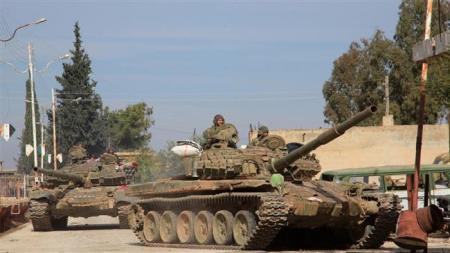
So far the Russian forces in Syria have deployed artillery groups and other ground forces while, according to reports coming from Russian sources, Russia is deploying batteries of S-400 anti-aircraft missiles again on Syrian territory, over and above providing “Buk” anti-aircraft missile systems to the Arab Syrian Army.

The S-400 missile – also known as “Growler”, according to the NATO designation – is an anti-aircraft missile which intercepts aircrafts flying up to 17,000 kilometers per hour, while “Buk” (also known as SAM 17) is a surface-to air missile system (also known as “Gainful” according to the NATO designation) with radars for the acquisition of targets, which are the enemy cruise missiles and strike aircrafts.

Nevertheless, why does Russia deploy such an advanced anti-aircraft structure if ISIS has no planes?

The simple answer to this question is because Russia wants to reduce and eventually eliminate Western raids, often objectively inconclusive or scarcely effective, also due to the lack of a network for target acquisition.

Conversely, Russia wishes to take Syria as a whole, after destroying or minimizing Al Baghdadi’s Caliphate.

President Putin needs a victory in Syria – firstly because the defeat of Al Baghdadi’s Caliphate avoids the jihadist radicalization of the over twenty million Muslim residents and citizens of Russia.

If the Russian and Central Asian Islam takes fire, Russia can no longer control – militarily or economically – the energy networks towards Europe and the Mediterranean region, which is the central axis of its geoeconomy.

Moreover, Vladimir Putin wants to become the only player of the Syrian crisis because, for Russia, ousting the West from a NATO neighboring country, which is pivotal for control over the Mediterranean region, means to become – in the future – one of the two players or even the first player  in the Mare Nostrum, with strategic consequences which are unimaginable today.

Finally, the Russian anti-aircraft missile systems are needed to wipe out the aircrafts of the powers not coordinating with Russia and to strengthen military cooperation with the countries which have accepted the Russian air superiority.

For example Israel which, for the time being, offsets by Russia the de facto breaking of military and strategic relations with the United States and the political anti-Semitism mounting in Europe.

Furthermore, Putin also holds together – in a hegemonic way – Iran, Bashar al-Assad’s Syria and the Lebanese Hezbollah, thus setting himself up as a mediator and power broker between the Shi’ite bloc and the West when, in all likelihood, the clash between the Sunnis and the “Party of Ali” will become disastrous and fatal for European security.

Furthermore, the Russian President wants to push the United States away from the Middle East definitively, regardless of the United States maintaining or not their preferential relations with Saudi Arabia.

Finally, within the UN Security Council, Russia will do its utmost to capitalize on its hopefully future victory against ISIS, by exchanging it with the achievement of other Russian primary interests: the management of the Arctic; the forthcoming militarization of the Shanghai Cooperation Organization; the regionalization of NATO eastward and possibly a new military agreement with China, which would make the composition of the UN Security Council completely asymmetrical.

Not to mention the great attraction which Russia would hold for a Eurasian peninsula left alone by the United States and devoid of acceptable defenses in the Southeast.

In this case, the Eurasia myth of the Russian philosopher and strategist, Alexander Dugin, would come true very quickly.

Russians let Hizballah into Daraa, breaking their promise to Israel

January 28, 2016

Russians let Hizballah into Daraa, breaking their promise to Israel, DEBKAfile, January 28, 2016

Syria_South

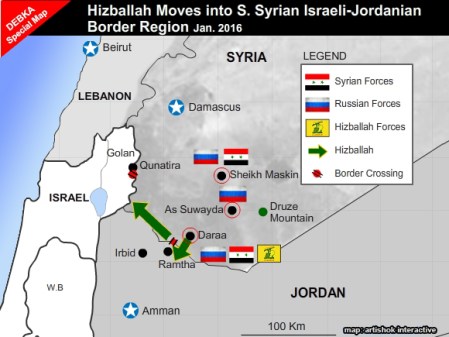
On Wednesday, Jan. 27 a large Hizballah force entered the southern Syrian town of Daraa, a critically dangerous event for Israel’s security. The way to the town, which lies near the Jordanian border and across from the Israeli Golan, was opened before Hizballah by none other than Russian forces. This was a blatant violation of President Vladimir Putin’s commitments to Prime Minister Binyamin Netanyahu and Jordanian King Abdullah not to permit Iranian and Iran-backed forces, such as Hizballah and Iraqi and Afghani Shiite militias, reach their borders in consequence of Russia’s military intervention in the Syria war.

Daraa is just 32 km from the southern Golan and 12 km from the Jordanian border. Hizballah forces in this town are therefore within easy striking distance from northern Israeli and Jordan.

What happened Wednesday was that a sizeable Hizballah contingent made it into Daraa, the day after a Syrian unit under the command of Russian officers captured the town of Sheikh Maskin, cutting off rebel forces east of Daraa from their comrades to the west.

Control of Sheikh Maskin is the key to the crossroads leading to Damascus in the north, the Druze Mountain town of es-Suwaida in the east, and Quneitra on Golan opposite Israel’s northern defenses.

The battle for Sheikh Maskin was the first in the Syrian conflict to be directly fought under Russian command. Its fall sparked accounts of Russian officers commanding Syrian troops in different parts of Syria.

So far, Israel has not reacted to the Hizballah force’s advance, notwithstanding public statements by Prime Minister Binyamin Netanyahu and Defense Minister Moshe Ya’alon that this would never be allowed to happen.

DEBKAfile’s military sources explain this reticence by a persistent misreading of the Syrian crisis in the higher ranks of the Israeli defense establishment. Military Intelligence chief Maj. Gen. Herzl Halevi, who has a good grasp of its complexities, is a lone voice against the defense minister and IDF chief of staff, Lt. Gen. Gady Eisenkot

In Amman, however, King Abdullah and his generals signified both alarm and fury. DEBKAfile’s sources report that Wednesday morning, the king shot off an urgent message to President Putin demanding an explanation for the Russian officers’ action in opening the door of Daraa to hostile Hizballah fighters.

Jordan has fought Hizballah and its conspiracies for three years, ever since its security forces seized an arms cache that Hizballah had smuggled into the kingdom for a terror cell to mount attacks in the northern province of Irbid. Amman is now concerned that Hizballah is close enough to make a grab for Al-Ramtha, the only border crossing between Syria and Jordan. That would be a feather in the cap of Iran’s Lebanese proxy, as the first Arab border crossing to fall to a Hizballah force outside Lebanon, and one, moreover, located athwart a main regional water source, the Yarmouk River.

As of Thursday morning, Jan. 28, Abdullah had not received a reply to his missive from Putin, but a message did come through to Amman from Syrian President Bashar Assad.

Using a back-door intelligence channel, he sent a notice in the name of Gen. Bahjat Suleiman, former Syrian ambassador to Jordan until he was expelled in May 2014, that King Abdullah must now face the consequences of his long support for the rebels of southern Syria.

The monarch was also advised to prepare for the influx of thousands of fleeing rebel fighters whom the combined Syrian and Hizballah forces were pushing towards the Jordanian border.

The next hours will be critical for the development of a similar crisis on the Israel-Syrian border in the Golan region.

A new US-Russian-Turkish military buildup over Syria: In unison or at odds?

January 25, 2016

A new US-Russian-Turkish military buildup over Syria: In unison or at odds? DEBKAfile, January 25, 2016

TurkishAirBase480

The US and Russia are in the process of a military buildup in the Kurdish areas of northern Syria. It is ranged along a narrow strip of land 85 km long, stretching from Hassakeh in the east up to the Kurdish town of Qamishli on the Syrian-Turkish border. Facing them from across that border is a parallel buildup of Turkish strength. This highly-charged convergence of three foreign armies athwart a tense borderland is reported here by DEBKAfile’s military sources. It is too soon to determine whether the three armies are operating in sync or at odds, especially in view of the bitter relations between Moscow and Ankara.

US Forces 

American Special Operations troops and Air Force attack helicopters landed first at Remelan airport. They are the first US troops to operate from a ground base in Syria, accommodated in living quarters built for them in advance by a US engineering corps unit. The airport runway has been widened for US warplanes.

American Special Operations troops and Air Force attack helicopters landed first at Remelan airport. They are the first US troops to operate from a ground base in Syria, accommodated in living quarters built for them in advance by a US engineering corps unit. The airport runway has been widened for US warplanes.

Russian Forces

Next came two Russian military missions on Jan. 16.  One group, led by a general and consisting of air force and Special Operations officers, is preparing to take over a small abandoned base in Syrian army-controlled territory just 80 km from the new US facility at Remelan, and adapt it for Russian use.

The other group, which consists of intelligence officers – some from Russia’s FSB federal security service, the FSB – indicates that Moscow has decided it is high time for professionals to protect the classified information moving around the Russian Task Force in Syria and safeguard it from reaching the wrong hands. .

The abandoned base is less than 3.5 km from the Turkish border, and would act as a Russian barrier between US forces in northern Syria and the Turkish border contingents.

Turkish Forces

This Russian deployment set off alarm bells in Ankara, and so the Turkish army responded with the third troop buildup, arraying tanks and mobile artillery on the border across from Qamishli.

Over the weekend, Turkish President Tayyip Erdogan stated, “We have said this from the beginning: we won’t tolerate such formations (in northern Syria) along the area stretching from the Iraqi border up to the Mediterranean.”

At the same time, US Vice President Joe Biden said Saturday, Jan. 23, that  the U.S. and Turkey are prepared for a military solution against ISIS in Syria should the Syrian government and rebel-opposition forces fail to reach a peace agreement during its upcoming meeting in Geneva.

However, Ankara views its war on terror as focused on both Kurdish separatists and ISIS, which is subjecting Turkey to multi-casualty attacks.

DEBKAfile’s military and intelligence sources note that Turkey’s military options are very limited. Its leaders know they dare not put a foot wrong because the Russian force in Syria is just waiting for an opportunity to avenge the downing of a Russian Su-24 warplane by the Turkish air force on November 24.

Another group of actors stirring the pot in northern Syria is the Kurds, particularly the YPG militia, the only fighting force in Syria capable of defeating ISIS, which has been reinforced by the Iraqi autonomous Kurdish region’s Peshmerga, as well as the outlawed Turkish PKK Kurdish organization.

At this stage, it is impossible to determine how this triple buildup will play out tomorrow – how far the US and Russia are in concert, at what point they may decide to vie for footholds in the Kurdish region of northern Syria and how far the Turks are clued into the joint US-Russian strategy for bludgeoning ISIS.

Russian Media Outlets Slam Turkey: Discuss Option Of Nuclear Attack On It, Accuse President Erdogan Of Supporting ISIS

January 19, 2016

Russian Media Outlets Slam Turkey: Discuss Option Of Nuclear Attack On It, Accuse President Erdogan Of Supporting ISIS, MEMRI, January 19, 2016

The Russian-Turkish conflict is reflected not only in the military, political and economic tension between the two countries but also in the Russian media, which expresses extreme hostility towards Turkey and its president.

This is evident, for example, in articles in English published recently on the Russian websites NEO[1] and Pravda.[2] One of these articles cites “a leading military expert” as saying that, in the event of a war between the two countries, “Russia will have to use nuclear weapons immediately, because the existence of the nation will be at stake.” The others focus on Turkish president Recep Tayyip Erdogan, presenting him as an enabler and supporter of the Islamic State (ISIS) and calling him a “madman” and a “murderer.” One even suggests that Turkey was “a prime mover in the [November 13] Paris attack.”

The following are excerpts from the articles.
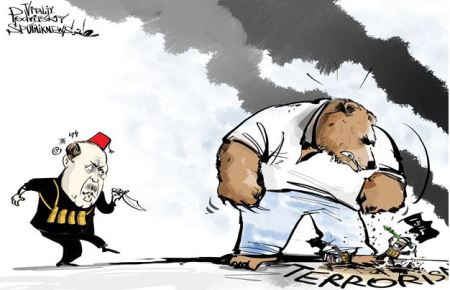
26473The Russian bear stamps out terror, but Erdogan prepares to stab it in the back (Sputniknews.com, November 24, 2015)

‘It Would Be A Mistake For Russia Not To Use Nuclear Weapons’ In A War With Turkey

A Pravda.ru article titled “‘Scenarios For Real War Between Russia And Turkey” states:

“The possibility of a full-fledged war between Russia and Turkey has been a talk of the day for conspiracy theorists, analysts, couch warriors and experts on international politics for several weeks already… Let’s assume that a real war sparks between Russia and Turkey (NATO) – what kind of war would it be? What results would it bring?

“Politonline.ru[3] discussed the topic with leading military experts that follow various approaches to international armed conflicts.

“A leading expert of the Center for Military and Political Studies,[4] Mikhail Alexandrov, is convinced that in case of a real war, Russia will have to use nuclear weapons immediately, because the existence of the nation will be at stake.

“‘It would be a mistake for Russia not to use nuclear weapons in this case,’ [he said]. ‘The West and Turkey will try to drag us into a war such as the Crimean war, where escalation will be slow, combat actions in the Caucasus will erupt, and the Russian group in Syria will be destroyed. The West will be helping Turkey – there will be military units and state-of-the-art aviation deployed there. It will be a war of the wearing-out strategy’, he said.

“‘From my point of view, should the war with Turkey start, it must be a determined, ambitious and quick war. Russia will have to strike a nuclear blow on main infrastructure and military targets in Turkey immediately’…

“‘During the first few hours of this war, Russia must destroy the entire military infrastructure of Turkey’, Mikhail Alexandrov said. ‘One does not even have to use ballistic missiles in this strike – Iskander-M with nuclear warheads would be enough. As soon as the military infrastructure is destroyed, the Russian troops will go and take the area of the straits’, he added.

“‘The West will not even have time to do anything. European countries will be so horrified that they will not even dare to intervene. The Americans will face a choice – either they begin a strategic nuclear war against Russia or not. As a result, Russia will take the area of the straits, and the rest will be left to Turkey’, said the expert.

“In turn, non-nuclear scenario of a hypothetical possibility, but deputy head of the Tauric information-analytical center at Russian Institute for Strategic Studies,[5] Sergey Ermakov, suggested a non-nuclear scenario.

“‘Hopefully, the real conflict will not happen. Using nuclear weapons is an extreme option. As for a  regional war, there are non-military tools in the region. There are many anti-Turkish players in the region. In the case of a military conflict, the Kurds will rip the region to pieces, so for Turkey, a war is a game not even with the zero, but with a negative sum’, he said.

“‘If Turkey provokes the conflict, NATO may not resort to the fifth article. Aggression is one thing, but a country asking for a conflict and pulling NATO into it is another thing. In such cases, NATO tries not to get involved’, Sergei Ermakov said.

“‘No one wants to get involved in a direct military conflict with Russia. This conflict is fraught with a nuclear war and a global tragedy’, he added.”[6]

‘The Leader Of The Turkish Nation Is Not Just An Islamist, He’s A Supporter Of International Terrorism”

An article on NEO titled “What Fate Awaits Turkey?” states:

“It is now clear that Tayyip Erdogan’s political career is heading to a closure, slowly but surely. He had a chance of saving it if he had the courage to immediately offer his apologies to Moscow after the downing of the Russian Su-24 bomber over Syria, that was in fact heading away from Turkey, not toward it.

“Instead, he got tangled in a web of ridiculous lies and explanations, all while being rude to Russia. On top of it all, he framed Washington, by trying to excuse the actions of the Turkish Air Force with alleged orders he personally received from Barack Obama at the G20 summit held in Antalya.

“But even with his back against the wall, Turkey’s President proved to be stubbornly shortsighted, which forced Russia to go even further by uncovering the role Turkey and Erdogan’s family played in the smuggling of stolen Syrian oil, which is a direct violation of the UN Security Council Resolution that was adopted on February 12, 2015. This means that the Turkish state is directly responsible for the sponsorship of international terrorism, which, according to the UN, should be punished in a particularly harsh manner.

“But what’s even more grave – the president has publicly disgraced himself before the country. His had already been steadily losing his position, but once he dropped his mask, his ratings started falling abruptly. It turns out that the leader of the Turkish nation is not just an Islamist, he’s a supporter of international terrorism.

“Now we are presented with a situation in which the AKP leader and the sitting Prime Minister Ahmet Davutoglu who are largely secured by the victory for the ruling party, has obtained as much influence as the president. And after the downing of Russia’s bomber he strengthened his positions even more, even though he decided not to distance himself publicly from the president. It’s safe to assume that he’s just quietly waiting for a perfect opportunity to strike a mortal blow. He’s nothing short of a dangerous contender that is prepared to replace Erdogan at any given moment.

“But the deposing of Erdogan is a relatively positive scenario. Those who remember Turkish history should know that Erdogan is hated by the military command of the Turkish Armed Forces, which has traditionally played a crucial role in the maintaining of country’s stability… The army is not getting any revenues from the illegal oil smuggling, so, should the ties between ISIL and Ankara be maintained, the military command, while enjoying the support of NATO allies, can launch a coup d’etat and return to the power they had three decades ago. But this scenario won’t satisfy local Kurds and other ethnic and religious minorities, who have experienced the cruelty of the army in the suppression of their rights first hand.

“Turkey is going to be plunged into political chaos, when the ruling AKP will find itself opposed by both the army and the legal opposition, along with 22 million Kurds led by the banned Kurdistan Workers Party (PKK). In this case, the civil conflict could result in the collapse of the Turkish state with the Kurdish areas (the entire South-East Anatolia) breaking away, seeking ways to create an independent Kurdistan that will absorb certain areas in Syria in Iraq, changing the whole balance of power in the Middle East.

“Whatever happens, one thing is clear: Tayyip Erdogan will be forced to answer for his stubbornness, inability to respect others, dictatorship, corruption, and connections with ISIL. And above all, he must answer to the people of Turkey. And also to Russia for the cowardly attacks that claimed the lives of two Russian soldiers who fought valiantly against terrorism.”[7]

‘Turkey May Well Have Been A ‘Prime Actor’ In The Paris Attack’

Another NOE article, titled “Mad King Erdogan’s Oil Lies,” stated: “Erdogan is claiming he stole no oil. He has threatened to resign if he receives proof. There is little doubt that Erdogan is insane, those who have been watching his dance of death with ISIS have known this all along.

“However, while Erdogan talks only of oil, there are other issues to note as well. First of all, let’s talk about arms shipments that cross Turkey and move into Syria and Iraq. By Erdogan’s claim of total innocence, we must assume that ISIS, al Qaeda and the other openly terrorist groups that make up 95% of those fighting against Iraq and Syria are operating without any outside supplies.

“Where Erdogan’s wild claims fail is simple as looking at a map. When Russia publishes surveillance photos of not just hundreds but thousands of oil trucks, how can there be denial? The roads that these trucks use only go to Turkey.

“They don’t go anyplace else, there is no place else. There is absolutely no vehicle traffic between the Turkish occupied areas of Iraq and Syria, and we might as well call them that, and the areas under control of the legitimate governments in Baghdad and Damascus.

“What is support of terrorism if it isn’t trading oil for arms or, moreover, trading oil and the other loot of Iraq and Syria, for the cooperation of Turkish politicians and, just perhaps, their European and American friends as well.

“Yet no one considers that Turkey may well have been a ‘prime actor’ in the Paris attack. Would Erdogan have downed a Russian plane if it weren’t for the Paris attack? What about the Russian airliner downed over Syria? When you add MH17 and examine what is now known, that Ukraine and Turkey have been working closely together all along, with ISIS troops joining Kiev forces against NovoRussians, do we see a pattern?”[8]

‘Turkey’s “Leader” Should Be Charged With Murder’

A Pravda.ru article titled “Turkey: Treacherous Turncoat,” stated:

“Turkey’s ‘leader’ should be charged with murder. The sanctimonious West is in denial. NATO, partly complicit if not the instigator, vows to defend the murderer. Washington, which knows every detail, feigns ignorance. Why is there no Western condemnation in absence of Turkey’s compunction?

“Turkey, though paying lip service to Obama’s ‘coalition of the coerced’ to at long last fight ISIS in Syria with military force, is loath to do so. More important Turkey has its political/economic motives to do just the opposite: not lift a finger (against ISIS). That is because, as President Putin already disclosed to Russia’s Western ‘partners’ at the G20 Summit, Turkey is in reality a turncoat. Russian military intelligence provided the evidence: Turkey, including its President, are really aiding and abetting the ISIS terrorists. Detailed satellite images show that Turkey provided the egress for the stolen oil that ISIS has been trucking in and through Turkey.

“From there the contraband, once brokered by the Turks, is sold elsewhere. The ‘buyers’ list includes Israel, the European Union and as some have suggested, even America. The scale and the scope of the covert theft equates to over 50 million barrels. Moreover, Turkey has profited from this nefarious heist for almost four years. Russia has more proof. The laundered money trail flows straight to the Turkish President’s palace. Using a labyrinth of the Erdogan’s financial network including his own son, the ill-gotten gains are then spirited outside the country.

“While the Kurds fight ISIS, Erdogan courts the terrorists by providing them military cover. Russia, now wiser as to Erdogan’s true colors, should endeavor to be ever more vigilant in its Syria campaign as to joining the West’s coalition of ‘partners’.

“That same portent applies to the newest ‘partners’: Hollande and Cameron. The two turkeys are even bigger U.S. vassals. Neither one is trustworthy. Syria’s war is about oil; both Putin and Assad know that well.”[9]


Endnotes:


[1] NEO (New Eastern Outlook) is the journal of the Russian Academy of Science’s Institute of Oriental Studies, a leading research institution dealing with Asian and African countries and cultures. NEO presents itself as follows: “We cover political and religious issues, economic and ideological trends, regional security topics and social problems. We are committed to develop NEO into a notable international networking platform offering unbiased expert opinions and open dialogue among all thinking people worldwide regardless of their nationality, race or religion… We are focused on creating a new culture of partnership where opinions influence decisions.” (Journal-neo.org, “About” section, accessed January 12, 2016).

[2] Pravda.ru is a pro-government news and opinion website. According to its former Director General, Vadim Gorshenin, it is the successor of Pravda, the official mouthpiece of the Soviet Union’s Communist Party. It was founded by prominent members of Pravda’s editorial staff who left it in 1999, and today it is privately owned by Pravda.ru Holding, of which Gorshenin is the head.  Its current Director General, Inna Novikova, is Gorshenin’s wife.

The Pravda website publishes in four languages: Russian, English, Italian, Portuguese, and has more than 200,000 visitors daily. According Gorshenin, the English version is the second most popular English-language Russian website, after Russia Today (Pravda.ru, September 16, 2013).

[3] Politonline.ru is a political website, part of the Pravda media network.

[4] The Center for Military-Political Studies is a division of the Russian foreign ministry’s Moscow State Institute of International Relations. The center studies trends and affairs in the domains of defense policy, weaponry, military industry, military cooperation and state security (Eurasian-defence.ru).

[5] The Russian Institute for Strategic Studies (RISS) is a research center established by the President of the Russian Federation. Its main task is to inform various Russian state institutions on the political, economic and socio-political situation in the Black Sea countries and  Mediterranean region (En.riss.ru).

[6] Pravdareport.com, December 8, 2015. The Russian version of the article was published on Politonline.ru on November 27, 2015.

[7] Journal-neo.org, December 7, 2015. The author, Peter Lvov, is described by NEO as a Ph.D in political science.

[8] Journal-neo.org, December 7, 2015. The author, Gordon Duff, is described by NEO as a U.S. Marine combat veteran of the Vietnam War and a senior editor and board chairman of the Veterans Today website.

[9] Pravdareport.com, December 16, 2016. The author’s name is given as “Montresor.”

Gen. Dvornikov: Russia’s combined C-in-C and top diplomat in Syria

January 10, 2016

Gen. Dvornikov: Russia’s combined C-in-C and top diplomat in Syria, DEBKAfile, January 10, 2016

Colonel_General_Alexander_Dvornikov

[T]he Russian general walks on eggs in a job that requires him to collaborate militarily with Iran and Hizballah, on the one hand, and uphold the understandings Putin reached with Prime Minister Binyamin Netanyahu, on the other, over Israeli Air Force actions against terrorists and their conflictive interests in the southern Syrian regions bordering on Israel.

********************

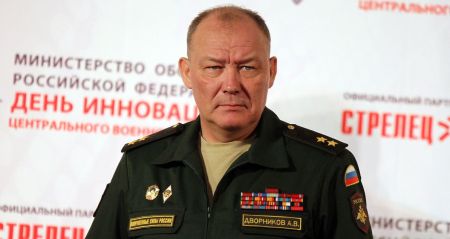
It was in August, 2015, on the eve of the massive Russian military intervention in Syria, that President Vladimir Putin selected Col. Gen. Alexander Dvornikov, 54, as chief of Russia’s military operation in Syria and Iraq, DEBKAfile’s military and intelligence sources report. He resolved a fierce debate among Russia’s top officials and generals over the officer to lead the what was to be the most high-powered venture of the Putin presidency. Many favored a senior air force officer, conceiving the campaign as focusing mainly on air strikes. They proposed Col. Gen. Victor Nikolaevich Bondarev, chief of Aerospace Defense Forces, a branch established just four months ago.

Putin overruled them, having decided that the diplomatic and ground components were to be just as important as the future aerial campaign. He picked Gen Dvornikov, whom he first met 26 years ago in Berlin during the last moments of the dying Soviet empire. In 2015, he judged the general as being the right man for the job he had in mind, by virtue of his extensive military experience in running the 2000-2003 North Caucasus wars against Islamic terror groups, as chief of staff and a motorized infantry division commander.

In his new posting, Gen. Dvornikov was given control of the twin Russian commands in Damascus and Baghdad. They function as two halves of the same war room.

At the Damascus headquarters, he has three partners: the Syrian Chief of Staff Gen. Ali Abdullah Ayyoub, the Iranian Revolutionary Guards Gen. Key Parvar and the commander of Hizballah forces in Syria, Mostafa Bader el-Din. Until his mysterious disappearance in November, Gen. Qassem Soleimani, Iranian commander in Syria and Iraq, would put in an occasional appearance at high command conferences.

The two command centers’ operations are fully coordinated and keep the single overall commander, Col. Gen. Dvornikov, on top of events and in control of decisions 24/7 – a key position of enormous authority and extreme diplomatic sensitivity for juggling Moscow’s opposition allies and interests.

The Saudi government, which operates, arms and funds a number of Syrian rebel militias, regards the Russian general as the ultimate nemesis of its interests in Syria, because he expends as much force on fighting those militias as in striking the Islamic State.

After the Hizballah super terrorist Samir Quntar was assassinated on Dec. 20, the Saudis engineered a press leak showing how Gen. Dvornikov was turned away from the door of the Iranian command headquarters in Damascus when he came to offer condolences for the death of one of their top agents. The Iranians were furious with the Russian commander for allowing Israeli air planes free rein to fire rockets into Quntar’s secret hideout in Damascus.

That incident was an illustration of how the Russian general walks on eggs in a job that requires him to collaborate militarily with Iran and Hizballah, on the one hand, and uphold the understandings Putin reached with Prime Minister Binyamin Netanyahu, on the other, over Israeli Air Force actions against terrorists and their conflciting interests in the southern Syrian regions bordering on Israel.

Concentrated Russian air strikes may open Syrian-Hizballah door to Israeli border

December 30, 2015

Concentrated Russian air strikes may open Syrian-Hizballah door to Israeli border, DEBKAfile, December 30, 2015

Sheikh_Maskin_29.12.15Sheikh Maskin-Syrian Army’s 82nd Brigade base

On the face of it, Moscow and Jerusalem make a show of their smooth air force collaboration in Syrian air space. But this picture is wide of the situation: The Russian air force omitted to notify Israel ahead of its massive bombardment close to its border Tuesday.

*****************************

Israel’s military and political leaders became intensely anxious Tuesday, Dec. 29, when they saw how concentrated Russian air strikes were swiftly dislodging anti-Assad rebels from southern Syria and beginning to open the door for the Syrian and Hizballah armies to come dangerously close to the Israeli border.

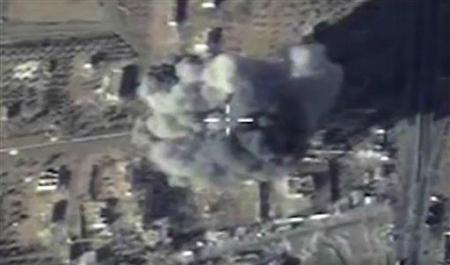
DEBKAfile’s military and intelligence sources report that Russian air strikes in other parts of the country have tapered off. Instead, heavy Russian bombardments are giving the combined Syrian-Hizballah force its first chance to recover Sheikh Maskin, the southern town housing the Syrian Army’s 82nd Brigade which has been passing from hand to hand for months. If the rebels lose that fierce battle, the way will be clear for the combined pro-Assad force to advance on the two key southern towns, Deraa and Quneitra on the Golan.

The rebel groups assaulted by the Russian air force Tuesday included moderate, pro-Western, pro-Israeli militias, such as the Southern Front and the First Column. Both suffered heavy casualties.

IDF unease as a result of Russia’s aerial intervention in the fighting in southern Syria is rising in proportion to the current military tensions with Hizballah. If the Lebanese Shiite terrorists manage to get the late Samir Quntar’s anti-Israel terror Front for the Liberation of Golan up and running, the Israeli air force would be severely hampered in launching its own strikes against this enemy by the dozens of Russian bombers using the same patch of sky without pause.

On the face of it, Moscow and Jerusalem make a show of their smooth air force collaboration in Syrian air space. But this picture is wide of the situation: The Russian air force omitted to notify Israel ahead of its massive bombardment close to its border Tuesday.

Some Israeli official circles suspect that Moscow is deliberately bringing Israel under pressure to accept a deal for southern Syria. One of President Vladimir Putin’s main objects from the outset of Russian’s military buildup in Syria was to eradicate the rebels in the South and the threat they posed to the Assad regime in Damascus.

More than once, Putin suggested to Prime Minister Binyamin Netanyahu that they work out a Russian-Israeli deal for that part of Syria. The Israeli leader was unresponsive, mainly because Israel is bound by prior understandings to coordination with the US, Jordan and moderate Syrian rebel groups. A deal with Moscow would counter those understandings.

However, The concentrated air strikes in the border region is intended by the Kremlin, according to some views, not just to push the rebels out, but to twist Israel’s arm for settling the issue with Moscow.

Assad again controls Damascus thanks to Russian air strikes and intelligence

December 26, 2015

Assad again controls Damascus thanks to Russian air strikes and intelligence, DEBKAfile, December 26, 2015

Allous_Killed_25.12.15

Less noticed, was the UN plan to remove at the same time several thousands ISIS fighters from the Syrian capital and transport them to their Syrian headquarters. The latter project has not been trumpeted for good reason: It implies UN recognition of ISIS as a party in the Syria war.

***************************

The Russian air strike that Friday, Dec. 25, killed Zahran Aloush, founder of the most powerful Syrian rebel group Jaysh al-Islam and his deputy, gave President Bashar Assad a big break in the Syrian war, thanks to his powerful backer, Vladimir Putin.

This grave loss will accelerate the breakup of Syrian rebel strongholds in and around Damascus. It will also hasten the evacuation under a UN-sponsored ceasefire of at least 2,000 rebels from the Damascus region. Less noticed, was the UN plan to remove at the same time several thousands ISIS fighters from the Syrian capital and transport them to their Syrian headquarters. The latter project has not been trumpeted for good reason: It implies UN recognition of ISIS as a party in the Syria war.

For nearly five years, the war seesawed back and forth, with neither the Syrian army nor the insurgents gaining the upper hand for long, even after Tehran threw its Lebanese proxy, Hizballah,  into the fray to bolster Assad’s army.

Interventions by the US, Saudi Arabia, Qatar, the UAE, Jordan and Israel were too trifling and hesitant to tilt the balance in favor of the anti-Assad insurgent militias. Weapons supplies were inferior and tardy and kept the rebels heavily outgunned by the Syrian army’s tanks, helicopters and fighter jets, and helpless against the Iranian-made barrel bombs dropped by the Syrian air force.

The Obama administration was the architect of this uneven support strategy, going so far as to constrain the rebels’ other foreign backers against giving them the resources for carrying the day, aside from local victories.

This strategy had the effect of prolonging the vicious conflict – until it was cut short by two events:

1. In the summer of 2014, the Islamic State of Iraq and the Levant arrived in full force to capture the northern Iraqi city of Mosul, scattering seven Iraqi armed divisions to the four winds, and grabbing  their sophisticated American weapons, along with their arsenals, that were crammed with good American tanks, armored personnel carriers, and an assortment of surface, antitank and antiair missiles.

Part of this booty was diverted to ISIS Syrian headquarters in Raqqa.

2.  A year later, in late September 2015, President Vladimir Putin embarked on a massive buildup of Russian military strength in Syria – notably, his air and missile forces – for direct intervention in the war.

In contrast to President Barack Obama, who sought to keep his hand on the conflict by a complicated system of dribbling arms to select Syrian rebel groups, Putin went all out with massive military and strategic backing to assure the Syrian ruler and his Iranian ally of victory.

The Russian strategy is now becoming evident:  It is to drive the rebels out of the areas they have captured around the main cities of Latakia, Aleppo, Idlib, Homs, Hama and the capital, Damascus, giving them two options: join the opposition front around the table for negotiating an end to the war, or total eradication – even though Moscow and Washington have yet to agree which of the rebel militias belong around that table.

According to Moscow’s scale of priorities, the fight against the Islamic State must wait its turn until after Bashar Assad’s authority as president is fully restored and his country returns to his army’s control.

But on the way to this objective, Putin has run up against a major impediment: the failure of Iranian, Shiite militia, Hizballah and Syrian army ground forces keep up with his pace. The plan was for Russian air strikes and missiles to clear rebels out of one area after another and for pro-Assad ground troops to storm in and take over.

But these troops are proving too slow to press the advantage given them by the Russians.

Last week, the Russians decided to use their intelligence assets to speed things up. They borrowed an Israeli counter-terror tactic to start targeting key rebel chiefs for liquidation.

The death of the Jaysh al-Islamc commander as the result of a Russian airborne rocket strike on Friday was an intelligence feat rather than a military one. Just as Israel last Sunday used its clandestine assets in Damascus to precisely target the Hizballah-Iranian arch terrorist Samir Quntar at his home in the Jaramana district, so the Russians directed their agents on the ground to mark the secret meeting of Jaysh al-Islam commanders at Marj al-Sultan at the precise moment for taking them down.

This blow to the rebel movement, plus the mass-evacuation of its fighters from the Syrian capital, are major steps towards bringing the Syrian capital back under the control of the Syrian dictator.

The battles in N. Syria will determine the fate of the peace process

December 21, 2015

The battles in N. Syria will determine the fate of the peace process, DEBKAfile, December 21, 2015

Syria_Iraq_Kurdsweekly

The US-Russian plan, approved by the UN Security Council as the lever for activating a political process towards ending the five-year Syrian war, can only go so far towards its objectives. The process is not capable of halting the fighting or removing Bashar Assad from power; just the reverse: progress in the talks is heavily dependent on the state of play on the battlefields of the north while the Syrian dictator’s ouster is a fading issue.

The limitations and obstacles facing the UN-endorsed US-Russian plan are summed up here by DEBKAfile’s analysts:

1. The understanding reached by the Obama administration and the Kremlin in the past month was first conceived as a stopgap measure. It was never intended to bring the calamitous Syrian war to an end or remove Assad, but rather to provide a pretext to account for the expansion of Russia’s ground operation and gloss over America’s military deficiencies in the Syrian conflict. Taking it as carte blanche from Washington, President Vladimir Putin felt able to announce Saturday, Dec. 19, that “the Russian armed forces have not employed all of their capability in Syria and may use more military means there if necessary.”

2. President Barack Obama has stopped calling for Assad’s removal as the condition for ending the war and is silent on the expanding Russian military intervention. Obama and Putin have in fact developed a working arrangement whereby Putin goes ahead with military operations and Obama backs him up..

3. Almost unnoticed, on Dec. 17, the day before the Security Council passed its resolution for Syria, all the 12 US warplanes that were deployed a month earlier at the Turkish air base of Incirlik for air strikes in Syria were evacuated. This happened at around the same time as Russia deployed to Syria its Buk-M2-SA-17 Grizzly antiaircraft missile systems. The presence of this system would have endangered American pilots had US air strikes over Syria not been halted. The upshot of the two evidently coordinated moves was the US withdrawal of most of its military resources for striking the Islamic State forces in Syria and the handover of the arena to the Russian army and air force.

4. In another related development, Friday, Dec. 18 the German intelligence service, BDN, leaked news that it had renewed its contacts with the Assad regime’s intelligence services and German agents were now visiting Damascus regularly. The import of this change is that Berlin no longer relies on US intelligence briefings from Syria and, rather than turn to Moscow, it prefers to tap its own sources in the Syrian capital.

5. Washington and Moscow are still far apart on the shape of the transitional government mandated by the Security Council resolution

The Obama administration wants Assad to hand presidential powers over the military and of all security-related and intelligence bodies to the transitional government, which is to be charged with calling general and presidential elections from which Assad will be barred.

Putin won’t hear of this process. He insists on a transitional government being put in place and proving it can function before embarking on any discussion of its powers and areas of authority.

The two presidents agree that the transition will need at least two years, overlapping the Obama presidency by about a year and dropping the issue in the lap of his successor in the White House.

6. The US and Russia don’t see to eye to eye either on which Syrian opposition organizations should be represented in the transitional government and which portfolios to assign them. On this question, both Washington and Moscow are at odds with the Persian Gulf states, Saudi Arabia, Qatar and the UAE, which back some of the organizations labeled as terrorist by Moscow.

7. But it is abundantly clear that the Obama administration is ready to wash its hands of the Syrian rebel movement and most of all, abandon Turkish President Tayyip Erdogan to give the Russians an open remit.

On Saturday, Dec. 19, Putin turned the screw again on Erdogan when he said he had no problem with the Turkish people, adding, “As for the current Turkish leadership, nothing is eternal.”

In support of Moscow, Obama meanwhile leaned hard on the Turkish president in a telephone conversation, to remove Turkish forces from northern Iraq. Ankara responded that Putin’s comment was not worth a response and denied hearing of any such US request.

Ankara may be feigning ignorance but it must realize by now that Moscow and Washington have joined forces to pus the Turkish military out of any involvement in northern Syria and Iraq.

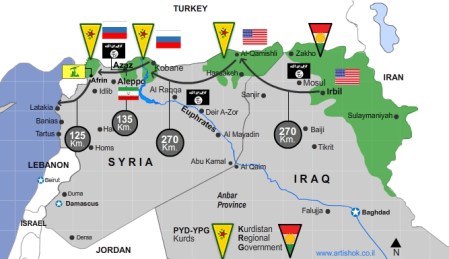
8. This US-Russia collaboration against Turkey is having a dramatic effect on the war in northern Syria along the Turkish border. DEBKAfile’s military and intelligence sources report it opened the door to the secret deal between Washington and Moscow to divide the areas of influence in northern Syria between them – essentially assigning the Kurdish enclaves north of the Euphrates river and bordering on Iraq to American influence (see map), and the areas west of the Euphrates up to the Mediterranean to Russian control. This deal (first revealed by DEBKA Weekly 688 on Dec. 4) effectively squeezes Turkey out of any role in the Syrian conflict.

9. The ongoing battles in northern Syria near the Turkish border will have a greater impact in shaping the future of Syria and its unending conflict than any UN resolution. Participating in the fighting at present is a very big mixed cast: Russia, the Kurdish YPG militia, most of the important rebel groups, including radical Sunni organizations tied to Al Qaeda, such as the Nusra Front and Ahram al-Sham, Iran and Shiite Hizballah, and the Islamic State.

It is only when one of these forces gains the upper hand in this free-for-all, that there will be progress toward a political solution on ending the war.

US bows to Russian demand to keep Assad in office. Israel follows suit

December 16, 2015

US bows to Russian demand to keep Assad in office. Israel follows suit, DEBKAfile, December 16, 2015

kerry-meets-putin-moscow_15.12.15

After two tries, US Secretary of State John Kerry finally turned President Barack Obama away from his four-year insistence that Bashar Assad must go, as a precondition for a settlement of the Syrian conflict. Tuesday, night, Dec. 15, the Secretary announced in Moscow: “The United States and our partners are not seeking so-called regime change.”

After Kerry’s first try, Obama still stuck to his guns. He said in Manilla on Nov.19 that he didn’t believe the civil war in Syria “will end while the dictator remains in power.”

Almost a month went by and then, Tuesday night, after a day of dickering with Foreign Minister Sergei Lavrov culminating in a joint conference with Putin at the Kremlin, Kerry confirmed this evolution in US policy. The focus now, he said, is “not on our differences about what can or cannot be done immediately about Assad.” Rather, it is on facilitating a peace process in which “Syrians will be making decisions for the future of Syria.”

Rather, it is on facilitating a peace process in which “Syrians will be making decisions for the future of Syria.”

This statement brought Washington in line with Moscow’s demand for the Syrian president’s future to be determined by his own people.

This statement brought Washington in line with Moscow’s demand for the Syrian president’s future to be determined by his own people.

On this demand, Iran’s Ayatollah Ali Khamenei is even more obdurate than Putin.

DEBKAfile’s Middle East sources wonder about the measure of freedom the Syrian people can expect while it is clamped firmly in a military vice by Russia, Iran and Hizballah. However, this was of no immediate concern to the big power players. Washington’s surrender to the Russian and Iranian line on Assad’s future was offered in the short-term hope of progress at the major international conference on the Syrian question taking place in New York Friday.

Another major US concession – this one to Tehran – was scarcely noticed.

Earlier Tuesday, the UN nuclear watchdog’s 35-nation board in Vienna closed its investigation into whether Iran sought atomic weapons, opting to back the international deal with Tehran rather than dwell on Iran’s past activities.

This motif of going forward toward the future rather than dwelling on the past was a repeat of the argument for keeping Assad in power. It provided an alibi for letting Tehran get away with the suspicion of testing a nuclear detonation at its Parchin military complex, without forfeiting sanctions relief, by the simple device of denying access to UN nuclear agency monitors to confirm those suspicions.

In a single day, the Obama administration handed out certificates of legitimacy to the Syrian dictator, who is responsible for more than a quarter of a million deaths, and to Iran’s advances toward a nuclear weapon.

These epic US policy reversals carried three major messages:

1. The Obama administration has lined up behind Putin’s Middle East objectives which hinge on keeping Bashar Assad in power.

2. Washington endorses Russia’s massive military intervention in Syria, although as recently as last month Obama condemned it as doomed to failure.

3. The US now stands behind Iran – not just on the Syrian question – but also on the existence of an Iranian-Syrian-Hizballah alliance, based on a solid land bridge from Iran and the Gulf up to the Mediterranean coast under Russian military and political protection and influence.

Even more surprising were the sentiments heard this week in Jerusalem.

Our military and intelligence sources cite officials urging the government to accept the American policy turnaround. In some military circles, senior voices were heard commenting favorably on Assad’s new prospects of survival in power, or advising Israel to jump aboard the evolving setup rather than obstructing it.

Those same “experts” long claimed that Assad’s days were numbered. They were wrong then and they are wrong now.

Israel was forced to yield on the Iranian nuclear program, but its acceptance of the permanence of Assad and the indefinite presence in Syria of his sponsors, Iran and Hizballah, will come at a high price for Israel in the next conflict.