Posted tagged ‘Putin’

Putin’s low-key Syrian operation – a call to Trump

November 16, 2016

Putin’s low-key Syrian operation – a call to Trump, DEBKAfile, November 16, 2016

The Russian air force and navy launched a “large-scale” operation against “terrorists” in the Syrian provinces of Idlim and Homs Tuesday, Nov. 15. Bombers took off from the Hmeymim air base and the Admiral Kuznetsov aircraft carrier whle cruise missiles were fired from the Admiral Grigorovich frigate. According to Russian Defense Minister Sergey Shoigu, who addressed a meeting of Russian generals with President Vladimir Putin, the targets were positions of the Islamic State and Al Nusra.

He did not say how long the operation would go on.

DEBKAfile’s military and intelligence sources say that the proportions of the Russian operation as seen from the ground better fit the description of low key than “large scale.”

No more than 2 Sukhoi Su-33 fighters lifted off the carrier’s decks and only a few Kaliber cruise missiles were fired from the frigate. They were not aimed at Islamist terrorist positions, but at arms factories and ammunition stores. Towards evening, a third Russian air strike hit a target in the hills overlooking the coastal province of Latakia.

The timing of the Russian operation was significant. It came five days after President Barack Obama finally ordered the Pentagon to seek out and target Nusra Front leaders, after long holding out against Moscow’s demand in this regard, and 12 hours after US president elect Donald Trump and Putin held their first telephone conversation after the election.

Since the attack was too limited to change the military situation on the Syrian war’s front lines, what was its purpose? And why was its launch given world-wide exposure accompanied by a photo-op of the Russian president meeting his generals for heightened drama?

It appears that Putin sought by this maneuver to convey the impression that Trump had agreed to the operation during their initial conversation on Monday. It is far more likely, however, that the Russian leader presented the offensive to Trump in general terms and did not hear an explicit negative response. He therefore decided to go ahead with the attack, marking out Islamist terrorists – which the president elect had declared in his campaign as America’s enemy – on the assumption that he would not disagree with a Russian strike against a consensual target. By this maneuver, Putin hoped to draw the next US president into backing Russia’s strategy in the Syrian war.
It is hard to believe that Donald Trump will be so easily drawn.

Putin hits Europe for letting Muslim migrants get away with crimes: “A society that cannot defend its children has no future”

November 3, 2016

Putin hits Europe for letting Muslim migrants get away with crimes: “A society that cannot defend its children has no future”, Jihad Watch

Russia has become the bogeyman of the 2016 presidential election, with the Democrats far more exercised about the threat from Moscow than they ever were during the Cold War (which they spent ridiculing those who thought there was a genuine threat from the Soviet Union). But however villainous one may think Putin is, he is absolutely right here: the massive influx of Muslim migrants in Europe has caused a “dissolution of traditional national values,” and indeed, “a society that cannot defend its children has no future.” That’s the United Kingdom, with its massive Muslim rape gang activity that authorities feared being called “racist” and “Islamophobic” if they stopped, and Austria with its release of the Muslim migrant who raped a 10-year-old boy — indeed, the illness has overtaken all of Europe’s political and media elites.

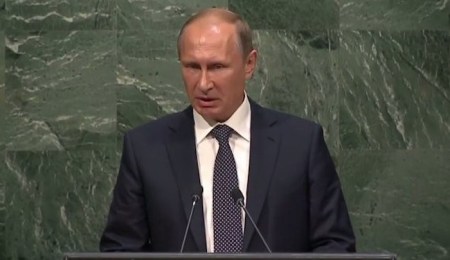
putin

“‘A society that can’t defend its children has no tomorrow’: Putin condemns Europe’s handling of migrants and says the child rape in Austria shows ‘a dilution of national values,’” by Jennifer Newton, MailOnline, November 3, 2016:

Vladimir Putin has waded into the migrant crisis condemning Europe’s handling of asylum seekers and saying a case of child rape in Austria ‘dilutes national values’….

The Russian president has largely kept quiet over the refugee crisis in Europe but has now spoken out of his disbelief over its handling claiming that a continent that ‘can’t protect its children’ has no future.

His comments come off the back of a case in Austria last week, which saw an Iraqi migrant have his conviction of raping a 10-year-old boy at a swimming pool in Vienna overturned.

He was originally convicted of the crime but it was overturned because a court didn’t prove he realised the boy was saying no.

It came after the migrant, identified as 20-year-old Amir A., claimed that it was a ‘sexual emergency’ because he had not had sex for four months.

A second trial for the rape is expected to take place next year, but the attacker is likely to remain in custody until then.

And speaking at a press conference this week, Putin slammed Europe’s migration policy and cited the case, where the victim was from a Serbian family living in Austria.

He said: ‘In a European country, a child is raped by a migrant, and the court releases him.

‘It doesn’t fit into my head what on earth they’re thinking over there.

‘I can’t even explain the rationale – is it a sense of guilt before the migrants? What’s going on? It’s not clear.’

He also claimed that the case highlighted ‘the dissolution of traditional national values’ adding: ‘A society that cannot defend its children has no future.’

And Putin’s words appeared to have struck a chord, as he is extremely popular with Serbs.

In the rape case, the boy had arrived in Austria with his Serbian mother, who paid for him to go to the Theresienbad swimming pool, where he was violently attacked.

The boy was so badly injured that he needed hospital treatment but he will be forced to go back to court for the Iraqi man’s second trial, outraging the Austrian Serbian community….

In March, Konstantin Romodanovsky, head of Russia’s Federal Migration Service accused leaders of willfully ignoring cultural differences that have caused such widespread friction and chaos across the Continent.

He also added that ‘multiculturalism has failed’ because Europe never formed a unified strategy to integrate refugees into Western society….

Romodanovsky also accused EU countries of ignoring the ‘differences in culture, religious traditions, and customs’ with the refugees, the vast majority of whom are Islamic.

Germany: World must take action in order to end Syrian crisis

October 21, 2016

European leaders condemn Russia for involvement in Syrian civil war The German Chancellor announced that the EU will take action in order to put an end to the deteriorating situation in Syria.

Oct 21, 2016, 4:00PM

Source: Germany: World must take action in order to end Syrian crisis – World News | JerusalemOnline

Merkel and Putin Photo Credit: Reuters/Channel 2 News

While the Russian and Syrian airstrikes on Aleppo continue, German Chancellor Angela Merkel said today (Friday) that the entire world needs to take action in order to end the “barbaric” situation in the city. Merkel added that if the attacks do not end, the EU will take measures against Russia and the Syrian government. Additional European leaders also condemned Russia for the continuous attacks on the city.

“We demand an end to the attacks,” said Merkel. “We have not only said that we could not only impose sanctions against Syria but also sanctions against all who are allied with Syria. This applies to Russia.” The EU leaders indented to impose new sanctions on Moscow but Italy has been opposing this course of action.

British Prime Minister Theresa May said that she would support sending a strict message to Russia and Syria in order to cause them to cease the attacks. UN High Commissioner for Human Rights Zeid Ra’ad Al Hussein called the attacks on Aleppo “crimes of historic proportions.”

Russia & Turkey carve anti-US enclaves in Syria

October 15, 2016

Russia & Turkey carve anti-US enclaves in Syria, DEBKAfile, October 15, 2016

rusturk

US President Barack Obama told Pentagon and military chiefs he met Friday, Oct. on Oct. 14, that instead of arming anti-Assad rebel groups in Syria, Washington was going back to negotiations with Moscow for cooperation in achieving a cessation of hostilities in the Syrian war.

US Secretary of State John Kerry therefore scheduled his umpteenth meeting with Russian Foreign Minister Sergey Lavrov for Saturday in Lausanne. This time, the foreign ministers of Turkey, Turkey, Iran, Saudi Arabia and possibly Qatar, tagged along.

Beyond the high words, recriminations and the unspeakable horrors attending the battle for Aleppo, Obama never seriously considered providing the anti-Syrian rebels holed up in Aleppo with the anti-air weapons they need to shoot down the Russian and Syrian warplanes blitzing them – any more than UK Foreign Secretary Boris Johnson’s statement that it was time for British military involvement in the Syrian war was for real

Above all, Britain is short of the military heft for backing up hypothetical intentions.

The options for serious Western intervention in the Syrian war are constantly diminishing for the reasons outlined here by DEBKAfile’s military sources:

1.  American missiles have no way of reaching Syrian rebel groups, certainly not those still fighting in eastern Aleppo. Neither Russia, nor Turkey, whose army now controls 5,000 sq. km of northern Syria, would let them through to that destination.

2. Had Turkish President Tayyip Erdogan chosen to do so, he could have simply ordered his army to open up a route for the supply of missiles to the rebels who are hemmed in in Aleppo by Russia, Syrian, Iranian and Hizballah forces. He is withholding that order because the military deals he concluded with President Vladimir Putin last week in Istanbul override any concerns he may have for the fate of those rebels or Aleppo’s population.

3. Those deals in a word sanctify the Turkish “security zone” in northern Syria which is covered by a no-fly zone for all but Russian and Turkish flights. They also provide for the Syrian rebels retreating from the various Syrian war zones, including Aleppo, to be taken in and absorbed in the Turkish enclave. Erdogan would thus become the senior patron of the Syrian opposition rebel movement, barring only the Al-Qaeda-affiliated Nusra Front and other Islamic extremist groups. This would enable him to steal from the United States, Saudi Arabia, Jordan and Qatar their sponsorship roles and their influence in the anti-Assad movement.

4. Ankara’s military alliance with Moscow is steadily eroding Turkey’s ties with the United States as well as NATO. Matters have gone so far that the two capitals or in advanced discussion of the supply of Russian air defense missiles to the Turkish army.

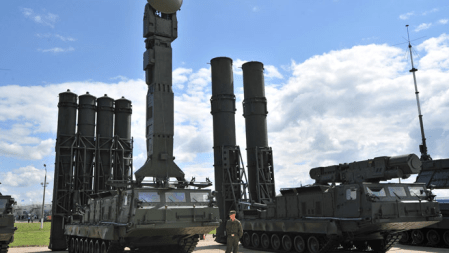
DEBKAfile’s intelligence sources reveal that under discussion is the installation in Turkey of a system of advanced Russian missiles linked to the Russian anti-air missile shield under construction in Syria.

Turkey would thus become the first member of NATO to arm itself with a Russian anti-air missile shield.

How was this allowed to happen?

According to our sources, Putin and Erdogan are moving fast to cash in on President Obama’s repugnance for military intervention in Syria and his waning powers at the tail end of his presidency.

Furthermore –

a) Neither is configuring Syrian President Bashar Assad into their calculations. They are going forward with their plans while ignoring him and his drastically diminished army as factors worth consideration.

b)  Their objectives are similar and interlocking:  Both are intent on developing their respective enclaves in northern Syria, Moscow for a long-term military presence in the country: likewise, Ankara.

Up until now, the Obama administration stood firm against the two goals, which is why Washington and Moscow were unable to achieve any real cooperation over a secession of hostilities in the war-torn country;  even when Kerry and Lavrov struck a truce accord on Sept 9, it never held up beyond a few hours.

Most recently, Putin and Erdogan tried signaling the US president that their sole ambitions with regard to Syria’s future lie in the two military enclaves now under construction.

Obama saw this as a sufficient basis to continue withholding advanced arms from Syrian rebel groups and to go for another round of diplomacy with Russia – with Turkey hitching a ride this time on the opposite side of the table..

Putin Ally Warns Americans To Vote For Trump Or Face Nuclear War

October 13, 2016

Putin Ally Warns Americans To Vote For Trump Or Face Nuclear War

by Tyler Durden

Oct 13, 2016 2:53 AM

Source: Putin Ally Warns Americans To Vote For Trump Or Face Nuclear War | Zero Hedge


The name of what is arguably Russia’s most flamboyant, ultra-nationalist politician, and according to some the local incarnation of Donald Trump,  Vladimir Zhirinovsky, a deputy in the state Duma and leader of the nationalist LDPR party, is familiar to frequent readers: he most recently made an appearance on these pages two months ago, when he warned Germany that it risks utter destruction if it continued on its present track of operating Bundeswehr forces in the Baltics. Zhirinovsky also shares another feature with Donald Trump: both are outspoken to a fault. Which is why we were not surprised to read that as Reuters reported earlier, Zhirinovsky urged Americans to vote for Donald Trump as president or “risk being dragged into a nuclear war.”

In an interview with Reuters, Vladimir Zhirinovsky, known in Russia and Europe for his fiery rhetoric, said that Trump was the only person able to de-escalate dangerous tensions between Moscow and Washington.

On the other hand, Hillary Clinton could spark World War Three, said the Russian who received a top state award from Putin after his pro-Kremlin Liberal Democratic Party of Russia (LDPR) came third in Russia’s parliamentary election last month.

“Relations between Russia and the United States can’t get any worse. The only way they can get worse is if a war starts,” said Zhirinovsky, speaking in his huge office on the 10th floor of Russia’s State Duma, or lower house of parliament. “Americans voting for a president on Nov. 8 must realize that they are voting for peace on Planet Earth if they vote for Trump. But if they vote for Hillary it’s war. It will be a short movie. There will be Hiroshimas and Nagasakis everywhere.”

Well, we said he was outspoken. And, Just like Trump, Zhirinovsky tends to polarize his fellow countrymen. According to Reuters while “many Russians regard the politician as a clownish figure who makes outspoken statements to grab attention” he is also “widely viewed as a faithful servant of Kremlin policy, sometimes used to float radical opinions to test public reaction.”

Zhirinovsky’s comments come at a time when relations between Russia and the US are at generational lows, as a result not only of the conflicts raging over Syria and Ukraine but also the recent White House accusation that Russia was responsible for cyber attacks against Democratic Party organizations. In turn, an amused Putin replied his country was not involved in an effort to influence the U.S. presidential election. Instead Putin accused the US of “starting this hysteria, saying that this (hacking) is in Russia’s interests. But this has nothing to do with Russia’s interests,” in a speech during a business forum in Moscow. He added that the accusations were a ploy to divert U.S. voters’ attention at a time when public opinion was being manipulated. “Everyone is talking about ‘who did it’ (the hacking),” said Putin. “But is it that important? The most important thing is what is inside this information.”

* * *

But back to “Russia’s Trump”: according to Reutersi, “Zhirinovsky likes to shock liberal public opinion and he has frequently heaped scorn on the West, which he and other Russian nationalists regard as decadent, hypocritical and corrupted by political correctness.

His combative style, reminiscent of Trump’s, ensures him plenty of television air time and millions of votes in Russian elections, often from the kind of blue-collar workers who are the bedrock of the U.S. Republican candidate’s support.


Zhirinovsky once proposed blocking off mostly Muslim southern Russia with a barbed wire fence, echoing Trump’s call for a wall along the U.S. border with Mexico.


Zhirinovsky, who said he met Trump in New York in 2002, revels in his similarities with the American businessman – they are the same age, favor coarse, sometimes misogynistic language and boast about putting their own country first. Zhirinovsky has even said he wants a DNA test to see if he is related to Trump.

Where the two differ, is that unlike Trump, an “anti-establishment candidate in the U.S. presidential race with no past political experience”, Zhirinovsky is a consummate political insider who has sat in the Duma for more than two decades; he is also more diplomatic when he needs to be, such as in this interview in which he continued to praise Trump: “(Trump) won’t care about Syria, Libya and Iraq and why an earth should America interfere in these countries? And Ukraine. Who needs Ukraine?,” said Zhirinovsky, who once counted himself a friend of Iraq’s Saddam Hussein and Libyan dictator Muammar Gaddafi and whose deaths he still laments.

“Trump will have a brilliant chance to make relations more peaceful … He’s the only one who can do this,” he said, adding that Trump could even win a Nobel peace prize.

And if he likes Trump, he must dislike Hillary. Sure enough Zhirinovsky described Clinton as “an evil mother-in law” and said her record as secretary of state under Obama in 2009-2013 showed she was unfit to lead her country.

“She craves power. Her view is that Hillary is the most important person on the planet, that America is an exceptional country, as Barack Obama said,” said Zhirinovsky. “That’s dangerous. She could start a nuclear war.”

 He did not stop here: “Most Americans should choose Trump because men have been leading for millions of year. You can’t take the risk of having one of the richest, most powerful countries led by a woman president,” he said.

Asked about lewd comments Trump made about women in 2005 that have harmed his campaign, Zhirinovsky defended the Republican: “Men all round the world sometimes say such things that are just for their comrades. We must only consider his business (and political) qualities.”

Zhirinovsky, who believes that although Putin and Trump have never met they could establish a close working relationship, had a very binary conclusion: “victory for Trump would be a gift to humanity. But if Hillary Clinton wins it will be the last U.S. president ever.”

Only time will tell if he is right.

Putin’s Puritan Piety: The Ideological War against the West

October 9, 2016

Putin’s Puritan Piety: The Ideological War against the West, Gatestone InstituteGiulio Meotti, October 9, 2016

Russia is one of the few countries in the Western world in which religion is becoming increasingly important and not less.

To establish his authority on the Russian society, President Vladimir Putin has shaped a doctrine mobilizing the entire Russian society against a perceived Western “decadence”. He has declared that Russian traditional family values are a bulwark against the West’s “so-called tolerance — genderless and infertile.”

The first Cold War was a clash between Western democracy and the Soviet dictatorship of the proletariat. The new Cold War is a one between Western liberalism and Russian conservatism.

During the Cold War, American conservatives used to label the Soviet Union “the godless nation” on the verge of collapse because it had purged religion from the Russian society. Two decades later, the Kremlin is occupied by a former officer of the KGB, secretly baptized, who launches the same accusation of atheism at the United States and the West.

Welcome to “Putin’s covert war on Western decadence“, as The Spectator defined it:

“Putin’s Russia is fast becoming a very puritan place. Ever since returning to the presidency in 2012, Putin has pursued an increasingly religious-conservative ideology both at home and abroad, defining Russia as a moral fortress against sexual licence and decadence, porn and gay rights”.

Recently, Russian officials censored porn websites. When the largest pornography site on the internet, PornHub, offered the Russia’s official communications and media watchdog a premium account in exchange for lifting the ban, Russian officials replied: “Sorry, we are not in the market and the demography is not a commodity.”

Russian President Vladimir Putin’s ideological war against the West is getting cocky and self-confident. In a televised speech from a Kremlin hall, Putin declared that Russian traditional family values are a bulwark against the West’s “so-called tolerance — genderless and infertile.”

“Many Euro-Atlantic countries have abandoned their roots, including Christian values,” said Putin. The patriarch of the Orthodox Church, Kirill, echoed Putin by charging the West of being engaged in a “spiritual disarmament” of the Russian people, and by criticizing the European laws that prevent wearing religious symbols in public. “We have experienced an era of atheism and we know what it means to live without God”, Kirill said.

1931Russian President Vladimir Putin meets with Patriarch Kirill of the Russian Orthodox Church, May 24, 2015. (Image source: The Kremlin)

The first ten years of Putin’s dominance were devoid of any religious and cultural reference. Putin and his circle never mentioned any “values”, and did not try to teach any moral lessons to the West. The second Putin decade has been marked by a “conservative revolution” based on the revival of an isolated Russian Orthodox culture, separated for centuries from European civilization. “Putin wants to make Russia into the traditional values capital of the world,” saidMasha Gessen, author of a Putin biography, entitled The Man Without a Face: The Unlikely Rise of Vladimir Putin. In the Russian media, Putin is now called “the savior of the decadent West.”

Putin is now focused on a church in the heart of Paris. The Sainte-Trinité Cathedral, often referred to as “Moscow on the Seine,” is under construction near the Eiffel Tower, in the Quai Branly, and will be the largest Orthodox cathedral in France. “This church is an outpost of the other Europe, conservative and anti-modern, in the heart of the country of libertinism and secularism”, said Michel Eltchaninoff, a French scholar and author of the book, Dans la tête de Vladimir Poutine (“Inside the Head of Vladimir Putin“), on the thoughts of the Russian president.

Are France, the United States and Ireland open to gay marriage? Putin’s Russia bans “gay propaganda“. Does Western Europe allow quick divorce? Putin’s Russia taxes divorce. Does the West legalize abortion on demand? Putin’s Russia is trying to restrict it. Russia’s leading clerics have just urged Putin to ban abortion. A new Russian law also targets “foreign religions.”

“Western values, from liberalism to the recognition of the rights of sexual minorities, from Protestantism to comfortable prisons for murderers, arouse in us suspicion, wonder and alienation”, said Yevgeny Bazhanov, one of Putin’s “intellectuals”. Putin has apparently even managed to win the support of the most renowned Russian musicians, such as the conductorValery Gergiev, superintendent at the St. Petersburg Marjinskij theater.

Even in foreign policy, Putin often justifies its decisions with references to Christianity. The New York Times explained that, in addition to strategic and economic interests, a major reason to explain Russian support for Assad’s regime in Syria is the uncompromising position of the Orthodox Church. The Russian Patriarch Kirill evoked, in fact, the Bolshevik Revolution of 1917, with its endless “carcasses of defiled churches.”

Before that, there was the historical role of Russia in defense of Armenian Christians against Turkish pro-Western Muslims, and Christian Serbs against Bosnian Muslims supported by the U.S. To try to justify the invasion of the Crimea, Putin said that is “our Temple Mount,” a reference to Judaism’s holiest site in Jerusalem.

Vladimir Putin has presided for years over the great revival of Orthodox Christianity. On the eve of the Bolshevik Revolution, the Russian church had 50,000 parishes and 60 schools. By 1941, Stalin had eliminated the church as a public institution. Every monastery and seminary had been closed. With the fall of communism in 1991, the church began to rebuild its devastated institutional life. Putin’s Russia is returning to the concept of Byzantine symphonia — an approach in which church and state work together.

The church apparently aspires to achieve the “re-Christianization of the Russian nation.” Although as much as 70% of Russians call themselves Orthodox and are baptized, only 4% take part in the liturgy. But Russia is also one of the few countries in the Western world in which religion is becoming increasingly important and not less.

To establish his authority over the Russian society, Putin has shaped a doctrine mobilizing the entire Russian society against a perceived Western “decadence.” The Kremlin has closely followed the opposition to gay marriage in France and tensions over migrants in the European Union. Putin then launched a conservative offensive aimed at both Russians and Europeans. As the Wall Street Journal wrote, “Putin Depicts Russia as a Bulwark Against European Decadence.”

Against a perceived Western amnesia about its own Christian past, moral relativism and political correctness, Putin affirmed the Christian roots of Russia, traditional family values, patriotism and obedience to hierarchy.

“According to him, in essence, Europe has entered a phase of decadence, while Russia is in an ascending phase of its history”, Michel Eltchaninoff says of Putin.

“He relies on the pseudo-scientific model of Konstantin Leontiev, one of whose most famous concepts Vladimir Putin is fond of quoting: that of ‘flourishing complexity’. According to the Russian philosopher, who took a fervently anti-European and anti-bourgeois position, any civilisation, after a period of original simplicity, reaches its apex in an era of flourishing complexity, before declining into a period of simplification and confusion. For Leontiev, ever since the Renaissance, Europe has ceased to give birth to saints and geniuses, and only engenders engineers, parliamentarians and ethics professors. It makes everything uniform, through its mode of development and its conformism. But it is also confused. Its inhabitants are lost, and no longer know how to give meaning to their lives. They show themselves to be incapable of perceiving an inspiring superior principle.”

The first Cold War was a clash between Western democracy and the Soviet dictatorship of the proletariat. Western freedom crushed the Soviet gulags. The new Cold War is a one between Western liberalism and Russian conservatism.

As happened during the first Cold War, when the Soviets depicted capitalism as a Western fault, avaricious and amoral, the burden is presumably again on the West to prove it has better way of life and that its society is not just a “decadent” stereotype. Meanwhile, against the West’s visible lack of self-confidence and the deterioration of Europe’s élite, Putin’s geopolitical and ideological hegemony is getting stronger.

Obama set for Mosul battle, leaves Aleppo to Putin

October 8, 2016

Obama set for Mosul battle, leaves Aleppo to Putin, DEBKAfile, October 8, 2016

(Please see also, The Obama administration is pushing Iraq into further chaos. — DM)

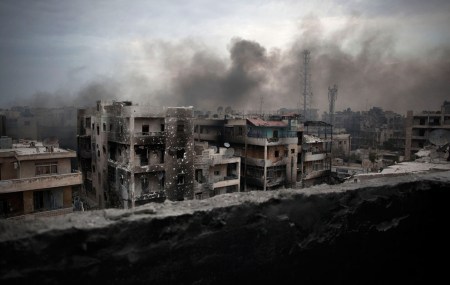
aleppo_destruction

Obama is brooking no distractions from his main objective, He hopes the Mosul operation will be over and done with by mid-December, so that when he exits the White House in January, he will have chalked up a major victory against the Islamic State as part of his legacy.

****************************

The warlike rhetoric heard from Washington over the plight of the stricken Syrian town of Aleppo does not represent any current Obama administration plan for military intervention to halt the ever-mounting carnage.

President Barack Obama’s mind is elsewhere.

This was discovered by his national security adviser Susan Rice every time she tried to arrange for Defense Secretary Ashton Carter and the Chairman of the Chiefs of Staff Gen. Joseph Dunford to be received by the president. After the collapse of diplomacy with Moscow for a cessation of hostilities, they had drawn up a plan for limited US military intervention in Syria that would enable essential humanitarian aid to reach the population.

Obama refused to hear what the trio had to say and the plan was shelved.

DEBKAfile’s Washington sources report that, for now, the US president’s mind is fixed exclusively on the preparations for the Oct. 19 offensive for the liberation of the Iraqi city of Mosul from ISIS occupation. US, Iraqi, Iraqi and Kurdish forces are aligned for the battle.

Obama is brooking no distractions from his main objective, He hopes the Mosul operation will be over and done with by mid-December, so that when he exits the White House in January, he will have chalked up a major victory against the Islamic State as part of his legacy.

In the process, the Democratic president intends to debunk the Republican candidate Donald Trump’s criticism of his administration as showing weakness in the face of ISIS.

Russian President Vladimir Putin is exploiting Obama’s preoccupation with the Mosul offensive to snatch a free hand for pushing the Aleppo battle to its barbaric limit. He is letting Bashar Assad and his allies conduct a scorched earth policy – even if this means reducing Syria’s second town to ruins.

Russian and Syrian jets are bombing the city, building by building, leaving the 8,000 rebels still fighting there with little hope of survival, since food, water, medicine or ammunition and anti-air missiles are out of their reach. The only form of resistance remaining to them is marksmen sniping from the rubble in an attempt to slow the advance of Syria, Iranian and Hizballah foot soldiers.

Obama, Putin and Assad are not alone in sentencing Aleppo to its doom: Turkish President Tayyip Erdogan, after grabbing 5,000 sq. km of northern Syria, is letting his army stand by idly as every attempt to bring life-saving assistance from Turkey to the beleaguered population is thrown back.

The Turkish leader is shielding himself with his secret deal with Putin, whereby his army is given a free hand in northern Syria without Russian interference, while the Aleppo arena becomes a Russian-Syrian precinct that is off-limits to Turkey.

This secret deal has also neutralized the US special operations forces deployed in northern Syria as well as the small Syrian rebel militias they trained and sponsor. Washington has therefore lost any leverage for swaying events in that part of the country. Since they are hemmed in on all sides, Obama refuses to hear of any military intervention in an area under Russian-Turkish control.

As he sees the larger picture, the northern Syrian devolution as a sphere of Turkish-Russian influence is balanced by US-Iraqi-Kurdish domination of northern Iraq

On paper, the US plans and preparations afoot for the liberation of Mosul are impressive.

Elite US troops are being pumped into the Mosul region – 600 just this week. Altogether an estimated 12,500 US servicemen are assigned for the offensive, which is due to be launched in 11 days, on Oct. 19.

This is the largest American military force to fight in Iraq since the battles against Al Qaeda during 2006-2007.

US military engineers are working overtime on the construction of bases around Mosul for the intake of US and Iraqi army units. The Kurdish Republic’s Peshmerga army is in position to the north.

Two new US facilities have just been completed. One is near the Mosul Dam, which regulates the flow of the Tigris River bisecting the targeted city. A second is located in the Bashiqa Mountains north of Mosul.

The two bases plus Kurdish army posts are designed as jumping-off points on the city from the south, east and Uninvited military forces are hovering nearby hoping to pick up a piece of the action. Among them are Turkish military units, local Iraqi militias, such as Turkmen, which the Turkish army is training for combat, and pro-Iranian Iraqi militias, such as the Badr Brigades and the Popular Mobilization Forces.

US commanders are intent on keeping these hangers-on out of the action, because their participation in the Mosul offensive would deepen the discord dividing Iraq’s Shiite, Sunni and Kurdish communities, and throw the city into chaos after the jihadists are driven out. US officers failed to check the sectarian violence that erupted in another Sunni-dominated town, Fallujah, in the wake of the battles for its recovery from ISIS in May and June.

Obama Warned To Defuse Tensions With Russia, “Unintended Consequences Likely To Be Catastrophic”

October 5, 2016

Obama Warned To Defuse Tensions With Russia, “Unintended Consequences Likely To Be Catastrophic”

Source: Obama Warned To Defuse Tensions With Russia, “Unintended Consequences Likely To Be Catastrophic” | Zero Hedge

A group of ex-U.S. intelligence officials is warning President Obama to defuse growing tensions with Russia over Syria by reining in the demonization of President Putin and asserting White House civilian control over the Pentagon.

ALERT MEMORANDUM FOR: The President


FROM: Veteran Intelligence Professionals for Sanity


SUBJECT: PREVENTING STILL WORSE IN SYRIA


We write to alert you, as we did President George W. Bush, six weeks before the attack on Iraq, that the consequences of limiting your circle of advisers to a small, relatively inexperienced coterie with a dubious record for wisdom can prove disastrous.* Our concern this time regards Syria.


We are hoping that your President’s Daily Brief tomorrow will give appropriate attention to Saturday’s warning by Russia’s Foreign Ministry spokesperson Maria Zakharova: “If the US launches a direct aggression against Damascus and the Syrian Army, it would cause a terrible, tectonic shift not only in the country, but in the entire region.”


Speaking on Russian TV, she warned of those whose “logic is ‘why do we need diplomacy’ … when there is power … and methods of resolving a problem by power. We already know this logic; there is nothing new about it. It usually ends with one thing – full-scale war.”


We are also hoping that this is not the first you have heard of this – no doubt officially approved – statement. If on Sundays you rely on the “mainstream” press, you may well have missed it. In the Washington Post, an abridged report of Zakharova’s remarks (nothing about “full-scale war”) was buried in the last paragraph of an 11-paragraph article titled “Hospital in Aleppo is hit again by bombs.” Sunday’s New York Times totally ignored the Foreign Ministry spokesperson’s statements.


In our view, it would be a huge mistake to allow your national security advisers to follow the example of the Post and Times in minimizing the importance of Zakharova’s remarks.


Events over the past several weeks have led Russian officials to distrust Secretary of State John Kerry. Indeed, Foreign Minister Sergey Lavrov, who parses his words carefully, has publicly expressed that distrust. Some Russian officials suspect that Kerry has been playing a double game; others believe that, however much he may strive for progress through diplomacy, he cannot deliver on his commitments because the Pentagon undercuts him every time. We believe that this lack of trust is a challenge that must be overcome and that, at this point, only you can accomplish this.


It should not be attributed to paranoia on the Russians’ part that they suspect the Sept. 17 U.S. and Australian air attacks on Syrian army troops that killed 62 and wounded 100 was no “mistake,” but rather a deliberate attempt to scuttle the partial cease-fire Kerry and Lavrov had agreed on – with your approval and that of President Putin – that took effect just five days earlier.


In public remarks bordering on the insubordinate, senior Pentagon officials showed unusually open skepticism regarding key aspects of the Kerry-Lavrov deal. We can assume that what Lavrov has told his boss in private is close to his uncharacteristically blunt words on Russian NTV on Sept. 26:


“My good friend John Kerry … is under fierce criticism from the US military machine. Despite the fact that, as always, [they] made assurances that the US Commander in Chief, President Barack Obama, supported him in his contacts with Russia (he confirmed that during his meeting with President Vladimir Putin), apparently the military does not really listen to the Commander in Chief.”


Lavrov’s words are not mere rhetoric. He also criticized JCS Chairman Joseph Dunford for telling Congress that he opposed sharing intelligence with Russia, “after the agreements concluded on direct orders of Russian President Vladimir Putin and US President Barack Obama stipulated that they would share intelligence. … It is difficult to work with such partners. …”


Policy differences between the White House and the Pentagon are rarely as openly expressed as they are now over policy on Syria. We suggest you get hold of a new book to be released this week titled The General vs. the President: MacArthur and Truman at the Brink of Nuclear War by master historian H. W. Brands. It includes testimony, earlier redacted, that sheds light on why President Truman dismissed WWII hero Gen. Douglas MacArthur from command of U.N. forces in Korea in April 1951. One early reviewer notes that “Brands’s narrative makes us wonder about challenges of military versus civilian leadership we still face today.” You may find this new book more relevant at this point in time than the Team of Rivals.


The door to further negotiations remains ajar. In recent days, officials of the Russian foreign and defense ministries, as well as President Putin’s spokesman, have carefully avoided shutting that door, and we find it a good sign that Secretary Kerry has been on the phone with Foreign Minister Lavrov. And the Russians have also emphasized Moscow’s continued willingness to honor previous agreements on Syria.


In the Kremlin’s view, Russia has far more skin in the game than the U.S. does. Thousands of Russian dissident terrorists have found their way to Syria, where they obtain weapons, funding, and practical experience in waging violent insurgency. There is understandable worry on Moscow’s part over the threat they will pose when they come back home. In addition, President Putin can be assumed to be under the same kind of pressure you face from the military to order it to try to clean out the mess in Syria “once and for all,” regardless how dim the prospects for a military solution are for either side in Syria.


We are aware that many in Congress and the “mainstream” media are now calling on you to up the ante and respond – overtly or covertly or both – with more violence in Syria. Shades of the “Washington Playbook,” about which you spoke derisively in interviews with the Atlantic’s Jeffrey Goldberg earlier this year. We take some encouragement in your acknowledgment to Goldberg that the “playbook” can be “a trap that can lead to bad decisions” – not to mention doing “stupid stuff.”


Goldberg wrote that you felt the Pentagon had “jammed” you on the troop surge for Afghanistan seven years ago and that the same thing almost happened three years ago on Syria, before President Putin persuaded Syria to surrender its chemical weapons for destruction. It seems that the kind of approach that worked then should be tried now, as well – particularly if you are starting to feel jammed once again.


Incidentally, it would be helpful toward that end if you had one of your staffers tell the “mainstream” media to tone down it puerile, nasty – and for the most part unjustified and certainly unhelpful – personal vilification of President Putin.


Renewing direct dialogue with President Putin might well offer the best chance to ensure an end, finally, to unwanted “jamming.” We believe John Kerry is correct in emphasizing how frightfully complicated the disarray in Syria is amid the various vying interests and factions. At the same time, he has already done much of the necessary spadework and has found Lavrov for the most part, a helpful partner.


Still, in view of lingering Russian – and not only Russian – skepticism regarding the strength of your support for your secretary of state, we believe that discussions at the highest level would be the best way to prevent hotheads on either side from risking the kind of armed confrontation that nobody should want.


Therefore, we strongly recommend that you invite President Putin to meet with you in a mutually convenient place, in order to try to sort things out and prevent still worse for the people of Syria.


In the wake of the carnage of World War II, Winston Churchill made an observation that is equally applicable to our 21st Century: “To jaw, jaw, jaw, is better than to war, war, war.”

For the Steering Group, Veteran Intelligence Professionals for Sanity

William Binney, former Technical Director, World Geopolitical & Military Analysis, NSA; co-founder, SIGINT Automation Research Center (ret.)

Fred Costello, Former Russian Linguist, USAF

Mike Gravel, former Adjutant, top secret control officer, Communications Intelligence Service; special agent of the Counter Intelligence Corps and former United States Senator

Matthew Hoh, former Capt., USMC, Iraq & Foreign Service Officer, Afghanistan (associate VIPS)

Larry C. Johnson, CIA & State Department (ret.)

John Kiriakou, former CIA counterterrorism officer and former senior investigator, Senate Foreign Relations Committee

Linda Lewis, WMD preparedness policy analyst, USDA (ret.) (associate VIPS)

Edward Loomis, NSA, Cryptologic Computer Scientist (ret.)

Ray McGovern, former US Army infantry/intelligence officer & CIA analyst (ret.)

Elizabeth Murray, Deputy National Intelligence Officer for Middle East, CIA (ret.)

Todd Pierce, MAJ, US Army Judge Advocate (ret.)

Coleen Rowley, Division Counsel & Special Agent, FBI (ret.)

Kirk Wiebe, former Senior Analyst, SIGINT Automation Research Center, NSA, (ret.)

Robert Wing, former Foreign Service Officer

Ann Wright, U.S. Army Reserve Colonel (ret) and former U.S. Diplomat

* In a Memorandum to President Bush criticizing Colin Powell’s address to the UN earlier on February 5, 2003, VIPS ended with these words: “After watching Secretary Powell today, we are convinced that you would be well served if you widened the discussion … beyond the circle of those advisers clearly bent on a war for which we see no compelling reason and from which we believe the unintended consequences are likely to be catastrophic.”


Putin signs decree suspending Russia-US deal on plutonium disposal over hostile US actions

October 3, 2016

Putin signs decree suspending Russia-US deal on plutonium disposal over hostile US actions

Published time: 3 Oct, 2016 08:23 Edited time: 3 Oct, 2016 16:48

Source: Putin signs decree suspending Russia-US deal on plutonium disposal over hostile US actions — RT News

And so it goes, lets trow in another Nobel peace price, priceless !

20/30 years negotiating trough the drain, and having fun already ?


Russia has suspended a post-Cold War deal with the US on disposal of plutonium from decommissioned nuclear warheads. The decision was explained by “the hostile actions of the US” against Russia and may be reversed, if such actions are stopped.

A decree signed by Russian President Vladimir Putin cites “the radical change in the environment, a threat to strategic stability posed by the hostile actions of the US against Russia, and the inability of the US to deliver on the obligation to dispose of excessive weapons plutonium under international treaties, as well as the need to take swift action to defend Russian security” as justification for suspending the deal.

While Russia suspended the plutonium reprocessing deal, it stressed that the Russian fissile material, which was subject to it, would not be used for any military purpose, be it production of new weapons or research.

The suspension decree has come into force, but it needs to be approved by the Russian parliament, which may overrule the president’s decision. Leonid Slutsky, who’s slated to be appointed head of the Foreign Relations Committee in the newly-elected parliament, said it would be given a priority.

“It’s a very important issue. It’s about taking swift action to protect Russian national security. We will deal with it as soon as the bill is submitted,” he told TASS.

A bill submitted by the president’s office to the parliament on Monday states that the uranium agreement may be resumed, provided the US takes steps to eliminate the causes of the suspension. In particular, Moscow wants Washington to curb its military presence on the territories of NATO members which have joined the alliance after September 1, 2000, to the number at which they were at the moment of signing the agreement, Russian media report.

The draft bill also mentions repeal of the so-called Magnitsky law and of sanctions against Russian regions, persons and companies introduced by the US over Ukrainian crisis, while also paying compensation for damages caused by them, including the damages caused by the counter-sanctions that Russia was forced to impose.

The Magnitsky Act is a 2012 US law intended to punish a number of Russian citizens believed to be linked to the death in custody of Russian lawyer Sergey Magnitsky.

Moscow also wants Washington to provide a clear plan how it is going to irreversibly reprocess plutonium under the agreement’s conditions.

Russian Foreign Minister Sergey Lavrov later said in a statement that Russia’s suspension of the agreement is “a forced measure.” According to the minister, Moscow has always viewed the Russia-US deal on plutonium disposal as an important step to nuclear disarmament.

“Unfortunately, in recent years the US has made a number of unfriendly steps towards Russia. In particular, under false pretexts, Washington introduced large-scale economic and other sanctions against Russia,” he said. “The US has started the build-up of its military forces and NATO infrastructure close to Russia’s borders. Washington and its allies openly talk about ‘restraining’ Russia.”

Lavrov added that Russia’s move “is a signal to Washington”:

“Trying to talk with Russia using strength, the language of sanctions and ultimatums, and still maintain selective cooperation with our country only in those areas where it is beneficial for the US, won’t work,” he added.

The development was not entirely surprising, since Russia earlier expressed its dissatisfaction with how the US wants to handle plutonium reprocessing.

Washington decided it would be cheaper to mix nuclear materials with special diluents. Russia insisted that the US was violating the terms of the deal, which required it to use a nuclear reactor to transmute plutonium. Unlike the mixing technology, the latter method makes the process irreversible.

The treaty between the US and Russia, which regulates how the two countries are to dispose of plutonium from nuclear warheads decommissioned as part of the parallel reduction of the two countries’ Cold War arsenals, was signed in 2000. Each country was required to dispose of over 34 tons of fissile material by turning it into so-called MOX fuel and burning it in nuclear reactors.

READ MORE: Why Russia can’t rely on US as partner against terrorism in Syria (OP-ED)

However, costs for building a facility at the Savannah River Site in South Carolina, where the US was supposed to fabricate MOX fuel from its plutonium, spiraled out of control. Under the Obama administration, the US decided that it would instead use the cheaper reversible process, arguing that it was in line with the spirit of the deal with Russia.

Russia expressed its concerns over the unilateral move in April, shortly after a nuclear security summit held in the US.

“We signed an agreement that the plutonium will be processed in a certain way, for which facilities would be purpose-built,” Putin said at the time. “We have met our commitments, and constructed the necessary facilities. The US has not.”

The US rejected the criticism from Russia. The “new US method would not require renegotiation of the agreement,” US State Department spokesperson Jennifer Bavisotto said.

Column One: The New Middle East

September 29, 2016

Column One: The New Middle East, Jerusalem PostCaroline B. Glick, September 29, 2016

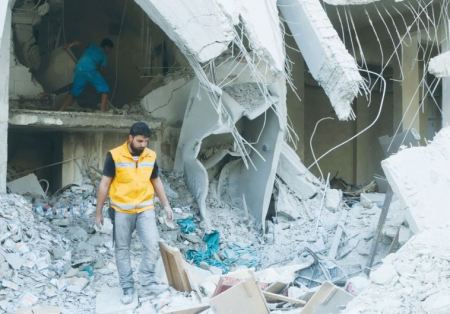
aleppo-messA RED CRESCENT aid worker inspects scattered medical supplies after an air strike on a medical depot in Aleppo on Saturday.. (photo credit:REUTERS)

So Obama let Syria burn. He let Iran and Hezbollah transform the country into their colony. And he let Putin transform the Mediterranean into a Russian lake.

A new Syria is emerging. And with it, a new Middle East and world are presenting themselves. Our new world is not a peaceful or stable one. It is a harsh place.

The new Syria is being born in the rubble of Aleppo.

The eastern side of the city, which has been under the control of US-supported rebel groups since 2012, is being bombed into the Stone Age by Russian and Syrian aircraft.

All avenues of escape have been blocked. A UN aid convoy was bombed in violation of a fantasy cease-fire.

Medical facilities and personnel are being targeted by Russia and Syrian missiles and barrel bombs to make survival impossible.

It is hard to assess how long the siege of eastern Aleppo by Russia, its Iranian and Hezbollah partners and its Syrian regime puppet will last. But what is an all but foregone conclusion now is that eastern Aleppo will fall. And with its fall, the Russian-Iranian-Hezbollah-Assad axis will consolidate its control over all of western Syria.

For four years, the Iranians, Hezbollah and Bashar Assad played a cat and mouse game with the rebel militias.

Fighting a guerrilla war with the help of the Sunni population, the anti-regime militias were able to fight from and hide from within the civilian population. Consequently, they were all but impossible to defeat.

When Russian President Vladimir Putin agreed to join the fight, he and his generals soon recognized that this manner of fighting ensured perpetual war. So they changed tactics. The new strategy involves speeding up the depopulation and ethnic cleansing of rebel-held areas. The massive refugee flows from Syria over the past year are a testament to the success of the barbaric war plan. The idea is to defeat the rebel forces by to destroying the sheltering civilian populations.

Since the Syrian war began some five years ago, half of the pre-war population of 23 million has been displaced.

Sunnis, who before the war comprised 75% of the population, are being targeted for death and exile. More than 4 million predominantly Sunni Syrians are living in Turkey, Lebanon and Jordan. More than a million have entered Europe. Millions more have been internally displaced. Assad has made clear that they will never be coming home.

At the same time, the regime and its Iranian and Hezbollah masters have been importing Shi’ites from Iran, Iraq and beyond. The process actually began before the war started. In the lead-up to the war some half million Shi’ites reportedly relocated to Syria from surrounding countries.

This means that at least as far as western Syria is concerned, once Aleppo is destroyed, and the 250,000 civilians trapped in the eastern part of what was once Syria’s commercial capital are forced from their homes and property, the Russians, Iranians, Hezbollah and their Syrian fig leaf Assad will enjoy relative peace in their areas of control.

By adopting a strategy of total war, Putin has ensured that far from becoming the quagmire that President Barack Obama warned him Syria would become, the war in Syria has instead become a means to transform Russia into the dominant superpower in the Mediterranean, at the US’s expense.

In exchange for saving Assad’s neck and enabling Iran and Hezbollah to control Syria, Russia has received the capacity to successfully challenge US power. Last month Putin brought an agreement with Assad before the Duma for ratification. The agreement permits – indeed invites – Russia to set up a permanent air base in Khmeimim, outside the civilian airport in Latakia.

Russian politicians, media and security experts have boasted that the base will be able to check the power of the US Navy’s Sixth Fleet and challenge NATO’s southern flank in the Mediterranean basin for the first time. The Russians have also decided to turn their naval station at Tartus into something approaching a fullscale naval base.

With Russia’s recent rapprochement with Turkish President Recip Erdogan, NATO’s future ability to check Russian power through the Incirlik air base is in question.

Even Israel’s ability to permit the US access to its air bases is no longer assured. Russia has deployed air assets to Syria that have canceled Israel’s regional air superiority.

Under these circumstances, in a hypothetical Russian-US confrontation, Israel may be unwilling to risk Russian retaliation for a decision to permit the US to use its air bases against Russia.

America’s loss of control over the eastern Mediterranean is a self-induced disaster.

For four years, as Putin stood on the sidelines and hedged his bets, Obama did nothing. As Iran and Hezbollah devoted massive financial and military assets to maintaining their puppet Assad in power, the Obama administration squandered chance after chance to bring down the regime and stem Iran’s regional imperial advance.

For his refusal to take action when such action could have easily been taken, Obama shares the responsibility for what Syria has become. This state of affairs is all the more infuriating because the hard truth is that it wouldn’t have been hard for the US to defeat the Iranian- Hezbollah axis. The fact that even without US help the anti-regime forces managed to hold on for four years shows how weak the challenge posed by Iran and Hezbollah actually was.

Russia only went into Syria when Putin was absolutely convinced that Obama would do nothing to stop him from dislodging America as the premier global power in the region.

As Michael Ledeen recalled earlier this week, Obama chose to stand on the sidelines in Syria because he wanted to make friends with Iran. Obama began his secret courtship of the mullahs even before he officially took office eight years ago.

After the war broke out in Syria, midway through his first term and in the following years, the Russians and the Iranians told the obsessed American president that if he took action against Assad, as strategic rationality dictated, he would get no nuclear deal, and no rapprochement with Tehran.

So Obama let Syria burn. He let Iran and Hezbollah transform the country into their colony. And he let Putin transform the Mediterranean into a Russian lake. Obama enabled the ethnic cleansing of Syria’s Sunni majority, and in turn facilitated the refugee crisis that is changing the face not only of the Middle East but of Europe as well.

And as it turns out, the deal with Iran that Obama willingly sacrificed US control of the Mediterranean to achieve has not ushered in a new era of regional moderation and stability through appeasement as Obama foresaw. It has weakened US credibility with its spurned Sunni allies. It has undermined the strategic position of Israel, the US’s only stable and reliable regional ally. It has financially and strategically fueled Iran’s hegemonic rise throughout the region. And it has facilitated Iran’s development of a nuclear arsenal.

Far from causing the Iranian to become more moderate, the nuclear deal has radicalized the regime still further.

On Wednesday Ray Takeyh wrote in The Washington Post that Supreme Leader Ali Khamenei is now grooming Ibrahim Raisi, a fanatic who makes Khamenei look moderate, to succeed him in power.

On Monday night, for the first time, Israel Air Force jets flying over Syria were shot at by Syrian anti-aircraft ordnance.

Air force sources told the media that the aircraft were never in danger and the munitions were only shot off after the aircraft had returned to Israel and were in the process off landing.

The fact that no one was hurt is of course reassuring.

But the fact that Russia targeted the planes makes clear that Putin has decided to send Israel a very clear and menacing message.

He is now the protector of the Iranian-Hezbollah colony on our northern border. If Israel decides to preemptively attack targets belong to that colony, Russia will not stand by and watch. And with the US no longer well-positioned to challenge Russian power in the region, Israel will have to deal with Russia on its own.

To face this challenge, Israel needs to look beyond its traditional reliance on air power.

There are two parts of the challenge. The first part is Iran.

As far as Israel is concerned, the problem with the Russian- Iranian takeover of Syria is not Putin.

Putin is not inherently hostile to Israel, as his Soviet predecessors were. He is an opportunist. Obama gave him the opportunity to partner with Iran in asserting Russian dominance in the Middle East and he took it. Israel is threatened by the alliance because it is threatened by Iran, not by Putin. To neutralize the alliance’s threat to its own security, Israel then needs to degrade Iran’s power, and it needs to emphasize its own.

To accomplish these goals, Israel needs to operate in two completely separate arenas. To weaken Iran, Israel should take its cue from Iran’s Revolutionary Guard Corps, and from its own past successful military ties to the Kurds of Iraq in the 1960s and 1970s.

Israel needs to deploy military trainers beyond its borders to work with other anti-Iranian forces. The goal of that cooperation must be to destabilize the regime, with the goal of overthrowing it. This may take time. But it must be done. The only way to neutralize the threat emanating from the new Syria is to change the nature of the Iranian regime that controls it.

As for Russia, Israel needs to demonstrate that it is a power that Putin can respect in its own right, and not a downgraded Washington’s sock puppet.

To this end, Israel should embark on a rapid expansion of its civilian presence along its eastern border with Syria and with Jordan. As Russia’s air base in Syria undermines Israel’s air superiority and reliance on air power, Israel needs to show that it will not be dislodged or allow its own territory to be threatened in any way. By doubling the Israeli population on the Golan Heights within five years, and vastly expanding its population in the Jordan Valley, Israel will accomplish two goals at once. It will demonstrate its independence from the US without harming US strategic interests. And it will reinforce its eastern border against expanded strategic threats from both the Golan Heights and the new Jordan with its bursting population of Syrian and Iraqi refugees.

It is ironic that the new Middle East is coming into focus as Shimon Peres, the failed visionary of a fantasy- based new Middle East, is being laid to rest. But to survive in the real new Middle East, Israel must bury Peres’s belief that peace is built by appeasing enemies along with him. The world in which we live has a place for dreamers.

But dreams, unhinged from reality, lead to Aleppo, not to peace.