Posted tagged ‘P5+1’

MEMRI: ‘The Emperor Has No Clothes’

October 30, 2015

MEMRI: ‘The Emperor Has No Clothes,’ Yigal Carmon, October 30, 2015

(Where are the media? In Obama’s pocket as usual. — DM)

25564

This MDB is dedicated to the memory of USAF pilot Captain (ret.) David Ganz, a man of honor and gallantry and a decorated officer, who passed away last week.

What Is The “Iran Nuclear Deal?”

What is mistakenly perceived as an agreement under the title of “Joint Comprehensive Plan of Action” (JCPOA), that was concluded on July 14 in Vienna, and celebrated by the White House as anhistoric agreement,” is neither a contract nor even a real agreement between Iran and the P5+1. It is a set of understandings and disputes compiled into a single document.

For example, the JCPOA states that in the event of Iranian violations, sanctions will be re-imposed (snapback). However, the Iranian position, which rejects all sanctions, is incorporated in the same document. In outlining the snapback of the sanctions, Article 37 also stipulates: “Iran has stated that if sanctions are reinstated in whole or in part, Iran will treat that as grounds to cease performing its commitments under this JCPOA in whole or in part.”[1] This is not merely an Iranian reservation expressed outside of the negotiating room. It is incorporated into the text of this selfsame document – and one that completely contradicts preceding provisions that stipulate otherwise. Since the parties were unable to arrive at an understanding on this issue in two entire years of negotiations, they decided to resolve this major issue by incorporating this disagreement into the document itself.

The JCPOA is best characterized by bangs and whimpers – by bold prohibitions on Iran that peter out in qualifying terms such as “unless,” “except if,” and the like.

Why isn’t the JCPOA a contract? Because Iran would never have signed any contract with the U.S. – “the Great Satan” – whose demise it seeks. Likewise, it would not have signed any contract with any other party to the negotiations, since it views the sanctions imposed on it by United Nations Security Council (UNSC) resolutions and by EU and IAEA reports as grievous injustice. By signing such an agreement, it would retroactively legitimize these wrongs done to it.

As Iranian Supreme Leader Ali Khamenei frequently reiterates, Iran agreed to negotiations mainly to get the sanctions lifted. Therefore, as far as Iran is concerned, the only acceptable name for this enterprise is “Joint Comprehensive Plan of Action” – under which each party commits to particular action. It is a joint plan, not a contract.[2]

Has Iran Fulfilled Its Initial Obligation To Approve The July 14 Vienna JCPOA?

The JCPOA includes a timetable and obligations applying to both sides. Within this time frame, both parties had 90 days from July 14 to secure approval for the agreement from their respective national institutions. By “Adoption Day,” set for October 19, which has come and gone, the agreement was meant to have been approved by both sides. The EU was to have announced the lifting of its sanctions, while President Obama, on behalf of the U.S., was to have announced the lifting of the U.S. executive branch’s sanctions, along with waivers on sanctions imposed by the U.S. legislative branch – that is, suspension, because the president is not authorized to lift them.

Adoption Day was preceded by a farcical UNSC endorsement of the agreement/disagreement, as demanded by Iran. The U.S. volunteered to play errand boy for this undertaking. For its part, the UNSC eschewed discussion on the matter, and passed this historic resolution, No. 2231,[3] on such a weighty historic document in record time – under 30 minutes.

The Western side showed its consent long before October 19; the self-effacing EU member countries did not even bother to discuss the agreement in their national parliaments – and thus confirmed their true status as nonentities. And while the U.S Congress did discuss it seriously, the agreement was allowed to proceed, via a convoluted process that was nonetheless legal and binding.

In Iran, however, following discussion in both its Majlis and its Guardian Council, the JCPOA as concluded and announced on July 14 was not approved. The Majlis ratified something else – a set of recommendations to the government of Iran regarding how it should execute the JCPOA. This hardly constitutes approval of the original document. The Guardian Council, for its part, approved what the Majlis had done; Guardian Council secretary-general Ayatollah Jannati said, on Iranian TV, that his council had approved not the JCPOA but a plan for the government to secure Iran’s interests in executing it.[4] Majlis speaker Ali Larijani said the same thing.[5]

Was this a fulfillment of what Iran was obligated to do under the JCPOA? No! Did the U.S. administration insist that Iran approve the JCPOA, as concluded and announced in Vienna on July 14? No! Does the U.S. realize that Iran’s ultimate authority to approve laws rests with Supreme Leader Khamenei, and that he has not yet approved the JCPOA? NO! Nevertheless, the U.S. and Europe have chosen to regard what Iran has done as approval – so that the peace process will not be halted.

The U.S. and Europe then proceeded to the first post-Adoption Day phase in the JCPOA timetable: The EU announced that its sanctions would be terminated. President Obama announced that the U.S.’s executive sanctions would be lifted and its legislative sanctions waived; this announcement was not for immediate execution, but in fact advance notice that these measures would come into effect by December 15 – provided that the IAEA would report that Iran has fulfilled its obligations under the JCPOA.

What are these obligations that Iran has to fulfill between Adoption Day and December 15 in order to merit this sanctions relief? The Arms Control Association, which supports Iran and the JCPOA, listed them on its website:[6]

*reducing the centrifuges at Natanz from over 16,000 to 5,060 IR-1 machines, which will enrich uranium to 3.67 percent, and removing the associated infrastructure;

*reducing the number of IR-1 machines centrifuges at Fordow to 1,000 (328 will operate) and converting the facility for radioisotope production;

*wrapping up testing on advanced centrifuges machines and removing all advanced centrifuges except one IR-4, IR-5, IR-6, and IR-8 machine for testing with uranium;

*storing all dismantled centrifuges under IAEA seal;

*reducing the stockpile of enriched uranium to less than 300 kilograms;

*removing the core of the Arak reactor and disabling it; and

*instituting the necessary transparency and monitoring mechanisms to implement Iran’s additional protocol and the continuous surveillance of key facilities.

Did Iran hasten to meet these obligations? No! The explanation follows below.

Why Has No One Said A Word About Iran’s Noncompliance?

Since Adoption Day, no one in the West – not the media, not Capitol Hill, not Israel – has spoken up about the fraud of Iran’s alleged “approval” of the JCPOA. Western intelligence agencies and think tanks have also held their tongues. Everyone swallowed the lie, in a spirit of goodwill, in order to allow the JCPOA to proceed, for “peace in our time.”

The Republicans should have remembered their revered leader, Abraham Lincoln, invoked by Barack Obama in 2007 when he announced his presidential candidacy at the spot where Lincoln had done so over 150 years previously. After all, it was Lincoln who said, “You cannot fool all the people all the time.”

The pro-JCPOA political media have, of course, misled the public by reporting that Iran approved the JCPOA. But even the anti-JCPOA media have failed to rebut this lie. Why? Ignorance, unprofessionalism, and hatred for President Obama blinded them. Here is what they likely are thinking: Obama gave in to Iran on everything. Obviously, Iran is going to approve this piece of “absolute Western capitulation.”

However, Iran did not get absolutely everything it demanded, and Obama did not give it absolutely everything it demanded – he held out for a tiny scrap of the U.S.’s initial position, as will be detailed below. That is why Iran would not approve the JCPOA – to Iran, anything less than 100% of what it wants is an injustice.

Why Isn’t Iran Rushing To Fulfill Its Obligations And Get Sanctions Relief By December 15?

At this stage, events have taken an absurd turn. Iran has started dragging its feet. Instead of rushing to carry out all the steps to meet its obligations under the JCPOA, it is idling in neutral. It has little time and much to do by December 15. It must dismantle thousands of centrifuges and transfer them to storage monitored by IAEA cameras. It must ship out 9,000 kg of its enriched uranium to a third country, retaining only 300 kg. It must dismantle and pour cement into the core of the Arak plutonium reactor, and transform the facility into a heavy water reactor. It must notify the IAEA of its voluntary acceptance of the NPT Additional Protocol. And more.

But senior Iranian officials are shifting responsibility for initiating fulfillment of these obligations to one another, sometimes with comical effect. For example, President Hassan Rohani sent a letter to Iranian Atomic Energy Organization head Ali Akbar Salehi instructing him to begin to take the appropriate steps. Salehi confirmed that he had received Rohani’s message, but said that it had not stated when he should start doing so. No one wanted to budge without explicit permission from Supreme Leader Khamenei.[7]

Khamenei Issues Nine New Conditions, Blocks Execution Of JCPOA

Now the big secret is out. Khamenei has not approved the JCPOA. And those who pretend that it has been approved – President Rohani, Foreign Minister and negotiator Javad Zarif, and their associates – have been on borrowed time. While they could lie to the West, to President Obama, to Secretary of State Kerry, and to the EU foreign ministers that they can move ahead, they always knew that Khamenei opposed the JCPOA. Now, at the moment of truth, they feared to proceed.

Indeed, it was logical for Khamenei to allow the Iranian negotiators to play along with the P5+1, to see what they could get at no cost to Iran – since it was well known that President Obama was dying for an agreement. But once Khamenei knew that President Obama is standing firm on the last fragment of the original U.S. position, either unwilling or unable to capitulate any further, Khamenei broke his silence. Stepping in in the final act, Khamenei, deus-ex-machina style, dictated, in a letter to President Rohani, nine new conditions for the JCPOA,and declared that if these were not met Iran would stop the agreement.[8]

Actually, Khamenei had issued an early warning in a September 3 speech,[9] in which he said that all the sanctions must be lifted, not suspended, and that if not, there would either be no agreement or Iran would also only “suspend” its obligations. But President Obama did not yield. He cannot override congressional sanctions; he can only issue a suspension via waiver. Politically too, it might be too far for him to go to break his promise of the JCPOA’s built-in security mechanism – snapback of the sanctions. Obviously, snapback is possible only if the sanctions remain in place under suspension. Therefore, Khamenei, realizing that the sanctions would remain, also kept his promise and blocked the agreement with new conditions, one of which – i.e. the lifting of sanctions rather than suspension – he knows for sure cannot be met.

How Did The American Media Describe Khamenei’s Nine New Conditions?

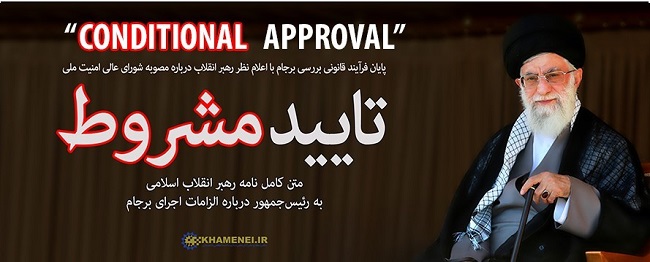
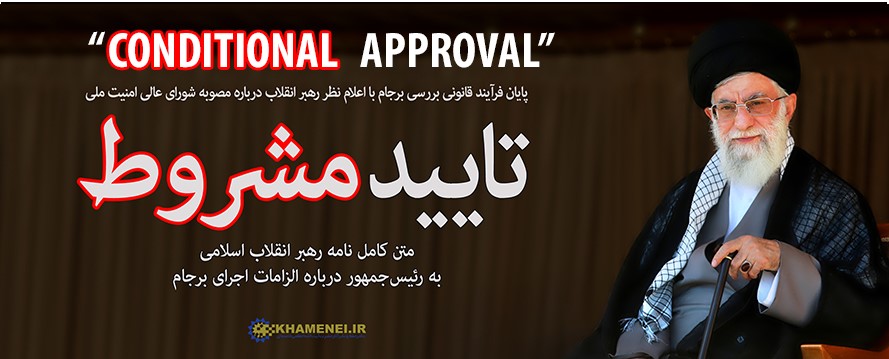
Khamenei’s letter to Rohani with his conditions for the execution of the JCPOA – the publication of which coincided with the days of the Ashura that are of vital religious and national significance in Iran and symbolize steadfastness against the forces of evil – was explicitly termed “conditional approval.” It was labeled thus in red letters, as posted on Khamenei’s website in Persian, tweeted from his Twitter account and posted on his Facebook page in English, and also published in English by the official Islamic Republic of Iran Broadcasting authority IRIB.
25565

But instead of reporting that at this stage, and at present, Khamenei’s approval is not given unless Khamenei’s conditions are met, the American media said that Khamenei had approved the JCPOA. Would these members of the media also consider a purchase concluded if they had not paid for it? The entire American media, without exception, left, right, and center – as well as, apparently, all the U.S. intelligence agencies and think tanks – claimed that Khamenei had approved the agreement. Only two newspapers in the West wondered about the emperor’s new clothes – but even they did not shout “But he hasn’t any clothes on at all!” They said only that he was missing a couple of accessories.

Khamenei had spoken, banning outright any implementation of the JCPOA by Iran until his new conditions are met. The entire Iranian political system is hewing to this line – including President Rohani, Foreign Minister Zarif, Majlis Speaker Larijani, a majority of Majlis members (166), and more (for a full list to date, see Appendix I).

Everyone, that is, except for Ali Akbar Hashemi Rafsanjani, Khamenei’s political rival and head of Iran’s pragmatic camp, who in an interview published this week by MEMRI openly challenged Khamenei and said that Iran should abide by what it undertook in the JCPOA.[10]

But this cannot happen. Khamenei holds the reins.

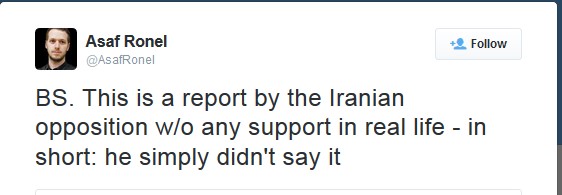
Did the media report on Rafsanjani’s interview? No! But the media in Iran did (see Appendix II). This, however, did not stop the editor of the Israeli daily Haaretz from writing that the interview was faked.
25566

This is a well-known human reaction: When people stand before the complete collapse of what they believe in, they enter a state of denial.

So What Now?

And what is President Obama to do, as everything he has stood for in the Iran deal collapses so ignominiously? On the right, they say he will continue to capitulate. In their ignorance, and in their hatred of him, they fail to realize that he can simply surrender no farther. OK, they say, so the IAEA will provide Obama with the necessary confirmation by December 15 that the Iranians have done their part. But that is impossible as well. What is demanded of Iran is gargantuan in scale, and it would be far more difficult for the IAEA to fake confirmation when the Iranians themselves are declaring loudly that they are not going to do it.

With every passing day, Iran is more and more in violation of the JCPOA. But neither the Republicans nor the Democrats, nor the media, nor anyone else will acknowledge this, for the implications are too devastating. The agreement is no longer in effect. Its clock has stopped.

But the weeks will pass, and the media and politicians will be forced to admit that this is the case. And the last thing they will be willing to do is to force Iran to meet its obligations. Thus, it appears that President Obama’s only option, shameful as it is, is to restart the negotiations with the Iranians and talk with them about their leaders’ new conditions. As is well-known, this administration advocates diplomacy – guaranteeing that there will be no breakthrough any time soon.

This is precisely what will serve President Obama best. All he needs to do is play for time and reach the end of his term with an agreement in hand – albeit virtual – and negotiations in progress – albeit unending. He will pass this situation on to the next administration. The success will be all his, and the failure will be all theirs. The media will zealously guard Obama’s legacy, and his successor, Republican or Democrat, will be too uninformed to protect him or herself from this historic maneuver. And it will serve them right.

Appendix I: Senior Iranian Officials Declare Their Acceptance Of Khamenei’s Instructions On Implementing The JCPOA

On October 10, 2015, Majlis Speaker Ali Larijani  said at a conference on war and peace in Syria: “…The commands of the leader [Khamenei], the decision of the Majlis and the Supreme National Security Council will illuminate the government representatives’ path on implementing the JCPOA… I thank the leader with all my heart.”[11]

President Rohani, responding to the directives letter by the Supreme Leader on carrying out the JCPOA (October 22, 2015): “Your historic letter of October 21, 2015 regarding the approval of decision number 634 of the Supreme National Security Council caused joy within the great Iranian people and warmed the hearts of the public servants in government… The government will obey your criticisms and obligations [that you imposed] and with good intentions will take measures relating to the full implementation of the Supreme National Security Council and the Majlis. We will be fully alert to the performance of the other side’s obligations and in the Supreme National Security Council we will take the necessary decisions to provide a fitting response.”[12]

On October 26, 2015, Foreign Minister Zarif referred in the Majlis to the supreme leader’s letter on carrying out the JCPOA and noted: “I am grateful to the leader for his path-illuminating letter on setting policy in the JCPOA’s implementation. His opinion always lighted the path to the nuclear negotiations team at the foreign ministry. Henceforward, we must make an effort to implement the JCPOA documents in the right way and following the leader’s guidelines.”[13]

On October 27, 2015, Zarif said that the modifications to the nuclear reactor in Arak must be performed after the PMD file has been closed at the IAEA and explained: “we calculated the details of re-planning the reactor following the leader’s guidelines, the decision of the Supreme National Security Council and the Majlis… We will coordinate everything necessary for swapping the uranium stockpiles and this matter will be performed precisely in the way that the leader elaborated and was previously agreed at the Supreme National Security Council and the Majlis nuclear committee.”[14]

In the Majlis, 166 members, constituting a majority, expressed on October 26, 2015 their admiration for the leader for his historic letter in implementing the JCPOA. The letter’s contents read “… For a certainty, the Majlis representatives will act as your stout arms and collaborate with all the supervisory organizations and with the Supreme National Security Council and invest efforts to ensure that after the JCPOA, the enemy will not be able to penetrate our Islamic country even minutely and we will supervise that all violation of promises by the 5+1 group will not remain unanswered.”[15]

Iran’s Judiciary Chief Sadeq Amoli Larijani at an October 26, 2015 conference of senior judicial branch officials said that the letter of conditions that Khamenei published on JCPOA implementation should put an end to debates on the issue. He added: “All groups [within Iran] should treat the leader’s letter as ‘self-explanatory’ and as the axis of unity and from now no they will make progress and think moderately about the future and the next stages of the JCPOA.”[16]

The leader’s representative in the Islamic Revolutionary Guard Corps (IRGC) Ali Saidi said on Wednesday, October 21, 2015: “… The leader is effectively managing the country according to the Koran and custom, the leader sets policy and the others execute it.”[17]

At an October 27, 2015 press conference, the leader’s advisor and the head of the Center for Strategic ResearchAli Akbar Velayati, said: “In the last letter we saw that he criticized the defects and shortcomings in carrying out the JCPOA. I hope that the agreement will be carried out flawlessly in the future. The continued support of the leader for the JCPOA is contingent on the response to the letter that Khamenei wrote the president [Rohani].”[18]

The head of the Majlis nuclear committee, Ebrahim Karkhanehei, referring to the leader’s letter on the JCPOA, said: “This letter produced social calm because in addition to leader the people as well demanded the things that were included in the letter. The most important issue in the letter is the issue of lifting sanctions and the government must seriously handle the matter of lifting the sanctions. In addition to the letter, the leader emphasized many times that if the sanctions are not lifted then there will be no agreement and therefore the US and the EU must fully lift the sanctions.

“The letter from the EU and the American president are not considered a [sufficiently] strong guarantee on the lifting of the sanctions. The Majlis will not be negligent about any clause in the leader’s letter and the government must seriously oversee and handle the sanctions-lifting issue.

“The leader demanded that a professional and  wise team should supervise the sound implementation of the JCPOA and therefore this team must be comprised of at least five people specializing in the legal, nuclear technical political, economic and the sanctions structure issues as well as an expert on security and defense matters.”[19]

An October 25, 2015 Kayhan editorial titled “Giving Interpretations Is Impermissible” wrote: “The leader’s order and the setting of numerous terms for the JCPOA’s implementation is self-explanatory and elaborated a clear path for all arguments and worries, according to religious jurisprudence, the law and the professional perspective. It is obligatory and essential to obey it.. as opposed to some of the impressions, the leader approved the JCPOA’s implementation only following obedience to the terms that may not be damaged and on principle, the leader did not express general approval on the matter.”[20]

Appendix II: Iranian Websites Covering Rafsanjani’s Interview In Inhnews.ir

*IRNA

*ILNA

*Hashemirafsanjani.ir.fa

*Etemaad

*ISNA

*Fars

*Tnews.ir

*Shomaokhabar

*Farsi-news

*Shafaf.ir

*Y. Carmon is president and founder of MEMRI.

Endnotes:

[1] For the complete text of the JCPOA see Eeas.europa.eu/statements-eeas/docs/iran_agreement/iran_joint-comprehensive-plan-of-action_en.pdf

[2] See MEMRI Special Dispatch No. 6151, Khamenei Declares That He Will Not Honor The Agreement If Sanctions Are Merely Suspended And Not Lifted, September 4, 2015; and MEMRI TV Clip #5067 – Iranian Supreme Leader Ali Khamenei: The Americans Must Lift the Sanctions, Not Suspend Them, September 3, 2015.

[3] Unscr.com/en/resolutions/doc/2231.

[4] See MEMRI TV Clip #5114 – Iranian Guardian Council Secretary-General Ahmad Jannati: Khamenei Has Not Approved or Signed the JCPOA, October 16, 2015; and MEMRI TV Clip #5117 – Iranian Guardian Council Spokesman Nejatollah Ebrahimian: The JCPOA Was Not Approved by the Majlis or the Guardian Council, October 18, 2015.

[5] Tasnim (Iran), October 18, 2015.

[6] http://www.armscontrol.org/blog/ArmsControlNow/2015-10-15/The-P5-1-and-Iran-Nuclear-Deal-Alert-October-15

[7] ISNA (Iran), October 18, 2015.

[8] On Khamenei’s nine demands, see MEMRI Inquiry & Analysis No. 1196, Iranian Supreme Leader Khamenei’s Letter Of Guidelines To President Rohani On JCPOA Sets Nine Conditions Nullifying Original Agreement Announced July 14, 2015, October 22, 2015.

[9] See MEMRI Special Dispatch No.  6151, Khamenei Declares That He Will Not Honor The Agreement If Sanctions Are Merely Suspended And Not Lifted , September 4, 2015.

[10] MEMRI Special Report No.43, Breaking Report: Challenging Khamenei, Rafsanjani Demands That Iran Fulfill Its Obligations Under The JCPOA, And Reveals: We Had Nuclear Option In Iran-Iraq War, October 28, 2015.

[11] Mehrnews.com, October 23, 2015.

[12] President.ir/fa/90172

[13] Isna (Iran), October 26, 2015.

[14] Isna (Iran), October 27, 2015.

[15] Mehrnews.com, October 26, 2015.

[16] Nasimonline.(Iran), October 26, 2015.

[17] Snn.(Iran), October 22, 2015.

[18] Isna (Iran), October 27, 2015.

[19] Mehrnews.com, October 26, 2015.

[20] Kayhan (Iran), October 25, 2015.
Iranian Supreme Leader Khamenei’s Letter Of Guidelines To President Rohani On JCPOA Sets Nine Conditions Nullifying Original Agreement Announced July 14, 2015

October 23, 2015

Iranian Supreme Leader Khamenei’s Letter Of Guidelines To President Rohani On JCPOA Sets Nine Conditions Nullifying Original Agreement Announced July 14, 2015, Middle East Media Research Foundation, Y. Carmon and A. Savyon, October 22, 2015

(Please pay particular attention to Conditions 1 – 6 and their implications as noted by MEMRI. The conditions appear to be quite substantial. Additional material, including Twitter and Facebook messages, is also provided in appendices at the end of the article. I have not reproduced that material here.– DM)

On October 21, 2015, Iranian Supreme Leader Ali Khamenei published a letter of guidelines to Iranian President Hassan Rohani on the execution of the Joint Comprehensive Plan of Action (JCPOA). The letter’s publication coincides with the days of the Ashura that are of vital religious and national significance in Iran and symbolize steadfastness against the forces of evil. Intended as an historical document aimed at assuring Iran’s future, the letter was posted on Khamenei’s website in Persian and tweeted from his Twitter account and posted on his Facebook page in English (see Appendices), and published in English by the official Islamic Republic of Iran Broadcasting authority IRIB (see below). The letter is now a founding document in all things concerning theJCPOA and the conditions under which Iran will be willing to execute it.

The letter, defined by Khamenei on his website as “conditional approval” of the JCPOA, sets several new conditions for Iran’s execution of the agreement. These conditions constitute late and unilateral additions to the agreement concluded three months previously that fundamentally change it. Khamenei stresses that the agreement awaits his opinion following what he calls “precise and responsible examination” in the Majlis and “clearance of this agreement through legal channels” in Iran’s Supreme National Security Council.  

25366

It should be further noted that in his introduction to the new conditions, Khamenei attacks the U.S. and President Obama with great hostility, and calls for Obama to be prosecuted by international judiciary institutions. He states that Obama had sent him two letters declaring that he has no intention of subverting the regime of the Islamic Republic of Iran, but adds that the U.S.’s support for fitna in Iran (i.e. the popular post-election unrest in 2009), its monetary aid to opponents of the Republic, and its explicit threats to attack Iran have proven the opposite and have exposed the real intent of America’s leaders, whose enmity towards Iran will not end. He wrote that the Americans’ behavior in the nuclear talks is another link in the chain of its enmity towards Iran, that America entered into the talks with the aim of “deception,” and that therefore Iran must remain alert in light of America’s hostile intentions.

The set of conditions laid out by Khamenei creates a situation in which not only does the Iranian side refrain from approving the JCPOA,[1] but, with nearly every point, creates a separate obstacle, such that executing the agreement is not possible.

The following are Khamenei’s nine conditions, and their implications:

Khamenei’s Conditions For Iranian Execution Of The JCPOA

First condition: Khamenei demands that the U.S. and Europe lift the sanctions, not suspend them, and in addition demands “solid and sufficient” guarantees in advance that this will be done, before Iran takes its own steps and meets its own obligations under the agreement. These guarantees, insists Khamenei, must include, inter alia, an official letter from the U.S. president and from the EU undertaking to fully lift the sanctions. Furthermore, he demands that this letter will state that any declaration by the West that the “structure of the sanctions will remain in force” (i.e. allowing snapback) will be considered “non-compliance with the JCPOA” on the part of the West.

Implications: These conditions constitute a total change of the JCPOA. Khamenei is not allowing any execution of the JCPOA by Iran until this is accepted in writing by the other side, and thus he is nullifying the JCPOA as agreed upon on July 14, 2015.

Second condition: Any sanctions against Iran “at every level and on every pretext,” including terrorism and human rights violations, by any one of the countries participating in the negotiations will “constitute a violation of the JCPOA,” and a reason for Iran to stop executing the agreement.

Implications: This demand, that links the JCPOA to other issues and prohibits any punishment of Iran on any issue and for any reason, serves as an excuse for Iran to cancel the agreement.

Third condition: Under the JCPOA, Iran is obligated, following the JCPOA’s Adoption Day, to carry out its obligations concerning changing the function of the nuclear reactor at Arak and shipping out most of its stockpile of enriched uranium. Contrary to this, Khamenei is changing the timetable of the JCPOA, stating that Iran will not carry out these actions until after the International Atomic Energy Agency (IAEA) declares that it is closing its dossier on Iran’s “past and future issues (including the so-called Possible Military Dimensions or PMD of Iran’s nuclear program).”

Implications: This demand to change the timetable creates a situation in which Iran will not take action as stipulated in the JCPOA, and will not meet its obligations, before the sanctions are eased, also according to the JCPOA, but instead dictates that the sanctions must first be lifted completely and states that only then will Iran meet its obligations. Khamenei here is creating a situation in which the IAEA will not be able to report on Iran’s meeting of its obligations regarding the Arak reactor and regarding the shipping out of its enriched uranium by the target date of December 15, 2015, because Iran is not going to do so by then – thus the execution of the agreement is thwarted from the beginning.

Fourth condition: Iran will meet its obligations to “renovate” and change the purpose of the Arak reactor only after there is a signed agreement on an “alternative plan” for changes to the reactor, and after there is “sufficient guarantee” that this alternative plan will be implemented.

Implications: Iran’s fulfillment of its obligations regarding the Arak reactor, as stipulated by the JCPOA, will be postponed until some unknown future date.

Fifth condition: Iran will carry out its obligation to ship out its enriched uranium to another country in exchange for yellowcake “on a gradual basis and on numerous occasions,” and only after “a secure agreement has been clinched to that effect, along with sufficient guarantees” that this exchange will be implemented.

Implications: The date for Iran to ship out its enriched uranium as stipulated by the JCPOA is postponed until some unknown future date. Khamenei is demanding that Iran receive in exchange for the enriched uranium not raw uranium as per the JCPOA, but instead uranium that has been enriched, albeit to a lower level than the uranium it ships out. This is yet another change to the JCPOA as concluded on July 14, 2015.

Sixth condition: Khamenei instructs President Rohani to begin, along with reducing Iran’s ability to enrich uranium under the JCPOA, immediately to expand Iran’s ability to enrich uranium with a 15-year long-term plan for 190,000 centrifuge SWU (Separative Work Units). “This plan,” he says, “must allay any concern stemming from some points entailed in the JCPOA appendices.”

Implications: This article nullifies the declared goal of the JCPOA, which is to reduce Iran’s nuclear enrichment capabilities.

Seventh condition: The Iranian Atomic Energy Organization must ensure continued nuclear research and development, in its various dimensions, such that in eight years’ time, Iran will not be lacking in enrichment technology. This, he says, is all in accordance with the JCPOA.

Eighth condition: In the event of doubt or ambiguity regarding the content of the JCPOA, the source of authority for removing this doubt or ambiguity will be the content of the talks – i.e. it will also include the statements by the Iranian side, not just the “interpretation provided by the opposite party,” that is, the P5+1.

Implications: Any doubt or ambiguity regarding the content of the JCPOA will become the source of unending dispute and will paralyze any possibility of executing the agreement.

Ninth condition: Due to apprehensions that the other side, particularly the U.S., will break its promises or cheat, President Rohani must establish a “well-informed and smart panel” to monitor the execution of the agreement.

Implications: Khamenei is creating an administrative framework for perpetual delays in the execution of the agreement.

Khamenei adds also a 10th condition, directed at Iran, not the P5+1, demanding that Rohani take seriously his instructions in the matter of the “resistance economy,” the main thrust of which is self-reliance instead of basing Iran’s economy on external sources. He also demands that after the sanctions are lifted, there will be no “unbridled imports,” and no imports whatsoever from the U.S.

Political Ramifications In Iran

In February 2016, elections for the Majlis and the Assembly of Experts are set to take place in Iran. The pragmatic camp, headed by Hashemi Rafsanjani and President Rohani, had hoped that a quick execution of the agreement would allow the sanctions to be eased and funds to be released immediately, which in turn would allow the pragmatic camp to present these achievements and triumph in the elections. By setting these conditions, however, Khamenei has thwarted any speedy execution of the agreement, and thus has thwarted the pragmatic camp’s hope for electoral success.

IRIB Translation

The following is the official English translation of Khamenei’s letter, as published by IRIB.[2] This translation was tweeted by Khamenei and also posted on his Facebook page (see Appendix I and II).

“Wednesday, 21 October 2015 17:41
“Ayatollah Khamenei sends a letter to President Hassan Rouhani about the JCPOA

25367

“Ayatollah Seyyed Ali Khamenei, the Leader of the Islamic Revolution, in a letter to President Hassan Rouhani, who also heads the Supreme National Security Council (SNSC), referred to the precise and responsible examination of the Joint Comprehensive Plan of Action (JCPOA) in the Islamic Consultative Assembly (parliament) and also the SNSC, and the clearance of this agreement through legal channels, and issued important instructions regarding the observation of and safeguarding the country’s national interests. Enumerating nine-point requirements for the implementation of the JCPOA, Ayatollah Ali Khamenei endorsed SNSC Resolution 634, dated August 10, 2015, provided that the following provisions and requirements are observed.

“The full text of Ayatollah Khamenei’s letter follows on:

In the Name of Allah, the Most Compassionate, the Most Merciful

“Your Excellency,  Mr Rouhani,
“President of the Islamic Republic of Iran and Head of the Supreme National Security Council
“May God bestow success upon you.
“Greetings to You

“The agreement known as the Joint Comprehensive Plan of Action (JCPOA) has already been cleared through legal channels following precise and responsible examinations in the Islamic Consultative Assembly, [parliamentary] ad hoc committees and other committees as well as the Supreme National Security Council. Since the agreement is waiting for my view, I deem it necessary to remind several points so that Your Excellency and other officials directly or indirectly involved in the issue would have enough time to comply with and safeguard national interests and the country’s best interests.

“1. Before anything else, I deem it necessary to extend my gratitude to all those involved in this challenging procedure throughout all its periods, including the recent nuclear negotiating team whose members tried their best in explaining the positive points and incorporating all those points [into the agreement], critics who reminded all of us of weak points through their appreciable meticulousness, and particularly the chairman and members of the Majlis ad hoc committee [set up to review the JCPOA] as well as the senior members of the SNSC who covered some voids by including their important considerations, and finally the Speaker of Majlis and Members of Parliament who adopted a cautious bill to show the right way of implementation [of the agreement] to the administration, and also national media and the country’s journalists who despite all their differences of view presented a complete image of this agreement to public opinion. This voluminous collection of activity and endeavors and thoughts [spent] on an issue which is thought to be among the unforgettable and instructive issues of the Islamic Republic, deserves appreciation and is a source of satisfaction. Therefore, one can say with certainty that the divine reward for these responsible contributions will, God willing, include assistance and mercy and guidance by Almighty God because the divine promises of assistance in exchange for assisting His religion are unbreakable.

“2. Enjoying decades-long background of presence in the very details of the affairs of the Islamic Republic of Iran, you must have naturally realized that the government of the United States of America, neither in the nuclear issue nor in any other issue, had been pursuing no other approach but hostility and disturbance, and is unlikely to do otherwise in the future either. The remarks by the US President [Barack Obama] in two letters addressed to me on the point that [Washington] has no intention of subverting the Islamic Republic of Iran turned out to be unreal and his open threats of military and even nuclear strike, which can result in a lengthy indictment against him in international courts, laid bare the real intentions of US leaders. Political pundits and public opinion of many nations clearly understand that the case of his never-ending hostility is the nature and identity of the Islamic Republic of Iran, which is born out of the Islamic Revolution. Insistence on rightful Islamic stances and opposition to the hegemonic and arrogant system, perseverance against excessive demands and encroachment upon oppressed nations, revelations on the US support for medieval dictators and suppression of independent nations, incessant defense for the Palestinian nation and patriotic resistance groups, rational and globally popular yelling at the usurping Zionist regime constitute the main items which make the US regime’s enmity against the Islamic Republic inevitable, and this enmity will continue as long as the Islamic Republic [continues to] disappoint them with its internal and sustainable strength.

“The behavior and words of the US government in the nuclear issue and its prolonged and boring negotiations showed that this (nuclear issue) was also another link in their chain of hostile enmity with the Islamic Republic. Their deception through flip-flopping between their initial remarks that came after Iran accepted to hold direct talks with them and their constant non-compliance with their pledges throughout two-year-long negotiations and their alignment with the demands of the Zionist regime and their bullying diplomacy regarding relations with European governments and bodies involved in the negotiations are all indicative of the fact that the US’s deceitful involvement in the nuclear negotiations has been done not with the intention of a fair settlement [of the case], but with the ill intention of pushing ahead with its hostile objectives about the Islamic Republic.

“Doubtlessly, vigilance vis-à-vis the hostile intentions of the US government and instances of resistance on the part of the officials of the Islamic Republic of Iran throughout the negotiations managed, in numerous cases, to prevent heavy damage from being inflicted [upon Iran].

“However, the outcome of the negotiations, which is enshrined in the JCPOA, has numerous ambiguities and structural weaknesses that could inflict big damage on the present and the future of the country in the absence of meticulous and constant monitoring.

“3. The nine-point provisions entailed in the recent bill adopted by the Majlis and the 10-point instructions outlined in the resolution of the Supreme National Security Council carry helpful and effective points which must be taken into consideration. Meantime, there are some other necessary points which are announced here while some of the points mentioned in the two documents are highlighted.

“First, since Iran has accepted to negotiate basically for the objective of removal of unjust economic and financial sanctions and its enforcement (the lifting of sanctions) is tied to Iran’s future actions under the JCPOA, it is necessary that solid and sufficient guarantees be arranged to avoid any infraction by the opposite parties. Written declaration by the US president and the European Union for the lifting of the sanctions is among them. In the statements of the EU and the US president, it must be reiterated that these sanctions will be fully lifted. Any declaration that the structure of the sanctions will remain in force shall imply non-compliance with the JCPOA.

“Second, throughout the eight-year period, any imposition of sanctions at any level and under any pretext (including repetitive and fabricated pretexts of terrorism and human rights) on the part of any of the countries involved in the negotiations will constitute a violation of the JCPOA and the [Iranian] government would be obligated to take the necessary action as per Clause 3 of the Majlis bill and stop its activities committed under the JCPOA .

“Third, the measures related to what is mentioned in the next two clauses will start only after the International Atomic Energy Agency (IAEA) announces [the conclusion of] the past and future issues (including the so-called Possible Military Dimensions or PMD of Iran’s nuclear program).

“Fourth, measures to renovate the Arak plant by preserving its heavy [water] nature will start only after a firm and secure agreement has been signed on an alternative plan, along with sufficient guarantees for its implementation.

“Fifth, the deal with a foreign government for swapping enriched uranium with yellow cake will start only after a secure agreement has been clinched to that effect, along with sufficient guarantees [for its implementation]. The aforesaid deal and exchange must be done on a gradual basis and on numerous occasions.

“Sixth, by virtue of the Majlis bill, the plan and the necessary preparations for mid-term development of the atomic energy industry, which includes the method of advancement in different periods of time for 15 years for the final objective of 190,000 SWU, must be drawn up and carefully reviewed by the Supreme National Security Council. This plan must allay any concern stemming from some points entailed in the JCPOA appendices.

“Seventh, the Atomic Energy Organization of Iran must organize research and development in different aspects such that after the end of the eight-year period, there would be no shortage of technology for the level of [uranium] enrichment entailed in the JCPOA.

“Eighth, it must be noted that on the ambiguous points in the JCPOA document, the interpretation provided by the opposite party is not acceptable and the reference would be the text of the negotiations.

“Ninth, the existence of complications and ambiguities in the text of the JCPOA and the suspicion of breach of promise, infractions and deception by the opposite party, particularly the US, require that a well-informed and smart panel be established to monitor the progress of affairs and [gauge] the opposite party’s commitment and realization of what was mentioned above. The composition and the tasks of this would-be panel should be determined and approved by the Supreme National Security Council.

“In witness whereof, Resolution 634, dated August 10, 2015, of the Supreme National Security Council, is endorsed pending the observation of the aforementioned points.

“In conclusion, as it has been notified in numerous meetings to you and other government officials and also to our dear people in public gatherings, although the lifting of sanctions is a necessary job in order to remove injustice [imposed on people] and regain the rights of the Iranian nation, economic overture and better livelihood and surmounting the current challenges will not be easy unless the Economy of Resistance is taken seriously and followed up on entirely. It is hoped that this objective will be pursued with full seriousness and special attention would be paid to enhancing national production. You should also watch out so that unbridled imports would not follow the lifting of sanctions, and particularly importing any consumer materials from the US must be seriously avoided.

“I pray to Almighty God for your and other contributors’ success.
“Source: www. leader. ir”

__________________

Endnotes:

[2] English.irib.ir/news/leader/item/217470-ayatollah-khamenei-sends-a-letter-to-president-hassan-rouhani-about-the-jcpoa, October 21, 2015.

[3] Twitter.com/khamenei_ir, October 21, 2015.

[4] Facebook.com/www.Khamenei.ir/posts/943612332378368:0, posted October 21, 2015.

Leader Outlines Major Observations in JCPOA Implementation

October 21, 2015

Leader Outlines Major Observations in JCPOA Implementation, Tasnim News Agency (Iran), October 21, 2015

139406041520538615968453

[T]hroughout the 8-year period of implementing the JCPOA, imposing any sanctions, at any level and under any pretext –such as the “recurring and fabricated allegations of terrorism and human rights violation – by any of the parties to the talks”, will be tantamount to breach of the JCPOA and the administration will be obligated to take the necessary measures under the Clause 3 of the Iranian Parliament’s plan and cease the JCPOA activities.

*********************

TEHRAN (Tasnim) – Supreme Leader of the Islamic Revolution Ayatollah Seyed Ali Khamenei in a letter to President Hassan Rouhani highlighted nine main points that the administration will need to take note of regarding the course of implementing a final nuclear deal with six world powers.

In the letter, Ayatollah Khamenei appreciated the efforts made by the country’s different bodies involved in the course of nuclear negotiations with the Group 5+1 (Russia, China, the US, Britain, France and Germany) and the consequent efforts to evaluate the deal.

The Leader, however, noted that the nuclear agreement, dubbed the Joint Comprehensive Plan of Action (JCPOA), contains “ambiguities, structural weak points and multiple points that could inflict heavy losses on the country” at present and in the future in case of lack of strict and constant vigilance.

Ayatollah Khamenei then explicated the observations that the administration should make about the JCPOA and its implementation.

The first point in the Leader’s letter was the necessity for the full termination of the anti-Iran sanctions under the JCPOA.

Since the purpose of Iran’s approval to the nuclear negotiations was the removal of “cruel economic and financial sanctions”, and given the fact that the termination of the sanctions has been subjected to completion of Iran’s undertakings, there needs to be “firm and sufficient guarantees” to avert the other side’s breach, Ayatollah Khamenei underlined.

The US president and the European Union must declare that the anti-Iran sanctions have been “fully lifted”, the Leader noted.

The second observation in the letter was the categorical rejection of imposition of any new sanctions against Iran, which the Leader described as a breach of the JCPOA in which case the Iranian administration would be obligated to stop implementing the deal.

Third, the Leader further said, throughout the 8-year period of implementing the JCPOA, imposing any sanctions, at any level and under any pretext –such as the “recurring and fabricated allegations of terrorism and human rights violation – by any of the parties to the talks”, will be tantamount to breach of the JCPOA and the administration will be obligated to take the necessary measures under the Clause 3 of the Iranian Parliament’s plan and cease the JCPOA activities.

The rest of the observations are as follows:

4. Measures to renovate the Arak plant, which should keep its heavy (water) nature, will begin only after signing a definite and safe contract on an alternative plan and sufficient guarantee for its implementation.

5. The trade of the available enriched uranium with the yellowcake (a type of uranium concentrate powder) with a foreign government will take place when a secure contract with sufficient guarantees is signed. The mentioned trade and exchange (of materials) should occur gradually and in multiple times.

6. In accordance with the bill passed by the Majlis (parliament), a necessary plan should be devised and meticulously discussed by the Supreme National Security Council (SNSC) for mid-term development of (the country’s) nuclear energy industry, including ways to make progress in the next 15 years, leading to the production of 190,000 SWUs (Separative Work Units).

7. The Atomic Energy Agency of Iran (AEOI) should organize research and development in different aspects in such a way that at the end of the 8-year period, there will be no technological shortages for achieving the level of enrichment as accepted in the JCPOA.

8. As for ambiguities in the JCPOA, it should be stressed that the other side’s interpretation is not accepted, and that the reference (for interpretation) is the text of the negotiations.

9. The existence of complexities and ambiguities in the JCPOA and the possibility of breach of commitments and deception on the part of the other side, especially the US, necessitate that a strong, observant and smart committee be formed to monitor the progress of works, fulfilment of the other side’s commitments and  realization of the observations mentioned above. The committee’s arrangement and responsibilities should be formulated and approved by the SNSC.

US confirms Iran tested nuclear-capable ballistic missile

October 16, 2015

US confirms Iran tested nuclear-capable ballistic missile

Source: US confirms Iran tested nuclear-capable ballistic missile – Middle East – Jerusalem Post


The United States has confirmed that Iran tested a medium-range missile capable of delivering a nuclear weapon in “clear violation” of a United Nations Security Council ban on ballistic missile tests, a senior US official said on Friday.

“The United States is deeply concerned about Iran’s recent ballistic missile launch,” US Ambassador to the United Nations Samantha Power said in a statement.

“After reviewing the available information, we can confirm that Iran launched on Oct. 10 a medium-range ballistic missile inherently capable of delivering a nuclear weapon,” she said. “This was a clear violation of UN Security Council Resolution 1929.”

WATCH: Iranian Revolutionary Guard reveals underground missile base

October 14, 2015

WATCH: Iranian Revolutionary Guard reveals underground missile base

Source: WATCH: Iranian Revolutionary Guard reveals underground missile base – Middle East – Jerusalem Post

http://tinyurl.com/pwrxzv4

Iran’s Revolutionary Guard on Wednesday revealed an underground bunker in which it stores long-range ballistic missiles, Iran’s semi-official Fars News Agency reported.

Footage of the underground missile bunker was aired on Iranian state television. According to Fars, a number of ballistic missiles were shown in the underground tunnel including a model with a range of 2,000 kilometers.

Fars quoted Amir Ali Hajizadeh, head of the Revolutionary Guard’s aerospace branch, as saying that the missiles represented the next generation of Iranian long-range missile technology.

The missile bunker shown is one of many that are buried as deep as “500 meters below the high mountains,” Fars reported.

Iran state television showed on Sunday what it said was a successful launch of the new Iranian missile, named Emad, which appears to be Tehran’s first precision-guided weapon with the range to strike its regional enemy Israel.

A total of 220 of Iran’s 290 lawmakers praised the missile test on Wednesday, announcing their full support of measures that “strengthen Iran’s defense capabilities.”

The US State Department said that the missile test was an apparent violation of a UN Security Council resolution and Washington will raise it at the United Nations.

“We’ll obviously raise this at the UNSC as we have done in previous launches,” State Department spokesman Mark Toner told reporters, noting the test appeared to be a violation of U.N. Security resolution 1929.

He and White House spokesman Josh Earnest both said the issue was separate from a deal Iran struck in July with six world powers, which seeks to curb Tehran’s atomic program in return for having sanctions against it eased.

Ballistic missile tests by Iran are banned under Security Council resolution 1929, which dates from 2010 and remains valid until the July 14 nuclear deal goes into effect.

Once the deal takes effect, Iran will still be “called upon” not to undertake any ballistic missiles work designed to deliver nuclear weapons for a period of up to eight years, according to a Security Council resolution adopted in July.

The resolution says that when the deal is in effect countries will be allowed to transfer missile technology and heavy weapons to Iran on a case-by-case basis with council approval.

However, at the time the resolution was drafted, a U.S. official called this provision meaningless and said the United States would veto any suggested transfer of missile technology to Iran.

Speaking on Tuesday, White House spokesman Earnest made clear countries could more to stop the flow of ballistic missile technology to Iran.

“That is work that requires international cooperation,” he said, adding that Washington was ready to work with Gulf allies to counter Iran’s ballistic missile program.

Khamenei’s new book preaches hatred and annihilation of America

October 13, 2015

Khamenei’s new book preaches hatred and annihilation of America, Front Page MagazineDr. Majid Rafizadeh, October 13, 2015

(Please see also, The Iranian Majlis Has Not Approved The JCPOA But Iran’s Amended Version Of It. — DM)

bazzi-top-1024x750

[C]an we consider ]US] policy an informed one when the US is compelled to continue to please and spoil the Islamic Republic — by turning a blind eye on its egregious human rights abuses, imprisonment of American citizens without fair and due process, support of  terrorist groups, sabotage of US foreign policy, national, and security interests in the region — all so that Iranian leaders will stick to the nuclear deal?

********************

Ironically, as the financial rewards and the improved legitimacy that have resulted from Obama’s nuclear deal continue to benefit the Iranian ruling clerics, the Iranian political establishment’s hatred towards the United States is reaching its peak. 

This week, the highest authority in the Islamic Republic, Supreme Leader Ayatollah Ali Khamenei, banned and forbade any further talks and negotiations between his country and the United States: “Negotiation with US is forbidden.”

In addition, he recently made his new e-book available for download in English. The Ayatollah points out: “The regional nations truly hate America and its European branch, England. This hatred is not limited to our people: all regional nations hate them … Why do they complain about being hated? Yes, we hate you.” The book advocates for annihilating America and Israel. It rants about how the Muslim world hates the US and Israel.

As a result, how can President Obama stand behind his promise that the nuclear deal is going to make the ruling clerics of the Islamic Republic more rational, less hostile to the United States and Israel, more civilized and a more constructive player in the region?

Adding to the intrigue is the fact that the theocratic leader has not even officially endorsed the nuclear deal, although the sanctions on the country are being gradually lifted. His strategy is to pull out of the nuclear deal after all economic sanctions have been lifted and Iran has obtained full nuclear capabilities.

The timing of the Supreme Leader’s announcement and other recent equally inflammatory statements is important since they come after the Islamic Republic has ensured that the nuclear deal is sealed and Tehran will be receiving over $150 billion in the short term and other additional financial rewards when the economic sanctions are fully lifted.

In addition, the Supreme Leader has heightened his anti-American and anti-Semitic views and speeches after getting indirect assurance from the Obama administration that the US will not impose any kind of sanctions on the Islamic Republic. Even in the future, no sanctions will be imposed on Iran’s human rights abuses, support for terrorism, or any other outlandish inhumane actions.

As the Secretary of State John Kerry pointed out to US senators, Congress won’t be able to impose new sanction on the Islamic Republic. The administration’s rule of not imposing sanctions applies to anything, whether related to nuclear issues or not, because as Mr. Kerry pointed out, he does not desire to show the Islamic Republic that the US is projecting “bad faith.”

This suggests that the administration will support the Iranian leaders in any way possible in order to show good faith, while Iran’s paramount leader is calling for the complete annihilation of the US and Israel, and increasing his military interventions in the region by dominating Baghdad, Damascus, Lebanon, and Sana’a. He has demonstrated clear support for terrorists groups, is determined to scuttle US national, economic and security interests, and has consistently increased his anti-American and anti-Semitic speeches and foreign policies.

Speaking to the commanders of the Islamic Revolutionary Guard Corps — who spread terrorism, militarism and Islamist ideologies in the region — Ayatollah Khamenei pointed out that “[w]e are in a critical situation now as the enemies are trying to change the mentality of our officials and our people on the revolution and our national interests.” In addition, with all the advantages that President Obama has given to the Supreme Leader through the nuclear deal, Khamenei stated, “Negotiations with the United States open gates to their economic, cultural, political and security influence. Even during the nuclear negotiations they tried to harm our national interests.”

The Obama administration, on the other hand, insists in not imposing any kind of new sanction because it does not want the Iranian government to get discontent and breach the nuclear deal, as recently made clear by Secretary Kerry.

So, can we consider this policy an informed one when the US is compelled to continue to please and spoil the Islamic Republic — by turning a blind eye on its egregious human rights abuses, imprisonment of American citizens without fair and due process, support of  terrorist groups, sabotage of US foreign policy, national, and security interests in the region — all so that Iranian leaders will stick to the nuclear deal?

In other words, what Secretary Kerry is saying is that any time the Iranian leaders feel discontent, the Obama administration’s policy is to give further bonuses to the ruling clerics and implore them not to back out of the nuclear deal. This coddling has created precisely a situation in which the Iranian ruling clerics have the opportunity to take complete advantage of the American government by exploiting the administration’s weak stance. It seems that when it comes to Iran, President Obama has switched the “carrot and stick” approach to a policy anchored in lavishing rewards on the Iranian leaders.

It is also important not to forget that Iranian leaders were the ones who were desperate for the nuclear deal: they are receiving billions of dollars, global legitimacy, and ensuring their hold on power and pursuit of nuclear objectives, as well as enhancing their regional hegemonic ambitions due to this deal. But since they have smelled the weakness of President Obama, they are more than happy to capitalize on it and exploit it.

As long as the theocratic Islamist political establishment is in power in the Islamic Republic, the Iranian leaders will continue their hatred and anti-American policies towards the US even if the US provides Tehran with its every whim and desire.

Iran Parliament passes bill approving nuclear deal

October 13, 2015

Iran Parliament passes bill approving nuclear deal

Published time: 13 Oct, 2015 05:50

Edited time: 13 Oct, 2015 06:37

Source: Iran Parliament passes bill approving nuclear deal — RT News

© Behrouz Mehri
The Iranian parliament has voted in favor of the nuclear deal with world powers, yet preconditioned that international inspectors will only have limited access to Tehran’s military facilities, reports IRNA news agency.

“The bill to implement the JCPOA … was passed in a public session on Tuesday with 161 votes in favor,” Reuters cited IRNA as saying, which referred to the Joint Comprehensive Plan of Action reached in July.

The parliament has also agreed on counter-measures in case the deal is not approved by other parties.

Now that the deal has been approved by the Majlis, the lower house, it needs endorsement by the Guardian Council of the Constitution consisting of clerics. Once the council approves the bill, it will come into law.

Once in force, the bill on the 6+1 nuclear agreement will enable Iranian government to implement the deal.

The agreement has a strong opposition from the Republican Party in the US, which attempted to prevent the deal from being approved by the Senate, but the Obama administration has so far been effective in finding right arguments to expect the deal get be agreed upon.

READ MORE: Senate fails to sink Iran nuclear deal by tying it to Israel

An Israeli lobby in the US has been fiercely opposing the nuclear agreement with Iran and put much effort to disrupt it.

The Israeli government has been vocally opposed to the deal, with the American-Israel Public Affairs Committee (AIPAC) spending up to $40 million on a public relations campaign criticizing the agreement, according to National Public Radio.

READ MORE: UN nuclear watchdog chief visits Parchin military facility in Iran

The historic agreement between Iran and six world powers was reached on July 14, putting an end to years of complex negotiations regarding the fate of the Iranian nuclear program. The deal is contingent on the adoption of a set of measures, the completion of which will lift all sanctions imposed on Tehran by the UN Security Council, the US and the EU.

A word from their Supreme Leader

October 10, 2015

A word from their Supreme Leader, Power LineScott Johnson, October 10, 2015

We have yet to see the fatuous fatwa allegedly promulgated by Iranian Supreme Leader Ali Khameni denouncing the development of nuclear weapons. Yet it has repeatedly been cited by President Obama and others in support of the deadly arrangement into which we have entered with Iran regarding its nuclear program. See, e.g., MEMRI’s reports here and here. The foreboding John Fogerty/Creedence Clearwater Revival song could be put to good use: “I want to know, have you ever seen the fatwa?”

Obama seems to have premised the agreement on hopes for an opening to Iran. Perhaps he doesn’t understand the nature of the Iranian regime. He has an unending train of excuses to mitigate the meaning of their terrorist ventures and ceaseless hostility to the United States. To the extent that Obama can distinguish America’s friends from America’s enemies, he weakens our friends and props up our enemies.

This week Reuters highlighted words actually spoken by their Supreme Leader that tend to belie Obama’s train of thought. In the translation provided in the video Reuters posts with the story, Khamenei states that “negotiation with the U.S. is forbidden[.]” It sounds something like a fatwa of the nonmythical variety. Reuters reports:

Iran’s Supreme Leader Ayatollah Ali Khamenei on Wednesday banned any further negotiations between Iran and the United States, putting the brakes on moderates [sic] hoping to end Iran’s isolation after reaching a nuclear deal with world powers in July.

Khamenei, the highest authority in the Islamic Republic, already said last month there would be no more talks with the United States after the nuclear deal, but has not previously declared an outright ban.

His statements directly contradict those of moderate Iranian President Hassan Rouhani, who says his government is ready to hold talks with the United States on how to resolve the conflict in Syria, where the two countries back opposing sides.

“Negotiations with the United States open gates to their economic, cultural, political and security influence. Even during the nuclear negotiations they tried to harm our national interests.,” Khamenei was quoted as saying on his website.

Khamenei asserts that in the negotiations leading to the arrangement “the Americans took advantage of a few chances.” I’m thinking those “chances” are of the same nature as the fatuous fatwa, i.e., mythical.

Khamenei’s remarks came in an address Revolutionary Guards Navy commanders. Obama hasn’t been asked about them yet. When asked, he will undoubtedly dismiss them as offered for domestic political consumption, as he has done with the Supreme Leader’s “Death to America” routine. Taking Obama’s interpretation at face value, we have Obama presenting a pure case of projection if there ever was one.

Obama Admin’s Iran Point Man Promotes Anti-Israel Conspiracy Theories

October 8, 2015

Obama Admin’s Iran Point Man Promotes Anti-Israel Conspiracy Theories, Washington Free Beacon, October 8, 2015

(Surprising? Nope. — DM)

eyrestate__2_Alan Eyre / Twitter

A State Department official closely involved in the Obama administration’s Iran push has been promoting publications from anti-Semitic conspiracy sites and other radical websites that demonize American Jewish groups and Israel, according to sources and documents obtained by the Washington Free Beacon.

Alan Eyre, the State Department’s Persian-language spokesman and a member of the negotiating delegation that struck a nuclear deal with Iran earlier this year, has in recent months disseminated articles that linked American-Jewish skeptics of the deal to shadowy financial networks, sought to soften the image of Iranian terrorists with American blood on their hands, and linked deal criticism to a vast “neoconservative worldview.”

Eyre described the one article, penned by the anti-Israel conspiracy theorist Stephen Walt, as having an “interesting thesis.”

Insiders who spoke to the Free Beacon about Eyre’s private postings pointed to a pattern of partisanship and called it a sign that key officials at the State Department are biased against the state of Israel. Such criticism has dogged the team Obama since the early days of the administration.

Eyre regularly briefed U.S. officials at the negotiating table and was responsible for proofreading draft texts of the recent Iranian nuclear agreement.

While Eyre has a public Facebook page officially sponsored by the State Department, screenshots taken from his private personal account obtained by the Free Beacon include content that insiders described as concerning.

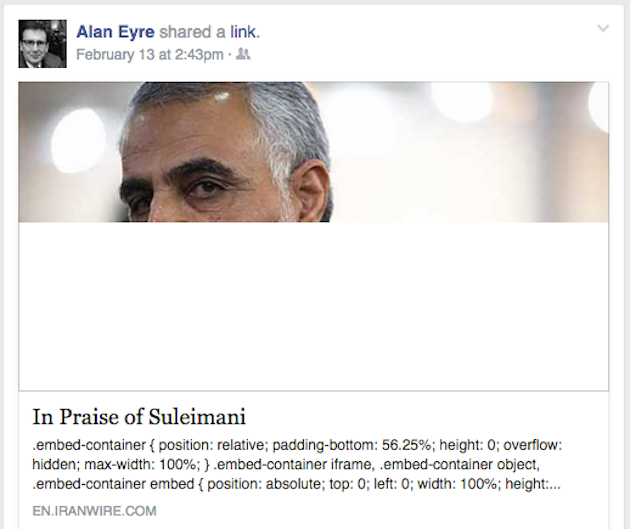
In one Feb. 13 posting, when Iran talks were at a critical stage, Eyre disseminated a link to an article praising Iranian Quds Force Chief Ghassem Suleimani, who is directly responsible for the deaths of Americans abroad.

Image-1

Suleimani, who is listed as a terrorist by the U.S. State Department, will have international sanctions against him waived under the parameters of the nuclear accord.

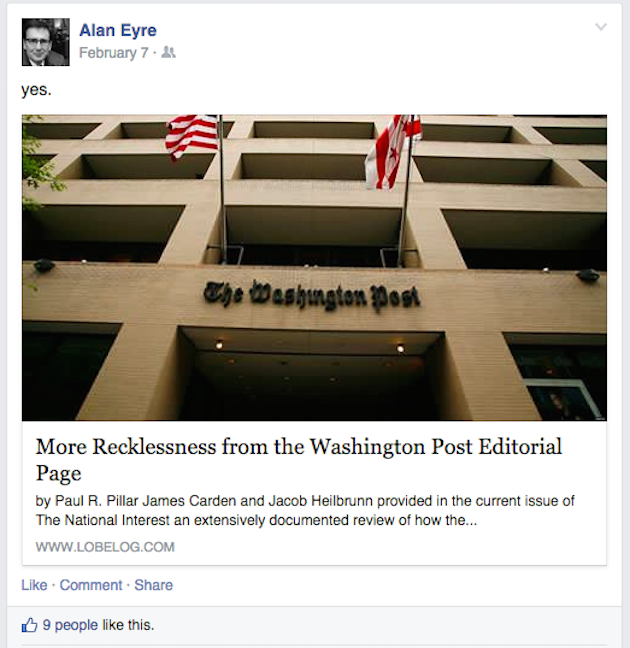
In another posting from Feb. 5, Eyre links to the website LobeBlog, which is viewed by critics as anti-Israel and regularly attacks neoconservative pundits.”

The article Eyre links to, “Who Are the Billionaires Attacking Obama’s Iran Diplomacy,” attacks opponents of the Iranian deal and insinuates that wealthy Jewish donors are behind this push.

The article puts particular emphasis on the Israel Project (TIP), a non-profit advocacy organization run by Josh Block, a longtime Democrat, and claimed that wealthy Jewish individuals were behind a stealth campaign to kill the deal. TIP is portrayed as playing a crucial role in discrediting the deal and convincing lawmakers to take a stance against it.

The article was penned by a former ThinkProgress blogger, Eli Clifton, who was forced out of the Center for American Progress-backed blog following a scandal in which several writers accused Iran deal critics of being “Israel firsters.”

Image-2

In another posting, Eyre links to an article by Stephen Walt, co-author of the book The Israel Lobby, which has been branded by the Anti-Defamation League (ADL) as an “anti-Jewish screed.”

Walt lashes out in the piece at neoconservative critics of the Iran deal, writing that “no one should listen to their advice today.”

Eyre linked to the piece with the comment, “interesting thesis.” He then quoted Walt at length, according to a screenshot:

The real problem is that the neoconservative worldview — one that still informs the thinking of many of the groups and individuals who are most vocal in opposing the Iran deal — is fundamentally flawed. Getting Iraq wrong wasn’t just an unfortunate miscalculation, it happened because their theories of world politics were dubious and their understanding of how the world works was goofy.

Image-3

Eyre also appeared to express disappointment online in March, when Sen. Tom Cotton and 46 other Republican lawmakers penned an open letter to Iran opposing the nuclear talks.

Eyre links to a March 9 Washington Post article by Paul Pillar, an Israel critic who backs boycotts of the Jewish state, titled ‘The misguided, condescending letter from Republican senators to Iran.’ He then opined in the post, “Seriously. Can someone write them a letter telling them that the most fundamental duty of Congress is to pass a budget?”

Image-4

At least one of Eyre’s Facebook friends has quibbled with his postings.

When Eyre linked to a Talking Points Memo article claiming that “49 percent of Republicans don’t believe in evolution,” one critic commented: “This post is total crap. Some 300 people were polled, and the polling criteria were, of course, not specified. This outfit has a deserved reputation as a left-leaning, professionally anti-Republican Flak Tank.”

Eyre dismissed that criticism, responding, “If you are going to fact check every incendiary posting I put up, it is going to detract from the sum total of my facebook-derived frivolity.”

In addition to his postings, Eyre has appeared as a keynote speaker at the National Iranian American Council’s Washington, D.C., conference.

The council, which has been accused as serving as a pro-Tehran lobbying shop, has helped the Obama administration disseminate pro-Iran talking points and champion the deal in the public sphere. Its top officials also have insinuatedthat Jewish lawmakers who oppose the deal have more loyalty to Israel than America.

One senior official at a Washington, D.C., pro-Israel organization expressed disappointment but not surprise at Eyre’s posting.

“The easiest way to explain the State Department’s behavior toward the Middle East is to assume that they don’t like the Israelis very much and they have this romantic fascination with Iran,” the source said. “That’s what you’re seeing here.”

“Of course they can’t admit that out loud, because the American people believe exactly the opposite, so they do it through passive-aggressive Facebook posts and occasional slips of the tongue about how moderate and sophisticated the Iranians are,” the source added.

A State Department spokesman declined to comment on Eyre’s personal postings when contacted by the Free Beacon.

“Alan Eyre is the Department’s Persian Language Spokesperson,” the official said. “In that capacity, he maintains his official page on Facebook here,” the spokesman continued, providing a link to the page.

The Facebook page in question, however, is separate from Eyre’s public-facing personal page referenced by the State Department, which said it had no knowledge of the second page.

“We’re not aware of any such content that you refer to posted on that account,” the official said.

The official did not respond to follow-up requests asking for comment from Eyre on the postings.

Prominent Iranian Analyst Amir Taheri: Obama Is Capitulating And Chasing Illusions In Deal With Iran

October 6, 2015

Prominent Iranian Analyst Amir Taheri: Unlike Kennedy, Nixon And Reagan, Who Drove A Hard Bargain In Negotiations With Enemies, Obama Is Capitulating And Chasing Illusions In Deal With Iran, Middle East Media Research Institute, October 5, 2015

In an opinion piece published August 25, 2015 in the London-based Saudi daily Al-Sharq Al-Awsat, Amir Taheri, a prominent Iranian analyst, author and columnist, compared Obama’s policy towards Iran to the policies of Kennedy, Nixon and Reagan in their dealings with the U.S.’s main rivals in their day – the USSR and China. Taheri wrote that, in making the deal with Iran, Obama wishes to portray himself as an heir to the tradition established by these presidents of defusing conflict through diplomacy and negotiations. He noted, however, that these leaders negotiated from a position of strength, and pursued a detente with America’s enemies only after the latter had fulfilled important American demands and changed key elements of their policies. For example, Kennedy negotiated with the USSR only after forcing it to remove the nuclear sites from Cuba; Nixon’s normalization with China came only after the latter had turned its back on the Cultural Revolution and abandoned its project of exporting communism, and Reagan engaged with the Soviets only after taking military measures to counter the threat they posed to Europe. Moreover, says Taheri, the U.S. warmed its relations with China and the USSR only after they abandoned their absolute enmity towards it and began regarding it as a rival and competitor rather than a mortal enemy that must be destroyed.

Conversely, says Taheri, Obama demanded nothing of the Iranians before commencing negotiations, not even the release of U.S. hostages. Moreover, he pursued rapprochement with Iran despite the absence of any positive change in this country’s hardline policies and ideologies. On the contrary, America’s overtures only encouraged Iran’s worst tendencies, as reflected in a sharp rise in human rights violations within Iran and in its continued support for terror groups and for Assad’s regime in Syria. The detente with America did not even cause Iran to abandon its calls of death to America, Taheri notes. He concludes “Kennedy, Nixon and Reagan responded positively to positive changes on the part of the adversary,” whereas “Obama is responding positively to his own illusions.”

The following are excerpts from his article:

24977Amir Taheri (Image: Twitter.com/amirtaheri4)

JFK Forced Russia To Remove Its Missiles From Cuba; Obama Obtained Nothing Tangible And Verifiable

“Promoting the ‘deal’ he claims he has made with Iran, President Barack Obama is trying to cast himself as heir to a tradition of ‘peace through negotiations’ followed by US presidents for decades. In that context he has named Presidents John F. Kennedy, Richard Nixon and Ronald Reagan as shining examples, with the subtext that he hopes to join their rank in history.

“Obama quotes JFK as saying one should not negotiate out of fear but should not be afraid of negotiating either. To start with, those who oppose the supposed ‘deal’ with Iran never opposed negotiations; they oppose the result it has produced… In one form or another, Iran and the major powers have been engaged in negotiations on the topic since 2003. What prompted Obama to press the accelerator was his desire to score a diplomatic victory before he leaves office. It did not matter if the ‘deal’ he concocted was more of a dog’s dinner than a serious document. He wanted something, anything , and to achieve that he was prepared to settle for one big diplomatic fudge.

“Is Obama the new JFK? Hardly. Kennedy did negotiate with the USSR but only after he had blockaded Cuba and forced Nikita Khrushchev to blink and disband the nuclear sites he had set up on the Caribbean island. In contrast, Obama obtained nothing tangible and verifiable. Iran’s Atomic Energy chief Ali-Akbar Salehi put it nicely when he said that the only thing that Iran gave Obama was a promise ‘not to do things we were not doing anyway, or did not wish to do or could not even do at present.’

“JFK also had the courage to fly to West Berlin to face the Soviet tanks and warn Moscow against attempts at overrunning the enclave of freedom that Germany’s former capital had become. With his ‘Ich bin ein Berliner‘ (I am a citizen of Berlin), he sided with the people of the besieged city in a long and ultimately victorious struggle against Soviet rule. In contrast Obama does not even dare call on the mullahs to release the Americans they hold hostage. Instead, he has engaged in an epistolary courting of the Supreme Guide and instructed his administration in Washington to do and say nothing that might ruffle the mullahs’ feathers.

Nixon Extracted Far-Reaching Concessions From China; Obama Has Only Encouraged The Worst Tendencies Of The Khomeinist Regime

“No, Obama is no JFK.  But is he heir to Nixon? Though he hates Nixon ideologically, Obama has tried to compare his Iran ‘deal’ with Nixon’s rapprochement with China. Again, the comparison is misplaced. Normalization with Beijing came after the Chinese leaders had sorted out their internal power struggle and decided to work their way out of the ideological impasse created by their moment of madness known as The Great Proletarian Cultural Revolution. The big bad wolf of the tale, Lin Biao, was eliminated in an arranged air crash and the Gang of Four defanged before the new leadership set-up in Beijing could approach Washington with talk of normalization.

“At the time the Chinese elite, having suffered defeat in border clashes with the USSR, saw itself surrounded by enemies, especially after China’s only ally Pakistan had been cut into two halves in an Indo-Soviet scheme that led to the creation of Bangladesh. Hated by all its neighbors, China needed the US to break out of isolation. Even then, the Americans drove a hard bargain. They set a list of 22 measures that Beijing had to take to prove its goodwill, chief among them was abandoning the project of ‘exporting revolution’.

“Those of us who, as reporters, kept an eye on China and visited the People’s Republic in those days were astonished at the dramatic changes the Communist leaders introduced in domestic and foreign policies to please the Americans. In just two years, China ceased to act as a ’cause’ and started behaving like a nation-state. It was only then that Nixon went to Beijing to highlight a long process of normalization. In the case of Iran, Obama has obtained none of those things. In fact, his ‘deal’ has encouraged the worst tendencies of the Khomeinist regime as symbolized by dramatic rise in executions, the number of prisoners of conscience and support for terror groups not to mention helping Bashar Al-Assad in Syria.

Reagan Had No Qualms About Calling The USSR ‘The Evil Empire’;  Obama Is Scared Of Offending The Mullahs

“No, Obama is no Nixon. But is he a new Reagan as he pretends? Hardly. Reagan was prepared to engage the Soviets at the highest level only after he had convinced them that they could not blackmail Europe with their SS20s while seeking to expand their empire through so-called revolutionary movements they sponsored across the globe. The SS20s were countered with Pershing missiles and ‘revolutionary’ armies with Washington-sponsored ‘freedom fighters.’

“Unlike Obama who is scared of offending the mullahs, Reagan had no qualms about calling the USSR ‘The Evil Empire’ and castigating its leaders on issues of freedom and human rights. The famous phrase ‘Mr. Gorbachev, tear down that wall!’ indicated that though he was ready to negotiate, Reagan was not prepared to jettison allies to clinch a deal.

“Obama has made no mention of Jimmy Carter, the US president he most resembles. However, even Carter was not as bad as Obama if only because he was prepared to boycott the Moscow Olympics to show his displeasure at the invasion of Afghanistan. Carter also tried to do something to liberate US hostages in Tehran by organizing an invasion of the Islamic Republic with seven helicopters. The result was tragicomic; but he did the best his meagre talents allowed. (NB: No one is suggesting Obama should invade Iran if only because if he did the results would be even more tragicomic than Carter’s adventure.)

“On a more serious note, it is important to remember that dealing with the Khomeinist regime in Tehran is quite different from dealing with the USSR and China was in the context of detente and normalization. Neither the USSR nor the People’s Republic regarded the United States as ‘enemy’ in any religious context as the Khomeinist regime does. Moscow branded the US, its ‘Imperialist’ rival, as an ‘adversary’ (protivnik) who must be fought and, if possible, defeated, but not as a ‘foe’ (vrag) who must be destroyed. In China, too, the US was attacked as ‘arch-Imperialist’ or ‘The Paper Tiger’ but not as a mortal foe. The slogan was ‘Yankee! Go Home!'”

China And USSR Moderated Their Virulent Hate For U.S,; In Iran The Slogan Is Still ‘Death To America’

“In the Khomeinist regime, however, the US is routinely designated as ‘foe’ (doshman) in a religious context and the slogan is ‘Death to America!’ Supreme Guide Ali Khamenei has no qualms about calling for the ‘destruction’ of America, as final step towards a new global system under the banner of his twisted version of Islam. Tehran is the only place where international ‘End of America’ conferences are held by the government every year. The USSR and China first cured themselves of their version of the anti-American disease before seeking detente and normalization. That did not mean they fell in love with the US. What it meant was that they learned to see the US as adversary, rival, or competitor not as a mortal foe engaged in a combat-to-death contest. The Islamic Republic has not yet cured itself of that disease and Obama’s weakness may make it even more difficult for that cure to be applied.

“Détente with the USSR and normalization with China came after they modified important aspects of their behavior for the better. Kennedy, Nixon and Reagan responded positively to positive changes on the part of the adversary. In the case of the USSR positive change started with the 20th congress of the Communist Party of the Soviet Union in which Khrushchev denounced Joseph Stalin’s crimes, purged the party of its nastiest elements, notably Lavrentiy Beria, and rehabilitated millions of Stalin’s victims.

“In foreign policy, Khrushchev, his swashbuckling style notwithstanding, accepted the new architecture of stability in Cold War Europe based on NATO and the Warsaw Pact. Kennedy, Johnson and, later, Nixon and President Gerald Ford had to respond positively. In the late1980s, the USSR offered other positive evolutions through Glasnost and Perestroika and final withdrawal from Afghanistan under Mikhail Gorbachev. Again, Reagan and President George Bush (the father) had to respond positively.

“In the case of China we have already noted the end of the Cultural Revolution. But China also agreed to help the US find a way to end the Vietnam War. Beijing stopped its almost daily provocations against Taiwan and agreed that the issue of the island-nation issue be kicked into the long grass. Within a decade, under Deng Xiaoping, China went even further by adopting capitalism as its economic system.

“There is one other difference between the cases of the USSR and China in the 1960s to 1990s and that of the Khomeinist regime in Tehran today. The USSR had been an ally of the United States during the Second World War and its partner in setting up the United Nations in 1945. Although rivals and adversaries, the two nations also knew when to work together when their mutual interests warranted it. The same was true of the Chinese Communist Party which had been an ally of the US and its Chinese client the Kuomintang during the war against Japanese occupation when Edgar Snow was able to describe Mao Zedong as ‘America’s staunchest ally against the Japanese Empire.’ In the 1970s, Washington and Beijing did not find it strange to cooperate in containing the USSR, their common rival-cum-adversary as they had done when countering Japan.

“In the case of the Islamic Republic there is no sign of any positive change and certainly no history of even tactical alliance with the US.

“Unless he knows something that we do not, Obama is responding positively to his own illusions.”