The New York Timesprofile of Ben Rhodes, Obama’s foreign policy guru, had plenty of shocking moments from his attempt to cover up Iran’s abduction of US sailors to his blatant gloating over the stupidity of the journalists whom he manipulated into spreading his lies in support of the Iran deal.
But the larger revelation is also simpler. Ben Rhodes knows next to nothing about foreign policy. He has no idea whether Iran will get nukes and couldn’t care less whether it’s moderate or not. He’s a failed fiction writer whose goal is “radically reorienting American policy in the Middle East in order to make the prospect of American involvement in the region’s future wars a lot less likely”.
That’s another way of describing a foreign policy built on isolationism.
Obama’s interviews are liberally spiced with contempt for the Europeans, whose foreign policy he adopted, and even former Islamist allies like Turkey are being treated with disdain. He despises both traditional US allies such as the UK and Israel, but he also has little use for the enemies, such as Russia and the Sunni Islamists, whom he tried to court. About the only enemy nation he still likes is Iran.
The first wave of Democratic backlash to the Iraq War was to champion diplomacy over military intervention. But diplomacy without intervention proved toothless. All that’s left now is a warped isolationism in which the US still pays the bills, signs all sorts of meaningless international accords that compromise our interests, but completely abandons its leadership role as a world power.
Rhodes sneers at the reporters whom he manipulated as knowing nothing. And he’s right. But he also doesn’t know anything. The condition is typical of an American left which has no foreign policy. It only has an anti-American domestic policy which it projects internationally without regard to its relevance.
The Iran deal had to happen to defeat “neo-conservatives”, the “war lobby” and whatever other leftist boogeyman was lurking around the premises. The men and women doing the defeating, like Rhodes, had zero interest in what was actually happening in Iran or what its leaders might do with nuclear weapons. They would tell any lie to help sell the deal because they were fighting a domestic battle of narratives. Iran wasn’t a real place. It was a fictional counter in a domestic ideological battle.
This problem did not begin yesterday.
Senator Ted Kennedy’s infamous letter to the Soviet leadership was seen as treasonous. But as a practical matter it revealed that an aspiring president had no interest in the USSR except to use it in a domestic battle against Reagan. Democrats had similarly supported and then turned against the Iraq War over domestic politics. Not only had they backed the removal of Saddam Hussein in the past, but Obama’s regime change in Libya showed that they did not believe any of their own critiques of regime change or unilateral intervention. Their foreign policy was based entirely on a domestic agenda.
Earlier generations of Democrats did have a comprehensive foreign policy based on ideas. It might be wrong, but it did exist. The Clinton-Kerry generation was very interested in talking about foreign policy, but viewed it purely in terms of opposing the Vietnam War as a critique of American power.
They had no other ideas to offer and it showed.
Without the Cold War, the Clinton era reduced foreign policy to multilateral diplomacy that existed to resolve conflicts and prevent genocide. But diplomacy proved useless in Rwanda and Bosnia. So Clinton ignored the former and used ruthless force casually for the latter. Meanwhile his foreign policy couldn’t process the rise of Al Qaeda and the growing threat of Islamic terrorism which led inevitably to 9/11.
Hillary Clinton is offering up a freezer fresh version of the same thing. The policies that failed her badly in Syria, Libya and across the Middle East are the only foreign policy offerings that she has for sale.
Bill Clinton had no foreign policy. Like Obama, he viewed foreign policy in terms of his domestic conflicts with Republicans. He tried to engage diplomatically while retreating militarily. His botched intervention in Yugoslavia had strong similarities to Obama’s disastrous intervention in Libya.
And a Clinton was behind both.
Hillary Clinton took the Secretary of State position to build up credibility for a presidential run. The invasion of Libya was a platform to take her to the White House. Libya did not matter to her. While the State Department blew through fortunes to finance her self-promotion, the Benghazi mission lacked basic security. Even the Jihadists who were hired on to provide security weren’t getting paid.
And that led to the murder of four Americans.
It’s a short distance from Ted Kennedy trying to figure out how he could use Soviet officials to undermine Reagan and become president to Hillary Clinton seeing regime change in Libya as a campaign commercial right down to the punchy media-friendly slogan, “We came, We saw, He died.”
Democratic foreign policy is animated by political careerism and the conviction that American power is the problem. Beyond that lies a deep and abiding ignorance of the actual conflicts and issues abroad.
The left’s reflexive anti-Americanism makes it easy to be ignorant while appearing knowledgeable. It allows the conflation of domestic policy critiques with foreign policy by blaming America for everything. Anything that doesn’t fit into the neat anti-American box can be waved away with some clichés about the importance of global communication, global poverty, trade policies, global warming and reform.
Democrats didn’t have to understand Iraq. They just had to know it was Bush’s fault. First it was Bush I’s fault for not removing Saddam Hussein, as Democrats and the media instead he should have. Then it was Bush II’s fault for removing Saddam, which Democrats and the media had now decided he shouldn’t have. But blaming Bush I and II didn’t actually teach them anything about Iraq. And so they had no idea what to do about it.
Bill Clinton ricocheted from bombing Iraq to trying to trying to ignore it. Obama followed the same course, first trying to ignore it and then bombing it. Neither of them understood anything about Iraq. While Obama still boasts of having gotten Iraq right, that’s because no one reminds him that back in the Senate he was insisting that Iraqis would achieve a political solution once American soldiers had left.
The political solution they achieved was a bloody civil war culminating in ISIS.
But Obama’s understanding of Iraq was limited to blaming America for its problems. He didn’t know anything else and he didn’t feel that he had to.
The rise of ISIS happened because Democrats didn’t feel they had to know anything about Iraq except that it was Bush’s fault. When Bush tried to get Assad to cut off the flow of Al Qaeda terrorists into Iraq, leading Democrats, including Pelosi and Kerry, rushed to support Assad against President Bush.
That flow of terrorists from Syria into Iraq eventually became the basis for ISIS.
It’s no wonder that Obama has never been able to come up with a working plan for Syria. Blaming Bush is not a plan. And it’s a particularly bad plan in this case.
Anti-Americanism, like most prejudices, is a license for ignorance. By embracing a prejudice against their own country, Democrats have lost any skill at foreign policy that they once had. Instead of learning anything about the world, they resort to the easy answer of turning away from the confusing problems of other countries to blame them all on us. Anti-Americanism is the only foreign policy that they need.
Anti-Americanism is the foreign policy of fools. It’s not smart power. It’s ignorance and prejudice with a dictionary.
(The views expressed in this article are mine and do not necessarily reflect those of Warsclerotic or any of its other editors. — DM)
A recent article by David Samuels at the New York Times Magazine, based on an interview with Obama’s foreign policy guru Ben Rhodes, purported to explain how, and about what, the Obama administration lied to get public support for the Iran Scam. According to the article, the principal Obama lie involved who was the Iranian president when the negotiations with Iran began. It’s much deeper and worse than that. As Paul Harvey would say, “Here’s “the rest of the story.”
Iranian President Rouhani was elected on June 15, 2013 and assumed office on August 3d. According to Rhodes,
negotiations started when the ostensibly moderate Hassan Rouhani was elected president, providing an opening for the administration to reach out in friendship. In reality, as Samuels gets administration officials to admit, negotiations began when “hardliner” Mahmoud Ahmadinejad was still president. [Emphasis added.]
There is no necessary inconsistency — about a month and a half elapsed between Rouhani’s election and becoming the Iranian president. However, that is of little if any consequences.
Mr. Rosen, interviewed in the above video, touches, very briefly, on other problems with the Iran scam. Back in the world of reality, “we” had been negotiating with Iran during Ahmadinejad’s presidency for a couple of years, during which “we” gave Iran everything it requested. This article is intended to provide substantially more information and analysis of what happened and why during “our” secret bilateral negotiations with Iran.
The Negotiations
According to interviews with Iranian vice president and Atomic Energy Organization head Ali Akbar Salehi, translated and published by the Middle East Media Research Institute (MEMRI) on August 17, 2015, secret bilateral negotiations between the Obama and Iranian regimes had begun much earlier and included Obama’s Assistant Secretary of State, William Burns. During those negotiations, the U.S. conceded that Iran’s right to Uranium enrichment would be respected, that Iran’s missile programs would be left out of any deal and that its efforts to develop nuclear warheads and other devices would be ignored. Obama had essentially caved in to Iran’s demands even before the existence of negotiations was acknowledged.
In an interview published in the daily Iran on August 4, 2015 under the title “The Black Box of the Secret Negotiations between Iran and America,” Iranian vice president and Atomic Energy Organization head Ali Akbar Salehi, who is a senior member of Iran’s negotiation team and was foreign minister under president Ahmadinejad, revealed new details on the secret bilateral talks between Iran and the U.S. that started during Ahmadinejad’s second presidential term. According to Salehi, U.S. Secretary of Energy Dr. Ernest Moniz, whom Salehi knew from his period as a doctoral student at MIT, was appointed to the American negotiation team at Salehi’s request, a request which the Americans met within hours. [Emphasis added.]
Salehi added that Khamenei agreed to open a direct channel of negotiations between Iran and the U.S. on the condition that the talks would yield results from the start and would not deal with any other issue, especially not with U.S.-Iran relations. Following this, Salehi demanded, via the Omani mediator Sultan Qaboos, that the U.S. recognize Iran’s right to enrich uranium, and received a letter from Qaboos expressing such American recognition, which he relayed to Ahmadinejad. [Emphasis added.]
The secret bilateral Iran-US negotiations had begun with a letter for Iran delivered to an Omani official. Salehi told an Omani intermediary.
‘I am not sure how serious the Americans are, but I will give you a note. Tell them that these are our demands. Deliver it on your next visit to Oman.’ I wrote down four clear issues, one of which was official recognition of rights to [uranium] enrichment. I figured that if the Americans were sincere in their offer, then they must agree to these four demands. Mr. Suri gave this short letter to the mediator, and stressed that these were Iran’s demands. [He added that]if the Americans wished to solve this issue, they were welcome to, otherwise dealing with White House proposals would be useless and unwarranted…
“All the demands in the letter were related to the nuclear challenge. These were issues we have always come against, such as closing the nuclear dossier [in the Security Council], official recognition of [Iran’s] right to enrich [uranium], and resolving the issue of Iran’s actions under the PMD [Possible Military Dimensions]. After receiving the letter, the Americans said: ‘We are certainly willing and able to easily solve the issues Iran has brought up.’ [Emphasis added.]
The first meeting between the Iranian and American negotiating teams began following eight months of coordination. Iran
sent a team to Oman that included the deputy foreign minister for European and American affairs, Mr. [Ali Asghar] Khaji, as well as several CEOs. The Americans were surprised in the first meeting and said, ‘We cannot believe this is happening. We thought Oman was joking. We aren’t even prepared for these talks with you.’
“Q: What was the level of the team that the Americans dispatched?
“A: It included Assistant Secretary of State William Burns. They said: ‘We only came to see if Iran was truly willing to negotiate.’ Our representative gave them the required response and eventually there were talks on this issue. The initial result was achieved and the ground was prepared for further coordination. [Emphasis added.]
“Q: How were the Americans convinced that the Iranian diplomats who were dispatched had the necessary authority?
“A: [Until] that phase, Iran and America had not been allowed to sit opposite each other at the negotiating table. The fact that Iran had sent a deputy foreign minister to the talks indicated its seriousness. The Americans also noticed how seriously [Iran was taking] the issue. At that meeting, Khaji pressed the Americans to set up a roadmap for the negotiations, and eventually the talks of a roadmap were postponed to the second meeting. At the second meeting, Khaji warned the Americans: ‘We did not come here for lengthy negotiations. If you are serious, you must officially recognize enrichment, otherwise we cannot enter into bilateral talks. But if you officially recognize enrichment, then we too are serious and willing to meet your concerns on the nuclear matter as part of international regulations.‘
International regulations were later agreed upon by the P5+1 negotiators, in the form of the Iran – IAEA secret deals concerning nuke inspections and a UN resolution dealing with Iranian missiles. Neither was included in the Joint Cooperative Plan of Action.
“Of course, at that time we were [still] exchanging various information with the Americans via the [Omani] mediation, and this is documented at the Foreign Ministry. We did not do it in the form of official letters, but rather unofficially and not on paper. The Omani mediator later came to Iran, held talks with us, and then later spoke to the Americans and told them our positions, so that the ties were not severed. But there was no possibility for direct talks.
“Thus, a real opportunity was squandered because, at the time, the Americans were genuinely prepared to make real concessions to Iran. Perhaps it was God’s will that the process progressed like that and the results were [eventually] in our favor. In any case, several months passed and Obama was reelected in America [in November 2012]. I thought that, unlike the first time, we must not waste time in coordinating [within regime bodies], so with the leader’s backing and according to my personal decision, I dispatched our representatives to negotiate with the Americans in Oman. [Emphasis added.]
“Q: Didn’t you have another meeting with the leader about the process and content of the talks?
“A: No. Obviously during the process I wrote a letter to the leader detailing the problems. He said ‘try to solve them.’ He was always supportive but told me to ‘act in a manner that includes necessary coordination [within the regime]. In this situation, I dispatched Khaji to the second meeting in Oman (around March 2013) and it was a positive meeting. Both sides stayed in Oman for two or three days and the result was that the Omani ruler sent a letter to Ahmadinejad saying that the American representative had announced official recognition of Iran’s enrichment rights. Sultan Qaboos sent the same letter to the American president. When Ahmadinejad received the letter, several friends said that this move would be fruitless and that the Americans do not keep [their] commitments. [But] we had advanced to this stage. [Emphasis added.]
. . . . We [then ] prepared ourselves for the third meeting with the Americans in order to set up the roadmap and detail the mutual commitments. All this happened while Iran was nearing the presidential elections [in June 2013]. At that time, the leader’s office told me that I had to cease negotiations and let the next government handle the talks after the results of the elections were known.
. . . .
“Q: What was the Americans’ position in the first meetings between Iran and the P5+1 held during the Rohani government [era]?
“A:After the Rohani government began to operate – along with the second term of President Obama – the new negotiations between Iran and the P5+1 were started. By then, Kerry was no longer an American senator but had been appointed secretary of state. As a senator, Kerry had been appointed by Obama to be in charge of handling the nuclear dossier, and then [in December 2012] he was appointed secretary of state. [Emphasis added.]
“Before that, the Omani mediator, who had close relations with Kerry, told us that Kerry would soon be appointed [U.S.] secretary of state. During the period when the secret negotiations with the Americans were underway in Oman, there was a situation in which it was easier to obtain concessions from the Americans. After the Rohani government and the American administration [of Obama’s second term] took power, and Kerry become secretary of state, the Americans spoke from a more assertive position. They no longer showed the same degree of eagerness to advance the negotiations. Their position became harder, and the threshold of their demands rose. At the same time, on the Iranian side, the situation [also] changed, and a most professional negotiating team took responsibility for negotiating with the P5+1. [Emphasis added.]
As to the reluctance of the American side to make concessions after Kerry had replaced Clinton as the Secretary of State, it must be remembered that “we” had already made all or most of the concessions Iran sought.
Another positive point was that [President] Rohani oversaw the dossier, knew its limits, and as a result succeeded in producing a good strategy to advance the nuclear dossier. At the same time, Rohani took responsibility for everything. Many may have reservations and ask why we were putting ourselves in danger, but Rohani’s willingness to take responsibility was very high. There are those who say, from a political standpoint, that he was willing to take a very great risk, because, had the negotiations not achieved certain results, and had the best results not been achieved, he would have faced waves of criticism. But he took upon himself the risk of [such] criticism. In any event, he agreed to take this responsibility, and, God be praised, even God helped him, and he emerged [from the negotiations] with his head held high.” [Emphasis added.]
At some point, the negotiations broke down over “technical issues.” Salehi, a technical expert as well as a diplomat, found a way to resolve those issues.
A . . . condition was that American experts would come to Iran and talk to me. I said that as vice president I would not enter into a discussion with their experts, because as far as the protocol was concerned, this would create a bad situation and they would say that Iran would capitulate in any situation. This was not good for Iran, but I was willing to quit and to come to the talks not as vice president but as the foreign minister’s scientific advisor. Larijani said ‘he’s right.’ The next day, Fereydoun asked me to come to his office and asked me who my [American] counterpart was. I said, the [U.S.] Department of Energy. Fereydoun called Araghchi and said, ‘Tell [U.S. Under Secretary of State for Political Affairs] Ms. [Wendy] Sherman that Salehi is joining the negotiations provided that the American secretary of energy also joins the negotiators.‘ Araghchi and Sherman were the liaison between Iran and America. Araghchi said in this conversation with Fereydoun that on such short notice it was unlikely that they [i.e. the Americans] would send their secretary of energy. I heard [Fereydoun’s conversation with Araghchi]. In short, Fereydoun asked and Araghchi contacted Sherman and a few hours later a report that they welcomed Iran’s proposal arrived. [Emphasis added.]
“Q: How many hours did it take before they [the Americans] said yes?
“A: It didn’t take long. I went to see Fereydoun in the evening and the next day they responded. This was because of the time difference [between Tehran and Washington].
“Q: The general perception was that because Moniz was brought into the negotiating team, you were brought into the Iranian team?
“A: [On the contrary,] Moniz came because of me. In any case, in February [2015] I joined [the negotiations], and praise God, matters moved forward with Moniz.
“Q: Did you and Moniz study together?
“A: Moniz knew me more than I knew him. I saw him at the annual IAEA meeting. When I was a doctoral student at MIT, he had just been accepted as a staff member. He is five years older than me.
“Q: Did you take one of his classes?
“A: No. He knew me because my doctoral studies advisor was his close friend and right hand man in scientific fields. Even now he is an advisor on many of Moniz’s scientific programs. Many of my fellow students are now experts for Moniz. One of them was Mujid Kazimi, who is of Palestinian origin. He recently died. He was two years older than me but we were friends in college. After graduating, he became the head of the MIT Department of Nuclear Science and was a prominent figure who carried out many programs with Moniz.
“Q: How did Moniz treat you initially?
“A: In light of our prior acquaintance, he was excited. We’ve known each other for years and he treated [me] very well. Our first meeting was in public.
“Q: How did you feel when you heard Moniz was coming [to the talks]?
“A: I was very happy. I was assured. I said that the prestige of the Islamic Republic remained intact [because] an Iranian official would not speak to an American expert but rather would negotiate with a high-ranking American official. This was very important. Second, as I said before, he could make a decision [while] an expert could not. We had a very interesting group meeting. The American experts were same ones who had dealt with disarmament vis-à-vis the Soviet Union.
“I said [to Moniz]: ‘I cannot accept your offer for various reasons.’ One American expert said, ‘We do not accept the basic assumption of your calculations.’ I said, ‘Tell us what is the basic assumption of [your] calculations so we can work from there.’ He said ‘we can’t do that.’ I said to them, ‘If you don’t accept our estimation, then tell us [yours]. You say that you cannot because this [exposes] your process. If we show [our] calculation, you will know our working secrets.’ So then I said ‘ok, what do we do now?’ The meeting stagnated.
“Later I thought about it… and said ‘Mr. Moniz, I am here with full authority from my country. Anything I sign will be acceptable to my country. Do you have full authority as well, or does any result achieved here need to be asked and clarified with officials from other countries?’ He said ‘no, I have full authority.’
“Q: Did you have full authority?
“A: Yes. In the scientific discussions, I knew the level of [Iran’s] demands. I said, ‘Mr. Moniz, you made an offer to Iran, and Iran rejects it. I want to ask you a question. If you can answer it [then] I will have no problem with your offer.’ I continued and said: ‘Show me one place on earth where enrichment is taking place using the method you are demanding of us. If you can give me even a single example then I will sign on the spot and we will become the second country to enrich in this method.’ He looked [at me] and then announced that the meeting was over, and we spoke. We had the first private meeting that lasted two or three hours. He said: ‘Mr. Salehi, when I was called [out of the negotiating room, it was because] Obama wanted to speak to me. Now I am free [to continue]. What you said is acceptable [but] there are practical problems with your offer.’ I said, ‘Do you agree? Then I relinquish that proposal.’ Eventually. we reached mutual understandings on this issue. I said ‘let’s start from the top.’ This diplomatic challenge should be published in a memoir so that everyone can understand how we reached 6,000 centrifuges. It is a very nice story… [Emphasis added.]
The Aftermath
Ultimately, Iran’s right to enrich Uranium was fully recognized in the Joint Plan of Action (JPOA) and in the subsequent Joint Cooperative Plan of Action (JCPOA). As to the missile aspects of the “possible military dimensions” of Iran’s nuclear program, neither document dealt with Iranian missiles. That was left up to the United Nations Security Council to deal with in its resolution approving the nuke “deal.” In light of Russia’s warm relations with Iran, Russia would most likely veto any proposed Security Council resolution finding Iran in violation of its missile provisions.
The “verification” mechanism was included only in separate and secret “side deal(s)” solely between Iran and the IAEAwhich members of the U.S. Congress were not permitted to see during the pseudo-approval process. According to Kerry, he was not permitted to see them either, but the details were “fully explained” to him.
Here’s a video of Secretary Kerry under questioning about the side deals:
Questions might have been better directed to this Kerry clone; more candid answers might have been provided.
Any pretense that the IAEA will have “any time, anywhere” access to Iran’s military sites was mere rhetoric, as acknowledged by US Under Secretary of State Wendy Sherman on July 16th
“I think this is one of those circumstances where we have all been rhetorical from time to time,” Sherman said in a conference call with Israeli diplomatic reporters. “That phrase, anytime, anywhere, is something that became popular rhetoric, but I think people understood that if the IAEA felt it had to have access, and had a justification for that access, that it would be guaranteed, and that is what happened.” [Emphasis added.]
Ms. Sherman was right about the rhetorical nature of administration assertions, but wrong about IAEA access, of which there will apparently be little or none pursuant to the secret deals between Iran and the IAEA.
In an interview on Al Jazeera TV last week Ali Akbar Velayati, Security Adviser to Iran’s Supreme Leader, stated that
United Nations nuclear inspectors from the International Atomic Energy Agency would not be given access to Tehran’s sensitive military nuclear sites.
. . . .
“First, allow me to emphasize that the issue of the missiles and of Iran’s defensive capabilities were not part of the negotiations to begin with,” Velayati said. [Emphasis added.]
“No matter what pressure is exerted, Iran never has negotiated and never will negotiate with others – America, Europe, or any other country – about the nature and quality of missiles it should manufacture or possess, or about the defensive military equipment that it needs. This is out of the question.” [Emphasis added.]
. . . .
Reza Najafi, Iran’s ambassador and permanent envoy to the IAEA, stated over the weekend that “no country is permitted to know the details of future inspections conducted by the IAEA.” [Emphasis added.]
Najafi’s statement could mean (a) that no details about inspection methodology will be disclosed, (b) that no details about inspection results will be disclosed or (c) both. If inspection methodologies — who did the inspections as well as when, where and how, are not disclosed, what useful purpose will they serve, other than for Iran? If details of the results of inspections are not disclosed, that will also be the case. How, in either or both cases, will the members of the P5+1 negotiating teams have sufficient information to decide whether to “snap back” sanctions — if doing so is now even possible — or anything else? [Emphasis added.]
Conclusions
One can only hope that our next president will dispose of the Iranian “deal” as a treaty which Obama refused to submit to the Congress as the Constitution requires or at least ostentatiously ignore it and grant no more concessions.
Otherwise, be not afraid; Obama the Great One — the smartest person in any room and the best President ever — has made us safe. How can one possibly be safer alive than dead?
This is the story of one young man — Ben Rhodes is his name — who aspired to become a novelist. He realized that dream, in a manner of sorts, by becoming a storyteller, and he would tell those stories at the White House, as the president’s deputy national security advisor for strategic communications.
Storyteller is too elegant a title, perhaps, for the person who sold us the tale known as the Iran nuclear deal. A profile piece on Rhodes, one of President Barack Obama’s closest advisers, by the New York Times Magazine reveals facts that we already knew, facts that led to the outrageous nuclear deal between Iran and world powers on July 14, last year:
1. The story of the elections in Iran and the victory of the “moderate” camp was a well-planned spin — an invention — to sell the nuclear deal to the American public (which opposed it) and to the world.
2. Obama desired a nuclear deal with Iran as early as 2009. He wanted it even more than the Iranians did, and was even prepared to sign such a deal with extremist President Mahmoud Ahmadinejad.
3. Obama upgraded Iran’s international and regional standing in order to shirk his commitments toward U.S. allies in the region, among them Israel, Saudi Arabia, Egypt and Turkey.
4. The Obama administration exploited journalists who are “27 years old … and know literally know nothing” (in the words of Rhodes himself), having them sing the administration’s tune to the world.
Even more experienced reporters like Jeffrey Goldberg (The Atlantic) and Laura Rozen (Al-Monitor) were relegated, at least on the Iranian issue, to “mouthpieces” for the administration.
5. Even had Iran failed to fulfill its obligations or concealed figures pertaining to its nuclear project, Obama would not have followed through on his threat to order a pre-emptive strike against it. This is according to former Defense Secretary Leon Panetta, whose job, according to the New York Times article, was to make sure that Israel wouldn’t attack Iran.
The giant scam, revealed by the person tasked with executing these deceitful manipulations (the same Rhodes), is nothing short of scandalous. It is testimony to how in July 2012, then-Secretary of State Hillary Clinton’s close aide Jake Sullivan was dispatched to Muscat in Oman to coordinate the details of the interim and permanent nuclear deal with the Iranians.
The New York Times story also reveals that three months before “moderate” Iranian President Hassan Rouhani was elected to office in the summer of 2013, Sullivan and then-Deputy Secretary of State William Burns had already met at the White House to approve the interim deal, which served as the basis for the permanent deal.
The Rhodes profile piece sheds light on things we already knew, or at the very least suspected, to have transpired during these manipulative negotiations. We witnessed the charade at Laussane from up close, in November 2013. Looking back, those talks were supposedly on the verge of collapsing, but in actuality the sides had already planned out the signing ceremony.
Rhodes is not waiting for Obama’s term in office to end to explain the roots of his boss’ worldview: the boy who grew up in Southeast Asia, in Indonesia, whose revulsion against a certain kind of global power politics was influenced by the interactions with power he had there.
As a young man, Obama, according to Rhodes, was revolted by the notion of a superpower. Thus, Rhodes explains, if someone tries tracing the origins of the idea of “leading from behind,” which Obama implemented in Libya, the answers can be found in the president’s childhood.
While the New York Times article focuses on Rhodes, he is only the executioner of policy. The person responsible for the scam is Obama. He is not the first to manipulate the media; many have done so before him. In 1967, President Lyndon B. Johnson “sold” Congress on the idea that the U.S. had met the challenges it faced in Vietnam, which was not the case. Other presidents, as well, such as Nixon and even George W. Bush in regard to Iraq, cynically used the media. But here we are talking about Obama — “Mr. Clean” — the man who is allegedly without flaw.
A storyteller’s festival
The New York Times piece illustrates yet again the extent to which the president is living in a virtual reality. Remember how just two weeks ago he called this the most peaceful era of human history? Now we understand that his comments have no place in the real world. Perhaps they are more befitting a storyteller’s festival.
Throughout the nuclear talks with Iran, Rhodes also gave interviews to Israeli news outlets. The New York Times article about him went online Thursday; did anyone over the weekend hear those Israeli news outlets mention even one word of what Rhodes himself has just revealed?
Of course not. After all, it’s one thing to hurt Israel — but to hurt Obama’s narrative? Heaven forbid.
Panetta isn’t Gates. He’s a career Democrat and a Clinton guy. He’s a conformist. He goes along. And yet he’s still making the admission.
As secretary of defense, he tells me, one of his most important jobs was keeping Prime Minister Benjamin Netanyahu of Israel and his defense minister, Ehud Barak, from launching a pre-emptive attack on Iran’s nuclear facilities. “They were both interested in the answer to the question, ‘Is the president serious?’ ” Panetta recalls. “And you know my view, talking with the president, was: If brought to the point where we had evidence that they’re developing an atomic weapon, I think the president is serious that he is not going to allow that to happen.”
Panetta stops.
“But would you make that same assessment now?” I ask him.
“Would I make that same assessment now?” he asks. “Probably not.”
Not news to anyone with any common sense. But probably a big admission within the echo chamber.
It’s hardly any wonder that Deputy National Security Adviser Ben Rhodes has a “mind meld” with his boss, the president. According to a David Samuels New York Times Magazine article to be published Sunday and already posted to the website, Rhodes, like Barack Obama, is contemptuous of “the American foreign-policy establishment.” What Obama calls the “Washington playbook” dictating the sorts of responses available to American policymakers, Rhodes calls the “Blob.”
The Blob includes “editors and reporters at The New York Times, The Washington Post, The New Yorker,” etc. It also encompasses, according to Rhodes, Obama’s former secretary of state Hillary Clinton, and the administration’s first defense secretary Robert Gates. Presumably Leon Panetta, former Pentagon chief and CIA director, who goes on the record to criticize Rhodes and the president, is also part of the Blob, alongside “other Iraq-war promoters from both parties who now whine incessantly about the collapse of the American security order in Europe and the Middle East.” In other words, the emotion driving the administration’s foreign policy is contempt—contempt for allies, colleagues, and the generations of American policymakers who built the post-WWII international order, ensuring relative global stability, and peace and prosperity at home.
Samuels’s profile is an amazing piece of writing about the Holden Caulfield of American foreign policy. He’s a sentimental adolescent with literary talent (Rhodes published one short story before his mother’s connections won him a job in the world of foreign policy), and high self regard, who thinks that everyone else is a phony. Those readers who found Jeffrey Goldberg’s picture of Obama in his March Atlantic profile refreshing for the president’s willingness to insult American allies publicly will be similarly cheered here by Rhodes’s boast of deceiving American citizens, lawmakers, and allies over the Iran deal. Conversely, those who believe Obama risked American interests to take a cheap shot at allies from the pedestal of the Oval Office will be appalled to see Rhodes dancing in the end zone to celebrate the well-packaged misdirections and even lies—what Rhodes and others call a “narrative”—that won Obama his signature foreign policy initiative.
“Like Obama,” writes Samuels:
Rhodes is a storyteller who uses a writer’s tools to advance an agenda that is packaged as politics but is often quite personal. He is adept at constructing overarching plotlines with heroes and villains, their conflicts and motivations supported by flurries of carefully chosen adjectives, quotations and leaks from named and unnamed senior officials. He is the master shaper and retailer of Obama’s foreign-policy narratives, at a time when the killer wave of social media has washed away the sand castles of the traditional press.
As Rhodes admits, it’s not that hard to shape the narrative. “All these newspapers used to have foreign bureaus,” Rhodes said. “Now they don’t. They call us to explain to them what’s happening in Moscow and Cairo. Most of the outlets are reporting on world events from Washington. The average reporter we talk to is 27 years old, and their only reporting experience consists of being around political campaigns. That’s a sea change. They literally know nothing.”
In Rhodes’s “narrative” about the Iran deal, negotiations started when the ostensibly moderate Hassan Rouhani was elected president, providing an opening for the administration to reach out in friendship. In reality, as Samuels gets administration officials to admit, negotiations began when “hardliner” Mahmoud Ahmadinejad was still president. It was Rhodes who framed the Iran deal as a choice between peace and war, and it was Rhodes who set up a messaging unit to sell the deal that created an “echo chamber” in the press. “[Al Monitor reporter] Laura Rozen was my RSS feed,” says Tanya Somanader, the 31-year-old who managed @TheIranDeal twitter feed. “She would just find everything and retweet it.”
“In the spring of last year,” Samuels writes:
legions of arms-control experts began popping up at think tanks and on social media, and then became key sources for hundreds of often-clueless reporters. “We created an echo chamber,” [Rhodes] admitted, when I asked him to explain the onslaught of freshly minted experts cheerleading for the deal. “They were saying things that validated what we had given them to say.”
When I suggested that all this dark metafictional play seemed a bit removed from rational debate over America’s future role in the world, Rhodes nodded. “In the absence of rational discourse, we are going to discourse the [expletive] out of this,” he said. “We had test drives to know who was going to be able to carry our message effectively, and how to use outside groups like Ploughshares, the Iran Project and whomever else. So we knew the tactics that worked.” He is proud of the way he sold the Iran deal. “We drove them crazy,” he said of the deal’s opponents.
It’s not clear whether or not Panetta supported the deal, but he admits he was wrong about Obama’s willingness to take all measures to stop Iran from getting a bomb.
As secretary of defense, he tells me, one of his most important jobs was keeping Prime Minister Benjamin Netanyahu of Israel and his defense minister, Ehud Barak, from launching a pre-emptive attack on Iran’s nuclear facilities. “They were both interested in the answer to the question, ‘Is the president serious?’ ” Panetta recalls. “And you know my view, talking with the president, was: If brought to the point where we had evidence that they’re developing an atomic weapon, I think the president is serious that he is not going to allow that to happen.”
Panetta stops.
“But would you make that same assessment now?” I ask him.
“Would I make that same assessment now?” he asks. “Probably not.”
Rhodes tells Samuels that Don DeLillo is his favorite novelist. “That’s the only person I can think of who has confronted these questions of, you know, the individual who finds himself negotiating both vast currents of history and a very specific kind of power dynamics,” he tells Samuels. “And that’s what it’s like to work in the U.S. foreign-policy apparatus in 2016.”
So that’s it. For the last seven years the American public has been living through a postmodern narrative crafted by an extremely gifted and unspeakably cynical political operative whose job is to wage digital information campaigns designed to dismantle a several-decade old security architecture while lying about the nature of the Iranian regime. No wonder Americans feel less safe—they are.
In its April 11, 2016 editorial, the Iranian daily Kayhan, the mouthpiece of Iran’s ideological camp which is led by Iranian Supreme Leader Ali Khamenei, discussed Russia’s interests in Syria and the Middle East, and Iran-Russia relations. The editorial warned Moscow not to reach a secret agreement with Washington at the expense of Syrian President Bashar Al-Assad and Iran in exchange for Washington’s lifting its pressure on Russia over Ukraine and Crimea. It also underlined that such an agreement would in any case be doomed to failure, because it would not have Tehran’s knowledge or agreement, and stated that Tehran is opposed to Russia’s federal plan for Syria.
Noting that while it is important to Russia, Syria is not strategic to it as it is to Iran and Hizbullah. Russia’s might in the region stems solely from its protection of the Iran-Hizbullah-Syria resistance axis, it said, adding that if Moscow sells out Assad and Syria, it will become a minor player in the region, like France and the U.K.
The editorial revealed that the Russian military had entered Syria in October 2015 at Tehran’s request, and acknowledged that major parts of northern and southern Syria are directly controlled by Hizbullah and Iran. It added that Tehran has for some time been providing Assad with strategic weapons, and that Russia had withdrawn from Syria because its presence there was no longer needed.
The following are excerpts from the editorial:
“What Part Does Syria Play In Russian Foreign Policy?”
“…What part does Syria play in Russian foreign policy? Is it great or small? To what extent is Russia’s Syria policy based on cooperation with the West? Great or small? Is Russia’s security situation such that it would prefer to trade Syria for Ukraine – meaning that Russia will receive Ukraine and give Syria to the West? What weight does Russia have in Syria – meaning how much does Russia really influence the Syrian security issue? And on this matter, historically, in the past 50 years, was Syria, or was it not, part of the Eastern Bloc and [after the collapse of the Soviet Union] one of Russia’s satellite states?
“What is the extent of the military relations between Russia and Syria? How dependent is the Syrian army on Russian arms? What was Russia’s aim in becoming [physically] involved in Syria’s security situation this past October? What agreement was arrived at between the U.S. and Russia at the Geneva talks?
“Isn’t Russia’s becoming a main focal point at the Geneva talks, and isn’t its secret agreement with the U.S., aimed at weakening Iran’s role [in Syria] and placing the fate of Iran’s allies in the hands of Moscow-Washington agreements?
“According to this, and in light of the fact that it is clear what the outcome of the secret Kremlin-White House talks will be, what was the point of our five-year effort to protect the Syrian government, and our sacrifice of beloved martyrs? And, ultimately, in light of its past reputation, can Russia’s game be trusted?…”
“All Russia’s Might Lies In Its Preservation Of Iran, Hizbullah, And Syria; If It Does Not Do This, [Russia] Will Become A Minor Player, Like France And England”
“Syria plays a major part in Russia’s foreign policy… Syria and its Mediterranean coast is the only point in the Middle East and North Africa that has [physical] contact with the southern reaches of NATO territory. To some extent, these places are under Russian control, and any plan that impacts Russia’s ongoing presence in this sensitive region is certainly contrary to Russia’s interests and national security.”
“On the other hand, there is no way Russia can trust that any agreement with the West that rejects Assad will not also reject Russian influence. Therefore, we can say that in terms of geopolitics and strategic interests, there is no possibility that an agreement between Russia and the West about the current Syrian government would be achieved – unless the Russians make a mistake in the talks. But even if this happens, there is a possibility for rectification [of such a mistake by Russia], thanks to the good Iran-Russia relations. Additionally, in the past year or two, we have seen at least two such mistakes that were subsequently rectified.”
“Regarding Russian control over Eastern Ukraine and the Crimea, and Russian military control of the Black Sea: There is no reason for Russia to bring Syria in [to the equation] in order to obtain Ukraine. At this time, in the Ukrainian issue, the Westerners and the Western government in Kiev are apprehensive about Russia’s influence and about Russia’s military and security expansion in Eastern and Southern Ukraine. Therefore, the statement that is brought up in Iran – i.e. that Russia wants to trade Syria for Ukraine, is not compatible with reality.
“What weight does Russia carry in Syria? Undoubtedly, Russia is one of the countries that influence the Syrian issue. Russia’s military presence in the ports of Latakia and Tartus, as well as the Russia-Syria military agreements, give Russia prominent status. But in comparison with the status of Iran and Hizbullah, [Russia’s] status is not considered strategic.
“In principle, in some strategic matters, there are strategic points of contention between Russia and Syria – but there are no such disputes between Damascus and Tehran… Russia’s influence in Syria is not so great that [Russia] can make decisions on behalf of the Syrian government and its allies in the region… that is, Russia has no strategic relations either with the Syrian government or with the main rebels such as Jabhat Al-Nusra and ISIS, which would allow it to establish a particular situation in Syria. All Russia’s might lies in its preservation of Iran, Hizbullah, and Syria. If it does not do this, [Russia] will become a minor player, like France and England.”
“Major Parts Of The Line Of Defense And The Operations Of North And South Syria Are Now Directly In Hizbullah’s And Iran’s Hands”
“Over the past 50 years, Syria was never recognized as part of the Eastern Bloc, and never expressed solidarity with it, despite its good relations with the Soviet Union and Russia. Perhaps the main reason there was no such alliance is Russia’s active relations with the Zionist regime. In any event, Syria was not defined as part of Russia’s [interests], and has, since the beginning of the victory of [Iran’s Islamic] Revolution, been part of the resistance front and an ally of Iran – and now too it owes its existence to Iran’s special and influential aid.
“In contrast to Russia, that has nothing in Syria that belongs to it, major parts of the line of defense and the operations of north and south Syria are now directly in Hizbullah’s and Iran’s hands. If Russia reaches an agreement with a third country that is unacceptable to Iran, such an agreement will surely fail – because in the past 30 years, every decision made for the resistance states and movements in which Iran had no part failed.
“Syria has no absolute dependence on Russian arms, and Iran has been providing Syria with strategic weapons for a long time. Therefore, in the [second Lebanon] war, the Assad government gave its Russian weapons to Hizbullah in Lebanon, without fearing that this would violate either the military protocols [that were in place] with Russia or the Russians’ conditions. Russia also did not succeed in expressing serious opposition [to this move]. Therefore, if Moscow was Syria’s only source of weapons, Assad would not have been able to unilaterally violate the agreement.”
“On The First Of October 2015, Russia [Physically] Entered The Syrian Security Issue, After Iran Officially Asked It To Do So”
“On the first of October 2015, Russia [physically] entered the Syrian security issue, after Iran officially asked it to do so. Two days after a visit [to Moscow] by a high-ranking Iranian delegation, Moscow sent its air forces and missile defense systems into the war against terrorist elements in Syria, and five and a half months later, it withdrew part of its military forces from Syria. This was because the Islamic Revolutionary Guard Corps (IRGC) agreement with Putin was in force for five months at most. After the end of the [Russia-Iran] agreement, Russia withdrew only some of its forces from Syria.
“[It was at] Iran’s invitation that Russia entered Syria, when such a [military intervention] was necessary and worthwhile, and [Russia] withdrew part of its forces when even withdrawing them all would not have harmed the [Assad] government and the Syrian security apparatuses one bit. In this case, Iran’s conclusion was that the Russian forces should return [to Russia].
“The truth is that last summer, because of the advance of the terror elements in Idlib, Shaykh Maskin, Sakhaneh, and Tadmor, terror elements were enthused, and Syria needed a psychological shock; additionally, prior to Russia’s entrance, the sensitive region of Zabadani was taken by Hizbullah.
“This shock [i.e. Russia’s entrance into Syria] was implemented in early October, and it gave the [Syrian] army, and the forces connected to it, their second wind, and they carried out the Nasser 2 operation in the western part of the city of Aleppo and also determined the fate of the war in Syria. Therefore, when the Russians withdrew their forces [from Syria], there was no longer any need for their presence. So it is not at all correct to say that Iran and Syria were surprised when this happened.
“For Syria, there is a need for diplomatic talks, and Iran always stresses [the need for] this alongside military operations. Iran has had a useful presence in most [of these talks] particularly in the two recent rounds of talks held in Munich and Geneva. Here, Russia’s role was two-pronged: First, in the developments in the [war] arena; in this matter [Russia] is fully coordinating with Iran. Second is Russia’s special plan, the main point of which is [Syria’s] federalization. Iran has neither rejected nor approved [this plan], but it recognizes it as premature, and as not serving the interests of the participants in the diplomatic talks in Geneva.”
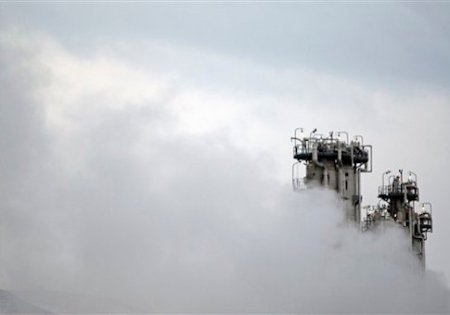
Part of Arak heavy water nuclear facilities is seen, near the central city of Arak, 150 miles southwest of the capital Tehran / AP
Officials from both the Treasury and Energy departments told the Free Beacon that details about the payment are being withheld until the purchase is complete. Iran is expected to deliver the heavy water to the United States in the “coming weeks,” officials confirmed.
**********************************
Obama administration officials are declining to provide specific details about an unprecedented upcoming purchase of Iranian nuclear materials, an $8.6 million exchange that is likely to be funded using American taxpayer dollars, according to conversations with multiple administration officials and sources in Congress.
The administration is preparing to purchase from Iran 32 tons of heavy water, a key nuclear material, in a bid to keep Iran in compliance with last summer’s comprehensive nuclear agreement.
But administration officials have declined to provide specific details to Congress and reporters about how exactly it will pay for the purchase, as well as other information, until the deal has been completed.
The effort to withhold key information about the purchase, which is likely to be paid in some form using U.S. taxpayer dollars, is causing frustration on Capitol Hill, according to multiple sources who disclosed to the Washington Free Beacon that the administration is rebuffing congressional attempts to discern further information about the deal.
Experts further disclosed to the Free Beacon that the exchange is likely to legitimize Iran’s research into plutonium, knowledge that would provide the Islamic Republic with a secondary pathway to a nuclear weapon capability.
Officials from both the Treasury and Energy departments told the Free Beacon that details about the payment are being withheld until the purchase is complete. Iran is expected to deliver the heavy water to the United States in the “coming weeks,” officials confirmed.
“We cannot discuss details of the payment until after the purchase is complete,” a Treasury Department official who was not authorized to speak on record told the Free Beacon. “The Department of Energy’s Isotope Program plans to pay Iran approximately $8.6 million dollars for 32 metric tons of heavy water.”
The administration will use an offshore third party to facilitate the transfer of cash to Iran, according to officials in both the Treasury and Energy departments.
“Regardless of whether or not this is in U.S. dollars, this licensed transaction is limited in scope. This routing through third-country financial institutions is similar to the mechanism that has been used for years to allow other authorized transactions—such as for exports of food and medicine—between the United States and Iran,” the treasury official said, referencing a loophole in U.S. sanctions that permits transactions of a humanitarian nature.
An Energy Department official confirmed that officials “cannot discuss details of the payment until after the purchase is complete.”
The exchange is being handled by the Energy Department’s Isotope Program, which routinely conducts transactions of this nature, according to the official.
“DOE’s Isotope Program produces and distributes a variety of isotopes that are in short supply for industrial and medical purposes,” an Energy Department official told the Free Beacon. “Transactions like this one are regular business for the program.”
Iran’s excess heavy water “will help to fulfill a substantial portion of U.S. domestic market demand this year,” according to the official, who said that “over the past few years, there have often been constrained supplies of heavy water.”
The administration further “expects to resell the purchased heavy water at commercially reasonable prices to domestic commercial and research buyers, including Oak Ridge National Laboratory’s Spallation Neutron Source, where it would be used to increase the efficiency of the facility,” the source said.
Congressional critics of the arrangement accuse the administration of using this sale as part of a larger plan to help Iran gain access to the American financial system and U.S. dollar.
“Subsidizing Iran’s production of heavy water is a dangerous move,” Sen. Tom Cotton (R., Ark.) told the Free Beacon. “It stimulates Iran’s nuclear industry, opens the door to the use of U.S. dollars to facilitate Iranian trade and illicit financing, and provides U.S. tax dollars to the world’s top state sponsor of terrorism.”
Energy Secretary Ernest Moniz “is aware of these dangers, which is why he stressed that this is a one-time purchase,” said Cotton, the author of a new amendment that would block the administration from engaging in similar purchases with Iran in the future. “I want to hold him and President Obama to that vow, particularly in light of the many promises broken and redlines erased by this administration in the course of negotiating the Iran deal.”
Rep. Mike Pompeo (R., Kan.), a member of the House intelligence committee, accused the administration of funding Iran’s nuclear pursuits in contradiction of last summer’s agreement aimed at winding down Tehran’s nuclear ambitions.
“The Obama administration’s deal with the Mullahs in Tehran to purchase heavy water demonstrates a disturbing, potentially illegal, willingness of the administration to subsidize Iran’s nuclear program,” Pompeo told the Free Beacon. “This purchase allows the Iranians to offload previously unsellable product and it destigmatizes the act of doing business in Iran.”
Pompeo said it is irresponsible to pursue this deal without first providing lawmakers detailed information about whether Iran will directly receive taxpayer dollars.
“This purchase is being made without explanation as to how Iran will receive these funds or what steps the administration is taking to prevent what will almost certainly be U.S. taxpayer dollars from possibly being used to support terrorist activities, Syrian dictator Bashar al-Assad, or Iran’s ballistic missile program,” Pompeo said. “Of course, the reality is that once that money is in the hands of the Ayatollah, there is no way to prevent the funds from being diverted toward any of those purposes—a fact that seems to concern no one at the White House.”
A larger debate has been taking place in Washington over Iranian and European demands that the United States grant Iran access to dollars, a move the administration has publicly opposed and promised Congress would not take place.
However, sources indicate that the heavy water exchange could be the first sign that the administration is caving on this promise.
Mark Dubowitz, head of the Foundation for Defense of Democracy’s Center on Sanctions and Illicit Finance, told theFree Beacon that Iran is producing excess nuclear material in order to wring more cash from the nuclear deal.
“Iran has created a clever scheme—produce too much heavy water so as to break the nuclear agreement, then get the Obama administration and eventually U.S. companies to pay Tehran using the U.S. dollar to get rid of it,” Dubowitz explained. “These U.S. subsidies will help Tehran perfect its heavy water production skills so it will be fully prepared to develop its plutonium bomb-making capabilities when restrictions on the program sunset over the next 10-15 years.”
“This scheme also will open the door to further dollarized transactions as the administration green-lights the greenback for a regime with a decades-long rap sheet of financial crimes,” he added.
A senior congressional source familiar with the trade disclosed that administration officials are declining to disclose key details about the deal.
“The administration is being coy about how the financial mechanics of this deal will work,” the source told the Free Beacon. “But the bottom line is that U.S. taxpayer dollars will be used, and used for a purchase directly connected to Iran’s nuclear program. This is an attempt by the administration to slowly open a door that leads to the wide acceptance of Iran’s nuclear industry and to the use of U.S. dollars by Iran to conduct trade.”
“Many in Congress—on both the Republican and Democratic sides—won’t stand for that, and will move to shut that door tightly,” the source said.






 anneinpt
 artaxes
 danmillerinpanama
 davidking1530
 Peter Hofman
 Joseph Wouk
 Peter
Peter Louisiana Steve
 WarSclerotic
Recent Comments