Posted tagged ‘Nuclear War’

Barack Obama, Pacifist

May 28, 2016

Barack Obama, Pacifist, Power Line,  John Hinderaker, May 28, 2016

Barack Obama spoke in Hiroshima yesterday. The full text of his speech is here. Obama did not quite apologize for America’s use of the atomic bomb to bring WWII to an end, as some had feared. But his speech was nevertheless deeply revealing of his world view.

Let’s begin by acknowledging that parts of Obama’s address were good, or at least unexceptionable. Peace is better than war! Modern man has developed terrible weapons, and the deaths of tens of millions are tragic. But it was in his specific references to Hiroshima and the weapons used there where Obama revealed his radical core.

This is what Obama had to say about the Second World War:

The World War that reached its brutal end in Hiroshima and Nagasaki was fought among the wealthiest and most powerful of nations. Their civilizations had given the world great cities and magnificent art. Their thinkers had advanced ideas of justice and harmony and truth. And yet, the war grew out of the same base instinct for domination or conquest that had caused conflicts among the simplest tribes; an old pattern amplified by new capabilities and without new constraints.

That is true. The war grew out of the “base instinct for domination or conquest” that prevailed in Germany, Japan and Italy. But note that Obama does not name the aggressors. He does not distinguish between the nations that started the war and those that defended themselves. He refers indifferently to the guilty and the innocent as “the wealthiest and most powerful of nations” “among whom” the war was fought–what a weaselly locution!

Similarly, Obama draws no distinction between America’s use of the atomic bomb to end the war in the Pacific and Germany’s concentration camps:

There are many sites around the world that chronicle this war — memorials that tell stories of courage and heroism; graves and empty camps that echo of unspeakable depravity. Yet in the image of a mushroom cloud that rose into these skies, we are most starkly reminded of humanity’s core contradiction….

The lesson that Obama draws from World War II–the most epic conflict between good and evil in history–is the same for all nations. Those who started the war have nothing special to learn from it. On the contrary, it seems that the United States and others who possess nuclear arsenals are, at least implicitly, the most indicted by history:

We may not be able to eliminate man’s capacity to do evil, so nations –- and the alliances that we’ve formed -– must possess the means to defend ourselves. But among those nations like my own that hold nuclear stockpiles, we must have the courage to escape the logic of fear, and pursue a world without them.

What Obama calls the logic of fear is actually the logic of deterrence. But the practical need to defend oneself from evil regimes is not Obama’s concern. Rather, he calls for a “moral revolution” that will make war obsolete.

Whatever. There is no mystery as to Obama’s ideology, at least as he expressed it in Hiroshima. Obama is an old-fashioned pacifist: indiscriminately hostile to the use of force, he papers over the fundamental difference between aggression and self-defense. Pacifism of this sort was rather common during the years between the wars, but World War II refuted it, seemingly, forever. It seems that the passage of time has allowed fuzzy thinkers like Barack Obama to use that black-and-white conflict to illustrate, not the need for eternal vigilance in defense of liberty, but rather the moral case for disarmament. How far we have come in a few short years.

Renegade Jew Backlash

May 19, 2016

Renegade Jew Backlash, Front Page Magazine, David Horowitz, May 19, 2016

wc_1

Reprinted from Breitbart.

According to the Internet Webster synonyms for renegade are “defector” and “deserter.” I applied the term to Kristol because of his efforts to launch a third party campaign to block the nominee of his party, split the conservative vote, and ensure the election of a Democrat whose party had provided a path to nuclear weapons to the Jews’ mortal enemy (and America’s as well).

***************************

I have been accused of being a provocateur all my life – when I was a leftist in the 60s proclaiming (God help me) that Vietnam was the fulfillment of the American dream; when I left the left declaring that, “the beginning of political morality is anti-Communism;” when I said that identity politics “owed more to Mussolini than to Marx;” when I opposed reparations for slavery 137 years after the fact because it was “bad for blacks and racist too;” and when I organized “Islamo-fascism Awareness Weeks on a hundred college campuses across the country. Now I have provoked a firestorm on the Internet through a Breitbart article that called Bill Kristol a “renegade Jew.”

According to the Internet Webster synonyms for renegade are “defector” and “deserter.” I applied the term to Kristol because of his efforts to launch a third party campaign to block the nominee of his party, split the conservative vote, and ensure the election of a Democrat whose party had provided a path to nuclear weapons to the Jews’ mortal enemy (and America’s as well). I picked the emotional term “renegade” because I wanted to shock Kristol and his co-conspirators into realizing the gravity of their actions.

However, I had no idea that this would provoke the reaction it did. A veritable tsunami of attacks were directed at Breitbart and myself from Kristol’s supporters on the “neo-conservative” right and from die-hard enemies of the Republican nominee in all political quarters. Even the Anti-Defamation League, which had once attacked me over my anti-reparations campaign) chimed in, calling the title of my piece “inappropriate and offensive.” This was actually pretty mild considering others were denouncing it as “disgraceful” and “an anti-Semitic slur.”

How by the way is the characterization “anti-Semitic slur” even possible? Are Jews immune to defecting from causes? When I publicly repudiated the radical cause, thirty years ago, the first attack on me appeared in the Village Voice under the title, “The Intellectual Life and the Renegade Horowitz.” It was written by Paul Berman, who years later became a somewhat chastened radical himself. Berman’s attack stung me – as I hoped my charge would sting Kristol and cause him to reconsider his course. But the epithet didn’t bother anybody but me. My current critics would stigmatize me not only as a defector from the conservative cause but as a double agent who never really left the left. After my Breitbart article appeared, Commentary editor (and Kristol relative) John Podhoretz sent me a one-line email: “Once a Stalinist always a Stalinist,” while Commentary writer Jonathan Tobin in a piece titled “Breitbart ‘Renegade Jew’ Disgrace,” suggest: “You can take the boy out of the Bolsheviks but you can’t take the Bolshevik out of the boy.”

Like many of the attacks on Trump, these squalid responses with their flimsy intellectual content call to mind a famous remark of Lionel Trilling’s, made more than 60 years ago. Conservatives, he wrote, did not “express themselves in ideas but only in action or in irritable mental gestures that seek to resemble ideas.” It is not that Kristol or his defender Tobin haven’t had worthy and defensible ideas. They have. But this makes it even sadder to see the flimsy arguments they trot out to discredit Trump and to defend Kristol’s indefensible campaign. Criticisms of Trump’s personal attacks on his Republican rivals are reasonable. But not when they fail to take into account the 60,000 political ads that were aired by those same rivals whose purpose was to destroy him. (The ads were not, should anybody have missed them, about policies and issues.)

I have no quarrel with people who have doubts about what Trump would do if elected. It is the task of the candidate to allay those doubts. For reasonable critics Trump’s announcement of his prospective Supreme Court nominees should be important steps along the way. My quarrel is not with Trump skeptics, but with the effort to nullify the vote of the Republican electorate – a politically active and informed, and conservative segment of that electorate. Kristol’s third party effort exudes an elitist contempt for the will of the people, which is particularly unbecoming in a crowd that prides itself on being “constitutional conservatives.”

Finally, I am disturbed by the failure of the nullifiers to consider the perils of the choices our country now faces. For the life of me I cannot understand how my friends in the conservative movement cannot have qualms about derailing the candidacy of the Republican Party’s pro-Israel, pro-military, pro-American nominee, and electing the candidate of a party that has built its foreign policy around making Islamist Iran the number one power in the Middle East, providing its jihadists with a path to nuclear weapons, putting $150 billion into their terrorist war chest and turning a blind eye to their circumvention of international restrictions so that they can build ballistic missiles capable of destroying the Jewish state and causing incalculable damage to the United States.

Iran to Build High-Powered Explosives Used for Nuclear Arms

April 11, 2016

Iran to Build High-Powered Explosives Used for Nuclear Arms, Clarion Project, April 11, 2016

(Obama will act decisively by sending a letter to Khamenei explaining “that’s not who you are.” — DM)

Iran-Defense-Min-Gen-Hossein-Dehqan-IPIranian Defense Minister Brigadier-General Hossein Dehqan

The U.S. administration claimed the agreement would mean that Iran’s break-out timeline to build a nuclear weapon would be at least one year for the next 10 years. With a nuclear detonator in place, that timeline would become significantly shorter.

*********************

Three months after the nuclear agreement with Iran was implemented, Iran just announced that it would be producing a powerful explosive that could be used to detonate nuclear weapons.

Iranian Defense Minister Brigadier General Hossein Dehqan announced plans to build a plant which produces Octogen (also known as HMX — High-velocity military explosive) to improve the penetration and destructive power of missile payloads while increasing their precision.

“Concurrently with its efforts to increase the precision-striking power of its weapons systems, the defense ministry has also paid attention to boosting the destructive and penetration power of different weapons’ warheads and has put on its agenda the acquisition of the technical know-how to produce Octogen explosive materials and Octogen-based weapons,”  Dehqan said at the plant’s inauguration ceremony.

While Octogen can be used in non-nuclear applications, one of its main purposes is that of a detonator of atomic weapons. The production of the chemical does not violate the agreement, which failed to mention the issue of nuclear detonators, but raises a red flag concerning the timetable used to sell the agreement to Western countries.

The U.S. administration claimed the agreement would mean that Iran’s break-out timeline to build a nuclear weapon would be at least one year for the next 10 years. With a nuclear detonator in place, that timeline would become significantly shorter.

In addition, there is concern Iran will sell the explosive to any number of terrorist groups that the Islamic Republic supports. A 2004 report by The New York Times regarding the disappearance of 380 tons of HMX and RDX (rapid detonation explosive, another chemical explosive) from a Sadadam Hussein/al-Qaeda facility notes that HMX’s  “benign appearance makes it easy to disguise as harmless goods, easily slipped across borders,” and that it is “used in standard nuclear weapons design.”

The new effort by Iran is part of a strategy outlined by Iran’s Supreme Leader Ayatollah Ali Khamenei on March 20, the beginning of the Iranian new year, in which Khamenei called for a concerted effort to increase the country’s power to confront its enemies while at the same time helping its economy.

“The main issue is that the Iranian nation should be able to do something to bring its vulnerabilities to zero point, and we should have the art of using opportunities and turning threats into opportunities,” Khamenei said

Echoing that sentiment, Dehqan said at the time, “We should strengthen ourselves to the level that we can prevent failure and acquire victory over our enemies.”

Just the day before the opening of the HMX plant, Iranian Revolutionary Guards Corps (IRGC) Commander Major-General Mohammad Ali Jafari, announced, “For years, we have been building power on the presumption of a widespread war with the US and its allies, and have developed all our capacities and capabilities for decisive victories over such enemies.”

“Before political and diplomatic options, we have gotten prepared for a military option,” he continued.

Jafari also bragged that If there is a military confrontation, the U.S. will not be able “to do a damn thing” about it.

Op-Ed: Chaos and 2nd Cold War, Part I: Israel’s Nuclear Strategy

October 11, 2015

Op-Ed: Chaos and 2nd Cold War, Part I: Israel’s Nuclear Strategy, Israel National News,Prof. Louis René Beres, October 9, 2015

To fashion a functional nuclear strategy would be difficult for any state in world politics, but it could be especially challenging for one that keeps its bomb more-or-less securely “in the basement.” Now, as the Middle East descends into an ever more palpable chaos,[1] Israel will have to make certain far-reaching decisions on this very complex task.

Among other nuanced and widely intersecting concerns, Jerusalem’s decisions will need to account for a steadily hardening polarity between Russia and the United States.

Here, almost by definition, there will be no readily available guidebook to help lead the way. For the most part, Israel will need to be directed by an unprecedented fusion of historical and intellectual considerations. In the end, any resultant nuclear strategy will have to represent the prospective triumph of mind over mind, not merely of mind over matter.[2]

Conceivably, at least for the Jewish State that is smaller than America’s Lake Michigan, an emergent “Cold War II” could prove to be as determinative in shaping its national nuclear posture as coinciding regional disintegration. Still, a new Cold War need not necessarily prove disastrous or disadvantageous for Israel. It is also possible, perhaps even plausible, that Jerusalem could sometime discern an even greater commonality of strategic interest with Moscow, than with Washington.

To be sure, any such stark shift of allegiance in Israeli geo-political loyalties ought not to be intentionally sought, or in any way cultivated for its own sake. Moreover, on its face, it would currently be hard to imagine in Jerusalem that a superpower mentor of both Syria and Iran could somehow also find strategic common ground with Israel. Yet, in these relentlessly tumultuous times, any normally counter-intuitive judgments could, at least on rare occasions, prove surprisingly correct.

Credo quia absurdum. “I believe because it is absurd.” In these tumultuous times, certain once preposterous counter-intuitive judgments should no longer be dismissed out of hand. Moreover, in seeking to best understand the Israel-relevant dynamics of any renewed Washington-Moscow bipolar axis of conflict, Jerusalem will need to consider the prospects for a conceivably “looser” form of enmity.

In other words, looking ahead, it would seem realistic that a now “restored” superpower axis might nonetheless reveal greater opportunities for cooperation between the dominant “players.” Understood in the traditional language of international relations theory, this points toward a relationship that could become substantially less “zero-sum.”[3]

By definition, regarding zero-sum relationships in world politics, any one state’s gain is necessarily another state’s loss. But in Cold War II, it is reasonable to expect that the still-emerging axis of conflict will be “softer.” Here, for both major players, choosing a cooperative strategy could sometimes turn out to be judged optimal.[4]

Recognizing this core difference in superpower incentives from the original Cold War, and to accomplish such recognition in a timely fashion,  could prove vitally important for Israel. In essence, it could become a key factor in figuring out what should or should not be done by Jerusalem about any expected further increments of regional nuclear proliferation, and about Iran.

Iranian nuclearization remains the single most potentially daunting peril for Jerusalem. In this regard, virtually nothing has changed because of the recent Iran Nuclear Agreement (Joint Comprehensive Plan of Action, Vienna, 14 July, 2015).[5] To the contrary, in a situation fraught with considerable irony, Iran’s overall strategic latitude will actually have been expanded and improved by the terms of this concessionary pact.[6] Most plainly, these Iranian enhancements are the permissible result of a now no-holds-barred opportunity for transfer of multiple high-technology weapons systems, from Moscow to Tehran.

For the foreseeable future, the nuclear threat from Iran will continue to dwarf all other recognizable security threats.[7] At the same time, this enlarging peril could be impacted by certain multi-sided and hard to measure developments on the terrorism front.  In more precisely military terminology, these intersecting terror threats could function “synergistically,” or as so-called “force multipliers.”

The “whole” of the strategic danger now facing Israel is substantially greater than the simple arithmetic sum of its parts.[8] This true combination could include a persistently shifting regional “correlation of forces,”[9] one that would continue to oscillate menacingly, and also to the  observable benefit of Israel’s mortal enemies, both state and sub-state.

In Jerusalem and Tel-Aviv, serious derivative questions should now be addressed. What does this changing set of adversarial developments mean for Israel in very specifically operational and policy terms? Above all, this configuration of enmity should warn that a steady refinement and improvement of Israel’s nuclear strategy must be brought front and center. For Israel, there can be no other reasonable conclusion, not only because of ominous developments in Iran, but also because of the growing prospect of additional nuclear weapon states in the region, including perhaps Egypt, and/or Saudi Arabia.

Despite U.S. President Barack Obama’s continuing support for a “world free of nuclear weapons,” all of the world’s existing nuclear weapon states are already expanding and modernizing their nuclear arsenals. As of the end of September 2015, the world’s total inventory of nuclear warheads was reliably estimated as 17,000.[10] What Israel must also bear in mind is that this American president’s notion that nuclear weapons are intrinsically destabilizing, or even evil, makes no defensible intellectual sense.

It is plausible, rather, that only the perceived presence of nuclear weapons in the arsenals of both original superpowers prevented World War III. Equally convincing, Israel, without its atomic arsenal – whether ambiguous, or declared – could never survive, especially in a region that may soon combine further nuclear spread with steadily undiminished chaos.

Israel will have to decide, in prompt and sometimes inter-related increments, upon the precise extent to which the nation needs to optimize its composite national security policies on preemption, targeting, deterrence, war fighting, and active defense. A corollary imperative here must be to deal more purposefully with the complicated and politically stubborn issues of “deliberate ambiguity.” Going forward, it will not serve Israel’s best interests to remain ambiguous about ambiguity.

To date, at least, it seems that this longstanding policy of “opacity” (as it is also sometimes called) has made perfectly good sense. After all, one can clearly assume that both friends and enemies of Israel already acknowledge that the Jewish State holds persuasive military nuclear capabilities that are (1) survivable; and (2) capable of penetrating any determined enemy’s active defenses. Concerning projections of nuclear weapon survivability, Israel has made plain, too, its steady and possibly expanding deployment of advanced sea-basing (submarines).

Thus far, “radio silence” on this particular “triad” component has likely not been injurious to Israel. This could change, however, and rather quickly. Here, again, there is no room for error. Already, in delivering his famousFuneral Speech, with its conspicuously high praise of Athenian military power, Pericles had warned: “What I fear more than the strategies of our enemies, is our own mistakes.”[11]

Thus far, there have been no expressed indications that Israel’s slowly growing force of Dolphin-class diesel submarines has anything at all to do with reducing the vulnerability of its second-strike nuclear forces, but any such policy extrapolations about Israeli nuclear retaliatory forces would also be problematic to dismiss.[12]

Also significant for Israel’s overall security considerations is the refractory issue  of “Palestine.” A Palestinian state, any Palestinian state, could pose a serious survival threat to Israel, in part, as a major base of operations for launching increasingly lethal terrorist attacks against Israeli citizens. A possibly more important “Palestine” security issue for Israel lies in an even larger generalized potential for creating a steadily deteriorating correlation of regional forces. More specifically, any such deterioration could include various destabilizing “synergies,” that is, tangible interactive effects resulting from instabilities already evident  in Iraq and Syria, and from a manifestly concomitant Iranian nuclearization.

Leaving aside the various possibilities of any direct nuclear transfer to terrorists, a Palestinian state would  itself remain  non-nuclear. But, when viewed together with Israel’s other regional foes, this new and 23rd Arab state could still have the stunningly consequential effect of becoming a “force multiplier,” thereby impairing Israel’s already-minimal strategic depth, and  further rendering the Jewish State vulnerable to a thoroughly diverse panoply of both conventional and unconventional attacks. Here, for a variety of easily determinable reasons, a “merely” non-nuclear adversary could still heighten the chances of involving Israel in assorted nuclear weapons engagements,[13] including, in the future, a genuine nuclear war.[14]

What, then, should Israel do next about its core nuclear posture, and about its associated “order of  battle?”  How, exactly, should its traditionally ambiguous nuclear stance be adapted to the increasingly convergent and inter-penetrating threats of Middle Eastern chaos, Iranian nuclearization, and “Palestine?” In answering these difficult questions, Jerusalem will have to probe very carefully into the alleged American commitment to “degrade” and “destroy” ISIS(IS).  However well-intentioned, this pledge, especially if actually carried out effectively, could simultaneously aid both Syria’s President Assad, and the surrogate Shiite militia, Hezbollah.[15]

___________________________

[1] Although composed in the seventeenth century, Thomas Hobbes’Leviathan still offers an illuminating and enduring vision of chaos in world politics. Says the English philosopher in Chapter XIII, “Of the Naturall Condition of Mankind, as concerning their Felicity, and Misery:”  during chaos, a condition which Hobbes identifies as a “time of Warre,”  it is a time “…where every man is Enemy to every man… and where the life of man is solitary, poore, nasty, brutish, and short.” At the time of writing, Hobbes believed that the condition of “nature” in world politics was less chaotic than that same condition existing among individual human beings -because of what he called the “dreadful equality” of individual men in nature being able to kill others – but this once-relevant differentiation has effectively disappeared with the global spread of nuclear weapons.

[2] The core importance of literally thoughtful military doctrine – of attention to the complex intellectual antecedents of any actual battle – had already been recognized by early Greek and Macedonian armies. See, on this still-vital recognition, F.E. Adcock, The Greek and Macedonian Art of War (Berkeley, CA: University of California Press, 1962), especially Chapter IV.

[3] For much earlier, but still useful, scholarly assessments of polarity in world politics, by this author, See: Louis René Beres, “Bipolarity, Multipolarity, and the Reliability of Alliance Commitments,” Western Political Quarterly, Vol. 25, No. 4, December 1972, pp. 702-710; Louis René Beres, “Bipolarity, Multipolarity, and the Tragedy of the Commons,” Western Political Quarterly, Vol. 26, No. 4, December 1973, pp. 649-658; and Louis René Beres, “Guerillas, Terrorists, and Polarity: New Structural Models of World Politics,”Western Political Quarterly, Vol. 27, No.4., December 1974, pp. 624-636.

[4] Of course, in the context of any non-zero-sum game, ensuring enforceable agreements between the players (here, the United States and Russia) could still prove more-or-less decisively problematic.

[5]  See Louis René Beres, “After the Vienna Agreement: Could Israel and a Nuclear Iran Coexist?”  IPS Publications, IDC Herzliya, Institute for Policy and Strategy, Israel, September 2015.

[6] Significantly, this agreement also violates two major treaties, the 1968Non-Proliferation Treaty (NPT), and the 1948 Genocide Convention. The first violation has to do with subverting the NPT expectation that all non-nuclear state signatories must remain non-nuclear for a period of “indefinite duration.” The second violation centers on codified U.S. indifference to Genocide Convention obligations concerning responsibility to enforce the prohibition against “incitement to genocide.” In both cases, moreover, per article 6 of theU.S. Constitution – the “Supremacy Clause” – these violations are ipso factoalso violations of U.S. domestic law.

[7] See Louis René Beres, “Like Two Scorpions in a Bottle: Could Israel and a Nuclear Iran Coexist in the Middle East?” The Israel Journal of Foreign Affairs, Vol. 8., No. 1., 2014, pp. 23-32. See, also: Louis René Beres and (General/USAF/ret.) John T. Chain, “Living With Iran: Israel’s Strategic Imperative,” BESA Perspectives Paper No. 249, May 28, 2014, BESA Center for Strategic Studies, Israel. General Chain was Commander-in-Chief, U.S. Strategic Air Command.

[8] See Louis René Beres, “Core Synergies in Israel’s Strategic Planning: When the Adversarial Whole is Greater than the Sum of its Parts,” Harvard National Security Journal, Harvard Law School, June 2, 2015.

[9] See Louis René Beres, “Understanding the Correlation of Forces in the Middle East: Israel’s Urgent Strategic Imperative,” The Israel Journal of Foreign Affairs, Vol. IV, No. 1 (2010). Russia’s Putin, of course, is accustomed to thinking in such strategic terms; in the Soviet days, “correlation of forces” was already a tested yardstick for measuring Moscow’s presumptive military obligations.

[10] Se: Hans M. Kristensen, “Nuclear Weapons Modernization: A Threat to the NPT?”  Arms Control Today, Arms Control Association, September 2015, 11 pp.

[11] From the Funeral Speech of 431 BCE, near the outbreak of the Peloponnesian War, when Sparta first invaded Attica. For greater detail, see:Thucydides, The Speeches of Pericles, H.G. Edinger, tr., New York: Frederick Ungar Publishing Co., 1979), 68 pp.

[12] On nuclear sea-basing by Israel (submarines) see: Louis René Beres and (Admiral/USN/ret.) Leon “Bud” Edney, “Israel’s Nuclear Strategy: A Larger Role for Submarine Basing,” The Jerusalem Post, August 17, 2014; and Professor Beres and Admiral Edney, “A Sea-Based Nuclear Deterrent for Israel,” Washington Times, September 5, 2014. Admiral Edney was NATO Supreme Allied Commander, Atlantic.

[13] Such engagements could include assorted enemy attacks on Israel’sDimona nuclear reactor. Already, in both 1991 and 2014, this small reactor came under combined missile and rocket attack from Iraq and Hamas aggressions, respectively. For fully authoritative assessments of these attacks, and related risks, see: Bennett Ramberg, “Should Israel Close Dimona? The Radiological Consequences of a Military Strike on Israel’s Plutonium-Production Reactor,” Arms Control Today, Arms Control Association, May 2008, pp. 6-13.

[14] Naturally, the risks of a nuclear war would be expected to increase together with any further regional spread of nuclear weapons. In this connection, returning to the prophetic insights of Thomas Hobbes, back in the seventeenth century (see Note #1, above), Leviathan makes clear that the chaotic condition of nature is substantially worse among individual human beings, than among states. This is because, opines Hobbes, also in Chapter XIII, within this particular variant of chaos, “…the weakest has strength enough to kill the strongest….” Now, however, with the spread of nuclear weapons, the “dreadful equality” of Hobbesian man could be replicated, more or less, in the much larger and more consequential arena of world politics.

[15] “Everything is very simple in war,” advises Clausewitz, “but the simplest thing is also very difficult.” See: Carl von Clausewitz, On War.

Israeli deterrence in the eye of the hurricane

July 12, 2015

Israeli deterrence in the eye of the hurricane, Jerusalem PostLouis Rene Beres, July 12, 2015

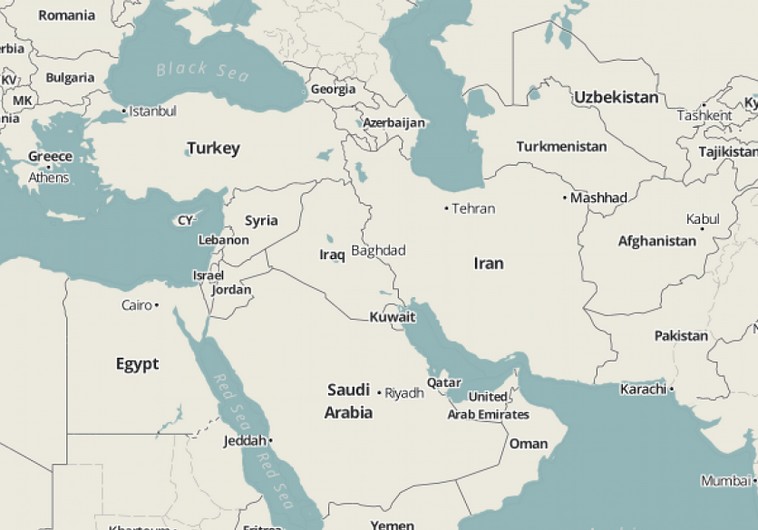
ShowImage (1)Map of Middle East. (photo credit:Courtesy)

Everything is very simple in war, but the simplest thing is difficult.”
– Carl von Clausewitz, On War

To prevent a nuclear war amid steadily growing regional chaos, especially as Iran will soon be fully nuclear (and the grateful beneficiary of US President Barack Obama’s pretend P5+1 diplomacy), Israel will need suitably complementary conventional and nuclear deterrents.

**********************

Left to themselves, especially as more “normal” hostilities dissolve into a full-blown regional chaos, Israel’s adversaries could drive the Jewish state toward an unconventional war. This fateful endangerment could be produced singly or collaboratively, by deliberate enemy intent or by the “collateral damage” of sectarian strife. Militarily, these Islamic adversaries of Israel, both Sunni and Shi’ite, could be either non-nuclear, or, in the future, nuclear.

They might also include certain wellarmed sub-state or terrorist forces. Already, Iranian-backed Hezbollah may have more usable missiles than all NATO countries combined.

To most effectively deal with such interpenetrating threats – including reasonably expected “synergies” and “force multipliers” – Israel’s leaders will first need to consider some largely-opaque factors. These include: 1) probable effects of regional chaos upon enemy rationality; 2) disruptive implications of impending Palestinian statehood; and 3) re-emergence of a corrosively Cold War-style polarity between Russia and the United States. Apropos of a “Cold War II,” there is already evidence of growing contact between Russia and Saudi Arabia, the world’s two largest oil producers.

In essence, Jerusalem must take all necessary steps to successfully manage an expectedly unprecedented level of adversarial complexity and weaponization. Israel’s leaders, in this connection, must take proper measures to ensure that any conceivable failures of its national deterrent would not spark biological or nuclear forms of regional conflict. To accomplish this indispensable goal, the IDF, inter alia, must continue to plan carefully around the core understanding that nuclear deterrence and conventional deterrence are inherently interrelated and meaningfully “seamless.”

Sometimes, in strategic matters, seeing requires distance. A nuclear war in the Middle East is not beyond possibility. This is a sensible assessment even if Israel were to remain the only nuclear weapons state in the region.

How is this possible? A bellum atomicum could come to Israel not only as a “bolt from the blue” enemy nuclear attack (either by a state or by a terrorist group), but also as the result, intended or otherwise, of certain uncontrolled military escalations.

Needed prudence in such narratives calls for additional specificity and precision. If particular Arab/Islamic enemy states were to launch conventional attacks upon Israel, Jerusalem could then respond, sooner or later, with calculated and more-or-less calibrated nuclear reprisals. Alternatively, if some of these enemy states were to launch large-scale conventional attacks, Jerusalem’s own still-conventional reprisals could then be met, perhaps even in the not-too-distant future, with enemy nuclear counterstrikes.

How should Israel prepare for such perilous contingencies? More than likely, Israel has already rejected any doctrinal plans for fielding a tactical/theater nuclear force, and for assuming any corollary nuclear war fighting postures. It would follow further from any such well-reasoned rejection that Israel should do whatever is needed to maintain a credible conventional deterrent.

By definition, such a measured threat option could then function reliably across the entire foreseeable spectrum of non-nuclear threats.

Still, any such strategy would need to include an appropriately complementary nuclear deterrent, a distinctly “last resort” option that could display a “counter-value” (counter-city) mission function. Si vis pacem, para bellum atomicum: “If you want peace, prepare for atomic war.”

A persuasive Israeli conventional deterrent, at least to the extent that it might prevent a wide range of enemy conventional attacks in the first place, could reduce Israel’s growing risk of escalatory exposure to nuclear war. In the always arcane lexicon of nuclear strategy, a complex language that more-or-less intentionally mirrors the tangled coordinates of atomic war, Israel will need to maintain firm control of “escalation dominance.” Otherwise, the Jewish state could find itself engaged in an elaborate but ultimately lethal pantomime of international bluster and bravado.

The reason for Israel’s obligation to control escalatory processes is conspicuous and unassailable. It is that Jerusalem’s main enemies possess something that Israel can plainly never have: Mass.

At some point, as nineteenth century Prussian military thinker Carl von Clausewitz asserts in On War: “Mass counts.”

Today, this is true even though Israel’s many enemies are in chaotic disarray. Now, amid what Clausewitz had famously called “friction” and the “fog of war,” it could become harder for Israel to determine real and pertinent differences between its allies, and its adversaries.

As an example, Jordan could soon become vulnerable to advancing IS forces.

Acknowledging this new vulnerability, an ironic question will come immediately to mind: Should Israel support the Jordanian monarchy in such a fight? And if so, in what specific and safe operational forms? Similarly ironic questions may need to be raised about Egypt, where the return to military dictatorship in the midst of surrounding Islamist chaos could eventually prove both fragile and transient.

Should President Abdel Fattah Sisi fail to hold things together, the ultimate victors could be not only the country’s own Muslim Brotherhood, but also, in nearby Gaza, Palestinian Hamas. Seemingly, however, Hamas is already being targeted by Islamic State, a potentially remorseless opposition suggesting, inter alia, that the principal impediment to Palestinian statehood is not really Israel, but another Sunni Arab terrorist organization. Of course, it is not entirely out of the question that IS’s Egyptian offshoot, the so-called “Sinai Province of Islamic State,” could sometime decide to cooperate with Hamas – the Islamic Resistance Movement – rather than plan to it.

To further underscore the area’s multiple and cross-cutting axes of conflict, it is now altogether possible that if an IS conquest of Sinai should spread to Gaza, President Sisi might then “invite” the IDF to strike on Egypt’s behalf. Among other concerns, Egypt plainly fears that any prolonged inter-terrorist campaign inside Gaza could lead to a literal breaking down of border fences, and an uncontrolled mass flight of Palestinians into neighboring Sinai.

Credo quia absurdum. “I believe because it is absurd.” With such peculiar facts in mind, why should Israel now sustain a conventional deterrent at all? Wouldn’t enemy states, at least those that were consistently rational, steadfastly resist launching any conventional attacks upon Israel, for fear of inciting a nuclear reprisal? Here is a plausible answer: suspecting that Israel would cross the nuclear threshold only in extraordinary circumstances, these national foes could be convinced, rightly or wrongly, that as long as their initial attacks were to remain conventional, Israel’s response would remain reciprocally non-nuclear. By simple extrapolation, this means that the only genuinely effective way for Israel to continually deter large-scale conventional war could be by maintaining visibly capable and secure conventional options.

As for Israel’s principal non-state adversaries, including Shi’ite Hezbollah and Sunni IS, their own belligerent calculations would be detached from any assessments of Israeli nuclear capacity and intent. After all, whatever attacks they might sometime decide to consider launching against the Jewish state, there could never be any decipherable nuclear response.

Nonetheless, these non-state jihadist foes are now arguably more threatening to Israel than most enemy national armies, including the regular armed forces of Israel’s most traditional enemies – Egypt, Jordan and Syria.

Some other noteworthy nuances now warrant mention. Any still-rational Arab/ Islamic enemy states considering firststrike attacks against Israel using chemical and/or biological weapons would likely take Israel’s nuclear deterrent more seriously. But a strong conventional capability would still be needed by Israel to deter or to preempt certain less destructive conventional attacks, strikes that could escalate quickly and unpredictably to assorted forms of unconventional war.

If Arab/Islamic enemy states did not perceive any Israeli sense of expanding conventional force weakness, these belligerent countries, now animated by credible expectations of an Israeli unwillingness to escalate to nonconventional weapons, could be more encouraged to attack. The net result here could be: 1) defeat of Israel in a conventional war; 2) defeat of Israel in an unconventional (chemical/biological/ nuclear) war; 3) defeat of Israel in a combined conventional/unconventional war; or 4) defeat of Arab/Islamic enemy states by Israel in an unconventional war.

For Israel, even the presumptively “successful” fourth possibility could prove too costly.

Perceptions are vitally important in all calculations of nuclear deterrence. By continuing to keep every element of its nuclear armaments and doctrine “opaque,” Israel could unwittingly contribute to the injurious impression among its regional enemies that Jerusalem’s nuclear weapons were unusable. Unconvinced of Israel’s willingness to actually employ its nuclear weapons, these enemies could then decide to accept the cost-effectiveness of striking first.

With any such acceptance, Israeli nuclear deterrence will have failed.

If enemy states should turn out to be correct in their calculations, Israel could find itself overrun, and thereby rendered subject to potentially existential harms.

If they had been incorrect, many states in the region, including even Israel, could eventually suffer the assorted consequences of multiple nuclear weapons detonations. Within the directly affected areas, thermal radiation, nuclear radiation and blast damage would then spawn uniquely high levels of death and devastation.

To prevent a nuclear war amid steadily growing regional chaos, especially as Iran will soon be fully nuclear (and the grateful beneficiary of US President Barack Obama’s pretend P5+1 diplomacy), Israel will need suitably complementary conventional and nuclear deterrents. Even now, at the eleventh hour, it will also require a set of residual but still-available preemption options. Under authoritative international law, actually exercising any such last-resort options would not necessarily represent lawlessness or “aggression.”

On the contrary, such strikes could readily meet the long-established and recognizable jurisprudential standards for “anticipatory self-defense.”

Going forward, Israeli nuclear deterrence – reinforced, of course, by ballistic missile defense – must become an increasingly central part of the Jewish state’s overall survival plan. Fulfilling this requirement should in no way suggest any corresponding violations of international law. After all, every state in world politics has an overriding obligation to survive.

International law is not a suicide pact.

Poking the Bear

June 26, 2015

Pentagon accuses Russia of ‘playing with fire’ over nuclear threats towards Nato

By Doug Bolton Friday 26 June 2015 Via The Independent


The US Deputy Secretary of Defence said that Russia’s attempts to intimidate Nato countries had not worked. [Photo Credit: Unknown]

(‘Violent statements and threats cannot provide a solution to the problem. They can only exacerbate feeling and make a clash of forces inevitable.’ – LS)

A senior Pentagon official has warned that Russia is “playing with fire” by suggesting it would threaten the use of nuclear weapons in international disputes, and added that Russia is attempting an intimidation campaign against Nato.

Robert Work, the US Deputy Secretary of Defence, told a House Armed Services subcommittee that Russia was trying to control the escalation of tensions by invoking the threat of nuclear weapons.

He said: “Anyone who thinks they can control escalation through the use of nuclear weapons is literally playing with fire.”

“Escalation is escalation, and nuclear use would be the ultimate escalation.”

The Kremlin has not made any direct nuclear threats, and Work did not specify and particular comments. However, numerous references to Russia’s nuclear arsenal in the last few months by Russian officials have increased tensions between East and West.

In April, leaked notes from a meeting between US officials and Russian generals revealed that Russia mentioned “a spectrum of responses from nuclear to non-military” if Nato moved more forces into the Baltic states.

In a documentary about the annexation of Crimea aired on Russian TV, President Vladimir Putin was asked by the interviewer if he was prepared to put Russia’s nuclear forces on alert. He said: “We were ready to do it.”

In March, the Russian ambassador to Denmark warned that “Danish warships would be targets for Russia’s nuclear weapons” if the country joined Nato’s missile defence programme.

Threats and posturing aside, Russia has taken steps to beef up its nuclear arsenal – speaking at a military expo earlier this month, Putin announced the development of 40 new intercontinental ballistic missiles, that would be able to overcome “even the most technically advanced anti-missile defence systems”.

A Topol-M intercontinental ballistic missile, capable of delivering multiple nuclear weapons, is paraded through Moscow’s Red Square in the 2009 Victory Day parade The new missiles are not themselves nuclear weapons, but are nuclear-capable, as they will allow Russia to more easily deliver their stockpile of around 3,000 warheads.

In his speech, Work was defiant in the face of the Russian nuclear arsenal.

He said: “Senior Russian officials continue to make irresponsible statements regarding its nuclear forces, and we assess that they are doing it to intimidate our allies and us.”

“These have failed. If anything, they have really strengthened the Nato alliance solidarity.”

Nato has accused Russia of ‘sabre rattling’ in recent months, but the alliance have themselves been increasing their military presence in Eastern Europe.

Read more: Britain remains vital to the success of Nato
Russia begins huge air force drill as Nato exercises begin
Russia warns Sweden not to join Nato

On Tuesday, Nato announced that heavy weapons would be deployed across Europe in an effort to stand up to Russia.

Tanks, artillery, fighting vehicles and thousands of soldiers will be stationed in Estonia, Lithuania, Latvia, Bulgaria, Romania and Poland, in a show of military strength.

US Defence Secretary Ashton Carter told the press: “While we do not seek a cold, let alone a hot war with Russia, we will defend our allies.”

Earlier this month, a large Nato military exercise took place in the Baltic Sea, with forces from across the alliance practicing amphibious landings and naval maneouvres.

Nato tests its high-readiness attack forces in Western Poland during a recent exercise Some of these exercises took place just a couple of hundred miles from Russia’s naval base in Kaliningrad.

As part of the larger exercise, Exercise Noble Jump took place in Poland from 9 June, in a test of Nato’s high readiness task force, that is designed to respond to urgent situations.

And yesterday, The Guardian reported that sources and Nato claimed that the alliance was preparing to discuss its own strategy on using nuclear weapons at a meeting in Brussels.

Up for discussion were Russia’s threats – with Nato ministers asking whether they should be taken seriously, or whether they are simply rhetoric.

As tensions increase, tit-for-tat exchanges of military force look set to continue.