Posted tagged ‘Netanyahu’

Netanyahu says he’s ready to meet Abbas for talks ‘right now’

May 13, 2016

Netanyahu says he’s ready to meet Abbas for talks ‘right now’ PM claims he’s taken unprecedented steps for peace, tells Palestinian leader to heed calls for direct negotiations

By Times of Israel staff

May 13, 2016, 2:46 am

Source: Netanyahu says he’s ready to meet Abbas for talks ‘right now’ | The Times of Israel

Prime Minister Benjamin Netanyahu speaks to the diplomatic corps at the President’s Residence in Jerusalem on May 12, 2016. (Haim Zach/GPO)

Prime Minister Benjamin Netanyahu said Thursday that he was ready to meet with Palestinian Authority President Mahmoud Abbas “today” for direct peace talks if the Palestinian leader was so willing, charging that he’d done more to advance peace than any other Israeli leader in history.

In a speech before the diplomatic corps at the President’s Residence in Jerusalem to mark Israel’s 68th Independence Day, Netanyahu said he was willing “to meet President Abbas today in Jerusalem. If he’d like, in Ramallah. Right now. Today.”

Acknowledging the “skepticism” about his position, Netanyahu claimed he has “taken steps that no other prime minister in Israel’s history has taken to advance peace,” adding that “so far, they’ve not been answered.”

Netanyahu told the roomful of foreign ambassadors, honorary consuls and military attachés that he continued to “support two states for two peoples: a demilitarized Palestinian state that recognizes the Jewish state.”

Denouncing the Palestinian refusal to recognize Israel as a Jewish state, a key Israeli demand for a peace agreement, Netanyahu said it “remains the core of this conflict,” and “why this conflict preceded the [1967] Six Day War by nearly 50 years.”


The Israeli leader called on members of the diplomatic corps to urge Abbas to accept the call for direct talks, maintaining these were the only way to reach an enduring peace deal.

“Every minute that President Abbas refuses to accept my call for peace robs Palestinians and Israelis of the opportunity to live without fear. It robs our children and our grandchildren the opportunity they so richly deserve,” Netanyahu said.

Expressing optimism for a wider peace arrangement with regional countries and a “deep and abiding faith…that our century-long conflict will end,” the prime minister said he was heartened to see “formerly hostile states in the region and beyond form new and deep partnerships with us.”

“We might solve the Israeli-Palestinian problem by enjoying the support of Arab states who now see Israel more and more not as an enemy, but as an ally against the forces that threaten their own countries as well,” he said, an apparent reference to Iran who last year signed a nuclear deal with world powers which sought the rein in its atomic program in exchange for sanctions relief.

Israel and many Sunni Arab states were deeply opposed to the accord.

US-brokered peace talks between Israel and the Palestinians collapsed in April 2014 and the prospects of fresh dialogue have appeared increasingly remote.

Obama’s Double Standard Toward Netanyahu

April 26, 2016

Obama’s Double Standard Toward Netanyahu, The Gatestone InstituteAlan M. Dershowitz, April 26, 2016

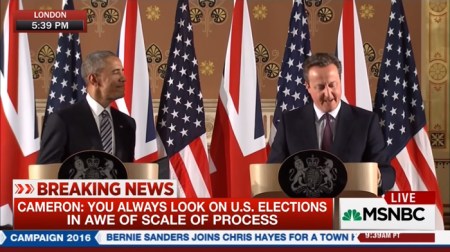
As President Obama winds up his farewell tour of Europe, it is appropriate to consider the broader implications of the brouhaha he created in Great Britain. At a joint press conference with Britain Prime Minister, David Cameron, President Obama defended his intrusion into British politics in taking sides on the controversial and divisive Brexit debate. In an op-ed, Obama came down squarely on the side of Britain remaining in the European Union — a decision I tend to agree with on its merits. But he was much criticized by the British media and British politicians for intruding into a debate about the future of Europe and Britain’s role in it.

Obama defended his actions by suggesting that in a democracy, friends should be able to speak their minds, even when they are visiting another country:

“If one of our best friends is in an organization that enhances their influence and enhances their power and enhances their economy, then I want them to stay in. Or at least I want to be able to tell them ‘I think this makes you guys bigger players.'”

Nor did he stop at merely giving the British voters unsolicited advice, he also issued a not so veiled threat. He said that “the UK is going to be in the back of the queue” on trade agreements if they exit the EU.

1562UK Prime Minister David Cameron and US President Barack Obama take a question at a press conference, on whether it is appropriate for Obama to say whether or not the UK should remain in the European Union, April 22, 2015.

President Obama must either have a short memory or must adhere to Emerson’s dictum that “foolish consistency is the hobgoblin of little minds.” Recall how outraged the same President Obama was when the Prime Minister of a friendly country, Benjamin Netanyahu, spoke his mind about the Iran Deal.

There are, of course, differences: first, Israel has a far greater stake in the Iran Deal than the United States has in whatever decision the British voters make about Brexit: and second, Benjamin Netanyahu was representing the nearly unanimous view of his countrymen, whereas there is little evidence of whether Americans favor or oppose Brexit in large numbers.

Another difference, of course, is that Obama was invited to speak by Cameron, whereas, Netanyahu was essentially disinvited by Obama. But under our tripartite system of government — which is different than Britain’s Unitary Parliamentary system — that fact is monumentally irrelevant. Netanyahu was invited by a co-equal branch of the government, namely Congress, which has equal authority over foreign policy with the president and equal authority to invite a friendly leader. Moreover, not only are the British voters divided over Brexit, but Britain’s Conservative Party itself is deeply divided. Indeed, the leading political figure in opposition to Britain remaining in the European Union is a potential successor to Cameron as leader of the Conservative Party. So these differences certainly don’t explain the inconsistency between Obama’s interference in British affairs and his criticism of Netanyahu for accepting an invitation from Congress to express his country’s views on an issue directly affecting its national security.

So which is it, Mr. President? Should friends speak their minds about controversial issues when visiting another country, or should they keep their views to themselves? Or is your answer that friends should speak their minds only when they agree with other friends, but not when they disagree? Such a view would skew the market place of ideas beyond recognition. If friends should speak about such issues, it is even more important to do so when they disagree.

A wit once observed that “hypocrisy is the homage vice pays to virtue.” It is also the currency of diplomacy and politics. That doesn’t make it right.

The President owes the American people, and Benjamin Netanyahu, an explanation for his apparent hypocrisy and inconsistency. Let there be one rule that covers all friends — not one for those with whom you agree and another for those with whom you disagree. For me the better rule is open dialogue among friends on all issues of mutual importance. Under this rule, which President Obama now seems to accept, he should have welcomed Prime Minister Netanyahu’s advocacy before Congress, instead of condemning it. He owes Prime Minister Netanyahu an apology, and so do those Democratic members of Congress who rudely stayed away from Netanyahu’s informative address to Congress.

A policy of hypocrisy

April 25, 2016

A policy of hypocrisy, Israel Hayom, Dr. Haim Shine, April 25, 2016

Judging by his approach to complex national and international issues, U.S. President Barack Obama is very frustrated. The frustration is natural for someone who made big promises, almost messianic ones, and is now leaving behind nothing more than a trail of shattered dreams. During his eight years in office, the United States has gone from being a leading superpower, a pillar of Western civilization, to a state that is hesitant, indecisive and alarmingly slow to respond. Its domestic economy is faltering, sowing uncertainty and insecurity among the large middle class.

Needless to say, the success enjoyed by Republican presidential candidate Donald Trump is an expression of a great number of Americans who grew up hearing about how their flag was raised on Japan’s Mount Suribachi on the island of Iwo Jima toward the end of World War II, and who are now watching with heartache as their beloved flag is being lowered to half-mast before being taken down altogether.

In an effort to gather up the pieces of his crumbling legacy, Obama set out on his final trip to the Middle East and Europe. America’s long-time allies feel betrayed. Their resentment is clear. Relationships between countries are not disposable. The Obama administration’s deference to Iran has had major implications on its ties with Saudi Arabia and the Gulf States. A divided Egypt is still paying the price for Obama’s support for the Muslim Brotherhood.

The state of Israel, which has led the struggle against a nuclear Iran for a long time, has by now come to terms with the fact that the United States was duped by the fake smiles of Iranian Foreign Minister Mohammad Javad Zarif and his friends in Tehran. Singing Passover songs in Hebrew won’t change the fact that Obama has not changed, after having sided entirely with the mendacious Palestinian narrative of victimhood.

Leaders in the Middle East cannot decide whether Obama is a naive president or one who is willing to sacrifice his fundamental values and his credibility just so he can leave behind what he sees as a positive sentence in the books of history — a sentence that will be erased with record speed.

Europe is also discouraged by the United States. Obama’s indecisiveness regarding the madness in Syria has allowed Russia to take significant steps in the Middle East and Europe. The failed efforts to confront the Syrian problem have contributed to the tsunami of migrants flooding Europe and all the resulting consequences for European society and its security. Add to this, of course, the financial crisis currently threatening to destroy the European Union, the seeds of which were sown in 1992 with the signing of the Maastricht Treaty in 1992.

It is against this backdrop that the British are expected to decide via referendum whether or not to remain a part of the European Union. During his recent visit to England, Obama spoke out strongly against Britain’s potential separation from the EU. This was a crude and disproportionate effort to meddle in another state’s affairs — an expression of his desire to evade blame for the collapse of the European Union. In his mind, British citizens are expected to forgo their opinions and best interests in favor of his legacy.

It is therefore unclear why Obama unleashed his fury at Prime Minister Benjamin Netanyahu when the latter made tireless efforts to convince Congress and the American public not be deceived by the dangerous nuclear deal. How much hypocrisy does it take to allow yourself to do things that you reprimand others for doing? Immanuel Kant saw this kind of behavior as a basic moral failure. Luckily for Britain’s citizens, Obama cannot veto their decision.

Top Senate Democrat chides Netanyahu over ‘untimely’ Golan remarks

April 22, 2016

Top Senate Democrat chides Netanyahu over ‘untimely’ Golan remarks, Jerusalem Post, April 22, 2016

(So Netanyahu should remain silent when Obama and Putin propose to give Golan to Israel’s long time enemy, Syria? — DM)

Sen. Ben Cardin, the top Democrat on the Senate Foreign Affairs Committee, counseled Israel to focus more on peace with the Palestinians.

Sen. Ben Cardin, the top Democrat on the Senate Foreign Affairs Committee, said declaring Israeli ownership of the Golan Heights was not “timely” while Syria was mired in civil war.

He counseled Israel to focus more on peace with the Palestinians.

“Syria is in a state of war, the whole area is in flux,” Cardin, D-Md., said Thursday when he was asked about Prime Minister Benjamin Netanyahu’s declaration this week that “the Golan Heights will forever remain in Israel’s hands.”

“I don’t think it’s timely to figure out what’s happening in the north when there is an active war in Syria,” Cardin said of Netanyahu.

“Ultimately you’re going to need to have some type of recognition factor and you don’t have a government you can negotiate with and talk with in Syria,” said Cardin, who was meeting foreign policy reporters during a break from Senate votes.

The Obama administration this week reiterated longstanding US policy that the strategic plateau captured by Israel in the 1967 Six-Day War was not part of Israel, and that its fate should be determined through negotiations.

“I would love to see a peace process and deal with the West Bank and Gaza,” he said. “And that to me is the most important chapter for Israel right now, is to advance the peace process toward a two-state solution for the Palestinians and Israelis. That to me is the most urgent need.”

Cardin is close to pro-Israel groups and has made clear in the past that he believes it is wrong to place the burden on Israel to renew talks, saying that the Palestinians must end incitement and return to talks with Israel suspended in 2014.

He was one of just four Senate Democrats who voted last year against the Iran nuclear deal, which Netanyahu vehemently opposed, and the senator was in the region just weeks ago, and met with Netanyahu.

Cardin also said he favors renewing the Iran Sanctions Act, due to expire this year, although Obama administration officials fear its renewal would rankle Iran and undercut the sanctions relief for nuclear rollback deal.

Cardin said there was broad agreement in Congress that the act needs renewing in order to keep in place sanctions that would be revived if Iran violates the deal. Obama administration officials say the president has the discretion to kick in sanctions should he need to.

The senator said he also hopes to pass new sanctions against Iran for testing ballistic missiles, a violation of UN Security Council resolutions. Current Republican proposals to renew the Iran Sanctions Act or to sanction Iran for its missile testing seem aimed at undercutting the Iran deal, Cardin said, a path he opposes even though he voted against the deal.

Column One: Our estranged generals

April 21, 2016

Column One: Our estranged generals, Jerusalem Post, Caroline B. Glick, April 21, 2016

(But, but if Israel accepts that weakness is strength and strength is weakness, as Obama and Europe have agreed, they will support Israel and a lasting peace will break out. Not. — DM)

IDF generalsIDF chief of staff Gadi Eisenkot (R), Defense Minister Moshe Ya’alon, and Prime Minister Benjamin Netanyahu. (photo credit:GPO)

It’s been a long time coming, but it finally happened.

The IDF General Staff has lost the public trust.

This is terrible for the General Staff. But it is more terrible for the country, because the public is right not to trust our military leaders. They have earned our distrust fair and square.

The final straw came in less than optimal circumstances.

But such is life. Things are never cut and dry. On Purim, Sgt. Elor Azaria killed a terrorist in Hebron as he lay on the ground, shot, following his attempted murder of one of Azaria’s comrades.

Still today, we don’t know whether Azaria acted properly or improperly. He claims that he believed the terrorist had a bomb beneath the heavy jacket he was wearing in the middle of a heat wave.

Azaria claims that he shot him because he feared that the terrorist – who was moving – was trying to detonate the bomb. This view was shared by emergency personnel at the scene caring for the wounded soldier.

But even before he had a chance to tell his story, IDF Chief of Staff Lt.-Gen. Gadi Eisenkot and Defense Minister Moshe Ya’alon had already declared Azaria guilty of murder. Based on an initial field investigation and a snuff film produced by the European-funded anti-Israel group B’Tselem, Eisenkot and Ya’alon excoriated Azaria and pronounced the soldier, who was decorated for his service just last year, a rotten apple.

Prime Minister Benjamin Netanyahu initially joined them in their condemnations. But when he realized that the public wasn’t buying it and that the evidence was far from cut and dry, to his credit, Netanyahu walked back his remarks.

Ya’alon and Eisenkot, in contrast, have refused to let the uncertainty of the situation affect them.

Their continued assaults on the soldier have compounded the damage. Their stubborn refusal to give Azaria the benefit of the doubt and admit that he may well have comported himself properly indicates that they have no idea how their statements are being viewed by the public, or worse, they may not care. They may simply be playing for another audience.

And here lies the beginning of the real problem.

For the public – including the five thousand citizens who came to the support rally for Azaria at Rabin Square on Tuesday – the critical moment was when the film of Azaria being led away from the scene in handcuffs was broadcast on the evening news. That image, of a combat soldier who killed a terrorist being treated like a criminal, was the breaking point for the public. Whether he was guilty or innocent was beside the point. The point was that his commanders – beginning with the defense minister and the chief of General Staff – were treating him like a criminal instead of a combat soldier on the front lines defending our country from an enemy that seeks our destruction.

This image, combined with Ya’alon’s and Eisenkot’s increasingly shrill and caustic condemnations of Azaria, was a breach of the social contract between the IDF and the public. That social contract says that we serve in the IDF. We send our children to serve in the IDF. And the IDF values us and values our sons and daughters as its own.

The sense that our generals are not on the same page as the rest of us has been gnawing at us since at least April 2002, in the aftermath of the battle in Jenin, during the course of Operation Defensive Shield.

Back then, fearing CNN and the UN, IDF commanders sent a reserve battalion into Jenin refugee camp, the epicenter of the Palestinian murder machine, without air cover and without armored vehicles. Thirteen reservists were killed in one day. Twenty-three soldiers were killed in the three-day battle.

The sense of alienation continued through the war in Lebanon four years later when the IDF conducted one of the most inept campaigns in its history. Soldiers were sent willy-nilly into battles with no strategic purpose because the General Staff wanted to “stage a picture of victory.”

This sense has been maintained in successive inconclusive campaigns in Gaza.

Now, with the General Staff’s decision to turn Azaria into a scapegoat at a time when it is failing to defeat the Palestinian terrorist wave in Judea and Samaria, that gnawing sense that something is amiss has become a certainty.

Our generals are not on the same page as the rest of us. In fact, they aren’t even reading the same book.

Our generals are motivated by three impulses and strategic assumptions that are not shared by the majority of Israelis.

The first of those is their willingness to sacrifice soldiers in battles, and, in the case of Azaria, in show trials, in the hopes of winning the support of the Europeans and other Western elites. This impulse is not simply problematic. It is insane, because for more than a decade, it has been continuously proven futile.

At least since the battle in Jenin, it has been abundantly obvious that the Europeans will never support us. The Europeans, along with the UN and the Western media, ignored completely the lengths Israel went to prevent Palestinian civilian casualties in Jenin. They accused us of committing a Nazi-style massacre despite the fact that not only wasn’t there a shred of evidence to back their wild allegations. There were mountains of evidence proving the opposite. The Palestinians were massacring Israelis and would have continued to do so, had the IDF not retaken their population centers and so ended their ability to strike us at will.

And yet, despite the trail of UN blood libels from Jenin to the Goldstone Report and beyond, despite the faked media images of purported IDF bombings of civilians in Lebanon and Gaza, despite the hostility of EU diplomats and politicians and the open anti-Semitism of the European media and public, our generals still care what these people think about us.

Eisenkot and his generals still believe that by giving soldiers sometimes life-threateningly limited rules of engagement, by forcing every battalion commander to have a legal adviser approve his targeting decisions, the Europeans will be convinced that they should stop supporting our enemies.

The second impulse separating our generals from us is that almost to a man, members of the General Staff want a Palestinian state to be established in Judea, Samaria and Jerusalem and they want that state to be joined in some way with Gaza.

After 15 years of Palestinian terrorism and political warfare, our security brass still believe that the PLO is Israel’s partner. It doesn’t matter to them that the PLO is driving the current wave of terrorism just as it drove all the previous ones.

This is the reason that Eisenkot and his ideologically driven generals insist that we leave the Palestinian population centers after we spent so much blood and treasure fighting our way into them 14 years ago.

This is the reason that while Eisenkot and his generals insist that the PA security services are helping us fight terrorism even though no help would be necessary if the PA wasn’t inciting terrorism.

The generals’ stubborn faith in the notion that Palestinian terrorists who seek the destruction of our country will magically be transformed into allies the minute we turn the keys to our security over to them, sets them apart from the vast majority of Israelis.

Most Israelis support a theoretical Palestinian state that is at peace with us. Most Israelis would be willing to give up substantial amounts of territory if doing so would bring peace with the Palestinians.

But most Israelis also recognize that the Palestinians are not interested in peace with us and as a consequence, it makes no sense to give them any land. Most Israelis recognize that you can’t trust the good intentions of leaders who tell their school-age children to stab our school-age children.

The third impulse separating our generals from the public is their embrace and glorification of weakness. On every front, for more than 20 years, members of the General Staff have embraced the notion that there is no military solution to any of the security threats facing the country.

Until the Syrian civil war, the generals believed that if we left northern Israel vulnerable to attack and invasion by giving the Assad dynasty the Golan Heights, then the Assads would be magically convinced to ditch their Iranian sponsors and make common cause with an Israel that could no longer defend itself.

They have opposed attacking Iran’s nuclear facilities, insisting that we can trust the US, even though it has been obvious for years that the US would take no action to prevent Iran from acquiring nuclear weapons.

As for the US, the IDF embraces strategic dependency on the US. They insist that we can trust the Americans even though the Obama administration sided with Hamas in Operation Protective Edge. They continue to argue that we can depend on American even though the Obama administration is actively enabling Iran to acquire nuclear weapons. Utterly foreign to them is the notion that Israel would strengthen its alliance with the US by acting independently against Iran’s nuclear facilities, because doing so would prove that Israel is not a strategic basket case but a regional power that commands respect.

They oppose destroying Hamas’s military capabilities.

As a consequence, they have conducted four campaigns in Gaza since the 2005 withdrawal that all lacked a concept of victory. And by the way, the General Staff enthusiastically supported the strategically irrational withdrawal from Gaza.

When the public gets angry at our generals for not striving to defeat Hamas, for instance, they look at us like we fell off of Mars. Why would they want to defeat Hamas? Their job is to contain Hamas. And they are doing their job so well that Hamas managed to dig a tunnel right under their feet.

What explains our generals’ embrace of positions that most Israelis reject? Why are they willing to sacrifice soldiers and embrace Orwellian notions that weakness rather than strength is the key to peace? It is hard to say. Perhaps it’s groupthink. Perhaps it’s the selection process. Perhaps it’s overexposure to Europeans or Americans. Perhaps they are radicals in uniforms. Perhaps it is none of those things.

But whatever the cause of their behavior, the fact is that behavior has alienated them from Israeli society. In treating Palestinian terrorists with more respect than it accords its own soldiers, the IDF General Staff is earning the public’s fury. And in their contemptuous dismissal of the public’s loss of trust, our generals – including Ya’alon – are demonstrating that they have become strangers to their own society. This of course is a calamity.

The IDF lost the public’s trust at Purim. Let us hope that at Passover, our generals will leave their bubble and begin repairing the damage they caused. They are not in Europe. They are here.

And they need to be with us.

IDF’s drill secures Netanyahu-Putin summit

April 18, 2016

IDF’s drill secures Netanyahu-Putin summit, DEBKAfile, April 18, 2016

1 (3)

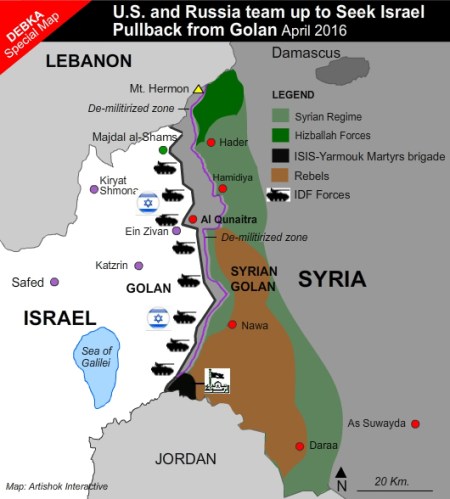
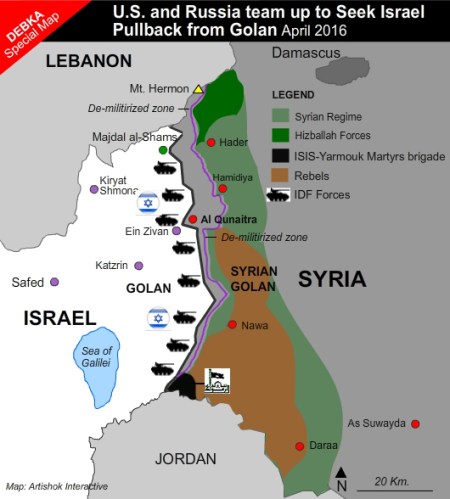
The IDF launched an unannounced military-air exercise in northen Israel Monday April 18. It will also be held in the Jordan valley, strategically located south of the Golan Heights and the Sea of Galilee. Despite the official explanation that the drills are part of the IDF’s training schedule for 2016, it is difficult not to see it as a follow-up to the Cabinet meeting on the Golan the previous day, including Prime Minister Benyamin Netanyahu’s declaration that “Israel will never withdraw from the Golan.”

Just as the Cabinet meeting was an “emergency” one, the exercise is not part of standard training, as an IDF statement claimed, but rather part of the overall picture of the war in Syria on the other side of the northeastern border.

The drill is mainly intended to prevent a possible attack by ISIS, Syrian, Iranian or Hizballah forces aimed at torpedoing Netanyahu’s discussions in Moscow with Russian President Vladimir Putin on Thursday, April 21.

DEBKAfile’s military sources report that the IDF exercise shows only half of the military picture in the area.
On the other side of the border, in the triangular pocket where the Israeli, Syrian and Jordanian borders meet, heavy fighting has been underway for several days between Syrian rebels and forces of the Yarmouk Martyrs Brigades and the al-Muthanna organization, which have both sworn allegiance to ISIS. The battles are taking place across from Israel’s Hamat Gader, south of the Sea of Galilee, which is the reason why the exercise is also being held in the Jordan Valley.

On the other side of the border, in the triangular pocket where the Israeli, Syrian and Jordanian borders meet, heavy fighting has been underway for several days between Syrian rebels and forces of the Yarmouk Martyrs Brigades and the al-Muthanna organization, which have both sworn allegiance to ISIS. The battles are taking place across from Israel’s Hamat Gader, south of the Sea of Galilee, which is the reason why the exercise is also being held in the Jordan Valley.

On the other side of the border, in the triangular pocket where the Israeli, Syrian and Jordanian borders meet, heavy fighting has been underway for several days between Syrian rebels and forces of the Yarmouk Martyrs Brigades and the al-Muthanna organization, which have both sworn allegiance to ISIS. The battles are taking place across from Israel’s Hamat Gader, south of the Sea of Galilee, which is the reason why the exercise is also being held in the Jordan Valley.

On Sunday, the leader and commander of Al-Muthanna was killed during the fighting. The goal of the rebel attack is to capture the Syrian villages in the territory held by ISIS, which threatens the Galilee and the Golan communities of Tel Katzir, Shaar Hagolan and Masada. Sources in Kuwait reported last week that Jordanian special forces and Israeli drones marked in the colors of the Jordanian air force are participating in the battles. The developments on the ground indicate that the goal of the attacking forces is to uproot ISIS from the Israeli and Jordanian border areas.

DEBKAfile’s sources provided the following exclusive details on April 17:   

The Israeli cabinet holds its weekly session Sunday April 17, on the Golan. Prime Minister Benyamin Netanyahu will visit Moscow on Thursday, April 21 to meet with Russian President Vladimir Putin and to launch the most important battle of his political career, and one of Israel’s most decisive contests of the last 10 years: the battle over the future of the Golan Heights.

DEBKAfile’s intelligence sources and its sources in Moscow report exclusively that Israel’s top political leaders and military commanders were stunned and shocked last weekend when they found out that US President Barack Obama and Russian President Vladimir Putin have agreed to support the return of the Golan to Syria. The two presidents gave their top diplomats, Secretary of State John Kerry and Foreign Minister Sergei Lavrov, the green light to include such a clause in a proposal being drafted at the Geneva conference on ending the Syrian civil war.

Israeli prime minister Benjamin Netanyahu seen during a security and defense tour in the Golan Heights, near the Northern Israeli border with Syria. April 11, 2016. Photo by Kobi Gideon/GPO *** Local Caption *** ??? ?????? ?????? ?????? ????? ?????? ?????. ????? ?????? ?????? ????? ?? ????? ??????? ???? ????? ?????? ?????? ?????

Israeli prime minister Benjamin Netanyahu seen during a security and defense tour in the Golan Heights, near the Northern Israeli border with Syria. April 11, 2016. Photo by Kobi Gideon/GPO

Israel captured the Golan from the Syrian army 49 years ago, during the Six-Day War in 1967 after the Syrian army invaded Israel.

In 1981, during the tenure of then Prime Minister Menachem Begin, Israel passed a law defining the Golan as a territory under Israeli sovereignty. However, it did not state that the area belongs to Israel.

While Israel was preparing for a diplomatic battle over the future of Jerusalem, Judea and Samaria, Obama and Putin decided to deal a diplomatic blow to Israel and Netanyahu’s government on an unexpected issue, the Golan.

It is part of an endeavor by the two powers to use their diplomatic and military cooperation regarding Syria to impose agreements on neighboring countries, such as Israel, Turkey, Saudi Arabia and Jordan.

For example, Washington and Moscow are trying to impose an agreement regarding the granting of independence to Syrian Kurds, despite Ankara’s adamant opposition. The two presidents are also pressuring Riyadh and Amman to accept the continuation of Syrian President Bashar Assad’s rule, at least for the immediate future.

DEBKAfile’s sources report that just like the other diplomatic or military steps initiated by Obama and Putin in Syria, such as those for Assad’s eventual removal from power, the two powers see a resolution of the Golan issue as a gradual process that may take a long time, perhaps even years. But as far as they are concerned, Israel will have to withdraw from the Golan at the end of that process.

It should be noted that Prime Minister Netanyahu is not traveling to Washington to discuss the Golan issue with Obama. The frequent trips by the prime minister, senior officials and top IDF brass to Moscow in recent months show where the winds are blowing in the Middle East.

However, Moscow is not Washington, and Israel has no lobby in the Russian capital defending its interests.

It should be made very clear that the frequent trips by senior Israeli officials to Moscow have not created an Israeli policy that can influence Putin or other senior members of the Russian leadership. Putin has made occasional concessions to Israel on matters of minimal strategic importance, but on diplomatic and military steps regarding Syria and Iran he has shown little consideration of Jerusalem’s stance.

It should also be noted that there has been no basis for the enthusiasm over the Russian intervention in Syria shown by Netanyahu, Israeli ministers and senior IDF officers.

All of the calls by a number of Russia experts, mainly those of ll of the calls by a number of Russia experts, mainly those of DEBKAfile, for extreme caution in ties with Putin have fallen on deaf ears among the political leadership in Jerusalem and the IDF command in Tel Aviv.

Amid these developments, three regional actors are very pleased by Washington and Moscow’s agreement to demand Israeli withdrawal from the Golan: Syrian President Assad, the Iranian leadership in Tehran and Hizballah leader Hassan Nasrallah.

Now, they do not need to risk a military confrontation with Israel over the Golan because Obama and Putin have essentially agreed to do the dirty work for them.

Syrian official answers Netanyahu: We will use all available means to recapture the Golan

April 17, 2016

Syrian official answers Netanyahu: We will use all available means to recapture the Golan, Jerusalem PostMaayan Groisman, April 17, 2016

(Please see also, Netanyahu to battle Obama, Putin over the Golan. — DM)

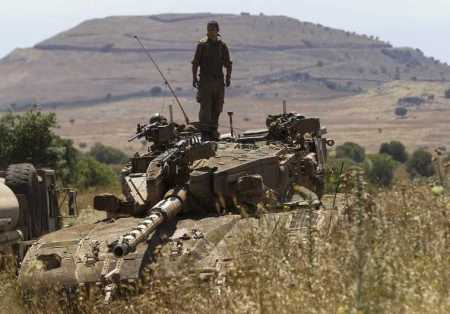
ShowImage (24)An IDF soldier stands atop a tank near Alonei Habashan on the Golan Heights, close to the ceasefire line between Israel and Syria. (photo credit:REUTERS)

In a first reaction to Prime Minister Benjamin Netanyahu’s declaration that “Israel will never leave the Golan Heights,” Syrian Foreign Minister Faisal al-Miqdad said Sunday that Syria is prepared to use every possible means to recapture the area, including military means.

“The Syrian Golan is an occupied Arab land according to the UN Security Council’s resolutions, and the presence of the United Nations Disengagement Observer Forces proves this,” Miqad said in an interview with the Lebanon-based TV channel al-Mayadeen.

“We have never renounced the resistance and we are ready to recapture the Golan in all possible ways, including military ways. Israel wants to provoke us, but we will never surrender,” Miqdad added.

Regarding Syria’s cooperation with Russia, he stated that “the daily communication between the Syrian leadership and the Russian leadership continues. We believe that the Russian policy leans on the international law and on UN Security Council resolutions.

“Neither Russian President Vladimir Putin nor any other president in the world would have accepted the indecent Israeli logic regarding the Golan,” Miqdad argued.

At the opening of a special cabinet meeting held for the first time ever on the Golan Heights on Sunday, PM Netanyahu declared: “The time has come after 40 years for the international community to finally recognize that the Golan Heights will remain forever under Israeli sovereignty.”

Netanyahu to battle Obama, Putin over the Golan

April 17, 2016

Netanyahu to battle Obama, Putin over the Golan, DEBKAfile, April 16, 2016

1 (2)

The Israeli cabinet holds its weekly session Sunday April 17, on the Golan. Prime Minister Benyamin Netanyahu will visit Moscow on Thursday, April 21 to meet with Russian President Vladimir Putin and to launch the most important battle of his political career, and one of Israel’s most decisive contests of the last 10 years: the battle over the future of the Golan Heights.

DEBKAfile’s intelligence sources and its sources in Moscow report exclusively that Israel’s top political leaders and military commanders were stunned and shocked last weekend when they found out that US President Barack Obama and Russian President Vladimir Putin have agreed to support the return of the Golan to Syria. The two presidents gave their top diplomats, Secretary of State John Kerry and Foreign Minister Sergei Lavrov, the green light to include such a clause in a proposal being drafted at the Geneva conference on ending the Syrian civil war.

Israel captured the Golan from the Syrian army 49 years ago, during the Six-Day War in 1967 after the Syrian army invaded Israel.

In 1981, during the tenure of then Prime Minister Menachem Begin, Israel passed a law defining the Golan as a territory under Israeli sovereignty. However, it did not state that the area belongs to Israel.

While Israel was preparing for a diplomatic battle over the future of Jerusalem, Judea and Samaria, Obama and Putin decided to deal a diplomatic blow to Israel and Netanyahu’s government on an unexpected issue, the Golan.

It is part of an endeavor by the two powers to use their diplomatic and military cooperation regarding Syria to impose agreements on neighboring countries, such as Israel, Turkey, Saudi Arabia and Jordan.

For example, Washington and Moscow are trying to impose an agreement regarding the granting of independence to Syrian Kurds, despite Ankara’s adamant opposition. The two presidents are also pressuring Riyadh and Amman to accept the continuation of Syrian President Bashar Assad’s rule, at least for the immediate future.

DEBKAfile’s sources report that just like the other diplomatic or military steps initiated by Obama and Putin in Syria, such as those for Assad’s eventual removal from power, the two powers see a resolution of the Golan issue as a gradual process that may take a long time, perhaps even years. But as far as they are concerned, Israel will have to withdraw from the Golan at the end of that process.

It should be noted that Prime Minister Netanyahu is not traveling to Washington to discuss the Golan issue with Obama. The frequent trips by the prime minister, senior officials and top IDF brass to Moscow in recent months show where the winds are blowing in the Middle East.

However, Moscow is not Washington, and Israel has no lobby in the Russian capital defending its interests.

It should be made very clear that the frequent trips by senior Israeli officials to Moscow have not created an Israeli policy that can influence Putin or other senior members of the Russian leadership. Putin has made occasional concessions to Israel on matters of minimal strategic importance, but on diplomatic and military steps regarding Syria and Iran he has shown little consideration of Jerusalem’s stance.

It should also be noted that there has been no basis for the enthusiasm over the Russian intervention in Syria shown by Netanyahu, Israeli ministers and senior IDF officers.

All of the calls by a number of Russia experts, mainly those of DEBKAfile, for extreme caution in ties with Putin have fallen on deaf ears among the political leadership in Jerusalem and the IDF command in Tel Aviv.
Amid these developments, three regional actors are very pleased by Washington and Moscow’s agreement to demand Israeli withdrawal from the Golan: Syrian President Assad, the Iranian leadership in Tehran and Hizballah leader Hassan Nasrallah.

Amid these developments, three regional actors are very pleased by Washington and Moscow’s agreement to demand Israeli withdrawal from the Golan: Syrian President Assad, the Iranian leadership in Tehran and Hizballah leader Hassan Nasrallah.

Now, they do not need to risk a military confrontation with Israel over the Golan because Obama and Putin have essentially agreed to do the dirty work for them.

Netanyahu’s dilemma: Détente with Turkey or recognition of Syrian Kurds

April 4, 2016

Netanyahu’s dilemma: Détente with Turkey or recognition of Syrian Kurds, DEBKAfile, April 4, 2016

obama_erdogan_best_friends_2012They were once good friends

Last Friday, April 1, President Reccep Tayyip Erdogan had his first encounter with a group of American Jewish leaders, at his request. The full details of its contents were hard to sort out because the Turkish translator censored his master’s words with a heavy hand to make them more acceptable to his audience. But Erdogan’s bottom line, DEBKAfile’s New York sources report, was a request for help in explaining to the Obama administration in Washington and the Netanyahu government in Jerusalem why they must on no account extend support to the Syrian Kurdish PYD and its YPG militia or recognize their bid for a separate state in northern Syria.

The Turkish president did not spell out his response to this step, but indicated that a Turkish invasion to confront the Kurdish separatists was under serious consideration in Ankara. His meaning was clear: He would go to war against the Kurds, even if this meant flying in the face of President Barack Obama’s expectation that Turkey would fight the Islamic State.

Relations between the Turkish and US presidents have slipped back another notch in the last two weeks. When he visited Washington for the nuclear summit, Erdogan was pointedly not invited to the White House and his request for a tete a tete with Obama was ruled out. The US president even refused to join Erdogan in ceremonially honoring a new mosque built outside Washington with Turkish government funding.

At odds between them is not just the Kurdish question, but Erdogan’s furious opposition to Obama’s collaboration with Russian President Vladimir Putin on the Syrian conflict, and the two presidents’ tacit accord to leave Bashar Assad in power indefinitely until a handover becomes manageable.

On Feb. 7, on his return for a Latin American tour, the Turkish president warned Obama that he must choose between Ankara and the Kurds, whom he called “terrorists.” By last week, the US president’s choice was clear. It was the Kurds.

ObamaErdogan480_Koteret

When Erdogan arrived home from Washington last week, he discovered that the roughly four million Syrian Kurds dwelling in three enclaves touching on the Turkish border had taken important steps to advance their goal for self-rule: They were drafting a plan for establishing a “Federal Democratic System” in their three enclaves – Hassakeh-Jazeera, Kobani and Afrin – and had announced the amalgamation of their respective militias under the heading the “Syrian Democratic Forces”.

Cold-shouldered in Washington as well as Moscow (since Turkish jets shot down a Russian fighter last November), Erdogan found himself let down by the Jewish leaders whom he tried to woo. They refused to support him or his policy on the Kurdish question for three reasons:

1. Ankara had for years consistently promoted the radical Palestinian Hamas organization. To this, Erdogan replied by denying he had backed Hamas  only acted to improve the lives of the Gaza population. And, anyway, he said he had reacyed understandings with Israel on this issue..

2. His hostility towards Egyptian President Abdel-Fatteh El-Sisi. Erdogan’s response to this was a diatribe slamming the Egyptian ruler.

3. No clear reply had been forthcoming from Jerusalem by that time on Israel’s relations with Turkey or its policy towards the Kurds, despite the Turkish leader’s positive presentation of  mended fences.

The current state of the relationship is laid out by DEBKAfile’s sources:

Prime Minister Binyamin Netanyahu is caught on the horns of multiple dilemmas: While reluctant to respond to Ankara’s suit for warm relations with a leader who is shunned by Obama and Putin alike, Turkey is nonetheless offering to be Israel’s best client for its offshore gas.

Israel’s friendship with the Kurdish people goes back many years. The rise of an independent or autonomous state in Syria and its potential link-up with the semiautonomous Kurdish region of Iraq would create an important new state of 40 million people in the heart of the Middle East.

Israel has no wish to make enemies of its longstanding friends by disowning them in favor of Turkey.

Already, Israel’s evolving ties with the Syrian Kurds have given Israel’s strategic position in Syria a new positive spin, upgrading it versus the Assad regime in Damascus and its Hizballah and Iranian allies, who are avowed enemies of the Jewish state. Those ties offer Israel its first foothold in northern Syria.

And finally, Erdogan is not the only opponent of Kurdish separatism; so too are important Sunni Muslim nations like Saudi Arabia and Egypt. By promoting the Kurds, Israel risks jeopardizing its rapidly developing ties with those governments.

The Fourth Strategy

March 11, 2016

The Fourth Strategy,  Front Page Magazine, Caroline Glick, March 11, 2016
mideast-lebanon-bulga_horo

Originally published by the Jerusalem Post

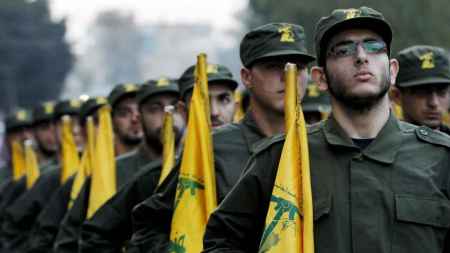
This week we learned that Lebanon is no more. It has been replaced by Hezbollah’s Iranian colony in Lebanon.

Two weeks ago, Saudi Arabia listed Hezbollah as a terrorist organization and canceled its $3 billion aid package to the Lebanese military. The Gulf Cooperation Council followed suit. Rather than support the move by his sponsors and allies, Saad Hariri, the head of the anti-Hezbollah March 14 movement, flew to Syria to meet with Hezbollah leaders.

Saudi Arabia’s decision to end its support for the Lebanese Armed Forces (LAF) doesn’t mean that Saudi Arabia is making peace with Hezbollah.

It means that the Saudis are no longer willing to maintain the fiction that with enough support, the LAF will one day challenge Hezbollah’s effective control of Lebanon.

Hezbollah and its bosses in Tehran don’t seem too upset about the Sunnis’ decision to acknowledge that Hezbollah is a terrorist group. And they are right not to care. In essence, the Saudi move is simply an admission that they have won. Lebanon is theirs.

Hezbollah’s isn’t the dominant force in Lebanon because it has better weapons than the LAF.

Unlike the LAF, Hezbollah has no air force. It has no armored divisions.

Hezbollah is able to dominate Lebanon because unlike the LAF and the March 14 movement, Hezbollah is willing to destroy Lebanon if doing so advances its strategic goals.

This has all been fairly clear for more than a decade. But it took the war in Syria to force the truth above the surface.

And now that it is clear to everyone that Lebanon has ceased to exist and that the country we once knew is now an Iranian colony, the time has come for Israel to reckon with the lessons of its own misadventures in our neighbor to the north.

Since the mid-1990s, Israel has implemented three strategies in Lebanon and in Syria. All of them originated on the Left. All of them failed.

The first strategy was appeasement.

From the mid-1990s until the Syrian war began five years ago, Israel’s strategic framework for understanding Syria was appeasement. Initially, the notion was that Syria was our enemy because we control the Golan Heights. If we surrendered the Golan to Syria, we would have peace in exchange.

In the years leading up to the Syrian war, our leaders embraced the idea that Syria was the weakest link in the Iranian axis. If we gave the Golan Heights to Syria, they said, then the Assad regime would withdraw from the Iranian axis.

As it turned out, these positions had no basis in reality. Appeasement failed.

Then there was unconditional surrender – or disengagement. Then-prime minister Ehud Barak implemented this strategy when he removed IDF units from the security zone in south Lebanon in May 2000.

From the mid-1990s on, Yossi Beilin was the chief advocate of unconditional surrender in Lebanon. The logic of surrender was similar to that of appeasement – of which he was also a principal architect and advocate.

The surrender strategy in Lebanon was based on the idea that Hezbollah fought the IDF in south Lebanon because the IDF was in south Lebanon. If the IDF were to leave south Lebanon, Hezbollah was have no reason to fight us anymore.

So if we were gone, Beilin argued, Hezbollah would stop fighting, ditch terrorism and Iran, and become a normal Lebanese political party.

The war with Hezbollah in 2006 destroyed the credibility of the surrender strategy. But the Left didn’t despair. They simply replaced surrender with the strategy of internationalization.

The internationalization strategy forms the basis of UN Security Council Resolution 1701 that set the cease-fire terms at the end of the war with Hezbollah. IDF soldiers, who left Lebanon without victory, were replaced by UN forces from UNIFIL. UNIFIL forces were supposed to block Hezbollah’s reassertion of control over south Lebanon by facilitating the LAF’s takeover of the border with Israel. While UNIFIL was protecting the LAF on the ground, the LAF itself would be empowered by a massive infusion of US and Saudi aid.

Saudi Arabia’s belated recognition that Hezbollah dominates the LAF, and controls Lebanon, makes clear that like appeasement and disengagement, internationalization is an utter failure.

To a certain degree, Israel’s serial strategic blundering did have one ameliorative effect. Through them, Hezbollah has become so powerful that it now poses a threat to the great powers. So Russia in Syria now needs to curb it. So, too, it is so powerful that Iran is loath to waste it on a war with Israel that it will lose when it is fighting to win the war in Syria.

For now then, Hezbollah is not an immediate threat. This is the case despite Hezbollah chief Hassan Nasrallah’s recent threat to bomb Haifa’s chemical depots and cause a fireball with the cataclysmic effect of a nuclear bomb.

But that doesn’t mean that the lessons of our repeated strategic mistakes in Syria and Lebanon shouldn’t be applied today. They should be applied, but toward another, more immediate foe – the Palestinians, toward whom Israel has applied the same failed policies, one after another, with similarly destructive outcomes.

After the first intifada ground to a halt in 1991, Israel adopted the Left’s first strategy. The so-called peace process with the PLO, which began in 1993, was an attempt to implement a strategy of appeasement. We would gradually give the PLO Judea, Samaria, Gaza and Jerusalem.

In return, the PLO would stop supporting terrorism and live at peace with Israel.

The failure of the appeasement strategy led to the second intifada. The second intifada caused Israel to adopt the Left’s second strategy – unconditional surrender.

Israel’s 2005 disengagement from Gaza failed just as spectacularly as its 2000 disengagement from Lebanon. Not only did it lead to the Hamas takeover of Gaza in 2007. It led to the further radicalization of the PLO and Palestinian society as a whole. The latter became convinced that terrorism worked. The former became convinced that the only way to garner public support was by being just as anti-Israel as Hamas.

Today, the center-left parties – the Zionist Union and Yesh Atid – cling to the failed strategy of disengagement. The far Left, together with the Arab political parties, have already moved on to the internationalization strategy. In the Palestinian context, the goal of the internationalization strategy is the collapse of Israeli sovereignty.

This strategy was in evidence this week with Peace Now head Yariv Oppenheimer’s outrageous claim Wednesday that in killing the terrorists who were in the midst of murdering innocents in Petah Tikva and Tel Aviv, civilians and security forces carried out summary executions.

Oppenheimer, whose group is funded by foreign governments, did not make the claim because he wished to build his support base at home. He demonized his fellow citizens to advance his paymasters’ goal of delegitimizing Israeli sovereignty by among other things, criminalizing Israel’s right to self-defense.

The goal of this delegitimization campaign is to make it impossible for Israel to function as a coherent nation-state and for it instead to become a powerless ward of Europe and the US.

In the face of both the rise in Palestinian terrorism and of efforts by Oppenheimer and his comrades to use Palestinian terrorism as a means to cause the collapse of Israeli sovereignty, the government is at a loss. Its paralysis doesn’t owe to a lack of will. Rather it is the consequence of the government’s difficulty in contending with the coalition of powerful domestic and foreign actors that together make it all but impossible for Prime Minister Binyamin Netanyahu and his ministers to abandon the Left’s failed strategies and embark on a new strategic course.

Perhaps the most poignant and infuriating expression of the government’s distress is its constant demand that PLO chief Mahmoud Abbas condemn Palestinian terrorism.

On seemingly a daily basis our leaders voice the demand that the man who heads a regime that indoctrinates its youth – including its young children – to murder Jews condemn his own actions.

Beyond being irrational, the demand is both defeatist and self-defeating. By demanding action from Abbas, we legitimize him and empower him. But so long as Israel refuses to abandon the appeasement strategy, and continues to accept that there is a peace process that can be resuscitated, the government will be unable to stop treating Abbas as legitimate and moderate.

So, too, so long as the Knesset fails to take serious, concerted action against the nonprofit groups funded by hostile foreign governments and foundations, the government will be unable to take effective action against the radical Left and its partners from the Joint (Arab) List that openly support both Palestinian terrorists and Hezbollah.

Just as Oppenheimer’s remarks weren’t directed toward the domestic audience, but to his European sponsors, so the Arab Knesset members who this week announced their opposition to Saudi Arabia’s decision to label Hezbollah a terrorist group, were directing their remarks toward their supporters – and Hezbollah’s sponsors – in Qatar.

While adopting in turn every failed strategy the Left could invent and recycle, for the past generation, Israel has avoided implementing the only strategy that has ever worked. That is the strategy of sovereignty – or, more broadly, of governing territories necessary for our defense.

From 1982 through 2000, Israel restrained Hezbollah and prevented it from taking over Lebanon by maintaining security control over the security zone in Lebanon. For 28 years, Israel prevented the Palestinians from becoming a terrorist society dedicated to the destruction of the people of Israel, by exerting security and civil authority over Judea, Samaria and Gaza through its military government and its civil administration.

And it worked. By fighting our enemies rather than empowering them, we weakened them.

The image of the first intifada that convinced us to legitimize the PLO was the teenager with a slingshot.

The image of the second intifada that convinced us to run away from Gaza was a bombedout bus.

So far, the image of the third intifada is a girl wielding scissors attempting to stab Jews. And we still haven’t figured out our response to her, although the Left would like us to run away or collapse.

It is time to let this image guide us though.

The girl with the scissors is not empowered. She is both dangerous and pathetic. She is both an enemy and a victim. You cannot destroy her. You can only punish her and then raise her up. In other words, you need to govern her.

Governing enemies is unpleasant. It brings no instant gratification. Instead it promises only thankless, Sisyphean efforts. In other words, governing your enemies is the price you pay to be free.