Posted tagged ‘Nato’

NATO Warns Russia to Stay Out of Turkish Air Space

October 6, 2015

NATO has warned Russia to keep its aircraft, currently in Syria, out of Turkey’s air space.

By: Hana Levi Julian

Published: October 6th, 2015

Source: The Jewish Press » » NATO Warns Russia to Stay Out of Turkish Air Space

American F-16 fighter jets

F-16 fighter jets in flight. (Illustration photo)
Photo Credit: US Government

Russia was warned Tuesday to keep out of Turkish air space by the North Atlantic Treaty Organization (NATO) over its violations of Turkish Air Space.

“Russian combat aircraft have violated Turkish airspace,” NATO secretary-general Jens Stoltenberg said in a statement on the NATO website following the organization’s meeting Monday (Oct 5). “This is unacceptable.”

In a follow-up news conference, Stoltenberg went on to say, “It doesn’t look like an accident (as Moscow had claimed earlier), and we also have seen two of them, two violations of Turkish airspace. Intelligence that we have received provides me with reason to say it doesn’t look like an accident.”

The first incursion was reported on Saturday, and the second allegedly occurred on Sunday, officials said.

“I’m also concerned that Russia is not targeting ISIL (the group’s acronym for ISIS, or Da’esh), but instead attacking the Syrian opposition and civilians,” Stoltenberg continued.

“I discussed the situation in Syria with [Russia’s] Foreign Minister [Sergei] Lavrov in New York last week. I urge Russia to play a constructive and cooperative role in the fight against ISIL, and to strive for a negotiated political solution to the conflict in Syria.”

Turkey has been an active member of NATO since 1952.

Israeli Minister Yuval Steinitz told Galei Tzahal Radio last week that Israel does not want to see Russian troops on the Golan Heights and is concerned about the positioning of Iranian ground troops in the neighboring country, and the opening of a direct ground front with Iran.

Steinitz added, the world powers must “ensure the Iranian army stays in Iran. We should not see Iranian army divisions in Syria.”

Steinitz said Israel has no official position on the fate of Assad as it’s an internal Arab civil war, but added that “the war against Sunni terror [ISIS] can’t come together with support for Iranian Shiite terror.”

“Allies expressed their deep concern with regard to the Russian military build-up in Syria,” NATO said in its statement, “and especially the attacks by the Russian Air Force on Hama, Homs, and Idlib which led to civilian casualties and did not target Da’esh.

“Russian military actions have reached a more dangerous level with the recent violations of Turkish airspace on 3 October and 4 October by Russian Air Force SU-30 and SU-24 aircraft in the Hatay region. The aircraft in question entered Turkish airspace despite Turkish authorities’ clear, timely and repeated warnings,” the statement went on.

“Allies strongly protest these violations of Turkish sovereign airspace, and condemn these incursions into and violations of NATO airspace. Allies also note the extreme danger of such irresponsible behaviour. They call on the Russian Federation to cease and desist, and immediately explain these violations.”

Russia is also moving in equipment in preparation for a rather more extended role in the region than its originally-stated claim, according to eyewitness reports in Syria.

Recently Moscow moved electronic jamming equipment into the country, including a truck-mounted system and a number of aircraft-mountable pods, according to local sources.

Several pieces of artillery were also moved into the country at Latakia port, including four highly accurate BM-30 multiple-launch rapid-fire rocket systems.

Instead of remaining at the port, however, the weapons were moved and currently are reported to be in position west of Idlib, towards Homs.

According to the report, the U.S. believes Russia is “stepping up its ground activity” to attack Syrian opposition forces rather than ISIS.

Officials are reportedly questioning whether Russian forces are planning to jam the electronics of coalition aircraft as they fly over Syria.

Russia, meanwhile, contends it is indeed targeting ISIS. But it is clear that its forces are also clearly bolstering the flagging defenses of Syrian President Bashar al-Assad.

U.S. President Barack Obama meanwhile authorized additional supplies on Monday for the Kurdish and other Muslim opposition forces in Syria, according to CNN.

“President Obama was clear that we intend to continue our efforts to degrade and ultimately destroy ISIL in Syria and to keep supporting the moderate Syrian opposition,” said a senior administration official who spoke with CNN.

Although both the Russians and the Americans claim to be targeting Da’esh forces, neither deny they are also supporting Syrian fighters – with Russia backing the government and the U.S. backing “moderate” Muslim opposition fighters.

There are problems on both sides.

The government forces have tortured and murdered hundreds of thousands of their own citizens, and used chemical weapons against their own people as well.

The “moderate” rebel forces, meanwhile, have also been caught selling their American-made weapons to radical Islamist forces – including the Al Qaeda-linked Jabhat al-Nusra group – in order to secure safe passage and in some cases, simply in order to remain alive. There is simply no way to know into whose hands those American weapons will fall next.

What is very likely, however, is that whichever “moderate” forces exist in Syria will not be in control of the country when the war ends. Up to half of the country’s total population have fled Syria to other lands simply to survive
NATO Allies Making It Easier for Iran to Attack Israel?

September 3, 2015

NATO Allies Making It Easier for Iran to Attack Israel? The Gatestone InstituteBurak Bekdil, September 3, 2015

  • Iran did not go mad and threaten to hit all NATO installations in Turkey because it wanted 3.5 million Turkish citizens to die from the chemical warhead of a Syrian missile. It went mad and threatened because it viewed the defensive NATO assets in Turkey as a threat to its offensive missile capabilities.
  • Iran’s reaction to the NATO assets in Turkey revealed its intentions to attack. It could be a coincidence that the U.S. and Germany (most likely to be followed by Spain) have decided to withdraw their Patriot missile batteries and troops from Turkey shortly after agreeing to a nuclear deal with Iran. But if it is a coincidence, it is a very suspicious one. Why were Assad’s missiles a threat to Turkey two and a half years ago, but are not today?
  • Apparently, NATO allies believe, although the idea defies logic, that the nuclear deal with Iran will discourage the mullahs in Tehran from attacking Israel.

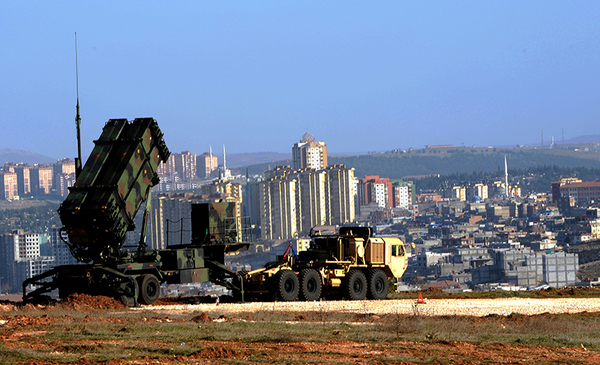
In early 2013, NATO supposedly came to its ally’s help: As Turkey was under threat from Syrian missiles — potentially with biological/chemical warheads — the alliance would build a mini anti-missile defense architecture on Turkish soil. Six U.S.-made Patriot missile batteries would be deployed in three Turkish cities and protect a vast area where about 3.5 million Turks lived.

The Patriot batteries that would protect Turkey from Syrian missiles belonged to the United States, Germany and the Netherlands. In early 2015, the Dutch mission ended and was replaced by Spanish Patriots. Recently, the German government said that it would withdraw its Patriot batteries and 250 troops at the beginning of 2016. Almost simultaneously, the U.S. government informed Turkey that its Patriot mission, expiring in October, would not be renewed. Washington cited “critical modernization upgrades” for the withdrawal.

Since the air defense system was stationed on Turkish soil, it unnerved Iran more than it did Syria. There is a story behind this. First, Patriot missiles cannot protect large swaths of land, but only designated friendly sites or installations in their vicinity. That the six batteries would protect Turkey’s entire south and 3.5 million people living there was a tall tale. They would instead protect a U.S.-owned, NATO-assigned radar deployed earlier in Kurecik, a Turkish town; and they would protect it not from Syrian missiles with chemical warheads, but from Iranian ballistic missiles.

1234 (1)U.S. Patriot missiles, deployed outside Gaziantep, Turkey in 2013. (Image source: U.S. Army Europe/Daniel Phelps)

Kurecik seemed to matter a lot to Iran. In November 2011, Iran threatened that it would target NATO’s missile defense shield in Turkey (“and then hit the next targets,” read Israel) if it were threatened. Shortly before the arrival of Patriots in Turkey, Iran’s army chief of staff warned NATO that stationing Patriot anti-missile batteries in Turkey was “setting the stage for world war.”

What was stationed in Kurecik was an early-warning missile detection and tracking radar system. Its mission is to provide U.S. naval assets in the Mediterranean with early warning and tracking information in case of an Iranian missile launch that might target an ally or a friendly country, including Israel. So, a six-battery Patriot shield to protect the NATO radar in Kurecik against possible Iranian aggression was necessary. And that explains why the Iranians went mad about Kurecik and openly threatened to hit it.

NATO and Turkish officials have always denied any link between the Patriot missiles and the NATO radar in Turkey. They have often pointed out that the Patriot batteries were stationed in the provinces of Adana, Kahramanmaras and Gaziantep, while Kurecik was in nearby Malatya province. But the Patriot is a road-mobile system: It can be dismantled easily and re-deployed in another area in a matter of hours (the road distance between Kurecik and Kahramanmaras is a mere 200 kilometers, or 124 miles).

Clearly, Iran did not go mad and threaten to hit all NATO installations in Turkey because it wanted 3.5 million Turkish citizens to die from the chemical warhead of a Syrian missile. It went mad and threatened because it viewed the defensive NATO assets in Turkey as a threat to its offensive missile capabilities, which the Patriots could potentially neutralize.

Why, otherwise, would a country feel “threatened” and threaten others with starting a “world war” just because a bunch of defensive systems are deployed in a neighboring country? Iran did so because it views the NATO radar in Turkey as an asset that could counter any missile attack on Israel; and the Patriots as hostile elements because they would protect that radar. In a way, Iran’s reaction to the NATO assets in Turkey revealed its intentions to attack.

It could be a total coincidence that the U.S. and Germany (most likely to be followed by Spain) have decided to pull their Patriot batteries and troops from Turkey shortly after agreeing to a nuclear deal with Iran. But if it is a coincidence, it is a very suspicious one. In theory, the Patriot systems were deployed in Turkey in order to protect the NATO ally from missile threats from Syrian President Bashar al-Assad’s regime. Right? Right.

Assad’s regime is still alive in Damascus and it has the same missile arsenal it had in 2013. Moreover, Turkey’s cold war with Assad’s Syria is worse than it was in 2013, with Ankara systematically supporting every opposition group and openly declaring that it is pushing for Assad’s downfall. Why were Assad’s missiles a threat to Turkey two and a half years ago, but are not today?

The Patriot missiles are leaving Turkey. They no longer will “protect Turkish soil.”

Apparently, NATO allies believe, although the idea defies logic, that the nuclear deal with Iran will discourage the mullahs in Tehran from attacking Israel.

It looks as if the potential target of NATO heavyweights’ decision is more a gesture to Iran than to Turkey.

NATO Calls Emergency Meeting at Turkey’s Request Over ISIS, PKK

July 27, 2015

A full emergency meeting of NATO has been called for Tuesday in Brussels by Turkey over threats it faces from ISIS and the PKK.

By: Hana Levi Julian

Published: July 26th, 2015

via The Jewish Press » » NATO Calls Emergency Meeting at Turkey’s Request Over ISIS, PKK.

Ambassadors of all 28 member states of the North Atlantic Treaty Organization (NATO) have been called to an emergency meeting on Tuesday in Brussels at the request of Turkey.

The allies were summoned under Article 4 of NATO’s founding Washington Treaty, according to a statement released Sunday by NATO secretary-general Jens Stoltenberg.

The request came in the wake of last week’s attacks on two fronts, one by Da’esh (ISIS) and the other by the outlawed Kurdish separatist PKK terror organization, which has fought for autonomy since 1984.

“Turkey requested the meeting in view of the seriousness of the situation after the heinous terrorist attacks in recent days, and also to inform allies of the measures it is taking,” NATO said. “NATO allies follow developments very closely and stand in solidarity with Turkey.”

Under the treaty, Turkey has the right to request military assistance,, surveillance aircraft to monitor activity along the Syrian border, or even to call for establishment of a “safe zone” in northern Syria. The latter has been under discussion for several days.

Article 4 reads: “The parties will consult together whenever, in the opinion of any of them, the territorial integrity, political independence or security of any of the parties is threatened.”

Turkey has invoked Article 4 twice before, in 2003 and 2012.

A week ago Monday a Da’esh (ISIS) suicide bomber attacked a cultural center in the southeastern Turkish town of Suruc, killing 32 Kurdish youth activists who were engaged in sending aid across the border to the Syrian Kurdish city of Kobane, six miles away. Kurds blamed Turkey for not patrolling the porous 500-mile border with Syria.

And the outlawed Kurdish PKK separatist terror organization retaliated – not against Da’esh, but against Turkey — with a deadly car bombing. Two Turkish soldiers were killed in the predominantly Kurdish southeastern Turkish province of Diyarbakir on Saturday night. Four other soldiers were wounded in the attack. Turkey said PKK terrorists also attacked a police station in the province.

Late Sunday, Turkish F-16 fighter jets struck back, aiming at PKK terror targets in the northern Iraqi town of Hakurk, according to Turkish security sources.

Turkey’s military operations will continue as long as there is a threat, Prime Minister Ahmet Davutoglu told United Nations secretary-general Ban Ki-moon. The U.S. backed Ankara’s air strikes in Iraq, according to a report in the British newspaper The Telegraph.

Talks between the Kurdish terror group and Ankara that led to a cease-fire in 2013 have not resulted in a formal agreement. However, the pro-Kurdish Peoples’ Democratic Party (HDP) garnered 12 percent of the votes in this past parliamentary election, entering the governing body for the very first time.

The Strategic Consequences of “Grexit”

June 29, 2015

The Strategic Consequences of “Grexit” The Gatestone InstitutePeter Martino, June 29, 2015

  • Last January, ISIS revealed that it is smuggling terrorists into Europe by hiding them among the immigrants leaving Turkey.
  • “If Europe leaves us in the crisis, we will flood it with immigrants, and it will be even worse for Berlin if in that wave… there will be some jihadists of the Islamic State, too.” — Panos Kammenos, Defense Minister of Greece
  • Greece is a member of NATO. The whole world witnessed how the Defense Minister of one NATO country was threatening other NATO members with unleashing Islamic terrorists on them.
  • A Greek exit will lead to a power vacuum in the southeastern corner of Europe, which Russia (and China) will be only too eager to fill. The Chinese are currently negotiating with the Greek government to acquire an even larger part of the port of Piraeus.

Last weekend, Greece failed to reach an agreement with its three creditors, the European Commission, the European Central Bank, and the International Monetary Fund. A bankruptcy of the Hellenic Republic is now imminent. If it materializes, a so-called Grexit will follow: Greece will be forced to leave the Eurozone — the group of 19 European Union (EU) member states that use the euro as their common currency. Leaving the Eurozone automatically means that, under the EU treaties, Greece will also have to leave the EU.

1134Across Greece, people have been lining up to withdraw money from cash machines, most of which have run out of money, after the government ordered banks to close for six days starting Monday. (Image source: Reuters video screenshot)

Grexit is likely to lead to economic and political turmoil in Greece, a hugely important strategic country, which borders on an increasingly unstable part of the world. Greece lies on the Mediterranean, fewer than 350 kilometers to the north of the Libyan coastal town of Derna, a stronghold of the Islamic terrorists of ISIS. It was here that, last February, ISIS beheaded 21 Coptic Egyptian prisoners, and vowed to conquer Europe. The threat to Greece’s eastern borders is even greater. Greece is currently being inundated by illegal immigrants, arriving from Turkey by sea. Each day in June, human traffickers were transporting between 650 and 1,000 migrants by boat from Turkish ports to Greece. Last January, ISIS revealed that it is smuggling terrorists into Europe by hiding them among the migrants leaving Turkey.

If Greece leaves the EU, it is highly unlikely that it will try to prevent the illegal immigrants from travelling on to the rest of Europe. On the contrary, in March, Greek defense minister Panos Kammenos vowed to flood the rest of Europe with immigrants if the EU should allow Greece to go bankrupt. “If Europe leaves us in the crisis, we will flood it with immigrants, and it will be even worse for Berlin if in that wave of millions of economic immigrants there will be some jihadists of the Islamic State, too,” the Greek minister said. All the newcomers to Greece, Kammenos said, would be given papers, so they “could go straight to Berlin.” Greece is a member of NATO. The whole world could witness how the defense minister of one NATO country was threatening other NATO members with unleashing Islamic terrorists on them.

A Greek exit from the EU will not only mean a rupture with its Western European neighbors, who are all members of NATO as well, but is also likely to affect the entire Atlantic partnership. It will lead to a power vacuum in the southeastern corner of Europe, which Russia will be only too eager to fill.

Greek Prime Minister Alexis Tsipras was recently in Moscow to sign a gas deal with Russian President Vladimir Putin. The deal allows the Russians to build a natural gas pipeline across Greece that will carry Russian gas to Europe. The construction of the pipeline will not only create 20,000 new jobs in Greece, but Russia will also pay Greece hundreds of millions of dollars annually in transit payments. Speaking about the pipeline deal, Putin offhandedly remarked to the international media that he saw no support for the Greeks from the EU.

There are also rumors that Athens might allow Russia the use of Greek military bases. Russia is expanding militarily in the Black Sea and the eastern part of the Mediterranean. Greece could also serve as a base for the Russians to strengthen their position in the Balkans. If Greece were to turn its back on NATO, it could become a geographical link between Russia and its Balkan vassal, Serbia — a process that would link the three Christian-Orthodox nations of Russia, Serbia and Greece.

But the Russians are not the only ones closely following the events in Greece and hoping for geopolitical benefits. For some time, China’s influence in Greece has also been expanding. The Chinese state-owed Cosco Group recently bought the container terminal in Greece’s largest port, Piraeus. The port was privatized after demands from the EU. The Chinese are currently negotiating with the Greek government to acquire an even larger part of Piraeus.

Both Russia and China are eager to strengthen their position in Greece if it were to turn its back on Europe and NATO. The consequences of Grexit will not merely be economic. The strategic implications are at least as important, and far-reaching.

Turkey: America’s unacknowledged problem

December 31, 2014

Turkey: America’s unacknowledged problem, Israel Hayom, Prof. Efraim Inbar, December 31, 2014

(The foreign policy of the Obama administration is difficult to understand. What might be the reasoning behind its apparently continuing support for Islamic Turkey, a bitter foe of Israel? What are the administration’s interests in the Middle East?– DM)

It is not clear why Washington puts up with such Turkish behavior. The Obama ‎administration seems to be unable to call a spade a spade. It refuses to acknowledge ‎that Turkey is a Trojan horse in NATO, and that Ankara undermines American interests ‎in the Middle East and elsewhere.‎

***************

Turkey is a NATO ally, and U.S. President Barack Obama has called Turkish President Recep Tayyip Erdogan his best friend. But Erdogan-led Turkey does not ‎behave as an ally or a friend of the U.S. This is not a new development.‎

Erdogan and his Islamist party, the Justice and Development Party (AKP), have ruled Turkey since 2002. Erdogan’s ‎Turkey has gradually distanced itself from the West, adopting domestic and foreign ‎policies fueled by Ottoman and Islamist impulses. ‎

Turkey has been on the road to an authoritarian regime for several years. Infringements ‎on human rights have gradually increased. In truth, Turkey has never had a political ‎system with checks and balances able to constrain attempts to consolidate power ‎around one politician. In recent years, Erdogan has weakened further the few ‎constitutional constraints against “Putinization” of the Turkish political system. ‎

The longer Erdogan rules, the more power-hungry he seems. His authoritarian ‎personality becomes clearer every day. The press is hardly free. Erdogan arrests even ‎Islamist journalists who are critical of his policies. His party has infiltrated the judicial ‎system and the police. Foci of power, such as the bureaucracy, the banking system, ‎industrial associations and trade unions, have been mostly co-opted by the AKP. ‎Opposition political parties are largely discredited. The military, once active in politics ‎as the defender of the Kemalist secular tradition, has been successfully sidelined. ‎

From a realpolitik perspective, the domestic political developments, deplorable as they ‎may be in Turkey, could be ignored by the democratic West as long as Ankara ‎continues to be a useful ally. Unfortunately, Turkey no longer qualifies as a trusted ‎ally. ‎

The most recent examples of nefarious Turkish behavior are its support of Islamic State and ‎Hamas. Turkey is playing a double game on the issue of Islamic State. It pretends to ‎cooperate with the U.S. policy in the attempt to contain radical Islam, but actually ‎Turkey supports the radical group. It allows passage of volunteers through Turkish territory to join ‎Islamic State in Iraq. The group gets logistical support via Turkey, and sends its wounded militants for ‎treatment in Turkey. Turkish military forces stood idly by the besieged city of Kobani, ‎just across the Turkish border, while the Islamists killed Kurdish fighters. Finally, ‎Turkey denies the American air force access to Turkish bases, forcing the U.S. to use far‎away bases when attacking Islamic State targets. ‎

Turkey is also openly supporting another radical Islamist organization, Hamas. ‎Despite the fact that the West regards Hamas a terrorist organization, Ankara regularly ‎hosts Hamas representatives to meet the highest Turkish dignitaries. Hamas, an ‎offshoot of the Muslim Brotherhood, has a rabid anti-American position. Moreover, ‎Salah al-Aruri, a senior Hamas operative, operates out of Istanbul. Recently, the ‎Turkish branch of Hamas was involved in a series of attempts to carry out terrorist ‎attacks against Israel, and in orchestrating a coup against the current leadership of the ‎Palestinian Authority.‎

Such behavior should not surprise policy makers in Washington. In 2003, Ankara ‎denied the request from Washington to open its territory so that the U.S. military could ‎attack Saddam Hussein’s forces from two separate fronts.‎

AKP-ruled Ankara also defied American preferences on Syria, a country allied with ‎radical Iran and on the American list of states supporting terrorism. In January 2004, ‎Bashar Assad became the first Syrian president ever to visit Turkey. In April 2009, the ‎two states conducted their first ever joint military exercise. No other NATO member ‎had such close relations with the authoritarian regime in Damascus, which has been ‎closely allied with Iran for several decades.‎

Turkey further deviated from the Western consensus in 2008 by hosting Sudanese ‎President Omar Hassan al-Bashir twice. Bashir, who was charged with war crimes and ‎genocide in Darfur, presided over an Islamist regime. ‎

Turkey even welcomed the president of the Islamic Republic of Iran, Mahmoud ‎Ahmadinejad, for a visit in August 2008. No Western country has issued such an ‎invitation to the Iranian leader. Additionally, Erdogan congratulated Ahmadinejad ‎immediately after his re-election in June 2009. When it comes to Iran’s nuclear threat, ‎Ankara, unlike its NATO allies, has refused to adopt the U.S. stance on harsher ‎sanctions, fearing in part the economic consequences of such steps. In June 2010, ‎Turkey voted at the U.N. Security Council against a U.S.-sponsored resolution meant to ‎impose a new round of sanctions on Iran.‎

Turkey also has consistently defied advice from Washington to tone down its anti-‎Israel statements and mend relations with an important American ally. All American ‎efforts in this direction have failed.‎

There is also a clear divergence between the U.S. and Turkey on important global issues ‎such as Russia and China. For example, U.S. wanted to send ships into the Black Sea via ‎the Bosporus Strait during the Georgia war in August 2008. Turkey flatly denied ‎several such requests on the pretext that the military vessels were too large. Moreover, ‎Turkey proposed the creation of a regional security framework involving Turkey, ‎Russia, Georgia, Armenia and Azerbaijan that left out a NATO role. More blatantly, ‎Turkey has failed to participate in the Western economic sanctions imposed on Russia ‎during the recent Ukraine crisis.‎

Dissonance exists also with regards to China. While the U.S. fears the rise of China, ‎Turkey sees this country as a potential economic partner and not a problem. It held ‎military exercises with China. Ankara even considered purchasing anti-aircraft systems ‎from Beijing, an incredibly brazen position for a NATO member.

It is not clear why Washington puts up with such Turkish behavior. The Obama ‎administration seems to be unable to call a spade a spade. It refuses to acknowledge ‎that Turkey is a Trojan horse in NATO, and that Ankara undermines American interests ‎in the Middle East and elsewhere.‎

NATO Commander: We Need to Be Ready for ‘Little Green Men’

August 18, 2014

NATO Commander: We Need to Be Ready for ‘Little Green Men’

via NATO Commander: We Need to Be Ready for ‘Little Green Men’.


FILE – NATO Supreme Allied Commander Europe, U.S.
General Philip Breedlove, speaks during a news conference in Ottawa, Canada, May 6, 2014. o
 

VOA News

August 17, 2014 8:30 PM

NATO’s Supreme Allied Commander in Europe says the alliance would respond militarily if any of its member countries faced an incursion similar to the one sustained by Ukraine’s Crimea prior to its annexation by Russia earlier this year.

“If NATO were to observe the infiltration of its sovereign territory by [anonymous] foreign forces, and if we were able to prove that this activity was being carried out by a particular aggressor nation, then Article Five would apply,” said U.S. General Philip Breedlove in an interview with Germany’s Die Welt, referring to NATO’s collective defense principle.

“That’s when the alliance principle goes into force. This means a military response to the actions of this aggressor,” said Breedlove.

The U.S. general said that the “big problem” facing NATO today is a new type of warfare that the alliance is in the process of preparing for. Citing the Crimea precedent and pointing to developments in eastern Ukraine, Breedlove said that it’s imperative that the alliance be prepared for anonymous warriors.


FILE – Armed men in unmarked uniforms, believed to be Russian soldiers,
are seen walking at the Crimean port of Yevpatoriya March 8, 2014.
 

“To be honest, it’s of utmost importance that NATO be ready for so-called ‘little green men.’ Armed military personnel without sovereign insignia, who create unrest, occupy government buildings, incite local populations, train and provide tactical advice to separatists, and in doing so, strongly contribute to the destabilization of a country.”

Such scenarios, said Breedlove, could also occur in other eastern European countries, and NATO must take steps there to prepare police and military forces to deal with such challenges.

Breedlove said that the new reality confronting NATO is part of a new type of hybrid warfare referred to as DIME: Diplomacy, information, military and economy. And in the case of Ukraine, Russia can be seen using all of these instruments of power, said he.

“Diplomatically, Russia is trying to push the argument that Ukraine’s authorities are the problem. In the information sphere, we see an information and disinformation campaign aiming to mask Russia’s intentions. Militarily, we see daily troop movements, cross-border shelling and the use of all [types of] military capabilities. And, lastly, economic warfare through [the manipulation of] energy supplies,” said Breedlove.

He added that this type of hybrid model brings all means to bear, and that mixture he called “very troubling.”


