Posted tagged ‘Nato’

Turkey’s New Territorial Claims Threaten NATO

October 13, 2016

Turkey’s New Territorial Claims Threaten NATO, Counter Jihad, October 13, 2016

turkey-islamic

Should Russia be able to get a process of negotiation going between Turkey, Iraq and Iran on the issue of Turkish territorial expansion, Russia would assume the leadership role in the region.  Should it actually resolve the negotiations successfully, it could expect Turkey to become part of the Russian sphere of influence.  That would potentially derail NATO, as NATO’s decisions must be taken by a unanimous vote.  If Turkey becomes as strong a Russian ally as China, NATO could become as useless an organ for opposing Russian ambition as the United Nations Security Council (on which Russia has a veto).

American diplomatic weakness is partially a function of American military weakness in the region.  Russian diplomatic success is partially likewise a function of its deployment of air and naval-gunnery forces, as well as its so-far successful alliance with Iran.  Better American leadership might help, but for now, the situation is rapidly sliding away from America and towards the Russians.

****************************

A significant claim is being pushed by the Turkish government, one that could redraw the lines of the old Ottoman Empire:

Тhe spat erupted after Turkish President Recep Tayyip Erdogan took the country and the region by surprise last month by calling into question the 1923 Treaty of Lausanne, which defined modern Turkey’s borders.  He declared Turkey had been blackmailed by foreign powers into giving up vast swaths of territory that were once part of the Ottoman Empire….

[A]ccording to visiting Carnegie Europe scholar Sinan Ulgen[:]  “The message should be seen more of a signal in relation to Turkish polices towards the south, Syria and Iraq. I read it as a backdrop to a policy that tries to build domestic support for a more long-term presence, particularly in Syria, by pointing out, at allegedly past historical mistakes,” Ulgen said.

Turkish forces are currently in Syria and Iraq. But the Turkish presence at the Bashiqa base, close to the Iraqi city of Mosul, has become the center of a deepening dispute with Baghdad. The base is ostensibly tor training Sunni militia to fight Islamic State.

On Tuesday, Erdogan dismissed Iraqi Prime Minister Haider al-Abadi’s calls to withdraw Turkish troops, telling him “he should know his place.”

Ulgen went on to point out that Turkey has historical claims not only to Mosul, currently contested in the fight against the Islamic State (ISIS).   Both Mosul and oil-rich Kirkuk were part of the original design of the modern-day Turkey.  The Turks’ traditionalists and nationalists view the treaty that gave them away as having been forced on them at the end of World War I.

If Russian diplomacy can broker a deal that allows Turkey to expand into Iraq and Syria, it could cement Turkey’s move into Russia’s sphere.  Until recently, that looked unlikely at best.  Last year, Turkmen fighters shot down a Russian jet over repeated incursions by the Russian air force.  At that time, relations between the two nations became quite tense.  Russia is backing Iran’s play in the region, apparently in the hope that a powerful Shi’a Iran will create a buffer zone between Russia and the Sunni jihadist forces that have acted to inflame Muslim minorities in Central Asia.  Likewise, the war in the Middle East draws attention away from Russia’s strategic moves in Eastern Europe, such as last week’s deployment of nuclear missiles on the very borders of Poland and the Baltic States.

Turkey’s latest move appears likely to inflame Iraq’s government, and Russia’s ally Iran intends to control Iraq at the end of this conflict.  Surrendering territory, especially oil-rich territory, may be a difficult negotiation.  On the other hand, Kirkuk is also disputed with the Kurds, and whichever government formally holds it after the war is going to have to fight to keep it.  Iran may be willing to be persuaded to concede the fight to Turkey in return for a more firmly-controlled corridor between Tehran and the Levant.

That will require some subtle diplomacy to negotiate, but right now Russia is having significant success in its diplomatic moves.  In the wake of a new energy deal between Turkey and Russia, the Russian diplomatic corps seems to have a lot of momentum on its side.  Turkey was already looking away from NATO and Europe in the wake of its Islamist purge following an alleged attempted coup.  Should Russia be able to get a process of negotiation going between Turkey, Iraq and Iran on the issue of Turkish territorial expansion, Russia would assume the leadership role in the region.  Should it actually resolve the negotiations successfully, it could expect Turkey to become part of the Russian sphere of influence.  That would potentially derail NATO, as NATO’s decisions must be taken by a unanimous vote.  If Turkey becomes as strong a Russian ally as China, NATO could become as useless an organ for opposing Russian ambition as the United Nations Security Council (on which Russia has a veto).

American diplomacy is meanwhile spinning its wheels.  The United States broke off talks with Russia, and then called for war crimes investigations into Russia and Assad for their campaign in Syria.  American Secretary of State John F. Kerry also accused Russia of interfering with America’s elections.  However, it appears that Kerry now wants a new push for a cease-fire in Aleppo, which would require Syria and Russia to sign on.

American diplomatic weakness is partially a function of American military weakness in the region.  Russian diplomatic success is partially likewise a function of its deployment of air and naval-gunnery forces, as well as its so-far successful alliance with Iran.  Better American leadership might help, but for now, the situation is rapidly sliding away from America and towards the Russians.

‘Position of strength’: NATO to deploy 4,000-strong ‘deterrent’ near Russia’s borders by May

September 19, 2016

‘Position of strength’: NATO to deploy 4,000-strong ‘deterrent’ near Russia’s borders by May

Published time: 18 Sep, 2016 23:35

Source: ‘Position of strength’: NATO to deploy 4,000-strong ‘deterrent’ near Russia’s borders by May — RT News


NATO is set to deploy a “deterrent” and possible “fighting” force of some 4,000 troops to the Baltic region by next May. The chief of the European Command has called on the alliance to approach Russia from a “position of strength.”

The announcement of the 4,000-strong contingent took place as military leaders from the military bloc gathered in Split, Croatia over the weekend. At the summit, Czech Army Gen. Petr Pavel said four battle groups will be sent to the region at different times in the first half of 2017.

Read more

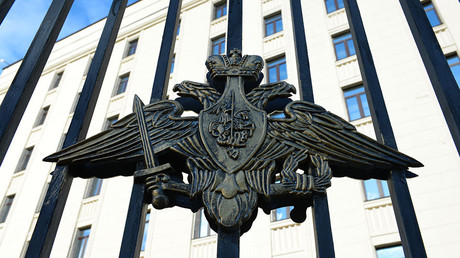
Emblem on the fence of the building of the Russian Defense Ministry on Frunzenskaya Embankment in Moscow. © Natalia Seliverstova

“With these four battle groups, we are not talking about exclusively about a training presence,” he said, according to Wall Street Journal.

“This force is to serve as a deterrent and if necessary as a fighting force. The rules will be different,” Pavel added.

The Croatian General pointed out that the new NATO force in the Baltic is planned to be commanded from the Polish division headquarters with US Army Gen. Curtis Scaparrotti overseeing any deployment of the new NATO force.

US officials told the publication that about 1,000 soldiers, will come from the 2nd Cavalry Regiment based in Vilseck, Germany, and are due to arrive in Poland by April. In addition to US contingent that will be sent to Poland, Germany will send forces to Lithuania. Canada is expected to offer troops to Latvia and the UK will deploy a battle group in Estonia. Norway, Denmark and France as well as other NATO states will be supplementing those forces.

“There are many strands of work,” Gen. Pavel said. “We are trying to come up with the big picture so we are assured the measures we are taking are well-coordinated, mutually supportive and we are not working in different directions.”

The military personnel will be deployed in close proximity to Russia’s northwestern borders in line with the newly-approved multinational task force that was agreed at the NATO summit in Poland in July.

Read more

© Evgeny Biyatov

At the summit in Croatia, the head of NATO operations in Europe tried to unite the alliance’s members to approach Russia from a “position of strength.”

While stressing that opportunities to collaborate with Russia do exist, Scaparrotti noted that “In the view of the allies, I can tell you from this conference that they recognize Russia’s a challenge in many areas.”

Pavel, meanwhile, called for a “pragmatic” but “firm” approach to Russia.

READ MORE: Russia forms brand-new task force to counter NATO buildup in Eastern Europe

Following the Warsaw summit, Russia has proposed that NATO follows a “positive program” for developing relations, aimed at decreasing tensions between Moscow and the US-led military bloc. Relations between Moscow and NATO soured sharply after Russia’s reunion with Crimea and the eruption of the military conflict in Ukraine in 2014.

Moscow considers NATO’s new troop deployment, as well as the increased number of military drills near Russian territory, the creation of anti-ballistic missile sites in Europe and other moves, a threat to Russia’s national security.

What’s the Plan for Winning the War?

August 25, 2016

What’s the Plan for Winning the War?, Counter Jihad, August 25, 2016

Who is even thinking about how to win the war?  Will the legacy of the Obama administration be a shattered NATO, a Turkey drawn into Russia’s orbit, an Iranian hegemony over the northern Middle East, and a resurgent Russia?  It certainly looks to be shaping up that way.  Russia is playing chess while the US is playing whack-a-mole.  The absence of a coherent governing strategy is glaring.

**********************

Michael Ledeen makes a clever observation:

Everyone’s talking about “ransom,” but it’s virtually impossible to find anyone who’s trying to figure out how to win the world war we’re facing.  The two keystones of the enemy alliance are Iran and Russia, and the Obama administration, as always, has no will to resist their sorties, whether the Russians’ menacing moves against Ukraine, or the Iranians’ moves against us.

The moves are on the chessboard, sometimes kinetic and sometimes psychological warfare.  Like a chess game, we are in the early stages in which maneuver establishes the array of forces that will govern the rest of the game.  Russia’s deployment of air and naval forces to Syria stole a march on the Obama administration.  Its swaying of Turkey, which last year was downing Russian aircraft, is stealing another.  Its deployment of bombers and advanced strike aircraft to Iran is another.  That last appears to be in a state of renegotiation, as Ledeen notes, but that too is probably for show.  The Iranians have too much to gain in terms of security for their nuclear program, at least until they’ve had time to build their own air force.

Iran is making strategic moves as well.  Ledeen notes the “Shi’ite Freedom Army,” a kind of Iranian Foreign Legion that intends to field five divisions of between twenty and twenty-five thousand men each.  Overall command will belong to Quds Force commander Qassem Suliemani, currently a major figure in the assault on Mosul, having recovered from his injury in Syria commanding Iranian-backed militia in the war there.  The fact of his freedom of movement is itself a Russian-Iranian demonstration that they will not be governed by international law:  Suliemani is under international travel bans for his assassination plot against world diplomats, but was received in Moscow and now travels freely throughout the northern Middle East.

Turkey, meanwhile, has been effectively cut off by Iran’s and Russia’s success in the opening game of this global chess match.  As late as the Ottoman Empire, the Turks looked south through Iran and Iraq to power bases as far away as Arabia.  Now the Ayatollahs are going to control a crescent of territory from Afghanistan’s borders to the Levant, leaving the Turks locked out.  One might have expected the Turks to respond by doubling their sense of connection to Europe and NATO.  Instead, the purge following the alleged coup attempt is cementing an Islamist control that leaves the Turks looking toward a world from which they are largely separated by the power of this new Russian-Iranian alliance.  The Turks seem to be drifting toward joining that alliance because being a part of that alliance will preserve their ties to the Islamic world.

For now, the Obama administration seems blind to the fact that these moves are closing off America’s position in the Middle East.  This is not a new policy.  Eli Lake reports that the Obama administration told the CIA to sever its ties to Iranian opposition groups in order to avoid giving aid to the Green revolution.  Their negotiation of last year’s disastrous “Iran deal” has led to Iran testing new ballistic missiles and receiving major arms shipments from Russia.  Yet while all these moves keep being made around them, the Obama administration proceeds as if this were still just an attempt to crush the Islamic State (ISIS).  The commander of the XVIIIth Airborne Corps has been given a task that amounts to helping the Iranians win.  Our incoherent policy has left us on both sides in Syria.  Our only real ally in the conflict, the Kurds, stand abandoned by America.

Who is even thinking about how to win the war?  Will the legacy of the Obama administration be a shattered NATO, a Turkey drawn into Russia’s orbit, an Iranian hegemony over the northern Middle East, and a resurgent Russia?  It certainly looks to be shaping up that way.  Russia is playing chess while the US is playing whack-a-mole.  The absence of a coherent governing strategy is glaring.

Germany may reintroduce conscription if defense of NATO borders needed

August 23, 2016

Germany may reintroduce conscription if defense of NATO borders needed

reports Published time: 23 Aug, 2016 08:52

Source: Germany may reintroduce conscription if defense of NATO borders needed – reports — RT News

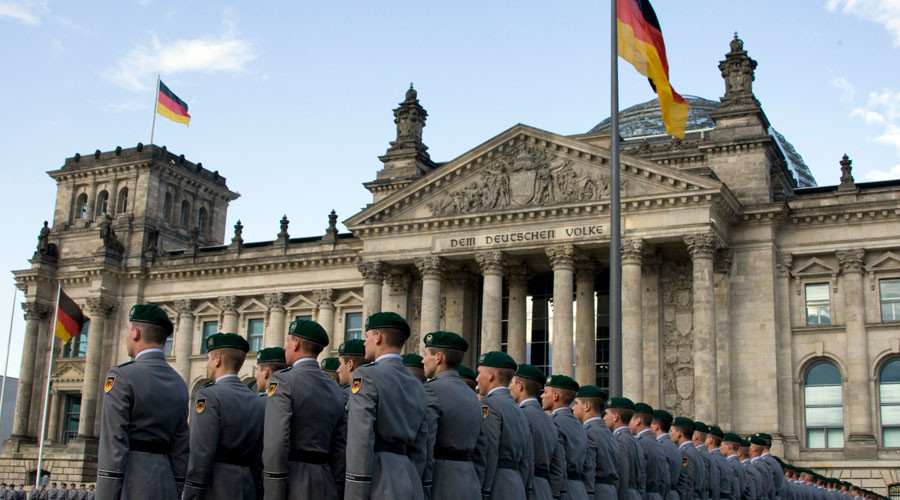
© Thomas Peter / Reuters

The German government may revive nationwide conscription in times of crisis, such as situations in which the country needs to “defend NATO’s external borders,” according to local media citing a controversial paper drafted by the Interior Ministry.

The so-called “Civil Defense Concept,” which is due to be discussed by the German cabinet on Wednesday, mainly focuses on fulfilling Germany’s obligations to defend NATO’s external border.

However, the controversial proposal to revive conscription does not lie on the surface and can only be found buried in a section entitled “Civil support for the armed forces,” according to DPA news agency.

Read more

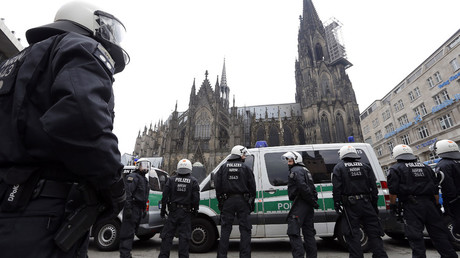
German riot police stand in front of the Cologne Cathedral in Cologne, Germany.© Vincent Kessler

“Quick and reliable delivery of mail especially important for the Bundeswehr (in particular, call-up papers and notices of performance in times of reintroduction of conscription) is ensured under Post- and Telecommunications Safety Act,” reads the draft cited by DPA.

Conscription was suspended in Germany in 2011 after long-standing debates in the government and society, with advocacy groups and experts arguing that it was no longer necessary for the country to maintain a large Cold War-era standing army to defend Europe from a perceived Soviet threat.

In June, German Defense Minister Ursula von der Leyen said conscription will not be reintroduced, notwithstanding renewed tensions with Russia and the terror threat posed by Islamic State (IS, previously ISIS/ISIL).

Conscription is specifically authorized in the German constitution and can be returned with a simple law approved by the parliament, according to Die Zeit.

Apart from conscription, the German Interior Ministry’s paper also mentions the obligations of civilians and civilian organizations to assist the Bundeswehr in other ways, particularly by helping “recruitment organizations and accommodation infrastructure.”

Some of the military’s support functions could also be outsourced to civilian companies, such as “a limited provision of catering for the troops during operations,” the paper reportedly says.

However, then the document goes far beyond modern-day military outsourcing tasks and discusses other proposals resembling war-time measures.

In times of crisis, the draft reads, the federal government can ensure “nutritional emergency preparedness” by imposing “tax obligations relating to cultivation, processing, distribution and sale of food products.”

Other excerpts from the paper previously leaked by German media included the idea of making citizens stockpile food and water reserves – enough to last at least ten days – in the event of a major disaster or a military invasion.

The “Civil Defense Concept” marks the first time since the Cold War that the German government has considered such measures, but the plan was devised as early as 2012, according to Frankfurter Allgemeine.

Turkish naval officer serving in US requests political asylum

August 10, 2016

Turkish naval officer serving in U.S, requests political asylum, DEBKAfile, August 10, 2016

turk

Turkish Navy Rear Adm. Mustafa Ugurlu, an officer serving on behalf of NATO at a US military base in Norfolk, Virginia, has requested political asylum in the US. An arrest warrant has been issued in Turkey for Urgulu. The Turkish embassy in Washington has announced that Ugurlu did not report for questioning as requested. The asylum request is expected to strain relations between Washington and Ankara even further following Turkey’s demand for the extradition of opposition leader Fethullah Gulen, who is in exile in the US.


Europe’s armies are dysfunctional

August 7, 2016

Europe’s armies are dysfunctional, Israel National News, Giulio Meotti, August 7, 2016

In 1958, a well-known American writer who was conducting an investigation about Europe, Joseph Alsop, asked the pacifist Lord Russell: “What if the Soviets won’t be induced, in any way, to an agreement for nuclear disarmament?”. “In this case – said the Nobel Prize Laureate Russell – I would be personally in favor of unilateral disarmament”. Fifty years later, Lord Russell got his wish. Europe is disarming.

The German weekly magazine Der Spiegel recently published an article entitled: “The unarmed forces of Germany”. “Forget the Wehrmacht, Germany may soon gave no army at all”, added The Guardian. “The inglorious Bundeswehr” wrote Politico. “Do not shoot, please, we’re German”, summarized The Economist. So while late German Foreign Minister, Guido Westerwelle, was promising to make Germany a “leader of peace and disarmament”, the American media reported that German soldiers could not even shoot in Afghanistan.

“An unarmed Europe will face the world alone”, wrote Gideon Rachman in the Financial Times.

In 1970, Mogens Glistrup, a prominent politician in Denmark, became famous for suggesting that his country had to replace the armed forces with a recorded message in Russian: “We surrender”. Since 2008, in response to the economic crisis, most European countries have cut defense spending by 10-15 percent. Most Atlantic alliance members have demobilized: Germany went from 545,000 soldiers in 1990 to 180,000, France from 548,000 to 213,000.

A comparison with Putin’s Russia? An increase of 79 percent in military spending in a decade.

The Royal Air Force now has only a quarter of the number of aircraft it had in 1970. The British Army is expected to be reduced to 82,000 soldiers, the minimum since the Napoleonic wars. In 1990 Britain had 27 submarines (excluding those carrying ballistic missiles) and France had 17. The two countries now have seven and six, respectively. And consider that Britain and France are commonly regarded as the only two European countries that still take defense seriously.

Spain today allocates less than 1 percent of GDP to military budget. 75 percent of the Belgian military spending goes to pay army pensions. Many of today’s NATO forces are poorly equipped because much of the money is spent on salaries and benefits. While the United States spends 36 percent of its defense budget on pay and benefits, the majority of NATO members in Europe spend an average of nearly 65 percent.

The NATO Secretary General George Robertson told the truth at the World Economic Forum: “The problem in Europe is that there are too many people in uniform and too few of them are able to go into action”. Belgium, for example, employs hundreds of military barbers, musicians and other useless staff but does not have the money to replace its helicopters. A former spokesman for the Belgian Minister of Defense Andre Flahaut, said it frankly: “I’m not sure that the mission of the military is to fight”.

Fed up with what he had seen, Joseph Ralston, former NATO supreme commander for Europe, defined European armies “fat and redundant”. In 2011, the first military campaign in Libya not guided by the Americans had already demonstrated the limits of European military power. It is no coincidence that this week the Libyan government has turned to the United States to bomb the positions of the Islamic State. While all 28 NATO nations in 2011 approved the Libya mission, less than half participated. “The military capabilities simply are not there”, said the former head of the Pentagon, Robert Gates.

Twenty years ago, at the end of the Cold War, European Allies were contributing one third of the costs for NATO. Today it is only twenty percent.

The Netherlands now invests in defense just 1.15 percent of its gross national product, so that Rob de Wijk, a Dutch defense counsel, told the parliament of the Netherlands that the Dutch are “international freeriders”.

On 11 March 2004, 192 people were killed in a series of terrorist attacks in Madrid. Three days later, the Spanish Socialist leader, José Luis Rodríguez Zapatero, was elected prime minister. Just 24 hours after the oath, Zapatero ordered the Spanish troops to leave Iraq “as soon as possible”. A monumental victory for radical Islam. Since then, Europe has deployed its boots on the ground not to fight jihadism abroad, such as Isis, but within European countries to protect monuments and civilians.

The current “Opération Sentinels” is the first large-scale military operation within France. For the first time since the end of the Cold War, the number of French soldiers actively deployed in metropolitan France matches those used in overseas operations. There is another worrying fact: of all French soldiers currently engaged in military operations, half of them are deployed on the French roads. Half.

The same figure in Italy: 11,000 Italian soldiers are currently engaged in various military missions and more than half of them are used in the operation “Safe Streets” in Italian cities.

US anti-terrorism officials are so frustrated with the inability of Belgium to face terrorist cells that they compared its security forces to “children”. Until a couple of decades ago, Sweden was militarily strong. Then, a number of decisions based on the belief that wars in Europe were “a thing of the past”, turned Sweden into a defenseless state. According to the Supreme Commander of Sweden, Sverker Göransson, the country is able, at best, to defend itself “in one place for a week”.

At a meeting in Washington with NATO officials and security experts, Robert Gates said that “the pacification of Europe” had gone too far. An example? While the Ukrainian troops were fighting the pro-Russian separatists on the eastern borders of Europe, a German battalion took part in a NATO exercise in Norway. They had no weapons, but the German army, the Bundeswehr, thought well and decided to give the soldiers some broomsticks to be used it as a weapon. The Bundeswehr has helicopters that can not fly, and tanks that can not shoot. And the soldiers will be decreased from 250,000 to 180,000.

Which part of the continent will Europe’s leaders sacrifice to the Islamic State and jihadists as their grandfathers did with Sudetenland to Hitler? The French Islamicized suburbs? Londonistan

Turkey’s Tradition of Murdering Christians

July 31, 2016

Turkey’s Tradition of Murdering Christians, Gatestone InstituteRobert Jones, July 31, 2016

(Please see also, Turkey’s Erdogan to US General: ‘Know Your Place’, which deals in large part with the U.S. relationship with Turkey. Turkey is “our” NATO ally and its membership in the European Union is still under consideration. — DM)

♦ Turkey’s countless agreements with Western organizations do not seem to have reduced the hatred for Christians there.

♦ In Turkey, it is “ordinary people” who murder or attack Christians, then the judiciary or political system somehow find a way of enabling the perpetrators to get away with the crimes. Most of these crimes are not covered by the international media and Turkey is never held responsible.

♦ While Muslims are pretty much free to practice their religion and express their views on other religions anywhere in the world, Christians and other non-Muslims can be killed in Turkey and other Muslim-majority countries just for attempting peacefully to practice their religion or openly express their views.

♦ “Multiculturalism,” which is passionately defended by many liberals in the West, could have worked wonders in multi-ethnic and multi-religious places such as Anatolia. But unfortunately, Islamic ideology allows only one culture, one religion, and one way of thinking under their rule: Islam. Ironically, this is the central fact these liberals do not want to see.

On 26 July, the northern French town of Saint-Étienne-du-Rouvray witnessed a horrific Islamist attack: Two Islamic State (ISIS) terrorists killed an 85-year-old priest, Jacques Hamel, in his church during Mass. Two nuns and two churchgoers were taken hostage.

The terrorists, who had pledged allegiance to ISIS and, shouting “Allahu Akbar”, slit the throat of the priest and captured the bloody episode on video, according to a nun who escaped the assault.

Such Islamist attacks might be new to EU member countries but not to Turkey. For decades, so many innocent, defenseless Christians in Turkey have been slaughtered by Muslim assailants.

Christians in Turkey are still attacked, murdered or threatened daily; the assailants usually get away with their crimes.

In Malatya, in 2007, during the Zirve Bible Publishing House massacre, three Christian employees were attacked, severely tortured, then had their hands and feet tied and their throats cut by five Muslims on April 18, 2007.

Nine years have passed, but there still has been no justice for the families of the three men who were murdered so savagely.

First, the five suspects who were still in detention were released from their high-security prison by a Turkish court, which ruled that their detention exceeded newly-adopted legal limits.

The trial is still ongoing. The prosecutor claims that the act “was not a terrorist act because the perpetrators did not have a hierarchic bond, their act was not continuous and the knives they used in the massacre did not technically suffice to make the act be regarded as a terrorist act.”

If the court accepts this legal opinion of the prosecutor, it could pave the way for an acquittal. However, given the many “mysterious” rulings of the Turkish judiciary system to acquit criminals, these killers could also be acquitted by a “surprise” ruling any time.

Ironically, Turkey’s President Recep Tayyip Erdogan said in March that it is necessary to redefine terrorism to include those who support such acts, adding that they could be journalists, lawmakers or activists. There was no difference, he said, between “a terrorist holding a gun or a bomb and those who use their position and pen to serve the aims” of terrorists.

In a country where state authorities are outspokenly so “sensitive” about “terrorism” and “people holding guns,” why are the murderers of Christians not in jail, and why is the prosecutor trying to portray the murders of Christians as “non-terroristic acts”?

Sadly, the three Christians in Malatya were neither the first nor the last Christians to be murdered in Turkey.

On February 5, 2006, Father Andrea Santoro, a 61-year-old Roman Catholic priest, was murdered in the Santa Maria Church in the province of Trabzon. He was shot while kneeling in prayer at his church. Witnesses heard the 16-year-old murderer shout “Allahu Akbar” (“Allah is the Greatest”) during the murder.

After the murder, a 74-year-old priest, Father Pierre François René Brunissen, from Samsun, led the next church service in Santoro’s church, which boasted barely a dozen members. Because no one volunteered to replace Santoro, Father Pierre was instructed to travel from Samsun to Trabzon each month to care for the city’s small congregation.

“This is a terrible incident,” Father Pierre said. “It is a sin to kill a person. After all of these incidents, I am worried about my life here.”

In July, 2006, he was stabbed and wounded by a Muslim in Samsun. The perpetrator, 53, said that he stabbed the priest to oppose “his missionary activities.”[1]

The attacks against the Christian culture in Anatolia continue in modern times — even after Turkey joined the Council of Europe in 1949 and NATO in 1952.

Turkey’s countless agreements with Western organizations do not seem to have reduced the hatred for Christians there. In March, 2007, as the Christian community of Mersin was preparing for the Easter, a young Muslim man with a kebab knife entered the church and attacked the priests, Roberto Ferrari and Henry Leylek.

Mersin, in southern Turkey, is home to Tarsus, the birthplace of Saint Paul, and to several churches dating from the earliest Christian era.

As the Christian roots of Anatolia weakened, so did its bonds with Western civilization. “The attack against the priest is an indicator that Ankara is not ready for Europe,” a Roman Catholic Cardinal and theologian, Walter Kasper, told the Italian newspaper, Corriere della Sera. “There is some amount of tolerance but there is not real freedom. Turkey has to change many things. This change is not about laws. A change of mentality is needed. But you cannot change mentality in one day.”

Bishop Luigi Padovese, Apostolic Vicar of Anatolia, said: “We do not feel safe. I am very worried. Fanaticism is developing in some groups. Some people want to poison the atmosphere and catholic priests are targeted. Anti-missionary films are broadcast on TV channels.”

At a commemorative ceremony for Father Santoro in February, Bishop Padovese said:

“Today, we are asking the question we asked four years ago: Why? We are also asking the same question for all other victims so unjustly murdered even though they were innocent. Why? What was it that they tried to destroy by murdering Father Andrea? Just a person or what that person represented? The aim of shooting Father Andrea was definitely to shoot a Catholic cleric. His being a Father became the reason of his martyrdom.

“The message of Christ on the cross is clear. ‘Father, forgive them, for they do not know what they do.’ Had they known, they would not have done that. It is wrong to extinguish a life to uphold an idea. It is wrong to think that a person who disagrees with us is at fault and should be destroyed. This is the fundamentalism that crumbles a society. For it wrecks coexistence. This fundamentalism — regardless of what religion or political view it belongs to — might win a few battles but it is doomed to lose the war. This is what history teaches us. I hope that this city and this country will turn into a place where people can live as brothers and sisters and unite for the common good for all. Is the Allah of all of us not the same?”

No, unfortunately, the Allah of all of us is not the same.

Just four months later, in June, 2010, it was Padovese’s turn to be murdered. This time the murderer was the Bishop’s own driver for the previous four years. The driver first stabbed the bishop, then cut his throat, while shouting “Allahu Akbar” during the attack.

At the trial, the driver said that the bishop was “Masih ad-Dajjal” (“the false messiah”), then twice in the courtroom he loudly recited the adhan (Islamic call to worship).

1737 (1)Father Andrea Santoro (left), a 61-year-old Roman Catholic priest, and 63-year-old Bishop Luigi Padovese (right), Apostolic Vicar of Anatolia, were two Christian priests murdered in Turkey in recent years.

In the territory where Christians once thrived, even converting to Christianity now creates serious problems.

“New Christians coming from Muslim families are often isolated and ostracized,” writes Carnes. “Turgay Ucal, a pastor of an independent church in Istanbul, who converted from Islam to Christianity said: “Buddhism is okay, but not Christianity. There was a history.”

And this history includes how indigenous Christians in Anatolia have been slaughtered by Muslims. [2]

The total population of Turkey is about 80 million; believers of non-Muslim faiths — mostly Christians and Jews — comprise 0.2%. Nevertheless, anti-Christian sentiment is still prevalent in much of the Turkish society. [3]

There seems to be a pattern: Murders of Christians are committed stealthily in Turkey: It is “ordinary people” who murder or attack Christians, then the judiciary or political system somehow finds a way of enabling the murderers or attackers to get away with what they have done. Sadly, most of these crimes are not covered by the international media, and Turkey is never held responsible.

Turkey, however, signed a Customs Union agreement with the European Union in 1995 and was officially recognized as a candidate for full membership in 1999. Negotiations for the accession of Turkey to the EU are still ongoing.

How come a nation that has murdered or attacked so many Christians throughout history, and which has not even apologized for these crimes, is considered even a suitable candidate for EU membership? Because of the threat of blackmail to flood Europe with Muslims? Turkey will flood Europe with them anyway. There is even a name for it: Hijrah, spreading Islam (jihad) by emigration. Exactly as Muslims have done inside Turkey.

And what kind of a culture and civilization have many Muslims built for the most part in the lands that they have conquered? When one observes the historical and current situation in Muslim-majority countries, what one mostly sees are murders, attacks and hatred: Hatred of non-Muslims, hatred of women, hatred of free thought and an extremely deep hatred of everything that is not Islamic. Many Muslims that have moved to the West have been trying to import political Islam to the free world, as well.

Muslim regimes including Turkey have not achieved civilized democratization that would enable all of their citizens — Muslims and non-Muslims — to live free and safe lives.

While Muslims are pretty much free to practice their religion and express their views on other religions or on atheism anywhere in the world, Christians and other non-Muslims can be killed in Turkey and other Muslim-majority countries just for attempting peacefully to practice their religion or openly express their views.

“Multiculturalism,” which is passionately defended by many liberals in the West, could have worked wonders in multi-ethnic and multi-religious places such as Anatolia. But unfortunately, Islamic ideology allows only one culture, one religion, and one way of thinking under their rule: Islam. Ironically, this is the central fact these liberals do not want to see.

Much of the history of Islam shows that the nature of Islamic ideology is to invade or infiltrate, and then to dominate non-Muslims.

In general, Muslims have never shown the slightest interest in peaceful coexistence with non-Muslims. Even if most Muslims are not jihadis, most do not speak out against jihadist attacks. Many thus appear quietly to support jihadis. That there are also peaceful Muslim individuals who respect other faiths does not change this tragic fact.

That is why non-Muslims in the West have every right to fear one day being exposed to the same treatment at the hands of Muslims. The fear non-Muslims have of Islamic attacks is, based on recent evidence, both rational and justified.

Given how unspeakably non-Muslims are treated in majority Muslim countries, including Turkey, who can blame them for being concerned about the possible Islamization of their own free societies?

Why does Turkey, which seems to hate its own Christians, want to have visa-free access to Christian Europe, anyway?

____________________________


[1] Christianity has a long history in Samsun – as in all other Anatolian towns. As Amisos, in Greek, it was one of the centers of the ancient Greek Pontos region, and helped spread the Christian influence in the region.

“After 1914 the Greek and Armenian populations were to dwindle considerably due to the organized death marches and other methods used by the Turks during the Greek and Armenian Genocides,” according to “Pontos World.”

Decades later, attacks against Christians are still commonplace. In December 2007, another Catholic priest, Adriano Franchini, 65, of Izmir was also stabbed and wounded during the Sunday church service by a 19-year-old Muslim.

Izmir, or Smyrna, was an ecclesiastical territory of the Ecumenical Patriarchate of Constantinople, and one of the Seven Churches of Asia mentioned by Apostle John in the Book of Revelation.

During the Ottoman era, Smyrna hosted one of the largest populations of Greeks and Armenians. Today, there is only a tiny Christian minority in the city. The devastation of the Greek culture in the city peaked during what is commonly known as the “Catastrophe of Smyrna.” The Turkish army destroyed the city in 1922, after the Great Fire of Smyrna. Turkish soldiers murdered many non-Muslim civilians, including dozens of priests and bishops, and forced countless Greek men to join labor battalions. Most Greeks fled their homes in the city to seek shelter in Greece and other states.

“The Great Fire of Smyrna,” wrote the author Ioanna Zikakou, “was the peak of the Asia Minor Catastrophe, bringing an end to the 3,000-year Greek presence on Anatolia’s Aegean shore and shifting the population ratio between Muslims and non-Muslims.”

According to the journalist Tony Carnes:

“Few nations have as rich a Christian history as Turkey. This is where Paul founded some of the earliest churches, including the church at Ephesus. Seven churches in this region were addressed in the Book of Revelation. Those in the early monastic movement found the caves of Cappadocia a near-perfect place to live out lives of prayer.

“But Christianity came under Islamic rule in Turkey in 1453 and steadily declined for centuries; the last 100 years have been the worst. In 1900, the Christian population was 22 percent. Now most experts estimate that there are fewer than 200,000 Christians nationwide, comprising less than 0.3 percent of the population.”

Today, in Islamized Anatolia, the members of the diminutive Christian minority are daily exposed to verbal or physical attacks. Kamil Kiroglu was born and raised in Turkey as a Muslim. At the age of 24, he became a Christian and served in the Turkish Church until 2009. After he became Christian, he was rejected by his family.

On January 8, 2006, Kiroglu was beaten unconscious by five young Muslim men.

“The attack followed church services,” writes the scholar John L. Allen Jr. in his book, The Global War on Christians. “Kiroglu later reported that one of the young men, wielding a knife, had shouted, ‘Deny Jesus or I will kill you now!’ Another reportedly shouted, ‘We do not want Christians in this country!’ As the attackers left, they told a friend of Kiroglu’s that they had left a gift for him. It turned out to be a three-foot-long curved knife, left behind as a further warning against Christian activity.”

“Turkey may be an officially secular state, but sociologically it’s an Islamic society. In general, the greatest threat facing Christians comes not from religiously zealous forms of Islam but from ultranationalists who see Christians as agents of the West, often accusing them of being in league with Kurdish separatists.”

In 2009, Bartholomew I of Constantinople, the Orthodox Christian Church’s Patriarch, said in aninterview with CBS that Turkey’s Christians were second-class citizens and that he felt “crucified” at the hands of Turkish state authorities.

[2] “The annihilation of the non-Turk/non-Muslim peoples from Anatolia started on April 24, 1915, with the arrest of 250 Armenian intellectuals in Istanbul,” wrote the columnist Raffi Bedrosyan.

“Within a few months, 1.5 million Armenians had been wiped out from their historic homeland of 4,000 years in what is now eastern Turkey, as well as from the northern, southern, central, and western parts of Turkey. About 250,000 Assyrians were also massacred in southeastern Turkey during the same period. Then, it was the Pontic Greeks’ turn to be eliminated from northern Turkey on the Black Sea coast, sporadically from 1916 onward.”

Orhan Picaklar, the pastor of the Samsun Agape Church, was kidnapped and threatened by Muslim locals in 2007. He said that people also tried to kidnap his 11-year-old son from his school. His church has been stoned countless times. Ahmet Guvener, the pastor of the Diyarbakir Protestant Church, said he received so many threats that he was awaiting death: “I will give a letter of attorney to a friend of mine. If I die, I want him to take care of my children.”

[3] See the yearly reports of the Association of Protestant Churches about rights abuses against Christians in Turkey.
1,000s Turkish forces surround NATO’s Incirlik air base for ‘inspection’ amid rumors of coup attempt

July 31, 2016

1,000s Turkish forces surround NATO’s Incirlik air base for ‘inspection’ amid rumors of coup attempt

Published time: 30 Jul, 2016 23:35 Edited time: 31 Jul, 2016 03:07

Source: 1,000s Turkish forces surround NATO’s Incirlik air base for ‘inspection’ amid rumors of coup attempt — RT News

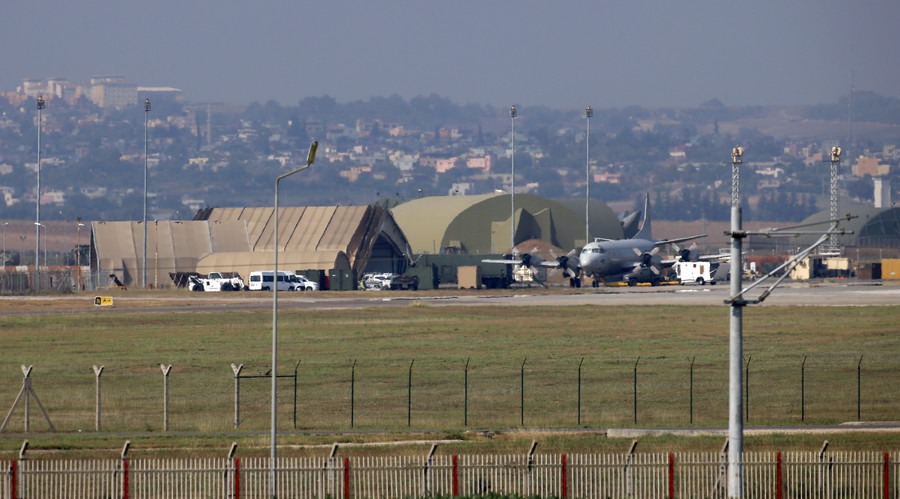
A military aircraft is pictured on the runway at Incirlik Air Base, in the outskirts of the city of Adana, southeastern Turkey. © Stringer / AFP

Some 7,000 armed police in heavy vehicles surrounded the Incirlik air base used by NATO forces in Adana in what a Turkish minister called a “security check.” With no official explanation, speculations have arisen about a new coup attempt or VIP visit.

READ MORE: Anti-US rally staged at NATO Incirlik air base in Turkey (VIDEO, PHOTOS)

Hurriyet reported earlier that Adana police had been tipped off about a new coup attempt, and forces were immediately alerted. The entrance to the base was closed off.

Security forces armed with rifles and armored TOMA vehicles used by Turkish riot police could be seen at the site in photos taken by witnesses.

https://twitter.com/Brasco_Aad/status/759522166962618368?ref_src=twsrc%5Etfw

Turkey’s minister for EU Affairs downplayed the situation in a Twitter post, saying a “security inspection” was carried out.

“We did the general security check. There is nothing wrong,” he tweeted from Adana.

Some supporters of Turkish President Recep Tayyip Erdogan have reportedly flocked to the cordon surrounding the base. The scene, however, did not appear as massive and tense as the recent Adana protests demanding for the base to be shut down.

https://twitter.com/Brasco_Aad/status/759531340173717504?ref_src=twsrc%5Etfw

On Thursday, a huge rally marched towards the NATO base, as people with loudspeakers chanted anti-American and anti-Israel slogans. The demonstrators claim that the US had a hand in the failed July 15 coup attempt in which 270 people died. Tens of thousands people, including members of the military, police, judiciary, media, and civil service, have been arrested in connection with the coup, which Turkish officials say was organized by US-based cleric Fethullah Gulen, Erdogan’s former ally, who is now his most hated rival.

READ MORE: Anti-US rally staged at NATO Incirlik air base in Turkey (VIDEO, PHOTOS)

https://twitter.com/SerboCanada/status/759545698912120832?ref_src=twsrc%5Etfw

Read more

© Medya Gundem

In the wake of the coup attempt, several military officials at the Incirlik Air Base, including its commander, General Bekir Ercan Van, were arrested on treason charges by Turkish authorities, which claimed that one of the rogue F-16 planes taking part in the rebellion to overthrow Erdogan’s government had been refueled there.

The general had even reportedly attempted to seek asylum in the US, but his plea was apparently rejected.

Incirlic Air Base is used by both the Turkish and US militaries and is vital to the US-led anti-terror bombing campaign in Syria and Iraq. It also serves as one of six NATO storage sites for US tactical nuclear weapons in Europe. The exact number of nuclear bombs kept at the base is unknown, although, according to various estimates, it may store up to 90 warheads.

The US-led coalition’s airstrikes had to be halted for several days when power was cut at the base. US military personnel stationed there had to switch to an internal power supply.

READ MORE: Local authorities block access to air base in Turkey that houses US nukes

The “inspection” at the base comes as the Turkish government announced a sweeping military reform on Saturday. In an interview with TV broadcaster A-Haber, Erdogan unveiled plans to scrap all military academies and replace them with a new national defense university.

https://twitter.com/LucidHurricane_/status/759552147201536000?ref_src=twsrc%5Etfw

The commanders of the different branches of the Turkish armed forces are to be put under the defense minister’s chain of command. In addition, Erdogan wants the National Intelligence Organization (MIT) and military chief of staff to report directly to him, which would require a new constitutional amendment to be passed by the parliament.

Communication with has been cutoff. Cannot reach them by email or phone.

 https://twitter.com/IncomeDisparity/status/759580516869894144/photo/1?ref_src=twsrc%5Etfw

It also comes on the eve of a visit from a top US military official, chairman of the Joint Chiefs of Staff Joseph Dunford, who is scheduled to arrive in Turkey on Sunday. Diplomatic sources quoted by Hurriyet claim Dunford will go visit both Ankara and Incirlik.

 https://twitter.com/DEFCONWS/status/759527790395949056?ref_src=twsrc%5Etfw

Trump and NATO

July 27, 2016

Trump and NATO, Front Page MagazineBruce Thornton, July 27, 2016

trump nato

The Never Trump crowd has found another example of The Donald’s disqualifying ignorance: comments he made about NATO. He has said that our contributions to NATO are “unfair,” that they are “costing us a fortune,” that we are “getting ripped off,” and that they are “getting a free ride.” By the way, Obama in his Atlantic interview also called the Europeans “free riders,” but I don’t recall a lot of sneering at the president for his “alarming” and “dangerous” remarks, as one critic put it.

Trump also implied that he would put the European NATO members’ feet to the fire about meeting the 2006 requirement that they spend 2% of GDP on their militaries, and suggested he would negotiate a new contribution schedule. Few NATO members have met that requirement, which is a violation of Article 3 that requires member states to “maintain and develop their individual and collective capacity to resist armed attack.” According to NATO’s own report, only five countries are estimated to meet the 2% requirement in 2016. France, Germany, Italy, and Spain­­––the first, third, fourth, and fifth largest economies in the EU––are not among them. The richest, Germany, is expected to remain at 1.19%. In contrast, the US will spend 3.9%. As Lord Robertson, NATO Secretary General from 1999-2004, put it, European nations are “military pygmies.”

Critics of Trump are technically correct to say that he exaggerates when he claims that the US pays the “lion’s share” of NATO funding. In fact, the US pays under a fifth (22%). But the complaints about European NATO members, which predate Trump by decades, take into account more salient deficiencies. “Common funding,” of which the US covers a fifth, is “used to finance NATO’s principal budgets: the civil budget (NATO HQ running costs), the military budget (costs of the integrated Command Structure) and the NATO Security Investment Programme (military capabilities),” according to NATO. In other words, mostly institutional bureaucratic infrastructure.

“Indirect spending” covers what each nation voluntarily contributes to an operation. NATO acknowledges the greater share the US spends on indirect spending: “there is an over-reliance by the Alliance as a whole on the United States for the provision of essential capabilities, including for instance, in regard to intelligence, surveillance and reconnaissance; air-to-air refuelling; ballistic missile defence; and airborne electronic warfare.” We could also mention transport aircraft, cruise missiles, and other matériel that the European countries simply don’t have much of. For example, in the 2011 NATO bombing of Libya, there were 246 cruise missiles launched. The US fired 228 of them. At $1.5 million apiece, that adds up to $342 million taxpayer dollars spent to destabilize a country and get four of our citizens killed.

This discrepancy in indirect spending and military capability was already obvious in the 1990’s when NATO intervened in Bosnia and Kosovo to stop a vicious war. During the 1999 crisis in Kosovo, the Europeans had to make “heroic efforts” just to deploy 2% of their two million troops, according to the British foreign secretary. Historian William Shawcross writes of the bombing campaign, “The United States flew the overwhelming majority of the missions, and dropped almost all the precision-guided U.S.-made munitions, and most of the targets were generated by U.S. intelligence.”

So Trump’s complaints, as blustering and exaggerated as they may be, are legitimate. Operations conducted by NATO are overwhelmingly American funded and directed, and NATO is a diplomatic fig-leaf for American power.

No more convincing are the reasons critics give for supporting NATO. The alliance has not prevented “major state conflict since World War II,” as a writer at NRO claims. Given that some 40 million people have died in conflicts since WWII, I’m not sure what “peace” we’re talking about. During the Cold War, the peace between the US and the Soviet Union was kept by nuclear “mutually assured destruction” and millions of American troops, not NATO. Nor was Europe in any condition to fight among themselves. The Europeans were, and still are in many ways, burned out after 30 years of warring, and had neither the will, the morale, nor the belief in anything worth dying for to engage in another war. With their security underwritten by the US, they could spend their money on lavish social welfare programs and la dolce vita. Thinking NATO kept the peace is as preposterous as claiming the EU did.

Then there’s Article 5, the pledge that NATO members will fight for any member state that’s been attacked. Much is made of the only time Article 5 has been invoked, after the terrorist attacks on 9/11. Yet all that solidarity and allied good will didn’t stop France and Germany from trying to undermine the US when it tried to get the UN to sanction the war in 2003 on Saddam Hussein, who had violated 16 UN resolutions and the formal terms ending the 1991 Iraq War. Despite the consensus of American and European intelligence agencies that Hussein had WMD stockpiles, France and Germany took the lead in lobbying the Security Council to oppose the authorization to use force against Iraq.  Germany’s ambassador to the UN Council pressured members like Mexico and Chile to vote against the US. Worse yet, France and Germany, along with Belgium, formally objected to a proposal for NATO to send defensive equipment to Turkey, which wanted assurances that it would be supported by its fellow NATO members if attacked for supporting the war against Hussein.

This behavior of NATO allies did not reflect principle, but national interests and politics. German Chancellor Gerhard Schroeder was running for re-election, and found reflexive German anti-Americanism and pacifism a convenient distraction from his terrible economic record. France had grubbier reasons in addition to its own ressentiment towards the US––renewing the arm sales to Iraq and oil development contracts it had enjoyed for years before the war, and could resume once the sanctions on Hussein were lifted, something France was actively pursuing. As Shawcross summarized, “The long friendship with Saddam, commercial considerations, the response to le défi Américain, and concern over the reactions of France’s Muslims––all these played a part in [President Jacques] Chirac’s calculations in the summer of 2002.”

The importance put on Article 5 forgets that, as George Washington said, “It is a maxim founded on the universal experience of mankind, that no nation can be trusted farther than it is bound by its interests.” NATO members have made and in the future will make decisions based on each nation’s estimation of its interests. So there’s no guarantee that invoking Article 5 would lead to meaningful NATO member support. And given the weakness of their militaries, just how much actual rather than rhetorical support could the Europeans provide in the event of an attack? How many battle carrier groups does NATO possess? The Europeans can’t even afford cruise missiles.

Finally, the arguments for NATO are predicated on an either-or fallacy. If we don’t have the NATO alliance and the benefits it supposedly brings for collective security, then we’ll have nothing. But of course, if NATO disappeared tomorrow, the US would quickly sign bilateral and multilateral defense agreements with individual countries or groups of countries, including some current NATO members. The argument that without NATO our security would be endangered is as fallacious as the argument of the Remain faction in England that leaving the EU would put the UK in danger. A country as rich and powerful as the US will find no dearth of countries eager to bandwagon with it.

Trump’s critics continue to search for dubious reasons to justify sitting out the election or even voting for Hillary. There may be many reasons not to vote for Trump, but criticizing NATO isn’t one of them.

Turkey – Roger Out

July 22, 2016

Turkey – Roger Out, Front Page MagazineCaroline Glick, July 22, 2016

turkey roger out

Originally published by the Jerusalem Post

On Wednesday, NATO Secretary-General Jens Stoltenberg insisted that the purge of thousands in the Turkish military – including a third of the serving generals – did not weaken the military.

Stoltenberg told Reuters, “Turkey has a large armed force, professional armed forces and… I am certain they will continue as a committed and strong NATO ally.”

It would be interesting to know whether the 1,500 US soldiers who have been locked down at Incirlik Air Base along with several hundred soldiers from other NATO countries since the failed coup Friday night would agree with him.

Following the failed coup, the Erdogan regime cut off the base’s external electricity supply and temporarily suspended all flights from the base.

The base commander Gen. Bekir Ercan Van and 11 other service members from the base and a police officer were placed under arrest.

Incirlik is the center of NATO air operations against Islamic State in Syria. It also reportedly houses 50 nuclear warheads. The atomic bombs belong to the US. They deployed to Turkey – under US control – as a relic of the Cold War.

It took US President Barack Obama two years of pleading to convince Turkish President Recep Erdogan to allow NATO forces to use the base at Incirlik. It was only after the Kurdish political party secured unprecedented gains in Turkey’s parliamentary elections last year, and Tayyip Erdogan decided to expand his operations against the Kurds of Iraq and Syria to dampen domestic support for the Kurds, that he agreed to allow NATO forces to use the base.

His condition was that the US support his war against the Kurds – the most effective ground force in the war against Islamic State.

Stoltenberg’s statement of support for Turkey is particularly troubling because Erdogan’s post-coup behavior makes it impossible to continue to sweep his hostility under the rug.

For nearly 14 years, since his AK Party first won the national elections in late 2002, Erdogan and his followers have made clear that they are ideologically – and therefore permanently – hostile to the West. And for nearly 14 years, Western leaders have pretended this reality under the rug.

Just weeks after AKP’s first electoral triumph, the Turkish parliament shocked Washington when it voted to reject the US’s request to deploy Iraq invasion forces along the Turkish border with Iraq. Turkey’s refusal to permit US operations from its territory are a big reason the Sunni insurgency in Iraq was able to organize.

It took the US some two months to take over northern Iraq. By that time, the Ba’athists had organized the paramilitary militias that later morphed into al-Qaida in Iraq and then, following the US withdrawal from Iraq in 2011, Islamic State.

Ever since then, Erdogan has paid lip service, and even assisted NATO and the EU from time to time, when it served his momentary interests to do so. But the consistent trend of his behavior has been negative.

Since taking power, Erdogan has galvanized the organs of state propaganda – from the media to the entertainment industry to the book world – to indoctrinate the citizens of Turkey to hate Jews and Americans and to view terrorists supportively.

This induced hatred has been expressed as well in his foreign policy. Erdogan was the first major leader to embrace Hamas after its electoral victory in the 2006 Palestinian Authority elections. He treated Hamas terror chief Ismail Haniyeh like a visiting monarch when he hosted him shortly after those elections.

During Hezbollah’s 2006 war against Israel, Turkey was caught red-handed as it allowed Iran to move weapons systems to Hezbollah through Turkish territory.

Erdogan has turned a blind eye to al-Qaida. And he has permitted ISIS to use Turkey as its logistical base, economic headquarters and recruitment center. Earlier this year the State Department claimed that all of the 25,000 foreign recruits to ISIS have entered Syria through Turkey.

As for Iran, until Obama engineered the lifting of UN sanctions against Iran through his nuclear deal with the ayatollahs, Turkey was Iran’s conduit to the international market. Turkey was Iran’s partner in evading sanctions and so ensuring the economic viability of the regime. According to a series of investigative reports by Turkish and foreign reporters, Erdogan’s family was directly involved in this illicit trade.

Then there is Europe. For ISIS, Turkey has been a two-way street. Fighters have entered Syria through Turkey, and returned to Europe through Turkey. Turkey is behind the massive inflow of Syrian refugees to Europe.

German Chancellor Angela Merkel tried to cut a deal with Erdogan that would stem the flow. Erdogan pocketed her economic concessions and did nothing to stop the hemorrhage of refugees to Europe.

As for the US, the years of anti-American incitement and indoctrination of Turkish society are now coming into full flower in the aftermath of the coup. Even before the dust had settled, Erdogan was pointing an accusatory finger at Washington.

Insisting that the failed coup was the brainchild of exiled Islamic cleric – and erstwhile ally of Erdogan – Fetullah Gulen, who took up residence in Pennsylvania’s Poconos Mountains 16 years ago – Erdogan demanded that the US immediately put Gulen on an airplane with a one-stop ticket to Turkey.

In the days that followed, the Erdogan regime’s accusations against the US became more and more unhinged. Prime Minister Binali Yildirim said that failure to comply with Erdogan’s extradition demand would be viewed as a hostile act by the US.

And Turkish Labor Minister Suleyman Soylu flat out said that “America is behind the coup,” in a media interview.

In other words, after arresting the base commander and other forces at Incirlik, and while effectively holding US-led NATO forces and 50 nuclear warheads prisoner for the past six days, Turkey is accusing the US of engineering the coup attempt.

But apparently, NATO has decided to try to again sweep reality under the rug, once more. Hence, Stoltenberg’s soothing insistence that there is no cause for worry. Turkey remains a trusted member of the alliance.

This isn’t merely irresponsible. It is dangerous, for several reasons.

First of all, Stoltenberg’s claim that the Turkish military is as strong as ever is simply ridiculous.

A third of the serving generals are behind bars along with thousands of commanders and soldiers, educators, police officers, jurists and judges.

Who exactly can be willing to take the initiative in this climate? Amid at best mixed messages from the regime regarding the war against ISIS, and with the generals who coordinated the campaign with NATO now behind bars, who will maintain the alliance with NATO ? No one will.

The implications of this passivity will be felt on the ground in Turkey as well as in Syria and Iraq.

Thanks to Erdogan’s passive support, ISIS has operatives seeded throughout Turkey. Who can guarantee that they will leave the nuclear weapons at Incirlik alone? Is the US really planning to leave those bombs in Turkey when its own forces are effective prisoners of the regime? And what are the implications of removing them? How can such a necessary move be made at the same time that NATO pretends that all is well with Turkey? Then there is the problem of chemical weapons.

In recent months, ISIS has used chemical weapons in Syria and Iraq. In February, James Clapper, the director of US national intelligence, warned that ISIS is developing a chemical arsenal and intends to use chemical weapons against the US and Europe.

In May it was reported that ISIS is conducting experiments with chemical weapons on dogs and prisoners in labs located in residential neighborhoods in Mosul.

Turkey is a NATO member with open borders to Europe, and the only thing that has prevented ISIS terrorists from bringing chemical weapons to Europe has been the Turkish military and police force. They are now being purged.

Moreover, as Soner Cagaptay reported in The Wall Street Journal this week, Erdogan used out and out jihadists to put down the coup on Friday night and Saturday. He has continued to embrace them in the days that have passed since then.

In so doing, Erdogan signaled that he may well use the post-coup state of emergency to dismantle what is left of Turkey’s secular state apparatus and transform the NATO member into an Islamist state, along the lines of the short-lived Muslim Brotherhood regime in Egypt, which Erdogan enthusiastically supported.

In this climate, it is difficult, if not as a practical matter impossible, to imagine that the military and police will work particularly hard to prevent ISIS terrorists from transporting weapons of mass destruction from Syria to Europe through Turkey.

The Obama administration is partly responsible for the current crisis. Secretary of State John Kerry just agreed to subordinate the US-led anti-ISIS campaign to Russia. In so doing, he made clear that the US will not protect Turkey from Russia. This gives Erdogan little choice other than to strike out a new, far more radical course.

To Erdogan’s own Islamist convictions and US incompetence must be added a third reason to assume the situation in Turkey will only get worse.

As David Goldman has reported in the Asia Times, Turkey is on the brink of economic collapse. Its currency has been devalued by 7 percent just since the failed coup. “With about $300 billion in foreign currency liabilities, Turkish corporations’ debt service costs rise as the currency falls. Stocks have lost more than half their value in dollar terms since 2013,” Goldman warned.

In the current climate, it is hard to imagine Erdogan instituting austerity measures to pay down the debt. So he needs a scapegoat for his failure. The chosen scapegoat is clearly the US.

To make a long story short then, the Turkish military is no longer capable of cooperating in any meaningful way with the US or NATO . Erdogan, never a reliable ally, is now openly hostile.

He is in the midst of committing aggression against NATO forces at Incirlik. And he is embracing Turkish jihadists who are ideologically indistinguishable from ISIS.

The US surrender to Russia means that America cannot protect Turkey from Russia. And Erdogan has chosen to blame American for Turkey’s fast approaching economic doomsday.

Under the circumstances, if NATO takes its job of protecting the free world seriously, it has no choice but to quit with the business as usual routine and kick Turkey out of the alliance, withdraw its personnel and either remove or disable the nuclear weapons it fields in the country.

As for anti-ISIS operations, the US will have to move its bases to Iraqi Kurdistan and embrace the Kurds as the strategic allies they have clearly become.

In the aftermath of the failed coup, Turkey is a time bomb. It cannot be defused. It will go off. The only way to protect the free world from the aftershocks is by closing the border and battening down the hatches.