Posted tagged ‘Mubarak’

Clinton Backed Egypt’s Muslim Brotherhood Regime

October 13, 2016

Clinton Backed Egypt’s Muslim Brotherhood Regime, Washington Free Beacon, Bill Gertz October 13, 2016
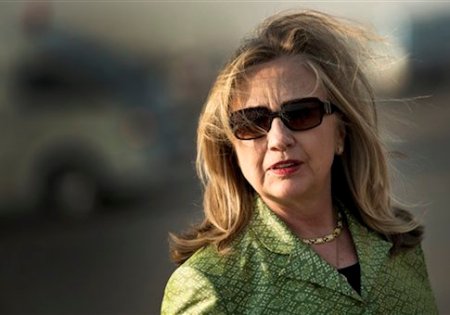
U.S. Secretary of State Hillary Rodham Clinton before her departure to Egypt's coastal city of Alexandria in Cairo, Egypt, July 15, 2012. Clinton on Sunday urged Egypt to commit to "a strong, durable democracy" that protects all citizens, hoping to appeal both to supporters of the popularly elected Islamist president and minorities fearful of being repressed under their new government. (AP Photo/Brendan Smialowski, Pool)

U.S. Secretary of State Hillary Rodham Clinton before her departure to Egypt’s coastal city of Alexandria in Cairo, Egypt, July 15, 2012. (AP Photo/Brendan Smialowski, Pool)

Secretary of State Hillary Clinton in 2012 called the election of Egypt’s Islamist Muslim Brotherhood leader a “milestone” for Egyptian democracy and offered covert police and security help, according to declassified State Department documents.

A nine-page document, once-labeled “Secret,” listed talking points for Clinton’s meeting with newly-elected Egyptian President Mohamed Morsi on July 14, 2012. The talking points said Morsi’s election was a key step toward popular democracy in the strategic North African state.

“We stand behind Egypt’s transition to democracy,” the heavily-redacted Clinton talking points state, adding that the only way to maintain a strong Egypt is “through a successful transition to democracy.”

The first key objective of the meeting was for Clinton to “offer our congratulations to Morsi and to the Egyptian people for this milestone in Egypt’s transition to democracy.”

Clinton then was meant to offer Morsi American technical expertise and assistance from both the U.S. government and private sector to support his economic and social programs.

Clinton’s talking points also included an offer of secret assistance to help Morsi “upgrade and reorient Egypt’s police force toward serving the needs of a democratic people.” The offer included sending a team of U.S. police and security experts to Egypt as part of a “framework of cooperation” that would be carried out “quite discretely.”

Also, the talking points reveal Clinton was ready to help launch an Egyptian-American Enterprise Fund, a private sector initiative of U.S. and Egyptian investors to help Egyptian businesses. The fund was to be launched with $60 million and would later involve Congress adding $300 million over five years.

The fund was created in September 2012.

Many pro-democracy Egyptians who had taken to the streets as part of the 2011 revolution that ousted long-time U.S. ally Egyptian President Hosni Mubarak viewed U.S. support for Morsi as a betrayal and part of a U.S. strategy of backing the Muslim Brotherhood in the region.

The meeting between Clinton and Morsi took place two months before terrorists in neighboring Libya attacked a U.S. diplomatic compound and CIA facility, killing four Americans, including U.S. Ambassador to Libya Christopher Stephens.

A second State Department document revealed that Deputy Secretary of State Thomas R. Nides wrote to Morsi on Sept. 24, 2012 seeking collaboration with the Egyptian leader on Syria and Iran.

“It was a honor to meet with you in Cairo,” Nides wrote in the letter. “We share the goal of growing our markets and increasing trade, as well as a desire for a stable, secure and peaceful region. As I said when we met, the United States also remains committed to helping Egypt address regional issues, including Syria and Iran.”

Both documents reveal that the State Department under Clinton had little understanding of the Islamist threat posed by the Muslim Brotherhood and its branches.

Andrew C. McCarthy, former assistant U.S. attorney in New York who prosecuted Islamist terrorism cases, said Clinton backed the Muslim Brotherhood over the Egyptian military, stating it was imperative that power be turned over to the winner of the election.

“The defining mission of the Muslim Brotherhood is the implementation of sharia,” McCarthy said. Sharia is Islamic law that critics say is antidemocratic and contrary to fundamental rights and freedoms

The documents were released under a Freedom of Information Act request seeking information on the Obama administration’s secret 2011 Presidential Study Directive-11, or PSD-11.

The directive, according to officials familiar with its contents, outlined how the administration would seek to support the Muslim Brotherhood around the world despite the Islamist supremacist organization providing the ideological underpinning for jihadist terrorism for both al Qaeda and its successor, the Islamic State.

U.S. backing for Morsi’s Muslim Brotherhood regime in Egypt was derailed by the Egyptian military a year after the meeting. Morsi, the first democratically elected head of state in Egyptian history, was ousted in a coup after he had sought to consolidate power by granting himself unlimited authority in what pro-democracy critics called an Islamist coup.

Egyptian military leaders arrested Morsi on July 3, 2013, after protesters took to the streets to oppose his rule. Abdel Fattah al-Sisi headed a military government and was later elected president.

The Muslim Brotherhood is an international organization founded in 1928 that adopted as its motto “Allah is our objective; the Prophet is our Leader; the Quran is our law; Jihad is our way; dying in the path of Allah is our highest hope.”

The leaders of the Brotherhood in September 2010 declared jihad, or holy war against the United States and Israel, six months before the Arab Spring uprisings in North Africa and the Middle East.

Clinton’s backing for Arab Spring states was guided by PSD-11 and produced ongoing disasters in the region, namely in Libya and Syria.

U.S. intervention in Libya ousted dictator Moammar Gadhafi but left the oil-rich state in turmoil. It is now viewed as a failed state and safe haven for several Islamist terror groups.

Syria’s civil war helped spawn the emergence of the Islamic State in 2014.

In a section on Israel, Clinton’s talking points expressed appreciation to Morsi for assertions that Egypt would continue to abide by international treaties and obligations.

“Maintaining peace with Israel is a fundamental shared interest and critical for Egypt’s ability to address its economic challenges and enjoy international support as it consolidates its democracy,” the talking points stated. “We may not have a common view, but we do have a common interest.”

The CIA also covertly backed the Muslim Brotherhood in Egypt, according to Egyptian news outlets. In December 2013, the news website Al Bashayer published audio recordings of a CIA delegation that met with Muslim Brotherhood Deputy Khayrat al Shatir and Brotherhood official Isam al Haddad at the U.S. Embassy in Cairo on Jan. 8, 2013.

The CIA asked the Muslim Brotherhood leaders to open a back channel to al Qaeda “to secure the safe exit of U.S. troops” from Afghanistan.

Additionally, another news outlet, Al-Marshad al Amni, reported that Maj. Gen. Abd-al-Hamid Khayrat, former deputy chief for Egyptian State Security Investigations said the CIA in January 2013 “asked for the help of the MB in Egypt to facilitate… the withdrawal from Afghanistan.” The Muslim Brotherhood agreed to become a “bridge” between the U.S. government and al Qaeda, Khayrat said.

The reports triggered widespread conspiracy theories in post-Morsi Egypt that the CIA was collaborating with Morsi and the Muslim Brotherhood to destabilize Egypt.

The Clinton talking points about the transition to democracy were reflected in a briefing given by a State Department official to reporters the day before the 2012 meeting. The covert police assistance was not mentioned.

A day after the meeting, Clinton stated in remarks at the U.S. Consulate in Alexandria, Egypt, that she told Morsi the success of his presidency and Egypt’s success “depends upon building consensus across the Egyptian political spectrum and speaking to the needs and concerns of all Egyptians—all faiths, all communities, men and women alike.”

Retired Army Lt. Col. Joseph Myers, a former DIA official and specialist on terrorism, said the documents show the endorsement and support of the Muslim Brotherhood government in Egypt was “a fools errand and shows a disastrous strategic naivety.”

“The whole policy initiative to support a Muslim Brotherhood government anywhere is another example of a total policy failure of Secretary Clinton,” Myers said.

“But it also raises deeper questions of who in our government is advising and influencing such reckless and dangerous policies that show no fundamental comprehension of the threat we face from radical Islamic jihad,” he added. “Or worse these advisers precisely understand what they are doing to U.S. policy and Secretary Clinton could not.”

The Bipartisan Enemy of the Good

April 5, 2016

The Bipartisan Enemy of the Good, Front Page MagazineCaroline Glick, April 5, 2016

secretary_kerry_with_president_al-sisi_july_2014

Originally published by the Jerusalem Post.

On March 25, The New York Times published an editorial effectively calling for US President Barack Obama to abandon the US alliance with Egypt.

The Obama White House’s house paper urged the president to “reassess whether an alliance that has long been considered a cornerstone of American national security policy is doing more harm than good.” The editorial concluded that Obama must “start planning for the possibility of a break in the alliance with Egypt.”

The Times’ call was based on an open letter to Obama authored by a bipartisan group of foreign policy experts that call themselves the “Working Group on Egypt.” Citing human rights violations on the part of the government of Egyptian President Abdel Fattah al-Sisi, the Working Group urged Obama to tie US financial and military assistance to Egypt to the protection of NGOs operating in Egypt.

The self-proclaimed bipartisan band of experts is co-chaired by Robert Kagan from the Brookings Institution and Michele Dunne from the Carnegie Endowment for International Peace. Among its prominent members are Elliott Abrams, Ellen Bork, Reuel Gerecht, Brian Katulis, Neil Hicks and Sarah Margon.

The Working Group has a history.

In January 2011, it called for Obama to force then Egyptian president Hosni Mubarak to resign from office. In so doing, it provided bipartisan cover for Obama’s decision to abandon the US’s most critical and dependable ally in the Arab world. Then, as now, the group’s esteemed experts argued that due to the regime’s infringement of human rights, the US could not in good conscience support it. Back in 2011, Israelis found a rare wall-to-wall unanimity of purpose in vocally and forcefully defending Mubarak from his American detractors. From the far Left to the far Right, from the IDF General Staff to the street, Israelis warned anyone who would listen that if Mubarak were forced out of power, the Muslim Brotherhood would take over and transform Egypt into a jihadist state.

Due in large part to the presence of senior Republican foreign policy hands on the Working Group, by and large Israel’s warnings were ignored in Washington. Facing the unusual Israeli consensus backing Mubarak was an American consensus insisting that “democracy” would ensure that a new liberal democratic Egypt would emerge out the ashes of the Mubarak regime.

The Americans chided us for repeating over and over again that the Muslim Brotherhood, the progenitor of al-Qaida, Hamas, Egyptian Islamic Jihad and every other major Sunni jihadist terrorist group around at the time, was a terrorist group.

We were attacked as “anti-democratic,” for insisting that the Facebook posters and twitterers on Twitter were in no position to replace Mubarak.

Who were we, the Americans scoffed, to point out that the “Facebook revolutionaries” were but a flimsy veneer which barely hid the Islamists from willfully blind Western officials and reporters who refused to admit that liberal values are not universal values – to put it mildly.

In the ensuing five years, every single warning that Israel expressed was borne out in spades.

Just as we said, right after Mubarak was forced from power, the Islamists unceremoniously dispatched with the Facebook crowd. The two million Islamists who converged on Tahrir Square to hear Sheikh Yussuf Qaradawi call for jihad and the Islamic conquest of Israel weren’t interested in democracy.

The women and Christians of Egypt soon realized, Mubarak’s overthrow, which paved the way for the Muslim Brotherhood electoral victories in 2012, did not expand their rights, it endangered their lives. As for the hapless Americans, immediately after Muslim Brotherhood leader Mohammed Morsi was inaugurated to serve as president of Egypt, the government began demanding that the US release from prison Omar Abdel Rahman, the so-called Blind Sheikh who masterminded the 1993 World Trade Center bombings. The US embassy in Cairo was the target of jihadist riots on September 11, 2012.

Then, since Morsi was elected democratically, none of this was any sweat off the back of Washington’s Egypt experts. They supported sending F-16s to his air force even after he hosted then Iranian president Mahmoud Ahmadinejad in Cairo, let Iranian warships traverse the Suez Canal and became a strategic ally of Hamas. They also supported his government, even though he enabled Libyan arms to flow through Egypt to Syria, transforming the war in Syria from a local dispute into the incubator for Islamic State – the precursor of which Morsi also gave a free hand to operate in the Sinai, in conjunction with Hamas.

The Americans didn’t reconsider their belief that Morsi was the guy for them, even after he allowed his Muslim Brothers to torch Coptic churches and massacre Christians. They didn’t revisit their support for the Muslim Brotherhood government even after Morsi arrogated to himself dictatorial powers that even Mubarak never dreamed of.

Perhaps if Morsi had been a responsible economic leader, and maintained the liberalization policies Mubarak enacted during his last five years in power, then defense minister Abdel Fatah Sisi wouldn’t have felt the need to remove him from power. After all, Morsi appointed Sisi to his position.

But in addition to ending even lip service to human rights, Morsi gutted the economy. By the time the military overthrew Morsi and the Muslim Brotherhood in the summer of 2013, Egypt had a mere $5 billion in reserves, and according to the World Health Organization, a quarter of Egyptians were starving.

So had the Muslim Brotherhood remained in power, Egypt would not have remained a democracy.

It would have become a jihadist state as dangerous as Iran, with the economic prospects of North Korea.

In other words, five years ago, there was no chance that a post-Mubarak Egypt would become a liberal democracy. There were only two options – a US-allied tyranny that fought jihad and maintained the peace with Israel, or a jihad state, aligned with Iran, that posed an existential threat to Israel, Jordan, the US and the international economy.

Those are still the choices today, but the stakes are even higher. Due to the Muslim Brotherhood’s year in power, the jihadist elements that gathered force in the Sinai over the past 20 years were able to organize as a more or less unified force, under the rule of Islamic State (ISIS), and in strategic alliance with Hamas. Like ISIS in Syria, ISIS in Egypt is an aggressive, dangerous group that stops at nothing to achieve its aims of expanding the ISIS empire.

The war it now fights against the Egyptian state is a total war.

To his credit, Sisi recognizes the nature of the threat and has taken steps to counter jihad that Mubarak never contemplated. The Egyptian leader recognizes that to defeat ISIS nothing less than a reformation of Islam is required. And so, in addition to fighting ISIS with everything he has, he is risking everything by taking on the jihadist belief system.

Sisi has mobilized the clerics at Al-Azhar seminary to develop an Islamic narrative that rejects jihad.

Sisi risks everything because everything is already at risk. If ISIS wins, Egypt is finished.

To win this war, he has publicly embraced Israel as an ally. He has openly sided with Israel against Hamas. Unlike Mubarak, Sisi has been fully willing to acknowledge that just because Hamas’s primary victims are Jews doesn’t mean that it isn’t a terrorist group that has to be destroyed.

Without putting too fine a point on in, for his fearless fight to the death with the forces of jihad – both in the mosque and on the battlefield – Sisi has already entered the pantheon, alongside Winston Churchill, of word historical figures. And yet, rather than embrace him and support him in his fight for Egypt and humanity, the same “experts” who called for Mubarak to be overthrown now urge Obama to abandon Sisi.

It is depressing that there is no magic bullet – like democracy – for the pathologies that afflict the Islamic world. But there is no magic bullet. And there are no easy choices for people who refuse to recognize that the natural state of man is neither liberal nor democratic.

But it is hard to accept the credibility of those who refuse to learn from their mistakes. It is harder still as well to listen to the “moral calls” of those who refuse to accept that because their past advice was heeded, thousands have died, and if their current calls are heeded, millions of lives will be imperiled.

Obama Backed Muslim Brotherhool Egypt Coup Against National Security Team Advice

March 18, 2016

Obama Backed Muslim Brotherhool Egypt Coup Against National Security Team Advice, Front Page Magazine, Daniel Greenfield, March 18, 2016

mubarak_miss_me_yet

Obama usually defends his bad decisions on foreign policy by blaming someone else. He tried to blame General Austinfor his ISIS JayVee team line. He blames Netanyahu for his failed outreach to Islamic terrorists in Israel. Benghazi was caused by a video. The Libyan War was caused by bad advice, especially from Hillary Clinton. Also by the Europeans.

We don’t discuss Egypt much. But, perhaps to get ahead of the blame game, it turns out that Obama rejected the advice of his national security team to back a Brotherhood coup of Mubarak in Egypt. (Yes, I know, the official media narrative is that the overthrow of Morsi was a “coup” but the overthrow of Mubarak was a popular protest, even though both involved the army stepping in. Because the narrative is based on lies and word games.)

Former Secretary of Defense Robert Gates revealed that President Barack Obama disregarded the near unanimous advice of the national security team and decided to depose then-Egyptian President Hosni Mubarak because he wanted to be on the “the right side of history.”

“The entire national security team recommended unanimously handling Mubarak differently than we did,” Gates said in a Fox News interview. “And the president took the advice of three junior backbenchers in terms of how to treat Mubarak — one of them saying, ‘Mr. President, you have to be on the right side of history.’”

This isn’t much of a surprise since Obama has always picked his White House juniors and his pet radicals over his official national security team. He’ll blame military people and cabinet members, but not his toadies who got upgraded from speechwriting to unofficially running foreign policy.

How has the “right side of history” worked out. The Muslim Brotherhood has been crushed in most places where it launched its takeovers. (Not counting the United States.) It’s still in the game in Libya though. Maybe Obama can start a second war on its behalf.


