Posted tagged ‘Middle East’

Report: Russia Working to Pick Off U.S.-Backed Syrian Rebels

August 6, 2016

Report: Russia Working to Pick Off U.S.-Backed Syrian Rebels Rebel leader blames U.S. policy

BY:
August 5, 2016 3:30 pm

Source: Report: Russia Working to Pick Off U.S.-Backed Syrian Rebels

The Russian government is working to pick off Syrian rebels armed and trained by the U.S. to fight against the Islamic State who have often been dissatisfied with Washington’s assistance.

The political leader of a prominent U.S.-backed brigade in Aleppo said he met with a Russian official nearly two weeks ago, who offered him “unlimited amounts of weaponry and close air support” to wage war with ISIS and Jabhat al Nusra, an al Qaeda-linked jihadist group in Syria, the Daily Beast reported Friday.

Mustafa Sejry said members of his Liwa al-Mu’tasim Brigade were concerned about shifting their loyalties to Russia given Moscow’s close alliance with their enemy—the regime of President Bashar al-Assad.

“Honestly, I would have never ever even thought about working with the Russians after their horrific atrocities against us and their slaughtering thousands of my own people,” Sejry said. “But this change of mindset I blame on the Americans.”

Sejry said the Russians told him they wanted to “go back to 2012 when there was a government and an opposition,” which would divert resources from the fights against ISIS and other militant groups in the region.

Sejry said he hoped to use Moscow’s offer to leverage improved support from the U.S., but expressed doubt as he described a year and a half of weak American backing and “broken promises,” the Daily Beast reported.

He said he told two U.S. military officials about the Russian offer, but has yet to receive a response.

Sejry’s claims of Russians attempting to poach U.S.-backed Syrian rebels come roughly three weeks after the Obama administration reached an agreement with Russian President Vladimir Putin that instructs the two military forces to coordinate joint bombing operations against al Nusra.

The provisional deal mandates the U.S. military to share information with Russia about specific targets in Syria, in exchange for Moscow halting its bombing campaign against U.S.-supported rebels.

Opponents of the pact at the Pentagon and CIA said the Obama administration caved into “Russian bullying” and that Moscow could not be trusted to honor the agreement’s provisions.

Sejry is among the 1,000 Syrian rebels who enlisted in the Pentagon’s train and equip operation. The group threatened to leave the program after U.S. Central Command imposed stern restrictions, including a prohibition on rebels from using their U.S.-provided training or weaponry against Assad’s government.

Sejry said the U.S. pays his fighters infrequently, claiming they’ve received only a months-worth pay during the last three months.

“We feel betrayed. Now other options are on the table,” Sejry said. [The Russians] said, ‘We are more reliable and trustworthy. Just look how we stood with Assad all this time. And look at the Americans. They are not truthful, they’re not supporting you guys. We’ll be 100 percent with you.’”


The following video is truly shocking and enraging!

August 2, 2016

The Palestinian lie
The following video is truly shocking and enraging!
An Arab father sends his three year old son to confront the Israeli border police, while shouting at the solders to “shoot the child”.
In addition, the Arab father urges his little son to throw rocks at the solders, but the youngster misunderstands and throws them sideways.
Now do you understand what we are dealing with?
The whole thing is being encouraged by radical left-wing protestors (you can hear them shouting through loudspeakers).

H/T E.J.Bron

‘Obama increased aid to Arab countries, but not to Israel’

July 28, 2016

Obama increased aid to Arab countries, but not to Israel’ GOP Senator Lindsey Graham reveals White House shot down aid package requested by Israel.

David Rosenberg, 28/07/16 14:42

Source: ‘Obama increased aid to Arab countries, but not to Israel’ – Defense/Security – News –

UAE Crown Prince Mohammed bin Zayed al-Nahayan, Barack Obama

Reuters

South Carolina Republican Senator Lindsey Graham blasted President Obama this week, condemning his refusal to increase American aid to Israel, as well as his efforts to bar Israel from spending the aid money within the Jewish state.

Speaking to Haaretz, Graham revealed that Israel had previously requested an increased aid package from the White House, with $4 billion a year for regular military funding, plus $600 million towards Israel’s missile defense network.

But, Graham said, the administration rejected the request, despite similar increases to Arab states, such as Jordan.

“I made a decision, given the deterioration in the region, that Israel needs more funding,” said Graham. “In the last three years, we increased funding to Jordan by $275 million outside of the MoU, because Jordan was under siege.”

“The administration didn’t object to that increase, but they are objecting to the increase to Israel for 2017.”

In 2015 the White House announced plans to raise the amount of aid to Jordan by more than 50%, topping $1 billion per year.

Despite Obama’s rejection of Israel’s aid request, Graham noted, Congress is under no obligations to abide by any agreements the White House makes with Israel.

“I am not bound by the MoU as a member of Congress. Congress is not a party to the MoU and the MoU can’t bind Congress. Everybody in Congress wants to be generous to Israel like we did with Jordan.”

Graham added that Congress overwhelmingly backed not only an increase in funding for Israel, but opposed the president’s goal of ending the convertibility of a portion of the aid package to shekels, allowing Israel to use the money to pay for fuel or purchase arms from domestic producers.

While Israel is currently allowed to spend a portion of the aid money in Israel, Obama has sought to gradually end the practice, requiring that the aid be spent entirely within the US.

“Eighty-three senators signed a letter to the president that we be generous towards Israel. It is my belief that there are not even 10 members of Senate who object to allowing the IDF to buy fuel from U.S. aid money or [object] that the money be used to boost Israeli defense industries. I have never heard one member of Congress concerned about this.”

In voicing his support for elevated levels of military aid to the Jewish state, Graham noted the increased geostrategic threats facing Israel.

“Netanyahu told me Hezbollah received from Iran precision-guided missiles that are military game-changers,” he said. “According to the prime minister and his team, these missiles present a greater threat than presented previously.”

“I want Iran to see that Israel gets more support from the U.S. and not less. I want to send a signal to Iran that while they get stronger, our allies in the region also get stronger. I don’t think it is an American interest for Iran to think we are negotiating a deal with Israel that is less generous.”

Hamas ready to pounce on weak Fatah in local elections, experts say

July 28, 2016

Hamas ready to pounce on weak Fatah in local elections, experts say Gaza-ruling terror group now says it will take part in vote set for October; after all, it has won the only two major elections in which it ever competed

By Dov Lieber

July 28, 2016, 2:52 pm

Source: Hamas ready to pounce on weak Fatah in local elections, experts say | The Times of Israel

The Hamas terror group in control of the Gaza Strip is poised to make a power play using one of its most potent weapons — the ballot box.

In 2012, the hardline Islamist group boycotted municipal elections over allegations of intimidation and corruption in the West Bank by its political rival Fatah, which dominates the Palestinian Authority. Since then, the two major Palestinian parties have remained in a state of cold war.

 Despite these ongoing tensions, Hamas surprised many by agreeing recently to participate in municipal elections across the Palestinian territories slated for October 8.

Experts told The Times of Israel that Hamas likely ended its boycott of the vote because the group sees an opportunity to gain legitimacy by beating a weak opponent — the aging and unpopular Palestinian Authority President Mahmoud Abbas and his divided Fatah party.

Hamas is also in a state of political isolation after losing the support of its important Sunni state backers, Egypt, Jordan and Saudi Arabia, and to some extent Turkey after Ankara and Jerusalem recently mended relations. The ballot box, one Israeli expert argued, is a way the group can take control of its own destiny, while a well-known Palestinian scholar hypothesized secret and unprecedented coordination between the Islamists and Fatah.

Palestinian security officers wait to cast their early votes during local elections at a polling station in the West Bank town of Jenin on Thursday. Members of Palestinian security forces cast an early vote ahead of local elections, which are taking place Saturday, in the first such polls since 2006.(photo credit: AP Photo/Mohammed Ballas)

Palestinian security officers wait to cast their early votes during local elections at a polling station in the West Bank town of Jenin on Thursday. Members of Palestinian security forces cast an early vote ahead of local elections, which are taking place Saturday, in the first such polls since 2006. (AP Photo/Mohammed Ballas)

Hamas has won the only two elections it ever ran in — the 2005 municipal elections and the 2006 legislative elections, which resulted in a war between Hamas and Fatah. But since Hamas’s last democratic victory, 10 years have passed.

“It’s almost obvious why Hamas decided to participate in the upcoming elections,” Prof. Shaul Mishal, head of the Middle East program at the Interdisciplinary Center in Herzliya (IDC), told The Times of Israel.

“If you look back at what happened during the election in 2006, Hamas believes that’s the best way to gain status and strength within the Palestinian population of the West Bank. They want to extend their influence to where the heart of the Palestinian issue is,” he said.

In 2006, Hamas won nearly all the electoral districts in the West Bank and in Gaza.

Mishal believes Hamas sees an opportunity to take advantage of Abbas’s current weakness. The PA leader is 81-years-old and is reportedly not in good health. Polls show a majority of Palestinians want him to resign.

Prof. Shaul Mishal (Courtesy)

Prof. Shaul Mishal (Courtesy)

“This is Hamas’s opportunity to ensure they will be part and parcel of any future political process,” Mishal said.

He added that Hamas has reached such a point of political isolation that “the only way to strengthen their position with the public is to run in this election.” He argues Hamas’s success in the past and its likely success in the upcoming election has much to do with its nature as an Islamist movement.

“Hamas is a party of the people, putting its efforts into working with the communities on the ground… first and foremost, they are an Islamist social group: they focus on social services, social welfare and working with the needy, especially in places where the central government might not reach,” Mishal said.

In an indication of Hamas’s likely victory in the upcoming elections, the Islamist movement has for the past two years won the contest considered the best barometer of Palestinian public opinion — student elections at Birzeit University. Birzeit is the oldest Palestinian university, considered a liberal outpost and a historic stronghold for Fatah and the PA.

“The young generation is more pro-Hamas. From experience, the student elections tend to be quite accurate,” Mishal said.

Palestinian students who support the Hamas movement take part in an election campaign rally for the student council at Birzeit University, near the West Bank city of Ramallah on April 26, 2016 (AFP/Abbas Momani)

Palestinian students who support the Hamas movement take part in an election campaign rally for the student council at Birzeit University, near the West Bank city of Ramallah on April 26, 2016 (AFP/Abbas Momani)

With the odds stacked against it, the Israeli professor believes Fatah may try to wiggle out of having the elections.

“It all depends on one man: Abu Mazen (Abbas). He can find ways to bypass the declaration. He may substitute it with something more dramatic, such as negotiations over the Arab Peace Initiative,” he said, referring to the 2002 offer to the Jewish state for full diplomatic ties with 57 Arab and Muslim countries after cementing a peace accord with the Palestinians.

The Arab Peace Initiative has come to the forefront in the past few months, with both Arab and Israeli statesmen discussing the plan.

Khalil Shikaki, the Director of the Palestinian Center for Policy and Survey Research at his office in Ramallah, June 14, 2011 (photo credit: Yossi Zamir/Flash90)

Khalil Shikaki, the Director of the Palestinian Center for Policy and Survey Research at his office in Ramallah, June 14, 2011 (Yossi Zamir/Flash90)

“My guess,” said Dr. Khalil Shikaki, a Palestinian political scientist and well-regarded pollster, “is that Hamas has agreed [to the elections] because Abbas, without publicly admitting it, has agreed that local elections in the Gaza Strip can take place fully under Hamas’s security and administrative control.”

Shikaki called the possible coordination “the most visible PA acknowledgment of the legitimacy of Hamas’s control in the Gaza Strip since Hamas’s takeover in June 2007.”

“At this stage,” Shikaki continued, “Hamas seems to care more about maintaining control over the Strip than extending its influence into the West Bank.”

The Palestinian political scientist did, however, offer a second theory similar to Mishal’s.

“Hamas might think that given Fatah’s fragmentation, particularly in the Gaza Strip, the outcome of elections will demonstrate the Islamist group’s ascendance and popularity despite the blockade and siege imposed by Israel and Egypt, thus strengthening further its legitimacy,” Shikaki said.

Israel imposed a land and sea blockade on the Strip, designed to prevent the terror group from importing weapons, after Hamas seized power there in a bloody 2007 coup, which saw Abbas’s Fatah movement ousted from Gaza.

The upcoming elections are slated to be held in 416 townships and village councils; 25 are located in Gaza and the other 391 in the West Bank. If the election does take place, it will be the largest municipal elections held by the Palestinians in their history.

‘Bloody massacres’: Syria appeals to UN after French & US airstrikes ‘kill over 140 civilians’

July 20, 2016

‘Bloody massacres’: Syria appeals to UN after French & US airstrikes ‘kill over 140 civilians’

Published time: 20 Jul, 2016 12:09 Edited time: 20 Jul, 2016 12:11

Source: ‘Bloody massacres’: Syria appeals to UN after French & US airstrikes ‘kill over 140 civilians’ — RT News

A U.S. Air Force F-15E Strike Eagle © US AIR FORCE / Reuters

Syria is demanding the UN take action after it says French war planes killed more than 120 civilians during airstrikes on Tuesday near the Turkish-Syrian border. The deaths came just a day after US air assaults killed a further 20 people in Manbij.

The Syrian Foreign Ministry sent letters to the UN secretary general and to the president of the UN Security Council, which at present is Japan.

Damascus wants the organization to look into atrocities committed by France, which is a member of the US-led international coalition, after it targeted the village of Toukhan Al-Kubra, located near the Turkish-Syrian border and the city of Manbij.

https://twitter.com/sayed_ridha/status/755359880022601728?ref_src=twsrc%5Etfw

“The French unjust aggression claimed the lives of more than 120 civilians, most of them are children, women and elderly, in addition to tens of wounded citizens, the majority of them are also children and women as reports say that the fate of scores of other civilians who still under debris are unknown too,” the Syrian Foreign Ministry wrote, as cited by the Syrian Arab News Agency.

The mass death toll in Toukhan Al-Kubra came just a day after US war planes killed around 20 people, mainly women and children, while many more were injured in and around the city of Manbij, the Foreign Ministry states.

“The government of the Syrian Arab Republic condemns, with the strongest terms, the two bloody massacres perpetrated by the French and US warplanes and those affiliated to the so-called international coalition which send their missiles and bombs to the civilians instead of directing them to the terrorist gangs… Syria also affirms that those who want to combat terrorism seriously should coordinate with the Syrian government and army,” the ministry added.

In the letter, the Syrian Foreign Ministry added that it condemns the continued support by the US, France, Saudi Arabia, the UK and Qatar to terrorist organizations such as Al-Nusra Front and Jaish Al-Islam, despite these groups having clear links to Islamic State (IS, formerly ISIS/ISIL) and Al-Qaeda.

The human rights watchdog Amnesty International also hit out at the US-led coalition, saying that it needs to do more to prevent the deaths of civilians.

“Anyone responsible for violations of international humanitarian law must be brought to justice and victims and their families should receive full reparation,” Amnesty’s interim Middle East director Magdalena Mughrabi said, as cited by Reuters.

A spokesman for the US Department of Defense says that it is aware of the loss of civilian life in Syria.

“We are aware of reports alleging civilian casualties near Manbij, Syria, recently. As with any allegation we receive, we will review any information we have about the incident,” Matthew Allen said in a statement.

“We take all measures during the targeting process to avoid or minimize civilian casualties or collateral damage and to comply with the principles of the Law of Armed Conflict,” he added.


https://amp.twimg.com/v/a918350f-8013-4f34-bcfc-b82f18a6180a

The US-led coalition has been providing air support to the rebel group the Syrian Arab Coalition, which is involved in heavy fighting around the city of Manbij, currently under the control of Islamic State.

The terrorist group has been in control of the city since it seized large swathes of Syria and Iraq in the summer of 2014.

In an interview with NBC News last week, Syrian President Bashar Assad said that the US is not interested in defeating terrorists in Syria as it really wants “to control and use them.”

“The reality is telling that, since the beginning of the American airstrikes, terrorism has been expanding and prevailing,” he told the channel, specifying that “during the American and alliance airstrikes, ISIS was expanding and taking over new areas in Syria.”

“It’s about being serious, having the will. The United States doesn’t have the will to defeat the terrorists. It had the will to control them and to use them as a card, like they did in Afghanistan. That will reflect on the military aspect of the issue,” Assad said.

BREAKING !-Report: Military Coup Under Way in Turkey

July 15, 2016

Report: Military Coup Under Way in Turkey

by John Hayward

15 Jul 2016

Source: Report: Military Coup Under Way in Turkey – Breitbart

Reports began emerging from Turkey of a possible military coup on Friday afternoon.

The UK Telegraph reports that while Prime Minister Binali Yildirim urged the public to remain calm, and said “it would be wrong to call it a coup,” he conceded that “part of the military” was making an “illegal attempt” to seize power.

It sounds like a spirited attempt, judging from tidbits of information flowing onto social media:


Social media services Facebook, Twitter, and YouTube were reportedly blocked shortly before 11:00 PM local time.

Finally: Congress Asking UNRWA for Real Number of Palestinian Refugees

July 15, 2016

By: JNi.Media Published: July 15th, 2016

Source: The Jewish Press » » Finally: Congress Asking UNRWA for Real Number of Palestinian Refugees

© JNi.media

Both houses of Congress are at work to modify funding bills for the United Nations Relief and Works Agency (UNRWA), as part of an effort to investigate the very legitimacy of the decades-old agency, Michael Wilner reported in the Jerusalem Post Friday. Both the House and the Senate want the State Department to, once and for all, define the term “Palestinian refugee,” and while they’re at it, reveal how many are receiving aid from UNRWA.

UNRWA was established in 1948 to assist the 750,000 Palestinians who had left Israel. Since then UNRWA has been a promoter of the Palestinian cause, funding as many as 5 million “refugees,” the majority of whom never left the homes where they were born in the Gaza Strip, the “West Bank,” eastern Jerusalem, or other Arab countries, to the tune of $1.23 billion annually, $250 million of which is donated by US taxpayers.

Many in Congress have been saying, since about 2012, that the majority of Palestinians are permanently settled, and should not be under the jurisdiction of a refugee agency.

Needless to say, Wilner points out, “such a finding would fundamentally change the narrative of the decades-old conflict.”

The first Palestinian census was completed 15 years ago, and the head of the Palestinian Central Bureau of Statistics (PCBS) admitted then that the census was, in effect, “a civil intifada” rather than a scientific survey. In 2011 the Bureau attempted to correct that blatant misrepresentation, claiming that 2.6 million Palestinian Arabs inhabit Judea and Samaria.

But Israeli demographer Yoram Ettinger challenged those numbers, claiming they overstated the real number of Arabs there by as much as 66%. He explained that the PCBS’s total counts 400,000 Palestinians living overseas, and double-counts 240,000 Jerusalem Arabs. It also undercounted Palestinian emigration.

In 2014, UNRWA came up with the figure of 5 million Palestinian refugees living in Gaza, Judea and Samaria, Jordan, Syria and Lebanon, and the US responded by providing hundreds of millions of dollars for UNRWA’s health, education, and social service programs.

“UNRWA is sort of becoming an entitlement program of the Middle East, and the desire is to increase transparency on who actually are refugees relevant to that conflict,” a senior Senate aide familiar with the language told Wilner, suggesting the new bill “goes to the heart of the debate over UNRWA funding.”

Republicans in both houses have launched parallel efforts to compel the State Department to go on the record with who qualifies as a “Palestinian refugee,” and the combined version of the law, once passed, will compel the secretary of state to provide “a justification of why it is in the national interest of the United States to provide funds to UNRWA.”

The bill’s language continues: “Such justification shall include an analysis of the current definition of Palestinian refugees that is used by UNRWA, how that definition corresponds with, or differs from, that used by UNHCR, other UN agencies, and the United States Government, and whether such definition furthers the prospects for lasting peace in the region.”

And, naturally, “the committee directs that such report be posted on the publicly available website of the Department of State.”

Finally, it should be noted that there are two distinct definitions of the term “refugee” in international law.

A refugee, according to the United Nations Convention relating to the Status of Refugees, is a person who is outside their country of citizenship because they have well-founded grounds for fear of persecution because of their race, religion, nationality, membership of a particular social group or political opinion, and is unable to obtain sanctuary from their home country or, owing to such fear, is unwilling to avail themselves of the protection of that country; or in the case of not having a nationality and being outside their country of former habitual residence as a result of such event, is unable or, owing to such fear, is unwilling to return to their country of former habitual residence.

It is rare for a refugee status to extend beyond the lifetime of the original refugee, because normally it is expected that their offspring will have settled someplace else.

Not so regarding Palestinian refugees, according to UNRWA’s definition of the term, which includes the patrilineal descendants of the original “Palestinian refugees,” limited to persons residing in UNRWA’s areas of operation in the Palestinian territories, Lebanon, Jordan and Syria.

ISIS Comes to Gaza

July 11, 2016

ISIS Comes to Gaza

by Khaled Abu Toameh

July 11, 2016 at 5:00 am

Source: ISIS Comes to Gaza

  • Recent reports leave no doubt as to cooperation between Hamas and ISIS groups in Sinai. These reports, the Egyptians and Palestinian Authority argue, provide further evidence that the Gaza Strip remains a major base for various jihadi terror groups that pose a real threat.
  • The report said that terrorists wanted by the Egyptian authorities were admitted to the Gaza Strip hospital in return for weapons given to Hamas by the Islamic State in the Sinai.
  • Mahmoud Abbas and the leaders of the Palestinian Authority (PA) can continue to talk all they want about a Palestinian state that would be established in the West Bank, Gaza Strip and east Jerusalem. But when ISIS-inspired groups are active in Gaza and there are no signs that the Hamas regime is weakening, it is rather difficult to imagine a Palestinian state.
  • The jihadi groups clearly seek to create an Islamic emirate combining the Gaza Strip and Sinai. Abbas might thank Israel for its presence in the West Bank — a presence that allows him and his government to be something other than infidel cannon fodder for the jihadis.

Hamas denies it up and down. Nonetheless, there are growing signs that the Islamist movement, which is based in the Gaza Strip, is continuing to cooperate with other jihadi terror groups that are affiliated with Islamic State (ISIS), especially those that have been operating in the Egyptian peninsula of Sinai in recent years.

This cooperation, according to Palestinian Authority security sources, is the main reason behind the ongoing tensions between the Egyptian authorities and Hamas. These tensions have prompted the Egyptians to keep the Rafah border crossing mostly closed since 2013, trapping tens of thousands of Palestinians inside the Gaza Strip.

In 2015, the Egyptians opened the Rafah terminal for a total of twenty-one days to allow humanitarian cases and those holding foreign nationalities to leave or enter the Gaza Strip.

This year so far, Rafah has been open for a total of twenty-eight days. Sources in the Gaza Strip say there are about 30,000 humanitarian cases that need to leave immediately. They include dozens of university students who haven’t been able to go back to their universities abroad and some 4,000 patients in need of urgent medical treatment.

Surprisingly, last week the Egyptians opened the Rafah terminal for five days in a row, allowing more than 4,500 Palestinians to leave and enter the Gaza Strip. The unusual gesture came on the eve of the Muslim feast of Eid al-Fitr. However, the terminal was closed again at the beginning of the feast on July 6.

The renewed closure of the Rafah terminal coincided with reports that efforts to end the tensions between Hamas and Egypt hit a snag. According to the reports, the Egyptian authorities decided to cancel a planned visit to Cairo by senior Hamas officials. The decision to cancel the visit, the reports said, came in the wake of the dissatisfaction of the Egyptians with the way Hamas has been handling security along the border between the Gaza Strip and Egypt. The closure of the border crossing came as a blow to Hamas’s efforts to patch up its differences with Egypt and pave the way for easing severe travel restrictions imposed by Cairo on the Palestinians in the Gaza Strip.

In recent weeks, Hamas announced that it had deployed hundreds of its border guards along the shared border with Egypt in order to prevent infiltration both ways, especially of jihadi terrorists who have been targeting Egyptian security personnel and civilians in Sinai. However, the Egyptian authorities remain extremely skeptical about Hamas’s measures.

Egyptian security officials are convinced that Hamas is not serious about preventing jihadi terrorists from crossing the border in either direction. Moreover, the Egyptians suspect that Hamas maintains close relations with some of the ISIS-affiliated groups in Sinai, and is providing them with weapons and medical treatment.

Egyptian President Abdel Fattah el-Sisi has refused to conduct high-level contacts with Hamas since he came to power in 2013. His regime views Hamas as a threat to Egypt’s national security. The few meetings that did take place between the two sides were restricted to security issues; that was why Sisi entrusted his General Intelligence officials to conduct the discussions with the leaders of the Islamist movement who visited Cairo in the past months.

Apparently, the Egyptian skepticism towards Hamas is not unjustified.

In recent weeks, reports have surfaced that leave no doubt as to cooperation between Hamas and ISIS groups in Sinai. These reports, the Egyptians and Palestinian Authority argue, provide further evidence that the Gaza Strip remains a major base for various jihadi terror groups that pose a real threat not only to Egypt’s national security, but also to Israel and the Palestinian Authority in the West Bank, as well as neighboring countries such as Jordan and Lebanon.

Reports have also emerged that some of the jihadi terrorists in Sinai have been receiving medical treatment in hospitals in the Gaza Strip, with the approval of Hamas. The terrorists, who are wanted by the Egyptian authorities, are believed to have entered the Gaza Strip through smuggling tunnels along the border with Egypt.

According to one report, one of the terrorist leaders from Sinai, Abu Sweilem, was documented lying in bed at the Abu Yusef al-Najjar Hospital in the city of Rafah, in the southern Gaza Strip. The report said that Abu Sweilem was hospitalized under the heavy guard of members of Hamas’s armed wing, Ezaddin al-Qassam. It said that he, and other terrorists wanted by the Egyptian authorities, were admitted to the Gaza Strip hospital in return for weapons given to Hamas by the Islamic State in Sinai, which is known as Wilayat Sina’.

Another report by the same source claimed that Mohamed Abu Shawish, a senior member of Ezaddin al-Qassam in the Gaza Strip, has been helping train and organize the jihadi terrorists in Sinai. Hamas claimed that the man had fled the Gaza Strip to join ISIS and was wanted by its armed wing for defection. The report, however, noted that Abu Shawish was moving freely between the Gaza Strip and Sinai and was even using Hamas vehicles to commute between the two areas. It added that Abu Shawish has even set up a vast network of relations along the Palestinian side of the border with Egypt to facilitate the smuggling of weapons and terrorists in both directions.

The report goes on to reveal that the top Hamas operative is in touch with Eyad al-Khaldi, the owner of a clothing factory in the Gaza Strip, who has been supplying him with military uniforms and other equipment for the terrorists in Sinai. The report cites this as evidence of the growing activities of the Sinai-based jihadi terrorists inside the Gaza Strip, which is taking place with the blessing of top Hamas officials.

Hamas has in the past indeed cracked down on ISIS-affiliated groups and individuals in the Gaza Strip. But this happens only when they seem to pose some kind of a threat or challenge to Hamas’s rule over the Gaza Strip.

This crackdown, however, has clearly not stopped Hamas members, especially those belonging to Ezaddin al-Qassam, from collaborating with other groups that are linked to ISIS and that are engaged in terror attacks against the Egyptians in Sinai. Isolated and desperate for cash in the Gaza Strip, Hamas seems prepared to cooperate with anyone in order to retain its control and survive.

Some Palestinians in the Gaza Strip argue that the double standard Hamas employs in dealing with the jihadi terrorists is the result of a split between its political and military wing. While the top political leaders of Hamas appear to be keen to distance themselves from the jihadi terrorists, the commanders of Ezaddin al-Qassam are acting independently and working with anyone who hands them weapons.

These Palestinians also point out that an increasing number of Ezaddin al-Qassam members have in recent years fled the Gaza Strip to join ISIS in Sinai, Syria and Iraq — a development that continues to worry the political leadership of Hamas. Those who have not been able to flee the Gaza Strip are joining other jihadi groups that are operating inside the Gaza Strip.

Reports indicate that an increasing number of Hamas gunmen have in recent years fled the Gaza Strip to join ISIS in Sinai, Syria and Iraq. Pictured above: An August 2014 image of terrorists from the Islamic State in Sinai (then known as Ansar Bayt al-Maqdis), preparing to behead four Egyptians they accused of spying for Israel.

Last month, further evidence of this trend was provided by the death of Khaled al-Tarabin, a former Hamas operative killed while fighting alongside ISIS in Syria. He is the seventh Hamas-affiliated Palestinian to be killed while fighting alongside ISIS in Iraq and Syria in recent months, according to sources in the Gaza Strip.

Regardless of the level of cooperation between Hamas and jihadi terrorists in Sinai, the Palestinians living in the Gaza Strip will pay the price. Reports about this cooperation simply entrench in the minds of the Egyptians the need to close the borders, humanitarian needs be damned.

As for the Palestinian Authority, all it can do for now is watch the Gaza Strip — which it is hoping will become part of a future Palestinian state — descend into hell.

Mahmoud Abbas and the leaders of the Palestinian Authority can continue to talk all they want about a Palestinian state that would be established in the West Bank, Gaza Strip and east Jerusalem. But when ISIS-inspired groups are active in the Gaza Strip and there are no signs that the Hamas regime is weakening, it is rather difficult to imagine a Palestinian state. Abbas has not been able to set foot in the Gaza Strip since 2007. Even his private residence in Gaza City is off-limits to him. But Hamas is just the beginning of the story for Abbas. The jihadi groups clearly seek to create an Islamic emirate combining the Gaza Strip and Sinai. The Palestinian Authority president might thank Israel for its presence in the West Bank — a presence that allows him and his government to be something other than infidel cannon fodder for the jihadis.

Khaled Abu Toameh is an award-winning journalist based in Jerusalem.

The covert dimension of Israeli-Egyptian ties

July 10, 2016

The covert dimension of Israeli-Egyptian ties, DEBKAfile, July 10, 2016

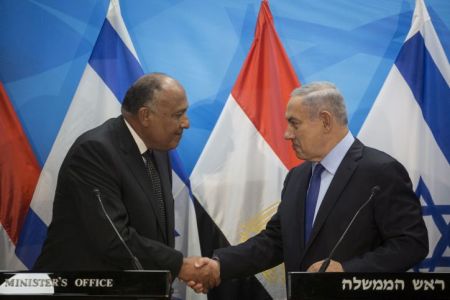
Prime Minister Benjamin Netanyahu meets with Egypt's Foreign Minister Sameh Shoukry at the Prime Minister's office in Jerusalem, on July 10, 2016, during a visit to Israel for the first time in nearly a decade. Foreign Minister Shoukry came to meet Netanyahu to support the peace process between Israel and the Palestinians. Photo by Hadas Parush/Flash90 *** Local Caption *** ????? ???? ?? ???? ???? ????? ????? ????? ???? ????? ??????? ??? ?????? ?????? ??????

Prime Minister Benjamin Netanyahu meets with Egypt’s Foreign Minister Sameh Shoukry at the Prime Minister’s office in Jerusalem, on July 10, 2016, during a visit to Israel for the first time in nearly a decade. Foreign Minister Shoukry came to meet Netanyahu to support the peace process between Israel and the Palestinians. Photo by Hadas Parush/Flash90

The Egyptian Foreign Minister Sameh Shoukry’s visit to Israel Sunday, July 10 and the two conversations he held with Prime Minister Binyamin Netanyahu that day underscored the intensified ties between the two governments and their leaders, President Abdel-Fatteh El-Sisi and the prime minister. The Palestinian issue rated a mention in passing, mostly as useful camouflage to disguise the real business under discussion. This, DEBKAfile’s intelligence sources reveal, revolved around a fresh update on the Syrian war and most of all on the sudden reversal of Syria’s Bashar Assad’s fortunes from wanted war criminal, whose head the US and its president Barack Obama demanded, to the master of a regime and army which is suddenly in the highest demand – even by Obama – as the only reliable military force capable of pursuing the war on jihadi terror, especially ISIS.

This astonishing reversal came to the fore in the last week of June. While putting the final touches on his reconciliation pact with Israel after six years of discord, Turkish President Tayyip Erdogan sent his intelligence chiefs on a clandestine mission to meet Assad’s aides and test the ground for burying the hatchet with him too.

This move was not taken into account by Netanyahu. Erdogan acted on the quiet, while in the midst of yet another maneuver, this one advanced talks for mending relations with the Egyptian president with the help of Algerian mediators who are flitting between Ankara and Cairo, DEBKAfile’s sources report.

While taking briefings from his foreign minister on the talks in Jerusalem, El-Sisi tried to assess whether Erdogan’s feelers to Assad would ripen into a deal between them   If so, the Turkish leader was perfectly capable of jumping aboard the Iranian-Syrian-Hizballah lineup on the Shiite side of the Middle East map and ditching the moves led by Saudi Arabia, Egypt and the UAE for a counter-alignment of Sunni nations.

The answer to this question will determine whether Iran’s position in Syria is strengthened or weakened.

Egypt and Israel share a strong common interest in this answer.

mistral_class_helicopter_carrier_Egypt_26.8.15

Meanwhile the balance of military strength in the region underwent a radical change with the delivery to the Egyptian Navy of its first helicopter carrier, an advanced Mistral-class vessel made in France and paid for by Saudi Arabia to the tune of half a billion dollars.

The second carrier is due later this year.

These acquisitions substantially upgrade Egypt’s military capabilities as the only power operating in the region in possession of helicopter carriers except Russia.

The highly versatile French amphibious assault ship, equipped with state-of the-art radar navigation and missile defense systems, can carry 16 helicopters plus a battalion of 40 Leclerc tanks and 450 soldiers. This makes the Egyptian navy the primary sea and air arm for defending the shores of the Sinai Peninsula, Suez Canal, the Gulf of Suez, the Red Sea and the approaches to the Gulf of Aqaba – not just against Islamist terrorists but also Iranian expansion.

Since the Saudi, Egyptian and Emirate governments are in close military and intelligence sync for combating the two threats, the Egyptian foreign minister had plenty of urgent business to discuss with Netanyahu.

Bennett: Kidnap Hamas officials to get soldiers’ bodies back

July 7, 2016

Bennett: Kidnap Hamas officials to get soldiers’ bodies back Jewish Home minister says Israel needs ‘leverage’ to secure return of soldiers’ remains held in Gaza Strip

By Times of Israel staff

July 7, 2016, 11:52 pm

Source: Bennett: Kidnap Hamas officials to get soldiers’ bodies back | The Times of Israel

Education Minister Naftali Bennett receives the Biton Committee report on July 7, 2016. (Flash90)

Education Minister Naftali Bennett on Thursday said Israel should start kidnapping senior Hamas members to gain leverage in its bit to secure the release of two Israeli civilians and two bodies of IDF soldiers held in the Gaza Strip.

The Jewish Home party leader has been strident in his criticism of the government’s failure to bring back the remains of Lt. Hadar Goldin and Sgt. Oron Shaul, and voted against a rapprochement deal with Turkey that was criticized for not guaranteeing pressure from Ankara on Hamas.

 “My policies are consistent over the years,” he said in a Radio Darom interview on Thursday, “complete opposition to disproportionate deals to free terrorists, and certainly in exchange for bodies.”

“Once, in a situation like this, we would go and kidnap from the other side,” Bennett, a former commando, said, apparently suggesting the kidnapping of senior Hamas officials.

In the past, he said, Israel would kidnap Syrian officers in order to gain diplomatic bargaining chips. Bennett said the military shouldn’t sit on its hands and “wait for the release of prisoners. We need to be aggressive and operate for ourselves.”

Bennett was an officer in the elite Sayeret Matkal commando unit, which abducted two senior Lebanese terrorists — Abdel Karim Obeid in 1989 and Mustafa Dirani in 1994 — in order to use as bargaining chips to trade for missing Israeli Air Force serviceman Ron Arad.

“We need to create leverage in order to free the bodies of our soldiers, and not release terrorists,” he said.

Former Hamas prime minister Ismail Haniyeh delivers a speech in front of portraits of late Iranian revolutionary founder Ayatollah Khomeini (left), and supreme leader Ayatollah Ali Khamenei (right), at a rally in Tehran, February 11, 2012. (AP/Vahid Salemi)

Former Hamas prime minister Ismail Haniyeh delivers a speech in front of portraits of late Iranian revolutionary founder Ayatollah Khomeini (left), and supreme leader Ayatollah Ali Khamenei (right), at a rally in Tehran, February 11, 2012. (AP/Vahid Salemi)

Bennett opposed the deal to reestablish diplomatic ties with Turkey, which stipulated Israel would pay $20 million in compensation to the families of 10 Turks killed in an IDF raid on a ship attempting to run the blockade on the Gaza Strip in 2010.

“Reconciliation with Turkey is important at this time and is in the interest of the State of Israel,” Bennett said before the cabinet voted on the deal at the end of June. “But at the same time paying compensation to the perpetrators of terrorist acts is a dangerous precedent that the State of Israel will regret in the future. Israel must not pay compensation to terrorists who tried to harm the IDF.”

The rapprochement agreement faced sharp criticism from the families of the Israeli soldiers whose remains are held by Hamas in Gaza, as well as the families of two Israeli citizens believed to be captive in the coastal enclave.

The parents of Shaul, killed in Israel’s 2014 war in the Strip and whose body is being held there, and family of Avraham Abera Mengistu, who disappeared into the Strip later in 2014 and who is believed to be still alive, had long petitioned for the agreement with Turkey to included a demand that their loved ones be returned to Israel. The parents of Goldin, also killed the 2014 war and whose body is also help by Hamas, have joined the protest against the deal.

The father of Hisham al-Sayed, the second Israeli held in Gaza, has called on the other families to cease their campaigns to pressure the government.

Bennett has recently called for aggressive measures to crack down on Palestinian terrorism in the wake of last week’s deadly terror attacks in the West Bank.

Suggestions included in his plan, he said, were the imprisonment or expulsion of terrorists’ families; the arrest of all Hamas operatives in the West Bank; the destruction of thousands of illegally built homes in the West Bank; the complete closure of the villages of assailants; resumption of full military activity in West Bank areas that are under the control of the Palestinian Authority; preventing Palestinian vehicles from traveling on Route 60 — the West Bank’s main north-to-south road; and disabling the internet in the entire Hebron region.