Posted tagged ‘Middle East’

Shia Militia Leader Explodes Over Possibility of U.S. Support for Kurdish Forces

April 30, 2015

Shia Militia Leader Explodes Over Possibility of U.S. Support for Kurdish Forces, Center for Security PolicyKyle Shideler, April 30, 2015

In the United States, the Obama Administration finds itself on the same side of the argument as Moqtada Al-Sadr, opposing the bill to permit arms for Kurdish forces.

******************

Shia leader Moqtada Al-Sadr, head of the Jaish al-Mahdi (JAM), issued a stark denunciation of the U.S. Defense Bill currently in front of the U.S. House of Representatives this week, threatening to fight U.S. interests both in Iraq and overseas, in the event that the bill passed.

Al Sadr opposes the bill, because it would authorize the direct transfer of military aid to Kurdish Peshmerga and Sunni tribal forces in order to fight the Islamic State, outside of the direct control of the central government in Baghdad.

“The U.S. House of Representatives intends to pass a draft law on Iraq making each sect independent from the other, and this will be the beginning of Iraq’s division,” Sadr said in a statement. If the U.S. passes such law, “then we will be obliged to lift the freeze on the military wing which is tasked with (fighting) the American side, to start hit the U.S. interests in Iraq and even abroad possibly,” Sadr warned.

Al Sadr’s JAM was one of the primary Shia militia forces used by Iran during Operation Iraqi Freedom, and responsible the deaths of numerous American fighting men and women. Iraq has primarily leaned on the use of Shia militias, operating under the rubric of the Popular Moblization Forces, but many of the 30,000+ militia fighters operate under direct command and control from the Iranian Islamic Revolutionary Guards Corps.

The Baghdad government, which is heavily supported by Iran, has also vocally opposedthe measure:

We will reject the arming of the Peshmerga directly by the US,” Iraq’s Defense Minister Khalid Al-Obeidi, told Rudaw on Thursday.

Kurdish forces have repeatedly complained that aid designated for use by their forces has repeatedly been redirected by the Baghdad government to Shia militias, some of whom are responsible for sectarian war crimes. Kurdish forces have also expressed concern over the entry of Shia forces into areas viewed by the Kurds as traditionally Kurdish, such as Kirkuk.

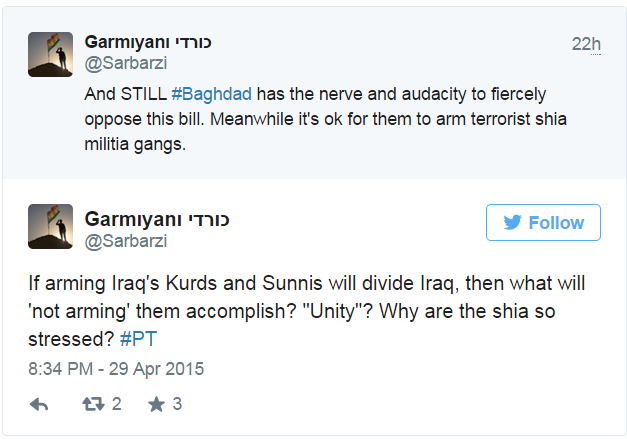
Supporters of the Peshmerga took to twitter to complain about the double standard:

garmiyani-tweet

In the United States, the Obama Administration finds itself on the same side of the argument as Moqtada Al-Sadr, opposing the bill to permit arms for Kurdish forces. As State Department Spokeswoman Marie Harf confirmed yesterday:

QUESTION: Yes. Do you have any comment about this draft resolution at the Armed Services Committee that calls for the recognition of the Sunni fighters and the Kurdish Peshmerga forces as a country, and so they can be – directly receive aid and weapons from the U.S., not through the central government?

MS HARF: I saw that. I saw that. And to be very clear: The policy of this Administration is clear and consistent in support of a unified Iraq, and that we’ve always said a unified Iraq is stronger, and it’s important to the stability of the region as well. Our military assistance and equipment deliveries, our policy remains the same there as well, that all arms transfers must be coordinated via the sovereign central government of Iraq. We believe this policy is the most effective way to support the coalition’s efforts.

So we look forward to working with congress on language that we could support on this important issue, but the draft bill, as you noted, in the House – this is very early in the process here for the NDAA – as currently written on this issue, of course, does not reflect Administration policy.

By opposing the direct arming of Sunni and Kurdish forces (and the Kurdish forces in particular), the administration is continuing a policy arc in the region that continues to serve the interests of the Iranians because it creates a dynamic where the only viable players are either Sunni jihadists (whether Islamic State, or in the case of Syria, Al Qaeda-linked groups such as Jabhat al-Nusra), or Iranian-backed forces, such as Assad and the Shia militias operating in Iraq, who are no less committed enemies of the United States.  Bringing supplies directly to Kurdish forces will give the United States a third option to positively affect the outcome of events in Iraq without requiring the modus vivendi with the Iranians.

How Iran Saved Obama’s “Blame America” Foreign Policy

April 29, 2015

How Iran Saved Obama’s “Blame America” Foreign Policy, Front Page Magazine, April 28, 2015

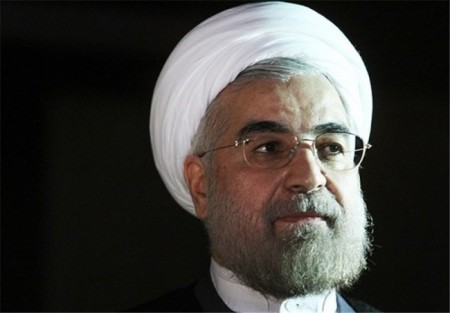
rouh-450x313

Obama’s public rejection of every ally, from Israel to Egypt to Saudi Arabia, has finally created the Post-American Middle East that his “Blame America” doctrine sought. The Post-American Middle East is a hive of terrorist groups and a region of nuclear arms races where murderous despots with vast armies dream of resurrecting the Ottoman Empire, the Persian Empire and the Abbasid Caliphate.

*********************

Obama’s Middle East policy was doomed to fail because it was based on the myth that everything wrong with the region was America’s fault.

Senator Obama had argued that Iraq would fix itself once we pulled out. Without America, the Iraqis would create a “political solution”. Instead the Shiites used the withdrawal to take over the government and Al Qaeda rebounded to dominate the Sunnis. After years of denying what was going on, he was forced back into Iraq after genocide and beheadings filled every television screen.

From the White House, he deployed the “Iraq Solution” across the Middle East by withdrawing support from American allies and backing terrorist groups like the Muslim Brotherhood. The chaos tore apart the region and turned over entire cities and countries to terrorists.

Egypt went through multiple coups. Street violence in Tunisia wrecked the country and supplied thousands of fighters to ISIS. His regime change war in Libya led to terrorist takeovers of its capital. Al Qaeda nearly took over Mali. Houthi Jihadists backed by Iran took over Yemen’s capital. The Saudis are bombing Yemen. The Egyptians are bombing Libya. The French are still fighting in Mali.

Iran and Al Qaeda have divided up Iraq, Syria and Yemen between themselves.

Withdrawing American power and influence didn’t work because we were never the problem. American soldiers weren’t causing the Sunnis and Shiites to fight each other. They were the only thing preventing it. American power and influence across the Middle East wasn’t holding back freedom and human rights, it was the only thing keeping a modicum of freedom alive in places like Egypt and Tunisia that quickly fell to Islamist rule in the Arab Spring, resulting in street violence, torture, terrorism and military coups.

The left had been fundamentally wrong about the cause of the problems in the Middle East. Obama trashed the region by following its wrongheaded doctrines.

Once the “Blame America” foreign policy has been implemented and the region went to hell, he had no idea what to do next. Intervening in Libya made sense according to the “Blame America” doctrine because Gaddafi had recently cut a deal with the United States and was obstructing the Jihadists who were implementing the local version of the Arab Spring in coordination with the Muslim Brotherhood.

But intervening in Syria didn’t. Assad wasn’t an American ally. Therefore the “Blame America” doctrine said that he should be left alone. But he was obstructing the Arab Spring. Overthrowing him would let the Muslim Brotherhood claim another country, but would alienate Iran and spoil any reconciliation.

Unable to make a final decision, Obama veered back and forth between Iran and the Muslim Brotherhood. Some days he seemed on the verge of bombing Syria and other days he was against even providing the promised weapons to the Sunni rebels. Even his supporters accused him of having no plan.

Syria’s real red line was the one that it had drawn through his foreign policy. Instead of making the Middle East better, his withdrawals had made it worse. And the beneficiaries of his foreign policy, especially the Muslim Brotherhood, were clamoring for more American military intervention.

Even Iraq’s Shiite government, backed by Iran, wanted American intervention.

Obama’s foreign policy had created a new set of untrustworthy client states which had to be kept alive by American intervention. The great joke of his foreign policy was that his new terrorist states acted just like the old dictators they were supposed to replace. They wanted American weapons and soldiers. Their own people hated them and hated America by extension. The climax of the Arab Spring came with crowds in Tahrir Square denouncing Obama and the Muslim Brotherhood for acting as his client state.

The “Blame America” foreign policy had led to even more blame of America. The new “democratic” Islamist governments that he helped bring to power to appease the Arab Street and atone for the sins of supporting the old secular-ish dictators backfired by making the Arab Street hate us more than ever.

Iran saved Obama’s foreign policy. Just as he was stumbling around Syria and weeping at being stuck back in Iraq, the agents of the Iran Lobby suggested that the whole mess could be put back together again. Iran and the US would fight on the same side against ISIS in Syria and Iraq. And this cooperation could be used to hammer out a nuclear accord that would retroactively justify Obama’s Nobel Prize.

The only problem was that everyone else in the region was completely against the idea.

The Iran Lobby threw Obama’s failed foreign policy a lifeline and he grabbed it. The bombing of Syria was off. Assad turned over some WMDs, but went on using others. The US began acting as the air force for Iran’s Shiite militias in Iraq while the Kurds and the Sunni Sheikhs of the Awakening were shut out.

When the Houthis took over Yemen, Obama shrugged. When the Saudis began bombing Yemen, they didn’t tell him because they were afraid the news would leak to Iran. And the administration covertly began pressuring them to stop, confirming that it now took its marching orders from Tehran, not Riyadh.

Obama ignored the vocal opposition, particularly from Israel’s Netanyahu, because the Iran deal was the only thing holding his foreign policy together. It made it seem as if he knew what he was doing. Take away the Iran deal and there was no longer a strategy, just a series of incoherent panicked responses.

That is why he continues to cling to the Iran deal. Without it, the Emperor’s foreign policy is naked.

The Iran deal salvaged the “Blame America” foreign policy by reorienting it away from the Muslim Brotherhood to deal with our great enemy in the region. By acceding to Iran’s nuclear program, Obama could finally fix everything by atoning for America’s biggest foreign policy sin in the region.

Despite his Muslim family background, Obama never understood the Middle East. Instead he looked at the region through a left-wing lens and saw only America’s crimes.

The Sunnis and Shiites, the Arabs, Kurds, Persians and Turkmen, weren’t fighting because of America. They were fighting over differences in religion, ethnicity and clan. The left has always thought that the way to fix the Middle East was to withdraw American influence. Instead doing that destabilized the region and created a power vacuum that Russia and Iran have been more than happy to fill.

Obama’s final foreign policy act was to fall directly into Iran and Al Qaeda’s trap.

Iran and the various Al Qaeda groups had effectively split parts of the region among themselves. By embracing Iran, Obama alienated the Sunni Middle East and shoved entire populations into Al Qaeda’s waiting embrace. He completed the polarizing process that he began with the Arab Spring by selling out the moderates to the extremists and waiting for everyone in the region to love America again.

But the Muslim Brotherhood lost out to its edgier Al Qaeda children. Egypt and the Saudis are scrambling to hold together some sort of Sunni center without the United States and against its wishes. Obama’s alignment with Iran, his rejection of Egypt’s new government and his failure to back the Saudis in Yemen has sent the message that the only legitimate alternative to Al Qaeda is Iran.

That’s not an alternative that most Sunnis can accept. Many would rather stand with Al Qaeda than Iran.

Obama’s public rejection of every ally, from Israel to Egypt to Saudi Arabia, has finally created the Post-American Middle East that his “Blame America” doctrine sought. The Post-American Middle East is a hive of terrorist groups and a region of nuclear arms races where murderous despots with vast armies dream of resurrecting the Ottoman Empire, the Persian Empire and the Abbasid Caliphate.

While genocide goes on, sex slaves are raped under the rule of a Caliph and black flags are unfurled and nuclear weapons are developed to fulfill apocalyptic Islamic prophecies, Obama smiles for the camera and waits for his second Nobel Prize.

It had been America’s fault all along. Now that Iran and Al Qaeda are in charge, everything will be okay.

Can Iran Do Whatever It Wants?

April 29, 2015

Can Iran Do Whatever It Wants? Commentary Magazine, April 28, 2015

[I]f the Obama administration were, in fact, to “tolerate” this disruption of the free flow of shipping it would send a dangerous signal, or to be more accurate, to reinforce a signal already sent: The U.S. lacks the will to stand up to predators in the international system, and in particular to Iran.

*****************

Every day, everywhere around the world, a silent referendum is going on about the state of American power. President Obama has consistently failed that test. By demanding that Bashar Assad leave power and then letting him stay; by letting Assad cross a “red line” on chemical weapons with impunity; by talking big about ISIS (“degrade and destroy”) and doing little; by standing by as Iran expanded its power into Iraq, Syria, and Yemen, as Russia seized chunks of Ukrainian territory, and as China intimidated its neighbors to claim sovereignty over disputed island, the president has dissipated the most precious commodity in the world—American credibility.

Today comes yet another test of American resolve. Details remain in dispute, but it appears that Iranian Revolutionary Guard gunboats seized the Maersk Tigris, a container ship traversing the Persian Gulf either through international waters or through a small section of Iranian waters that it would be allowed to traverse under the international legal doctrine of “innocent passage.” Instead of allowing the ship to go on its way, the IRGC fired a shot across its bow and detained the ship along with its crew. This is a vessel flagged in the Marshall Islands, a U.S. protectorate, owned by the Maersk line (a company with substantial American operations that is headquartered in Denmark, a NATO ally), and chartered by Rickers Ship Management, the Singapore-based subsidiary of a German company (two more U.S. allies).

The Iranian action may well be an indirect response to the U.S. decision to deploy an aircraft carrier strike group in order to intimidate Iran into turning back a cargo of supply ships reportedly bringing weapons to Iranian-backed Houthi fighters in Yemen. But whatever caused the Iranian action, it is a direct threat to freedom of navigation, which the U.S. Navy has defended around the world for centuries.

In the Persian Gulf, the U.S. commitment to that doctrine led President Reagan to order U.S. Navy ships to escort tankers and protect them from Iranian attacks, precipitating a short and sharp conflict (the Tanker War of 1987-88) between the U.S. and Iran. This was the last time, incidentally, that the U.S. used force to respond to Iranian attacks and it was an unqualified success—the Iranians lost some oil platforms and boats that they had been using to harass shipping. Finally the accidental shootdown of an Iranian airliner in 1988 by the USS Vincennes (an unintended and unfortunate consequence of these operations) helped convince the Iranian leadership to end their war with Iraq.

Today the U.S. still remains committed, at least on paper, to protecting freedom of navigation in the Persian Gulf. In 2011, a 5th Fleet spokesman put it well: “The free flow of goods and services through the Strait of Hormuz is vital to regional and global prosperity. Anyone who threatens to disrupt freedom of navigation in an international strait is clearly outside the community of nations; any disruption will not be tolerated.”

Thus if the Obama administration were, in fact, to “tolerate” this disruption of the free flow of shipping it would send a dangerous signal, or to be more accurate, to reinforce a signal already sent: The U.S. lacks the will to stand up to predators in the international system, and in particular to Iran. Put another way, it would signal to the entire region that the president is so invested in reaching a deal with Iran that no Iranian misconduct—not the dropping of barrel bombs on Syrian civilians, not the takeover of Yemen, not the ethnic cleansing of Sunni communities in Iraq, and now not the seizure of a Western cargo ship—will be allowed to interfere with his objective.

The fate of the Maersk Tigris does not matter much in and of itself, but it will say much about this administration’s commitment to maintaining America’s traditional security responsibilities.

How does sanctions-ridden Iran find a multibillion war chest to fund 6 armies fighting in 4 Mid East wars?

April 24, 2015

How does sanctions-ridden Iran find a multibillion war chest to fund 6 armies fighting in 4 Mid East wars? DEBKAfile, April 24, 2015

(The sanctions on Iran have been of decreasing significance since the initial “framework” of 2013 went into effect. — DM)

According to figures reaching DEBKAfile in March, Iran is spending a vast fortune – up to an estimated $6-8 billion per year – to keep six armed forces fighting in four Middle East war campaigns for expanding its sphere of influence.  Month after month, Tehran forks out close to half a billion dollars – and sometimes more – to keep those conflicts on the boil. How Iran manages to keep this war chest flowing so abundantly from an economy crippled by international sanctions has never been explained.

Syria
As the Syrian war enters its fifth year, Iranian Revolutionary Guards are found to be running it from four command and control centers, our military and intelligence sources report:

1. In Damascus, the IRGC operates as a part of the Syrian General Staff, with two imported pro-Iranian militias at its independent disposal. This command center has three tasks: To oversee the Syrian general staff and monitor its operational planning; to guard President Bashar Assad’s regime and his family; defend key locations such as the military airport and Shiite shrines, and keep the highways to Lebanon open.

2.  In the Aleppo region of the north, IRGC officers were engaged in drawing up plans for a general offensive to rout rebel forces from positions they have captured in the city. Tehran attaches prime importance to a peak effort for the recapture of Aleppo, Syria’s largest city. The IRGC command has transferred large-scale Hizballah forces from Lebanon to this arena, along with Afghan and Pakistani Shiite militias. Thousands of these combatants underwent training at specialist IRGC bases. Our military sources disclose that those militias recently took so many casualties that Iranian officers decided to hold off the Aleppo offensive.

3.  In the Qalamoun Mts., which are situated athwart the Syrian-Lebanese frontier, Tehran has given high priority to flushing rebel forces, including the Nusra Front and the Islamic State, out of the pockets they have seized on the mountain slopes, so as to clear the mountain roads for the passage of Hizballah units. This offensive has also been delayed.

4.  In South Syria, Iranian officers led a large-scale month-long drive to drive rebel forces out of the area they hold between Deraa and Damascus, in order to position Iranian-led Hizballah and pro-Iranian militia forces face to face with the Israeli army on the Golan. This drive has so far been stalled.

Tehran establishes – and pays for – new Syrian army

Iranian officers have established, trained and equipped a new 70,000-strong fighting force called the Syrian National Defense Force. Its operations, including the soldiers’ wages, are financed from Tehran’s pocket.

Iran runs airlifts day by day to re-supply the Syrian army with weapons systems and ammunition, and the Syrian Air Force with bombs and ordnance for attacks against rebel forces – of late, mostly barrel bombs. Intelligence sources estimate that Iran’s expenditure in the Syrian conflict now hits $200 million per month – around $2.5 billion a year.

Iran bankrolls Hizballah from top to bottom

The 25,000-strong Lebanese Shiite Hizballah operates under the direct command of IRGC officers. All its military equipment comes from Tehran, which also draws up its annual budget. Each month, Iran transfers to Beirut $150-200 million, as well as paying for all the Lebanese militias’ expenses for maintaining an expeditionary force in Syria. Hizballah costs Tehran an approximate $2 billion per annum.

An all-Shiite “people’s national army” for Iraq, re-supplies for Yemen

Iran’s deep military intervention in Iraq includes the creation of an all-Shiite “people’s national army.” It follows the same template as the Syrian National Defense Force and consists of the same number of fighters – 70,000 troops.

Tehran has also invested in barricades to fortify Baghdad against invasion from the north and the west.

The offensive to retake the Sunni town of Tikrit from the Islamic State was led by Iranian officers, and fed constantly with high-quality weapons systems, including missiles and tanks.

All the war materiel required by the Iraqi army and Shiite militias fighting the Islamic State is airlifted to Baghdad, some directly from Iran.

There is no reliable estimate of the Islamic Republic’s current contribution to Iraq’s war budget (estimated at a quarter of a billion dollars per month) because part of the cost is carried by the Iraqi government from oil revenues.

In Yemen, until Saudi Arabia and Egypt imposed an air and sea blockade a month ago, Iran ran supplies by air and sea to the Shiite Zaydi Houthis and their Yemeni army allies whom Tehran championed, sponsored and funded directly. The deployment of US warships in the Gulf of Aden this week put a stop to this traffic. But by then, Iran had sunk an estimated half a billion dollars in a Houthi victory.

Sanctions are no bar to Iran’s ambitions

This arithmetic is testimony to Iran’s mysteriously deep pockets. The sanctions the US, Europe and the United Nations clamped down on Tehran clearly had no effect on its willingness and ability to lay out fabulous sums to promote its ambitions as Middle East top dog.

China Warns Of Rising Nuclear Threat From North Korea – Lou Dobbs

April 24, 2015

China Warns Of Rising Nuclear Threat From North Korea – Lou Dobbs, Fox News via You Tube, April 23, 2015

(The first four minutes is about the mess in Yemen and the last four minutes is about the North Korean nuclear threat. — DM)


Empowering Iran

April 24, 2015

Empowering Iran, Weekly Standard, Lee Smith, May 4, 2015 (print date)

Obama’s foreign policy legacy will be to have tied America’s fortunes to an imperial and nuclear Iran governed by an ambitious and ruthless anti-American regime.

*****************

Last week, the Obama administration urged Saudi Arabia to halt its air campaign against the Iranian-backed Houthi rebels who have wrested control of the Yemeni capital Sanaa. The White House’s professed concern was that Riyadh’s Operation Decisive Storm was killing too many civilians. Unfortunately, that’s hardly surprising since Iranian proxies, like Hezbollah and Hamas, typically stash their missiles and rockets in civilian areas. Presumably, the Houthis have read from the same playbook. The effect of the administration’s diplomatic efforts, then, was to protect Iranian arms in Yemen. And this, in turn, the administration no doubt believes, protects Obama’s nuclear agreement with Iran.

Houthi rallyHouthis rally against Saudi Arabia, April 1. Newscom

In public, Obama is eager to show that the United States still stands by its traditional allies, like Riyadh. But behind the scenes, it’s clear that the White House’s real priority is partnering with Iran. Sure, the White House dispatched an aircraft carrier to the Arabian Sea, but this was not to stop Iran from shipping arms to the Houthis. As Obama himself explained, America’s blue-water Navy was present to ensure freedom of navigation in the Persian Gulf. The notion that the White House really intended to interdict Iranian arms shipments beggars belief. For more than four years Obama has done nothing to stop Bashar al-Assad from killing nearly a quarter of a million people in Syria, lest he endanger his nuclear agreement with Iran. With a deal so close, Obama is certainly not going to risk what he sees as the capstone of his foreign policy legacy by disarming Iranian allies in Yemen.

The problem is that by protecting his nuclear agreement with Iran, the president has protected and empowered the Islamic Republic. Tehran may boast of controlling four Arab capitals, but the reality is that its regional position is a house of cards. Pull out one of those Arab capitals, or the nuclear program, and Iran’s burgeoning empire quickly collapses. It’s Obama who is propping it up.

It’s interesting to imagine how these last six years might have gone for the Islamic Republic had the White House not been so determined to have a nuclear deal. Perhaps the Tehran regime would have been toppled when the Green Movement took to the streets in June 2009 to protest a fraudulent election if the American government had decided to back the opposition early, openly, and resourcefully. Perhaps another administration would at least have seen that uprising as an opportunity to gain leverage over the Iranian regime. Not Obama. He wanted a nuclear deal with the existing regime.

Another White House might have backed the Syrian rebels in order to bring down Assad. Indeed, a good portion of Obama’s cabinet counseled as much. To topple Tehran’s key Arab ally would have been the biggest strategic setback to Iran in 20 years, said Gen. James Mattis. Obama chose to leave Assad alone, and even ignored his own red line against the use of chemical weapons. Instead of the airstrikes he threatened on Syrian regime targets, Obama made a deal to ostensibly remove the chemical weapons that Assad is still employing.

As Assad’s position became weaker, Hezbollah entered the Syrian war to prop him up. The Iranian-backed militia was stretched thin between Syria and Lebanon, but the Obama administration helped the terrorist organization cover its flank by sharing intelligence to keep Sunni car bombs out of Hezbollah strongholds in Beirut. Another administration might have understood this as an opportunity to weaken Iran’s position in Damascus and Beirut, but not Obama. He had his eyes on the prize.

In sum, over the last six years, almost all of Iran’s advances in the region, including its move into Iraq to fill the vacuum in Baghdad after the American withdrawal from that country, has taken place with either the overt or tacit assistance of Obama. The White House brags about it. Israel might have attacked Iranian nuclear facilities, as one administration official told the press, but we deterred Prime Minister Benjamin Netanyahu from striking. If the Iranians strut with confidence these days, that’s because they understand who has their back.

The nuclear deal, as the president has explained, means that within a little more than a decade, Iran’s breakout time will be down to zero—which is a nice way of saying the clerical regime will have the bomb. The likely result is that the agreement will ensure Iran’s regional position long after Obama’s presidency is around to safeguard it. It will strengthen the hand of the hardliners. It is not Rouhani or Zarif or other so-called moderates who hold the nuclear file, but Khamenei and the Revolutionary Guard Corps. And in the future, American policymakers will have a vital interest in ensuring there are no internal regime fights over who controls the bomb.

In other words, Obama’s foreign policy legacy will be to have tied America’s fortunes to an imperial and nuclear Iran governed by an ambitious and ruthless anti-American regime.

Progressives at the Poker Table

April 24, 2015

Progressives at the Poker Table, Mishpacha Magazine, Jonathan Rosenblum, via Jewish Media Resources, April 24, 2015

A comparison of the progressive approach to the threat of climate warming and that of a nuclear-armed Iran offers interesting insights into the progressive mind.

Let’s start with climate warming, which according to the best measures, inconveniently stopped about 18 years ago. First, what is the magnitude of the threat? The most alarmist predictions of future catastrophe are based on computer-generated climate models that have been consistently refuted by events of the real world. According to the alarmists, there would be fifty million refugees from global warming by 2010. Never happened.

Those models are based on a variety of assumptions about “feedback mechanisms” generated by increased CO2 in the atmosphere trapping more heat. NASA satellite date from 2000-2011 showed far more heat escaping the earth’s atmosphere than predicted by the computer models, according to study in the peer-reviewed journal Remote Sensing.

Nor is clear to what extent the global warming of the 20th century was generated by anthropogenic forces – i.e., increased CO2 emissions. Many leading climate scientists now think that solar activity — about which we can do nothing — may be a larger contributor to temperature variation than carbon emissions. That would be consistent with the wide fluctuations between warm and cold periods over the last millennium, even prior to the onset of the Industrial Resolution.

Scientists at CERN, the European Organization of Nuclear Research, which involves 600 universities and national labs and 8,000 scientists, have shown that cosmic rays promote the formation of molecules that grow and seed clouds. And clouds trap heat in the atmosphere. The magnitude of cosmic rays emitted by the sun depends on variations in the sun’s magnetic field.

Finally, that which the alarmists consider an unmitigated disaster — higher levels of CO2in the atmosphere may have many beneficial effects. A 2012 statement signed by 16 distinguished scientists from universities like Harvard, Princeton, MIT, and the Hebrew University, pointed out that CO2 is “not a pollutant,” but rather a “key component of the biosphere’s life cycle.” Higher concentrations of CO2 spur plant growth.

In sum, the threat, if any, is one for the indeterminate future, of unknown magnitude and causation, and may not even be subject to ameliorative action. Yet climate alarmists propose a Global Green Carbon Treaty of such cost and intrusiveness that Yale’s Walter Russell Mead compares it to the 1928 Kellogg-Brand Pact outlawing war for sheer folly. He describes GGCT as less a treaty and more a constitution for world government regulating all economic production in every country on earth. That constitution would be for a “global welfare state with trillions of dollars ultimately sent by the taxpayers of rich countries to governments (however feckless, inept, corrupt or tyrannical) to poor ones.”

These proposals are put forward seemingly oblivious to the economic cost or loss of liberty involved. In his 2001 book The Skeptical Environmentalist, Danish statistician Bjorn Lonborg calculated that enforcement alone of the Kyoto Treaty would cost $150,000 billion a year, money which could save tens of thousands of lives annually.

The above-mentioned statement of the 16 scientists cited the work of Yale economist William Nordhaus, whos showed that the highest benefit-to-cost ratio would be achieved via a policy of fifty years of economic growth unimpeded by greenhouse gas controls. The least developed countries would benefit most by being able to share some of the advantages of material well-being — i.e., health and life expectancy — with the more developed world.

NOW TO THE OTHER SIDE of the comparison. Even President Obama admits that under the unsigned understanding reached at Lausanne, Iran will have zero breakout time to a nuclear weapon thirteen years from now. (Today, he puts the breakout time at three months.)

That fact alone creates a world with as many tripwires leading to war as Europe on the eve of the assassination of Archduke Ferdinand in August 1914. Only this time the weapons of choice will be nuclear.

The proposed agreement with Iran means the end of nuclear non-proliferation. If the world’s leading rogue state and sponsor of terrorism can have its nuclear weapons program effectively endorsed by the members of the U.N. Security Council, every other nation that was dissuaded in the past by international pressure from expanding its civilian nuclear program to include enrichment to weapons level – e.g., South Korea, Brazil – will reconsider.

The most rapid nuclear proliferation will take place in the world’s most volatile region, the Middle East, in which the millennial hatred of Sunnis and Shiites still burns hot. Saudis have made it clear that they will purchase nuclear weapons off-the-shelf from Pakistan, as per a prior agreement, to counter Iran’s ability to obtain nuclear weapons. Egypt and Turkey will almost certainly follow suit.

An already aggressive Iran would become vastly more so with the hundreds of billions of dollars in revenues from the lifting of sanctions and the ability to provide a nuclear umbrella for its regional proxies. As a consequence, the Middle East would become all the more volatile.

The nations most likely to acquire nuclear arms and unstable, which increases the possibility of terrorist groups acquiring nuclear weapons. Iran has long eyed the “holy cities” of Mecca and Medina, and is already stirring up the Shiite population in Saudi Arabia’s eastern, oil-producing provinces and in Yemen on its southern border. Egypt cannot feed its population.

And Iran might find it useful to supply some of its non-state allies, like Hezbollah or Hamas, with dirty nuclear weapons that do not require missiles to deliver. Non-state actors are far harder to deter or hold accountable.

A nuclear Iran should terrify not only Israel, which it has repeatedly threatened to obliterate. Iranian leaders have publicly speculated for years about the grim calculus of a nuclear exchange with Israel: one bomb wipes out Israel; Israeli retaliation still leaves us with tens of millions survivors. Former CIA Director James Woolsey and Peter Fry, a member of the congressional EMP (electro-magnetic pulse) Commission, stress the vulnerability of the United States. The recent “understanding” (the terms of which are unknown and perhaps unknowable given the wide divergence between American and Iranian descriptions of what has been concluded) makes no reference to any limitations on Iran’s ballistic missile program, on which it works closely with North Korea.

Iran may soon possess long-range missiles capable of reaching the United States or the capacity to launch a nuclear-armed satellite above the United States. Even one nuclear weapon detonated above the United States could potentially knock out much of the national power grid. The congressional EMP Commission estimated that a nationwide blackout lasting one year from such an EMP attack could result in the deaths of nine out of ten Americans, with ISIS-like gangs ruling the streets.

Nor are traditional doctrines of nuclear deterrence relevant to the Middle East, in general, and Shiite Iran, in particular. Former secretaries of state Henry Kissinger and George Schultz ask in their devastating critique of the recent agreement how will traditional doctrines of deterrence based on stable state actors “translate into a region where sponsorship of non-state proxies is common, the state structure is under assault, and death on behalf of jihad is a kind of fulfillment?”

As the dean of Middle East scholars Bernard Lewis has pointed out, for Shiite fanatics awaiting the return of the “hidden Imam,” after a cataclysmic event, the destruction of nuclear war might be an inducement rather than a deterrent.

WHAT DOES PRESIDENT OBAMA offer as the response to this description of a nuclear tinderbox waiting to be lit? Pure fantasy.

He and Secretary of State Kerry have made repeated references to a fatwa of the Supreme Leader Ayatollah Khameini against the use of nuclear weapons, which does not exist and certainly is credited by none of Iran’s enemies.

And he speaks hopefully of a newly mellowed Iran after the conclusion of an agreement. What is it about the Supreme Leader’s repeated chants of “Death to America” and insistence that current negotiations have nothing to do with reconciliation that the President can’t hear?

One option that the President has completely excluded is an air campaign to destroy Iran’s nuclear infrastructure and cut of the “head of snake,” as Woolsey once described the Revolutionary Guard to me. Obama has repeatedly accused the opponents of the Lausanne understanding as being advocates of war.

Clearly, then, all the tough talk about “all options are on the table,” “a bad deal is worse than no deal [followed by military attack],” “I will never allow Iran to acquire nuclear weapons,” had the same truth content as “If you like your plan, you can keep your plan.”

Yet no one doubts that the United States has the capability to destroy Iran’s enrichment infrastructure. (If Russia goes through with the delivery of advanced anti-aircraft batteries, as a consequence of the Lausanne understanding, the task will be complicated.) And there will be consequences that cannot be fully known in advance. Iran has terrorist sleeper cells around the world. But it also has lots of assets, besides its nuclear infrastructure, which would be subject to further attacks if it unleashes those cells.

Whatever the Iranian response, the price to be paid will certainly be less than consigning all humanity to live in a world perpetually poised on the cusp of nuclear war.

SO WHY in the case of global warming are progressives willing to incur unbearable costs to combat a future threat of unknown magnitude and immediacy, and against which their solutions may well prove futile, while with respect to the easily identified and imminent danger of a nuclear-armed Iran, they write off from the start a clear and known remedy?

For progressives the solution of worldwide government, run by the executive decree of “the best and the brightest,” is not a cost too great to be contemplated, but rather the fulfillment of the progressive dream. But they will never countenance military action, even to save millions of lives down the road. Churchill’s dictum, “If you want peace, prepare for war,” remains foreign to them.
U.S. Warships On Watch – Leading From Behind – Lt Col Ralph Peters – Willis Report

April 22, 2015

U.S. Warships On Watch – Leading From Behind – Lt Col Ralph Peters – Willis Report, Fox News via You Tube, April 21, 2015

(It’s from yesterday and the situation remains fluid. Still, it’s worth watching. — DM)


Arab states snub Obama’s D.C. summit as Iran Mocks Obama

April 21, 2015

Arab states snub Obama’s D.C. summit as Iran Mocks Obama, BreitbartJoel B. Pollak, April 21, 2015

ap_saud-bin-faisal-bin-abdulaziz-al-saud_ap-photo-640x422The Associated Press

As the U.S.S. Theodore Roosevelt heads to Yemen to confront a convoy of Iranian ships, including destroyers, it is worth asking why President Barack Obama is still talking to the Iranian regime about its nuclear program. The Iranians, who used the Houthi militia to knock over the American-aligned Yemeni government, clearly has no fear that Obama will suspend negotiations. If anything, Iranian tactics are winning more concessions.

When you strike a deal with an enemy who continues to attack you, that is not called “peace,” but “surrender.”

It is a wonder Obama is even bothering to send an aircraft carrier to the region at all. His hand has been forced by two factors: first, that Saudi Arabia has gone to war in Yemen without bothering to ask for American approval; second, Yemen is key to Obama’s drone policy against Al Qaeda, his only modest military success.

America has lost more than an ally in Yemen or a foothold in Iraq. It has lost the opportunity to defend hundreds of thousands of innocent lives from being murdered by Iran’s Syrian ally, which is using chemical weapons against civilians. It has lost the opportunity to demilitarize Lebanon—an achievement then-Sen. Joe Biden foolishly claimed in his debate with Sarah Palin in 2008. It may even have lost the chance to stop a nuclear Iran.

Iranian foreign minister Javad Zarif made clear in his New York Times op-ed this week that the regime sees a nuclear deal as the key to regional domination. He offered—no, demanded—American cooperation on ISIS and other issues, not as a possible outcome of a deal but as a condition for a deal.

Yet the White House refuses to make its own regional demands—such as recognition of Israel, or an end to Iran’s global terrorism.

Israel has made clear that the Iran deal is an existential threat, and even that has not moved Obama to reconsider. The Arab nations are not waiting to be double-crossed, and are making their own plans, which likely include Saudi Arabia obtaining nuclear warheads from Pakistan.

In an attempt to save face, Obama has invited the Arab nations to a May 13 summit at the White House—long after final negotiations with Iran have begun

Already, some Arab states have indicated that they will not be attending (Oman), or will only send junior delegations (Saudi Arabia, United Arab Emirates). Amir Taheri of theNew York Post quotes  one Arab official: “He is going to give a Churchillian speech. But we know that you can’t be Chamberlain one day and Churchill the next.”

Meanwhile, Israel quietly signals that it is not going to wait for a Churchill to arrive in the Oval Office.

Hizballah copycats Hamas’ terror tunnels for Lebanese-Galilee border. No IDF solutions yet

April 21, 2015

Hizballah copycats Hamas’ terror tunnels for Lebanese-Galilee border. No IDF solutions yet, DEBKAfile, April 20, 2015

Gaza-Terror-Tunnels_4.15A Hamas terror tunnel – a model for Hizballah

Anxiety about the new terror tunnels they sense Hamas is excavating under their feet is no longer confined to Israelis living in proximity to the Gaza Strip, or the soldiers serving there. Israel’s northern borderland dwellers, who can see Hizballah’s yellow flags in from their balconies, have the same concerns. Their reports of mysterious underground explosions are confirmed by thousands of Israeli troops conducting field exercises in the neighborhood. The soldiers attest to heavy earthmoving equipment, explosions, burrowing, and shaking ground on the Lebanese side of the border, giving the area the appearance of a huge subterranean building site.

The Lebanese Shiite Hizballah group, Iran’s Lebanese surrogate, has clearly taken a leaf out of its Palestinian ally, Hamas’ book, for a fully mobilized terror tunnel project against northern Israel. Its manpower, including engineering units, is working under the guidance of Iranian Revolutionary Guards officers to sink a large network of tunnels leading under the border into Galilee. They are working efficiently and at top speed with the aid of modern Western-made earthmoving equipment and foreign professionals paid top dollar to manage the project.

Israel seems to be curiously passive in the face of its enemy’s ambitious enterprise. Only last week, the Defense Ministry’s Political Coordinator Amos Gilad denied any knowledge of terrorist tunnels reaching Israel from Lebanon.

However, Brig. Gen. Moni Katz, commander of the IDF’s Division 91, which is responsible for security of the Galilee region, told a different story: “To me it is obvious that the other side is busy digging tunnels. I don’t need intelligence to tell me this. Intuition is enough. There is no denying that this is what they are up to. Can I say they have completed a tunnel?” The general went on to reply: “I must assume they have. I can’t prove it or say for sure a tunnel has crossed into our territory. But my basic premise is that this is so and it is up to us to make plans to fit this case.”

Putting those plans into practice – which would necessitate destroying the tunnels either before they were built or at their entry-points – faces four major difficulties:

1. Close surveillance and first-class intelligence are required to keep track of hostile tunnel projects starting from the planning stage, the recruitment of manpower, the acquisition of engineering technology and equipment and registering the quantity of earth displaced and removed from the underground burrow.

2.  The digging process, which sound sensors should have no difficulty in detecting, is a relatively short and irregular process which can just as easily be camouflaged by surface activities.

3.  Locating a finished tunnel at the stage when it is still unused and relatively quiet calls for pinning down a number of variables, such as the type of soil, the depth, length, breadth and lining material used in building the tunnel, humidity, weather conditions on the surface as well as its environment, whether urban or rural.

4.  Locating such a tunnel – even when it is already in operational use by an enemy – poses another set of difficulties. In combat conditions, electronic listening devices would be drowned out by the fire and explosions of battle and, in the confusion of war, enemy troops would be hard to intercept as they moved in and out the tunnels.

A glance at the map shows that the danger of tunnel warfare should also be taken into account on Israel’s eastern front – where it would just as hard to detect as in the north and the southwest: The Arab populations inhabiting the West Bank and the Israeli side of the border – only hundreds of meters apart – are similar enough to keep counter-terrorism authorities on a high level of alert for the construction of tunnel links between the two territories.

Perhaps a succession of military chiefs should be held accountable for letting the tunnel terror peril develop to its current proportions. But it must also be said that no silver bullet has so far been invented to counter this primitive vehicle of terror, including the methods tried till now, such as buried microphones, optical fibers sensitive to seismic tremors, deep trenches along the border and an assortment of off-beat inventions.

In the view of our military analysts, any solutions would have to vary from sector to sector, adapted to the military and topographical features in each case and an intelligence assessment of the level of risk involved in counteraction. This effort would have to be directed by an interdepartmental, interagency administration directly answerable to the prime minister or defense minister.