Posted tagged ‘Middle East’

Op-Ed: Every Day is “Opposite Day” with President Barack Obama

May 26, 2015

Op-Ed: Every Day is “Opposite Day” with President Barack Obama, Israel National News, Mark Langfan, May 26, 2015

In sum, either Obama is, at best, a Middle-east policy ignoramus or, at worst, an Iranian stooge. If Obama rolled dice to make his Middle-East decisions, he’d have a better average than his current total Middle-East failure on every issue.  So, chances are he is not intending his Middle-East policies to bring peace, but instead planning them to bring war and sow the violence, death and destruction that they have predictably brought.

**********************

Obama has done exactly the opposite of what should be done in the Middle East for his entire term. Israel had better ignore his advice.

Following Obama’s speeches is like watchingSesame Street’s “Opposite Day”, the Sesame Street episode where everything is “opposite.”  ‘Up’ is ‘down,’ ‘left’ is ‘right,’ and so on and so forth.  It’s like Berra saying “It’s deja vu all over again.”

With Obama, for the past seven years, every day is “Opposite Day.”  Everything he says sounds upside-down and backwards, and is proven, in the short-term, to be just that.  Instead of being chastened by reality, Obama blithely still talks-the-talk like he’s reading off the Holy Grail.

Take Obama’s latest upside-down and backwards ‘Opposite-Day’ statement: “I continue to believe a two-state solution is absolutely vital for not only peace between Israelis and Palestinians, but for the long-term security of Israel as a democratic and Jewish state.”  Given Obama’s 0%batting average on Middle-East strategy, it safe to conclude that keeping the “West Bank” is vital for Israel’s security.

For starters, what Middle East policy has Obama gotten right in the last seven years?  Obama’s total retreat from Iraq that empowered Iranian-puppet al Maliki to castrate the Western Iraqi Sunnis that mutated into ISIS?  Obama’s bombing of Qaddafi, and setting North Africa into a ball of flames?  Obama’s toppling of Mubarak and coronation of the Muslim Brotherhood Sunni Islamic State of Egypt?  Obama’s green-lighting Iran to set Shiite Arab against Sunni Arab as he anoints Iran as a nuclear-threshold state, and gives $50 billion to further fund its Islamic “resistance” revolution?  Obama’s total protection of the genocidal Assad as he gasses Sunni Muslims to death?

Obama has made the wrong policy decision on every Middle Eastern issue, yet still speaks as if he’s the Middle-east guru.

The truth is Israel’s retention of the “West Bank” is vital not only for the peace and security of Israel, but also, most importantly, for the moderate Arabs who bathe in the warmth of Israel’s security envelope.  If Israel left the “West Bank”, forget about the resulting Hamastan that once concerned us, because the result would be an  ISIStan. Hamas will soon start asking Israel for protection from ISIS as that organization is beginning to attack it in Gaza.  And after Assad falls, and the Sunnis start really paying Hezbollah back for its genocide against the Syrian Sunnis, the Shiites of South Lebanon will have only one protector: Israel.

Was Israel’s retreat from Gaza good for Egypt?  No, it created a cancer that sent its Iranian-funded Islamic-bedlam to the Sinai, and then to Egypt-proper.  Israel’s “peace-process” regarding Gaza has enabled Hamas to turn the Palestinians of Gaza into cannon-fodder for the world press, and the World Court.  With Gaza’s failed-test-case, Obama’s claim that Israel repeat the same withdrawal from Judea and Samaria almost seems to present evidence of a malevolent intent to eradicate peace and security for Israel, and the moderate Arabs who are now protected by Israel.

And let us not forget Jordan.  Wouldn’t Jordan “love” an ISIStan state to its west?  The analogy is simple, a Hamastan Gaza is to Egypt what an ISIStan “West Bank” would be to Jordan—a formula for Jordan’s total disintegration.  As it is, Jordan’s King Abdullah is facing ISIS to the north and to the south. Jordan can be easily overrun, it hardly needs additional pressure along its western border, now protected by Israel.

In sum, either Obama is, at best, a Middle-east policy ignoramus or, at worst, an Iranian stooge. If Obama rolled dice to make his Middle-East decisions, he’d have a better average than his current total Middle-East failure on every issue.  So, chances are he is not intending his Middle-East policies to bring peace, but instead planning them to bring war and sow the violence, death and destruction that they have predictably brought.

If Obama says “up,” think “down;” and if he advises retreat from Judea and Samaria, Israel had better stay exactly where it is.

Muslim world reacts to Obama’s latest speech

May 26, 2015

Muslim world reacts to Obama’s latest speech – IPhoneConservative, MEMRI TV via IPhoneConservative via You Tube, May 20, 2015

(Another update: Now the video is up at Front Page Magazine, with a caveat about Poe’s law.

Poe’s law is an internet adage which states that, without a clear indicator of the author’s intent, parodies of extremism are indistinguishable from sincere expressions of extremism.[1][2] Poe’s Law implies that parody will often be mistaken for sincere belief, and sincere beliefs for parody.[3]

– DM)

(UPDATE, May 27th: the subtitles were edited by IPhoneConservative. In a comment beneath the video, posted on May 26th, it was stated:

I must admit I find it fascinating that so many people commenting here are voicing their outrage at my editing of the subtitles in this clip from MEMRI. For those that don’t know who they are………..they are an invaluable site that documents and translates much of what goes on in Middle East media. This clip was from their site. Every day they post videos with leading Islamic figures and personalities making hideous statements about Jews and Christians. About killing gays and beating women. I wonder how many of those outraged by my use of the clip in this way are equally outraged by the real sentiments expressed on these program’s? Not enough I would guess.

– DM)

***********************

(Offensive? Yes. Well worth watching? Yes.– DM)

No army in Mid East is challenging ISIS. Iran regroups to defend S. Iraqi Shiites, Assad to save Damascus

May 25, 2015

No army in Mid East is challenging ISIS. Iran regroups to defend S. Iraqi Shiites, Assad to save Damascus, DEBKAfile, May 25, 2015

Baiji_22.5.15Iranian troops in fight to evict ISIS from Baiji refinery

Hassan Nasrallah Saturday, May 23, called his Lebanese Shiite Hizballah movement to the flag, because “we are faced with an existential crisis” from the rising belligerence of the Islamist State of Iraq and the Levant. His deputy, Sheik Naim Qssem, sounded even more desperate: “The Middle East is at the risk of partition” in a war with no end in sight, he said. “Solutions for Syria are suspended. We must now see what happens in Iraq.”

The price Iran’s Lebanese proxy has paid for fighting alongside Bashar Assad’s army for four years is cruel: some 1,000 dead and many times that number of wounded. Its leaders now understood that their sacrifice was in vain. ISIS has brought the Syrian civil war to a new dead end.

This week, a 15-year old boy was eulogized by Hizballah’s leaders for performing his “jihadist duty” in Syria.

Clearly, for their last throw in Syria, the group, having run out of adult combatants, is calling up young boys to reinforce the 7,000 fighting there.

The Syrian president Bashar Assad is in no better shape. He too has run dangerously short of fresh fighting manpower. Even his own Alawite community has let him down. Scarcely one-tenth of the 1.8 million Alawites have remained in Syria. Their birthrate is low, and those who stayed behind are hiding their young sons to keep them from being sent to the front lines.

Assad also failed to enlist the Syrian Druze minority to fight for his regime, just as Hizballah’s Nasrallah was rebuffed when he sought to mobilize the Lebanese army to their cause. This has left Hizballah and the Syrian ruler alone in the battlefield with dwindling strength against two rival foes:  ISIS and the radical Syrian opposition coalition calling itself Jaish al-Fatah – the Army of Conquest – which is spearheaded by Al Qaeda’s Nusra Front and backed to topple Assad by Saudi Arabia, Qatar and Turkey.

Nasrallah tried to paint a brave picture of full mobilization to expand the war to all parts of Syria. However, Sunday, May 24, a key adviser to Assad admitted that his regime and its allies were being forced to regroup.

Their forces were withdrawing from the effort to shift the Islamists from the land they have conquered – about three-quarters of Syrian territory – and concentrating on defending the cities, Damascus, Homs and Latakia, home to the bulk of the population, as well as the strategic Damascus highway to the coast and Beirut. Hizballah needed to build up the Lebanese border againest hostile access.

But Syrian cities, the Lebanese border and the highway are still under threat – from Syrian rebel forces.

The Iraqi army, for its part, has been virtually wiped out, along with the many billions of dollars the US spent on training and weapons. There is no longer any military force in Iraq, whether Sunni or Shiite, able to take on ISIS and loosen its grip on the central and western regions.

The Kurdish peshmerga army, to whom President Barack refused to provide armaments for combating the Islamists, has run out of steam. An new offensive would expose the two main towns of the semi-autonomous Kurdish Republic – the capital Irbil and the oil city of Kirkuk – to the depredations of the Islamist belligerents.

A quick scan of Shiite resources reveals that in the space between the Jordan River and the Euphrates and Tigris, Iran commands the only force still intact in Iraq – namely, the Iraqi, Afghan and Pakistani Shiite militias, who are trained and armed by the Revolutionary Guards.

This last remaining fighting force faces its acid test in the battle ongoing to recover Baiji, Iraq’s main oil refinery town. For the first time, Iranian troops are fighting in Iraq, not just their surrogates, but in the Baiji campaign they have made little headway in three weeks of combat. All they have managed to do is break through to the 100 Iraqi troops stranded in the town, but ISIS fighting strength is still not dislodged from the refinery.

The Obama administration can no longer pretend that the pro-Iranian Shiite militias are the panacea for the ISIS peril. Like Assad, Tehran too is being forced to regroup. It is abandoning the effort to uproot the Islamists from central and western Iraq and mustering all its Shiite military assets, such as the Badr Brigade, to defend the Shiite south – the shrine towns of Najef and Karbala, Babil (ancient Babylon) and Qadisiya – as well as planting an obstacle in the path of the Islamists to Iraq’s biggest oil fields and only port of Basra.

The Shiite militias flown in by Tehran from Pakistan and Afghanistan have demonstrated in Syria and Iraq alike that they are neither capable nor willing to jump into any battlefields.

The upshot of this cursory scan is that not a single competent army capable of launching all-out war on ISIS is to be found in the Middle East heartland – in the space between the 1,000km long Jordan and the Euphrates and Tigris to the east, or between Ramadi and the Saudi capital of Riyadh to the south.

By Sunday, May 24, this perception had seeped through to the West. US Defense Secretary Ashton Carter, remarked: “What apparently happened was that the Iraqi forces just showed no will to fight.” The former British army chief Lord Dannatt was more down to earth. Since the coalition air force campaign had failed to stop ISIS’s advance, he said “it was time to think the previously unthinkable” and send 5,000 ground troops to fight the Islamists in Syria and Iraq.

The next day, Monday, Tehran pointed the finger of blame for the latest debacles in Iraq at Washington. Al Qods Brigades chief Gen. Qassem Soleimani was quoted by the English language Revolutionary Guards mouthpiece Javan as commenting: “The US didn’t do a damn thing to stop the extremists’ advance on Ramadi.”

Why Obama has come to regret underestimating the Islamic State

May 24, 2015

Why Obama has come to regret underestimating the Islamic State, The Telegraph, May 23, 2015


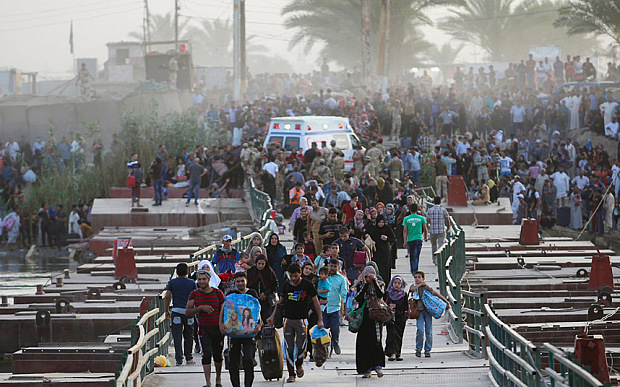
Displaced Sunni people, who fled the violence in the city of Ramadi, arrive at the outskirts of Baghdad Photo: STRINGER/IRAQ

Its strategy is essentially Maoist – the comparison has not been enough made, but now that Isil has declared itself an agent of Cultural Revolution, with its destruction of history, perhaps it will be more. Like Mao’s revolutionaries, it conquers the countryside before storming the towns.

Even now, the fact that much of its territory is rural or even desert is seen as a weakness. But it is beginning to “pick off” major towns and cities with impunity. In fact, where society is fractured, like Syria and Iraq, the “sea of revolution” panics the citizenry, making it feel “surrounded” by unseen and incomprehensible agents of doom.

********************

Have any words come back to haunt President Obama so much as his description of Islamic State of Iraq and the Levant last team as a “JV” – junior varsity – team of terrorists?

This wasn’t al-Qaeda in its 9/11 pomp, he said; just because a university second team wore Manchester United jerseys didn’t make them David Beckham.

How times change. As of this weekend, the JV team is doing a lot better than Manchester United. With its capture of Palmyra, it controls half of Syria.

Its defeat in Kobane – a town of which few non-Kurds had heard – was cheered by the world; its victory in Ramadi last Sunday gives it control of virtually all of Iraq’s largest province, one which reaches to the edge of Baghdad.

Calling itself a state, one analyst wrote, no longer looks like an exaggeration.

Senior US officials seem to agree. “Isil as an organization is better in every respect than its predecessor of Al-Qaeda in Iraq. It’s better manned, it’s better resourced, they have better fighters, they’re more experienced,” one said at a briefing to explain the loss of Ramadi. “We’ve never seen something like this.”

How did Isil manage to inflict such a humiliation on the world’s most powerful country? As with many great shock-and-awe military advances over the years, it is easier to explain in hindsight than it apparently was to prevent.

Ever since Isil emerged in its current form in 2013, military and and political analysts have been saying that its success is due to its grasp of both tactics and strategy.

Its strategy is essentially Maoist – the comparison has not been enough made, but now that Isil has declared itself an agent of Cultural Revolution, with its destruction of history, perhaps it will be more. Like Mao’s revolutionaries, it conquers the countryside before storming the towns.

Even now, the fact that much of its territory is rural or even desert is seen as a weakness. But it is beginning to “pick off” major towns and cities with impunity. In fact, where society is fractured, like Syria and Iraq, the “sea of revolution” panics the citizenry, making it feel “surrounded” by unseen and incomprehensible agents of doom.

Like Mao, Isil uses propaganda – its famed dominance of social media – to terrorise its targets mentally. Senior Iraqi policemen have recounted being sent images via their mobile phones of their decapitated fellow officers. This has a chastening effect on the fight-or-flight reflex.

It then uses actual terror to further instil chaos. Isil’s main targets have been ground down by years of car bombs and “random” attacks. It seems extraordinary, but one of the reasons given by Mosul residents for preferring Isil rule is that there are no longer so many terrorist attacks: not surprising, since the “terrorists” are in control.

Only once your enemy is weak, divided, and demoralised, do you strike.

You then do so with an awesome show of force – one which can mislead as to the actual numbers involved.

The final assault on central Ramadi, which had been fought over for almost 18 months, began with an estimated 30 car bombs. Ten were said to be individually of an equivalent size to the 1995 Oklahoma bombing, which killed 168 people.

There is nothing new in saying that both Syrian and Iraqi governments have contributed greatly to the rise of Isil by failing to offer the Sunni populations of their countries a reason to support them.

Some say that focusing on the failings and injustices of these regimes ignores the fact that militant Islamism, like Maoism, is a superficially attractive, even romantic idea to many, whether oppressed or not, and that its notions must be fought and defeated intellectually and emotionally.

That is true. But relying on Islamic extremism to burn itself out, or for its followers to be eventually persuaded of the errors of their ways, is no answer. Like financial markets, the world can stay irrational for longer than the rest of us can stay politically and militarily solvent.

Rather, the West and those it supports have to show they can exert force against force, and then create a better world, one which all Iraqis and Syrians, especially Sunnis, are prepared to fight for.

In March, an uneasy coalition of Shia militias, Iraqi soldiers, and US jets took back the town of Tikrit from Isil. It remains a wasteland, whose inhabitants have yet to return, ruled over by gunmen rather than by the rule of law.

That is not an attractive symbol, for Iraqi Sunnis, of what victory against Isil looks like. If the war against Isil is to be won, the first step is to make clear to Iraqis and Syrians alike what victory looks like, and why it will be better for them.

Relying on the U.S. for security is a mistake

May 21, 2015

Relying on the U.S. for security is a mistake, Al Arabiya News, Khalaf Ahmad Al Habtoor, May 21, 2015

(Al Arabiya is based in the United Arab Emirates and is majority-owned by Saudi broadcaster Middle East Broadcasting Center.– DM)

Obama says Iran’s newfound wealth will be used to improve lives rather than end up in the treasure chests of Hezbollah, the Shiite Yemeni Houthis, or other troublemakers under the Iranian wing. Sorry, but to me that smacks of naivety at best, snake oil at worst.

According to a Daily Telegraph investigation, Iran’s Supreme Leader controls “a financial empire” estimated to be worth $95 billion, more than even the grandiose Shah had managed to accumulate. That alone should tell Mr Obama that Iran has no intention of prioritising the needs of its people over its regional mischief makers.

****************

At a passing glance, President Barack Obama’s meetings with the leaders of the Arab Gulf States have borne fruit in terms of furthering mutual respect and as a building block to closer cooperation. But when one digs beneath the flimflam and the verbal pledges – with the exception of a joint missile defense system and a promise that deliveries of U.S. weapons would be fast-tracked – the recent Camp David Summit delivered few tangible benefits.

Indeed, more than a few commentators have described the meeting as a U.S.-hosted arms bazaar, one that will fill the coffers of American weapons manufacturers with billions of dollars. Plus the P5+1 – Iranian nuclear deal is set to enrich and empower Tehran once economic sanctions are lifted.

Obama says Iran’s newfound wealth will be used to improve lives rather than end up in the treasure chests of Hezbollah, the Shiite Yemeni Houthis, or other troublemakers under the Iranian wing. Sorry, but to me that smacks of naivety at best, snake oil at worst.

According to a Daily Telegraph investigation, Iran’s Supreme Leader controls “a financial empire” estimated to be worth $95 billion, more than even the grandiose Shah had managed to accumulate. That alone should tell Mr Obama that Iran has no intention of prioritising the needs of its people over its regional mischief makers.

Eradicating terrorism

The question is whether the leaders of the GCC countries should rightly feel secure from Iranian aggression now that the U.S. President has promised to come to their defense, militarily if deemed necessary. Naturally, that assessment would be made by the White House, not by the threatened states.

Without a signed and sealed security pact and in light of Obama’s track record of hesitancy in ending regional conflicts or eradicating terrorism, I don’t think so. Are we seriously to believe that the U.S. would declare war on Iran were we to be menaced?

Obama’s rhetoric speaks otherwise when he told the New York Times that internal threats to Gulf States are “bigger than Iran” and, at Camp David, he warned his guests not to “marginalise” Tehran. And even if Obama’s undertaking was rock solid, his term expires in just over 18 months. What happens then?

In any case, while there is nothing wrong with cementing better relations with the U.S., we must not on any account rely on its protection or that of any other world power. Yemen proves that we are able and willing to protect ourselves and our allies and when the proposed Joint Arab Force comes into play, our capabilities will be strengthened. We have no need of guardians or bosses in foreign capitals. We have strong, well equipped armies and air forces. We are not helpless, underage youths pleading to be defended, as characterised by sectors of the media.

Merely a public relations exercise

I would urge GCC heads of state to put Camp David under a microscope to ascertain whether it was a genuine attempt on Obama’s behalf to induce closer ties or merely a public relations exercise to bring Gulf States on board a bad deal rewarding Iran for its hostility, regional interference and its backing of terrorists.

In my opinion, trusting the Obama administration to rein in Iran would be a huge mistake. U.S. engagement with Iran was exactly the legacy Obama was after even before he moved into the Oval Office. And to that end he surrounded himself with pro-Iranian officials, such as Vice President Joe Biden, Secretary of State John Kerry and Deputy Secretary-of-State Bill Burns, who have all been championing détente with Iran for many years.

Obama’s personal adviser and family friend, Valerie Jarrett grew up in Iran, speaks Farsi, and was a main player along with Bill Burns in U.S.-Iranian secret talks to pave the way for official negotiations. The President’s National Security Council Director for Iran, Sahar Nowrouzzadeh is a former employee of the National-Iranian American Council, a pro-Iranian lobbying organisation.

The President’s own behaviour with regards to America’s long-time sworn enemy was suspect since the beginning. He has been sending the Iranians video Nawrus (New Year) messages and letters to Iran’s Supreme Leader. This year, Obama actually celebrated the Persian New Year at home with his wife and daughters.

Just as strange was Obama’s silence concerning Iran’s crackdown on street protests following elections. And if he condemns Tehran for its human rights abuses and lack of civil liberties, he must be whispering. Because all we hear from him is condemnation of predominately Sunni Arab states on those issues.

“The greatest supporter and plotter of terrorism”

Stranger still, while Obama comes across as the ayatollahs’ new best friend, just days ago, the Ayatollah Khamenei attacked the U.S. as “the greatest supporter and plotter of terrorism” and accuses Washington of pursuing its own interests making the region insecure, while branding America as the enemy of both Shiite and Sunni Muslims. Far from committing to stay out of Arab affairs, Khamenei stressed that his country would continue supporting “the oppressed people of Yemen, Bahrain and Palestine in every way possible.”

Are we really going to place our trust in America’s Commander-in-Chief when he claims backing the Free Syrian Army against the Syrian regime partnered with Iran and Hezbollah, even as his Air Force provides air cover to Iran’s Quds Force and pro-Iranian Shiite militias in Iraq’s Anbar province? This rabble with blood-stained hands – officially known as Popular Mobilisation Forces (Al-Shaabi) – has been deployed by Prime Minister Haider Al-Abadi and is directed by the commander of Iran’s Quds Force Qassem Soleimani. What is worse is that Iran is poised to send in ground troops as soon as it receives the go ahead from the government.

And what does Mr Obama say about the shocking news revealed by the Times and other papers to the effect that the government in Baghdad is turning away tens of thousands of desperate Sunni refugees fleeing the city of Ramadi, recaptured by ISIS? Nothing much as far as I can tell! Iraq families with nowhere to go are being treated worse than foreign foes, barred entrance into their own capital city unless they happen to have a local “guarantor.” This is a plan to reduce the Sunni population by sending them into the fray to die; there is no other explanation.

In reality, Saudi Arabia’s towns bordering northern Yemen are under direct threat from Houthis, while Iran, close to being literally under the Iranian boot, constitutes a grave threat to Gulf States. Does the Obama administration plan to wait until the horse has bolted before acting? The Iranian plot to dominate the region is taking shape before our eyes. We are being surrounded. Yet the U.S. president asks us to play nice with the plotters.

Qualitative military edge

The bottom line is we did not get what we asked for. Obama’s commitment to intervene in Syria to stop the regime’s killing spree was off the table along with a joint defense pact on the lines of those the U.S. has with Israel, Japan and South Korea. Moreover, he has turned down the Saudi request to purchase state-of-the-art F-35 Joint Strike Fighters to maintain Israel’s qualitative military edge over its neighbors.

And we certainly did not get what we need. Most importantly, any final agreement with Iran should be negotiated with the participation of Gulf states and co-signed by our leaders. Such agreement should not be limited to nuclear issues, but should be conditional upon Tehran’s commitment to quit meddling in the affairs of Arab countries, notably Syria, Lebanon, Iraq, Yemen and Bahrain whether directly (in the case of Iraq and Syria) or via its armed proxies (Lebanon and Yemen).

We should not trust any other countries but our own. We must not await instructions from the White House on how to pursue our own interests, as it is well-known that U.S. friendship is not proffered without strings. We must proceed with our mission to free Yemen of Houthi rabble, continue with our efforts to destroy ISIS and lend every support to that sector of the Syrian opposition fighting for a democratic, inclusive state – as opposed to terrorist groups that seek to drag Syria back to the Middle Ages.

Lastly, we should insist upon the stringent terms outlined above. And if those terms are not put in writing, the GCC should work to weaken the Iranian regime once and for all, beginning with material support for the oppressed Ahwazi Arab citizens of Iranian-occupied Arabistan – a region Iran now calls Khuzestan, which supplies the country with most of its oil and gas.

I fear that Camp David was a well-timed bluff and its weapons bounty no more than candies to sweeten the pill. I trust and believe that our leaders understand the score and will maintain independent strategies to counteract threats to our very existence. We cannot gamble with tomorrow on the words of one man, even if that man is the U.S. president.

Our region has been burned many times before. If the past is a good predictor of the future, we should recognise that ultimately we must become the masters of our own destiny, which is far too precious to be handed to the safekeeping of fair-weather friends.

Arab military chiefs approve Egyptian-led intervention in Libya

May 19, 2015

Arab military chiefs approve Egyptian-led intervention in Libya, DEBKAfile, May 19, 2015

(Obama will be displeased. — DM)

Arab military chiefs held an unpublicized meeting in Cairo Monday to confirm coordinated plans for Egyptian-led regional intervention into the eastern Libya region of Cyrenaica to drive out the armed extremists, who have kept the country locked in chaos since Muammar Qaddafi’s ouster, and install a stable government in the region;s capital of Benghazi. The meeting was attended by the chiefs of staff of Egypt, Jordan, Saudi Arabia, UAE, Kuwait, Bahrain, Sudan and the Libyan Tobruk government. Talks are ongoing with France and Libya to take part in the operation. Both have a direct interest in putting a stop to the ungoverned flow of African refugee migrants to Europe through Libya, which is being used by Islamic State terrorists to infiltrate Europe. France will be asked for logistic support and special forces for the Libyan operation and Italy to provide naval support. Egyptian President Abdel-Fatteh El-Sisi is seeking  early military action cut down the fast-expanding ISIS threat to his country, the region and southern Europe.

Liberating Our Jerusalem

May 18, 2015

Liberating Our Jerusalem, Sultan Knish Blog, Daniel Greenfield, May 17, 2015

[T]here are still Jews in the West Bank and they have to be gotten rid of. Once enough Jews have been expelled, there will be peace. That’s not a paragraph from Mein Kampf, it’s not some lunatic sermon from Palestinian Authority television– it is the consensus of the international community. This consensus states that the only reason there still isn’t peace is because enough Jews haven’t been expelled from their homes. The ethnic cleansing for peace hasn’t gone far enough.

There will be peace when all the Jews are gone.

Jerusalem Day is a reminder of what the real problem is and what the real solution is. Muslim occupation of Israel is the problem. The Islamization of Jerusalem is the problem. Muslim violence in support of the Muslim occupation of Israel and of everywhere else is the problem. Israel is the solution. Only when we liberate ourselves from the lies, when we stop believing that we are the problem and recognize that we are the solution. Only then will we be free of the Joe Bidens and the Peter Beinarts, the Jimmy Carters and Barack Obamas, the Gilad Atzmons and Jeremy Ben Amis. Only then will the liberation that began in 1967 be complete.

**********************

When Jordan’s Arab Legion seized half of Jerusalem, ethnically cleansed its Jewish population and annexed the city– the only entity to recognize the annexation was the United Kingdom which had provided the officers and the training that made the conquest possible. Officers like Colonel Bill Newman, Major Geoffrey Lockett and Major Bob Slade, under Glubb Pasha, better known as General John Bagot Glubb, whose son later converted to Islam, invaded Jerusalem and used the Muslim forces under their command to make the partition and ethnic cleansing of Jerusalem possible.

MigdalDavid0002

Since then, the annexation and ethnic cleansing has become an international mandate. It would be absolutely inconceivable for the international community to denounce an ethnically cleansed group which survived attempted genocide for moving back into a city where they had lived. It is, however, standard policy at the State Department and the Foreign Office to denounce Jews living in those parts of Jerusalem that had been ethnically cleansed by Muslims, as “settlers” living in “settlements,” and describe them as an “obstruction to peace.” Peace being the state of affairs that sets in when an ethnic cleansing goes unchallenged.

Describing Jewish homes in Jerusalem, one of the world’s oldest cities, a city that all three religions in the region associate with Jews and Jewish history, as “settlements” is a triumph of distorted language that Orwell would have to tip his hat to. How does one have “settlements” in a city older than London or Washington D.C.? To understand that, you would have to ask London and Washington D.C., where the diplomats insist that one more round of Israeli compromises will bring peace to the region.

They say that there are three religions in Jerusalem, but there are actually four. The fourth religion is the true Religion of Peace, the one that demands constant blood sacrifices to make peace possible, that insists that there will be peace when the Jews have been expelled from Judea and Samaria, driven out of their homes in Jerusalem, and made into wanderers and beggars once again. Oddly enough, this religion’s name isn’t even Islam– it’s diplomacy.

Diplomacy says that the 1948 borders set by Arab countries invading Israel should be the final borders and that, when Israel reunified a sundered city in 1967, it was an act of aggression, while, when seven Arab armies invaded Israel in 1948, it was a legitimate way to set boundaries. When Jordan ethnically cleansed East Jerusalem, it set a standard that Israelis are obligated to follow to this day by staying out of East Jerusalem.

Vice President Biden was so upset that the Jerusalem municipality had partially approved some buildings in the city during his visit that he threw a legendary hissy fit. Hillary Clinton stopped by MSNBC to tell Andrea Mitchell that, “It was insulting. And it was insulting not just to the Vice President who didn’t deserve that.” David Axelrod browsed through his thesaurus and emerged on the morning shows calling it an “affront” and an “insult.” Two for the price of one.

Editorials in newspapers denounced the Israeli government for this grave insult to the Obama Administration.”Israel’s Provocation”, the Chicago Tribune shrieked in bold type, describing it as a “diplomatic bomb” that went off in Biden’s face. The Atlantic, eager to get in on the action metaphors, described Israel slapping Biden in the face. A horde of other columnists jumped in to depict the Israelis kicking and bashing the poor Vice-President, while holding his head in the toilet.

Whether Joe Biden was the victim of the Jews or the Jews were the victims of Joe Biden is all a matter of perspective. The Hitler Administration was quite upset to find that Jewish athletes would be competing in the 1936 Munich Olympics. When you ethnically cleanse people, they are supposed to stay ethnically cleansed. It’s in poor taste for them to show up and win gold medals at the Olympics or rebuild their demolished synagogues. It’s insulting to the ethnic cleansers and their accomplices.

That sounds like a harsh accusation, but it’s completely and undeniably true.

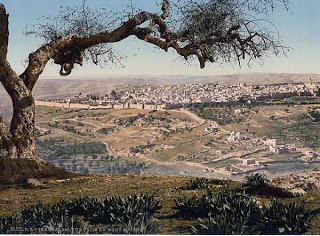
bauernfeind-mur-lamentation-jerusalem

When Muslims move into a Jewish town, poor Joe doesn’t come crying that he’s been bombed with a diplomatic affront and slapped with a Menorah. When Muslim countries fund Muslim housing in Israel, there are no angry statements from Clinton and no thesaurus bashing from David Axelrod. Muslim housing in Jerusalem or anywhere in Israel is not a problem. Only Jewish housing is. The issue is not Israel. If it were, then Arabs with Israeli citizenship would get Biden to howl as loudly. It’s only the Jews who are the problem.

The entire Peace Process is really a prolonged solution to the latest phase of the Jewish Problem. The problem, as stated by so many diplomats, is that there are Jews living in places that Muslims want. There were Jews living in Gaza before 1948, but they were driven out, they came back, and then they were driven out again by their own government in compliance with international demands. Now only Hamas lives in Gaza and it’s as peaceful and pleasant without the Jews as Nazi Germany.

But there are still Jews in the West Bank and they have to be gotten rid of. Once enough Jews have been expelled, there will be peace. That’s not a paragraph from Mein Kampf, it’s not some lunatic sermon from Palestinian Authority television– it is the consensus of the international community. This consensus states that the only reason there still isn’t peace is because enough Jews haven’t been expelled from their homes. The ethnic cleansing for peace hasn’t gone far enough.

There will be peace when all the Jews are gone. That much is certainly undeniable. Just look at Gaza or Egypt or Iraq or Afghanistan, which has a grand total of two Jews, both of them in their seventies. Or Pakistan, Saudi Arabia and Syria where peace reigns now that the Jews are gone. Some might say that violence seems to increase proportionally with the number of Muslims, but we all know that would be a racist thing to say. On the other hand suggesting that violence increases with the number of Jews living on land that Muslims want, that’s just diplomacy. A common sense fact that everyone who is anyone in foreign policy knows to be true.

How will we know when the Muslims have gotten all the land that they want? When the violence stops. Everyone knows that agreements mean nothing. No matter how many pieces of paper are signed, the bombs and rockets still keep bursting; real ones that kill people, not fake ones that upset Vice Presidents. The only way to reach an agreement is by groping blindly in the dark, handing over parcel after parcel of land, until the explosions stop or the Muslims fulfill their original goal of pushing the Jews into the sea.

That’s the wonderful thing about diplomacy if you’re a diplomat and the terrible thing about it if you are anyone else without a secure way out of the country when diplomacy fails. And diplomacy in the region always fails. Camp David and every single agreement Israel has signed with Muslim countries aren’t worth the paper they’re written on. The only peace treaty that counts is the one made by tanks and rifles. It’s the one made by Israeli planes in Egyptian skies and Israeli soldiers walking the border. It’s the one made by Jewish farmers and ranchers, tending their sheep and their fields, with rifles strung over their backs. The only peace that’s worth anything is the peace of the soldiers and settlers.

In 1966, Jerusalem was a city sundered in two, divided by barbed wire and the bullets of Muslim snipers. Diplomacy did not reunite it. Israel pursued diplomacy nearly to its bitter end until it understood that it had no choice at all but to fight. Israel did not swoop into the fight, its leaders did their best to avoid the conflict, asking the international community to intervene and stop Egypt from going to war. Read back the headlines for the last five years on Israel and Iran, and you will get a sense of the courage and determination of the Israeli leaders of the day.

When Israel went to war, its leaders did not want to liberate Jerusalem, they wanted Jordan to stay out of the war. Even when Jordan entered the war, they did not want to liberate the city. Divine Providence and Muslim hostility forced them to liberate Jerusalem and forced them to keep it. Now some of them would like to give it back, another sacrifice to the bloody deity of diplomacy whose altar flows with blood and burnt sacrifices.

As we remember Yom Yerushalayim, Jerusalem Day, it is important to remember that the city is united and free because diplomacy failed. The greatest triumph of the modern state happened only because diplomacy proved hopeless and useless in deterring Muslim genocidal ambitions. Had Israel succumbed to international pressure and had Nasser been as subtle as Sadat, then the Six-Day War would have looked like the Yom Kippur War fought with 1948 borders– and Israel very likely would not exist today.

Jerusalem-Scopus

Even as Jews remember the great triumph of Jerusalem Day, the ethnic cleansers and their accomplices are busy searching for ways to drive Jews out of Jerusalem, out of towns, villages and cities. This isn’t about the Arab residents of Jerusalem, who have repeatedly asserted that they want to remain part of Israel. It’s not about peace, which did not come from any previous round of concessions, and will not come from this one either. It’s about solving the Jewish problem.

As long as Jews allow themselves to be defined as the problem, there will be plenty of those offering solutions. And the solutions invariably involve doing something about the Jews. It only stands to reason that if Jews are the problem, then moving them or getting rid of them is the solution. The bloody god of diplomacy always assumes that they are the problem. There is less friction in defining Jews as the problem, than in defining Muslims as the problem. The numbers alone mean that is so.

Jerusalem Day is a reminder of what the real problem is and what the real solution is. Muslim occupation of Israel is the problem. The Islamization of Jerusalem is the problem. Muslim violence in support of the Muslim occupation of Israel and of everywhere else is the problem. Israel is the solution. Only when we liberate ourselves from the lies, when we stop believing that we are the problem and recognize that we are the solution. Only then will we be free of the Joe Bidens and the Peter Beinarts, the Jimmy Carters and Barack Obamas, the Gilad Atzmons and Jeremy Ben Amis. Only then will the liberation that began in 1967 be complete.

Only then will we have liberated our Jerusalem. The Jerusalem of the soul. It is incumbent on all of us to liberate that little Jerusalem within. The holy city that lives in all of us. To clean the dross off its golden gates, wash the filth from its stones and expel the invaders gnawing away at our hearts until we look proudly upon a shining city. Then to help others liberate their own Jerusalems. Only then will we truly be free.
Kerry – North Korea can have a great nuke deal like Iran if it becomes as moderate

May 17, 2015

Kerry – North Korea can have a great nuke deal like Iran if it becomes as moderate, Dan Miller’s Blog, May 17, 2015

(The views expressed in this article are mine and do not necessarily reflect those of Warsclerotic or its other editors. — DM)

North Korea played those negotiating its denuclearization for fools, much as Iran has been doing more recently with Obama. It must not have been difficult to do. To continue the process with Iran, and to repeat it with North Korea, makes no sense.

Speaking in the People’s Republic of China on May 16th, Secretary Kerry offered North Korea a nuke deal

Kerry explained that an Iran deal could help in showing North Korea how “your economy can do better, your country can do better, and you can enter into good standing with the rest of the global community by recognizing — just like Iran — that there is a verifiable, irreversible, denuclearization for weaponization, even as you can have a peaceful nuclear power program.”

Iran has not agreed to “a verifiable, irreversible, denuclearization for weaponization” and likely never will. On April 15th, Iran disputed the accuracy of the Obama Administration’s April 2nd “fact sheet,” which had made such claims about the deal. In the highly unlikely event that Iran were it to claim to do accept such terms, it would “cheat” as it has done in the past. In this video, John Bolton speaks about the “deal” with Iran as well as the North Korean connection.

Nevertheless, Iran has already received many of the rewards of essentially irreversible sanctions relief, including augmented power, both military and financial, in the Middle East.

A deal like the one Iran is about to get by virtue of the Iran scam should be welcomed by North Korea. The countries have long cooperated on nukes and missile development, a matter apparently ignored during Obama’s P5+1 “negotiations” with Iran.

Kerry also said,

the United States will continue to work with its partners “to make it absolutely clear to the DPRK that their actions, their destabilizing behavior — unlike Iran’s — is unacceptable against any international standard.” [Emphasis added.]

Iran’s destabilization efforts and successes are, in Kerry’s view, apparently not “against any international standard.” Yet Iran does far more regional destabilizing than does North Korea — North Korea mainly relies upon bellicose bluster (with infrequent military actions against South Korea). Iran — a major if not the most active sponsor of terrorism —  sends its proxies throughout the Middle East while accusing America and others of destabilization. A likely “signing bonus” of up to fifty billion dollars for Iran if and when the “deal” is finalized will substantially further Iran’s hegemonic ambitions and power as well as its missile and nuclear weapons development.

Here’s a video of Iran having some fun:

According to Hossein Salami, Deputy Commander of the Iranian Revolutionary Guard, Iran welcomes war with the United States:

This North Korean propaganda video purports to displays North Korean military prowess:

Conclusions

The rogue nations of Iran and North Korea are both intent upon maximizing their nuclear weapon capabilities. Both are totalitarian and have obscene human rights records. To trust either would be a gross mistake; yet that appears to be what Obama intends to do.

The only thing notably missing from Kerry’s offer is a requirement that North Korea abandon the Religion of Kim and adopt the glorious “Religion of Peace” instead. That would help North Korea to fit even better than at present into Obama’s policy of supporting America’s enemies and rejecting her friends. If Kim Jong-un would merely recognize Allah as the superior power, perhaps he could become the first Korean Ayatollah. Obama would probably be thrilled were North Korea to become the Democratic Islamic Republic of Korea (DIRK).

Key Iraqi town of Ramadi falls to ISIS, along with Jubbah next door to US training base

May 15, 2015

Key Iraqi town of Ramadi falls to ISIS, along with Jubbah next door to US training base, DEBKAfile, May 15, 2015

Al_RAMADI-ISIS_14.5.15ISIS rolls into Iraqi town of Ramadi

In the current situation prevailing in western Iraq, the Americans and Iraqis might as well forget about their plans for retaking Iraq’s second city, Mosul, from ISIS control,  this year.

*********************

Ramadi, the provincial capital of western Iraqi Anbar, fell to the Islamic State of Iraq and the Levant Friday, May 15 after its inhabitants were put to mass flight. The town, 110 km west of Baghdad, controls the traffic on the Euphrates River. Small pockets of Iraqi troops are still stranded there after taking hundreds of casualties.

The jihadists are in mid-momentum of a fresh multi-pronged offensive, which they launched shortly after they lost Tikrit last month to the biggest counter-offensive they had faced since seizing large tracts of land in Iraq nearly a year ago.

This momentum has carried the Islamists across Anbar province which touches the Syrian and Jordanian borders to capture another key location – Jubba, next door to Iraq’s biggest air base at Al-Ansar. There, hundreds of US officers and soldiers are training Iraqi troops to fight ISIS and helping the Iraqi army manage the fighting in the province.

Parts of this base have already come under Islamist gun and mortar fire.

Not far from Ramadi, ISIS is threatening the oil-producing town of Baiji where a small Iraqi army force of no more than a few hundred soldiers is surrounded by the jihadists, with slim chances of holding out much longer before they are wiped out or forced to surrender.

Yet another ISIS arm is pushing east towards Baghdad, with the object of disabling the international airport by bringing its runways within mortar range.

To conquer Ramadi, ISIS used bulldozers to knock gaps in the sand earthworks built by the Iraqi army to defend the town, then sending half a dozen bomb cars through the gaps to the Iraqi military command centers where they detonated.

Some of those bomb cars were driven by Muslims from West Europe, who had traveled through Syria to join up with ISIS in Iraq. The jihadists named one of them as “Abu Musa al-Britani.”

Just Thursday, May 14, the British police revealed that more than 700 potential terror suspects had traveled to Syria from the U.K. to fight or support extremists, and about half are believed to have returned, primed for terrorist operations on home ground.

In response to the British police statement, ISIS released a video recording of a message delivered by its leader Abu Bakr al-Baghdadi calling on supporters around the world to join the fight in Syria and Iraq or to “take up arms wherever they live.”

It was Baghdadi’s first message since a number of media reports said he was killed or critically injured, and was intended to refute claims that he was no longer in active charge of the group.

DEBKAfile’s counter-terror sources outline the common operational tactic, modus operandi, employed by the Islamist group in all its Iraq offensives.

After singling out a targeted location, their fighters first seize control of its environs. That way, they can block off in advance any incoming and outgoing movements of Iraqi troops – whether in retreat or for bringing up reinforcements. Next, their fighters storm into the core of the targeted location. Fleeing Iraqi soldiers and their local allies and civilians are summarily put to death.

This new ISIS impetus in Iraq has wiped out the military advantages the Iran-backed Shiite militias and US air force gained from the capture of the central Iraqi town of Tikrit in late March and early April. When the Shiie mlitias turned on the local Sunni populace for murder, burning and looting, the Obama administration turned to Tehran and Baghdad and demanded those militias be removed from the city.

Since the Iraqi army is incapable of recovering control and holding Tikrit after the Islamists were driven out, the town has sunk into anarchy with innumerable armed gangs battling each other for control of its quarters, some of them ISIS loyalists.

In the current situation prevailing in western Iraq, the Americans and Iraqis might as well forget about their plans for retaking Iraq’s second city, Mosul, from ISIS control,  this year.

Obama’s Not-So-Ironclad Guarantee

May 15, 2015

Obama’s Not-So-Ironclad Guarantee, Commentary Magazine, May 15, 2015

Now that the nuclear deal makes an Iranian bomb only a matter of when rather than if, the Gulf nations were hoping for more than just a carefully worded expression of American indifference.

***********

This was supposed to be the week when President Obama put on a show of his desire to reaffirm America’s support for its Arab allies. Saudi Arabia and the other Gulf states have spent the last year in the unusual position of agreeing more with Israel than the United States, as Obama pushes for détente with Iran. Like the Israelis, the Arabs are pondering their future in a region dominated by an Iranian nuclear threshold state that appears to be the lynchpin of the president’s foreign policy legacy. So to demonstrate his good will, Obama invited these nations to a summit at which he would convince them they had nothing to fear. But with the U.S. putting nothing on the table of substance that would allay those concerns about the weak nuclear deal being negotiated with Iran, the Saudi king and other leaders snubbed the event, turning it into a fiasco even before it began. But it turned out King Salman didn’t miss much. Though Obama offered what he called an “ironclad guarantee’ of America’s support for the Arabs, it was phrased in the kind of ambiguous language that rendered it meaningless. The meeting and especially the statement epitomized an Obama administration foreign policy that puts a premium on appeasing foes and alienating friends.

The wording of the president’s “guarantee” is a marvel of lawyerly ambiguity that any connoisseur of diplomatic doubletalk must appreciate:

In the event of such aggression or the threat of such aggression, the United States stands ready to work with our GCC partners to determine urgently what action may be appropriate, using the means at our collective disposal, including the potential use of military force, for the defense of our GCC partners.

Let’s unpack this carefully so we’re clear about what the United States isn’t promising its Arab allies. As even Obama’s cheerleaders at the New York Times noted, this “carefully worded pledge that was far less robust than the mutual defense treaty the Gulf nations had sought.” In the event of aggression, the U.S. isn’t going to spring into action to defend them. Instead it will “work” with them to “determine” what they might do. That falls quite a bit short of a hard promise of collective action, let alone the drawing of a line in the sand across which the Iranians may not cross. In other words, if something bad happens, Obama will talk with the threatened parties but he won’t say what he will do in advance or if he will do anything at all. If that is an “ironclad guarantee,” I’d hate to see what a less binding promise might sound like.

To understate the matter, this is not the sort of pledge that will deter an Iran that is emboldened by its diplomatic victory in the negotiations that let them their nuclear infrastructure and continuing working toward a bomb. Iran’s push for regional hegemony has also been boosted by the triumph of their Syrian ally Bashar Assad with the help of Tehran’s Hezbollah terrorist auxiliaries. With the Iran-backed Houthi rebels threatening to take over Yemen and Iran also resuming its alliance with Hamas in Gaza, the axis of Iranian allies has Arab states understandably worried about their future. Now that the nuclear deal makes an Iranian bomb only a matter of when rather than if, the Gulf nations were hoping for more than just a carefully worded expression of American indifference.

That’s why the statement at the end of the summit made no mention of America’s chief worry about the Gulf states: the possibility that the Saudis will, either acting alone or in concert with their neighbors, seek to match Iran’s nuclear potential. As critics of the Iran deal foretold, far from saving the Middle East from an Iranian bomb, it has set off an arms race that has will make the world a fare more dangerous place.

This omission will likely make the Iranians even more reluctant to give in to U.S. demands about sanctions, Tehran’s military research and the disposition of its stockpile of enriched uranium in the final stages of the nuclear talks. A better guarantee for the Arabs might have convinced the Islamist state that the president really meant business about strengthening the deal. In its absence, they have no reason to think Obama won’t fold as he has at every other stage of the negotiations.

Under the circumstances, it’s little wonder that Bahrain’s King Hamad preferred to go to a horse show London rather than confer with Obama. Just as Israel has learned that the United States is more interested in a new Iran-centric policy than it backing its traditional allies, so, too, must the Arabs come to grips with a new reality in which their Iranian foe is no longer restrained by the United States.